Magic Quadrant for Enterprise AI Coding Agents
20 May 2026 - ID G00841434 - 53 min read
By Philip Walsh, Keith Holloway, and 3 more
The enterprise AI coding agent market is evolving as adoption, automation and intensifying competition reshape all aspects of software engineering. Use this research to compare vendors, assess key trends and select technologies to boost developer productivity and maximize ROI from agentic workflows.
Strategic Planning Assumptions
By 2027, over 65% of engineering teams using agentic coding will treat IDEs as optional, shifting control, governance and validation to automated platforms.
By 2028, more than 70% of enterprise software engineers will rely on AI coding agents for both synchronous and asynchronous development tasks.
By 2028, asynchronous AI coding agent workflows will improve software engineering team productivity by 30% to 50%, surpassing the 0% to 20% gains from AI code assistants in 2025.
By 2028, AI coding costs will overtake the average developer’s salary due to rising LLM token consumption and increased consumption-based licensing cost.
Market Definition/Description
Gartner defines enterprise AI coding agents as autonomous or semiautonomous software engineering solutions that perceive context, translate human intent into multistep plans, and execute and verify those steps across code, tests and related engineering artifacts. Enterprise AI coding agents enable developers to prompt, steer, delegate and supervise workflows through synchronous or asynchronous modes with varying human oversight, delivered via IDEs, CLIs, cloud environments and collaboration platforms. This market focuses on solutions designed for enterprise software engineering organizations and their requirements for governance, integration and scale.
Enterprise AI coding agents are an evolution of AI code assistants. While code assistants primarily suggest code, complete snippets and answer questions in a chat interface, enterprise AI coding agents enable software engineering teams to delegate and offload a greater portion of development work through dynamic task planning and tool use.
Enterprise AI coding agents constitute the market category of tools and platforms that enable agentic coding workflows in enterprise software engineering organizations. Agentic coding is an approach to software engineering that leverages AI coding agents to move beyond interactive suggestions toward multistep planning, execution and verification. These solutions use integration protocols to connect agents with context (from repositories, CI/CD systems, agile planning tools and artifact stores), the environments where engineering work occurs (command-line consoles, IDEs and cloud platforms), and third-party tools (such as security and quality tools). This expands context awareness beyond the editor, enabling agents to retrieve relevant context, maintain task continuity and flexibly interact with organizations’ unique environments.
Enterprise AI coding agents help automate and accelerate software engineering activities such as greenfield coding, multifile changes, refactoring and modernization, test generation and remediation, dependency updates, and issue resolution. They can be configured and extended to complete this (and other) work guided by common practices and preferences, and using integration defined by the development team and environment. They iterate through a plan-act-verify loop that can run interactively or asynchronously in the background, including event-triggered workflows (for example, responding to build failures). The primary output of enterprise AI coding agent solutions is version-controlled source code and related engineering artifacts (such as tests, configuration and documentation), rather than deployed or running applications, and their operation assumes validated requirements and constraints supplied through established software engineering processes.
Key outcomes include faster delivery cycles, reduced manual effort on repetitive engineering work, improved consistency across large codebases, and greater developer focus on design, architecture and complex problem solving. At scale, this shifts cost drivers from interactive suggestions to longer-horizon execution with more retrieval, validation and model calls. This also shifts pricing from per seat toward consumption or hybrid models tied to measurable agent activity (such as task executions, premium requests, or metered compute and token usage). As adoption grows, organizations require cost governance, workload throttling and usage controls aligned with enterprise engineering practices.
Mandatory Features
- Autonomous task execution: Ability to take high-level natural language instructions and dynamically generated plans and carry them out through multistep coding workflows without continuous user guidance
- Iterative verification and self-correction: Ability to run builds, tests or other validation steps and iteratively debug or refactor generated code until defined success criteria are met
- Extensible tool and environment integration: Configurable integration with development tools and environments, including IDEs, command-line interfaces, build systems, dependency managers and CI/CD pipelines
- Advanced context awareness: Ability to automatically identify, select and manage relevant project context — including code, configuration, documentation and related artifacts — and optimize how this context is gathered, reused and maintained across coding tasks
- Support for Model Context Protocol (MCP): Native MCP support to provide a standardized way for the agent to access tools, perform actions and retrieve project context in a consistent and governed manner
- Human oversight, traceability and auditability: Built-in mechanisms for human review and approval of agent-produced changes, with detailed logs and traceability of agent actions, decisions and tool usage
- Usage analytics: Analytics and reporting that provide visibility into agent usage, activity types and impact across users and projects to support adoption management and help prove ROI
- Enterprise controls and data protection: Enterprise-grade controls including user and access management, organizational configuration of agent behavior (including mechanisms to contain or isolate agent actions), codebase indexing and exclusions, and a guarantee that base models will not be trained on customer code or documentation (except for explicitly approved fine-tuning or customization)
Optional Features
- Multiagent orchestration: Ability to coordinate multiple specialized agents or roles (such as planning, coding, testing and reviewing) in parallel within a single interface
- Event-triggered workflows: Activation of agents in response to signals such as build failures, test regressions, repository changes, ticket updates or production telemetry, with policy controls for scope and frequency
- Custom subagents: Support for creation and use of specialized subagents that operate with their own context, instructions and tool permissions, allowing the primary agent to delegate tasks to focused, task-specific agents for improved reliability and workflow organization
- Reusable workflow instructions: Support for specialized, modular instruction sets (e.g., skills-based markdown files) that define “ideal” workflows, allowing agents to adopt domain-specific expertise and follow reliable, repeatable operational patterns without manual reprompting
- Unified context orchestration: Structured knowledge base for coding agents, built through native or deep integrations to organizational enterprise systems
- Extensible plugin ecosystem: Reusable standard or customized capabilities, packaged MCP, skills, and debuggers/hooks in one plug-in and accessible through a public or private marketplace
- Spec-driven or plan-first markdown workflows: Support for structured workflows that separate intent capture, planning and execution phases within agentic coding tasks
- Documentation and artifact generation: Generation of technical documentation and related artifacts such as design descriptions, functional summaries, dependency maps or architecture diagrams
- Specialized agents for code modernization and translation: Purpose-built agents to support language translation, refactoring or modernization initiatives (for example, Java, .NET or COBOL)
- AI-assisted code review: Automated or agent-assisted review of code changes to identify defects, style issues or improvement opportunities prior to human review
- Cost management and FinOps support: Visibility and controls for managing agent-related consumption, including token usage, compute spend, quotas and budget thresholds
- Deployment flexibility: Support for multiple deployment models, including SaaS, virtual private cloud (VPC), on-premises and hybrid environments.
Magic Quadrant
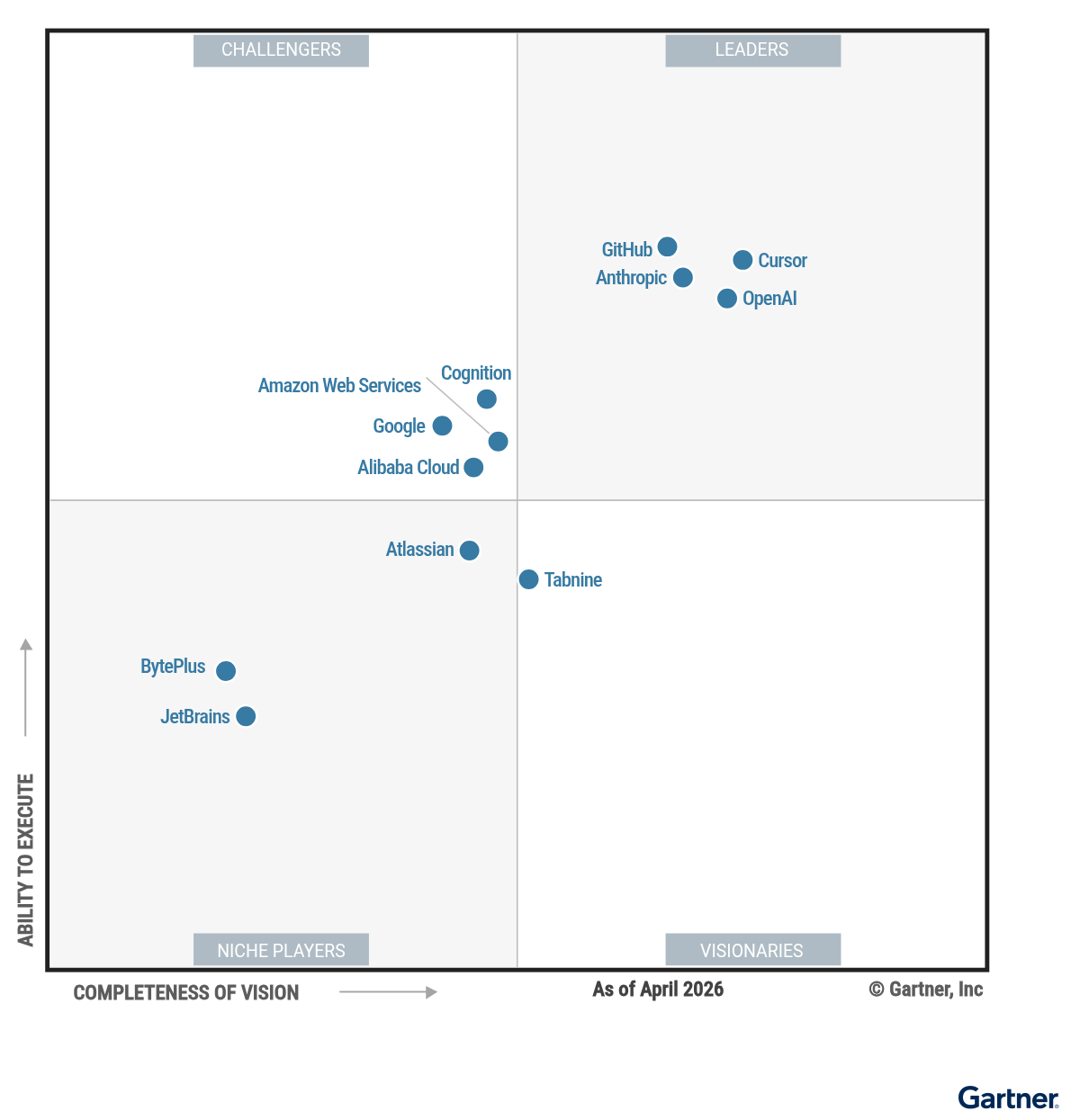
Vendor Strengths and Cautions
Alibaba Cloud
Alibaba Cloud is a Challenger in this Magic Quadrant. Its Qoder coding agent is offered through Qoder IDE, a JetBrains plug-in, a CLI, and GitHub Actions integration. Its operations are geographically diversified, with particular strength in Greater China and the Asia/Pacific region. Alibaba Cloud reports rapid growth in customer organizations and licensed usage for Qoder, with a high proportion of small business customers. Alibaba Cloud emphasizes an agent-first future built around multiagent orchestration, persistent organizational knowledge and fine-tuned models for specific industry verticals (e.g., banking), differentiating through early investments in parallel execution, platform consolidation and governance-aware AI-native development environments.
- Customer retention and overall viability: Alibaba Cloud combines strong customer retention with the scale and resources of Alibaba Group, supporting long-term product investment and customer relationships. Qoder’s user base reached 100,000 within five days of launch and has continued to grow rapidly.
- Security and deployment flexibility: Alibaba Cloud supports flexible deployment patterns for Qoder, including on-premises, hybrid cloud and isolated VPC-based environments. Alibaba Cloud has obtained more than 150 security and compliance certifications, including SOC 2, PCI DSS, HIPAA, GDPR and ISO 27001, which strengthens its appeal in highly regulated industries.
- Global scale with regional execution: Alibaba Cloud pairs international reach with differentiated regional strategies for service, support and operations. Its continued expansion of data center capacity across South America, EMEA and the Asia/Pacific region supports customers wanting to adapt the offering across diverse locations and development environments.
- Localized customer support footprint: Seventy-five percent of Alibaba Cloud’s customer support partners are in China. This focus on China limits its ability to provide consistent support for multinational rollouts outside the Asia/Pacific region.
- Current execution lags product vision: Alibaba Cloud articulates a product vision around multiagent orchestration. However, its current implementation remains less deeply orchestrated and autonomous than the multiagent capabilities of leading vendors. Alibaba Cloud has recently moved to address this gap through its Experts Mode feature, introduced after the evaluation cutoff for this Magic Quadrant.
- Pricing transparency: Qoder’s consumption model relies on “credits” rather than direct API-based metering, making it harder for customers to understand how different agentic actions translate into underlying model usage and cost.
Amazon Web Services
Amazon Web Services (AWS) is a Challenger in this Magic Quadrant. AWS offers its coding agent via Kiro AI-native IDE, Kiro CLI and agent client protocol (ACP) integration with compatible editors. AWS Transform is a separate modernization tool/agent available in Kiro as a power. AWS’ operations are geographically diversified, and adoption of Kiro has grown consistently across all global regions since its general availability launch in November 2025, supported by conversion from free to paid usage. Its product vision centers on spec-driven, autonomous agents across the SDLC, underpinned by early innovation in property-based testing and neurosymbolic reasoning.
- Market visibility and developer engagement: AWS has increased awareness of its AI coding strategy through Kiro, supported by strong launch momentum, broad developer engagement and a more visible market narrative. This strengthens AWS’ position with enterprise buyers by pairing a clearer product story with its established global reach and ecosystem.
- Enterprise-grade operations: AWS offers the operational depth, global infrastructure and service maturity expected of a hyperscaler, giving enterprise buyers confidence in its ability to support large-scale deployments with strong reliability and support coverage.
- Customer experience and enablement: AWS provides robust customer onboarding, extensive training and documentation, multiple support options, and a structured path from initial adoption to broader enterprise rollout. Its customer approach is reinforced by AWS-backed support models, partner-led enablement and a broad set of success mechanisms that help organizations operationalize the product.
- Product experience lags leaders: AWS’ offering remains less differentiated than the strongest products in the market, particularly for buyers prioritizing asynchronous agent experience. At the time of our evaluation, it lacked capabilities for running parallel agents that Leaders provide.
- Evolving pricing and packaging: Following its November 2025 launch, AWS is still refining how it handles pooled usage, mixed user populations and broader consumption flexibility. Buyers seeking predictable cost governance across different developer profiles will find AWS’ pricing model is less flexible than those of competitors.
- Opinionated workflow: Kiro is known for its opinionated, structured spec-driven development workflow that enables developers to generate specs or import existing requirements from external tools. The optional purpose-built spec mode allows for feature and app integration as well as bug fixes, but buyers should evaluate whether this approach aligns with their teams’ needs and existing ways of working.
Anthropic
Anthropic is a Leader in this Magic Quadrant. Its Claude Code offering is delivered through a CLI, native VS Code extension and JetBrains plug-ins, a proprietary desktop app, web interface, mobile app, CI/CD integration, and Agent SDK. Anthropic’s operations are geographically diversified, with strongest growth in North America. Offerings are available globally, except in Greater China. Anthropic reports rapid enterprise adoption and strong customer organization growth for Claude, although these adoption indicators reflect broader claude.ai usage rather than Claude Code alone. Anthropic’s strategy focuses on rapid model capability gains, and it differentiates through open, unopinionated agent design; early leadership in MCP; terminal-native workflows and multiagent verification.
- Rapid innovation and exceptional market resonance: Anthropic has quickly translated frontier-model momentum into one of the market’s most popular coding products. Its expansion from research-oriented model provider to market leader reflects both innovation and clear alignment with developer demand.
- Model-native innovation: Anthropic’s tight integration between its underlying models (which are continuously optimized for software engineering) and the Claude Code agent harness give it a structural advantage in how it improves performance and shapes user experience. This approach allows for innovation from the model layer upward rather than relying on orchestration of third-party models.
- Distinctive product experience: By making the CLI the primary surface and extending into IDEs, Anthropic tapped into established developer habits rather than forcing users into a prescriptive environment. This CLI-first approach also made it easier to push parallel work to back-end agents, reducing reliance on slow human-in-the-loop coordination. This product-led design has quickly driven strong adoption and developer mind share.
- Operational maturity and incident transparency: Anthropic’s pattern of service disruptions and release process failures in early 2026, along with its inconsistent postincident communication, raise concerns about its operational maturity for enterprise-critical development workflows. Organizations considering Claude Code should validate SLAs, uptime history, incident response practices and communication expectations.
- Narrow strategic focus and limited model choice: Anthropic remains concentrated on delivering a model-centric, vertically integrated product. Anthropic currently limits users to Anthropic-hosted Claude models and does not offer third-party model selection, which may be a constraint for organizations requiring multimodel environments.
- Government procurement risk: In March 2026, the U.S. Department of Defense designated Anthropic a supply chain risk and Anthropic has filed a formal appeal of this designation. This creates procurement and compliance uncertainty for defense contractors and government-adjacent buyers until the legal situation is resolved.
Atlassian
Atlassian is a Niche Player in this Magic Quadrant. Its Rovo Dev coding agent is offered through a stand-alone CLI, Atlassian web interfaces and browser extensions. Atlassian’s offerings are available globally except for Greater China, with strongest growth in EMEA and North America. The company reports early commercial traction for Rovo Dev, supported by its large Jira installed base and conversion of trial users to paid subscriptions since general availability in October 2025. Atlassian positions AI coding agents as intent-driven, multiplayer collaborators across the SDLC, leveraging its early innovations in Atlassian Teamwork Graph for deep organizational context, as well as AI-native DevEx metrics and embedded governance.
- Platform-centric offering strategy: Atlassian’s offering strategy is built around integrating Rovo Dev into Jira, Confluence, Bitbucket and the wider Atlassian platform, where enterprises already manage requirements, collaboration, planning and code workflows.
- Customer experience and value realization: Atlassian pairs developer tooling with a structured customer experience model, recently strengthened by its acquisition of DX, a developer productivity insight platform. Atlassian’s four- to six-week onboarding process and network of globally distributed, certified partners provide a clear path to demonstrating and scaling value.
- Operational maturity: Atlassian delivers a 99.95% uptime SLA for Atlassian Cloud Enterprise customers, an aggressive 30-minute Level 1 critical response target and a cloud-native delivery model supporting continuous background updates without customer disruption. Its infrastructure and operating environment are also supported by a wide range of enterprise and industry certifications.
- Limited product depth and execution maturity: Rovo Dev does not yet match the depth or execution maturity of leading AI coding agents for core application development use cases. The extensibility of Rovo Dev remains limited compared to competitors with broader plug-in ecosystems.
- Value tied to Atlassian ecosystem: Rovo Dev is geared toward organizations already standardized on Jira, Confluence or Bitbucket (although the solution is SCM-agnostic). Atlassian’s value proposition is less compelling in heterogeneous engineering environments, where organizations are seeking stand-alone or tool-agnostic coding agents.
- Market responsiveness: Atlassian’s Jira and Confluence installed base, SDLC workflow data, and enterprise relationships give it meaningful structural advantages in the AI coding agent market. However, Rovo Dev’s market momentum has not yet matched that opportunity. Atlassian remains more dependent on ecosystem-led adoption than competitors that established earlier traction with developers and platform engineering teams.
BytePlus
BytePlus is a Niche Player in this Magic Quadrant. Its TRAE coding agent is offered through the TRAE proprietary agentic IDE, plug-ins for VS Code and JetBrains IDEs, a web interface, and a CLI. Its operations are geographically diversified and its offerings are globally available, with strongest adoption in Greater China. BytePlus reports having more than 1,000 customer organizations after launching TRAE in 4Q25. The company envisions a shift from human-centric coding to intent-driven, AI-native software creation, with investments in autonomous workflows, deep repository understanding, multisurface delivery and enterprise governance controls. During the evaluation period, TRAE operated under Volcano Engine; after the evaluation cutoff, the company informed Gartner that TRAE is now operated and marketed externally under BytePlus.
- Early marketing momentum: BytePlus has quickly established relevance in a competitive market, offering the tool completely free in China while pricing its overseas packages significantly lower than global competitors.
- Operational discipline and support posture: BytePlus delivers exceptionally fast response targets for critical issues in its highest support tier. It is backed by a robust compliance posture, including SOC 1/2/3 reports, ISO certifications and defense-in-depth capabilities.
- Geographic strategy: BytePlus has driven strong adoption in Greater China and has started expanding into multiple regions. It is building out regional data centers, obtaining region-specific certifications and providing localized deployment options, offering a more balanced international posture than many emerging vendors.
- Generic market vision: BytePlus frames its vision around AI-driven, intent-based software development with agents handling implementation, but this largely reflects the market’s baseline direction. Unlike leading competitors, it has not articulated a distinct or opinionated view — such as a differentiated context engine or developer workflow model — that indicates a clearer bet on how AI agents will reshape software engineering.
- Developing global customer experience: All of BytePlus’s certified SI partners are located in China, which limits its ability to provide consistent support for multinational buyers or those outside of China.
- Maturing commercial model: BytePlus’s license models and price plans remain underdeveloped relative to more established vendors. The company has just begun to roll out tiered subscription packages and optimized licensing terms.
Cognition
Cognition is a Challenger in this Magic Quadrant. Its AI coding agent capabilities are delivered through the Windsurf AI-native IDE, comprehensive IDE plug-in coverage, the Devin cloud-based agentic environment, integrations with DevOps and messaging platforms, Windsurf CLI, and the Devin API. Cognition’s offerings are available globally except for Greater China and Central Asia, and its strongest growth is in North America. Cognition reports strong commercial momentum across enterprise customers, supported by adoption of both Windsurf and Devin and expansion within existing accounts. Cognition envisions enterprises deploying fleets of autonomous AI engineers and it differentiates through early leadership with Devin, combining persistent context, autonomous PR-level execution, enterprise security models and platform-led organizational transformation.
- Product breadth across workflows: Cognition combines Windsurf’s AI-native IDE with Devin’s autonomous engineering capabilities. It supports both developer-in-the-loop workflows and delegated execution across planning, coding, testing, debugging, code review and pull request creation. Features like DeepWiki provide deep contextual understanding and reinforce Cognition’s value.
- Fit for regulated environments: Cognition stands out for its deployment flexibility and compliance posture, supporting cloud, customer-managed, on-premises and air-gapped options. Credentials such as FedRAMP High (only for Windsurf) and other certifications strengthen its appeal in government and highly regulated sectors requiring control, isolation and auditability.
- High-touch customer enablement: Cognition provides hands-on enablement using forward-deployed engineers to operationalize complex Devin workflows. This approach is especially valuable for enterprises adopting autonomous software engineering patterns that require close guidance, workflow design and rollout support.
- Scalability of business model: Cognition has shown consistent new logo growth, but Devin’s enterprise value proposition depends on deep workflow integration, customized deployment and high-touch enablement. This can support durable expansion within strategic accounts, but may scale less efficiently than more product-led or developer-led AI coding agent offerings.
- Overall viability: The acquisition of Windsurf broadened Cognition’s portfolio, but it followed Windsurf’s CEO, co-founder and select research leaders joining Google, which also licensed Windsurf technology. Along with the company’s low free-to-paid conversion rate and stated reliance on deeper enterprise expansion over broad self-serve adoption, this raises questions about Cognition’s long-term durability.
- Pricing transparency: Cognition uses a unified ACU-based consumption model across Windsurf and Devin, giving enterprises a single mechanism to manage platform spend. However, ACUs remain an abstract consumption unit, and buyers may need time to understand how agentic workflows, task complexity, model selection and context usage translate into consumption. This can make initial budgeting and comparison with seat-based or token-based pricing models more difficult.
Cursor
Cursor is a Leader in this Magic Quadrant. Its AI coding agent is offered through its AI-native IDE, asynchronous cloud agents running in isolated VMs, a native CLI and integrations with third-party editors. Cursor’s operations are geographically diversified, with offerings available in all global regions. The company reports more than 50,000 customer organizations and millions of weekly active users. Cursor is investing heavily in long-running asynchronous cloud agents, enterprise governance, proprietary models and a broader AI-native SDLC platform that extends beyond coding into adjacent workflows.
- Category-leading product depth: Cursor offers one of the strongest products in this market, combining an AI-native IDE with agent-centric workflows that extend beyond in-editor assistance. Its support for parallel and asynchronous agent execution, codebase-aware planning and debugging, and expanding capabilities in testing and code review provide broad technical differentiation.
- Innovation across models and surfaces: Cursor continues to innovate rapidly across multiple capabilities and surfaces, combining access to state-of-the-art third-party frontier models (including Claude, GPT and Gemini models) with growing investment in its own Composer models. This flexibility gives customers broad model choice and improves cost-efficiency across desktop, CLI, cloud, web, mobile and third-party development environments.
- Enterprise sales execution: Cursor has translated product momentum into meaningful enterprise market share through effective sales strategy and rapid commercial expansion. The company has achieved significant penetration in large enterprises globally, and it continues to scale its sales organization, partner relationships and geographic reach to support growth.
- Overall viability: As a startup operating between hyperscalers and major model providers, Cursor remains exposed to margin pressure and competitive compression from larger competitors. Its long-term durability depends on continued differentiation against better-capitalized rivals.
- Enterprise customer experience: Cursor’s enterprise customer support model is still maturing. Its partner ecosystem appears stronger as an indirect sales channel than as a scaled support and delivery system, which may challenge enterprises relying on partners for implementation and ongoing life cycle assistance.
- Support operations: Cursor offers global 24/7 support but targets less than six hours for first response, which trails some market leaders. As the company continues to scale rapidly, organizations should validate support responsiveness, escalation paths and consistent service delivery.
GitHub
GitHub, a subsidiary of Microsoft, is a Leader in this Magic Quadrant. Its GitHub Copilot capabilities are offered through native VS Code integration as well as other IDE extensions, GitHub Copilot CLI, GitHub Copilot cloud agent, and web and mobile experiences integrated with the GitHub platform. Its operations are geographically diversified, serving individual developers and enterprises globally. GitHub reports more than 4.7 million licensed seats, up 75% year over year. GitHub views AI coding agents as full-life cycle collaborators embedded in team workflows, differentiating itself through deep repository context, parallel agent sessions, open extensibility and multimodel orchestration tightly integrated with the GitHub ecosystem.
- Platform-centric offering strategy: GitHub’s platform hosts multiple agents, including native coding agents, custom agents, multimodel extensibility and deep integration across IDEs, CLI, GitHub web, repositories, pull requests, CI and security workflows. This broad platform enables GitHub to govern and operationalize first-party, third-party and extensible/custom agent experiences.
- Systematic investment in developer needs: GitHub effectively embeds agentic tooling into existing developer workflows. Its steady build-out across IDE, CLI, web and workflow automation surfaces aligns with how developers want to use agents for day-to-day software development tasks.
- Overall viability: Backed by Microsoft’s financial resources and enterprise reach, GitHub has established strong viability and a global presence. It has the ability to support customer organizations of all sizes in the long term, providing comprehensive governance, compliance and administrative controls.
- Innovation: GitHub’s leadership is less clear in frontier AI coding agents than in the broader AI coding assistant market. Copilot supports configurable agents, custom workflows, tool calling and MCP-based extensions, but its advanced agentic workflows appear less productized and automated. Buyers should validate Copilot’s depth in event-driven workflows, asynchronous execution and preconfigured agent orchestration.
- Developer mind share: GitHub’s developer mind share has weakened as influential developers increasingly associate the leading edge of autonomous software engineering with other vendors. This perception gap may matter for organizations seeking to attract early adopter developers or standardize on tools viewed as setting the pace for AI-native development.
- Marketing strategy: GitHub’s messaging focuses on governance, platform control and standardization, positioning itself as a safe enterprise default rather than a vendor that is driving the market’s direction. In a market defined by rapid innovation and change, GitHub’s messaging is not resonating with customers that seek cutting-edge capabilities.
Google is a Challenger in this Magic Quadrant. Its AI coding agent capabilities are offered through Google Gemini CLI, Google Antigravity AI-native IDE, cloud and web development surfaces (Google Cloud console), and integrations with JetBrains and a wide range of additional editors. Its operations are geographically diversified, with offerings available globally except for Greater China. The company emphasizes an agent-first SDLC that bridges legacy enterprise data and modern development, supported by early innovation in large-context models, open interoperability protocols and modular CLI-based agents.
- Agent-first product vision: Google’s combination of Gemini CLI and Antigravity provides a clear agent-first product vision, offering terminal-native workflows as well as asynchronous and parallel agent execution. Antigravity pushes beyond conventional AI-native IDE patterns toward orchestrating multiagent workflows for future developer experiences.
- Broad enablement and customer reach: Google supports a sizable extension ecosystem that helps distribute new capabilities across enterprise development environments. Its expansive integrations with IDEs, cloud development surfaces, MCP-based toolchains and enterprise workflows simplify adoption in existing engineering environments.
- Operational strength: Google brings the delivery maturity, governance and operational discipline expected from a hyperscaler. It provides strong features for enterprise controls, observability, auditability, and support for large-scale asynchronous and multiagent workflows. These capabilities appeal to enterprises seeking robust administration, security guardrails and cloud-scale execution.
- Lack of product cohesion: Google is still optimizing the integration between its frontier coding models and agent harnesses. Google has yet to convert its strong first-party models into a market-leading AI coding product.
- Evolving product strategy: Google offers multiple agentic coding tools that have overlapping capabilities and varied enterprise traction. The company is still working to streamline the vision for how its AI coding agent offerings will fit together.
- Lack of vertical partner strategy: Google does not show a clearly articulated vertical partner strategy for AI coding agents. This absence may weaken its appeal in regulated or domain-specific engineering environments.
JetBrains
JetBrains is a Niche Player in this Magic Quadrant. Its AI coding agent capabilities are offered through JetBrains AI in the IntelliJ platform, JetBrains Air proprietary agentic IDE (available in preview), extensions for Android Studio and VS Code, and CLI (Junie) and JetBrains Central Console. Its offerings are globally available, with strongest growth in EMEA and North America. JetBrains reports more than 32,000 customer organizations and 324,000 paid licensed seats (out of the total JetBrains user base of more than 15 million developers). The company anticipates a shift to collaborative, governed agentic development, and differentiates itself through early adoption of model-agnostic infrastructure, deep semantic IDE context, centralized controls and an open interoperability layer for multiagent coordination.
- International reach: JetBrains has a globally distributed customer base and continued growth across regions (including Greater China), giving it a broad international presence in the AI coding agent market. Its user-facing product content and documentation are available in more than 10 languages, which helps support adoption across a diverse global user base.
- Overall viability: JetBrains benefits from a large installed base, strong customer retention, long-standing profitability and strong recognition among developers. This foundation supports its credibility as AI coding agents become more strategic to software engineering organizations.
- Monetization opportunity: JetBrain’s native integration of AI capabilities within popular IDE workflows gives it a structural advantage. The company is well-positioned to monetize AI coding features by driving adoption of its agent capabilities across its loyal user base.
- Evolving AI product strategy: JetBrains’ AI coding agent portfolio spans several overlapping products, including JetBrains Central for agent governance, JetBrains AI for multiagent IDE access, JetBrains Air as an agent-first development environment and Junie as its first-party coding agent. Their relationship and relative strategic priority remain difficult for buyers to assess, creating uncertainty about JetBrains’ primary path for agentic software development.
- Product competitiveness: JetBrains’ AI coding offering underperforms across nearly all evaluated use cases. While the vendor has outlined many agentic capabilities on its roadmap, the pace of feature delivery in this market makes it difficult to close the gap. As a result, JetBrains may continue to face challenges keeping pace with more advanced competitors
- Lack of definitive guidance: JetBrains has not offered clear direction for organizations with significant JetBrains developer populations about what tooling they should standardize on for advanced AI coding. Some customers are looking to external agents and model providers for capabilities that JetBrains could deliver inside its own ecosystem.
OpenAI
OpenAI is a Leader in this Magic Quadrant. Its OpenAI Codex capabilities are offered through the proprietary Codex app, several IDE extensions, a CLI, SDK surfaces and cloud-based orchestration. Offerings are available globally except for Greater China. OpenAI reports that Codex adoption has grown to more than 4 million weekly users. It has balanced adoption across small and midsize to large enterprises. OpenAI frames the market around enterprise-scale multiagent SDLC orchestration and long-horizon automation, with early innovations in multiagent Codex workflows, OS-level sandboxing, approval gates and reproducible automation patterns for governed autonomy.
- Model-native innovation: OpenAI tightly aligns its underlying model capabilities and the Codex agent harness, providing a structural advantage in how it improves performance and user experience. OpenAI is building Codex around a more expansive vision of chat and agent task delegation, multiagent orchestration, and end-to-end agentic workflows.
- Enterprise-grade governance and sandboxing: OpenAI pairs strong product innovation with robust enterprise controls. It delivers OS-level agent sandboxing across macOS, Linux and Windows, along with approval gates, RBAC, customizable policies and auditable controls at the global and workspace levels. These guardrails are especially relevant for regulated enterprises seeking advanced agentic capabilities without giving up operational containment and governance.
- Enterprise go-to-market strategy: OpenAI’s broad connector and partner ecosystem, flexible deployment patterns, and implementation paths help large organizations to operationalize Codex in complex environments.
- Model flexibility: Codex defaults to OpenAI’s commercial GPT models and GPT-OSS open-weight model. Organizations can configure third-party models through API keys or custom providers, but the Codex harness is primarily optimized for GPT models, and buyers should validate whether third-party model configurations provide the required level of functionality. Buyers with model portability or private deployment requirements should also assess Codex’s public cloud deployment constraints.
- Market responsiveness: OpenAI entered the coding agent market later than some first movers, despite its frontier model leadership. Although Codex has expanded across multiple surfaces since general availability, buyers should evaluate whether OpenAI’s marketplace, extension ecosystem and specific third-party integrations are mature enough for their required development workflows.
- Legal and regulatory uncertainty: OpenAI remains subject to high-profile copyright litigation, privacy-related discovery disputes and regulatory scrutiny of major AI partnerships. While OpenAI offers enterprise contractual protections and data controls, these issues create company-level legal and regulatory uncertainty that buyers should assess as part of AI vendor risk due diligence.
Tabnine
Tabnine is a Visionary in this Magic Quadrant. Its AI coding agent is offered primarily through IDE plug-ins, a CLI and a web interface, with flexible deployment across SaaS, VPC, on-premises and air-gapped settings. Tabnine’s offerings are available globally, with strongest growth in North America and EMEA. The company reports continued customer growth, with adoption concentrated among security-conscious enterprises and organizations with complex development environments. Tabnine’s vision emphasizes context as the primary differentiator for enterprise autonomy, pairing Tabnine Enterprise Context Engine with neurosymbolic verification and policy-driven governance.
- Context-engine innovation: Tabnine’s differentiated Enterprise Context Engine grounds agent behavior in enterprise code, policy and structured organizational context rather than relying only on prompt-time interaction. Tabnine’s interoperability across IDEs, repositories, tools and heterogeneous technology environments strengthens its appeal for organizations seeking alignment with internal standards and existing engineering ecosystems.
- Deployment flexibility: Tabnine supports on-premises, VPC, private cloud and air-gapped environments, making it well-suited for regulated and security-sensitive organizations that require tighter control over data residency, access and infrastructure choices.
- Product durability in enterprise-centric use cases: Tabnine continues to offer strong capabilities for code quality assurance and deep codebase understanding in large, complex environments. Its ongoing ability to support enterprise use cases maintains its credibility in the market.
- Limited market traction: Tabnine’s sales execution appears to lag market leaders, as it has not achieved the same level of broad market adoption. It has established itself among large enterprises with complex environments but has gained little traction among other customers.
- No free tier: Tabnine does not offer a free tier, which limits experimentation and developer-led adoption. This narrow funnel restricts pipeline growth to traditional B2B sales and paid trials.
- Market responsiveness: Tabnine has focused recent innovation on enterprise context, policy alignment and reliability in complex environments, rather than on more visible agentic coding capabilities. This may make Tabnine appear less responsive to buyers and developers expecting rapid advances in agent functionality, workflow automation and user experience.
Vendors Added and Dropped
We review and adjust our inclusion criteria for Magic Quadrants as markets change. As a result of these adjustments, the mix of vendors in any Magic Quadrant may change over time. A vendor's appearance in a Magic Quadrant one year and not the next does not necessarily indicate that we have changed our opinion of that vendor. It may be a reflection of a change in the market and, therefore, changed evaluation criteria, or of a change of focus by that vendor.
Added
- Anthropic
- Atlassian
- BytePlus
- OpenAI
Dropped
- Augment Code
- GitLab
- Harness
- IBM
- QodoTencent Cloud
Inclusion and Exclusion Criteria
Inclusion Criteria
To qualify for inclusion, providers must have met the following criteria effective 2 March 2026 (all general availability and market participation thresholds also must have been met by that date).
Market Participation Inclusion Criteria
To be considered a participant in the market, providers must have met all of the following criteria:
- Their offering meets Gartner’s Market Definition for enterprise AI coding agents.
- The AI coding agent and all listed mandatory features are generally available (not beta/limited access/preview) and fully supported for production use by customers as of 2 March 2026. GA means the product or service is available on a public-facing price sheet for purchase directly by clients. Vendors must be able to furnish the link to a pricing page for their AI coding agent.
- The AI coding agent must be purchasable via a public-facing price sheet and usable without dependency on the provider’s developer platform (DevOps/SRE/observability platform, etc.). Bundling in a general AI assistant plan is acceptable if the agent’s core development capabilities are usable without additional developer-platform dependencies.
- They must demonstrate a go-to-market strategy for their AI coding agent that targets coding and application development as the core product use cases and aligns with the Market Definition, including autonomous task execution, iterative verification and self-correction, and extensible integration with developer tools and environments.
- They must sell directly to paying customers without requiring professional services to purchase or run the product, and provide first-line support for all bundled capabilities (including any bundled open-source components). Support includes comprehensive product documentation, installation guidance and reference examples. English-language contract/portal, technical documentation and support are required.
Performance Inclusion Criteria
Providers must meet one of the following criteria, focused on 2025 performance and “as of” 31 December 2025 levels:
- Greater than or equal to 500 paying customer organizations (logos), excluding education, free use and trials
or
- Greater than or equal to $25 million recognized GAAP revenue from the AI coding agent in 2025, and either
- Greater than or equal to 40% year-over-year revenue growth in 2025 or
- Greater than or equal to 50 net-new paying customer organizations (logos) added in 2025.
Geographic Presence Inclusion Criteria
Providers must have 10 paying customer organizations (logos) in each of three of the following regions:
- North America
- Latin/South America
- Europe
- Middle East
- Africa
- Asia/Pacific, including Japan and China
and
- At least 15% of product revenue must come from outside the provider’s home market (home market equals the country of its legal headquarters).
Client relevance, as determined by analyst expertise and informed by public and proprietary information, is also considered.
Exclusion Criteria
Providers are excluded if any of the following apply:
- Coding agent capabilities are only accessible as part of a broader developer platform or suite (e.g., DevOps, SRE, observability) and cannot be used independently of a broader developer platform, or are only delivered as part of custom software development or professional services engagements (nonproductized deliveries)
- The offering’s primary use case is low-code/no-code development or coding assistance limited to packaged business/SaaS applications (e.g., Salesforce, Oracle, SAP, ServiceNow) rather than procode software engineering.
- The offering is part of a platform with a primary mode of interaction that is prompt-driven application creation (“vibe coding platforms”), where the system generates and manages most or all of the application structure on behalf of the user, and the core workflow abstracts users away from directly writing or manipulating source code.
- The offering’s primary functionality is code review and is not marketed as a general-purpose coding agent across development tasks.
- The offering’s primary functionality is security assessment and remediation (e.g., scanning first-party or open-source code for vulnerabilities, recommending/backporting fixes) and is not marketed as a general-purpose coding agent across development tasks.
- The offering’s primary function is documentation generation (e.g., API docs, architecture summaries, abstract syntax trees/diagrams) or code comprehension and is not marketed as a general-purpose coding agent across development tasks.
Evaluation Criteria
Ability to Execute
Product or Service: The capabilities, features and overall quality of the core goods and services that compete in and or serve the defined market. We specifically look for agentic plan-act-verify execution, integration across IDE/CLI/CI/CD with MCP where applicable, governance and traceability, analytics for usage/ROI, and deployment/model flexibility suitable for enterprises.
Overall Viability: The organization’s overall financial health, as well as the financial and practical success of the relevant business unit. This includes the likelihood that the organization can continue to offer and invest in the product, as well as the product’s position in the organization’s portfolio. We specifically look for revenue and growth health, sustained R&D capacity, and portfolio commitment to the AI coding agent offering.
Sales Execution/Pricing: The organization’s capabilities in all presales activities and the structures that support these activities. This includes deal management, pricing and negotiation, presales support, and the overall effectiveness of the sales channel. We specifically look for new logo momentum and expansion, clarity of seat/consumption/hybrid pricing, predictability for enterprise deals, and customer satisfaction with cost and negotiation.
Market Responsiveness/Record: The ability to respond, change direction, be flexible and achieve competitive success as opportunities develop, competitors act, customer needs evolve and market dynamics change. This includes the provider’s history of responsiveness to changing market demands. We specifically look for timely releases that map to customer input, ecosystem progress (e.g., MCP/plug-ins) and measurable impact from shipped updates.
Marketing Execution: The ability to deliver clear, high-quality, creative and effective messaging via publicity, promotional activity, thought leadership, social media, referrals and sales activities. This includes the organization’s ability to influence the market, promote the brand, increase awareness of products and establish a positive reputation among customers. We specifically look for demonstrated reach and engagement with developers (community, OSS, events, content) and evidence that role-specific messaging converts (e.g., developer activation and qualified enterprise demand from executive audiences).
Customer Experience: The degree to which a vendor’s products, services and programs enable customers to achieve their desired results. This includes the quality of supplier/buyer interactions, technical support or account support, as well as ancillary tools, customer support programs, availability of user groups and service-level agreements. We specifically look for rapid onboarding, effective enablement and support, and documented adoption, productivity and ROI outcomes from case studies and testimonies.
Operations: The ability of the organization to meet its goals and commitments. This includes the quality of its organizational structure, skills, experiences, programs and systems that enable the organization to operate effectively and efficiently. We specifically look for robust SLAs, controlled releases/upgrades with customer choice, regional support where applicable and a security/compliance posture fit for enterprise engineering.
Ability to Execute Evaluation Criteria
| Evaluation Criteria | Weighting |
|---|---|
Product or Service | High |
Overall Viability | Medium |
Sales Execution/Pricing | Medium |
Market Responsiveness/Record | High |
Marketing Execution | Low |
Customer Experience | High |
Operations | Medium |
Source: Gartner (May 2026)
Completeness of Vision
Market Understanding: The ability to understand customer needs and translate that understanding into products and services. Vendors with a clear vision of the market listen to and understand customer demands, and they can shape or enhance market changes with their vision. We specifically look for thought leadership on a forward-looking vision for the AI coding agent market, evidence of product-market fit and differentiation, and insight into top customer challenges and buyer priorities.
Marketing Strategy: The ability to clearly communicate differentiated messaging, both internally and externally, through social media, advertising, customer programs and positioning statements. We specifically look for programs that build sustained developer mind share and clear, differentiated messaging tailored to executives, engineering leadership and hands-on practitioners.
Sales Strategy: The ability to create a sound strategy for selling that uses the appropriate networks including direct and indirect sales, marketing, service, and communication. This includes partnerships that extend the scope and depth of a provider’s market reach, expertise, technologies, services and their customer base. We specifically look for evidence of effective sales motions (direct, partner-led and PLG-assisted), initiatives to expand across industries and geographies, and the degree to which the vendor prioritizes the AI coding agent in its portfolio and channels.
Offering (Product) Strategy: The ability to approach product development and delivery in a way that meets current and future requirements, with an emphasis on market differentiation, functionality, methodology and features. We specifically look for a clear differentiation thesis, a credible 12- to 18-month roadmap, and insight into strategic investments and product priorities to avoid commoditization and sustain innovation.
Business model: The design, logic and execution of the organization’s business proposition. We specifically look for coherent monetization (seat/consumption/hybrid), transparent edition boundaries that affect agent workflows and a PLG/enterprise mix that supports durable growth.
Vertical/industry strategy: The ability to strategically direct resources (sales, product, development), skills and products to meet the specific needs of verticals and market segments. We specifically look for tailored approaches to highly regulated industries/sectors and partnerships that drive adoption where vertical constraints matter.
Innovation: Marshaling of resources, expertise or capital for competitive advantage, investment, consolidation or defense against acquisition. We specifically look for evidence of continuous innovation, including R&D prioritization and investment, mechanisms that reliably ship advances, and a recent track record of first-to-market or early mover proof points on material techniques or capabilities.
Geographic strategy: The ability to direct resources, skills and offerings to meet the specific needs of regions outside the providers’ home region, either directly or through partners, channels and subsidiaries. We specifically look for data sovereignty compliance, residency options, certifications and clear regional availability with new customer traction.
Completeness of Vision Evaluation Criteria
| Evaluation Criteria | Weighting |
|---|---|
Market Understanding | High |
Marketing Strategy | Low |
Sales Strategy | Low |
Offering (Product) Strategy | High |
Business Model | Medium |
Vertical/Industry Strategy | Low |
Innovation | High |
Geographic Strategy | Medium |
Source: Gartner (May 2026)
Quadrant Descriptions
Leaders
Leaders in this Magic Quadrant combine strong execution with a clear ability to shape the direction of the market. These vendors stand out for differentiated product experiences, rapid innovation and broad relevance across modern software engineering workflows, including agentic execution that extends beyond in-editor assistance into planning, testing, code review and workflow automation. They also demonstrate strong market resonance with developers and enterprises, supported by viable business models, expanding ecosystems, and enterprise-grade governance, security and operational maturity. While Leaders are not identical in approach, they consistently show that they can translate technical advances into durable market influence and remain central to how organizations adopt agentic software engineering at scale.
Challengers
Challengers in this Magic Quadrant demonstrate strong operational execution, commercial strength and the ability to support enterprise adoption at scale. They often benefit from global infrastructure, customer reach, partner ecosystems and disciplined enablement models that make them credible choices for organizations prioritizing reliability, support and broad deployment readiness. Many Challengers also show promising product direction and meaningful investment in agentic capabilities. However, they are generally less convincing than Leaders in the clarity, distinctiveness or completeness of their long-term market vision. Compared with Leaders, Challengers more often appear to be refining product strategy, pricing models or differentiated product experiences, which can limit their influence on the broader direction of the market even when execution remains strong.
Visionaries
Visionaries in this Magic Quadrant are distinguished by a differentiated view of where the market is going and by technical or architectural choices that address emerging enterprise requirements in distinctive ways. These vendors often emphasize forward-looking capabilities such as richer contextual grounding, policy-aware behavior, flexible deployment models, or stronger alignment to regulated and security-sensitive environments. Their strategies can be especially compelling for organizations seeking innovation beyond mainstream patterns in the market. However, Visionaries typically lag the strongest vendors in overall market traction, scale of adoption or breadth of go-to-market execution. As a result, they may have an outsized influence on important design ideas in the market without yet demonstrating the same level of commercial momentum or broad enterprise penetration as Leaders and Challengers.
Niche Players
Niche Players in this Magic Quadrant offer meaningful strengths for specific customer contexts, often tied to an existing platform footprint, regional advantage, installed developer base or particular operational requirements. These vendors can be attractive for buyers that value ecosystem adjacency, operational maturity, localized execution or alignment with established engineering workflows. However, compared with Leaders and Challengers, Niche Players tend to show less complete product maturity in core coding agent use cases, weaker differentiation in long-term market vision or slower responsiveness to the pace of change in this market. Their offerings are therefore more likely to be compelling in defined scenarios rather than as broad market-shaping platforms. For the right customers, however, those focused strengths can still translate into real value and a pragmatic fit.
Context
Choosing an Enterprise AI Coding Agent
Selecting an enterprise AI coding tool should be treated as an operating model decision, grounded in the maturity of software engineering teams and platforms. AI code assistants and AI coding agents represent two distinct operating models. AI code assistants operate with humans in the loop, augmenting developers within existing SDLC practices and governance structures. AI coding agents execute multistep workflows with reduced human oversight and therefore amplify both strengths and weaknesses in architecture, testing and governance (see How to Choose Between AI Code Assistants and AI Coding Agents).
Enterprise AI coding agents should only be evaluated where organizations can consistently supply high-quality context; enforce nonnegotiable zero-trust controls at generation, commit and CI/CD stages; and automatically validate outputs at scale (see Gartner Maturity Model for AI-Native Software Engineering). Selecting agentic tools without these prerequisites increases rework and introduces security risk and architectural drift rather than improving productivity (see How to Successfully Scale AI Coding Agents Across the SDLC).
Measuring Productivity and ROI From AI Tools
Effective measurement of productivity and return on investment (ROI) is critical, but it must start with defining clear outcomes and credible baselines. Organizations should establish baseline metrics aligned with recognized frameworks such as DevOps Research and Assessment (DORA) metrics and the SPACE framework, supported by developer productivity insight platforms that provide visibility across the SDLC (see Magic Quadrant for Developer Productivity Insight Platforms). Organizations should also baseline key business outcomes, such as customer adoption and engagement of delivered features and customer or user satisfaction, to ensure that productivity improvements can be meaningfully anchored to value realization over time.
The impact of agentic tools should be evaluated holistically, avoiding reliance on activity- or volume-based metrics such as lines of code produced, acceptance rates or narrowly scoped task-level metrics alone, as they often fail to capture broader, system-level productivity gains. Measurement should therefore maintain a clear line of sight from productivity signals to sustained team-level outcomes, such as delivery flow, software quality, developer experience and onward to business outcomes, ensuring ROI assessments remain credible and grounded in how value is actually delivered (see A Practical Guide to Improving Developer Productivity and Use These 3 Metrics to Measure Software Engineering Agentic AI Success).
Redesigning Roles, Teams and Culture
Finally, the adoption of enterprise AI coding agents is breaking traditional software engineering role boundaries and delivery assumptions, creating misalignment between how work is executed and how teams are structured and governed (see How AI Will Transform Software Engineering Organizations, Roles and Processes). Agents automate routine tasks, but these advantages in speed can be offset by legacy roles, approval paths and human-only coordination models, which increasingly slow decision making.
Organizations must respond by deliberately redesigning roles and team structures so accountability shifts from task execution to outcome ownership. Teams must operate with greater autonomy supported by shared platform capabilities. This redesign also requires moving beyond one-dimensional career ladders and skills models, as engineers increasingly need blended engineering and product capabilities to manage agent-driven work effectively (see AI in the Software Development Life Cycle (SDLC): A Skills Review). Without this alignment, people, processes and governance become the primary bottlenecks constraining the value that AI coding agents are designed to deliver (see How to Transform Software Engineering Culture for the Agentic AI Era).
Market Overview
The market for enterprise AI coding agents has entered a new phase of expansion and competitive realignment, driven by sustained enterprise adoption, intensified vendor competition and rising monetization per developer. What began as a wave of AI-assisted code completion has rapidly evolved into a market defined by increasingly autonomous, compute-intensive agent workflows that extend well beyond the text editor. As a result, vendors are no longer competing solely on code completion quality, but also on their ability to orchestrate complex development tasks, integrate deeply across software delivery workflows and capture a growing share of enterprise software engineering spend (see Leading in Enterprise AI Coding Agents Requires More than Product Momentum).
We estimate the global market for enterprise AI coding agents at roughly $9.8 billion to $11.0 billion annualized as of April 2026. Under this lens, the market includes AI coding assistants, AI-native IDEs, terminal-based coding agents and related agentic coding products sold into enterprise software engineering workflows. Growth has accelerated materially since mid-2025 as enterprise adoption has broadened, vendors have expanded from seat-based subscriptions toward hybrid seat-plus-consumption pricing and agentic workflows have increased realized spend per paying developer. The market is led by a small number of large vendors, but a growing second and third tier of providers now contributes meaningful revenue, particularly in enterprise deployments.
Four key trends are shaping the enterprise AI coding agent market in 2026:
- Model providers move up the stack. Frontier model providers are now competing directly with the application ecosystem they once supplied, reshaping competitive dynamics between vertically integrated and model-agnostic approaches.
- Agentic workflows redefine how development work is executed. Development workflows are shifting from single-thread assistance to parallel, customizable and increasingly autonomous agentic execution.
- AI coding agents land and expand across the SDLC. Vendors are expanding beyond code generation toward broader ownership of SDLC workflows, such as code review, testing and validation.
- Rising productivity gains collide with evolving pricing models. Measured productivity gains are increasing, but evolving pricing models are changing how enterprises assess ROI and value realization.
Frontier Model Providers Competing With Their Customers
A defining dynamic in the 2026 market is the transition of frontier model providers from upstream infrastructure suppliers to direct competitors in the enterprise AI coding agent landscape. In 2025, leading foundation model vendors such as Anthropic and OpenAI primarily served as critical inputs to coding assistants and emerging agent platforms. In 2026, that boundary has eroded as model providers have launched full-featured coding agents that directly overlap with the products built on their own APIs.
This shift has introduced a structural fork in the market. Vertically integrated vendors argue that co-optimizing the model and the agent harness provides a durable advantage, enabling tighter feedback loops, faster performance gains and deeper task automation. In contrast, model-agnostic platforms contend that long-term differentiation will come from workflow design, enterprise integration, context management and flexible model choice, rather than exclusive access to any single foundation model. Increasingly, however, this distinction is blurring as some application-layer vendors invest in proprietary models of their own, seeking not only product differentiation, but also better performance economics.
Underlying this debate is an unresolved question about the future of the model layer itself. If frontier model performance continues to advance faster than complementary orchestration techniques, vertically integrated offerings may compound their advantage. However, if coding-specialized or distilled models reach “good enough” performance at substantially lower cost, the model layer may commoditize more rapidly, pushing value creation higher into workflow orchestration, tooling integration and developer experience. Notably, this dynamic now runs in both directions: Frontier model providers are building their own coding agent products, while some harness vendors are developing or adapting their own models to improve cost, speed and strategic control.
Agentic Workflow Redesign and Parallelization
Enterprise AI coding agents are no longer defined primarily by their ability to respond to single prompts or generate in-line code suggestions. The market has shifted toward agentic systems capable of planning tasks, delegating work and executing multiple activities concurrently. Leading products now emphasize orchestration features that allow developers to break work into parallel streams, supervise background execution, and selectively engage different agents or models based on task requirements.
This evolution is fundamentally changing the developer workflow. Rather than acting as an always-on autocomplete, coding agents increasingly function as collaborators that can be assigned discrete objectives, such as implementing features, refactoring modules or resolving classes of defects. The user experience challenge has likewise shifted from prompt formulation to managing concurrency, visibility and control — ensuring developers understand what agents are doing, why they are doing it and when human intervention is required.
Closely related is the growing emphasis on flexibility across execution environments. Many platforms now support seamless transitions between local development sessions and background or cloud-based agents, allowing work to continue asynchronously and scale beyond the constraints of a single developer machine. Together, these capabilities signal a move from assistance toward orchestration, with implications for how engineering teams structure work and measure output.
Expansion Beyond Code Generation Across the SDLC
As core code generation capabilities have matured, vendors are increasingly targeting adjacent development bottlenecks to expand their role within the SDLC. Code review has emerged as one of the most prominent early focus areas, reflecting its persistent impact on delivery velocity and developer throughput. AI-driven review agents are being positioned to identify defects, enforce standards and propose improvements, often as a complement to (or partial replacement for) traditional peer review processes.
Beyond review, vendors are extending agent capabilities into testing, validation and other downstream activities, including automated environment setup and UI or visual testing. While few offerings claim comprehensive end-to-end SDLC coverage today, it is becoming clear that AI coding agents are evolving into broader software delivery platforms that seek to unify fragmented workflows and reduce handoffs between disparate tools.
Vendors that successfully extend beyond code generation can increase switching costs, deepen enterprise relationships and capture a larger share of development spend. At the same time, this trajectory places them in direct competition with established SDLC tools, accelerating consolidation pressures and blurring traditional category boundaries.
Rising Productivity Gains and the New Economics of ROI
Enterprise perceptions of AI-driven productivity have improved meaningfully over the past year, even as expectations continue to mature. According to the Gartner Software Engineering Content Survey for 2026, 90% of engineering leaders now report productivity gains attributable to AI, with a net average productivity gain of 19.3%. This is a clear upward shift from earlier assessments, indicating that organizations are becoming more effective at integrating AI coding agents into day-to-day development work.
However, the enhanced productivity story is increasingly entangled with changes in pricing and cost structure. As vendors move away from flat per-seat subscriptions toward hybrid models that combine seats, shared consumption pools and usage-based charges, the cost of adoption has become more variable. Agentic workflows, background execution and parallel tasking increase token usage and compute consumption, complicating budget forecasting and ROI measurement. These pressures are also influencing vendor strategy. Some harness providers are betting that proprietary, fine-tuned or distilled models can improve response times and lower serving costs, while vertically integrated model providers may retain an economic advantage by delivering their own models into their own agent products more efficiently than downstream intermediaries.
As a result, the ROI conversation in 2026 is less about whether enterprise AI coding agents deliver value, and more about at what cost that value is realized. Enterprises that align tooling, workflows and governance are more likely to achieve sustained gains, while those that adopt agents opportunistically may see rising costs without commensurate returns. This tension between improving productivity and increasingly complex economics is now a defining feature of the market’s maturation.
The market estimate in the Market Overview section is based on Gartner analysis of proprietary vendor-reported installed base, pricing models, and enterprise adoption patterns across the Enterprise AI Coding Agents market, anchored in public disclosures from the category leaders. These include Anthropic’s statement that Claude Code exceeded $2.5 billion in run-rate revenue as of February 2026 and had more than doubled since the beginning of 2026, public reporting that Cursor exceeded $2 billion in annualized revenue in February 2026, and GitHub’s disclosure of more than 4.7 million paid Copilot subscribers as of January 2026. The estimate also reflects conservative April 2026 growth adjustments for the largest vendors and incremental contribution from additional platform and pure-play providers based on Gartner analysis of proprietary vendor data and public disclosures. Range reflects the enterprise-focused category definition and the rapidly expanding monetization of agentic coding workflows.
Gartner Software Engineering Content Survey for 2026. This survey was conducted to provide a comprehensive understanding of the current landscape in software engineering, as well as to determine the priorities and strategic challenges of software engineering leaders. It also aims to identify the demand for various roles and skills within software engineering organizations, and assess their budget expectations, team structures and organizational outcomes. Finally, it explores the integration of AI in software engineering workflows and its impact on engineering organizations. The survey was conducted online from August through November 2025 among 482 respondents from the U.S. (n = 360) and U.K. (n = 122). Qualifying organizations operated in multiple industries and reported enterprisewide revenue for fiscal year 2024 of at least $250 million or equivalent. Qualified participants were highly involved in managing software engineering/application development teams and the activities they perform. Disclaimer: The results of this survey do not represent global findings or the market as a whole, but reflect the sentiments of the respondents and companies surveyed.
Ability to Execute
Product/Service: Core goods and services offered by the vendor for the defined market. This includes current product/service capabilities, quality, feature sets, skills and so on, whether offered natively or through OEM agreements/partnerships as defined in the market definition and detailed in the subcriteria.
Overall Viability: Viability includes an assessment of the overall organization's financial health, the financial and practical success of the business unit, and the likelihood that the individual business unit will continue investing in the product, will continue offering the product and will advance the state of the art within the organization's portfolio of products.
Sales Execution/Pricing: The vendor's capabilities in all presales activities and the structure that supports them. This includes deal management, pricing and negotiation, presales support, and the overall effectiveness of the sales channel.
Market Responsiveness/Record: Ability to respond, change direction, be flexible and achieve competitive success as opportunities develop, competitors act, customer needs evolve and market dynamics change. This criterion also considers the vendor's history of responsiveness.
Marketing Execution: The clarity, quality, creativity and efficacy of programs designed to deliver the organization's message to influence the market, promote the brand and business, increase awareness of the products, and establish a positive identification with the product/brand and organization in the minds of buyers. This "mind share" can be driven by a combination of publicity, promotional initiatives, thought leadership, word of mouth and sales activities.
Customer Experience: Relationships, products and services/programs that enable clients to be successful with the products evaluated. Specifically, this includes the ways customers receive technical support or account support. This can also include ancillary tools, customer support programs (and the quality thereof), availability of user groups, service-level agreements and so on.
Operations: The ability of the organization to meet its goals and commitments. Factors include the quality of the organizational structure, including skills, experiences, programs, systems and other vehicles that enable the organization to operate effectively and efficiently on an ongoing basis.
Completeness of Vision
Market Understanding: Ability of the vendor to understand buyers' wants and needs and to translate those into products and services. Vendors that show the highest degree of vision listen to and understand buyers' wants and needs, and can shape or enhance those with their added vision.
Marketing Strategy: A clear, differentiated set of messages consistently communicated throughout the organization and externalized through the website, advertising, customer programs and positioning statements.
Sales Strategy: The strategy for selling products that uses the appropriate network of direct and indirect sales, marketing, service, and communication affiliates that extend the scope and depth of market reach, skills, expertise, technologies, services and the customer base.
Offering (Product) Strategy: The vendor's approach to product development and delivery that emphasizes differentiation, functionality, methodology and feature sets as they map to current and future requirements.
Business Model: The soundness and logic of the vendor's underlying business proposition.
Vertical/Industry Strategy: The vendor's strategy to direct resources, skills and offerings to meet the specific needs of individual market segments, including vertical markets.
Innovation: Direct, related, complementary and synergistic layouts of resources, expertise or capital for investment, consolidation, defensive or pre-emptive purposes.
Geographic Strategy: The vendor's strategy to direct resources, skills and offerings to meet the specific needs of geographies outside the "home" or native geography, either directly or through partners, channels and subsidiaries as appropriate for that geography and market.