Hype Cycle for Enterprise Architecture, 2026
18 May 2026 - ID G00846817 - 119 min read
By Gilbert van der Heiden, Andrei Razvan Sachelarescu
The CIO’s focus on productivity, growth and AI-led transformation compels heads of EA to align their strategies accordingly. This research will help guide teams to assess business and technology trends to drive productivity within and beyond EA, enhance performance, and orchestrate transformation with AI.
Analysis
What You Need to Know
Respondents to the 2026 Gartner CIO and Technology Executive Survey reported that their CEOs consider improving efficiency and productivity-related digital initiatives as most critical for internal-facing systems. Customer experience for externally facing systems was regarded as the most critical digital initiative. However, the survey also indicates that exceeding targets for these outcomes is difficult, especially for digital initiatives aimed at growing revenue from existing customers, acquiring new customers, improving asset utilization and reducing costs.
To meet these aggressive goals, executives expect AI to transition rapidly from pilots to full-scale integration across all products and services in 2026. The shift is fueled by geopolitical and economic pressures driving organizations to prioritize emerging technology investments for competitive parity and differentiation. At the same time, organizations are increasingly investing in technological sovereignty, specifically by reducing reliance on global vendors in favor of secure, regionally owned stacks.
As AI becomes ubiquitous across every layer of the enterprise, from front-office client interactions and autonomous business capabilities to back-office infrastructure and physical IT and business systems, it is driving a pace of product evolution necessary to remain competitive. However, while the long-term transformative power of AI is clear, the near-term challenges of governing and scaling its rollout are significant.
Rapid change also leads to more agile and dynamic reprioritization of budgets and funding. Rather than relying on yearly cycles, business and technology strategies and roadmaps must increasingly be agile in response to observed market and technology changes and shifts. This demands greater flexibility in business and operating models — customers, value propositions and financial models may all change, as well as the necessary business capabilities. As these capabilities evolve, resources, governance and value streams must also adapt, and at a much faster pace.
All of these changes and targets must be managed. Setting the right priorities is paramount, and not just for the executives. Since heads of enterprise architecture (EA) typically still report to the CIO, they will have to align their priorities to the targets of the CIO.
For 2026, Gartner identifies three priorities the head of EA:
- Lead AI-driven business and technology transformation: According to the 2025 Gartner Heads of Enterprise Architecture Signature Survey, 65% of heads of EA see an increased pressure on the EA function to integrate AI into the technology portfolio. Successful AI-based transformation, however, requires proper design and planning of an AI-driven business future and agentic systems, identifying enterprise gaps in AI capabilities and data foundations, selecting the right AI and agentic use cases, and creating the roadmap. Heads of EA then need to orchestrate the realization of the roadmap, enabling the piloting of these technologies, designing agentic AI systems, and ultimately governing and scaling AI architectures. For more details, see 2026 Heads of Enterprise Architecture Priority: Lead AI-Driven Business and Technology Transformation.
- Capitalize on disruption with emerging technologies: Already 70% of heads of EA indicate that, due to EA’s effort, technology innovation has increased, yet only 36% find themselves extremely effective at identifying and assessing trends and disruptions and use it to trigger architectural changes. Heads of EA must assess the strategic need for emerging technologies, identify and prioritize critical bets, and determine the viability of providers and services. They must also drive alignment on these technology bets, facilitate experiments, redesign the architecture to scale them and govern their overall value. For more details, see 2026 Heads of Enterprise Architecture Priority: Capitalize on Disruption With Emerging Technologies.
- Reinvent EA to meet the speed of business and technology change: Heads of EA expect 30% of EA activities to be AI-augmented by 2027, citing needs to reskill and retool for success, according to the 2025 Gartner Heads of Enterprise Architecture Signature Survey. Heads of EA must constantly understand enterprise strategy and ambition, determine future scenarios for EA, and transform the EA operating model. Success requires modernizing EA products and services, empowering architecture thinking across the enterprise, scaling EA capacity and insight, and enabling rapid business adaptation. For more details, see 2026 Heads of Enterprise Architecture Priority: Reinvent EA to Meet the Speed of Business and Technology Change.
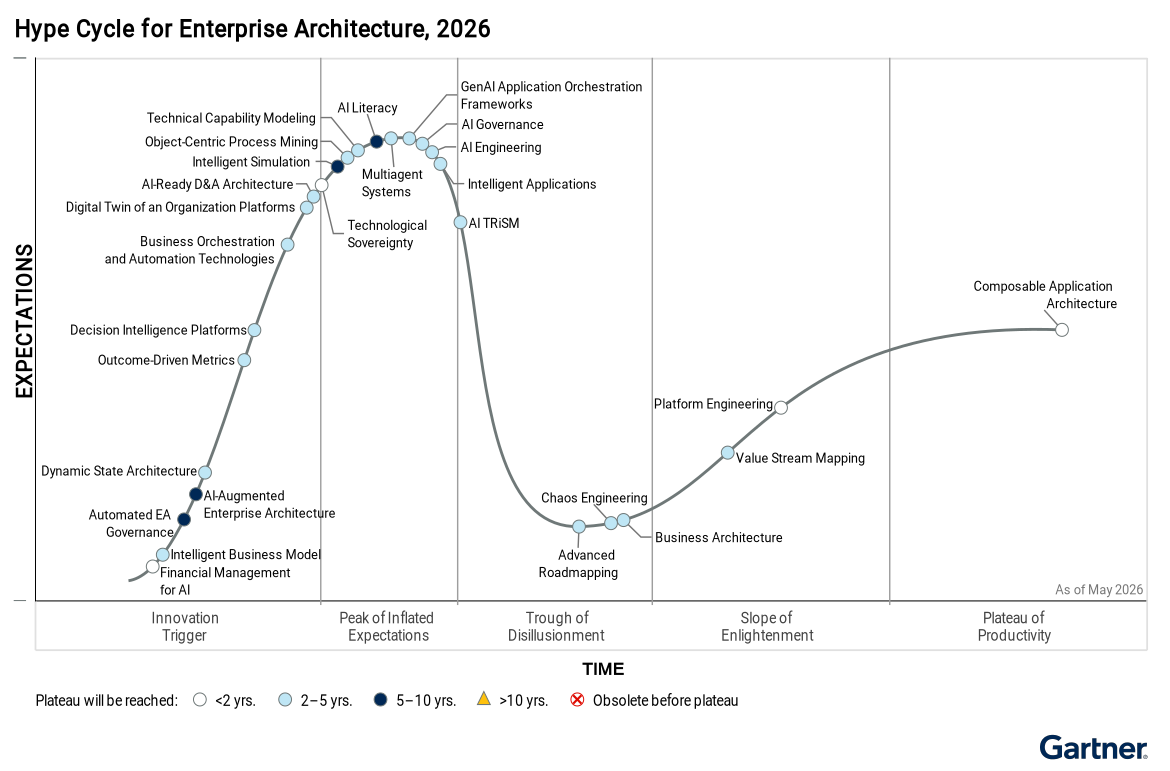
The Hype Cycle
This year’s EA Hype Cycle is organized around three primary themes that align directly with the 2026 priorities for heads of EA are all equally important.
Lead AI-Driven Business and Technology Transformation
This group of innovations focuses on scaling, governing and extracting value from artificial intelligence to establish an AI-driven future. Heads of EA are tasked with identifying enterprise gaps in AI capabilities and managing the complex foundations required for AI implementations. To do this, they must prepare the data ecosystem (AI-ready D&A architecture) and put robust guardrails in place to manage the nondeterministic behaviors, unique costs and risks associated with AI (AI TRiSM, AI governance and financial management for AI). Furthermore, technologies like multiagent systems, GenAI application orchestration frameworks and intelligent applications enable the deployment of advanced, agentic AI systems.
Collectively, these profiles equip the head of EA to lead safe, scalable and cost-effective AI transformations across the enterprise:
- AI engineering
- AI governance
- AI literacy
- AI-ready D&A architecture
- AI TRiSM
- Financial management for AI
- GenAI application orchestration frameworks
- Intelligent applications
- Intelligent business model
- Multiagent systems
Capitalize on Disruption With Emerging Technologies
To capitalize on disruption, heads of EA must assess the strategic need for emerging technologies and drive alignment on bets that provide deep organizational agility and strategic optionality. This theme encompasses innovations that map, visualize and orchestrate complex, interdependent business operations to identify performance bottlenecks and integration opportunities (object-centric process mining, digital twin of an organization, business orchestration and automation technologies, and decision intelligence platforms). It also includes intelligent simulation, which unites digital twins, GenAI and advanced analytics to model complex physical or digital process systems, delivering dynamic “what if” scenarios that give organizations a significant business advantage during disruptive shifts. Foundational architecture patterns (platform engineering and composite applications) allow for the rapid reconfiguration of business capabilities.
Finally, the inclusion of technological sovereignty ensures that as organizations adopt these disruptive technologies, they maintain control and continuity in a volatile geopolitical landscape:
- Business orchestration and automation technologies
- Composite applications
- Decision intelligence platforms
- Digital twin of an organization
- Intelligent simulation
- Object-centric process mining
- Platform engineering
- Technological sovereignty
Reinvent EA to Meet the Speed of Business and Technology Change
EA must move away from static, monolithic deliverables toward agile, automated and continuous guidance. This theme groups the practices and technologies necessary to modernize EA capabilities. AI-driven capabilities (AI-augmented enterprise architecture and automated EA governance) alleviate the manual burden of documentation and compliance checking. Meanwhile, modern mapping, solutioning and tracking capabilities (advanced roadmapping, dynamic state architecture, value stream mapping, business architecture and technical capability modeling) allow EA to dynamically adjust architectures in real time, guiding the realization of intelligent business models. It also features chaos engineering to realize solutions that are “resilient by design,” designed and tested against potential major disruptions (the “chaos”), such as rapid operational changes due to AI agent unpredictability.
Outcome-driven metrics help explicitly tie these modernized EA capabilities to measurable business outcomes, proving the function’s value to the C-suite:
- Advanced roadmapping
- AI-augmented enterprise architecture
- Automated EA governance
- Business architecture
- Chaos engineering
- Dynamic state architecture
- Intelligent business model
- Outcome-driven metrics
- Technical capability modeling
- Value stream mapping
Movement Along the Hype Cycle
There are significant movements across the 2026 Hype Cycle that directly reflect how the market is aligning to the new head of EA priorities:
- Leading AI-driven transformation: Innovations governing and operationalizing AI are moving fast. AI governance remains at the Peak of Inflated Expectations, reflecting the urgent board-level mandates to manage AI risks. GenAI application orchestration frameworks and intelligent applications have started to slide into the Trough of Disillusionment, signaling the reality checks and integration challenges organizations face when scaling these technologies. A massive influx of AI-centric new entrants in this Hype Cycle (e.g., multiagent systems, AI engineering, AI TRiSM, financial management for AI) demonstrate the market and EA’s shift from piloting GenAI solutions to industrialized, agentic and financially viable AI realization.
- Capitalizing on disruption: Technologies that enable continuous operational tracking and orchestration, such as business orchestration and automation technologies, are progressing rapidly. Emerging entrants driving this agility, like object-centric process mining, digital twin of an organization, decision intelligence platforms and intelligent simulation, are gaining traction, providing the situational awareness and what-if modeling needed to adapt to complex market disruptions.
- Reinventing EA: Established practices essential for reinventing EA and demonstrating value, such as business architecture, value stream mapping and advanced roadmapping, continue to mature, moving out of the Trough of Disillusionment and up the Slope of Enlightenment. To keep pace with the speed of business, emerging trends like automated EA governance and AI-augmented enterprise architecture are moving along the Innovation Trigger, reflecting EA’s critical shift toward using AI to augment its own capabilities. Furthermore, chaos engineering is emerging as a critical practice to test and ensure system reliability amid this accelerated speed and complexity.
The changes from the 2025 Hype Cycle are listed below.
New entrants: The following innovations have been added this year to the EA Hype Cycle:
- AI engineering
- AI-ready D&A architecture
- AI TRiSM
- Chaos engineering
- Decision intelligence platforms
- Digital twin of an organization
- Dynamic state architecture
- Financial management for AI
- Intelligent applications
- Intelligent business model
- Intelligent simulation
- Multiagent systems
- Object-centric process mining
- Outcome-driven metrics
- Technological sovereignty
The Priority Matrix
The Priority Matrix shows that many transformational and high-benefit technologies are clustered in the two- to five-year and the five- to 10-year time frames before mainstream adoption. The speed to mainstream adoption underscores the challenges that heads of EA face in evolving their playbook to support AI, capitalize on emerging technologies and meet the speed of business change:
- Less than two years: Platform engineering remains the core innovation expected to reach maturity within two years, continuing to foster the reuse of capabilities and adaptiveness to multiple stakeholders’ technology needs.
- Two to five years: Key innovations expected to plateau in two to five years are critical for enabling the 2026 priorities. For leading AI-driven transformation, this includes high-impact trends like multiagent systems (which has a transformational benefit rating), AI governance, GenAI application orchestration frameworks and AI literacy. For capitalizing on disruption, high-benefit innovations like decision intelligence platforms will reach maturity. For reinventing EA, established but evolving practices like business architecture, value stream mapping, advanced roadmapping and the newly added outcome-driven metrics will reach productivity, giving EA leaders the tools to immediately demonstrate strategic impact.
- Five to 10 years: Longer-term investments are required to truly realize a dynamic state architecture, achieve full technological sovereignty and reach the end-state vision of intelligent simulation. Transformational and high-benefit innovations such as AI-augmented enterprise architecture, automated EA governance, and business orchestration and automation technologies reside in this horizon. Chaos engineering will also mature in this horizon as organizations build feedback loops for continuous resilience improvements against complex attacks and AI failures.
Priority Matrix for Enterprise Architecture, 2026
| Benefit | Years to Mainstream Adoption | |||
|---|---|---|---|---|
| Less Than 2 Years | 2 to 5 Years | 5 to 10 Years | More Than 10 Years | |
Transformational | ||||
High | ||||
Moderate | ||||
Low | ||||
Source: Gartner (May 2026)
Off the Hype Cycle
We continue to refine the Hype Cycle for Enterprise Architecture each year. The following innovations were eliminated this year because, while they remain valid trends, they have been superseded by concepts that more tightly align with the 2026 EA priorities (AI-driven transformation, emerging tech disruption and EA reinvention):
- Organizational resilience: Refocused into chaos engineering, dynamic state architecture and technological sovereignty to provide more actionable and technology-driven resilience.
- Exposure evaluation: Replaced by more specific attention to technological sovereignty.
- AI reference architecture: Focus has shifted toward AI engineering and AI TRiSM for operational execution.
- Data and analytics architecture: Replaced with AI-ready D&A architecture to reflect the overarching priority of AI-driven transformation.
- AI agents and generative AI: Subsumed by the broader and more impactful trends of multiagent systems and GenAI application orchestration frameworks.
- Managed innovation and minimum viable architecture: Attention has shifted to dynamic state architecture and intelligent business model design, which better address continuous, rapid change.
- Architecture decision making outside IT: Subsumed by intelligent applications and decision intelligence platforms.
- Digital adoption patterns: Focus has moved to digital twin of the organization, intelligent simulation and object-centric process mining.
- Communities of practice: Replaced by more specialized operational focuses like AI engineering.
- Product architecture: Subsumed by the need for continuous agility found in dynamic state architecture.
On the Rise
Financial Management for AI
Analysis By: Andrei Razvan Sachelarescu
Benefit Rating: Transformational
Market Penetration: Less than 1% of target audience
Maturity: Embryonic
Definition:
Financial management for AI is a discipline focused on assessing cost versus value and providing guardrails and mechanisms to mitigate the risk or reduce the impact of AI investment outpacing AI value. Unlike predictable software, AI requires continuous monitoring and dedicated tracking mechanisms to manage its unpredictable behavior for the cost, value and risks per successful outcome to prevent value erosion.
Why This Is Important
Traditional IT financial management is designed for deterministic systems and fails when applied to AI’s volatile, probabilistic nature. AI introduces highly variable token costs and unique risks that traditional methods can’t track, leading to an expectation gap where AI implementation and foremost operation costs exceed realized benefits.
Business Impact
Financial management for AI is critical for heads of enterprise architecture, CIOs, CFOs and business leaders across all industries adopting AI. By continuously synthesizing raw AI telemetry data into executive-grade metrics like the portfolio value multiple (see Tool: AI-Specific Financial Management Life Cycle Tracker), organizations can reliably communicate AI’s return on investment to the C-suite. It reduces the risks of unpredictable spending spikes and runaway costs, enabling confident decisions on whether to scale, retun or decommission AI solutions.
Drivers
- The rapid deployment of AI leads to unpredictable cost, risk and value structures that traditional IT financial management was not designed to handle.
- There is a sharp disconnect between executive expectations and reality: The Gartner Board of Directors Survey 2026 shows that 91% of surveyed board members view AI as an opportunity to drive shareholder value, whereas the 2025 Gartner AI Survey — CIO and Technology Leader View paints a very different picture, with 74% of CIOs reporting that their implementation costs currently break even or outweigh realized benefits from AI.
- AI introduces variable and unpredictable cost models, such as volatile token consumption as a consequence of inefficient or lack of prompt engineering as well as unpredictable reasoning loops, which cause unprecedented spending spikes compared to predictable compute usage.
- Organizations are increasingly impacted by hidden AI expenses, such as data readiness, the need for synthetic data, rapid expansion of LLMs, model decay and continuous context memory optimization, which frequently exceed basic infrastructure costs.
- Static approval queues are proving completely ineffective for governing AI, driving the need for automated, real-time alerts embedded directly into architectures that trigger cost and value management actions.
Obstacles
- The highly unpredictable behavior of AI solutions and the ever lurking risk of reliability degradation that ensues from chaining AI agents or AI capabilities together require real-time tracking and assessment of cost versus value versus risk that can be cost-prohibitive in terms of implementation and the skills required for many organizations.
- Enforcing financial governance for AI requires CFO accountability and finance team responsibility to implement and maintain. Nonadherence and increased shadow AI spending can be expected without executive accountability and finance team collaboration with business and IT product and delivery teams.
- Implementing financial management for AI demands a cultural shift to form a multicompetence center of excellence (COE) consisting of enterprise architecture, finance and data/AI experts.
- Without granular tagging of AI solutions to track AI workloads by project and capability, organizations risk missing hidden costs during prioritization and failing to detect value drift during runtime.
- Translating raw technical telemetry data into C-suite validatable metrics like hard savings and AI-yield debt status requires complex hybrid total cost of ownership (TCO) modeling.
- Current financial management tooling in the market doesn’t fully support the application of financial management for AI, so organizations will need to combine multiple tools to be able to capture and track the associated financial metrics across the full AI life cycle.
User Recommendations
- Establish an AI-specific financial management COE by partnering with finance and AI experts to track investments from initial ideation to production.
- Register all AI initiatives in a dedicated repository. No registration implies no funding, no integration nor access to corporate data and applications, and no support.
- Mandate specific, testable value hypotheses rather than generic productivity claims, requiring concrete leading indicators before approving any AI budget.
- Apply the unique AI-specific financial management best practices that leverage traditional IT financial management metrics like ROI, NPV, TCO and sensitivity analysis but, at a granular level, provide new types of metrics such as value drift, AI-yield debt, portfolio value multiplier, etc.
- Embed automated governance guardrails directly into the AI architecture designed to trigger alerts or block actions to proactively prevent value drift.
- Continuously monitor for value drift during runtime to ensure operating costs do not exceed generated value, triggering automated life cycle reviews to retune or retire underperforming models.
Sample Vendors
Airia; Amnic; Cast AI; CloudBolt; Cloudgov; Exostellar; Finout; Flexera; IBM
Gartner Recommended Reading
Intelligent Business Model
Analysis By: Lucas Kobat
Benefit Rating: Transformational
Market Penetration: 5% to 20% of target audience
Maturity: Adolescent
Definition:
An intelligent business model is an organizational blueprint where the four components of a business model — value proposition, customer base, financials, and business capabilities — are designed from the ground up to leverage AI, data analytics, and autonomous agents, all guided by human judgment.
Why This Is Important
Enterprise architecture’s impact is stalling, while AI is reshaping value creation. CEOs acknowledge that current business models are unfit for AI, spurring a need to redesign business models for the AI era. For heads of enterprise architecture (EA) to enable this transformation, they must pivot from traditional EA practices to intelligent business design (IBD). Intelligent business design enables the rearchitecting of value propositions, customer experiences, and revenue models by combining AI, autonomous agents, data, and human judgment.
Business Impact
Enterprises that adopt intelligent business models will accelerate innovation, improve customer outcomes, and unlock new revenue streams. EA’s role elevates from technical stewardship to strategic innovation, aligning AI investments with measurable business value and enabling pervasive agentic operations across processes, products, and services.
Drivers
- Business models are not built for AI. CEOs view AI as essential to competitiveness, yet most acknowledge their current models cannot support it, creating urgency for AI-native business model redesign.
- Agentic AI investment is accelerating. CIOs plan rapid deployment of autonomous and semiautonomous agents, requiring an architectural shift to event-driven, data-centric, policy-governed platforms that embed agents across operations.
- AI democratization is reshaping customer expectations. Customers demand hyperpersonalization, instant service, and frictionless experiences. Delivering AI-native journeys and products requires foundational changes to business and operating models.
- Real-time operational intelligence is becoming standard. Richer data estates, intelligent processes, and digital twins make it possible to industrialize AI outcomes at scale, enabling the realization of dynamic-state architectures.
- EA’s traditional mandate is losing relevance. Underused EA deliverables push the function to shift toward co-designing value propositions, growth hypotheses, and operating architectures with business leaders, positioning EA as an innovation catalyst.
- The next wave of operating model transformations is here. Operating-model transformation is underway, with human readiness lagging. Success requires new roles, decision rights, and risk controls.
- AI sovereignty and lock-in risk concerns are rising. AI governance, security, data privacy, and model risk management require intentional design. Architectures that encode policy, observability, and auditability by default lower adoption friction and protect brand trust.
- Designing for dynamic architectures is now mandatory. Composable platforms, vector databases, real-time streaming, and foundation models make agentic architectures viable if EA defines the reference model and adoption roadmap.
Obstacles
- Legacy-centric mindsets: Teams default to documenting current state rather than designing future value.
- Siloed ownership: Disconnected business, IT, and corporate functions delay decisions and dilute outcomes.
- Governance bottlenecks: Risk, security, and compliance processes not tailored for AI slow time to value.
- Skills gaps: Limited expertise in AI product management, agentic design, and data governance creates a learning curve that will need to be overcome quickly.
- Tool/platform fragmentation: Point solutions without a unifying reference architecture impede scale.
- Measurement challenges: Lack of KPIs linking AI to growth, margin, and customer outcomes undermines sponsorship.
- Change fatigue: Competing transformations reduce capacity for operating-model shifts.
User Recommendations
- Stand up intelligent business design: Set up the four core services of IBD, including value proposition redesign, human-machine journey enablement, autonomous finance, and intelligent capability analysis. These services should be delivered by EA-led, cross-functional teams.
- Publish an agentic reference architecture: Pilot dynamic-state changes to architectures using patterns for agent orchestration, policy guardrails, data contracts, observability, and human-in-the-loop controls; include a capability map for intelligent operations and assets.
- Operationalize AI readiness: Prioritize a portfolio of AI use cases tied to strategic outcomes; build a rapid prototyping “garage” to iterate on models, agents, and experiences.
- Enable human readiness: Define roles, skills, and decision rights; establish AI governance that accelerates, rather than blocks, delivery.
- Measure what matters: Instead of lagging analyses based on static deliverables, use digital twin and process intelligence tools to gather real-time operational data to view the performance of intelligent business models.
Gartner Recommended Reading
Automated EA Governance
Analysis By: Philip Allega, Marcus Blosch
Benefit Rating: High
Market Penetration: 1% to 5% of target audience
Maturity: Emerging
Definition:
Enterprise architecture (EA) governance guides decisions, establishing processes, policies and procedures for investments aligned with business strategy. Automated EA governance automatically provisions EA guidance, facilitates EA assurance, and analyzes and predicts EA governance impact through toolchaining.
Why This Is Important
Manual enterprise architecture governance is too slow for today’s digital pace. By integrating observability, ITOM, ITSM and SPM with agentic AI into EA tools, organizations eliminate human error and ensure real-time alignment. This shift moves EA from reactive policing to proactive guidance, predicting the impact of changes before they occur. Ultimately, automation allows the EA function to scale, reducing the need to embed personnel into every delivery effort.
Business Impact
Adoption shifts EA from a “bottleneck” to an “accelerator.” Just-in-time data-driven insight of change reduces the need for design authority and review board bureaucracy. Dynamic impact analysis minimizes postproject rework, providing near-real-time support to the state of change and its predicted impact upon business outcomes. This allows for EA resources to support legacy management and innovation, beyond delivery efforts within the IT estate.
Drivers
As of 2025 Gartner has found the maturity of EA to deliver governance as 2.2, on a scale where 5 is best (see Infographic: Benchmark Data From the IT Score for Enterprise Architecture (2025). Several factors are propelling the growth of this niche market toward broader adoption in 2026:
- Complexity of hybrid environments: The explosion of SaaS, cloud-native apps and microservices makes manual inventory impossible. Organizations need EA tools to keep data fresh via automated integrations.
- The AI surge: The integration of AI/ML into EA tools allows for predictive modeling and streamlined operations. Companies are no longer just looking at what exists today, but using automation to forecast how shifting one variable ripples across the entire ecosystem.
- Speed of change: Agile and DevOps methodologies demand that governance happens at the “speed of code.” Waiting for a monthly architecture review board is no longer viable.
- Consolidation and maturity: EA tool providers are maturing their offerings, moving from simple diagramming to sophisticated, data-driven governance engines that appeal to C-suite executives concerned with risk.
- Regulatory pressure: Regulations such as GDPR, SOX and industry-specific mandates intensify the need for auditable, traceable compliance. Automated controls and real-time reporting ensure continuous adherence, reducing audit penalties and reputational damage.
- Cost optimization: Tightening budgets means that heads of EA must continue to meet growing demand without additional headcount, making automated EA governance more attractive to have a greater impact without additional staff.
Obstacles
Despite its promise, several hurdles remain:
- Data quality: Automation depends on the underlying data. If source systems (ITOM, ITSM and SPM) are unreliable, the “automated” guidance will be fundamentally flawed.
- Agentic AI maturity: Autonomous governance requires a robust multiagent system orchestrated across the toolchain. Current maturity is too low to build a consistently reliable, integrated ecosystem.
- Cultural resistance: EA teams may fear automation replaces their strategic value, while others may view automated, code-driven governance as intrusive or overreaching.
- Vendor fragmentation: Many tools still operate in silos. Achieving the required “toolchaining” often demands significant engineering effort to overcome lack of interoperability.
- High initial cost: Establishing automated workflows requires heavy upfront investment in licenses and process redesign. Proving tangible value beyond basic compliance can make funding approvals difficult.
User Recommendations
Focus on these strategic pillars:
- Secure executive sponsorship: Maintain buy-in by demonstrating cost avoidance and the value of just-in-time change assessments.
- Audit the data foundation: Automation fails without reliable, high-quality inputs; ensure all data sources are healthy.
- Evaluate tooling fit: Prioritize vendors with proven connectors to your ITSM and cloud stacks to reduce friction.
- Establish foundations: Categorize principles and architectures from “mandatory” to “prohibited,” enabling automated compliance.
- Build the toolchain: Integrate EA tools into CI/CD pipelines to make architectural insight a natural part of development.
- Invest in agentic AI: Develop multiagent workflows for automated assurance using dedicated or embedded tools.
- Pilot high-impact use cases: Application rationalization proves value, followed by iterating and scaling.
- Upskill the EA team: Shift architects from "data gatherers" to "insight analysts" who drive strategic business conversations.
Sample Vendors
Ardoq; Avolution; Bizzdesign; Orbus Software; Planview; QualiWare; SAP LeanIX; ServiceNow; Sparx Systems
Gartner Recommended Reading
AI-Augmented Enterprise Architecture
Analysis By: Austin Steinmetz, Andrei Razvan Sachelarescu
Benefit Rating: Transformational
Market Penetration: 1% to 5% of target audience
Maturity: Embryonic
Definition:
AI-augmented enterprise architecture (EA) integrates machine learning, generative AI and autonomous AI agents into EA’s operating model. It shifts EA from point-in-time documentation to dynamic, continuous guidance. By leveraging conversational interfaces, AI interoperability and automated decision support, AI-augmented EA practices make quicker, smarter decisions, freeing up time for strategic activities.
Why This Is Important
Surging business demand for agility outpaces traditional EA capacity. Integrating AI capabilities into EA activities alleviates the burden of manual maintenance and documentation that has reduced EA teams to inert gatekeepers. Through composite AI patterns, AI observability, automated governance and AI-savvy architects, organizations can scale innovation, prevent value decay and rapidly translate complex data into actionable future-state architectures.
Business Impact
Integrating AI into EA accelerates time-to-value for strategic initiatives. Autonomous agents and conversational interfaces help democratize architecture decision making, allowing business stakeholders to easily query EA repositories and co-design solutions. By embedding trust, risk and security management (TRiSM) directly into AI-augmented workflows, organizations can ensure compliance while preventing technical debt.
Drivers
- Existing AI capabilities can partially augment, generate, or streamline many architecture activities.
- EA practices face productivity and efficiency constraints due to the increasing complexity of business and IT operations, coupled with a rapidly decentralizing IT environment.
- Accelerated digital transformation continues to push organizations to utilize AI for internal research, artifact generation, decision support and compliance guidance.
- The rise of complex, multiagent AI systems demands that EA establishes scalable “AI factories” and reusable composite AI design patterns to ensure deployment consistency.
- Augmenting enterprise architecture activities with AI techniques produces personalized advice and context, helping EA practices better support stakeholders of varying degrees of maturity and expertise.
- Decision support capabilities in leading EA tools are beginning to amplify the impact of predictive analytics, allowing for automated architectural drift detection and anomaly resolution, without extensive architect involvement.
- Growing financial scrutiny on IT investments is incentivizing EA practices to use AI to help mitigate risks, optimize costs and potentially grow revenue, by transforming existing enterprise data into usable strategic insight.
Obstacles
- Integrating AI into EA relies heavily on technical maturity, human readiness and, crucially, the legal team’s risk tolerance for different AI capabilities.
- A widespread lack of role-specific AI literacy breeds skepticism, which ultimately undermines trust in AI-generated architectural recommendations and prevents their adoption.
- Applying general-purpose language models to EA data without an updated metamodel frequently results in vocabulary misalignment and hallucinations.
- Providing reliable architecture advice and guidance for strategic decisions still requires considerable architect involvement to mitigate risks and threats from AI guidance that is plausibly incorrect or misleading.
- Opaque reasoning in predictive AI models and a lack of audit trails complicate root cause analysis, which complicates accountability for decision making.
- Unsupervised “shadow AI” implementations create cascading errors, exposing organizations to significant compliance, security and data privacy risks.
User Recommendations
- Redesign the EA operating model and team governance to include specialized AI engineering roles, distributing tasks between human-in-the-loop oversight and automated AI agents.
- Construct an MVA library of preapproved composite AI design patterns to fast-track safe, compliant and cost-effective AI deployments across the enterprise.
- Audit existing EA tools to identify embedded AI capabilities and confirm with vendors that organizational thresholds for data governance, reasoning-transparency and cost-effectiveness are met.
- Mandate automated AI TRiSM guardrails (e.g., PII masking) directly into continuous delivery pipelines to ensure ongoing compliance adherence.
- Educate architects and stakeholders on the limitations of AI and the controls in place to help them successfully apply scrutiny to AI-augmented deliverables.
- Convey the value of investing in AI efforts for EA activities by creating a business case that links the augmentation of EA tasks to enterprisewide desired business outcomes.
Sample Vendors
Ardoq; Bizzdesign; BOC Group; GBTEC; ins-pi; Orbus Software; SAP LeanIX; ServiceNow; ValueBlue
Gartner Recommended Reading
Dynamic State Architecture
Analysis By: Marc Kerremans, Philip Allega
Benefit Rating: High
Market Penetration: 5% to 20% of target audience
Maturity: Emerging
Definition:
A dynamic state architecture (DSA) represents a future state architecture that can continuously adjust itself as the internal business operations and the external environment change. A DSA uses observability and feedback to guide these adjustments and supports the planning and what-if analysis of future scenarios.
Why This Is Important
Heads of EA should collaborate with business and IT to create a future state architecture (FSA) that fosters innovation and resilience. However, most FSAs are static and may not suit changing needs. EA leaders should instead design dynamic state architectures that adapt to rapid economic, regulatory, and technological changes. The rise of AI will further enhance these architectures by enabling automated, adaptive feedback and modifications.
Business Impact
Building DSAs in response to accelerating technological, economic, and regulatory changes helps heads of EA build resilience and agility into architecture by default. This ensures the organization remains competitive and can rapidly adapt to disruptions. The impact is clear: Those who persist with static models risk obsolescence, while those who adopt DSAs can optimize investments, accelerate decision making, and maintain strategic advantage.
Drivers
- The accelerating pace of change — Economic volatility, political shifts, regulatory changes, and competitive pressures, combined with business events like mergers, product launches, and brand campaigns, are creating unpredictable spikes in enterprise architecture- and IT-related demand. The consequential rapidly evolving business and technology landscape is widening the gap between the current state architecture (CSA) and a future state architecture (FSA) that is designed to be realized years out and seldom revisited.
- The emergence of new technological capabilities — Traditional enterprise architectures, built for stability and fixed integration, are now obsolete due to rapid market disruptions. Dynamic state architectures (DSA) enable real-time adaptation, letting organizations sense and respond quickly. Using digital twins, process intelligence, and living applications, they can reconfigure processes, integrate new data sources, and enhance customer experiences with minimal delay.
- The adoption of (generative) AI — Adoption of generative AI (GenAI) enables the automation of data discovery, cleaning, and synthesis, feeding insights that enable the adaptation of DSAs. It boosts real-time monitoring, anomaly detection, recommendations, and adaptive modifications. GenAI also enhances explainability with interactive, conversational interfaces and helps interpret complex interdependencies within all DSA components.
- The rise of AI agents — AI agents are making DSAs more autonomous by supporting and replacing tasks needed for adaptation. Currently, skilled architects are required to implement changes, but as AI agents evolve, they will increasingly recommend, support, and eventually take over rearchitecting tasks, streamlining the process.
Obstacles
- DSAs impact multiple interdependent architectural components at various levels. The required investments in DSA-enabling technologies, as well as people, processes, services, and required governance, are a major challenge. DSAs in principle imply limited human oversight over automated changes to business and technology capabilities, which can lead to uncontrolled and destructive decisions.
- The main challenge for DSAs therefore is balancing the right degree of dynamism. Excessive, unchecked change can cause business and operational issues and potentially impact business viability. It also causes fatigue and resistance, hindering progress and widening the gap between current and future architectures.
- Effective DSAs require lightweight, flexible business and operating models that allow for rapidly changing business and technology capabilities, yet in a way that is sustainable in delivering business value. This requires robust governance mechanisms that currently don’t exist. EA leaders must support business and IT leaders to carefully calibrate adaptiveness to match the architecture’s level of dynamism.
- As organizations use AI agents to operationalize DSA, they must realize that the probability of success drops exponentially with every sequential step in an autonomous workflow, suggesting that even highly accurate individual agents might quickly cause the entire system’s reliability to plummet.
User Recommendations
- Transition to DSAs by implementing parametric models and scenario planning, ensuring real-time adaptability to market and regulatory changes.
- Establish real-time operational feedback loops and performance metrics to monitor and optimize architectural effectiveness, keeping investments aligned with evolving objectives.
- Ensure that data is ready to support a DSA, by preparing the data architecture, governance, quality, stewardship, and access in order to represent a valid interim state of an enterprise.
- Include complex event processing capabilities which are fundamental to reflect the significance of multiple incoming base events, to discard the irrelevant, and deliver validated triggers for change.
- Deploy AI in continuously adapting architecture through supporting changing parameters, scenario and impact analysis, recommending actions, and ultimately providing (semi)autonomous capabilities.
Gartner Recommended Reading
Outcome-Driven Metrics
Analysis By: Saul Brand, Alana Nolan
Benefit Rating: High
Market Penetration: 20% to 50% of target audience
Maturity: Early mainstream
Definition:
Outcome-driven metrics (ODMs) track measurable business and operational outcomes — revenue growth, cost optimization, risk reduction, resilience and customer success — rather than mere activities or outputs. In IT, ODMs tie specific performance indicators (investments, incident-impact reduction, compliance, system availability) directly to organizational goals, establish clear causal links, support continuous monitoring and justify each initiative’s value.
Why This Is Important
Heads of EA often struggle to articulate the business value of EA because traditional metrics focus on technical deliverables rather than outcomes. ODMs connect EA efforts directly to strategic objectives — revenue growth, cost optimization and risk mitigation — creating a clear line of sight to enterprise goals, demonstrating EA’s impact and securing executive support.
Business Impact
ODMs help heads of EA bridge the strategy-to-execution gap by measuring the true business impact of technology investments and initiatives. With measurable ODMs, EA functions can guide IT investment decisions, demonstrate value delivery to the CIO and course-correct proactively. ODMs also enable data-driven executive discussions, influence strategic priorities and align cross-functional teams around shared goals.
Drivers
- Client inquiries about ODMs surged 33% year-over-year between March 2025 to March 2026 compared to March 2024 to March 2025.
- Between January 2025 and January 2026, “EA value and communication” was the second most in-demand topic among Gartner’s head-of-EA clients — 60.8% sought strategies and guidance to enhance EA’s value, alignment and communication, underscoring the urgent need to articulate EA’s business impact.
- A significant capability gap exists. Even among the top 20% most mature EA functions, only 31% measure performance by business outcomes (e.g., growth, time-to-market) and just 19% by financial impact (e.g., revenue, cost savings). Instead, IT-centric metrics prevail — 86% of mature and 43% of all EA functions report IT successes, while 78% of mature and 39% of all EA functions gather qualitative IT feedback. Heads of EA must adopt ODMs to demonstrate clear business and financial value and secure executive support.
- Rapid AI adoption demands EA productivity metrics that link AI-enabled improvements to measurable strategic outcomes.
- CIOs and executives need clear, priority-aligned narratives of EA’s value — exactly what ODMs deliver.
- In cost-constrained environments, balancing short- and long-term IT investments requires ODM-driven performance management and course correction.
- By shifting focus from technical outputs to business outcomes, ODMs become essential for demonstrating EA’s impact.
- Rapid enterprise AI adoption requires EA productivity metrics that tie AI-driven improvements to measurable strategic outcomes.
- In fast-paced environments, CIOs and executives need clear, priority-aligned EA value narratives — exactly what ODMs deliver.
- Cost constraints force EA leaders to balance short- and long-term IT investments through ODM-based performance management and course correction.
- By focusing on universal business outcomes (revenue growth, cost reduction, risk mitigation) instead of internal deliverables, ODMs demonstrate EA’s true impact.
Obstacles
- Heads of EA often lack visibility into enterprise strategy and CIO priorities. Without understanding the business outcomes the CIO targets, EA cannot establish the required line-of-sight linkage to make ODMs relevant.
- EA functions frequently lack dashboards and feedback loops to track performance and manage metric implications, leaving them without the real-time insights required to intervene and course-correct when priorities shift.
- Translating technical and operationally focused EA metrics into business outcomes that resonate with executives is a widespread challenge.
- Capturing the financial value (e.g., AI-enabled EA productivity gains) requires redesigning EA workflows to channel freed-up capacity into revenue-generating or cost-saving tasks — a shift that must also be explicitly tracked and demonstrated via ODMs.
- Failing to regularly realign EA ODMs with shifting CIO and enterprise priorities renders measurement efforts obsolete and undermines value demonstration.
User Recommendations
- Engage proactively with the CIO to develop business outcome statements that capture disruptive trends and map EA priorities to CIO objectives.
- Construct specific, measurable, actionable, relevant and time-bound ODMs that establish a clear line of sight from technology and EA initiatives to enterprise outcomes like revenue growth, cost optimization and risk mitigation.
- Contextualize ODMs using storytelling and value stories to communicate the value EA delivers and secure stakeholder buy-in for proposed actions.
- Establish a routine quarterly review cadence to assess ODM performance against defined thresholds, leveraging dashboards to track insights and enable timely course correction.
- Maximize AI-enabled EA productivity gains by redesigning EA workflows. Convert newfound capacity into measurable “return on employee” (RoE) outcomes, redirecting EA’s freed-up time toward high-value activities and explicitly tracking these shifts via ODMs to ensure time savings translate to business value.
Sample Vendors
Ardoq; Avolution; Bizzdesign; BOC Group; GBTEC; ins-pi; Orbus Software; SAP LeanIX; ServiceNow; QualiWare
Gartner Recommended Reading
Decision Intelligence Platforms
Analysis By: David Pidsley, Carlie Idoine
Benefit Rating: High
Market Penetration: 1% to 5% of target audience
Maturity: Adolescent
Definition:
Decision intelligence platforms (DIPs) are software to create decision-centric solutions that support, augment and automate the decision making of humans or machines, powered by the composition of data, analytics, knowledge and AI. DIPs enable enterprises to collaboratively design and explicitly model decisions, orchestrate decision flow during execution at scale, and enable monitoring and governance of decision quality, while learning from actions and outcomes.
Why This Is Important
Organizations struggle with the complexity, speed and ambiguity of decision making in volatile environments. DIPs address this by turning decisions into managed, reusable assets to bridge the gap from insight to action. By integrating diverse data and analytics and using AI, DIPs offer a unified, adaptable approach to decision augmentation and automation, enabling resilience, quality and faster realization of business value. They present a viable “buy” alternative to building custom solutions.
Business Impact
- Enterprises gain differentiation via decision-centric solutions that improve decision quality and cross-functional collaboration for reusable and consistent decision models, logic and metadata aligned to objectives.
- Financial services, healthcare and government improve AI auditability and risk management.
- Supply chain, front and back office achieve agility and efficiency through augmented decisions.
- Data and analytics leaders gain capability for transparent, accountable decision making at scale.
Drivers
- Regulatory and compliance demands for explainable, interpretable AI decision making prompt organizations to adopt tools that deliver transparent, observable, traceable decision logic, ensuring accountability across diverse functions and industries.
- Fragmentation in enterprise decision-making tools leads organizations to favor platforms capable of managing complex, end-to-end decision workflows, while reducing reliance on custom-built solutions or external service providers.
- Pressure to automate decisions drives greater operational efficiency, agility and responsiveness in environments characterized by volatility, uncertainty, complexity and ambiguity.
- Investments are shifting beyond data accumulation toward building composable enterprise architectures that connect data, analytics and knowledge assets directly to business decisions, enabling more measurable outcomes.
- Advances in analytics and AI empower engineers to blend rule- and logic-based reasoning, machine learning (ML), optimization, graph analytics, and generative and agentic AI techniques, supporting adaptive decision scenarios that reflect real-world complexity.
- The imperative to preserve and codify tacit knowledge intensifies as workforce turnover, aging and persistent skills shortages increasingly threaten the continuity of expertise and decision-making best practices.
- DIP adoption is accelerating as platforms incorporate capabilities traditionally found in adjacent markets: decision modeling, orchestration and governance capabilities. Convergence with analytics and business intelligence (BI), data science and ML, process automation, real-time event stream and natural language processing, personalization and AI agent platforms accelerate market adoption.
- Customers and stakeholders increasingly expect rapid, context-aware and fair decisions, and this compels organizations to reduce decision latency and increase the reliability and transparency of decision flows to maintain competitive advantage and trust.
Obstacles
- Composite AI and multimodal data complicate DIP integration. DIPs are suited for structured decisions, but are less applicable for complex or chaotic scenarios.
- Data quality, inconsistency, lack of AI-ready data and weak D&A governance undermine DIP effectiveness. Incomplete, outdated or poorly governed data erode accuracy in decision execution. Disconnected decision networks complicate efforts.
- Overlap with analytics, BI, business orchestration and AI agent platforms risks duplication, demanding connected governance. Applications and domain-specific workflows often include prebuilt decision workflows.
- Concerns for loss of human judgment, accountability and control impede adoption if decision rights are closely held or trust in automation is low.
- Assurance of ethical and compliant AI for decision automation remains difficult as regulatory and stakeholder expectations evolve. Skill gaps in DI, prescriptive analytics, ModelOps and DecisionOps limit the ability to deploy and operate DIPs.
User Recommendations
- Map and prioritize high-value, structured and complicated decision networks where DIPs can deliver measurable business outcomes. Consider the pain points and areas where decision augmentation could provide most strategic differentiation and resilience.
- Strengthen decision governance to ensure models are built on accurate, consistent and trusted data. Address data silos, duplication and gaps in lineage to build confidence in decision execution.
- Assemble cross-functional teams from business, analytics, IT and compliance to drive adoption, manage change and align DI initiatives with D&A, AI, strategic objectives and regulatory requirements. Foster a culture of transparency and collaboration to ensure accountability.
- Select DIP vendors that offer strong interoperability with existing analytics, BI, DSML and AI platforms, transparent and ethical AI capabilities, robust governance features and comprehensive support for skills development, training and ongoing organizational change management.
Sample Vendors
ACTICO; Aera Technology; Decisions; FICO; IBM; o9 Solutions; Pegasystems; Quantexa; Sapiens International; SAS Institute
Gartner Recommended Reading
Business Orchestration and Automation Technologies
Analysis By: Arthur Villa, Saikat Ray
Benefit Rating: Moderate
Market Penetration: 5% to 20% of target audience
Maturity: Emerging
Definition:
BOAT is a software platform that delivers enterprise process automation by enabling the orchestration of business processes, connectivity to systems, low-code development and agentic automation. BOAT includes capabilities from markets such as business process automation, low-code application platforms, integration platform as a service, intelligent document processing and robotic process automation.
Why This Is Important
Organizations have discovered that individual automation technologies struggle to provide the connectivity, scale and composability needed to orchestrate diverse, long-running, complex processes. Integrating multiple automation technologies from different providers requires significant investment in maintenance and limits purchasing power. BOAT offers a consolidated approach to accessing multiple automation technologies from a single vendor in a cohesive, natively integrated platform.
Business Impact
A business orchestration and automation technologies (BOAT) platform can reduce automation software spend, development and maintenance costs, and improve experiences, while enabling a broad range of automation capabilities. Application leaders facing the limitations of a single technology or challenges of maintaining multiple technologies will find BOAT providers’ native integration, bundled licensing, and unified development and operations advantageous.
Drivers
- Market consolidation: Vendors in technology markets such as RPA, iPaaS, BPA, LCAP and IDP continue to add complementary technologies to their product portfolios. This leads to convergence across disparate automation markets.
- Automation expansion: Enterprises struggling with the limitations of individual technologies from multiple vendors will gravitate toward BOAT platforms that can meet a wider range of automation and integration options, including both current and future needs.
- Bundling incentives: Organizations that have purchased multiple automation technologies from different vendors will find that bundled solutions with attractive migration pricing provide an incentive to consolidate multiple vendors into a single BOAT provider.
- Agentic enablement: AI agents can more effectively invoke automation through a single, cohesive platform, rather than multiple platforms with different data structures.
- Increasing orchestration demand: Organizations are realizing the business value of automating and orchestrating complex, cross-functional processes with both structured and unstructured data that require sophisticated integration and orchestration capabilities.
- Effective cross-selling: Solution bundling, customer success and successful cross-selling from vendors will encourage greater adoption of BOAT platforms` compared to single-technology purchases.
Obstacles
- AI: Buyers and investors believe that AI and AI agents will cannibalize traditional automation markets by supplanting the need for human development and operations. Today, this is not true, but misconceptions about AI capabilities will continue to affect BOAT adoption.
- Total cost of ownership: Most BOAT platforms today are priced at a premium, with above-average annual price increases by vendors leading in individual technology markets. Customers that have little future need for the wide range of BOAT capabilities will find these premiums to be excessive and downgrade to a more limited number of cost-effective technologies.
- Vendor lock-in: Switching from an existing technology platform to a BOAT platform will require time and resources. Few migration tools exist to replatform from a preexisting automation platform, meaning organizations will need to invest in rebuilding automations, experience and process models in the new BOAT platform.
User Recommendations
- Ensure BOAT is right for you. Most organizations with less developed automation practices rarely need BOAT, since one or two technologies will be sufficient to meet their near-term needs. Conversely, organizations with more developed automation practices may find a best-of-breed approach provides more advanced technical capabilities.
- If your automation initiatives struggle because of application sprawl, procurement complexity and maintenance needs, develop a plan to consolidate your automation portfolio into a BOAT platform. Migrations can be difficult with high switching costs and labor-intensive refactoring required. A rushed, poorly planned consolidation creates business and operational risks.
- Monitor the market for BOAT with a defined vendor strategy. Automation markets rapidly change with several leaders in a specific technology market experiencing operational challenges. Multiple mega vendors have acquired their way into BOAT markets, posing new threats to established incumbents.
Sample Vendors
Appian; Camunda; IBM; Microsoft; Pegasystems; SAP; ServiceNow; UiPath; Workato
Gartner Recommended Reading
AI-Ready D&A Architecture
Analysis By: Nina Showell, Michael Gabbard, Robert Thanaraj
Benefit Rating: High
Market Penetration: 5% to 20% of target audience
Maturity: Adolescent
Definition:
AI‑ready D&A architecture is an enterprise architectural design that defines and unifies the data, analytics, and AI platforms supporting an organization’s core D&A functions. It combines modern technical design with the strategy and operating model required to scale AI, future‑proof the D&A function, and guide the transition toward becoming an AI‑first enterprise.
Why This Is Important
The rise of AI has created fragmented, tool‑centric landscapes. Organizations need a D&A architecture that supports current and future use cases, including AI initiatives. A modern D&A architecture aligns with enterprise strategy and operating models while accounting for technology and architectural shifts to guide both near‑term platform choices and long‑term evolution. Without a cohesive architecture, you will not be able to scale D&A adequately in the future.
Business Impact
By modernizing their D&A architecture, organizations gain a resilient, future‑proof foundation to scale AI initiatives, streamline operations, and adapt quickly to market change. This leads to faster innovation, better risk management, and more effective use of data. All of these benefits have a direct positive impact on growth, cost savings, and business outcomes.
Drivers
- Most organizations lack a holistic, enterprise view of the D&A ecosystem, leading them to manage conflicting viewpoints, technical constraints, and siloed operational and analytical needs. A cohesive architecture connects these elements, linking business solutions to the supporting technical capabilities.
- To enable scaling, growth, and interoperability, D&A and AI solutions require architectural coherence. Project‑by‑project delivery introduces architectural constraints, especially as organizations scale their AI work as they progress toward becoming AI-first enterprises.
- D&A teams increasingly shape platform and ecosystem investment decisions. A clear architecture streamlines cost planning, guides tooling choices, and ensures investments align with enterprise priorities.
- With a well‑defined architecture, organizations can map D&A and AI capabilities to business needs and use enterprise architecture teams to create robust guidance for technical design. A coordinated architectural view helps stakeholders align on how D&A solutions relate and work together, reducing technical debt.
Obstacles
- AI has amplified hype across already‑confusing concepts (data ecosystems, platforms, and tool choices), making an AI‑ready D&A architecture difficult to define and create.
- Documenting both the current-state and future-state architecture is messy and complex. Long-term, multiyear roadmaps often fail to balance immediate business value, slowing progress.
- Architecture work is often isolated among specialists, reinforcing silos and limiting collaboration between business and technical teams. Fragmented ownership, unclear decision rights, and inconsistent governance hinder architectural coherence and adoption.
- Optimizing the tech stack requires addressing inherited technical debt. Doing so requires a strategic approach, not a purely technical approach.
- Skills gaps (such as building ontologies and semantic definitions) and overlapping vendor claims complicate decisions, and teams often focus too narrowly on technical components at the expense of broader vision and strategy.
User Recommendations
- Define a clear end‑state architecture to guide your long‑term direction, while simultaneously delivering quick, high‑value wins as your D&A architecture evolves. A perfectly complete multiyear architecture is impractical, and the D&A function cannot wait years to deliver value.
- Use your data architecture knowledge to guide critical platform decisions and apply a “build‑to‑deliver” mindset. Define what is good enough, avoiding feature sprawl and platform bloat.
- Assess your data architecture based on near‑term AI‑ready data goals, and set a medium‑ and long‑term strategy aligned with your enterprise AI vision for evolution.
- Evolve your practices related to the forward-looking D&A architecture, such as AI engineering, context engineering, and platform engineering. Use these practices to build on the architectural principles you’ve laid out. Strengthen these practices and decisions with clear ownership, decision rights, and governance to avoid duplication, fragmentation, and silos.
Gartner Recommended Reading
Digital Twin of an Organization Platforms
Analysis By: Marc Kerremans
Benefit Rating: Transformational
Market Penetration: 5% to 20% of target audience
Maturity: Emerging
Definition:
A digital twin of an organization (DTO) platform is a dynamic software model that uses operational and contextual data to understand how an organization operationalizes its business model, connects with its current state, responds to changes, deploys resources, and delivers customer value. DTOs are created, managed and operationalized by an underlying DTO platform.
Why This Is Important
Organizations face challenges in implementing digital business strategies and improving customer experiences due to difficulties in managing and adapting operational scenarios. They also find it difficult to adapt to evolving strategic and operational targets. Without effective guidance, the risk of failure rises as initiatives grow in scope and speed, often resulting in unsuccessful business transformations. A strategic “navigator” is essential to mitigate these risks and ensure success.
Business Impact
Strategic and economic value:
- Potential for revenue increase, (operational) cost reduction and lower required working capital
- Faster strategy deployment by collaborative management
- Increased customer and stakeholder satisfaction
Decision-making value:
- KPIs to optimize the entire value chain
- Scenario analysis to support decision making
- Improved agility and shorter response time
Behavioral value:
- Collective behavior toward same goals
- Continuous improvement supported by KPIs
- Supported top-down, realized bottom-up
Drivers
- Digital business transformation: Digital business transformation initiatives have made business users more aware of the benefits of analyzing and understanding these initiatives within a broader enterprise context. A model to map your journey will guide your approach for implementing the chosen digital business strategy, ensuring that the targeted business outcomes are met.
- Business operations orchestration: Another driver for the DTO platform market is the realization that processes do not live in isolation, but that they belong to business operations. Business operations are the combination of processes, interactions and activities that result in products, services and information, and ultimately provide value to the organization’s customers and stakeholders.
- Process intelligence: The adoption of DTOs is also being driven by the emergence of process intelligence and its ability to provide a digital representation of operations or processes. Enterprises are increasingly seeking integrated process intelligence that unifies process modeling, design, analysis, monitoring, and mining to visualize workflows, identify inefficiencies, and act on data-driven recommendations.
- AI-augmented automation: Adding automation and new AI capabilities to the operational resilience created by the DTO platform supports the evolution toward autonomous business operations. New agentic AI capabilities enable reduction of the complexity of interdependencies derived through a DTO platform and lead to faster and better insights to support enterprise decisions.
- Dynamic state architecture: In this case, the DTO platform supports the operationalization of business capabilities and related EA artifacts. The DTO approach makes it possible to measure the efficiency and effectiveness of the acquired capabilities, and to continuously monitor the status of capabilities within the value-creating operations.
Obstacles
- A DTO that depicts each component, function and unit of an entire organization is far too complex to build all at once. Gartner finds that companies that are using DTO platforms successfully start small and expand them incrementally (see Market Guide for Digital Twin of an Organization Platforms).
- Corporate governance maturity is a key success factor. To reduce the complexity, you will need a competency center approach that includes several aspects, such as organization and culture, business operation skills, methodologies, technology and architecture, metrics, and governance (see 5 Steps to Establish a Business Operations Center of Excellence).
- DTOs are complementary models and don’t replace business intelligence, enterprise architecture or any enterprise application.
- DTO platform implementation requires vision and courage from the organization’s leadership, culture and people.
User Recommendations
- Embrace the disruptive potential that a DTO presents for the enterprise by creating visibility, delivering situational awareness and supporting improved enterprise decisions. A DTO forms a proven design pattern for implementing an enterprise operating model.
- Partner with business unit leaders and executive leaders to create a roadmap for the enterprise skill sets, architectures and governance needed to use a DTO platform by combining several operations and disciplines. Making the business case for using a DTO requires an outside-in view of internal operations, leadership, and above all, vision and courage.
- Select technology based on the capabilities required for priority use cases. Given that this is an emerging market, the breadth and depth of DTO platform functionality will vary significantly based on the predominant use case marketed and implemented by different vendors.
Sample Vendors
ARIS; Bizzdesign; BusinessOptix; Celonis; Corporater; GBTEC; iGrafx; Mavim; QPR Software; SAP (Signavio)
Gartner Recommended Reading
Technological Sovereignty
Analysis By: Rene Buest, Gregor Petri
Benefit Rating: Transformational
Market Penetration: 20% to 50% of target audience
Maturity: Adolescent
Definition:
Technological sovereignty is the degree to which an organization can ensure continuity and control over its technological destiny. It addresses the need for long-term autonomy, control, and independence when using specific technologies, such as IaaS, PaaS and SaaS, or artificial intelligence.
Why This Is Important
Unlike in-house hardware and perpetually licensed software, cloud services have a higher risk of being cut off from the provided services. For example, the Amsterdam Trade Bank bankruptcy shows the results of losing cloud services due to trade sanctions. Another example is Karim Khan of the International Criminal Court ICC. Traditional protections such as service contracts with penalty clauses don’t provide protection from this risk, especially if the provider falls under foreign jurisdiction.
Business Impact
Trust in global supply chains is undermined by escalating geopolitical uncertainty, intensifying global trade conflicts, and growing military confrontations. The level of independence a state or an organization can have in relation to critical technologies has become a concern. Technological sovereignty preserves autonomy and ensures business continuity by developing independent capabilities and avoiding dependencies. It is essential for creating critical innovations and taking autonomous action.
Drivers
- The need for technical sovereignty is being driven from the top down. Executives identify the need to break dependency on global/international providers and set technical sovereignty as a strategic priority.
- Concentration risks and too much dependence on a particular vendor or a technology, such as a cloud service, has the potential for disasters like business continuity issues.
- In the financial industry, regulators have been advocating for an approach in which banks minimize concentration risk by engaging multiple cloud providers and promoting exit plans.
- Regulators are looking to ensure continued technical sovereignty in the case of a major geopolitical shift.
- Organizations are concerned about service continuity risks. For example, a foreign country may forbid its cloud service providers from serving customers in their country. It may insist on significant isolation and independence (including source code access and rights) of the local provider’s operations. This may be designed to ensure that the local operations of the cloud provider can be nationalized or made independent from the foreign country and parent company in the event of a major geopolitical shift.
- Geographically isolated locations (for example, islands) and areas where communications are not fully reliable require technological autonomy to run their local business in the event of networking and communications issues affecting cloud services access and functionality. The possibility of a failure in communications can break the links to control planes, disabling cloud services functionality. Under such conditions, solutions need to be totally autonomous.
Obstacles
- Research shows that technological sovereignty resides on a spectrum. But as sovereignty requirements increase, the ability to access advanced technologies and innovation in a timely manner decreases.
- Remedies for technological sovereignty are complex to implement without sacrificing key characteristics that make a cloud attractive.
- There is pressure from internal users demanding access to technology and services that are mainly available in the hyperscale cloud, as local cloud providers lack scale and enterprise features.
- The approach from most software vendors deploying their solutions and innovations exclusively on software as a service is forcing customers to work with their dependent models.
- Cost, effort, and talent skills are required to maintain, update, and run technologically independent solutions.
- Some current technological distributed and sovereign cloud solutions can only work when disconnected from the world for a limited time. Beyond that limit, solutions won’t work.
User Recommendations
- Enable workloads to be brought in-house or to a partner location when needed. This demands industry-standard, in-house or external hardware. The cloud service provider’s software should be open source.
- Ensure technological sovereignty remedies include customers opting for portable cloud services including private cloud options.
- Balance technological sovereignty requirements against access to advanced technology and innovation required for business priorities. Do not try to achieve full technological sovereignty unless it is an absolute requirement.
- Deploy cloud services as isolated private offerings to make it feasible to bring cloud operations in-house or to a new partner.
- Evaluate open-source cloud software, local/regional vendors, and industry-standard hardware to address continuity challenges. Most leading cloud services are based on proprietary hardware and software.
Gartner Recommended Reading
At the Peak
Intelligent Simulation
Analysis By: Evan Brown
Benefit Rating: High
Market Penetration: 1% to 5% of target audience
Maturity: Embryonic
Definition:
Intelligent simulation is a design framework that integrates domain expertise with AI, agentic, and use-case-specific technologies to provide greater optimization of business goals and prediction of outcomes than traditional simulation solutions. It is a platform that integrates various tools to automate and iterate on both physical and digital systems through the ingestion, categorization, and application of relevant data to address a range of needs such as operations and pharmaceuticals.
Why This Is Important
Adoption and unification of AI, agentic, and simulation solutions are resulting in a range of advanced capabilities that provide greater outcomes than any singular technology. Though nascent, intelligent simulation is the culmination of this trend, with implementations that deliver highly targeted insights by autonomously integrating and contextualizing multimodal data from corporate silos to determine optimal decisions through simulation. It acts as the foundation for future autonomous business.
Business Impact
Intelligent simulation will significantly impact businesses across verticals through near or fully autonomous operations, offering efficiency, cost savings and quality improvements. Solutions will predict and adapt to operational disruptions like equipment failure or market shifts, while also addressing vertical-specific use cases, displacing existing business analytics dashboards. Intelligent simulation will also aid in automating the development of new products, like material and drug discovery.
Drivers
Adopters, providers, and broad market trends are driving intelligent simulation.
Adopters see intelligent simulation as a way to:
- Optimize day-to-day operations across both isolated and companywide processes.
- Significantly improve profitability by automating and more efficiently aligning resource and product output against target markets.
- Reduce cost structure through improved product development, as well as the monitoring and preventative maintenance of infrastructure.
- Monetize and leverage proprietary information, whether from customers, supply chains, or IoT-enabled equipment.
Providers see intelligent simulation as a way to:
- Establish long-term relationships with adopter organizations for recurring revenue by acting as critical infrastructure for day-to-day operations.
- Drive new revenue through product differentiation by staying ahead of competitor products and delivering increased value over traditional AI, digital twins, and simulation solutions.
- Capitalize on interest in and desire for AI products with solutions that deliver tangible, easily quantified value.
Additionally, intelligent simulation is being driven by several broader trends, including:
- Ongoing improvements to analytics solutions, visualization and simulation capabilities, as well as the standards that facilitate technologies to understand, predict and automate business actions.
- Rapid changes and growing uncertainty surrounding the global and economic environment and a need to predict and mitigate potential challenges.
- Improvements to and growing deployment of agentic AI solutions, a critical enabler of intelligent simulation functionality required to deliver on autonomous functionality.
- Increased scrutiny of AI projects and investment and a growing need for solutions to deliver verifiable, quantified value.
Obstacles
- Enterprises struggle to define clear business objectives for intelligent simulation initiatives. They lack executive consensus on the scope, structure, process or teams to start developing more advanced functionality.
- The market is only beginning to understand and grasp basic simulation capabilities in traditional business environments, such as predicting the operational impact of process and asset changes and market outcomes.
- Intelligent simulation requires many interconnected technologies, and a unification of data. However, many organizations are still at an early stage of their digitalization journey. Few standards exist to easily unify disparate solutions.
- Updating and replacing infrastructure to support intelligent simulation needs is expensive, lacks a clear business case and may require constructing new facilities.
- Few vendors have the necessary go-to-market, deployment, and culture strategies required to adequately address adopter needs, and many have yet to cultivate domain expertise.
User Recommendations
- Pursue the development of advanced AI and simulation technologies now to better support their integration and deployment alongside traditional digital twins and similar products in the future.
- Avoid foundational projects that lack a business objective, as they will waste resources with no potential to grow into intelligent simulation implementations.
- Identify and address priority technology gaps, and establish a long-term technology roadmap aimed at constructing a data architecture that can best handle multimodal data from siloed systems.
- Develop a long-term governance and budget plan to steward nascent intelligent simulation projects and ensure long-term viability and business results.
- Work to develop and execute a comprehensive sales, integration, and onboarding strategy that involves critical stakeholders early in the ideation process and addresses end-user friction through targeted education and training.
Sample Vendors
Aerogility; Alembic; Ansys; AVEVA; Cosmo Tech; Dassault Systèmes; DataMesh; GenHealth.ai; Siemens; Skyhawk Security; TWAICE
Gartner Recommended Reading
Object-Centric Process Mining
Analysis By: Marc Kerremans
Benefit Rating: Transformational
Market Penetration: 5% to 20% of target audience
Maturity: Emerging
Definition:
Object-centric process mining (OCPM) provides enterprise application leaders responsible for process automation with the capabilities to visualize the design of how multiple processes and operations are orchestrated. OCPM also helps identify, quantify and prioritize opportunities for AI technologies and agentic AI. OCPM’s continuous monitoring capabilities provide a mechanism for orchestration governance, control and learning.
Why This Is Important
Traditional process mining is limited to analyzing processes centered on a single case or process instance identifier. Therefore, processes are viewed in isolation, making analysis incomplete or biased. OCPM supports the analysis of processes involving multiple interacting objects (customers, orders, products, invoices) within a single model. As a result, data needs to be extracted once, distortions are avoided and performance problems involving multiple interconnected processes can be identified.
Business Impact
One of the core advantages of OCPM is its ability to provide a comprehensive view of business processes. By capturing the interactions among various processes and objects, OCPM enables organizations to identify and analyze bottlenecks, inefficiencies and opportunities for optimization across the entire value chain. This holistic perspective is particularly valuable in industries where processes are highly interdependent, such as manufacturing, supply chain and healthcare.
Drivers
- Process orchestration is a design pattern that clarifies how processes are organized and are acting together to deliver products, services and information that ultimately create value to internal and external clients. OCPM provides visibility, analysis and understanding around business operating models that represent the way of doing business by providing information to all end users about how they are currently performing and what could be improved.
- Digital transformation requires a holistic transformation in how IT, business operations and business executives work together. Enterprises that are realizing this have started to leverage OCPM to increase business users’ awareness of the benefits of analyzing and understanding their own processes and business operations in a broader enterprise context.
- The growing adoption of (generative) AI tools and the emergence of AI agents necessitate the identification of optimal implementation areas and ongoing performance tracking. OCPM helps identify, quantify and prioritize opportunities for AI technologies within organizations, aligning these opportunities with business objectives and ensuring continuous improvements in AI-driven processes.
- Continuously monitoring current improvements (such as a control tower) and identifying new improvement opportunities is a key building block in maintaining business operations resilience. OCPM helps business operations become more resilient to external shocks, such as the current economic climate, protective legislation or new market entrants.
- Grasping the business value of business process automation (BPA) by automating and orchestrating complex, interdependent processes requires sophisticated integration and orchestration capabilities. Where traditional process mining plays a fundamental role in creating visibility and insights before and after you automate, OCPM extends these capabilities by visualizing how different islands of process automation are connected.
Obstacles
- Lack of maturity in process teams and governance: The initiative is shifting from a process perspective to a business operations perspective. Thus, roles within the organization responsible for these business operations, such as chief operating officers (COOs), business transformation leaders and supply or demand chain leaders, are the key engagement points of this stage of the process improvement initiative.
- Lack of maturity in process management: The focus is on the alignment and orchestration of processes. Data comes from multiple data sources, many times requiring master data management. The metrics and measurements must include the establishment of process performance indicators (PPIs) or operations performance indicators (OPIs), and the methodology should resemble a toolbox with many diverse techniques to continuously improve processes (such as Lean Six Sigma).
- Lack of vendors: A limited number of vendors offer OCPM; most process mining vendors have it on their roadmap.
User Recommendations
- Check whether OCPM is the technique and solution you need today. Where traditional process mining focuses on linear, siloed processes, OCPM acknowledges the complex, interconnected nature of business operations, where multiple processes and objects interact dynamically. You must understand its foundational principles and the broader implications for enterprise operations.
- Explore use cases that go beyond traditional mining by targeting business operations and interactions with external parties such as customers and partners. Ultimately, the adoption of OCPM can lead to significant competitive advantages.
- Foster a mindset of continuous improvement and innovation, encouraging employees to embrace new technologies and methodologies. The cultural aspect of OCPM adoption cannot be overlooked. Training and development programs can help build the necessary skills and knowledge, empowering teams to leverage OCPM effectively.
Sample Vendors
Celonis; IBM; mpmX; ProM Tools; QPR Software; ServiceNow
Gartner Recommended Reading
Technical Capability Modeling
Analysis By: Andrew Gianni, Shubhangi Jena
Benefit Rating: High
Market Penetration: 20% to 50% of target audience
Maturity: Adolescent
Definition:
Technical capability modeling is a method of describing a hierarchy of technical capabilities that delivery teams use in developing business applications. The resulting technology reference models are used to assess and plan for the technologies that can support a given capability, much as business capability models can be used to manage the portfolio of business applications.
Why This Is Important
As technological change accelerates, IT organizations struggle to adapt with new developments while still supporting a growing catalog of technology components. At the same time, delivery teams struggle to understand the technology tools available to them and how to best put them to use. Technical capability modeling is a mechanism for managing and communicating the contents and structure of the catalog of technology components that make up the organization’s digital foundations.
Business Impact
Continuous digital transformation requires management of the evolving digital foundations that support it. Organizations that struggle to manage their digital foundations miss opportunities presented by new technologies while facing increasing IT spend and technical debt as their catalog of technology components grows unchecked. Technical capability modeling improves response time to emerging technology trends and helps manage cost through rationalization of the enterprise technology catalog.
Drivers
- Continuous digital transformation: Organizations must realize that digital transformation is not a one-time thing but a continuous process. This process requires a similarly continuous rationalization of the enterprise technology catalog.
- Emerging technologies: The rate of change in the IT landscape is ever-increasing. Thus, organizations that want to get the most out of emerging technologies need a framework to help them strategically integrate proofs of concept and technology acquisition with the existing technology catalog.
- Growing complexity of the technology catalog: The constantly changing technology landscape and adoption of new technologies inevitably leads to increasing complexity in the technology catalog. Ad hoc or siloed management of the catalog does not scale.
- Growing cost of technology catalog: The increasing complexity of the technology catalog carries growing cost for licenses and support. Technology capability modeling helps ensure this growing cost supports delivery of business value.
- Growing agile adoption: More organizations are adopting agile practices and a mature reference architecture is critical to supporting agile delivery. Processes that rely on those with architect titles to do all of the architecture work are not compatible with agile delivery. A reference architecture informed by technical capability modeling provides a form of self-service governance for delivery teams that need support with architecture decision making.
- IT strategic planning: Technical capability modeling complements business capability modeling and helps align the technical and business architectures. This in turn, helps organizations outline a thorough strategic plan for realizing their targeted business outcomes.
Obstacles
- Scarce architecture resources: Technical capability modeling requires skilled architects who can orchestrate its practice. Many enterprise architecture (EA) practices are already busy with existing commitments and will struggle to take on an additional practice. Even those teams who wish to expand to support technology capability mapping may struggle to recruit qualified candidates in the current job market.
- Building stakeholder buy-in: It can be difficult to explain the value of technical capability modeling. Communicating value effectively requires examples of use, but it can be difficult to find relatable examples without a proof of concept.
- Lack of structured approach: A fragmented approach to technical capability modeling, with inconsistent skills and tools across the enterprise, limits the effectiveness of the practice. This results in lack of alignment between the technical and business architectures and leads to inefficient planning or unfulfilled business outcomes.
User Recommendations
- Develop a consistent technology reference architecture: Take a systematic approach to technical capability modeling to build an optimized technology reference architecture that guides solution delivery.
- Identify technology stakeholders and owners: Enterprise architects must have expertise to lead technical capability modeling, but must identify subject-matter experts from across technical domains to drive and own the resulting models.
- Integrate with innovation team(s) to identify opportunities: Technical capability models provide a framework for IT strategic planning. Work with innovation teams to map emerging technologies to the technical capabilities they support to integrate them into the overall strategy.
- Build a central repository to ensure consistency: Maintain a central repository of architecture deliverables that supports governance of complexity and risk, serving as a single source of truth to support good architecture decision making by distributed delivery teams.
Gartner Recommended Reading
AI Literacy
Analysis By: Alan D. Duncan, Pieter den Hamer
Benefit Rating: High
Market Penetration: 5% to 20% of target audience
Maturity: Emerging
Definition:
AI literacy is the ability to effectively and responsibly utilize AI in context (business and societal). This includes role-based knowledge about its implications, risks and resulting values and outcomes. It includes understanding the fundamental principles of AI, technology and applications, analytical and algorithmic methods, data and knowledge sources, and ethical considerations.
Why This Is Important
AI is a top business priority for many organizations. To capitalize on AI’s potential to drive innovation, business leaders need to create value and transform the organization, upskilling staff in AI is necessary. Role-specific AI literacy (and the closely associated data literacy) is a foundational competency that organizations of all types must develop to realize the full potential of the new AI era and beyond.
Business Impact
To capitalize on the promise of AI to transform business models and shape society, leaders must accelerate AI literacy as a core aspect of AI adoption and governance. AI leaders need to optimize value, build trust and manage AI risk via workforce upskilling, working closely with other C-suite leaders. Quick wins and minimum viable AI use cases can build momentum. However, lasting change requires time for the acquisition of new skills across the workforce to attain expected business outcomes.
Drivers
- As AI implementations increase, including generative and agentic AI, driven by CEOs and business leaders, there is a focus of attention on AI readiness and the need to upskill the workforce. Employee AI literacy has become increasingly recognized as an important factor in an organization’s overall ability to identify opportunities, triage AI-ready data and deliver on the promise of AI and innovation.
- Based on high demand, the adoption of AI is growing rapidly. It is now at the core of an organization’s business model and digital platforms. With everyone being an information worker, the ability to use AI — together with adjacent technologies, such as workflow automation, data and analytics and knowledge management — is more urgent than ever before.
- Effective AI strategies are reliant on the incorporation of change management initiatives that drive AI adoption and include upskilling staff in AI and data.
- The risks, limitations and ethical concerns of AI, along with growing regulatory pressures, such as the EU AI Act, drive the need for AI governance, policies and more technical mitigation strategies. These factors are driving the urgency for AI literacy to focus on the awareness, behavior and critical thinking skills essential for the responsible use of AI.
- Because of the ongoing AI hype, unrealistic sentiments range from overly optimistic (e.g., seeing AI as a miracle cure) to overly pessimistic (e.g., seeing AI as a threat to humanity and employment). Such sentiments negatively impact effective and trusted AI adoption. AI literacy is a critical approach to create more realistic and practical expectations about AI’s role and impact in the here and now.
Obstacles
- AI directives from CEOs and executives equate to high-stakes pressure to deliver but are met with unrealistic expectations regarding AI workforce skills.
- There is a lack of clarity of what AI literacy means, how it relates to data literacy, and whether they should be considered separate disciplines or be combined..
- AI literacy in the workforce is low at many organizations.
- Organizations don’t recognize enough that AI readiness requires AI literacy as foundational.
- AI literacy frameworks and training offerings are relatively new.
- The required budget, time and effort to initiate and run a scalable AI literacy program is often underestimated.
- Enterprisewide AI literacy adoption will take years to achieve across all roles in some organizations.
User Recommendations
- Capitalize on AI demand from business executives as a catalyst to boost AI literacy as a critical and integral part of AI readiness and value creation.
- Establish the business case for AI literacy as a critical component of the organization’s workforce talent management strategy.
- Leverage your data literacy initiative, if one exists, to springboard AI literacy.
- Differentiate the AI literacy training curriculum by role. At project level, work in fusion teams for project-enabled AI training.
- Utilize communities of practice and centers of excellence to foster AI literacy by bringing people together.
- Look to service providers for AI literacy training. Consider whether to be fully dependent on a service provider or to take a hybrid approach based on your own resources and expertise.
- Utilize data and AI literacy assessments to evaluate current skills and maturity and aid in planning.
- Establish a plan to foster culture change as AI skills will be new to numerous roles and may be daunting for some.
Sample Vendors
Accenture (Udacity); DataCamp; Data Literacy Academy; Data Society Group; InnovateUS; Pluralsight; Skillsoft
Gartner Recommended Reading
Multiagent Systems
Analysis By: Leinar Ramos, Anthony Mullen, Pieter den Hamer
Benefit Rating: Transformational
Market Penetration: 1% to 5% of target audience
Maturity: Emerging
Definition:
Multiagent systems (MAS) are collections of AI agents that interact to achieve individual or shared goals. These agents can operate within a single environment or be independently developed and deployed across distributed environments.
Why This Is Important
Multiagent systems are a powerful design architecture for managing complex workflows. By breaking workflows into modular components, these systems enable individual AI agents to specialize in specific decisions and tasks. Applying multiple AI agents together allows them to tackle complex tasks that individual agents cannot while creating more adaptable, scalable and robust solutions.
Business Impact
MAS can be used in:
- Software development for automating complex tasks across the software delivery life cycle.
- Complex business workflows such as customer service, marketing and sales.
- Robotics for warehouse optimization, search and rescue, and environmental monitoring.
- Supply chain operations for scheduling, planning, routing and supply chain optimization.
- Transportation for traffic flow optimization and autonomous vehicle coordination.
- Telecom for network optimization and fault detection.
Drivers
- Evolution of MAS: MAS can be built on a single platform, across platforms or across the internet, forming networks of AI agents. These emerging design patterns provide flexibility and access to diverse skills and tools as agents form dynamic collaborations to address complex challenges.
- Multiagent frameworks: The rise of multiagent frameworks is increasing the feasibility of experimenting with and deploying these systems, particularly those based on LLM‑powered agents. These frameworks simplify the creation, orchestration and management of multiple AI agents.
- Limitations of single AI agents: Current AI agents are not reliable enough to perform well across a broad set of tasks. As a result, it is often more effective to break a process into smaller tasks and assign each task to a narrow, specialized agent coordinated through MAS.
- Increased decision-making complexity: AI is increasingly used in real‑world engineering problems that involve complex systems, where large networks of interacting components exhibit emergent behavior that is difficult to predict. The decentralized nature of MAS makes them more resilient and adaptable to complex decision making.
- Agent communication protocols: The emergence of agent‑to‑agent communication standards and protocols is increasing potential interoperability among agents built on different platforms.
- Critic agents: Agents that apply standards and guardrails can evaluate workflow quality and determine whether to proceed to the next step or execute final actions, enhancing overall decision‑making quality and task execution.
Obstacles
- Training complexity: MAS are harder to train and build than individual AI agents. These systems can exhibit emergent behavior that is difficult to predict in advance, increasing the need for robust training and testing.
- Monitoring and governing multiple agents: Coordinating and collaborating across agents is challenging. Effective oversight requires careful monitoring, governance and a shared grounding to ensure the system behaves as intended.
- Reliability: Multiagent approaches without some form of centralized planning are often unreliable. Successful implementations typically enforce tighter workflow control across agents, which improves reliability but reduces system flexibility.
User Recommendations
- Use MAS for complex problems that single AI agents cannot solve, including tasks that require multiple perception steps, decisions and actions to achieve higher accuracy. Break each step of the workflow into modular tasks to produce accurate results across complex processes.
- Shift to a multiagent approach gradually since this is an emerging research area and its risks and benefits are not yet fully understood.
- Invest in technologies that support collaboration among AI agents to harness the full potential of MAS as cross‑platform agent capabilities evolve.
- Establish clear guardrails when implementing MAS, including legal and ethical guidelines on autonomy and liability, as well as robust security and data privacy measures.
- Educate AI teams on MAS: how they differ from single‑agent designs and the frameworks available to build and manage these systems.
Sample Vendors
Amazon Web Services; CrewAI; Google; LangChain; Maisa AI; Microsoft; OneReach; Openstream.ai; Salesforce; Thunk.AI
Gartner Recommended Reading
AI Engineering
Analysis By: Soyeb Barot, Haritha Khandabattu, Gary Olliffe, Chirag Dekate, Arun Chandrasekaran
Benefit Rating: Transformational
Market Penetration: 5% to 20% of target audience
Maturity: Early mainstream
Definition:
AI engineering is the discipline of designing, developing, delivering, operating, and governing tools and systems that use/deploy/apply AI to deliver business value. The discipline unifies DataOps, ModelOps, LLMOps, AgentOps and DevSecOps to create a coherent development, deployment, and operationalization framework for AI-based solutions.
Why This Is Important
AI engineering matters because most enterprises no longer struggle with creating isolated proofs of concept; they struggle with repeatable production delivery. The value with AI comes from turning fragile AI experiments into governed, reusable capabilities. Few organizations have built the data management, AI model management, agentic orchestration and DevSecOps foundations to build, maintain or operate portfolios of AI solutions — ceding competitive ground to those that can. Cross-collaboration across teams with diverse skills is needed to build composite AI solutions. Enterprises must establish consistent pipelines supporting the full scope of AI models and agents.
Business Impact
AI engineering provides speed and control — faster delivery of AI solutions, with the governance and stakeholder alignment needed to manage risk and cost at scale. It establishes process flows to ensure necessary cross-domain collaboration across IT and business with the development and maintenance of AI-based solutions. With defined AI engineering processes, it is possible to deploy AI solutions into production in a structured, repeatable model. Significant engineering, process and cultural challenges must be addressed as part of building and deploying composite AI solutions at scale, and cross-functional alignment between AI engineering and business is the defining challenge enterprises are paying to solve in 2026.
Drivers
- Scaling from pilot to production requires operational discipline across the full AI life cycle — from data ingestion and model engineering to agent deployment — in a governed, repeatable architecture combining classical ML, LLMs, RAG, APIs and agents.
- DataOps, ModelOps (including LLMOps), AgentOps and DevSecOps provide best practices for moving artifacts through the AI development life cycle. Standardization across data and model pipelines is accelerating the delivery of AI solutions, whether the approach is retrieval-augmented generation (RAG) or fine-tuning techniques alongside implementations with models built using diverse AI techniques.
- AI engineering enables discoverable, composable and reusable data, AI artifacts (such as data catalogs, knowledge graphs, code repositories, reference architectures, feature stores and model stores), and agents across the enterprise technical architecture. These are essential for scaling delivery of AI solutions enterprisewide.
- AI engineering is being driven by demand for agentic AI solutions. AI engineering teams are adapting existing software development life cycle practices into new agent development.
- The shift to agentic AI solutions requires AI engineering to address multiagent orchestration, tool use, autonomous decision loops, and real-time inference — demanding new practices beyond those developed for single-model deployments.
- Regulatory pressure, sovereignty (including the EU AI Act) and competitive urgency are forcing enterprises to invest in AI engineering as the operational backbone that makes AI auditable, governable, and continuously deliverable.
Obstacles
- The hardest part with building AI solutions is usually not model building; it is operating-model and platform execution to scale from pilots to production. This is where failure occurs in enterprises’ AI-native building ambitions.
- AI engineering requires simultaneous maturity across multiple domains (data, model, agent, platform and governance) which most enterprises cannot develop in parallel at the required pace.
- It requires integrating full-featured solutions with an ecosystem of tools, enabling operationalization capabilities, to address enterprise architecture gaps with minimal functional overlap. These include gaps around extraction, transformation and loading data stores, feature stores, model repositories, and agent repositories, and ensuring observability, orchestration, and governance across the life cycle.
- AI engineering requires cloud maturity and possible rearchitecting, or the ability to integrate data and AI model and agent pipelines across various deployment contexts.
- Tooling fragmentation is a critical obstacle. Enterprises accumulate separate point tools for pipelines, model registries, observability, evaluation, and governance — creating integration debt that slows delivery and undermines auditability.
- Talent scarcity is another obstacle which can compound the problem. Engineers who can operate across data engineering, DevOps, model development, agentic orchestration, and platform infrastructure simultaneously are rare and in high demand.
User Recommendations
- Maximize business value from ongoing AI initiatives by establishing an AI engineering practice that streamlines data, models and implementation pipelines. Simplify data and analytics pipelines by identifying the capabilities required to operationalize end-to-end AI development platforms and build AI-specific toolchains.
- Implement CI/CD practices for all AI artifacts — data pipelines, models, and agents — to enable continuous delivery, rollback, and auditability across the AI development life cycle.
- Apply platform engineering principles to the establishment and sustainment of optimized tools and technology capabilities that support AI engineering across multiple solutions and initiatives. Avoid piecemeal technology selection. Think ecosystem and platform to enable teams across domains to build and deploy AI-based systems.
- Leverage cloud service provider environments as foundational to build AI engineering. At the same time, rationalize your data, analytics, and AI portfolios as you migrate to the cloud.
- Adopt a platform approach with GenAI by investing in centralized AI engineering tools for automation, governance, and use-case enablement across a broad set of AI models and cloud service providers.
- Upskill data engineering and platform engineering teams to adopt tools and processes that drive continuous integration/continuous development for AI artifacts (e.g., data, models, agents).
Sample Vendors
Akka; Anyscale; Amazon Web Services; CoreWeave (Weights & Biases); DataRobot; Google; Microsoft; NVIDIA (OctoAI); OneReach.ai; TrueFoundry
Gartner Recommended Reading
AI Governance
Analysis By: Svetlana Sicular
Benefit Rating: High
Market Penetration: 20% to 50% of target audience
Maturity: Adolescent
Definition:
AI governance is the process of creating policies, assigning decision rights, and ensuring organizational accountability for risks and decisions across the AI life cycle. Enterprises make decisions on the appropriate, safe use of AI to achieve business outcomes within governance guardrails. AI governance addresses the predictive, generative, and increasingly autonomous (agentic) nature of AI to ensure responsible use and regulatory compliance.
Why This Is Important
Effective AI governance must support AI progress by balancing the business value of AI with proper oversight, where oversight is a strategic enabler, not a bureaucratic bottleneck. AI governance efforts must span three directions:
- An operating model
- Policies and controls
- Enabling oversight technologies
Scaling AI from experimentation to production-grade systems without governance is ineffective and dangerous, particularly as AI shifts toward high-agency ecosystems.
Business Impact
AI governance, as part of the enterprise governance structure, establishes, monitors, and enforces AI guardrails to support AI progress and business value. It provides a common operating model and technical oversight for:
- Applications, models, and agentic AI
- Risk management, privacy, sovereignty, and regulatory compliance
- Trust and transparency to support and secure AI adoption
- The right data, technologies, and roles for the AI portfolio
- Ethics, fairness, and safety to protect the business and its reputation
Drivers
- According to the Gartner AI Maturity and Organizational Mandates for 2026 Survey, establishing governance frameworks and ethical guidelines for AI use is the top-ranked action organizations are taking to reduce risks associated with AI systems. This keeps AI governance in the Peak of the Hype area.
- The rise of agentic AI: The transition from passive tools to autonomous, multiagent ecosystems introduces complex compounded risks, necessitating explicit accountability, guardrails, and continuous monitoring to prevent loss of control and unpredictable emergent behaviors.
- Board mandates and regulatory pressure: CEOs and boards demand structured governance frameworks to assure AI value, safety, and sovereignty. Compliance with new laws (e.g., EU AI Act), emerging AI insurance offerings, and the need for rigorous audit trails are unlocking dedicated governance budgets.
- Data sensitivity and privacy: Utilizing proprietary, sensitive data in AI models strains organizational trust. The aggregation problem, where isolated safe data becomes sensitive when merged, requires governance frameworks beyond traditional data management.
- The need for strategic enablement: Organizations are moving away from ad hoc pilots toward centralized or hybrid (federated) operating models to ensure interoperability, scale AI safely, and replace shadow AI with preapproved, secure pathways.
- Workforce trust and AI literacy: Achieving widespread AI adoption requires addressing workforce skepticism by establishing transparent governance, promoting critical thinking about AI’s probabilistic nature, and defining clear verification processes.
- Continuous monitoring for risk and value: The dynamic nature of AI demands monitoring and observability tools to track drift, bias, and compliance deviations across the entire AI life cycle.
Obstacles
- The conflict between innovation and safety often causes employees to view governance as a bottleneck, leading to disconnected practices.
- Lack of clarity in decision rights for tools, models, software, and principles leads to suboptimal operating models.
- Outdated governance practices impair AI guardrails and scaling AI.
- Many organizations do not balance AI value assurance and AI risk management, ignoring the former.
- Interoperability, reliability, and evaluation in agentic AI environments, if ignored, could impede complex workflows. Compounded agentic AI risks due to complexity in orchestration are more likely to cause failures than an individual component.
- The nondeterministic nature of AI and the opaque reasoning make continuous evaluation, reliability testing, and establishing a chain of liability difficult.
- Technologies supporting AI governance remain fragmented, often focusing on isolated capabilities like evaluation or security, rather than offering unified, systemic oversight.
User Recommendations
- Focus governance on your AI portfolio; don’t “boil the ocean.” Pace AI governance with AI speed.
- Adopt a centralized governance operating model initially for stability, and transition to a federated model to balance central control with decentralized agility as AI maturity grows.
- Establish and refine processes for making AI-related decisions.
- Define levels of use-case criticality to focus AI governance on what matters the most and allow freedom for innovation.
- Explicitly define accountability, decision rights, and an AI agent code of conduct to ensure autonomous agents and human stakeholders operate within clear ethical and regulatory guardrails.
- Invest in AI literacy to proactively increase the quality of AI-related decisions.
- Mandate human-in-the-loop oversight and define escalation procedures to intervene in critical, high-stakes decisions and manage the compounded risks of multiagent orchestration.
- Implement tools for AI oversight, review, validation, and evaluation.
Gartner Recommended Reading
GenAI Application Orchestration Frameworks
Analysis By: Arun Chandrasekaran, Tigran Egiazarov
Benefit Rating: High
Market Penetration: 5% to 20% of target audience
Maturity: Adolescent
Definition:
Generative AI (GenAI) application orchestration frameworks provide an abstraction layer to enable prompt chaining, model chaining, interfacing with external APIs, retrieving contextual data from data sources and maintaining statefulness (or memory) across various model requests. These frameworks also provide templates, monitoring, evaluation and deployment capabilities for new GenAI applications and AI agents.
Why This Is Important
GenAI application orchestration frameworks expand AI foundation models’ capabilities, making them more adaptable, context-aware and efficient. They enable seamless application workflows by providing a standard interface to GenAI models to enable data integration, chaining prompts and models, effective prompting through prompt templates, input prompt optimization, and output parsing.
Business Impact
These frameworks allow teams to build, iterate and deploy GenAI apps quickly, reducing time from idea to production and enabling faster time to value. They also enable businesses to abstract AI app development, lower vendor lock-in and reduce cost, through usage of multiple models, often smaller, cheaper models, for low-complexity tasks and reserve larger models for high-complexity tasks.
Drivers
- Use-case evolution: Most AI applications require an ensemble of AI models, which unify a number of different models that are combined to enable the right balance of features to enable application quality, cost, performance and risk. This typically requires complex, multicomponent AI systems. Models may need to be chained together, routed between or augmented with data retrieval or evaluation or guardrail steps. This drives the need for orchestration frameworks that support complex, production-ready AI applications.
- GenAI application development: Developers need to capitalize on GenAI models to build applications. GenAI application orchestration frameworks provide developers with a new way to build user interfaces (UIs) and automate application builds.
- Need for GenAI customization: GenAI models can be combined with enterprise data through advanced prompt engineering techniques, retrieval-augmented generation (RAG) or model fine-tuning. GenAI application orchestration frameworks provide an open approach to integrating data sources with AI models.
Obstacles
- Lack of clear winners: Although these orchestration frameworks are designed to bridge GenAI application development, their longevity and ability to innovate iteratively remain unknown.
- Integration challenges: Most enterprises operate with a mix of legacy systems and modern applications, making integration with GenAI orchestration frameworks difficult.
- Lack of awareness: These tools are new and there is a lack of understanding of what they do, which one to use and how to safely deploy them.
- Customization and flexibility: Although these tools offer general capabilities for integrating GenAI models into application workflows, specific enterprise needs might require more customization than is currently available.
User Recommendations
- Encourage experimentation on what these tools do and their potential fit with your technical architecture to reduce vendor lock-in and enable better integration.
- Identify the use cases in which you are implementing prompt engineering, RAG or fine-tuning, which can benefit from these tools.
- Select tools that offer APIs and customization options that align with your current and future needs.
- Take a centralized platform approach to achieve standardization and automation across the GenAI applications you are building.
Sample Vendors
Amazon Web Services; deepset; Dust; Google; Hugging Face; LangChain; LlamaIndex; Microsoft; OpenAI
Gartner Recommended Reading
Intelligent Applications
Analysis By: Tad Travis, Stephen Emmott, Justin Tung
Benefit Rating: Transformational
Market Penetration: 20% to 50% of target audience
Maturity: Adolescent
Definition:
Intelligent applications are the next generation of enterprise applications. Unlike traditional applications that typically follow strict rules and conditional logic, intelligent applications use generative AI and other advanced techniques to adapt, learn, and apply themselves to process automation, insight generation, and knowledge distribution. This technology enables the augmentation and automation of work across diverse scenarios and use cases.
Why This Is Important
Agentic AI is the most important technological enhancement within enterprise applications in the last 20 years. Many technology providers now enable AI in their products via built-in, added, proxied, or custom capabilities. Recent developments in AI continue to enable applications to work autonomously across a wider range of scenarios with elevated quality and productivity. Integrated intelligence and machine learning can also support decision-making processes alongside transactional processes.
Business Impact
- Process augmentation and automation: Increased automated workflow reduces the cost and unreliability of human intervention.
- Insight generation: The speed and quality of dynamic decision making, based on context and knowledge graphs, improves.
- Knowledge contextualization: Applications can synthesize information from diverse, different systems to create new knowledge repositories. Applications can also adapt to the context of the user or process, creating personalized or adaptive experiences.
Drivers
- The continued hype wave for generative AI and large language models (LLMs) will drive enterprise application modernization. Gartner has identified five drivers in particular: AI assistants, AI agents, no-code development, prompt engineering, and fluid knowledge (i.e., the changing information landscape). Gartner sometimes refers to these drivers as the Adaptive Intelligence Continuum, which is the process of evolving intelligent applications. Features such as recommendations, insights, and personalization are more easily accessible via natural language prompts. Looking ahead, wider incorporation of conversational interfaces will blur the line between interface and intelligence in an easily composable manner.
- AI capabilities and features, such as AI agents, are increasingly being integrated into ERP, CRM, digital workplaces, supply chains, and knowledge management software within enterprise application suites. Embedded generative AI (as with LLMs) and composite AI capabilities (such as predictive analytics) help organizations derive more insights from data in such applications.
- Organizations are demanding more functionality from applications, whether built or bought, expecting them to enhance current processes for transactions and decision making, with recommendations and insights. The trend toward composable application architectures highlights the possibilities for delivering advanced and flexible capabilities to support, augment, and automate decisions, which have traditionally required an underlying data fabric and packaged capabilities to build. However, the increased adoption of LLMs can be potentially used as a composable interface layer, kick-starting the ability to deliver on the composable architecture.
Obstacles
- Lack of AI-ready data: Intelligent applications require data and context from many systems. Plus, providing an individually tailored adaptive experience could require collecting user data.
- Added complexity in operations: Models and agents have to be trained and maintained.
- Trust in system-generated insights: It takes time for business users to see the benefits and to trust AI-powered insights.
- Trust in enterprise application providers: Gartner clients, and survey results, confirm there is low trust in vendors’ AI-embedded capabilities.
- Overwhelming array of options: The number of applications and application vendors selling and marketing their intelligent application features is causing confusion for those seeking to streamline their AI portfolio.
- Introduction of new AI-based technologies: New developments have created greater uncertainty and exaggerated claims around the true capabilities of intelligent applications.
User Recommendations
- Maintain a flexible implementation approach for the next one to two years. Design and implementation best practices are still emerging. For the next year, plan on a buy-first strategy, adopting AI capabilities from your incumbent vendors. But at the same time, test build-first capabilities for small or highly innovative use cases.
- Evaluate your providers’ architecture by considering that the best-in-class intelligent applications are built from the ground up, constantly collecting data from other systems, with a solid data layer in the form of a data fabric.
- Prioritize investments in specialized and domain-specific intelligent applications delivered as point solutions.
- Bring AI components into your composable enterprise applications, for faster and safer innovation, to reduce costs by building reusability and to lay the foundation for business-IT partnerships. Be aware of what makes AI different, particularly how to refresh ML models to avert implementation and usage challenges.
Gartner Recommended Reading
Sliding into the Trough
AI TRiSM
Analysis By: Avivah Litan, Jeremy D'Hoinne, Bart Willemsen, Lauren Kornutick
Benefit Rating: High
Market Penetration: 5% to 20% of target audience
Maturity: Early mainstream
Definition:
AI trust, risk, and security management (AI TRiSM) comprises four layers of technical capabilities that support enterprise policies for all AI use cases and help assure AI governance, trustworthiness, fairness, safety, reliability, security, privacy, and data protection. The top two layers — AI governance, and AI runtime inspection and enforcement — are purposefully directed to support AI. The bottom two layers represent information governance and traditional technology in the context of AI.
Why This Is Important
AI brings new trust, risk, and security management challenges that conventional controls do not address. Top concerns for enterprises include data compromise, third-party risks, undesired outcomes, and the need to ensure enterprise AI actions align with deployment purposes. Organizations must retain independence from any single AI model or hosting provider to ensure scalability, flexibility, and trust (and cost control as a derivative benefit) as AI markets rapidly change.
Business Impact
Those failing to manage AI risks experience project failures, underperformance, and compromised data. Inaccurate, unethical/unintended AI outcomes, and interference from malicious actors can result in financial and reputational loss, liability, and social harm. AI underperformance can also lead to poor business decisions and uncontrolled costs. Applying AI TRiSM improves project timelines, operational precision, product durability, and enhanced customer trust and overall AI investment ROI.
Drivers
- The increasing use of AI, GenAI, and AI agents is limited by a lack of trust in AI as a safe and ethical option for supporting critical business processes. Fewer than 5% of respondents fully trust their vendor’s hallucination safeguards, AI security, and governance controls according to the 2025 GenAI and Agentic AI in Enterprise Apps Survey (see Assessing the Impact of Generative AI and Agentic AI In Enterprise Applications).
- Enterprises face multiple AI risks and are most concerned with data compromise, third-party risks, and inaccurate or unwanted output.
- Large language models are nondeterministic, and their output and behavior are unpredictable.
- Regulations for AI risk management (such as the AI Act in Europe or Local Law 144 in New York) are driving businesses to institute measures for managing AI risk. Such regulations define new compliance requirements that organizations will have to meet on top of existing ones, like those pertaining to privacy protection.
- Malicious hacks against enterprise AI are still uncommon, while incidents of unconstrained harmful chatbots are well-documented, and internal oversharing data compromises are prevalent.
- AI agents pose new risks of aberrant behavior deviating from human instructions and greatly expand the attack surface.
- The rapid proliferation of AI agents will create more need for governance than human-in-the-loop oversight can fulfill alone.
- User demand for AI TRiSM solutions is increasing, and providers of all sizes are competing for this new enterprise business. Many AI TRiSM startups have been acquired by large security vendors.
- Some organizations are mostly concerned with security and risk mitigation, while others also focus on supporting ethical or safe practices and regulatory compliance.
- AI trust, risk, and security issues surface organizational silo issues, pushing teams to realign to solve problems that cross departmental boundaries and to implement technical measures that address them.
Obstacles
- Adopting AI TRiSM technology is often an afterthought. Many organizations don’t consider it until AI applications or agents are in production, when it becomes challenging to retrofit.
- Many enterprises are resource-constrained and don’t have the skills or capacity to implement AI TRiSM.
- Enterprises often rely on their incumbent vendors to provide AI TRiSM capabilities, although they often lack it and must rely on vendor licensing agreements to ensure their confidential data remains private in the host environment.
- Most embedded software and SaaS services use AI but they often do not support APIs to third-party AI TRiSM products that can enforce enterprise policies.
- AI TRiSM requires a cross-functional team, including legal, compliance, cybersecurity, IT, and data analytics staff, to establish common goals and use common frameworks. Coordination between these teams might be lacking, leading to competing or overlapping technologies. This fragmentation of TRiSM efforts hinders AI progress.
User Recommendations
- Set up an organizational unit to manage AI TRiSM and include members with a vested interest in AI projects.
- Discover and inventory all AI used in the organization, leveraging the capabilities of TRiSM vendors who support this.
- Define acceptable use policies that are flexible with just the right level of granularity for agile enforcement.
- Revisit and implement data classification, protection, and access management across all enterprise information that can potentially be used by AI. Collaborate across the teams involved in governance.
- Work with legal and compliance to contractually define accountability for unacceptable AI use or behavior in third-party-embedded AI applications.
- Obtain vendor attestation to meet legal requirements.
- Evaluate and implement layered AI TRiSM technology to support and enforce policies across all AI in use. This includes enterprise-owned services, along with controls offered by incumbent model and platform providers. However, do not solely rely on the latter.
Gartner Recommended Reading
Advanced Roadmapping
Analysis By: Philip Allega, Marcus Blosch
Benefit Rating: High
Market Penetration: 20% to 50% of target audience
Maturity: Early mainstream
Definition:
Advanced roadmapping is a structured method for visualizing interdependent elements in the technology and business stacks over time, using the connecting tissue of people, processes and information. It visually depicts desired, required and ongoing changes across business capabilities, processes, people, information, applications and technologies simultaneously (for example, today, yesterday, tomorrow). Sources include investments that are in-production, in-flight and planned.
Why This Is Important
Advanced roadmapping visualizes the state of strategy and its execution. By visualizing the interdependencies across people, processes, information and technology, it ensures that decision makers avoid silo delivery and future additional costs. This allows leaders to see how a change in one layer, like an application, impacts business capabilities and outcomes. In a volatile market, this clarity is essential for maintaining agility without losing sight of long-term goals.
Business Impact
Visual roadmaps accelerate decision-making and mitigate risk by identifying bottlenecks before projects stall. Aligning business and technology stacks through people, processes and information reduces redundant spending and ensures planned investments support core capabilities. As the market matures, integrating non-IT leaders into these visualizations clarifies the impact of change, driving greater efficiency in investment decisions.
Drivers
Roadmaps constitute the highest number (70%) of enterprise architecture (EA) or business architecture (BA) deliverables produced for IT leaders (see Heads of EA Must Build Consumable Roadmaps to Achieve Strategic Goals). The evolution of the “Strategy and innovation roadmapping” sector (see Sample Vendors) is currently driven by a shift from static planning to dynamic, AI-enhanced intelligence. Further drivers include:
- An AI-advisory surge: Although dominated by private companies, this market revenue is projected to reach upward of $290 million in 2026 is largely fueled by AI modules. AI will shift roadmapping from a manual data-entry chore to automated analysis production. AI can now suggest “next best moves” by analyzing in-production and in-flight investments, predicting where resource conflicts might occur.
- Need for cross-stack visibility: Organizations are moving away from simple “delivery timelines.” The demand for advanced, or “next-generation” roadmapping stems from the complexity of modern business stacks. Companies need to see the “yesterday, today, tomorrow” of their entire ecosystem, not just a software release schedule, or an ERP or specific business capability implementation roadmap.
- Consolidation and maturity: M&A activity, such as the Lumivero acquisition of SharpCloud, suggests a maturing market where roadmapping is being integrated into broader data analytics and research suites. This may help the tools become more attractive to enterprise-level buyers.
- The rise of the non-IT user: The “plateau” for this technology profile will occur when adoption goes beyond the IT department. As business leaders face pressure to prove ROI on digital transformations, they will find that the structured, visual clarity advanced roadmapping provides communicates their vision to stakeholders and boards. This is especially true of those that reflect the impact on people and processes, as well as on technology and information and their supporting business capabilities.
Obstacles
- Data integrity: The primary hurdle is the effort required to maintain data integrity across fragmented sources.
- Tool fatigue: Many organizations struggle with “tool fatigue,” where roadmapping software becomes another “best-of-breed” silo rather than a bridge.
- Literacy gap: While academic understanding is high, practical adoption requires greater understanding of the value of connecting time horizons over operating resources to deliver the outcomes desired and required.
- Credibility: If “in-production” data is inaccurate, the “tomorrow” visualization loses credibility.
- Perceived value: Without tool support for greater automation of data ingestion and an “AI-advisory” hook for analysis and visualization updates, the perceived manual effort of advanced roadmapping may outweigh the perceived value for time-strapped EA teams.
User Recommendations
- Audit the data stack: Before selecting a tool provider, ensure your “in-flight” and “in-production” data sources are clean and accessible.
- Pilot AI-advisory modules: Focus on vendors offering automated analysis to reduce the manual burden on enterprise architects.
- Expand the audience: Invite non-IT stakeholders into the roadmapping process early. Aim for that 20% adoption rate to ensure the roadmap is a living business document, not an IT secret.
- Carry out phased implementation: Start by mapping a single high-value business capability across the full stack (people, process, information, tech) rather than attempting to map the entire enterprise at once.
Sample Vendors
Aha!; airfocus; ITONICS; Productboard; ProductPlan; SharpCloud; Tempo
Gartner Recommended Reading
Business Architecture
Analysis By: Saul Brand, Philip Allega
Benefit Rating: Transformational
Market Penetration: More than 50% of target audience
Maturity: Mature mainstream
Definition:
Business architecture (BA) refers to the activities of creating diagnostic and actionable deliverables to support the development and execution of business strategy, business and operating model design, and the IT investment decisions necessary to respond to disruptive forces and realize targeted business outcomes.
Why This Is Important
BA is essential for planning and executing digital strategy, providing key activities and deliverables to help business and IT leaders plan and prioritize IT investment decisions. BA is the starting point for linking IT efforts to business direction and strategy. It provides critical guidance and support to close the strategy-to-execution gap. It addresses the “why” and “what” before executing the “how” of EA. It defines the organization and its operations from a business perspective.
Business Impact
- BA guides a rigorous analysis of the business — its context, disruptions and threats — and identifies technology investment opportunities that enable business outcomes.
- Organizations that utilize BA increase their ability to make better technology investment decisions and execute on their technology-enabled and data-driven business strategies.
- BA deliverables provide insight that supports innovation and business transformation efforts by building a bridge between strategy and execution.
Drivers
- Investment in technology is a strategic driver essential to deliver competitive advantage to help organizations meet strategic goals and infuse much-needed innovation and resilience into the overall business. Technology investments are essential to increasing productivity and efficiency, growing revenue, reducing costs and mitigating risks. CEOs are demanding growth, but as IT struggles to keep up, their efforts to achieve AI-fueled growth are falling short of expectations (see Leadership Vision for 2026: Heads of Enterprise Architecture).
- Interest in BA remains largely stable, with a marginal 1% year-over-year decline in client inquiries between March 2025 and March 2026 compared to the previous period (March 2024 to March 2025).
- Interest in BA is driven by clients’ growing need to enhance their competencies by incorporating financial modeling and analysis into business architecture. This enables stakeholders and decision makers to support cost optimization, evaluate technology investments, assess feasibility, and demonstrate the economic value and financial benefits of technology initiatives (see Tool: Cost Optimization Playbook for the Head of EA).
Obstacles
- One of the criticisms of BA is that it is often immature and ambiguous, offering limited insight into technology investment decision making because of a lack of financial modeling and analysis. Many heads of EA and their teams lack the necessary financial modeling and analysis skills to help stakeholders evaluate the benefits, risks and options when making technology investment decisions.
- Often, individuals taking on BA responsibilities are not directly affiliated with a formal EA practice. Their domain focus might not be aligned with the enterprise perspective. An enterprise view is necessary to plan, design, prioritize and fund strategic IT investments.
- BA deliverables are usually built from the top down to support business and IT leaders. They need to evolve so that they capture the bottom-up, distributed and agile team perspectives that are needed to construct deliverables fit for an expanding pool of business and IT stakeholders.
User Recommendations
- Use business architecture — inclusive of financial modeling and analysis — as a core part of your EA operating model to help your organization realize the top- and bottom-line benefits of technology investments.
- Calibrate BA skills for market demand. Assess the existing talent pool of business architects’ skill sets. Hire new business architects where necessary to close gaps.
- Expand the BA talent pool with skilled individuals from IT strategy and business strategy teams to enhance the overall business impact of BA.
- Develop a new value proposition for BA by engaging decentralized product and fusion teams so an overall enterprise perspective can be maintained.
- Leverage BA to orchestrate product and platform team efforts to ensure the realization of business outcomes.
- Engage in conversations with agile teams about the importance of BA and more real-time, consumable BA deliverables to guide strategy, drive customer and employee experience, and design the composable enterprise and IT estate.
Sample Vendors
Ardoq; Avolution; Bizzdesign; BOC Group; ins-pi; Orbus Software; SAP LeanIX
Gartner Recommended Reading
Chaos Engineering
Analysis By: Jim Scheibmeir, Hassan Ennaciri
Benefit Rating: Moderate
Market Penetration: 20% to 50% of target audience
Maturity: Adolescent
Definition:
Chaos engineering (CE) is the use of experimental and potentially destructive failure testing or fault injection to uncover vulnerabilities and weaknesses within a distributed system. Chaos engineering tools provide the ability to systematically plan, document, execute, and analyze an attack on components and whole systems throughout a system’s life cycle.
Why This Is Important
Many organizations rely on test plans that overemphasize functionality and underemphasize validating the system’s reliability and resilience. The distribution and complexity of systems make understanding them more difficult. CE shifts the focus of testing a system from the “happy path” toward testing it under “chaotic path” conditions by intentionally simulating failures. Proactive CE identifies potential system improvements for confidentiality, integrity, and availability.
Business Impact
CE is aimed at minimizing time to recovery and the change failure rate, while maximizing uptime and responsiveness. Addressing these elements helps improve customer experience, satisfaction, retention, and acquisition. Improving systems reliability also helps traditional cybersecurity concerns of confidentiality, integrity, and availability.
Drivers
- As applications become “intelligent by design,” the need for making them “resilient by design” increases. Failure injection capabilities for large language models (LLMs) and AI agents will be the next driver for this practice and its associated tools and vendors.
- Increased complexity of systems and increasing customer expectations are the two largest drivers of CE and the associated tools.
- As systems become richer in features, they also become more complex in their composition and more critical to digital business success.
- Overall, CE enhances organizational resilience by improving the way processes, knowledge, and technology are managed and continuously adapted.
- Teams often lack the confidence to handle failures and the psychological safety to take action to resolve incidents. CE can help build that confidence.
- More resilient systems allow support and development teams a better work-life balance, less unplanned work, and more consistency in their ability to deliver on planned work.
Obstacles
- Within many organizations, the predominant view of CE is that the practice is random, first implemented during production, and increases, rather than reduces, risk.
- Organizational culture and attitudes toward quality and testing can present barriers to adopting CE. When quality and testing are only viewed as overhead costs, there will be a focus on feature development over application reliability.
- It can be challenging to secure the time and budget to invest in learning CE and associated technologies. Organizations must reach minimum levels of expertise so that value is returned.
- There are costs associated with CE and system reliability that can’t be ignored. Not every process in the system demands the same level of resiliency; the focus should be on processes that are most integral to the needs of the business.
User Recommendations
- Utilize a test-environment-first approach by practicing CE in preproduction environments.
- Incorporate CE into your system development, continuous integration/continuous delivery, or testing processes.
- Leverage CE when embedding generative AI API calls in your applications to test fallback patterns.
- Implement CE to prepare your organization against ransomware-style attacks.
- Utilize scenario-based tests — known as “game days” — to evaluate and learn how individual IT systems would respond to certain types of outages, including catastrophic failures.
- Prioritize CE activities on critical systems that have elevated security privileges, business-critical services such as payment/payroll, or components that are single points of failure.
- Investigate opportunities to use CE in production to facilitate learning and improvement at scale as the practice matures.
- Adopt a platform or tool to track activities and create metrics to build feedback for continuous improvements.
Sample Vendors
Amazon Web Services; Gremlin; Harness; Microsoft; Quinnox; Steadybit
Gartner Recommended Reading
Climbing the Slope
Value Stream Mapping
Analysis By: Philip Allega, Saul Brand
Benefit Rating: High
Market Penetration: More than 50% of target audience
Maturity: Mature mainstream
Definition:
Value stream mapping visualizes and combines sequences of business processes that represent how an enterprise provides customer value. From receiving customer requests to delivering products, services or experiences to its customers, each step in the value stream cuts across and connects siloed business capabilities and links lower-level and detailed business processes.
Why This Is Important
Many business executives find business capabilities hard to grasp. Value stream mapping (VSM) provides a visualization of end-to-end work activities that cross business functions, and capabilities, to deliver business outcomes. This visualization brings rapid attention to cross-functional bottlenecks and waste across underlying processes and tasks. It rapidly identifies reusable asset opportunities, providing leadership teams with insight into optimization and suboptimization trade-offs.
Business Impact
Visualizing end-to-end workflows exposes silos, bottlenecks, duplication, costs and value impacts on the target(s) of a value stream. Doing so highlights automation and autonomy opportunities across and within the value stream. Optimization can accelerate time-to-market, reduce latency, introduce automation and autonomous technologies as well as increase the satisfaction of results delivered to the target(s) of value streams.
Drivers
Based on Gartner inquiries, interest in VSM increased by 32.9% from 2024 through year-end 2025. As of 13 March 2026, the run-rate of interest is consistent with that of 2025. The surge in VSM adoption is propelled by three primary pressures:
- Executive accountability. There is intense C-suite pressure to prove the ROI of digital and AI investments. VSM provides the “value story” by linking technology spend to measurable outcomes like throughput, productivity and top-line growth.
- Enterprise architecture alignment. Enterprises use VSM to bridge the divide between the business stack and the IT stack. Doing so allows enterprise architects to map value streams to business capabilities and applications, supporting clarity of investment portfolio prioritization opportunities for increased business value with, for example, AI technologies.
- Operational efficiency. As delivery becomes more complex, VSM can be implemented with automation and autonomous technologies (e.g., AI, agentic AI) and supported by digital twins of organization (DTO) for process intelligence for continuous optimization.
At its heart, a value stream is the end-to-end flow of activities required to deliver a product or service to a customer. Rather than looking at departments (e.g., marketing, sales) in isolation, VSM visualizes the horizontal journey of value creation. Mapping these flows allows organizations to:
- Productize assets. Identify which tasks and technologies should be packaged for reuse.
- Enable insight. Transition from rigid oversight to adaptive governance that balances emergent design with intentional architecture guidance.
- Drive data-led decisions. Use “flow metrics” to baseline performance and track real-time improvements in cost-per-transaction and customer experience.
Obstacles
Adopting VSM requires overcoming deep-rooted organizational and technical hurdles. For business leaders, the primary obstacles are cultural and structural; functional silos and fragmented funding impede end-to-end efficiency. VSM also risks failure through over-engineered “shelfware” that lacks feasibility. Without executive-ranked objectives and active business-side engagement, VSM results cannot be realized.
IT must address two critical obstacles: technical debt and data gaps. Legacy monoliths and fragile integrations stifle efficiency in end-to-end mapping. Composability cannot thrive on a broken foundation. While data gaps exist across the information flow, IT must leverage the digital twin of the organization (DTO) and process intelligence for real-time observability. Integrating cost telemetry is essential for continuous improvement and measuring the actual value delivered to the business.
User Recommendations
- Identify a high-impact “pilot” stream.
- Avoid mapping the entire enterprise at once. Select a cross-functional value stream where there is a clear “visibility gap” or performance pain point.
- Define shared flow metrics.
- Establish baseline metrics before mapping. Focus on lead time (request to fulfillment), cycle time (active work time) and flow efficiency. These metrics provide the data-led evidence needed for C-suite buy-in.
- Form a “fusion team” for mapping.
- Bring together participants from the “business stack” and the “IT stack.” For evolution, collaborative workshops map the current state, specifically labeling “wait times” and manual handoffs as waste. For revolution, collaborative workshops develop a desired future state unencumbered by today’s constraints.
- Build the “value story.”
- Connect the identified bottlenecks directly to business outcomes. For example: “Reducing handoff latency in this stream will improve time-to-market by 20%.”
Sample Vendors
Broadcom; Celonis; Digital.ai; IBM; Microsoft; OpenText; Planview; SAP; ServiceNow; Software AG
Gartner Recommended Reading
Platform Engineering
Analysis By: Neha Agarwal, Paul Delory, Cary Pillers, Bill Blosen
Benefit Rating: Transformational
Market Penetration: More than 50% of target audience
Maturity: Mature mainstream
Definition:
Platform engineering is the discipline of building and operating a self-service developer platform for software development and delivery. A platform is a layer of tools, services, automations, and information maintained as products by a dedicated platform team, designed to support software developers or other engineers by abstracting unnecessary complexity. Its goal is to optimize developer productivity, centralize governance of AI capabilities, and accelerate delivery of customer value.
Why This Is Important
Digital‑empowered enterprises increasingly rely on complex tools, processes, and AI capabilities that must evolve based on business needs. Platform engineering abstracts this complexity by providing a self‑service, curated platform aligned with developer needs and internal requirements, like security and architecture. Using platform engineering increases developer productivity, improves quality, and enables faster delivery or value.
Business Impact
Platform engineering empowers product teams to deliver software value faster. It reduces the burden of underlying infrastructure construction and maintenance, and increases teams’ capacity to dedicate time to customer value and learning. Platform engineering voluntarily standardizes the chaos associated with custom software, which results in reduced risk in security, architecture, and compliance. It helps scale and manage the complexity of AI capabilities.
Drivers
- AI-enablement: Platforms provide paved roads, templates, and tools to enable scale AI, promote responsible AI usage, and manage the complexity of AI capabilities.
- Cognitive load: Adopting modern, distributed architectural patterns and software delivery practices means that developing and delivering software involves more tools, subsystems, and moving parts than ever before. This approach increases the burden on product teams, which must build a delivery system in addition to the software itself. Platform engineering reduces the load of infrastructure construction and maintenance.
- Scale: As more teams embrace modern software development practices and patterns, economies of scale emerge, which justifies creating a platform capability shared by multiple teams. This strategy is mostly of value at larger organizations where savings from platform engineering are clearer.
- Need for increased speed and agility: The need for speed and agility of software delivery is leading software organizations to pursue DevOps, which is a tighter collaboration of infrastructure and operations (I&O) and development teams, to drive faster delivery and increased deployment frequency. This approach enables organizations to respond rapidly to market changes, handle workload failures better, and tap into new market opportunities. Platform engineering enables this cross-team collaboration.
- Emerging platform construction tools: Many organizations have built internal platforms as homegrown efforts tailored to their unique needs, including using cloud-native application provisioning platforms and DevOps automation. Platforms generally are not transferable to other companies or sometimes even to other teams within the same company.
- Emerging developer portals: A healthy internal developer portal market is enabling front-end platforms, and Backstage is a popular open-source solution.
- Infrastructure modernization: Modernization efforts push I&O and development teams to adopt platform engineering to deliver more value to the business.
Obstacles
- Platform engineering is easily misunderstood: Traditional models of mandated platforms and DevOps toolchains can be relabeled and not achieve the true benefits of platform engineering.
- Lack of skills: Requires high in-demand skills of software engineering, product management, and modern infrastructure.
- Outdated management/governance models: Reliance on request-based provisioning models can create delays and complexity.
- Internal politics: Intraorganizational fights, no appetite to improve developer experience, or resistance from teams to give up their customized toolchains stalls efforts.
- Funding: Enterprises may refuse to fund platform engineering without a clear ROI. Attribution of the costs to user budgets is also tricky. Measuring the benefits/outcomes is critical.
- Scaling: It’s hard to scale and meet the constant need for platform evolution.
- Innovation: Platform engineering has not kept up with the pace of AI and internal developer portal innovation has stagnated.
User Recommendations
- Begin by setting up a platform team with aligned stakeholders and a product owner to guide platform-building efforts with the thinnest viable platforms for the complex infrastructure underneath cloud-native and distributed applications, including technologies like containers and Kubernetes.
- Enable shift-left and shift-right security within DevOps pipeline platforms, which will provide a compelling, paved road to engineers.
- Embed architectural guardrails, compliance controls, and any other nonfunctional requirements into the platform to further pave the road for developers.
- Refrain from expecting to buy or build a complete platform, as it is unlikely that any commercially available tool will provide the entirety of the platform you need.
- Implement an internal developer portal, which enables self-service discovery and access to internal developer platform capabilities. Consider the Backstage open-source solution, if resources permit, or other commercial tools.
Gartner Recommended Reading
Entering the Plateau
Composable Application Architecture
Analysis By: Tigran Egiazarov, Prasanna Lakshmi Narasimha
Benefit Rating: Transformational
Market Penetration: More than 50% of target audience
Maturity: Mature mainstream
Definition:
Composable application architecture is an architectural pattern that enables application delivery teams to respond rapidly to changing business demands and support multiple experiences and agentic AI needs. A composite application is implemented as a mesh of distributed, loosely coupled, autonomous and shareable components. Fit-for-purpose user and AI agent experiences are built on top of back-end services exposed as APIs through a mediation layer.
Why This Is Important
Composable application architecture is a foundational pattern for modern application architecture. This technical approach enables agility, modularity, scalability and rapid delivery of new features. It facilitates incremental modernization of legacy applications while enabling mechanisms that ensure security and robust operations. Composable architecture should be applied selectively — focused on services that encapsulate broad, multicapability domains rather than narrow, single‑purpose apps.
Business Impact
Composable application architecture is both an architectural pattern for stand-alone apps and a strategy for modernizing portfolios. It enables organizations to respond rapidly to opportunities, disruptions and changing priorities by extending existing applications or composing new apps. As demand for agentic AI rises, this approach accelerates integration of existing applications with agentic experiences. Well-implemented API and MCP remediation and catalogs enable AI agents to discover capabilities and compose workflows dynamically.
Drivers
- Agentic AI solutions and AI agents require unified, well-governed access to operational, transactional, behavioral, and historical data. Legacy application designs trap critical data behind siloed systems, blocking AI agents from achieving high-quality outcomes.
- Composable architecture facilitate the development and delivery of intelligent applications by preparing application architectures for intelligent behavior — not just basic AI integration through composable design with well-defined, metadata-rich APIs.
- Monolithic applications, architectural complexity and technical debt continue to burden development teams, slowing innovation and limiting support for cross-channel, cross-modality and AI-driven use cases.
- AI agents need application services to be exposed via APIs in order to execute business flows autonomously. Furthermore, without a robust catalog of discoverable APIs for AI agents to consume, multiagent autonomous workflows will fail
- Distinct, optimized experiences are needed for different personas using an application — including both users and AI agents.
Obstacles
- The technical debt embedded in existing application portfolios limits the encapsulation of existing functionality as services participating in the ecosystem and is the biggest obstacle to composable application architecture.
- Composable application architecture involves breaking down applications into distributed, context-aware components. While this approach offers flexibility and scalability, it also increases complexity significantly. As a result, achieving true composability can take decades, since it is challenging to justify projects focused solely on building composable interfaces without a compelling business case. Success requires a thorough evaluation of the business value and long-term benefits.
- Composable application architecture requires application functionality in legacy applications to be encapsulated and exposed via APIs. To gain the right level of flexibility, scalability and development agility/speed, legacy applications should be modernized and refactored to convert the embedded business logic into composable services.
- The composable application architecture is usually enabled by iterative modernization, but it can take years — sometimes decades — to modernize the entire application portfolio. Most organizations go through a transitional stage involving workarounds to access data and jailbreak capabilities from existing legacy systems.
- Composable application architecture requires an investment in API mediation, API catalogs and often a microservice orchestration technologies such as Camunda, Flowable, Orkes Conductor, Temporal.
- Composable application architecture requires culture change as architects and development teams need to embrace distributed models and adopt new ways of thinking about the system architecture.
User Recommendations
- Analyze your business’s digital transformation roadmap to identify and prioritize applications to modernize.
- Determine appropriate service granularity based on your objectives. Don’t presume that all services must be microservices. Align service boundaries with business domain boundaries.
- Ensure that development teams have competence in user experience design, service-oriented architecture, and API-first and domain-driven design. Composable architecture allows different teams to have specialized expertise, such as UX or back-end. However, even with separate teams, close collaboration is essential to ensure seamless integration and a cohesive user experience.
- Update existing technical architectures, governance mechanisms and success metrics to align with composable application architecture and composition technologies you use.
- Ensure flexibility, security and AI readiness with API mediation layers that govern access and deliver trusted AI-ready data for both current services and future AI agents.
Gartner Recommended Reading
Appendixes
See the previous Hype Cycle: Hype Cycle for Enterprise Architecture, 2025
Hype Cycle Phases, Benefit Ratings and Maturity Levels
Hype Cycle Phases
Phase | Definition |
Innovation Trigger | A breakthrough, public demonstration, product launch or other event generates significant media and industry interest. |
Peak of Inflated Expectations | During this phase of overenthusiasm and unrealistic projections, a flurry of well-publicized activity by technology leaders results in some successes, but more failures, as the innovation is pushed to its limits. The only enterprises making money are conference organizers and content publishers. |
Trough of Disillusionment | Because the innovation does not live up to its overinflated expectations, it rapidly becomes unfashionable. Media interest wanes, except for a few cautionary tales. |
Slope of Enlightenment | Focused experimentation and solid hard work by an increasingly diverse range of organizations lead to a true understanding of the innovation’s applicability, risks and benefits. Commercial off-the-shelf methodologies and tools ease the development process. |
Plateau of Productivity | The real-world benefits of the innovation are demonstrated and accepted. Tools and methodologies are increasingly stable as they enter their second and third generations. Growing numbers of organizations feel comfortable with the reduced level of risk; the rapid growth phase of adoption begins. Approximately 20% of the technology’s target audience has adopted or is adopting the technology as it enters this phase. |
Years to Mainstream Adoption | The time required for the innovation to reach the Plateau of Productivity. |
Source: Gartner
Benefit Ratings
Benefit Rating | Definition |
Transformational | Enables new ways of doing business across industries that will result in major shifts in industry dynamics |
High | Enables new ways of performing horizontal or vertical processes that will result in significantly increased revenue or cost savings for an enterprise |
Moderate | Provides incremental improvements to established processes that will result in increased revenue or cost savings for an enterprise |
Low | Slightly improves processes (for example, improved user experience) that will be difficult to translate into increased revenue or cost savings |
Source: Gartner
Maturity Levels
Maturity Levels | Status | Products/Vendors |
Embryonic | In labs | None |
Emerging | Commercialization by vendors Pilots and deployments by industry leaders | First generation High price Much customization |
Adolescent | Maturing technology capabilities and process understanding Uptake beyond early adopters | Second generation Less customization |
Early mainstream | Proven technology Vendors, technology and adoption rapidly evolving | Third generation More out-of-box methodologies |
Mature mainstream | Robust technology Not much evolution in vendors or technology | Several dominant vendors |
Legacy | Not appropriate for new developments Cost of migration constrains replacement | Maintenance revenue focus |
Obsolete | Rarely used | Used/resale market only |
Source: Gartner
2025 Gartner Heads of Enterprise Architecture Signature Survey. This survey was conducted to identify the main goals and challenges faced by heads of enterprise architecture (EA), including AI enablement, IT cost optimization, and EA’s role in achieving sustainable savings. The survey was conducted online from 10 October to 27 November 2025 among 200 director-level and above respondents from organizations with at least 100 employees across various industries and regions, including North America (n = 95), Western Europe (n = 53), the Middle East (n = 7), and Asia/Pacific (n = 45). All respondents were part of the EA function and had influence or authority over business and technology architecture decisions across their enterprises. Disclaimer: The results of this study do not represent global findings or the market as a whole, but reflect sentiment of the respondents and companies surveyed.
2026 Gartner CIO and Technology Executive Survey. This survey was conducted online from 1 May to 30 June 2025 to help CIOs and technology executives benchmark their priorities and investment plans against those of peers worldwide. Qualified respondents led a digital/technology function and were accountable for running or improving/growing a specific area of their enterprise. In total, 2,501 CIOs and technology executives participated, with representation from all geographies, revenue bands and industry sectors (public and private).
Note 1: EA Playbook
The EA playbook contains all the parts and pieces that make up the EA practice’s go-to-market approach for getting things done successfully. It includes a list of services, engagement plan/model, governance, resources, deliverables, process workflows, standard operating procedures and cultural values that shape a consistent response/approach to offering EA as a service — “the play.”