Enhancing CNAPP for Agentic Remediation and Business-Driven Risk Determination
13 March 2026 - ID G00810546 - 9 min read
By Charanpal Bhogal, Dale Koeppen, and 1 more
CNAPP platforms must evolve from being “observation platforms” to “agentic remediation platforms” enabling adaptive autonomy and automation, while allowing for human-in-the-loop decision making. Chief product officers must evolve roadmaps promoting a spectrum of agentic remediation options.
Overview
Key Findings
- CNAPP buyers are still driven by platformization of siloed cloud security tools however the need for a spectrum of remediation options that integrate with agentic AI is driving a shift in buyer behavior toward unified “code-to-runtime” platforms.
- The remediation gap is driving the focus on agentic security adoption, as traditional workflows cannot keep up with modern threats. Autonomous systems that plan and execute multistep fixes are increasingly being adopted to close the gap between detection and resolution, changing the human-in-loop role to one of orchestrator and overseer.
- Business-driven risk context gaps in mitigating controls across connectivity, exposure, and sensitive data are replacing technical severity as the primary driver for prioritization, as modern platforms now use business risk observability to focus on vulnerabilities that truly threaten revenue and operations, rather than relying solely on technical scores.
Recommendations
- Transition roadmaps from detection to agentic remediation by building and deploying autonomous, goal-oriented AI agents that plan and execute multistep fixes for closed-loop security outcomes while retaining human-in-the-loop for guided outcomes.
- Focus on a context-first approach by integrating blast radius and asset criticality into risk scoring to achieve peak prioritization precision. Shifting from generic technical severity (CVSS) to business-driven risk determination.
- Product leaders must embed explainable AI (XAI) reasoning, approval workflows and integrate with agentic IAM platforms to safeguard stability while scaling remediation, maintaining phased human-in-the-loop governance to achieve the enterprise trust required for autonomous scale.
Strategic Planning Assumption(s)
By 2028 70% of CNAPP vendors will use agentic remediation as a market differentiator to drive risk reduction up from less than 5% in 2025.
Analysis
Cloud infrastructure continues to grow rapidly with IaaS and PaaS double-digit growth projected through 2029 and is predicted that cloud infrastructure and platform services (CIPS) offerings will account for 72% of IT spending (see Forecast Analysis: Cloud Infrastructure and Platform Services, Worldwide). CSPM being one of the major components of a CNAPP has one of the highest growth rates in the security software market.
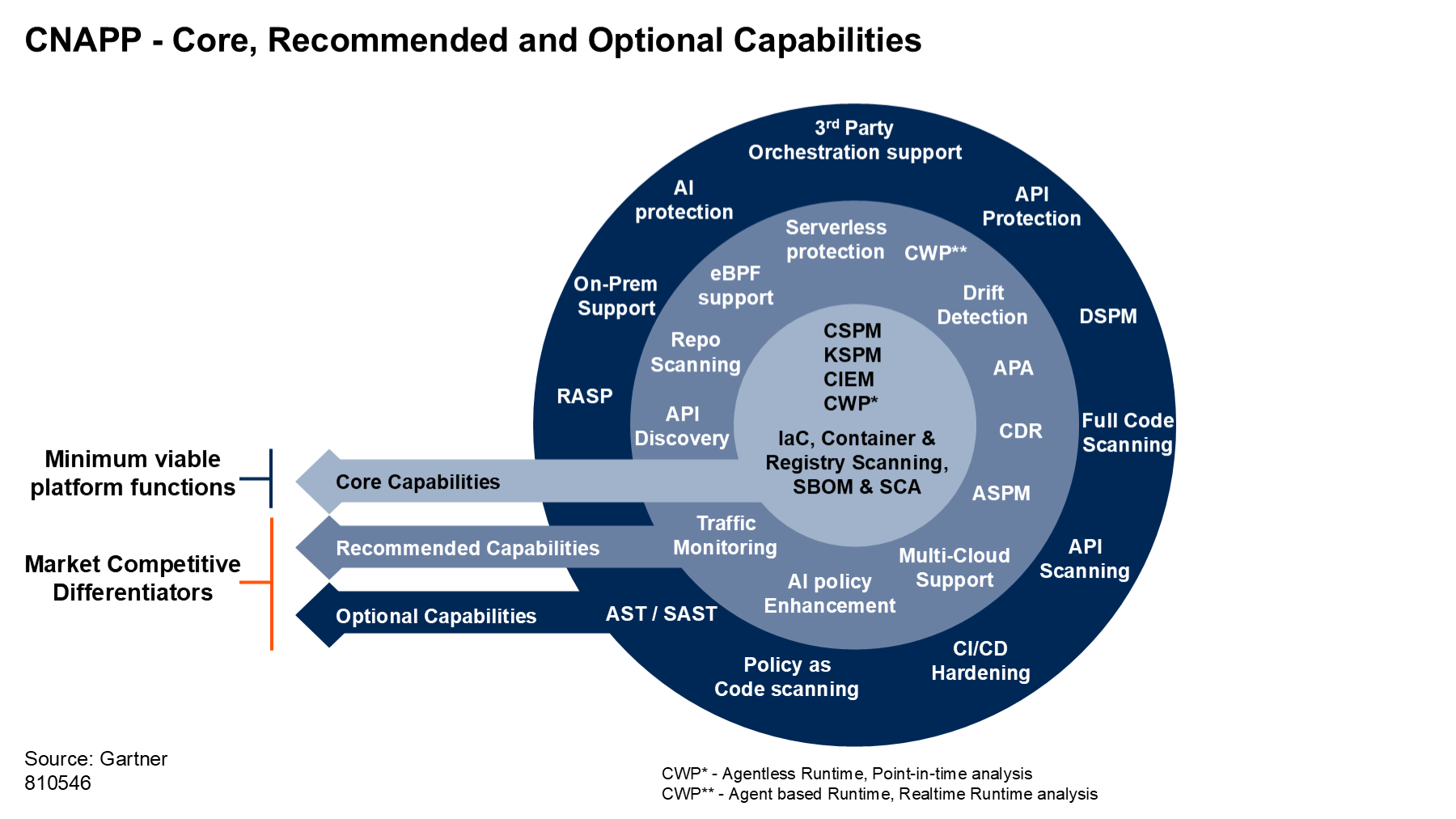
Cloud-native application protection platforms (CNAPPs) are a unified and tightly integrated set of security and compliance capabilities, designed to protect cloud-native infrastructure and applications (see the definition in Market Guide for Cloud-Native Application Protection Platforms). CNAPP integrates separate components like CSPM, CIEM, CWPP, and KSPM into container and Kubernetes security to address the need for holistic visibility, resulting in CNAPP becoming the de facto platform for securing cloud workloads across IaaS and PaaS. CNAPP vendors continue to evolve platforms with more adjacent capabilities, see Figure 1 below which shows the evolving CNAPP capabilities (see Buyers’ Guide for Cloud-Native Application Protection Platforms).
The platform approach creates operational complexity and makes it difficult for buyers to realize value. CNAPP vendors need to shift toward autonomous, agentic AI-driven remediation to maximize platform benefits and the increasingly rich, multidimensional context that is available.
As organizations approach 2026, the CNAPP market is moving beyond traditional visibility and alert-based monitoring, which overloads analysts and slows remediation. Next-generation CNAPPs must prioritize autonomous, business-driven risk remediation to reduce alert fatigue and align security with business impact. The following insights highlight key areas for CNAPP product leaders to differentiate their platforms.
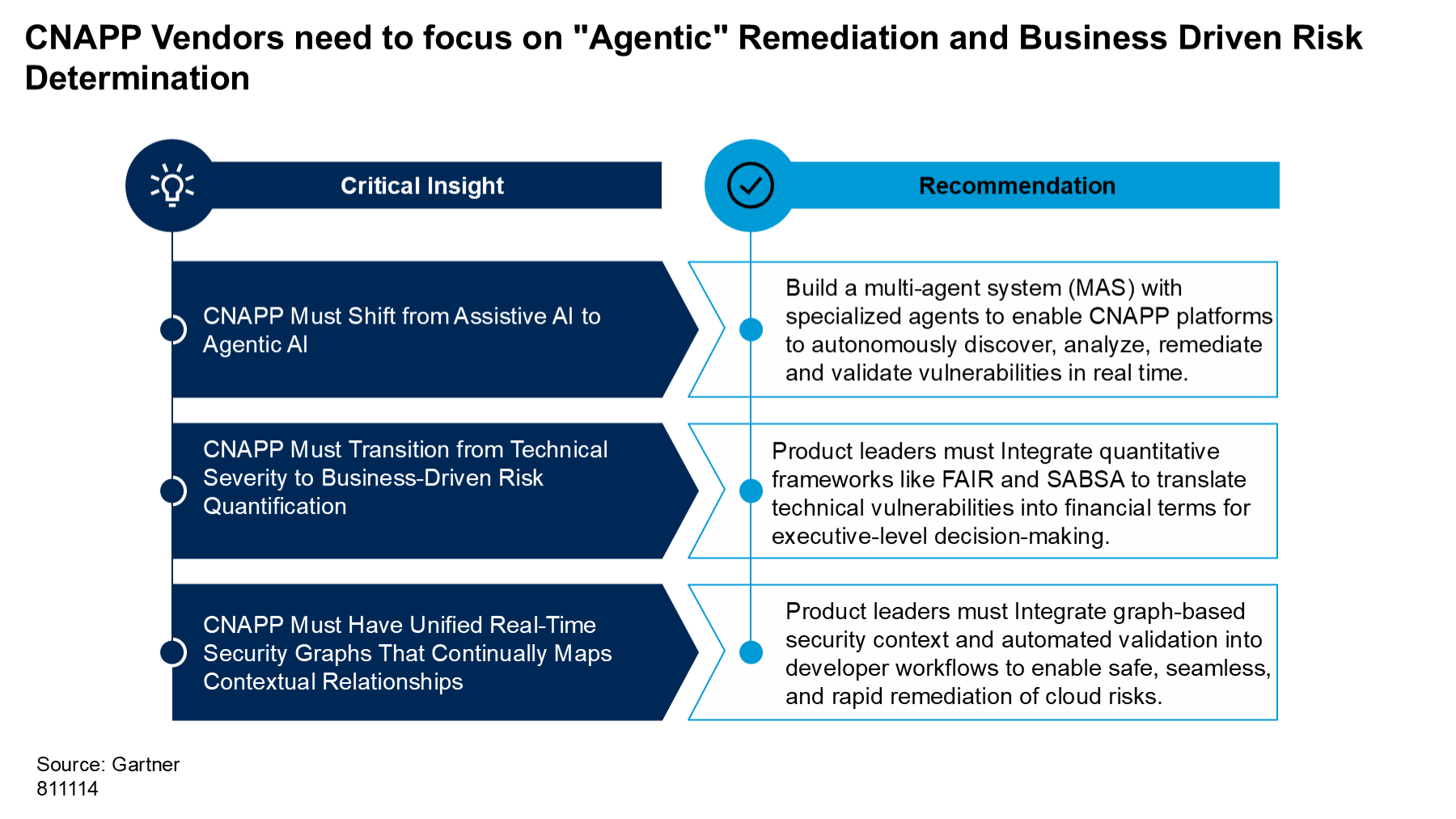
Critical Insight: CNAPP Must Shift From Assistive AI to Agentic AI
Moving to an agentic AI model transforms the competitive landscape for CNAPP. Current platforms typically compete on the volume and prioritization of vulnerabilities, agentic platforms creating a fundamental shift to driving outcomes. Focusing on autonomous guided (human-in-the-loop) remediation, the customer conversation moves away from managing a growing mountain of alerts to where the platform starts to reduce the workload itself.
Near-Term Implications for Product Leaders
- The primary user persona is transitioning from an operator of tools to a supervisor of autonomous agents. This transition drives the need to move away from data visualization toward “decision transparency.” Outcome of a product’s value will be judged by the clarity of the agent’s reasoning and the speed at which a human can validate or reverse its actions.
- Agentic AI introduces a new, high-risk attack surface: the agent’s own identity. Traditional IAM roles are insufficient for autonomous systems that span code, cloud, and identity silos, creating a need for CNAPP vendors to focus on agentic identities and scope their authorization from within the platform to restrict the AI’s blast radius without stifling its ability to remediate.
- Agentic models create “time to context” bottlenecks with agents acting in near real-time. Any latency between a cloud configuration change and the AI’s awareness of it renders the autonomy obsolete or dangerous. This latency has created a need for continuous, event-driven data architecture versus traditional periodic scanning cycles.
Recommended Actions for the Next 6 to 18 Months
- CNAPP needs to achieve flexible risk remediation. Product leaders must build a granular “confidence threshold” slider that lets customers set policies for automatic agent remediation above a chosen confidence level and requiring manual approval for lower-confidence actions.
- Create value through transparent and compliant agent operations. Implement a comprehensive agent auditing through an immutable log that records every agent “chain of thought,” and ensures this log is exportable to SIEM/SOAR tools for continuous monitoring.
- CNAPP product leaders must unify predeployment static scans, deployment orchestration gates, and postdeployment runtime context to enable agents to autonomously isolate active threats starting with low-risk maintenance tasks.
Critical Insight Analysis
The shift toward agentic AI in CNAPP stems from the need for action, not just discovery, in fast-paced cloud environments. As data overload hampers response, the market is shifting from assistive to autonomous platforms. Product leaders must redesign user relationships and focus on administrator agents, not just features, to build the trust needed for enterprises to adopt autonomous capabilities.
Strategically, the move toward agentic systems forces a transition from broad, shallow visibility to deep, integrated governance. Legacy CNAPPs often operate as a collection of disjointed modules (CSPM, CIEM, CWPP and KSPM) that lack the cohesive intelligence required for autonomous action. By establishing agentic guardrails (see Use This Framework to Successfully Implement GenAI Guardrails) and specialized personas, product leaders address the critical security paradox of an agent powerful enough to fix a cloud environment which is also powerful enough to destroy it. Implementing these governance layers ensures that the AI remains a controlled asset rather than a new, unmanaged attack surface, allowing the product to scale security operations without increasing the customer’s risk profile.
The shift to agentic AI makes batch-processing obsolete, as agents require real-time, event-driven data for accurate decisions. Acting on outdated information risks errors and outages. By enabling rapid data ingestion and preaction verification, product leaders equip their platforms for safe, autonomous operation — surpassing legacy tools limited by slow, reactive scans.
Critical Insight: CNAPP Must Transition From Technical Severity to Business-Driven Risk Quantification
Near-Term Implications for Product Leaders
- High-fidelity visibility has created unmanageable backlogs, with the average mean time to remediate (MTTR) for critical cloud alerts currently reaching 128 days. Reliance on manual triage will fail completely as AI-assisted development accelerates the volume of vulnerabilities beyond human capacity.
- Security teams face a critical velocity gap where 52% of teams release code weekly, yet only 18% are capable of remediating vulnerabilities at that same speed. Traditional periodic scanning creates “visibility delays” that allow automated exploits to move laterally and begin data exfiltration in seconds before a breach is even recorded.
- Enterprise boards are transitioning from technical activity metrics toward “security yield,” which measures the actual risk reduction achieved per incremental dollar spent. Static technical severity scores like CVSS increasingly lead to prioritization paralysis because they lack the business context required to identify risks that threaten revenue and operational continuity.
Recommended Actions for the Next 6 to 18 Months
- Product leaders should build agent-orchestrated platforms with specialized agents for discovery, analysis, remediation, and validation, enabling CNAPP to autonomously resolve vulnerabilities in real time and prevent backlog.
- Transition from periodic scanning to a “stateful cloud twin” model with real-time streaming observability to achieve machine-speed threat preemption and enable immediate, automated containment actions.
- Product leaders should integrate quantitative frameworks like FAIR into the platform’s risk engine to achieve “security yield” reporting that translates technical flaws into financial terms that can be presented in executive-level reporting.
Critical Insight Analysis
The shift toward agentic remediation and business-driven risk determination is driven by the need to overcome the “visibility plateau” in cloud security, where excessive telemetry and slow, human-led triage have resulted in high MTTR for critical alerts based on the sheer volume of alerts. Adopting Innovation Insight: Multiagent Systems (MAS) transforms CNAPP platforms from passive information systems to proactive action systems, using validation agents to safely automate remediation and reduce reliance on manual intervention.
Time is the ultimate barrier to security, as attackers leverage AI to breach defenses in minutes while many security teams still respond in hours or days. Transitioning to a “stateful cloud twin” model with real-time observability allows autonomous agents to instantly contain threats by revoking credentials or isolating workloads as soon as risky conditions are detected, effectively closing the window of opportunity for attackers.
Product leaders should shift from technical metrics like CVSS to quantitative frameworks such as FAIR, enabling CISOs to show risk reduction per dollar spent and position security as a strategic investment. With the rise of nonhuman identities, adopting a “zero agency” model with just-in-time permissions is also critical for preventing automated insider attacks and ensuring strong cloud identity governance.
Critical Insight: CNAPP Must Have Unified Near Real-Time Security Graphs That Continually Map Contextual Relationships
Near-Term Implications for Product Leaders
- CNAPP must continue to mature security graphs that provide unified event and alert contextualization in order to enable a shift away from reactive remediation to predictive guided pipeline hardening.
- Product value must shift from total coverage to contextual criticality by surfacing only alerts linked to exploitable attack paths, reducing noise and focusing user attention on real risks.
- CNAPP product roadmaps need to focus on the development of cross-domain policy engines that automate security actions based on graph insights. Thus, visualizing the “blast radius” of a single compromise, enabling rapid containment of threats across code, identity, and infrastructure silos.
Recommended Actions for the Next 6 to 18 Months
- Focus on evolving CNAPP to have a zero-risk remediation engine by implementing sandboxed validation loops that use a digital twin or shadow clone of the environment to test fixes before applying them to production, increasing customer trust and autoremediation adoption.
- Product leaders should enable frictionless developer adoption by embedding graph-based security context directly into tools like GitHub, allowing developers to address prioritized risks within their workflow and reduce patch times.
- Leverage agent development platforms to enforce intent-based policies allowing for real-time governance and multisignature verification of autonomous actions within the CNAPP life cycle.
Critical Analysis
Agentic AI and unified security graphs transform CNAPPs from asynchronous reporting to real-time resolution. Unified security graphs enable relational risk analysis, prioritizing threats by mapping vulnerabilities to actual impact.
Adopting agentic models requires new trust frameworks — sandboxed validation and intent-based governance ensure AI agents operate safely as privileged identities. This approach scales security without increasing headcount, making CNAPPs force multipliers instead of sources of alert fatigue.
Success hinges on democratizing security context across the software development life cycle. Integrating graph-based insights and agentic fixes into developer workflows makes security continuous and automated. CNAPP leaders will deliver autonomous agents that are safe, transparent, and seamlessly integrated with modern engineering practices.