AI Providers That Automate Business Decisions Control the Future of Work
3 April 2026 - ID G00852233 - 7 min read
By Vuk Janosevic, Raymond Paquet
The agentic AI orchestration market is fragmented by architectural legacy, yet converging on control of enterprise execution. Infrastructure, workflow, semantic, and intent-led platforms embed different operating models. The winners will be the platform that owns autonomous work at scale.
Insights at a Glance
Most agentic AI orchestration platforms are not designed from first principles on enterprise value, but attempts to extend architectural control points into the agentic era. What looks like product variation really constitute different starting points in the battle over control. The market is fragmented, and no single point is sufficient. Market winners will converge across key four architectural layers:
- Intent defines the desired outcome, allowing users to specify goals while agents determine how work should be executed, but can weaken operational discipline if execution is not governed.
- Workflow structures execution through explicit processes, improving control and compliance, but risks rigidity if limited to deterministic automation.
- Semantics grounds decisions in enterprise meaning and relationships, improving reasoning quality and cross-functional coordination, but requires upfront modeling investment.
- Infrastructure scales and governs performance across agents, tools, and runtimes, enabling reliability and distribution, but can distance orchestration from business logic and ownership.
Providers are using orchestration to pull enterprise decision flow toward the part of the stack that is their architectural strength. That is why many offerings aiming to control agentic execution reflect inherited architectural debt more than strategic clarity. The strategic coherence will determine adoption, trust, and ultimately who controls the execution layer of enterprise AI.
Enterprises should not evaluate orchestration platforms as feature bundles. They should identify which front door best fits their immediate constraint, then pressure-test the roadmap for convergence across the other three, with the focus on minimizing future replatforming costs and architectural fragmentation.
Strategic Planning Assumptions
By 2030, the winners in the agentic AI orchestrator market will have intent, workflow, semantics, and infrastructural capabilities in a single platform.
By 2030, providers that cannot reduce future replatforming risk and architectural fragmentation will face lower win rates with enterprise buyers.
Issue
What appears to be product variation is, in reality, a structural divergence in how vendors conceptualize autonomous work — as goals, processes, semantics, or runtime control. These differing starting points are shaping enterprise perceptions of how AI should operate, long before the market converges technically, and are influencing adoption patterns, trust models, and time to value.
At the same time, enterprises are rapidly moving from isolated copilots and point automation toward multistep AI systems capable of planning, coordinating tools, and executing work end to end. This shift is accelerating the transition from systems of record and intelligence toward systems of action, where value is created not by generating insights, but by governing how work is executed across humans, systems, and AI.
However, vendors are not approaching this execution layer from a common foundation. The market is fragmenting across infrastructure-, workflow-, semantic-, and intent-led entry points, each reflecting where providers already hold architectural and commercial gravity. As a result, enterprises are encountering competing models of orchestration that differ in control, governance, and execution philosophy.
Despite these differences, architectures are beginning to converge around shared requirements, such as planning, durable execution, shared context, and governance. Organizations therefore must make near-term decisions about which entry point best aligns with their constraints, while ensuring the platform can evolve into a unified orchestration control plane.
Impact
The emergence of multiple orchestration entry points signals that enterprises are not only selecting AI platforms, but also choosing how autonomous work will be structured, governed, and scaled throughout the organization. Early platform choices will influence operating models, economic viability, and governance frameworks in ways that are difficult to reverse.
This creates both urgency and opportunity. Organizations that treat orchestration as a tactical AI capability risk fragmenting execution across competing models, increasing operational complexity, weakening governance, and slowing time to value. In contrast, enterprises that deliberately align orchestration with how they want work to be executed — whether goal-driven, process-driven, context-driven, or runtime-driven — can accelerate adoption, reduce coordination friction, and establish a scalable foundation for autonomous execution.
The strategic opportunity lies in selecting platforms that can evolve beyond their initial architectural foothold. As the market converges, value will accrue to organizations that avoid locking into narrow orchestration models and instead build toward unified execution layers that combine intent, workflow, semantics, and infrastructure. Early decisions will therefore shape the technology architecture as well as who controls enterprise decision flow and how quickly AI-driven execution can scale throughout the business.
More Detail
Architectural starting points in agentic orchestration do more than shape product design — they implicitly define how autonomous work is structured, governed, and scaled. Each also reflects a different balance between agency, or how much autonomous judgment the orchestration layer exercises, and effort, or how much enterprise design and governance is required to make it work. Because most platforms extend legacy control points, each entry point carries assumptions about where decisions originate and how execution should flow, meaning enterprises adopting them are effectively inheriting an operating model for autonomous work, as highlighted on Figure 1.
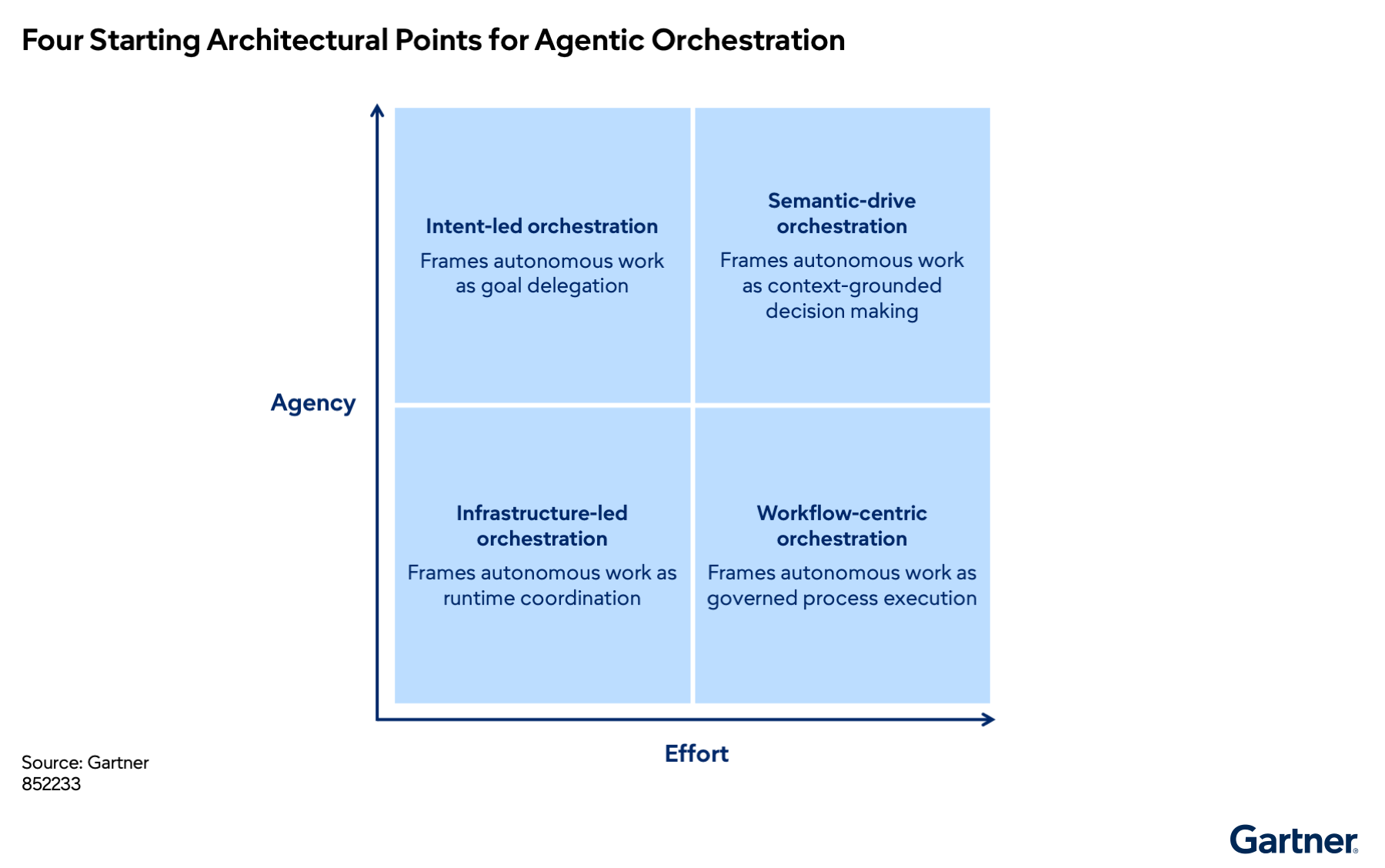
- Intent-led: Frames autonomous work as goal delegation, allowing users to specify outcomes while agents determine execution paths.
- Workflow-centric: Frames autonomous work as governed process execution, emphasizing control, compliance, and structured coordination.
- Semantic-/ontology-driven: Frames autonomous work as context-grounded decision making, anchoring execution in enterprise meaning and relationships.
- Infrastructure-led: Frames autonomous work as runtime coordination, prioritizing scale and interoperability across agents, models, and tools.
Each architectural starting point optimizes for a different control point in autonomous work, creating distinct advantages and trade-offs that influence governance, time to value, and long-term ownership of enterprise decision flow, as outlined in Table 1.
Areas of Optimization and Control for Architectural Entry Points
| Architectural entry point | What it optimizes for | Advantages | Trade-offs | Illustrative vendor examples |
|---|---|---|---|---|
Infrastructure-led | Runtime scale, interoperability, model/tool composability |
|
|
|
Workflow-centric | Structured process orchestration and governance |
|
|
|
Semantic- or ontology-driven | Context-grounding decision making |
|
|
|
Intent-led | Goal-driven autonomy and planning |
|
|
|
Source: Gartner
All Starting Points Will Collapse Into Execution Platforms
Convergence across orchestration entry points is mechanically inevitable because autonomous work requires four capabilities that cannot operate independently: intent definition, contextual grounding, governed workflow execution, and scalable runtime coordination. Infrastructure-led platforms must add semantics and workflow logic to deliver business outcomes, workflow-centric platforms must incorporate intent planning and dynamic runtime behavior to enable autonomy, semantic approaches must operationalize their models through execution control, and intent-led platforms must introduce governance, repeatability, and life cycle management.
As deployments scale, enterprises demand reliability, auditability, and economic predictability, forcing vendors to expand beyond their original control point. Over time, the market will therefore shift from competing entry points to competing execution layers, where differentiation depends on how well platforms integrate all four capabilities into a coherent operating model.
Evaluate Strategic Fit for Enterprise AI Execution
Assess platforms not on their starting point, but on their path to convergence. Enterprises should judge whether a provider can integrate intent, semantics, workflow control, and runtime optimization into a unified execution layer without forcing future replatforming. They should also examine whether governance and economic controls are embedded directly into execution, rather than added later, and whether the architecture can scale across domains instead of remaining confined to isolated use cases.
Organizations can use the Gartner Agentic Orchestration Scorecards to evaluate two questions at once (see AI Native Operating Models Separate Winners From Pilot Purgatory): how demanding the target use case really is and whether the platform can govern that work reliably at scale. In practice, the scorecards help both product leaders and enterprise executives assess how much autonomy, coordination, contextual understanding, and risk tolerance a use case requires, then compare that against a platform’s ability to translate business intent into governed execution, assemble the right context, coordinate workflows and agents across systems, and make performance, cost, and assurance visible. It is a practical way to evaluate not just whether a platform can automate a task, but whether it can operate as a durable enterprise execution layer.