Magic Quadrant for Specialist Supply Chain Strategy, Planning and Operations Consulting
26 May 2026 - ID G00841241 - 42 min read
By Michael Dominy, Caleb Thomson
Supply chain strategy, planning and operations consulting improves quality and efficiency for functions like manufacturing, warehousing and logistics. Supply chain leaders can use this Magic Quadrant to evaluate specialist supply chain consulting service providers with under $5 billion in revenue.
Market Definition/Description
Supply chain strategy and planning consulting is a subset of corporate strategy consulting. Gartner defines the latter as “strategic advisory services that analyze risks and opportunities for clients, working with them to develop a detailed strategic roadmap.” Supply chain operations consulting is a specialized form of business operations consulting, which Gartner defines as “transformation advisory services that improve quality and efficiency for business operations in an organization.” These services focus on improving operations in functions that have physical assets, such as manufacturing, warehousing and logistics.
Supply chain leaders often need help from consulting firms across a spectrum of projects. These leaders include chief supply chain officers (CSCOs), supply chain strategists and functional supply chain leaders in planning, logistics, customer service, manufacturing, and sourcing and procurement. Projects can range from developing supply chain strategy and strategic planning to implementing new practices in specific functions.
Examples of supply chain strategy and planning projects include:
- End-to-end supply chain strategy and roadmaps
- Supply chain and manufacturing network design
- Digital supply chain strategies and roadmaps
- Organizational design
- Postmerger/postacquisition supply chain and operational integration planning
- Supply chain segmentation
- Product portfolio/SKU rationalization
- Cost-to-serve analysis
- Complexity reduction/optimization
- Sales and operations planning (S&OP)
- New product introduction and launch (NPI&L)
Supply chain operations consulting is focused in industries that are highly dependent on the management of physical flows of material and inventory from suppliers through internal operations, such as manufacturing or distribution to end customers or patients. These industries include industrial manufacturing, consumer products, retail, life sciences, high tech, natural resources, and oil and gas.
Examples of supply chain operations consulting projects include:
- Business process improvement
- Process and operational training
- Functional improvements in areas such as:
- Sourcing and procurement operations
- Distribution center design, layout and operations
- Transportation and fleet operations
- Factory layout and operations
- Postsale and aftermarket services
Mandatory Features
- Quantitative analysis of overall or function-specific performance
- Capability or maturity assessment for end-to-end supply chain and multiple supply chain functions
- Identification of capability gaps and process improvement opportunities across the supply chain or individual function
- Business case analysis that includes defining and assessing options and initiatives for closing gaps for the defined scope of the project, including cost-benefit analysis
- Implementation roadmap for capability and process improvements, including timeline and resources required
- Change management and communications plan development and execution
- Supply chain network modeling and optimization
Optional Features
- Peer group benchmarking and leading practice definition
- Organization design to support target operating model
- Program management for capability and process improvements initiatives
- End-to-end or function-specific digital strategy and roadmap
- Product portfolio/SKU rationalization
- Supply chain segmentation and cost-to-serve analysis
- Software selection or service provider selection, such as system integrator, third-party logistics (3PL) provider or external manufacturing service provider
- Sales and operations planning (S&OP)
- New product introduction and launch
- Lean Six Sigma or other industry operational excellence program implementations
- Distribution or manufacturing facility layout, design and optimization
- Sourcing and procurement initiatives, such as strategic sourcing and category management
Magic Quadrant
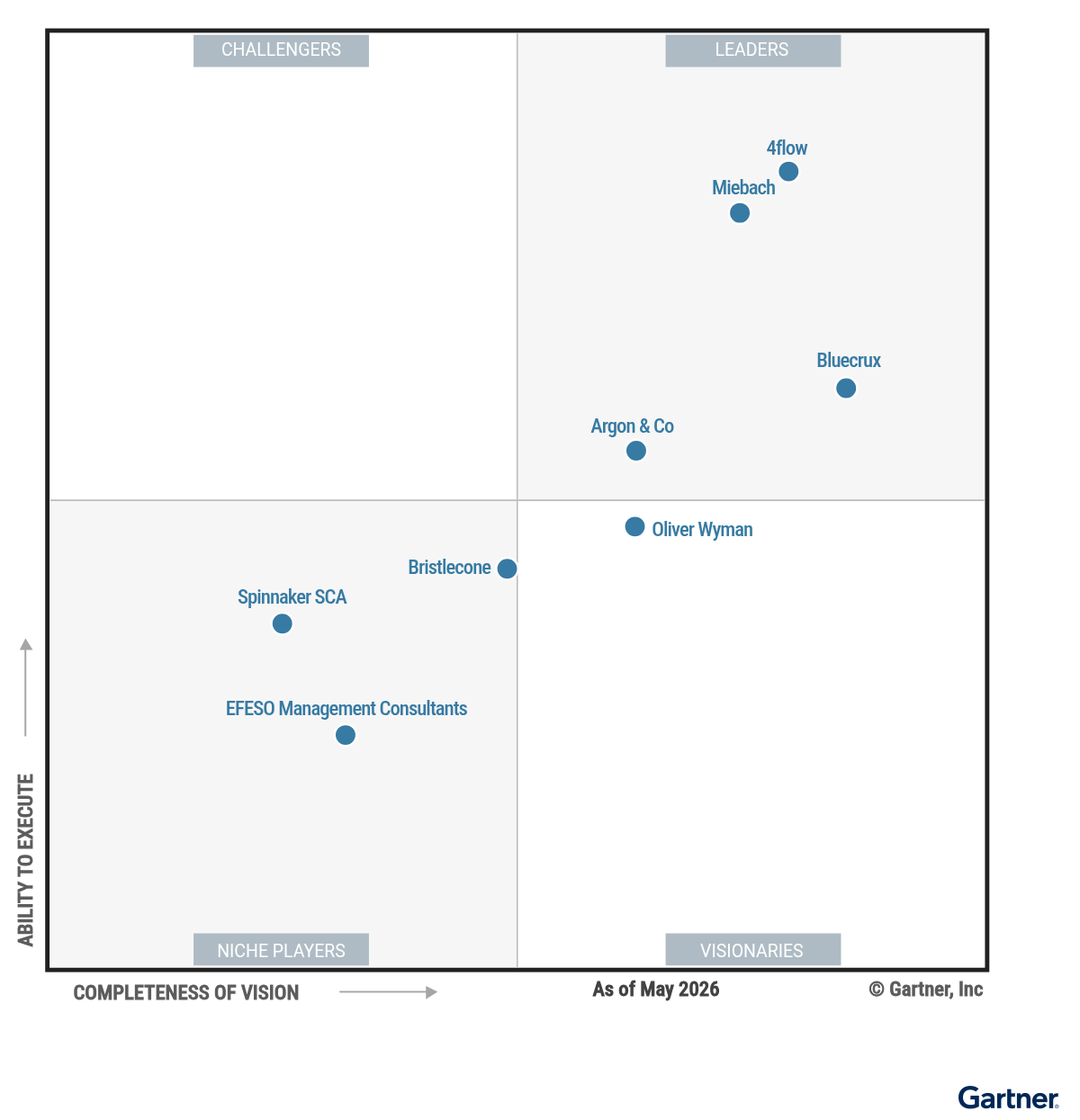
Vendor Strengths and Cautions
4flow
4flow is a Leader in this Magic Quadrant. It is a private specialist supply chain consulting firm focused on strategy, planning and operations. The firm has its strongest presence in Europe, North America and China. It primarily serves large global enterprises, especially in automotive, industrial, retail/consumer, high tech and life sciences.
Its consulting and digital-twin-enabled offerings are broadly aimed at helping clients redesign networks, improve planning, optimize logistics and manufacturing execution, and realize digital enablement. It is investing in AI-enabled orchestration, digital twin decision intelligence, and adoption-to-outcome methods that extend strategy into measurable operational change, often backing these engagements with outcome-based or gain-sharing commercial models.
- Digital-twin-led strategy-to-execution delivery: The firm connects strategy to execution through its proprietary 4flow VIA digital-twin-led modeling, supply chain execution support, and a strong record in network, planning and logistics engagements. This helps clients move from diagnostic insight to implementable actions with clearer cost, service and inventory trade-offs.
- Clear vision for agentic AI-enabled supply chain decision making: 4flow presents a clear vision for agentic AI-enabled, model-driven supply chain consulting through capabilities such as the Autonomous Resilience Orchestrator (ARO), scenario-based decision intelligence, and adoption-to-outcome transformation methods. This gives clients a more forward-looking path to resilience and planning improvement.
- Focused specialist positioning with strong client retention: It has built a focused specialist message around supply chain depth, asset-backed consulting and long-term partnerships, reinforced by a reported 97% client retention rate and long-standing client relationships. This can make it a strong fit for clients seeking domain-specific expertise.
- Geographic strength remains concentrated in core markets: Its go-to-market emphasis and current delivery depth remain centered on Europe, North America and China, with smaller hubs and expansion efforts in India and South America supporting broader coverage. For clients, that may warrant closer validation of local delivery depth for large multiregion programs beyond its primary geographic focus.
- AI innovation capabilities are evolving: Some of its newer capabilities, including ARO, are emerging through pilots and phased expansion. For clients, this means the most distinctive innovation elements may require diligence on maturity, integration requirements and postproject support arrangements.
Argon & Co
Argon & Co is a Leader in this Magic Quadrant. It is a privately held, specialist consulting firm formed through the integration of multiple specialist firms since 2018. Argon & Co has built a global footprint of about 1,200 consultants across Europe, Asia/Pacific (APAC), and North America. The firm positions itself as a pure-play supply chain and operations partner, combining strategy-led advisory with deep functional expertise across planning, logistics, manufacturing, procurement, sustainability, and digital enablement.
Over the past two years, it has moved from predominantly strategy and functional advisory toward end-to-end supply chain transformations that are system-enabled and analytics-driven. This includes the expansion of IRIS by Argon & Co (its data and AI capability) and NEOS by Argon & Co (its system-enabled planning and transformation capability). It also has proprietary frameworks — most notably scprime and MODE (its manufacturing operating system).
- Deep focus on supply chain and operations: Unlike diversified management consultancies, it has supply chain and operations work at its core. This focus translates into deep functional expertise across supply chain strategy, sales and operations planning (S&OP), logistics, manufacturing excellence, procurement and sustainability.
- Proprietary, codified methodologies and assets: Argon & Co has developed a set of proprietary frameworks and platforms that underpin its delivery, including scprime for end-to-end supply chain assessment and benchmarking, MODE for manufacturing operating systems, and IRIS for data, analytics and AI-enabled use cases. These assets support repeatability, faster diagnostics, and clearer linkage between strategy, execution, and financial outcomes.
- Strong execution orientation and collaborative delivery model: A culture of collaboration and pragmatism — working side-by-side with client teams — is frequently cited by clients as a differentiator, particularly in complex transformation and postmerger integration contexts.
- Evolving North American brand awareness and enterprise penetration: While it is aggressively expanding its North American footprint through strategic acquisitions (such as Scott Sheldon) and key partner hires, its brand recognition in the U.S. is still maturing compared to its strong EMEA presence. As it broadens its network, integration of newly acquired businesses may present some client delivery risk.
- Narrower reach beyond core supply chain and operations domains: The firm has robust supply chain technology, system integration and managed services capabilities, driven largely by its NEOS integration arm. However, clients pursuing tightly integrated, enterprisewide transformations across corporate finance, HR, among other functions, may need to engage generalist partners to address broader requirements.
- Manufacturing and logistics capabilities vary by region: Although MODE provides a differentiated manufacturing operating system offering, depth of service delivery capability is not uniform across all geographies.
Bluecrux
Bluecrux is a Leader in this Magic Quadrant. It is a specialist supply chain consulting firm with offices across North America, Western Europe and APAC. It focuses on supply chain strategy, planning and operations consulting for complex value chains, in semiprocess manufacturing sectors, especially life sciences, consumer goods, chemicals and industrial settings.
Its footprint is centered in EMEA, with expansion underway in North America and earlier-stage growth in APAC. Bluecrux continues to invest in its good x practice (GxP)-validated Axon digital twin, AI-ready value chain data foundations and GenAI-embedded delivery model. Its growth remains organic rather than acquisition-led, and it also provides system implementation services for certain supply chain planning solutions.
- Integrated strategy-to-execution delivery model: Bluecrux links diagnostics, operating model redesign, system implementation support and enablement in one delivery model rather than separating strategy from execution. The firm often supports this with multiyear transformation projects.
- Differentiated vision for AI-enabled value chain transformation: It has a strong vision for emerging AI-enabled consulting through its Axon digital twin and AI-ready data foundation offerings with GenAI capabilities embedded into delivery. These can help clients accelerate technology delivery and operational time to insight.
- Deep specialization in complex and regulated industries: The firm is tightly focused on complex and regulated value chains, especially in life sciences, consumer goods and chemicals. About 50% of its revenue comes from life sciences, where it serves 14 of the top 20 global pharmaceutical companies, reinforcing its specialist depth in that sector.
- Lack of consistent depth across supply chain service lines: Relative to some specialists, its profile is less comprehensive in logistics and physical manufacturing operations work, especially in North America and APAC. This is reflected in a lower share of client work within manufacturing operations compared to planning- and data-led growth areas overall.
- Sales go-to-market is still developing relative to some peers: Its sales execution is less mature than some specialist peers with broader commercial reach. Its growth model relies heavily on account expansion consistent with its account-based partnering approach. This may matter to clients running large, highly competitive sourcing processes that favor providers with broader scale and more diversified go-to-market coverage.
- Smaller scale and developing regional depth outside EMEA: As it is growing organically and investing in innovation, it remains smaller than some specialist peers with broader client bases and denser regional benches. Its North America expansion is progressing rapidly, while its APAC expansion is still developing from an EMEA-centered foundation. Clients with very large multinational programs should validate local capacity and coverage against program scope.
Bristlecone
Bristlecone is a Niche Player in this Magic Quadrant. Its supply chain strategy, planning and operations consulting business is focused on planning transformation, procurement, inventory, logistics and manufacturing advisory for large enterprises with complex, multiregion supply chains, and also system implementation support.
Its business is centered primarily in North America, with additional delivery capability in India and other regions, and it is most visible in consumer packaged goods (CPG), life sciences, high tech and manufacturing. Bristlecone is investing in continued capability building and has advanced its AI-first consulting strategy, including AI-enabled use cases embedded with its client transformation programs and micro vertical focus areas such as semiconductors, data centers, frozen foods and clinical supply chains.
- Follows an integrated delivery model: It provides strong governance and change enablement, supported by Bristlecone’s ADAPT framework, across strategy, planning, procurement, logistics and inventory engagements. It emphasizes execution discipline and stakeholder alignment. For clients, this can reduce the risk that transformation stalls during delivery.
- Has a clear vision for AI-first consulting: Its vision is backed by assets such as its Change Navigator and Planning Explainability tools, and it also has focused industry and account-driven strategy. Its vendor-agnostic approach prioritizes practical supply chain decisions, helping clients build pragmatic roadmaps and gain greater transparency into planning and change.
- Deliberately markets to priority buyers: This is reflected in its client engagement model, which includes executive-community programs and a dedicated consulting partner approach for target accounts. It strengthens the link between consulting leadership and account development, giving clients better access to senior leadership and clearer alignment from sales to delivery.
- Delivery capabilities are less complete than those of many specialist peers: This is particularly true outside planning, inventory management and procurement work. Its logistics and manufacturing depth is less developed than that of leading operational specialists. As a result, delivery capability validation is especially important for manufacturing-heavy or other physical-operations transformations.
- The business model remains more consulting-led than asset-led: Its proposition still depends heavily on people-based delivery with an expanding set of accelerators and AI-enabled assets supporting repeatability. For clients, this means they should verify what accelerators, “leave-behinds” and ongoing capabilities are available beyond upfront strategy development.
- Coverage across regions and service lines may be less extensive: Compared to some peers, its coverage across functions and regions is less extensive. For clients, this means it is important to confirm local delivery depth and executive support before committing to large multiregion programs.
EFESO Management Consultants
EFESO Management Consultants is a Niche Player in this Magic Quadrant. It provides end-to-end supply chain strategy, planning and operations consulting, including network design, fulfillment, procurement inventory, and working capital optimization advisory. It closely integrates manufacturing and operational excellence programs.
EFESO delivers execution-led, production-aware supply chain solutions focused on co-creation, measurable outcomes and strategies grounded in manufacturing realities, supported by planning technology and embedded change management.
EFESO serves large multinational clients across industrial manufacturing, automotive, consumer products, life sciences, chemicals, food and beverage, aerospace and defense, as well as private equity portfolio companies. While EFESO operates globally, its supply chain consulting presence is strongest in Europe, with continued investment to expand scale and visibility in North America.
- Manufacturing-led supply chain differentiation: EFESO’s primary differentiation lies in its tight integration of supply chain strategy and planning with manufacturing and operations consulting. Its ability to align network design, inventory and planning decisions with production realities and footprint strategy resonates with clients seeking execution-ready, operations-grounded transformation.
- Strong execution and implementation orientation: The firm emphasizes hands-on delivery and co-creation rather than advisory-only work. Demonstrates a solid track record in translating supply chain strategies into operating models, processes and systems.
- Depth in planning, inventory and working capital programs: It has proven capability in inventory optimization, cost-to-serve and working capital improvement, including large, multiyear initiatives delivering quantified financial outcomes. Targeted use of value-based and gain-sharing pricing reinforces its outcome-oriented positioning.
- Supply chain brand recognition trails top-tier strategy firms: Despite strong credentials, its supply chain brand visibility — especially in North America — lags behind that of large global and other specialist consultancies, which may limit inclusion in early-stage shortlists and credibility with executives.
- Supply chain not a fully stand-alone global practice: Supply chain consulting is closely integrated with manufacturing and operations practices rather than operating as a fully independent, globally scaled supply chain unit. This may be less attractive to buyers seeking more comprehensive advisory engagements.
- Limited scale for large, complex IT transformations: Supports planning technology implementation, but lacks the scale and breadth of firms with large, multiplatform global system integration programs.
Miebach
Miebach is a Leader in this Magic Quadrant. It is a specialist consulting firm with more than 50 years of history. The firm provides end-to-end advisory and execution support across network design, integrated business planning (IBP/S&OP), inventory optimization, logistics and distribution operations, manufacturing and warehousing design, and transportation strategy.
Miebach differentiates through an execution-ready, engineering-led delivery model that connects strategy, planning and physical operations. The firm complements consulting delivery with asset-enabled capabilities such as digital twins, simulation, network modeling and AI-enabled optimization, while typically serving as the client’s representative for technology selection and implementation rather than acting as a large-scale system integrator.
Miebach serves multinational and midmarket enterprises globally, deploying expertise across regions to support complex, multicountry transformations.
- Exclusive focus on supply chain strategy, planning and operations: A singular focus on supply chain differentiates it from diversified consulting firms. Its depth across network design, planning, logistics, manufacturing and warehousing enables end-to-end supply chain transformation without dilution into adjacent advisory domains.
- Strong execution and engineering-led delivery: The firm demonstrates strong capability in translating supply chain strategies into executable designs, operating models and physical solutions. Its combination of consulting and engineering expertise supports facility design, automation and logistics initiatives.
Asset-enabled decision support and scenario modeling: Miebach makes extensive use of digital twins that extend into manufacturing sites and distribution centers, simulation and advanced analytics to quantify trade-offs and stress-test decisions prior to implementation. This asset-enabled approach supports scenario modeling, inventory deployment and continuous network optimization in volatile operating environments.
- Pure-play focus on supply chain operations: The firm does not provide enterprise strategy, ERP transformation or broader business consulting services. Those seeking an integrated, enterprisewide transformation under a single provider may require additional partners.
- Procurement consulting is not a primary focus: Procurement advisory is not a core pillar of its offering but is often included within aspects of broader supply chain engagements (e.g., sourcing, tendering and RFP processes). Clients seeking deep, stand-alone procurement strategy or indirect procurement transformation may find stronger alignment with other firms.
- Limited scale for large, complex IT implementations: While supporting technology selection and implementation oversight, it does not operate at the scale of large global system integrators. Rather, it focuses on collaborating with these firms where required to deliver IT-centered transformations.
Oliver Wyman
Oliver Wyman is a Visionary in this Magic Quadrant. It is a global management consulting firm providing supply chain strategy, planning and operations consulting. Its offerings broadly focus on strategy, operating model design, planning, logistics and manufacturing transformation, combining analytics and implementation to deliver measurable outcomes.
The firm has made sustained investments in analytics and AI-enabled supply chain capabilities, including proprietary tools such as Sentrisk, which are typically embedded within client environments rather than commercialized as stand-alone platforms.
Oliver Wyman serves large multinational clients across industrials, consumer goods, retail, transportation and logistics, aerospace and defense, health and life sciences, financial services and government, with a global footprint and scale exceeding most specialist supply chain consultancies.
- Strong integration of strategy, analytics and execution: Oliver Wyman demonstrates strong capability in linking supply chain strategy with analytics-driven insight and execution. Engagements typically progress from strategic framing into operating model redesign, governance and implementation, supporting measurable improvements in cost, service, inventory and resilience.
- Advanced analytics and AI-enabled supply chain capabilities: The firm has invested meaningfully in analytics, AI and data science, supported by dedicated global hubs. Capabilities such as Sentrisk extend beyond diagnostics into operational use, enabling multitier risk visibility, scenario analysis and regulatory compliance.
- Global scale and multiindustry depth: With a sizable global supply chain and operations team embedded within a larger consulting platform, the firm brings scale, geographic reach and industry depth. Its ability to staff complex, multiregion and multiyear programs is stronger than that of most specialist supply chain firms.
- Supply chain is part of a broader global practice: Supply chain consulting is embedded within Oliver Wyman’s broader Transformation and Operations practices rather than operating as a fully independent, globally scaled supply chain unit. This is a deliberate strategy and is reflective of the broader set of services it has compared to most of the other specialists. This may be less attractive for buyers seeking a dedicated supply chain specialist for narrowly scoped projects.
- Proprietary tools are not offered as commercial platforms: While this vendor has developed advanced proprietary analytics and AI tools, these are primarily deployed within consulting engagements rather than offered as scalable, licensed products. Clients seeking long-term platform ownership or managed solutions may require additional partners.
- Variability in depth by region and industry: Although Oliver Wyman operates globally, depth of supply chain expertise can vary by region and industry depending on partner concentration and demand. Buyers should validate team composition for highly specialized supply chain requirements.
Spinnaker SCA
Spinnaker SCA is a Niche Player in this Magic Quadrant. Its supply chain strategy, planning and operations consulting services are focused on end-to-end transformation across strategy, planning, fulfillment, supply chain execution, and system integration. It has a growing focus on AI-enabled decision making and data platforms.
Spinnaker SCA operates primarily in North America, with an expanding delivery presence in Europe, Middle East, Latin America and offshore locations. It serves midmarket and large enterprises across retail, consumer products and technology-led industries, including warehouse operations capabilities to connect front-office demand shaping with back-office supply chain execution.
As part of Publicis Sapient, the firm continues to invest in proprietary AI platforms (including Sapient Bodhi and Sapient Slingshot), and hyperscaler-based AI data engineering solutions focused on decision making and data enablement.
- Execution depth across planning and warehouse operations: Spinnaker demonstrates strong execution across supply chain planning, fulfillment and warehouse operations, supported by its hands-on consulting depth and Publicis Sapient’s global engineering and delivery scale. The firm has further strengthened physical execution through a joint Warehouse Automation & Optimization (WAO) offering listed on the Amazon Web Services (AWS) Marketplace.
- AI-enabled connected planning and decision orchestration: This vendor presents a clear vision for AI-enabled and data-driven supply chains, particularly around connected planning, decision orchestration and cross-functional integration with commercial functions. Clients benefit from transformation roadmaps that align emerging AI capabilities with operational realities.
- Account-based selling and flexible commercial models: Spinnaker applies flexible commercial models and account-based selling approaches that support incremental expansion from diagnostics into multiyear transformation work. This allows clients to better align consulting investments with measurable business outcomes and phased delivery.
- Asset and product-based strategy still maturing: Today, the most significant source of revenue is from its consulting service delivery (i.e., human-centered). While this approach may offer less differentiation today for clients seeking standardized tools alongside advisory services, the firm is actively working to evolve this balance. Efforts are underway to productize its Sapient Bodhi AI platform as part of a new “People + Products” go-to-market strategy, and its parent organization, Sapient, also holds substantial product offerings.
- Uneven geographic density outside North America: This vendor has uneven regional representation, and is particularly concentrated in North America when compared with leading peers. Clients pursuing large, multiregion programs may encounter variability in local depth and presence. However, since its 2024 acquisition, growth has accelerated across Europe, LATAM, Middle East and Asia as part of a broader Sapient consulting development strategy.
- Less formalized customer experience and value governance: Its customer experience measurement and value-realization governance are less formalized than some specialist competitors. Clients undertaking long, complex transformations may need to play a more active role in governing outcomes and benefits tracking over time. These challenges may be less pronounced for narrow and tactical transformation efforts.
Inclusion and Exclusion Criteria
To qualify for inclusion, specialist supply chain strategy, planning and operations consulting service providers need to meet all the following criteria:
Service capabilities:
- Support the must-have capabilities in two major geographic regions (North America, EMEA and APAC) for all three aspects of the market definition:
- End-to-end supply chain strategy.
- Supply chain planning non-technology-focused projects.
- Supply chain operations consulting in at least two of the following (direct materials sourcing and procurement, manufacturing operations, logistics [transportation, distribution or service parts]).
- Actively market, sell and have delivered supply chain strategy, planning and operations consulting services on a stand-alone basis as of 1 January 2024 — not bundled with or as an add-on to other services, such as enterprise transformation implementation engagements or recurring/managed services contracts, nor add-ons to solution implementation projects.
- Actively market, sell and have delivered supply chain strategy, planning and operations consulting services on a stand-alone basis to companies in at least two industries that manufacture, distribute or sell physical products (consumer goods, life sciences, industrial manufacturing, electronics or semiconductor).
- The provider’s most recent fiscal year’s supply chain consulting revenue must not exceed $1 billion in U.S. constant currency.
Market presence:
- Have completed at least 10 engagements between 1 January 2024 and 31 December 2025, with a scope of work including at least two of the following: end-to-end supply chain strategy, supply chain planning, or operations consulting. At least five of these must have been with net-new customers.
- Have delivered, in calendar year 2025, at least three supply chain strategy consulting engagements with a scope that encompasses multiple supply chain functions. At a minimum, the scope of the strategy project must have included at least three major functions within the supply chain (i.e., planning, warehousing, transportation, manufacturing, procurement, aftermarket, etc.)
- Have delivered, in calendar year 2025, at least two end-to-end supply chain strategy or supply chain planning engagements plus at least two supply chain operations (in two or more of the following areas: direct materials sourcing and procurement, manufacturing operations or logistics) in two major regions (Americas, EMEA or APAC).
- Have at least 100 supply chain “business-focused” consultants globally excluding those that are primarily focused on implementing supply chain technology or ongoing support services (ITO, business process outsourcing [BPO], etc.) and a minimum of 10 supply chain business-focused consultants located in North
- America and Western Europe, respectively.
- Must have less than $5 billion in total revenue and at least 20% of supply chain revenue must be in strategy and operations consulting
Honorable Mentions
The providers that are most relevant to our clients were selected for evaluation in this Magic Quadrant. However, the decision not to evaluate a provider does not mean that the provider lacks viability. The following are noteworthy providers not included in the formal analysis. These providers could be appropriate for clients, contingent on their requirements:
FTI Consulting is a global business advisory firm with a reputation for helping organizations navigate complex challenges, manage risk and enhance performance. Operating in more than 30 countries, FTI Consulting serves a diverse range of industries and offers services that span corporate finance, forensic and litigation consulting, economic consulting, strategic communications and technology solutions. FTI Consulting’s multidisciplinary expertise enables it to deliver tailored advice and actionable solutions that drive sustainable growth for its clients.
FTI Consulting specializes in optimizing supply chains to improve efficiency, reduce costs and enhance supply chain agility. The firm’s consultants use advanced analytics and industry insights to assess current performance, identify opportunities and implement strategies for improvement. Its services include network design, inventory management, procurement transformation and logistics optimization, with a strong emphasis on integrating digital technologies and risk management to help clients adapt to disruptions and achieve operational excellence.
Kearney is a global management consulting firm. For 100 years, Kearney has been a trusted partner to three-quarters of the Fortune Global 500 and governments around the world, with a presence in more than 40 countries. As one of the original operations consulting firms, Kearney brings depth and experience in solving complex operational challenges.
Its Strategic Operations Practice helps companies solve complex supply chain and operations challenges across the full value chain, from planning and sourcing to manufacturing and logistics, improving resilience, performance and growth.
Kearney Activate accelerates transformation and execution by combining strategic consulting with specialized operational delivery, implementation and procurement capabilities through Kearney Operations Services (KOS) and Prokura. The firm’s alliance ecosystem connects established technology leaders like SAP, Kinaxis and AWS with emerging AI innovators, helping clients pair enterprise-scale platforms with the latest capabilities.
The Kearney Supply Chain Institute produces deep research and insights to help leaders navigate the impact of today’s complex geopolitical environment on global operations.
Evaluation Criteria
Ability to Execute
We evaluate organizations and products in the specialist supply chain strategy, planning and operations consulting market based on two categories of criteria: Completeness of Vision and Ability to Execute. In the two tables below, we define the specific evaluation criteria and assign a weight to each criterion based on our view of its relative importance in the market.
Product/Service: The capabilities, features and overall quality of the core services that compete in and/or serve the defined market. What we include here is: the name of the provider’s service offering, what services it offers and breakdown of services by the buckets in the market definition.
Overall Viability: The organization’s overall financial health, as well as the financial and practical success of the relevant business unit. This includes the likelihood that the organization can continue to offer and invest in the services, as well as its position in the organization’s portfolio. What we include here is: current and new customer count, investment plans for the provider’s services and relative distribution of services by region.
Sales Execution/Pricing: The organization’s capabilities in all presales activities and the structures that support these activities. This includes deal management, pricing and negotiation, and the overall effectiveness of the sales channel. What we include here is: contracting/pricing models, how revenue is broken down by buyer type, and typical length of engagements.
Market Responsiveness/Track Record: The ability to respond, change direction, be flexible and achieve competitive success as opportunities develop, competitors act, customer needs evolve and market dynamics change. This includes the provider’s history of responsiveness to changing market demands. What we include here is: trends the provider sees in the market, the role of AI/agentic AI in the consulting services market and how it has adapted its offerings.
Market Responsiveness/Track Record: The ability to respond, change direction, be flexible and achieve competitive success as opportunities develop, competitors act, customer needs evolve and market dynamics change. This includes the provider’s history of responsiveness to changing market demands. What we include here is: trends the provider sees in the market, the role of AI/agentic AI in the consulting services market and how it has adapted its offerings.
Market Execution: The ability to deliver clear, high-quality, creative and effective messaging via publicity, promotional activity, thought leadership, social media, referrals and sales activities. This includes the organization’s ability to influence the market, promote the brand, increase awareness of services and establish a positive reputation among customers. What we include here is: who (role/persona) the provider targets, key performance indicators (KPIs) to measure its marketing effectiveness and examples of thought leadership.
Customer Experience: The degree to which a provider’s products, services and programs enable customers to achieve their desired results. This includes the quality of supplier/buyer interactions, technical support or account support, as well as ancillary tools, customer support programs, availability of user groups and service-level agreements. What we include here is: how the provider approaches customer (client) experience, how it incentivizes customer experience (CX) for its delivery teams, how it measures CX.
Operations: The ability of the organization to meet its goals and commitments. This includes the quality of its organizational structure, skills, experiences, programs and systems that enable the organization to operate effectively and efficiently. What we include here is: talent and retention, use of AI in the provider’s operations and how it measures its operational performance.
Ability to Execute Evaluation Criteria
| Evaluation Criteria | Weighting |
|---|---|
Product or Service | High |
Overall Viability | Low |
Sales Execution/Pricing | Medium |
Market Responsiveness/Record | Medium |
Marketing Execution | Low |
Customer Experience | High |
Operations | Medium |
Source: Gartner (May 2026)
Completeness of Vision
Market Understanding: The ability to understand customer needs and translate that understanding into products and services. Providers with a clear vision of the market listen to and understand customer demands, and they can shape or enhance market changes with their vision. What we include here is: an understanding of the competitive landscape, changes planned for the provider’s offerings and how you spot trends in the market.
Marketing Strategy: The ability to clearly communicate differentiated messaging, both internally and externally, through social media, advertising, customer programs, and positioning statements. What we include here is: changes to the provider’s marketing strategy, buyers it plans to target and its top marketing strategies.
Sales Strategy: The ability to create a sound strategy for selling that uses the appropriate networks including direct and indirect sales, marketing, service and communication. This includes partnerships that extend the scope and depth of a provider’s market reach, expertise, services, and their customer base. What we include here is: changes to the provider’s sales strategies, ideal customer/client account, changes to its pricing/contracting strategies.
Offering (Product) Strategy: The ability to approach services development and delivery in a way that meets current and future requirements, with an emphasis on market differentiation, methodology, and features. What we include here is: investments made in capability areas within market definition, use of AI agents, the vendor’s capability differentiators.
Business Model: The design, logic, and execution of the organization’s business proposition.
What we include here is: competitive vs sole sourced deals, commercial/contracting models you use and asset vs people-based services.
Vertical (Industry) Strategy: The ability to strategically direct resources (sales, product, development), skills and products to meet the specific needs of verticals and market segments. What we include here is: how the provider’s business breaks down by industry, changes planned to its targeted verticals, any unique or industry-specific capabilities or services.
Innovation: Marshaling of resources, expertise, or capital for competitive advantage, investment, consolidation, or defense against acquisition. What we include here is: recent innovations the provider has delivered, planned innovations this year, and how it engages clients in innovation.
Geographic Strategy: The ability to direct resources, skills and offerings to meet the specific needs of regions outside the provider’s home region, either directly or through partners, channels and subsidiaries.
What we include here is: how the provider’s business breaks down by geography, changes planned for geographic strategy.
Completeness of Vision Evaluation Criteria
| Evaluation Criteria | Weighting |
|---|---|
Market Understanding | Medium |
Marketing Strategy | Low |
Sales Strategy | Low |
Offering (Product) Strategy | High |
Business Model | Medium |
Vertical/Industry Strategy | High |
Innovation | Medium |
Geographic Strategy | High |
Source: Gartner (May 2026)
Quadrant Descriptions
Leaders
Leaders provide mature offerings that meet market demand and have demonstrated the vision necessary to sustain their market position as requirements evolve. The hallmark of Leaders is that they focus on and invest in their offerings to the point where they lead the market and can affect its overall direction. As a result, Leaders can become the providers to watch as you try to understand how new market offerings might evolve.
Leaders typically possess a large, satisfied customer base (relative to the size of the market) and enjoy high visibility within the market. Their size and financial strength enable them to remain viable in a challenging economy.
Leaders typically respond to a wide market audience by supporting broad market requirements. However, they may fail to meet the specific needs of vertical markets or other more specialized segments.
Supply chain strategy, planning and operations consulting leaders are characterized by their ability to fundamentally reinvent or reorient the business of client organizations across all use cases and capabilities as assessed in this Magic Quadrant.
Leaders in this market excel in several key areas:
- Outcome-based value: Leaders distinguish themselves by demonstrating transformative client experiences, underwriting business outcomes and structuring commercial arrangements commensurate with those outcomes.
- Geographic reach: Leaders have a strong presence across multiple regions, specialized go-to-market strategies and targeted relationships.
- Strategic agility: Leaders proactively adapt their offering strategy in response to market dynamics.
- AI maturity in service delivery: Not only do they grasp the impact of AI on the consulting business, but they also leverage AI with a high level of maturity across all facets of service delivery.
Challengers
Challengers have a strong Ability to Execute but may not have a plan that will maintain a strong value proposition for new customers. Larger providers in mature markets may be positioned as Challengers because they choose to minimize risk or avoid disrupting their customers or their own activities.
Although Challengers typically have significant size and financial resources, they may lack strong vision, innovation or an overall understanding of market needs. Challengers may offer products nearing the end of their lives that dominate a large but shrinking segment.
Challengers can become Leaders if their vision develops. Over time, large companies may fluctuate between the Challengers and Leaders quadrants as their product cycles and market needs shift.
Challengers in supply chain strategy, planning and operations have a balanced portfolio across all use cases and capabilities as assessed in this Magic Quadrant.
Challengers typically possess robust operational foundations, which are evident in:
- A broad scope of their service offerings.
- They demonstrate agility in responding to market changes, effective talent management and established service delivery models.
- They serve a diverse clientele across various industry verticals and maintain a balanced mix of offerings across the four primary use cases.
- They have high market responsiveness and are quick to adapt to trends, whether through offering nuanced services or realigning their go-to-market strategies.
- They have successfully integrated and capitalized on AI across their service portfolio and consulting engagements. However, their proprietary market sensing capabilities, particularly at the industry or domain level, are still under development.
The tools and frameworks employed by Challengers are utilized effectively in numerous client engagements, but they have not yet achieved recognition as industry-standard benchmarks. Challengers are frequently viewed as fast followers in their offering strategy. Their approach emphasizes the industrialization of execution, leading them to adopt a global geographic strategy with minimal differentiation at the regional level.
Visionaries
Visionaries align with Gartner’s view of how a market will evolve, but their ability to deliver against that vision is less proven. In growing markets, this status is typical. In more mature markets, it may reflect a competitive strategy for a smaller provider — such as selling an innovation ahead of mainstream demand — or a larger provider trying to break out of a rut or differentiate itself.
For providers and customers, Visionaries fall into the higher-risk, higher-reward category. They often introduce new services or business models, and they may need to build financial strength, service and sales channels. Whether Visionaries become Challengers or Leaders may depend on if customers accept the new services or if the providers can develop partnerships that complement their strengths. Visionaries are sometimes attractive acquisition targets for Leaders or Challengers.
Visionaries in this Magic Quadrant articulate a sophisticated and forward-looking understanding of the market:
- Many have a substantial portfolio of tools and industry benchmarks.
- They have strong offerings and go-to-market strategies that are well-supported by a geographic strategy.
- The providers in this quadrant differentiate themselves through highly focused regional and/or vertical/industry strategies that give them a competitive edge.
- Visionaries expand the horizons of the provider market by leading with innovative business models, pioneering new service offerings or capabilities, driving path-breaking innovation and IP, and curating peer-learning forums and opportunities for clients.
- Visionaries specialize in specific functional domains, leading to uneven maturity in their offerings across use cases.
- The providers assessed as part of this quadrant were still evolving their offerings, resourcing and capabilities in at least two of the use cases or major capability areas.
- Operational agility constrained by organizational models, traditional talent structures and struggle to shift market perceptions about their strong heritage positions deters the ability of Visionaries to fully capitalize on market opportunities.
Niche Players
Niche Players do well in one or more segments of a market, or they have a limited ability to innovate or outperform other providers in the wider market. They typically focus on fewer functional domains, industries or geographic regions, or are new entrants to the market. Niche Players may have reasonably broad capabilities, but have a more limited customer base. Compared to other quadrants, they do not demonstrate as strong a vision for their offerings.
Niche Players concentrate their efforts and investments on specific segments of the market. They exhibit a strong Ability to Execute within selected areas, which typically involve one or two domains, industries or capability areas as assessed in this Magic Quadrant. These providers frequently receive positive client feedback, demonstrating leadership within a limited scope. Most providers in this quadrant leverage AI as an opportunity leveler rather than a differentiator.
For end users, assessing Niche Players is more challenging than assessing providers in other quadrants. Some could make progress, while others do not execute well and may not have the vision and means to keep pace with broader market demands.
A Niche Player may be a perfect fit for your requirements. However, if it goes against the direction of the market — even if you like what it offers — then it may be a risky choice because its long-term viability will be threatened.
Context
Buyer Needs, Priorities and Market Readiness
Buyers, led by chief supply chain officers (CSCOs) and senior supply chain leaders, now prioritize rapid time-to-value, measurable ROI and executable roadmaps that close capability gaps. Mandatory features such as quantitative performance analysis, end-to-end capability and maturity assessments, gap identification, business-case development with cost-benefit analysis, implementation roadmaps, change-management plans and supply chain network modeling have effectively become table stakes for competitive differentiation.
Client preference has moved toward engagements that progress quickly from diagnostics and proof-of-value analysis to deployment of prepriority technology-enabled, IP differentiating platforms or assets that are used to accelerate improved capabilities during the engagement. These assets are “leave-behinds” that clients can use on an ongoing basis at no additional cost (it was embedded in the cost of the engagement) or as a software subscription that includes product support services. In some cases, the assets are bundled with managed services offering that includes business process services delivered to the client on a continual basis.
Market readiness varies by use case: strategic, end-to-end roadmaps, network design, digital strategy and S&OP are broadly mature, while large-scale production deployments of agentic AI and fully industrialized digital twins are still transitioning from pilots to governed, repeatable workflows. Practical inhibitors to buyer readiness remain consistent across the market: poor data quality, fragmented legacy systems, multipartner handoffs and talent constraints slow scaling of advanced analytics and AI. Additionally, many buyers are explicitly asking for explainability and responsible-AI controls as part of standard deliverables.
Consulting Provider Responses to Buyer Needs
Providers are responding by industrializing consulting through repeatable assets, vertical playbooks and productized accelerators that compress pilot-to-scale timelines. A clear majority have evolved from pure advisory models to consult-plus-technology or consult-plus-software-and-execution models that can carry a program from strategy through implementation to operation. Common responses include packaging centers of excellence, prebuilt control-tower templates, digital twins, agent libraries and training academies.
Go-to-market has shifted to outcome-led, account-based and verticalized programs with proof-led thought leadership and commercial KPIs (pipeline-influenced, time-to-value, deal velocity). Commercial experimentation is visible in the increased use of milestone, gain-sharing, fixed-fee and subscription/managed-service constructs to better align incentives with measured business outcomes. These moves align with high-weight evaluation criteria. Offering and product strategy has become a primary differentiator as firms invest in AI agents, digital twins and domain accelerators; vertical and geographic strategies are more explicitly articulated with sector micro vertical playbooks and regional delivery hubs. And customer experience and product/service capabilities are being measured through Net Promoter Score/voice of the customer (NPS/VoC), value realization dashboards and adoption metrics.
Recurring cross-provider themes include strong partnerships with vendors to build data foundations and actionable AI, heavy investment in reskilling and hybrid “operator-architect” roles, and tighter integration playbooks to mitigate execution risk tied to implementation partners. At the same time, several providers withheld granular commercial metrics or long-term scale targets, and concrete, large-scale production examples of agentic AI remain less common than roadmaps and pilots — signaling that parts of the market remain in transition.
Other Noteworthy Themes
- Regulatory requirements (Carbon Border Adjustment Mechanism [CBAM], Corporate Sustainability Due Diligence Directive [CSDDD], export controls, serialization, data-localization) are now routinely embedded into network, planning and traceability designs rather than treated as add-ons.
- AI adoption is pervasive in provider service-offering roadmaps and delivery models but is shifting from experimentation to industrialization, with governance, explainability and staged scaling called out as necessary prerequisites.
- Common inhibitors to rapid value realization are data quality, fragmented systems, multipartner orchestration risks and talent shortages; vendors address these through preconfigured assets, data-cleaning agents and regional delivery hubs.
- Commercial models are evolving toward outcome orientation (gain-sharing, milestone, subscription) and asset monetization (licensing/platform fees) even as standardized public reporting of asset vs. people-based revenue and outcome-based pricing reporting remains inconsistent across providers.
- The market shows early signs of structural consolidation around firms that can combine deep vertical IP, scalable digital platforms and outcome-linked commercial constructs, a dynamic reflected in the market’s move to Magic Quadrant evaluation.
Recommendations to buyers of supply chain consulting services:
- Ensure that key experts and leaders, such as project managers and domain experts presented during the proposal process, will be on the project by specifying in the contract that you must interview and have approval authority. This is important for key roles and any backfills or replacements that might be needed if a consultant transitions off the project.
- Explicitly include assets as part of the evaluation process. Rate-card-based, time-and-expenses-focused sourcing can lead to lower-cost engagements but miss the goal of the initiative.
- Broaden the range of possible providers and define a more competitively priced “longlist” by including, on the longlist, IT and business process outsourcing providers that your company uses.
- Keep the fundamentals when selecting a consulting firm. General descriptions of what you want to do or, worse, simply calling a few firms too often results in spending more than is necessary or getting insufficient deliverables. Instead, use a structured process that includes weighted selection criteria, client references and an evaluation model.
- Ask for sample deliverables in your RFP. You need to know how detailed a supply chain roadmap or business case will be when deciding which service provider’s proposal is right for you.
- When contracting with a large consulting firm that recently acquired a specialist, insist that individuals from the acquired firm comprise most of the project team. The acquired firm, not the large global provider, has the specialized expertise.
Market Overview
The providers in this Magic Quadrant are those with less than $5 billion in total revenue and an exclusive or dominant focus on supply chain consulting services. They might have additional services such as system integration or business process outsourcing or managed services offerings.
There is a complementary Magic Quadrant (Magic Quadrant for Supply Chain Strategy, Planning and Operations Consulting) that includes providers with greater than $5 billion in total revenue, have more than 1,000 supply chain business consultants globally, and significant presence in every major region and multiple countries. They also serve multiple industries and functions beyond the supply chain.
Supply chain leaders often need help from consulting firms across a spectrum of projects. These leaders include CSCOs, supply chain strategists and functional supply chain leaders in planning, logistics, customer service, manufacturing, and sourcing and procurement. Projects can range from developing supply chain strategy and strategic planning to implementing new practices in specific functions.
Supply chain operations consulting is focused on industries that are highly dependent on the management of physical flows of material and inventory from suppliers through internal operations, such as manufacturing or distribution, to end customers or patients. These industries include industrial manufacturing, consumer products, retail, life sciences, high tech, natural resources, and oil and gas.
Supply chain strategy, planning and operations consulting excludes project work specifically tied to software implementation within the client’s business. However, it may precede, follow or run concurrently with software deployments or outsourcing.
The supply chain strategy, planning and operations consulting market is in a phase of rapid maturation driven by buyer demand for faster, more cost-effective and outcome-oriented engagements. Recurring disruptions accelerated a shift away from long, siloed advisory projects toward integrated, asset-enabled approaches that combine advanced analytics, digital tooling, and deep functional and industry expertise.
This shift is material enough that analyst evaluation has moved from point assessments to a Magic Quadrant format, reflecting a market with clearer competitive differentiation and repeatable product-and-service models.
Core enabling technologies — digital twins, control towers, multiechelon inventory optimization, scenario engines and AI/GenAI (including agentic architectures) — have become standard pillars of vendor value
propositions. Additionally, sustainability and regulatory constraints are increasingly embedded into network and planning designs rather than being treated as add-ons.
This is the first version of the Magic Quadrant for Specialist Supply Chain Strategy, Planning and Operations Consulting. It replaces the Market Guide for Supply Chain Strategy, Planning and Operations Consulting.
Ability to Execute
Product/Service: Core goods and services offered by the vendor for the defined market. This includes current product/service capabilities, quality, feature sets, skills and so on, whether offered natively or through OEM agreements/partnerships as defined in the market definition and detailed in the subcriteria.
Overall Viability: Viability includes an assessment of the overall organization's financial health, the financial and practical success of the business unit, and the likelihood that the individual business unit will continue investing in the product, will continue offering the product and will advance the state of the art within the organization's portfolio of products.
Sales Execution/Pricing: The vendor's capabilities in all presales activities and the structure that supports them. This includes deal management, pricing and negotiation, presales support, and the overall effectiveness of the sales channel.
Market Responsiveness/Record: Ability to respond, change direction, be flexible and achieve competitive success as opportunities develop, competitors act, customer needs evolve and market dynamics change. This criterion also considers the vendor's history of responsiveness.
Marketing Execution: The clarity, quality, creativity and efficacy of programs designed to deliver the organization's message to influence the market, promote the brand and business, increase awareness of the products, and establish a positive identification with the product/brand and organization in the minds of buyers. This "mind share" can be driven by a combination of publicity, promotional initiatives, thought leadership, word of mouth and sales activities.
Customer Experience: Relationships, products and services/programs that enable clients to be successful with the products evaluated. Specifically, this includes the ways customers receive technical support or account support. This can also include ancillary tools, customer support programs (and the quality thereof), availability of user groups, service-level agreements and so on.
Operations: The ability of the organization to meet its goals and commitments. Factors include the quality of the organizational structure, including skills, experiences, programs, systems and other vehicles that enable the organization to operate effectively and efficiently on an ongoing basis.
Completeness of Vision
Market Understanding: Ability of the vendor to understand buyers' wants and needs and to translate those into products and services. Vendors that show the highest degree of vision listen to and understand buyers' wants and needs, and can shape or enhance those with their added vision.
Marketing Strategy: A clear, differentiated set of messages consistently communicated throughout the organization and externalized through the website, advertising, customer programs and positioning statements.
Sales Strategy: The strategy for selling products that uses the appropriate network of direct and indirect sales, marketing, service, and communication affiliates that extend the scope and depth of market reach, skills, expertise, technologies, services and the customer base.
Offering (Product) Strategy: The vendor's approach to product development and delivery that emphasizes differentiation, functionality, methodology and feature sets as they map to current and future requirements.
Business Model: The soundness and logic of the vendor's underlying business proposition.
Vertical/Industry Strategy: The vendor's strategy to direct resources, skills and offerings to meet the specific needs of individual market segments, including vertical markets.
Innovation: Direct, related, complementary and synergistic layouts of resources, expertise or capital for investment, consolidation, defensive or pre-emptive purposes.
Geographic Strategy: The vendor's strategy to direct resources, skills and offerings to meet the specific needs of geographies outside the "home" or native geography, either directly or through partners, channels and subsidiaries as appropriate for that geography and market.