Hype Cycle for Digital Commerce, 2026
2 June 2026 - ID G00846349 - 105 min read
By Sandy Shen
AI and AI agents are transforming digital commerce, impacting customer behavior, technology capabilities and architecture. This Hype Cycle helps digital commerce leaders tune into the latest technology trends to future-proof their investment decisions.
Analysis
What You Need to Know
As AI and agentic commerce take center stage in the evolution of commerce technologies and customers’ buying behavior, they are no longer optional but essential to organizations’ growth and competitiveness. The 2026 Gartner CEO and Senior Business Executive Survey shows that growth remains the top strategic business priority for CEOs, who expect a “high” to “medium” degree of change in their organization’s capabilities due to AI.1
This year, many technologies have moved past the trigger stage and into later stages of the Hype Cycle. This indicates a rapid pace of change in the AI era where new technologies keep emerging but can quickly mature or become obsolete. This makes it ever more important for technology leaders to be well-informed of the changing market trends and directions. This Hype Cycle features more AI-powered commerce technologies than any previous year, and will help digital commerce leaders make informed technology decisions related to AI and commerce.
The Hype Cycle
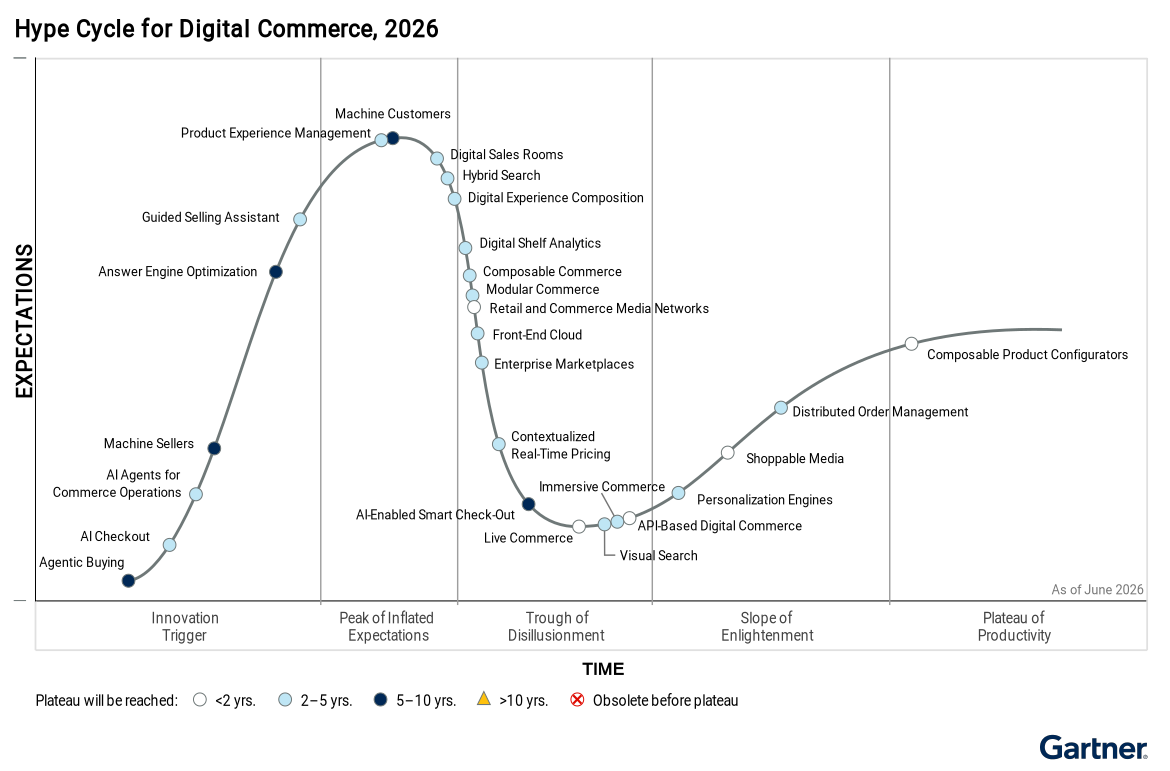
As organizations focus on growth, agentic commerce is a key opportunity to unlock new revenue. Three new entrants related to agentic commerce are featured on this year’s Hype Cycle:
- AI checkout enables customers to buy directly on AI platforms (e.g., ChatGPT, Google Gemini and Perplexity) without going to the merchant’s website.
- Agentic buying sees AI agents act as customers that make end-to-end transactions with little or no human involvement. It is a future state of agentic commerce.
- Answer engine optimization (AEO) helps organizations improve product visibility on AI platforms, increasing referrals to commerce sites.
Other technologies have advanced significantly on the Hype Cycle due to an increase in their maturity, or a lack of market interest:
- Composable product configurators moved onto the Plateau of Productivity due to the maturing of visual configurators and virtual photography, and the wide availability of the product.
- Immersive commerce moved into the Trough of Disillusionment because, though the benefits are well understood, the value is limited to products requiring visual or spatial support.
- Product experience management moved to the Peak of Inflated Expectations, with vendors extending solutions to cover more components in the framework, while organizations still struggle to measure the ROI.
- Digital experience composition is descending into the Trough of Disillusionment due to relatively low awareness among developers and front-end deliveries remaining code-heavy.
- Hybrid search moved to the late stage of the Peak of Inflated Expectations due to it becoming a common capability for leading search and product discovery solutions despite the technology being relatively new.
- Visual search moved into the Trough of Disillusionment because, though the technology has matured quickly with better accuracy, organizations have yet to integrate it into multimodal use cases to see more value.
The Priority Matrix
Agentic buying will have transformational impacts on how customers buy and how organizations sell in five to 10 years. AI agents will act as customers, make purchase decisions and transact with little or no human involvement. When technology obstacles are overcome, AI agents will bypass the storefront and connect directly to commerce systems using APIs and protocols to transact. Organizations need to prepare to serve this type of new customer to stay relevant, or miss the revenue opportunities and lose customer relationships.
AEO will have transformational impacts on agentic commerce in five to 10 years. This not only impacts product visibility in AI checkouts but also referrals from “AI answers” to commerce sites. Organizations need to develop content best practices and use visibility tools to ensure a good presence on AI platforms, to offset the decline in referrals from traditional search engines.
AI agents for commerce operations are expected to have a transformational impact in the next two to five years, due to its quickly becoming a common capability in commerce solutions. Typical use cases include merchandising configurations, setup of rules and campaigns, event-based actions, and insight analytics. The primary benefit is productivity enhancement.
While modular commerce and composable commerce have transformational impacts, the complexity and costs associated with implementing these technologies are now better understood by the market. Organizations are taking a more pragmatic approach by balancing agility and flexibility with total cost of ownership (TCO), and selectively using extensions when needed.
Priority Matrix for Digital Commerce, 2026
| Benefit | Years to Mainstream Adoption | |||
|---|---|---|---|---|
| Less Than 2 Years | 2 to 5 Years | 5 to 10 Years | More Than 10 Years | |
Transformational | ||||
High | ||||
Moderate | ||||
Low | ||||
Source: Gartner (July 2026)
Off the Hype Cycle
Technologies that have been dropped from the Hype Cycle include:
- Customer data platform supports a wide range of use cases beyond commerce and is not a commerce-specific technology anymore.
- Customer journey maps support various purposes and are not a commerce-specific technology anymore.
- Payment as a packaged service has entered the mainstream and is now off the Hype Cycle.
- Retail media supply-side technologies serve retailers instead of brand organizations, which are the focus of retail media on this Hype Cycle.
On the Rise
AI Checkout
Analysis By: Sandy Shen
Benefit Rating: Moderate
Market Penetration: Less than 1% of target audience
Maturity: Emerging
Definition:
AI checkout is a form of agentic commerce where AI platforms recommend products relevant to a user’s query, based on factors such as product data, shipping and quality signals. Buyers can select products and complete checkout on the platform using either the platform’s native checkout experience or an embedded merchant experience. AI checkout differs from agentic buying, another form of agentic commerce, because humans retain full control over purchase decisions and use AI solely as tools.
Why This Is Important
AI checkout is relatively small due to limited availability and buying options. However, it can become an important channel to reach large audiences and increase commerce revenues, given the large user base of AI platforms. If participating, organizations must actively manage technical integration and channel mix strategy to ensure overall revenue growth. Even organizations that choose not to participate can get referrals as AI platforms include links to products not yet available in checkout.
Business Impact
Organizations can increase commerce revenue and acquire new customers through AI checkout, but platform-specific integrations add technical complexity. They must carefully manage their channel mix to prevent cannibalization of existing sales channels. As AI platforms increasingly control product discovery and purchase decisions, organizations need to protect brand visibility and influence. To maintain customer mind share, they should strengthen D2C experiences to match or exceed AI checkout convenience.
Drivers
- More AI platforms are rolling out checkout, and their large user base offers potential to drive sales for organizations.
- Organizations struggling with visibility on answer engines can participate in AI checkout as a “fast track” to win customers and grow sales.
- Technology vendors are integrating with AI platforms to facilitate product listing, including channel integration providers, such as Feedonomics, and commerce platforms, such as Shopify and Shopware. These integrations ease the technical complexity of preparing product data and connecting to multiple platforms.
Obstacles
- AI checkout is currently available on a limited number of AI platforms, primarily in the U.S. Most platforms require merchants to go through a curation and approval process, which means many relevant products may not yet be available for purchase through AI checkout.
- Product discovery remains central to AI checkout. Even when participating, organizations still compete with other merchants for visibility on the “digital shelf.”
- AI checkout today supports B2C transactions only and does not enable B2B purchasing. Even within B2C, support for capabilities such as multiitem purchases, bundles, subscriptions and service add-ons remains limited or unavailable.
- Checkout experiences vary by platform, resulting in inconsistent purchase journeys for the same product. Some platforms use standardized, platform-native checkout flows (e.g., Google and Perplexity), while others rely on embedded merchant checkout experiences (e.g., OpenAI and Google).
- AI checkout programs also differ in product feed mechanisms and protocols (e.g., OpenAI’s ACP vs. Google’s UCP), often requiring organizations to create and maintain platform-specific merchant accounts to ensure product discoverability, adding technical complexity.
- AI platforms use opaque product recommendation algorithms. Organizations can influence limited factors, such as product data, availability and shipping, but not model evolution or personalization depth.
- As AI platforms increasingly control both product discovery and checkout, they build direct customer relationships, shifting the starting point of the buying journey away from individual merchants.
User Recommendations
- Assess whether AI checkout aligns with product fit and go-to-market strategy. If participating, start with a limited product set to evaluate technical requirements and the impact on sales volume and customer acquisition before expanding participation.
- Monitor changes in AI platform policies, ranking mechanisms, buying options and checkout experiences, and adjust technical configurations, product listings and channel mix accordingly. Reassess participation decisions on an ongoing basis as these platforms evolve.
- While participating in AI checkout, retain influence over product discovery by delivering agentic commerce experiences across channels and customer touchpoints. Agentic commerce CX enables personalized, transparent interactions throughout the buying journey, helping build stronger customer relationships and long-term loyalty.
- Implement technologies that support efficient product feed integration with AI platforms, and apply SEO and AEO best practices to improve product visibility and discoverability.
Sample Vendors
Feedonomics, Google, Microsoft, OpenAI, Perplexity, Shopify
Gartner Recommended Reading
AI Agents for Commerce Operations
Analysis By: Sandy Shen
Benefit Rating: Transformational
Market Penetration: 1% to 5% of target audience
Maturity: Emerging
Definition:
AI agents for commerce operations assist business users in automating digital commerce operational tasks, leading to better productivity and business outcomes. These agents have multiple skills to support business roles and can interact with humans using natural language. They can also collaborate among themselves for complex tasks. AI agents are typically powered by LLMs but can also use other technologies such as rule engines and machine learning.
Why This Is Important
AI agents can improve productivity in digital commerce operations by automating tasks such as content generation, customer segmentation and campaign setups. These agents can also enhance business outcomes by suggesting optimization strategies that may not be obvious to business users. Organizations can apply rules and guardrails to constrain the actions taken by agents. AI agents are currently emerging in digital commerce but are expected to become a standard capability in vendor solutions within the next two years.
Business Impact
AI agents make business users more productive and improve digital commerce outcomes by automating tasks and suggesting optimization strategies. AI agents, when not properly implemented, can negatively impact the business and CX by delivering misleading answers, exposing sensitive data to unintended users or taking wrong actions.
Drivers
- AI features embedded in commerce platforms, such as product description generation, search optimization, review summaries and data insight analysis, are underlying capabilities that can be invoked by AI agents.
- Business users are more likely to adopt AI agents for daily tasks due to their ability to interact using natural language.
- AI agents become the gateway to business systems, supporting various tasks and reducing the number of tools business users need to learn and interact with. These tasks include arranging campaigns, developing webpages, segmenting customers, suggesting personalization strategies, generating data insights and customizing reporting.
- Organizations have a high awareness and willingness to invest in AI agents to improve commerce productivity and performance.
- Digital commerce vendors are deploying AI agents in their solutions, leveraging the extensive data residing in the platform. This drives customer adoption.
- Low-code agent builder and integration platform as a service (iPaaS) tools within commerce platforms allow business users to customize agent skills and workflows to execute tasks across systems and even those (e.g., ERP) beyond the commerce platform.
Obstacles
- There is a lack of transparency of vendor’s AI capabilities and a common understanding by organizations about AI agents, AI assistants, chatbots and robotic process automation, leading to organizations investing in suboptimal solutions for their needs.
- Organizations don’t always have sufficient or accurate data (e.g., customer preferences, inventory availability), nor robust data management, to achieve the expected outcomes of AI agents.
- An Insufficient amount or lack of security controls and guardrails can lead to security breaches or misconduct by AI agents, or unintended use of AI agents.
- Besides Model Context Protocol (MCP), multiple agentic protocols are competing to become the standard to enable agents to connect with organizations’ internal data and systems. Although MCP is the most adopted by the installed base, organizations may need to invest in other protocols for various purposes, such as connecting with an AI discovery channel.
User Recommendations
- Use Gartner research to understand the scope and capabilities of AI agents and what they can reasonably achieve.
- Ensure that accurate and sufficient data is present for key commerce entities, such as product, pricing, inventory, order and customers. Take stock, organize, and enrich the data for agents to easily access and retrieve.
- Experiment with agentic capabilities embedded in digital commerce applications to assess their impact on productivity and business outcomes. When available, use low-code agent builders and iPaaS tools to construct your custom agents and workflows.
- Set up security mechanisms and guardrails to regulate the input and output of AI agents to ensure compliance and accuracy. Put employees in the loop when needed to verify the behavior and output of AI agents.
- Communicate the deployment of AI agents to employees and equip them with skills to work with agents in data preparation, prompt formulation, monitoring and feedback. Encourage them to focus on higher-value tasks such as goal setting, use cases and CX designs that cannot yet be undertaken by AI agents.
Sample Vendors
KIBO; Salesforce; SAP; Shopify; Shopware; VTEX
Gartner Recommended Reading
Machine Sellers
Analysis By: Luke Tipping, Daniel Hawkyard
Benefit Rating: High
Market Penetration: 1% to 5% of target audience
Maturity: Emerging
Definition:
Machine sellers (or sellerbots) are persona-based AI agents that automate end-to-end sales workflows for simple transactions or complete specific deal activities on behalf of human sellers during more complex sales processes. Currently, they predominantly facilitate routine, predictable transactions. This includes selling to and serving human customers, or interacting directly with AI agents acting on behalf of human customers to purchase goods and services (machine customers or custobots).
Why This Is Important
Sales organizations can achieve scale using machine sellers to automate deal workflows that would require significant human resources to complete. These AI agents unburden human sellers from low-value activities, enabling a focus on high-value tasks. Furthermore, machine sellers provide the vast datasets, interfaces, and instant response times that machine customers (custobots) expect, ensuring an optimal, frictionless buying experience that drives faster deal conversions.
Business Impact
Sales organizations deploying machine sellers will gain a competitive advantage, locking in recurring revenue by satisfying buyer preferences for seamless purchases. Machine sellers enable organizations to meet the expectations of machine customers at scale and unlock seller productivity by unburdening them from involvement in nonstrategic purchases and low-value activities. Organizations that do not adopt machine sellers risk wasting resources, decreasing efficiency, and missing revenue goals.
Drivers
- Machine sellers present an opportunity for sales organizations to drive recurring revenue and shorten sales cycle times by automating repurchases. They provide revenue and margin enhancement opportunities by surfacing buyer needs that may not be immediately obvious to sellers or buyers, and product recommendations optimized for conversion rate or improved profit margins.
- Buyers increasingly expect suppliers to deliver an effortless and frictionless customer experience. According to the 2025 Gartner B2B Buyer Survey, 67% of B2B buyers state that they prefer rep-free sales experiences. Machines are better equipped than humans to make instant, data-driven decisions that meet buyer demands for streamlined purchasing processes, cost-efficiencies, and productivity gains.
- Deployment of machine sellers will be critical for delivering CEO strategies for engaging with machine customers and AI agents. According to the 2026 Gartner CEO and Senior Business Executive Survey, CEOs anticipate 20% of their revenue to be generated by AI agents or machines acting as customers by 2030. With the increasing level of sophistication and autonomy of agentic AI, machine sellers and machine customers will interact with each other to make complex purchase decisions and transact among themselves.
- Continued advancement of agentic technology will expand and improve the capabilities of machine sellers for supporting increasingly sophisticated tasks. This trend will also see buying groups increasingly adopt machine customers, forcing sales organizations to deploy machine sellers in response.
- Machine sellers offer productivity gains to sales organizations by unburdening sellers from overseeing routine, nonstrategic transactions, and automating more complex deal activities, enabling sellers to focus on high-value tasks.
Obstacles
- Machine sellers are an emerging technology and do not represent a single market. Instead, sales organizations leverage automation and agentic capabilities within existing software, or technology embedded within connected products to support specific tasks or outcomes for customers, such as automated reordering or subscriptions.
- AI agents must be connected to a central, integrated data platform to successfully execute their assigned tasks, consolidating data from disparate sales systems.
- Organizations must establish trust in machine sellers across internal and external stakeholders. Sales leaders must build confidence that tasks executed by the technology are understandable and deliver optimal outcomes.
- Impact of machine sellers will vary by industry, geography, business model and use case. Complex industries are less likely to adopt machine sellers in the short term as buyers prefer to receive guidance from humans. In these cases, machine sellers will autonomously execute specific deal activities such as call scheduling, automated follow-ups, and contract negotiations.
User Recommendations
- Incorporate machine sellers into your go-to-market strategy roadmap within the next one to two years, particularly if you’re in a market that predominantly consists of highly routine, predictable transactions. However, regardless of your industry or solutions, buying organizations will increasingly expect suppliers to offer efficient, frictionless purchase experiences.
- Establish a cross-functional team to explore the business potential of launching your own machine sellers to drive revenue and customer retention. Evaluate your offerings and customer segments to identify those most suited to routine, predictable transactions that can be serviced by a machine seller through autonomous replenishment.
- Conduct an assessment of complex deal processes, identifying the most burdensome activities for sellers and buyers, to surface opportunities to automate these tasks via machine sellers.
- Pilot machine sellers to facilitate tasks, such as solution building, quote creation, and contract writing, to determine productivity and effectiveness gains compared to human-seller-led processes.
Gartner Recommended Reading
Answer Engine Optimization
Analysis By: Noam Dorros
Benefit Rating: Transformational
Market Penetration: 20% to 50% of target audience
Maturity: Emerging
Definition:
Answer engine optimization (AEO) refers to optimizing content to appear in direct answers provided by public search and large language model (LLM) answer engines. AEO tactics and technology promise to help marketers measure and manage the disruptive impact of GenAI on search.
Why This Is Important
Answer engines and LLM algorithms continue to profoundly disrupt human behavior and communications patterns. As information discovery and retrieval habits are upended, marketing must adapt. CMOs must rethink how to build brands, drive traffic, generate leads and acquire customers. The balance of paid, earned and owned media investments must be reevaluated. AEO refers to the nascent but essential process of maximizing marketing outcomes in this new world.
Business Impact
AEO aims to help marketers harness answer engine disruption by creating and measuring content that is readily discovered and featured by answer engines and AI chatbots. AEO focuses on providing clear, concise answers to specific user queries. It aims to structure content for readability and extraction by LLMs, thereby boosting visibility and increasing brand trust. By using AEO to quickly meet user intent, businesses may gain an edge, despite reductions in site traffic due to answer engine zero-click search dynamics. AEO can be reasonably viewed as an incremental update to search engine optimization (SEO), but its continued evolution is likely to be convoluted as competition for Google heats up and users establish new behavior patterns.
Drivers
The adoption of AEO is driven by several key factors that reflect changes in technology, user behavior and the digital landscape:
- Growth of AI and conversational search: Advanced AI models and chatbots (such as ChatGPT) can interpret and respond to complex queries. Users now expect immediate, accurate answers rather than sifting through multiple webpages, pushing businesses to optimize for these answer engines.
- Rise of voice search and virtual assistants: The increasing use of voice-activated devices, such as smartphones, smart speakers and virtual assistants, has shifted how users search for information. Voice queries are more conversational and specific, making concise, direct answers more valuable.
- Increased competition for visibility: As organic search becomes more competitive, securing placement as a featured answer or snippet can significantly boost visibility and traffic. AEO provides a strategic advantage by positioning content where users are most likely to see it.
- Enhanced search engine capabilities: Search engines are increasingly capable of parsing structured data, understanding context and extracting answers from well-optimized content. Businesses must adapt their content to these evolving algorithms.
- Motivational targeting: In contrast with traditional keyword-based search queries, which marketers interpret as signals of basic intent, conversations with extended context are more likely to reveal the “why” behind a request. This ability offers marketers opportunities to produce content aligned to more specific user concerns, collapsing purchase cycles and enabling more tailored solutions.
- Extended content strategy: Traditional website content is constrained by information architecture design and site-search limitations. Websites designed with AEO in mind have few limitations on the breadth and depth of content exposed to indexers.
Obstacles
AEO presents several obstacles and challenges:
- Lack of algorithm transparency: Search engines and AI assistants do not disclose how they select and rank content.
- Content strategy inertia: The rise of conversational AI means queries are more nuanced, requiring a more agile content strategy that goes beyond keyword focus to deeper search intent and consumer preferences.
- Limited data and measurement tools: It’s difficult to track and measure the impact of AEO compared to traditional SEO.
- Zero-click searches: When direct answers are provided, users may not click through to your site, limiting traffic, conversion and measurement opportunities.
- Frequent algorithm updates: Answer engines frequently update how they craft answers.
- Localization challenges: Optimizing for multiple languages or regions adds complexity.
- Intense competition: Many brands are targeting the same questions, making it difficult to win and retain answer-box positions.
- Brand and content ownership: When answer engines use your content, there is a risk of losing brand visibility.
User Recommendations
Achieving success with AEO requires ongoing adaptation, investment in structured content development and distribution, and acceptance that not all benefits will be directly measurable or controllable. Given this, Gartner recommends that marketing leaders:
- Continue building domain authority through traditional SEO practices, such as ensuring mobile-friendliness and adding appropriate alt text.
- Monitor your brand’s presence on answer engines, either manually or with third-party tools.
- Create concise, authoritative answers to common user questions, and distribute them multimodally across the web and social media — in text, visual, and video formats.
- Use structured data (schema markup) to help engines extract answers.
- Develop use-case-specific landing pages that target key queries.
Gartner Recommended Reading
Guided Selling Assistant
Analysis By: Sandy Shen
Benefit Rating: High
Market Penetration: 5% to 20% of target audience
Maturity: Adolescent
Definition:
A guided selling assistant is a customer-facing solution that enables self-service product discovery with a goal to convert buyers into customers. It uses search engines, leveraging AI, vectors and domain knowledge to power intent detection and responses that are delivered through an experience combining conversations, facets and quizzes to recommend products per customer requirements.
Why This Is Important
Guided selling assistants improve buyer confidence in product choice and, as a result, can increase conversion and average order value (AOV). AI has elevated the buying experience through conversational capabilities and its ability to understand user intent and handle complex questions. Blending conversations with existing guided-selling techniques is an area of innovation for product discovery solutions that used to be designed primarily for search and browse experiences.
Business Impact
Guided selling assistants reduce buyer friction in finding the right products, thus improving conversion and revenue. They can handle complex questions and support solution cross-selling, further increasing revenue. They can support digital and physical channels, helping both customers and store employees find the right product quickly.
Drivers
- Guided selling assistants reduce buyer friction in the purchase journey by leveraging multiple types of content, self-service tools and calls to actions. For example, interactions can include images, videos, instructions and reviews, self-service tools such as size guide, product comparison and virtual try on, and calls to action like talk to an agent, add to favorites and add to cart. They increase customer engagement and conversions.
- The technology often layers over search and product discovery solutions, and can be used for multiple channels, including commerce sites, apps, emails, social media, messaging platforms, ads and retail stores. This broad applicability expands the technology’s reach and generates high-quality leads.
- AI improves the conversational capabilities to understand vague or open-ended requests and handle complex questions via a dialog — an advancement over the previous technologies that were often scripted and too rigid to adapt to user intent. The technology also helps business users set up questionnaires more efficiently without managing complex rules.
- Guided selling assistants will merge with traditional search and browse experiences to drive a new, hybrid UI that better suits user preferences. Product discovery vendors are experimenting with optimal UX to offer a more intuitive experience with hybrid conversational and browsing experience.
Obstacles
- While more customers are asking full questions on answer engines, they are still unaccustomed to such behavior on websites and default to searching with a few keywords. Evolving the “search box” towards a conversational UI needs careful consideration and iteration to encourage richer interactions.
- AI hallucination is a key challenge, leading to customer frustrations and loss of trust in the recommendations. Gartner surveys show that 75% of U.S. consumers feel that GenAI has made it harder to distinguish what is real vs. not, and a similar portion of people feel it more stressful to let AI make purchase decisions on their behalf.
- Organizations do not use guided selling for channels such as social media, messaging apps or stores, failing to reach a wider audience and generate a higher ROI for the investment.
- Guided selling assistants are better positioned for simple or moderately complex products and have limitations for highly complex products such as those requiring design or engineering efforts, where a visual configuration tool is more appropriate.
User Recommendations
- Assess whether guided selling assistants are a good fit for your offerings. Typically, products that require high consideration, are performance-driven or have many similar options are good candidates.
- Select the solution based on its ability to leverage multiple techniques, including filters, quizzes and conversations, and how it blends conversations with the browsing experiences. Avoid positioning and presenting it as a traditional chatbot or education tool, as customers may have gained reservations about the usefulness of these.
- Use A/B testing to find the right UX for blending various techniques and for different channels.
- Address the usefulness and trustworthiness of the assistant by including self-service tools, connecting to humans, and explanation of recommendations and tool limitations.
Sample Vendors
Constructor; Fractal; Google; Jio Platforms (Haptik); Salesfloor; Zoovu
Gartner Recommended Reading
At the Peak
Machine Customers
Analysis By: Don Scheibenreif
Benefit Rating: High
Market Penetration: 1% to 5% of target audience
Maturity: Emerging
Definition:
Machine customers are nonhuman economic actors that obtain goods or services in exchange for payment. Examples of machine customers include AI agents, generative AI chatbots, smart appliances, connected cars and Internet of Things (IoT)-enabled factory equipment. Machine customers act on behalf of a human customer or an organization.
Why This Is Important
Gartner estimates 5 billion B2B and B2C internet-connected machines can act as customers today, growing to 12 billion by 2030. These machine customers will have varying degrees of autonomy. AI assistants (or chatbots) will also reach into the billions. Machines are increasingly capable of buying, selling and requesting services. Moreover, machine customers are evolving from simple informers to advisors and decision-makers.
Business Impact
Over time, trillions of dollars are expected to be in control of nonhuman customers. This will result in new opportunities for revenue, efficiencies and managing customer relationships. Leaders seeking new growth must reimagine their operating and business models to take advantage of this emerging market of tens of billions of machine customers. Organizations that miss this opportunity will be marginalized, just like those retailers who missed the digital commerce wave.
Drivers
- In the coming years, machine customers are set to become major players in industrial, retail, and consumer sectors. Billions of connected products, powered by advanced technologies, will soon act as autonomous customers, shopping for services and supplies for themselves and their owners. According to Gartner’s CEO and Senior Business Executive Surveys, 29% of CEOs are developing strategies to engage with machine customers and AI agents, with half expected to have a strategy by the end of 2026. By 2030, 19.5% of revenue is projected to come from machine customers.
- Currently, machines inform, recommend, and perform routine tasks but are evolving into sophisticated customers. Examples include Amazon’s Dash Replenishment Service, HP Instant Ink, Tesla’s self-ordering of spare parts, and Fastenal’s auto-replenishing vending machines. More advanced tasks are handled by Waymo’s autonomous taxis and Agility Robotics’ Digit.
- AI platforms and agents are accelerating this trend. Services like Amazon Alexa+, Google Gemini, and OpenAI’s Instant Checkout enable 24/7 inquiries, product recommendations, streamlined check-out, and support for human agents. In B2B, AI-based contract negotiation systems like Pactum AI, used by Walmart and Maersk, generate fair contracts, while supplier discovery and data platforms are shaping machine customer interactions.
- Payment solutions — such as Mastercard’s Agent Pay and Google’s Universal Commerce Protocol — will further empower AI agents to execute digital transactions. Overall, machine customers represent new revenue streams, increased productivity, enhanced health and security, and benefits for both sellers and buyers.
Obstacles
- Operating model changes: Serving machine customers will disrupt existing models. Companies must create separate experiences for machines and humans, scaling operations to meet real-time machine demands or risk losing them.
- Lack of trust: Humans may distrust machine customer technology over privacy and accuracy, while machines may distrust suppliers.
- Fear of machines: Some fear delegating purchasing to machines and AI. Customers and organizations must assess governance for ethical, legal, fraud, and risk standards.
- Security and governance: Increased AI use may lack security, leading to misinformation and reputational damage.
- Cost: Implementing and maintaining these systems is complex and costly. Adapting to changing needs requires significant investment in technology, software, and support.
User Recommendations
- Identify use cases where your products and services can be extended to machine customers. Collaborate with digital, data, strategy, sales, and customer officers to explore the potential.
- Assess B2B customers’ tech purchase intent data to spot machine customer capabilities and use cases.
- Pilot ideas to understand required technologies, processes, and skills. Build digital commerce and AI capabilities — starting with generative and agentic AI.
- Use APIs and bots for low-complexity transactions, then expand to complex purchases.
- Monitor competitor adoption of AI agents as machine customers. Follow examples from Amazon, Google, HP, iProd, NEC, OpenAI, and Tesla for evidence of capabilities and business-model impact.
Sample Vendors
Amazon; Anthropic; Google; HP Inc.; iProd; NEC; OpenAI; Pactum; Perplexity; Tesla
Gartner Recommended Reading
Product Experience Management
Analysis By: Jason Daigler
Benefit Rating: High
Market Penetration: 20% to 50% of target audience
Maturity: Early mainstream
Definition:
Product experience management (PXM) is a framework of applications and capabilities that optimize the creation, delivery, activation and analysis of product content across various channels. PXM enhances digital commerce by ensuring consistent and accurate product information. It does not replace product information management (PIM) solutions or digital asset management (DAM) platforms. Rather, PIM solutions and DAMs are fundamental components of PXM.
Why This Is Important
PXM is crucial in digital commerce, where accurate, consistent and enhanced product information is vital for customer engagement and sales conversion across a variety of channels. PXM leverages and consolidates product content from existing systems, addressing the challenges of siloed data and enhancing brand representation across channels. Its relevance is amplified by the growing demand for seamless shopping experiences and an ever-increasing number of channels, including AI platforms and AI assistants on retail sites and marketplaces.
Business Impact
Industries such as consumer packaged goods will benefit most from PXM by improving product data accuracy. PXM enables streamlined product content management, aligning with channel requirements and driving revenue growth. It increases operational efficiency by managing frequently changing integration requirements and reducing manual efforts involved in integration, compliance, governance and product listing optimization. Companies focused on digital commerce, especially in indirect channels, should prioritize PXM implementation.
Drivers
- Growing consumer demand for personalized and seamless shopping experiences across digital channels, including AI platforms and retailer sites and marketplaces that use AI assistants.
- The increasing complexity and volume of product data requires streamlined management solutions.
- Marketplaces are increasingly augmenting their product listing offerings by integrating with video services, chat features, brand stores, etc. These advancements require more capabilities from PXM applications to optimize listings.
- Advancements in AI to enhance PXM capabilities.
- Pressure on brands to provide best-in-class content and maintain consistent and accurate product information across multiple platforms to optimize listings and grow sales.
- The increasing number of channels that companies need to sell on requires robust management of product experiences.
- Regulatory requirements for accurate product information and data compliance.
Obstacles
- Integration with existing systems is complex, particularly in harmonizing product information across diverse platforms.
- Managing PXM across many geographies is complex, especially for large organizations with separate business units using different tools while selling in geographically specific channels.
- Organizations might not see value if they don’t develop closed-loop processes whereby they draw insights from digital shelf analytics applications, make changes in a PIM and resyndicate to downstream channels.
- Organizations may struggle to identify a clear ROI from PXM investments due to the disconnected nature of the channels where products are sold.
- Potential confusion between the roles of PIM, DAM, MDM, ERP and product catalogs within digital commerce platforms can hinder effective implementation and utilization of PXM. Most PIM vendors are evolving their offerings to include applications and capabilities within the PXM framework. Additionally, many channel integration applications offer product catalog capabilities that could be confused with PIM solutions.
User Recommendations
- Prioritize the integration of source data from existing systems of record to a PIM to get started with PXM.
- Develop a list of channels where products are currently sold and a list of potential future sales channels. Ensure that syndication and channel integration applications, along with digital shelf analytics applications, are aligned with your organization’s required channel coverage.
- Avoid relying on product catalogs within digital commerce platforms as substitutes for PXM capabilities, as they are insufficient for channel integration/syndication and other capabilities within the PXM framework.
- Explore PXM capabilities and partnerships offered by PIM vendors first, as most PIM solutions are evolving their native capabilities and partner ecosystem to solve PXM use cases.
- Develop closed-loop processes whereby insights from digital shelf analytics applications are used to enhance product information. Explore the emerging agentic capabilities of PIM and DSA vendors for this purpose.
- Enable marketers and product experts to collaboratively enhance content and data, optimize product information for different channels, and distribute product information to common and emerging channels.
- Use PXM to expand product sales across a variety of new channels. Consider whether existing order management systems (OMS), which are often purpose-built for orders from direct channels, are sufficient for managing orders from indirect channels. If they are not fit for the purpose, consider vendors who can offer both syndication and order management capabilities. PIM solutions and DSA applications rarely have OMS capabilities.
Sample Vendors
Akeneo; Baozun; Centric Software; ChannelEngine; Inriver; Rithum; Salsify; Syndigo
Gartner Recommended Reading
Digital Sales Rooms
Analysis By: Melissa Hilbert
Benefit Rating: Transformational
Market Penetration: 5% to 20% of target audience
Maturity: Adolescent
Definition:
Digital sales rooms (DSRs) are a channel designed to increase buyer and seller engagement throughout the customer journey via a privately formed persistent microsite. DSRs use a combination of digital assets, e-commerce and workstream planning capabilities. Customers or prospects can interact asynchronously or live anytime and especially at critical decision points. Revenue teams can provide personalized and relevant insights at various touchpoints to facilitate the customer’s journey.
Why This Is Important
Digital interactions in combination with seller-led interactions is a permanent shift heavily affecting complex B2B buying and selling processes. DSRs support new business, growth and customer retention by providing a platform where suppliers and buying groups engage in ongoing collaboration across the buying journey and customer life cycle. This primary interface for live and asynchronous digital interactions with buying teams can strongly improve customer experience (CX) and lifetime value.
Business Impact
DSRs provide the following advantages:
- Improved win rates with tailored and focused buyer-centric collaboration.
- Accelerated pipeline conversion rates and improved buyer confidence and consensus at key stages in a buying process.
- Hyper-personalized content for buyers, leading to faster sales cycles.
- Improved seller visibility into the buyer stakeholders’ engagement with content, process and tools, resulting in faster action.
- Improved forecast accuracy with improved insight into buyer engagement.
Drivers
- Buyers prefer to engage digitally and want to control how and when they interact with suppliers and sellers.
- DSRs offer a streamlined platform for digital interaction and collaboration with buyers located globally, thereby ensuring sustained value throughout the customer relationship — from presale activity to postsales relationship-building, growth and renewal.
- DSRs enhance the customer lifetime value by improving the buyer’s experience and consolidating digital channels, simplifying the interaction process with the supplier.
Obstacles
- Incomplete DSR capabilities and inadequate integration with existing systems — such as CRM sales platforms, digital content management, configure, price and quote (CPQ), interactive demo applications, digital commerce platforms, and AI assistants — can lead to a fragmented subpar buyer experience.
- Limiting DSRs to a single use case reduces their comprehensive value and utility across the customer life cycle.
- Tighter budgets require DSRs to prove commercial impact, including revenue growth and sales cycle time, which may be difficult if the DSR does not have full capabilities — including key capabilities such as bidirectional content sharing, mutual action plans or digital commerce.
- DSRs not integrated with CRM platforms limit insights that can be surfaced to sellers.
User Recommendations
- Evaluate DSR capabilities offered by best-of-breed solutions and those offered by revenue enablement platforms, digital commerce and CRM sales platform vendors.
- Prioritize the following capabilities, depending on your organization’s needs:
- Configurable templates for a personalized persistent microsite for the entire life cycle of the customer
- Bidirectional content sharing for all forms of media types
- Integrations with CRM platforms, videoconferencing tools and collaboration tools
- Call scheduling for buyers
- Buyer engagement analytics for interactions within the DSR
- Collaborative mutual action plans for sellers and buyers or customers
- Integrations with e-signature, digital commerce and CPQ applications
- Complex deal negotiation support for sellers and buyers
- AI assistants in the DSR answering buyer questions.
- Establish a business methodology with DSRs to support your B2B customers at customer life cycle inflection points where DSRs are effective, valued or helpful to deliver strategic outcomes.
Sample Vendors
Aligned; Allego; ClientPoint; Dock; Flowla; Highspot; Mindtickle; SalesHood; Shopware; trumpet
Gartner Recommended Reading
Hybrid Search
Analysis By: Mike Lowndes
Benefit Rating: High
Market Penetration: 5% to 20% of target audience
Maturity: Adolescent
Definition:
Hybrid search is the integration of keyword (or term-based) search, natural language processing (NLP)-based semantic search and vector search to provide an improved search and product discovery solution. A hybrid approach connects the speed and accuracy (precision) of keyword search and the intent detection and inference capabilities (recall) of vector search, within the same search experience.
Why This Is Important
Keyword-based search has dominated discovery by matching queries to keywords indexed from documents and assigning relevance based on position, frequency and other rules. NLP extended this via linguistic understanding of queries and mapping them to knowledge graphs for inference, giving rise to semantic search. Vector search takes a fundamentally different approach via mathematical representation, enabling results to be identified for a much broader range of queries than previously.
Business Impact
- Responding to both keyword and natural language or multiword queries with relevant results improves customer experience.
- Vendors that can dynamically select the right results to show based on intent provide customers a more seamless experience.
- Customers are beginning to expect discovery experiences delivered through more conversational, agentic UIs. Hybrid search is a step toward future discovery UIs and conversational modes of discovery, and will underpin such UIs.
Drivers
- Discovery is transitioning toward natural language, often with a question-based approach. As users increasingly use natural language queries when searching the internet and social media, they will expect the same from websites, portals, intranets and apps.
- Hybrid search solves “zero results” by invoking vector search for lower-precision queries. Zero results remain a significant challenge to businesses, acting as a blocker to conversion when there may be a product or service that is relevant but uses different terms to those in the query.
- Keyword search, especially for single terms such as product SKU codes, remains an accurate and efficient method of retrieval and so is preferred over vectors. The use of named entity recognition (NER) for NLP is an effective extension of this for intent detection, especially when using context data; (for example, where the search is done from within a taxonomy, previous search terms or using knowledge graphs providing inference). Blending together keyword, NLP/NER and vector approaches provides a mechanism to return results based on all these methods as appropriate.
- Vector databases also support visual search by vectorizing image features, and AI-based semantic feature tagging can blend this into hybrid search.
- While training LLMs remains rare and training domain-specific language models (DSLM) remains expensive, retrieval-augmented generation (RAG) is used to ground models in the appropriate dataset. However, as with human searches, RAG can use hybrid search to improve the efficiency of GenAI pipelines and new UIs to discovery.
Obstacles
- The World Wide Web has focused on keyword search use for over 25 years, and many desktop applications are still limited to this function. Although expectations are changing, especially generationally, there are many who still use keyword search and don’t expect hybrid search when visiting websites or in native apps.
- Many users are not yet comfortable conducting long or full-sentence searches on brand/digital commerce websites, especially when using the search bar, and tend to enter fewer words, which requires more accurate intent detection to deliver high relevancy.
- Some vendors are already moving to multidimensional unified search indexes requiring only one query, rendering the hybrid approach obsolete. It is too early to tell how successful this new paradigm will be, but it could replace hybrid search if generally accepted.
User Recommendations
- Use analytics on the kinds of search terms used by customers to detect the proportion of natural language and complex queries. Also, look into the proportion of zero or low-quality results with low conversion. The queries against these pages may be better served via hybrid search.
- Look for a long tail of low-quality results that may indicate a large volume of poorly performing search that may be due to keyword search limitations.
- Be aware that search analytics may be skewed by the limitations of the current solution and customer expectations.
- Run proofs of concept (POCs) to test the effectiveness of this new approach. Use messaging to alert the customer that the search accepts natural language, or provide it as an option. Many search and product discovery vendors support POCs as part of their sales cycle.
Sample Vendors
Algolia; Constructor; Coveo Solutions; Lucidworks; Netcore Unbxd
Gartner Recommended Reading
Digital Experience Composition
Analysis By: Mike Lowndes
Benefit Rating: High
Market Penetration: 5% to 20% of target audience
Maturity: Adolescent
Definition:
DXC is the “head for headless,” composing digital experiences backed by API-first content and applications. It can include front-end cloud, visual page builders and templating tools with design system integration. DXC enables developers to manage digital experience UIs at scale and assign them to business users for day-to-day, no-code management. DXC employs API connectivity to headless services such as content management systems (CMSs), search, personalization and digital commerce.
Why This Is Important
Monolithic head-on applications with integrated UIs deliver wide functionality, but are often slow to update, release and scale. Headless architecture brought agility to front-end development, but forgot about the business user. Digital experience composition (DXC) brings experience orchestration and what you see is what you get (WYSIWYG) to the headless world, providing a modular capability for business users and developers to rapidly compose and iterate digital experiences.
Business Impact
Rapid innovation is essential to achieve digital business goals. By orchestrating experiences through DXC, business and technical users can drive innovation while preserving the integrity of decoupled back-end applications. This decoupling enables faster release of front-end innovations. While DXC platforms are not digital experience platforms (DXPs), they serve as a foundational element of DXP, providing a composition layer in no-code/low-code environments. DXC is increasingly merging with the DXP market.
Drivers
- A headless or composable approach to DXP often requires significant development and architectural expertise. Early adoption often resulted in business users being unable to manage the digital experience directly in a way they were used to via a head-on solution.
- Front-end cloud (e.g., Netlify, Vercel) has commoditized the runtimes for presentation layers. Its focus is on the front-end developer and DevOps but usually lacks the business tooling for no-code management for the resulting front ends.
- Experience builders (page builders, visual builders) enable business users to control the layout and composition of web content and functionality from multiple underlying systems via a drag-and-drop or WYSIWYG UI, with the ability to configure component behaviors and presentation and integrate widgets and third-party components.
- As front-end delivery remains code-heavy, low-code and no-code platforms need to package these capabilities and make them easier to consume. DXC contains a templating engine and integration to design systems, providing an integrated development environment for developers to create and orchestrate experiences at scale.
- An API integration and orchestration layer between multiple technologies powers the digital experience. This enables the integration of assets (such as content, products and images) or interactions (such as forms, search, access control and cart/basket) from their source system into a unified digital experience.
- API integration can also be used to orchestrate between components. Some vendors differentiate by focusing on this, maintaining productized, prebuilt connectors to leading vendors in core digital experience segments.
Obstacles
- DXC is not necessary for simple, mainstream “brochureware” needs where packaged, head-on solutions such as web content management (WCM) with lower agility offer a good fit.
- DXC can be misused. Avoid considering it from a purely technical or architectural perspective. DXC enables businesses to manage headless, API-first experiences with full consideration for business users, but this is not always required.
- B2B penetration of API-first approaches and DXC has been slower due to the requirement for deeper integration with multiple internal systems and more complex UIs and workflows.
User Recommendations
- Ensure the expertise and resources are available to implement and manage the new architecture. A high level of digital maturity is still required to manage UI decoupling and integration. Tools, design and implementation skills can vary greatly from a monolithic/head-on approach.
- DXC has mostly converged with and has become part of composable digital experience platforms. Via evolution and M&A, most “headless CMS” and DXPs have brought DXC into their suites. This is only an obstacle to DXC as a stand-alone capability — it is likely to be reduced to a feature but broadly accepted.
Sample Vendors
Amplience; Builder.io; Conscia; Contentful; Contentstack; Netlify; Sanity; Uniform
Gartner Recommended Reading
Sliding into the Trough
Digital Shelf Analytics
Analysis By: Jason Daigler
Benefit Rating: High
Market Penetration: 20% to 50% of target audience
Maturity: Early mainstream
Definition:
Digital shelf analytics (DSA) applications provide brands and manufacturers with data from third-party digital channels where their products are sold, such as online marketplaces and retailers’ digital commerce sites. These applications scrape websites or consume data from APIs to improve the governance of product listings and monitor the performance metrics used to optimize product discovery and conversion.
Why This Is Important
Companies need to sell through an optimal mix of channels to reach their ideal customers. This channel mix constantly evolves as consumer behaviors change and companies learn which channels yield the best results. DSA applications improve the quality of online product listings, enabling sellers to make better decisions about their channel mix, protect their brand image, monitor inventories, improve retail media advertising, and optimize listings for maximum discoverability and conversion rates.
Business Impact
DSA applications enable brands and manufacturers to:
- Gain visibility into their product content on the digital shelf
- Improve positioning in search results
- Improve responsiveness to ratings and reviews
- Highlight inventory issues, even at the local store level
- Automate actions to update product listings and purchase advertising on retail media networks (RMNs)
- Integrate with other applications, such as product information management (PIM) solutions, and move toward product experience management (PXM)
Drivers
- Online sellers continue to leverage an increasing number of channels to reach their customers, and customers continue to demonstrate a preference for online buying.
- Brands and manufacturers often lack comprehensive oversight of their products’ performance on the digital shelf, making decisions about their chosen channel and product mix more difficult.
- DSA is a valuable technology for consumer goods companies that leverage digital channels they don’t own, such as marketplaces, retailers’ digital commerce sites, and comparison engines.
- For retailers that don’t sell on other retail sites — and sell less frequently on marketplaces — data and insight from DSA applications will originate primarily from social channels or other locations where retailers syndicate their products. Retailers can benefit from competitive pricing insights and promotional information. They can also track new product additions from competitors and identify internal assortment gaps, as well as competitors’ assortment gaps.
- Some DSA applications also provide competitive pricing information. As digital commerce grows and more marketplaces emerge, brands will experience increased pricing pressures. Leveraging DSA applications will help ensure that they’re pricing their products correctly.
- Preventing items from going out of stock and understanding inventory challenges have become critical priorities for many companies. Some DSA applications can gather insights about inventory at the local store level.
- Native AI capabilities within applications such as PIM solutions have increased companies’ ability to generate new product content at scale, thereby creating more content variations on third-party channels that need to be governed and optimized.
- The emergence of agentic commerce and the growing ability of AI platforms to ingest product content have increased the need for visibility on third-party channels. However, it remains to be seen how DSA applications will adapt to provide insight to AI platforms.
Obstacles
- Brands need to ensure that their DSA vendors can monitor their required channels and continue to add new, relevant channels.
- DSA applications are not beneficial without strong processes, technologies, and integration with other systems. Brands should develop processes for gaining insights using DSA applications, identifying changes to make, implementing those changes in a PIM or other system, and then resyndicating or publishing content to channels. They can then “close the loop” using the DSA application to ensure the changes are visible. Agentic capabilities with the DSA application and the existing tech stack could provide the needed technology and insight to facilitate the closed-loop concept.
- Even with strong closed-loop processes, the number of required optimizations can be daunting as product portfolios and channels expand. Automation is needed for simple changes, yet many vendors lack strong automation functionality, or the integrations may be inadequate to achieve automation.
- For retailers with physical stores, there is one digital shelf per store, especially for inventory. This increases the data sources and the amount of data returned, making analysis cumbersome.
User Recommendations
- Identify all channels through which products are being sold and the data available to define product performance in those channels.
- Use DSA applications to monitor the performance of the company’s products on digital shelves and gain insights about competitive products.
- Manage the end-to-end product content life cycle by developing a closed-loop process in which the DSA applications uncover insight and product teams make changes in other systems, such as digital commerce, marketing, and merchandising, to optimize performance. This may require offline processes for making changes to multiple systems; tight integration between the DSA application and other systems (e.g., PIM, PXM, and digital asset management [DAM]), plus integration with different RMNs; or selecting a vendor that offers a closed-loop system.
- Invest in automation once a closed-loop system is in place, allowing changes to be made in internal systems and pushed to external commerce sites without human intervention. Leverage AI and agentic capabilities from DSA vendors to automate product data changes.
Sample Vendors
CommerceIQ; Inriver; NIQ; Profitero+; Salsify; Shalion; Stackline; Syndigo; Wayvia; XPLN
Gartner Recommended Reading
Composable Commerce
Analysis By: Jason Daigler, Mike Lowndes, Sandy Shen
Benefit Rating: Transformational
Market Penetration: 1% to 5% of target audience
Maturity: Adolescent
Definition:
Composable commerce is an architectural approach to digital commerce whereby applications are constructed in a modular fashion. It requires loosely coupled back-end application capabilities, which are used to compose new commerce functionality and custom experiences. This approach contrasts with a platform-centric approach, in which monolithic commerce platforms are deployed to manage most aspects of the commerce customer experience.
Why This Is Important
Digital commerce solutions must be flexible to react to changing customer expectations, products, processes, delivery methods and customer experiences. Composable commerce enables solution changes, deployment to production environments and flexibility in scaling, whereas a monolithic platform includes many tightly coupled components that are not changed in every release. Composable commerce solutions are ideal for evolving AI and agentic commerce applications, allowing easier integration and automation than monolithic platforms.
Business Impact
Composable commerce:
- Provides benefits to digital commerce teams that want a more flexible architecture
- Provides greater ability to move quickly in response to customer demand
- Reduces reliance on large version upgrades
- Provides a means to replace capabilities when new vendors emerge
- Enables integration with AI and agentic commerce solutions, supporting advanced automation and data sharing
Drivers
- The foundational concept of composable commerce, whereby companies use best-of-breed, individual applications to construct commerce experiences, is not new. Many of the individual components of full digital commerce solutions — such as personalization engines, product search and discovery, and content management applications — have been around for several years, and have been sold and integrated independently.
- Modular commerce takes commerce experience a step further by offering granular functional components within the core commerce offering. Composable commerce is a further evolution, in which business users may construct commerce experiences using low-code tools.
- More complex requirements and increased investment in digital commerce often leads to the need for external “best-of-breed” point solutions from third parties — easy integration of those modules is enabled by composable approaches.
Moves toward composable commerce are often driven by:
- The desire to move away from inflexible, slow-to-update and monolithic digital commerce platforms.
- The need to adopt a modular approach that provides more flexibility to a digital commerce technology stack by allowing companies to replace nonoptimal functionalities with best-of-breed modules from a different vendor or with a solution that they develop themselves.
- The need for individual business units or geographically dispersed teams to customize capabilities to meet their needs without duplicating investments or needing to collaborate on a shared set of development priorities.
- The opportunity to consolidate software investments through reuse by reducing redundancy of functionality across applications and departments.
Obstacles
- Confusion abounds in the digital commerce market, as vendors use terms like “headless,” “microservices” and “API first,” resulting in confusion for buyers.
- Companies with smaller development teams or fewer solution integration resources may be more comfortable with a larger commerce suite with a single business user administration console. Achieving composable commerce takes time; business value may not appear instantly.
- In a challenging macroeconomic climate, organizations focus more on cost optimization and time to market. A shift toward composability, which can take longer and cost more to implement, may be more challenging due to smaller budgets and fewer resources. Some businesses that began a composable journey have reverted to selecting packaged or suite solutions featuring lower composability.
- Adopters of composable commerce need digital maturity — strong architectural, process, product management, integration and API orchestration skills and governance to be successful.
- User-friendly integration tools, such as low-code application platforms, will need to emerge before composable commerce can become mainstream.
- Smaller, less-complex companies may not see the same benefits from composable commerce as those with more complex businesses that have diverse systems, business units and processes that require customization of a common set of underlying functionalities.
- Commerce platform vendors that have attempted to decompose their legacy monolithic offerings to evolve toward composable architectures have had varied results and such initiatives generally remain incomplete. Prospects must look beyond composable marketing claims and evaluate platform architectures in order to gain confidence in new platforms.
User Recommendations
- Assess your digital maturity. Succeeding with composable commerce requires a digitally mature perspective that embraces processes, such as digital product management, fusion teams and DevOps.
- Work with the individual product teams responsible for functional areas of digital commerce to build the business case for composable commerce.
- Evaluate your commerce technology stack to identify inflexible and tightly coupled or redundant components that could benefit from composable commerce.
- Advance toward composable commerce in small increments, ensuring the presence of governance at each step before proceeding further.
- Plan for integration complexity. Low-code or no-code integration tools are nascent between digital commerce capabilities, especially if they come from different vendors. Resources to build and maintain integrations over time will be required. Give preference to application vendors that deliver well-articulated business-modular applications.
Sample Vendors
BigCommerce; Broadleaf Commerce; commercetools; Elastic Path; Emporix; Infosys Equinox; KIBO; Spryker; Virto Commerce; VTEX
Gartner Recommended Reading
Modular Commerce
Analysis By: Aditya Vasudevan
Benefit Rating: Transformational
Market Penetration: 5% to 20% of target audience
Maturity: Early mainstream
Definition:
Modular commerce extends API-based (headless) commerce by decomposing core platform functions into independently deployable, API-driven business modules. This approach enhances flexibility, agility and scalability by enabling organizations to integrate AI faster, deliver personalized experiences and optimize commerce operations using composable, best-of-breed capabilities.
Why This Is Important
Modular commerce is critical as it shifts digital commerce from monolithic to componentized, API-driven architectures. This modular approach drives faster innovation, increases agility and simplifies AI integration, while reducing deployment risk and complexity and enabling businesses to adapt quickly to changing market demands.
Business Impact
- Delivers maximum flexibility across customer journey touchpoints.
- Supports product-led, personalized experiences.
- Increases business agility and drives innovation.
- Empowers business units to deliver differentiated experiences.
- Accelerates speed to market for new features.
- Reduces development costs by enabling rapid feature delivery.
- Aligns business and IT around shared objectives.
Drivers
- Modular commerce represents the next step beyond API-based (headless) commerce on the path to composability, enabling organizations to replace or upgrade individual components without replatforming.
- Organizations that have adopted, or are adopting, an API-based digital commerce approach should consider a product-led solution rather than a platform-led one. This approach enables them to innovate and scale critical capabilities independently without affecting others.
- Modularity improves organizational agility by “productizing” capabilities, allowing organizations focused on innovation and growth to avoid constraints imposed by monolithic platforms. Faster innovation cycles, for example, help business users enhance targeted experiences and capabilities more effectively.
- Modular commerce also reduces platform dependencies by enabling each capability to be delivered, maintained, upgraded, or replaced independently.
- In parallel, more digital commerce platforms now offer modular pricing models, giving organizations the flexibility to implement only the capabilities they use.
- Gartner research shows that organizations adopting modular commerce are better positioned to leverage AI, automation, and advanced analytics, resulting in stronger customer experiences and improved operational efficiency.
Obstacles
- Data dependencies across modules can create integration challenges, especially in single-vendor, “walled-garden” environments, limiting flexibility to adopt third-party alternatives.
- Modular architectures introduce additional complexity, requiring higher levels of digital maturity and often leading to longer initial implementation timelines than traditional platforms.
- Skills gaps can hinder adoption, including insufficient availability of technical skills, such as API integration and DevOps as well as business skills, such as digital product management.
- Maintaining multiple applications that support modular components demands robust DevOps processes and ongoing resource investment to maintain agility and reliability.
User Recommendations
- Develop and stabilize a headless storefront roadmap as a foundational step toward modular commerce.
- Select tools and platforms that empower business users to control the UI and customer journey, even within a modular architecture.
- Evaluate commerce platforms for modular capabilities and assess vendor roadmaps to ensure timely module decomposition and integration.
- Invest in DevOps and agile practices to manage complexity, enable rapid deployment and support ongoing module maintenance.
- Build internal capabilities in API integration, DevOps and digital product management to maximize the success of modular commerce initiatives.
Sample Vendors
BigCommerce; commercetools; Elastic Path; KIBO Commerce; SCAYLE; Spryker; VTEX
Gartner Recommended Reading
Retail and Commerce Media Networks
Analysis By: Greg Carlucci
Benefit Rating: High
Market Penetration: 20% to 50% of target audience
Maturity: Early mainstream
Definition:
Retail and commerce media networks aggregate audiences across commerce-owned sites, apps and digital assets to create advertising opportunities on search, display, video and off-site channels. They use first-party behavioral and transaction data to package audience segments for advertisers through direct or programmatic buying models, enabling targeted activation and commerce-linked performance measurement.
Why This Is Important
Retail and commerce media networks allow advertisers to activate first-party shopper and customer data across both on-site and off-site channels, at a time when signal loss and rising performance media costs are increasing pressure on digital advertising efficiency. As more networks launch across industries, fragmentation and rising CPMs increase the need for standardized measurement, incrementality insights and data collaboration capabilities.
Business Impact
Retail and commerce media networks offer advertisers the ability to reach users via first-party data, providing more direct links between media exposure and commerce outcomes than most digital advertising channels. As budgets shift toward performance-accountable media, identity resolution technologies and programmatic access enable deeper audience insights, advanced incrementality analysis and unified activation across channels.
Drivers
Several factors are accelerating the evolution of commerce media, driven by changes in technology, measurement needs and media buying behavior:
- Expansion beyond retail: Commerce networks are moving into industries such as banking, travel and delivery services, increasing advertiser options and competition among networks.
- AI-driven planning access: Generative AI planning capabilities are democratizing access to commerce media networks, enabling more advertisers to activate and optimize campaigns.
- Measurement beyond ROAS: Rising media costs and cross-network orchestration are driving demand for improved measurement frameworks focused on new customers, retention and long-term category growth.
- Performance-led investment: Brands that sell through retailers are investing heavily in performance marketing tactics like retail media to drive online and in-store sales.
- Signal loss pressures: Cookieless environments and consumer-driven signal loss are pushing indirect-to-consumer brands toward new targeting and measurement data sources closer to the point of sale across digital and physical touchpoints.
- Programmatic enablement: Ad technology platforms are building supply relationships with commerce networks and their SSPs, allowing advertisers to access select networks programmatically through third-party DSPs.
- Off-site media expansion: Retail and commerce media networks are extending into streaming, social and walled-garden environments such as Meta and Google, creating new off-site advertising opportunities.
Obstacles
- Lack of standardization and cost pressures: Proliferation of networks has created inconsistent attribution measurement standards, and rising CPMs make it difficult for advertisers to manage frequency, compare performance and scale investment efficiently.
- Network effects concentration: Advertisers must select from larger networks with scale at a higher price point, or diversify in multiple networks that may be less costly but lack efficiency and scale.
- Scale and profitability challenges: While digital marketing leaders value the targeting accuracy of commerce media, reaching audiences at scale and driving profitable growth remain difficult outside of the largest network partners.
- Budget and data constraints: The rapid growth of retail and commerce media is straining brand media budgets, while evolving privacy regulations and cookieless environments limit data availability for targeting and measurement.
User Recommendations
- Select scalable, integrated ecosystems: Prioritize networks with strong off-site capabilities, standardized reporting and mature programmatic features that also integrate seamlessly into the shopper journey for optimal ad visibility, competitive separation and contextual relevance.
- Unify targeting and planning: Invest in clean rooms and generative AI planning tools to improve targeting consistency, reduce duplicate reach and align commerce media with national strategies through collaboration with media agencies and sales teams.
- Measure holistic performance: Choose media networks that provide insights beyond ROAS, including incremental revenue, new customer acquisition and category growth.
- Expand internal capabilities: Leverage third-party support such as agencies or managed services to enhance internal bandwidth, expertise and execution.
Sample Vendors
Amazon Ads; Chase Media Solutions; DoorDash Ads; Instacart Ads; Kroger Precision Marketing; Orange Apron Media; Target (Roundel); Uber Advertising; Walmart Connect
Gartner Recommended Reading
Front-End Cloud
Analysis By: Tigran Egiazarov, Mike Lowndes, Irina Guseva
Benefit Rating: High
Market Penetration: 5% to 20% of target audience
Maturity: Adolescent
Definition:
Front-end is a type of cloud-native application platform tailored for front-end and full-stack development, offering tools for building, testing and deploying web applications efficiently. Key features include serverless function support, scaling, global content delivery, Git integration, built-on DevOps platform and enhanced security measures. Front-end cloud solutions further expedite the deployment of applications and prototypes generated using vibe-coding or AI coding agents.
Why This Is Important
Front-end cloud enables modern development by offering deployment, global scalability and performance benefits. It simplifies workflows with automated builds, serverless functions and real-time analytics, compared to directly using cloud providers. It can be used to decouple front-end from back-end capabilities, i.e., becoming the “head for headless” in API-first architectures. Front-end cloud enables developers to focus on code and user experience rather than infrastructure, which may reduce costs and accelerate project timelines. However, front-end cloud may come with a cost penalty in the long run when complexity for the system grows, compared to directly using the capabilities of major cloud providers.
Business Impact
Front-end cloud changes the way organizations build and deploy modern application stacks — such as Next.js and Nuxt — by providing higher-level infrastructure abstraction functionality as a service that makes the development process simpler. With the growing adoption of vibe coding platforms such as Lovable, Vv0, and Replit, organizations can rapidly prototype new ideas, validate concepts and build applications with modern user interfaces. These platforms also streamline deployment to front-end clouds, eliminating lengthy setup processes and complex environment configurations.
Drivers
Front-end cloud:
- Enables rapid prototyping of applications via deployment of prototypes created using vibe coding platforms.
- Is suitable for low-to-medium complexity full-stack applications that do not require specialized infrastructure and operations skills. This is particularly the case for Jamstack-style (JavaScript, APIs and Markup) applications.
- Provides higher cost-efficiency in the early stages of application development, thus lowering the initial investment required for developing and operating applications in a product environment.
- Offers multiple deployment options, ranging from the standard native runtime environments to edge serverless functions and serverless GPU runtime environments bringing large language models to the edge.
- Offers built-in observability, including security, tools and compliance certifications. These can include multilayer distributed denial of service (DDoS) protection, rate limiting and instant rollback, and compliance standards like HIPAA, GDPR and System and Organization Controls (SOC) 2.
- Some of the vendors offer AI agent development runtime, streamlining the AI agent development capabilities for organizations.
Obstacles
- Initial savings might be offset by higher long-term costs as usage scales. Front-end cloud vendors usually offer tiered rather than pay-as-you-go pricing.
- Front-end clouds have relatively simple predefined configurations and distributed architecture capabilities that may not meet specific complex needs over time, especially for complex distributed microservices architectures.
- Due to the limited services support — such as data store and event brokers — developers may require external providers, leading to potential vendor lock-in. Moreover, overreliance on semi-integrated third-party non-native cloud platform services introduces new security concerns.
- Front-end cloud operational performance can fluctuate based on the provider’s infrastructure as well as the underlying cloud infrastructure.
- The lift-and-shift approach for legacy monolithic applications is generally not supported, as the underlying platform as a service (PaaS) capabilities primarily focus on modern features, functions and technology stacks. Consider a cloud provider that offers infrastructure as a service (IaaS) for lift-and-shift scenarios.
- Limited availability of data centers in diverse regions can lead to increased latency and reduced availability. Inadequate multiregion deployment capabilities can affect redundancy and disaster recovery efforts. Moreover, navigating regional compliance requirements such as GDPR can be complex and challenging. Lack of local support and resources may complicate troubleshooting and maintaining service reliability.
User Recommendations
- Consider front-end cloud for relatively simple applications or services that require rapid prototyping.
- Determine whether front-end cloud should be the end goal for your application or an intermediate option. Define the KPIs to start migration to public cloud.
- Calculate the budget and monthly costs to secure the finances. Focus on the minimum and maximum cost to avoid surprises.
- Avoid microservices architecture early in development; instead, focus on the modern monolithic architecture. You will be able to decouple modular monolith to more granular services should the need arise.
- Avoid platform-dependent capabilities of front-end cloud, unless absolutely required. This will allow you to migrate to another front-end cloud vendor or public cloud provider by just moving the code and data.
- Use front-end cloud when your operational performance and SLAs have a sufficient error budget for issues beyond your control.
- Launch a pilot to adopt front-end cloud as the delivery platform for AI-generated applications, such as prototypes produced with tools like Lovable.
Sample Vendors
Akka; Cloudflare; DBOS; Fly.io; Harper; Mia-Platform; Netlify; Render; Upsun; Vercel
Gartner Recommended Reading
Enterprise Marketplaces
Analysis By: Jason Daigler, Sandy Shen
Benefit Rating: High
Market Penetration: 5% to 20% of target audience
Maturity: Early mainstream
Definition:
Enterprise marketplaces are digital platforms that allow multiple sellers to sell directly to end customers. Marketplace operation applications (MOAs) enable marketplace operators to manage seller onboarding, product catalogs, order routing and management, and seller compliance with marketplace policies.
Why This Is Important
Enterprise marketplaces help to improve and expand the assortment of products available on a digital commerce sites by offering a richer assortment, improved customer experience (CX), streamlined procurement processes, and a resilient supply chain. They enable organizations to shift their business models from traditional digital commerce (where they sell directly to end customers) to a platform business (where they facilitate transactions between sellers and buyers). Organizations can also generate new revenue through value-added services.
Business Impact
Companies can expand product and service assortments with geographically dispersed suppliers, mitigate supply chain risk, and digitize seller onboarding. They can also create a “one-stop shop” for their customers, thereby improving CX and growing revenue.
Drivers
- Marketplace operators benefit from enriched product offerings, expanded assortments and the ability to test new products via third-party sellers before offering products as a first-party seller.
- Operators using dropshippers can move nonstrategic items (those with lower sales that are not a core part of the operator’s offering) to the marketplace to improve the performance of the core business.
- Operators can generate new revenue by charging commissions or fees from the sale of third-party products, as well as offering value-added services such as fulfillment, advanced analytics, and retail media.
- Operators can mitigate inventory risk from future disruptions or from reduced demand for their first-party products.
- Enterprise marketplaces are valuable assets for exposing products to AI platforms, given their larger assortments and more diverse understanding of category pricing, inventory, and product content.
- Organizations can improve procurement compliance by having all entities buying through a centralized marketplace. This also reduces procurement costs and improves bargaining power with suppliers.
- Sellers benefit from the reach and scale of established marketplaces. Seller listing visibility improves when the marketplace has a more targeted customer base than broad, global marketplaces, and the seller’s products are aligned with the target audience of the marketplace.
- MOAs have added richer functionality over the past several years, including support for marketplace, dropshipping, and multiple product types. They have also evolved to offer modular products, seller networks for new seller discovery, and retail media solutions. These functional components help operators to scale the marketplace more quickly and generate revenue streams.
- Several digital commerce platform vendors now offer marketplace functionality, making it easier for organizations to get started with existing solutions instead of procuring new vendors.
- Some vendors have added a network of suppliers to help operators scale the marketplace more rapidly and easily.
Obstacles
- Creating an enterprise marketplace is a fundamental business- model change that requires support from the highest levels of the organization. Marketplace operators will need to serve end customers as well as third-party sellers. As a result, many companies pursuing enterprise marketplaces choose to start slowly, with only a few new sellers or categories.
- Marketplace models can create conflicts with both internal and external teams and partners. New categories and products from marketplace sellers are sometimes perceived as unfairly competitive to existing offerings or sales processes.
- Successful marketplaces benefit from a flywheel effect of more buyers, sellers, data, and offerings. Therefore, to succeed, operators must successfully recruit buyers and sellers, and provide the tools and experience they need.
- Integration with existing applications is critical for success, including the digital- commerce platform, product information management (PIM) systems, and order management systems (OMSs). However, prebuilt integrations may not exist and can be costly to build and configure.
- Enterprise marketplaces can introduce ethical dilemmas in which marketplace operators must decide how products are positioned, what data is collected and shared, and which products to source from third parties versus selling themselves. Third-party products need to be treated consistently in processes related to customer service, loyalty, returns, and logistics.
User Recommendations
- Organize strategic planning sessions early in the process to craft the strategy and get buy-in from top management and functional leaders, such as those from marketing, sales, IT, and customer service. Evaluate product categories to see whether they can be augmented by third-party sellers rather than adding totally new categories that are inconsistent with the core business.
- Ensure consistent CX in the marketplace across all sellers. This includes product specifications, ratings and reviews processes, loyalty and rewards programs, shipping/returns policies and processes, and customer service.
- Define win-win monetization models for operators and sellers. Operator revenue can come from various fees (e.g., listing and transaction fees) and value-added services (e.g., fulfillment, advertising, and advanced analytics).
- Leverage vendors’ seller networks, which can help with initial launches and marketplace scaling efforts.
- Balance dropshipping programs with enterprise marketplace efforts, and develop a plan to merge disparate applications used for each purpose.
Sample Vendors
AppDirect; CloudBlue; Logicbroker; Marketplacer; Mirakl; Octopia; Rithum; Spryker; Ultra Commerce; Unirgy
Gartner Recommended Reading
Contextualized Real-Time Pricing
Analysis By: Jonathan Kutner, Robert Hetu
Benefit Rating: High
Market Penetration: 20% to 50% of target audience
Maturity: Early mainstream
Definition:
Contextualized real-time pricing (CRTP) refers to the automatic calculation of the optimal price of products and services based on the latest inventory availability, customer demand, customers’ behavioral profiles, promotional cadence and competitors’ pricing. CRTP can offer real-time, customer-specific, personalized experiences in pricing and promotions.
Why This Is Important
Retailers are reaching the limits of static planning, siloed pricing tools and rule-based optimization. As channels fragment and customer behavior becomes more context-driven, decision latency and margin leakage increase. A new generation of agent-based, context—aware AI embeds intelligence directly into workflows, enabling continuous decision making, explainable automation and margin protection across channels.
Business Impact
Contextualized, real-time pricing is most applicable to:
- Large retailers and DTC brands with high SKU counts and frequent price changes.
- Pricing, merchandising and category teams seeking to reduce manual effort and pricing errors through automation.
- Organizations seeking margin improvement by avoiding unnecessary price matching and optimizing prices daily.
Adoption is concentrated in environments with sufficient data availability, pricing complexity and operational scale.
Drivers
- CRTP allows retailers to make pricing and promotions personalized and relevant, addressing only the products that are related to specific consumers’ needs.
- CRTP enables dynamic repricing of promotions to improve sellthroughs, in real time. AI becomes necessary to calculate the mountains of data necessary to achieve this.
- The adoption of additional competitor and market intelligence solutions will make pricing data more visible to retailers and enable them to react dynamically to changing market conditions.
- Technology solution providers’ application capabilities are maturing and can now support CRTP, down to an individual customer.
- Rising pricing complexity at scale, as retailers manage thousands of SKUs across online and physical channels, is making manual, rule-based pricing increasingly error-prone and difficult to govern.
- Margin pressure from competitive price transparency, where frequent competitor price changes and automated matching have led to unnecessary price wars and margin leakage.
- Improved availability of real-time data, including transaction data, competitor prices, inventory signals and customer behavior, enabling more frequent and granular pricing decisions.
- Advances in AI and agent-based automation, enabling software agents to continuously monitor conditions, generate price recommendations and execute low-risk actions within defined guardrails.
- Operational limits of traditional pricing organizations, where pricing decisions are fragmented across merchandising, marketing and finance, increasing decision latency.
- Early enterprise adoption signals, including reduced pricing errors, lower manual effort and daily automation at scale, are accelerating market interest.
- Enabling execution technologies, such as APIs, cloud platforms and electronic shelf labels, is making near real-time price updates feasible across channels.
- CRTP has progressed into the Trough of Disillusionment on a two- to five-year path.
Obstacles
- Organizational and governance complexity, as pricing decisions span merchandising, marketing, finance and stores, requiring time to define ownership, guardrails and trust in automated or agent-driven decisions.
- Legacy technology constraints, in which ERP and point-of-sale platforms were not designed to support personalized or high-frequency pricing at scale.
- Data orchestration challenges, including fragmented loyalty, customer, product and cost data, which must be unified before real-time pricing can be operationalized.
- Physical-store execution barriers, including the cost and complexity of deploying electronic shelf labels and upgrading store infrastructure, which slow real-time adoption in bricks-and-mortar environments.
User Recommendations
- Select solutions with explainable, agent-assisted pricing, ensuring price changes can be justified to internal teams and customers, and executed within defined guardrails.
- Build foundational capabilities first, including unified price, promotion and customer data, and clear ownership of pricing decisions before scaling automation.
- Enable timely responses to market changes by integrating pricing with competitor and market intelligence without unnecessary price matching.
- Progress toward behavioral and loyalty-aware pricing, starting with segments and advancing cautiously toward more granular personalization as trust and governance mature.
Sample Vendors
dunnhumby; GK Software; Impact Analytics; invent.ai; RELEX Solutions; Revionics; Valuelenz
Gartner Recommended Reading
AI-Enabled Smart Check-Out
Analysis By: Max Panther Hammond, Sandeep Unni, Kelsie Marian
Benefit Rating: Transformational
Market Penetration: 5% to 20% of target audience
Maturity: Adolescent
Definition:
Gartner defines AI-enabled smart check-out solutions as systems that automate or significantly streamline the in-store check-out process through real-time item recognition, basket creation, integrated payment and loyalty workflows. These solutions use computer vision, sensor fusion or item-level RFID to reduce friction, strengthen loss prevention and provide high-fidelity behavioral and operational data.
Why This Is Important
Operational pressures are forcing retailers to rethink check-out in physical stores beyond transactional execution. Smart check-out reflects a broader shift as retailers apply AI and real-time intelligence to evolve the role of the physical store. As retailers gain greater clarity on deployment models and value realization, smart check-out is emerging as a scalable entry point for extending AI-driven intelligence across physical retail environments.
Business Impact
Smart check-out elevates physical store operations by streamlining transactions, strengthening loss prevention and optimizing front-end labor. It provides real-time visibility into basket behavior, customer flow and promotional performance, generating actionable behavioral and operational intelligence used in enterprise planning and decision making. In select models, these insights also enable targeted in-store promotions and expansion of retail media opportunities in the store.
Drivers
- Retailers are under increasing pressure to gain deeper visibility into in-store customer behavior and store-level operations. Smart check-out addresses this challenge by capturing real-time basket and behavioral data, empowering more informed enterprise decision making across merchandising, inventory management, loss prevention and store operations.
- Growing shrink rates and increased focus on transaction integrity are making loss prevention a primary driver of smart check-out adoption. Real-time basket reconciliation, automated item recognition and more efficient exception handling reduce unnecessary associate intervention while delivering a positive customer experience.
- Retailers have gained greater clarity on which smart check-out models can scale efficiently across core retail formats. Modular deployments such as SCO and hybrid check-out, RFID-enabled check-out, and smart carts enable faster implementation within existing stores, reducing operational disruption and reinforcing confidence in long-term adoption.
- Improvements in multimodal foundation models and generative AI are strengthening smart check-out performance across delivery models. Higher recognition accuracy, faster model deployment and more reliable exception handling are accelerating retailer confidence and adoption.
- Growing investment in in-store retail media is driving interest in smart check-out as a transaction-level data and activation layer for in-store promotions and emerging physical retail media opportunities.
- Retailers are increasingly using smart check-out to validate in-store performance by linking basket-level purchase data to in-store engagement, enabling clearer assessment of conversion, promotional lift and operational execution at the point of sale. Gartner expects this innovation to continue forward over the next 12 months as retailers continue to define their approach to the smart check-out strategy.
Obstacles
- Scalability and total cost of ownership remains a challenge, particularly where smart check-out deployments require additional hardware, in-store infrastructure or ongoing operational tuning to sustain accuracy and uptime at scale.
- Autonomous store formats continue to face practical constraints, limiting their applicability beyond smaller, highly controlled environments.
- Smart cart deployments remain operationally complex, with challenges related to fleet management, durability, store integration and associate workflows slowing expansion beyond pilots and targeted formats.
- Progress is impeded by retailers having to balance innovation with strong governance for trust, spend time and resources to enable operational readiness, and thoroughly evaluate store format suitability as they refine deployment strategies.
User Recommendations
- Accelerate business outcomes by using modular smart check-out architectures to activate real-time behavioral and operational data while optimizing capital investment.
- Ensure deployments deliver sustained operational and commercial value by defining and regularly reviewing success metrics for smart check-out that extend beyond check-out speed, such as shrink reduction, labor redeployment, conversion impact and data utilization.
- Extend value to the enterprise, beyond the store, by leveraging real-time basket and behavioral insights integrated with data from POS, inventory, pricing, merchandising and loss prevention systems to enable enterprisewide analytics and decision making.
- Maintain trust and support resilience at scale by implementing edge-enabled infrastructure and embedding privacy, monitoring and governance controls aligned with regulatory compliance.
- Deliver a consistent, flexible and scalable in-store check-out experience by harmonizing smart check-out deployments with existing assisted and self-check-out options.
Sample Vendors
A2Z Cust2Mate Solutions; Amazon; GK Software; Hanshow; KBST; NCR Voyix; SeeChange Technologies; Sensei; Shopic; Toshiba Global Commerce Solutions
Gartner Recommended Reading
Live Commerce
Analysis By: Sandy Shen
Benefit Rating: Moderate
Market Penetration: 20% to 50% of target audience
Maturity: Early mainstream
Definition:
Live commerce uses livestreaming or video chat to engage shoppers, driving conversions and customer satisfaction. The technology can be integrated into commerce platforms or contact centers, and can be offered by commerce organizations, online marketplaces or social networks with redirect or on-site check-out functions.
Why This Is Important
Live commerce can be a use case that enables unified commerce, where store associates can connect with customers remotely using the technology. It can be offered in one-to-many and one-to-one formats to increase brand awareness and product exposure, engage customers, and drive sales. Consumer products that require high consideration or expert advice, as well as brands that need more exposure, can benefit more from live commerce.
Business Impact
Live commerce can help brands and retailers interested in enabling a unified commerce experience. It allows store associates to engage customers remotely and increase sales productivity. Organizations with full-time employees dedicated to live commerce can expect higher revenue per headcount than those that have employees do this during their downtime. Its one-to-many format can increase brand awareness, product exposure and customer acquisition, and the one-to-one format can drive sales and customer satisfaction.
Drivers
- Live commerce is easier to set up than TV shopping and doesn’t have slot constraints on a particular platform. When integrated with multiple channels, live sessions can be broadcast to all channels from one place to maximize audience reach.
- One-to-one interactions offer personalized experience, leading to better customer satisfaction, and increased conversion rates and order value.
- AI-assisted selling technologies can be more effective in engaging customers to increase conversion rates and order value during live sessions.
- Live commerce can leverage merchandising setups in physical locations and be built on top of live (video) chat platforms to leverage existing infrastructure, technology and staffing capacity.
- Several commerce platforms have embedded live commerce capabilities, enabling merchants to quickly launch the service. Some online marketplaces and social networks also offer easy setups that can be managed by business users.
- Revenue attribution is easier than with other digital marketing mechanisms, as live commerce directly contributes to traffic generation and sales revenue.
Obstacles
- The one-to-many format hasn’t gained much traction in Western markets, due to different customer preferences from those in China and some Asian countries.
- Organizations need to prove the ROI of live commerce and equip employees with digital selling skills before live commerce can scale up and become a regular offering.
- Retailers still face labor shortages and cannot afford dedicated staff for live commerce, which negatively impacts live session hours and customer satisfaction.
- The solution needs to be seamlessly integrated into the commerce platform to get accurate data and support a frictionless check-out experience. It also needs to be integrated into existing tools, such as live (video) chat and clienteling platforms, to ease the learning curve.
- Shoppable video, as an alternative format to livestreaming, is gaining popularity, as it offers an always-on and on-demand video experience that provides engaging content and calls to action, and requires fewer operational resources or customer efforts.
User Recommendations
- Decide if live commerce is a use case that helps enable a unified commerce experience. If so, identify the format that can best serve your business goals and customer preferences.
- Identify channels for live commerce, such as branded websites/apps, online marketplaces, livestreaming platforms and social networks.
- Record live commerce sessions and reuse them as on-demand illustrations across your commerce and media channels to increase ROI.
- Set up cross-functional collaboration. Marketing can prepare scripts, curate products, monitor audience sentiment and identify next best actions. Supply chain can ensure adequate supplies and transparent return processes. IT should test the system to ensure smooth delivery and integration into the existing technology platforms.
- Provide training and align incentives for employees to effectively engage customers and offer compelling service.
Sample Vendors
Bambuser; CommentSold; Confer With; Emplifi; Firework; Immerss; Sprii
Gartner Recommended Reading
API-Based Digital Commerce
Analysis By: Aditya Vasudevan
Benefit Rating: High
Market Penetration: 20% to 50% of target audience
Maturity: Early mainstream
Definition:
API-based digital commerce, or headless commerce, leverages APIs to separate front-end experiences from core commerce functions. This architecture enables seamless integration of AI-driven personalization and commerce capabilities across diverse channels, supporting agility, innovation and rapid adaptation to customer needs.
Why This Is Important
API-based digital commerce is critical because it enables multichannel, multiexperience strategies by decoupling the user interface from core services. This approach supports rapid innovation, AI integration and agility across touchpoints, allowing businesses to adapt quickly to evolving customer expectations and digital trends.
Business Impact
- Enables flexibility and agility by decoupling the front end from core commerce
- Supports consistent, seamless experiences across all channels
- Accelerates the innovation and integration of AI-driven features
- Facilitates the use of digital experience platforms or custom front ends for tailored experiences
- Requires higher digital maturity for successful implementation
Drivers
- Demand for highly responsive and faster front ends is growing, as consumers expect seamless, real-time interactions across all digital channels.
- Enterprises are advancing their digital maturity, with API-based commerce now being the standard for delivering flexible, scalable experiences, even when legacy monolithic systems are still in use.
- Differentiation increasingly depends on delivering high-quality digital experiences at every touchpoint, including native mobile apps, marketplaces, social platforms, Internet of Things devices, wearables, smart homes and connected vehicles.
- Advanced capabilities, such as AI-powered webpage development, are accelerating the adoption of headless technologies by empowering business users to rapidly deploy and iterate new pages without deep technical expertise.
- Emerging advancements suggest future capabilities in which websites dynamically assemble hyperpersonalized pages for each visitor, leveraging real-time data and behavioral analytics to enhance engagement and conversion rates.
- The proliferation of Digital Experience Platforms (DXP) and headless architectures supports the shift toward experience-driven commerce, enabling brands to orchestrate personalized, AI-powered journeys across channels.
- API-based digital commerce is essential for supporting omnichannel strategies, accelerating time to market and enabling continuous delivery of new features and experiences.
Obstacles
- The “headless” trend has led to some disillusionment, because implementation is often more complex than anticipated, despite growing mainstream adoption.
- API-based or headless commerce increases integration and governance complexity compared with single-vendor, full-stack solutions.
- Ensuring business users maintain no-code or low-code control over storefronts adds to implementation challenges and requires advanced business user interfaces.
- Many vendors offer Single Page Applications (SPA) or Progressive Web Applications (PWA) storefronts, but simply providing APIs does not make a platform “API-first.” Without foundational API architecture, the full benefits of API-driven commerce such as flexibility and seamless integration are often missed.
- Skills gaps in API integration, front-end development and governance can hinder successful adoption and ongoing management.
User Recommendations
- Deploy a DXP, Multiexperience Development Platforms (MXDP) or SPA/PWA presentation tier to maintain granular control over multiexperience delivery.
- Ensure consistent business logic and seamless experiences across all digital and physical channels.
- Leverage a DXP to unify customer experience across commerce, brand and other digital properties.
- Plan a phased migration of legacy monolithic platforms to modular, API-based architecture to reduce risk and complexity.
- Prioritize vendors with true “API-first” capabilities and robust integration tools.
- Invest in upskilling teams in API integration, front-end frameworks and governance to maximize value and minimize implementation challenges.
- Empower business users with no-code/low-code and AI tools for storefront management and webpage development to maintain agility and control.
Sample Vendors
BigCommerce; commercetools; Elastic Path; Infosys Equinox; KIBO; SCAYLE; Shopify; Spryker; Virto Commerce; VTEX
Gartner Recommended Reading
Immersive Commerce
Analysis By: Sandy Shen
Benefit Rating: Moderate
Market Penetration: 5% to 20% of target audience
Maturity: Adolescent
Definition:
Immersive commerce blends the physical and digital worlds by using technologies such as spatial computing, augmented reality (AR), virtual reality (VR), and audio to enhance the customer experience. The goal of immersive commerce is improving product understanding, easing the purchase process and forming brand loyalty by building emotional engagement.
Why This Is Important
Immersive commerce visualizations and interactions improve prospective customers’ ability to self-serve, rather than conduct lengthy sales calls and demos as part of a purchase decision. The technology offers a virtual or online/offline hybrid experience to support confident product decisions.
Business Impact
Industries such as retail, consumer goods, travel, automotive, and real estate have been early adopters. High-consideration, configurable products or those with complex technical specifications can benefit from immersive technologies that allow customers to see the final product or how it fits on the body or in the physical environment, or to virtually experience the product before the final purchase decision. This can increase customers’ confidence in the product selection, which leads to more conversions in digital commerce and shows the domain expertise of the product organization.
Drivers
- Evolving shopping and purchasing behaviors are driving the adoption of immersive commerce as part of an overall commerce strategy.
- Goods that require consumers to try them on can use AR to enable customers to do so without going to the store, increasing buying confidence and conversion. For complex products that require configuration, customers can view products in 2D and 3D by using configurators. Simple 360-degree videos provide compelling emotional experiences of products.
- Immersive technologies can be leveraged for guided selling to offer multimodal experiences using image, video, and audio to help customers quickly find the right product and increase conversion.
- Digital commerce vendors are embedding 3D viewer and AR/VR capabilities in the solution to facilitate immersive experiences without a third-party solution.
- AI-powered content generation allows marketers to produce high-quality 3D images and video faster and cheaper, making the immersive experience more accessible for organizations without 3D modeling skills.
Obstacles
- Immersive experience requires specific skills to create, and is typically provided by vendors rather than in-house teams.
- Accessibility challenges may be prevalent in immersive experiences.
- Not all products require the immersive experience. 2D images or visual configurators can be sufficient in many cases for simple, standard products.
User Recommendations
- Treat spatial computing, AR, and VR as different technologies that solve different problems.
- Integrate immersive technologies with product discovery, guided selling, and configure, price, and quote (CPQ) to serve more use cases.
- Embed immersive experiences in multiple channels beyond online and mobile to include social media, in-store kiosks and emails to achieve a better ROI.
Gartner Recommended Reading
Visual Search
Analysis By: Aditya Vasudevan
Benefit Rating: Moderate
Market Penetration: 20% to 50% of target audience
Maturity: Early mainstream
Definition:
Visual search in digital commerce leverages AI, specifically computer vision, NLP and ML, to enhance product discovery by analyzing image content for taxonomy, attributes, and visual features. In B2C and B2B search use cases, visual search usually improves customer experience, enables multimodal search (text, image, video) and supports advanced filtering, positioning visual search as a key driver of AI-powered personalization and conversion in retail.
Why This Is Important
Visual search can drive higher conversion rates, average order value and customer engagement by surfacing visually relevant products. Gartner research identifies strong adoption in B2C sectors like fashion and home improvement, with growing B2B demand particularly strong for OEM part search and replacement, highlighting its expanding impact on digital commerce efficiency and personalization.
Business Impact
Visual search delivers business value by:
- Enhancing customer experience with improved search relevance, discovery and personalization (e.g., “shop the look,” shoppable media)
- Driving improved customer experience and operational efficiency through enhanced B2B purchasing processes, as exemplified by streamlined part identification and procurement workflows
- Improving productivity by reducing manual efforts, streamlining data and accelerating product onboarding
Drivers
- Visual search adoption is accelerating as digital commerce organizations seek more intuitive and engaging product discovery methods. Visual search is especially effective among younger, image-driven consumers, often outperforming traditional text-based search in engagement and satisfaction and B2B users such as field engineers.
- Advanced AI — such as computer vision and multimodal large language models (LLMs) — now powers visual search, enabling detailed analysis of visual attributes and context. This results in more relevant and personalized recommendations driving higher conversion rates and order values in sectors such as fashion, beauty, home improvement and OEM parts.
- The technology is rapidly maturing. The integration of generative AI and foundation models is improving image tagging accuracy, automating catalog enrichment and enabling innovative use cases like “shop the look,” visual product bundling, and shoppable media.
- Visual search is a key component of omnichannel strategies, supporting seamless experiences across web, mobile and social commerce. Leading retailers and marketplaces are prioritizing visual search to differentiate digital offerings and boost market share.
- Most visual search solutions are delivered as SaaS, allowing for easy integration with existing digital platforms and rapid deployment. This supports best-of-breed adoption, scalability and reduced vendor lock-in, aligning with more modular technology stacks.
- Expanding capabilities, including support for video, AR, and VR, are broadening the impact of visual search. Gartner forecasts continued investment, positioning visual search as a foundational capability for AI-driven personalization, product discovery and customer engagement.
Obstacles
- Generic visual search often underperforms unless ML models are trained on specific product domains, limiting relevance for commerce.
- Vendor capabilities for tag management, search, merchandising and configuration vary widely, creating complexity in vendor selection and implementation.
- Organizations encounter a steep learning curve in adopting visual search technology, particularly in aligning these solutions with specific business objectives. Key challenges include integrating visual search seamlessly with text and voice modalities and designing unified user experiences that effectively blend conversational, navigational and multimodal interactions.
User Recommendations
- Clearly define functional and domain-specific requirements, including advanced features like visual filters, image hot spots, “shop the look” and shoppable media.
- Evaluate vendor capabilities for visual search, focusing on tag management, search relevance, catalog enrichment and support for personalization and analytics.
- Prioritize vendors with proven expertise in your vertical and robust ML models trained on relevant product data.
- Integrate visual search with other modalities (text, voice, browse, chats) to maximize discovery and engagement.
- Plan for organizational training to address the learning curve and ensure successful implementation and adoption.
Sample Vendors
Algolia; Bloomreach; Constructor; Google; HawkSearch; Lucidworks; Netcore; Partium; Rezolve AI; Syte
Gartner Recommended Reading
Climbing the Slope
Personalization Engines
Analysis By: Penny Gillespie
Benefit Rating: High
Market Penetration: 20% to 50% of target audience
Maturity: Early mainstream
Definition:
Personalization engines use knowledge about an individual to create and deliver optimum experiences for them. These engines use AI, ML, advanced analytics and sophisticated testing to determine the next best action and/or content. They facilitate customer engagement, measure impact and drive revenue.
Why This Is Important
Getting personalization right is a challenge, especially as its scope continues to increase, encompassing all aspects of a customer’s journey, associated touchpoints and business use cases. The 2025 Gartner CMO Spend Survey showed an expected 33% increase in year-over-year budget allocated to personalization efforts over 2024 (see Insights From the 2025 CMO Spend Survey).
Business Impact
Personalization engines improve outcomes for marketing, digital commerce, merchandising and customer service experience efforts. They enable data collection, segmentation and experience testing, and make real-time, next-best-action recommendations across channels and use cases. They drive revenue through higher value engagement and average order value, increased conversion, improved customer satisfaction, and greater customer lifetime value, while reducing abandonment rates.
Drivers
- Deliver immediate value to customers: Organizations use personalization to build deeper customer relationships by making real-time recommendations (e.g., content, products, services) tailored to customer interest and intent, improving both customer satisfaction and loyalty.
- Offer sophisticated testing: Some vendors have expanded their testing capabilities from A/B and multivariate to include multiarmed bandit. Some have also tightened the reins on testing to stop inefficient testing quicker and monitor statistical soundness.
- Provide multiple AI options: Many providers offer out-of-the-box, built-in, customer-level predictions that can be used for triggering, behavioral segmentation, identifying opportunities and making recommendations. Some offer customer journey optimization algorithms and also support “bring your own algorithms.”
- Simplify usage through conversational inputs and GenAI: Many vendors offer sophisticated functionality and complex testing, but some incorporate conversational inputs to enable users to set up testing more easily, monitor statistical soundness and enable virtual agents. Others use GenAI to automatically create segments, triggers and emotionally relevant messages.
- Predict intent of anonymous customers: Vendors continue to expand their capabilities to understand anonymous customers’ intent and deliver better initial experiences, which in turn promotes customer data sharing.
Obstacles
- Personalization technology and organizational complexity: Personalization engine features and capabilities can require significant expertise. Organizations that allocate more budget to personalization training increase the likelihood of achieving their objectives by 1.7 times.
- Confusing product landscape: Personalization engines often compete against multichannel marketing hubs (MMHs), digital experience platforms (DXPs) and customer data platforms (CDPs) due to overlapping capabilities and inconsistent channel support. This complicates vendor evaluation and selection.
- Complicated vendor offerings: Personalization vendors go to market in three ways: pure-play personalization engines, personalization engines with complementary solutions (e.g., web content management [WCM], CDP and digital commerce), and personalization engines incorporated into an enterprisewide product portfolio (e.g., marketing, sales, digital commerce, customer service and support, ERP). The mix of vendor offerings adds further complexity to evaluation and selection because multiple personalization products may be offered or required contingent on scope (i.e., number of customer journey steps and channels to be supported).
User Recommendations
- Determine your requirements for personalization based on where it will occur in the customer journey, which channels will be supported and the desired outcomes. Create an appropriate CX steering committee to govern the program..
- Assess personalization capabilities in your existing martech stack (e.g., CDP, MMH, DXP). Develop a map/workflow of how these solutions work together to deliver personalization. Identify gaps in existing functionality (e.g., analytics, segmentation, testing, real-time triggering, AI/GenAI, data storage) to determine specific personalization engine requirements.
- Identify and map sources of customer data (e.g., behavioral, contextual, transactional) with appropriate product data (e.g., content, images, inventory levels) to understand data integration and governance needs.
- Invest in training to increase personalization engine adoption and use. Evaluate vendor training resources and customer success teams to accelerate instruction.
Sample Vendors
Adobe; Algonomy; Bloomreach; CleverTap; Insider One; Kameleoon; Mastercard Dynamic Yield; MoEngage; Monetate; Optimizely; Salesforce; SAP
Gartner Recommended Reading
Shoppable Media
Analysis By: Sandy Shen, Jason Daigler
Benefit Rating: Moderate
Market Penetration: More than 50% of target audience
Maturity: Mature mainstream
Definition:
Shoppable media refers to interactive images, videos and other media formats that let shoppers click on the content or a call-to-action object to move shoppers further along the purchase journey. Call-to-action examples include shop, chat, book an appointment and find a product. Organizations can use shoppable media across any channel, including direct-to-customer (D2C) commerce platforms, social media, messaging and email communications.
Why This Is Important
Shoppable media links product inspiration directly to purchase by reducing buying friction with calls to action and useful content such as how-to videos and instructions. The goal is to increase conversions and online revenue. Organizations can use shoppable media across D2C platforms, social media, ads, messaging and email communications to enable the path to purchase.
Business Impact
Shoppable media bridges inspirational content and commerce by giving customers the information they need for product discovery and purchase decisions. By streamlining purchase journeys, shoppable media increases customer awareness, drives revenue growth and gives brands insight into content performance.
Drivers
- Shoppable media inspires shoppers and strengthens brand perception when quality content supports purchase decisions.
- Organizations can reuse shoppable media content across multiple channels, including digital commerce sites, marketplaces, ads, social media, video streaming and TV, increasing the ROI of media spending.
- Sales attribution is straightforward because shoppable media creates a clear link between clicks, add-to-cart actions and conversions, addressing a long-standing challenge in measuring ROI and demonstrating the business impact of traditional marketing spend.
- Major social platforms, including Google, Meta and Pinterest, continue to lead in developing new shoppable ad formats and technologies. For example, in March 2026, Google enhanced its Performance Max video ads with AI voice-over that adds audio generated from an advertiser’s headlines and descriptions.
- AI reduces content creation effort with capabilities such as drafting mock-ups and automating workflows, and improves ROI through better targeting, predictive analysis and overall campaign management.
Obstacles
- Shoppable media is less suited for B2B products because buyers rely more on fact-based product specifications and documents than on inspirational content when making purchase decisions.
- Most shoppable media does not offer personalized experiences that dynamically surface content and calls to action based on user behavior, which limits its ability to improve conversion rates.
- Organizations often rely on multiple shoppable media platforms, each with different publishing technologies and content guidelines, which increases the cost and effort required for content management and adaptation.
- The cost of shoppable media and cost-per-click (CPC) on social media and ad platforms continues to rise, reducing the return on advertising spend. In 2025, Google Ads CPC increased by more than 12% year over year across industries (LocaliQ). Facebook CPC rose by more than 8% between March 2025 and March 2026 (Birch).
User Recommendations
- Assess the impact of different shopper engagement media content and formats on conversion and sales. Work with marketing and sales leaders to define content guidance for selecting the right engagement formats for each use case.
- Select platforms for shoppable media based on target audience, technical capabilities and purchase experience, and curate the content and products for each platform.
- Evaluate vendor solutions for shoppable media based on capabilities for content management, channel publishing and analytics insights.
- Test new shoppable media innovations from vendors and platforms when they align strongly with audience segments and show potential to improve revenue performance.
Sample Vendors
Bambuser; Bazaarvoice; ChannelSight; Firework; PriceSpider; Shoppable; SmartCommerce; Videowise
Gartner Recommended Reading
Distributed Order Management
Analysis By: Max Panther Hammond, Chap Achen, Sandeep Unni
Benefit Rating: High
Market Penetration: More than 50% of target audience
Maturity: Mature mainstream
Definition:
Gartner defines distributed order management (DOM) as the software that orchestrates and optimizes the order fulfillment process. DOM uses inventory and fulfillment capacity throughout the supply chain to deliver consumer-specific service levels and provide cost-effective order fulfillment.
Why This Is Important
Consumers’ expectations for free or low-cost flexible fulfillment options are now an essential competitive requirement. Retailers with complex fulfillment networks and a wide variety of fulfillment services require DOM systems to optimize fulfillment performance, reduce cost and maximize the use of all available inventory. DOM enables them to fulfill customer orders as accurately and as efficiently as possible from wherever inventory is available and further simplifies the returns process.
Business Impact
Distributed order management improves retailers’ ability to orchestrate and fulfill orders across increasingly complex fulfillment networks. By coordinating inventory, sourcing and fulfillment decisions across multiple nodes and channels, DOM supports more consistent order execution and enables retailers to manage fulfillment complexity and service expectations more effectively.
Drivers
- Rising order-promise and fulfillment complexity is driving adoption of DOM as retailers must increasingly coordinate orders across multiple sales channels, fulfillment locations and delivery options.
- Increasing fragmentation of inventory across channels, locations and partners is increasing the need for a single, near-real-time view of inventory across retail networks.
- As retailers expand fulfillment beyond owned assets, reliance on marketplaces, drop-ship suppliers and third-party logistics providers is increasing demand for coordinated order management.
- As orders require more complex coordination, retailers face increasing pressure to apply consistent orchestration and exception handling logic across channels, fulfillment locations and stages of the order life cycle.
- Growing complexity in fulfillment decision making is increasing pressure on retailers to optimize sourcing and routing choices across an expanding range of fulfillment scenarios.
- Increased competition from online retailers heightened customers’ expectations for convenient, immediate, and free or low-cost fulfillment.
- Integration of AI and ML into distributed order management is reducing operational complexity and improving usability, making it easier for retailers to adopt and scale advanced order orchestration across complex fulfillment scenarios.
- The emergence of more automated and agent-driven commerce models is increasing pressure on retailers to execute orders reliably and consistently across distributed fulfillment and execution environments.
Obstacles
- Due to the complexity of DOM, integration presents a challenge to retailers when implementing the technology into their existing systems environment and architecture, particularly where legacy inventory sources and ERP platforms constrain AI integration and real-time orchestration.
- Vendors’ fragmented approaches to DOM architecture and deployment can complicate selection and limit retailers’ ability to standardize and scale implementations consistently.
- Accurate and timely inventory data across stores and other fulfillment nodes is critical for effective order orchestration. However, inventory inaccuracy and latency at the store level limits effectiveness and increases execution risk as store-based fulfillment expands.
- Expanding fulfillment responsibilities in stores can introduce labor constraints and higher execution costs, making it difficult for retailers to scale store-based fulfillment consistently across locations.
- Current retail store formats have limited space to stage orders and process returns compared to dedicated warehouses and distribution centers.
User Recommendations
- Create scenarios for the variety of ways a transaction can be ordered, fulfilled and returned, considering both business and consumer processes. Retailers should use these scenarios to determine the need for a DOM.
- Determine your need for a DOM by assessing the complexity of your current and planned consumer order fulfillment service portfolio against the capabilities of existing enterprise systems, to manage this complexity.
- Identify current integration points between DOM and other applications supporting the order fulfillment process and assess their readiness to support AI-enabled decision making and orchestration.
- Ensure there is no conflict between other applications or platforms that may include this capability, including point of sale embedded in unified commerce platforms.
- Use DOM capabilities to manage sales channel and fulfillment complexity by applying inventory segmentation, order promising and routing logic consistently across channels, supported by real-time inventory and delivery data.
Sample Vendors
Blue Yonder; fabric; Fluent Commerce; fulfillmenttools; IBM; KIBO; Manhattan Associates; OneStock; SAP; SymphonyAI
Gartner Recommended Reading
Entering the Plateau
Composable Product Configurators
Analysis By: Mark Lewis
Benefit Rating: High
Market Penetration: 5% to 20% of target audience
Maturity: Early mainstream
Definition:
A product configurator supports the definition and ordering of complex products with customer-selectable options and features, rules that govern the choices available, and one or more dynamic, intuitive end-user experiences for selecting those options and features. A composable product configurator must be available for stand-alone purchase without other components of a quoting/ordering solution.
Why This Is Important
Composable product configurators enable vendors to boost total sales and margins by increasing the proportion of sales performed via the self-service channel. They ensure consistency across all sales channels.
Business Impact
Deploying a composable product configurator improves win rates and average order values, reduces the cost of samples and order rework, and enables selling through all channels. These products will be offered by both traditional configure, price and quote (CPQ) players that have unbundled their technology and new entrants that create a modular product from the outset.
Drivers
- B2B buyers and sellers want to conduct more business through the self-service digital commerce channel because it is more convenient for buyers and less expensive for sellers. To increase the volume and value of online business, it is necessary to support the selling of more complex goods and services.
- 3D visual configuration reduces the cost of building samples.
- Virtual photography reduces the cost of creating high-quality 2D product images for online and offline catalogs.
- Composable product configurators reduce the training time for sales representatives or resellers on the details of products and offers.
- Composable product configurators reduce the number of questions and inquiries from dealers.
The innovation is also driven by the desirability of the benefits of product configuration in general:
- Increased customer satisfaction and margin by shifting sales from assisted to self-service channels.
- Increased average order value by suggesting the best options and add-ons.
- Improved win rates by producing a proposal more quickly.
- Lower rework costs.
- Lower return rates.
- Improved customer satisfaction by eliminating miscommunication between the customer and vendor.
Obstacles
- Most CPQ applications are monolithic and do not support plugging in an external, composable product configurator.
- Most digital commerce platforms do not support product configuration natively. Customization is often required to integrate a composable product configurator.
- Most configurators were created for assisted sales channels. Unassisted channels require greater attention to the simplicity and discoverability of the UI.
- 3D visual configuration/virtual photography requires an organization to invest in creating 3D visual assets to represent its product portfolio. These can be based on engineering CAD drawings but must be simplified to improve end-user response times and augmented to capture materials, colors and textures.
User Recommendations
- Purchase product configuration software that supports all sales channels.
- Select a tool that supports a pixel-perfect layout of the configuration UIs, rich media to guide the user and skinning to make the UI blend seamlessly into the self-service website.
- Implement product configuration software with a customer-first mindset. This involves simplifying product offerings and making the configuration of those offerings intuitive for a naive self-service user. You can expose additional capabilities to trained salespeople, who will also appreciate a discoverable, intuitive user experience.
- Deploy 3D visualization whenever the final look or spatial geometry of the product is important (e.g., an automobile or a sofa).
Sample Vendors
3D Cloud; 3D Source; Artifi Labs; CDS Visual; Configit; Epicor; Expivi; London Dynamics; Modular Management; ShapeDiver; Threekit
Gartner Recommended Reading
Appendixes
See the previous Hype Cycle: Hype Cycle for Digital Commerce, 2025.
Hype Cycle Phases, Benefit Ratings and Maturity Levels
Hype Cycle Phases
Phase | Definition |
Innovation Trigger | A breakthrough, public demonstration, product launch or other event generates significant media and industry interest. |
Peak of Inflated Expectations | During this phase of overenthusiasm and unrealistic projections, a flurry of well-publicized activity by technology leaders results in some successes, but more failures, as the innovation is pushed to its limits. The only enterprises that make money are conference organizers and content publishers. |
Trough of Disillusionment | Because the innovation does not live up to its overinflated expectations, it rapidly becomes unfashionable. Media interest wanes, except for a few cautionary tales. |
Slope of Enlightenment | Focused experimentation and solid hard work by an increasingly diverse range of organizations lead to a true understanding of the innovation’s applicability, risks and benefits. Commercial off-the-shelf methodologies and tools ease the development process. |
Plateau of Productivity | The real-world benefits of the innovation are demonstrated and accepted. Tools and methodologies are increasingly stable as they enter their second and third generations. Growing numbers of organizations feel comfortable with the reduced level of risk; the rapid growth phase of adoption begins. Approximately 20% of the technology’s target audience has adopted, or is adopting, the technology as it enters this phase. |
Years to Mainstream Adoption | The time required for the innovation to reach the Plateau of Productivity. |
Source: Gartner
Benefit Ratings
Benefit rating | Definition |
Transformational | Enables new ways of doing business across industries that will result in major shifts in industry dynamics |
High | Enables new ways of performing horizontal or vertical processes that will result in significantly increased revenue or cost savings for an enterprise |
Moderate | Provides incremental improvements to established processes that will result in increased revenue or cost savings for an enterprise |
Low | Slightly improves processes (e.g., improved user experience) that will be difficult to translate into increased revenue or cost savings |
Source: Gartner
Maturity Levels
Maturity levels | Status | Products/vendors |
Embryonic | In labs | None |
Emerging | Commercialization by vendors Pilots and deployments by industry leaders | First generation High price Much customization |
Adolescent | Maturing technology capabilities and process understanding Uptake beyond early adopters | Second generation Less customization |
Early mainstream | Proven technology Vendors, technology and adoption rapidly evolving | Third generation More out-of-box methodologies |
Mature mainstream | Robust technology Not much evolution in vendors or technology | Several dominant vendors |
Legacy | Not appropriate for new developments Cost of migration constrains replacement | Maintenance revenue focus |
Obsolete | Rarely used | Used/resale market only |
Source: Gartner
1 2026 Gartner CEO and Senior Business Executive Survey. This survey was conducted to examine CEO and senior business executive views on current business issues and areas of technology impact. 469 actively employed CEOs and other senior business executives participated in the survey that was conducted across three quarters in 2025 – March-April, May-June, and October-November. CEOs (n = 330), CFOs (n = 100), COOs or other C-level executives (n = 23), and chairs, presidents or board directors (n =16) from North America (n = 186), Europe (n = 147), Asia/Pacific, excluding China (n = 99), Latin America (n = 22), the Middle East (n = 11) and South Africa (n = 4) and organization of various sizes ($50 million to less than $250 million, n = 43, $250 million to less than $1 billion, n = 102, $1 billion to less than $10billion, n = 213 and $10 billion or more, n = 111) participated in the survey. Survey results reflect open-ended responses categorized using an LLM-based topic modeling that was updated in 2025. As such, results are not directly comparable to previously published research. Disclaimer: Results of this survey do not represent global findings or the market as a whole but reflect the sentiments of the respondents and companies surveyed.