Emerging Market Quadrant for Physical AI Services — Established Vendors
8 June 2026 - ID G00850756 - 25 min read
By Katie Gove, Jonathan Davenport, and 3 more
Physical AI services (PAIS) address the complex challenge of designing, developing, deploying and managing AI-enabled physical systems — such as mobile robots, autonomous vehicles, ships and drones — in real-world environments. Enterprise technology buyers should use this research to evaluate service providers’ PAIS offerings.
Summary Market Definition
Gartner defines physical AI services (PAIS) as professional and managed services that help organizations plan, design, build, integrate, deploy and operate AI-enabled physical systems. These services support devices or systems such as robots, vehicles and drones that use AI models and sensors to perceive and act in physical environments. PAIS can span strategy, model development, integration, testing and deployment, and ongoing support and maintenance. These services ensure that physical AI systems work safely, meet performance targets and comply with industry and regulatory standards. For more, see the Detailed Market Definition section below.
Key Emerging Market Trends
The Shift From Experimentation to Industrialization
The PAIS market is moving from exploratory experimentation toward operational reliability at scale. This trend is driven by mounting labor constraints, safety requirements, infrastructure modernization and advances in AI, simulation and automation technologies. Unlike earlier generations of AI services, physical AI directly takes actions and governs real-world autonomous systems deployed into operational environments — in factories, warehouses, grids, vehicles and infrastructure — where failure carries physical consequences — including life or death — in addition to regulatory and economic implications. As a result, market evolution is being shaped less by algorithmic novelty and more by engineering rigor, life cycle governance and earning trust in autonomy.
Enterprises are increasingly progressing from task-level automation pilots to embedded operating layers, where physical AI participates continuously in planning, execution and optimization. This transition elevates the importance of runtime accountability, explainability and resilience. In parallel, simulation-first architectures — including digital twins, simulation twins and synthetic data — are now foundational for validating autonomous behavior before deployment, especially in regulated or safety-critical environments. For more, see Tech FutureSight: Discipline-Based AI Will Shatter Market Dynamics in “Hard Tech” Industries.
The PAIS market is also bifurcating along architectural and delivery model lines. Some service providers differentiate through control layer or industrial stack embedding, integrating AI directly into machines or automation platforms. Others lead via orchestration-centric service models, coordinating multiple technologies and partners across heterogeneous environments. These dynamics underpin the structure of the Emerging Market Quadrant for Physical AI Services.
Movement within the Emerging Market Quadrant is nonlinear. Vendors will move by deepening production maturity, expanding breadth and depth across industries or shifting delivery models toward run-phase accountability. Advancement from Specialist to Market Shaper requires not just better AI usage or technologies but organizational, ecosystem and economic transformation.
Due to the increasing market complexity and the inherent overlaps, PAIS is evolving into an operating discipline, not a discrete technology layer. As enterprises prioritize resilience, safety and predictability, leadership will increasingly favor providers that combine engineering credibility, ecosystem fluency and sustained operational ownership. This Emerging Market Quadrant highlights how providers are positioning themselves along this trajectory — and where future consolidation and leadership are most likely to emerge.
The Rise of End-to-End Professional and Managed PAIS
As the deployment of AI-enabled physical systems — such as mobile robots, autonomous vehicles and drones — accelerates, organizations are realizing they lack the specialized in-house expertise, critical mass of talent and operational frameworks required to deploy and manage them. Rather than piecing together disparate solutions, enterprises are relying on service providers to handle the entire life cycle of physical AI, spanning initial strategy and model development to hardware integration, testing, deployment and ongoing maintenance. This holistic approach allows organizations to overcome complex implementation hurdles and accelerate their digital transformation.
Prioritizing Safety, Compliance and Simulation-Driven Risk Mitigation
Unlike purely digital AI, physical AI systems operate in many different, dynamic, real-world environments where errors can result in physical harm or crippling operational disruption. Therefore, a defining trend in PAIS is the heavy emphasis on safety, security and regulatory compliance. Service providers are increasingly using digital twins and intelligent simulation models to virtually validate system behavior, ensuring AI agents can safely perceive, navigate and interact with objects. This simulation-first approach enables continuous risk mitigation, boosting the abilities of physical systems to meet strict performance targets and industry standards before they are ever deployed in the physical world.
Bridging the IT/OT Divide via Advanced Hardware and Model Integration
A critical pain point driving the PAIS market is the challenge of integrating advanced AI with physical hardware and operational technology (OT). Service providers are addressing this by offering highly specialized integration skills designed to fuse sensors, edge computing and complex AI models. A key part of this trend involves orchestrating a mix of domain-specific models and generative AI, adapting them to function seamlessly within physical devices.
The Maturation of Specialized MLOps for the Physical World
To sustain AI operations in physical environments, the market is seeing a rapid evolution of specialized machine learning operations (MLOps) tailored for edge devices and robotics. PAIS now mandate rigorous methodologies for managing continuous model training, versioning and over-the-air deployment directly to machines operating in the field. By capturing real-time data and actionable insights from these physical systems, PAIS providers enable continuous loop optimization and customer value via measurable improvements in productivity and cost-efficiency.
Emerging Market Quadrant Analysis
Gartner’s Emerging Market Quadrant is designed to help clients understand the dynamics of relatively new and fast-moving market capabilities and form shortlists of technology providers to explore when making tech buying, partnering, acquisition and investment decisions. For more information on the underlying methodology, see How Markets and Vendors Are Evaluated in Gartner Emerging Market Quadrants.
An Emerging Market Quadrant is not an exhaustive analysis of every tech provider in an emerging market. It is a focused analysis of the providers Gartner analysts believe are most indicative of the market and most relevant for Gartner’s technology buyer clients who are exploring engaging in the emerging market.
Market Shapers: Characterized by Scale, Growing Autonomy Depth and Integration Across Complex Ecosystems
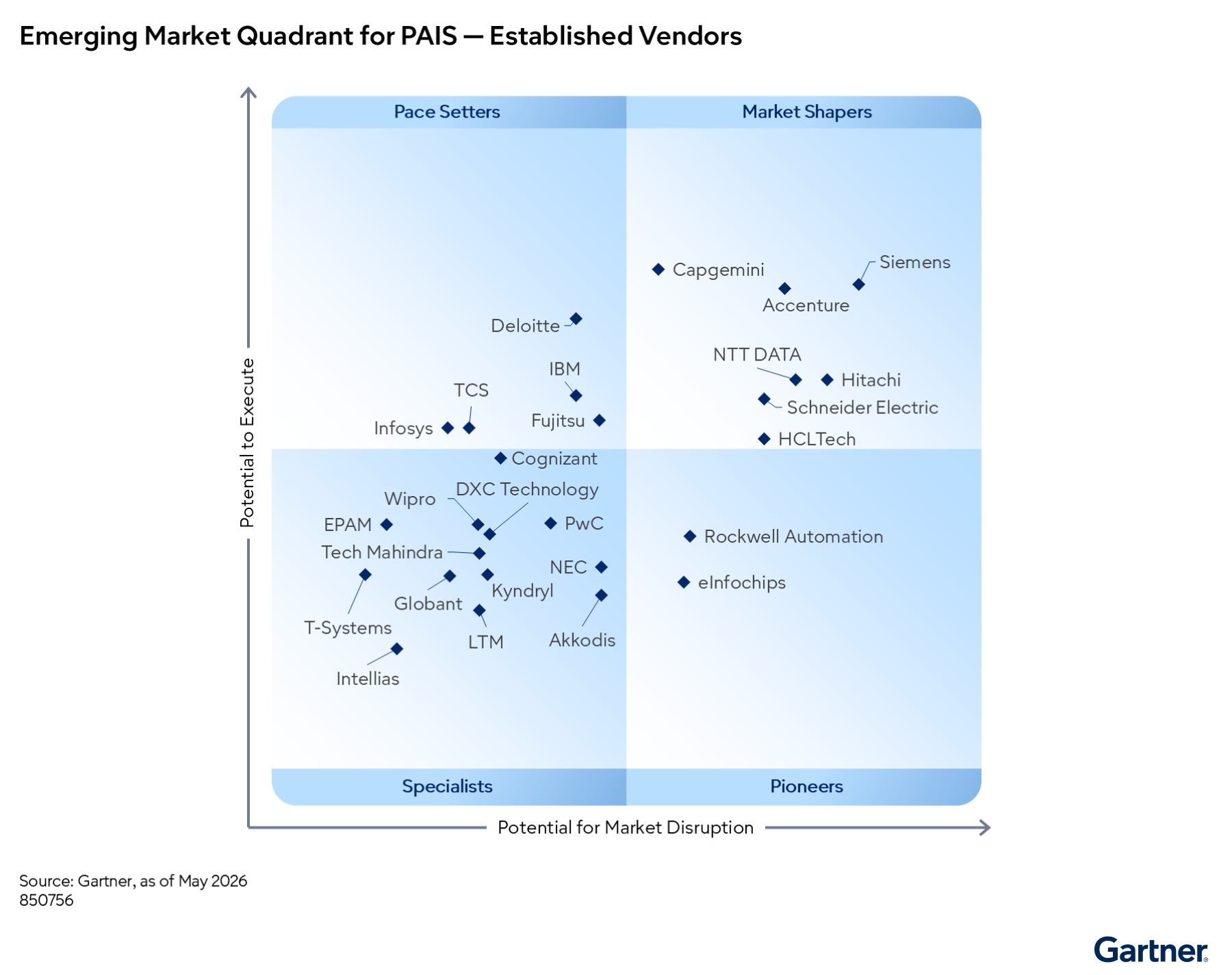
The assessment of this quadrant is based on Gartner’s opinion of the collective characteristics of its featured vendors: Accenture, Capgemini, HCLTech, Hitachi, NTT DATA, Schneider Electric and Siemens.
Analysis of Disruptive Potential
The Market Shapers quadrant represents the vendors most likely to drive disruption in the emerging PAIS market. These vendors have moved beyond experimentation and are beginning to materially redefine how AI operates in physical environments. PAIS offerings found in this quadrant are characterized by their ability to embed AI into continuous operational workflows, transforming AI from a supporting capability into a core component of real-world business execution. These services can help services buyers disrupt traditional operating models by shifting decision authority, optimizing physical processes in real time and redefining the balance between human oversight and machine autonomy. As these models scale, buyers should evaluate PAIS providers based on an ability to increase productivity, resilience and operational agility across industries.
A key driver of disruption is the emergence of end-to-end physical AI life cycle services. Vendors in this quadrant deliver integrated capabilities spanning system design, simulation, integration, deployment and ongoing management. This allows clients to adopt physical AI not as a fragmented set of tools but as a managed operating capability that evolves continuously over time and contributes meaningfully to the client’s own PAIS maturity. By assuming responsibility beyond initial deployment — often extending into ongoing monitoring and optimization — these offerings can potentially reshape client relationships from project-based engagements to long-term operational partnerships. Buyers looking for operate services and continuous improvements should evaluate service providers’ abilities to support longer-term partnerships with proven abilities to deliver value.
Another defining dimension of disruption and a mandatory parameter for buyers to evaluate PAIS providers is the adoption of simulation-first and safety-driven deployment models. PAIS providers in this quadrant treat simulation, digital twins and synthetic environments as foundational to system design that, when done well, enables organizations to test, validate and stress-test autonomous behavior before it is introduced into live environments. This approach is particularly disruptive in safety-critical and regulated industries, where the ability to prove system behavior in advance unlocks use cases that would otherwise be too risky to pursue. Accelerating adoption in a complex operational context requires buyers to stringently evaluate and downselect based on providers’ proven abilities to enable autonomy without compromising safety or compliance.
A third Market Shapers disruption and mandatory evaluation point for buyers to require is the degree to which a provider can support sophisticated integration across fragmented ecosystems and bridge the IT/OT divide. PAIS offerings in this quadrant are beginning to be built to connect AI models, sensors, edge infrastructure and control systems into unified execution environments. This capability, while emerging, is critical in real-world settings where legacy systems, diverse vendors and regulatory constraints create barriers to adoption. Vendors that can reduce this complexity and enable coordinated operation across heterogeneous components will position themselves at the center of ecosystem activity. Buyers should evaluate providers based on actual abilities to influence architectural decisions, partner alignment and long-term strategy.
Analysis of Potential to Execute
The Market Shapers quadrant demonstrates the strongest disruption execution capability in the PAIS market, defined by providers’ abilities to reliably deploy and sustain AI systems in high-stakes, real-world environments. Execution in this quadrant extends beyond successful implementation to include continuous, stable operation under dynamic conditions, such as changing inputs, environmental variability and regulatory requirements. PAIS offerings found here are characterized by their ability to maintain system performance over time while adapting to new data, conditions, complexities and operational constraints. This level of execution maturity is critical in environments where downtime, inconsistency or failure is unacceptable.
A central pillar of execution strength is end-to-end life cycle ownership, including specialized management capabilities for AI systems operating in physical contexts. Vendors in this quadrant provide mechanisms for continuous model validation, retraining, deployment and monitoring, often referred to as physical-world MLOps. These capabilities enable systems to operate in closed loops, where data generated from real-world activity is used to refine future behavior while maintaining adherence to safety and performance constraints. The ability to manage this life cycle at scale ensures physical AI systems remain effective and compliant long after initial deployment, reinforcing trust and operational stability.
Execution is further strengthened by deep expertise in integrating complex hardware and software systems across IT and OT environments. Physical AI requires the seamless interaction of AI models, sensors, edge devices and control systems — often in environments with legacy infrastructure and strict performance requirements. Vendors in the Market Shapers quadrant demonstrate the engineering rigor and system integration capability needed to deliver mission-ready solutions that can operate in real time. This includes managing latency, ensuring precision and maintaining safety under variable conditions. As a result, PAIS in this quadrant are not only technically functional but operationally viable at scale.
Finally, the ability to execute at scale is underpinned by strategic partnering, organizational maturity, resource depth and delivery standardization. Vendors in this quadrant possess the human capital, financial capacity and global delivery infrastructure required to manage large-scale physical AI programs across multiple environments simultaneously. They are also advancing toward more standardized delivery approaches, leveraging reusable architectures and proven implementation patterns to reduce variability and accelerate time to value. This combination of scale, rigor and repeatability ensures execution is not only strong but predictable and scalable, enabling enterprises to adopt physical AI with confidence and position these vendors as the most reliable partners for long-term operational transformation.
Case Example: Autonomous Factory Orchestration
Goal: Enable fully optimized, adaptive manufacturing operations that continuously respond to changing production conditions.
Primary Buyer Personas:
- Chief operations officer (COO)
- Head of manufacturing/plant operations
- Chief digital officer (CDO)
Situation: A global manufacturer operates multiple facilities with siloed systems, manual decision making and limited ability to dynamically adjust production in real time.
Implication: Without integrated autonomy, the organization experiences inefficiencies, downtime and an inability to respond effectively to demand variability or supply disruptions.
Resolution: PAIS offerings in this quadrant deliver end-to-end autonomous factory orchestration by integrating production systems, robotics and operational data into a continuous decision loop across facilities and operations. AI models dynamically optimize scheduling, throughput and resource allocation while digital twins validate changes before execution, ensuring safe deployment. These systems operate continuously at runtime, adjusting production in response to disruptions and learning from real-world data, including dynamic production for factors such as greater demand, more favorable regulations or changing trade policies. This transforms manufacturing from a reactive system into a self-optimizing operating environment, where performance improvements are sustained through ongoing life cycle management and optimization.
Cautions and Risks:
- Vendor dependency risk: Long-term operational ownership can create reliance on the provider for critical production processes.
- Integration complexity: Deep IT/OT integration can expose hidden dependencies in legacy systems, increasing implementation risk and time to value.
Pace Setters: Characterized by Deep Technical Sophistication With Impact in Specific Industries, Domains and/or Client Types
The assessment of this quadrant is based on Gartner’s opinion of the collective characteristics of its featured vendors: Deloitte, Fujitsu, IBM, Infosys and TCS.
Analysis of Disruptive Potential
The Pace Setters quadrant includes vendors that are advancing physical AI capability and adoption but without yet fully redefining operating models at scale. PAIS offerings in this quadrant are characterized by strong technical execution and credible production use, combined with a more measured pace of expansion across industries and ecosystems. These vendors do not yet set market norms in the same way as Market Shapers, but they play a critical role in pushing performance, reliability and domain-specific innovation forward.
Innovation in this quadrant is driven primarily through deep industry transformation rather than horizontal expansion or agnostic offerings. Vendors in the Pace Setters quadrant tend to offer narrowed, informed focus on specific industries, environments or system classes, where they deploy physical AI to meaningfully improve operational performance. This includes environments such as industrial production, infrastructure operations or regulated systems where engineering rigor, safety and precision are paramount. In these contexts, disruption occurs through incremental but meaningful shifts — such as improving throughput, reducing downtime or enabling selective autonomy — rather than wholesale redefinition of operating models.
A distinguishing factor of innovation in this quadrant is the emphasis on simulation-first execution and controlled autonomy progression. PAIS offerings found here often prioritize validation, testing and phased deployment of autonomous behaviors, ensuring systems evolve in alignment with operational and regulatory constraints. This creates a more risk-aware adoption pathway, which can be slower than orchestration-driven approaches but more acceptable in environments where trust is critical. As a result, Pace Setters contribute to market disruption by making physical AI implementable in domains where aggressive autonomy would otherwise stall adoption.
Finally, Pace Setters disrupt by establishing credible, production-ready benchmarks for specific use cases, typically for complex business challenges. This is meaningful because at present, PAIS use cases are overindexing on technical challenges and often in prescale, preoperate states. Buyers of PAIS should downselect vendors based on proven use cases aligned to their priority business challenges. While they may not yet influence the broader ecosystem at scale, Pace Setters’ success in narrowly defined areas sets expectations for performance, safety and reliability. These benchmarks often become the foundation for subsequent scaling efforts, either by these vendors or by others attempting to replicate their approaches. In this way, Pace Setters play a key role in derisking the market and expanding the range of viable physical AI applications.
Analysis of Potential to Execute
The Pace Setters quadrant demonstrates strong execution capability, particularly in environments that require engineering precision, regulatory compliance and system reliability. PAIS offerings in this quadrant are defined by their ability to deliver consistent, production-grade outcomes within constrained domains, even if they are not yet scaled across broader ecosystems or multiple industries.
Execution strength in this quadrant is rooted in disciplined delivery models and technical depth. Vendors in the Pace Setters quadrant typically exhibit robust capabilities in system integration, testing and validation, ensuring physical AI systems perform reliably within defined operational boundaries. These offerings often emphasize predictability over speed, prioritizing stable performance and reduced operational risk over rapid expansion. This approach makes them particularly well-suited to industries where failure tolerance is low and compliance requirements are high.
Another defining aspect of execution is the ability to manage controlled deployment and gradual autonomy progression. PAIS in this quadrant often deploy capabilities incrementally, starting with decision support and progressing toward greater levels of automation and autonomy. This enables organizations to validate system behavior in real-world environments while maintaining oversight and control. Execution success is therefore tied to the ability to balance innovation with operational continuity, ensuring new capabilities can be introduced without disrupting existing systems.
At the organizational level, execution is supported by specialized talent and focused delivery frameworks. While vendors in this quadrant may lack the scale and ecosystem centrality of Market Shapers, they compensate through deep expertise and disciplined methodologies. Their execution is not necessarily the most scalable, but it is highly reliable within its intended scope, making them strong partners for targeted physical AI initiatives.
Case Example: Human-Machine Collaboration in Industrial Operations
Goal: Improve operational efficiency and safety by augmenting human decision making with AI without removing human oversight.
Primary Buyer Personas:
- Head of operations/plant manager
- Chief safety officer
- VP of engineering
Situation: An industrial operator relies heavily on skilled workers to manage complex processes, with limited data-driven support and highly variable decision quality.
Implication: Manual processes result in inconsistent performance, increased error rates and constrained productivity, while full automation introduces unacceptable operational risk.
Resolution: PAIS offerings in this quadrant implement human-machine collaboration systems that provide real-time insights, recommendations and anomaly detection to operators. These systems use sensor data and AI models to guide decision making while maintaining human control and accountability. Simulation and validation environments are used to test AI recommendations before deployment, ensuring safe interaction between humans and machines. Over time, this approach enables incremental progression toward autonomy while maintaining stability, resulting in measurable efficiency gains without compromising safety or trust.
Cautions and Risks:
- Change management risk: Workforce resistance or improper training can limit adoption and reduce the effectiveness of AI-augmented workflows.
- Underrealized ROI: Partial automation may deliver incremental gains but fall short of transformative benefits if not scaled beyond initial use cases.
Pioneers: Characterized by Domain-Specific Innovations and Localized Disruption
The assessment of this quadrant is based on Gartner’s opinion of the collective characteristics of its featured vendors, including eInfochips and Rockwell Automation.
Analysis of Disruptive Potential
The Pioneers quadrant captures vendors that are actively exploring new directions in physical AI, offering differentiated ideas, emerging capabilities and forward-looking use cases but with limited production-scale impact. PAIS offerings in this quadrant are disruptive in concept, but their market influence remains early-stage and unevenly realized. For the buyer, this means these providers can be better aligned to piloting edge use cases and other emerging POCs.
Disruption in this quadrant stems from challenging existing assumptions about how to design and deploy physical AI. Vendors here often experiment with new architectural approaches, domain-specific innovations or novel combinations of AI, robotics and physical systems. These efforts can introduce new and often unique but still one-off solutions for CIOs, expanding the range of possibilities in the market. However, the disruptive potential remains constrained by limited repeatability and inconsistent transition from pilot to production.
Another dimension of disruption is the focus on targeted, high-impact use cases. PAIS in this quadrant often address specific operational challenges — such as mobility systems, infrastructure optimization or specialized industrial processes — with innovative approaches. While these solutions may deliver strong results in isolated contexts, they have not yet been generalized into broader service models. As a result, disruption occurs locally rather than systemically, influencing particular domains without reshaping the wider market.
The long-term disruptive potential of this quadrant is significant, as successful innovations spawned by Pioneers may be adopted or scaled by Market Shapers and/or Pace Setters over time. Pioneers effectively act as experimentation engines, advancing the frontier of what is possible even if they are not yet defining how the market operates today. For buyers, this means the Pioneers quadrant should be understood as a forward-deployed vector that shows where domain-specific innovations are pushing at the edges of disruption.
Analysis of Potential to Execute
The Pioneers quadrant demonstrates emerging execution capability, with strength in innovation and technical exploration but limited consistency at scale. PAIS offerings in this quadrant are capable of delivering successful outcomes in specific engagements, but execution remains variable and context-dependent.
Execution in this quadrant is characterized by project-level success rather than standardized delivery. Vendors often excel in designing and implementing advanced physical AI solutions for individual clients or use cases, particularly where requirements are well-defined and controlled. However, the lack of repeatable delivery frameworks and life cycle management capabilities limits their ability to scale execution across multiple environments.
Another constraint on execution is limited run-phase ownership and operational maturity. PAIS in this quadrant are more likely to focus on development and deployment rather than long-term system operation. As a result, ongoing optimization, monitoring and life cycle governance may be handed off to clients or partners, reducing the vendor’s ability to ensure sustained performance over time.
Despite these limitations, execution capability is supported by technical agility and specialization. Vendors in this quadrant can adapt quickly to new requirements, experiment with novel approaches and deliver tailored solutions. While this agility does not yet translate into scalable execution, it positions Pioneers as important contributors to market evolution, particularly in early-stage or rapidly changing domains.
Case Example: Autonomous Mobility and Fleet Optimization
Goal: Improve transportation efficiency and reduce operating costs through AI-driven fleet optimization and early-stage autonomy.
Primary Buyer Personas:
- Chief supply chain officer (CSCO)
- Head of logistics/transportation
- Innovation or transformation lead
Situation: A logistics provider operates vehicle fleets with limited real-time optimization capabilities and is exploring AI to improve routing, utilization and performance.
Implication: Without advanced optimization, the organization faces inefficiencies in fuel consumption, asset utilization and route planning, limiting cost savings and scalability.
Resolution: PAIS offerings in this quadrant deploy AI models that analyze traffic patterns, demand signals and operational data to optimize routing and fleet utilization in pilot or controlled environments. These systems may enable selective automation of decision making while remaining within well-defined operational boundaries. While not yet fully scalable or standardized, these deployments provide early validation of autonomous capabilities and demonstrate measurable improvements in efficiency. This allows organizations to build confidence in physical AI while gradually expanding its role in operations.
Cautions and Risks:
- Scalability risk: Solutions that perform well in pilots may not translate effectively to full-scale deployment across regions or conditions.
- Uncertain business case: ROI may be difficult to quantify early, creating challenges in securing long-term investment.
Specialists: Characterized by Deep Expertise in Narrowly Defined Areas of Physical AI
The assessment of this quadrant is based on Gartner’s opinion of the collective characteristics of its featured vendors, including Akkodis, Cognizant, DXC Technology, EPAM, Globant, Intellias, Kyndryl, LTM, NEC, PwC, Tech Mahindra, T-Systems and Wipro.
Analysis of Disruptive Potential
The Specialists quadrant represents vendors that bring deep expertise in narrowly defined areas of physical AI, delivering innovative impact within specific domains with less impact to broadly disrupt market structures. PAIS offerings in this quadrant are characterized by focus, precision and specialization, rather than scale or ecosystem reach. This focus and precision makes their value to clients equally anchored to that domain specificity, which buyers should require, evaluate and use as the basis of selection.
Disruption in this quadrant is highly targeted and domain-specific. Vendors introduce improvements in performance, safety or efficiency within particular use cases, such as embedded systems, product engineering or highly specialized operational environments. While these improvements may be significant within their scope, they do not typically extend to broader organizational transformation or cross-industry impact. As a result, innovation is incremental rather than a systemic disruption, enhancing existing processes rather than redefining them.
Another defining trait is the focus on component-level or subsystem innovation. Specialists often contribute to physical AI through specific capabilities — such as device-level intelligence, engineering integration or analytics embedded within products — rather than full end-to-end solutions. These contributions are important enablers of the broader ecosystem, even if they do not independently drive large-scale adoption. However, buyers must recognize that these ecosystem capabilities and solutions will need to be vetted as well.
Over time, the disruptive influence of Specialists may increase indirectly, as their innovations are incorporated into larger solutions delivered by more integrated providers. In this way, they act as building blocks of the ecosystem, shaping capabilities at a granular level rather than at the system level.
Analysis of Potential to Execute
The Specialists quadrant demonstrates reliable execution within tightly defined scopes, supported by focused expertise and well-understood delivery models. PAIS offerings in this quadrant are capable of consistent performance in specific domains, but lack the breadth, integration capability or life cycle ownership required for broader execution at scale.
Execution strength is centered on precision and repeatability within a narrow context. Vendors in this quadrant often have deep expertise in particular technologies, industries or system components, enabling them to deliver high-quality results in those areas. This makes them effective partners for targeted initiatives where specific technical capabilities are required.
However, execution is constrained by limited integration and orchestration capability. Physical AI requires coordination across multiple systems and stakeholders, and vendors in this quadrant do not always operate at that level. As a result, they may sometimes rely on integration by other providers or client organizations to embed their capabilities into larger solutions.
Execution is also limited by less involvement in life cycle management and run-phase operations. While these vendors may deliver successfully within project boundaries, they are less likely to support ongoing system operation, optimization or governance. This restricts their role in long-term physical AI deployments, even if their contributions are critical at specific points in the life cycle.
Overall, Specialists deliver high-confidence execution within their domain but do not yet demonstrate the scale, integration depth or life cycle accountability required to compete with more comprehensive physical AI service providers.
Case Example: Simulation-Driven Validation for Robotics Systems
Goal: Ensure safe, reliable deployment of robotic systems by validating performance before real-world operation.
Primary Buyer Personas:
- Head of engineering/robotics
- Chief technology officer (CTO)
- Head of quality and compliance
Situation: An organization deploying robotics in production requires assurance that systems will perform reliably across a wide range of operating conditions.
Implication: Without rigorous validation, robotic systems may fail in production, leading to safety risks, operational disruption and increased costs.
Resolution: PAIS offerings in this quadrant provide simulation-driven validation environments that model real-world conditions using digital twins and synthetic data. These environments are used to test robotic behaviors, identify edge cases and refine system performance prior to deployment. By focusing on a specific phase of the life cycle, these services enable organizations to derisk implementation and ensure compliance with safety and operational requirements. While not delivering full end-to-end autonomy, they play a critical role in enabling reliable physical AI adoption within larger systems.
Cautions and Risks:
- Limited scope risk: Validation alone does not ensure successful deployment. Additional integration and operational capabilities are required.
- Integration gap risk: Insights from simulation may not fully translate to real-world environments without strong downstream implementation, monitoring and disruption prevention.
Detailed Market Definition
Gartner defines physical AI services (PAIS) as professional and managed services that help organizations plan, design, build, integrate, deploy and operate AI-enabled physical systems. These services support devices or systems such as robots, vehicles and drones that use AI models and sensors to perceive and act in physical environments. PAIS can span strategy, model development, integration, testing and deployment, and ongoing support and maintenance. These services ensure that physical AI systems work safely, meet performance targets and comply with industry and regulatory standards.
Physical AI services address the complex challenge of deploying and managing AI-enabled physical systems — such as mobile robots, autonomous vehicles, ships and drones — in real-world environments. Organizations often lack the specialized expertise, integration capabilities and operational frameworks required to safely and reliably design, build and run these agentic AI systems. Key pain points include ensuring safety, security and compliance; achieving real-time performance and accuracy; integrating advanced AI with physical hardware; and aligning system missions with strategic business outcomes.
Each physical AI use case needs careful design, development, integration and testing. Sites, machines and workflows often differ, so solutions cannot be copied from one location to another. Many organizations do not have the skills to manage this work. They need support to plan investments, prepare facilities, meet safety and regulatory requirements, and keep systems reliable after deployment. PAIS provide the expertise and processes needed to deploy these systems in a consistent and repeatable way. PAIS expertise and processes can reduce the risk of project failure, improve implementation and enable better returns on investment.
Physical AI services deliver tangible outputs including:
- Fully integrated, mission-ready AI-powered devices, sensors and systems that can autonomously perceive, navigate, interact and manipulate objects in dynamic environments
- Safety, reliability and compliance through end-to-end system design, deployment and operational support
- Measurable improvements in productivity, accuracy and cost-efficiency through automation of physical tasks
- Continuous improvement and risk mitigation via digital twins and simulation models
- Real-time data and actionable insights to enable ongoing optimization and alignment with business objectives
By leveraging PAIS, organizations can accelerate digital transformation, realize automation at scale and achieve sustainable competitive advantage.
Mandatory Features
- Skills to use, adapt and orchestrate AI models, including generative models and domain-specific models, for use in physical systems
- Processes and methodologies to manage model training, versioning and deployment for systems that run in physical environments, MLOps
- Systems and adaptive processes to collect and prepare data from sensors and machines, and to create synthetic data when real data is limited
- Comprehensive capabilities for building and using physics-based simulations and digital twins to test system behavior before deployment
Optional Features
Design: Strategy, Conceptualization and Specification Services
- Strategic advisory
- Design and conceptualization services covering:
- Digital twin, world models and intelligent simulation
- Perception and multimodal fusion
- AI model architectures
- Safety-by-design and human-robot design of collaboration interfaces
- Rapid prototyping and iterative development. Running proof-of-concept trials to compare solutions, analyzing performance data to support scalable platform deployment.
- Regulatory and industry standards compliance including certifications and accounting for evolving regulations.
Build: Implementation and Deployment Services
- Deploying and customizing physical platforms, edge and cloud computing infrastructure
- Developing distributed and centralized AI systems
- Integrating advanced analytics, control algorithms and custom interfaces
- Enabling swarm intelligence, fleet management and coordinated task execution
- Monitoring for physical AI cybersecurity vulnerabilities
- Assessing facility and environment readiness
Run: Operation, Optimization and Orchestration Services
- Managed services and fleet orchestration
- Model retraining and safety compliance
- Change management, including standard operating and safety procedures, runbooks and more
- Ecosystem orchestration reaching across technology and industry partners
Contributors
Sushovan Mukhopadhyay