Critical Capabilities for AI Governance Platforms
17 June 2026 - ID G00845612 - 40 min read
By Sumit Agarwal, Lauren Kornutick, and 3 more
AI governance platforms are designed to centrally define, approve and enforce responsible AI policies across AI use cases, applications and agents. AI governance leaders should align their business and functional requirements and identify the optimal solution based on the 13 critical capabilities identified by Gartner.
Overview
Key Findings
- The AI landscape within organizations is diversifying, extending beyond traditional machine learning (ML) models. It now encompasses embedded AI in third-party applications and platforms, internally developed retrieval-augmented generation (RAG) solutions and an imminent AI agent sprawl.
- Organizations are relying more on their business teams to leverage AI assistants and related toolsets. Many teams are also implementing their own solutions using no-code or low-code agentic AI tools.
- Traditional approaches to model risk management (MRM) and governance, risk and compliance (GRC) are no longer adequate for governing AI systems. The rise of self-service AI implementations, combined with dynamic, flexible and action-oriented AI agents, challenges these conventional methods. Additionally, these traditional approaches are slow and often fail to keep up with the rapid pace of AI adoption. They also lack a focus on enabling value and implementing effective usage and cost controls.
Recommendations
- Identify the organization’s primary use case for AI governance. Use these motivations to establish product requirements, then align them with the product’s key strengths.
- Prioritize products that support the purpose, vision and scope for AI initiatives. Factor in the broader AI ecosystem and the pace of new AI deployments during this evaluation.
- Examine the future roadmaps of shortlisted products to assess their potential for growth and innovation.
- Adopt a comprehensive view of the AI technology landscape to identify any additional components needed for effective AI governance.
Strategic Planning Assumptions
- By 2027, AI governance will become a requirement of all sovereign AI laws and regulations worldwide.
- By 2027, AI governance and responsible AI capabilities will be part of 75% of AI platforms, making them the main area of competition.
What You Need to Know
Organizational risk is escalating due to the surge in implementations of AI systems, including models, applications and agents throughout the enterprise, coupled with the drive to empower business users to develop AI-agent-based solutions. This necessitates the urgent implementation of robust AI governance. Similar to other forms of governance frameworks, AI governance requires the involvement of multiple stakeholders and processes to effectively assess and mitigate these risks (see How to Build a Lightweight Organizational Structure for AI Governance for further detail).
Traditional governance approaches, including model risk management and GRC frameworks, are too slow, static and fragmented to keep pace with the volume, velocity and autonomy of modern AI systems. AI governance platforms address this gap by embedding policy enforcement, monitoring and risk controls directly into the runtime and operational flow of AI systems. This enables organizations to move from periodic oversight to continuous control via a unified control plane.
Furthermore, AI governance is a must-have strategic enabler that provides the necessary transparency and accountability to track, measure and optimize AI investments. By systematically monitoring the performance, adherence to business objectives and regulatory compliance of AI initiatives, the governance framework provides clear mechanisms for tracking tangible value generated by AI, while simultaneously controlling and documenting the associated costs.
Analysis
Critical Capabilities Use-Case Graphics
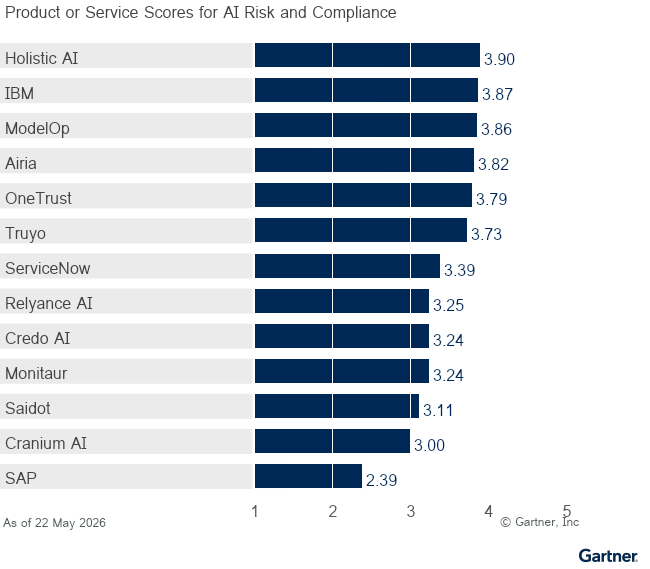
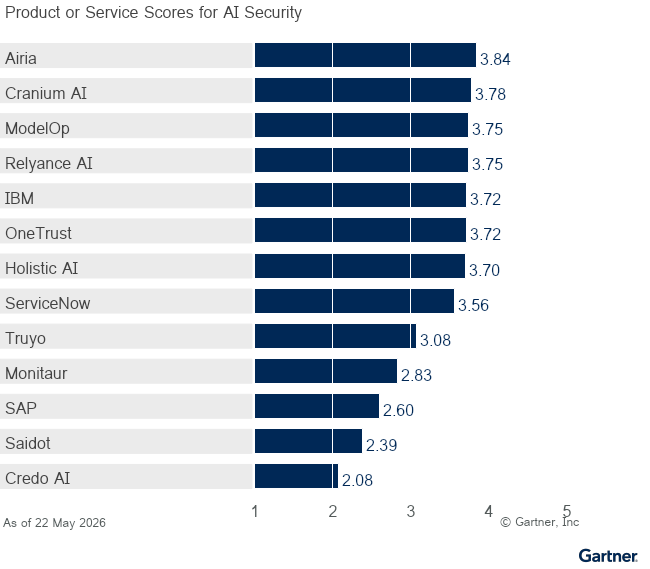
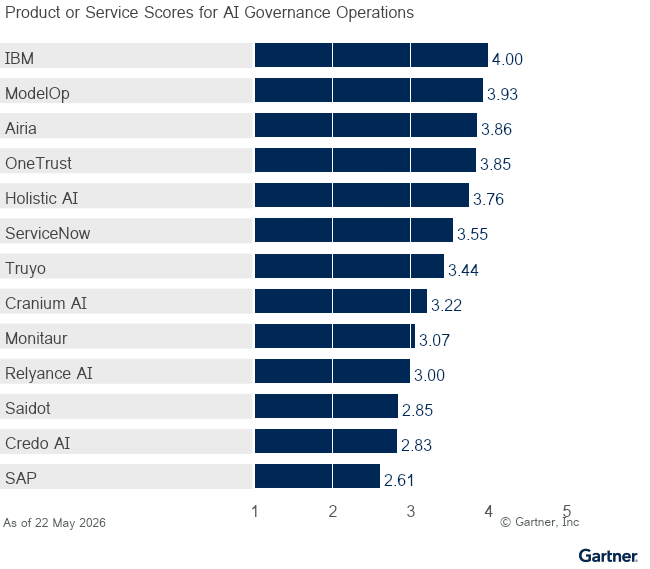
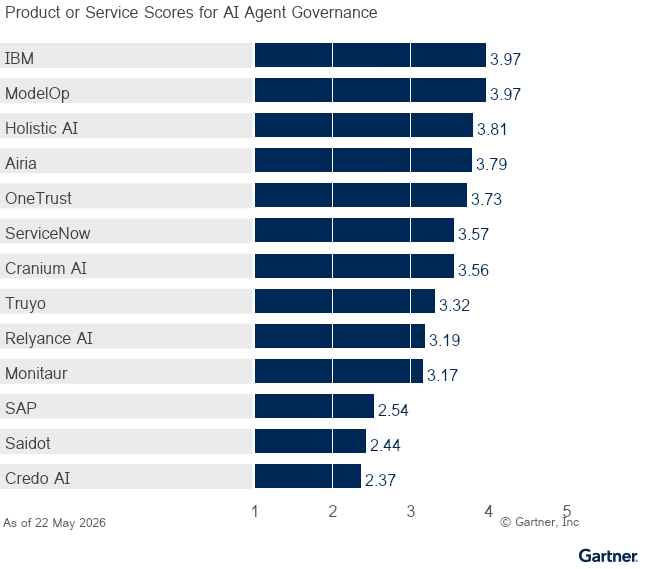
Vendors
Airia
Airia is a cloud-based AI governance platform focused on providing centralized visibility and control across models, applications, tools and AI agents. The platform provides real-time, in-line governance through its Model Context Protocol (MCP) gateway, enabling policy enforcement and monitoring directly at runtime. Airia supports generative AI (GenAI) and agent-based systems and integrates with enterprise security, continuous integration/continuous delivery (CI/CD), MLOps and data platforms. Over the past year, Airia has expanded automated AI discovery, strengthened agent-level guardrails and improved continuous monitoring aligned with the EU AI Act, National Institute of Standards and Technology AI Risk Management Framework (NIST AI RMF) and ISO/IEC 42001.
Airia’s most suitable use case is runtime AI governance for organizations scaling generative and agentic AI. Its approach places governance controls directly in the execution path of AI systems. This enables organizations to detect unmanaged or “shadow” AI, enforce policy dynamically and adapt governance as AI assets change in production.
Airia’s strongest capability is dynamic risk scoring, along with workflow and approvals and audit trail. The platform automatically flags deviations from the initial risk assessment and generated risk narratives. It also provides an immutable audit trail supported by an ability to export the evidence package, along with an AI-assisted use-case intake process and configurable life cycle with stage gates.
Airia’s biggest opportunities for improvement across its critical capabilities are AI value tracking and interoperability. It has limited native capabilities for systematically measuring AI business value, cost efficiency and ROI alongside risk. In addition, broader integration with enterprise GRC, financial management and business analytics platforms may require extra effort. Organizations seeking a unified view of AI risk, value and enterprisewide governance operations may need complementary tooling or custom integrations.
Cranium AI
Cranium AI Security & Governance Platform is deployed as a SaaS subscription model. It includes a range of natively available runtime controls such as prompt injection, jailbreak prevention and sensitive data leakage prevention. Cranium AI Security & Governance Platform features an API-first architecture covering all AI use in the enterprise. It also connects to Anthropic Claude (via API), Amazon Bedrock and Hugging Face models. In the last year, Cranium AI updated its capabilities to include features such as AI red teaming with prompt injection testing, as well as guardrail optimization and adversarial simulation.
Cranium AI’s most suitable use case is AI security. It is particularly well-suited for this because it delivers multilayer AI security through features such as scanning version control system repositories to generate AI bills of materials with common vulnerabilities and exposure vulnerability scoring. Additionally, Cranium AI maps security controls and supports a wide range of integrations, enabling findings to be routed to security information and event management systems, ticketing platforms, and incident response tools. However, this description does not evaluate Cranium AI’s broader AI security capabilities.
The strongest of Cranium AI’s capabilities is dynamic risk scoring along with policy management and enforcement. It provides automated change in risk score over time. Cranium AI differentiates by incorporating automated red teaming to link security to governance. In addition, it provides automation of policy mapping to guardrails.
Its biggest opportunity for improvement across its capabilities is AI value tracking, as it is notably absent from the product. Also, the functionality for evidence collection is integrated with security and vulnerability scans, but limited for AI governance regulatory frameworks and controls.
Credo AI
Credo AI governance platform is deployed as either a SaaS subscription, on-premises subscription or SaaS private cloud. It includes runtime controls such as bias monitoring, prompt injection and jailbreak prevention. Credo AI features an API-first architecture with over 300 representational state transfer (REST) endpoints, a Python software development kit (SDK) and an MCP server. This covers a wide range of AI use case deployments, including GenAI, traditional ML, computer vision and autonomous AI agents. It also integrates with domain-specific tools across the technology stack, including Azure AI Foundry for model registration and evaluations and ServiceNow or Jira for ticketing via webhooks. In the last year, Credo AI updated its capabilities to include Shadow AI Discovery (November 2025), AI Monitoring and Data integrations (December 2025), and the Govern AI Assistant (GAIA; January 2026).
Credo AI governance platform’s most suitable use case is AI risk and compliance. It is particularly well-suited for this because it provides an audit-ready, multientity registry that tracks use cases, models and vendors. The platform features a large number of prebuilt policy packs for global regulations, such as the EU AI Act and NIST AI RMF, and uses the GAIA agent to automate risk classification, control assignment and evidence collection.
The strongest of Credo AI’s capabilities is optimization for compliance workflows. It provides embedded assistive features that act as a force multiplier for the AI governance teams and platform users. Features like GAIA, an AI copilot that supports system registration by extracting metadata from unstructured descriptions, suggesting field values and reviewing questionnaire answers for accuracy, help streamline workflows for nontechnical stakeholders.
Credo AI’s biggest opportunity for improvement across its capabilities is data usage mapping. It does not currently support these features across the AI life cycle, which limits a client’s ability to automate end-to-end data lineage and visualization for collection, training and inference.
Holistic AI
Holistic AI is deployed as SaaS with a private cloud option to accommodate regulated industries. Holistic AI includes a variety of key capabilities, such as policy management, risk management, regulatory intelligence and monitoring. The Holistic AI governance platform features an open API architecture that supports proprietary, open-source and third-party AI models. It also integrates with major MLOps platforms, cloud services, GRC tools and enterprise risk management systems. In the last year, Holistic AI updated its capabilities to include runtime enforcement for agentic AI systems, shadow AI detection and automated policy enforcement.
Holistic AI’s most suitable use case is AI risk and compliance. It is particularly well-suited for this because it provides a centralized hub to discover all AI systems, including shadow AI, and automatically maps them against regulatory frameworks or enterprise-defined policies to generate audit-ready evidence.
The strongest of Holistic AI’s capabilities is AI discovery and registry. It provides a real-time, automated inventory of an organization’s entire AI estate, including what the AI is using. This includes models, AI use cases, agents and APIs. Holistic AI achieves this task by scanning cloud environments and code repositories to identify shadow AI. This is critical for clients, as it replaces manual processes with a “living” source of truth that automatically captures metadata (such as risk classifications) and maps them against regulatory obligations. Utilizing autonomous Sentinel Agents, the platform provides continuous oversight and policy enforcement across complex AI ecosystems without manual intervention.
Its biggest opportunity for improvement across its capabilities is AI value tracking, as it lacks the comprehensive functionality to measure and manage the tangible business impact and ROI of AI initiatives. While the platform excels in technical and regulatory oversight, the absence of native value-tracking features makes it difficult for clients to visualize how their AI investments align with strategic organizational goals. This gap forces users to rely on external tools to bridge the accountability divide between IT delivery and actual realized business value, which is critical for securing ongoing executive buy-in and funding.
IBM
IBM watsonx.governance is delivered via SaaS, on-premises and hybrid deployments, and is designed for large enterprises operating in regulated environments. The platform provides centralized AI life cycle oversight spanning inventory, risk and compliance management and policy enforcement. It supports traditional ML, GenAI and agent-based AI and embeds IBM OpenPages GRC and security ecosystems. Recent enhancements include expanded regulatory mappings (e.g., EU AI Act, NIST AI RMF and ISO/IEC 42001) and stronger centralized inventory and lineage capabilities.
IBM watsonx.governance’s most suitable use case is enterprise AI agent governance for organizations that prioritize AI governance operations (including AI agents), as it applies governance controls and visibility across the entire AI life cycle. It is particularly well-suited for this use case because it allows organizations to standardize and implement the AI process end-to-end across AI models and AI agents.
The strongest of IBM’s capabilities are audit trail and AI value tracking. It offers comprehensive traceability by capturing drift, bias and other performance metrics, along with maintaining immutable audit logs. Additionally, IBM enables organizations to track ROI and operational KPIs, which are essential for justifying AI investments and extending AI governance programs from being solely risk-focused to actively enabling AI implementations.
IBM’s biggest opportunity for improvement across its capabilities is AI discovery and registry. While the platform provides a unified version-aware inventory with partial automation, it leverages the Guardium AI Security product for shadow AI detection, which limits its effectiveness as a single continuous AI discovery and registry tool.
ModelOp
ModelOp Center is primarily deployed as an on-premises or cloud marketplace solution; the vendor does not offer a public SaaS option. It provides AI inventory visibility and enforcement throughout the life cycle of an AI solution . It embeds AI governance into the life cycle from intake to retirement while assessing risk, applying controls, and tracking usage, cost and value, among other functionalities. It also integrates with AI development, AI execution, data platforms, IT service management (ITSM), CI/CD, GRC, procurement, architecture and security systems. In the last year, ModelOp updated its capabilities to include the Notifier “Reminder” Service and new Monitoring Execution Runtime.
ModelOp’s most suitable use case is AI agent governance. It governs agents with the same inventory, life cycle automation, risk assessments, control mapping, approvals, monitoring and evidence capabilities applied for all AI types, while linking use cases to models, assets, tools and solutions for full traceability.
The strongest of ModelOp’s capabilities is audit trail. The platform’s audit trail is based on a continuous and dynamic system of record for each AI use case. ModelOp’s life cycle automation and workflow engine continuously logs evidence of decisions, controls, approvals, evidence, changes and runtime outcomes connected to each use case, model, agent and business process.
Its biggest opportunity for improvement across its capabilities is ease of implementation, as the average time for a customer to set up ModelOp’s capabilities is 13 weeks. During implementation, customers typically require configuration tailored to their organization, which increases timelines. Key configuration areas include governance processes and policies, model data integration, and role-based access.
Monitaur
Monitaur’s AI governance platform is deployed as a SaaS subscription or hybrid model. It includes key runtime monitoring and enforcement controls for bias, agent and model observability via Monitaur’s FlightSim and Automate Record. Monitaur features an API-first architecture that supports any AI deployment in the organization. It also integrates with Amazon Web Services (AWS) Bedrock, AWS Bedrock AgentCore, Google Cloud Model Armor and Microsoft Azure AI Foundry. In the last year, Monitaur updated its capabilities to include AWS AgentCore and Bedrock integrations with FlightSim support, risk quantification foundation and third-party vendor governance.
Monitaur’s AI governance platform’s most suitable use case is AI risk and compliance. It is particularly well-suited for this because its product is built around organizational AI policy to define, manage and mitigate risks associated with AI use. The platform features a control library that has been mapped into regulations, standards and Monitaur’s policy templates. Monitaur also can apply these controls and guardrails centrally and enforce them at runtime.
The strongest of Monitaur’s capabilities is workflow and approvals. The platform provides assurance that only AI use that is within the organization’s policy is approved for deployment and automates the risk assessment process. Monitaur’s objective runtime policy enforcements and validations can satisfy work expected from the first- and second-line teams. Furthermore, when Monitaur Automate is used to satisfy a Monitaur Governance control, clients can achieve automated approvals.
Its biggest opportunity for improvement across its capabilities is AI value tracking, as its product’s ability to track ROI and cost is limited given the product’s focus on AI risk and compliance. The capability is mostly available via integration with tools such as AWS Bedrock, AWS AgentCore, Azure AI Foundry and Google Cloud Model Armor to configure governance-specified rate limit or cost controls.
OneTrust
OneTrust AI Governance is delivered as a SaaS platform and extends OneTrust’s established privacy, risk and compliance capabilities into AI-specific governance. It gives organizations a central place to manage AI systems, with features like automated AI inventories, risk classification, assessments, policy management, approvals and runtime controls. The platform supports traditional ML, GenAI and agent-based AI and integrates with common enterprise GRC, privacy, security, CI/CD and data tools. It also includes ready-made regulatory mappings and regularly updated policy content for frameworks such as the EU AI Act, NIST AI RMF and ISO/IEC 42001. In the last year, OneTrust has added native policy management and runtime enforcements.
OneTrust’s most suitable use case is AI governance operations for enterprise AI governance teams that need structured workflows, strong auditability and regulator-ready assurance. It works especially well for organizations with mature GRC operating models, where AI intake, review, approval and monitoring need to scale across a large and distributed AI portfolio.
OneTrust’s strongest capabilities are workflow and approvals, audit trail and evidence collection. It delivers end-to-end governance workflows with configurable approval paths and thorough evidence capture across assessments, validations and decisions. Its immutable audit trails and exportable documentation support audits and regulatory reporting, making it a good fit for organizations that need defensible and repeatable governance processes.
The biggest opportunities for improvement across its capabilities are ease of implementation and business-friendly user experience (UX). Deployments can be configuration-heavy and often require coordination across multiple teams, which can slow time to value for less mature organizations.
Relyance AI
Relyance AI offers SaaS, on-premises and hybrid deployment options. It integrates privacy and AI security with AI governance capabilities. It also integrates with data governance platforms. In the last year, Relyance AI updated its capabilities to include features such as discovery and classification with AI data exposure coverage; model, vendor AI and AI agent/MCP server discovery for governance; and flow visualization across systems, vendors and AI assets.
Relyance AI’s most suitable use case is AI security. The product takes a data centered approach to AI-native security with a focus on data protection by detecting risks such as data leakage, prompt injection exposure, overprivileged nonhuman identities, and insecure model and data flows.
The strongest of Relyance AI’s capabilities is data usage mapping. It captures compliance evidence from live runtime behavior across data stores, identity providers and cloud platforms. Evidence is generated automatically from ongoing policy evaluations, meaning no manual collection or upload is required.
Its biggest opportunity for improvement across its capabilities is AI value tracking, as it does not provide functionality to track the outcomes of deployed AI use cases. Additionally, Relyance AI does not provide end-to-end intake/deployment approval workflows and reports no telemetry for drift, bias, toxicity, performance or cost.
Saidot
Saidot is deployed as a SaaS service and all associated data is hosted exclusively in the EU. It provides a framework for managing risk and compliance, while determining required controls It also integrates with REST API for full read/write access, in addition to MCP servers for agentic integration and direct integrations to Azure, AWS and Google. In the last year, Saidot updated its capabilities to include a product library, EntraID and Google IdP authorization, Azure evaluation integration, and an extended agent catalog. Saidat integrates with AI development platforms as well as Claude Desktop, VS Code (Copilot), Cursor, and command-line client for CI/CD and automation pipelines.
Saidot’s most suitable use case is AI risk and compliance, because it addresses all major elements of the risk management life cycle via agents. Users can address life cycle approval integrations via REST API, webhooks and MCP servers, and can programmatically update system status, submit evidence and trigger reviews from CI/CD pipelines. Additionally, the product addresses frameworks such as the EU AI Act, NIST AI RMF and ISO/IEC 42001 via native regulatory intelligence. It autonomously propagates controls derived from these and other frameworks to all relevant AI systems, with evidence that can be reused across similar frameworks.
The strongest of Saidot’s capabilities is workflow and approvals. In addition to standard workflow capability, it utilizes agents to automate routine governance tasks such as life cycle approvals, risk and control approvals, risk classification, policy application, risk identification, control assignment, transparency reporting, and evidence bundle creation.
Its biggest opportunity for improvement across its capabilities is AI value tracking. Although cost and rate limit can be tracked via custom fields in the Saidot Graph, Saidot does not offer any native capability to track cost of tokens via telemetry at runtime.
SAP
SAP AI Agent Hub is deployed as an independent SaaS solution that is also available as part of LeanIX. It includes a “single pane of glass” view that connects the AI inventory to business capabilities and process execution data, structured in fact sheets with relationships, hierarchy and native discovery within SAP and non-SAP environments. SAP AI Agent Hub features an API-first architecture supporting AI agents within SAP, but can extend to any other AI model, agent or use case in the enterprise. It also applies enforcement for MCP servers through the unique “Verification” status via the SAP Integration Suite and for agents’ access to SAP applications through the SAP Cloud Identity Services. In the last year, SAP added inventory features, managed AI model deployments and agent discovery for SAP, Google and Microsoft. In March 2026, automated discovery was extended to MCP servers (via Azure API Center), large language models (LLMs) on SAP AI Core across SAP BTP, and agents built on Bedrock and Bedrock AgentCore.
SAP’s AI Agent Hub’s most suitable use case is AI governance operations. It is particularly well-suited for this within the SAP environment because it puts business capabilities and processes (managed in Signavio) first by connecting the AI use case to a business purpose and linking to the underlying data.
The strongest of SAP’s capabilities is the business-friendly user experience. It provides native AI enhancements such as SAP Joule to improve end-user experience, a native natural language search and interactive tutorials. SAP provides good business process-centric UX, but has weaknesses on an end-to-end UX.
Its biggest opportunity for improvement across its capabilities is compliance risk management. The platform has significant gaps that restrict clients from conducting dynamic risk scoring and autonomously updating packaged controls based on regulations, frameworks and standards.
ServiceNow
ServiceNow is available as SaaS, hybrid and multicloud deployment with multimodel options.. AI Control Tower provides an operational hub for AI governance, risk and controls assessment, security, privacy, and value tracking across governed AI systems. It includes Now Assist Guardian for configurable guardrails covering offensive content, prompt injection and sensitive topics. ServiceNow’s AI control and governance solution features an API-first core architecture, supporting any enterprise AI use case. It uses a REST API for custom integrations, includes over 200 prebuilt Integration Hub connectors, supports A2A protocols and integrates with AI gateways via an MCP server. Recent updates include a core AI asset inventory in a configuration management database (CMDB), basic life cycle management, a risk and compliance framework and a Value tab (May 2025). It also introduced A2A and MCP support in 3Q25, followed by observability, evaluations, an AI-native packaging model (1Q26), and hyperscaler connectors to AWS, Azure and Google Cloud AI Gateway.
ServiceNow’s most suitable use case is AI security. It is particularly well-suited for this because it builds upon the organization’s ITSM, CMDB and GRC workflow processes by extending them to an AI inventory. It also combines cyber GRC processes and connects them to real-time monitoring and policy enforcement of key assets within the AI inventory.
Core to its primary business, the strongest of ServiceNow’s capabilities is workflow and approvals. It automates and customizes end-to-end life cycle playbooks that address AI intake, risk assessment, multipersona review, architecture review board stages, executive approvals, structured signoff and attestation. This helps ensure organizational accountability for AI use.
Its biggest opportunity for improvement across its capabilities is ease of implementation, based on its average implementation time frame of 12 to 16 weeks. While the ability to provide configurable workflows and integration is valued to manage the complexity of large enterprises, a long implementation time frame cannot keep pace with rapid AI deployment and adoption.
Truyo
Truyo’s AI governance platform is available through SaaS, on-premises and hybrid deployments. It includes a range of runtime controls including bias monitoring, rate limiting, cost controls and agent decision-making logic. Truyo features an API-first access to AI inventory, risk, policy and evidence data that supports integration with GRC platforms, data catalogs, workflow tools and business intelligence solutions. It also integrates with tools from across the technology stack, including data platforms, MLOps tools, and ITSM and ticketing systems.
Truyo’s most suitable use case is AI risk and compliance. It supports ongoing monitoring, regulatory change tracking, reassessment triggers and governance workflows to demonstrate compliance, accountability and risk mitigation across the AI life cycle. It also is grounded in data privacy and protection, and enables connection with tools and workflows that address those processes.
The strongest of Truyo’s capabilities is workflows and approvals, along with compliance risk management. It provides role-based, configurable workflows to manage AI intake, review, approval, mitigation and oversight. These workflows route AI use cases to the appropriate governance bodies or approvers based on factors including risk level, regulatory applicability and policy requirements.
Its biggest opportunity for improvement across its capabilities is AI value tracking, as the product lacks functionality to track value attributed to an AI use case. Although the product is grounded in data protection, it is slower to adapt to AI value tracking and cost governance and should be avoided by end users who prioritize this feature.
Context
The AI governance platform market is emerging and can be challenging for buyers to navigate. With over 100 vendors marketing AI governance capabilities, evaluating options can quickly become overwhelming. While most vendors position their solutions as AI governance platforms, the reality is that given the nascent state of the market, few products meet the comprehensive needs of enterprise-level AI governance leaders.
This document serves as a companion to the Magic Quadrant for AI Governance Platforms. It includes an evaluation of platforms based on four distinct use cases and 13 critical capabilities. The use cases illustrate scenarios or objectives that drive the organization’s adoption of an AI governance platform, while the capabilities outline the key functional requirements that organizations should consider.
The focus of this Critical Capabilities research is on the functionality of the products in specific governance scenarios. However, the weights of each capability can be modified to suit an organization’s specific needs and priorities in the interactive version of this report. Organizations should use this Critical Capabilities research in conjunction with the Magic Quadrant, along with inquiries with Gartner analysts and other Gartner research, to define their requirements and select the solutions that match their needs.
Market Definition
Gartner defines AI governance platforms as tools designed to ensure organizations comply with their responsible AI practices, organization policy, regulations, and other risk management frameworks/industry standards. They enable AI leaders and other leaders to streamline AI governance processes organizationwide and are a central repository that links trust, risk and security runtime controls for AI systems and third-party AI usage. They automate workflow approvals for new AI use cases, applications and agents, and support risk-based, real-time execution of responsible AI guardrails.
AI governance platforms (AIGPs) are tailored to the organization’s AI governance leader. This leader is responsible for setting internal governance policy across common responsible AI principles (RAI) and accountable for providing corporate assurance that policy rules that can be translated to technical controls are enforced at runtime. AIGPs serve a wide range of assets built using multiple AI techniques and must be able to support any AI use case. AIGPs must be interoperable across the organization’s technology and data stack as well as domain-specific tools addressing operational execution of governance policy.
AIGPs tie the corporate oversight and application of AI governance policy to real-time execution of these requirements for responsible AI practices across AI systems and third-party AI usage in the organization. These platforms automate governance policy, and manage and report on AI risks and acceptable use adherence in the enterprise across all forms of AI. They serve as oversight systems that continuously manage, implement and enforce the necessary trust, risk and security controls (e.g., data and model guardrails). This aligns with requirements to demonstrate that the organization has implemented and is governing all AI use cases, including agents and third-party applications or models.
AIGP tools facilitate the ongoing AI use-case risk assessment and approval process for AI systems, such as models, applications or agents, and streamline information exchange with AI governance stakeholders. They incorporate real-time observability and responsible AI policy guardrail enforcement along with audit trails.
An AIGP serves as a central repository for continuous monitoring and policy enforcement from AI governance rules that cover corporate responsible AI policy, regulations, frameworks and standards. It also has the ability to capture data and/or metadata from more than one of the following operational governance categories: acceptable use, identity and other organization-level security policies; observability; and data governance. AIGPs must have policy engines (e.g., prepackaged rules and/or models) to adhere to common regulations (e.g., EU AI Act), frameworks and standards, such as NIST AI RMF and ISO 420001, with the option to customize rules for corporate policy and apply enforcement at runtime.
Mandatory Features
- AI discovery and registry: Provides a centralized, discoverable registry of all AI use cases and AI services like SaaS with embedded AI that can support multiple use cases. These use cases include applications, agents and models within the organization, including version history, metadata (purpose, data sources, algorithms), documentation (e.g., model cards or systems cards, agentic decision logic), ownership, development stage and deployment status.
- Compliance risk management: Catalogs the risks applied to AI applications, agents, models or use cases. The ability to classify, assess and mitigate AI-specific risks (bias, fairness, robustness, etc.), including content libraries that address unique laws for AI and data protection (e.g., EU AI Act, GDPR), frameworks (e.g., NIST AI RMF) and standards (e.g., ISO 42001), as well as address compliance and decision making with organizational AI policy, such as acceptable use and common RAI principles of accountability, fairness, explainability, transparency, and security and safety.
- Policy management and enforcement: Provides centralized, automated management and enforcement of AI-specific policies via multiple guardrails, including control validation for AI-specific risks (e.g., bias, data leakage, trust, privacy, security), access controls, use-case alignment and other enterprise policies, remediation recommendations, and compliance reporting.
- Dynamic risk scoring: Enables model builders or AI agent, application or use-case product owners to continuously monitor, understand and diagnose the performance and behavior of AI models, applications and agents in production. This enables stakeholders to understand why an AI system behaves a certain way through explainability techniques. This includes providing alerts, dashboards and historical trend analysis to ensure that AI systems remain accurate, reliable and compliant over time.
- Evidence collection: Provides documentation for trust, risk and security assessments, testing and validation results (such as security, bias detection, and model), and risk and compliance remediation evidence.
- Interoperability: Enables different systems, devices, applications or agents to exchange and utilize information effectively.
- Workflow and approvals: Enables the automation of routine governance tasks such as a new AI use-case model, application or agent approval by a governing body; risk and security assessments internal to the organization or with third parties; approvals; testing procedures; and documentation generation and feedback loop from detection to remediation. Facilitates communication and coordinated action among diverse stakeholders. Includes structured signoff, attestation and approval requirements.
- Audit trail: Provides comprehensive audit trails of actions taken in the platform and, where applicable, automatically logs all activities related to the AI life cycle.
Optional Features
- AI usage reporting: Automates the generation of standardized documentation for AI models and use (e.g., model cards, datasheets) for auditors, regulators, and so on. Reporting should include the ability to customize dashboards for end users in nontechnical roles and the ability to observe monitoring in real time.
- Data usage mapping: Captures data mapping used by various AI entities and tracks use and misuse over time. This may also include the ability to track the provenance of training data and interface with data governance platforms to include data lineage, classification, ownership and data observability information. This feature can be captured via the AI governance platform directly or via interoperability with a D&A governance platform or similar technology solution.
- AI value tracking: AIGPs capture the use-case requirements and the expected business value or other nonfinancial KPIs (such as usage or hours saved). AIGPs may extend their observability capabilities to keep track of the outcomes and the associated value to enable a single organizational view of the value achievement. AIGPs may be interoperable with tools that govern spend.
- Business-friendly user experience: Enables targeted users to easily navigate and use the tool to complete their tasks without the need to consult with product subject matter experts (SMEs) or technical staff. This could be interpreted at minimum to mean that the majority of users will not revert back to tools such as spreadsheets after using the tool and/or including visualization capabilities in the user experience (UX).
- Ease of implementation: Allows users to quickly adopt a new instance of the tool to support AI governance activities without the need to heavily customize off-the-shelf templates/prebuilt workflows or make changes to the underlying data model. This could include how-to guides, AI agents or easy plug-ins to implement the tool.
Product/Service Trends
The market for AI governance platforms (AIGPs) is undergoing significant transformation, driven by innovations and the growing adoption of AI technologies. Key factors include the rise of AI agents, embedded AI in third-party products, continuous improvements to LLMs and the self-service implementation of AI agents. These changes are simultaneously raising concerns over implementation cost and whether organizations will achieve the expected value realization.
Collectively, these factors are contributing to the following market trends:
- Market evolution and consolidation: In the next two years, the AIGP market is expected to undergo consolidation as startups are acquired by vendors in adjacent markets such as AI security and GRC to close product gaps as evidenced by acquisitions in this space that have already occurred. Furthermore, AIGPs will need to evolve to comprehensively manage AI cost and agent sprawl, which will become primary drivers for platform adoption.
- AI agent governance will force continued consolidation with AI security: Agents operating without policy enforcement and in-line blocking of unwanted activity can cause irreversible harm for organizations. For AI governance to be effective, security and governance controls that address behavioral anomaly detection and in-line blocking, dynamic least-privilege access enforcement and multiagent trust chain verification will fully converge in the next two years for agents.
- Rise of guardian agents: AIGPs will increasingly focus on decision governance and situational awareness to support complex agentic use cases. This includes introducing guardian agents — AI-based governance workflows that will continuously monitor baseline context and execute real-time insights via multitiered evaluations to safely oversee autonomous decision making.
- Decision governance for autonomous agents: As AI agent use cases become more integrated into enterprise ecosystems, aligning AI intent with outcomes through “decision governance” will be critical.
- Regulatory requirements: Navigating new and complex regulations like the EU AI Act and emerging U.S. state regulations like the Colorado AI Act is a major driver for AIGP investment. Furthermore, as AI incidents become mainstream and tracked in databases organizations are seeking AIGPs to prevent reputational damage and satisfy underwriters who increasingly require robust AI controls to provide cyber and AI liability insurance.
- Distinction from cybersecurity and data tools: While cybersecurity tools will continue to focus broadly on all AI use, in the future, AIGPs will clearly distinguish themselves by targeting high-risk deployments, enforcing responsible AI policies that include security use cases and managing high risk, high-value or consequential agents. Additionally, data-centric AIGPs (DAGPs) are expected to emerge to prioritize controlling the provenance of data throughout an organization.
- Sovereign AI: Sovereign AI is becoming a top priority for executives and is influencing technology decisions amid ongoing regulatory uncertainty in various regions. AIGPs will evolve to apply additional regulatory resiliency to the various AI technology decisions, including data to ensure adherence to the necessary standards.
Critical Capabilities Definition
AI Discovery and Registry
Provides a centralized, discoverable registry of all AI use cases and AI services like SaaS with embedded AI that can support multiple use cases.
Supported use cases include applications, agents and models within the organization, including version history, metadata (purpose, data sources, algorithms), documentation (e.g., model cards or systems cards, agentic decision logic), ownership, development stage and deployment status.
Compliance Risk Management
Catalogs risk applied to AI applications, agents, models or use cases.
This includes the ability to classify, assess and mitigate AI-specific risks (bias, fairness, robustness, etc.), including content libraries that address unique laws for AI and data protection (e.g., EU AI Act, GDPR), frameworks (e.g., NIST AI RMF) and standards (e.g., ISO 42001), as well as address compliance and decision making with organization AI policy, such as acceptable use and common RAI principles of accountability, fairness, explainability, transparency and security and safety.
Policy Management and Enforcement
Provides centralized, automated management and enforcement of AI-specific policies via multiple guardrails.
This includes control validation for AI-specific risks (e.g., bias, data leakage, trust, privacy, security), access controls, use case alignment and other enterprise policies, remediation recommendations and compliance reporting.
Dynamic Risk Scoring
Enables model builders or AI agent, application or use-case product owners to continuously monitor, understand and diagnose the performance and behavior of AI models, applications and agents in production.
This enables stakeholders to understand why an AI system behaves a certain way through explainability techniques. It includes providing alerts, dashboards and historical trend analysis to ensure AI systems remain accurate, reliable and compliant over time.
Evidence Collection
Provides documentation for trust, risk and security assessments, testing and validation results (such as security, bias detection and model) and risk and compliance remediation evidence.
Interoperability
Enables different systems, devices, applications or agents to exchange and utilize information effectively.
Workflow and Approvals
Enables the automation of routine governance tasks.
These tasks may includea new AI use-case model, application or agent approval by a governing body; risk and security assessments internal to the organization or with third parties; approvals; testing procedures; and documentation generation and feedback loop from detection to remediation. Facilitates communication and coordinated action among diverse stakeholders. Includes structured signoff, attestation and approval requirements.
Audit Trail
Provides comprehensive audit trails of actions taken in the platform and, where applicable, automatically logs all activities related to the AI life cycle.
AI Usage Reporting
Automates the generation of standardized documentation for AI models and use (e.g., model cards, datasheets) for auditors, regulators, and so on. Reporting should include the ability to customize dashboards for end users in nontechnical roles and the ability to observe monitoring in real time.
Data Usage Mapping
Captures data mapping used by various AI entities and tracks the usage and misuse over time.
This may also include the ability to track the provenance of training data and interface with data governance platforms to include data lineage, classification, ownership and data observability information. This feature can be captured via the AI governance platform directly or via interoperability with a D&A governance platform or similar technology solution.
AI Value Tracking
Captures the use-case requirements and the expected business value or other nonfinancial KPIs (such as usage or hours saved).
AIGPs may extend their observability capabilities to keep track of the outcomes and the associated value to enable a single organizational view of the value achievement. AIGPs may be interoperable with tools that govern spending.
Business-Friendly User Experience
Enables targeted users to easily navigate and use the tool to complete their tasks without the need to consult with product subject matter experts (SMEs) or technical staff.
This could be interpreted at minimum to mean that the majority of users will not revert back to tools such as spreadsheets after using the tool and/or including visualization capabilities in the UX.
Ease of Implementation
Allows users to quickly adopt a new instance of the tool to support AI governance activities without the need to heavily customize off-the-shelf templates/prebuilt workflows or make changes to the underlying data model.
This could include how-to guides, AI agents or easy plug-ins to implement the tool.
Use Cases
AI Risk and Compliance
Assessing and managing risks associated with AI use cases and ensuring compliance with organization AI policy and associated relevant regulations, frameworks and standards.
AI Security
Integrating AI security functionalities such as access controls, security guardrails and vulnerability assessments, in connection with the other core AI governance activities.
AI Governance Operations
Runtime assessment and enforcement of the established AI governance controls and AI value measurement.
AI Agent Governance
Drive the oversight and control of AI agents.
Vendors Added and Dropped
We review and adjust our inclusion criteria for Critical Capabilities as markets change. As a result of these adjustments, the mix of vendors in any Critical Capability may change over time. A vendor’s appearance in a Critical Capability one year and not the next does not necessarily indicate that we have changed our opinion of that vendor. It may be a reflection of a change in the market and, therefore, changed inclusion criteria or of a change of focus by that vendor.
This is the inaugural publication of this research. Therefore, no vendors have been dropped.
Inclusion and Exclusion Criteria
Weighting for Critical Capabilities in Use Cases
| Critical Capabilities | AI Risk and Compliance | AI Security | AI Governance Operations | AI Agent Governance |
|---|---|---|---|---|
AI Discovery and Registry | 20% | 15% | 10% | 15% |
Compliance Risk Management | 30% | 0% | 10% | 5% |
Policy Management and Enforcement | 5% | 30% | 10% | 30% |
Dynamic Risk Scoring | 5% | 5% | 10% | 5% |
Evidence Collection | 10% | 5% | 10% | 5% |
Interoperability | 5% | 5% | 10% | 15% |
Workflow and Approvals | 5% | 0% | 10% | 0% |
Audit Trail | 5% | 0% | 10% | 10% |
AI Usage Reporting | 5% | 15% | 5% | 5% |
Data Usage Mapping | 5% | 25% | 5% | 5% |
AI Value Tracking | 0% | 0% | 5% | 5% |
Business-Friendly User Experience | 3% | 0% | 3% | 0% |
Ease of Implementation | 2% | 0% | 2% | 0% |
As of 22 May 2026 | ||||
Source: Gartner (June 2026)
This methodology requires analysts to identify the critical capabilities for a class of products/services. Each capability is then weighed in terms of its relative importance for specific product/service use cases.
Critical Capabilities Rating
Table 3 shows the product/service scores for each use case. The scores, which are generated by multiplying the use-case weightings by the product/service ratings, summarize how well the critical capabilities are met for each use case.
To determine an overall score for each product/service in the use cases, multiply the ratings in Table 2 by the weightings shown in Table 1
Product/Service Rating on Critical Capabilities
| Critical Capabilities | Airia | Cranium AI | Credo AI | Holistic AI | IBM | ModelOp | Monitaur | OneTrust | Relyance AI | Saidot | SAP | ServiceNow | Truyo |
|---|---|---|---|---|---|---|---|---|---|---|---|---|---|
AI Discovery and Registry | 4.1 | 2.9 | 3.8 | 4.6 | 3.0 | 3.8 | 3.1 | 3.8 | 3.7 | 2.9 | 2.9 | 3.7 | 4.0 |
Compliance Risk Management | 3.5 | 2.4 | 3.8 | 3.6 | 4.2 | 3.9 | 3.8 | 3.7 | 3.1 | 3.5 | 1.4 | 2.7 | 4.2 |
Policy Management and Enforcement | 3.9 | 4.4 | 1.3 | 4.1 | 4.2 | 4.1 | 3.7 | 3.2 | 3.2 | 1.5 | 1.9 | 3.6 | 3.4 |
Dynamic Risk Scoring | 4.3 | 4.5 | 3.3 | 4.2 | 4.2 | 4.0 | 2.3 | 3.9 | 3.6 | 1.7 | 2.0 | 3.8 | 3.6 |
Evidence Collection | 3.7 | 2.3 | 3.0 | 3.9 | 3.9 | 4.0 | 3.3 | 4.1 | 3.0 | 3.7 | 2.7 | 4.0 | 3.5 |
Interoperability | 3.0 | 3.7 | 2.9 | 3.6 | 4.0 | 4.0 | 3.9 | 3.8 | 2.6 | 2.8 | 3.1 | 3.6 | 3.0 |
Workflow and Approvals | 4.3 | 2.7 | 3.7 | 4.0 | 4.0 | 4.2 | 4.0 | 4.2 | 1.3 | 3.8 | 2.7 | 4.0 | 4.2 |
Audit Trail | 4.3 | 3.4 | 2.2 | 4.0 | 4.6 | 4.3 | 3.0 | 4.3 | 3.1 | 3.6 | 3.0 | 3.9 | 3.8 |
AI Usage Reporting | 4.0 | 4.3 | 2.7 | 3.8 | 4.0 | 3.8 | 1.5 | 4.0 | 4.0 | 2.3 | 3.0 | 4.0 | 3.0 |
Data Usage Mapping | 3.6 | 3.4 | 1.0 | 2.5 | 3.2 | 3.1 | 2.2 | 4.0 | 4.7 | 3.0 | 3.0 | 3.0 | 2.0 |
AI Value Tracking | 3.3 | 1.2 | 1.2 | 1.0 | 4.4 | 4.0 | 1.0 | 4.2 | 1.0 | 1.3 | 3.2 | 2.5 | 1.0 |
Business-Friendly User Experience | 4.1 | 2.6 | 3.8 | 4.1 | 4.3 | 3.6 | 2.5 | 3.1 | 2.7 | 3.7 | 3.7 | 3.2 | 3.3 |
Ease of Implementation | 4.2 | 3.5 | 3.4 | 3.7 | 3.9 | 2.1 | 2.4 | 2.4 | 3.7 | 3.0 | 3.5 | 2.3 | 3.4 |
As of 22 May 2026 | |||||||||||||
Source: Gartner (June 2026)
Product Score in Use Cases
| Use Cases | Airia | Cranium AI | Credo AI | Holistic AI | IBM | ModelOp | Monitaur | OneTrust | Relyance AI | Saidot | SAP | ServiceNow | Truyo |
|---|---|---|---|---|---|---|---|---|---|---|---|---|---|
AI Risk and Compliance | 3.82 | 3.00 | 3.24 | 3.90 | 3.87 | 3.86 | 3.24 | 3.79 | 3.25 | 3.11 | 2.39 | 3.39 | 3.73 |
AI Security | 3.84 | 3.78 | 2.08 | 3.70 | 3.72 | 3.75 | 2.83 | 3.72 | 3.75 | 2.39 | 2.60 | 3.56 | 3.08 |
AI Governance Operations | 3.86 | 3.22 | 2.83 | 3.76 | 4.00 | 3.93 | 3.07 | 3.85 | 3.00 | 2.85 | 2.61 | 3.55 | 3.44 |
AI Agent Governance | 3.79 | 3.56 | 2.37 | 3.81 | 3.97 | 3.97 | 3.17 | 3.73 | 3.19 | 2.44 | 2.54 | 3.57 | 3.32 |
As of 22 May 2026 | |||||||||||||
Source: Gartner (June 2026)
Critical Capabilities Methodology
This methodology requires analysts to identify the critical capabilities for a class of products or services. Each capability is then weighted in terms of its relative importance for specific product or service use cases. Next, products/services are rated in terms of how well they achieve each of the critical capabilities. A score that summarizes how well they meet the critical capabilities for each use case is then calculated for each product/service.
"Critical capabilities" are attributes that differentiate products/services in a class in terms of their quality and performance. Gartner recommends that users consider the set of critical capabilities as some of the most important criteria for acquisition decisions.
In defining the product/service category for evaluation, the analyst first identifies the leading uses for the products/services in this market. What needs are end-users looking to fulfill, when considering products/services in this market? Use cases should match common client deployment scenarios. These distinct client scenarios define the Use Cases.
The analyst then identifies the critical capabilities. These capabilities are generalized groups of features commonly required by this class of products/services. Each capability is assigned a level of importance in fulfilling that particular need; some sets of features are more important than others, depending on the use case being evaluated.
Each vendor’s product or service is evaluated in terms of how well it delivers each capability, on a five-point scale. These ratings are displayed side-by-side for all vendors, allowing easy comparisons between the different sets of features.
Ratings and summary scores range from 1.0 to 5.0:
1 = Poor or Absent: most or all defined requirements for a capability are not achieved
2 = Fair: some requirements are not achieved
3 = Good: meets requirements
4 = Excellent: meets or exceeds some requirements
5 = Outstanding: significantly exceeds requirements
To determine an overall score for each product in the use cases, the product ratings are multiplied by the weightings to come up with the product score in use cases.
The critical capabilities Gartner has selected do not represent all capabilities for any product; therefore, may not represent those most important for a specific use situation or business objective. Clients should use a critical capabilities analysis as one of several sources of input about a product before making a product/service decision.