Gartner’s Cyber Resilience Framework: Anticipate, Withstand, Recover and Adapt
21 May 2026 - ID G00843075 - 17 min read
By Arthur Sivanathan, Lampis Alevizos, and 2 more
Assume breach is the new normal. This research shifts focus to “survivability” using Gartner’s Cyber Resilience Framework. By anticipating, withstanding, recovering and adapting, leaders can cut business disruptions by 65% by 2030.
Insights at a Glance
Why Cyber Resilience Must Be Your Top Priority
In an “assume breach” landscape, organizations must pivot from mere prevention to ensuring digital resilience through cyber resilience. According to our recent survey, 66% of boards are now focused on minimizing disruption through cyber resilience.1 This approach, centered on Gartner’s Cyber Resilience Framework, emphasizes anticipating threats, withstanding attacks, recovering swiftly and adapting continuously. Embedding resilience into organizational strategy not only minimizes disruptions but also enhances trust and market confidence.
Key Insights
- Strategic advantage: Cyber resilience transforms cybersecurity from an IT function to a business enabler, ensuring uninterrupted operations and minimizing financial losses.
- Trust and confidence: Demonstrating resilience builds trust with stakeholders and enhances competitive standing by reducing regulatory exposure and accelerating recovery.
- Leadership and collaboration: Cross-functional collaboration and executive buy-in are crucial for embedding resilience across the organization, securing long-term success.
Recommendations
- Embed resilience across functions: Integrate cyber resilience as a shared responsibility, engaging the board and establishing governance structures that balance oversight with agility.
- Prioritize critical functions: Identify and protect essential business functions, defining your minimum viable organization (MVO) and ensuring resources are allocated to maintain operations during disruptions.
- Integrate with risk management: Incorporate resilience into enterprise risk management, conducting scenario-based exercises and aligning with industry standards.
- Prioritize ruthlessly: Focus on high-impact capabilities from each stage (anticipate, withstand, recover and adapt). Select those that deliver measurable outcomes aligned with protecting MVO functions.
By adopting these strategies, organizations can safeguard their reputation, maintain stakeholder trust and achieve significant reductions in business disruptions, positioning themselves for sustained success in a volatile digital landscape.
Strategic Planning Assumption
By 2030, enterprises that build cyber resilience “muscle memory” by explicitly designing capabilities to anticipate threats, withstand active attacks, recover critical systems and adapt to lessons learned will cut operational downtime by 65%.
Cyber Resilience Today
Cyber Resilience Is Your Strategic Advantage
Cybersecurity leaders who champion cyber resilience create significant strategic advantage. Embedding resilience into your organization’s strategy, governance and culture positions cybersecurity as a true business enabler, not just an IT function. Proactive resilience ensures critical operations remain uninterrupted, even amid sophisticated attacks, minimizing financial loss and operational downtime.
Resilience Builds Trust and Market Confidence
Demonstrating robust resilience builds trust with regulators, customers and the board while enhancing your organization’s reputation and competitive standing. Effective resilience accelerates recovery from incidents, reduces regulatory exposure, strengthens stakeholder confidence in leadership decisions and elevates cybersecurity from compliance to business enablement.
Leadership in an Era of Inevitable Disruption
By leading an enterprisewide agenda for cross-functional collaboration on cyber resilience, you secure not only your organization’s future but also your own credibility as a strategic leader. In today’s environment where disruption is inevitable, resilience leadership is the key to sustained business performance and long-term success.
To secure a competitive edge in an “assume breach” world:
- Move beyond prevention alone.
- Make cyber resilience continuous by focusing on anticipation, withstanding attacks, rapid recovery and constant adaptation led from the top.
- Measure success by how well you minimize business disruption and maintain operations under attack.
Impact Brief
Cybersecurity leaders must pivot to Gartner’s Cyber Resilience Framework to guarantee organizational survivability. The goal is no longer stopping every attack; it is prioritizing what matters most and minimizing business disruption by embedding a continuous cycle:
- Anticipate threats.
- Withstand attacks.
- Recover quickly.
- Adapt based on lessons learned.
Implementing cyber resilience elevates security from an IT compliance obligation to a core business differentiator. Cybersecurity leaders must champion cross-functional collaboration, enforce foundational security hygiene across the enterprise and integrate resilience into strategic planning at the highest level. Organizations that embrace this imperative will safeguard their reputation, protect market advantage and achieve up to 65% fewer business disruptions by 2030. Act now to protect your core operations and maintain stakeholder trust as threats escalate.
Gartner’s Cyber Resilience Framework
Anticipate, Withstand, Recover and Adapt: Shifting From Cybersecurity to Cyber Resilience
A Practical Model for Today’s Threats
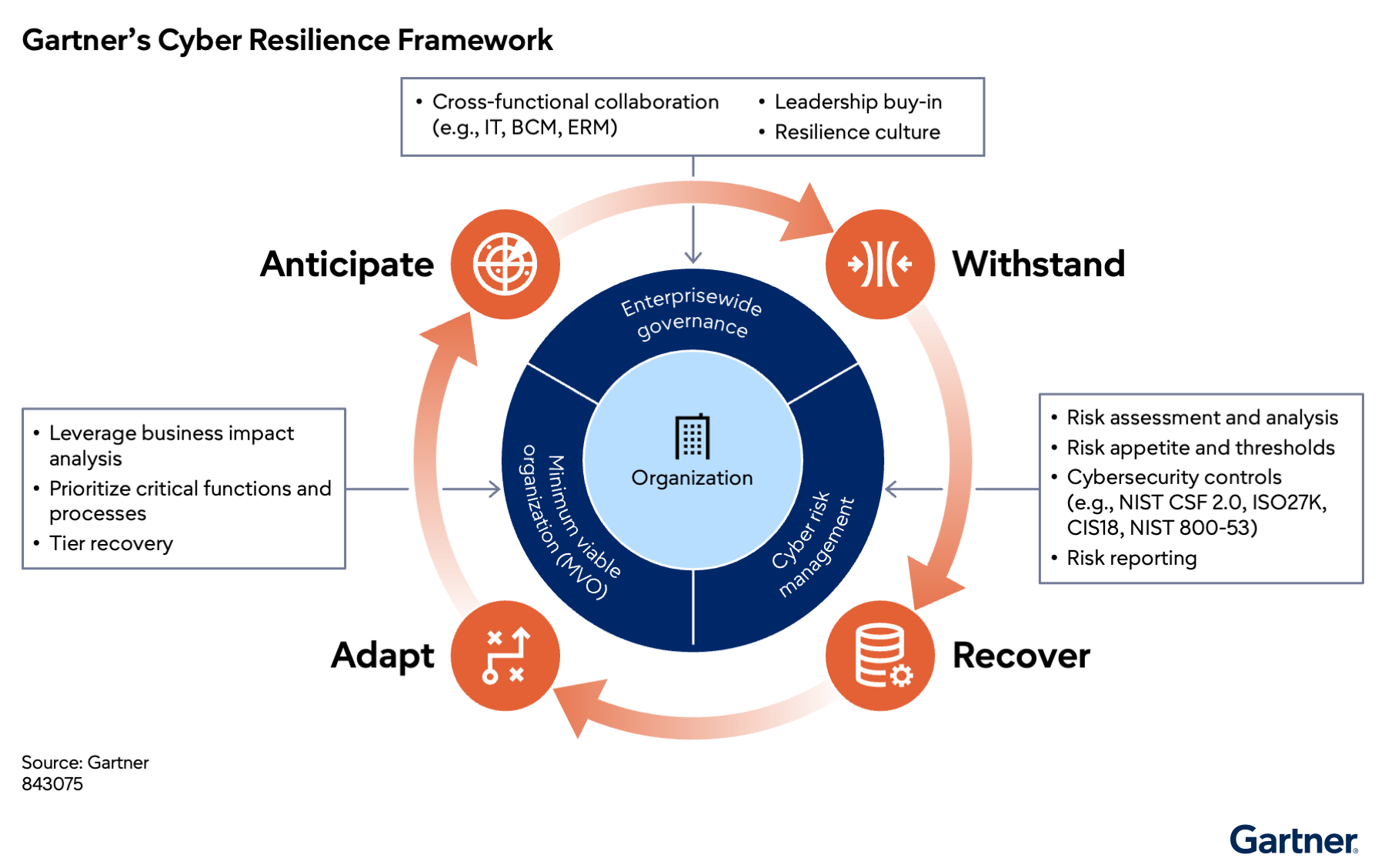
Gartner’s Cyber Resilience Framework provides a strategic model to anticipate, withstand, recover and adapt to cyberattacks, ensuring organizations can minimize business disruption (see Figure 1). This framework shifts organizations beyond traditional cybersecurity focused on prevention toward resilience that minimizes business disruption at every stage of an incident.
Differentiating From Industry Standards
Existing standards such as NIST SP 800-160 only focus on complex systems engineering. Our framework differentiates by delivering actionable capabilities that leaders can prioritize to ensure organizational survival and continuity before, during and after a crisis.
Practicing Resilience Across the Organization
Cyber resilience is a virtuous cycle, strengthened through regular practice. The more your organization tests response plans, including IT disaster recovery, backup strategies and crisis management, the greater your ability becomes to respond effectively across functions.
Using the Framework
The Gartner Cyber Resilience Framework is inherently business-centric and requires cross-functional collaboration with executive buy-in. Many capabilities such as IT disaster recovery, backup and recovery, business continuity planning and crisis management extend well beyond the cybersecurity leader’s direct ownership.
To implement this framework effectively:
- Embed and engage: Embed cyber resilience as a shared responsibility across all business functions. Actively engage the board and establish formal governance structures that balance oversight with agility.
- Focus on key business functions: Identify your organization’s essential business functions, prioritize them in recovery plans, allocate resources to protect these priorities and communicate MVO principles across teams so all stakeholders collaborate during disruptions.
- Integrate with existing cyber risk management practices: Incorporate this framework into enterprise risk management processes. Regularly conduct scenario-based exercises, align with industry-recognized standards to ensure foundational cybersecurity hygiene and measure progress using clear metrics to drive ongoing improvement and informed decision making.
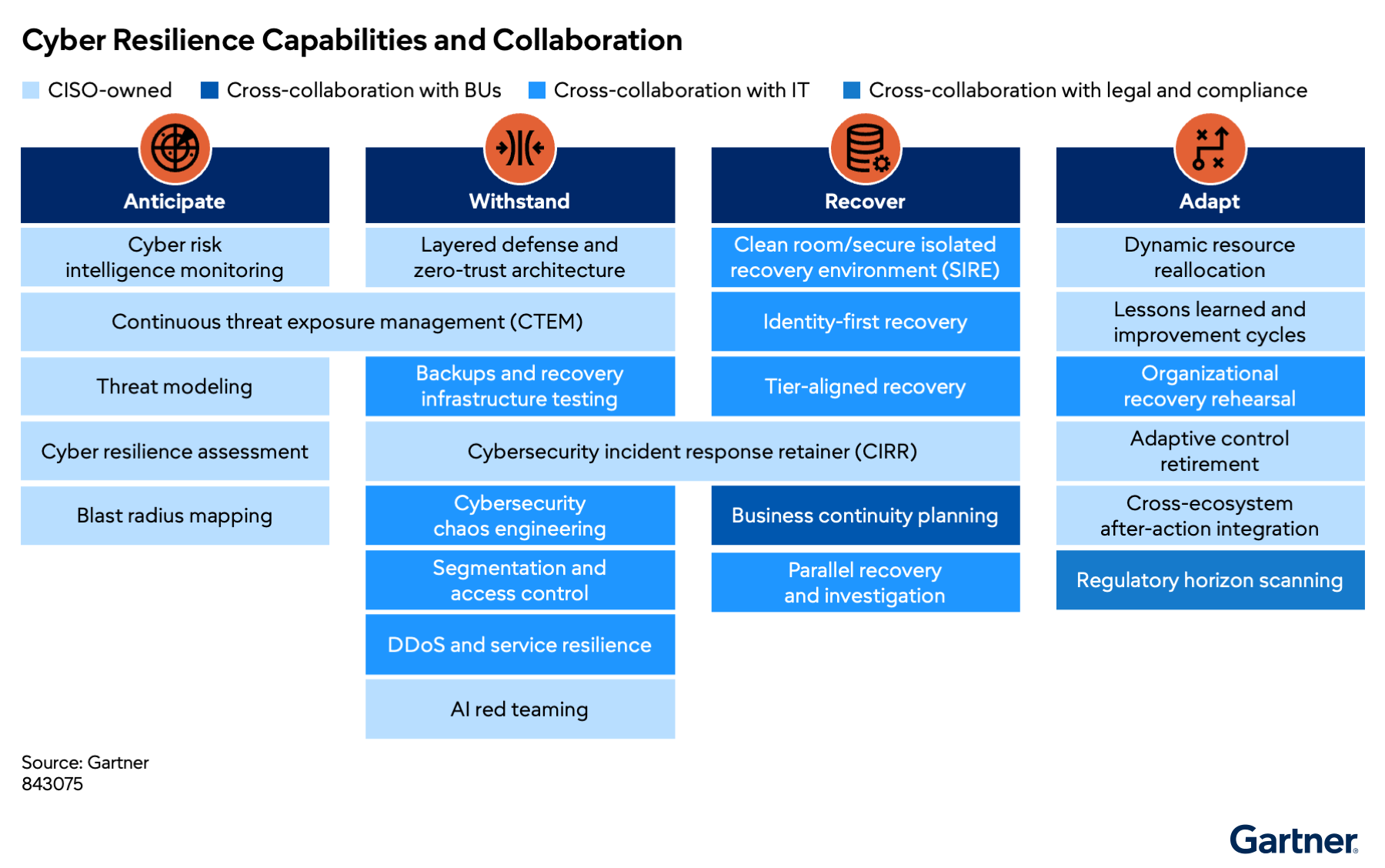
- Prioritize: Select specific capabilities from each stage of the anticipate, withstand, recover and adapt framework that best fit your current environment and maturity level (see Figure 2). Recognize some capabilities span multiple domains and often require coordination between IT teams, business units, and legal and compliance functions. Implement capabilities that deliver optimal organizational outcomes; not all capabilities are mandatory. Expect priorities will change as threats and risks evolve over time.
Anticipate
Objective
While it is impossible to anticipate every possible threat and scenario your organization may face, proactively identifying the most likely (and impactful) risks will make your organization more resilient no matter what emerges. Use threat-informed risk assessments to understand how attackers would target your critical systems before incidents occur. For more on threat-informed risk assessments, read Build Cyber Resilience Through Threat-Informed Risk Assessment and Decisions.
Anticipate: Identifying and preparing for the most likely threats enables organizations to reduce risk and maintain operations, even when unexpected attacks occur.
Key Recommendations and Capabilities
- Establish an intelligence-driven risk posture:
Develop a proactive threat intelligence program that integrates analytics, continuous exposure assessment and structured threat modeling. Map findings to business-critical assets and processes to prioritize resilience investments. - Embed continuous risk assessment:
Maintain an up-to-date understanding of organizational risk by regularly assessing critical functions with stakeholders and communicating in line with board priorities. - Simulate high-impact scenarios:
Conduct regular tabletop exercises, red-team assessments (including purple and blue team simulations), cyber range drills and scenario planning to stress-test readiness against emerging and worst-case impacts.
Common Anticipate Capabilities for Cyber Resilience
Capability | Actions to take | Research to consider |
Cyber risk intelligence and monitoring | Build a structured cyber intelligence program integrating analytics and detection systems, conduct regular threat briefings, map findings using frameworks such as MITRE and D3FEND, and move from reactive to proactive exposure assessment and threat hunting. | |
Continuous threat exposure management (CTEM) | Continuously identify and assess active exposures including misconfigurations, outdated systems and legacy platforms that expand attack surfaces; use CTEM practices for remediation priorities. | |
Threat modeling | Integrate formal modeling into architecture and design reviews, including AI tech, to address weaknesses early. | |
Cyber resilience assessment | Run combined blue/red/purple team simulations to stress-test cyber and organizational resilience. Conduct IR strategy reviews, testing and assessment to build cybersecure behavior. | |
Blast radius mapping | Quantify potential damage (“blast radius”) by mapping critical assets using process modeling; use these insights to prioritize security control investments. | |
Note: Not a conclusive list | ||
Source: Gartner (May 2026)
Withstand
Objective
Even the best-prepared organizations cannot withstand every attack, but by focusing on continuity of critical operations during an incident, you can minimize disruption and maintain essential services. For additional guidance on what is critical to your organization, read Unlock Cyber Resilience: Build Your Program on BIA Foundations.
Withstand: Maintaining continuity of critical operations and minimizing disruption during cyberattacks ensures your organization functions effectively in adversity.
Key Recommendations and Capabilities
- Focus on critical services:
In a real attack situation, prioritize what matters most. Identify key systems using frameworks such as MVO, isolate your critical business services quickly in an incident and ensure rapid recovery. - Architect for resilience and containment:
Implement zero-trust principles and network segmentation to limit the blast radius and avoid single points of failure. Build redundancy into critical systems and implement MVO so you can operate in degraded modes if necessary. - Use early detection and rapid response:
Deploy advanced endpoint and network defenses with automated containment and isolation mechanisms; empower SOC teams with preapproved authority for emergency actions. - Validate operational resilience:
Regularly test defensive durability and operational continuity through live-fire exercises and “assume breach” scenarios.
Common Withstand Capabilities for Cyber Resilience
Capability | Actions to take | Research to consider |
Layered defense and zero-trust architecture | Implement zero-trust principles so multiple controls prevent lateral movement or exfiltration of sensitive data, even after initial compromise. | |
Backups and recovery infrastructure testing | Ensure IT has regular backup integrity testing, validate recovery processes and enforce resilient storage practices. | |
Cybersecurity incident response retainer (CIRR) | Contract external CIRR services as needed to augment in-house incident response and disaster response capabilities. | |
Cybersecurity chaos engineering | Proactively experiment on security controls, systems and processes to validate how they behave under stress or failure conditions. | |
Segmentation and access control | Apply network and identity segmentation, enforce least privilege consistently and audit privileged access routinely. | |
DDoS and service resilience | Maintain service availability controls under high load and test resilience configurations regularly. | |
AI red teaming | Use existing or new SSE platforms to evaluate AI system security and resilience of AI systems against realistic attacks. | |
Note: Not a conclusive list | ||
Source: Gartner (May 2026)
Recover
Objective
The key objective for any cyber resilience program and organization is restoring normal operations quickly and safely after a cyber incident. Recovery requires collaboration across IT, business units and leadership and often differs from traditional IT recovery.
Recover: Swiftly restoring operations after a cyber incident relies on coordinated actions across the organization.
Key Recommendations and Capabilities
- Maintain robust cyber recovery capabilities:
Work with IT to ensure immutable, regularly tested backups and alternative operational pathways are in place for rapid recovery and failover during disruptions of critical functions. Consider immutable, offline and logically isolated backups. - Prioritization of recovery efforts:
Leverage business impact analysis (BIA) principles such as MVB principles and maximum tolerable downtime (MTD) to focus resources where they matter most; avoid attempting to restore everything at once. - Practice cyber recovery:
Conduct full recovery exercises with IT and business teams and include clean system rebuilds, covering both critical cloud environments and third-party providers. - Integrate with crisis management:
Align recovery efforts closely with crisis management teams, including IT, legal, corporate communications, facilities and HR teams. Prepare predefined external and internal messaging for potential cyber incidents and consider using external PR or communications support if needed.
Common Recovery Capabilities for Cyber Resilience
Capability | Actions to take | Research to consider |
Clean room/secure isolated recovery environment (SIRE) | Deploy SIRE disconnected from production; use baselines such as golden images and configuration integrity validation before reconnecting systems. | |
Identity-first recovery | Restore privileged access roles from known, clean sources. | |
Tier-aligned recovery | Work with executives, business units and IT to define clear processes for recovering critical systems, ensuring Tier 3 or 4 (most essential) systems are restored first. | |
Parallel recovery and investigation | Work with IT and forensic teams to establish processes and systems for parallel recovery without destroying forensic evidence. | |
Business continuity planning | Support business unit leaders in maintaining their business continuity plans. Run regular exercises and align recovery priorities with actual business needs, ensuring downtime procedures are in place where feasible. | |
Note: Not a conclusive list | ||
Source: Gartner (May 2026)
Adapt
Objective
Continuously evolve defenses and resilience strategies based on lessons learned, threat evolution and organizational change. Treating failure as a learning curve, rather than a complete disaster, is a crucial part of the resilience life cycle that helps organizations build flexibility in today’s rapidly evolving digital world. Consider taking a deeper dive and varied approach for adaptive cyber resilience by reading Build Adaptive Cyber Resilience to Thrive Amid Volatility.
Adapt: Continuously evolving your defenses in response to new threats and postincident insights ensures ongoing protection and organizational agility.
Key Recommendations and Capabilities
- Institutionalize postincident learning:
Conduct structured reviews after incidents and exercises. Capture lessons across people, process and technology and use findings to drive continuous improvement. - Modernize and optimize defenses:
Regularly update controls, architectures and operating models to address emerging threats and remediate weaknesses, prioritizing modernization of legacy and high-risk systems. - Advance workforce readiness:
Invest in ongoing training and adaptive awareness programs to ensure improved security awareness actually translates to more secure behavior across the organization. - Integrate adaptive governance:
Embed feedback loops into executive and board-level oversight; adjust risk appetite, KPIs and resilience priorities to reflect real-world insights.
Common Adapt Capabilities for Cyber Resilience
Capability | Actions to take | Research to consider |
Dynamic resource reallocation | Shift budgets, staffing and priorities dynamically after incidents, based on real operational insights. | |
Lessons learned and improvement cycles | Ensure structured postincident reviews are followed by implemented improvements. | |
Organizational recovery rehearsal | Run simulations focused on regulatory response, customer communication and trust recovery. | |
Adaptive control retirement | Retire controls that no longer provide value; reduce unnecessary complexity. | |
Cross-ecosystem after-action integration | Share incident insights with partners to reduce systemic risk. | |
Regulatory horizon scanning | Use proactive process- or technology-enforced scanning of emerging cyber regulations; build compliance and resilient architectures early rather than bolting it on later. | |
Note: Not a conclusive list | ||
Source: Gartner (May 2026)
Embedding Cyber Resilience: Governance, Risk and MVO as Strategic Imperatives
By anchoring cyber resilience in enterprisewide governance, integrated cyber risk management and a clearly defined MVO, cybersecurity leaders can protect critical assets, sustain operations and recover rapidly from disruptions. These three imperatives, when executed proactively and collaboratively, transform cyber resilience from a technical concern into a core strategic business capability.
Enterprisewide Governance: The Foundation for Organizational Resilience
Enterprisewide governance is foundational for cyber resilience because it extends beyond traditional IT boundaries. Holistic leadership means institutionalizing cross-functional accountability at all levels, coming top-down with board engagement, to operationalize resilience throughout the organization. While robust oversight is necessary, organizations leaders must balance it with agility so crisis response remains swift when needed.
Imperatives
- Establish cross-functional accountability: Embed cyber resilience as a shared responsibility across the enterprise. Executive leaders should mandate collaboration among IT, business continuity functions, crisis management, procurement, legal and compliance, all anchored by visible C-suite sponsorship.
- Engage and educate the board: Regularly present evolving threat scenarios to your board alongside business impact assessments. Secure their buy-in by linking strategic and financial implications of cyber risk directly to organizational priorities, thereby ensuring sustained investment and oversight. Consider leveraging presentation materials similar to Cyber Resilience in the Boardroom: 3 Messages CISOs Must Deliver or Tool: CISO Board Briefing — Introduction to Cyber Resilience.
- Institutionalize governance structures: Develop formal governance mechanisms such as steering committees and integrated reporting lines that facilitate ongoing oversight and enable rapid escalation and response during cyber incidents.
- Anticipate regulatory change: Schedule systematic reviews with legal and compliance teams to proactively monitor regulatory developments and keep strategy aligned with emerging requirements.
Cyber Risk Management
Effective cyber risk management integrates seamlessly with enterprise risk processes and drives ongoing improvement. Scenario-based exercises and clear metrics provide practical insights, enabling leaders to make informed decisions about priorities. When resources are limited, prioritizing risk management activities based on business impact ensures optimal allocation and resilience.
Imperatives
- Integrate cyber risk into enterprise risk management (ERM): Move beyond reactive defense by embedding cyber risk assessments within broader ERM frameworks. Leverage BIA to define risk appetite and operational tolerances.
- Conduct scenario-based exercises: Regularly run realistic threat simulations and tabletop exercises to test preparedness, inform executive decision making and refine risk mitigation strategies.
- Leverage established frameworks: Maximize existing investments by adopting recognized standards such as NIST CSF 2.0, ISO 27002, NIST SP 800-53 and CIS18. Employ tools such as the Cybersecurity Controls Assessment to identify and remediate gaps in essential security hygiene.2
- Monitor and measure progress: Establish tangible metrics for your organization’s cyber risk posture, report regularly to executive stakeholders and adjust strategies based on evolving threat landscapes.
Minimum Viable Organization (MVO)
The MVO concept provides clarity during crisis scenarios, enabling organizations to prioritize and sustain core business operations. By operationalizing MVO principles across teams in advance of a crisis, leaders reduce ambiguity under pressure while accelerating recovery efforts when disruptions occur.
Defining MVO principles may be challenging in complex organizations; iterative refinement and stakeholder engagement are critical for alignment and effectiveness at every level. For additional guidance on putting these principles into practice, including steps for defining your MVO (sometimes referred to as minimum viable business), read What’s Truly Critical? 8 Steps to Minimum Viable Business for Catastrophic IT Events.
Imperatives
- Define essential functions: Use BIA to identify the minimum set of business functions required for continued operation during a cyber crisis. Establish clear thresholds for minimum viable operations.
- Align recovery plans and resources: Tailor incident response and business continuity plans to support MVO priorities directly. Allocate resources to protect and recover these essential functions efficiently.
- Operationalize across teams: Communicate defined MVO thresholds throughout the organization so everyone understands what comes first, enabling faster, more effective decision making and resource allocation under duress.
- Foster a resilience culture: Integrate MVO objectives into performance metrics, recognition programs and training initiatives, from executives to frontline staff, to embed resilience thinking at every level.
Contributors
Wayne Hankins, Pedro Pablo Perea de Duenas, Christopher Mixter, Erin Ferguson, Chiara Girardi, Dhivya Poole, Carlos De Sola Caraballo
1 2026 Gartner CISO Role-Based Survey: The purpose of this survey was to evaluate changes in cybersecurity budget allocation, assess the evolving threat landscape, and understand organizations’ approach to managing nth-party risks and post quantum cryptography (PQC). The survey also included questions specifically on the CISO role — including shifts in their ownership and accountability for key cybersecurity activities, influence on board-level decisions, and the impact of stress and burnout. The online survey was administered from 18 March 2026 through 7 May 2026 and included 297 respondents from North America (n=134), EMEA (n=91), APAC (n=40), Latin America (n=32). Respondents were required to be the most senior leader of the cybersecurity function (CISO or equivalent) and came from a wide variety of industries, including banking/investment services (n=76), technology products or services (n=58), manufacturing (n=35) and others. Disclaimer: The results of this survey do not represent global findings or the market as a whole, but reflect the sentiments of the respondents and companies surveyed.
2 1H26 Gartner Cybersecurity Controls Assessment. This benchmark tool offers a self-assessed view of controls implementation maturity against leading industry-recognized frameworks and standards. It enables cybersecurity leaders to conduct peer benchmarking relevant to their industry and level of risk exposure. The benchmark includes data from 307 organizations gathered between July 2024 and February 2026. Participating organizations represent a broad range of industries, geographies and sizes (based on revenue in U.S. dollars).