Critical Capabilities for PLM Software in Discrete Manufacturing Industries
10 June 2026 - ID G00844393 - 44 min read
By Marc Halpern, Sudip Pattanayak, and 2 more
Product life cycle management is core to manufacturers’ product fulfillment. Without PLM, many product decisions are slow, costly, and possibly misguided. This research helps CIOs and IT leaders differentiate PLM software among Magic Quadrant vendors based on software capabilities and business use cases.
Overview
Key Findings
- According to Gartner’s product life cycle management (PLM) vendor survey, manufacturers adopt PLM primarily for product innovation and introduction use cases, yet vendors often underperform in these areas due to a lack of strategic and financial product portfolio management capabilities.
- Product data management, a critical capability, is the foundational core of PLM. However, most vendors on the Magic Quadrant also have a digital thread strategy that connects product data across the entire life cycle, enabling model-based enterprises and improving life cycle costing quality and regulatory compliance.
- AI assistants and agents are a critical PLM capability, with most vendors rapidly advancing from simple chatbots to semiautonomous, multistep agents, elevating PLM from a system of record to a system of intelligence for decision making.
Recommendations
- Address gaps in innovation outcomes by not relying solely on PLM software. Instead, drive vendors to close product portfolio management deficiencies, redesign governance, and anchor PLM to upstream decision making as well as downstream execution.
- Reduce risk and accelerate innovation by synchronizing product and process data across the life cycle and extending PLM into a full digital thread. Ensure cross-enterprise consistency, prevent architectural defects, and maximize digital thread value by engaging suppliers, partners, and customers to map end-to-end data flows aligned with business processes.
- When adopting AI, maintain PLM and the digital thread as the authoritative product record by preventing data inconsistencies, traceability gaps, and governance risks. Do not feed AI tools directly from unmanaged sources; PLM must remain the single source of truth. A governed digital thread ensures all AI outputs are based on controlled, auditable, human-approved data.
What You Need to Know
CIOs and IT leaders in discrete manufacturing companies must execute PLM strategy effectively to drive improved business performance and deliver high-quality products of growing complexity. This is because PLM manages design content and provides critical enterprise systems such as ERP, supply chain management (SCM), and CRM with consistent, governed product data. As a result, PLM serves as a manufacturer’s backbone for digital threads and product and process digital twins, spanning product design to delivery and service operations.
Leveraging cloud, high-performance computing and AI, PLM enables version-controlled design management, real-time design validation, predictive maintenance, life cycle cost analysis, and more efficient regulatory and requirements compliance. AI depends on PLM data and process discipline to improve and automate PLM tasks from product development through manufacturing operations and service.
This companion research to the Magic Quadrant for PLM Software in Discrete Manufacturing Industries gives CIOs and IT leaders deeper insights into the PLM vendors evaluated. PLM has become a core enterprise system that unifies product data and processes across design, manufacturing operations, and adjacent supply chain processes, quality, and service. This research analyzes and evaluates the vendors based on the most important business needs (or use cases) that PLM supports and the critical PLM capabilities that enable those use cases.
The use cases analyzed include product innovation and introduction, software-defined products, regulatory and product compliance, product life cycle intelligence, supply chain collaboration, and model-based enterprise. The following critical capabilities support those use cases: product data management, product portfolio management, product quality and cost management, digital thread, AI-assistants and/or agents, architectural composability, and deployment ease and scalability. Clients can find definitions of each use case and capability after the vendor analysis section.
Analysis
Critical Capabilities Use-Case Graphics
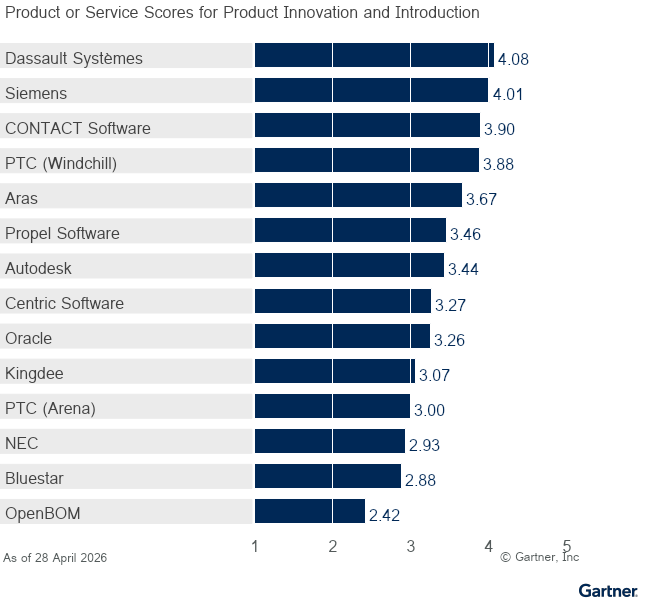
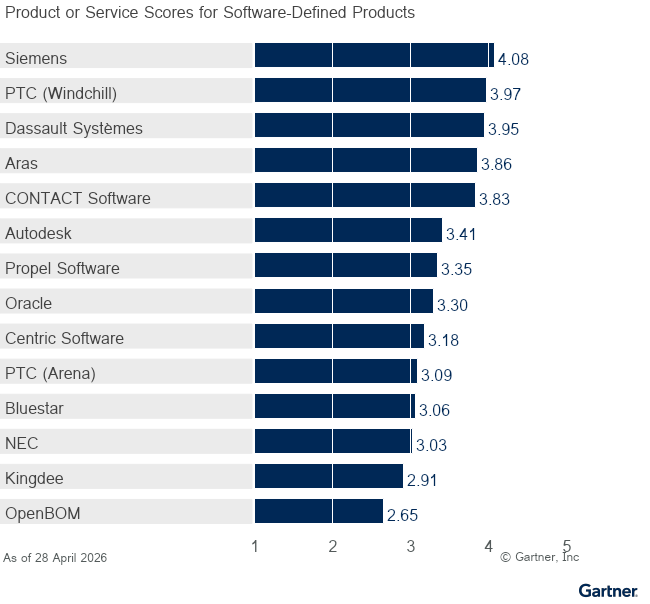
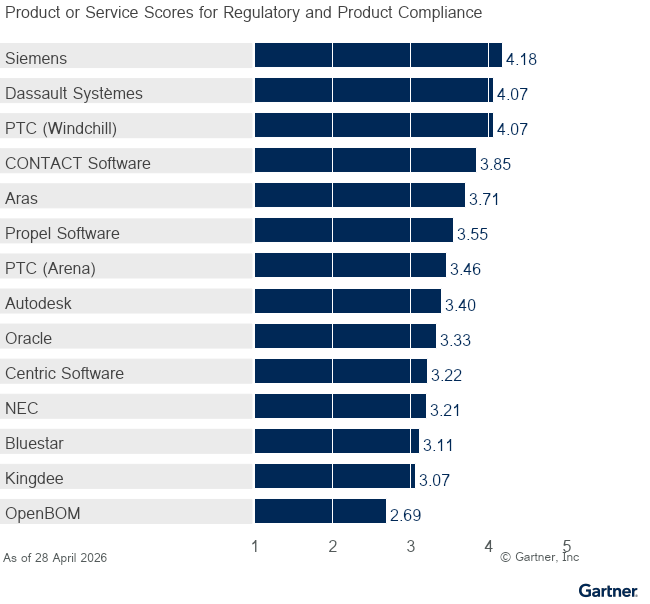
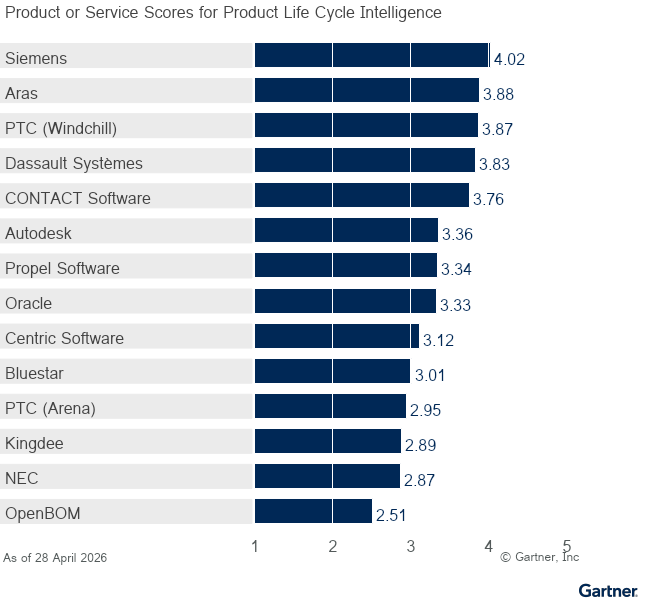
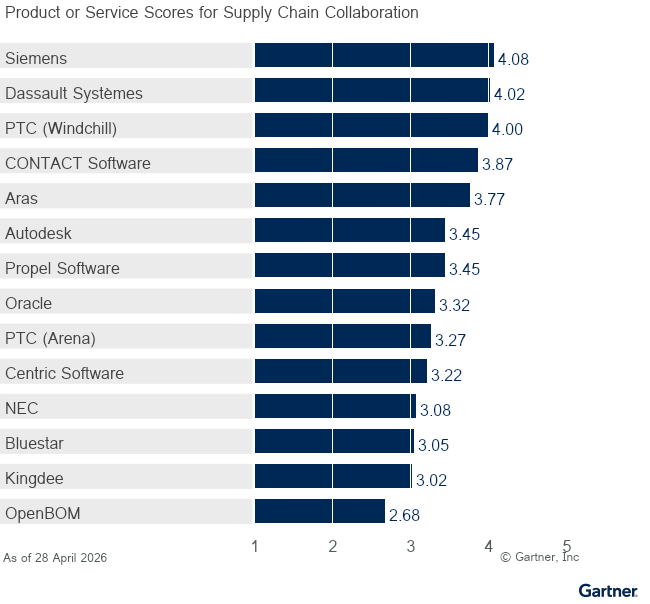
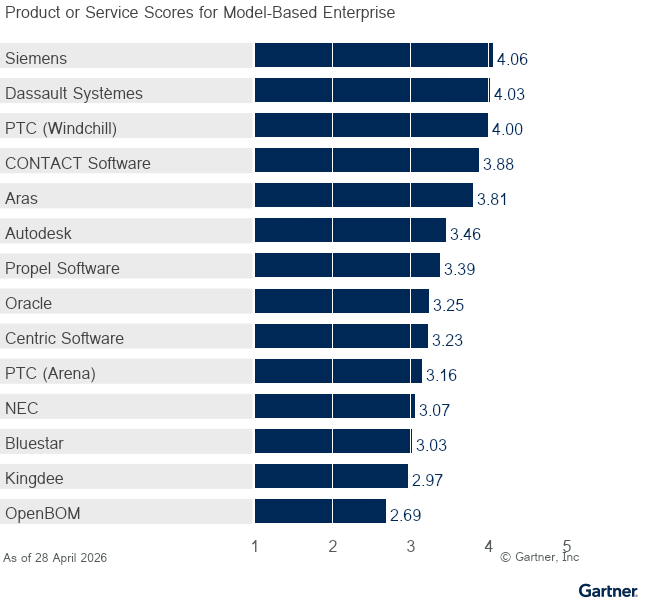
Vendors
Aras
Aras Innovator is an adaptable PLM platform designed to connect people, data, and processes across the enterprise. Its composable, low-code architecture, available both on-premises and as a SaaS solution, allows organizations to configure data models faster. The platform is continuously updated via predictable quarterly releases. Aras recently introduced InnovatorEdge and InnovatorEdge AI to support integrations with third-party systems and embedded, governed agentic AI capabilities.
Innovator’s strongest use case is product life cycle intelligence. By securely bridging product, process, and change data across its digital thread, Innovator provides visibility into performance, dependencies, and life cycle risk. It enables users to navigate traceability and conduct robust cross-domain impact analyses dynamically, supported by custom-built apps developed natively or by customers and partners. Aras has launched InnovatorEdge AI, which allows customers to build, deploy, and orchestrate PLM-native AI agents. These conversational assistants and AI agents use the digital thread’s context to discover hidden trends, parse data, and generate operational insights, supporting better decision making. However, it is worth noting that all InnovatorEdge AI capabilities are in the early stages of availability and are not yet market-proven.
Innovator’s strongest capability is its support for a digital thread, anchored by strong product data management features. Instead of managing isolated records, the product utilizes a flexible, relationship-based data model that intrinsically links requirements, systems architecture, multi-computer-aided-design (CAD) structures, bills of materials (BOMs), and quality records in an IT-friendly system. This backbone ensures that life cycle context is preserved — if the data quality is maintained at the point of authoring — as data traverses various functions. Its open API-first framework and event-driven integration enable the digital thread to orchestrate data across heterogeneous engineering authoring tools, application life cycle management (ALM) for software, ERP, and manufacturing execution systems (MES) for downstream execution. This provides an authoritative source of truth for the enterprise without forcing organizations into a “rip-and-replace” approach for existing systems. Innovator handles basic program management, requirements engineering, and BOM cost roll-ups effectively.
Innovator’s strongest capability is its support for a digital thread, anchored by strong product data management features. Instead of managing isolated records, the product utilizes a flexible, relationship-based data model that intrinsically links requirements, systems architecture, multi-computer-aided-design (CAD) structures, bills of materials (BOMs), and quality records in an IT-friendly system. This backbone ensures that life cycle context is preserved — if the data quality is maintained at the point of authoring — as data traverses various functions. Its open API-first framework and event-driven integration enable the digital thread to orchestrate data across heterogeneous engineering authoring tools, application life cycle management (ALM) for software, ERP, and manufacturing execution systems (MES) for downstream execution. This provides an authoritative source of truth for the enterprise without forcing organizations into a “rip-and-replace” approach for existing systems. Innovator handles basic program management, requirements engineering, and BOM cost roll-ups effectively.
Innovator’s biggest opportunity for improvement centers on the product innovation and introduction use case, particularly the depth of its native product portfolio management (PPM) and cost management features. It lacks the latest out-of-the-box portfolio optimization, advanced financial prioritization, and highly granular predictive cost analytics found in some top-tier competing platforms. Innovator has the opportunity to use AI-enabled functionalities to enrich product concept and introduction support. In general, customers relying on the platform for complex product innovation need to further configure these capabilities.
Autodesk
Autodesk’s PLM software Fusion Manage is a cloud-native, configurable SaaS platform. The platform unifies product content in a template-driven architecture. It supports new product introduction (NPI) with phase-gate workflows, dashboards, and portfolio structures, while automating content change control through engineering change order (ECO) governance. It supports product designs and quality processes. Supplier management covers onboarding, sourcing, and collaboration. Its connected digital thread provides traceability and supports regulatory compliance.
Fusion Manage’s strongest use case is model-based enterprise. This can be attributed to its robust product innovation, product introduction, and supplier collaboration capabilities, particularly for small-to-midsize enterprise (SME) manufacturers. Fusion Manage uses model-based definition for products with product manufacturing information (PMI)/model-based definition (MBD) as the authoritative product definition. Fusion Manage links the models directly to BOMs and makes them accessible to non-CAD users through lightweight viewables and markup tools. Its end-to-end traceability ensures changes, quality events, and downstream manufacturing instructions stay tied to specific model revisions, enabling model-driven execution across the life cycle. For suppliers, Fusion Manage centralizes technical and process content and makes it accessible through a supplier portal, all protected by access control.
Fusion Manage’s strongest capability is deployment ease and scalability, which is delivered through its SaaS architecture. It is hosted and operated entirely by Autodesk on Amazon Web Services (AWS). It offers fast rollouts with configurable defaults and provides centrally managed automated upgrades. The platform scales horizontally with load balancing and regional replication and vertically for database and analytics workloads. At the same time, it offloads heavy tasks to asynchronous processing. The platform delivers high availability and low-latency access across different regions without requiring organizations to set up additional IT infrastructure.
Fusion Manage’s biggest opportunity for improvement lies in AI capabilities. Currently, the product has gaps in simplifying and accelerating PLM intelligence across the life cycle. While features such as 2D/3D similarity search, smart copy, autoassembly, and drawing automation are available, customers may encounter limited AI support for specification-driven validation, automated testing, and cross-domain quality assurance. Gaps in AI-driven orchestration can increase manual coordination when connecting Fusion with external AI tools and enterprise systems. In addition, limited spatial intelligence and AI understanding of physical products can constrain advanced reasoning around product behavior and manufacturability, requiring greater reliance on manual analysis or external validation tools.
Bluestar
Bluestar PLM is natively embedded in Microsoft Dynamics 365 (D365), serving as a system of record across engineering, manufacturing, and the supply chain. By sharing the D365 data model, user interface, security, and workflow engine, the product supports a digital thread and eliminates the need for custom PLM-to-ERP middleware. Bluestar PLM extends its product data management offering with integrated quality management, compliance, and supply chain collaboration components. A recent product release has introduced architectural improvements, extended asset management capabilities, enhanced CAD integrations, and expanded configurator functionality.
Bluestar PLM’s strongest use case is regulatory and product compliance. Operating within D365, it provides structured documentation workflows, controlled change management, and end-to-end traceability. This reduces audit risks and ensures consistent compliance documentation. Its embedded quality management system (QMS) and engineering change management natively connect quality events to product data, enabling proactive quality control. Furthermore, the platform supports robust supply chain collaboration. Because it resides inside the ERP environment, external suppliers, operations, and procurement teams can access synchronized, revision-controlled product data. This can enable accurate handovers and consistent artifact revisions without relying on disconnected external portals.
Bluestar PLM’s strongest capability is its digital thread, backed by robust product data management functionalities. By unifying CAD, PLM, and ERP data into a single environment, the platform supports a digital thread that spans mechanical, electrical, software, and manufacturing artifacts. Its shared semantic data layer ensures a common definition across items, BOMs, revisions, and workflows, effectively eliminating departmental silos. Synchronized engineering and manufacturing BOMs reduce rework and provide PLM users with reliable, consistent visibility. However, this digital thread is better suited to strengthening supply chain coordination and product commercialization than to supporting intensive model-based engineering approaches.
Bluestar PLM’s biggest opportunity for improvement lies in its product portfolio management capabilities. While the platform handles product data, change execution, and basic project tasks, it relies heavily on broader Microsoft Dynamics technology and features to deliver comprehensive strategic product and portfolio planning, prioritization, and resource allocation. Consequently, customers seeking advanced, out-of-the-box PPM capabilities specifically tailored for NPI roadmapping, product rationalization, and “what-if” portfolio scenarios may find that the platform requires additional configuration or third-party ecosystem tools. However, because the platform is native to Dynamics, integrating additional tools can introduce complexity and limit flexibility.
Centric Software
Centric PLM serves as the foundation of a business-centric, concept-to-commercialization platform for consumer-driven discrete manufacturing and retail. Available in single-tenant cloud or multitenant SaaS, it anchors the digital thread by linking upstream product development to downstream commercialization. Recent upgrades to Centric PLM include a redesigned UI, updated architecture, improved supplier collaboration, and added features such as compliance rules and cloud-based 3D visualization. The recent upgrade also adds stronger compliance and traceability support, including integrated compliance checks, certificate management, competitive data tools, bulk data handling, and improved conversation workflows.
Centric PLM’s most suitable use case is product innovation and introduction. The platform natively connects ideation, requirements, sourcing, costing, and launch readiness within a single environment. It captures and structures product ideas, objectives, and planning inputs at ideation. Further, it manages downstream product introduction by extending its PLM capabilities with platform add-ons for financial planning, inventory management, market intelligence, and product experience management (PXM). This scope reflects the vendor’s ability to align product development with commercialization, allowing technical and nontechnical cross-functional teams to collaborate using visual boards and structured workflows. This helps accelerate product launches and improve market responsiveness.
Centric PLM’s strongest capability is product portfolio management. The platform connects product strategy, planning, resource priorities, and execution milestones within a unified hierarchy. It offers adjacent visual boards, integrated Gantt charts for critical path tracking, and cross-functional portfolio health dashboards that aggregate key performance indicators (KPIs) alongside visual stage-gate status indicators. Configurable for different departments, these tools provide real-time visibility into project health and financial targets. This enables data-driven portfolio rationalization by utilizing AI to identify gaps, overlaps, and underperforming items to align product investments with business goals.
Centric PLM’s biggest improvement opportunity is centered on strengthening its digital thread with agentic AI. While this vendor has already released role-based AI tools for portfolio insights, image generation, sourcing, costing, compliance, and commercialization, more should be done to enhance multiagent orchestration. This will facilitate end-to-end cross-functional workflows that enhance PLM processes and decision making.
CONTACT Software
CONTACT Elements is a PLM solution that unifies product data and life cycle management with CAD, documents, BOMs, and change processes. Its embedded Fourier AI provides multimodal, context-aware automation across the digital thread. The Collaboration Hub enables secure supplier access to live data. The product’s integrated quality, cost, and portfolio tools link requirements, tests, costing, and NPI. ALM integration supports software-hardware releases, while its modular, open architecture scales and connects to ERP, SCM, and Internet of Things (IoT) systems through Elements’ open architecture.
Elements’ strongest use cases include product innovation and introduction and model-based enterprise support. Both use cases hinge on the platform’s unified, open, and fully traceable digital backbone. This backbone connects CAD, BOMs, requirements, simulation, manufacturing, and service data in a single model-centric environment. Its composable architecture, open standards, and life cycle traceability enable customers to maintain a coherent digital thread. Embedded AI further enhances model understanding across 3D, documents, and metadata, while secure supplier collaboration and ALM integration ensure hardware-software alignment.
Elements’ strongest capability is product portfolio management. It links strategic planning directly to product structures, projects, and life cycle data, ensuring alignment between R&D investments and business goals. Its portfolio navigator and real-time dashboards provide visibility into portfolio composition, dependencies, and performance. Continuous KPI tracking supports plan-to-actual control, while Fourier AI enhances decision quality using real execution data. Built-in Excel and PowerPoint integrations, along with a live dashboard, are examples of options that streamline executive reporting. Similarly, end-to-end life cycle transparency — from ideation to launch — helps maximize ROI and improve new product success. Supplier collaboration data improves feasibility assessments, and ALM integration supports portfolios that include software, firmware, and mechatronic systems.
Elements’ biggest opportunity for improvement centers on enhancing product life cycle intelligence with AI. CONTACT can further leverage its Fourier AI so that customers can more effectively manage complex cross-domain PLM workflows. However, customers may face limited automation for tasks such as data aggregation, impact analysis, and risk reporting, increasing manual effort and coordination. Opportunities to orchestrate ERP, SCM, and ALM with PLM can enhance product portfolio insights. In addition, deeper AI-driven engineering reasoning — such as constraint-aware analysis, tolerance validation, and manufacturability checks — will enable customers to conduct engineering reasoning within CONTACT Elements with less need for external third-party tools.
Dassault Systèmes
Dassault Systèmes’ 3DEXPERIENCE (3DX) platform, which powers the ENOVIA PLM brand, is available for both on-premises and cloud deployment. The platform delivers across public SaaS, private cloud, and dedicated cloud environments, providing access to Dassault Systèmes’ digital thread. Recent enhancements to ENOVIA emphasize AI capabilities, cross-domain integration, and expanded industry support.
ENOVIA’s strongest use case is product innovation and introduction. ENOVIA enables customers to streamline and secure product innovation by orchestrating design, simulation, and systems engineering, connecting intelligence, ideation, and execution across the full life cycle. It orchestrates market sensing, collaborative concept development, and end-to-end launch management while enabling objective-driven portfolio steering and agile program execution. ENOVIA manages the flow from market inputs through concept development to product launch, and provides tools for portfolio prioritization and program oversight. It handles configurable product structures for complex, software-enabled systems and includes supply chain risk data to support more resilient planning. Its new 3D configure, price, and quote (CPQ) connectivity links engineering, manufacturing, and sales to ensure continuity from product definition to final quotation.
ENOVIA’s strongest capability is product portfolio management supported by product data management. ENOVIA R2026x strengthens product portfolio management by improving strategic alignment, execution visibility, and life cycle continuity. It enhances objective-driven portfolio steering, linking corporate goals to product roadmaps and enabling better prioritization across value, risk, and resources. Program execution gains clearer cross-functional status and milestone tracking based on real engineering data. R2026x also improves market-to-launch orchestration, supports configurable and software-defined products, embeds supply chain risk insights, and adds 3D CPQ connectivity to align commercialization with product definition.
ENOVIA’s biggest opportunity for improvement lies in applying AI beyond assistants to simplify deployment and adoption. ENOVIA R2026x can be difficult for customers to implement due to the complexity of the 3DEXPERIENCE data model, significant migration effort from legacy systems, evolving role structures, and frequent changes to APIs, data models, life cycle rules, and security configurations that can disrupt integrations. As customers increasingly expect AI companions and guided experiences from ENOVIA, they would also benefit from AI-driven PLM configuration and assistance tools that accelerate setup, personalization and adoption. Without AI-driven guidance and automation, customers may experience slower onboarding, higher error rates, and greater reliance on manual configuration, training, and support to identify misconfigurations, usability barriers, and adoption challenges.
Kingdee
Kingdee AI PLM is a cloud-native SaaS solution built on the proprietary Kingdee AI Cosmic platform. It primarily targets midsize discrete manufacturing enterprises in China and other Asian countries. It utilizes a data-centric unified product development and commercialization strategy to orchestrate product data, streamline workflows, and drive collaborative design. The platform supports integration with third-party CAD, MES, and supplier relationship management (SRM) systems, while offering deep, native integration with Kingdee ERP. Its recent release introduces the Kingdee AI PLM suite, which is embedded with autonomous AI agents to enhance end-to-end integration across R&D, production, and supply chain processes.
Kingdee AI PLM’s strongest use case is product innovation and introduction, specifically tailored for the faster iterations required for highly customized products. This capability makes it suitable for engineered-to-order products. The platform leverages the integrated product development (IPD) framework that connects the initial product development stages — from market demand and requirement definition to detailed design and pilot production. It supports the linear progression from R&D to manufacturing, using AI for requirement analysis and design compliance checks at stage-gate milestones.
Kingdee AI PLM’s strongest capability is product portfolio management supported by PLM-ERP integration and IPD process orchestration that leverages AI functionalities. It must be noted that such AI functionalities are still in the early stages of availability and not yet market-proven. The platform manages product information and master data, providing systematic product roadmap planning, version iteration, and resource load matching. It also uses AI to deliver a holistic view of the product life cycle along with cost and feasibility insights. It achieves this by combining PLM and ERP data to evaluate financial performance, market coverage, and budget deviations.
Kingdee AI PLM’s biggest opportunity for improvement centers on architectural composability and support for an engineering-led digital thread. Currently, functional components within Kingdee AI PLM can be replaced or upgraded independently. However, while the platform connects R&D to production, the depth and maturity of its digital thread, particularly for model-based systems engineering (MBSE) and 3D, fall short of market expectations.
NEC
NEC’s PLM software Obbligato is best known for its integrated BOM capability. It centrally manages multiple, purpose-specific BOMs (such as engineering, manufacturing, and service BOMs) on a single platform. Alongside BOMs, it manages bill of process (BOP) data to explicitly link product designs with manufacturing processes and resources. This ensures consistency across the entire life cycle. Most recently, NEC introduced integrated generative AI, which functions as an interactive, chat-based assistant for design and development.
Obbligato’s strongest use case is regulatory and product compliance. NEC designed Obbligato around a manufacturing master data model that tightly controls product structures, documentation, and change propagation across the entire life cycle. In particular, Obbligato strengthens compliance by managing planning, engineering, manufacturing, and service BOMs on one platform with automated links that keep every downstream structure aligned. By unifying BOM, BOP, and resource data, it ensures manufacturing processes stay consistent with engineering intent and provides full audit trails for both product and process changes.
Obbligato’s strongest capability lies in product data management, enabling strong regulatory and product compliance. It supports comprehensive BOM, BOP, and research management. Additionally, NEC centralizes all technical documents — drawings, specs, CAD, and analysis data — with drag-and-drop registration, automatic numbering, classification control, viewable file generation, and strict revision and access management. Its multi-CAD integration supports configuration, attribute, and version control across heterogeneous CAD data. Parts management centralizes specifications, vendor data, numbering, and versioning. Advanced BOM management supports configuration deployment, baseline validity periods, and visual comparison. Engineering change management links ECOs to all affected parts, BOMs, and documents, with automated numbering and clear diff views to ensure accurate downstream updates.
Obbligato’s biggest opportunity for improvement lies in product portfolio management. Currently, it lacks comprehensive strategic planning tools, including scenario modeling, value-risk scoring, and roadmap alignment, which can limit customers’ ability to plan and govern product investments effectively. Gaps in early-phase innovation capabilities and program-level visibility force organizations to rely on external processes for prioritization and oversight. Limited support for modular physical products with key software functionality, along with insufficient cost, risk, and supply chain insight, can weaken portfolio decisions. This can increase friction across engineering, manufacturing, and sales during commercialization. Customers would also benefit if NEC rolled out AI features focused on scenario modeling, portfolio intelligence, and cross-life-cycle insights.
OpenBOM
OpenBOM’s SaaS-based PLM offering of the same name introduces new features and updates on a monthly basis. The SaaS business model makes it well-suited for small- and midsize discrete manufacturers — an underserved market transitioning away from spreadsheets and disconnected tools — to quickly access PLM functionality.
OpenBOM’s strongest use case is regulatory and product compliance across supply chains. It achieves this primarily through strong data governance, structured traceability, and integrations rather than dedicated native compliance or QMS modules. The platform provides full audit history for items, BOMs, revisions, and changes, along with controlled releases and downstream integrations that extend compliance workflows across engineering, procurement, and manufacturing. For formal quality management, OpenBOM relies on partner solutions.
OpenBOM’s strongest capabilities are deployment ease and scalability, and composability. The product supports supply chain collaboration and regulatory compliance by combining easy cloud deployment, multitenant scalability, and a composable architecture. Its easy onboarding and browser-based access lets suppliers collaborate in real time on shared BOMs, requests for quotation (RFQs), and procurement data. At the same time, cloud scaling ensures full traceability, revision control, and SOC 2 Type II-level security. Its composable, API-driven design allows organizations to integrate specialized QMS tools for formal compliance needs.
OpenBOM’s biggest opportunity for improvement lies in its product portfolio management capabilities. While the platform’s graph-based data architecture and linkages across product content provide strong visibility into dependencies, reuse, and cross-product impacts, customers seeking comprehensive portfolio planning, prioritization, and financial governance must rely on external PPM and planning tools. As a result, organizations may need to integrate OpenBOM with third-party portfolio and financial systems to support advanced scenario analysis, resource trade-offs, and investment decision making, increasing integration effort and operational complexity.
Oracle
Oracle Fusion Cloud PLM is delivered as a SaaS application running on Oracle Cloud Infrastructure (OCI). The product provides a modular and composable architecture, leveraging a component-based design to unify product data and processes from ideation to commercialization. The platform acts as the enterprise item master, centralizing product data into a unified digital thread across PLM, ERP, SCM, and customer experience (CX).
Fusion Cloud’s strongest use cases are product life cycle intelligence and supply chain collaboration. The product centralizes items, BOMs, documents, changes, and quality records into a unified digital thread. It surfaces near-real-time insights in Oracle Transactional Business Intelligence (OTBI) dashboards and reports. It monitors BOM and change impacts across functions and runs AI-driven supply chain impact analyses on product changes to highlight effects on inventory, work orders, and purchase orders. This improves decision making, traceability, and quality, enabling organizations to proactively identify and mitigate risks, streamline cross-functional collaboration, and gain greater visibility and control over the entire product life cycle. Oracle also delivers PLM-integrated supply chain collaboration through a secure supplier portal. This portal centralizes product data and enables external partners to engage across the product life cycle — from BOM collaboration to change execution.
Fusion Cloud’s strongest capability is its AI assistants and/or agents. The product differentiates itself by embedding “built-in, not bolted-on” agentic AI directly into the Fusion Cloud platform. Through the Oracle AI Agent Studio, customers can design, deploy, and govern specialized AI agents that execute multistep workflows across the PLM and supply chain ecosystem. Rather than relying on generic conversational chat, they perform targeted actions that move work forward. For example, they can calculate optimal ECO cut-in dates based on live inventory and open purchase orders, or automatically generate RFQs and track target costs for BOM sourcing.
Fusion Cloud’s biggest opportunity for improvement lies in model-based enterprise (MBE) and software-defined product capabilities. The product provides foundational capabilities to link hardware, software, and firmware within product structures. However, limitations in native systems-engineering modeling, multidomain architecture management, and deep software life cycle integration can constrain customers pursuing advanced cross-domain design and verification. As a result, organizations developing mechatronics and software-intensive products may face additional effort to achieve model-centric workflows, integrated software life cycle governance, and end-to-end traceability, particularly in environments that require tight alignment across mechanical, electrical, and software domains.
Propel Software
Propel PLM serves as a key component of the cloud-native product value management system of record for discrete manufacturers in highly regulated environments. Available exclusively as a multitenant SaaS application on the Salesforce platform, it anchors the digital thread by natively linking engineering, quality, and commercial teams. Propel PLM extends traditional PLM with integrated QMS and product information management (PIM). The platform’s recent release added DesignHub to connect mechanical and electronic CAD data directly to the product record in PLM. DesignHub supports structured, automated data transfers from mechanical CAD (MCAD), electronic CAD (ECAD), and product data management (PDM) systems into PLM.
Propel PLM’s strongest use case is regulatory and product compliance. The platform natively links compliance requirements, medical device design history files (DHFs), and device master records (DMRs) directly to the core product record. It delivers prebuilt templates, electronic signatures, and comprehensive audit trails to accelerate compliance with regulations and standards. Furthermore, when document revisions are approved, the system automatically triggers training assignments and tracks completion to ensure continuous audit readiness without manual administration.
Propel PLM’s strongest capability is product quality and cost management, with a particular emphasis on quality execution. The platform establishes a closed-loop quality system by connecting nonconforming material reports, customer complaints, and corrective and preventive actions (CAPAs) directly to the specific BOM and item revision. Additionally, the solution manages supplier quality, first article inspections, and equipment calibration. This unified architecture allows quality and engineering teams to trace manufacturing and field issues to their source and drive ECOs through the same platform, avoiding disconnected processes and data silos. With respect to costing, BOM roll-ups include supplier splits, SiliconExpert connectivity facilitates electronic component insights, and bidirectional ERP integrations sync pricing to assess ECO cost impacts. Native Salesforce integration supports additional advanced costing analytics and CPQ capabilities.
Propel PLM’s biggest opportunity for improvement is its native support for MBE workflows. The platform does not natively author 3D design data, nor does it provide full out-of-the-box 3D model-centric definition and validation capabilities. Propel PLM associates 3D models with product records by integrating with MCAD and ECAD systems via its DesignHub and third-party middleware partners (e.g., Razorleaf). However, organizations pursuing full MBE adoption — where the model serves as the single authoritative definition — need professional services engagements and external tools to achieve this. Additionally, the platform lacks direct systems modeling language support.
PTC (Arena)
PTC’s Arena is a SaaS PLM and QMS platform. It is hosted on AWS and utilizes a multitier, load-balanced architecture. It centralizes product data, BOMs, engineering changes, and quality records into a single system of record, enabling secure collaboration across internal teams and external suppliers. Additionally, the platform features supply chain intelligence (SCI), which enables teams to identify and mitigate supply chain risks early in product development.
Arena’s strongest use case is regulatory and product compliance. The platform differentiates itself by natively unifying PLM and QMS, which allows organizations to manage quality events — such as CAPAs, nonconformances, and audits — directly within the product record. It provides built-in support and traceability for stringent regulatory standards, such as FDA 21 CFR Part 11 and Part 820, ISO 13485, and environmental mandates like RoHS, REACH, and conflict minerals. This closed-loop approach ensures continuous audit readiness and eliminates the traceability gaps found when using disconnected document-centric quality tools.
Arena’s strongest capability is deployment ease and scalability. The platform is designed for distributed, high-complexity environments and emphasizes ease of adoption, scalability, and lower IT infrastructure overhead compared with legacy PLM solutions. Arena is delivered exclusively as a SaaS solution, enabling distributed design, supplier collaboration, and compliance with regulated processes. Arena’s architecture supports rapid deployment and allows organizations to configure the platform without custom coding, preserving scalability and accelerating time to value.
Arena’s biggest opportunities for improvement lie in product portfolio management and AI-assistants and/or agents. The platform provides limited product portfolio management capabilities; while it supports basic project tracking and visibility into development activities, it does not offer full portfolio planning, initiative prioritization, or financial portfolio management out of the box. Organizations requiring advanced portfolio optimization will need to complement the platform with external portfolio management tools. Additionally, while the vendor has recently introduced AI-assisted features — such as natural language search across workspace data and documents — it does not currently offer AI agents. Organizations seeking to deploy agentic AI to orchestrate and execute complex product life cycle workflows will find Arena’s current intelligence capabilities limited primarily to user assistance and data retrieval.
PTC (Windchill)
PTC’s Windchill serves as the system of record for product data in complex, diverse, and regulated environments. Available on-premises, in the cloud, or as SaaS (Windchill+), it anchors the digital thread by linking engineering to manufacturing, quality, and service. PTC extends Windchill with integrated ALM, native QMS, cost and sustainability management, and service life cycle integrations. Its recent release adds a modern role-based UX, enhanced BOM collaboration, stronger PLM-ALM traceability, sustainability analysis, and a foundation for modular AI capabilities.
Windchill’s strongest use case is product regulatory and compliance management in regulated industries, including medical devices, automotive, aerospace, and defense. It supports FDA, EU, and ISO requirements through strong configurable solutions and workflows, often delivered via predefined templates to accelerate compliance. Windchill also enables secure supplier collaboration with role-based access, automated change workflows, and approved vendor management. This is supported by integrations with supplier and compliance data providers. Additionally, Windchill supports model-based enterprise strategies by managing multi-CAD, geometric dimensioning and tolerancing (GD&T), and PMI using industry standards. This enables rich 3D data reuse across manufacturing, quality, and service. This capability is reinforced by tight integration with its own and third-party CAD products.
Windchill’s strongest capability is its end-to-end digital thread built on a robust product data management foundation. As the system of record, Windchill provides a PLM backbone for complex product structures, multi-CAD data, documentation, and configurations. It connects engineering with manufacturing, quality, and service through different BOMs within a single environment, ensuring changes propagate consistently across life cycles. The digital thread is further extended through open services for life cycle collaboration (OSLC)-based integrations with PTC’s Codebeamer and PTC Modeler, enabling traceability across hardware, software, and enterprise systems.
Windchill’s biggest opportunity for improvement is product portfolio management and new product introduction. Currently, these capabilities remain limited to basic stage-gate governance and project management. Advanced portfolio strategy and investment decisions require integration with third-party tools. While large enterprises are comfortable with best-in-class integrated tools, many others prefer a cohesive platform powered by AI to support product introduction. While Windchill is rolling out AI features through quarterly plug-ins, its AI capabilities, particularly in early-stage product ideation, remain less mature than those of some peers. Customers increasingly expect natively embedded AI to support early design reviews, automate data validation, enable value-stream collaboration, and perform advanced “what-if” portfolio and scenario analysis.
Siemens
Siemens’ Teamcenter is an enterprise PLM platform serving as the digital backbone for complex manufacturing environments. Available on-premises, in the cloud, or as a SaaS (Teamcenter X), it provides end-to-end life cycle management. Recent releases embed AI-assisted productivity via Teamcenter Copilot, enhance BOM workflows, and expand cross-domain digital thread connectivity.
Teamcenter’s strongest use case is regulatory and product compliance, with capabilities embedded directly into life cycle data rather than treated as a separate activity. The platform supports industry-specific compliance requirements, including automotive safety and medical device regulations, across the product life cycle. In addition, Siemens delivers strong MBE support. Through tight integration across CAD, computer-aided engineering (CAE), requirements, and system models, Teamcenter uses authoritative models as the primary definition, linking them directly to BOMs, process plans, and manufacturing instructions.
Teamcenter’s strongest capability is its digital thread, driven by robust product data management across mechanical, electrical, and software domains. This is reinforced by native product quality (Teamcenter Quality) and cost management features that calculate tooling costs, profitability, and carbon footprints. The digital thread extends into manufacturing execution through integration with Opcenter MES. This integration provides engineering-to-manufacturing continuity and closed-loop operations. Siemens offers specific digital thread solutions for battery manufacturing, electronics and chip design, and medical devices.
Teamcenter’s biggest opportunity for improvement lies in its architectural composability. Historically, highly tailored on-premises environments have faced upgrade complexity and rigid integrations across its software modules. Siemens is improving composability with the containerized, microservices-based architecture of its SaaS offering, Teamcenter X. However, the vendor must do more to expedite the transition from its legacy deployments into this more modular, easily upgradable framework. This transition is increasingly being demanded by aerospace and defense manufacturers seeking to modernize customized legacy systems and eliminate upgrade bottlenecks or to maximize upgraded features in classified environments.
Context
PLM platforms may appear similar, but differences in their underlying system design assumptions mean that the wrong choice of PLM partner can lead to costly mistakes for manufacturers. For example, PLM software designed for complex products delivers very different value for asset-intensive industries such as aerospace, automotive, and industrial equipment than PLM software optimized for commercialization that best serves manufacturers in fast-moving consumer goods markets. Therefore, manufacturers must carefully consider differences among PLM providers because each platform is built around distinct capabilities and use-case priorities.
To help manufacturers understand the differences among PLM software providers in greater depth, this Critical Capabilities research complements its companion Magic Quadrant by helping discrete manufacturers differentiate PLM providers based on the relative strengths of their capabilities and the use cases that they best serve. The analysis increases the likelihood that the PLM software selected aligns with how a manufacturer designs, builds, and services products. In short, understanding PLM differentiation helps manufacturers select a system that accelerates time to market, strengthens governance, and supports the specific workflows that drive competitive advantage.
Market Definition
Gartner defines the product life cycle management (PLM) software market in discrete manufacturing industries as a philosophy, process and discipline. It is supported by software to manage product data and related processes throughout their entire life cycle, from concept through recycling/retirement. It applies to products that are assembled or constructed.
PLM software streamlines and manages the entire life cycle of a product, from initial concept through design, manufacturing, service and its ultimate disposal. It centralizes product-related data and processes, thus facilitating collaboration among cross-functional teams and ensuring consistent and accurate content. PLM is essential for managing product configurations tailored for specific markets or customers. By optimizing workflows and integrating with other enterprise systems, PLM software helps improve product quality, reduce time to market and enhance the overall efficiency of product life cycle activities. PLM software encompasses a broad range of essential data and processes, making it foundational for a modern digital manufacturing enterprise. It serves as a basis for digital threads and digital twins and as the foundation for digital engineering and manufacturing.
Mandatory Features
- Multidomain CAD integration: Integration of mechanical and electrical/electronics CAD systems and information with PLM platforms, including translation of assemblies into bill of materials (BOM) structures that can be consumed across all phases of design and manufacturing activities.
- Digital thread enablement: Integrated life cycle data management and process flows across organizational silos, capturing information from product requirements to extended life cycle BOM definitions, such as as-serviced or as-maintained. This ensures visibility into product definition interconnections across all life cycle phases.
- Product structure and BOM management: Definition and management of product structures through creation and updates of multiple BOM types, such as engineering, manufacturing, process, and software BOMs to support product configuration and manufacturing planning.
- Integrated product development and innovation management: End-to-end control of product ideation, requirements, and development schedules within a unified digital thread. This should enable milestone-based scheduling with full life cycle visibility, delivered through native functionality or third-party integrations, ensuring seamless PLM access for new product introductions and enhancements.
- Decision intelligence and analytics: Advanced decision-making capabilities for projects, products, part, document, and item selection, as well as BOM setup. Real-time insights enable accurate impact analysis and efficient product development.
- Quality, risk and compliance management: Integrated features for managing quality processes such as CAPA, nonconformance handling, audits, supplier quality, and document control. Compliance support for material substance regulations and BOM roll-ups at any level using internal or third-party data, improving reliability and regulatory adherence throughout the life cycle.
- AI-enabled data authoring and data management: Modern UI/UX and AI-based assistants for guided CAD, document, and BOM creation, along with change management. Capabilities include parts and materials selection, procurement guidance, automated product configurators, and initiation of life cycle processes within PLM.
- APIs: Robust integration with enterprise systems, such as ERP, manufacturing execution system (MES), configure, price and quote (CPQ), and supply chain management. Bidirectional data exchange with out-of-the-box integration features reduces reliance on custom connectors and ensures enterprise interoperability.
Optional Features
- Product portfolio management: Tracking of new product introduction roadmaps and plans, including idea generation, product introduction rationalization, price and cost management, and end‑of‑life product management.
- Branching of information records and reusability: Versioning and rollback of product content to any prior state as the basis for new work or improvements to existing designs or document revisions. Support for concurrent evolution from a common historical baseline, enabling multiple users to develop in different directions.
- Establishing and managing data classification: Establishment and management of data categories to improve searchability and classification, and support downstream activities such as manufacturing planning and sourcing of parts and materials.
- Requirements engineering: Continuous validation of engineering activities and outcomes against functional, technical, cost, and sustainability/circularity requirements during new product introduction (NPI) stages. Availability as native PLM functionality or through integration with market leading requirements management solutions.
- Orchestration with model-based systems engineering (MBSE): Interoperability across MCAD, ECAD, software development, requirements engineering, and CAE tools. Foundation for product system architecture and model‑based manufacturing, enabling consistent models and traceability.
- Supplier collaboration: Contract manufacturing enablement and co‑creation capabilities that extend beyond conventional technical data packages. Seamless collaboration for suppliers and approved manufacturers on requirements, deliverables, and release packages.
- Mechatronic product support: Orchestration of mechanical, electronic, and software development processes and data management throughout the product life cycle, enabling cohesive multidisciplinary engineering.
- Orchestration with application life cycle management (ALM): Synchronization of software development release cycles with mechanical and other engineering disciplines. Assurance of software BOM accuracy and governance of over‑the‑air software updates for IoT‑connected products.
- Sustainability workflows and functionalities: Design and manufacturing support for sustainability requirements, including rule management, tracking of sustainable materials, and connectivity to life cycle assessment databases. Use of digital twins to assess and validate environmental impacts with higher fidelity.
- Integration of business applications: Connectivity with supply chain, ERP, MES, and CRM systems to maximize PLM value. Upstream integrations, such as project management, requirements management, and LIMS, enabling digital traceability and improved ROI from PLM initiatives.
- Integration with IoT: Derivation of cross‑functional product insights and composite digital twins for products or assets. PLM interfacing for traceability and requirements/inputs supporting complex product simulation and optimization.
- Agentic AI architecture: AI agents capable of reasoning‑based activities and multiagent orchestration within the PLM platform and with external agents. Expansion beyond summarization and routine tasks to automate complex workflows and decisions.
Product/Service Trends
The top product and service trends influencing the PLM software market for discrete manufacturers include:
- The transition to cloud-native and SaaS PLM deployments is driven by the need for faster time-to-value, predictable upgrades, lower IT infrastructure overhead, and the ability to seamlessly scale global collaboration.
- PLM is shifting from simple conversational AI interfaces and stand-alone analytics toward embedded or bolt-on “agentic” workflows.
- PLM is evolving from a passive repository for engineering data into an active decision-making and execution engine.
- The digital thread is expanding beyond its traditional engineering boundaries to connect the entire product life cycle.
- The PLM software market is evolving from siloed PLM systems toward unified platforms that natively combine PLM with QMS, supplier management, and product portfolio management.
- As discrete manufacturers incorporate more electronics and software into their physical products, PLM is evolving to manage multidomain complexity.
- Due to increasing global regulations (such as REACH, RoHS, and digital product passports) and corporate environmental, social, and governance (ESG) goals, compliance, and sustainability are becoming native to PLM.
- Ongoing global disruptions have forced manufacturers to shift supply chain risk assessment directly into the product development phase.
- Manufacturers are prioritizing API-first, composable platforms with low-code configuration capabilities to achieve agility without the need to customize code.
- As manufacturers transition from simply selling products to offering outcome-based service models (servitization), PLM is taking on a larger role in the aftermarket.
Critical Capabilities Definition
Product Data Management
The capability to centralize, organize, secure, and track all technical and adjacent product data, such as CAD files, drawings, specifications, parts, and bills of material — as well as manage the processes used to create, review, and change that data.
Product Portfolio Management
The capability to evaluate, prioritize, and manage products and product ideas as a coordinated portfolio rather than as isolated offerings. The process balances risk and allocates resources to achieve strategic, financial, and market objectives.
Product Quality and Cost Management
The capability to ensure that products meet defined quality standards while controlling and optimizing the total cost to design, produce, deliver, and support them.
Digital Thread
The capability to provide a data-driven, end-to-end communication and collaboration framework that is interoperable and connects and synchronizes information across the full product life cycle, including third-party systems, from concept through and end of life.
AI-Assistants and/or Agents
The capability to support product life cycle decisions using AI systems in PLM, ranging from LLM-powered assistants that respond to prompts and perform tasks to AI agents that interpret goals, plan activities, use tools, and execute actions with limited human guidance during the product life cycle.
Architectural Composability
The capability to design modular, adaptable, and resilient PLM software and systems, processes, or IT architecture such that components can be analyzed, configured, scaled, recombined, or replaced rapidly in response to change.
Deployment Ease and Scalability
The capability to deliver software efficiently across diverse IT environments and expand performance, capacity, and functionality seamlessly as demand increases through captive or partner services.
Use Cases
Product Innovation and Introduction
Use of PLM to enable product innovation and introduction. Product innovation defines the new or improved product, while product introduction brings the product to market.
Software-Defined Products
Use of PLM to enable software-defined products — physical products with key functions/performance/value largely controlled/enhanced/updated via software vs. fixed hardware.
Regulatory and Product Compliance
Use of PLM to support regulatory and product compliance by ensuring products meet all required standards.
This includes externally mandated rules (such as safety, environmental, and industry regulations) and internally defined requirements for performance, cost, and quality.
Product Life Cycle Intelligence
Use of PLM to enable product life cycle intelligence using integrated data and analytics from concept through service and retirement to improve decisions and performance.
Supply Chain Collaboration
Use of PLM to coordinate sharing of information/processes/decisions across a company and its partners to improve quality, reduce risk, and optimize cost and time to market.
Model-Based Enterprise
Use of PLM to support MBE by using digital 3D models as the primary product definition across the life cycle, replacing 2D drawings with integrated model-based data.
Inclusion and Exclusion Criteria
To qualify for inclusion, each vendor needed to:
- Demonstrate financial stability and market relevance by meeting specific financial and operational thresholds. The vendor needed to be in the PLM discrete software business for at least five years or demonstrate a revenue growth rate of minimum 10% year over year, particularly over the prior two fiscal years. In relation to the company’s overall revenue, the specific contribution of PLM business revenue from the discrete manufacturing market must be significant and growing. The vendor should have acquired 10 net new customers within the last 18 months and maintained a retention ratio of 50% or above. There must be a robust, PLM-centric growth roadmap that ensures ongoing business viability.
- Deliver and/or support at least five out of the seven capabilities given below, including ease of implementation across a distributed architecture:
- Product data management
- Product portfolio management
- Product quality and cost management
- Digital thread
- AI-assistants and/or agents
- Architectural composability
- Deployment ease and scalability
- Support and enable most and/or all the use cases referenced in Critical Capabilities. They include:
- Product innovation and introduction
- Software-defined products
- Regulatory and product compliance
- Product life cycle intelligence
- Supply chain collaboration
- Model-based enterprise
- Have a minimum of 10 unique customers operating the generally available (GA) platform in production, preferably spanning multiple geographic regions such as North America, South America, Europe, APAC, the Middle East or Africa. There must be a dedicated customer support and services portal serving the regions.
- Have functional and technical maturity that provides the mandatory and/or common features mentioned in the PLM market definition.
- Integrate with or provide solutions for at least two of the following: authoring design, engineering and documentation tools, and support integrations with adjacent enterprise systems, such as ERP, MES, CRM and IoT.
- Demonstrate a proven and active market presence by maintaining at least 20 customers in the discrete manufacturing industry sectors in a go-live production environment. Deployment metrics had to evidence recent market activity, specifically tracking the number of successful deployments over the prior 12 months and their growth rate.
- Serve a minimum of two industry sectors (unless demonstrating exceptional growth as a single-industry niche provider). The relevant industry segments for this evaluation include established sectors such as motor vehicles and parts (automotive and suppliers), A&D, and industrial machinery and equipment. Additional sectors include expanding and specialized verticals such as medical devices and bioengineering, utilities, renewable energy, durable consumer goods, ship and rail, urban mobility solutions, semiconductors, fabricated metal products, computer and electronic products, electrical equipment, and appliances and components.
Weighting for Critical Capabilities in Use Cases
| Critical Capabilities | Product Innovation and Introduction | Software-Defined Products | Regulatory and Product Compliance | Product Life Cycle Intelligence | Supply Chain Collaboration | Model-Based Enterprise |
|---|---|---|---|---|---|---|
Product Data Management | 25% | 30% | 30% | 20% | 35% | 30% |
Product Portfolio Management | 20% | 5% | 0% | 5% | 5% | 10% |
Product Quality and Cost Management | 15% | 10% | 40% | 10% | 20% | 10% |
Digital Thread | 20% | 30% | 25% | 25% | 20% | 30% |
AI-Assistants and/or Agents | 10% | 15% | 5% | 30% | 10% | 5% |
Architectural Composability | 5% | 10% | 0% | 5% | 5% | 10% |
Deployment Ease and Scalability | 5% | 0% | 0% | 5% | 5% | 5% |
As of 28 Apr 2026 | ||||||
Source: Gartner (June 2026)
This methodology requires analysts to identify the critical capabilities for a class of products/services. Each capability is then weighted in terms of its relative importance for specific product/service use cases.
Critical Capabilities Rating
Each of the products/services that meet our inclusion criteria has been evaluated on the critical capabilities on a scale from 1.0 to 5.0.
Product/Service Rating on Critical Capabilities
| Critical Capabilities | Aras | Autodesk | Bluestar | Centric Software | CONTACT Software | Dassault Systèmes | Kingdee | NEC | OpenBOM | Oracle | Propel Software | PTC (Arena) | PTC (Windchill) | Siemens |
|---|---|---|---|---|---|---|---|---|---|---|---|---|---|---|
Product Data Management | 3.8 | 3.7 | 3.2 | 3.2 | 4.1 | 4.2 | 3.2 | 3.3 | 3.0 | 3.4 | 3.4 | 3.4 | 4.2 | 4.2 |
Product Portfolio Management | 3.0 | 3.5 | 2.0 | 3.7 | 4.2 | 4.6 | 3.5 | 2.3 | 1.0 | 3.0 | 3.6 | 1.8 | 3.3 | 3.7 |
Product Quality and Cost Management | 3.3 | 3.3 | 2.9 | 3.4 | 3.9 | 4.2 | 3.3 | 3.3 | 2.5 | 3.4 | 4.0 | 3.9 | 3.9 | 4.1 |
Digital Thread | 4.2 | 3.3 | 3.4 | 3.0 | 3.7 | 3.8 | 2.7 | 3.3 | 2.9 | 3.0 | 3.2 | 3.1 | 4.2 | 4.3 |
AI-Assistants and/or Agents | 4.0 | 3.1 | 2.8 | 2.9 | 3.5 | 3.4 | 2.7 | 2.2 | 1.9 | 3.6 | 3.2 | 2.2 | 3.4 | 3.8 |
Architectural Composability | 3.8 | 3.5 | 2.7 | 3.5 | 4.0 | 3.9 | 2.4 | 3.0 | 3.2 | 3.4 | 3.4 | 3.3 | 3.7 | 3.6 |
Deployment Ease and Scalability | 3.9 | 3.8 | 3.0 | 3.2 | 3.8 | 3.6 | 3.2 | 3.0 | 3.7 | 3.2 | 3.5 | 4.0 | 4.1 | 3.6 |
As of 28 Apr 2026 | ||||||||||||||
Source: Gartner (June 2026)
Table 3 shows the product/service scores for each use case. The scores, which are generated by multiplying the use-case weightings by the product/service ratings, summarize how well the critical capabilities are met for each use case.
Product Score in Use Cases
| Use Cases | Aras | Autodesk | Bluestar | Centric Software | CONTACT Software | Dassault Systèmes | Kingdee | NEC | OpenBOM | Oracle | Propel Software | PTC (Arena) | PTC (Windchill) | Siemens |
|---|---|---|---|---|---|---|---|---|---|---|---|---|---|---|
Product Innovation and Introduction | 3.67 | 3.44 | 2.88 | 3.27 | 3.90 | 4.08 | 3.07 | 2.93 | 2.42 | 3.26 | 3.46 | 3.00 | 3.88 | 4.01 |
Software-Defined Products | 3.86 | 3.41 | 3.06 | 3.18 | 3.83 | 3.95 | 2.91 | 3.03 | 2.65 | 3.30 | 3.35 | 3.09 | 3.97 | 4.08 |
Regulatory and Product Compliance | 3.71 | 3.40 | 3.11 | 3.22 | 3.85 | 4.07 | 3.07 | 3.21 | 2.69 | 3.33 | 3.55 | 3.46 | 4.07 | 4.18 |
Product Life Cycle Intelligence | 3.88 | 3.36 | 3.01 | 3.12 | 3.76 | 3.83 | 2.89 | 2.87 | 2.51 | 3.33 | 3.34 | 2.95 | 3.87 | 4.02 |
Supply Chain Collaboration | 3.77 | 3.45 | 3.05 | 3.22 | 3.87 | 4.02 | 3.02 | 3.08 | 2.68 | 3.32 | 3.45 | 3.27 | 4.00 | 4.08 |
Model-Based Enterprise | 3.81 | 3.46 | 3.03 | 3.23 | 3.88 | 4.03 | 2.97 | 3.07 | 2.69 | 3.25 | 3.39 | 3.16 | 4.00 | 4.06 |
As of 28 Apr 2026 | ||||||||||||||
Source: Gartner (June 2026)
To determine an overall score for each product/service in the use cases, multiply the ratings in Table 2 by the weightings shown in Table 1.
Critical Capabilities Methodology
This methodology requires analysts to identify the critical capabilities for a class of products or services. Each capability is then weighted in terms of its relative importance for specific product or service use cases. Next, products/services are rated in terms of how well they achieve each of the critical capabilities. A score that summarizes how well they meet the critical capabilities for each use case is then calculated for each product/service.
"Critical capabilities" are attributes that differentiate products/services in a class in terms of their quality and performance. Gartner recommends that users consider the set of critical capabilities as some of the most important criteria for acquisition decisions.
In defining the product/service category for evaluation, the analyst first identifies the leading uses for the products/services in this market. What needs are end-users looking to fulfill, when considering products/services in this market? Use cases should match common client deployment scenarios. These distinct client scenarios define the Use Cases.
The analyst then identifies the critical capabilities. These capabilities are generalized groups of features commonly required by this class of products/services. Each capability is assigned a level of importance in fulfilling that particular need; some sets of features are more important than others, depending on the use case being evaluated.
Each vendor’s product or service is evaluated in terms of how well it delivers each capability, on a five-point scale. These ratings are displayed side-by-side for all vendors, allowing easy comparisons between the different sets of features.
Ratings and summary scores range from 1.0 to 5.0:
1 = Poor or Absent: most or all defined requirements for a capability are not achieved
2 = Fair: some requirements are not achieved
3 = Good: meets requirements
4 = Excellent: meets or exceeds some requirements
5 = Outstanding: significantly exceeds requirements
To determine an overall score for each product in the use cases, the product ratings are multiplied by the weightings to come up with the product score in use cases.
The critical capabilities Gartner has selected do not represent all capabilities for any product; therefore, may not represent those most important for a specific use situation or business objective. Clients should use a critical capabilities analysis as one of several sources of input about a product before making a product/service decision.