Magic Quadrant for CRM Sales Platforms
6 August 2026 - ID G00840909 - 50 min read
By Adnan Zijadic, Guy Wood, and 1 more
AI integrations are becoming increasingly widespread, with CRM sales platform vendors intensifying their focus on generative AI and agentic AI use cases. Sales operations leaders can use this research to better evaluate vendor solutions and make more informed purchasing decisions.
Market Definition/Description
CRM sales platforms are AI-driven systems that orchestrate end-to-end sales workflows to optimize seller and manager productivity through adaptive, multimodal experiences. They embed AI — predictive, generative, and agentic — into tasks like lead qualification, opportunity progression, and forecasting, while leveraging connected and contextual customer, activity, and transaction data to automate and augment sales actions. Built on a composable architecture, these platforms also deliver and provide governance, observability, and performance instrumentation to ensure safe sales operations and measurable business outcomes. Additionally, CRM sales platforms facilitate enhanced cross-departmental collaboration and unified workflows with shared visibility by seamlessly integrating with other customer-facing teams and into customer interactions to drive a consistent prospect and customer experience throughout the entire relationship life cycle.
A CRM sales platform helps organizations manage and improve their interactions with current and potential customers throughout the sales cycle, ultimately leading to increased sales, better customer retention, increased lifetime value, and growth. It provides the central hub for all customer and sales insight, managing every interaction from lead to loyal client. It helps sales teams by streamlining sales processes and delivering actionable, context-aware guidance and next best actions to improve lead qualification and opportunity management, supporting both human and AI-based execution. The platform aids team collaboration, ensures a consistent seller and buyer experience, and empowers sales management with visibility into performance, pipeline health, and coaching opportunities, ultimately enabling the business to close more deals and build stronger customer relationships for long-term growth.
Mandatory Features
The mandatory features for this market include:
- Accounts and contacts — Centralize and unify account and contact records to support engagement history, interactions, and transactions.
- Opportunity orchestration — Automate, orchestrate, and guide opportunity progression through the sales and buyer journey with AI.
- Activity management — Track, automate, and guide tasks, calls, meetings, and emails to create visibility into seller activities and prescribe next best actions.
- Pipeline and forecast management - Provide real-time pipeline health, predictive and prescriptive analytics, and automated forecasting.
- Lead orchestration — Capture, qualify, and route leads with rules and AI.
- Visualization and analytics — Offer dashboards and reports for sales performance and KPIs, including customizable visualizations.
- Mobile and voice — Mobile apps and voice-enabled assistants for on-the-go access to non-CRM and CRM data and actions.
- Data and platform extensibility — Provide a flexible and scalable architecture that enables integration with diverse systems and data sources. The solution must support the configuration of sales processes that leverage both AI and human insights, enabling organizations to tailor AI for specific use cases and integrate data from multiple sources to optimize sales execution.
Optional Features
The optional features for this market include:
- Advanced CPQ — Conduct more advanced product configuration, pricing, and quote generation to streamline complex sales processes and reduce errors.
- Digital sales rooms — Provide secure, collaborative online spaces for buyers and sellers to share content, track deal progress, and engage throughout the sales cycle.
- Enablement — Unify digital content management, learning, practice, and coaching. These features integrate with CRM sales platforms or marketing automation platforms, provide sellers with the ability to create and curate content focused on sales use cases and buyer journeys, feature buyer engagement analysis, and measure content effectiveness.
Magic Quadrant
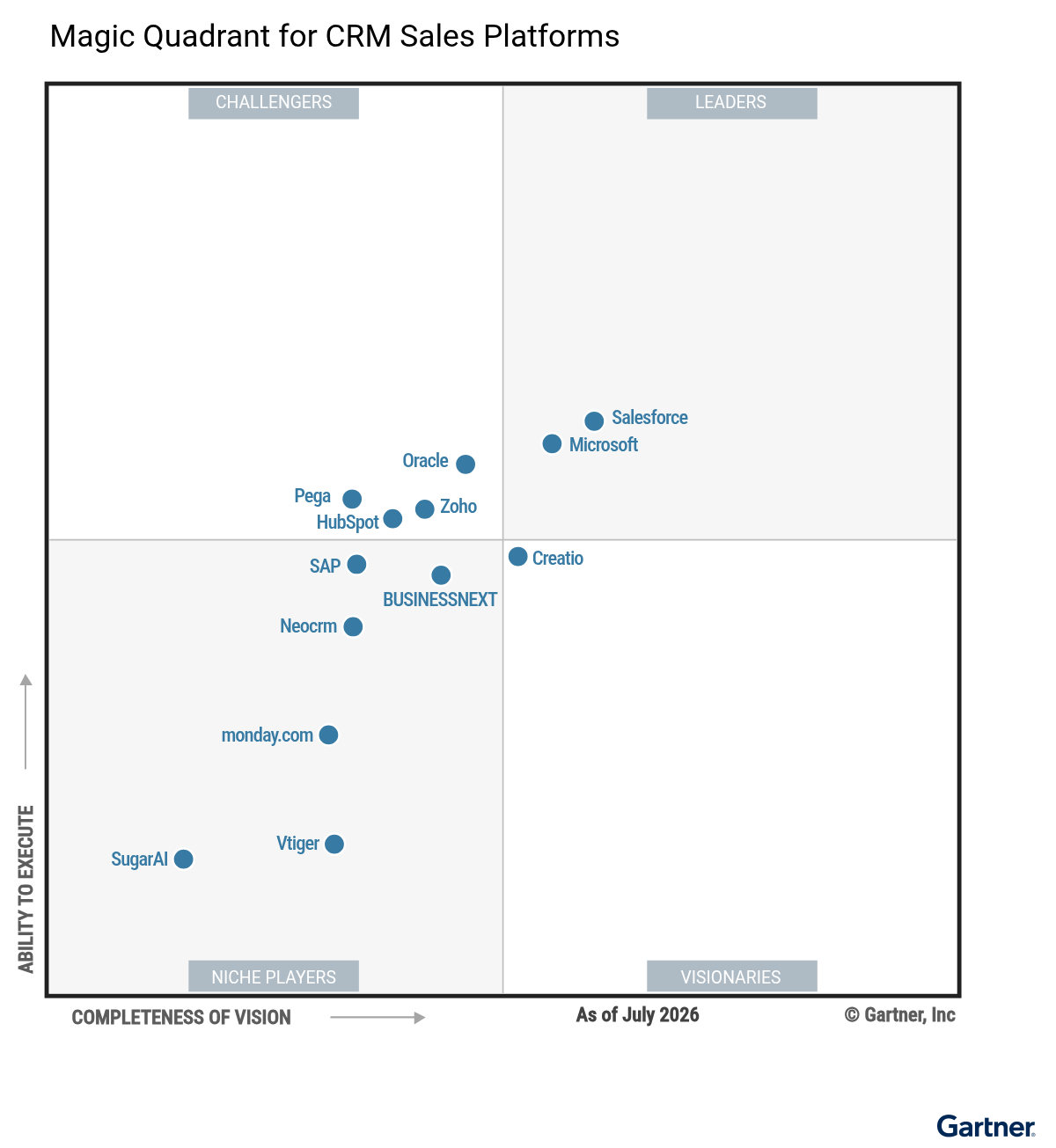
Vendor Strengths and Cautions
BUSINESSNEXT
BUSINESSNEXT is a Niche Player in this Magic Quadrant. Its CRM sales platform offering, BUSINESSNEXT CRM and WORKNEXT, focuses on process-driven sales execution for organizations operating within highly standardized and regulated environments. Its data residency footprint spans South Asia, Southeast Asia, the Middle East and the U.S. The vendor’s implementation and partner depth is strongest in the Middle East and Africa (MEA) and APAC, with limited coverage in Europe and LATAM. Its clients value its vertical depth, deployment flexibility and banking-oriented process support.
Recent strategic investments have centered on WORKNEXT, enhancing agent configuration tools, retrieval tuning and chat-based CRM execution. These advancements support intelligence-infused workflows and conversational interaction layers, particularly for regulated and process-driven sales motions.
- Market direction: The WORKNEXT canvas delivers a conversational chat experience that aligns with emerging headless CRM patterns. During demonstrations to Gartner, the interface allowed users to query data, generate on-demand analytics and trigger specific actions through natural language, supporting a more intuitive sales workflow.
- Agent configuration: The vendor’s agent studio provides a robust framework for sales operations teams to design AI-assisted workflows. Capabilities include agent creation, external-agent registration, granular configuration of topics, memory options and retrieval tools, offering significant breadth for customizing agentic-based sales assistants.
- Opportunity-guided selling: BUSINESSNEXT supports structured account and opportunity management through multisource account views, deal-risk detection, deal-health explanations and WORKNEXT-guided reengagement. This fits sales teams that want consistent opportunity governance across complex or regulated selling motions.
- Seller experience: Organizations should anticipate a process-heavy user experience that may affect sales team productivity. Buyers prioritizing seller speed should validate lighter-touch configurations for their workflows. In Gartner-observed demonstrations, the experience appeared fragmented in places and users needed to know which module or agent to invoke. Buyers should validate how well WORKNEXT, Ambient Flow, Analytics GPT and mobile execution come together for their priority sales workflows.
- AI orchestration: Interplay between predictive, generative and agentic AI capabilities is not fully automated. BUSINESSNEXT can share a common data model, but cross-modality context often depends on administrator- or operations-led prompts, context and workflow design rather than automatic reasoning across AI techniques.
- AI sales governance: Buyers should validate how BUSINESSNEXT monitors AI-generated sales recommendations, agent actions and usage costs. Built-in monitoring shows some activity and errors, while Gartner-observed demonstrations indicated that deeper tracing, observability and monitoring relied on third-party tooling, such as Langfuse.
Creatio
Creatio is a Visionary in this Magic Quadrant. Its Creatio CRM Sales and Creatio AI products are broadly focused on a no-code sales workflow configuration, AI-assisted seller actions and CRM process automation. Its data residency, office coverage and partner ecosystem span North America, LATAM, EMEA and APAC, with customer-selected hosting regions and strong partner coverage across all major regions. Clients value its no-code extensibility, rapid configuration and business-user-led process automation.
Recent investments include Creatio AI, AI skills, agent governance and sales engagement.
- AI sales governance: Creatio provides sales operations and leadership teams with comprehensive oversight of agent behavior and utilization. Its platform includes controls for session monitoring, latency tracking, token consumption and audit trails alongside evaluation and rollback mechanisms. These tools allow organizations to scrutinize recommendation quality and manage AI expenditures before scaling assistant-driven workflows across the broader sales force.
- Mobile field execution: The mobile application delivers a reliable interface for field teams, featuring AI-driven briefings, visit preparation tools, and support for voice- or text-based CRM updates. Sellers can generate postmeeting summaries, create follow-up tasks and add participants while leveraging offline synchronization to maintain CRM data integrity from any location.
- Relationship guidance: Creatio demonstrated account relationship mapping, enriched account views, stakeholder engagement context, next best action cards and deal-health indicators. This gives account teams a configurable way to surface relationship and opportunity context inside the sales workflow.
- Administrative complexity: Organizations should not anticipate a turnkey deployment for sophisticated sales motions that involve AI. Demonstrations to Gartner indicated that AI-infused workflows may require meaningful configuration and design effort involving skills, folders and prompt logic, creating additional design responsibilities for sales operations teams.
- Sales analytics: While the platform facilitates dashboard and chart generation using natural language, its prescriptive capabilities for forecasting remain underdeveloped. Insights often lean toward descriptive summaries, requiring sales leadership to manually investigate deal-level data to interpret fluctuations in pipeline health or risk metrics.
- Workflow automation depth: Some sales engagement, routing, multithreading and account-retention scenarios depend on configured rules or recently added capabilities. Buyers with limited sales operations capacity should validate how much is available out of the box before committing.
HubSpot
HubSpot is a Challenger in this Magic Quadrant. Its Sales Hub and Breeze AI products are broadly focused on seller adoption, sales engagement and RevOps workflows for small and midsize organizations. Its direct operations and partner network span North America, LATAM, Europe and APAC, while its data residency coverage is concentrated in the U.S., EU, Canada and Australia. Its clients value its ease of use, fast deployment, integrated marketing-sales workflows and broad marketplace ecosystem.
Recent investments include Breeze Prospecting Agent, Data Agent, conversation intelligence and buying-group capabilities.
- Seller UX: HubSpot showed a user-friendly Sales Workspace and Breeze assistant experience that helps sellers prepare for meetings, view priority tasks and act without requiring heavy configuration. This supports sales teams that value fast adoption and concise AI outputs over deep process control.
- High-velocity inside sales: The platform’s prospecting workflows leverage the Breeze Prospecting Agent, Data Agent and integrated sequences alongside power dialing and automated logging. These capabilities are strategically aligned with high-volume sales productivity and the coordination of marketing-to-sales transition motions.
- Activity management: HubSpot’s conversation intelligence, transcripts, source-linked next steps, AI-drafted follow-up emails and data hygiene suggestions help sellers turn calls into CRM actions. This improves sales follow-through while keeping review and acceptance in the seller workflow.
- Account management depth: Organizations focusing on expansion or portfolio health should scrutinize HubSpot’s product packaging and workflow depth. During demonstrations to Gartner, customer success and account health scenarios appeared heavily dependent on Service Hub, lacking a truly integrated account management experience within the native Sales Hub interface.
- Visualization and analytics: HubSpot’s visualization and analytics capabilities appeared less developed than its seller activity and prospecting workflows. Buyers needing prescriptive forecast coaching, deal-by-deal probability insight or advanced win-loss analysis should validate those capabilities carefully.
- Limited action configuration: Custom agent configuration for Breeze agents is constrained by manual prompt logic and narrow execution paths. Prospective clients should not anticipate sophisticated autonomous orchestration, self-evolving agent behaviors or the ability to deploy extensive custom action libraries at this stage.
Microsoft
Microsoft is a Leader in this Magic Quadrant. Its Dynamics 365 Sales, Sales agent in Microsoft 365 (M365) Copilot, M365 Copilot and Copilot Studio capabilities are broadly focused on AI-assisted selling across CRM, Work IQ, Outlook, Teams and Dataverse, with its sales agents surfacing in the same M365 productivity apps where sellers already work. Its global reach is among the broadest in the market, with Microsoft Azure data residency, compliance and partner coverage spanning North America, LATAM, EMEA and APAC. Its clients value its productivity-suite integration, enterprise compliance, partner availability and extensibility across its cloud ecosystem.
Recent investments center on sales agents, research canvases, signal-based selling and Copilot Studio extensibility.
- Sales research and analytics: Microsoft’s Sales Research Agent and research canvas capabilities synthesize CRM data, web insights and SQL context to provide natural language querying. The platform delivers pipeline coverage, deal-tracking bubble charts and prescriptive recommendations, enabling sales leadership and account teams to scrutinize pipeline health and competitive risks without the burden of manual report generation.
- M365 sales workflow: The vendor delivers a unified sales experience across Dynamics 365, Outlook and Teams via M365 Copilot and Sales agent in Microsoft 365 (M365) Copilot. These tools provide sellers with context-aware meeting preparation, record summaries and automated follow-up support, allowing organizations to embed intelligent sales guidance directly within their existing daily collaboration and productivity ecosystems.
- Agent extensibility: Through Copilot Studio and the broader Power Platform, it facilitates the granular configuration of custom AI agents leveraging multisource connectors and Dataverse. This environment is well-suited for organizations with specialized sales operations and IT teams, enabling them to deploy sophisticated, enterprise-scale customization of sales assistants.
- AI experience cohesion: Prospective clients should scrutinize the integration across its disparate Copilot and agent interfaces, as its demonstrations revealed fragmented research surfaces, latency in generating relationship summaries and verbose AI outputs. Sales operations teams may need to provide meaningful training to ensure sellers can navigate these experiences effectively.
- Mobile field execution: Microsoft did not demonstrate voice-based CRM updates or robust offline synchronization on mobile during Gartner-observed demonstrations. Sales leadership with significant field-based requirements should scrutinize the platform’s ability to maintain data integrity and support write-back actions in disconnected environments.
- AI sales governance: Microsoft’s frameworks for agent telemetry, tracing and boundary enforcement appear underdeveloped relative to its expansive agent library. Deploying sophisticated custom agents will likely necessitate specialized technical expertise to manage the complexities of Copilot Studio, Dataverse and multisource connector configurations.
monday.com
monday.com is a Niche Player in this Magic Quadrant. Its monday CRM product is mainly focused on configurable, board-based (project management style) sales workflows for small and midsize sales organizations. Its data residency footprint covers the U.S., EU, APAC and Israel, and its offices and partner network span North America, EMEA, APAC and LATAM, though enterprise implementation depth is less extensive than that of larger global vendors. Its clients tend to value its ease of use, flexible work management and rapid configuration.
Recent investments center on monday sidekick, AI blocks embedded in boards and monday vibe apps for custom CRM experiences.
- Board-based usability: monday CRM delivers a visually intuitive, board-centric interface that allows representatives to navigate between accounts, deals and engagement tasks with minimal friction. This architecture is well-suited for sales organizations that prioritize rapid user adoption through familiar, flexible work management frameworks.
- Embedded AI blocks: The platform allows for the placement of generative AI (GenAI) components directly within board columns and operational workflows. This provides sales operations teams with significant latitude to embed intelligent summaries, outreach guidance, risk narratives and prescriptive action cues directly into the primary seller workspace.
- Mobile execution: The vendor demonstrated robust mobile- and voice-enabled capabilities for interacting with monday sidekick, modifying opportunity stages and capturing spoken field notes. These tools facilitate real-time CRM updates and context-aware briefings for field-based sellers operating within a mobile-first environment.
- Administrative and design burden: Prospective clients should not anticipate a turnkey CRM sales platform experience for sophisticated sales motions. Gartner observations indicated that critical workflows — including account management dashboards, deal rooms and forecast visualizations — rely on manual configuration of boards and custom objects rather than purpose-built, native sales modules.
- AI maturity: The platform’s AI capabilities remain nascent, primarily revolving around prompt-based GenAI and rule-driven workflow chaining. monday CRM did not demonstrate advanced predictive machine learning (ML), agentic orchestration or native conversation intelligence, limiting its effectiveness for organizations seeking intelligent sales guidance.
- Forecasting and analytics: monday CRM lacks a robust, native forecast management layer or advanced analytics surface. Buyers requiring prescriptive deal-level insights, historical model training or interactive trend reporting should carefully validate the extent of manual setup necessary to achieve parity with dedicated sales analytics solutions.
Neocrm
Neocrm is a Niche Player in this Magic Quadrant. Its Neocrm product is mainly focused on CRM sales execution for organizations operating in China and APAC. Its data residency and ecosystem coverage are concentrated in China and the Association of Southeast Asian Nations, with standard SaaS coverage in Singapore, Indonesia, Germany and China. Neocrm’s partner coverage is mainly focused in APAC and parts of Europe. Its clients tend to be midsize and large organizations that need mobile-first selling, account and opportunity management, and integration with the Tencent ecosystem.
Recent investments center on mobile AI assistance, Neo Agent, Agent Studio, predictive deal assessment, AI forecast views and Neo BI analytics.
- Mobile field execution: The platform delivers a high degree of parity between its mobile and desktop environments, featuring voice-activated AI agent interactions, opportunity cards, and comprehensive activity and object creation. For field-based representatives, Neocrm supports offline work orders, real-time account updates, and robust attachment and photo capture capabilities, ensuring CRM data integrity for sellers operating away from the office.
- Sales analytics: Neo BI Shared Space facilitates data exploration through analyst-agent interactions and self-service visualizations. The platform provides complex analytical surfaces, including deal views, comparison tables, trend analysis and AI-driven forecast projections, enabling sales leadership and account teams to scrutinize pipeline health and portfolio metrics through an intelligent, visual interface.
- AI breadth: The vendor integrates traditional predictive machine learning with generative and agentic experiences. Its capabilities span AI-based forecasting, lead assessment, opportunity risk detection, prompt-generated explanations, proactive agent actions and account briefings. Agent building is supported through Neo Agent and Agent Studio, where administrators can define topics, actions, APIs, variables and prompt instructions.
- Regional ecosystem: Neocrm is most effectively utilized by firms with a localized footprint in China or primary APAC sales motions. The vendor’s interoperability with M365 (including Teams) and other productivity stacks remains limited.
- Activity management: The platform’s conversation intelligence framework appears nascent relative to its mobile and analytics surfaces. During demonstrations to Gartner, the solution necessitated manual ingestion and parsing of recordings, with subsequent task orchestration often relying on preconfigured workflows or static templates.
- AI sales governance: Monitoring and observability for agent actions remain underdeveloped, frequently requiring administrators to navigate raw numerical logs or construct custom BI dashboards. Buyers should validate whether Neocrm delivers sufficient transparency regarding agent quality, audit trails and rollback mechanisms for large-scale enterprise deployments.
Oracle
Oracle is a Challenger in this Magic Quadrant. Its Oracle Fusion Cloud Sales product is mainly focused on sales execution for upper-midsize and large enterprises, especially organizations invested in Oracle Fusion applications. The Oracle Cloud infrastructure footprint and partner network span North America, LATAM, EMEA and APAC, with particularly strong data residency coverage and enterprise partner depth. Its clients tend to have complex front-office and back-office processes.
Recent investments center on Sales Motions and Sales Plays, Deal Advisor, Account Advisor, and agent configuration within Oracle’s Fusion application stack.
- Market responsiveness: Oracle demonstrated Sales Motions and Sales Plays that can turn a strategy prompt and supporting documents into objectives, high-value activities and suggested actions. This supports sales operations teams that want a vendor-defined structure for account, renewal and opportunity plays.
- Enterprise context: The platform grounds AI assistants and agents within the broader Oracle ecosystem, encompassing ERP, marketing and customer data platform context. This multisource integration is designed for large enterprises seeking to inform deal guidance with a unified view of both front-office interactions and back-office operational signals.
- Opportunity guidance: Account Advisor and Deal Advisor allow the vendor to deliver intelligent surfaces that highlight account context, deal-risk detection and prescriptive engagement recommendations. This approach provides complex sales organizations with a framework for guided next steps without the administrative burden of constructing custom agents.
- Agentic AI configuration complexity: Oracle supports governed agentic AI through scoped agent teams, workflow agents, Sales Motions, Sales Plays and workflow nodes. Buyers should validate the configuration, extensibility and ongoing maintenance effort required to adapt these capabilities to their sales motions, data models and approval workflows, especially where sales operations teams need to manage changes without heavy IT involvement.
- Activity management: Oracle’s evaluated CRM workflows provide limited conversation intelligence, lacking embedded call capture, native CTI/dialer support and mature click-to-call execution. Customer engagement analysis depends on logged interactions, uploaded meeting summaries or third-party integrations, which may limit effectiveness for sales organizations with high-volume calling requirements.
- Mobile field execution: Prospective clients should evaluate whether mobile and Outlook experiences provide sufficient continuity with desktop workflows. Key actions such as email execution and interaction capture may require switching contexts or relying on integration patterns, creating a fragmented seller experience for field-based users.
Pega
Pegasystems is a Challenger in this Magic Quadrant. Its CRM sales platform product, Pega Sales Automation, is mainly focused on sales execution for large, complex enterprises that need case-based workflows, decisioning and process orchestration. Its data residency, office presence and implementation partner network span the Americas, EMEA and APAC, with strong global time frame coverage aligned to complex enterprise deployments. Its clients tend to have complex customer engagement, service and sales operations.
Recent investments center on Blueprint, Knowledge Buddy, Pega GenAI Sales Assistant, predictive decisioning and agent-assisted sales workflows.
- AI architecture: Pega delivers a comprehensive framework that integrates predictive, generative and agent-assisted capabilities through its Customer Decision Hub and Knowledge Buddy. This multisource orchestration allows enterprise sales teams to ground intelligent guidance within persistent workflow context and reusable data assets, ensuring recommendations are aligned with established business processes.
- Opportunity orchestration: The platform facilitates sophisticated deal-risk diagnosis and predictive health scoring alongside prescriptive action cues and assistant-driven email creation. This framework provides account teams with granular risk explanations and immediate seller interventions, moving beyond descriptive deal summaries to drive proactive opportunity governance.
- Analytics and visualization: Through Explore Data, the vendor demonstrated intelligent, natural language querying and automated pipeline analysis with comparative performance views. These analytical surfaces enable sales leadership and operations teams to scrutinize loss patterns and pipeline fluctuations through an intuitive, visual interface without the burden of manual report generation.
- Administrative complexity: Prospective customers should anticipate the need for specialized technical expertise and sales operations support. Deploying sophisticated capabilities via Customer Decision Hub, data pages or Knowledge Buddy necessitates deep architectural and data-modeling proficiency.
- Mobile field execution: Pega’s mobile AI framework appears underdeveloped relative to its desktop assistant and analytical surfaces. During demonstrations to Gartner, voice interactions featured noticeable latency, and the vendor did not demonstrate real-time opportunity creation or record updates within the mobile environment.
- High-velocity sales: The platform is not optimized for high-volume, human-led prospecting motions. Observations indicated a reliance on static lead queues and basic telephony, with limited support for sophisticated sales development representative (SDR) sequences outside of its autonomous, email-based qualification agents.
Salesforce
Salesforce is a Leader in this Magic Quadrant. Its Agentforce Sales product is mainly focused on AI-assisted selling for small, midsize and large enterprises that need broad CRM, sales engagement, forecasting, data, analytics and agent-building capabilities. Its Hyperforce data residency and partner ecosystem span North America, LATAM, EMEA and APAC, supported by one of the deepest global CRM partner networks. Its clients represent many varieties of sales operations models, often have Salesforce-centered ecosystems, and span the globe.
Recent investments center on end-to-end agentic selling capabilities and a multichannel data foundation that surfaces insights across the sales life cycle.
- Agentforce breadth: Salesforce offers predictive scoring, conversation intelligence, agentic cadences, mobile AI, and configurable agent and subagent workflows. Subagents can be configured with grounded actions, data libraries and Salesforce Flow, supporting sales organizations that need various AI types across lead, opportunity, account, activity and mobile workflows.
- High-velocity selling: The platform delivers specialized capabilities for high-volume prospecting, such as agentic routing, integrated dialing and AI-driven transcription with automated voice-note logging. These tools are designed to enhance seller productivity during rapid qualification and outreach motions through embedded engagement scripts and intelligence-infused workflows.
- Governance and observability: Salesforce provides leadership teams with granular oversight through agent analytics, trust-layer guardrails and audit tracing of autonomous actions. Capabilities such as toxicity metrics, versioning controls and flex-credit visibility offer the necessary administrative scrutiny for enterprises seeking to scale assistant-driven workflows more securely.
- Packaging, dependencies and consumption oversight: Prospective clients should scrutinize the dependencies across Agentforce 1, Data 360, Tableau and Slack alongside industry-specific clouds. Achieving the full breadth of the demonstrated AI experience often necessitates multiple product investments and diligent oversight of consumption-based flex credits to manage escalating operational expenditures.
- Agentic workflow readiness: Deploying more advanced agentic workflows requires robust sales operations and data governance proficiency. Agent outcomes depend on how buyers compose, chain and govern subagents, often through Salesforce Flow. Buyers should test confidence handling, error recovery and whether recommendations can be executed directly before assuming end-to-end autonomy.
- Seller UX: Salesforce Lightning interface for sellers can be perceived as crowded with traditional CRM screens, widgets, panels and assistant sidebars. Buyers should validate whether Agentforce reduces seller effort or adds another layer to an already complex Salesforce environment.
SAP
SAP is a Niche Player in this Magic Quadrant. Its SAP Sales Cloud product, part of the SAP CX product line, is best suited for organizations already invested in SAP enterprise applications such as SAP S/4HANA. Its data residency, direct implementation coverage and partner network span North America, LATAM, EMEA and APAC, with particular relevance for large SAP-centric enterprises in industries such as manufacturing, consumer products, high tech, utilities and related sectors. Its clients tend to be large enterprises with SAP-centered processes.
Recent investments center on enhancements to its embedded AI assistant Joule, predictive opportunity and lead insights, relationship analytics, product recommendations, SAP Analytics Cloud, Business Data Cloud and AI-assisted sales workflows.
- SAP enterprise context: The platform grounds sales workflows in the broader SAP ecosystem, encompassing S/4HANA-linked account, opportunity and customer data context. This multisource integration supports SAP-centric organizations seeking to inform deal guidance with a unified view of CRM interactions and back-office operational data.
- Predictive sales signals: Opportunity and lead insights, relationship analytics and product recommendations deliver predictive engagement recommendations. This framework enables account teams to leverage predictive guidance based on CRM activities and relationship frequency, reducing manual effort.
- Account management depth: SAP Sales Cloud supports account teams managing existing customer relationships with SAP-linked sales and back-office context. Its capabilities include pipeline queries, gap-analysis prompts, relationship indicators, account and opportunity recommendations through Joule, and predictive signals such as opportunity scoring, lead scoring, product recommendations and relationship analytics.
- AI experience cohesion: During demonstrations, the AI experience appeared spread across separate screens and canvases, requiring manual prompting and underscoring the need for prospective clients to scrutinize Joule integration across SAP Sales Cloud workflows. Sales operations teams should validate whether the platform facilitates a persistent assistant experience across seller workflows without significant workflow context switching.
- Agentic maturity: SAP’s frameworks for generative and agentic orchestration remain nascent relative to other CRM providers evaluated. Deploying custom agents requires specialized technical expertise, including SAP Build Studio and custom Model Context Protocol configurations, which limits sales operations leaders’ ability to directly own agentic sales workflows. Additionally, reliance on add-on products such as SAP AI Agent Hub for Agent Governance introduces further complexity.
- Mobile and high-velocity sales: SAP’s mobile framework appears underdeveloped, with voice-based updates requiring Siri shortcuts and offline data integrity dependent on prior manual downloads. The platform showed limited support for high-volume prospecting motions, with list-based leads, rules-based routing and no native high-productivity sequencing. Conversation intelligence relied on postcall Microsoft Teams transcript analysis, without demonstrated in-call guidance or scoring.
SugarAI
SugarAI (formerly SugarCRM) is a Niche Player in this Magic Quadrant. Its Sugar Sell product is mainly focused on foundational CRM for midsize and upper-midsize organizations, especially in manufacturing, wholesale and distribution. Its evaluated capabilities are strongest where buyers need straightforward account, contact, opportunity, activity and pipeline records management, configured process guidance, and basic opportunity and pipeline indicators rather than advanced AI-led selling.
Recent investments center on enhancements to sales-i, Sugar Discover and Smart Guides to complement its CRM sales platform.
- Foundational CRM: SugarAI delivers an intuitive, conventional CRM experience centered on account, contact, opportunity, activity and pipeline records management. This architecture is well-suited for organizations that prioritize system-of-record visibility, opportunity management and configured sales processes over advanced AI orchestration.
- Process governance: Through Smart Guides, SugarAI preconfigures seller tasks and automated field updates within linear guided sales workflows. This framework provides sales operations teams with a structured, step-based environment for driving repeatable execution.
- Account intelligence: SugarAI leverages sales-i to surface predictive likelihood signals, deal alerts and adjacent product recommendations. These surfaces enable account teams to identify renewal risks and cross-sell opportunities derived from historical spend patterns and product consumption data.
- AI maturity: SugarAI’s generative capabilities remain nascent relative to those of other CRM sales platform providers evaluated in this Magic Quadrant. Sugar Sell did not demonstrate mature generative AI experiences embedded across seller workflows, robust configurable predictive AI or conversational intelligence for natural language processing.
- Sales AI agent gaps: The platform lacks a comprehensive framework for agentic orchestration and administrative oversight. Prospective clients should not anticipate native tools for agent development, knowledge tuning, action-library configuration, composite AI, natural language analytics, or granular AI monitoring and observability guardrails.
- Sales productivity depth: SugarAI is not optimized for high-volume prospecting or complex enterprise opportunity governance. Organizations requiring intelligent call prioritization, native conversation intelligence, stakeholder multithreading or natural language analytical surfaces should look to alternative solutions that can support such sophisticated selling motions.
Vtiger
Vtiger is a Niche Player in this Magic Quadrant. Its Vtiger CRM product is mainly focused on CRM sales for small and midsize organizations that need straightforward CRM, basic AI indicators and affordable configurability. Its data residency and partner coverage span APAC, the Americas and EMEA, though its direct implementation presence is strongest in India. Its clients tend to value ease of use over deep enterprise sales orchestration.
Recent investments center on Vtiger One, AI Studio, Ask AI, Vmeet, predictive deal indicators and configurable AI agents.
- Predictive deal guidance: Through deal-risk indicators, the vendor delivers intelligent surfaces that highlight engagement signals, deal velocity and momentum alongside descriptive risk explanations. This framework facilitates basic opportunity prioritization for small and midsize sales organizations without the administrative burden of constructing complex AI agents from the ground up.
- Activity management: Vtiger demonstrated robust meeting capture and transcription capabilities featuring speaker identification, objection detection and automated follow-up support. Vtiger is strategically aligned with the needs of sales teams seeking to embed intelligent activity management and record synchronization within a unified, cost-effective CRM environment.
- Emerging AI Studio: The vendor facilitates the granular configuration of custom AI agents through a dedicated studio environment encompassing agent topics, custom skills and multisource connectors. While these capabilities remain nascent, they offer smaller sales operations teams a path toward intelligent, nonturnkey sales assistants leveraging commercial large language models (LLMs).
- Replatforming risk: Vtiger is navigating a transition toward a unified architectural foundation, and demonstrations were difficult to evaluate because some data and workflow executions were not shown coherently. Prospective clients should validate whether specific expected capabilities are production-ready, legacy-only, migrated or still being rebuilt in the Vtiger One experience.
- Agentic maturity: The vendor’s agentic framework remains nascent, with configuration necessitating heavy reliance on manual instructions, webhooks and flows. Gartner observations indicated significant gaps in advanced orchestration, including context relevance tuning, memory and robust administrative guardrails such as boundary enforcement and business-outcome telemetry.
- Use-case coverage: Vtiger is not intended for sales organizations requiring sophisticated account management, high-velocity prospecting or complex enterprise opportunity governance. Buyers seeking advanced relationship white-space analysis, stakeholder multithreading or intelligent call-list productivity should scrutinize alternative solutions capable of supporting these specialized selling motions.
Zoho
Zoho is a Challenger in this Magic Quadrant. Its Zoho CRM product is mainly focused on CRM sales for small, midsize and upper-midsize organizations that want broad CRM capabilities, unified AI through Zia, and a large adjacent application suite. Its data residency, direct implementation coverage and partner network span North America, LATAM, EMEA and APAC, with particularly strong APAC and emerging-market coverage.
Recent investments center on Zia Agent Studio, Zoho’s AI assistant Zia, predictive scores, agent orchestration, natural language reporting and Zoho’s broader application ecosystem.
- Unified Zia experience: Zia offers a cohesive intelligence layer that integrates predictive scoring, summaries and assistant-driven workflows within a single interface. This consolidated approach is designed for sales teams seeking a persistent AI entry point, reducing the friction associated with navigating disparate AI experiences across disconnected CRM modules.
- Agent configuration: Zia Agent Studio provides a granular environment for managing knowledge sources, model selection and multiagent orchestration. The platform includes robust administrative tools for agent observability and audit tracing, offering small and midsize organizations sophisticated agentic capabilities without the technical overhead of larger enterprise solutions.
- Geographic breadth: The vendor maintains an expansive global footprint featuring diverse data residency options, localized interfaces and a robust regional partner network. This infrastructure is strategically aligned with the requirements of distributed buyers, particularly those operating in APAC, MEA and emerging markets that necessitate localized implementation support.
- Mobile field execution: Zia is primarily optimized for desktop environments and was not available in the evaluated mobile app. Voice-driven mobile opportunity creation, information retrieval and native agentic execution were not demonstrated, so field-heavy buyers should scrutinize mobile parity carefully.
- Execution and performance: While Zoho maintains a robust AI vision, Gartner observed noticeable latency, generic narrative outputs and a heavy reliance on manual configuration. Buyers should validate recommendation specificity, workflow performance and dependencies on adjacent Zoho products such as WorkDrive or Zoho Learn.
- High-velocity sales: The platform is not optimized for complex, high-volume prospecting motions. Although it facilitates lead scoring, filtering and Kanban-centric views, Zoho did not demonstrate a native high-productivity sales engagement queue or robust sequencing engine. Organizations requiring advanced sales development representative productivity should scrutinize the depth of the vendor’s routing, cadence management and automated outreach capabilities.
Vendors Added and Dropped
We review and adjust our inclusion criteria for Magic Quadrants as markets change. As a result of these adjustments, the mix of vendors in any Magic Quadrant may change over time. A vendor's appearance in a Magic Quadrant one year and not the next does not necessarily indicate that we have changed our opinion of that vendor. It may be a reflection of a change in the market and, therefore, changed evaluation criteria, or of a change of focus by that vendor.
Added
No vendors were added.
Dropped
No vendors were dropped.
Inclusion and Exclusion Criteria
To qualify for inclusion in the 2026 Magic Quadrant and Critical Capabilities for CRM Sales Platforms, providers must meet Entry Criteria, Level 1 Criteria, Level 2 Criteria, and Level 3 Criteria.
Entry Criteria: Vendors must meet all Entry Criteria to be eligible for the Magic Quadrant and Critical Capabilities reports.
1. Composite artificial intelligence (AI) minimum: Provide production use of at least two AI modalities (predictive, generative, agentic, or conversation intelligence) embedded within at least two core sales workflows. At least two workflows must demonstrate cross-modality operation, where the output of one AI modality directly informs, triggers, or improves another AI modality within the product experience.
Example 1: Postcall follow-up that changes deal risk:
- Conversation intelligence extracts objections, commitments, and stakeholder sentiment from a recorded call.
- Those extracted signals update the opportunity context and feed predictive AI that recalculates deal risk.
Example 2: Lead scoring that conditions personalization:
- Predictive AI scores inbound leads and identifies the top drivers behind the score (fit and intent signals).
- Those drivers become inputs to generative AI, which produces personalized outreach messaging and suggested next steps for the seller.
2. Native baseline: The platform must deliver the critical capabilities without requiring third-party add-ons for the core product experience. Integrations to native non-CRM systems are permitted, but the platform cannot rely on a third-party product to provide core CRM sales platform functions or the AI modalities used to meet the Entry Criteria.
Level 1 Criteria: If the provider meets Entry Criteria, then the provider must meet all eight of the following criteria in the generally available product (without reliance on third-party add-ons).
- Accounts and contacts: Centralize and unify account and contact records to support engagement history, interactions, transactions.
- Opportunity orchestration: Automate, orchestrate, and guide opportunity progression through the sales and buyer journey with AI.
- Activity management: Track, automate, and guide tasks, calls, meetings, and emails to create visibility into seller activities and prescribe next best actions.
- Pipeline and forecast management: Provide real-time pipeline health, predictive and prescriptive analytics, and automated forecasting.
- Lead orchestration: Capture, qualify, and route leads with rules and AI.
- Visualization and analytics: Offer dashboards and reports for sales performance and KPIs, including customizable visualizations.
- Mobile and voice: Mobile apps and voice-enabled assistants for on-the-go access to non-CRM and CRM data and actions.
- Data and platform extensibility: Provide a flexible and scalable architecture that enables integration with diverse systems and data sources. The solution must support the configuration of sales processes that leverage both AI and human insights, enabling organizations to tailor AI for specific use cases and integrate data from multiple sources to optimize sales execution.
Level 2 Criteria: If the provider meets Entry Criteria and Level 1 Criteria, then the provider must meet both of the following criteria to qualify:
- Have customers with live CRM sales platform implementations in at least four of the five use cases for CRM sales platform critical capabilities: face-to-face (F2F) field sales, account manager (management), high-velocity inside sales, long-cycle business to consumer (B2C), and complex enterprise deals.
- Made at least three major CRM sales platform releases with significant functional improvements during the 12 months from February 2025 to February 2026. A new or acquired offering from an established provider in this market is also considered, if Gartner established that offering was being sold to customers actively.
Level 3 Criteria: If the provider meets Level 2 Criteria, then the provider must meet at least one of the following three market relevance pathways.
Pathway A (Revenue): Revenue of at least $30 million during calendar year 2025 is attributable to the CRM sales platform offering. If AI capabilities are required to deliver the vendor’s CRM sales platform offering as sold, then related AI subscription or usage fees must be included in the reported CRM sales platform revenue for this criterion.
Pathway B (Customer Footprint): At least 80 customers with live CRM sales platform implementations as of February 2025, spanning at least four industries, with an average of at least 25 paid users per customer.
Industry definitions for Pathway B:
- Automotive
- Communications, media, and services
- Consumer product goods manufacturing
- Education
- Energy and utilities
- Financial services
- Healthcare providers
- High tech and software
- Industry
- Insurance
- Life sciences
- Manufacturing and natural resources
- Professional and business services
- Retail
- Transportation and logistics
Pathway C (Market Traction): During the 13 months from January 2025 to February 2026, closed CRM sales platform contracts with either (a) at least 15 new logos on deals that exceed $500,000 in total contract value or (b) at least 50 new logos on deals between $50,000 and $500,000 in total contract value.
Evaluation Criteria
Providers are excluded if their offering does not meet the CRM sales platforms market definition or if the offering is primarily a point solution that does not provide the mandatory features as an integrated platform. Examples include sales engagement point solutions, conversation intelligence point solutions, configure, price and quote (CPQ) point solutions, sales performance management (SPM) point solutions, and marketing automation offerings that do not provide the mandatory CRM sales platform features.
Ability to Execute
Product or Service: Vendors are evaluated on the quality of their native CRM sales platforms capabilities, including both the core capabilities and CRM sales platforms extensions. Vendors are also evaluated on technical considerations, such as ease of use and administrative functions. Gartner assesses information provided by Gartner Peer Insights, other publicly available sources, Critical Capabilities research and observations collected from Gartner inquiries.
Overall Viability: Vendors were evaluated on additional factors such as customer retention rate and the ability to generate revenue specifically in the CRM sales platforms market.
Sales Execution/Pricing: Among the many factors in this category, Gartner evaluates the number of new customers acquired, growth in CRM sales platforms revenue, average CRM sales platforms deal size, average contract duration and customer retention. Gartner also evaluates client satisfaction with contracting and negotiation processes.
Market Responsiveness and Track Record: Gartner evaluates the quality and depth of a vendor’s releases and the ability to deliver functions requested by clients.
Marketing Execution: Marketing execution was not rated in this year’s evaluation because the Magic Quadrant analyst team is moving toward more product-centric evaluations with demonstrations as evidence.
Customer Experience: Customer experiences were evaluated based on a vendor’s ability to help customers achieve positive business value as well as sustained user adoption, quality implementation and ongoing support.
Operations: Criteria include assessments of product upgrade processes, quality, scope and the breadth of peer user community and customer communities.
Ability to Execute Evaluation Criteria
| Evaluation Criteria | Weighting |
|---|---|
Product or Service | High |
Overall Viability | Medium |
Sales Execution/Pricing | Medium |
Market Responsiveness/Record | High |
Marketing Execution | NotRated |
Customer Experience | Medium |
Operations | Low |
Source: Gartner (August 2026)
Completeness of Vision
Market Understanding: Vendors must define how their CRM sales platforms solutions improve client sales process execution and support sales effectiveness objectives. Vendors must also define their competitive differentiators, value proposition and outcomes achieved by clients. Vendors were also evaluated on their articulated and demonstrated ability to align with client customer experience, digital business and sales execution optimization objectives.
Marketing Strategy: Vendors were evaluated on their segmentation strategies and how their solutions appeal to selling organizations in multiple verticals as well as to prospects with 50 or more sales sellers. If a vendor derives a significant percentage of its revenue from recurring-revenue-based products, it must also have a customer retention strategy.
Sales Strategy: Vendors were evaluated on their ability to sell to business and IT stakeholders as well as to the segments defined in the marketing strategy.
Offering (Product) Strategy: Gartner assesses a vendor’s product and packaging offerings. A vendor should not only demonstrate a product vision that accounts for core CRM sales platforms functionality (as defined by the market’s core capabilities) but also offer new application functionality across the breadth and depth of product capabilities. This consideration is critical for meeting the needs of a maturing market.
Subcapabilities include a vendor’s vision for:
- Sales enablement functions such as content management, sales training and coaching
- B2B and B2C digital commerce
- Digital sales rooms
- Sales effectiveness functions (e.g., CPQ or order management)
- Integration with third-party sales applications, with a primary focus on native functions
Business Model: Business model was not rated in this year’s evaluation because the Magic Quadrant analyst team is moving toward more product-centric evaluations with demonstrations as evidence.
Vertical/Industry Strategy: Vendors were evaluated on the scope of native-built applications that automate industry-specific sales processes in verticals such as financial services and life sciences. Vendors were also evaluated on the scope of third-party partnerships with independent software vendors (ISVs) that offer industry-specific capabilities.
Innovation: Vendors must show continued investment in improving core CRM sales platforms features. They must also show growth in new areas such as sales execution, analytics, collaboration or new devices (for example, Internet of Things [IoT]), and new technology directions such as digital business and bot-building functions to support multiexperience.
Geographic Strategy: Vendors were evaluated on the percentage of employees allocated to the regions and the depth and scope of partners in those regions.
Completeness of Vision Evaluation Criteria
| Evaluation Criteria | Weighting |
|---|---|
Market Understanding | High |
Marketing Strategy | Low |
Sales Strategy | Low |
Offering (Product) Strategy | High |
Business Model | NotRated |
Vertical/Industry Strategy | Medium |
Innovation | High |
Geographic Strategy | Medium |
Source: Gartner (August 2026)
Quadrant Descriptions
Leaders
Leaders have the ability to execute their vision through products, services and demonstrably solid business results in the form of revenue and earnings. Leaders have significant, successful worldwide customer deployments in a wide variety of industries and multiple proof points for deployments above 500 users. They demonstrate consistently above-average customer experience levels, product execution scores and sales execution scores.
Leaders demonstrate product leadership by delivering new enhancements and innovations on a consistent schedule. They also provide thought leadership, showing customers and prospects how their CRM sales platforms solutions improve sales execution and sales processes.
Challengers
Challengers are often larger than most (but not all) Niche Players and demonstrate a higher volume of new business for CRM sales platforms. They have the size to compete worldwide; however, in some cases they may not be able to execute equally well in all geographies or segments. They may often return stronger CX satisfaction scores. They understand the evolving needs of a sales organization yet may not lead customers into new functional areas with a strong functional vision.
Challengers tend to have a good technology vision for architecture and other IT organizational considerations but have not won over the top sales executives and/or application leaders in the IT organization.
Visionaries
Visionaries are ahead of most potential competitors in delivering innovative products and delivery models. They anticipate emerging and changing sales needs and move the market into fresh areas with solutions that improve sales execution.
Visionaries have strong potential to influence the direction of the CRM sales platforms market but are limited in terms of execution and/or track record.
Niche Players
Niche Players offer products for CRM sales platforms functionality but may lack some functional components. Some may not show the ability to consistently handle deployments of more than 500 users across multiple geographies. Some may lack strong business execution in the CRM sales platforms market even if their core features are strong. These vendors may offer complete portfolios for a specific industry but face challenges in one or more areas necessary to support cross-industry requirements, such as complex forecasting or pricing and quotation features. They may have an inconsistent implementation track record or they may lack the ability to support the requirements of large enterprises.
Niche Players often offer the best solutions for the needs of particular sales organizations or CRM sales platforms use cases.
Context
Given that there are more than 100 CRM sales platforms vendors worldwide, those in this research represent a small part of the overall CRM sales platforms vendor market. Hundreds more vendors provide basic contact management software, which is a subset of CRM sales platforms. Dozens of vendors have built vertical-specific CRM sales platforms solutions.
Because it is not possible to review every CRM sales platforms provider, this Magic Quadrant evaluates CRM sales platforms solutions that are broadly applicable to many different size sales organizations and verticals.
We place particular emphasis on vendors’ core CRM sales platforms capabilities, such as artificial intelligence, broadly speaking, as described in the Market Definition/Description section of this Magic Quadrant. However, to build as complete a picture as possible, we also evaluate their noncore CRM sales platforms capabilities such as, but not limited to, sales engagement, conversation intelligence, and the emerging trends surrounding AI governance and observability for managing agentic deployments within face-to-face field sales, account management, high-velocity inside sales, long cycle B2C sales, and complex enterprise deal selling.
Sales Organization Sizing
In this Magic Quadrant, Gartner refers to sales organization customer sizes or vendor target segments. We define these segments as follows:
- Small business: Fewer than 100 sales users
- Midsize enterprise (MSE) or business: 101 to 1,000 sales users
- Large business: 1,001 to 2,500 sales users
- Enterprise: More than 2,500 sales users
Market Overview
The CRM sales platforms market grew 12.1% in 2025, reaching $16.9 billion. Gartner continues to facilitate a large number of inquiries surrounding vendors and their capabilities. Most notably, Gartner inquiries have seen a significant shift into AI capabilities, with clients both learning about and inquiring about sales AI use cases and where to anchor their platform investments.
Key Trends in CRM Sales Platforms
Trend 1: Agentic AI remains largely bounded by LLM-augmented workflow chains, rather than dynamic, goal-seeking runtimes.
While vendors universally characterize agentic AI as the nucleus of their strategic direction, the underlying execution often remains materially less sophisticated. Current vendor environments typically rely on workflow chaining: predefined graphs of large language model nodes, deterministic triggers, and text queries authored by administrators or shipped out of the box. Although platforms increasingly use supervisor-agent-to-subagent patterns to route requests, these agents generally require design-time planning rather than dynamic autonomy or goal-seeking reasoning to select tools based on changing deal context. Execution remains securely grounded in rigid workflow engines. Because these systems operate within administrator-defined paths, topics, and tools, they become brittle when seller requests fall outside configured scenarios. This places a heavy configuration burden on information technology teams, including the need to build custom Model Context Protocol (MCP) servers or use Agent2Agent (A2A) cards to extend capabilities.
This architectural limitation manifests in several recurring behaviors across the peer set. Agent invocation latencies are not uncommon, a time frame that can be incompatible with the quicker goal-perception-action loops that define genuine agentic behavior. Sellers can also be burdened with identifying specific assistants for discrete tasks, such as deal revival or lead nurturing, rather than experiencing ambient, goal-oriented guidance. Furthermore, cross-modality signal flows for composite AI, where conversational insights automatically inform predictive deal scoring, remain largely aspirational and are rarely demonstrated as functional runtime behaviors in an agentic setup.
For sales operations leadership, the implication is clear: Broadly reliable, autonomous agentic sales capability remains more likely a post-2026 market development. Purchasing decisions in 2026 should prioritize vendors that demonstrate investments in architectural primitives such as planner runtimes, context engines, persistent memory, and dynamic orchestration. These foundational elements serve as the primary leading indicators for long-term viability. By contrast, solutions that merely add large language model nodes to existing workflow canvases are unlikely to deliver on the agentic promise.
Trend 2: Context federation is becoming the next architectural battle.
The market’s shift toward headless CRM requires a federated context layer capable of sharing state across AI services without traditional data ingestion. While integration-layer federation, using APIs to surface external data, is well established, true data-plane federation remains rare. Zero-copy architecture is emerging as the defining standard for this capability. Only a select few market leaders demonstrated a production-grade zero-copy primitive, allowing AI to read data directly from warehouses such as Snowflake or Databricks without duplicating it. Most evaluated vendors still rely on rigid data ingestion, replication, caching, or basic API connectors.
Compounding this architectural gap is the lack of durable AI memory. Retention windows and memory behaviors are highly inconsistent across the peer set, with some platforms enforcing strict 15-day memory ceilings or relying solely on isolated session history and basic CRM fields. Without a persistent memory layer spanning the entire sales arc, platforms fail to capture nuanced relationship history, such as promises, contradictions, and learned buyer preferences. Consequently, sellers must manage this context manually or administrators are forced to hardcode it into agent permissions and prompt instructions.
Positive patterns are emerging at the integration layer. Vendors continue to successfully federate expansive account context from third-party aggregators, providing deep visibility into corporate hierarchies and financial health. Broad industry support for MCP servers also indicates a strategic shift away from vendor lock-in. Yet, while several providers boast architectural commitments to unified context layers that bridge structured and unstructured data, functional runtime maturity still significantly lags behind these strategic visions.
Prospective buyers must focus on this divergence. Organizations procuring for long-term horizons should heavily weight federated, zero-copy data-plane capabilities and seamless connectivity to enterprise data lakes and lakehouses. These capabilities are becoming more important as the technological definition of CRM expands beyond relational application databases into broader enterprise context layers. Increasingly, those layers are supported by data lakes, lakehouses, knowledge graphs, context graphs, or some combination of these approaches, enabling composite AI and event-driven or signal-based agentic workflows that depend on timely access to distributed customer, account, activity, intent, and transaction data. Because crossing this architectural threshold requires a multiyear engineering effort, buyers should treat it as a leading indicator of long-term platform viability. While basic integration-layer federation may suffice for immediate 2026 productivity needs, the ability to query enterprise data in place without major architectural rework will define those who are leading the market in a new direction.
Trend 3: The seller experience is fragmenting, and the destination CRM model is eroding.
The seller experience is no longer converging around a single design. Instead, three distinct paradigms have emerged across vendor user experiences, each reflecting different architectural commitments:
- The cross-application overlay paradigm provides ambient guidance directly within the tools sellers use, including email, calendar, and collaboration platforms. By embedding CRM context where the work actually happens, this workflow-native model eliminates the destination friction that has historically hampered sales productivity. It also introduces a more headless approach to administering CRM workflows.
- The assistant-sidebar paradigm serves as the dominant middle ground. While the CRM remains the primary workspace, an integrated panel hosts AI capabilities such as account briefings and natural language querying. This model acknowledges the AI-native shift but stops short of a full architectural commitment to a workflow-native experience.
- Conversely, the destination CRM with AI bolt-ons paradigm is losing ground. In this model, AI is merely layered onto conventional workflows as summarization or autofill tooling, requiring sellers to navigate back to the CRM for daily execution. Mobile execution highlights this paradigm gap most starkly. Vendors focused on workflow-native overlays prioritize mobile as a primary AI surface, featuring voice-driven interactions and offline capture. Those anchored in destination-CRM thinking often treat mobile as a secondary, thin client where AI features are either absent or significantly reduced. This divergence is structural. Mobile-first AI design cannot be easily retrofitted into platforms designed around traditional desktop-centric CRM objects.
The long-term implications of these paradigm choices are significant. Platforms built on cross-application overlay principles will continue to expand their reach, returning capacity to revenue-generating activities by meeting sellers where they work. In contrast, destination CRM models will continue to struggle with seller adoption, mobile parity, and workflow continuity, especially when AI remains confined to assistant panels or isolated CRM pages rather than embedded in the seller’s daily work. Buyers must weigh these design philosophies as heavily as feature lists. A release cycle can close a feature gap, but shifting a core architectural paradigm is a far more difficult endeavor.
Trend 4: AI value is increasingly constrained by packaging, data readiness, and consumption economics.
As CRM sales platforms add more generative and agentic AI, the practical value available to buyers is increasingly shaped by packaging, data architecture, and consumption economics rather than feature availability alone. Many vendors demonstrated compelling AI experiences that depended on premium editions, adjacent data products, vertical clouds, analytics products, collaboration products, or consumption-based credits. As a result, buyers can no longer assume that a demonstrated AI workflow is included in the core sales application or economically scalable across the sales organization.
This trend is most visible in three areas.
- The most complete AI experiences often require multiple product layers to work together. A sales assistant may depend on a data cloud, knowledge repository, analytics product, collaboration interface, workflow builder, or industry-specific application to deliver the demonstrated outcome.
- Consumption models introduce a new operating discipline for sales operations. Agent actions, retrieval calls, external data lookups, model usage, and workflow execution may be metered separately, making total cost difficult to forecast before production use.
- Legacy data quality and customization become inhibitors. Heavily customized CRM environments, inconsistent account and opportunity models, poor activity capture, and fragmented data sources can materially reduce the value of predictive, generative, and agentic capabilities.
The result is a widening gap between value shown in demonstrations and production value. In demos, vendors can show polished agents, well-grounded recommendations, clean account context, and tightly choreographed workflows. In production, buyers must determine whether their own data model, permissions, integrations, governance practices, and commercial entitlements can support the same experience. This creates a new evaluation burden for sales operations leaders, who must assess not only whether the AI capability exists, but also what data, products, roles, credits, integrations, and administrative skills are required to make it work at scale.
This shift also changes the economics of CRM sales platform selection. Traditional license comparisons are insufficient when AI capabilities depend on action credits, model usage, data ingestion, third-party enrichment, vertical applications, or premium agent editions. A lower-cost CRM with limited AI may be easier to forecast financially but may deliver less productivity improvement. A more advanced AI platform may deliver broader value but require higher subscription tiers, additional data products, implementation services, and ongoing consumption management. Buyers must therefore model cost to value at the workflow level, not just the user-license level.
For 2026 purchasing decisions, buyers should require vendors to disclose which AI capabilities are included in the evaluated edition, which require add-ons, which are consumption-metered, and which depend on adjacent products. They should also test AI workflows using their own data model, security roles, activity history, and integration constraints. The strongest vendors will not simply show advanced AI features. They will make the path to production value transparent by providing packaging clarity, usage forecasting, data-readiness guidance, governance controls, and cost monitoring that sales operations teams can administer without excessive technical dependency.
Market Synthesis and Strategic Recommendation
The 2026 landscape is defined by a transition toward headless, AI-supported architectures and agentic execution layers. While most vendors have articulated visions aligned with this direction, shipped capabilities frequently lag behind marketing narratives. The middle of the pack remains tightly clustered around workflow-chaining models, while the true leaders are separating themselves through foundational commitments to planner runtimes, persistent memory, and ambient cross-modality orchestration.
The next two years are pivotal for sales operations leaders making platform commitments. Decisions made in 2026 will likely cover a three- to five-year horizon, a period that will witness the most significant architectural evolution since the transition to SaaS. Procurement teams must scrutinize architectural roadmaps and demonstrated execution beyond marketing claims. The vendors that succeed will be those whose technical foundations can support the complexities of the emerging AI-led era.
Ability to Execute
Product/Service: Core goods and services offered by the vendor for the defined market. This includes current product/service capabilities, quality, feature sets, skills and so on, whether offered natively or through OEM agreements/partnerships as defined in the market definition and detailed in the subcriteria.
Overall Viability: Viability includes an assessment of the overall organization's financial health, the financial and practical success of the business unit, and the likelihood that the individual business unit will continue investing in the product, will continue offering the product and will advance the state of the art within the organization's portfolio of products.
Sales Execution/Pricing: The vendor's capabilities in all presales activities and the structure that supports them. This includes deal management, pricing and negotiation, presales support, and the overall effectiveness of the sales channel.
Market Responsiveness/Record: Ability to respond, change direction, be flexible and achieve competitive success as opportunities develop, competitors act, customer needs evolve and market dynamics change. This criterion also considers the vendor's history of responsiveness.
Marketing Execution: The clarity, quality, creativity and efficacy of programs designed to deliver the organization's message to influence the market, promote the brand and business, increase awareness of the products, and establish a positive identification with the product/brand and organization in the minds of buyers. This "mind share" can be driven by a combination of publicity, promotional initiatives, thought leadership, word of mouth and sales activities.
Customer Experience: Relationships, products and services/programs that enable clients to be successful with the products evaluated. Specifically, this includes the ways customers receive technical support or account support. This can also include ancillary tools, customer support programs (and the quality thereof), availability of user groups, service-level agreements and so on.
Operations: The ability of the organization to meet its goals and commitments. Factors include the quality of the organizational structure, including skills, experiences, programs, systems and other vehicles that enable the organization to operate effectively and efficiently on an ongoing basis.
Completeness of Vision
Market Understanding: Ability of the vendor to understand buyers' wants and needs and to translate those into products and services. Vendors that show the highest degree of vision listen to and understand buyers' wants and needs, and can shape or enhance those with their added vision.
Marketing Strategy: A clear, differentiated set of messages consistently communicated throughout the organization and externalized through the website, advertising, customer programs and positioning statements.
Sales Strategy: The strategy for selling products that uses the appropriate network of direct and indirect sales, marketing, service, and communication affiliates that extend the scope and depth of market reach, skills, expertise, technologies, services and the customer base.
Offering (Product) Strategy: The vendor's approach to product development and delivery that emphasizes differentiation, functionality, methodology and feature sets as they map to current and future requirements.
Business Model: The soundness and logic of the vendor's underlying business proposition.
Vertical/Industry Strategy: The vendor's strategy to direct resources, skills and offerings to meet the specific needs of individual market segments, including vertical markets.
Innovation: Direct, related, complementary and synergistic layouts of resources, expertise or capital for investment, consolidation, defensive or pre-emptive purposes.
Geographic Strategy: The vendor's strategy to direct resources, skills and offerings to meet the specific needs of geographies outside the "home" or native geography, either directly or through partners, channels and subsidiaries as appropriate for that geography and market.