Magic Quadrant for Service Orchestration and Automation Platforms
5 August 2026 - ID G00843158 - 42 min read
By Hassan Ennaciri, Daniel Betts, and 1 more
Service orchestration and automation platforms are essential for delivering IT services through complex workloads. These platforms unify workload automation, workflow orchestration and data pipelines across on-premises and cloud-native architectures.
Strategic Planning Assumptions
By 2029, 90% of organizations currently delivering workload automation will be using service orchestration and automation platforms to orchestrate workloads and data pipelines in hybrid environments across IT and business domains.
By 2029, 75% of service orchestration and automation platform workflows will leverage generative AI (GenAI) to increase troubleshooting efficiency by 50% — up from less than 20% in 2026.
By 2030, 50% of service orchestration and automation platform activity will be initiated by AI agents — up from less than 5% in 2026.
Market Definition/Description
Gartner defines service orchestration and automation platforms as solutions that encompass the capabilities required to integrate, coordinate, and manage complex workflows and processes across IT. These platforms empower infrastructure and operations (I&O) leaders to design and implement end-to-end workflows by unifying workload automation, resource provisioning, and data pipelines across hybrid digital infrastructures. By shifting from discrete task management to cohesive orchestration, these platforms enable the execution of complex processes, significantly reducing operational friction and accelerating delivery cycles.
Service orchestration and automation platforms empower I&O leaders to move beyond fragmented task management toward the seamless delivery of end-to-end workflows. By unifying workload automation, resource provisioning, and orchestration across hybrid IT landscapes, these platforms provide the “automation fabric” necessary to scale complex digital operations. These platforms don’t just replace traditional scheduling, they also integrate with DevOps toolchains, data pipelines, and business technologist developers to drive customer-centric agility, resilience, and measurable cost optimization.
Strategic use cases extend to:
- Workload and workflow automation and orchestration
- Hybrid cloud infrastructure provisioning
- Complex data pipeline orchestration
- Business technologist enablement
Mandatory Features
The mandatory features for this market include:
- Management of workloads in complex technology and deployment topologies: This includes supporting mission-critical workload automation of IT processes in various combinations and configurations of internally developed applications, including the support of enterprise commercial off-the-shelf (COTS) products. This also includes infrastructure deployments, including on-premises, cloud, colocation, software as a service (SaaS), and edge locations.
- End-to-end operational continuity: This includes request management, integration between IT software platforms and end-user enablement, data pipeline orchestration, citizen developer enablement, and DevOps pipeline integration.
- Broad integration and extensibility: Platforms must offer a plug-and-play architecture that incorporates disparate technology landscapes, from mainframe systems to modern enterprise applications, leveraging deep API integration and prebuilt connectors.
- Flexible workflow design: This includes providing a visual workflow designer, a code-based designer, and a library to create and reuse workflow templates. Additionally, it needs to support version control and collaboration, allowing multiple users to work on workflows simultaneously and track changes.
- Intelligent remediation and resilience: The platform ensures stability by moving beyond reactive error handling to autonomous resilience. It leverages real-time observability to proactively detect anomalies and trigger self-healing actions, such as intelligent retries, stateful rollbacks, or automated scaling. This minimizes disruption and maintains data integrity through intelligent recovery, ensuring mission-critical reliability without manual intervention.
- Governance: To support self-service, platforms must have embedded security guardrails that automatically enforce compliance, role-based access control, and encryption across every automated task.
Optional Features
The optional features for this market include:
- Mobile or web portal interaction capabilities for end users
- Cloud-native support
- Jobs-as-code development capabilities for facilitating DevOps interactions with platform
- DevOps integration
- Event-driven automation for responding to events as they occur with workflow execution
- Generative AI (GenAI) support for improved productivity and advanced AI use in the solution
- Data pipeline support for delivering advanced data tasks, directly supporting infrastructure build and more-complex workflows across technology domains
- Workload and workflow definition, execution, management, and notification
- Job scheduling, job definition and execution, dependency management among steps, and enabling plan/predict/optimize actions for service-level agreement management
- Security and compliance
- Scalability and high availability
- Multicloud support
- GenAI workflow co-authoring
- Multiagent orchestration
- Visual agentic workflows
- Model Context Protocol (MCP) support
Magic Quadrant
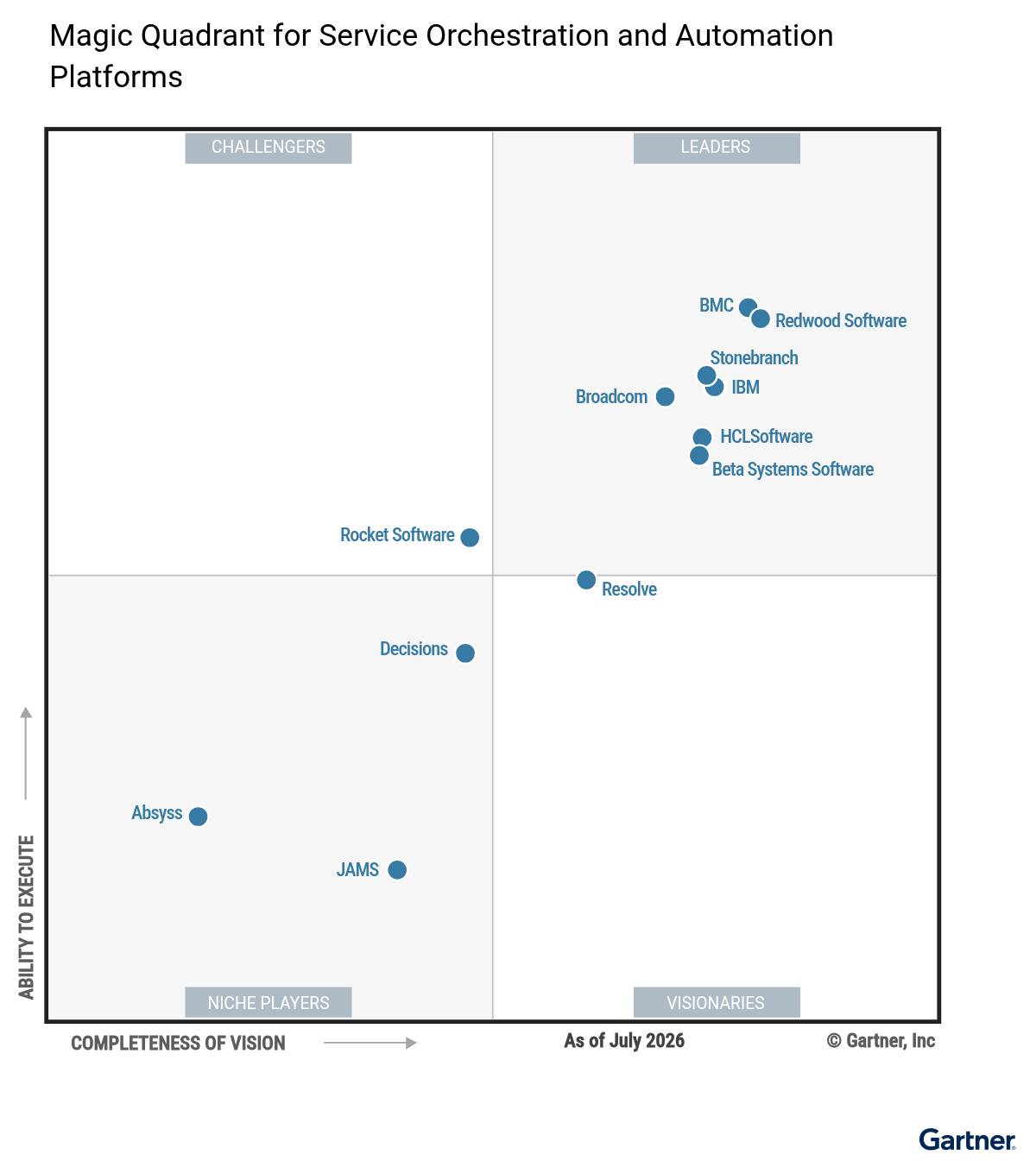
Vendor Strengths and Cautions
Absyss
Absyss is a Niche Player in this Magic Quadrant. Its offering, Visual TOM, enables workload automation and workflow orchestration for business and IT processes executed across heterogeneous environments. Visual TOM can be deployed as an on-premises solution or as a managed option available through partners. Absyss’ operations, direct sales and support presence are heavily concentrated in France, and the vast majority of its client base is located in Europe. In 2026, Absyss introduced new MFT capabilities, in addition to maintaining its core job scheduling platform and expanding workflow orchestration to support broader use cases.
- Usability for IT operations and business technologist personas: Absyss delivers a straightforward, low-code visual authoring and tracking interface for workflow management. This lowers the learning curve and barrier to entry for teams executing standard batch jobs and business workflows without deep software engineering or coding knowledge.
- Commercial flexibility: Absyss offers competitive and predictable pricing structures. Customers can choose between subscription-based models (opex) or perpetual acquisition with ongoing maintenance (capex), accommodating diverse enterprise investment strategies.
- Resource efficiency and sustainable IT: Visual TOM’s lightweight footprint reduces hybrid hosting costs and energy consumption. Combined with Absyss’ corporate commitment to eco-responsible operations and waste management, this appeals to enterprises navigating rigid sustainability mandates.
- Geographic constraints: Absyss’ marketing, sales and operational footprint is primarily focused in France and Europe. Organizations operating globally or headquartered in North America, APAC or LATAM will need to rely on partner-provided implementation and support. This stands in contrast to the global footprints maintained by larger platform providers.
- Deployment models: Absyss’ SaaS model is primarily provisioned, hosted and managed through regional hosting partners rather than as a native, vendor-supported global cloud platform. Organizations seeking direct, multitenant cloud flexibility may be frustrated by the additional operational management layers that partner-hosted setups introduce.
- Advanced AI and intelligent automation: Absyss’ advanced artificial intelligence capabilities trail other vendors evaluated in this market. While leading platforms have integrated native generative AI workflow creators, autonomous agentic remediation and machine learning pipeline orchestration, Absyss is expanding these capabilities as a part of its AI integration roadmap. This limits its appeal for organizations looking to scale advanced enterprise AI automation.
Beta Systems Software
Beta Systems Software is a Leader in this Magic Quadrant. Its offering, ANOW!, provides workload automation and workflow orchestration capabilities spanning distributed, hybrid, cloud and mainframe environments. The platform offers deployment flexibility and can be provisioned as self-hosted on-premises software in a customer cloud presence or as a fully managed SaaS. Beta Systems’ core operations and client base remain concentrated in Europe, with expansion into the North American market underway. Its particular strength is in risk-averse, mission-critical verticals such as financial services, insurance and public sector. In 2026, the vendor advanced its intelligent automation capabilities, embedding AI-driven coding assistants, natural language observability dashboards, a built-in Model Context Protocol (MCP) server, and automated migration factories into its core architecture.
- Innovation: Beta Systems has integrated advanced AI into the developer workflow. The platform features an AI coding assistant that converts natural language into structured automation scripts and an integrated MCP server for secure, governed interactions with external large language models (LLMs). This framework enables “agentic automation,” allowing intelligent software agents to autonomously resolve environmental incidents based on real-time execution data.
- Observability and intelligence: The OpenTelemetry-native monitoring layer embedded in the ANOW! platform provides unified, real-time telemetry across distributed, cloud and mainframe infrastructure. Operationally, the addition of an AI-driven PII filter automatically detects and redacts sensitive data within system logs, directly supporting enterprise compliance audits for GDPR, HIPAA and DORA.
- Migration capabilities: Beta Systems’ proprietary migration tool automates the ingestion and translation of competitor task definitions into optimized ANOW! structures, reducing migration risks and delivering a lower total cost of ownership (TCO) for enterprises transitioning away from rigid legacy environments.
- Geographic concentration: Beta Systems’ marketing, sales and support footprints remain concentrated in Western Europe. Global organizations operating across APAC or LATAM may encounter a relative lack of direct local field support, regional partner expertise and peer community engagement compared with more established global alternatives.
- Market perception: Beta Systems is still heavily associated with its mainframe heritage. Consequently, enterprise DevOps and DataOps teams frequently overlook the ANOW! platform during cloud-native tool evaluations for service orchestration and automation platforms.
- Partner ecosystem: The limited network of independent global system integrators (GSIs) and certified third-party deployment partners restricts competitive multisourcing. Large enterprises that prefer to leverage existing master services agreements with global consultancies for platform rollouts will face a shortage of certified external expertise, leading to a higher long-term dependency on Beta Systems’ internal professional services.
BMC
BMC is a Leader in this Magic Quadrant. Its offering, Control-M, provides workload automation and workflow orchestration capabilities spanning mainframes, distributed systems, cloud-native AI/ML and data pipelines. The platform can be deployed self-hosted in on-premises or customer cloud presence, or as a single or multitenant SaaS. BMC maintains a geographically diverse customer base across North America, EMEA, APAC and LATAM. In 2026, BMC expanded its investment in agentic AI by expanding the Jett AI Advisor and Model Context Protocol (MCP) server, and deepening go-to-market partnerships with AWS and SAP.
- Agentic AI innovation: BMC has positioned Control-M as a production-grade control plane for agentic AI architectures. While initially focused on enabling internal and external AI agents and copilots to dynamically discover and execute enterprise automation tasks within defined role-based access and governance constraints, this provides a framework that can be applied more broadly to operationalize AI agents.
- Data pipeline assurance: The platform embeds data quality validation natively within the execution layer, eliminating reliance on custom scripts or third-party testing tools. This allows teams to enforce validation rules, configure severity-based gating and maintain dataset-level visibility directly inside the orchestrator, automatically preventing low-quality data from propagating downstream to workflows and AI/ML models.
- Intelligent automation governance: Control-M executes nondeterministic AI agents and LLM tasks within standard, observable orchestrator jobs. Routing agentic interactions through a native MCP server and runtime gateway subjects AI actions to the platform’s role-based access controls (RBAC), audit trails and human-in-the-loop approvals, enforcing security guardrails and SLAs before executing state-changing actions.
- Licensing complexity: Control-M’s licensing and pricing models based on tracking task executions can lead to cost overruns and budgeting complexities for procurement teams.
- No OpenTelemetry support: Control-M does not offer native OpenTelemetry (OTel) data streams for observability of executions. Customers that require this visibility must rely on provided Control-M dashboards and widgets, APIs, webhooks, logs or specific application monitoring integrations to connect with third-party Event Intelligence Solutions.
- Extensibility: Control-M’s out-of-the-box connector portfolio is focused on established enterprise applications and cloud services. Where customers have to build their own, these custom extensions can be built using the low-code application integrator, which requires platform knowledge to align with Control-M’s execution engine, introducing higher integration complexity.
Broadcom
Broadcom is a Leader in this Magic Quadrant. Its offering, Automic Automation, provides workload automation and workflow orchestration capabilities bridging mainframes, ERP systems and modern cloud-native DataOps/MLOps pipelines. It can be deployed on-premises, via containerized environments and as a SaaS offering. Broadcom maintains a geographically diversified customer base with direct sales and support presence across North America, EMEA, APAC and LATAM. In 2026, Broadcom expanded its automation ecosystem by introducing native integration with VMware Cloud Foundation (VCF), releasing Automation Analytics & Intelligence (AAI) updates for distributed AI observability, and adding Model Context Protocol (MCP) support to govern automated AI agents.
- Innovation: Broadcom integrated Agentic AI Jobs into Automic Automation. Using MCP, these autonomous AI agents analyze dynamic data, choose tools and execute complex remediation. To ensure safety, these nondeterministic actions are bounded by strict role-based access controls (RBAC) and audit trails.
- Resilience and scalability: Automic Automation’s architecture is engineered to manage high-volume execution dependencies across multienvironment setups, providing automated disaster recovery routing, high-availability clusters and system updates with zero execution downtime.
- Industry strategy: Broadcom maintains dedicated vertical teams aligned with core sectors, including financial services, retail and manufacturing. This specialized alignment delivers industry-specific best practices and preconfigured compliance frameworks directly within Automic Automation, addressing sector-specific regulatory requirements and transactional workflow demands.
- Customer experience: Some Broadcom customers report commercial friction with the vendor and its partners, specifically citing significant price increases during contract renewals. These software costs contribute to general customer dissatisfaction, driving evaluation of alternative solutions.
- Self-service migration tooling: Broadcom does not provide customer-facing, self-service migration utilities. Independent migrations are technically feasible using standard programmatic interfaces (Transport Case, REST APIs and DB utilities) but require significant custom scripting to format legacy logic. Consequently, most large-scale migrations depend on Broadcom Expert Advantage Partners, creating professional services dependencies for teams seeking an automated transition.
- Partner-tiered support routing: Broadcom utilizes a dual support model where large accounts are managed directly and smaller or standard accounts are serviced via regional partner channels. Although all customers receive 24/7 coverage, partner-led support can introduce triage handoffs before reaching native Broadcom product specialists, resulting in variable postsales support quality across different account sizes.
Decisions
Decisions is a Niche Player in this Magic Quadrant. Its offering, Decisions Platform, provides workflow automation, business rule management and data pipeline orchestration across cloud, hybrid and distributed enterprise ecosystems. The platform can be deployed on-premises, in containerized Kubernetes architectures, or as a single-tenant SaaS hosted on Microsoft Azure. Decisions maintains strong direct sales and support hubs in North America, with an expanding reach into EMEA, APAC and LATAM via delivery partners. In 2026, the company acquired Configurable Management to enhance native SAP integrations, and advanced its agentic orchestration capabilities by introducing the AI Common module and an external Model Context Protocol (MCP) server.
- Unified orchestration and rule engine: Decisions provides a unified “control plane” that merges workflow automation, integrations and a robust business rule engine into a single low-code/no-code visual studio. This approach allows business technologists to design, debug and maintain complex, daisy-chained logic and routing decisions without relying on deep developer intervention or piecing together separate point solutions.
- Agentic AI governance: The platform treats large language model (LLM) interactions as orchestrated, interchangeable components. Through its AI Common module, customers can switch between AI providers (e.g., OpenAI, AWS Bedrock, Google Vertex AI, Anthropic) midworkflow based on the specific task. This has been extended to expose deterministic, governed workflows as callable “AI Tool Flows” via its MCP server, ensuring that autonomous agents remain bound by existing enterprise compliance, auditing and human-in-the-loop policies.
- Deployment flexibility: Decisions offers a fully managed single-tenant deployment option on Azure. This architecture guarantees strict data isolation, prevents cross-tenant performance degradation and grants customers granular control over their geographic data residency to satisfy rigid local compliance mandates.
- Lack of native mainframe agents: The platform lacks native, proprietary execution agents designed for mainframe environments. To orchestrate workloads on mainframe platforms, organizations must implement standard integration workarounds such as REST/SOAP web services or direct ODBC database connections. This limits its suitability for heavy-duty, legacy mainframe-centric batch scheduling.
- Workload automation depth: Decisions does not provide built-in tools for scheduling and managing complex batch processes at a low level. Automation teams will need to invest additional effort to make these types of workloads run smoothly on the platform’s event-driven system.
- SLA tracking: The platform lacks advanced intelligent monitoring and observability, and offers limited predictive capabilities to alert IT operations before an infrastructure delay breaches an enterprise SLA. Decisions’ website tracks process life cycles from a business or case-management perspective. It lacks system dependency mapping and infrastructure-level SLA simulation engines necessary for IT operations teams.
HCLSoftware
HCLSoftware is a Leader in this Magic Quadrant. Its offering, HCL Automation Orchestrator Suite (AOS), unifies HCL Workload Automation (HWA) and the cloud-native HCL Universal Orchestrator (UnO/UnO+). The platform coordinates hybrid workflows spanning mainframes, distributed infrastructure and containerized cloud-native environments. HCL AOS features deployment options, including on-premises, containerized Kubernetes configurations and fully managed single-tenant or multitenant SaaS. HCLSoftware maintains a global direct sales and support presence, with Europe representing its strongest growth region. In 2026, HCLSoftware launched Agentic AI Builder with Model Context Protocol (MCP) support and expanded its underlying data intelligence layer through the acquisitions of Wobby and Jaspersoft.
- Flexible SaaS topologies and data sovereignty: HCLSoftware customers can choose between private single-tenant SaaS (HCL Now) and modern, multitenant cloud-native environments. Enterprises can dictate their precise geographic hosting zones across major hyperscalers. This granular control over data residency is attractive to organizations navigating strict local compliance mandates and digital operational resilience frameworks.
- Governed agentic AI architecture: The platform embeds agentic automation directly into its core engine via the HCL UnO Agentic AI Builder and a native MCP server. Autonomous AI agents can independently analyze operational anomalies, select correct API tools and execute remediation paths. To eliminate risk, these nondeterministic actions are bound by role-based access controls (RBAC) and human-in-the-loop checkpoints.
- Data ecosystem and analytics: Bolstered by its Actian data division and its acquisitions of advanced business intelligence platforms and conversational data-analyst agents, HCLSoftware provides an expansive, data-intelligent automation ecosystem. The platform unifies data pipeline ingestion, metadata cataloging and embedded reporting directly within the core orchestration workflow.
- Market visibility: HCLSoftware experiences lower brand awareness in stand-alone software evaluations compared with other Leaders in this Magic Quadrant. Because it is often perceived primarily as an extension of the broader IT services ecosystem, organizations outside its core regional hubs or existing client bases occasionally omit the platform from stand-alone shortlists.
- Licensing: HCL AOS primary licensing for distributed systems is consumption-based, with capacity-based pricing only on mainframe. Organizations that require non-consumption-based licensing may need commercial assistance to adopt HCL AOS.
- Product strategy: HCL AOS bridges two radically different enterprise personas: the infrastructure/mainframe system operator (HWA) and the cloud-native AI developer (UnO+). Organizations deploying the unified suite may encounter an internal operations gap, requiring cross-training for legacy infrastructure teams to master containerized topologies and agentic AI frameworks.
IBM
IBM is a Leader in this Magic Quadrant. Its offering, IBM Workload Automation (IWA), provides workload automation and workflow orchestration capabilities spanning hybrid cloud, Kubernetes, CI/CD pipelines, data ecosystems, AI workloads and mainframe environments. It can be deployed on-premises as a single-tenant or multitenant SaaS and via containerized Kubernetes deployments. IBM maintains a global operational footprint across more than 175 countries. In 2026, IBM added native integration with watsonx Orchestrate (wxO) for agentic AI scheduling.
- Innovation: IBM has integrated AI into the execution layer of IWA. The platform features native integration with watsonx Orchestrate to enable governed agentic AI, an embedded Optimization Advisor utilizing reinforcement learning for SLA recommendations, and native MCP client capabilities to register and invoke third-party AI models and data sources.
- Stateful operational resilience: IBM replaces standard, unsegmented job-level restarts with granular, step-level checkpoints across hybrid pipelines. This allows IWA to resume interrupted workflows precisely from the point of failure, bypassing manual data replays. Paired with container self-healing via its Kubernetes Operator, the platform ensures that complex transaction chains spanning cloud microservices and mainframe ledgers recover dynamically to protect enterprise SLAs.
- Enterprise compliance and sovereignty: IWA’s SaaS deployments achieve FedRAMP High compliance for U.S. federal agencies, and align with strict EU DORA mandates through IBM’s status as a designated Critical ICT Provider. This infrastructure ensures strict data residency and hardware-level isolation that typical multitenant public cloud providers fail to match.
- Reliance on software partners: IWA is co-developed via a partnership with HCLSoftware, which licenses and brands the product independently. Buyers must navigate this dual-branded market and rely on this joint structure for future product innovation and architectural direction. This limits IBM’s absolute control over its product offering compared with market competitors who fully own their software stacks.
- Integration ecosystem complexity: IWA utilizes multiple sources of integrations, including IBM Enterprise Connect, watsonx Orchestrate, IBM Bob, IBM Automation Hub and IBM FixCentral. This complicates end-user discovery and implementation of these integrations in comparison to other vendors in this research.
- Commercial and licensing complexity: Clients operating in dynamic cloud environments report unpredictability due to IBM’s licensing metrics, including Virtual Processor Unit (PVU) and capacity calculations. This complexity makes the platform challenging for midmarket enterprises to justify the broader infrastructure investment.
JAMS
JAMS is a Niche Player in this Magic Quadrant. Its offering, JAMS, provides workload automation, workflow orchestration and data pipeline execution across distributed and hybrid environments. JAMS can be deployed on-premises or via IaaS, but currently lacks a vendor-managed SaaS option. In June 2025, Fortra announced the divestiture of the JAMS portfolio, and JAMS now operates as a fully independent company backed by PSG, 2ndWave Software and its employees. Its operations and direct sales remain primarily concentrated in North America, with a smaller footprint in EMEA and APAC. In 2026, JAMS launched a modernized web client and REST API, expanded its data orchestration capabilities with native Apache Airflow, Azure Data Factory, AWS EC2 and Azure Blob integrations, and announced the release of its JAMS JAX AI Agent and Model Context Protocol (MCP) server for agentic AI interactions.
- Customer support experience: JAMS’ technical support model extends beyond traditional break/fix ticketing to include proactive architectural advice, ad hoc administration training and scripting guidance — often bundled into standard agreements without requiring expensive professional services engagements.
- Predictable and scalable licensing model: JAMS’ flat-rate and agent-based licensing model eliminates the budgeting volatility and unexpected overage costs typical of per-task scaling. Enterprises can expand their automation footprint across dynamic cloud and hybrid environments with total cost of ownership (TCO) predictability.
- Microsoft ecosystem optimization: For enterprises that have standardized on Microsoft platforms, JAMS provides native execution environments for advanced PowerShell scripts, seamless .NET API access and deep configuration hooks into SQL Server and Azure Data Factory.
- Geographic concentration and limited partner scale: JAMS’ marketing, direct sales and engineering support are heavily concentrated within North America. Multinational organizations operating globally may experience a lack of direct local field support, regional ecosystem expertise and localized peer user groups compared with global alternative providers.
- Innovation: The vendor’s advanced machine learning capabilities lag behind market leaders. Features such as proactive SLA anomaly prediction, autonomous agentic error remediation and AI-assisted workflow optimization are in early development cycles, limiting appeal for organizations prioritizing mature AI-driven operations.
- Lack of SaaS options: JAMS lacks a native SaaS deployment track, requiring customers to provision, maintain, patch and manage the underlying engine infrastructure themselves (either on-premises or via self-managed cloud VMs). This adds operational overhead and inflates internal infrastructure total cost of ownership (TCO).
Redwood Software
Redwood Software is a Leader in this Magic Quadrant. Its platform, RunMyJobs, provides workload automation, workflow orchestration and data pipeline orchestration across distributed, hybrid and cloud environments. The platform is delivered as a fully managed, single-tenant SaaS offering and as self-hosted deployments. Redwood’s operations and customer base are globally distributed, with North America representing its largest market share and fastest growth vertical. In 2026, Redwood expanded its intelligent automation capabilities by introducing native support for open agentic frameworks like the Model Context Protocol (MCP) and Agent2Agent (A2A) protocol, launching the Redwood RangerAI assistant portfolio and releasing Redwood Insights Premium for extended cross-functional observability.
- Strategic SAP partnership: Redwood maintains a co-development integration with SAP, serving as the only workload automation vendor recognized as an SAP Endorsed App and natively embedded within the RISE with SAP reference architecture.
- Bidirectional agentic AI governance: Through Redwood’s native MCP server, external AI agents can securely trigger RunMyJobs workflows as tools, while its A2A plug-in allows workflows to drive external AI agents as process steps. All interactions are bound by native RBAC and immutable audit trails.
- Resilient single-tenant SaaS architecture: Redwood provisions fully isolated cloud infrastructure and databases for each customer. The vendor bundles automated cross-region disaster recovery with aggressive enterprise RTO SLAs into standard SaaS agreements at no extra cost.
- Renewal pricing volatility: Customers frequently cite frustration with sales execution during contract renewals. Customers note unexpected price escalations and aggressive commercial pushes for expanded licensing or premium feature add-ons during renewal negotiations.
- GSI channel friction: Redwood’s direct sales strategy and specialized vendor relationships can introduce friction for enterprises that rely on independent global system integrators (GSIs). This can trigger procurement hurdles, unaligned implementation roadmaps and a lack of clear accountability when deployment issues arise between the vendor and service provider.
- Native mainframe integration gaps: RunMyJobs is architected as a cloud-native, SaaS-first platform. Enterprises with larger on-premises and mainframe environments must choose either an on-premises deployment or rely on remote gateways to route secure, low-level on-premises job execution back to a public cloud plane.
Resolve
Resolve is a Visionary in this Magic Quadrant. Its offering, Resolve Actions, provides workflow orchestration, incident remediation and intelligent automation across distributed, hybrid, cloud and network environments. It can be deployed on-premises, via IaaS, natively via containerized Kubernetes deployments, or as a dedicated single-tenant SaaS. Resolve’s operations and customers are geographically diversified across North America, EMEA and Asia/Pacific. In 2026, Resolve shifted to a unified platform packaging model, fully completed the structural integration of its Espressive acquisition to natively embed conversational and agentic AI, and introduced a Scheduled Jobs Dashboard alongside an open Model Context Protocol (MCP) server framework to enforce strict enterprise governance over autonomous AI interaction.
- Expansive automation exchange: Resolve provides a digital marketplace featuring thousands of prebuilt, production-tested automation components and multivendor connectors. This extensive ecosystem allows operations teams to rapidly assemble cross-domain pipelines without writing custom API code.
- Agentic AI life cycle architecture: Resolve’s Agentic Resolution Fabric unifies deterministic workflows and autonomous AI agents (Knowledge, Automation and Assist) into a single life cycle. This ensures all nondeterministic AI actions remain bound by strict version controls, centralized rollbacks and immutable audit trails.
- Closed-loop observability: Resolve ingests real-time alert streams from third-party monitoring tools (e.g., Splunk, Dynatrace) to instantly trigger automated diagnostic and self-healing runbooks. It also offers a native ROI Dashboard that quantifies ticket deflection rates and engineering cost savings in real time.
- Workload automation: Resolve’s architecture is not optimized for calendar-centric batch scheduling. Organizations with complex, higher-volume batch workloads may find the tool’s event-driven IT operations focus misaligned with their core requirements.
- Market awareness: Resolve Actions’ brand visibility is lower than larger competitors. For prospective buyers, this creates a narrower ecosystem characterized by fewer independent user forums and a lack of extensive peer-to-peer discussions during vendor evaluations.
- DataOps and analytics ecosystem gaps: Resolve’s integration catalog remains heavily skewed toward ITSM and NetOps rather than data orchestration. The platform lacks native, out-of-the-box connectors for modern cloud data warehouses and ETL pipelines, forcing data teams to incur the overhead of building and maintaining custom API integrations.
Rocket Software
Rocket Software is a Challenger in this Magic Quadrant. Its offering includes Rocket Enterprise Orchestrator (EO), Rocket Zena and Rocket Zeke, providing workload automation and orchestration capabilities across hybrid environments, spanning mainframe, distributed systems and cloud-native architectures. The platform can be deployed on-premises, via IaaS, in containerized environments or as a SaaS solution. Rocket Software’s operations are geographically diversified across North America, EMEA, APAC and LATAM. In 2026, Rocket expanded its automation capabilities by launching Rocket EVA, an agentic AI platform, and completed the acquisition of Vertica Enterprise Analytics to integrate operational intelligence and data analytics.
- Pricing model: Rocket utilizes flat server- and agent-based licensing, establishing fixed cost ceilings as transaction volumes scale. This licensing model protects organizations from unexpected budget overruns during periods of high-volume or burstable processing.
- Mainframe integration: The platform provides native integration for mainframe environments to manage batch processing, core subsystems and databases without requiring additional middleware abstraction layers. This architecture unifies mainframe infrastructure with cloud-native frameworks, establishing centralized operational control across the entire IT environment.
- Change modeling: The platform includes an advanced simulation engine (AI Predictive Pulse) that allows operations teams to model change scenarios and run them against historical baselines. Customers can validate workflow performance, assess capacity requirements and evaluate potential SLA impact in a simulated environment before implementing infrastructure or scheduling changes into live production.
- Third-party dependency: Rocket’s AI Predictive Pulse capability is licensed via an OEM agreement with Digitate. Customers adopting this module will have a dependency on this third-party vendor. Changes to this partnership agreement could alter the long-term availability or development trajectory of the platform’s predictive features.
- User experience: Rocket’s portfolio spans multiple distinct engines, resulting in varied user interfaces across legacy mainframe-native and distributed modules. This lack of a fully unified, consistent visual framework across the entire software suite may require additional training for new users and may hinder enterprisewide adoption of advanced features.
- No stand-alone migration tooling: The vendor does not provide a stand-alone migration utility for all conversions, requiring organizations to use its managed professional services for conversions. This approach may increase upfront deployment costs and reduce a customer’s independent control over migration execution.
Stonebranch
Stonebranch is a Leader in this Magic Quadrant. Its offering, Universal Automation Center (UAC), provides workload automation, workflow orchestration, data pipeline orchestration and managed file transfer (MFT) capabilities across distributed, hybrid, cloud and mainframe environments. It can be deployed on-premises, as IaaS, in containerized Kubernetes architectures, or as single-tenant and multitenant SaaS. Stonebranch’s operations are geographically diversified across North America, EMEA, APAC and LATAM. In 2026, Stonebranch introduced Robi AI and the AI Extension Builder, released Agentic AI orchestration capabilities, and completed the acquisition of Honico to integrate native SAP automation capabilities.
- Data pipeline orchestration: UAC provides native integrations for data environments, including Snowflake, Databricks and dbt. Data engineering teams can build, monitor and troubleshoot complex data pipelines and extract, transform, load (ETL) processes within the same unified control plane used for traditional IT operations. Combined with embedded managed file transfer and AI orchestration capabilities, this capability delivers end-to-end visibility, integrated AI functions and SLA tracking from raw data ingestion to final analytics.
- Business technologist enablement: Stonebranch offers the “Universal Portal,” a streamlined interface that enables nontechnical citizen automators and business technologists to build, monitor and trigger their own complex automations via self-service without writing scripts. This broadens the footprint of automation across the enterprise into lines of business (like HR and finance) while allowing centralized IT to maintain security, governance and visibility.
- Development acceleration: The platform’s AI Extension Builder uses AI to reduce the time to develop and release custom integrations. It utilizes a spec-driven development approach to improve the configuration and deployment of custom third-party integrations.
- Global system integrator (GSI) ecosystem footprint: Enterprises executing large digital transformation strategies may find fewer certified independent consultants, which increases project delivery risk or forces a reliance on Stonebranch’s internal professional services division.
- Structural SLA optimization limitations: The platform currently lacks built-in AI capabilities to recommend structural workflow design changes such as suggesting resequencing or parallelization of specific job steps to meet SLAs. These prescriptive, AI-driven optimization recommendations are currently planned in the vendor’s roadmap.
- U.S. federal compliance limitations: While Stonebranch holds commercial compliance certifications, the product lacks native FedRAMP certification. For clients requiring this level of compliance, a pass-through partner is needed and may complicate procurement for public sector or federal agencies.
Vendors Added and Dropped
We review and adjust our inclusion criteria for Magic Quadrants as markets change. As a result of these adjustments, the mix of vendors in any Magic Quadrant may change over time. A vendor's appearance in a Magic Quadrant one year and not the next does not necessarily indicate that we have changed our opinion of that vendor. It may be a reflection of a change in the market and, therefore, changed evaluation criteria, or of a change of focus by that vendor.
Added
Decisions
Dropped
Honico Systems
Inclusion and Exclusion Criteria
Inclusion Criteria
To qualify for inclusion in this Magic Quadrant, vendors were required to meet the following criteria as of January 2026:
- Actively market, sell and support a product that provides capabilities as defined in the Market Definition for service orchestration and automation platforms.
- Have made the qualifying offering generally available as of January 2026.
- Respondents should meet one of the following criteria:
- Have generated revenue of at least $25 million (or the equivalent in another currency) from service orchestration and automation platforms in 2025, or
- Have at least 200 paying customers for service orchestration and automation platforms as of 1 March 2026.
- Providers must operate in at least two of the following geographies:
- North America
- Latin/South America
- Europe, the Middle East and Africa
- Asia/Pacific (not including Japan)
- Sell service orchestration and automation platforms software directly to paying customers without the need to engage professional services to deploy. The vendor may offer professional services to enable or adopt, but it cannot be a requirement of deployment.
Exclusion Criteria
Vendors were excluded from this Magic Quadrant if:
- They only sell the platform along with development and professional services, where it is used exclusively by the vendor’s consultants or service providers.
Evaluation Criteria
Ability to Execute
We used the following criteria to assess each vendor’s Ability to Execute:
Product or Service: For each vendor, we evaluated the core capabilities and architectural breadth of their platform across complex hybrid IT, multicloud, and legacy environments. Key areas assessed include workload execution and scheduling, flexible workflow design (supporting visual, jobs-as-code, and GenAI co-authoring), end-to-end operational continuity, and broad integration capabilities. We also considered advanced features such as event-driven automation, data pipeline orchestration, intelligent self-healing and remediation, embedded governance, and emerging support for agentic AI architectures, multiagent orchestration, and MCP.
Overall Viability: For each vendor, we considered its relative size in terms of customers and revenue, and the scale, strength and resilience of its ecosystem; the impact of past acquisitions and the potential for future acquisitions; the financial stability and continuity of its offerings in this market; the ability and effectiveness of its partnerships to improve viability; the size and quality of its active user community relative to its target market; the availability and effectiveness of professional and consulting services.
Sales Execution/Pricing: For each vendor, we considered revenue and customer growth; competitive wins; the number and business impact of the projects it has implemented, and whether (and how) professional and consulting services have eased implementations; the clarity and predictability of pricing models — on-premises, cloud, multicloud and hybrid — and their changes over time; the ability to handle large and complex deals, including support and flexibility for volume growth, seasonality and predictability; licensing options and flexibility; delivery partners.
Market Responsiveness and Track Record: For each vendor, we evaluated its ability to quickly adapt and offer meaningful solutions in response to the dynamic requirements of service orchestration and automation platforms, and the rapid pace of change that digital transformations increasingly demand; respond to rapidly evolving conditions and deliver superior alternatives that align with competitive trends (even if they do not lead those trends); support clients during unforeseen business disruptions and geopolitical events.
Marketing Execution: For each vendor, we assessed the degree to which it has captured mind share, demonstrated thought leadership and gained a solid reputation in the market; effectively devised and executed go-to-market strategies with substantial results; executed marketing and partnership programs to expand its influence.
Customer Experience: For each vendor, we considered its track record of resolving customer issues; support outside the vendor’s home region; the reach and availability of service implementers and efforts to expand these, such as training and certification programs; customer success programs; implementation and migration assistance and services.
Operations: For each vendor, we considered its track record of meeting SLAs, data sovereignty and its privacy certifications; the scale of its workforce and data centers; reliability in relation to its hosted service platforms (for cloud offerings), and scalability and adaptability in relation to its software platforms (for on-premises deployments); use of, and adherence to, metrics for efficiency, speed of change and implementation of new features.
Ability to Execute Evaluation Criteria
| Evaluation Criteria | Weighting |
|---|---|
Product or Service | High |
Overall Viability | Low |
Sales Execution/Pricing | High |
Market Responsiveness/Record | Medium |
Marketing Execution | Low |
Customer Experience | High |
Operations | Medium |
Source: Gartner (August 2026)
Completeness of Vision
We used the following criteria to assess each vendor’s Completeness of Vision:
Market Understanding: We assessed each vendor’s understanding of present and future customer priorities, use cases and challenges, and the evolution of such priorities; the role of the products in this market to support workload automation, workflow orchestration, data pipelines, DevOps automation and citizen automation; the impact and opportunities of AI on the service orchestration and automation platform market; general, geographic and industry-specific market opportunities.
Marketing Strategy: We assessed each vendor’s strategy for translating product features into clear business outcomes and value drivers for the customer; developing tailored and differentiated messaging that addresses the unique needs of each buyer persona (e.g., CIO, developer,infrastructure and operations [I&O] leader); a clear understanding and articulation of its competitive differentiation from key market rivals; effectiveness in growing market mind share and fostering a vibrant, loyal user community; executing a credible thought leadership program and strategic alliances that build industry influence.
Sales Strategy: We assessed each vendor’s strategy for effectiveness of the go-to-market (GTM) model, including the balance between a direct sales force and a robust channel ecosystem (e.g., GSIs, value-added resellers [VARs], technology partners); demonstrable success and vertical-specific expertise in penetrating key industries (e.g., finance, retail, manufacturing) and high-growth geographies; execution of a value-driven sales cycle, from expert-led presales engagements to a mature professional services organization that ensures customer success postsale; ability of the sales organization to articulate and quantify the solution’s business value, aligning it with the strategic initiatives of key stakeholders.
Offering (Product) Strategy: For each vendor, we looked for a clearly defined GTM strategy that effectively utilizes a mix of direct sales and channel partnerships to reach its target markets; a proven track record of winning and retaining customers in key vertical markets, backed by industry-specific solution messaging and expertise; a comprehensive customer engagement model that aligns expert presales, value-added professional services, and thought leadership to guide customers from evaluation to adoption; the sales team’s proficiency in shifting conversations from technical features to tangible business benefits that resonate with executive-level stakeholders.
Business Model: For each vendor, we examined the viability and sustainability of its financial model, including its primary revenue streams, margin profile and path to durable profitability; the clarity and effectiveness of its pricing and packaging strategy across all deployment models (SaaS, hybrid, on-premises) to meet diverse customer needs and drive adoption; the strategic value and viability of its partner ecosystem in delivering a comprehensive, integrated solution and extending the platform’s market reach; a coherent strategy for long-term growth, balancing organic innovation (R&D investment) with inorganic growth (mergers and acquisitions) to expand capabilities and market presence.
Vertical/Industry Strategy: For each vendor, we examined the depth and market success of its targeted industry solutions, evaluating how they address specific vertical challenges and provide clear differentiation; the availability and maturity of tangible, industry-specific assets like blueprints, templates and solution accelerators that speed customer time to value; the platform’s ability to address the specific compliance, regulatory and business transformation pressures facing key vertical markets.
Innovation: For each vendor, we looked for a well-defined innovation strategy and a clear process for funneling new ideas into a customer-centric product roadmap; a demonstrable track record of anticipating market trends and delivering transformative solutions that influence the direction of the category; leveraging generative, conversational, and agentic AI to maximize user productivity and elevate service delivery; specializing in designing and optimizing AI assistants that automate workflows and streamline incident response; strategic implementation of AI in IT operations to enable proactive and autonomous capabilities, including predictive analytics and self-remediating actions.
Geographic Strategy: For each vendor, we looked for a clear, data-driven strategy for identifying and penetrating high-growth and strategic geographic markets; establishment of a global operational presence, including a “follow-the-sun” support model to provide continuous, 24/7 service to international customers; the platform’s ability to meet complex international requirements, including data sovereignty options and compliance with region-specific regulations (e.g., General Data Protection Regulation [GDPR]).
Completeness of Vision Evaluation Criteria
| Evaluation Criteria | Weighting |
|---|---|
Market Understanding | High |
Marketing Strategy | Medium |
Sales Strategy | Medium |
Offering (Product) Strategy | High |
Business Model | Medium |
Vertical/Industry Strategy | Medium |
Innovation | High |
Geographic Strategy | High |
Source: Gartner (August 2026)
Quadrant Descriptions
Leaders
Leaders in this market distinguish themselves through a combination of market-shaping vision and a proven Ability to Execute. Leaders demonstrate a deep understanding of customer needs, which they translate into a clear and innovative product roadmap. This vision is backed by a consistent track record of delivering high-performing, reliable solutions that anticipate the market’s direction.
Leaders’ primary differentiator is meeting customers where they are in their modernization journey. Leaders provide a unified orchestration platform that can manage complex workloads and workflows across an enterprise’s entire hybrid reality — from legacy mainframes and ERP systems to modern SaaS platforms and cloud-native applications.
This combination of vision and execution translates into significant market success. Leaders have a strong global presence, deep penetration into key vertical industries, and a large, loyal customer base that relies on them for mission-critical business and IT processes.
Leaders in this market are distinguished by three core pillars:
- An extensive and extensible integration fabric for universal connectivity.
- Intuitive, self-service automation that empowers diverse personas beyond just IT operations.
- A multifaceted AI strategy that uses AI for optimization, generative AI for accelerating development and agentic AI for autonomous actions.
While these leading vendors are well-positioned, the market is dynamic and converging with adjacent categories. Continued dominance requires intense focus on innovation, as any Leader that loses focus risks falling behind.
Challengers
Challengers are characterized by a strong and proven Ability to Execute. They possess solid, feature-rich platforms that meet the needs of a significant market segment, backed by effective sales execution and a growing customer base. These vendors have demonstrated the financial strength and commitment to compete effectively against Niche Players and even Leaders on major deals.
However, Challengers typically lag behind Leaders in Completeness of Vision. Their product roadmaps are often more reactive to current customer demands rather than proactively shaping the market’s future. They may be slower to adopt groundbreaking innovations, such as agentic AI or a fully unified hybrid cloud orchestration fabric. For many enterprises, this makes Challengers a solid, pragmatic choice, but their path to becoming Leaders depends on their ability to close the innovation gap and improve on their cautions.
Visionaries
Visionaries are defined by their market-leading Completeness of Vision. They push the boundaries of what is possible with compelling, innovative technology and a clear product roadmap that anticipates future customer needs. Their thought leadership often sets the tone for where the market is heading, particularly in areas like agentic AI, data pipeline orchestration and unified hybrid cloud control.
However, Visionaries’ Ability to Execute on a global scale is still developing. While they may have strong initial traction, they typically lack the broad market presence, extensive partner ecosystem or proven track record in large-scale enterprise deployments that Leaders possess. For forward-thinking organizations, Visionaries represent an opportunity to partner with an innovator, but their path to the Leaders quadrant requires them to translate their powerful vision into consistent, enterprise-grade market execution.
Niche Players
Niche Players are characterized by a deliberate and narrow focus, choosing to excel in a specific segment rather than competing across the entire market. This focus can manifest in several ways: a deep specialization in a particular vertical industry (like financial services), a strong presence in a limited geographic region, or a solution tailored to a unique technological use case (such as mainframe-only operations).
While Niche Players may not match the broad capabilities or global reach of Leaders, their concentrated expertise makes them a strong choice for organizations whose requirements align with that niche. For these customers, the benefits of a highly tailored solution and deep subject matter expertise can often outweigh the advantages of a larger, more generalized platform.
Context
The service orchestration and automation platform market represents the dynamic evolution of mature workload automation tools into platforms that are purpose-built for modern business demands. This transformation is marked by a critical shift from traditional, time-based scheduling to real-time, event-driven orchestration. By supporting complex data pipelines and integrating with cloud-native architectures, service orchestration and automation platforms make IT processes more visible and directly valuable to business stakeholders. As a core component of an enterprise’s intelligent automation strategy, a modernized service orchestration and automation platform extends its value far beyond IT efficiency, becoming the fabric for orchestrating end-to-end business processes.
The primary implementers and consumers of these platforms include:
- IT operations teams
- Site reliability engineering (SRE) teams
- DevOps teams
- Dedicated automation teams within I&O
- Data operations
- Business technologists
A key trend among leading platform vendors is the democratization of automation through self-service capabilities aimed at business users. By allowing nontechnical teams to build and manage their own automations within secure, IT-defined governance guardrails, these platforms move beyond simple task elimination to directly enhance business agility.
Market Overview
The service orchestration and automation platform market continues to grow steadily as more organizations seek a single tool to orchestrate workflows, automate workloads and provision resources.
The market once again experienced growth year over year, with revenue reaching $4.3 billion in 2025 — up from $3.9 billion in 2024 (see Market Share: IT Operations Management Software, Worldwide, 2025). This market is expected to continue to increase to an estimated $4.9 billion by 2028 in constant currency, representing a five-year compound annual growth rate (CAGR) of 7.7% (see Forecast: IT Operations Management Software, Worldwide, 2022-2028, 2Q24 Update).
Market dynamics: Since 2025, the market has experienced yet another wave of ownership changes and investment funding. A few recent influential activities include:
- Fortra divested JAMS, making it an independent company.
- Numerous vendors — JAMS, Resolve, Rocket Software and Stonebranch — received investment from venture capital and private equity firms (or are outright owned by investors).
- Honico Systems was acquired by Stonebranch in September 2025, representing a continuation of market consolidation (i.e., Beta Systems acquired InfiniteDATA in 2023).
Vendor direction: Service orchestration and automation platform providers are rapidly expanding beyond IT task automation by embedding intelligent automation into their platforms. There have been some limited vendor investments that overlap into the business orchestration and automation technologies (BOAT) market. Most vendors now offer integrated GenAI assistants to accelerate development, and many are deploying AI agents to support proactive problem determination and remediation. A few are extending this capability to agent governance. As more vendors continue to develop and improve their agentic AI capabilities, these platforms will increasingly enable orchestration of complex, end-to-end business workflows across the entire enterprise.
Customer expectations: The primary buyers of these platforms are large, complex enterprises that are grappling with a hybrid IT reality that spans legacy systems, data pipelines and cloud-native applications. These organizations expect a unified platform to provide centralized control and orchestrate processes end to end. They demand mission-critical reliability and a strategic partnership with providers, which helps them to standardize processes, drive efficiency and ensure business continuity across their entire landscape.
Ability to Execute
Product/Service: Core goods and services offered by the vendor for the defined market. This includes current product/service capabilities, quality, feature sets, skills and so on, whether offered natively or through OEM agreements/partnerships as defined in the market definition and detailed in the subcriteria.
Overall Viability: Viability includes an assessment of the overall organization's financial health, the financial and practical success of the business unit, and the likelihood that the individual business unit will continue investing in the product, will continue offering the product and will advance the state of the art within the organization's portfolio of products.
Sales Execution/Pricing: The vendor's capabilities in all presales activities and the structure that supports them. This includes deal management, pricing and negotiation, presales support, and the overall effectiveness of the sales channel.
Market Responsiveness/Record: Ability to respond, change direction, be flexible and achieve competitive success as opportunities develop, competitors act, customer needs evolve and market dynamics change. This criterion also considers the vendor's history of responsiveness.
Marketing Execution: The clarity, quality, creativity and efficacy of programs designed to deliver the organization's message to influence the market, promote the brand and business, increase awareness of the products, and establish a positive identification with the product/brand and organization in the minds of buyers. This "mind share" can be driven by a combination of publicity, promotional initiatives, thought leadership, word of mouth and sales activities.
Customer Experience: Relationships, products and services/programs that enable clients to be successful with the products evaluated. Specifically, this includes the ways customers receive technical support or account support. This can also include ancillary tools, customer support programs (and the quality thereof), availability of user groups, service-level agreements and so on.
Operations: The ability of the organization to meet its goals and commitments. Factors include the quality of the organizational structure, including skills, experiences, programs, systems and other vehicles that enable the organization to operate effectively and efficiently on an ongoing basis.
Completeness of Vision
Market Understanding: Ability of the vendor to understand buyers' wants and needs and to translate those into products and services. Vendors that show the highest degree of vision listen to and understand buyers' wants and needs, and can shape or enhance those with their added vision.
Marketing Strategy: A clear, differentiated set of messages consistently communicated throughout the organization and externalized through the website, advertising, customer programs and positioning statements.
Sales Strategy: The strategy for selling products that uses the appropriate network of direct and indirect sales, marketing, service, and communication affiliates that extend the scope and depth of market reach, skills, expertise, technologies, services and the customer base.
Offering (Product) Strategy: The vendor's approach to product development and delivery that emphasizes differentiation, functionality, methodology and feature sets as they map to current and future requirements.
Business Model: The soundness and logic of the vendor's underlying business proposition.
Vertical/Industry Strategy: The vendor's strategy to direct resources, skills and offerings to meet the specific needs of individual market segments, including vertical markets.
Innovation: Direct, related, complementary and synergistic layouts of resources, expertise or capital for investment, consolidation, defensive or pre-emptive purposes.
Geographic Strategy: The vendor's strategy to direct resources, skills and offerings to meet the specific needs of geographies outside the "home" or native geography, either directly or through partners, channels and subsidiaries as appropriate for that geography and market.