Customer Insights 2026: Align GenAI Investments With New Customer Behaviors
9 June 2026 - ID G00853243 - 14 min read
By Eric Keller
GenAI customer service investments often yield disappointing ROI because they are not aligned with customer behaviors. Based on the 2026 State of the Customer Survey, this research helps service leaders align their AI strategy and business case with customer expectations and usage trends.
Insights at a Glance
Service and support leaders are investing in customer-facing AI to increase self-service resolution and improve the digital experience, but many have been disappointed with the impact so far. Achieving success depends not just on having effective technology, but on aligning that technology with changing customer expectations and behaviors.
Core Insights
Based on a survey of more than 3,500 customers, we found that:
- Customers are 3x more likely to use third-party GenAI tools than a company-provided chatbot when solving service and support issues.
- When customers use GenAI (including both company and third-party tools), they use it to complete tasks and take action, not only get answers.
- While customers are open to using GenAI to resolve service issues, they will resist GenAI when they see it as an intentional barrier to reaching a human agent.
Strategic Recommendations
As a result of these findings, customer service and support leaders should:
- Prioritize GenAI investments to improve the voice experience, recognizing that while many customers will bypass the company’s website in favor of third-party GenAI tools, they will continue to rely on the company’s phone channel when they need additional support.
- Rather than investing in stand-alone GenAI chatbots that few customers use, rethink the entire support website as a single conversational interface for all service requests reaching the company.
- Enable customers to take action — not only get answers — when using both company-provided and third-party GenAI tools.
- Position GenAI tools to customers as the first step in a connected journey, rather than a gatekeeper or barrier to reaching human agents.
Disappointing ROI From Initial AI Investments
Disappointing ROI From Initial AI Investments
Service and support leaders are under substantial pressure from executives to achieve value and ROI from GenAI. They have invested a median of 12% of their 2025 functional budget on AI, the highest amount among the 10 business functions assessed.1 But much of this spending has resulted in limited impact, with only 24% of service and support leaders citing positive returns across the AI use cases they have invested in so far.1
When it comes to customer-facing GenAI investments, the disappointing impact has less to do with technology limitations and more to do with misalignment with customer behaviors and attitudes. For example, customers have built negative attitudes toward customer service chatbots based on previous experiences with chatbots that had limited functionality and rarely understood their intent. Now, they are using popular GenAI chatbots in their everyday life and see few reasons to try a different chatbot to solve a single customer service issue. And even in cases where GenAI can answer their question, they often seek reassurance from a human.
When it comes to customer-facing GenAI investments, the disappointing impact has less to do with technology limitations and more to do with misalignment with customer behaviors and attitudes.
When these adoption challenges are considered only as an afterthought after launching new technology, the result is flashy new tools that few customers use.
Impact
The Risk of Misunderstanding Customer Behaviors and Expectations
When organizations’ AI investments are out of sync with customer expectations and behaviors, they risk:
- Low ROI: Only 24% of service and support leaders said they have seen a positive financial return from AI use cases so far — with 24% citing negative returns, 11% breaking even, and the rest unsure about the returns.1
- Loyalty and retention risk: Customers who experience high-effort GenAI interactions are at higher risk of churn. Fifty-three percent of customers say that they would consider switching to a competitor if they learn a company is using AI for customer service.2
- Reputational risk: GenAI that provides incorrect information to customers at scale can lead to costly and embarrassing situations that damage the brand’s reputation.
- Workforce disruption: Leaders may reduce their human service workforce in anticipation of efficiency that never materializes, resulting in expensive rehiring.
Based on a survey of more than 3,500 customers regarding their recent service and support interactions, Gartner identified three key findings related to how customers use GenAI in service and support interactions.
Our survey examines customer behaviors and attitudes regarding use of GenAI in service and support interactions. With the understanding that most customers don’t distinguish between different forms of AI, we defined GenAI for respondents as follows:
Generative artificial intelligence (GenAI) refers to advanced AI tools that can create new text, images and other content in response to requests. Examples include:
- ChatGPT
- Google Gemini
- Apple Intelligence
- Advanced chatbots on company websites and apps
We excluded customers from our analysis who said they were not familiar or had not heard of GenAI.
Implications
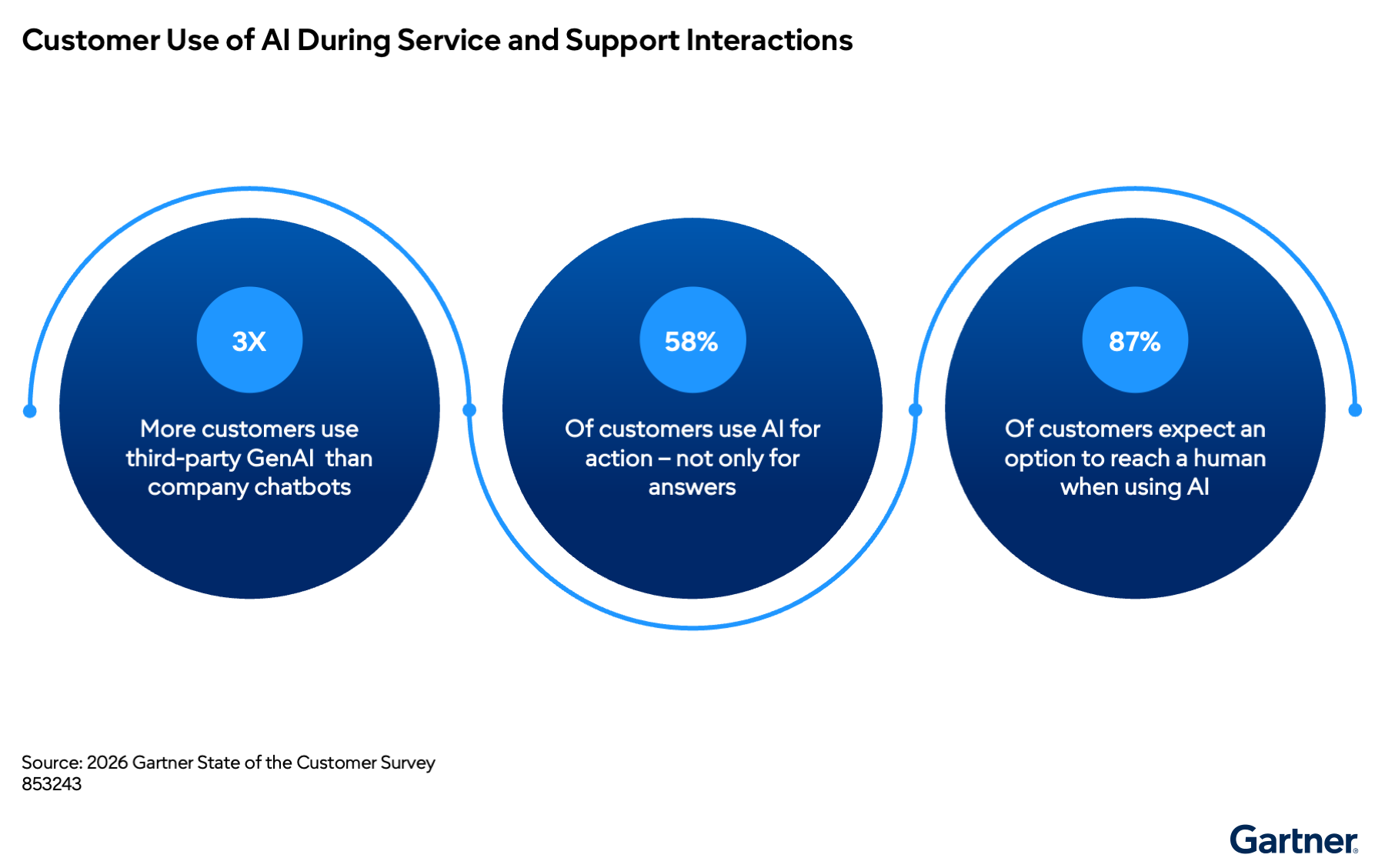
Three overarching insights stood out from the data in our 2026 State of the Customer Survey. Our analysis found that customers are far more likely to use third-party GenAI tools to solve their service and support issues, compared to company-provided chatbots. Additionally, we found that customers use GenAI (including both company and third-party tools) with the goal of completing tasks and taking action, not simply getting information or answering a well-defined question. Finally, while customers are open to using GenAI during service interactions, they are less likely to do so if they see it as a barrier to reaching a human agent.
Finding 1: Increased Use of GenAI (But Not Your GenAI)
Sixty-six percent of customers said they use GenAI in their personal life, work or both.3 This figure includes use of chatbots like ChatGPT, work tools like Copilot, and AI assistants on the service organization’s website. Among those customers who use GenAI tools like the above:
- 78% say their use of GenAI has increased in the past year
- 74% believe the quality of GenAI outputs is getting better
- 66% say they trust the outputs from GenAI
But when we asked customers specifically about their most recent service or support interaction, it was clear that increased use of GenAI is driven by third-party, rather than company-provided, tools. In their last service interaction, customers were approximately 3x more likely to use third-party GenAI tools (e.g., ChatGPT) than a company-provided chatbot.3
And while use of third-party GenAI tools for service and support nearly doubled in the past year alone, use of company-provided chatbots has remained statistically unchanged since 2022 (see Figure 1).3
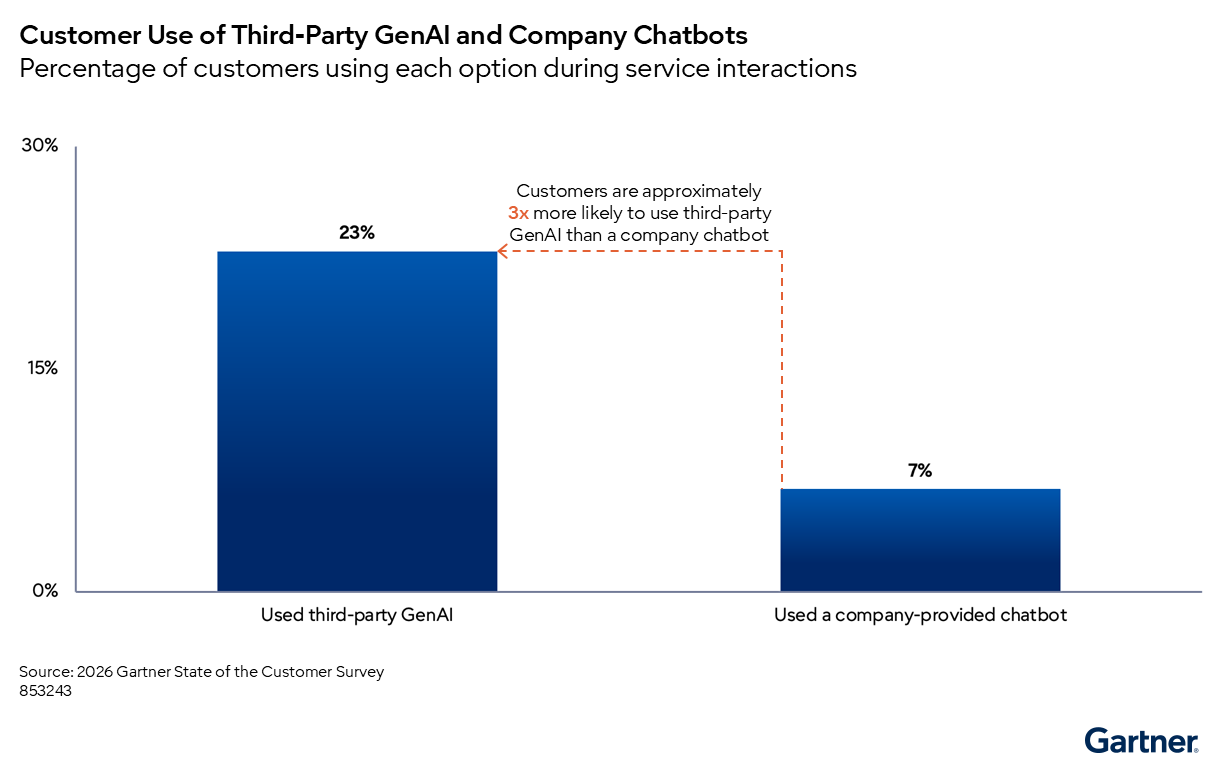
Increased use of and trust in GenAI has not translated to adoption of company-provided chatbots. The impact of GenAI has been largely to shift interactions outside of company-owned channels.
This data calls into question a commonly held assumption that company-provided GenAI chatbots are the future of customer service and support. While this doesn’t mean that service and support leaders should not deploy customer-facing AI, it does mean they need to reconsider which customer-facing use cases to pursue, and how to pursue them.
Recommendations:
- Prioritize GenAI investments in the voice channel. Third-party GenAI tools provide customers with a conversational, familiar and trusted source of information in self-service. If their issue is not fully resolved, many customers will completely bypass the company’s digital channels and go straight to voice. Surprisingly, the impact of GenAI may be that companies see a greater percentage of their contacts coming through voice, compared to their digital channels.
Leaders can account for this by indexing GenAI investments toward the voice channel. They should prioritize a modern, AI-enabled IVR (often called an IVA) that can fully resolve customer issues rather than serving only as a routing mechanism. The IVA should include capabilities that identify or predict customer intent, perform authentication, provide information, support transactions and route customers to humans when more assistance is needed. (See: How Intelligent Voice Assistants Revitalize the Voice Channel).
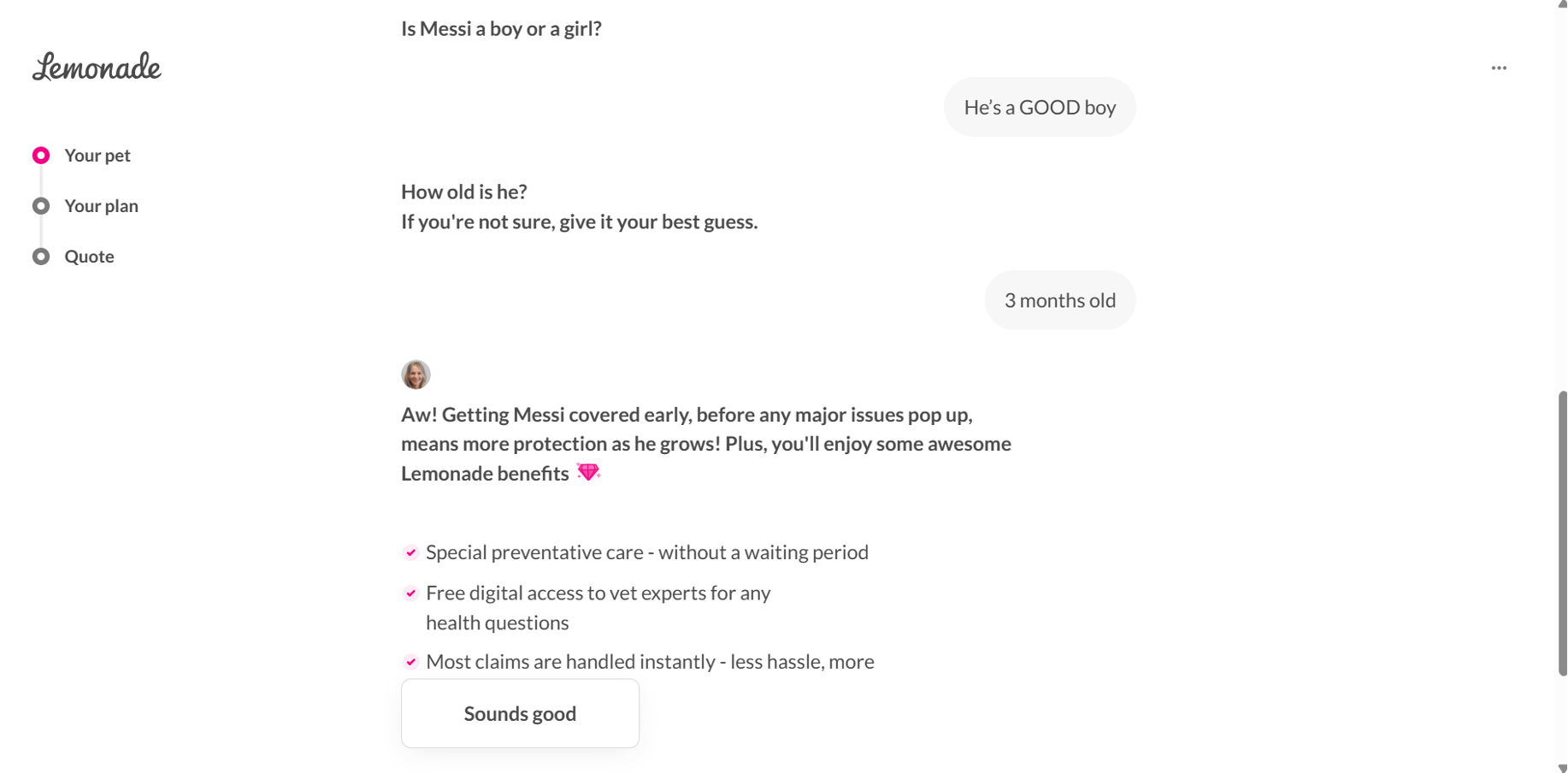
- Redesign the digital support experience as a single conversational interface. Customers are showing a preference for third-party GenAI tools that provide a single conversational interface, rather than a navigational experience. Organizations should meet this expectation when redesigning their digital offerings.
This shift in customer expectations provides a strong justification for shifting the digital approach toward an AI-powered Intelligent Front Door (see Exploring the Intelligent Front Door: How Leading Organizations Are Transforming CX). From the customers’ perspective, a website experience that previously centered on navigation and following links becomes conversational. And instead of a chatbot positioned as “another option” on the corner of the screen, customers encounter a single conversational interface to initiate requests and guide the interaction.
For example, Lemonade (an insurance company) presents the onboarding journey on its website as a single conversational interface (see Figure 3).
Finding 2: Customers Use GenAI for Action, Not Only Answers
Among customers who use GenAI — including both company-provided and third-party tools — 58% said they have used it to complete a task on their behalf, as opposed to only answer a question (see Figure 4).3 This behavior is extremely common in B2B environments, where 74% of customers report using AI to complete tasks.
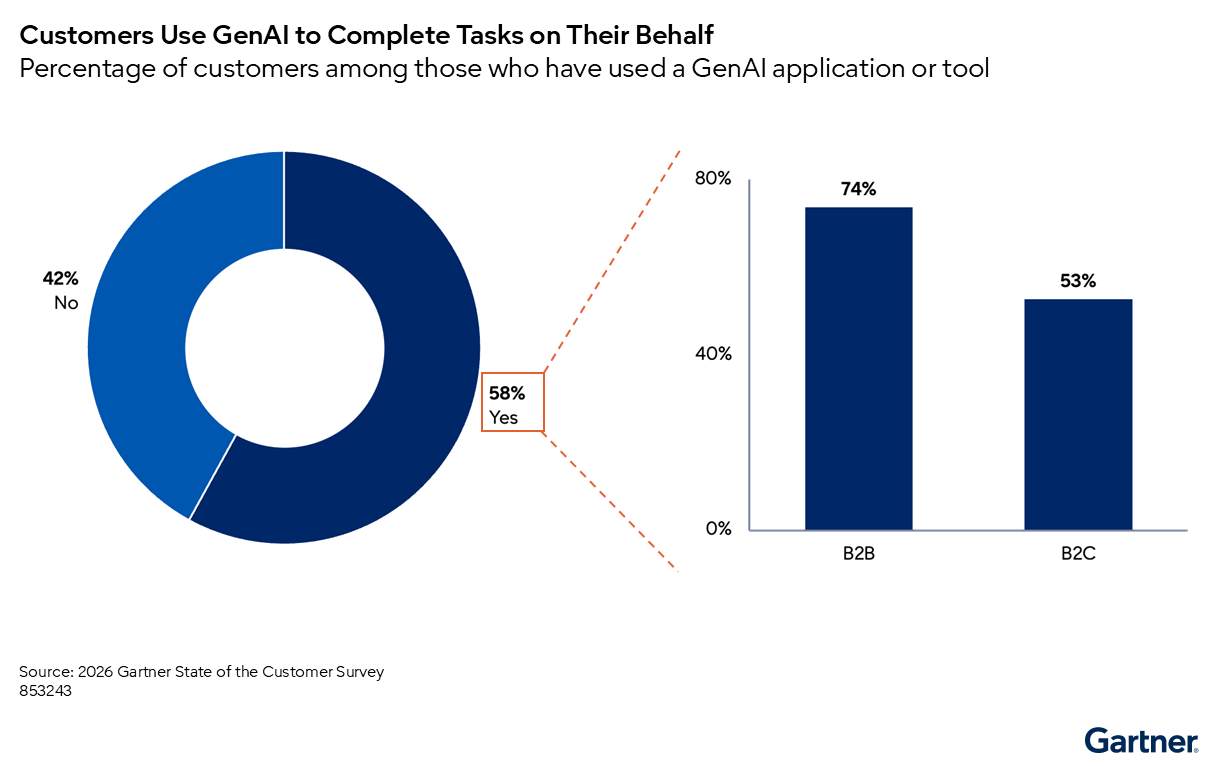
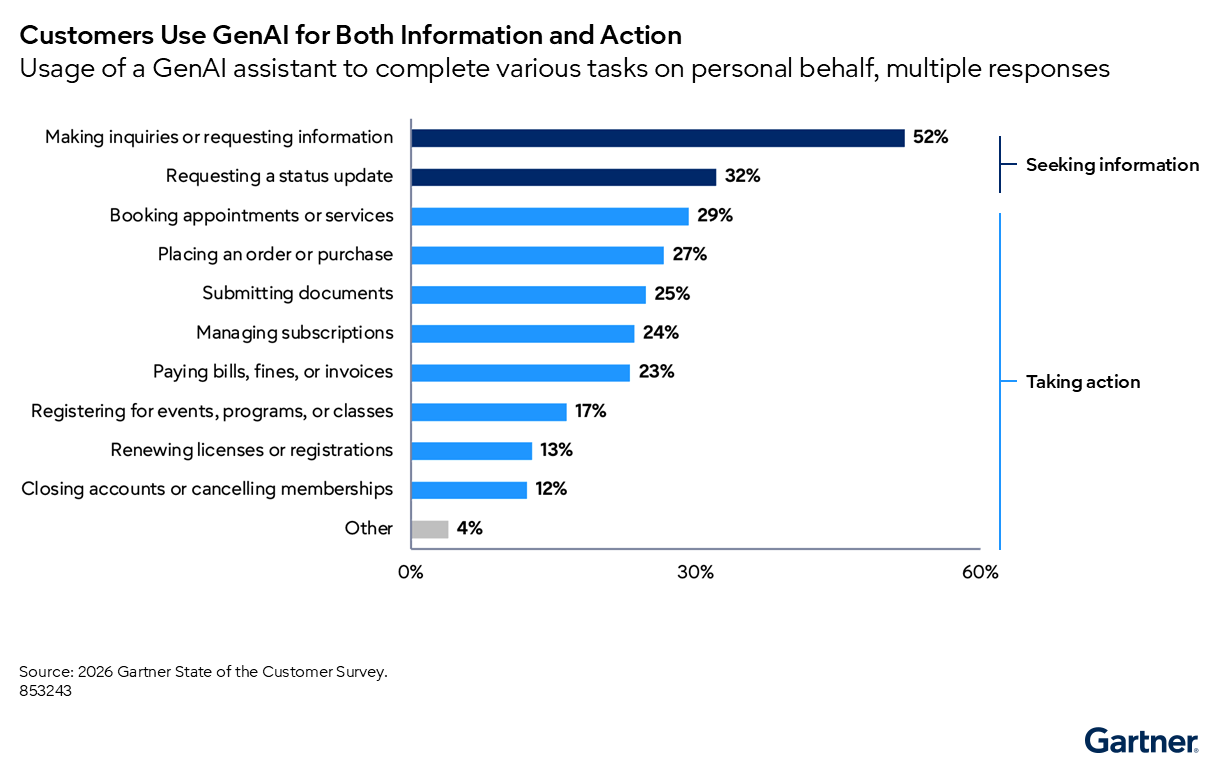
When understanding the specific tasks customers use GenAI to complete, we found they are often using it to take direct action — not only provide them with information.
Figure 5 highlights the most common tasks customers seek to accomplish using GenAI. While the most common tasks are related to information seeking (e.g., requesting information or a status update), customers also turn to GenAI to take a wide range of direct actions, including booking appointments, placing orders, submitting documents and managing subscriptions.
Currently, customers use GenAI to complete tasks with oversight, for example, directing it to book an appointment or prompting it to draft a service request based on information they provide. In the future, many customers will completely delegate service tasks to AI with limited involvement on their end (see Future-Proof Service by Preparing for the Next Generation of Customers).
Recommendations:
- Enable customers to take action, rather than only get information, when using company-provided AI tools. While customers increasingly turn to third-party AI tools when seeking answers and information, in many cases they still need to go to the company’s digital properties to transact or take action. Organizations should embed the ability for customers to complete tasks and transactions directly in their conversational GenAI interfaces, rather than creating experience fracture by requiring them to navigate to a separate page or portal to transact.
This does not mean that organizations should always use GenAI to execute these tasks on the back end. Many tasks can be executed less expensively using traditional rule-based automation. Organizations can use a blended strategy where, for example, GenAI is used to assess customer intent, and then a transaction is conducted through traditional automation (see When to Use (and Not to Use) Agentic AI for Customer Service).
- Make it easier for customers to take action when starting with third-party GenAI tools.
For now, customers interacting with third-party GenAI tools generally need to leave those tools and come to company-owned resources to transact. Organizations should streamline that transition (see ChatGPT for Service and Support: Share, Hide or Compete?).
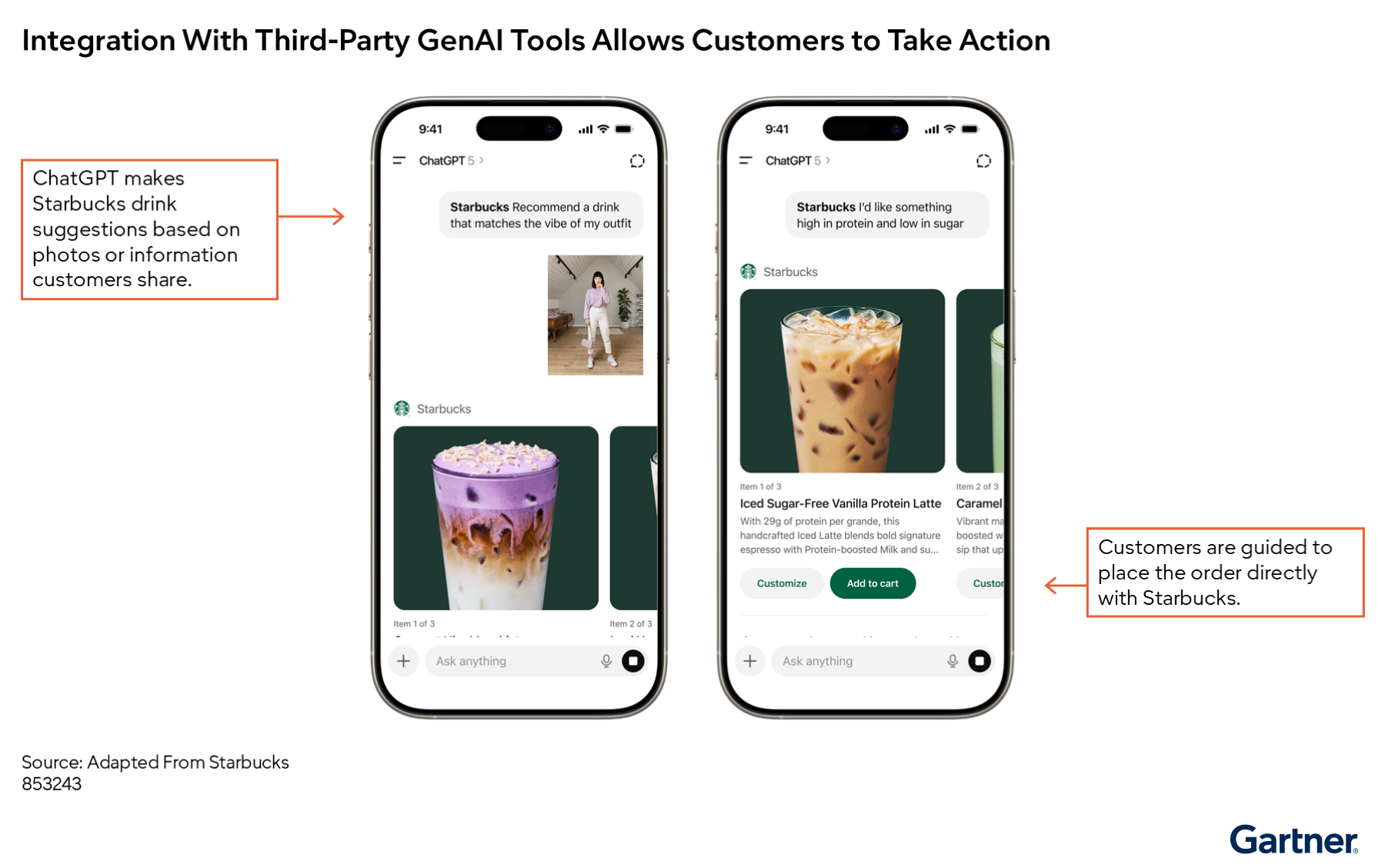
For example, Starbucks piloted an integration with ChatGPT that allows customers to get drink suggestions based on requests they write or photos they upload (see Figure 6). Customers get recommendations on what to order from the menu and how to customize those items, and then are guided to the Starbucks app to place the order.
- Prepare to serve bots, not just humans. In the future many customer service interactions will be AI to AI; they will originate from customers’ AI agents and be fully resolved by company AI agents. Service and support leaders must begin preparing for these interactions today. They should start by identifying the issue types customers are most likely to delegate to AI bots (e.g., appointment scheduling, pricing inquiries), considering desired SLAs and security standards and determining when AI-to-AI interactions need to be flagged for and escalated to a human (see Future-Proof Service by Preparing for the Next Generation of Customers).
Finding 3: Customers Expect AI to Be a Bridge to a Human, Not a Barrier
When asked about their attitudes regarding GenAI in customer service, 50% of customers say that their interactions are easier when companies use GenAI. Despite this optimism, customers overwhelmingly agree that GenAI should not serve as a roadblock to reaching a human, with 87% saying it is essential to provide an option to reach a human agent.3
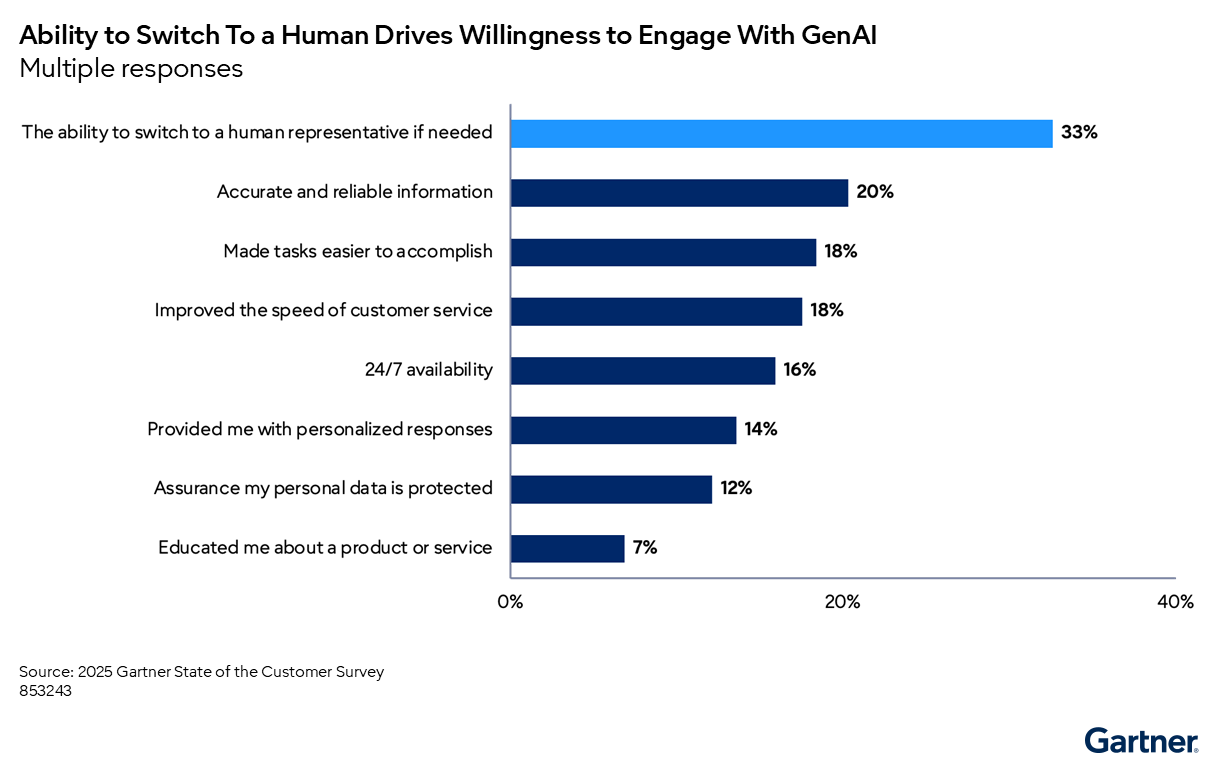
Customers who perceive GenAI as a bridge to a human will be more likely to use it, and may ultimately resolve their issue without human support. In fact, when we asked customers who said they were not willing to engage with AI what might increase their willingness, the most common response was the ability to switch to a human agent if needed (see Figure 7).3
Recommendations
- Position GenAI as the first step in the journey, rather than a barrier to reaching humans. Present GenAI tools as a way to collect information and assess needs — clearly communicating that human agents can step in if more help is needed. Disclose to customers when GenAI is being used, and allow them to escalate to live support whenever they request it, or if confidence in being able to resolve the issue with GenAI is low based on the context the customer provides. For complex or sensitive issues, escalate them to live support immediately (see Build Customer Trust and Drive Adoption With a Blended Chatbot Strategy).
- Pass context and intent of the customer interaction in self-service to the agent. Customers who interact with the chatbot expect their context to follow them if they transition to human support — including the information they have already provided and troubleshooting steps they have already tried. Seventy-four percent of customers who experience seamless transitions to human agents say they will try self-service again (compared to just 42% of customers who experience high-effort transition). Additionally, when context follows the customer, it can reduce handle time in assisted channels by 27%4 (see Deliver Seamless Customer Service Journeys Across Channels).
1 2026 Gartner C-Suite AI Survey. This survey was conducted to understand how enterprises are approaching AI, including budget allocations, current state of implementation and impact, AI strategy, and use cases across key business functions. The functions covered in the survey include finance, HR, procurement, supply chain, marketing, sales, customer service, legal/compliance, IT, and product management. The research was conducted online from January through April 2026 among 1,303 respondents across various industries and regions, including North America (n = 671), EMEA (n = 425), Asia/Pacific (n = 141), LATAM (n = 65), and others (n = 1). Qualifying organizations reported enterprisewide annual revenue of at least $50 million (or equivalent) in fiscal year 2025. Participants were required to be either the most senior leader or one level below the most senior leader within their respective function, and have familiarity with AI strategy, implementation, and budget for that function. Disclaimer: The results of this survey do not represent global findings or the market as a whole, but reflect the sentiments of the respondents and companies surveyed
2 2025 Gartner State of the Customer Survey. This annual survey enables customer service and support leaders to understand trends in customer preference and behavior. The survey was conducted online 6 January through 11 February 2025 and included customers whose service interactions were in various industries. The sample included 5,801 customers in the U.S. (n = 2,889), the U.K. (n = 1,216), Canada (n = 700), Australia (n = 515), New Zealand (n = 231) and Singapore (n = 250). The sample included customers in both B2C (n = 4,978) and B2B (n = 823) customer service interactions. Disclaimer: Results of this survey do not represent global findings or the market as a whole, but reflect the sentiments of the respondents and companies surveyed.
3 2026 Gartner State of the Customer Survey. This study was conducted to 3,566 B2B and B2C customers with service interactions in various industries. The research was conducted online via an external panel from 3 February to 10 March 2026 among 3,566 customers in both B2C (2,927) and B2B (639) interactions. The sample included respondents from the U.S. (n=1,757), U.K. (n=767), Canada (n=435), Australia (n=315), Singapore (n=148), and New Zealand (n=144) across various industries. Respondents were screened to ensure they had a relevant service interaction with a company.
4 2023 Gartner State of the Customer Survey