Magic Quadrant for Cloud Database Management Systems
18 November 2025 - ID G00829253 - 71 min read
By Henry Cook, Xingyu Gu, and 3 more
The cloud DBMS market is undergoing significant changes, including the adoption of generative AI, real-time processing and analysis, and new methods of interaction between DBMSs and other data management components. This research guides data and analytics leaders in making informed decisions about evaluating and selecting cloud DBMS solutions.
Market Definition/Description
Gartner defines the market for cloud database management systems (DBMSs) as software products that store and manipulate data and are primarily delivered as platform as a service (PaaS) in the cloud. Cloud DBMSs may optionally be capable of running on-premises or in hybrid, multicloud or intercloud configurations. They can be used for transactional and/or analytical work. They typically persist data using a combination of proprietary and open components in a durable manner, enabling a full range of create, read, update and delete operations. They are used by application end users, designers, developers and operators of large database systems.
Cloud DBMSs provide a means for businesses to store and process data in support of business applications and processes. They support transactional and/or analytical processing by supplying the data to run the business and analyzing it to improve overall business benefits. They address the needs of the following use cases:
- Online transaction processing (OLTP) transactions: Support a centralized transaction focus, with a fixed, stable schema, while delivering high speed; high volumes; concurrency controls; data insert/update; atomicity, consistency, isolation and durability (ACID) properties; transaction isolation; and security.
- Lightweight transactions: Support very high volumes of simple transactions with high concurrency, low latency and potentially relaxed consistency. This use case covers processing of fast-moving events captured from the edge.
- Application state management: Supports modern end-user experiences by managing session state at scale, providing rich user profiles and offering variable consistency mechanisms across the database. It supports variable and complex schemas across multiple applications and developer teams.
- Enterprise data warehouse: Manages data from multiple sources in a highly structured schema to meet analytical demands. It provides predictable performance for both batch and interactive queries.
- Lakehouse: Manages the variety and volume of data of variable structures across a wide range of analytical query workloads, ranging from traditional analytics to data science. Data may be physically distributed.
- Event analytics: Manages data that is written at high frequency and volume. Queries are made in real time to both evaluate data against models and summarize events. The same data is also queried at later times for ad hoc investigation, discovery and model training. In all cases, data is mixed in structure and size. Predictable performance and availability are critical for both ingestion and querying.
A cloud DBMS must support at least one of the use cases listed above.
Mandatory Features
- Deploy as PaaS on provider-managed public or private cloud systems.
- Manage data within cloud storage, not within hosted infrastructure as a service (IaaS), such as a virtual machine or container managed by the customer.
- Persist data; provide full create, read, update and delete (CRUD) operations; and provide durability of data across time.
- Persist data within storage controlled by the cloud DBMS itself, rather than handle data “in flight.”
- Serve as stand-alone data management components that store, read, update and manage data, as opposed to embedded systems within other software, such as business intelligence tools.
- Support transactional or analytical database operations, or both.
- Provide operational management and cost control for monitoring, auditing and performance tracking.
- Support dynamic autoscaling to automatically adjust workloads in response to changing requirements and enable pay-as-you-go models.
Common Features
- Support multiple data models and data types — relational, nonrelational (e.g., document, key-value, wide-column, graph, vector), geospatial, time series and others.
- Deliver as a PaaS that may also be deployable on-premises.
- Participate in a broader data ecosystem.
- Provide AI, machine learning (ML) and GenAI capabilities, either by itself or through interoperability with other services.
- Automatically handle different types and sizes of workloads simultaneously and efficiently, while enforcing, or dynamically extending, policy-based resource limits. The cloud DBMS can also handle varying and conflicting workloads, while optimizing response times and prioritizing the workloads to meet policy-defined service levels.
- Read, write and utilize data stored in open table formats, or utilize the open table APIs most commonly used in enterprises.
- Provide advanced capabilities to support a wide variety of data types for both storage and query, as well as advanced support to aid analysis of such data. This includes support for document types, continuous streams, various multimedia formats, embeddings and other data types.
- Perform support transactions on any of the individual nodes within the distributed database system.
- Access data outside the internal storage of the DBMS and optimize distributed access by a variety of methods, such as push-down, extended metadata, statistics collection and catalog federation.
- Support complex relational operations involving one or many tables that include composite, derived, single and multivalued attributes.
- Optimize performance for queries, transactions and workloads to meet performance and budget goals without manual intervention or management. This optimization may be achieved through performance-enhancing features, as well as pricing and packaging options, that enable management of complex workloads within set budgets.
- Deploy and operate analytical and operational activities across multiple cloud environments and on-premises.
Magic Quadrant
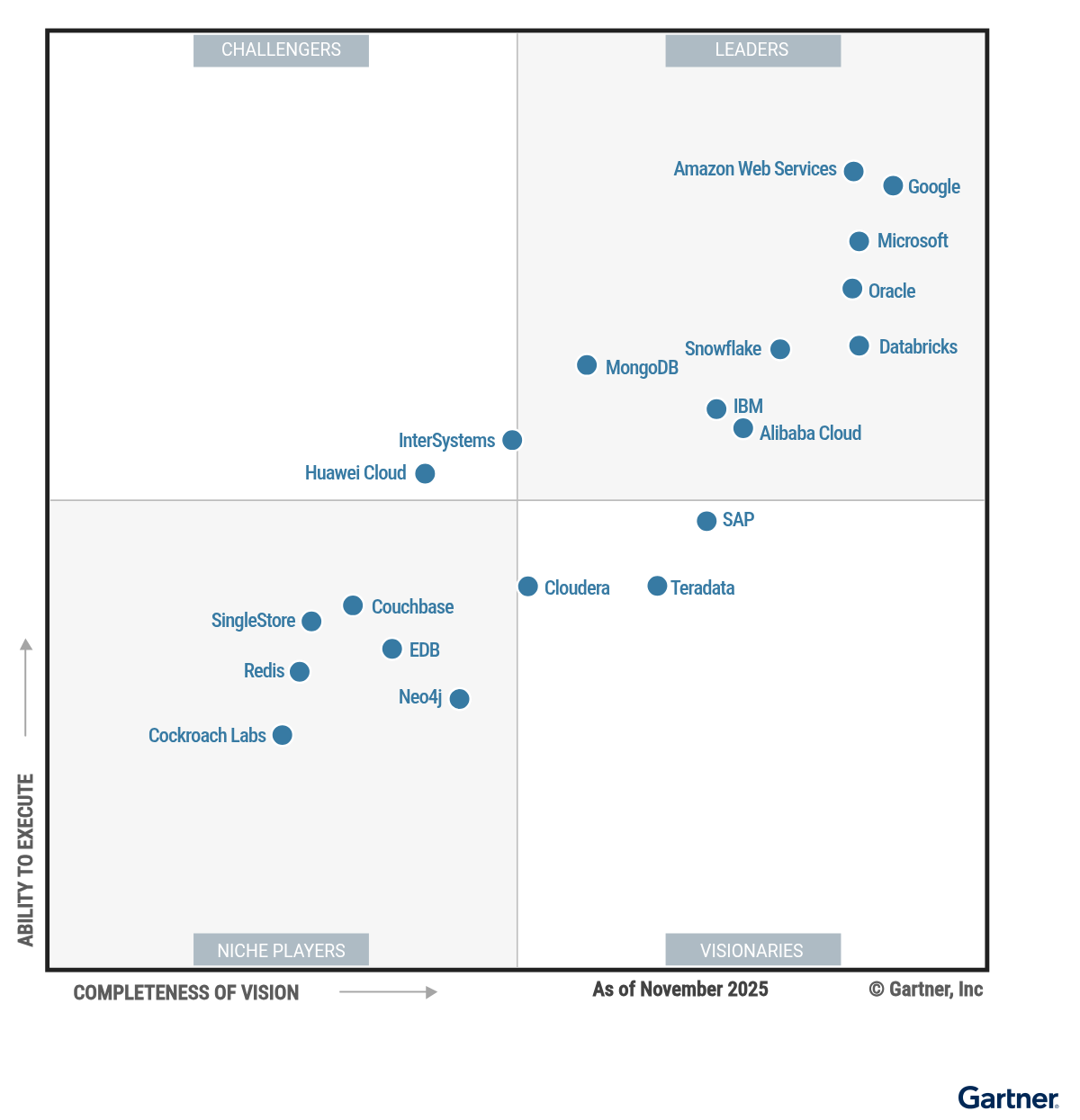
Vendor Strengths and Cautions
Alibaba Cloud
Alibaba Cloud is a Leader in this Magic Quadrant. Its DBMS offerings include PolarDB and ApsaraDB RDS for transactional, AnalyticDB and MaxCompute for analytical, Tair and Lindorm for key value and multimodal data management workloads. The vendor also offers Data Management Service (DMS) for data integration and governance, Data Transmission Service for data migration and synchronization, and Platform for AI (PAI), which are natively integrated with its DBMS products.
Alibaba Cloud provides cloud services in 29 regions and 92 AZs across the world. It is a global cloud service provider based in China, with presence in APAC, Europe, North America, the Middle East and Latin America. Its DBMSs can be deployed in both public cloud and hybrid environments.
- Flexible and serverless architecture: Alibaba Cloud has expanded serverless support across all its proprietary DBMS products. It is one of the few DBMS vendors offering comprehensive cloud-native capabilities within a hybrid cloud environment, including a three-tier decoupled compute-memory-storage architecture and hybrid cloud high availability.
- Comprehensive data and AI platform: Alibaba Cloud’s data and AI platform encompasses infrastructure, cloud platforms, DBMS, multimodal data management, AI engineering and large language models (LLMs). It is among the few hyperscaler vendors that enable clients to develop and deploy applications using only first-party provided components.
- Competitive pricing: Alibaba Cloud DBMS continues to deliver prices that help clients optimize their database investments without compromising performance or reliability. This cost-efficiency is especially attractive to clients migrating from more expensive legacy DBMS products.
- Limited ecosystem outside APAC: Alibaba Cloud’s global ecosystem outside APAC is still limited compared to its peers. This may result in fewer third-party tool integrations and English language resources like documentation, support and training, especially for product-driven DBMS users.
- Configuration complexity: Based on client feedback, new users find PolarDB’s configuration to be complex, particularly in balancing performance and cost, and managing the multilayer storage architecture. Optimizing performance, cost and other admin workloads in a more transparent and simplified manner remains a primary challenge for users.
- Overlapping product capabilities: Alibaba Cloud’s data management products, such as AnalyticDB and Hologres for analytical DBMS, DMS and DataWorks for data integration, continue to have overlapping functionalities that target the same roles. This overlap creates confusion for clients and is impacting their long-term product engagement decisions.
Amazon Web Services
Amazon Web Services (AWS) is a Leader in this Magic Quadrant. AWS provides an array of DBMS services to deploy transactional, operational and analytical applications with purpose-built databases. Its offerings include Amazon Aurora, Amazon Redshift, Amazon DynamoDB, and the next generation of Amazon SageMaker. It also offers zero-ETL integrations to help streamline data movement between different databases and deliver real-time insights across its database stack.
AWS’s dedicated industry teams and service delivery partners operate in over 30 regions across the globe, serving all major industries and providing its own tailored industry-specific solutions.
- Market presence and leadership: AWS has attracted customers around the world with its reputation for responsive development and its comprehensive solution deployment in the cloud. AWS also has a good track record for infrastructure availability and in proactively approaching customers with suggestions for cost optimization.
- Balance of choice and flexibility: AWS provides the broadest choice of cloud database management services, such as Amazon Aurora for operational databases, Amazon Redshift for data warehousing, Amazon DynamoDB for distributed NoSQL, Amazon ElastiCache for fully managed caching, and Amazon SageMaker, an integrated platform for data, analytics and AI. These solutions help customers address diverse business needs and use cases across different industries.
- Unified data and AI governance: AWS is unifying its D&A ecosystem for simplified deployment, management and governance. Amazon SageMaker provides central access to create, govern and share data, analytics and AI assets.
- Capabilities and choices trade-offs: AWS provides customers with an expansive menu of choices for DBMS services and integration options. However, the overlapping and conflicting features of these products can be confusing, which makes it difficult for customers to determine which solutions they need.
- Navigating cost controls and management: Tracking and managing costs is difficult in AWS because the company does not offer a unified pricing model across its numerous services. Most, but not all, resources are automatically tagged in AWS Cost Explorer, and costs can vary significantly, depending on which services are used to implement the solution.
- Ecosystem evolution and limitations: AWS has limited its emphasis on multicloud offerings, opting to instead provide native connectors, support for popular open-source engines like PostgreSQL and Apache Spark, and open table formats such as Apache Iceberg. As a result, many customers depend on third-party solutions for hybrid and multicloud orchestration.
Cloudera
Cloudera is a Visionary in this Magic Quadrant. It offers Cloudera Platform, which provides distributed storage and processing with multiple engines for transactional, analytical, streaming and AI workloads. Cloudera implements open data lakehouse architectures, as well as open standards for data and AI service portability across environments. It delivers centralized management through Cloudera Management Console, and its Shared Data Experience (SDX) layer provides security, metadata, governance and observability. In support of its strategy, Cloudera has acquired Octopai to enhance data lineage and Taikun to provide a unified cloud experience.
Cloudera supports a range of industry use cases and is available worldwide. It operates on AWS, Google Cloud Platform (GCP), Microsoft Azure, private cloud and on-premises infrastructure, supporting hybrid and multicloud deployments.
- Multicloud, intercloud and hybrid support: Cloudera offers significant capabilities for managing workloads across multiple clouds, including workloads that span clouds. Cloudera’s unified management, security and orchestration capabilities differentiate it from competitors, even among the few vendors that offer hybrid capabilities.
- Data security and governance: Clients highlight Cloudera’s ability to apply fine-grained access control, encryption and audit capabilities uniformly across both cloud and on-premises deployments. This unified approach to security and governance is a notable advantage for enterprises with complex compliance requirements, as it ensures that security policies and data residency are enforced regardless of the environment.
- Scalability: Cloudera continues to be the platform of choice for a number of extremely large deployments and has proven capable of managing 10+ PB data estates. It is designed to seamlessly handle increasing data volumes and user demands without compromising performance.
- Hadoop migration: Cloudera has made investments to allow legacy Apache Hadoop deployments to leverage new technologies, such as Cloudera Object Store (powered by Apache Ozone). While this is of significant value for its installed base, Hadoop continues to be seen as harder to use. Prospective customers should do a proof-of-concept to evaluate Cloudera’s technology for greenfield deployments.
- Pricing concerns: Cloudera customers continue to report cost increases that exceed the industry averages.
- Operational capabilities: Customers report they are not using Cloudera’s operational database for new workloads, and the capabilities of this database lag its competitors, particularly the highly distributed offerings from Amazon, Microsoft and Google. While Cloudera has recently announced new Kafka capabilities, customers should monitor Cloudera’s progress in improving its operational database.
Cockroach Labs
Cockroach Labs is a Niche Player in this Magic Quadrant. CockroachDB is a cloud-distributed transactional DBMS. It provides resilience, scalability and consistency for modern applications across globally distributed regions. Cockroach Lab’s database platform as a service deployment option is available on AWS, GCP, Microsoft Azure, IBM Cloud, Oracle Cloud Infrastructure (OCI) and hybrid clouds. The self-hosted offering can be run in on-premises and hybrid deployments.
Cockroach Labs has customers in industries including high tech, finance, retail, entertainment and manufacturing. Its business is mainly in North America and Europe, but it has some presence in APAC and Latin America.
- Distributed SQL with resilience: Cockroach Labs has significantly enhanced its DBMS resilience, including disaster recovery, availability and consistency, while maintaining its natural strengths in scalability and cross-region operations. These improvements make it even more suitable for organizations’ mission-critical, transactional workloads.
- PostgreSQL enhancement: Cockroach Labs recently invested in innovations and ecosystem engagements to improve PostgreSQL compatibility, including expanded support for PostgreSQL functions, extensions and migrations. These innovations enable seamless migration and integration for PostgreSQL developers.
- Ecosystem engagements: Cockroach Labs enhanced its ecosystem through collaborations with major cloud service providers, consulting firms like PwC, and data management independent software vendors (ISVs) such as IBM, Snowflake and Confluent. These partnerships enable customers to seamlessly integrate CockroachDB into their existing IT stack.
- Competitive edge: Cockroach Labs faces intensifying competition from leading cloud service providers, as well as offerings from independent vendors.
- FinOps challenges: Managing costs of CockroachDB on-cloud is still challenging, due to a lack of tools and vendor support and given the inherently higher complexity of using distributed SQL clusters. However, CockroachDB has a major opportunity to help users save money by innovating on multicloud/intercloud resource optimization. Customers should consider the use of third-party FinOps tooling, including CSP native tools, to help mitigate these challenges.
- Unproven analytical and AI capabilities: CockroachDB has delivered some innovations for analytics and AI apart from support for pgVector. Its innovations are mainly focused on relational data use cases. Customers with complex AI or analytical use cases may prefer alternatives to CockroachDB.
Couchbase
Couchbase is a Niche Player in this Magic Quadrant. Couchbase provides two versions of its nonrelational database platform: Couchbase Enterprise, a self-managed offering; and Couchbase Capella, a managed cloud database service. It also offers Couchbase Mobile, consisting of Couchbase Lite, App Services and Edge Server for mobile and IoT use cases.
The company operates primarily in North America, with a presence in Europe and a growing footprint in APAC. Couchbase is used across various industries, with particular adoption in large-scale, name-brand, consumer-facing applications.
- Support for disconnected operations use cases: Couchbase Mobile enables clients to deploy its platform in locations where network connectivity may be intermittent or unavailable. Its synchronization framework and embedded database options help organizations maintain data consistency and application functionality in disconnected scenarios. This benefits industries like transportation and retail, where Couchbase has a significant presence.
- Performance: Couchbase is well-suited for applications that need consistently low latency and high throughput, such as transactional and real-time systems. Its architecture supports a high volume of public-facing workloads without excess infrastructure. Gartner clients note that Couchbase’s high performance in resource-constrained settings is a key reason they use it.
- Document model support: Couchbase differentiates itself with strong JSON document store and model capabilities, which are integrated with in-memory cache, text search, columnar indexes and vector search. Customers report that they value the ability to incorporate vector queries and AI workloads into existing processes, as they praised Couchbase’s unified data access, easier development and a simpler architecture.
- Private equity acquisition: Couchbase’s pending acquisition by Haveli Investments brings uncertainty to its commercial and product strategy. Private equity ownership often leads to a stronger focus on profitability, which may result in price increases, changes in licensing and support tiers, or stricter contracts.
- Ecosystem integrations: Couchbase’s ecosystem integration is less extensive than those of leading relational products. Unlike some relational databases, Couchbase has only recently added advanced AI features and broader integrations with open-source tools, third-party products and native cloud services.
- Limited analytics capabilities: Couchbase’s columnar analytics features support real-time insights and operational reporting, but these features provide limited support for enterprise data warehouses or data lakes. Organizations with complex BI, historical analysis or large-scale batch processing typically cannot use Couchbase, limiting its deployment to transactional analytics.
Databricks
Databricks is a Leader in this Magic Quadrant. It offers Databricks Data Intelligence Platform, which includes Unity Catalog for centralized governance of data and AI assets, enhanced lineage and monitoring, and AI-powered discovery and business semantics. It also offers data warehousing capabilities through Databricks SQL, data integration and data engineering capabilities through Lakeflow, and a recently released, fully managed, Postgres-compatible operational database through Lakebase.
Databricks serves both operational and analytical use cases. It operates worldwide across various industry verticals, including financial services, media, manufacturing, retail, energy, transportation, government and public sectors. Databricks Data Intelligence Platform can be deployed on Alibaba Cloud, Azure, AWS, and GCP, and in customer-managed virtual private clouds.
- Lakehouse vision: Databricks leads the lakehouse market, blending data lakes and warehouses. It offers a unified platform for all workloads, featuring a single governance and security layer that spans data, formats, clouds and use cases. The platform delivers high-performance analytics and AI with serverless scaling, predictive execution and AI-powered usability.
- Velocity of innovation: Databricks demonstrates rapid innovation through both development and strategic acquisitions. Agent Bricks has introduced substantial new functionalities on a near-monthly basis. Recent moves, such as the 2024 acquisition of Tabular, have led to full Iceberg support across the product portfolio. Lakeflow has expanded its capabilities while simultaneously introducing no-code and low-code support.
- Open standards: Databricks’ commitment to open standards, including Delta Lake, Apache Iceberg, Apache Spark and PostgreSQL, helps prevent vendor lock-in and promotes data portability. This supports interoperability across processing engines, reducing data duplication and the need for complex restructuring.
- Cost predictability: Despite significant advancements in financial governance tooling, many clients report challenges with understanding and managing the costs of Databricks. While this is a common problem when moving from fixed capacity to pay-as-you-go consumption models, Databricks’ expansive list of products and new features (such as HIPAA compliance security) contribute to the difficulty.
- Proprietary features: Despite its commitment to open standards, clients express concerns about potential vendor lock-in due to the proprietary nature of certain Databricks features, such as orchestration and Delta Live Tables, which may not be compatible with other tools. Customers should determine whether they need to create their own abstraction layers to mitigate the risk of lock-in.
- Complexity: Clients consistently report that effective use of Databricks requires a high level of technical skills. Databricks has started to address this issue by introducing Databricks One, a redesigned experience tailored to business users, as well as Databricks Assistant, an AI-assistant available throughout the platform.
EDB
EDB is a Niche Player in this Magic Quadrant. It offers EDB Postgres AI, a fully managed or self-managed data platform for operational, analytical and AI workloads, featuring high availability and an enterprise-grade Postgres engine. EDB supports open-source communities and contributes a significant portion of its code to the PostgreSQL codebase. EDB offers an Oracle compatibility layer that enables organizations to run Oracle-based applications seamlessly on its platform.
EDB serves customers in a range of industries worldwide, such as financial services, government, public sector and education. Its operations are mainly in North America and Europe, with a growing presence in APAC. EDB Postgres AI can be hosted on AWS, Microsoft Azure, GCP, Alibaba Cloud and others, and can be deployed in hybrid, multicloud and sovereign on-premises environments.
- Leading commercial support for PostgreSQL: EDB’s on-premises support for commercial PostgreSQL, combined with its proven track record of releasing its own bug fixes, sets it apart in this market. Growing interest in PostgreSQL compatibility for GenAI and agentic AI use cases is driving increased adoption of EDB.
- Developer contributions: EDB has fostered an engaged developer community that drives research-based innovation. Developers help EDB maintain its enterprise Postgres leadership by enhancing, testing and providing timely bug fixes.
- AI innovations: EDB has added GenAI and agentic AI capabilities to its PostgreSQL-based system. Additionally, its Apache-licensed Massively Parallel Processing architecture enables higher scaling for analytic workloads compared to other PostgreSQL implementations.
- Cost concerns: Some users report that EDB’s licensing fees, support contracts and premium features can be expensive, making it a significant investment. Smaller businesses or teams with limited budgets may prefer more affordable or open-source alternatives.
- Increasing competition: There is an increasing number of competitors that provide Postgres API support. Although EDB maintains compatibility and support for the latest versions, customers seeking Postgres compatibility have many choices. Customers should carefully weigh their compatibility requirements (for example, identical binaries, source code portability or wire protocol).
- Vendor lock-in: Although EDB is built on open-source PostgreSQL, some proprietary features and management tools can create dependencies and increase the risk of vendor lock-in. For example, of the multiple Postgres distributions EDB offers, one distribution (EDB Enterprise Postgres Oracle Compatible Edition) provides advanced Oracle compatibility features that are not part of Postgres. EDB provides other Postgres distributions (EDB Enterprise Postgres and Community PostgreSQL) with full PostgreSQL compatibility that enable customers to avoid any vendor lock-in. While vendor lock-in is true of many other Postgres services, customers should understand where these proprietary features are present.
Google is a Leader in this Magic Quadrant. It offers managed database services that cater to a wide range of workloads, such as transactional, analytical, nonrelational and in-memory use cases. Its database offerings include Spanner, BigQuery, AlloyDB for PostgreSQL, Cloud SQL, Firestore, Memorystore and Bigtable. These services enable organizations to develop modern, data-driven solutions that support mission-critical applications, real-time data synchronization and serverless architectures. Google also integrates its DBMS offerings with advanced technology offerings for analytics, machine learning and AI. This includes support for vector, graph and LangChain in addition to its proprietary LLM, Google Gemini, and a wide ecosystem of first and third-party models for generative AI use cases.
Google serves multiple major industries and is available worldwide. Google’s AlloyDB Omni offers a downloadable version that is designed to run anywhere, including on-premises and in other clouds.
- DBMS for agentic AI: Google Cloud’s DBMS offerings are designed to enable agentic AI use cases and engineering. By seamlessly integrating Google’s advanced proprietary AI models, such as Gemini, with its DBMS offerings, customers can create and execute complex and automated workflows.
- Integrated governance and knowledge engine: Google delivers a unified foundation for data and AI through its semantic models and integrated metadata management through Dataplex. Its underlying data architecture also facilitates automatic data discovery, governance of data and AI artifacts, data classification and managing data products.
- Multimodel application development: Google’s Spanner database has multimodel capabilities, including support for vector, full-text search, relational, key-value and graph functionalities. This helps to meet the demands of data-driven applications that require complex relationship modeling as well as advanced semantic search capabilities.
- Navigating PostgreSQL solution selection: Google Cloud offers a range of PostgreSQL platforms, including Cloud SQL, AlloyDB and Spanner. Each platform is tailored to specific needs, allowing customers to choose the best platform for their use case. Customers must weigh the cost, scale and availability requirements of each service against their needs.
- Maturing marketplace and data sharing capabilities: While Google offers unique datasets to customers via Search trends, Ads, Geospatial and commercial datasets, its marketplace and data sharing ecosystem is still growing. Despite improvements in clean rooms and cross-cloud interoperability, customers may find that its options for data sharing are less extensive compared to other platforms in this evaluation.
- Navigating cost management and controls: As Google rolls out new capabilities to meet data and AI demands, cost management within Google Cloud databases can become more complex. To support users in addressing these challenges, Google’s FinOps Hub has introduced enhancements that offer increased visibility, control and predictability. The platform now includes proactive, continuous anomaly detection, usage quota threshold safeguards, cost transparency and GenAI cost optimization features. This is likely to help Google Cloud customers gain better control over efficiently balancing usage and cost across their database portfolio.
Huawei Cloud
Huawei Cloud is a Challenger in the Magic Quadrant. Its DBMS solutions include GaussDB and TaurusDB for operational workloads, DWS for analytics, and GeminiDB for multimodal use cases. Complementary data management tools, including DataArts Studio, Data Ingestion Service (DIS) and Data Replication Service (DRS), enhance its data-AI solution portfolio.
Operating primarily in China, Huawei Cloud maintains an increasing footprint across Asia/Pacific, the Middle East, Africa and Latin America, serving diverse industries from telecom and healthcare to finance, insurance and the public sector. Its portfolio supports both public cloud and comprehensive hybrid deployment environments for a wide range of DBMS clients.
- Unified data+AI capabilities: Huawei Cloud provides a unified data, analytics and AI solution. By seamlessly integrating its DBMS and lakehouse products into DataArts Studio, it creates a single, unified data+AI platform for enterprises. This simplifies governance and accelerates how enterprises build and deploy intelligent applications from one cohesive platform.
- Global recognition: Despite geopolitical headwinds, Huawei Cloud’s DBMS business continues its strong expansion across Africa, Latin America and the Middle East. With eight data center regions in these regions, GaussDB is now well-positioned to support mission-critical enterprise applications in these markets.
- Potential of self-developed AI chips: Huawei Cloud’s ongoing investment in self-developed AI chips and AI infrastructure offerings, including Ascend accelerators and Huawei CloudMatrix 384, positions it to deliver a comprehensive end-to-end AI stack in the future. This evolving synergy between AI infrastructure and DBMS capabilities on Huawei Cloud is set to significantly enhance DBMS adoption and drive future growth.
- GaussDB adoption as DBaaS: Huawei Cloud offers two relational DBMSs: The flagship product GaussDB and TaurusDB (formerly GaussDB for MySQL). Gartner client feedback indicates that GaussDB is still primarily deployed in on-premises or private cloud settings, rather than as a fully managed DBaaS on public cloud. Prospective clients should thoroughly assess the appropriate use cases for each DBMS solution before adoption.
- Limited global ecosystem: Outside of China and the APAC region, Huawei Cloud’s data management ecosystem is less present than its global peers. This presents practical challenges for businesses, including fewer third-party tool integrations, a shortage of English-speaking talent, and a more limited network of experienced international partners for specialized implementation and support.
- Lack of English language DBMS documentation: A key challenge for international users of Huawei Cloud is the insufficiently detailed English documentation from both official and community-generated sources. This results in a steeper learning curve and slower troubleshooting for non-Chinese speaking teams.
IBM
IBM is a Leader in this Magic Quadrant. IBM offers a broad portfolio of scalable and highly available database-as-a-service offerings. It offers Db2 for transactional/operational workloads and watsonx.data, a lakehouse solution, for supporting analytic workloads; both are available on IBM Cloud and other hyperscalers. IBM has consolidated its data and AI platform under the watsonx brand, with watsonx.ai, watsonx.data and watsonx.governance providing integration, lakehouse, modern AI capabilities and AI governance in an integrated manner.
IBM’s ongoing investments in cloud interoperability and open-source technologies enhance its ability to support complex, multicloud and hybrid deployments, making it a compelling choice for organizations with diverse and evolving data requirements. IBM operates globally across all industries and organization sizes.
- Data ecosystem integration: IBM offers a well-defined approach for how DBMS instances will operate within broader, enterprisewide data management frameworks. IBM’s product strategy demonstrates robust integration with key components across the data management ecosystem. This strategy is strong in governance and the management, and the sharing of metadata. This positions IBM well for the industry’s shift toward data fabric and comprehensive data ecosystems.
- Expanding cloud presence: IBM’s partnerships with hyperscalers, such as AWS and Azure, further solidify its enterprise presence. IBM is expanding its cloud footprint by making its products, particularly the Db2 portfolio, available on hyperscaler cloud platforms. This strategy is further strengthened by IBM’s recent acquisition of DataStax, which has a well-established, multicloud presence.
- Vertical solutions: IBM provides robust, industry-specific data models for sectors such as banking, finance and retail. These models serve as valuable guides for clients.
- Complex portfolio: IBM’s cloud DBMS portfolio has overlapping and complex features that can make it difficult for users to select the most suitable solutions (i.e., Db2 Warehouse, Netezza, and watsonx.data for data warehouse). Customers should assess their workload requirements to ensure they choose the platform best aligned with their business needs and utilize IBM’s dedicated sales and support teams to help in the selection process.
- Limited communication: IBM’s marketing collateral continues to trail behind those of hyperscalers in clearly and effectively conveying the comprehensive scope and integration of its offerings. As a result, some prospective clients lack awareness of all the capabilities that IBM offers.
- Legacy perception: Despite ongoing modernization of its product portfolio, some buyers hold perceptions of IBM as being primarily a legacy technology provider. This perception limits its opportunities to win over customer use cases.
InterSystems
InterSystems is a Challenger in this Magic Quadrant. It offers InterSystems IRIS, InterSystems Data Studio, and a range of solution-focused cloud services, all based on the InterSystems IRIS distributed multimodel data platform. These services are available on AWS, Microsoft Azure, and Google Cloud Platform, in addition to self-managed private clouds leveraging Kubernetes. InterSystems IRIS supports both operational and analytical workloads.
The company has a strong presence in the healthcare sector, and it also serves customers in supply chain, finance, and manufacturing. InterSystems operates globally, with primary markets in North America, Europe, and the Asia/Pacific region. The platform is available for both cloud and on-premises deployments.
- Data fabric approach: InterSystems IRIS implements a data-fabric-styled architecture that spans both operational and analytic workloads. The platform’s built-in support for multimodel data, real-time data ingestion, and advanced metadata management facilitates support for a significant number of use cases, particularly those that require extensive integration and orchestration across both operational and analytic queries.
- Vertical depth: Customers in the key verticals that InterSystems serves (healthcare, financial services and supply chain) report possessing significant knowledge, commitment and functionality. Gartner clients consistently report that InterSystems brings deep domain knowledge, a strong commitment to industry requirements and specialized functionality that addresses both operational and compliance needs.
- Customer support: Customer feedback across industries is overwhelmingly positive and praises the reliability and performance of both the technology and the support provided by InterSystems staff. Customers say the company is highly responsive and proactive in addressing customer needs.
- Proprietary architecture: InterSystems’ proprietary multidimensional array DBMS engine is different from standard relational or NoSQL models, although it does provide projections to these models. This unfamiliarity can make it difficult to port data or applications that take advantage of this multidimensional structure. Even satisfied customers often choose to restrict IRIS usage to specific, typically complex, applications, preferring mainstream DBMS engines for the majority of new workloads to ensure easier data portability and wider ecosystem support.
- Skills availability: While InterSystems has broadened its support for SQL and Python in recent years, using IRIS requires specific skills that can be difficult to acquire. This is a problem for proprietary API DBMS products as open-source APIs, and particularly PostgreSQL, increase in popularity.
- Learning curve: Leveraging InterSystems IRIS’ differentiated capabilities requires not only learning some new syntax but also adopting a new way of constructing data-centric apps. While this challenge is somewhat mitigated by IRIS’ vertical solutions, InterSystems’ Python interface and Data Studio, this learning curve remains a significant challenge for broadscale adoption.
Microsoft
Microsoft is a Leader in this Magic Quadrant. It provides a broad range of cloud DBMS offerings, including Azure SQL Database, Azure Database for PostgreSQL, Azure Database for MySQL and Azure Cosmos DB. It also provides Microsoft Fabric, a converged data, analytics and AI platform with built-in DBMSs and data ecosystem governance functions by the integration with first- and third-party tools in the APAC region. Microsoft Fabric also has other data management solutions built in such as Data Factory, Real-Time Intelligence and Power BI. Another data analytics offering is Azure Databricks, a Microsoft first-party data analytics platform, based on its OEM partnership with Databricks.
Microsoft is one of the leading CSPs with geographically diversified business operations throughout the world. Its DBMSs are used in almost every industry and deployment size.
- Comprehensive product portfolio: Microsoft provides a comprehensive portfolio of DBMS products that support almost all data models, time sensitivities and industry use cases. Combined with its products across infrastructure, data engineering, security, AI platforms and models, it enables customers to sustain diverse enterprise IT use cases.
- PostgreSQL engagement: Microsoft is now a major contributor to the PostgreSQL community, especially in key areas like I/O, availability and performance. These improvements are built into Azure SQL and Azure Database for PostgreSQL. As PostgreSQL becomes more popular for a wide range of enterprise uses, especially for GenAI application development, its users will find it easy to switch to Microsoft platforms.
- GenAI readiness: Microsoft has introduced substantial AI innovations to its DBMS, including in-DBMS embeddings, built-in vector indexing, and compatibility with Copilot in Fabric and Azure AI Foundry. These advancements position Microsoft platforms as a common choice for Microsoft-oriented organizations building generative AI and agents, whether for highly customized, complex applications or simple business prototypes.
- Overlapping D&A offerings: Microsoft’s data and analytics market execution, particularly the competition among Azure Synapse, Fabric and Azure Databricks, continues to generate uncertainty among existing clients about which to choose. The overlap between unified “all-in-one” platforms frequently conflicts with established enterprise strategies, leading to concerns about platform stability and technical debt.
- Unproven functions in Microsoft Fabric: Despite Microsoft Fabric’s growing market presence, Gartner client feedback highlights ongoing concerns regarding its data warehouse and data governance functions, including sovereignty and resource sizing, pricing, metadata management, data quality and data migration. Many of these features were available or more mature in its established data management products. However, Microsoft is heavily investing in these areas with new capabilities in a rapid manner.
- Fabric databases: Microsoft is investing in integrating its operational databases, such as Azure SQL Database and Azure CosmosDB, into Fabric to ensure the use of the same engines and core infrastructure. While this approach has the potential to deliver a comprehensive user experience across its operational and analytical products, in the short term, it may also introduce compatibility challenges such as performance and resource management.
MongoDB
MongoDB is a Leader in this Magic Quadrant. It offers the document-based nonrelational MongoDB Atlas on AWS, GCP and Microsoft Azure; the on-premises MongoDB Enterprise Advanced; and MongoDB Community Edition, which is source-available and free to use. MongoDB Atlas and MongoDB Enterprise Kubernetes Operator enable customers to deploy and manage MongoDB database resources to a Kubernetes cluster. The vendor also offers MongoDB Atlas Charts, Atlas Data Federation, Atlas Search, Atlas Online Archive, and Voyage AI for embedding models and re-rankers. It supports application-driven analytics, AI workloads, queryable encryption and time series collections, along with full-text search, vector search and stream processing.
MongoDB is widely used across all industry segments and in enterprises of all sizes globally.
- Category definition: Gartner clients in competitive evaluations prefer MongoDB as a document database over other similar offerings. There are a few companies that establish standards within the industry, and MongoDB is one of them. This is demonstrated by the fact that several other vendors advertise “MongoDB compatibility” as a desirable feature. Hence, if customers desire a document model, MongoDB should be considered a strong contender.
- Deployment options: Deployments can be distributed and active-active for high availability. MongoDB has a worldwide presence with a rich set of deployment options. It is popular with both its commercial and community editions. A robust partner program augments its deployment options globally; Alibaba, Tencent, IBM and other partners offer a managed MongoDB service.
- Agile development: MongoDB is highly valued by its customers for its flexible and agile approach to application and database development. As an early proponent of the document data model to allow fast iteration of database design, it has a large community of practitioners from whom prospective buyers can benefit. There are also many proven case study examples on which to base their designs, and from whom advice can be gathered.
- Increased competition: While MongoDB remains a leading exponent of the document model, other vendors now do this too, either as a stand-alone database or as a feature of a multimodel database, such as JSON support within an RDBMS.
- Analytical processing: A trend is emerging toward integrating operational and analytical systems. While MongoDB does enable some analytics, it has not yet articulated a full story in this area, either an expansion into an analytic database or integration with other analytic systems.
- Training: Developers not familiar with the document DBMS model need to increase their familiarity with the model and make the transition. However, the necessary adjustments are now well understood, and MongoDB has an extensive training and certification program.
Neo4j
Neo4j is a Niche Player in this Magic Quadrant. It is recognized as a popular graph database for storing and querying highly connected data and complex relationships where contextual data structures are involved. It offers ACID support for transactions and analytics. Neo4j AuraDB is a fully managed graph database and has a strong presence on AWS, Azure and Google Cloud. Neo4j is most effective at integrating diverse datasets supporting advanced techniques such as GraphRAG, contributing to it and other systems, and their applications being AI-ready and enhancing trust in GenAI solutions.
Neo4j is widely used in various industries such as finance, insurance, healthcare and social assistance, public administration, manufacturing, retail and information-related industries. Popular use cases include customer 360, fraud detection, logistics and recommendation engines.
- Leadership in graph technology: Neo4j provides native vector indexing and similarity search capabilities, setting standards for Cypher/openCypher query language for graphs and establishing GQL standards. It also offers extensive libraries of graph algorithms, and it supports GenAI business applications through GraphRAG.
- Unified integration and seamless connectivity: Neo4j offers direct plugin connectors to existing data platforms such as data warehouses and lakehouses. Together with its integration with BI tools, it provides storage and retrieval with its graph database engine for running graph algorithms and generating predictions on most major data platforms and analytics tools.
- Improved LLMs and GenAI accuracy: Neo4j delivers context-rich data assets by extracting knowledge from structured, semistructured, and unstructured data to enhance data quality and drive AI readiness and semantics for GenAI applications. Its robust knowledge graph capabilities also support GenAI and LLMs, and enable AI in driving accuracy and reducing hallucinations for intelligent decisions and insights.
- Resource and scalability considerations: Graph databases are purpose-built to handle complex data structures involving nodes and relationships, enabling higher throughput and efficient data retrieval. However, as application size grows, careful data modeling is essential to optimize storage and compute resource usage.
- Cloud ecosystem dynamics and preferences: Neo4j has extended its partnership with several CSPs and ISVs, enabling customers to advance into graph technologies. However, some customers prefer to use the CSPs’ native graph DBMS offerings when available. In addition, several open-source graph DBMS and analytics products are gaining momentum in the cloud.
- Convergence in data management: Graph databases are primarily used for specialized, advanced functions. As organizations increasingly seek integrated solutions and broader data ecosystems, the demand for stand-alone graph databases could experience a decline. This favors database management systems that combine graph capabilities with relational, nonrelational and multimodal features.
Oracle
Oracle is a Leader in this Magic Quadrant. Oracle’s database services portfolio includes Autonomous AI Transaction Processing, Autonomous AI Lakehouse, Autonomous JSON Database, Oracle APEX and Oracle Exadata Database Service. Oracle Exadata Database Service, Autonomous AI Transaction Processing and Autonomous AI Lakehouse are offered across Oracle Cloud Infrastructure (OCI), Microsoft Azure, Google Cloud Platform (GCP) and AWS. Oracle also offers Exadata Cloud@Customer and OCI Dedicated Region for private cloud environments.
Additional database services include Oracle HeatWave MySQL, MySQL Database Service, Oracle NoSQL Database Cloud Service, OCI Cache for Redis and OCI Database with PostgreSQL. Oracle’s offerings support a wide range of operational and analytical workloads across industries globally.
- Mission criticality: Oracle maintains its position in the market as a premier mission-critical database system with significant AI commitments in both databases and in overall AI infrastructure. It is trusted by large organizations with highly stringent security, performance, reliability and availability demands.
- Deployment: Oracle has the most deployment options in the market. It is available in all the main clouds, both as relational database services and also with colocated Exadata class equipment and integrations with AWS, GCP and Microsoft Azure clouds. Applications in those clouds can directly connect to Oracle Database services in their own OCI cloud. In addition, it offers Cloud@Customer, which are cloud-like systems on customer premises.
- Feature richness: Oracle offers a comprehensive set of capabilities. This includes enhanced distributed database offerings as well as developer capabilities such as natural language-to-SQL transformation and an agentic AI framework, along with JSON-Relational Duality, Property Graph Analytics and AI Vector Search.
- Database-centricity: Oracle takes a highly database-centric approach, which differs from other modern architectures that combine multiple separate DBMS and data management systems. Gartner views Oracle’s converged database strategy as a valid alternative, and the company is increasingly supporting integration with collaborative architectures. Evaluators and architects should be aware of how this difference in approach affects their plans.
- Sales and pricing strategy: We continue to hear client feedback about pricing and contracting difficulties, although this seems to be mitigated for many when moving to the cloud because of pay-per-use. Oracle has been successful in retaining customers and helping them move to the cloud.
- Lakehouse deployments: Customers continue to prioritize other products for their lakehouse deployments. However, Oracle is demonstrating a direction that blends older and newer approaches, combining open table format data with Oracle tables, so customers should be aware of this when evaluating.
Redis
Redis is a Niche Player in this Magic Quadrant. Redis provides Redis Cloud, a fully managed service available on AWS, Google Cloud Platform and Microsoft Azure. Redis can also be deployed in on-premises, hybrid and multicloud environments. The platform is an in-memory, cached data store designed for low-latency and high-throughput workloads. Redis supports multiple data models and is used for real-time transactional processing, web and user session management, messaging, leaderboard, and ranking system use cases. Redis has a significant presence in high-volume, customer-facing applications as well as financial services.
The company operates primarily in North America, with a significant presence in EMEA and the Asia/Pacific region, and serves customers across various industries.
- A standard for real time/cache: Redis remains a popular database for in-memory data processing, supporting a wide range of real-time use cases across various industries. Almost every developer framework integrates with Redis.
- Performance: Redis prioritizes speed. Customers consistently report that Redis delivers on that promise. This is driven by a combination of Redis’ code optimization, Redis’ experience and its continuing work on DBMS performance, as well as broad and deep industrywide knowledge on how to use Redis to drive high-performance systems. This has continued with its support for LLM caching. Redis is utilized by many significant GenAI platforms.
- Worldwide reach/support: Redis is available on almost every major cloud provider worldwide. Additionally, the availability of skills is strong globally. Although smaller than some other vendors, customers report that Redis does a good job of supporting multinational, mission-critical deployments.
- Community fragmentation: The 2024 shift to a source-available license fractured the developer community and led directly to the creation of Valkey, a competitor now backed by the Linux Foundation. While Redis reverted to an OSI-approved (AGPLv3) license in May 2025, the community remains fragmented, creating some uncertainty for users.
- Converged database competition: Redis faces adoption headwinds as organizations prioritize architectural simplicity and lower TCO over pure performance. Mainstream converged databases, such as PostgreSQL (via unlogged tables) and MongoDB (via internal caching), increasingly offer “good enough” native in-memory speed. This trend pressures customers to avoid the operational overhead of a separate cache, limiting Redis’s appeal primarily to hyperscale or specialized use cases.
- Broadening product footprint: Redis transitioned from a single product to an aggressive launch of new products, such as LangCache. While this expansion will enhance Redis, customers and prospects should be aware of any potential degradation in Redis’s traditionally strong product quality and support that may result from this change.
SAP
SAP is a Visionary in this Magic Quadrant. It offers SAP HANA Cloud and SAP Business Data Cloud, which includes SAP Datasphere. SAP HANA Cloud addresses operational and analytical use cases, supports both transactional and analytical workloads, and includes multimodel, graph, vector, spatial, AI and GenAI support. SAP HANA Cloud is the underlying database technology that supports the vendor’s core products — SAP S/4HANA Cloud — and also provides the SAP-oriented data warehouse, SAP Business Data Cloud. For ecosystem-oriented use cases, SAP Business Data Cloud unifies SAP and non-SAP data by being able to connect to non-SAP data and develop functionality using a choice of tooling from no-code, low-code to pro-code. Furthermore, SAP Business Data Cloud offers SAP Databricks as a natively integrated, fully SAP-managed solution to bring together AI, data science and data engineering.
SAP operates globally from diverse locations. It has enterprise customers of all sizes in all industries. It is supported by Alibaba Cloud, AWS, GCP and Microsoft Azure.
- Operational and analytical integration: SAP Business Data Cloud and the SAP HANA Cloud DBMS provide fully integrated operational and analytical processing using in-memory technology with cost-efficient object store and scalable cloud processing. Organizations will benefit from faster delivery and reduced complexity from these traits.
- Mission-critical: SAP Business Data Cloud and the SAP HANA Cloud DBMS are proven for mission-critical work, as demonstrated by them being used for SAP’s mission-critical ERP and other large-scale applications, including CRM.
- Breadth of features: SAP Business Data Cloud and SAP HANA Cloud implement a wide range of native features, with multimodal support including relational, JSON, text, spatial, time series graph, property graph, vector and knowledge graph. There are comprehensive internal predictive and application function libraries. The system now accommodates vector processing, LLMs, GenAI and RAG capabilities. As part of SAP’s recent, more open strategy, SAP data can be made more easily available, either natively or via partners.
- SAP affinity: The SAP HANA Cloud DBMS and its associated ecosystem was originally developed to provide SAP with advantages in its systems modernization. It has not broken through into the larger general-purpose DBMS market. It is attractive to the large market segment that is SAP customers, but relatively unknown to the non-SAP general market.
- Hybrid systems: A hybrid approach where SAP Business Data Cloud handles SAP data while another analytical platform that manages non-SAP data is an option because the integration is now easier. SAP Business Data Cloud allows access to and manipulation of data just like any normal RDBMS. SAP and non-SAP data can reside on either side of the hybrid architecture, so it is important to recognize that this need not be an either/or decision as to which product to use strategically.
- Perceived as costly: Customers have voiced some concern about costs when adopting SAP BDC; however, this also needs to take into account the simplified integration. Adopters should pay particular attention to this and work with their SAP team to ensure that they are satisfied that they understand the full implications.
SingleStore
SingleStore is a Niche Player in this Magic Quadrant. Its flagship offering, SingleStore Helios, is a fully managed, on-demand cloud database service compatible with the MySQL wire protocol. Designed as a clustered database with an in-memory row and on-disk column store engine, it delivers high performance and efficiency for real-time data access, data applications and analytics. SingleStore supports flexible deployment across AWS, Google Cloud, Microsoft Azure, private clouds, IBM Cloud, Red Hat OpenShift and Snowpark Container Services, while SingleStore Self-Managed is available for on-premises or self-managed environments.
The platform is commonly adopted by organizations in financial services, media, telecommunications and retail sectors. It primarily operates in North America, with a significant presence in the EMEA and APAC regions.
- Unified transactional and analytical engine: SingleStore’s unified architecture enables organizations to run both transactional and analytical workloads in a single, ACID compliant database, with multiple cloud deployment options. Real-time replication ensures that analyses reflect the latest data, providing timely and consistent insights, and streamlining operations for quick decision making.
- High performance and efficient architecture: SingleStore is praised by Gartner clients for its ability to enhance performance, particularly for applications that require real-time data access. Its clustered database and column-store engine are major upgrades for users migrating from systems like PostgreSQL, handling large data volumes and index rebuilding issues. It also provides in-memory capabilities and high availability.
- Vector Capabilities: SingleStore is an early adopter of vector embeddings for GenAI use cases, integrating vector capabilities into its core architecture. Organizations can efficiently store, index and query vector data at scale. The platform supports exact keyword matching and advanced vector search, unified with transactional and analytical workloads.
- Increasing competition: SingleStore operates in a highly competitive hybrid transactional/analytical processing market, where several vendors, including CSPs that offer embedded HTAP support from CSP offerings, are rapidly advancing. Organizations should evaluate alternatives to ensure alignment with long-term data strategies. As the market matures, ongoing innovation and differentiation will be key for sustained success.
- Narrower breadth of function: SingleStore’s breadth of functionality may not match that of some larger, more established database providers. Organizations with complex or highly specialized requirements should assess whether SingleStore’s feature set aligns with their needs. Prospective customers should monitor its roadmap for enhancements that address broader use cases.
- Limited FinOps capabilities: SingleStore offers basic FinOps capabilities, which may be insufficient for organizations seeking more advanced cost management tools. Prospective customers should consider their needs and monitor SingleStore’s progress as FinOps becomes more important in cloud deployments.
Snowflake
Snowflake is a Leader in this Magic Quadrant. It offers a unified data and AI platform with fully managed services for data storage, engineering, AI, application development and collaboration. Snowflake enables seamless operations across diverse table formats, compute engines and data estates, supporting governance, data discovery and secure access. Snowflake provides access to native applications and AI products supporting data sharing, collaboration and monetization. Its Snowpark Container Services streamlines operations and provides a cohesive ecosystem for managing all types of workloads.
Snowflake serves industries including finance, telecommunications, retail and distribution, and healthcare. It is available worldwide and runs on Azure, AWS and GCP.
- Intuitive and user-friendly platform: Snowflake has made ease of use a central pillar of its platform design, which has been a key factor in its widespread adoption. Its intuitive user interface and developer experience streamline data and AI operations for different user personas, including data engineers, analysts and data scientists.
- Expanded capabilities and offerings: Snowflake has evolved beyond cloud data warehousing and now offers lakehouse via Apache Iceberg, advanced data engineering through Snowflake Openflow, and machine learning and AI features with Snowpark, Snowflake ML and Snowflake Cortex AI. Snowflake also supports PostgreSQL through its acquisition of Crunchy Data.
- Improved scalability with Gen2 warehouses: Snowflake’s Gen2 warehouse delivers improved scalability and performance, enabling faster DML operations and high-concurrency queries with advanced processing. Migration is straightforward and provides better price-to-performance for complex data workloads, though with a modest increase in cost.
- Cost management and optimization: Snowflake’s user-friendly ecosystem can encourage a “black box” mindset, limiting users’ ability to optimize workloads and avoid inefficiencies. This can result in higher costs and inhibit users’ ability to accurately forecast expenses, making proactive cost management and a deeper understanding of platform operations essential.
- Navigating real-time and streaming data challenges: Snowflake’s architecture is primarily focused on batch processing and analytics rather than operational or real-time transactional workloads. However, lakehouse adoption, hybrid tables and enhanced PostgreSQL integration can help address this gap. Users should evaluate their architectures and plan accordingly.
- Hybrid integration and data sharing limitations: Organizations with compliance or legacy constraints can integrate Snowflake with on-premises storage via external tables. However, optimal performance is only achieved with Snowflake’s native storage or Iceberg tables. While Snowflake excels in data sharing, factors like read-only access, resharing, permission complexities, data sensitivity and regional restrictions need consideration and planning.
Teradata
Teradata is a Visionary in this Magic Quadrant. It offers Teradata VantageCloud and focuses on analytics, data warehousing and lakehouse requirements. It also offers the complementary Teradata ClearScape Analytics for in-database analytics and AI/ML use cases. Its products are available via the main hyperscaler cloud providers and on-premises. Teradata provides vertical industry offerings such as Teradata Vantage Industry Data Models (IDMs), including data models for finance, retail, telecommunications, manufacturing and healthcare. It has customers of all sizes, and many are large organizations with demanding analytical workloads. Teradata also provides federated analytics capability via its Teradata QueryGrid feature.
Teradata operates worldwide, with customers in a wide variety of sectors, including retail, manufacturing, telecommunications, healthcare and financial services.
- Enterprise scale and performance: Teradata’s major strength lies in managing complex, mixed workloads at enterprise scale with proven performance, reliability and availability.
- Breadth of features: Building on its longevity in the analytical database market, Teradata has continued to enhance its platform to align with modern developments. This includes the use of machine learning, AI and GenAI.
- Industry verticals: Based on its decades of analytical experience, Teradata continues to offer in-depth industry specialization, with dedicated vertical teams and extensive intellectual capital garnered over many years, including its detailed and specialized industry data models, under the name iDM. This specialization helps enterprises accelerate time to value by applying proven data models and best practices specific to their industry.
- Focus is on analytical workloads: Teradata centers on an analytical mission and has yet to expand into operational processing, either natively, through acquisition or partnership. Prospective adopters should ensure that they understand how they will do mixed transactional and analytical processing when using Teradata.
- Reception of vision: Teradata has found it increasingly difficult to articulate its differentiation from the many cloud-based competitors it now faces. However, the main components of a modern vision are present, aligning with enterprise needs for trusted, scalable AI and analytics.
- Skills availability: The market has grown and competition for experienced professionals has increased. Cross-training from other analytical databases is relatively straightforward, but organizations should plan for onboarding and enablement when adopting Teradata.
Vendors Added and Dropped
We review and adjust our inclusion criteria for Magic Quadrants as markets change. As a result of these adjustments, the mix of vendors in any Magic Quadrant may change over time. A vendor's appearance in a Magic Quadrant one year and not the next does not necessarily indicate that we have changed our opinion of that vendor. It may be a reflection of a change in the market and, therefore, changed evaluation criteria, or of a change of focus by that vendor.
No vendors were added or dropped in this year’s Magic Quadrant.
Inclusion and Exclusion Criteria
To qualify for inclusion in this Magic Quadrant, vendors had to meet the following criteria:
- Offer a generally available software product that meets Gartner’s definition of a cloud DBMS.
- Support one or more of the following cloud DBMS use cases:
- OLTP transactions
- Lightweight transactions
- Application state management
- Enterprise data warehouse
- Lakehouse
- Event analytics
- Rank among the top 20 organizations in a customer interest indicator (CII) defined by Gartner for this research. Data inputs used to calculate CII include the following measures, among others:
- Gartner customer search and inquiry volume and trend data.
- Frequency of mentions as a competitor to other Cloud DBMS vendors in reviews on Gartner’s Peer Insights forum during the year ending 20 April 2025.
- Have market presence in at least three of the following regions (regional market presence is defined as the existence of dedicated sales offices or distribution partnerships in a specific region) and a minimum of 5% of the cloud revenue from each region. Revenue numbers are expressed in USD constant currency.
- North America (Canada, Mexico and the U.S.)
- Central and South America
- Europe (including Western Europe and Eastern Europe)
- Middle East and Africa (including North Africa)
- Asia/Pacific
- Japan
- Have a cloud DBMS service generally available as of midnight, U.S. Eastern Daylight Time on 1 July 2025. This includes any new functionality added to the service(s) by the specified date. We do not consider beta, “early access,” “technology preview,” or other not generally available functionality or services. Additionally:
- Any acquired product or service must have been acquired and offered by the acquiring vendor as of 1 July 2025. Acquisitions after this date were considered under their preacquisition identities, if appropriate, and are represented separately until the publication of the following year’s Magic Quadrant.
Vendors marketing only products from the list below are explicitly excluded from this Magic Quadrant. They include:
- Streaming services, whose use cases are dominated by immediate event processing, and which are rarely, if ever, used for subsequent management of the data involved.
- Prerelational DBMS products.
- Object-oriented DBMS products.
- Data grid products.
- BI and analytical solutions that offer a cloud DBMS that is limited specifically to the vendor’s own BI and analytical tools.
- Analytics query accelerators (SQL interfaces to object stores or file systems).
- Vendors of data virtualization, data fabric and data federation that do not provide data persistence of their own.
Honorable Mentions
The cloud DBMS market is large, so there are many additional vendors that may be of interest to readers. The following vendors were not among the top 20 organizations in the Customer Interest Indicator (CII) defined by Gartner for this Magic Quadrant, although they met all other inclusion criteria.
Noninclusion due to the CII should not reflect negatively on these vendors or products. The following list does not include all notable vendors not represented in this body of research. Gartner clients are encouraged to request inquiry calls to discuss these and other notable vendors.
Actian: Actian, the data division of HCLSoftware, provides a wide range of database management and data intelligence solutions, including the Actian Data Intelligence Platform, with a data catalog and enterprise data marketplace; the Actian Data Platform; Actian Data Observability; relational DBMS, Actian Ingres and HCL Informix; NoSQL databases, Actian Zen and Actian NoSQL FastObjects; Actian DataConnect and DataFlow for integration, data quality and streaming data; and Actian Vector, an in-memory columnar analytics database. Actian’s products can run on-premises, in the cloud or as hybrid deployments. Its products support solutions in multiple industries, including manufacturing, finance, healthcare, transportation, logistics, communications and retail.
Broadcom: Broadcom offers VMware Tanzu Data Intelligence, a massively parallel processing data lakehouse based on PostgreSQL. It supports the ingestion and processing of structured, unstructured and semistructured data with analytics, machine learning, AI use cases, federated query services and multilayered caching. It is available globally on major public clouds, including AWS, Microsoft Azure, and Google Cloud, as well as on-premises for VMware vSphere, OpenStack, and Kubernetes. Additionally, it supports private clouds such as VMware Cloud Foundation and bare metal deployments.
ClickHouse: ClickHouse offers ClickHouse Cloud, a turnkey SaaS cloud database based on its open-source, real-time analytical database. It is designed for analytics, with an emphasis on online analytical processing and real-time workloads. ClickHouse combines compression, column-oriented storage, parallel processing, and data type and layout optimization to aggregate and filter massive volumes of data. ClickHouse Cloud is available on AWS, GCP and Microsoft Azure. Managed ClickHouse services are also available from other cloud service providers, including Alibaba Cloud.
InfluxData: InfluxData offers InfluxDB, a time-series database designed for monitoring, IoT, application metrics and analytics. It is available as both open-source and commercial offerings, including managed cloud services on AWS, Google Cloud and Azure. InfluxDB supports SQL and a SQL-like query language (InfluxQL), edge processing, integrations with observability stacks, efficient data compression, and support for unlimited cardinality datasets, complemented by an ecosystem of tools for data collection, visualization and alerting. Its products are primarily used in the aerospace, manufacturing, finance and energy industries.
MotherDuck: MotherDuck offers a cloud data warehouse for both internal business intelligence and customer-facing analytics use cases. The company recently introduced a managed deployment of DuckLake, a new open table format that brings together metadata, governance, and ACID transactions on cloud object storage. DuckLake’s use of Postgres, MySQL and other relational databases as a metadata store for a lakehouse has disrupted the open-source lakehouse community. It supports simplified deployment and performant queries, without the overhead of a data lake architecture that requires file-based catalogs. DuckLake has seen rapid adoption and increasing client interest.
OceanBase: OceanBase offers OceanBase Database, a distributed transactional database that is compatible with both MySQL and Oracle. Its fully managed cloud database service is available on Alibaba Cloud, AWS, Huawei Cloud, GCP and Tencent Cloud. OceanBase provides high performance, elasticity, availability and disaster recovery. Its product is primarily used in China by organizations in finance, telecom, energy and the public sector to replace aging mainframe relational databases, especially for mission-critical systems. OceanBase has started expanding beyond China in 2022, but has not yet made significant progress.
PingCAP: PingCAP provides TiDB, an open-source, distributed transactional, analytical and vector database database that is compatible with MySQL. TiDB Cloud is a commercial, fully managed cloud service available on all major public cloud platforms. It also offers TiDB Cloud Dedicated for fully managed but isolated clusters on cloud, and TiDB Self-Managed for on-premises and hybrid deployments. TiDB is mainly used for data-intensive applications in industries such as finance, e-commerce, gaming, logistics and high-tech. It is also used to modernize mission-critical systems, offering an alternative to traditional database architectures. PingCAP is a global company with offices and customers in APAC, Europe and North America.
Tencent Cloud: Tencent Cloud offers Tencent Distributed SQL (TDSQL), a distributed transactional database available on both Tencent Cloud and private cloud environments; and TDSQL-C, a fully managed cloud DBMS service on Tencent Cloud. It also offers analytical DBMS solutions, including TCHouse for data warehousing and Tencent Big Data Suite for unified lakehouse use cases; and nonrelational offerings such as CTSDB for time-series data, KeeWiDB for key-value storage and Cloud VectorDB for vector data management. TDSQL is primarily used in China to replace legacy mainframe databases and to support mission-critical applications, such as core banking systems. Tencent Cloud is a leading cloud service provider in China, and it has also established a presence in APAC and Europe. Tencent Cloud’s DBMS customer base spans a broad range of industries.
TigerGraph: TigerGraph offers a native graph DBMS platform that runs on-premises or as TigerGraph Cloud, a fully managed service supported on AWS, GCP and Microsoft Azure. It also offers TigerGraph Machine Learning Workbench and TigerGraph Insights for visualization and self-service graph analytics. The TigerGraph platform supports both operational and analytical workloads with real-time capabilities. TigerGraph’s solutions are mainly used for uncovering financial crime; connecting customers with personalized product or service recommendations); analyzing data across silos; supporting development of cybersecurity applications; and enabling development of graph-powered AI applications. TigerGraph operates in the Americas, Europe and APAC.
Yugabyte: Yugabyte provides YugabyteDB, a PostgreSQL-compatible, global-scale relational transactional database system. It features built-in resilience, scalability and flexible geographic distribution for transactional workloads. YugabyteDB also offers YugabyteDB Voyager, providing tools and services to migrate from PostgreSQL, MySQL and Oracle to YugabyteDB. Deployment options include YugabyteDB Aeon, which can be deployed in main hyperscale clouds (AWS, GCP and Microsoft Azure) or using a bring-your-own-cloud option. An Apache-licensed version of the core engine, YugabyteDB, is available for download and use. The vendor operates globally, with a presence in many countries and industries.
Evaluation Criteria
Ability to Execute
- Product or Service: The capabilities, features and overall quality of the core goods and services that compete in and or serve the defined market.
- Overall Viability: The organization’s overall financial health, as well as the financial and practical success of the relevant business unit. This includes the likelihood that the organization can continue to offer and invest in the product, as well as the product’s position in the organization’s portfolio.
- Sales Execution/Pricing: The organization’s capabilities in all presales activities and the structures that support these activities. This includes deal management, pricing and negotiation, presales support and the overall effectiveness of the sales channel. What we will be specifically looking for here are understandability, simplicity and flexibility as experienced by the vendors, customers and prospects.
- Market Responsiveness and Track Record: The ability to respond, change direction, be flexible and achieve competitive success as opportunities develop, competitors act, customer needs evolve and market dynamics change. This includes the provider’s history of responsiveness to changing market demands.
- Marketing Execution: The ability to deliver clear, high-quality, creative and effective messaging via publicity, promotional activity, thought leadership, social media, referrals and sales activities. This includes the organization’s ability to influence the market, promote the brand, increase awareness of products and establish a positive reputation among customers.
- Customer Experience:The degree to which a vendor’s products, services and programs enable customers to achieve their desired results. This includes the quality of supplier/buyer interactions, technical support or account support, as well as ancillary tools, customer support programs, availability of user groups and service-level agreements.
- Operations: The ability of the organization to meet its goals and commitments. This includes the quality of its organizational structure, skills, experiences, programs and systems that enable the organization to operate effectively and efficiently.
Ability to Execute Evaluation Criteria
| Evaluation Criteria | Weighting |
|---|---|
Product or Service | High |
Overall Viability | Medium |
Sales Execution/Pricing | High |
Market Responsiveness/Record | High |
Marketing Execution | Low |
Customer Experience | High |
Operations | Low |
Source: Gartner (November 2025)
Completeness of Vision
- Market Understanding: The ability to understand customer needs and translate that understanding into products and services. Vendors with a clear vision of the market listen to and understand customer demands, and they can shape or enhance market changes with their vision.
- Marketing Strategy: The ability to clearly communicate differentiated messaging, both internally and externally, through social media, advertising, customer programs and positioning statements.
- Sales Strategy: The ability to create a sound strategy for selling that uses the appropriate networks, including direct and indirect sales, marketing, service and communication. This includes partnerships that extend the scope and depth of a provider’s market reach, expertise, technologies, services and their customer base.
- Offering (Product) Strategy: The ability to approach product development and delivery in a way that meets current and future requirements, with an emphasis on market differentiation, functionality, methodology and features.
- Business Model: The design, logic and execution of the organization’s business proposition.
- Vertical/Industry Strategy: The ability to strategically direct resources (sales, product, development), skills and products to meet the specific needs of verticals and market segments.
- Innovation: Marshaling of resources, expertise or capital for competitive advantage, investment, consolidation or defense against acquisition. What we will be specifically looking for here is innovations that advance the state of the art in 1) data ecosystems; 2) data fabric; 3) data management.
- Geographic Strategy: The ability to direct resources, skills and offerings to meet the specific needs of regions outside the providers’ home region, either directly or through partners, channels and subsidiaries.
Completeness of Vision Evaluation Criteria
| Evaluation Criteria | Weighting |
|---|---|
Market Understanding | High |
Marketing Strategy | Medium |
Sales Strategy | Medium |
Offering (Product) Strategy | High |
Business Model | Medium |
Vertical/Industry Strategy | Low |
Innovation | High |
Geographic Strategy | Low |
Source: Gartner (November 2025)
Quadrant Descriptions
Leaders
Leaders generally demonstrate support for a broad range of DBMS use cases, including a mix of operational and analytical processing, based on support for a wide range of data types and/or diversity of deployment models (such as multicloud, intercloud and hybrid). They may support a number of different cloud DBMS offerings. They may represent diverse cloud ecosystems, of which their cloud DBMS is a part, or have good interoperation with such systems. These vendors demonstrate consistently high customer satisfaction and strong customer support. Many companies have mature products that are designed for the cloud or have been migrated to become cloud-native. They incorporate or lead advanced features and architectures. Leaders generally represent the lowest risk for customers in the areas of performance, scalability, reliability and support. As the market’s demands change, Leaders demonstrate strong vision in support of not only the market’s current needs, but also of emerging trends. These include requirements for serverless DBMS and financial governance with effective and understandable pricing models and support for AI/ML and, more recently, GenAI. Finally, the marketing messages, product research and development, and delivery of Leaders suit today’s market for public and private cloud services.
Challengers
Challengers are vendors with strong, established offerings, but they lack a clear vision for the cloud DBMS market. It can be challenging for some vendors to improve both their vision and execution simultaneously. It is normal for some to have high scores for Ability to Execute one year, and high scores for Completeness of Vision the next. Challengers normally show strong corporate viability and financial stability, and demonstrate strong customer support. However, they lack some features necessary to support the latest trends in the cloud DBMS market, such as support for a broad range of use cases or a roadmap for transitioning to multicloud/intercloud implementations. Although they may be lacking in relation to some of the market’s innovative concepts, Challengers have strengths in relation to many of the Ability to Execute criteria. They can become a threat to Leaders by widening their vision and by market innovation.
Visionaries
Visionaries have a strong market understanding and a robust roadmap for the cloud DBMS market. They have innovative ideas about functionality and demonstrate advanced use of new deployment models. They may be young/small vendors and have fewer customers than Leaders. Although lacking the market presence of Leaders, they have the potential for growth in the market due to elements of their vision that are market-leading. Alternatively, they may be large companies that have been overtaken in the market by other cloud DBMS providers — but crucially, they retain the potential to regain their former leadership position. Both types of Visionaries can enhance their execution and growing market share by introducing innovative ideas that propel the market in new directions. Both are a threat to the Leaders.
Niche Players
Niche Players generally deliver a highly specialized product with a particular, limited market appeal. Niche Players will not support a massive spread of cloud DBMS use cases, but will support a smaller number of use cases particularly well. They may offer a more restricted range of products. Niche Players may be sizable and financially sound companies, but have a particular focus within which they are successful. They may have settled into a particular submarket specializing in a specific type of technology and its applications.
Niche Players may lack one or all of the following:
- A strong or large customer base and, consequently, market share
- The breadth of functionality or vision exhibited by Leaders
- Penetration of a broad range of industries or geographies
- Proven, mature products that present low risk
- Strong market growth
However, if an organization has a specific need for the capabilities that a Niche Player provides, then it can be a good fit.
Context
This Magic Quadrant evaluates vendor capabilities based on their execution and vision in 2024 and early 2025, as well as their future development plans. As vendors and the market continue to evolve, assessments may be valid for only a limited duration. Readers should not use this Magic Quadrant in isolation as a tool for selecting vendors and products. They should treat it as one reference point among many required to identify the most suitable vendor and product.
We also recommend using Gartner’s client inquiry service for a more detailed discussion of technology choices. Additionally, we recommend consulting Gartner Peer Insights for peer reviews of products and services, accessible at gartner.com.
With the increasing convergence of transactional and analytical systems, it is advantageous for a vendor to address both operational and analytical use cases; however, it is not essential. A vendor can still be a Leader if it serves its single chosen market particularly well. However, as the convergence of operational and analytical processing increases in demand, this will become increasingly difficult.
It is important to remember that the evaluation of the vendors in the Magic Quadrant is relative, not absolute. Typically, all vendors advance from year to year in vision, execution ability or both; the whole market moves. The Magic Quadrant is a snapshot of their new relative positions. If a vendor’s dot appears to go down or to the left in a year, it usually does not mean that it has degraded its execution or vision. Usually, it means that the vendor advanced, but other peer vendors advanced more. The overall aggregate capability of the market represents major new capabilities for organizations.
This Magic Quadrant evaluates vendors that supply fully managed cloud DBMS services (dbPaaS offerings) for some or all operational and analytical use cases. It is helpful for many Gartner data and analytics roles, such as heads of data management, CIOs, CTOs, CDAOs, infrastructure managers, database and application architects, database administrators, IT purchasing managers, and, increasingly, business leaders who are involved in acquiring cloud DBMS technology.
Market Overview
This Magic Quadrant covers cloud DBMS services. That is, database management system providers offer products that are managed services, provided as a dbPaaS.
Market statistics:
- The overall DBMS market grew by 13.4% in 2024, reaching $119.7 billion.
- The nonrelational DBMS and relational DBMS (RDBMS) segments grew by 22.7% and 10.8% respectively. While the nonrelational segment is the fastest-growing segment, it is worth noting that RDBMS accounted for 76% of the DBMS market in 2024, down from 78% in 2023.
- Cloud dpPaaS captured the majority of the gain, with cloud spend (64%) exceeding on-premises (36%).
For additional market information, see Forecast Analysis: Database Management Systems, Worldwide, 2024.
Gartner forecasts that dbPaaS spend will be 82% of the market by 2029. While on-premises share is still growing (3.8% in 2024), even while its percentage of the total market shrinks. This means that an on-premises/hybrid solution still matters and will continue to matter to a substantial subset of the market.
GenAI: The major shift in the market this year has been the widespread adoption of GenAI and the multiple expressions of its use. Most modern cloud DBMS make use of LLMs internally or by interfacing with them. This includes:
- Copilots, low-code and no-code, natural language query
- Configuration advice
- Vector search
- Conversion between data types — documents, summaries, text, code
- Combining structured and unstructured data together; example, SQL extensions.
- Migration assistance is in its early stages, but it can already be seen to be very promising; it will make major changes to the dynamics and economics of database migrations.
- RAG, Graph RAG to validate the results produced by GenAI.
Metadata integration: This has become increasingly important, as it enables interoperability with various metadata stores, both their own and those of other suppliers. This includes the use of knowledge graphs to extend the context of the data beyond just a technical definition. Knowledge graphs enable the consideration of business and organizational context when utilizing data.
Open source: This continues to grow in importance. Multiple open-source systems and now readily integrated into our data systems. These can be open-source databases, standards, streaming software and others.
The popularity of PostgreSQL as an interface standard is another example of this. Adopting a PostgreSQL-compatible database, whether PostgreSQL itself or another offering, provides multiple exit and migration strategies for moving the system.
Recent geopolitical uncertainties: In particular, those arising from tensions between the United States and China have resulted in a more fragmented and competitive landscape within the DBMS market. While both countries are increasingly adopting technology protectionist measures in AI and data management fields (see Building Resilient Data Management Strategies Amid Global Trade Policy Volatility and Market Guide for DBMS, China), Chinese DBMS vendors are also experiencing robust global growth, especially across the Asia/Pacific, Middle East, and South America regions. According to Market Share: Enterprise Software, Worldwide, 2024, leading Chinese DBMS vendors, including Alibaba Cloud, Huawei Cloud, PingCAP and Tencent Cloud, have achieved a 29.6% growth rate outside of China, more than double the global DBMS market average of 13.4%.
These geopolitical dynamics have also heightened client concerns regarding vendor lock-in with cloud hyperscalers, particularly in relation to country- or industry-specific requirements (see How to Evaluate Sovereign Hosting Options to Reduce Geopolitical Risk). As a result, there is a growing demand for multicloud, hybrid cloud, and intercloud deployment strategies within the DBMS sector to mitigate such risks.
Governance: With increasing demand from new regulations and the need for data governance, the ability of a DBMS to participate in it has become of major importance. Support for metadata to assist with data lineage, data quality and integration, and greater observability are all increasingly demanded.
This extends into features that help support DataOps, agile development and CI/CD, which is needed for pipeline development through agile practices.
Transactional and analytical systems Integration: These systems are increasingly expected to be integrated, as they have been separated due to technical limitations. Now that the technology allows them to combine, sometimes even as the same system, sometimes with close integration. Thus, allowing business requirements that can benefit from real-time and near-real-time processing will be delivered.
Database systems are becoming increasingly automated and self-governing. Whether this is through the use of AI or more traditional methods, customers expect their DBMS to be simple to use, easy to expand and self-tuning.
Federation and virtualization: The federation and virtualization of data have become business as usual, albeit still needing an eye toward performance monitoring and service levels. The lakehouse was rapidly adopted for data consolidation, supporting both analytical and operational systems.
The automatic replication of business application data into lakehouses and zero ETL to rapidly reflect back analyses into front-end operational systems are likely to become the norm.
Open table formats, such as Delta Live tables, Iceberg, and others, have gained acceptance, and most vendors are incorporating working with them into their roadmaps.
These trends will continue as the current generation of database systems evolves into the data fabrics and data ecosystems of the future.
Database migration assisted by AI technology: This is also being applied to database migration, which will make it substantially easier to move between systems. Already, most vendors have enhanced their tools and services to help customers adopt their products. This makes sense because a vendor can have the best product in the world, but if it is difficult to move to it, that factor can determine the decision. Gartner anticipates further advancements in this capability in the near future.
Distributed database technologies: These are becoming increasingly prevalent, often integrated by specialists into other established databases. Distributed databases are complex to develop, but once that is done, they offer high concurrency, throughput and built-in resilience, including between clouds, and cloud and on-premises. They also hold out the promise of being able to dynamically move workloads between platforms, not just for disaster recovery but also potentially to arbitrage and optimize costs.
Multicloud: Multicloud operation remains popular, and for a segment of the market, the ability to choose and move between clouds is a significant attractor. There are also instances where vendors collaborate to have their clouds interoperate over fast networks so that customers can spread their applications and databases across multiple vendors’ clouds, yet still get good performance and avoid egress charges.
Lakehouses: Lakehouses have emerged as a well-defined subset of the cloud database market for analytical use cases. These include one or more data persistence, catalogs, data integration, AI/ML and other capabilities to provide integrated analytics solutions. Gartner now publishes a Market Guide for this significant development in the market (see Market Guide for Data Lakehouse Platforms).
The Cloud DBMS market remains as innovative and dynamic as ever and will continue to expand its capabilities, enabling DBMS customers to derive business benefits.
Acronym Key and Glossary Terms
| Agentic AI | Use of autonomous agents using AI |
| GenAI | Generative artificial intelligence |
| CDBMS | Cloud DBMS |
| Data Mesh | Architecture that supports the distributed development and maintenance of an analytical system. |
| DBMS | Database management system |
| DDBMS | Distributed database management system |
| Lakehouse | An architectural design approach based on expanding a data lake so that it can run the workloads originally covered by both the data warehouse and the data lake |
| NRDBMS | Nonrelational database management system |
| RDBMS | Relational database management system |
This research is partly based on Gartner client inquiry service data recorded from August 2024 through August 2025.
Ability to Execute
Product/Service: Core goods and services offered by the vendor for the defined market. This includes current product/service capabilities, quality, feature sets, skills and so on, whether offered natively or through OEM agreements/partnerships as defined in the market definition and detailed in the subcriteria.
Overall Viability: Viability includes an assessment of the overall organization's financial health, the financial and practical success of the business unit, and the likelihood that the individual business unit will continue investing in the product, will continue offering the product and will advance the state of the art within the organization's portfolio of products.
Sales Execution/Pricing: The vendor's capabilities in all presales activities and the structure that supports them. This includes deal management, pricing and negotiation, presales support, and the overall effectiveness of the sales channel.
Market Responsiveness/Record: Ability to respond, change direction, be flexible and achieve competitive success as opportunities develop, competitors act, customer needs evolve and market dynamics change. This criterion also considers the vendor's history of responsiveness.
Marketing Execution: The clarity, quality, creativity and efficacy of programs designed to deliver the organization's message to influence the market, promote the brand and business, increase awareness of the products, and establish a positive identification with the product/brand and organization in the minds of buyers. This "mind share" can be driven by a combination of publicity, promotional initiatives, thought leadership, word of mouth and sales activities.
Customer Experience: Relationships, products and services/programs that enable clients to be successful with the products evaluated. Specifically, this includes the ways customers receive technical support or account support. This can also include ancillary tools, customer support programs (and the quality thereof), availability of user groups, service-level agreements and so on.
Operations: The ability of the organization to meet its goals and commitments. Factors include the quality of the organizational structure, including skills, experiences, programs, systems and other vehicles that enable the organization to operate effectively and efficiently on an ongoing basis.
Completeness of Vision
Market Understanding: Ability of the vendor to understand buyers' wants and needs and to translate those into products and services. Vendors that show the highest degree of vision listen to and understand buyers' wants and needs, and can shape or enhance those with their added vision.
Marketing Strategy: A clear, differentiated set of messages consistently communicated throughout the organization and externalized through the website, advertising, customer programs and positioning statements.
Sales Strategy: The strategy for selling products that uses the appropriate network of direct and indirect sales, marketing, service, and communication affiliates that extend the scope and depth of market reach, skills, expertise, technologies, services and the customer base.
Offering (Product) Strategy: The vendor's approach to product development and delivery that emphasizes differentiation, functionality, methodology and feature sets as they map to current and future requirements.
Business Model: The soundness and logic of the vendor's underlying business proposition.
Vertical/Industry Strategy: The vendor's strategy to direct resources, skills and offerings to meet the specific needs of individual market segments, including vertical markets.
Innovation: Direct, related, complementary and synergistic layouts of resources, expertise or capital for investment, consolidation, defensive or pre-emptive purposes.
Geographic Strategy: The vendor's strategy to direct resources, skills and offerings to meet the specific needs of geographies outside the "home" or native geography, either directly or through partners, channels and subsidiaries as appropriate for that geography and market.