Critical Capabilities for HCM Suites for 1,000+ Employee Enterprises
9 September 2025 - ID G00825433 - 41 min read
By Josie Xing, Ranadip Chandra, and 12 more
HCM suites continue to evolve, driven by AI innovations, demonstrating varying ability to meet organizations’ diverse functional and regional needs. HR tech leaders in enterprises with 1,000+ employees should use this research to identify suites aligned with their specific use cases.
Overview
Key Findings
- Human capital management (HCM) vendors continue to differentiate on the basis of their geographic coverage, the depth and maturity of their functional capabilities, and their total cost of ownership (TCO) — factors that materially influence scoring across diverse use cases.
- AI capabilities, including generative AI (GenAI) and agentic AI, are rapidly evolving within HCM suites. However, vendors’ AI pricing models vary significantly.
- Mega-HCM vendors are driving unified platform strategies that embed AI and other innovations across HR, ERP and enterprisewide systems to enable end-to-end workflows. Vendors’ expanded partner ecosystems and robust suite extension capabilities are reinforcing these efforts.
Recommendations
- Define your vendor shortlist by selecting the optimal use case from the six options, then assess each vendor’s product satisfaction, vendor-customer relationship (VCR) ratings and innovation roadmap to ensure they meet your evolving needs.
- Examine your contract agreement thoroughly to clarify AI feature pricing and, in your RFP, include inquiries about each vendor’s AI security, philosophy and governance partnerships to assess their commitment to responsible AI.
- Test the option of adopting a unified platform across the enterprise that embeds AI and other innovations, if applicable. Assess each vendor’s suite extension capabilities, functionality beyond HCM, and its TCO and product satisfaction.
Strategic Planning Assumption
By 2028, 80% of global midsize and large enterprises will have invested in a cloud-deployed HCM suite for administrative HR and talent management (TM), but will still need to use other solutions for 20% to 30% of their HR requirements.
What You Need to Know
The six use cases presented in this research represent the combinations of product functionality, geographic presence and workforce size most commonly mentioned by Gartner clients with more than 1,000 employees. HR technology leaders should use this research to determine how well the capabilities of the largest and most commonly deployed HCM suite vendors align with their organizations’ requirements.
Throughout this research, all mentions comparing a vendor’s critical capability score to “average” or “cross-vendor average” refer to a calculated average of the individual scores for the 12 vendors evaluated in this research. Since AI has emerged as a key focus among HR tech buyers over the past two years, we have slightly increased its weighting within the analytics/applied AI/technology evaluation criterion to better reflect HCM vendors’ AI capabilities. We’ve also added key details about the underlying model and the availability of innovation catalysts, with a particular emphasis on broad AI capabilities, including GenAI and agentic AI.
Because no two organizations are the same, each will have different priorities when evaluating vendors. Gartner encourages use of the interactive version of this research to adjust the weightings for better alignment with your organization’s unique priorities.
We also recommend complementing this research with the assessments in the companion Magic Quadrant for Cloud HCM Suites for 1,000+ Employee Enterprises. Gartner’s Magic Quadrant methodology evaluates vendors’ Completeness of Vision and Ability to Execute, whereas the Critical Capabilities methodology focuses on functional fit and geographic suitability. For example, the extensive global coverage of a Leader HCM vendor may make it a good fit for a large global company. However, a Leader vendor’s complexity and cost to implement may make it less suitable for a company undertaking a midsize, single-country deployment.
Analysis
Critical Capabilities Use-Case Graphics
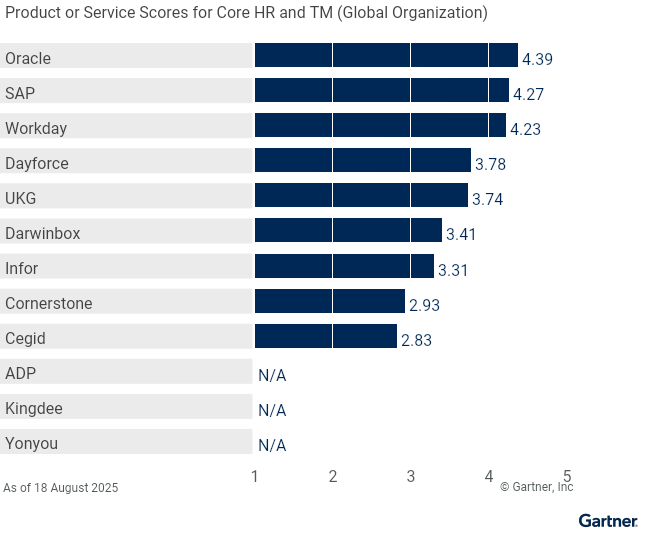
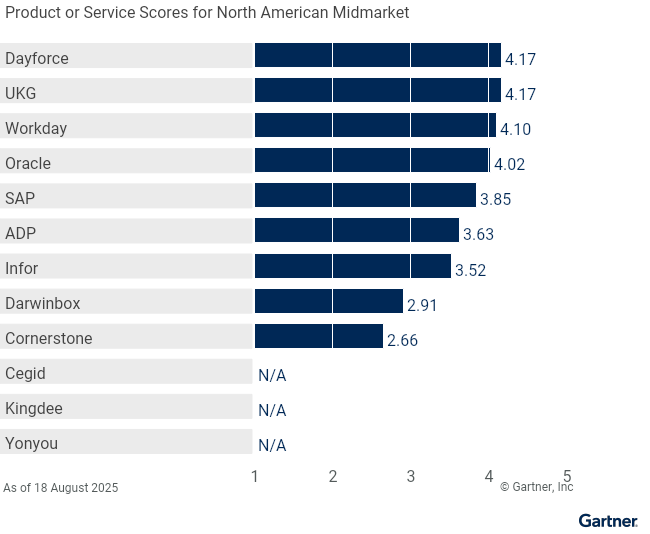
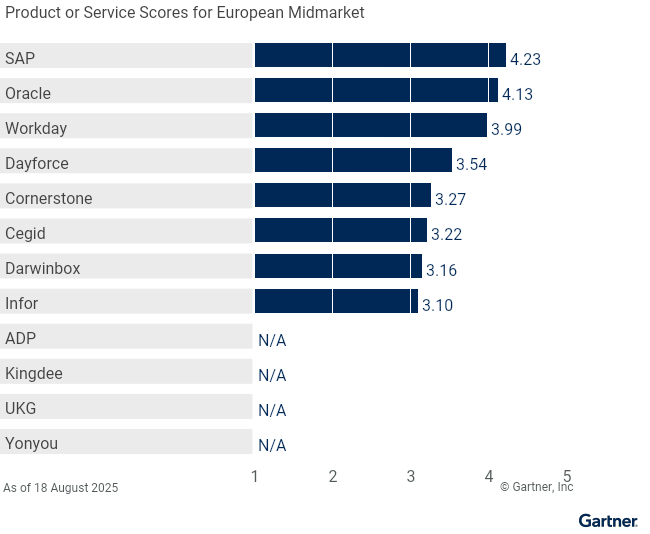
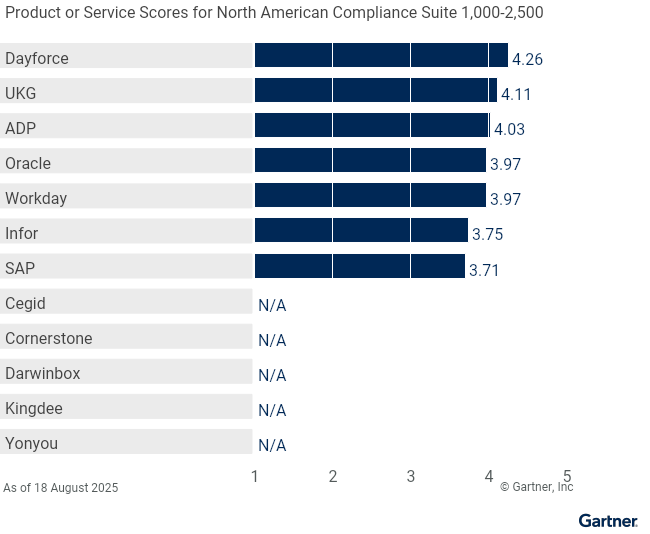
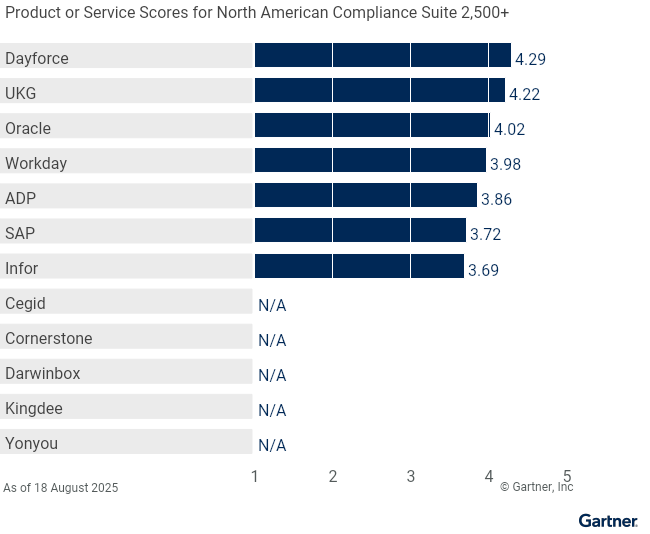
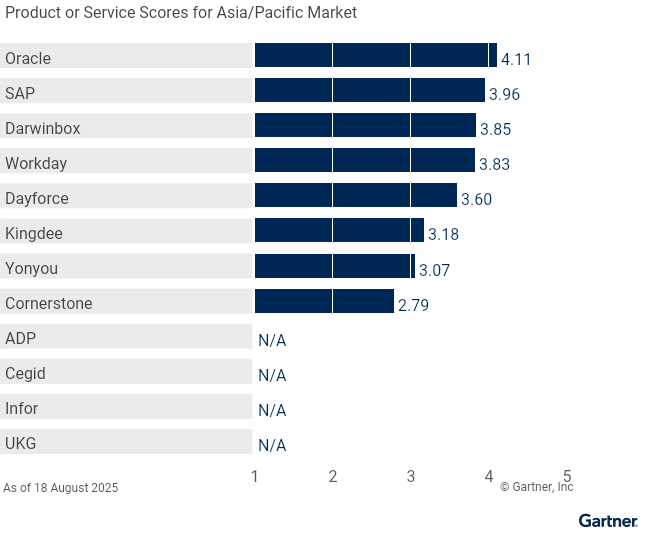
Vendors
ADP
ADP Workforce Now offers strong capabilities in payroll, compensation, reporting and analytics, and workforce management (WFM). However, some TM features remain less robust, with a notable gap in career planning.
ADP Workforce Now scores above average in analytics/applied AI/technology. ADP Assist, the GenAI-based virtual assistant, has been enhanced across service delivery, analytics and payroll. ADP Assist delivers timely payroll insights and flags exceptions (e.g., missed punches, pending timecard approvals, payroll anomalies) with corrective guidance. Analytics enhanced by ADP Assist can create a dashboard via Q&A prompts with access to underlying employee data. These GenAI features are included at no additional cost.
ADP Workforce Now received its highest use-case scores for North American (NA) compliance suite 1,000-2,500 employees, followed by North American compliance suite 2,500+. These scores reflect ADP’s comprehensive administrative software, dedicated payroll and tax-compliance capabilities, and deep North American regulatory expertise. Additionally, ADP delivers implementation support with its own resources, potentially lowering the customer’s TCO. ADP’s midmarket focus, backed by tailored pricing, service levels and implementation methods, resonates with smaller North America-based organizations with a high volume of hourly paid workforce.
Since the product is not directly sold outside of North America, Gartner did not evaluate ADP Workforce Now for any non-North American use cases.
Cegid
Cegid scores comparatively well in services, alliance and partners, and learning capabilities. Its scores in other capabilities, including analytics/applied AI/technology, trail the cross-vendor average.
While the introduction of a virtual assistant and growing TM capabilities are positive developments, Cegid’s AI roadmap lags market leaders. Cegid has not yet fully extended its AI capabilities across its entire suite, including core areas such as payroll. Additionally, there is limited evidence of AI explainability and auditability. HR users seeking to use AI agents for guidance in task execution and decision making may find these capabilities less advanced compared to other solutions.
Cegid earned its highest rating for the European midmarket use case. The company is particularly well-suited for large enterprises headquartered in Europe, particularly in the French market, seeking an HCM suite with localized payroll support and access to European support teams.
Cegid received a lower score for the core HR and TM (global organization) use case. This is primarily due to limited depth in key functional areas such as talent acquisition, onboarding and employee experience, as well as limited experience outside the French market. Nonetheless, the suite is still a viable option for that use case due to its strong base in Western Europe and an established presence in Latin America. Notably, 30% of Cegid HCM implementations are delivered through third-party partners.
Cornerstone
The capabilities of Cornerstone Galaxy (the previous Cornerstone onDemand product) stand out in posthire TM, with an above-average score driven by its robust learning management platform. Its scores in other capabilities, including analytics/applied AI/technology, trail the cross-vendor average.
Cornerstone has focused its AI development on its core strength: posthire TM. Nonetheless, the vendor is increasing its depth of capabilities in other areas, such as skills management through the acquisition of SkyHive. Its skills graph — an AI-enabled skills management engine — delivers skills inference and mapping, and skills gaps identification. Cornerstone is refining its AI pricing models, with a premium version of Cornerstone SkyHive incurring additional costs.
Cornerstone Galaxy received its highest score for the European midmarket use case. Cornerstone received a lower score for the core HR and TM (global organization) use case, where its limited core HR functionality is partially offset by robust TM capabilities. The Galaxy suite is ideal for organizations that demand market-leading TM functions and are satisfied with partner-delivered WFM and payroll. With Federal Risk and Authorization Management Program (FedRAMP) certification, it’s also a viable choice for U.S. federal government agencies. Additionally, although Cornerstone scores low for the Asia/Pacific use case, the vendor has established market adoption in Australia and New Zealand.
Gartner estimates that Cornerstone implements the solution through system integration partners in the majority of cases.
Darwinbox
Darwinbox scores above average in talent acquisition, employee experience/integrated HR service management (IHRSM) and overall VCR satisfaction. Darwinbox lags the cross-vendor average in learning and benefits administration, despite improvements over the previous year. Darwinbox outperforms the vendor average in analytics/applied AI/technology.
Darwinbox spans nearly every HR function with AI-driven features such as process and profile summarization, workflow generation, payroll anomaly detection, and workforce scheduling. In response to the rise of agentic AI, Darwinbox was the first HCM platform to develop its own Model Context Protocol (MCP) server to facilitate interaction between its platform and any MCP-compatible AI agent deployed by its customers. Darwinbox employs a tiered approach to pricing for its AI-enabled features. Some GenAI features use a freemium, credit-based model, with subscriptions offering limited free credits while charging for additional use.
Darwinbox received its highest score for the Asia/Pacific market use case, making it suitable for organizations headquartered in the Asia/Pacific region seeking wider deployment of a single system of record for core HR and TM functions, with optimal TCO. Its score for the core HR and TM (global organization) use case has improved this year due to its increasing traction in North America. The vendor falls in the middle of the cohort in the three North American use cases, due to the lack of native U.S. payroll and subsequent reliance on its U.S. payroll partners. Darwinbox implements its solution through its own internal resources in 47% of the cases.
Dayforce
Dayforce scores above average for most of its capabilities, with its highest ratings for payroll administration and workforce management. It lags the average in learning, employee experience/IHRSM and succession planning.
Dayforce’s score in analytics/applied AI/technology is above the cross-vendor average. Dayforce offers its LLM-powered AI assistant and AI agents to automate repetitive tasks, assist users in accessing knowledge and advise leaders with insights. Key features include AI-powered sourcing, automated job description generation and answering questions about employee pay. Dayforce is developing agent-to-agent integration to connect it with third-party agents. Dayforce has a pricing model for its AI features, with most AI capabilities built into the product at no additional charge. The Dayforce AI Assistant is priced as a per-employee per-month (PEPM) SKU.
Dayforce demonstrates its strongest fit for the North American midmarket and two North American compliance use cases. Contributing to this strong fit are Dayforce’s managed services, competitive TCO, and strong integration of WFM and payroll within a single system. Dayforce’s robust WFM capability makes it suitable for organizations that have a high volume of hourly paid workers. Dayforce Wallet’s flexible earned wage access feature, including the Wallet Card program, also aligns closely with customer priorities in these segments. Beyond North America, Dayforce is a viable HCM solution in the U.K., Australia and New Zealand. The vendor implements the solution through its own internal resources in 62% of deployments.
Infor
Infor scores above average in WFM and core HR/benefits administration. It scores near the mean in prehire TM, but lags the average in posthire TM functions. Infor’s score in analytics/applied AI/technology trails the cross-vendor average.
Although the vendor needs to advance its AI capabilities by adding more use cases in TM, it provides robust AI capabilities for its core strength — WFM solutions. This strongly resonates with its target customers: frontline workers. Notable features include an AI assistant that automates shift scheduling and forecasting, factoring in overtime and split shifts. Infor’s GenAI capabilities are embedded as standard functionality within its HCM suite, offered through a token-based subscription model.
Infor received its highest scores in the two North American compliance use cases, followed by the North American midmarket and core HR and TM (global organization) use cases. Infor is deployed more frequently in organizations with a sizable hourly workforce, particularly in healthcare and manufacturing, due to its administrative HR and WFM capabilities. Its competitive pricing and industry specialization make it suitable for midmarket organizations looking for an all-around ERP suite with industry-specific compliance and basic TM functionality. Additionally, Infor has FedRAMP certification, which makes it suitable for U.S. federal government organizations. The vendor implements its Infor HCM solution using its own internal resources in 60% of projects.
Kingdee
Kingdee International Software Group scores above average in WFM and close to the average in payroll. Its scores in other capabilities lag the cross-vendor average.
Kingdee’s below-average score for analytics/applied AI/technology reflects its focus on compliance-driven organizations in Greater China (which includes the Chinese mainland, Hong Kong and Taiwan), where companies prioritize regulatory support over advanced AI. However, Kingdee is expanding its AI use cases in recruiting, learning, service delivery and payroll. For example, its enhanced Employee Self-Service Agent now supports voice- and text-based HR queries. Kingdee launched its first AI agent, Intelligent Recruitment, which is purpose-built for recruitment workflows. Kingdee’s AI capabilities follow a value-based pricing model — for example, the recruitment agent is billed per position filled.
Kingdee scores highly for the Asia/Pacific use case. It is well-suited to China-headquartered multinationals with large, in-house payroll operations and to local Chinese enterprises pursuing digital transformation and rigorous compliance. Kingdee does not have a substantial presence outside of Greater China and was not evaluated in the remaining use cases. The vendor implements the solution through its system integration partners in 43% of the cases.
Oracle
Oracle scores above average in all capabilities assessed in this research, with its highest scores in core HR/benefits administration, prehire TM and posthire TM.
Oracle also ranks highly for analytics/applied AI/technology, and continues to embed a broad range of AI capabilities across its suite, from recruiting and TM to payroll and workforce planning. Integrated GenAI and agentic AI features include Learning and Training Advisor, Compensation Guidelines Analyst and Job Seeker Analyst. Oracle AI Agent Studio allows users and partners to build and customize agents. Oracle follows a cost-inclusive pricing model, meaning its AI features, including AI agents, are available at no additional cost.
Oracle receives high scores in the majority of use cases. It remains a market leader in addressing the core HR and TM (global organization) use case due to its breadth of functional capabilities and strong global presence. Oracle also ranks at the top for Asia/Pacific customers given its support in local language, customer service and implementation. Oracle is FedRAMP-certified, making it suitable for U.S. federal government organizations. However, small and midmarket organizations prioritizing TCO and North American WFM and administrative compliance may rank Oracle lower on their shortlists. The vendor implements the solution through its system integration partners in 80% of the cases.
SAP
SAP SuccessFactors HCM scores above average in all capabilities assessed in this research, including analytics/applied AI/technology. Its highest scores are in core HR/benefits and payroll administration.
SAP delivers comprehensive AI solutions powered by Joule agents that support key HCM tasks and collaborate via agent-to-agent protocol. Joule has evolved as an AI orchestrator, assembling and coordinating teams of agents to perform complex processes. SAP follows a two-tier commercial AI framework in which base AI features are included at no extra cost, while premium AI capabilities incur an additional fee.
SAP SuccessFactors HCM is particularly well-suited for large and complex organizations seeking an HCM suite to support HR administration and payroll on a global scale. The vendor ranks second in the core HR and TM (global organization) use case, where it has the widest-ranging global HR and payroll localizations. SAP is also a strong fit in the European midmarket use case, as demonstrated by its adoption among European product-centric companies and public-sector organizations. It scores lower for the two North America-based compliance use cases for organizations needing a more integrated HCM suite with natively built WFM. SAP implements the solution through its system integration partners in 90% of the cases.
UKG
UKG scores above average in most capabilities, with high ratings in WFM and employee experience/IHRSM. However, posthire TM is an area where the vendor lags the cross-vendor average.
While UKG scores at the midpoint for analytics/applied AI/technology, this remains an area of active investment for the vendor. UKG Bryte, an AI-enabled virtual assistant, delivers a robust set of use cases with particular strengths in WFM and frontline-worker support. For example, it can identify timekeeping exceptions, such as missed punches and unscheduled absences, and guide managers through corrective actions. UKG is enabling MCP and agent-to-agent protocol for interaction with external AI agent ecosystems. The vendor offers GenAI capabilities as an added per-employee per-month (PEPM) cost to existing employee-based subscription pricing.
UKG ties for the highest score for the North American midmarket use case and ranks second in the two North American compliance use cases. Driving these ratings is UKG’s strong capability to meet core HR/benefits administration, payroll and WFM requirements, as well as compliance needs in the region. UKG offers broad functional capabilities, professional services and ongoing managed services that support midsize to large global organizations with significant workforces based in the U.S. and Canada. The vendor implements the solution through its own internal resources in 75% of the cases.
UKG Pro HR and payroll are not sold directly outside of the U.S. and Canada, and were not evaluated for other use cases.
Workday
Workday scores above average in all capabilities assessed in this research. Its highest ratings are for EX/IHRSM and product satisfaction.
Workday ranks very highly for analytics/applied AI/technology. Since launching its AI brand, Workday Illuminate, the vendor has introduced AI in TM, recruiting, payroll, core HR, wellness, analytics and scheduling. Role-based agents, such as Recruiting Agent, boost hiring speed by matching external talent to business needs. When paired with Workday Skills Cloud, Talent Mobility Agent provides employees with personalized recommendations for learning, gigs, projects, internal roles, skills development and mentorship. Some of Workday’s AI capabilities, especially for GenAI, are available at no additional cost, while the vendor offers some agents as separate SKUs that carry additional fees.
Workday receives its highest use-case score for core HR and TM (global organization), followed by the North American and European midmarket use cases. Workday is best-suited for midsize and large global organizations that prioritize employee experience, talent analytics and prehire/posthire TM capabilities, but are willing to source payroll through third-party providers that connect through Workday Global Payroll Connect. It scores lower for the two hourly-based North American compliance use cases due to these use cases’ sophisticated WFM requirements and low TCO expectations. Workday holds FedRAMP certification, making its solutions suitable for U.S. federal government organizations. It has recently launched Workday Government, a subsidiary dedicated to serving U.S. federal agencies. The vendor implements the solution through its system integration partners in 80% of the cases.
Yonyou
Yonyou scores above average in WFM and close to the average in payroll. Its scores in other capabilities lag the average due to the vendor’s region-specific focus.
Yonyou trails the cross-vendor average for the analytics/applied AI/technology category, reflecting limited customer adoption of AI capabilities and an emerging strategic roadmap. Nonetheless, it has launched its AI program, Digital HR, which includes various AI use cases such as employee service, HR administration, compensation and time. Yonyou introduced Yonmate, an AI assistant powered by Chinese models like DeepSeek and designed to support autonomous decision making and task execution. By enabling peer-like conversations with HR leaders, Yonmate aims to streamline HR workflows across core processes. Yonyou’s GenAI licensing uses a token-based subscription model.
Yonyou scores highly for the Asia/Pacific use case. The vendor is well-suited for organizations headquartered in China or Southeast Asia that have a large workforce and need to process payroll in-house. Its capacity to support specific labor law requirements, such as cadre management or curating electronic work contracts, makes it a suitable option for organizations in Greater China (which includes the Chinese mainland, Hong Kong and Taiwan). Yonyou’s market presence is primarily concentrated in the Asia/Pacific region. The vendor implements the solution through its system integration partners in 30% of the cases.
Context
This Critical Capabilities report focuses specifically on cloud HCM products and has two dimensions:
- Critical capabilities — We have identified 15 critical capabilities comprising core and extended functionality, geographic coverage, and overall satisfaction with the product and services.
- Use cases — We assess the suitability of each vendor’s solution for the six most common use cases for cloud HCM suites. The importance of specific functional strengths varies across each use case. For example, extensive global coverage is weighted heavily for the core HR and TM (global organization) use case, but is less relevant for the North American midmarket use case. The different weightings will influence the total scores and relative positioning of the vendors across the six use cases.
See Note 1 for a tabular summary of the use cases and the specific capabilities that align with them.
The overall vendor scores in this research vary from previous versions due to changes driven by shifting buyer requirements and changes in the scored capabilities. For 2025, we increased the weighting of applied AI from the analytics/applied AI/technology critical capability because AI capabilities have become more important selection factors in all the use-case scenarios. These changes were driven by Gartner interactions with end users and the capabilities most often prioritized by organizations at the various levels of complexity.
While previous years’ differentiators — GenAI that enhances user efficiency by responding to prompts and inputs and creating content — are maturing, high-impact GenAI and agentic AI use cases are emerging. A summary of broad AI capabilities as observed in cloud HCM suites in 2025 includes:
GenAI:
- Creation of job requisition and description and support for recruitment campaigns by generating personalized emails and interview questions
- Consolidation of knowledge base articles and drafting of specific guidance tailored to the audience
- Generation of performance review summaries for individuals and teams, and career growth plans based on employee goals, skills and performance feedback
Agentic AI:
- HR process execution with minimal human intervention
- Intelligent scheduling and shift optimization by autofilling open shifts
- HR and recruitment AI agent support for policy inquiries and task completion by understanding user intent and adapting to make informed decisions
- Agent builder tool that enables customers and partners to create, deploy and manage their own custom AI agents
Market Definition
Gartner defines cloud HCM suites for 1,000+ employee enterprises as cloud application suites that deliver functionality for attracting, developing, engaging, retaining and managing employees.
Cloud HCM suites for 1,000+ employee enterprises are designed to support transactions and/or analytical processing for more than one of the following use cases within a single integrated solution:
- Manage organization and employee historical data, life cycle processes and transactional employee/manager self-service.
- Attract and retain talent through talent sourcing, applicant tracking, internal mobility and onboarding.
- Manage organizational structure through creating, planning and limiting employee positions. Maintain a record of workforce data through assigned positions.
- Develop the workforce through learning, performance and career pathing.
- Manage the operational deployment of salaried and hourly workers to capture time worked and absences.
- Deliver tools to assist employers in managing country-specific compliance with legislation and agreements pertaining to data residency and labor laws.
- Integrate with notable enterprise applications (e.g., finance, procurement).
At a minimum, a cloud HCM suite for enterprises with more than 1,000 employees must deliver:
- Core HR administrative transaction support, reporting and analytics capabilities
- At least three talent management functions or a combination of workforce management and one talent management function
Mandatory Features
Must-have capabilities of cloud HCM suites for enterprises with more than 1,000 employees include:
- Administrative HR — Employee data, organization structure, employment life cycle transaction, role-based self-service, payroll and benefits administration. It may also include absence management, health and safety administration, and other value-added capabilities.
- Talent management — Recruiting, onboarding, performance management, compensation planning, career and succession planning, learning and skills development.
- Integrated HR service management (IHRSM) — Personalized direct access to policy, procedure and program guidance for employees and managers. It may also include integrated case management, knowledge bases, digital document management, virtual assistants and workflow management.
Common Features
Optional functional capabilities for this market include:
- Workforce management (WFM) — Time and attendance administration and workforce scheduling. It may also include task and activity tracking, budgeting and forecasting, fatigue management and capabilities supporting the experience of frontline workers.
- Employee experience (EX) — Includes functions designed to support the experience of employees, including voice of the employee (VoE), employee well-being, coaching and mentoring, employee campaigns and recognition and rewards.
- Cross-functional enabling capabilities — These capabilities (which are often emerging) use data from and interact with the above capabilities, and they are increasingly embedded in HCM suites. They include talent analytics, HR virtual assistants (HRVAs) and internal talent marketplace capabilities.
- Applied artificial intelligence (AI) — includes nongenerative machine learning (ML), natural language processing (NLP), generative AI, graphs and other AI technologies to improve HR processes and employee experience.
Product/Service Trends
The market for cloud HCM suites grew by 16.4% in 2024, with total revenue for cloud HCM suites reaching $27.5 billion. The HCM software market remained the top segment in the ERP market, at 55.3% revenue share. Overall, the market is maturing and is expected to consolidate under a stable number of viable providers. However, innovation in product development continues to distinguish HCM suite offerings.
GenAI (and wider AI) capabilities for HR use cases are evolving rapidly. Most HCM suite vendors are releasing significant new features every year, and new tools (or AI features added to existing tools) just as regularly. While these developments present opportunities, such as enhanced employee experience and productivity, they also present challenges to HR technology leaders. Concerns over privacy and security issues, accuracy of the models, and long-term usage costs often overshadow the hype.
HR technology leaders should examine subscription agreements carefully and validate certifications from AI governance alliances such as the National Institute of Standards and Technology (NIST), Organisation for Economic Co-operation and Development (OECD), AI Alliance, and United Nations Educational, Scientific and Cultural Organization (UNESCO).
Since the last iteration of this research, vendors in this market have responded to evolving customer demands in the following areas:
- Prioritizing solutions with balanced agentic AI and human oversight to ensure clear boundaries between AI autonomy and human intervention
- Adopting AI practices that take ethical and compliance guidelines into account
- Providing actionable insights for managers on high-level trends such as reasons for high employee turnover, unrestricted overtime or declining employee satisfaction metrics.
- Implementing advanced skills tagging and notifying employees about equitable opportunities
Overall, the landscape shows a strong push toward natively embedded AI and emerging agentic AI across all HR functions, with significant investment in making these technologies context-aware and ensuring that human oversight remains central to critical decisions.
Critical Capabilities Definition
Core HR/Benefits Administration
Core HR includes company/worker data management and transactional worker/manager self-service. Benefits administration includes worker eligibility, worker enrollment, work/life event change processing and carrier billing support.
Prehire Talent Management
Prehire TM involves recruiting and onboarding workers. It also covers integration capabilities for passing data to downstream systems and/or connecting with additional recruiting technology partners (e.g., assessment and background screen vendors).
Recruiting includes sourcing, marketing, candidate relationship management, requisition management, career site/candidate application, candidate management, offer management and recruiting process management.
Onboarding encompasses new hire workflows, including online form/task completion, e-signature, hosted content/videos, Day 1 orientation support and assimilation.
Posthire Talent Management
Posthire TM includes skills/competency tracking, performance management, goal setting, career development, succession planning, internal talent marketplaces, talent reviews, learning management and compensation planning.
Payroll Administration
Payroll administration includes earning and deduction setup, tax setup, import of time and exception hours, entry of special pay items, gross-to-net calculations, retroactive pay adjustments, trial payroll reviews/corrections, and payroll confirmation.
It may also include pay-related incident management, check/paycheck printing, tax filing and bank transfers.
Workforce Management
Workforce management includes absence management, time capture, time and attendance evaluation against work rules, task/activity tracking, labor budgeting/forecasting, scheduling, frontline workforce experience, and AI-enabled skills planning for hourly workforce and labor analytics.
Work rules can relate to the business, regulations or the bargaining unit for the hourly workforce. Scheduling can range from basic support to advanced scheduling optimization.
Employee Experience/IHRSM
Employee experience includes capturing the voice of the employee (VoE), delivering corporate communications, and personalizing the user experience (UX) via employee life cycle journeys, workflow management and other techniques. IHRSM provides policy and procedure guidance to employees and managers.
IHRSM also comprises knowledge bases, HR contact centers, HR case management, HR document management and transition management.
Analytics/Applied AI/Technology
This capability encompasses tools to generate and format standard list-based reports, ad hoc queries and graphical metrics dashboards. It also covers talent and workforce analytics that include more sophisticated analysis and visualization of data.
Solutions are also evaluated against the following criteria:
- The ability of the AI models in the solution to adapt to continuous changes by using techniques such as reinforcement learning
- The solution’s ability to provide an advanced technology stack with attributes such as in-memory computing, low-code application builders, UX design, and integration studios for connecting external applications or different components of the suite
Overall Product Satisfaction
The product satisfaction rating is determined by combining aggregated analyst ratings across 10 product criteria, Gartner client inquiry feedback and Gartner Peer Insights data.
The 10 product criteria are:
- Overall product quality — Indicates the extent to which the product functions as designed (for example, running without bugs).
- System performance — Measures how quickly the application responds to end-user input and returns results.
- Ease of use for professional/administrative users — Indicates the level of satisfaction with the application’s UX. In the context of HCM suites, representative roles include HR generalist/business partner, payroll administrator, benefits specialist, scheduling coordinator, time and attendance analyst, recruiter, compensation analyst, learning and development manager, and performance management specialist.
- Ease of use for employees and managers — Rates the user-friendliness of the application. Seamless, direct access for employees and managers is expected by most organizations, and ease of use directly impacts enterprise adoption of HCM solutions.
- System administration, configuration and workflow — Assesses satisfaction with:
- The robustness of delivered configuration tools
- The ability to enable regular usage by line-of-business users with strong domain expertise, but limited technical training
- The ability to route business process tasks and transactions for review and approval, with features such as conditional branching, escalation rules, alerts and notifications
- Mobile support — Indicates the overall rating of the vendor’s mobile framework and support for specific mobile-enabled processes across the HCM suite.
- Integration within HCM suite — Rates the extent to which the various functional modules appear to the customer as seamless parts of the suite from UX, process, data and reporting perspectives.
- Integration with other applications — Measures the robustness and ease of use of delivered integration tools.
- Ability to customize or extend HCM suite — Measures how well the suite can be tailored to fit users’ needs, either by customizing source code or by using platform as a service (PaaS) or other vendor tools to extend delivered capabilities.
- Documentation — Measures the quality, quantity and format of the documentation delivered with the solution, as well as any product update release notes.
Overall VCR Satisfaction
The VCR satisfaction rating is determined by combining aggregated analyst ratings across nine service criteria, Gartner client inquiry feedback and Gartner Peer Insights data.
The nine service criteria are:
- Experience through the sales process — Includes all interactions with vendor staff, from initial contact to contract signing.
- Initial implementation and deployment — Includes customer satisfaction with initial training, fit/gap analysis, design, configuration, testing, data conversion and cutover to live production.
- Handover from implementation to support — Evaluates the transition from the sales and implementation teams to ongoing support teams.
- Ongoing communication and support — Addresses how well the vendor delivers information and support to customers over the entire application life cycle.
- Additional deployments and upgrades — Assesses current customers’ experiences with expanding application usage to additional employee populations, as well as configuring and applying updates and upgrades.
- After-sales care — Evaluates current customers’ perspectives on the vendor’s process of determining the need for additional modules and selling them to the customer base.
- Account management — Measures the quality of the resources assigned to this critical function, which serves as a key escalation point, needs assessor, communicator and relationship manager.
- Available training — Measures the quantity, quality and availability of vendor-delivered learning events.
- Enhancement request processes — Includes the various ways that customers can interact with vendor product management and other customers to request enhancements to current product functionality or service and support processes. It also includes customers’ views about the extent to which their enhancement requests have actually been incorporated into the product over time.
Complexity, TCO (Global Org)
This capability assigns equally high weightings to global coverage and support for complexity. TCO/value is weighted lower in this capability than in others.
Complexity, TCO (NA Midmarket)
This capability assigns the highest weighting to TCO/value. Compliance with North American regulations and support for complexity receive medium weightings.
Complexity, TCO (Euro Midmarket)
This capability assigns the highest weighting to TCO/value. Compliance with European regulations and support for complexity receive medium weightings.
Complexity, TCO (NA Hourly 1K-2.5K)
This capability assigns the highest weighting to TCO/value. Compliance with North American hourly workforce regulations and support for complexity receive medium weightings.
Complexity, TCO (NA Hourly 2.5K+)
This capability assigns equal weightings to TCO/value, compliance with North American hourly workforce regulations and support for complexity.
Complexity, TCO (Asia/Pacific)
This capability assigns the highest weighting to TCO/value. Compliance with Asia/Pacific regulations and support for complexity receive medium weightings.
Use Cases
Core HR and TM (Global Organization)
Best fit for organizations with more than 5,000 workers operating in multiple countries that need an integrated solution for core HR and TM.
Organizations with this use case are looking for a single global system of record for core HR and talent data across multiple countries (at least five, but often 50 or more). The following features are paramount to this use case:
- Support for core HR processes (organization, job and worker data management; life cycle transactions; and reporting relationships)
- HR localization coverage
- Robust prehire and posthire TM to enable global talent processes
Payroll administration and WFM functionality are less important to this use case, as these are often provided by country-specific or regional solutions. Organizations can often rationalize higher subscription fees and substantial implementation costs if the solution meets their HR requirements for multiple countries, global operations and complex process configurations.
North American Midmarket
Best fit for organizations based in North America (NA) with 1,000 to 5,000 workers seeking solutions for a broad set of admin HR, service management, TM and WFM functions.
Organizations attracted to this use case seek to consolidate as many functions as possible within a single solution, from a single vendor, to take maximum advantage of a single UX, reporting platform and data model. Adopters seek tightly integrated core HR, payroll and benefits administration, along with TM modules of moderate complexity. WFM is also desired if time and attendance requirements are not overly complex, and HR service management is increasingly sought by organizations with more than 2,500 employees. Because of their more limited size and narrower geographic focus, these organizations are seeking:
- Depth of localization support for North America
- Rapid, cost-effective implementation
- Lower TCO
European Midmarket
Best fit for organizations headquartered in Europe with 1,000 to 5,000 workers in multiple countries that want one solution for core HR and TM.
Primary adopters of this use case are moderately sized organizations with a relatively even workforce distribution across multiple countries in Europe, the Middle East, North Africa and the Americas. The functional focus on strong core HR support (including localizations) and TM is similar to that of the core HR and TM (global organization) use case. However, the focus on quick time to value and lower TCO that is characteristic of midmarket organizations is shared with adopters of the North American midmarket use case.
North American Compliance Suite 1,000-2,500
Best for organizations based in NA with 1,000 to 2,500 (mainly hourly paid) workers seeking solutions covering core HR, payroll, benefits administration and WFM.
Organizations interested in this use case have a high proportion of hourly paid workers. As a result, they value broad and deep WFM functionality tightly linked to administrative HR (core HR, payroll and benefits administration). Additionally, as smaller organizations, they often seek to get as much out of a suite as possible, so they prioritize TM capabilities a bit more. A successful provider for this use case can handle complex work rules and deliver a well-rounded suite that offers high value and requires little customization.
North American Compliance Suite 2,500+
Best for organizations based in NA with more than 2,500 (mainly hourly paid) workers seeking solutions covering core HR, payroll, benefits administration and WFM.
Organizations interested in this use case have a high proportion of hourly paid workers. As a result, they consider broad and deep WFM functionality tightly linked to administrative HR (core HR, payroll and benefits administration) far more important than robust TM capabilities. Larger organizations pursuing this use case may often look for point solutions and specialist providers to supplement certain TM modules. A successful provider for this use case can satisfy adopters’ needs to balance cost of ownership, comply with U.S. and Canadian requirements, and handle complex work rules.
Asia/Pacific Market
Best for Asia/Pacific organizations with 1,000+ employees in multiple countries aiming to consolidate core HR and TM in a single suite with strong UX/technology capabilities.
Organizations interested in this use case have a presence in multiple countries in the Asia/Pacific region, but a large number of workers are concentrated in their country of origin. Vendors that serve this use case often have an existing installed base of legacy HR applications.
The main drivers for the implementation of an HCM suite are to remain competitive in a dynamic talent market, attract the best talent in the Asia/Pacific region and curb the high attrition rates that are typical there. Compliance with regulations through a robust core HR capability is another driver. Technology/UX plays an important role because the workforce in this region has adopted mobile phones and consumer applications extensively. A lower TCO, including implementation cost, is desirable.
Payroll is generally sourced through an external provider, except in countries with a relatively mature HCM market (for example, Australia). Only a few cloud HCM suite providers include payroll localizations for the Asia/Pacific region in their integrated cloud suites. WFM typically presents an opportunity to optimize costs due to its relatively low adoption in this region. However, adoption of WFM as part of an HCM suite remains quite low for this use case, as WFM is mostly sourced from third-party partners.
Vendors Added and Dropped
Kingdee International Software Group was added because it met the qualifications listed in the inclusion criteria section of this research.
Inclusion Criteria
To be included in this Critical Capabilities research, each vendor had to:
- Deliver core HR administrative transaction support and reporting/analytics capabilities, plus at least three of the following talent management functions — recruiting/onboarding, performance management, career/succession management, learning, compensation and workforce planning — or a combination of WFM and at least one TM function.
- Deploy its solution(s) on a cloud architecture.
- Have at least 150 customers, each with more than 1,000 employees, that use its core HR capabilities and at least two TM functions in a production environment in either a community cloud or public cloud.
- Actively market, sell and implement an HCM suite on a stand-alone basis, regardless of any additional bundling with ERP suites or other applications.
- Provide evidence of market momentum by documenting at least 50 net-new deals during the previous four fiscal quarters (31 March 2024 through 31 March 2025) — each with more than 1,000 employees — for its core HR capabilities and either two or more TM functions or one TM function and WFM.
- Rank among the top 20 for the Customer Interest Indicator (CII) as defined by Gartner. CII was calculated using a weighted mix of internal and external inputs that reflect Gartner client interest, vendor customer engagement and vendor customer sentiment from 1 February 2024 through 28 February 2025.
Some vendors did not satisfy all of these criteria and were therefore excluded from this research. However, their offerings do meet many customer requirements and could also be included in an evaluation of HCM suites. See Market Guide for Cloud HCM Suites for Regional and/or Sub-1,000 Employee Enterprises for more information..
Weighting for Critical Capabilities in Use Cases
| Critical Capabilities | Core HR and TM (Global Organization) | North American Midmarket | European Midmarket | North American Compliance Suite 1,000-2,500 | North American Compliance Suite 2,500+ | Asia/Pacific Market |
|---|---|---|---|---|---|---|
Core HR/Benefits Administration | 10% | 10% | 10% | 10% | 10% | 10% |
Prehire Talent Management | 10% | 6% | 12% | 4% | 0% | 10% |
Posthire Talent Management | 10% | 4% | 12% | 2% | 0% | 10% |
Payroll Administration | 2% | 10% | 0% | 12% | 12% | 2% |
Workforce Management | 2% | 5% | 0% | 10% | 12% | 2% |
Employee Experience/IHRSM | 8% | 8% | 8% | 6% | 8% | 8% |
Analytics/Applied AI/Technology | 8% | 7% | 8% | 6% | 8% | 8% |
Overall Product Satisfaction | 10% | 10% | 10% | 10% | 10% | 10% |
Overall VCR Satisfaction | 5% | 5% | 5% | 5% | 5% | 5% |
Complexity, TCO (Global Org) | 35% | 0% | 0% | 0% | 0% | 0% |
Complexity, TCO (NA Midmarket) | 0% | 35% | 0% | 0% | 0% | 0% |
Complexity, TCO (Euro Midmarket) | 0% | 0% | 35% | 0% | 0% | 0% |
Complexity, TCO (NA Hourly 1K-2.5K) | 0% | 0% | 0% | 35% | 0% | 0% |
Complexity, TCO (NA Hourly 2.5K+) | 0% | 0% | 0% | 0% | 35% | 0% |
Complexity, TCO (Asia/Pacific) | 0% | 0% | 0% | 0% | 0% | 35% |
As of 18 August 2025 | ||||||
Source: Gartner (September 2025)
This methodology requires analysts to identify the critical capabilities for a class of products/services. Each capability is then weighted in terms of its relative importance for specific product/service use cases.
Gartner has evaluated each of the products/services that meet our critical capabilities inclusion criteria on a scale ranging from 1.0 to 5.0.
Critical Capabilities Rating
Product/Service Rating on Critical Capabilities
| Critical Capabilities | ADP | Cegid | Cornerstone | Darwinbox | Dayforce | Infor | Kingdee | Oracle | SAP | UKG | Workday | Yonyou |
|---|---|---|---|---|---|---|---|---|---|---|---|---|
Core HR/Benefits Administration | 3.6 | 2.8 | 2.6 | 3.7 | 4.3 | 3.7 | 3.1 | 4.5 | 4.3 | 4.2 | 4.3 | 2.4 |
Prehire Talent Management | 3.6 | 3.1 | 3.7 | 4.4 | 4.1 | 3.7 | 3.1 | 4.5 | 4.2 | 4.0 | 4.2 | 3.1 |
Posthire Talent Management | 2.6 | 3.2 | 4.0 | 3.8 | 3.5 | 3.2 | 2.5 | 4.4 | 4.2 | 3.6 | 4.1 | 2.5 |
Payroll Administration | 4.5 | 3.3 | 1.0 | 3.3 | 4.5 | 3.5 | 3.3 | 3.8 | 4.2 | 4.0 | 3.9 | 3.4 |
Workforce Management | 4.2 | 2.0 | 1.3 | 3.5 | 4.5 | 4.2 | 3.6 | 4.1 | 3.8 | 4.6 | 4.2 | 3.8 |
Employee Experience/IHRSM | 3.1 | 2.6 | 2.3 | 3.8 | 3.1 | 3.3 | 2.4 | 4.4 | 4.0 | 4.2 | 4.4 | 2.2 |
Analytics/Applied AI/Technology | 3.2 | 1.9 | 2.9 | 3.5 | 3.3 | 2.8 | 2.4 | 4.0 | 3.6 | 3.1 | 3.9 | 2.3 |
Overall Product Satisfaction | 4.0 | 3.3 | 3.5 | 3.8 | 4.4 | 3.8 | 3.3 | 4.6 | 4.4 | 4.3 | 4.6 | 3.3 |
Overall VCR Satisfaction | 4.0 | 3.2 | 3.6 | 3.9 | 4.3 | 3.2 | 3.2 | 4.6 | 4.3 | 4.1 | 4.5 | 3.0 |
Complexity, TCO (Global Org) | 1.0 | 2.7 | 2.6 | 2.7 | 3.6 | 3.1 | 2.0 | 4.4 | 4.5 | 3.4 | 4.2 | 1.5 |
Complexity, TCO (NA Midmarket) | 3.5 | 1.0 | 2.7 | 1.4 | 4.4 | 3.6 | 1.0 | 3.5 | 3.3 | 4.5 | 3.9 | 1.0 |
Complexity, TCO (Euro Midmarket) | 1.0 | 3.8 | 3.3 | 1.9 | 3.0 | 2.5 | 1.0 | 3.6 | 4.4 | 1.3 | 3.5 | 1.0 |
Complexity, TCO (NA Hourly 1K-2.5K) | 4.4 | 1.0 | 1.3 | 1.0 | 4.5 | 4.1 | 1.0 | 3.4 | 2.9 | 4.1 | 3.5 | 1.0 |
Complexity, TCO (NA Hourly 2.5K+) | 3.9 | 1.0 | 1.3 | 1.0 | 4.6 | 3.9 | 1.0 | 3.6 | 3.0 | 4.5 | 3.5 | 1.0 |
Complexity, TCO (Asia/Pacific) | 1.0 | 1.0 | 2.2 | 3.9 | 3.1 | 1.0 | 3.7 | 3.6 | 3.6 | 1.0 | 3.1 | 3.7 |
As of 18 August 2025 | ||||||||||||
Source: Gartner (September 2025)
Table 3 shows the product/service scores for each use case. The scores, which are generated by multiplying the use-case weightings by the product/service ratings, summarize how well the critical capabilities are met for each use case.
Product Score in Use Cases
| Use Cases | ADP | Cegid | Cornerstone | Darwinbox | Dayforce | Infor | Kingdee | Oracle | SAP | UKG | Workday | Yonyou |
|---|---|---|---|---|---|---|---|---|---|---|---|---|
Core HR and TM (Global Organization) | N/A | 2.83 | 2.93 | 3.41 | 3.78 | 3.31 | N/A | 4.39 | 4.27 | 3.74 | 4.23 | N/A |
North American Midmarket | 3.63 | N/A | 2.66 | 2.91 | 4.17 | 3.52 | N/A | 4.02 | 3.85 | 4.17 | 4.10 | N/A |
European Midmarket | N/A | 3.22 | 3.27 | 3.16 | 3.54 | 3.10 | N/A | 4.13 | 4.23 | N/A | 3.99 | N/A |
North American Compliance Suite 1,000-2,500 | 4.03 | N/A | N/A | N/A | 4.26 | 3.75 | N/A | 3.97 | 3.71 | 4.11 | 3.97 | N/A |
North American Compliance Suite 2,500+ | 3.86 | N/A | N/A | N/A | 4.29 | 3.69 | N/A | 4.02 | 3.72 | 4.22 | 3.98 | N/A |
Asia/Pacific Market | N/A | N/A | 2.79 | 3.85 | 3.60 | N/A | 3.18 | 4.11 | 3.96 | N/A | 3.83 | 3.07 |
As of 18 August 2025 | ||||||||||||
Source: Gartner (September 2025)
To determine an overall score for each product/service in the use cases, multiply the ratings in Table 2 by the weightings shown in Table 1.
Acronym Key and Glossary Terms
| AI | artificial intelligence |
| ERP | enterprise resource planning |
| FedRAMP | Federal Risk and Authorization Management Program |
| GenAI | generative AI |
| HCM | human capital management |
| MCP | Model Context Protocol |
| IHRSM | integrated HR service management |
| NA | North America |
| NIST | National Institute of Standards and Technology |
| OECD | Organisation for Economic Co-operation and Development |
| PaaS | platform as a service |
| PEPM | per employee per month |
| TCO | total cost of ownership |
| TM | talent management |
| UNESCO | United Nations Educational, Scientific and Cultural Organization |
| UX | user experience |
| VCR | vendor-customer relationship |
| VoE | voice of the employee |
| WFM | workforce management |
Gartner used the following sources to gather information about vendors and their cloud HCM offerings:
- Vendor presentations and demonstrations to the Gartner analyst team — Specifically, to support this research, each vendor was allotted time to present information about its company, capabilities and functionality, using a product demonstration script that Gartner provided to all participating vendors. Each vendor was allotted the same amount of time for this research, but Gartner also conducts interactions with vendors throughout the year as part of normal and ongoing relationships with user and vendor clients.
- Research and data collection — Gartner also asked each vendor to respond to and fill out a survey that investigates, in more detail, factual information about its company and HCM offering. Also, as part of this exercise, Gartner reviewed customer references on Gartner Peer Insights submitted in the past 12 months.
Note 1: Critical Capabilities Aligned to Use Cases
Table 4 summarizes the use cases and the specific capabilities that align with them. Each of these capabilities has different ratios of subcomponents — geographic localization, complexity and TCO.
Critical Capabilities Aligned to Use Cases
Use case | Most relevant critical capability | Focal points |
Core HR and TM (global organization) | Complexity, TCO (global organization) | Global coverage and support for complexity |
North American midmarket | Complexity, TCO (North American midmarket) | TCO and North American compliance |
European midmarket | Complexity, TCO (Euro midmarket) | TCO and Europe, the Middle East and Africa compliance |
North American compliance suite 1,000 to 2,500 | Complexity, TCO (North American hourly 1,000 to 2,500) | TCO and North American compliance |
North American compliance Suite 2,500+ | Complexity, TCO (North American hourly 2,500+) | Equal focus on complexity, North American compliance and TCO |
Asia/Pacific Market | Complexity, TCO (Asia/Pacific) | TCO and Asia/Pacific compliance |
Source: Gartner (September 2025)
Critical Capabilities Methodology
This methodology requires analysts to identify the critical capabilities for a class of products or services. Each capability is then weighted in terms of its relative importance for specific product or service use cases. Next, products/services are rated in terms of how well they achieve each of the critical capabilities. A score that summarizes how well they meet the critical capabilities for each use case is then calculated for each product/service.
"Critical capabilities" are attributes that differentiate products/services in a class in terms of their quality and performance. Gartner recommends that users consider the set of critical capabilities as some of the most important criteria for acquisition decisions.
In defining the product/service category for evaluation, the analyst first identifies the leading uses for the products/services in this market. What needs are end-users looking to fulfill, when considering products/services in this market? Use cases should match common client deployment scenarios. These distinct client scenarios define the Use Cases.
The analyst then identifies the critical capabilities. These capabilities are generalized groups of features commonly required by this class of products/services. Each capability is assigned a level of importance in fulfilling that particular need; some sets of features are more important than others, depending on the use case being evaluated.
Each vendor’s product or service is evaluated in terms of how well it delivers each capability, on a five-point scale. These ratings are displayed side-by-side for all vendors, allowing easy comparisons between the different sets of features.
Ratings and summary scores range from 1.0 to 5.0:
1 = Poor or Absent: most or all defined requirements for a capability are not achieved
2 = Fair: some requirements are not achieved
3 = Good: meets requirements
4 = Excellent: meets or exceeds some requirements
5 = Outstanding: significantly exceeds requirements
To determine an overall score for each product in the use cases, the product ratings are multiplied by the weightings to come up with the product score in use cases.
The critical capabilities Gartner has selected do not represent all capabilities for any product; therefore, may not represent those most important for a specific use situation or business objective. Clients should use a critical capabilities analysis as one of several sources of input about a product before making a product/service decision.