Market Guide for Multicarrier Parcel Management Solutions
15 June 2026 - ID G00839356 - 45 min read
By Simon Tunstall, Brock Johns, and 1 more
Despite challenges at the low end of the market from AI tools, multicarrier parcel management solutions continue to differentiate and innovate, helping logistics leaders optimize costs and services while maximizing capacity. This research provides an overview of market trends and the leading vendors.
Overview
Key Findings
- Global parcel delivery volumes continue to grow, although at a slower pace, despite macroeconomic challenges and significant regional variations. In regions like North America parcel delivery volume has begun spreading across a larger number of carriers.
- Issues around flexibility and customer experience continue to grow in tandem with demand, despite inflationary pressures. These increases, spurred by multichannel retail and B2B e-commerce, are unlikely to reduce.
- Companies are faced with increased parcel delivery costs, driven by fuel and labor cost inflation, and shippers often lack the tools to optimize their transportation spend effectively.
- Most providers of ERP, transportation management systems (TMS), order management systems (OMS) and warehouse management systems (WMS) do not specialize in parcel capability. Rather, they partner with noncompeting, stand-alone, multicarrier parcel management solutions (MCPMS) to support their customers.
Recommendations
- Consolidate and optimize parcel shipments by using an MCPMS as a complementary solution to the TMS and/or WMS, ERP or OMS, or as a transportation solution for shippers that have parcel as their predominant or sole mode of transportation.
- Support activities such as carrier balancing, returns management, advanced cartonization and analytics by exploring extended features offered by MCPMS vendors.
- Create a business case for optimizing costs by expanding their carrier portfolio and improving carrier, rate and service selection. This will allow their organization to decrease parcel spend and improve shipping capacity through parcel consolidation and optimization.
- Identify savings and service opportunities by improving visibility, service options and costs to improve productivity and customer satisfaction.
Strategic Planning Assumptions
- By 2031, global parcel delivery volumes will increase by over one-third.
- By 2030, e-commerce retailers and consumer electronics companies will spend twice as much on managing reverse and returns logistics compared to outbound orders and deliveries.
Market Definition
Multicarrier parcel management solutions help companies select the most appropriate parcel carrier from among all contracted carriers. This selection is based on order characteristics (such as weight and dimensional properties), delivery rules (such as delivery time and delivery zone) and carrier performance, while considering the cost differentials of various carrier offerings. These tools also enable shippers and third-party logistics (3PLs) to manage the creation of labels, create shipper manifests, provide status messages to customers or customer service representatives, and manage carrier rates.
Multicarrier parcel management solutions focus on managing parcel operations where the volume of parcel shipping is high or very high and the automation capabilities provided are critical. These solutions help companies select the best transportation options and digitize the collaboration between the shipper and the parcel carriers to automate actions such as the tendering, booking and tracking of parcel shipments.
MCPMSs have become a necessary, and complementary, part of multimodal TMS and WMS offerings. TMS and WMS vendors partner with the MCPMS vendors to expand the capability in their products when their own parcel management capabilities are limited. MCPMSs connect to a broad set of parcel carriers (e.g., large international and niche local parcel carriers). They also provide compliance capabilities that allow for the seamless and streamlined exchange of data-enabling carrier selection based on time and transit and other intangibles such as service level.
MCPMS vendors have been expanding their offerings beyond standard execution capabilities to provide more value-added services. Functionalities such as robust business intelligence platforms, front-end commerce/web integration, and predictive tools are quickly becoming differentiators in the market.
Mandatory Features
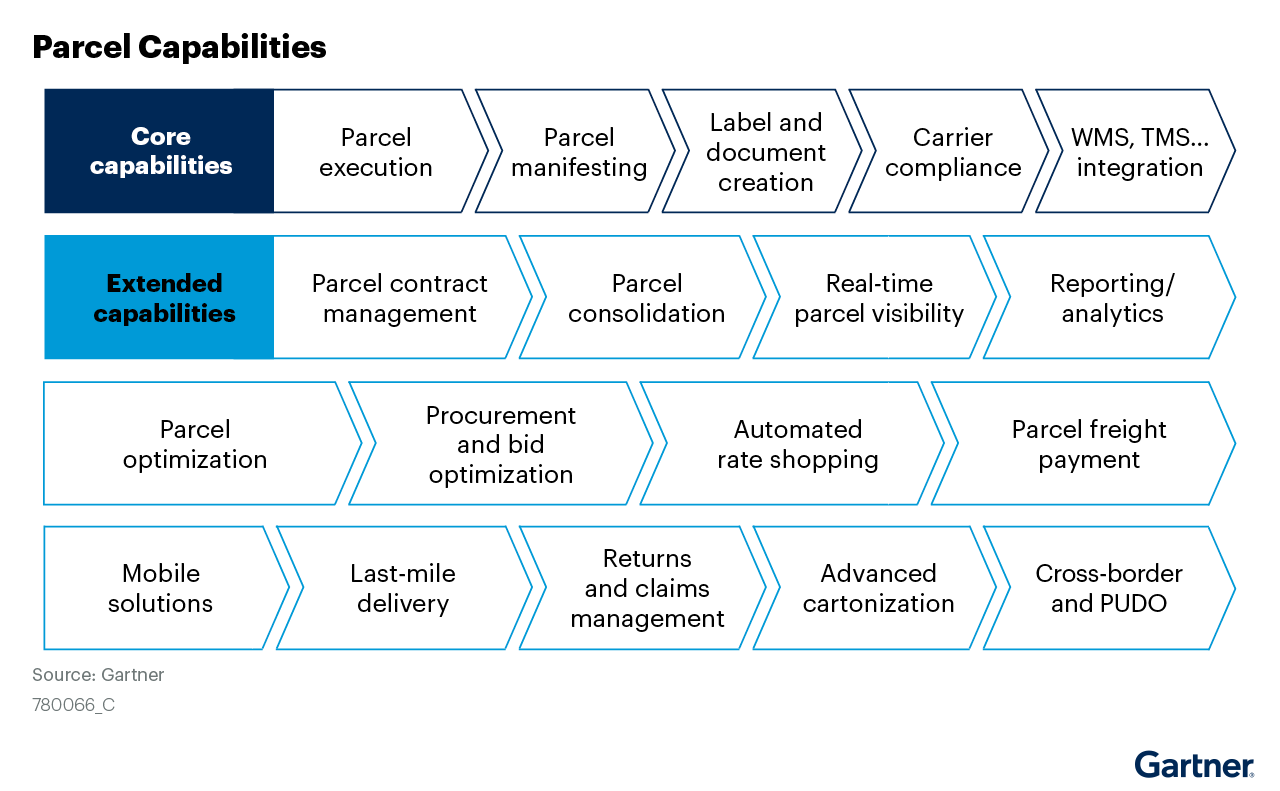
The mandatory features or core capabilities of the software applications in this market include:
- Parcel execution: Provides capabilities to execute a high volume of parcel shipment requests in minimal time, significantly reducing the time to process a parcel shipment through your carriers.
- Multicarrier parcel manifesting: Validates shipments against carrier-defined rules, routing and tracking number generation, and communication to the carrier once the shipment is ready to depart.
- Label and document creation: Involves the ability to generate shipment parcel labels and related shipping documents.
- Carrier compliance: Involves knowledge of import tariffs, packaging specifications, and customs rules and regulations by country. Aspects of the shipping process that are not handled properly could incur additional fees, result in major delivery delays, or cause shipment returns. This capability provides a key success factor for companies that have tapped into international markets.
- Integration with WMS, TMS, distributed order management (DOM) and/or ERP: Simplifies the integration or interface with the organization’s other systems, aiding in processes and shipment consolidation.
Common Features
The common features/extended capabilities for this market include:
- Parcel contract management: This capability supports the rating processes within the MCPMS, allowing the storage and management of contracts with the different carriers.
- Parcel consolidation: Shippers can benefit significantly by consolidating parcels into grouped shipments and, in some cases, leveraging LTL rates rather than parcel rates. Companies can save between 30% and 50% with “zone skipping” rather than shipping items individually from origin to final destination.
- Real-time parcel visibility: By giving customers the ability to track their own shipment, the number of calls into the call center will significantly decrease.
- Reporting/analytics: MCPMSs support the collection and processing of historical data stored in the system to create summaries and reports for further analysis.
- Parcel optimization: This allows for the optimization of carrier and mode of transport selection, considering different rules and constraints (that may include company- or region-specific needs) to calculate the best transportation option.
- Procurement and bid optimization: This supports the automation of the transportation bidding process, allowing the bidding “send and response” process. The MCPMS sends the bids to the carriers, analyzes their responses, awards bids, and imports and saves the provided rates.
- Automated rate shopping: Rate-shopping multiple carriers at a shipment level is a powerful tool for ensuring least-cost alternatives and benefit from the value regional carriers could offer.
- Parcel freight payment: This allows for the payment of the parcel freight charges directly from the system, helping to manage discrepancies, as charges received electronically can be easily compared with final carrier invoices within the MCPMS application.
- Mobile solutions: These allow users to access the MCPMS application through web portals or specially designed apps for mobile or tablet-like devices that are connected to the internet.
- Last-mile delivery: This supports the digital capture of proof of delivery, allows for tracking of shipment status and helps with the engagement of customers during the delivery process.
- Returns and claims management: Some MCPMSs offer capabilities to help manage the reverse supply chain processes, including the creation of exception events, generation of return labels and connection to the client’s web store to provide the ability to track returned packages.
- Advanced cartonization: Some MCPMSs offer or embed algorithms to determine and guide the appropriate number and sizes of cartons needed to ship the items in the order, as well as protection/packing methodology.
- Cross-border and PUDO: Some MCPMSs offer capabilities to support international consolidation services and documentation. Some carriers also offer integration into PUDO networks, further reducing carrier costs.
Additionally, Gartner is seeing the emergence of the concept of “carrier balancing.” This is where MCPMS vendors attempt to collaborate with carriers to view live and predictive carrier information. This helps them determine which carrier may have capacity to serve their clients’ needs during peak times.
Market Description
Figure 1 below provides a quick reference for the MCPMS capabilities detailed above.
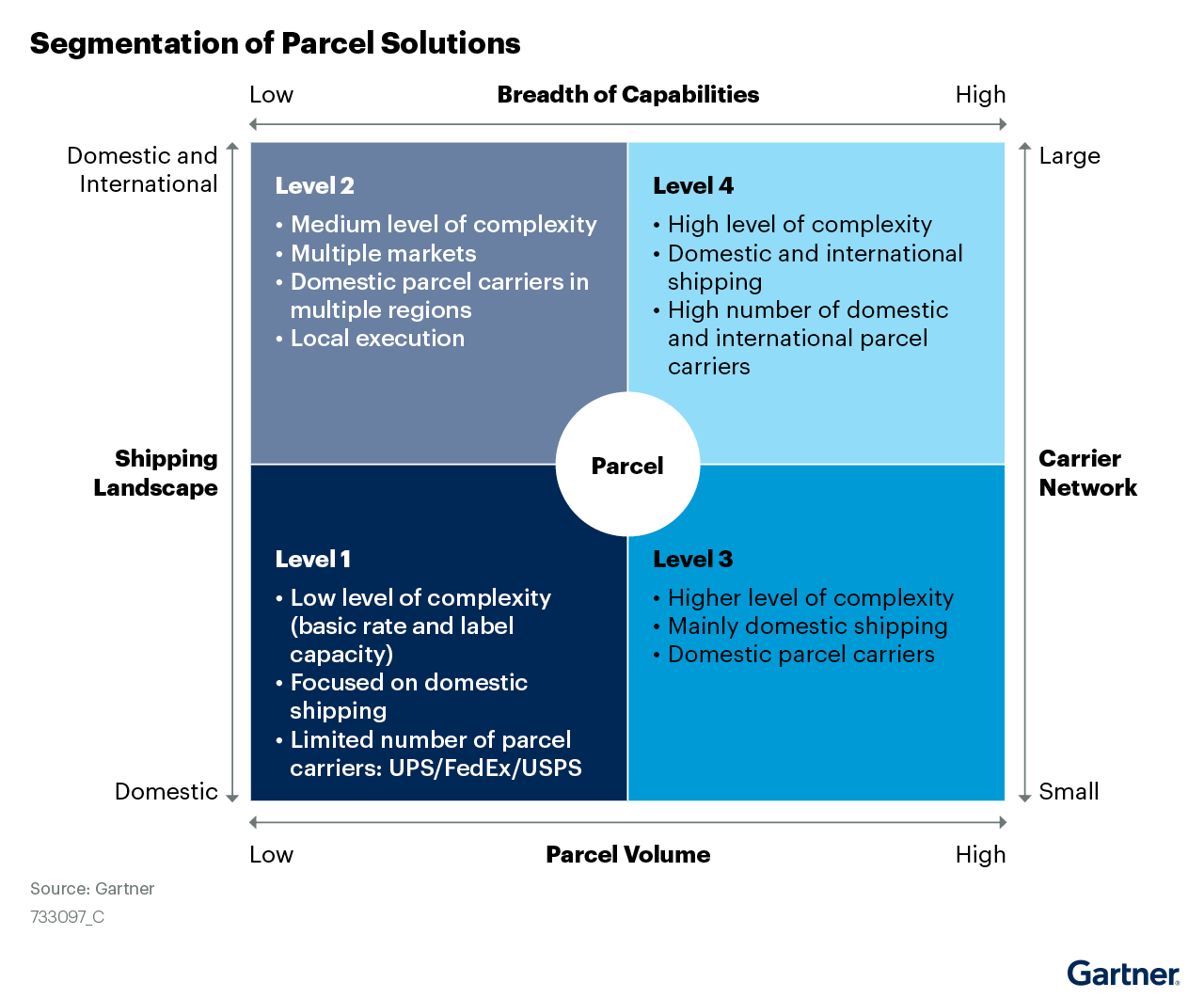
Parcel solutions have different levels of capabilities based on four specific characteristics: shipping landscape, breadth of capabilities, parcel volume and carrier network (see Figure 2). Some companies operate in only one region with regional carriers. Others work in multiple regions, each with its own regional carriers. Global companies might work with a large number of global carriers, as well as regional carriers for international and domestic parcel operations.
Some parcel vendors focus on only one of the four levels outlined in Figure 2, whereas other parcel vendors offer a platform that can support multiple or all levels. Gartner has also identified a few vendors that offer multiple solutions, depending on the volume and needs of the shipper. For example, Auctane has multiple parcel and mail solutions across its suite of organizations and Pitney Bowes has a range of parcel and mail solutions beyond those explicitly called out in this report.
There are also some TMS vendors that offer parcel capability as part of their TMS, but these can often only be categorized as a Level 1 capability. However, there have been acquisitions of multicarrier parcel management solutions adding these capabilities to their portfolios.
Market Direction
The market for multicarrier parcel management solutions (MCPMS) is entering a period of sustained and accelerated growth, driven by the structural rise in global parcel volumes and carrier choices, increasing the complexity of e-commerce and omnichannel fulfillment. According to Gartner’s latest research, global parcel delivery volumes are forecast to rise by over one-third from 2026 through 2031, underpinning strong demand for MCPMS in the coming 12 through 24 months. The primary drivers of adoption are mid-to-large multichannel retailers and B2B e-commerce shippers, with notable momentum from manufacturers and third-party logistics providers (3PLs) as parcel flows diversify and regulatory pressures mount.
Adoption and Buyer Priorities
Adoption is being led by organizations with complex, high-volume, and often international shipping requirements. Retailers and B2B e-commerce companies are the dominant adopters, particularly in the midmarket and enterprise segments where scale, carrier breadth, and advanced capabilities are essential. 3PLs are increasingly leveraging MCPMS to orchestrate multiclient, multicarrier networks, delivering differentiated delivery performance and flexibility for their customers. Manufacturers and enterprises in regulated or high-volume parcel environments are also turning to MCPMS to manage risk, compliance, and cost. In North America, where using fewer carriers traditionally held sway, there is a growing appetite for carriers other than “the big three” or Amazon Logistics due to price demands and rising charges from larger players. Additionally, retailers are concerned over funding the competition through Amazon, with Amazon Logistics for the first time being the largest carrier parcel volume provider in 2025.1
Across industries, aside from managing volume, complexity and carrier variation, buyer priorities are sharpening around four key themes: cost control, delivery experience, returns management, and sustainability. Rising transportation costs — driven by fuel and labor inflation, surcharges, and general rate increases — are a central concern. Many shippers lack effective tools to optimize transportation spend, creating a capability gap that MCPMS vendors are addressing with smarter rate shopping, contract modeling, and automation. Delivery experience is now a frontline differentiator, with buyers seeking accurate delivery promises, real-time tracking, and proactive communication to protect revenue and customer loyalty. High return rates, particularly in retail and e-commerce, are making returns management a core driver for MCPMS investment, with buyers prioritizing returns portals, automated label generation, and integrated visibility of forward and reverse flows. Sustainability and compliance are also rising in importance in some regions, as large enterprises and cross-border shippers seek greener carrier options, emissions tracking, and regulatory reporting.
Technology and Capability Trends
The fastest-growing MCPMS capabilities are automation, API enhancements and event-driven integration, carrier diversification, advanced analytics, and AI/ML for rate shopping, ETA prediction, and exception management. Automation and operational efficiency are critical as organizations grapple with more parcels, more carriers, and persistent labor constraints. API-first integration is now an expectation, enabling MCPMS to connect more easily with ERP, WMS, TMS, and OMS platforms and support rapid onboarding of new carriers and services.
Carrier diversification is a key strategy for managing risk and capacity, with leading MCPMS vendors offering libraries of hundreds or even thousands of carriers, including regional and local providers. This flexibility enables shippers to avoid overreliance on a single carrier and to optimize for cost, service, and sustainability. Advanced rule engines and decision intelligence are enabling dynamic carrier selection based on price, SLA, zone, capacity, and business rules.
AI and advanced analytics are rapidly becoming basic requirements, with buyers expecting features such as autonomous rate shopping, ETA prediction, exception scoring, and generative AI for customer communication. However, buyers are increasingly skeptical of “black box” optimization, demanding transparency, measurable ROI, and strong data foundations.
Carrier diversification is a key strategy for managing risk and capacity
Competitive Dynamics and External Forces
Stand-alone MCPMS platforms continue to consolidate their position relative to embedded parcel modules in TMS, WMS, OMS, and ERP suites, as most core systems lack the depth and flexibility required for modern parcel management. Integration — both with core systems and with last-mile, visibility, and returns platforms — is the norm, not the exception. Pricing models are evolving, with hybrid approaches combining subscription, transaction-based, and feature-bundled fees, and increasing scrutiny on total cost of ownership as AI features become more prevalent.
However, some multicarrier vendors are being challenged at the lower end of the market, where some WMS vendors have found easier methods to integrate carriers using AI for lower complexity environments. However, more advanced capabilities for MCPMS vendors like rate and service shopping are not yet challenged.
External forces such as carrier rate increases, labor shortages, service variability, regional carrier expansion, and the emergence of sustainability reporting requirements are accelerating the shift toward modern, flexible, and AI-ready MCPMS. E-commerce growth, high return rates, and cross-border shipping complexity partially driven by the elimination of de minimis exceptions further strengthen the business case for configurable, carrier-agnostic solutions. However, some carriers are beginning to charge shippers for high volume API queries, driving MCPMS vendors to manage tracking differently.
Market Analysis
Parcel capabilities are being deployed more frequently and are sometimes integrated with multimodal domestic TMSs, where parcel is one of the available mode choices. Alternatively, stand-alone multicarrier systems can dynamically select the right rate and service, and consolidate parcel shipments to find less costly shipping alternatives. For example, combining multiple parcel shipments into one less-than-truckload (LTL) shipment would have a lower total cost. Another example is “zone skipping” (aka zone jumping), whereby a large number of parcel shipments are consolidated, transportation is delayed until the volume reaches a full load, and the parcels are then moved by truck to a less expensive zone, and then parcel delivery is used from there.
Integrating parcel management into TMSs alone can be challenging because, in many cases, the packaging or “cartonization” of the parcel isn’t determined until it proceeds through the warehouse operations.
Due to these operational constraints, the parcel rating is often estimated in TMSs, and the final rating and manifesting or labeling are done as part of warehouse operations, usually driven by the WMS. However, we are seeing some multicarrier parcel management solutions extend and enhance cartonization in collaboration with WMSs, or embed point solution cartonization offerings in their solutions, beyond some of the more basic cartonization capabilities offered by some WMSs.
Parcel management has become a necessary, and complementary, part of multimodal TMS and WMS offerings. TMS and WMS vendors partner with the MCPMS vendors to expand the capability in their own toolsets. Most TMS vendors have no plans to develop these expanded capabilities themselves, beyond notable acquisitions, and most WMS providers’ capabilities in this space are limited. Also, multicarrier parcel vendors connect to a completely different set of carriers (i.e., large international and niche local parcel carriers) than full truckload (FTL) or LTL rail, ocean or air carriers, which are the typical carriers traditional TMS solutions focus on. Carrier compliance is another part of the work these parcel vendors provide. Carrier compliance can be different by country and region.
E-commerce and multichannel commerce continue to drive innovation, resulting in notable changes in the space. As home delivery becomes more pervasive and companies move to multiple pickup points, further evolution in this space, beyond the traditional use of multicarrier parcel management, is occurring. Some vendors are offering specialized solutions to support last-mile delivery and postpurchase processes.
Leading multicarrier parcel solution vendors are moving past standard execution capability and toward more value-added services. Functionalities such as robust business intelligence platforms, front-end commerce/web integration and predictive tools are becoming differentiators in the market.
Rate Shopping Maturity Model Detail
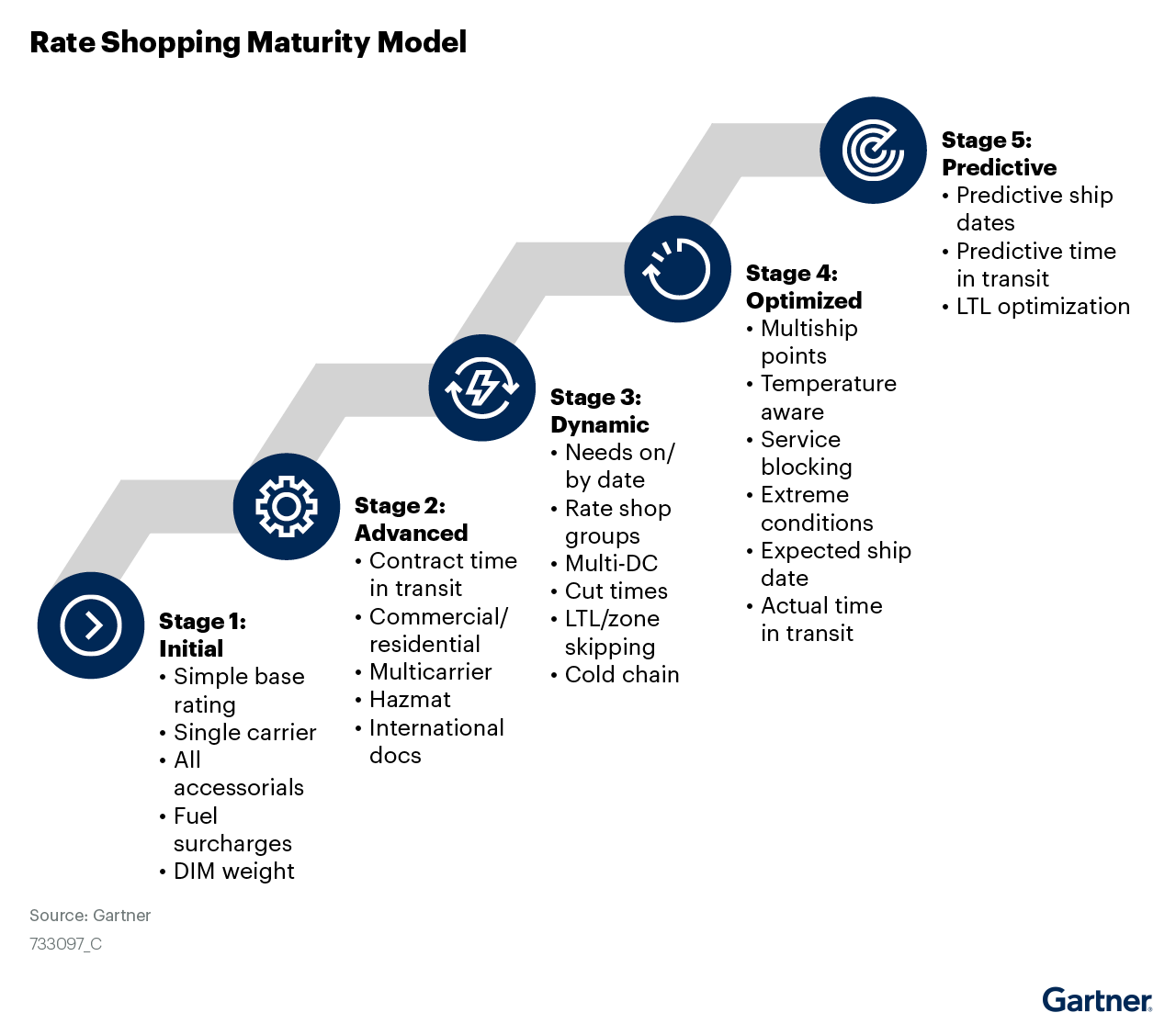
Different levels of parcel solutions can be identified by the shipper based on the shipping landscape, parcel volume, carrier network and breadth of capabilities needed. Similarly, solutions differ based on the level of rating complexity and maturity offered by the parcel vendor.
Figure 3 shows the five maturity stages of rating engines. Progression goes from Stage 1, with a simple base rating for a single carrier, to Stage 5, where the rating engine predicts ship dates and time in transit, selecting the appropriate parcel option (carrier, rate, service). Gartner most commonly notices demand for Stages 1 through 3. Stage 4 is starting to be more relevant in today’s complex shipping environment, and Stage 5 is the vendor’s eventual goal.
Carrier Compliance
Compliance in shipping refers to shippers that are certified by their parcel carriers and continually comply with ongoing rules and requirements for rating, labeling and manifest reporting. Leveraging multiple carriers and services is crucial for providing the best options and offering the most competitive shipping costs for parcels. This is where carrier compliance becomes increasingly important as part of a parcel solution.
Carriers are constantly updating ZIP Codes or postal codes, rating labels, or other data and need to work with a provider that has a strong focus on compliance. If a carrier does not receive the right document in the right format, it may hold a shipment until they are able to contact the shipper. At that point, the carrier is not moving the goods, which can result in fulfillment deadlines not being met.
Part of compliance involves communicating with carriers and providing carrier-approved shipping labels or tracking numbers.
Carrier compliance is also a key success factor for companies that have tapped into the international market. However, it’s a complex process that involves knowledge of import tariffs, packaging specifications, and customs rules and regulations.
The right multicarrier shipping software can handle carrier compliance. This compliance is built on the seamless and streamlined exchange of data and enables carrier selection based on time and transit, as well as other intangibles such as service level.
Representative Vendors
The vendors listed in this Market Guide do not imply an exhaustive list. This section is intended to provide more understanding of the market and its offerings.
Vendor Selection
This research provides information on 19 MCPMS vendors perceived as relevant in the market, based on revenue, number of clients, and end-user interest and feedback. Client interest, market presence and growth also factored into the selection of the vendors featured in this guide.
Representative Vendors in Multicarrier Parcel Management Solutions
Vendor name | Headquarter address | Product name |
AEB | Stuttgart, Germany | Carrier Connect |
Centiro | Borås, Sweden | Delivery Management, Customer Experience, Finance and Control |
e2open | Austin, Texas, U.S. | Global Parcel |
EasyPost | Lehi, Utah, U.S. | EasyPost, EasyPost Enterprise |
FarEye | Chicago, Illinois, U.S. | Ship, Track, Experience, Analyze |
Locus | Bengaluru, India | ShipFlex |
Metapack | London, U.K. | Delivery Manager, Delivery Tracker, Delivery Intelligence, Delivery Options |
nShift | Oslo, Norway | nShift Ship, Book & Print, Checkout, Post-purchase, Returns |
Pierbridge | Schaumburg, Illinois, U.S. | Transtream |
Pitney Bowes | Stamford, Connecticut, U.S. | SendPro Enterprise, PitneyShip Enterprise |
ProcessWeaver by Elemica | Richardson, Texas, U.S. | Enterprise Centralized Shipping (ECS) for SAP and xCarrier |
ProShip | Brookfield, Wisconsin, U.S. | ProShip, WorldLink |
QAD | Redzone | Miami, Florida, U.S. | QAD Transportation Execution (GTTE), Delivery Exception Management (DEM), Freight Bill Audit and Pay |
RateLinx | Scottsdale, Arizona, U.S. | ShipLinx TMS |
Sendflex | Northborough, Massachusetts, U.S. | Sendflex Parcel TMS |
ShipERP | Miami, Florida, U.S. | ShipERP Core, ShipERP Cloud, ShipEWM |
Shipium | Seattle, Washington, U.S. | Shipium, Carrier Selection (CS), Carrier Network, Fulfillment Engine, Delivery Promise, Simulation |
ShippyPro | Florence, Italy | ShippyPro |
Shipsy | Gurugram, India | Multi-Carrier Management (Shipsy MCM) |
Source: Gartner (June 2026)
Vendor Profiles
AEB
AEB is a global trade and logistics software and service provider headquartered in Stuttgart, Germany. It provides enterprise multicarrier parcel management solutions through its primary products, Carrier Cloud for SAP and Carrier Connect API. Delivered as cloud-hosted, multitenant SaaS offerings built on a microservices architecture, the platforms provide core shipping capabilities such as rate shopping, label generation, and real-time tracking with strong integration into SAP-based logistics and fulfillment processes. For clients with special compliance, isolation or performance needs, AEB also offers dedicated cloud deployments as an additional paid option. Its solution can operate as a stand-alone application or as part of an integrated set of modules comprising AEB’s TMS solution and can be extended with other modules, such as customs export/import filing, customs broker integration and denied third-party screening, to strengthen the capabilities of the solution for international shipping. The vendor supports customers across global regions, mostly in Europe, North America and Asia.
To support this footprint, AEB has preonboarded more than 300 carriers worldwide to its network. In its latest product updates, AEB introduced new capabilities such as a Carrier URL Tracking Link Service, and an expansion of its Carrier Gateway features for contract-based freight cost calculations and transit-time APIs. Additionally, the vendor maintains a hybrid carrier integration strategy combining APIs and EDI, selecting the optimal approach based on carrier capabilities, volume requirements and process criticality. This approach is designed to ensure high throughput, reliable batch processing, and maximum flexibility in label design for complex warehouse processes. AEB is growing a set of AI capabilities, focusing on GenAI for carrier documentation interpretation, proposals for carrier configuration generation and knowledge retrieval for support teams. It is exploring agentic opportunities to support proactive process handling in the future. It works with approximately 11 SAP specialist consulting and technology partners as part of the Carrier Cloud for SAP ecosystem. The solution offers add-ons for integration with SAP ECC, SAP S/4HANA, SAP Transportation Management, SAP Extended Warehouse Management (EWM), and SAP Logistics Management. It leverages SAP Business Technology Platform (BTP) as an extensibility and integration layer to support side-by-side extensions, event-driven integration, and clean core strategies. AEB’s customers are across industries with particular focus on manufacturing, automotive, e-commerce, healthcare (life sciences), and high-tech industries.
Centiro
Centiro is a privately held company headquartered in Borås, Sweden, and founded in 1998. Its solution, the Centiro platform, is a SaaS platform that enables its customers to manage and control their transportation, as well as connect to a network of transport service providers for flexible selection of commerce fulfillment.
Centiro provides multicarrier parcel management solutions via its SaaS platform, supporting customers shipping from and to all global regions. The platform’s continuous release model ensures customers access the latest features without downtime. In its most recent release, Centiro introduced advanced address validation and correction services with API integration, proactive monitoring and anomaly detection for real-time issue resolution, and expanded live tracking capabilities through partnerships such as Intugine for India. Centiro has preonboarded over 2,000 global, regional, and local carriers to its network. The platform integrates with customer systems through APIs and supports internationalization with multilanguage, multicurrency, and global shipping rules. It also supports other modes including crowdsourced delivery services through Urban Street, a part of Centiro Group that supports urban same-day delivery by connecting brands with on-demand delivery networks.
Centiro offers real-time tracking, event management, proactive notifications, returns flows, and financial governance tools for freight cost calculation, invoice audit, and dispute automation. The company emphasizes compliance, security, and operational resilience, supporting both enterprise and midsize shippers with scalable, configurable solutions focused on customer experience and operational transparency. Centiro has been expanding its AI capabilities to support areas such as data harmonization, multiple ML and GenAI models to improve SLAs through faster case resolution, and is developing a tool to significantly simplify how rate cards and carrier rates are managed in the system through AI. It is also developing a client-facing chatbot to support consumer postpurchase activities such as tracking and returns. It has also developed predictive and prescriptive analytics to support volume forecasting and identify delays and anomalies in logistics flows. Centiro has customers in many different industry verticals, with a strong presence in retail, apparel and footwear, 3PL, industrial manufacturing, and high-tech.
e2open
E2open, which was acquired by WiseTech Global in August 2025, is a specialized supply chain software vendor headquartered in Austin, Texas. It provides enterprise multicarrier parcel management solutions through its product, Global Parcel. Delivered primarily as a cloud-first, single-tenant hosted deployment, with WiseTech data centers as the preferred cloud platform. It will continue to support existing on-premises deployments until clients are ready to migrate. The solution offers core capabilities such as multicarrier rate shopping, carrier compliant label and document creation, flexible workflow APIs for high-volume processing environments, cross-border shipping with integration to U.S. AES systems for export filing, and visibility and exception management. The vendor supports customers across geographies, specifically within the Americas, EMEA, and APAC regions.
To support these worldwide operations, e2open has preonboarded over 450 carriers to the platform. Modes include parcel, same day, courier and LTL, with expansion supported with its Connected Logistics TMS product. In its latest product update, the vendor introduced three key new capabilities: an expansion of its carrier network to include new alternative providers (such as DoorDash and UniUni), updated carrier compliance and security features, and an enhanced Parcel Analytics offering that includes data-acquisition APIs. As part of the larger group “Connected Logistics” initiative, e2open plans to expand multicarrier functionality to leverage its AI digital assistant capabilities and enable cross-functional workflows. E2open has customers across most industry verticals, with particular depth within retail, e-commerce, industrial manufacturing, high-tech/consumer electronics, 3PL, wholesale distribution, consumer products and wholesale distribution.
EasyPost
EasyPost, headquartered in Lehi, Utah, was founded in 2012. The EasyPost Suite provides flexible, modern shipping APIs that facilitate rate shopping between carriers, label printing, address verification, package tracking, and insurance of shipments. EasyPost’s strategy is built around zero downtime, multicarrier access and simplicity, while focusing on supporting small, midsize, and enterprise shippers. Its EasyPost Enterprise solution is primarily offered to support higher-speed rate and service shopping, as well as label production for high-volume environments, with hundreds of concurrent users.
The solutions offer many different features, including rating and shipping, zone skipping, label creation and customizable document generation, among others. EasyPost currently supports more than 100 carriers, holds Diamond status with FedEx and is a Manhattan Associates Gold Partner. In February 2025, EasyPost launched Luma, its shipping AI to support performance insights, predictive simulations and to test carrier combinations. It supports more than 12,000 customers across its products and has customers in multiple industries. The vendor has a primary focus on direct-to-consumer shippers, such as retailers, subscription services, e-commerce platforms and 3PLs.
Elemica
ProcessWeaver, part of Elemica, provides multicarrier parcel management solutions through its SOA-based platform, supporting customers in more than 90 countries, mainly in North America and Europe, but it also has customers based in Asia and Latin America. ProcessWeaver has one version of its parcel and freight shipping solution that is cloud native, and also has an SAP certified version that runs natively within SAP. The latest release introduced a new feature enabling customers to monitor, track and evaluate messages between the carrier, the application and ERP/OMS/WMSs. It also enhanced automated alerts and email notifications, enhanced cartonization capabilities and supports the new FedEx shipping services.
ProcessWeaver by Elemica has digitally integrated with over 450 global carriers and freight forwarders, leveraging decades of transactional history to accelerate carrier onboarding and reduce implementation times. The platform offers deep integration with ERP systems like SAP, Oracle’s NetSuite, Infor, and Microsoft Dynamics via APIs and web services, and supports both inbound and outbound operations through eTMS. ProcessWeaver emphasizes compliance and security, maintaining certifications such as GDPR and SOC II, and adhering to NIST-800 guidelines. The solution includes spot quote functionality, advanced analytics, and supports paperless customs and dangerous goods shipping.
ProcessWeaver serves both enterprise and midsize shippers, enabling end-to-end supply chain collaboration and visibility. ProcessWeaver supports customers across industries with particular strength in the industrial manufacturing, consumer products, life sciences/pharmaceuticals, consumer electronics, wholesale distribution, high tech, and food and beverage verticals.
FarEye
FarEye is a software provider for logistics and supply chain focused on order orchestration, route optimization, visibility and customer experience, headquartered in Chicago, Illinois with six other locations in London, U.K.; Amsterdam, Netherlands; Dubai, U.A.E.; Delhi, India; Singapore, and Sydney, Australia. FarEye provides multicarrier parcel management solutions through the modules Ship, Track, Experience, and Analyze of its microservices-based SaaS multitenant cloud platform. FarEye has a modest but growing number of parcel customers in North America, Europe, Asia, Australia, and the Middle East. FarEye has preintegrated more than 260 parcel express and parcel carriers, and 60+ same-day, next-day, and hyperlocal carriers to its network.
The platform enables integration with WMS, TMS, OMS, ERP, and YMS systems via standardized APIs, and offers returns management, predictive analytics, and compliance tools. The latest release introduced an advanced rate simulation engine for cost prediction, capabilities to embed a returns initiation portal in the end-customer account for e-commerce, and improvements in invoice reconciliation capabilities.
FarEye’s solutions support both enterprise and midsize shippers, providing operational visibility, branded customer experience modules, and flexible fleet configurations including owned, outsourced, hybrid, and crowdsourced models. FarEye has been focused on AI, developing capabilities such as its finance assistant to determine charging variations, and a voice agent to autonomously confirm delivery availability, reschedule slots and manage service queries. FarEye supports customers in multiple industries with particular strength in the retail/e-commerce, food and beverage, consumer electronics, health and beauty, and automotive sectors.
Locus
Locus is a logistics technology vendor founded in 2015 and headquartered in Bengaluru, India. In 2022, Locus piloted hyperlocal fleet orchestration capabilities in India and began to develop hybrid parcel and fleet orchestration capabilities. In 2023, it launched its multicarrier parcel management offering, ShipFlex, which to date has a modest but growing number of customers across retail, e-commerce, e-grocery, CPG/FMCG, 3PL, manufacturing, healthcare and service industries. In October 2025, Ingka Investments, the investment arm of Ingka Group, owner and operator of IKEA stores in 32 countries, made a strategic investment in Locus to improve its order fulfillment landscape.
Locus remains independent and continues to serve other customers, though it does partner with IKEA to improve delivery speed and reliability. ShipFlex offers multicarrier integration, rate management, configurable workflows, customer and carrier insights, carrier performance benchmarking, and some returns management, image matching and cartonization capabilities. The vendor has now embedded AI/ML capabilities to ease carrier onboarding and rule configuration using natural language. Its system can create new customer-specific rules supporting over 150 business constraints and over 30 logic and static rules (configurable by carrier type, delivery SLA and product type). It also enables multileg orchestration capabilities across the carrier network. It plans to also deploy AI-assisted parcel analysis, intelligent rate optimization and automated shipment tracking variance detection for carrier performance management.
Locus’ order management module evaluates in-house fleet capacities and automatically diverts overflow to ShipFlex for third-party fulfillment. The majority of its customers were historically based in Asia, it is growing its focus and presence in Europe, North America and the Middle East. It claims ease of integration with over 1,500 carriers globally (spanning global and national carriers and hyperlocal providers) and the solution is typically deployed within two to four weeks. Implementations are currently carried out directly.
Metapack
Metapack, headquartered in London, U.K., is a subsidiary of Auctane that offers an enterprise-level cloud-based global multicarrier shipping solution, as well as customer experience management, prepurchase and postpurchase retail analytics and returns capabilities, multiple tracking products and audit and fraud tracking capabilities. It provides its multicarrier parcel management solutions through its SaaS platform, supporting customers in Europe, North America, Asia/Pacific, and Latin America. It offers four modules including check-out, shipping, tracking and intelligence and has recently partnered with parcelLab to enhance the postpurchase experience. The latest release introduced enhanced carrier allocation algorithms for improved delivery performance, expanded out-of-home delivery options including lockers and over 3.24 million PUDO points, and advanced analytics dashboards for shipment tracking and carrier performance.
Metapack has preintegrated over 350 carriers and over 4,000 delivery services to its network. The platform offers integration with OMS, WMS, and e-commerce platforms via APIs, and supports international shipping with automated customs documentation and localized delivery options. Metapack emphasizes compliance with industry standards and data security, and provides tools for branded tracking, returns management, and customer communication. Metapack launched its AI initiatives, known as the Intelligence Hub in February 2026, to support predictive delivery forecasting and late-parcel forecasting, automated carrier invoice reconciliation, and carrier requirements definitions. It is also developing its Metapack Recommends natural language capability to query its Intelligence Hub to evaluate every warehouse-carrier option against cost, SLA, disruption, and historic performance to generate recommendations.
The solution serves both enterprise and midsize shippers, offering flexibility in delivery management and operational visibility. Metapack customers are across industries with particular depth in retail, fashion and apparel, health and beauty, consumer electronics, and home and garden.
nShift
nShift, co-headquartered in Oslo, Norway, and London, U.K., offers an enterprise-level delivery management suite, including its multicarrier parcel solution called nShift Ship. nShift also offers additional products and solutions that extend and work with Ship, including check-out, sustainability and postpurchase, the latter of which includes tracking and returns solutions. Each solution is capable of operating as a stand-alone application or as a cohesive integrated suite. nShift has 10 offices located across Europe (including Norway, the U.K., Denmark, Sweden, Finland, Belgium, Romania and the Netherlands), where the majority of its approximately 20,000 customers are based. Customers for its solutions range from SMB through enterprise.
It offers its software in multiple deployment methods and can integrate to ERP, WMS or e-commerce platform solutions using API technology or through its extensive partner network providing ready-to-use integrations. It offers one of the largest carrier networks, with more than 1,000 carriers integrated in its solution, from local providers to international parcel and LTL carriers. Its customers range from small operations dispatching less than 1,000 parcels per year to multiregion high-volume multichannel retailers rate-shopping across more than 60 carriers and shipping tens of millions of packages from multiple distribution centers. The vendor advises its systems manage the shipment of over 1 billion parcels per year. The solution offers multiple rule and configuration options to create a shipping logic and automate the execution of parcel shipping. It also provides customer-centric capabilities, like multicarrier options in check-out, multiple returns-handling options, web browser and mobile application track-and-trace solutions, and branding.
Additionally, nShift provides customers visibility on their shipment execution and performance, allowing them to set up events and notifications to improve their customer service and delivery experience. In March 2026, the vendor announced the launch of its AI infrastructure and nShift Companion product, an AI-powered assistant. This allows users to interact with nShift’s delivery management platform using natural language, removing the need for specialist knowledge to manage complex delivery settings and gain best-practice recommendations. In April 2026 the vendor announced multicarrier integration connectivity with agentic AI.
Pierbridge (WiseTech Global)
Pierbridge, part of WiseTech Global, provides multicarrier parcel management solutions through its SaaS platform, primarily supporting customers in North America, with additional coverage in Europe, Asia, and Australia/New Zealand. The platform is designed for enterprise and midsize shippers, offering flexibility and scalability for diverse shipping needs. The latest release included further LTL freight support, enhanced cross-border consolidated carrier drop shipping and capabilities to simplify USPS onboarding and account management. It has also updated its user interface and configuration capabilities and typically adds 10 to 15 new carriers per year.
Pierbridge has preonboarded more than 250 carriers across parcel, LTL, and TL modes, facilitating integration for ground, express, and air shipments. The solution integrates with WMS, TMS, and ERP systems via APIs and EDI, and supports omnichannel fulfillment, including store, warehouse, and drop ship locations. Pierbridge emphasizes compliance with standards such as SOC 2, ISO 27001, and PCI DSS, and provides tools for customs documentation and international shipping. The platform features advanced returns management, cartonization algorithms, and branded customer communication modules. Detailed reporting tools enable users to monitor shipping costs, carrier performance, and service levels. Pierbridge also offers support for dangerous goods shipping and multileg, cross-border shipments. The vendor has been investing in AI-powered predictive visibility, route optimization and simulation tools.
Pierbridge customers are across industries including in retail, 3PL, healthcare, manufacturing, automotive, and high-tech or consumer electronics.
Pitney Bowes
Pitney Bowes offers enterprise multicarrier parcel management solutions through SendPro Enterprise and PitneyShip Enterprise, built on the Shipping 360 platform. In August 2024, Pitney Bowes sold its controlling interest in its Global Ecommerce (GEC) Entities to facilitate the value-maximizing liquidation of certain of the GEC Entities. It continues to focus on its Presort and SendTech businesses. SendTech comprises solutions that include its multicarrier parcel management offerings. Its microservices-based, multitenant SaaS architecture operates across seven global regions, serving customers in North America, Europe, Asia, and Australia/New Zealand.
The latest release introduced custom freight carrier support for the U.S. and Canada, carrier service approved list management via API, and page-level custom functions using low-code technology. Pitney Bowes has preonboarded over 120 global, regional, and local carriers to its network. The platform supports integration with e-commerce, ERP, WMS, and TMS systems via API and EDI, and offers features for cross-border shipping, including customs documentation. It includes cartonization algorithms through partnership with Paccurate, returns management, predictive analytics, and detailed reporting tools for shipping costs and carrier performance.
Compliance with industry standards and security protocols including FedRamp is emphasized. Services extend to consolidated carrier billing, financial services via Pitney Bowes Bank, alternative delivery locker networks, and tracking. It deploys some AI capabilities to assist clients in using the product, navigate shipping workflows and build desired reports. Pitney Bowes supports both high-volume enterprise shippers and midsize businesses. It supports customers across industries with a focus on life sciences and pharmaceuticals, banking, industrial manufacturing, wholesale distribution, and brokers.
ProShip
ProShip, headquartered in Brookfield, Wisconsin, and founded in 1987, is a global provider of automated multicarrier shipping software, offering product options dependent on the complexity, volume and speed of shipment execution required. It provides multicarrier parcel management solutions offered through multiple deployment options including SaaS-based and on-premises environments, primarily serving customers in North America, with additional support in Europe, Asia, and Australia/New Zealand. The platform integrates with WMS, TMS, ERP supply chain automation systems via RESTful APIs and EDI, enabling omnichannel fulfillment from warehouses, stores, and drop ship locations. ProShip has over 140 preintegrated carriers, including parcel, LTL, and same-day delivery providers around the world. The ProShip includes updated APIs and webhooks to provide faster, secure communications, and included other components in its solution such as advanced date shopping, proactive event-based notifications and enhanced analytics and reporting among others.
The platform features carrier rationalization tools, carrier volume balancing, and advanced tracking solutions. ProShip follows a continuous integration/continuous deployment (CI/CD) model that allows customers to update components without downtime and without replacing the entire platform, supporting operational agility. ProShip uses AI to bolster internal development where it is beneficial and supports integrations with partners that provide predictive transit-time insights, aiding ETAs. ProShip serves both enterprise and midsize shippers, offering choice, flexibility and scalability for diverse shipping needs. ProShip customers come from all industries with particular depth in the retail, healthcare, manufacturing, and 3PL/distribution verticals.
QAD | Redzone
QAD, headquartered in Miami, Florida, is a provider of ERP, global trade and transportation software solutions for manufacturers and supply chain organizations. QAD provides multicarrier parcel management solutions through its SaaS platform, supporting customers primarily in North America and Europe, with additional coverage in Asia/Pacific and Latin America. QAD’s offering for parcel shipping, QAD Transportation Execution, is part of its QAD GTTE single platform. QAD GTTE includes capabilities for global trade, freight bill audit and payment, and transportation execution. The platform integrates with ERP, WMS, and TMS systems via APIs and web services, enabling workflows across manufacturing and distribution operations. QAD has preonboarded over 70 carriers to its network in 2025, increasing its directly connected network to over 230, including parcel and LTL providers. In its latest release, QAD introduced enhanced shipment visibility with real-time tracking, automated carrier selection based on service levels and cost, and improved analytics dashboards for shipment performance and cost analysis.
The platform offers compliance tools for customs documentation, supports multileg and cross-border shipments, and provides advanced returns management capabilities. QAD emphasizes data security and privacy, adhering to industry standards and certifications. It recently released AI-enhancements to its third-party screening in order to handle false positives, and plans to deploy AI for freight cost simulations, carrier enablement and onboarding.
The solution is designed for both enterprise and midsize shippers, offering flexibility and scalability for diverse logistics needs. It recently released a light version of Transportation Execution to enable rapid deployment for midmarket customers with a smaller number of shipments. QAD customers are across industries with particular strength in the automotive, consumer products, food and beverage, industrial, and life sciences verticals.
RateLinx
RateLinx, headquartered in Scottsdale, Arizona, and founded in 2002, provides multicarrier parcel management solutions through its cloud/SaaS solution, ShipLinx, primarily supporting customers in North America, though it has customers in Europe and Asia/Pacific. The platform integrates with ERP, WMS, and TMS systems via APIs, enabling efficient data flow and streamlined operations across supply chains, but also supports alternatives. ShipLinx offers a range of core and extended multicarrier capabilities, including carrier contract management, parcel consolidation and optimization, rate shopping, execution, and postpurchase capabilities. RateLinx has preonboarded over 100 parcel and LTL carriers, allowing customers to access a broad range of shipping options. In its latest release, RateLinx introduced enhanced shipment visibility with real-time tracking, automated carrier selection based on cost and service levels, and advanced analytics dashboards for shipment performance and spend analysis. Its system has no limit on users, locations or carriers.
The vendor also offers freight audit and payment capabilities, providing users with invoice validation and cost control capabilities. RateLinx offers compliance tools for customs documentation, supports multileg and cross-border shipments, as well as postpurchase capabilities. The platform is designed to be highly configurable, supporting both enterprise and midsize shippers with flexible workflows, reporting, and operational scalability. RateLinx emphasizes data security and privacy, adhering to industry standards and certifications, and provides proactive customer support for onboarding and ongoing optimization. It is currently conducting a pilot with Microsoft to exploit the AI Fabric within Azure.
RateLinx supports customers of all sizes, with the majority being midsize and large enterprise organizations. Its customers span industries with particular concentration in the industrial, healthcare, retail, automotive, and high tech verticals.
Sendflex
Sendflex was founded in 2021 by executives with significant backgrounds in multicarrier parcel management software development, fulfillment center logistics management, and e-commerce delivery. It provides multicarrier parcel management solutions through its multitenant cloud-native platform. All customers are currently headquartered in North America. The platform integrates with WMS, TMS, ERP, and e-commerce systems via APIs and web services, enabling order and shipment processing. Sendflex has preonboarded over 60 parcel, LTL, and same-day carriers to its network. In its latest release, Sendflex introduced dynamic rate shopping with real-time carrier cost and service comparisons, automated shipping rule management for complex fulfillment scenarios, and enhanced analytics dashboards for shipment visibility and performance tracking.
The solution includes planning optimization, event management and simulation for parcel, LTL and local carrier networks. Its planning and simulation capabilities apply no-code routing, cartonization (through partnership with Paccurate) and consolidation instructions across orders and fulfillment operations. The planning module releases planned shipments to Sendflex’s multicarrier parcel execution or to other multicarrier parcel management solutions. The platform supports omnichannel fulfillment, including ship-from-store, warehouse, and drop ship locations, and offers returns management and branded customer communication tools.
Sendflex is SOC 2, Type 2 certified and emphasizes compliance with industry standards and data security, supporting cross-border shipping with automated customs documentation. The solution is designed for both enterprise and midsize shippers, providing flexibility, scalability, and configurable workflows to meet diverse logistics needs. Sendflex’s optimization engine features an in-memory rating capability that does not rely on carrier APIs, and the vendor advises is able to calculate 250,000 rates and rules per second. It is further developing Azure-based ML models to support predictive delivery, predictive delivery costs and anomaly detection. It plans extensive rollouts of AI/ML capabilities through 2026 and is releasing an Adaptive Decision Intelligent Framework to provide optimization rule recommendations. Sendflex supports customers in multiple industries with particular strength in the retail, e-commerce, healthcare, industrial, and consumer electronics verticals.
ShipERP
ShipERP is a multicarrier shipping execution platform designed for ERP-centric enterprises with complex logistics requirements. It provides multicarrier parcel management solutions through its cloud-based platform (ShipERP Cloud) or embedded with SAP’s system (ShipERP Core). The majority of its customers are headquartered in the Americas and Europe, though it has customers in Asia/Pacific and MEA. The platform integrates with ERP, WMS, TMS, and e-commerce systems via APIs and native connectors, enabling order and shipment processing across multiple business units. Its offerings can be embedded within SAP, enabling direct SAP to carrier connections, including offerings for SAP’s WMS such as ShipEWM, and SAP’s TMS such as ShipTM.
While differentiated for its depth of integration with SAP’s portfolio and team of ABAP (SAP programming language) developers, the platform also supports integrations across other ERP ecosystems, including Oracle and Microsoft. ShipERP has preintegrated a respectable global network of parcel and LTL carriers, including production-grade and certified carrier APIs, offering broad coverage for domestic and international shipping. ShipERP provides rule-based and optimization-driven carrier selection, real-time shipment visibility with proactive event notifications, and operational analytics for shipment performance and spend management. The platform supports omnichannel fulfillment, including warehouse, store, and drop ship locations, returns processing and customer communication capabilities integrated into shipping workflows.
ShipERP supports compliance-driven operations, cross-border shipping with automated customs documentation as well as regulatory workflows such as export filings and hazardous materials handling. The vendor offers modular capabilities including address validation, denied third-party screening, hazardous materials shipping or electronic export filing. ShipERP provides capabilities including parcel audit and analysis, and rate shopping optimization. It is developing AI- or ML-driven capabilities to detect tracking variances, with a focus on augmenting deterministic shipping execution through intelligent, event-driven agents to support monitoring, exception handling and decision making. Customers span industries including retail, logistics service providers, high-tech/consumer electronics, industrial manufacturing, life sciences and pharmaceuticals, where shipping operations require high accuracy, regulatory compliance, and deep ERP integration.
Shipium
Shipium, headquartered in Seattle, Washington, is a small logistics technology vendor focused on parcel and freight solutions founded in 2019 by former Amazon supply chain and retail/e-commerce executives. It launched its microservices-based multicarrier parcel management solution, (now called Shipping Management System or SMS) through its cloud-native platform in 2021. It also provides a set of modules that offer complementary services across customer experience, audit, and analytics. It has almost doubled its customer numbers in the last year, the majority are headquartered in North America, but it is growing in Latin America and Europe.
The platform integrates with OMS, WMS, TMS, ERP, and e-commerce systems via APIs and webhooks, enabling order, fulfillment, and shipping workflows. Shipium has preonboarded almost 80 parcel, LTL, and same-day carriers to its network and around 230 services, offering broad options for domestic and international shipping. Customers upload a PDF of their carrier contract, and Shipium automates contract set up and location/zone mappings. In the last year Shipium released AI capabilities to complement its Analytics solution, billing management, a pack app solution to support individual station shipping, offline label generation, and Dynamic Limits which models the best parcel to carrier allotment based on contract incentives, factoring that into rating in real-time. The platform supports omnichannel fulfillment, including ship-from-store, warehouse, and drop ship locations, and offers robust returns management and branded customer communication tools.
Designed for both enterprise and midsize shippers, Shipium charges an annual subscription based on the product modules used and total parcel volumes, not other variables such as number of sites, labels generated or number of carriers used. Since its inception Shipium deployed multiple ML models to optimize parcel execution and its simulation capabilities and has focused on enhancing estimated delivery date and ETA capabilities. In the first half of 2026 it expanded its Shipping AI capabilities to support analytics and improve UI through chat features, and its roadmap through 2027 and 2028 focus on agentic workflows and inventory modeling. Shipium supports customers in multiple industries but has a strong focus in the retail, e-commerce, health and beauty, pharma, consumer electronics, and apparel verticals.
ShippyPro
ShippyPro is a fast-growing logistics technology vendor based in Florence, Italy that provides multicarrier parcel management solutions through its microservices-based multitenant cloud SaaS platform. It supports almost 1,800 customers, with a strong SMB foundation, and growing in larger organizations with over 100 enterprise customers across 50 countries, primarily headquartered in Europe, though it is growing in North America and has customers in other regions. It offers two products, SMB, which is its self-service shipping solution, and enterprise, its full multicarrier offering. It also offers business intelligence through its Optimizer module that compares carrier costs, performance and service quality to support data-driven tender decisions.
The vendor allows customers to upload and manage their carrier price lists in Excel or PDF, ensuring accurate rate application and recently released new capabilities to support the management of contract terms. It also provides a prepopulated carrier rate repository by automating rate ingestion from carrier APIs, standardized rate file uploads and continuous synchronization with carrier price lists. The platform integrates with e-commerce, WMS, OMS, and ERP systems via APIs and native connectors. ShippyPro has preonboarded over 195 parcel, LTL, and same-day carriers to its network, offering broad coverage for domestic and international shipping.
In its latest release, ShippyPro enhanced its multicarrier rate comparison tools, released a new ROI dashboard and dedicated logs that provide step by step visibility into its configurable workflows to identify any issues and optimize rules with greater transparency. It is also releasing SMS and WhatsApp notifications in multiple languages to help reduce WISMO queries and improve delivery success rates. It provides automated carrier selection based on delivery speed and cost, and advanced analytics dashboards for shipment tracking and performance insights. The platform supports omnichannel fulfillment, including warehouse, store, and drop ship locations, and offers robust returns management, branded customer communication tools, and automated customs documentation for cross-border shipments.
ShippyPro emphasizes compliance with industry standards and data security. It has recently released AI-enabled capabilities to support data normalization and address correction, billing analysis and prescriptive insights on carrier performance, shipping costs, delivery reliability and exception patterns. ShippyPro customers span industries with particular strength in the retail, fashion and apparel, health and beauty, consumer electronics, and home and garden verticals.
Shipsy
Shipsy is a software provider focused on international and domestic logistics based in India. Shipsy’s MCPMS, Multi-Carrier Management (MCM) is a solution built in a cloud-native architecture that supports the delivery orchestration of parcel shipping with 3PLs, couriers and carriers. Shipsy has a small but growing MCPMS customer base, primarily headquartered in Asia, but it is growing in the Middle East and has some customers in Europe. The platform integrates with WMS, TMS, ERP, and e-commerce systems via APIs and webhooks, enabling order, fulfillment, and shipping workflows.
Shipsy has preonboarded over 240 parcel, LTL, and same-day carriers to its network, offering a wide range of options for domestic and international shipping. In its latest release, Shipsy introduced its AI-based carrier allocation engine. It deploys ML and rules decisioning that scores carriers by cost, SLA and predicted performance. It also released advanced real-time shipment tracking with automated customer notifications, and a Communication Agent to minimize WISMO queries. It also released an ML-driven address checker and master data cleanser to reduce bad labels and undeliverables. It also has analytics dashboards for operational performance and spend management.
The platform supports omnichannel fulfillment, including ship-from-store, and warehouse, and provides branded customer communication tools. Shipsy emphasizes compliance with industry standards and data security, supporting cross-border shipping with automated customs documentation and multileg shipment management. Designed for both enterprise and midsize shippers, Shipsy offers flexibility, scalability, and configurable workflows. Shipsy supports customers across industries with particular focus in the retail, e-commerce, and 3PL verticals.
Market Recommendations
Logistics leaders looking to optimize their parcel transportation should:
- Optimize their parcel supply chain. In one sense, parcel shipping could be described as easy. Carriers make it possible to send large volumes of packages all over the world simply by creating and affixing a label to a box. However, the speed at which packages need to be delivered is increasing and e-commerce is driving that. Review how your selected multicarrier solutions can expand your delivery networks, and aid in the creation of compliant labels for a multitude of carriers. Additionally, determine how these solutions help increase the speed of your transactions to accommodate the growth in volume and customer expectations.
- Improve the dynamics of parcel shipping. It’s not easy to ensure that your parcel supply chain is as cost-effective as possible. Consider the various dynamics at play with your parcel shipping — the dozens of service-level options between multiple carriers, hundreds of possible accessorial charges, dimensional weight factors and shippers not using the optimal service when billing to your account number. These are just a few factors. Review the rate shopping and service configuration options across multiple carriers provided by your selected MCPMS vendor.
- Improve visibility. Assess your preferred MCPMS vendors’ user interfaces for status visibility and directed actions across multiple carriers, to avoid your team having to use individual carrier systems to resolve issues. Parcel shipping gets complicated pretty quickly, which makes visibility key to managing your parcel business. A big part of your parcel optimization resolution this year should be to get visibility to your parcel data and, more importantly, to use the data to your advantage.
- Assess vendors’ evolving capabilities and roadmaps. A number of vendors have deployed or are exploring various AI tools to enhance their offerings. These can include faster/easier ways to onboard carriers, natural language data retrieval to simplify reporting and ease configuration. Engage your selected vendor on their approach to these evolving capabilities and how they may help your operations.
1 Pitney Bowes Parcel Shipping Index
Note 1: Gartner’s Initial Market Coverage
This Market Guide provides Gartner’s initial coverage of the market and focuses on the market definition, rationale for the market and market dynamics.