Magic Quadrant for PLM Software in Discrete Manufacturing Industries
9 June 2026 - ID G00830059 - 47 min read
By Sudip Pattanayak, Marc Halpern, and 2 more
Product life cycle management adoption is surging as its scope extends beyond engineering to the entire product cycle, driving up its total cost of ownership. This research outlines PLM advances and the critical criteria CIOs need to evaluate vendors to power enterprisewide innovation and business outcomes.
Strategic Planning Assumption
By 2030, over 60% of manufacturers are expected to rely on PLM as a core system for enabling AI-driven product innovation and development, up from about 20% today.
Market Definition/Description
Gartner defines the product life cycle management (PLM) software market in discrete manufacturing industries as a philosophy, process and discipline. It is supported by software to manage product data and related processes throughout their entire life cycle, from concept through recycling/retirement. It applies to products that are assembled or constructed.
PLM software streamlines and manages the entire life cycle of a product, from initial concept through design, manufacturing, service and its ultimate disposal. It centralizes product-related data and processes, thus facilitating collaboration among cross-functional teams and ensuring consistent and accurate content. PLM is essential for managing product configurations tailored for specific markets or customers. By optimizing workflows and integrating with other enterprise systems, PLM software helps improve product quality, reduce time to market and enhance the overall efficiency of product life cycle activities. PLM software encompasses a broad range of essential data and processes, making it foundational for a modern digital manufacturing enterprise. It serves as a basis for digital threads and digital twins and as the foundation for digital engineering and manufacturing.
Mandatory Features
- Multidomain CAD integration: Integration of mechanical and electrical/electronics CAD systems and information with PLM platforms, including translation of assemblies into bill of materials (BOM) structures that can be consumed across all phases of design and manufacturing activities.
- Digital thread enablement: Integrated life cycle data management and process flows across organizational silos, capturing information from product requirements to extended life cycle BOM definitions, such as as-serviced or as-maintained. This ensures visibility into product definition interconnections across all life cycle phases.
- Product structure and BOM management: Definition and management of product structures through creation and updates of multiple BOM types, such as engineering, manufacturing, process, and software BOMs to support product configuration and manufacturing planning.
- Integrated product development and innovation management: End-to-end control of product ideation, requirements, and development schedules within a unified digital thread. This should enable milestone-based scheduling with full life cycle visibility, delivered through native functionality or third-party integrations, ensuring seamless PLM access for new product introductions and enhancements.
- Decision intelligence and analytics: Advanced decision-making capabilities for projects, products, part, document, and item selection, as well as BOM setup. Real-time insights enable accurate impact analysis and efficient product development.
- Quality, risk and compliance management: Integrated features for managing quality processes such as CAPA, nonconformance handling, audits, supplier quality, and document control. Compliance support for material substance regulations and BOM roll-ups at any level using internal or third-party data, improving reliability and regulatory adherence throughout the life cycle.
- AI-enabled data authoring and data management: Modern UI/UX and AI-based assistants for guided CAD, document, and BOM creation, along with change management. Capabilities include parts and materials selection, procurement guidance, automated product configurators, and initiation of life cycle processes within PLM.
- APIs: Robust integration with enterprise systems, such as ERP, manufacturing execution system (MES), configure, price and quote (CPQ), and supply chain management. Bidirectional data exchange with out-of-the-box integration features reduces reliance on custom connectors and ensures enterprise interoperability.
Optional Features
- Product portfolio management: Tracking of new product introduction roadmaps and plans, including idea generation, product introduction rationalization, price and cost management, and end‑of‑life product management.
- Branching of information records and reusability: Versioning and rollback of product content to any prior state as the basis for new work or improvements to existing designs or document revisions. Support for concurrent evolution from a common historical baseline, enabling multiple users to develop in different directions.
- Establishing and managing data classification: Establishment and management of data categories to improve searchability and classification, and support downstream activities such as manufacturing planning and sourcing of parts and materials.
- Requirements engineering: Continuous validation of engineering activities and outcomes against functional, technical, cost, and sustainability/circularity requirements during new product introduction (NPI) stages. Availability as native PLM functionality or through integration with market leading requirements management solutions.
- Orchestration with model-based systems engineering (MBSE): Interoperability across MCAD, ECAD, software development, requirements engineering, and CAE tools. Foundation for product system architecture and model‑based manufacturing, enabling consistent models and traceability.
- Supplier collaboration: Contract manufacturing enablement and co‑creation capabilities that extend beyond conventional technical data packages. Seamless collaboration for suppliers and approved manufacturers on requirements, deliverables, and release packages.
- Mechatronic product support: Orchestration of mechanical, electronic, and software development processes and data management throughout the product life cycle, enabling cohesive multidisciplinary engineering.
- Orchestration with application life cycle management (ALM): Synchronization of software development release cycles with mechanical and other engineering disciplines. Assurance of software BOM accuracy and governance of over‑the‑air software updates for IoT‑connected products.
- Sustainability workflows and functionalities: Design and manufacturing support for sustainability requirements, including rule management, tracking of sustainable materials, and connectivity to life cycle assessment databases. Use of digital twins to assess and validate environmental impacts with higher fidelity.
- Integration of business applications: Connectivity with supply chain, ERP, MES, and CRM systems to maximize PLM value. Upstream integrations, such as project management, requirements management, and LIMS, enabling digital traceability and improved ROI from PLM initiatives.
- Integration with IoT: Derivation of cross‑functional product insights and composite digital twins for products or assets. PLM interfacing for traceability and requirements/inputs supporting complex product simulation and optimization.
- Agentic AI architecture: AI agents capable of reasoning‑based activities and multiagent orchestration within the PLM platform and with external agents. Expansion beyond summarization and routine tasks to automate complex workflows and decisions.
Magic Quadrant
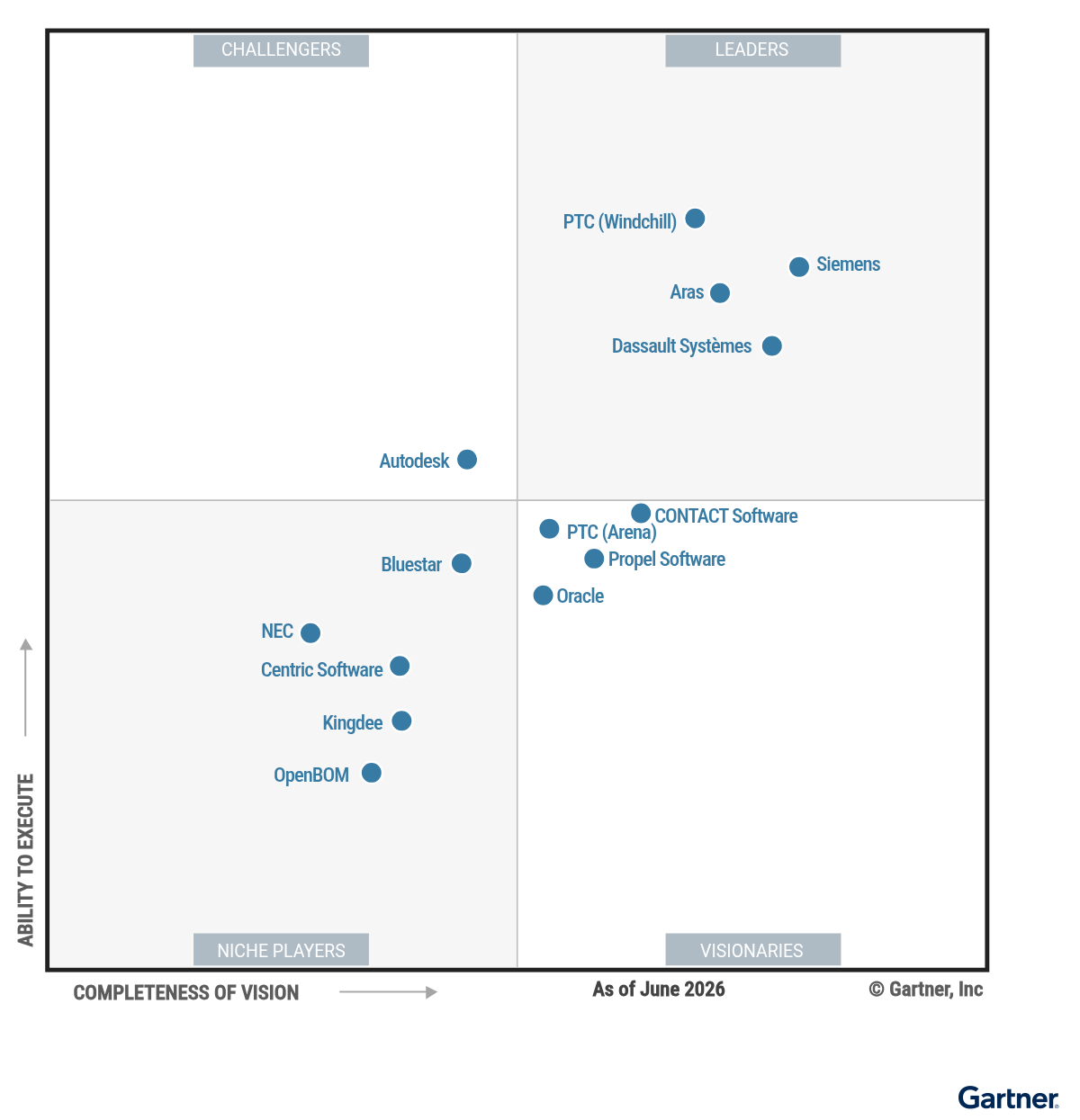
Vendor Strengths and Cautions
Aras
Aras is a Leader in this Magic Quadrant. Its product Aras Innovator is focused on delivering digital-thread-enabled PLM solutions with an open, flexible model-driven architecture that connects product data and processes across the life cycle.
The vendor’s operations are geographically diversified, with a strong direct presence in North America, Western Europe and Japan. Its clients tend to be midsize and large enterprises in sectors such as industrial machinery, shipbuilding, automotive, aerospace and defense (A&D), high-tech electronics, and medical device manufacturing.
Aras is investing in expanding its cloud-based offerings and developing more targeted industry solutions. The vendor is also advancing its InnovatorEdge AI framework, enabling customers to build, deploy and securely govern agentic AI workflows across the digital thread.
- Scalable platform: Customers can adopt Aras incrementally through its freemium Community Edition for evaluation and smaller-scale deployments, enabling a low-risk approach. Aras offers a consistent data model, flexible integration across systems like ERP, MES and CRM, and high configurability supported by a partner ecosystem for tailored application development.
- Governed agentic AI: Aras’ InnovatorEdge AI enables organizations to build, deploy and govern agentic AI workflows directly within the PLM environment, including configuring PLM features. By using contextualized knowledge and information retrieval, the AI framework supports the nuances of PLM, traceability and governance control, offering a risk-managed approach to AI.
- Predictable costs: Aras differentiates through a simple subscription model that avoids functional module-based pricing and supports pricing transparency. Tiered, named-user licenses provide access to core PLM applications, the data platform, low-code tools and managed upgrades. Customers report that this transparency improves cost predictability and flexibility.
- Limited vertical support: Aras remains a horizontal solution that must be configured to meet certain industry-specific needs. Its out-of-the-box, PLM-specific vertical capabilities continue to be less mature than other vendors in this research, even though the vendor is investing in targeted industry packages.
- Limited functional maturity: During Gartner inquiries, clients reveal that Aras’ overall PLM completeness does not always keep pace with its ambitious digital thread and AI vision. Some Aras customers note gaps in end-to-end functional maturity, which lead to additional configuration or partner support to deliver full PLM value.
- Limited manufacturing execution integration: Aras has limited maturity for out-of-the-box MES integrations, requiring custom or third-party solutions to connect engineering with shop-floor operations. Additionally, although Aras provides process-planning capabilities, it is comparatively weaker in advanced model-based continuity across planning and execution.
Autodesk
Autodesk is a Challenger in this Magic Quadrant. Its product Fusion Manage is integrated into its broader Fusion “design, make and build” ecosystem. Autodesk differentiates itself through its ability to bridge Fusion with architecture, engineering and construction (AEC) workflows.
Autodesk leverages its existing customer base to expand its PLM presence globally. Its PLM presence is strongest across consumer products, industrial machinery, building products and fabrication, automotive suppliers, medical devices, and high-tech electronics manufacturing.
Autodesk continues to invest in expanding the offerings of its Fusion platform and is actively evolving PLM by embedding AI tools such as the Autodesk Assistant directly into Fusion Manage.
- Integrated design to build support: Autodesk customers benefit from the integration of PLM within its design, make and build ecosystem. This unifies design, engineering, manufacturability and PLM across its broad software portfolio to improve data continuity and reduce fragmentation between upstream and downstream processes.
- Hybrid on-premises-to-cloud flexibility: Autodesk offers manufacturers at various stages of digital maturity a phased, low-risk transition from on-premises operations to cloud PLM. Through Vault PDM, companies can maintain their heavy mechanical engineering data securely in on-premises deployments. At the same time, they can extend life cycle processes to the cloud via Fusion Manage.
- Rapid deployment: Fusion Manage delivers configurable, out-of-the-box workflows that significantly reduce implementation time, IT overhead and overall cost. This allows manufacturers to deploy the software quickly, achieve measurable business impacts faster and easily scale the solution as their organizations grow. The benefits of rapid deployment extend to connected suppliers and partners for co-developing products.
- Best fit for Fusion platform customers: Autodesk positions PLM as part of the Fusion design, make and build ecosystem that connects data from design, engineering and manufacturing processes, not as a stand-alone offering. Consequently, its strengths are primarily focused on enabling core product development workflows, with less emphasis on independent PLM capabilities.
- Platform cost exposure: Fusion Manage is often sold within Autodesk’s broader Fusion platform, so price increases to the Fusion platform will cascade directly to customers who have Fusion Manage included. This creates an inherited cost escalation risk: Even if the vendor’s PLM product pricing itself remains stable, the cost to access it remains exposed to broader platform pricing changes.
- Best for midmarket needs: Autodesk is primarily positioned for midmarket PLM, prioritizing fast deployment and flexibility over deep, complex PLM capabilities. As a result, Fusion Manage is often seen as a cloud data platform rather than a stand-alone enterprise PLM solution for highly complex industries like A&D and automotive.
Bluestar
Bluestar is a Niche Player in this Magic Quadrant. Its product Bluestar PLM is focused on providing an embedded CAD, PLM and ERP environment natively within Microsoft Dynamics 365. This unifies engineering, manufacturing and supply chain data.
Bluestar operates directly in North America and Europe but also has a global presence via a partner-led network. The vendor caters to customers in sectors such as industrial machinery, medical device manufacturing and automotive supply.
Bluestar is investing in embedded Microsoft Copilot agentic AI capabilities to support product design features, compliance and regulatory management. Its strategy emphasizes automatic cloud updates aligned with Microsoft’s release cadence.
- Native Dynamics 365-centric delivery model: Bluestar PLM is purpose-built for discrete manufacturers operating within the Microsoft Dynamics 365 ecosystem, making it a familiar software suite. By delivering a fully embedded PLM, CAD and ERP experience, it eliminates the need for complex integrations and provides a unified user experience (UX) native to existing Dynamics environments.
- Ecosystem-led viability: Bluestar demonstrates strong operational resilience by leveraging a long-standing strategic partnership with Microsoft and Dynamics partners. This model enables a large installed base worldwide, providing scalable delivery, global reach and long-term stability without relying on a large internal sales or support organization.
- Positive user experience: Customers indicate that Bluestar PLM is easy to implement and administer, supporting predictable and intuitive outcomes. Also, deployments are completed within expected timelines. Its effectiveness is reflected in successful multiphase enterprise rollouts and incremental adoption across distributed lines of business within the same organizations.
- Ecosystem dependency: Bluestar’s business model and operational architecture are natively and exclusively embedded within Microsoft Dynamics 365. The dependency practically rules out Bluestar as a viable platform-agnostic option, making it unsuitable for markets with heterogeneous toolchains.
- Limited market penetration: The vendor relies on a partner-led go-to-market model in certain scenarios and markets through Microsoft Dynamics ecosystems. Hence, it has limited brand recognition and global presence, compared to many other PLM vendors in this Magic Quadrant. This may impact direct engagement, market visibility and consistency of solution positioning.
- Scalability concerns: The vendor’s direct support model is lean and relies on third-party partners for execution in certain regions and engagements. This raises concerns about Bluestar’s ability to scale consistently across regions and compete at larger enterprise levels.
Centric Software
Centric Software is a Niche Player in this Magic Quadrant. It is a subsidiary of Dassault Systèmes but operates independently from its parent company. The vendor’s product Centric PLM focuses on extending PLM beyond engineering, evolving it into a business-centric platform that connects product development, sourcing and commercialization.
Its operations are geographically diversified and its largest presence is in Europe. The vendor’s clients tend to be fast-moving organizations in the consumer electronics, consumer goods, fashion and retail industries.
Centric is investing in expanding its platform connectivity with broader enterprise systems to deepen its footprint in core discrete manufacturing and transitioning to a SaaS-first deployment model. Furthermore, the vendor is enhancing its supply chain co-creation capabilities, adding compliance functionality and embedding AI-driven agents into core product workflows.
- High speed to market: Centric PLM increases speed to market by bridging the gap between product ideation, development and go-to-market execution. Its concept-to-commercialization process capabilities support agility and flexibility over rigidity, and enable manufacturers to make faster product decisions based on real-time market signals related to product performance.
- Cross-functional collaboration: Centric’s role-inclusive PLM platform enables faster alignment across technical and nontechnical teams, reducing handoffs and decision delays. Built-in collaboration with external suppliers — through shared specifications, RFQs and certifications — helps customers improve coordination, shorten cycle times and increase supply chain responsiveness.
- Ease of adoption: Centric provides an intuitive, visually-driven user experience that allows rapid deployment, easy configurability and faster adoption, even for non-PLM users. Additionally, the vendor utilizes a modular pricing structure that helps customers clearly understand their costs as they scale their deployment.
- Limited complex manufacturing coverage: Centric’s industry coverage remains heavily focused on fast-moving consumer goods, electronics and retail, which have shorter product life cycles and higher demand volatility. The platform is not ready to handle the complex and highly engineered products found in sectors such as A&D, automotive or industrial products, including OEMs.
- Limited advanced engineering support: Centric offers limited integration with design and engineering tools needed for modular and multilevel product data and BOM management in discrete manufacturing. Centric’s integration with Dassault Systèmes’ 3DEXPERIENCE (3DX) platform is less mature and less broadly adopted than established engineering-centric PLM integrations.
- Limited contract flexibility: Customer survey indicate that the vendor frequently operates on long-term agreements, such as five-year contracts, with systematic year-over-year price increases. Some customers report that longer-term commercial agreements and predefined pricing structures are less flexible than alternative purchasing models.
CONTACT Software
CONTACT Software is a Visionary in this Magic Quadrant. Its PLM solution CONTACT Elements is broadly focused on delivering a composable system that lets companies build and scale PLM capabilities as needed. It offers an open architecture that integrates PLM, Internet of Things (IoT) and AI to design and operate products along a digital thread.
Its operations are mostly concentrated in Europe and its clients tend to be midsize-to-large enterprises in discrete manufacturing sectors such as automotive, industrial machinery and transportation.
CONTACT is currently investing in expanding its SaaS offerings, deepening its native CONTACT Fourier AI capabilities across the product life cycle, and expanding into the U.S. and Asia/Pacific (APAC) markets through partners and service integrators.
- Composable, open architecture: The platform utilizes open standards such as REST and Open Services for Life Cycle Collaboration (OSLC), and features a fully extensible Python development tool. This allows organizations to flexibly assemble, extend and scale PLM functionalities. The architecture also allows the vendor to embed its integrated intelligence layer across the entire digital thread, instead of “bolting on” isolated AI tools, leading to reliable insights.
- Deployment flexibility: CONTACT Elements operates on the same technology stack regardless of whether it is deployed on-premises, as SaaS or PaaS, or in a hybrid configuration. This architectural consistency, leveraging native DevOps, enables customers to incrementally transition from legacy on-premises environments to the cloud without a disruptive “rip-and-replace” reimplementation.
- Context-driven supplier collaboration: Suppliers operate directly on live, shared product data, such as CAD models and BOMs, from within isolated, virtual workspaces. This embeds external partners into life cycle activities — such as engineering changes and validation tasks — while strict role-based access controls protect the manufacturer’s internal IP. Overall, this leads to accelerated product development, better change accuracy and improved product quality.
- Limited market penetration: Organizations may face challenges scaling or committing to CONTACT for large, multiregion deployments, as its market presence remains concentrated in Europe. Further, the product is closely aligned with specific discrete manufacturing use cases, making it unfamiliar to enterprises operating across diverse industries.
- Challenges in scaling: Some of CONTACT’s customers have reported slower-than-expected progress scaling projects from pilots to production progress. The customers find themselves on a learning curve, and need to design data models and workflows and configure the platform.
- Adaptation issues with UX changes: In the transition from the old user environment to the new user experience, CONTACT has supported the use of both legacy and modern interfaces within the same PLM instance. Some customers have reported difficulties adapting to this dual-environment setup.
Dassault Systèmes
Dassault Systèmes is a Leader in this Magic Quadrant. Its product ENOVIA is best-known for an engineering-centric, model-based approach to product development and PLM. ENOVIA is powered by the 3DEXPERIENCE (3DX) platform, which provides a unified environment for design, simulation, manufacturing and life cycle management.
The vendor has a strong presence across all major global geographic regions. The company’s presence is very strong among large enterprises and OEMs within highly complex discrete manufacturing sectors, particularly A&D, automotive and industrial equipment manufacturing.
Dassault is currently investing in embedding AI through Virtual Companions, linking AI-generated experiences with virtual twins and improved interoperability. It is also advancing Virtual Twin as a Service (VTaaS) via its NVIDIA partnership, and strengthening application life cycle management (ALM) for software-defined products via its ENALEAN acquisition.
- Deep engineering capabilities: Dassault supports complex, engineering-intensive discrete manufacturing industries through its integrated CATIA, SIMULIA and DELMIA portfolio. This helps customers manage detailed product definitions and validate designs earlier. Integrated model-based systems engineering (MBSE) and virtual twin capabilities within PLM improve cross-disciplinary collaboration and reduce late-stage design risk.
- Industry-specific expertise: Dassault leverages its expertise in product development and manufacturing to offer industry-specific PLM solutions, particularly for A&D and automotive industries. The vendor’s dedicated consulting teams help customers apply PLM not only in engineering, but also extend it into manufacturing and execution processes.
- Focus on security and sovereignty: Dassault’s OUTSCALE sovereign cloud infrastructure holds Europe’s highest cloud security certification. Paired with this is an “AI independence” strategy that allows customers to utilize secure, sovereign LLMs without locking their sensitive enterprise data into a single AI provider.
- High implementation complexity: 3DX platform implementations typically require extensive process re-engineering, strict data model alignment and careful limitation of customizations. Customer inquiries indicate that some large enterprises — particularly long-standing Dassault customers with complex legacy environments — struggle to migrate existing tools, data models and in-flight projects into 3DX.
- Unclear value proposition: Dassault’s complex messaging makes it difficult for customers to understand the product’s day-to-day operational value. This can create adoption friction, with some customers expressing hesitation around 3DX due to perceived implementation effort and overall cost.
- Interoperability concerns: During client inquiries, some customers operating in highly heterogeneous environments express concerns about the pressure to adopt Dassault’s full platform stack, limiting flexibility in mixed-vendor environments. While integrations are available, effective interoperability often depends on remaining within the native 3DX data model.
Kingdee
Kingdee is a Niche Player in this Magic Quadrant. Its product Kingdee AI PLM is a data-driven life cycle management platform that enables strong PLM and ERP integration and embedded AI capabilities. It also supports an integrated product development (IPD) framework for R&D.
The vendor’s operations are mostly focused in China, and it is also present in Southeast Asia to support overseas Chinese enterprises and local manufacturers. Its clients tend to be small and midsize enterprises in sectors such as high-tech electronics, automotive parts and industrial equipment manufacturing.
The vendor is investing in Kingdee AI Cosmic platform to deepen AI-native agent capabilities in PLM. It is also expanding core capabilities in MBSE, 3D collaboration and ALM integration to support software-defined products.
- Product capabilities: Kingdee emphasizes integrated product development and commercialization by natively connecting PLM with its ERP system, supporting design, manufacturing and supply chain workflows. Its IPD framework enables top-down engineering, reducing manual handoffs, while embedded AI assistants streamline routine tasks such as requirements analysis and knowledge reuse.
- Flexible adoption and localized delivery: Kingdee offers flexible SaaS subscription and preconfigured industry templates to lower adoption barriers. Also, strong partner ecosystems in China, combined with native support for local IT infrastructure and regulatory requirements, enable faster, more predictable deployments while addressing China-specific compliance needs.
- Flexible cloud-native architecture: Kingdee AI PLM’s SaaS model has a cloud-native, microservices-based architecture, which supports scalability and flexible deployment across public, private and hybrid deployments. It provides features such as zero-downtime upgrades and elastic storage for large datasets to ensure optimal performance for distributed engineering teams as usage scales.
- Limited global reach: Kingdee’s market presence and delivery model are primarily focused on China and some parts of Southeast Asia. Its international growth largely follows Chinese manufacturers expanding into nearby markets such as Vietnam, Thailand and Indonesia. Therefore, customers need to exercise caution while expanding PLM deployments outside APAC.
- Uneven product capacities: Several Kingdee PLM capabilities, particularly those related to UI/UX, are still maturing compared with best-in-class PLM platforms. At present, customers may encounter gaps in advanced use cases such as 3D data integration, increasing reliance on third-party tools for complex engineering needs.
- ERP-platform dependencies: Kingdee’s PLM offering is preferred with its ERP platform, and therefore it is most effective for existing Kingdee ERP customers. Organizations using other enterprise systems may find it harder to realize full PLM value, which may limit flexibility for heterogeneous IT environments.
NEC
NEC is a Niche Player in this Magic Quadrant. Its PLM product Obbligato delivers an enterprisewide PLM platform centered on integrated BOM management, connecting the engineering, production, supply, service and sustainability chains.
The vendor’s operations are mostly focused in Japan, and its clients tend to be midsize-to-large enterprises in the machinery, precision electrical equipment and electronic component manufacturing sectors. NEC’s global expansion is highly conservative and is primarily aimed at supporting the overseas sites of its existing Japanese customers.
NEC is currently enhancing its architecture to improve scalability, integrating GenAI supported by Obbligato AI for practical decision support, and expanding its capabilities in environmental compliance and sustainability management.
- Comprehensive data platform: The platform connects data across what NEC calls the “five chains” of a manufacturing business — engineering, supply, production, service and sustainability — to break down departmental silos. Optimizing these interconnected domains enables more holistic and effective decision making for customers.
- Integrated data architecture: Obbligato centrally manages multiple BOM types concurrently with bills of process (BOPs) data on a single platform. This improves data consistency and the accurate propagation of design changes to site-specific manufacturing, reducing possibilities of rework and manual errors.
- AI capabilities: NEC embeds GenAI into core Obbligato engineering workflows, enabling faster search, summarization and cross-referencing of technical documents. By interpreting charts and tables and linking them to source content, the AI feature improves the accuracy and usability of engineering information.
- Limited market penetration: NEC’s go-to-market focus on serving its existing customer base in Japan limits its ability to scale and support new engagements in other regions. Prospective buyers should consider impacts on expansion, execution speed and broader market reach.
- User interface complexity: The platform’s deep menu structures and dense navigation negatively impact usability and user adoption. Customers report that Obbligato’s user interface becomes complex as it accommodates diverse and specialized business processes. This leads to increased complexity, slower user adoption and higher training effort for customers.
- High upgrade cost: Customer survey feedback indicates that Obbligato’s version upgrades can be expensive and difficult, especially in heavily customized environments where legacy configurations must be retained. Reliance on add-on development and integration services increases technical debt, which inflates cost.
OpenBOM
OpenBOM is a Niche Player in this Magic Quadrant. Its PLM product, OpenBOM, is a cloud-native, multitenant SaaS solution that provides structured product data management, multiview BOMs and a connected digital thread linking engineering with procurement and manufacturing.
The vendor’s operations are geographically diversified, and its clients tend to be small enterprises across sectors such as machinery, electronics, robotics and consumer products manufacturing.
OpenBOM is currently investing in its graph-based product memory architecture and agentic AI capabilities, and evolving its hybrid pricing model to include usage-based consumption for AI features.
- Scalable architecture: OpenBOM enables organizations to scale usage as needs grow, supported by its intuitive user interface, lightweight data formats and UX/UI design that create a low entry barrier for smaller teams moving away from spreadsheets. Its SaaS architecture further eliminates the need for on-premises IT and supports self-service onboarding.
- Advanced data model: OpenBOM’s advanced data model enables it to natively capture product data, relationships, context and dependencies across content domains. As users perform their day-to-day work, a digital thread is created automatically, without requiring additional effort to define, link or maintain relationships across product information.
- Interoperability and openness: OpenBOM provides a CAD-agnostic environment with out-of-the-box integrations for widely used mechanical and electrical CAD tools, and represents software artifacts through its xBOM structure. This openness is reinforced by REST APIs, webhooks and event-driven integrations that support custom applications, automated data synchronization and tailored business logic.
- Limited enterprisewide support: While OpenBOM is highly effective for its target small-sized enterprise market, it has limitations in overall functionality and support. Organizations with complex, enterprisewide PLM needs may find that OpenBOM’s out-of-the-box capabilities are limited without extensive dependence on its integration ecosystem.
- Lack of extended modules: OpenBOM does not provide extended functional modules, such as a quality management system (QMS) or product portfolio management, as part of its core PLM offering. Organizations requiring robust quality processes or project management functions will need to rely on integrations with external third-party QMS solutions.
- Lack of industry-specific support: OpenBOM provides a horizontal PLM solution with limited out-of-the-box support for industry-specific requirements. Organizations in regulated or specialized sectors will face gaps in vertical templates, compliance workflows and tailored data models, requiring additional customization or third-party solutions.
Oracle
Oracle is a Visionary in this Magic Quadrant. Its Oracle Fusion Cloud PLM delivers a cloud-based commercialization platform that establishes a digital thread connecting product definition to sourcing, manufacturing, quality and compliance.
Oracle’s PLM clients are mostly based in North America and mainly consist of midsize and large enterprises in discrete manufacturing sectors such as high-tech, medical devices and industrial products.
Oracle is investing in embedding AI agents directly into PLM workflows to address targeted use cases while strengthening core PLM capabilities. In parallel, the vendor is enhancing the user experience through its Redwood design framework to streamline cross-functional navigation, including support for closed-loop quality management across the product life cycle.
- Enterprisewide product strategy: Oracle’s product strategy expands PLM beyond traditional engineering by natively integrating with Oracle ERP, SCM and CX applications. This unified digital thread eliminates data silos, allowing organizations to streamline product commercialization and directly link early design decisions to manufacturing readiness and supply chain impacts.
- Embedded AI: Oracle embeds AI directly into the Fusion Cloud platform, enabling it to run natively on governed PLM data. Organizations can utilize specialized AI capabilities, progressing toward AI agents, to execute outcome-driven workflows. For example, these capabilities can autonomously calculate optimal engineering change cut-in dates using live inventory and open purchase order data.
- Outcome-driven sales strategy: Oracle aligns its sales approach with enterprise priorities by positioning PLM as a product commercialization platform. This framing emphasizes business outcomes, such as speed to market, rather than treating PLM solely as an engineering product data management tool.
- Limited market focus: Oracle’s current market focus does not fully address diverse and evolving requirements of some global discrete manufacturing organizations. The platform prioritizes select industry verticals such as high-tech and medical devices, leaving gaps in industries requiring advanced capabilities that support multi-industry use cases such as digital engineering, model-based enterprise (MBE) and software-defined products.
- Migration challenges: Customer inquiries show that users of Oracle’s soon-to-be retired Agile PLM are uncertain about transitioning to Oracle Fusion Cloud PLM, a more natural consideration. Some customers cite concerns about feature parity, readiness and highly engineered product-specific capabilities compared to alternative PLM solutions. As a result, these customers continue to evaluate alternative vendors rather than committing to migration.
- Non-Oracle integration complexity: Oracle Fusion Cloud PLM is optimized for integration within the Oracle Fusion ecosystem and has limited maturity in connecting with wider third-party authoring tools, which range from design to simulation to application life cycle. Organizations with heterogeneous toolchain requirements will need to evaluate and work with Oracle partners to address specific integrations.
Propel Software
Propel is a Visionary in this Magic Quadrant. Its product Propel PLM serves as a core component of the vendor’s broader product value management (PVM) platform, which unifies PLM, quality management and product information management (PIM).
Its operations are mostly focused in North America and its clients tend to be midsize organizations in medical devices, life sciences, high-tech electronics and industrial equipment.
Propel is focusing its future investments on expanding its embedded AI capabilities. This includes deriving compliance checks from unstructured documents, such as standard operating procedures. Additionally, the vendor is working on advanced product variant management and software life cycle support. It is improving cross-domain, multi-CAD collaboration by expanding its DesignHub integration environment.
- Unified platform: Propel provides a unified, composable platform that natively converges PLM, QMS and PIM. This shared data model enables organizations to create a digital thread across engineering, quality and marketing functions without custom code, and preserves upgradeability.
- Quick time to value: The platform’s cloud-native architecture, low-code configurability and intuitive interface support faster implementation and onboarding. Simplified legacy migration services and a transparent licensing model help organizations reduce deployment effort and accelerate return on investment.
- Flexible role-based agentic AI capabilities: Users can access Propel’s role-based AI agents directly within the PLM environment or through collaboration tools such as Slack and Microsoft Teams. This allows enterprises to deploy and extend prebuilt agents or create custom workflows using low-code tools.
- Narrow industry coverage: Propel primarily targets specific niche industries such as medical devices, high-tech electronics and industrial equipment. The platform has limited native CAD integrations and advanced PLM capabilities for supporting complex and highly engineered products in discrete manufacturing sectors such as A&D, automotive OEMs and large industrial machinery.
- Dependency on Salesforce: Customers looking for a platform-agnostic PLM back-end architecture will face reduced flexibility due to Propel’s reliance on Salesforce as its core platform. They may also encounter a narrower global integrator ecosystem, limiting support for large-scale or geographically diverse deployments.
- Limited market penetration outside North America: Propel’s direct operations, sales, and support footprint remain heavily concentrated in North America, resulting in limited adoption in other regions. As a result, global enterprises may typically need to engage third-party system integrators to support deployments in other regions.
PTC (Arena)
PTC (Arena) is a Visionary in this Magic Quadrant. Its product Arena is a cloud-native PLM and QMS platform that manages product data, BOMs and change processes for new product introduction.
Its operations are geographically diversified and its clients tend to be small-to-midsize enterprises in discrete manufacturing sectors such as high-tech, and regulated industries such as medical devices.
PTC is investing in Arena’s AI capabilities, Supply Chain Intelligence (SCI) and integrations, such as the cloud-native Onshape-Arena Connection, to improve user productivity and supply chain resilience.
- Regulated industry focus: Arena targets high-tech, medical device and A&D component manufacturers by natively embedding quality management and regulatory compliance directly into product life cycle workflows. This unified approach also eliminates disconnected processes and accelerates time to value for organizations migrating from legacy systems.
- Total cost of ownership (TCO): Organizations can benefit from a low TCO through Arena’s SaaS platform and simplified licensing model. Its architecture supports faster and easier deployment, continuous updates and high availability.
- Supply chain connectivity: The vendor’s market strategy emphasizes secure, role-based collaboration that aligns internal teams and external suppliers around a single source of product truth. Arena enables procurement and engineering teams to proactively identify component risks and make data-driven sourcing decisions early in the design phase.
- Advanced-engineering limitations: The platform does not natively provide full MBE or simulation-driven digital twin capabilities. Organizations with complex mechanical CAD requirements must rely on third-party integrations, as Arena is not positioned as an MBSE-centric tool.
- Lagging AI execution: Arena PLM’s AI-assisted features, while maturing, are basic and nonagentic, and are limited primarily to searches. Organizations seeking advanced AI functionality — such as agentic AI to automate multistep product life cycle and quality workflows — will find the platform’s intelligence capabilities currently restricted to user assistance.
- Narrow vertical focus: The vendor maintains a concentrated focus on the high-tech, cleantech and medical device sectors, limiting its broader industry appeal. Organizations operating outside these specific discrete manufacturing markets may find a lack of preconfigured industry templates and tailored implementation guidance.
PTC (Windchill)
PTC (Windchill) is a Leader in this Magic Quadrant. Its PLM software Windchill provides a governed system of record for product data, acting as the digital thread backbone connecting engineering, software development and manufacturing value streams.
The vendor’s operations and customers are geographically diversified. It caters to midmarket and large enterprise manufacturers in the A&D, automotive, electronics, industrial and medical device sectors.
PTC is investing in its SaaS offering Windchill+ as a scalable cloud platform designed to support midsize-to- large enterprises with complex product development needs. This differentiates it from the vendor’s other PLM product, Arena, which is primarily optimized for midmarket and lower-complexity use cases. Beyond embedding AI features, its future focus includes modernizing the UI/UX, strengthening ALM connections and enhancing support for supply chain.
- Complex-industry focus: Windchill supports complex manufacturing industries by connecting mechanical and software engineering. It integrates PLM capabilities and its proprietary ALM software, Codebeamer, to enable a continuous digital thread that improves hardware and software traceability. This helps customers better manage complexity and change across the product life cycle.
- Operational reliability: Customer survey and client inquiries highlight PTC’s reliable execution, noting that Windchill’s long-term operational stability aligns well with its market messaging. By staying focused on its core PLM strengths and emphasizing practical AI use cases — such as part reuse and change impact analysis — PTC delivers tangible value that improves everyday engineering workflows.
- Enterprise scalability: Windchill supports large-scale, global deployments with long-term operational stability and enterprise-grade licensing through its newly introduced ePLM model and organizational change management support. Standardized, role-based licensing simplifies user expansion and governance across complex organizations.
- Moderate pace of innovation: Customer survey and client inquiries show that some view Windchill’s pace of platform modernization as slower than peers, particularly around core AI-ready data architecture and agentic AI capabilities. While PTC is addressing these areas, customers express expectations for faster execution and clearer progress.
- Lacks intuitive UI/UX: Some customers find Windchill’s user interface and workflows unintuitive, particularly for new or occasional users, relative to modern enterprise applications. These usability limitations may slow nonengineering adoption and broader value realization, although PTC continues to invest in UI/UX improvements.
- Packaging and value complexity: Client inquiries indicate that some organizations find aligning licensing with business value difficult due to PTC’s evolving packaging and transition to Windchill+ and ePLM. This lack of clarity in sales execution can make it harder for organizations to understand costs up front, creating challenges when planning renewals or considering a move to SaaS.
Siemens
Siemens is a Leader in this Magic Quadrant. Its product named Teamcenter provides end-to-end product life cycle management built on a comprehensive digital thread that seamlessly connects mechanical, electrical, software, manufacturing and service domains.
The vendor’s operations are geographically diversified. Its clients tend to be midsize-to-large enterprises operating in complex, regulated discrete manufacturing sectors, such as A&D, automotive, high-tech, semiconductors and medical device manufacturing.
Siemens is currently investing heavily in industrial AI, including Teamcenter Copilot and digital thread agents. It is also expanding its scalable SaaS and hybrid PLM offerings and industry-specific solutions.
- Integrated portfolio clarity: Customers benefit from Siemens’ alignment with enterprise PLM buying patterns through an account-based approach that engages cross-functional stakeholders across IT, engineering and operations. The consolidation of capabilities under its digital thread and manufacturing portfolios helps improve offering clarity, making PLM solutions easier to evaluate and assess.
- Market-driven innovation: Siemens demonstrates strong market responsiveness. Recent releases have introduced AI-assisted productivity and life cycle intelligence capabilities, especially for electronics and software-defined products. The integration of advanced simulation and analytics while maintaining openness strengthens support for digital twins. Additionally, client feedback highlights steady improvements to usability.
- Overall viability: Siemens demonstrates steady customer growth and sustained technology investment, supporting a credible long-term vision. Customer perceptions of Siemens as a reliable long-term partner further indicate its viability, particularly for highly regulated industries.
- Evolving sales and pricing complexity: Siemens’ shift to subscription and SaaS models has introduced unpredictable pricing changes in some cases, particularly for customers migrating from perpetual licenses. Its highly modular portfolio and licensing structure can also increase buyer complexity, requiring careful contract review to fully understand entitlements and renewal costs.
- Execution challenges: During Gartner inquiries, some clients report challenges in end-to-end digital thread execution for complex multi-system integration scenarios, particularly in the effort required to integrate PLM with ALM, ERP and MES. As a result, large enterprise deployments often require extensive configuration, customization and iterations, increasing implementation effort and time to achieve intended outcomes.
- Disconnected partnership models: Despite offering a broad solution portfolio supported by dedicated technology and implementation partners, the platform’s software solutions and partner delivery models do not always come together cohesively. As a result, customers may need to coordinate across Siemens and multiple partners rather than relying on Siemens to fully own PLM-led solutions and outcomes end-to-end.
Inclusion and Exclusion Criteria
To qualify for inclusion, each vendor needed to:
- Demonstrate financial stability and market relevance by meeting specific financial and operational thresholds. The vendor needed to be in the PLM discrete software business for at least five years or demonstrate a revenue growth rate of minimum 10% year over year, particularly over the prior two fiscal years. In relation to the company’s overall revenue, the specific contribution of PLM business revenue from the discrete manufacturing market must be significant and growing. The vendor should have acquired 10 net new customers within the last 18 months and maintained a retention ratio of 50% or above. There must be a robust, PLM-centric growth roadmap that ensures ongoing business viability.
- Deliver and/or support at least five out of the seven capabilities given below, including ease of implementation across a distributed architecture:
- Product data management
- Product portfolio management
- Product quality and cost management
- Digital thread
- AI-assistants and/or agents
- Architectural composability
- Deployment ease and scalability
- Support and enable most and/or all the use cases referenced in Critical Capabilities. They include:
- Product innovation and introduction
- Software-defined products
- Regulatory and product compliance
- Product life cycle intelligence
- Supply chain collaboration
- Model-based enterprise
- Have a minimum of 10 unique customers operating the generally available (GA) platform in production, preferably spanning multiple geographic regions such as North America, South America, Europe, APAC, the Middle East or Africa. There must be a dedicated customer support and services portal serving the regions.
- Have functional and technical maturity that provides the mandatory and/or common features mentioned in the PLM market definition.
- Integrate with or provide solutions for at least two of the following: authoring design, engineering and documentation tools, and support integrations with adjacent enterprise systems, such as ERP, MES, CRM and IoT.
- Demonstrate a proven and active market presence by maintaining at least 20 customers in the discrete manufacturing industry sectors in a go-live production environment. Deployment metrics had to evidence recent market activity, specifically tracking the number of successful deployments over the prior 12 months and their growth rate.
- Serve a minimum of two industry sectors (unless demonstrating exceptional growth as a single-industry niche provider). The relevant industry segments for this evaluation include established sectors such as motor vehicles and parts (automotive and suppliers), A&D, and industrial machinery and equipment. Additional sectors include expanding and specialized verticals such as medical devices and bioengineering, utilities, renewable energy, durable consumer goods, ship and rail, urban mobility solutions, semiconductors, fabricated metal products, computer and electronic products, electrical equipment, and appliances and components.
Honorable Mentions
The providers that are most relevant to our clients were selected for evaluation in this Magic Quadrant. However, the decision not to evaluate a provider does not mean that the provider lacks viability. The following are noteworthy providers not included in the formal analysis. These providers could be appropriate for clients, contingent on their requirements:
ComplianceQuest: ComplianceQuest may be a fit for clients in regulated discrete industries such as medical devices because its Salesforce-native ProductQuest (PLM and Design Quality products) embeds quality, compliance and supplier management directly into the product life cycle. It delivers a closed-loop digital thread across product BOMs, requirements, design controls and quality processes, enabling traceability and quality intelligence through its CQ.AI capabilities.
Infor: Infor PLM for Discrete may be of interest to clients already invested in Infor CloudSuite products. This is due to its tight ERP integration, with multi-BOM views and data management, rapid deployment for engineer-to-order and project-based manufacturing, and roadmap focus on deeper ERP and CPQ alignment, sustainability data, and incremental AI-assisted capabilities.
SAP: SAP’s solutions for PLM (discrete manufacturing) may be of interest to SAP-centric customers seeking tighter product data management, product configuration, and engineering-to-manufacturing integration aligned with SAP ERP, BTP and supply-chain suite.
Evaluation Criteria
Ability to Execute
Product/service: Depth, quality, and maturity of PLM capabilities, including PDM, PPM, digital thread, quality and cost management, AI assistants, composability, deployment ease and scalability across defined use cases in the companion the Critical Capabilities document.
Overall viability: Financial health, customer growth, recurring revenue, investment continuity and strategic importance of PLM within the company portfolio.
Sales execution/pricing: Effectiveness of presales activities, deal management, pricing transparency, negotiation, channel execution and management of shifts to subscription or usage-based models.
Market responsiveness/record: Ability to respond to market shifts, customer needs, cloud adoption, composability, interoperability, AI readiness and digital thread execution.
Marketing execution: Effectiveness of branding, awareness, thought leadership and market influence supporting PLM adoption and adjacent market expansion.
Customer experience: Quality of engagement, support, account management, user communities, SLAs and responsiveness to voice-of-the-customer feedback.
Operations: Organizational effectiveness, delivery reliability, support processes, SLAs, escalation paths and operational scalability.
Ability to Execute Evaluation Criteria
| Evaluation Criteria | Weighting |
|---|---|
Product or Service | High |
Overall Viability | High |
Sales Execution/Pricing | High |
Market Responsiveness/Record | Medium |
Marketing Execution | Low |
Customer Experience | High |
Operations | Medium |
Source: Gartner (June 2026)
Completeness of Vision
Market understanding: Ability to understand customer needs, solve real business problems with PLM, and articulate how PLM supports evolving product development, manufacturing and service models.
Marketing strategy: Clear, differentiated, and consistent messaging that communicates PLM value, scope and differentiation; alignment with market disruptions such as AI, tariffs and economic shifts.
Sales strategy: Effectiveness of direct and indirect sales models, partnerships, pricing communication, licensing clarity and domain-specific selling approaches.
Offering (product) strategy: Product differentiation, alignment with critical capabilities and use cases elaborated in the companion Critical Capabilities document, architectural direction, product licensing strategy, and the ability to meet current and future PLM requirements.
Business model: Soundness and adaptability of the vendor’s business model amid economic change and transformation-driven investments.
Vertical/Industry strategy: Depth of focus, resource alignment, skills and solution tailoring for specific industries and segments.
Innovation: Investment and execution in organic innovation, partnerships and M&A to improve time to market and competitive positioning.
Geographic strategy: Ability to scale offerings, support and go-to-market execution across regions via direct presence or partners.
Completeness of Vision Evaluation Criteria
| Evaluation Criteria | Weighting |
|---|---|
Market Understanding | High |
Marketing Strategy | Low |
Sales Strategy | Medium |
Offering (Product) Strategy | High |
Business Model | Medium |
Vertical/Industry Strategy | Medium |
Innovation | Medium |
Geographic Strategy | Low |
Source: Gartner (June 2026)
Quadrant Descriptions
Leaders
Leaders demonstrate broad support for all or most critical capabilities across most PLM use cases. They have high market awareness and responsiveness, high market penetration, strong market momentum, and a clear, long-term strategic vision and roadmap for growing their PLM software business. They are covering wider discrete manufacturing sectors, including new market segments, and the PLM revenue is a significant part of their business. Their strategy and capabilities support a wide swath of the product life cycle starting from product concept and design to supply chain, manufacturing and extended life cycle phases such as services and maintenance. They are operating in complex manufacturing environments with a large number (exceeding thousands) of PLM users.
Challengers
Challengers provide robust, proven core PLM functionality and demonstrate strong execution within defined discrete manufacturing segments, but generally lack the breadth, depth and innovation leadership of Leaders — especially in cohesive long-term vision and advanced PLM capabilities and across multiple discrete manufacturing industries. Their emphasis is typically on selected markets, regions or PLM domains aligned to existing strengths, rather than on shaping market direction through forward-looking strategies that anticipate noncustomer needs or competitive disruption. Additionally, Challengers often trail Leaders and Visionaries in global sales and marketing effectiveness, geographic scale, industry-specific solutions, and overall market visibility and influence.
Visionaries
Visionaries articulate compelling strategic directions or introduce differentiated innovation in one or more PLM functional areas — such as compliance and regulatory management, cloud-native and SaaS architectures, specialization in niche markets, or the advancement of PLM adoption in emerging industries. They demonstrate a strong understanding of where the PLM market is heading and how technology can enable new value. However, Visionaries may not yet deliver the full breadth of functionality, operational maturity or go-to-market execution required for broad adoption. Gaps in sales, marketing reach, marketing effectiveness, service and support capabilities, or partner and business ecosystems can constrain their ability to scale consistently, limiting overall market presence relative to Leaders.
Niche Players
Niche Players deliver a foundational set of PLM capabilities and typically focus on stabilizing or incrementally advancing their offerings for well-defined segments of the discrete manufacturing market. Their solutions are often tailored to organizations of a specific size and scope, particular industries or select geographic regions. Compared with Leaders and Visionaries, vendors in this quadrant have limited breadth and depth of advanced PLM capabilities. In addition, constrained financial, operational or organizational resources — along with less mature go-to-market strategies — limit their ability to execute at scale, resulting in a more modest overall market presence relative to Leaders and Challengers.
Context
This Magic Quadrant for PLM Software in Discrete Manufacturing Industries replaces prior Market Guides, reflecting stronger client demand for clear, comparative evaluations of PLM vendors. PLM adoption has evolved well beyond its origins in product data management (PDM). While it remains foundational for traditional discrete manufacturing, it is increasingly adopted in adjacent sectors such as process industries, shipbuilding, energy infrastructure, and niche defense and space industries to progress and manage large-scale digital transformation.
This Magic Quadrant evaluates only stand-alone PLM platforms and excludes vendors offering limited PDM, CAD data management or document management solutions. All assessments reflect vendor capabilities at the time of publication, recognizing that both vendor offerings and the market continue to evolve.
Although AI capabilities within PLM platforms remain early in maturity, several PLM vendors are investing in or introducing AI features intended to simplify system configuration, automate data mapping and shorten implementation timelines. However, PLM platforms manage complex information models that tightly interrelate 3D designs, drawings, documents, requirements, parts and extensive attribute data. This inherent complexity constrains how quickly AI can be embedded in a meaningful, production-ready manner. As a result, customer expectations for AI-enabled PLM currently outpace delivered capabilities. Buyers increasingly look for AI outcomes grounded in deep engineering and manufacturing domain expertise, particularly to address long-standing challenges within authoring tools such as CAD and simulation. At the same time, they also expect continued progress in PLM architecture, scalability and core functional innovation that will define the next phase of the market.
To that end, as leaders responsible for leading PLM initiatives and projects, you should:
- Understand the rationale behind vendor placement and scoring by carefully studying and reviewing the full range of factors in the‘Evaluation Criteria section that determines each vendor’s Ability to Execute and Completeness of Vision.
- Complement vendor positioning with detailed product and service evaluation for key differentiating use cases by using this Magic Quadrant research in conjunction with the companion Critical Capabilities research.
- Ensure accurate interpretation of this Magic Quadrant by applying Gartner’s definitions of Completeness of Vision and Ability to Execute, rather than narrowly mapping them to product vision and market share, respectively.
As you build your business case and requests for proposals, factor in the time, cost and complexity of integrating your PLM platform with other core enterprise systems. Annual subscription-based pricing is becoming the standard in this market. Pricing can also be impacted by other factors, such as the need for add-on features extending or complementing PLM capabilities. These may include application (software) life cycle management, quality management, product portfolio management and configuration life cycle management.
Market Overview
The Scope of PLM Software Is Widening
The product life cycle management (PLM) market is evolving from traditional systems that primarily manage product data with limited, extendable capabilities into platforms that actively drive decisions and business outcomes. Today, most PLM buyers expect the system to function as a central product master data backbone, with robust, native capabilities that bridge the gap between PLM’s historical promise and real-world execution.
To close this gap, modern PLM solutions now support broader business needs beyond engineering and have moved into procurement, manufacturing, commercialization and service. This shift is driven by increasing product complexity, especially with the rise of software-defined products that combine mechanical, electrical and software components. At the same time, organizations are dealing with supply chain disruptions and stricter regulatory requirements, which require better visibility, traceability and coordination across the product life cycle.
Market Shifts
The market continues to see steady growth, with strong investment from both large enterprise vendors and newer players targeting midmarket segments. While large vendors are growing at moderate rates, smaller and more specialized vendors are experiencing faster growth, reflecting increasing demand across different customer segments. However, as adoption grows, buyers are experiencing rising software costs, making it important to carefully evaluate pricing models and long-term total cost.
A major shift in the market is the move from traditional on-premises deployments to cloud-based and SaaS platforms. These solutions are expected to offer faster deployment, automatic updates and lower infrastructure requirements, making PLM more accessible, especially for small and midsize organizations that previously found it too complex or expensive. Vendors are also introducing AI-enabled and low code capabilities along with preconfigured templates to simplify implementation and reduce customization effort.
PLM is increasingly being integrated with other enterprise systems such as CRM, ERP, MES, ALM and QMS to enable a connected digital thread. This integration helps organizations improve collaboration, ensure data consistency and make better decisions across functions. However, achieving seamless integration across these systems remains a key challenge and an important evaluation factor for buyers.
AI is gradually becoming a core capability in PLM platforms. Vendors are embedding AI to automate processes such as change impact analysis, part matching and data navigation through conversational interfaces. Going forward, AI is expected to evolve into more advanced, agent-driven capabilities that can automate cross-functional workflows and provide intelligent recommendations, making it an important consideration in PLM selection.
At the same time, supply chain resilience and sustainability are becoming critical priorities. Modern PLM solutions incorporate supplier collaboration tools, real-time risk insights and capabilities to track materials, carbon footprint and compliance requirements. This allows organizations to design products that are not only cost-effective and high-performing but also compliant with regulations and optimized for sustainability and life cycle management.
Overall, the PLM market is moving toward more connected, intelligent and cloud-based platforms. For buyers, this means greater opportunities to improve efficiency and innovation, but also a need to carefully assess solution fit, integration capabilities, cost structure and long-term scalability to ensure alignment with business requirements.
Ability to Execute
Product/Service: Core goods and services offered by the vendor for the defined market. This includes current product/service capabilities, quality, feature sets, skills and so on, whether offered natively or through OEM agreements/partnerships as defined in the market definition and detailed in the subcriteria.
Overall Viability: Viability includes an assessment of the overall organization's financial health, the financial and practical success of the business unit, and the likelihood that the individual business unit will continue investing in the product, will continue offering the product and will advance the state of the art within the organization's portfolio of products.
Sales Execution/Pricing: The vendor's capabilities in all presales activities and the structure that supports them. This includes deal management, pricing and negotiation, presales support, and the overall effectiveness of the sales channel.
Market Responsiveness/Record: Ability to respond, change direction, be flexible and achieve competitive success as opportunities develop, competitors act, customer needs evolve and market dynamics change. This criterion also considers the vendor's history of responsiveness.
Marketing Execution: The clarity, quality, creativity and efficacy of programs designed to deliver the organization's message to influence the market, promote the brand and business, increase awareness of the products, and establish a positive identification with the product/brand and organization in the minds of buyers. This "mind share" can be driven by a combination of publicity, promotional initiatives, thought leadership, word of mouth and sales activities.
Customer Experience: Relationships, products and services/programs that enable clients to be successful with the products evaluated. Specifically, this includes the ways customers receive technical support or account support. This can also include ancillary tools, customer support programs (and the quality thereof), availability of user groups, service-level agreements and so on.
Operations: The ability of the organization to meet its goals and commitments. Factors include the quality of the organizational structure, including skills, experiences, programs, systems and other vehicles that enable the organization to operate effectively and efficiently on an ongoing basis.
Completeness of Vision
Market Understanding: Ability of the vendor to understand buyers' wants and needs and to translate those into products and services. Vendors that show the highest degree of vision listen to and understand buyers' wants and needs, and can shape or enhance those with their added vision.
Marketing Strategy: A clear, differentiated set of messages consistently communicated throughout the organization and externalized through the website, advertising, customer programs and positioning statements.
Sales Strategy: The strategy for selling products that uses the appropriate network of direct and indirect sales, marketing, service, and communication affiliates that extend the scope and depth of market reach, skills, expertise, technologies, services and the customer base.
Offering (Product) Strategy: The vendor's approach to product development and delivery that emphasizes differentiation, functionality, methodology and feature sets as they map to current and future requirements.
Business Model: The soundness and logic of the vendor's underlying business proposition.
Vertical/Industry Strategy: The vendor's strategy to direct resources, skills and offerings to meet the specific needs of individual market segments, including vertical markets.
Innovation: Direct, related, complementary and synergistic layouts of resources, expertise or capital for investment, consolidation, defensive or pre-emptive purposes.
Geographic Strategy: The vendor's strategy to direct resources, skills and offerings to meet the specific needs of geographies outside the "home" or native geography, either directly or through partners, channels and subsidiaries as appropriate for that geography and market.