Magic Quadrant for Warehouse Management Systems
29 April 2026 - ID G00834211 - 119 min read
By Simon Tunstall, Rishabh Narang, and 1 more
WMS vendors are competing to resolve critical market demands like cost reduction, automation/robotics and AI support, usability, adaptability and ease of deployment. Supply chain technology leaders can use this research to understand the current state of the WMS market and gain vendor insight.
Market Definition/Description
Gartner defines a warehouse management system (WMS) as a software application that helps manage and intelligently execute the operations of a warehouse, distribution center (DC) or fulfillment center (FC).
WMS operations natively exploit mobile devices along with bar codes and potentially RFID or other scanning/sensing technologies, to form the transactional foundation of warehouse management. This enables efficiencies of directed work activity (optimization) and the delivery of accurate information in near real time. Core WMS capabilities address, among others, the needs to receive, put away, store, count and pick, pack and ship goods. Gartner also includes additional integrated functionality offered by WMS providers beyond core WMS. These extended WMS capabilities can include more advanced capabilities, such as managing labor or optimizing the locating of inventory within a facility.
Mandatory Features
- Receiving
- Inspection/quality
- Put-away
- Cross-docking
- Stock locating
- Inventory management
- Location management
- Replenishment
- Order allocation
- Picking
- Wave planning/management
- Staging
- Packing
- Truck loading
- Manifesting
- Cycle counting
- Shipping
- Automated material handling equipment (MHE) interfaces
Common Features
- Workforce/labor management
- Task interleaving
- Slotting
- Yard management
- Dock appointment scheduling
- Voice picking
- Parcel manifesting
- Value-added services, such as light manufacturing/kitting
- Third-party logistics (3PL) billing
Magic Quadrant
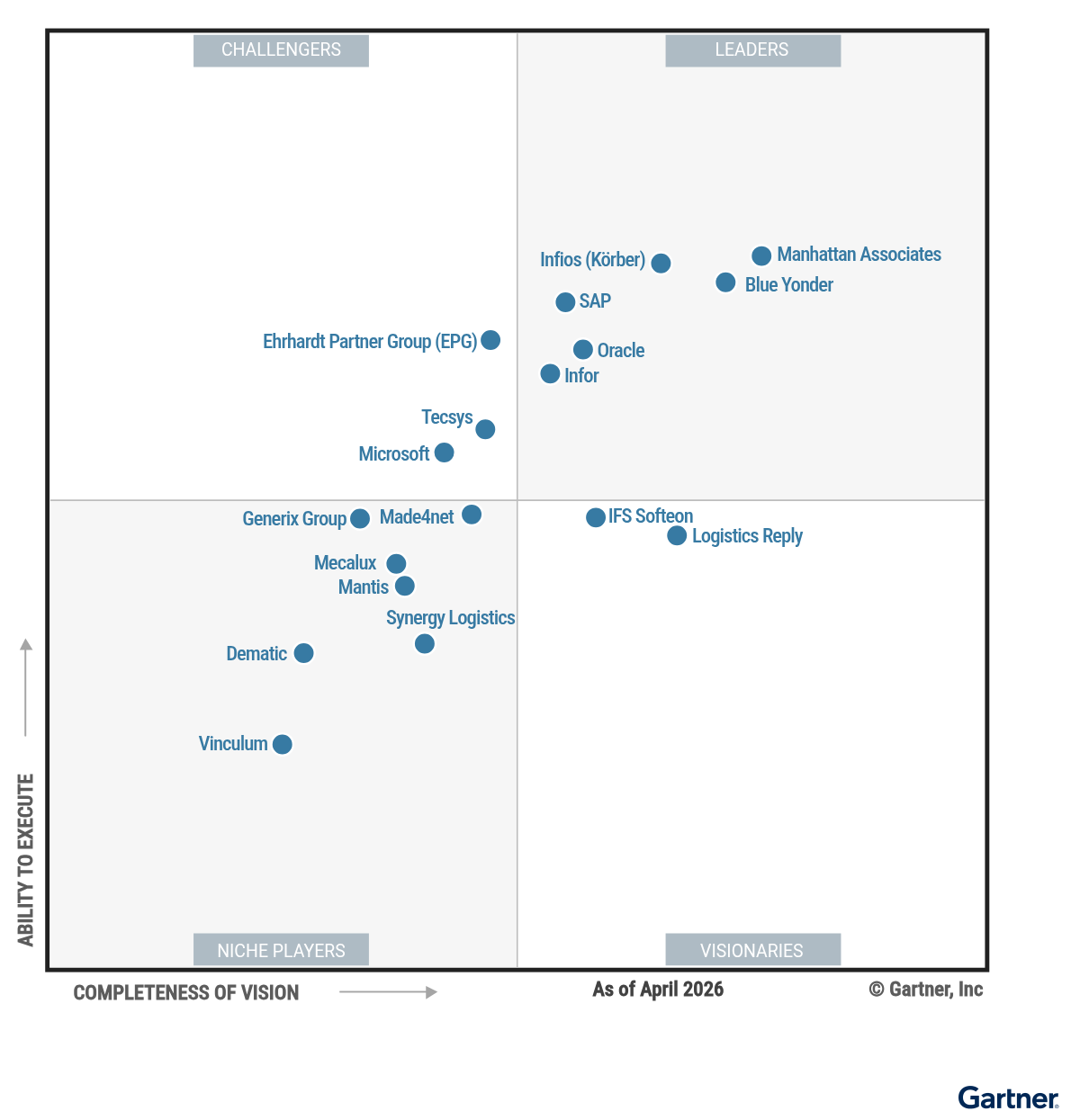
Vendor Strengths and Cautions
Blue Yonder
Blue Yonder is a Leader in this Magic Quadrant. It’s the largest supply chain management (SCM) suite vendor in this evaluation, with 2025 total revenue of approximately $1.43 billion, including over $1 billion from software.
Blue Yonder’s SCM solutions portfolio includes warehouse management, workforce/labor management, transportation management, supply chain planning, retail and manufacturing planning, scheduling, network and order management. To enhance its supply chain execution (SCE) portfolio, with the aim to optimize total cost of service, Blue Yonder acquired multiple vendors across transportation, manufacturing and returns management in the last three years, including Doddle, flexis AG, One Network Enterprises, and, most recently, Pledge (May 2025) and Optoro (August 2025).
Blue Yonder has approximately 1,100 WMS customers, with 80 global customer go-lives across 260 sites in 2025. Customers span 19 industries, with notable strengths in consumer products, third-party logistics (3PL), retail, grocery, automotive and pharmaceuticals. Almost 50% of WMS customers are outside North America, supported by a global network of over 40 implementation partners.
Blue Yonder’s warehouse management solution is mainly used in Levels 3 and 4 warehouse operations, but can scale from high Level 2 to Level 5 operations, where it has numerous highly automated customers. Blue Yonder has moved from an on-premises deployment model to cloud/SaaS, with over 300 customers on SaaS today. All new bookings now on SaaS, with 30% of the installed base already deployed on cloud.
Over the last year, Blue Yonder completed its shift of core WMS capabilities to Microsoft Azure, launching its new Cognitive WMS product, which was fully realized with its 25.2 version. Every new deal since the 25.2 release has opted for this new version. Blue Yonder delivers its WMS on dedicated/single-tenant cloud, while leveraging multitenant services for machine learning (ML), platform services and non-mission-critical services. Its new Cognitive WMS incorporates WES, enterprise analytics, a warehouse agent and other, more advanced capabilities as part of the WMS bundle with a global consumption-based allowance for AI and advanced feature usage. Azure is its chosen hyperscaler for all cloud deployments.
- Blue Yonder is distinguished by the maturity, adaptability and capabilities of its core and extended WMS functionality. It is strong in workforce/labor management, traceability, and performance management. Its acquisitions allowed it to expand into areas like integration with manufacturing work orders, returns flows and appointment scheduling.
- Blue Yonder has a significant partner network playing a role in 70% of overall WMS implementations. Key partnerships aid further expansion into regions like Latin America, which now account for 16% of its new deployments.
- Blue Yonder’s bundled tasking and robotics capabilities (part of the Warehouse Execution System embedded in its Cognitive WMS) offer accelerated robotics onboarding and an easier upgrade path for its WMS customers without having to directly integrate with robotics vendors.
- Blue Yonder maintains a long track record of delivering WMS solutions to highly complex warehouse operations, with a large and diversified WMS customer base of demanding and sophisticated customers. Its Cognitive WMS provides robust functionality and the option of deploying more forecasting and prediction intelligence, enhancing tasking, slotting, automation onboarding and large language models (LLMs) to simplify user experience.
- While Blue Yonder targeted portability for 70% of customer modifications/extensions from its Discrete WMS to its Cognitive WMS within the year, it’s currently only at 30%. Additionally, legacy Dispatcher customers should press Blue Yonder for a roadmap for migration to its new Cognitive WMS, seek partner support to maintain stability and improve UX, and avoid the unnecessary interim step of migrating to its previous Discrete WMS.
- New customers (and those migrating from older Blue Yonder WMS versions) must evaluate consumption across sites, as the organization amended the pricing structure for its new Cognitive WMS toward a site and order line (not user) basis. It also bundles advanced WES and AI capabilities within its global AI consumption credits allowance. Use the vendor’s tools to estimate this change’s cost impact.
- Most new Cognitive WMS implementations will be vendor-led, as only a small number of Blue Yonder’s partners have received certification in this new WMS, though about 50% have had informal training.
- While Blue Yonder is not forcing migration to its new platform, it is offering commercial subscription incentives for those with recent Discrete WMS deals. However, the vendor’s go-forward platform in collaboration with Microsoft Azure offers more security and reliability guarantees, and many innovations are tied to the new platform. Organizations on legacy versions should review disaster recovery and upgrade options.
Dematic
Dematic, part of KION, is a Niche Player in this Magic Quadrant. It specializes in material handling equipment (MHE) and software solutions. Dematic made several acquisitions over the past decade, bringing various forms of warehouse software, including U.K.-based intralogistics and WMS software provider Digital Applications International (DAI).
Dematic offers a broad portfolio of warehouse capabilities, including automated MHE and system integration services and an extensive suite of warehouse software solutions that features a warehouse control system (WCS), a warehouse execution system (WES), a WMS, and asset and maintenance management. It also resells automation solutions like AutoStore and Quicktron and provides implementation services for SAP’s EWM.
Dematic has around 10,000 employees, with almost 900 focused on warehouse software. Gartner estimates its warehouse software revenue exceeds $140 million annually, with approximately 560 warehouse software customers, a high proportion of which are multisite, especially in EMEA. It serves customers in 26 countries, with over 60% headquartered in North America, 29% in Europe, and the rest headquartered in Asia and other regions. It maintains purely direct implementation resources across Europe, North America, and APAC, with WMS customers in 23 industries, including retail, food service, and industrial and construction machinery.
Dematic targets large businesses with both automated and manual warehouses. Most customers choose Dematic for highly automated Level 5 warehouse operations, though many customers have site deployments that are manual Level 3 operations. Due to its historical focus on large-scale automation solutions, almost all of Dematic’s implemented customers are on-premises deployments.
Dematic has been developing the next generation of its offering, W*S, leveraging Google Cloud to combine WMS, WCS and WES capabilities on a common technical platform based on its existing solution portfolio. The solution is currently live in a Dematic-owned facility, with planned customer rollouts through 2026.
- Dematic’s intralogistics software portfolio is well-suited to complex automated warehouse operations, and includes WMS, WCS and WES capabilities. It has developed a unified user experience that it is expanding across Dematic products, and is focusing on AI capabilities and simulation in warehousing through its partnerships with Accenture and NVIDIA.
- Dematic’s Command Center is a recently launched offering providing enhanced operational visibility and performance analysis. It offers add-ons for simulation, forecasting and scenario modeling to help orchestrate automated and manual activities.
- Dematic is stable, existing in one form or another for more than 200 years. Because it is part of the larger Europe-headquartered KION Group, it has the opportunity to expand, collaborate, and serve as a one-stop shop for MHE, racking, warehouse software, and optimization capabilities.
- Dematic enhanced its inventory analytics and foundational AI Chat capabilities, which it plans to make multilingual. Dematic’s roadmap for 2026 includes enhancements to dynamic replenishment, AI-enabled vision, and movement toward digital twins.
- Dematic lags behind most WMS vendors in cloud maturity, with only 6% cloud adoption. Most of its clients are still on-premises with a perpetual license model.
- While Dematic has made progress on its next-generation platform with the first site now live for its consolidated WMS, WCS and WES, its current, large customer base exists on fragmented parts of its existing suite. This may divert focus away from support for net-new clients.
- Dematic’s background and heavy focus on automation may limit depth and breadth of focus on manual WMS business functionalities and emerging capabilities demonstrated by other vendors. Despite its presence on a large number of manual sites, its stand-alone WMS sales strategy is limited compared to other vendors.
- Despite significant progress, Dematic’s next-generation W*S is still maturing. Clients and prospects should scrutinize its capabilities and emerging pricing models versus its competitors.
Ehrhardt Partner Group (EPG)
Ehrhardt Partner Group (EPG) is a Challenger in this Magic Quadrant. It offers a broad portfolio of WMS/logistics solutions. EPG’s WMS licenses and services revenue is over $140 million annually, approximately 75% of its total revenue.
In addition to its WMS solution, EPG LFS, EPG has multiple SCE applications, a native WCS, consulting, and cloud services in multiple regions. EPG also offers LYDIA Voice independently from its WMS as part of its Supply Chain Execution suite (EPG ONE). In March 2026, EPG launched its new supply chain execution-focused AI environment called AURA, and it is expanding its collaboration with NVIDIA. In March 2025, EPG acquired byways, a timeslot and yard management provider, to complement its dock appointment scheduling (DAS) offering.
EPG’s main offices are in Germany and the U.S., and it has 23 locations across EMEA, North America, Australia, Japan and Mexico. It expanded facilities in 2025 in the U.S., Japan and Austria. EPG has over 1,100 employees focused on logistics software and hardware. Of EPG’s 1,750 supply chain execution customers, 970 are WMS, with 68% based in Europe, mainly in the Germany, Austria and Switzerland (DACH) region. About 12% of its WMS customers are in the Middle East and Asia, 10% are in North America, 4% are in Latin America, and 6% are elsewhere. EPG’s largest customer segments are 3PL, retail/e-commerce, industrial and construction machinery, automotive/parts, and consumer products. It offers specific functions for these segments and for food and beverage, pharma/healthcare, and textiles. EPG’s WMS is most often used in Levels 4 and 5 warehouse operations, but it can scale from high Level 3.
EPG has direct implementation resources globally, with partners in North America, Latin America and Asia supporting 8% of implementations. EPG released its AI-powered Virtual Assistant (EVA) in 2025. Recently, EVA has been integrated as part of EPG’s stand-alone AI environment, AURA. AURA is tightly integrated with the EPG ONE Suite and can be integrated with third-party software or warehouse automation technologies.
About 80% of customers have deployed or migrated to a dedicated cloud environment using EPG’s private cloud services. However, in January 2026, EPG partnered with Microsoft Azure to enable customers’ hyperscaler-based cloud deployments and further AI development. Its core applications, including WMS, are dedicated cloud. Others, like its International Shipping System (ISS) and its Timesquare analytics offering, are multitenant cloud. New customers are on the cloud with subscription pricing, but EPG still supports existing customers who prefer to remain on-premises.
- EPG is a stable, privately owned company with over 35 years of warehouse management experience. It demonstrates consistent regional and international growth in revenue, customers, facilities, employees and partners.
- EPG has extensive experience in highly complex and automated (Level 5) warehouses. It offers integrated WCS and 3D graphical simulation, emulation and visualization capabilities, and what it calls its multiagent orchestration (MAO), formerly named Suburbia.
- EPG offers competitive pricing and total cost of ownership (TCO) compared with other WMS vendors in this Magic Quadrant. It’s also expanding further internationally into areas like Japan with its co-development partnerships.
- EPG provides a strong portfolio of supporting technologies and extended WMS capabilities including gamification. Its AURA environment includes AI-powered capabilities like a voice communicator, intelligent video analytics (IVA) and intelligent document processing (IDP), labor optimization and space calculation as well as intelligent configuration management (ICM). It also aims for augmented and autonomous supply chain orchestration.
- EPG lags behind other vendors who have moved, or are moving, toward more modern, microservices-based WMSs. It has transitioned to an object-oriented architecture with its latest versions, but three-quarters of customers continue to use older versions.
- Customers more easily benefit from AI enhancements by using the latest LFS versions (V9 onward). Though customers on V8 can achieve benefits and AURA can work with third-party solutions, more time and effort are required to deploy with older versions. If customers demonstrate significant interest, resources to support upgrades could become constrained.
- Most of EPG’s new developments are based on interactions with the AURA AI environment. Customers should scrutinize new subscription pricing for this solution in conjunction with assessing their needs.
- While suitable for complex and highly automated environments, LFS is not built for lower-complexity operations, and, despite EVA expansion, its usability remains undifferentiated. EPG offers stand-alone solutions, such as cross-docking and light WMS, to complement basic ERP warehouse management functionality through its LYDIA Enterprise Solution (LES).
Generix Group
Generix Group is a Niche Player in this Magic Quadrant. It offers a portfolio of SCM solutions, including two WMSs, transportation and yard management, logistics order and replenishment management, and electronic data interchange (EDI). In April 2025, it released its new Resource Management System (RMS).
Also in April 2025, it fully merged the teams from its 2023 acquisition of DDS, a French software vendor that provides a TMS and digitizes supply chain and transport flows. In May 2025, Generix secured significant refinancing to accelerate its SaaS, data and AI transformation, and international development. Generix is now using the capabilities from its previous acquisition of Keyneo to support lower-complexity warehouse operations and dark stores with its order management and mobility offerings. Approximately 45% of Generix’s $130 million in total company revenue in 2025 comes from its WMSs, on which more than 300 of its 800 employees are focused.
Generix deploys two distinct WMS offerings across 570 customers: Generix WMS and SOLOCHAIN WMS, a contemporary WMS and manufacturing execution system (MES) solution. Approximately 80% of its customers utilize Generix WMS, typically across multiple sites. SOLOCHAIN customers are mainly in Canada, the U.S. and Mexico, with some in South Korea and Australia.
Seventy-four percent of Generix’s WMS customers are based in Europe, 20% are in North America and the remaining 6% are in other regions. Its WMSs are deployed in 36 countries, with the largest market in France, followed by Spain and Portugal. The vendor no longer supports Russia. Approximately 75% of Generix’s WMS revenue is from consumer products manufacturers, retail (including e-commerce) and 3PL, with multichannel retail representing its largest customer segment.
Generix’s WMSs are most often used in Levels 2 through 4 warehouse operations, but Generix WMS in particular scales to Level 4 and some Level 5 environments. More than 90% of its new contracts are SaaS, with 70% of Generix WMS customers and almost 40% of SOLOCHAIN customers now deployed on dedicated cloud. Amazon Web Services (AWS) serves as the current hyperscaler for SOLOCHAIN WMS and Generix RMS, while Generix WMS is deployed on a private cloud. Generix is planning to offer Microsoft Azure as an alternative option for both SOLOCHAIN WMS and Generix RMS.
Notably, some extended capabilities for Generix WMS are multitenant cloud. Generix WMS has two pricing models based on users linked to the functional package of simple, medium or complex needs, or fixed monthly fees based on features/sites and transaction volume-based fees, not users. For SOLOCHAIN, pricing is primarily based on users and sites.
- Generix deployed new capabilities in 2025, including the new Resource Management System (RMS), which is now live with customers and can be deployed with either of its WMSs. Generix plans to release its complementary workload forecasting capabilities based on deep learning and ML-forecasting models in early 2027.
- Generix has enhanced its API connector to significantly reduce implementation time, as well as its 3D map and congestion analysis to reduce travel distances. It has also developed absenteeism tracking/forecasting capabilities and is enhancing its user interface across both WMSs.
- SOLOCHAIN offers a seamlessly integrated WMS and MES that addresses the complexities of process integration between the warehouse and shop floor. It has also enhanced TMS integrations, MES planning, and yard and dock capabilities.
- Generix WMS does not restrict the number of users in its subscription pricing model, providing an attractive TCO for some customers.
- Generix lacks a strong global implementation partner ecosystem, with only 10% of its implementations involving a partner. Clients should vet implementation and support capabilities, especially for multisite deployment.
- Generix’s WMS revenue and customer growth in 2025 overall were modest, with its SOLOCHAIN solution only seeing a few new customers. It lags behind vendors with functional conversational software and agents, with a roadmap over two years out. Its focus on integrating its acquisitions may further complicate these efforts.
- Generix lacks a warehouse control system for highly automated Level 5 warehouse operations, but it does offer standard connectors to some automation systems and engineering support for more complex mechanized integrations.
- While SOLOCHAIN’s architecture and back-office capabilities are differentiated, it lacks the depth and breadth of other WMSs’ core and extended functionalities, including Generix WMS. This forces customers to balance architecture versus capability. Generix is aiming to make both its WMSs interoperable with its companion solutions to mitigate this.
IFS Softeon
IFS Softeon is a Visionary in this Magic Quadrant. Prior to being acquired and rebranded as IFS Softeon, Softeon was a small, SCE solution vendor in business for over 25 years with annual revenue of $64 million, the majority of which was in WMS. In March 2026, IFS, a large, Sweden-headquartered, privately held provider of ERP, field service management, enterprise asset management, enterprise service management, and other industrial software solutions completed its acquisition of Softeon. IFS has over 7,000 employees and 10,000 customers in 80 countries and revenue of approximately $1.7 billion. In 2023, IFS Softeon acquired GetUsROI and its AttunedLabs software development arm. This acquisition added new capabilities through its LUCA platform, which provides low-code and prebuilt integrations with a variety of material handling systems and automation vendors.
IFS Softeon is based in North America, which accounts for the majority of its customers and revenue (84%), plus about 7% in Europe, 4% are in Latin America, and 5% in Asia and other regions. Although IFS Softeon’s roots are in warehousing, it has a noteworthy SCE portfolio that includes distributed order management (DOM), some transportation, direct store delivery and planning on a common technical platform.
IFS Softeon’s customer base of 224 and growth of 22 net-new customers over the last year are modest compared with most vendors in this research. Some of these customers have very large and complex multisite WMS implementations (Levels 4 and 5), while others, including some of the cloud users, are quite small and less complex (Level 2). IFS Softeon is particularly strong in 3PL (over a third of its customers) and is growing in other industries, such as e-commerce (17%), retail (9%), apparel (10%) and consumer goods (about 8%). More recently, it added healthcare logistics capabilities to support the 8% of its customers in pharmaceuticals and healthcare services. The acquisition by IFS will likely provide opportunities to expand into industrial manufacturing and other industries.
IFS Softeon is most often used in Level 3 warehouses but has a high proportion of customers in Level 4 and Level 2 operations and can scale to highly automated Level 5 operations. Customers have deployed it to a large number of Level 1 sites. The vendor combines WMS and WES on a common platform, supporting nonautomated and more automated operations. It offers the same software as either dedicated (single-instance) cloud or multitenant cloud. About 95% of its business is dedicated cloud with AWS as the preferred hyperscaler. All new clients deploy on the cloud with a subscription model.
- IFS Softeon is one of the few WMS providers offering fixed-price implementations that are generally lower in cost than others. Its solution delivery methodology includes a recent commitment to 100-hour upgrades. This approach is supported with strong implementation tools used by the vendor and its partners.
- IFS’ acquisition of the vendor provides a large opportunity to expand WMS sales into IFS’ ecosystem, broaden into new verticals, and expand IFS Softeon’s international presence. IFS Softeon may also benefit from IFS’ large investment in industrial AI technology, such as its Nexus Black customer co-creation program.
- The IFS acquisition may enhance IFS Softeon’s SCE convergence capabilities with access to IFS’ complementary solutions (some also through recent acquisitions), such as transportation, labor and MES.
- IFS Softeon continues to enhance its functional and technical capabilities in areas such as data access and integrations, an AI Advisor embedded into the WMS UI, and enhanced slotting and labor capabilities. It’s also developing its IFS Softeon AI layer (SAIL), a framework to help adoption and deployment of AI assistants. IFS Softeon offers native integration to and optimization of technologies such as voice, put walls and robotic pick to cart, and integrates to programmable logic controller (PLC) level in some environments.
- IFS Softeon remains largely an Americas-centric organization in practice and in strategic direction, with the vast majority of its revenue and customers in North America and some rollouts for large global customers. This presents an opportunity for significant change, given IFS’s strength in Northwestern Europe (notably Sweden and the U.K.) and extensive use of partners.
- Clients have historically praised the vendor’s customer-centricity, but changes in ownership and the need to adapt to IFS’ large customer pool mean this characteristic should be watched.
- IFS Softeon has customers across industries, yet it appears to place much of its strategic focus on key 3PL customers and capabilities. Adapting to its acquiring company’s heavy manufacturing industry priorities may force changes in IFS Softeon’s strategy.
- While partners are now involved in around 50% of IFS Softeon implementations, IFS Softeon remains the lead for all implementations. Given its current resource pool, if sales accelerate due to IFS Softeon entering IFS’s ecosystem, there is a risk of implementation overruns. Customers should vet the availability, training and experience of resources in IFS Softeon’s WMS.
Infios (Körber)
Infios, a Körber company, is a Leader in this Magic Quadrant. Gartner estimates its 2025 revenue at close to $500 million, with approximately 60% WMS-related. It offers a portfolio of warehousing, transportation and order management solutions.
In March 2025, Körber’s supply chain software business rebranded as Infios following a management restructure the previous year. In October 2024, Infios acquired MercuryGate, a TMS vendor, adding 300 employees, and about 500 TMS customers.
Infios serves 5,000 customers across all its products, with over 1,600 paying customers for its four independent WMSs. In 2025, it gained approximately 100 net-new WMS customers. Around 1,100 of its 2,100 employees focus on warehousing solutions including WMSs, voice, automation and robotics. Others focus on related applications such as order management system (OMS), freight audit and payment (FAP), and TMS.
Infios is in the process of rationalizing some of its WMSs. It is currently in the process of migrating Enterprise 3PL customers to its Warehouse Advantage platform and adaptability tools while preserving Enterprise 3PL business logic and workflows. Its other WMSs are:
- Warehouse Edge, which is best-suited to Level 2 and low Level 3 warehouse operations.
- Warehouse Advantage, which primarily fits Levels 3 and 4, with some presence in Level 5 operations.
- WMS X, which primarily serves Level 5 operations but is also present in Levels 3 and 4. WMS X is deployed primarily in the DACH region, France and Spain, and is beginning to expand more in the Middle East and Asia.
Fifty-five percent of the company’s WMS customers are based in North America, 32% are in Europe, 5% are in Latin America, 1% are in Asia and the remainder are elsewhere.
Infios has a cloud-first model for new business, but adoption varies by WMS, with low cloud penetration for WMS X but approximately 70% for the others. Infios’ WMSs are dedicated cloud, and customers can deploy with Oracle or AWS as the hyperscaler.
- Infios enhanced its integration between its own WMSs and the TMS and OMS it gained through its previous acquisitions of MercuryGate, and enVista’s DOM/OMS. This improves its viability as a supply chain execution suite vendor. Continued development of its Infios Archer offering aims to enhance AI capabilities, access real-time operational data and orchestrate intelligent agents across supply chain execution systems.
- Infios continues to focus on expanding its partner network and certification program. Thirty percent of all the vendor’s WMS implementations involve partners, and 10% are solely run by partners. Infios also added multiple enhancements in areas like mobile UI and inbound workflows to speed deployments, citing an average 15% improvement.
- Infios has strong warehousing expertise and solutions beyond core WMS in areas like voice, slotting, material handling integration, and simulation and modeling. It also has its own WCS. The organization continues to differentiate in support relative to intralogistics smart robotics.
- Infios offers a blended, user-based pricing model (concurrent and named) to its clients. This can provide flexibility and a lower TCO for multisite/multishift operational models.
- Infios continues to sell, develop, and support multiple distinct WMS offerings. While its WMS technical platform enables it to upgrade some common functionalities across two of the WMSs, other features are built on different logic and will not fit this approach.
- Despite expanding partnerships, reorganized service teams, significant improvements in implementation times, and evidence of improved project governance at Infios, some clients still note negative service and support issues with implementations, upgrades, and large deployments. Some customers cite service issues potentially impacted by Infios’ restructuring.
- Customers choosing to leverage the high adaptability to adapt workflows or extend capabilities must plan for strong internal technical resources and robust governance to manage and control those changes, although Infios’ professional services and partner network can support ongoing changes.
- Infios’ private equity investment has helped fuel its growth through acquisitions and investments. However, because private equity firms tend to hold assets for around three to five years, this makes a notable financial transaction likely in that time frame.
Infor
Infor is a Leader in this Magic Quadrant. Owned by Koch Industries, Infor is a business application megavendor with more than $3.8 billion in global revenue. In addition to WMS, its portfolio includes a number of SCM applications embedded in or integrated with several of its ERP solutions.
Infor’s SCM products range from planning applications to warehousing, labor management, 3PL billing and transportation. About 30% of its new WMS deals involve existing Infor ERP customers, and 70% are with net-new customers. We estimate the vendor has approximately 1,700 WMS customers across numerous WMS offerings, with about 400 now multitenant cloud. Ninety percent of new customers are cloud, with new on-premises customers primarily in China and Japan. Most overall WMS customers are on legacy systems.
Fifty-seven percent of Infor’s customers are international (20% in Asia/Pacific, 24% in Europe and the Middle East, and 13% in Latin America), with North America having significantly grown in the last 12 months to 43%. Around 60% of implementations involve system integrators and partners, including three global organizations and 21 local partners. Partners most often lead in Europe and APAC. Its strongest markets are 3PL, retail/grocery, wholesale distribution, automotive and industrial. Infor prefers a subscription-based WMS pricing model but supports perpetual licensing.
Infor’s WMS is most often used in Level 3 operations, but it is making inroads toward more complex Level 4 and Level 5 environments. It also offers Factory Track, bundled with ERP systems, providing simplified Level 1 and low Level 2 warehouse capabilities. Infor prefers a multitenant cloud deployment, with AWS as the hyperscaler, but offers various deployment options, including on-premises.
- Koch provides financial stability and a 10-year roadmap to further develop the Infor organization, its products and global partner network. This network facilitates Infor’s international presence, leading to frequent shortlisting by clients in Asia.
- Infor continues to upgrade its sales strategy for stand-alone WMS deals and suite expansions, as well as supporting partners. Competing on price in a market scrutinizing TCO continues to drive above-average WMS customer growth.
- Infor’s Velocity Suite provides a catalog of all AI use cases that can be deployed to support its applications, including WMS. It also has a controlled vision on emerging AI capabilities such as pick path optimization, incorporating congestion avoidance, and agentic security. To date, it offers practical ML use cases in areas such as location recommendations, cartonization and 3PL billing revenue forecasting and deploys its GenAI digital assistant for information retrieval and shift startup meeting scripts.
- Infor’s extensibility approach offers differentiated WMS customization even for midsize enterprises, which remains problematic in other multitenant WMS cloud deployments. Enhanced scripting enables more advanced technical changes, and the Infor Marketplace offers partner-built products with prebuilt connectors.
- Despite some improvement, market awareness of Infor’s WMS remains low. Customer bases for the WMS (about 1,700) and Factory Track (about 2,600) are small relative to Infor’s overall ERP customers. Many remain unaware of its warehousing and data collection capabilities, leading them to seek alternatives.
- While pricing has become competitive, some clients find it complex due to atypical metrics (like number of APIs and different transaction metrics). While Infor Velocity Suite provides opportunities for innovation and optimization, it is a separate subscription that isn’t bundled as part of the WMS price.
- Infor emphasizes industry focus and differentiation (including healthcare) at the corporate level, but notable verticalization of its WMS product remains limited.
- Many WMS customers still use legacy products and can’t easily upgrade to leverage newer features. Infor’s LEAP program simplifies this with a structured migration path that assesses existing customizations. But, as with any generational shift, moving to its modern WMS platform will require reimplementation, not an upgrade.
Logistics Reply
Logistics Reply is a Visionary in this Magic Quadrant. Logistics Reply is part of the Reply Group, which specializes in the design and implementation of solutions based on artificial intelligence, cloud computing, the Internet of Things, and digital media. Reply Group has total annual company revenue of more than $2.9 billion and approximately 16,600 employees.
Logistics Reply offers warehouse management applications and services, with about $52 million total WMS revenue, of which approximately 25% is license/subscription revenue. Over 400 employees support its two WMSs: LEA Reply, a multitenant cloud WMS developed in a contemporary microservices architecture, and Click Reply, its on-premises WMS.
Logistics Reply has approximately 370 WMS customers, gaining about 20 net-new WMS customers in 2025. LEA has been the vendor’s dominant WMS and held a significantly faster growth rate since 2023. Reply’s WMSs are deployed in 35 countries, with 80% of LEA WMS customers in Europe, 4% in North America, 8% in Latin America, 4% in Asia and 4% in other regions. Last year it expanded its international presence with new leadership, resources, and locations in France, the U.K., and the U.S. Its WMS customers span multiple industries: LEA Reply is strong in retail, e-commerce, food and beverage, fashion and luxury, and 3PL, while Click Reply is strong in automotive, industrial, service, and high tech.
LEA Reply generally caters to a range of warehouse-centric network environments and is most often used in Level 2 and Level 3 warehouse operations. However, it can scale up to Level 4 operations and has a growing presence in Level 5 warehouses (13%). LEA Reply is the vendor’s multitenant cloud offering built on its contemporary microservices architecture. It’s deployed on AWS globally, and can also be deployed via other cloud providers upon request. Click Reply is best-suited to multisite, complex Level 3 and Level 4 warehouse operations. It often uses material handling automation, and can scale to Level 5 operations (26%). Reply can host its on-premises Click Reply WMS as a dedicated cloud solution.
- Logistics Reply remains a technological innovator that prototypes, commercializes and delivers new capabilities at a greater rate than most other WMS providers. These include a variety of AI techniques to support analytics and implementation, ML-based workforce forecasting, smart loading, and computer-vision-aided picking. It plans to release its Warehouse Orchestrator in 2027 to enhance planning and optimization, edge automation, and field technologies.
- Logistics Reply has greater maturity in GenAI capabilities that are part of its baseline GaliLEA multiagent AI offering enabling features such as contextual search, ticket support, and dynamic query. GaliLEA includes ready-to-use AI agents and the recently launched GaliLEA Dynamic Intelligence, Logistics Reply’s in-house agent builder, to configure and deploy customer-specific agents.
- Reply leverages an expansive set of strategic technology partnerships, some for its internal product development and some as a direct deliverable to its customers.
- Unlike most vendors, Logistics Reply demonstrates both technical and commercial composability by assembling only the required microservices across its applications into new packages for e-commerce, in-store, and manufacturing customers. In 2025 it reconfigured its microservices support tools to enable faster development cycles to increase its innovations’ speed to market.
- For WMS, Logistics Reply remains primarily focused on Europe (mostly in Italy and the U.K.), with 73% of its customers and more than 65% of its employees in Europe. However, in 2025, it started expanding into other European regions like France and growing resources in the U.S.
- Packaged WMS software is not the Reply Group’s core business, representing less than 3% of its revenue; its primary business is consulting and system integration (SI) services.
- The LEA Reply team has designed its ecosystem for reliability, observability, and security and is following OWASP best practices; however, formal certification is only planned for completion by the end of 2026.
- While LEA Reply customers can benefit from Reply’s overall resources and expertise, the Reply Group is a collection of over 150 branded offerings. Implementation resources and support will still need vetting and would mostly come from within the WMS group, not the broader consulting organization. However, Logistics Reply is beginning to seek partners to support implementations.
Made4net
Made4net is a Niche Player in this Magic Quadrant. It is a WMS and SCE-related solutions vendor. Gartner estimates its annual WMS revenue at $40 million. In 2022, Made4net acquired U.S.-based WMS vendor Zethcon and its midmarket 3PL and cold-chain-focused Synapse WMS. In 2023, Ingka Investments, the investment arm of Ingka Group, owner and operator of IKEA stores in 32 countries, acquired Made4net to improve its order fulfillment landscape. It expects to complete deployment to 40 of its IKEA stores through 2026. Made4net continues to operate as an independent subsidiary.
Made4net’s SCExpert Suite includes WMS, transportation, delivery management, and yard and labor management, all running on a single common technical platform.
Made4net has over 260 employees focused on warehouse management and 991 customers globally (120 of whom are Synapse WMS customers) with 47 net-new WMS customers in 2025. All Synapse WMS customers are in North America, but Made4net’s WarehouseExpert customers are well-spread-out globally: 43% in North America, 24% in Europe, 12% in Asia, 10% in Latin America and 12% in other regions. Made4net has partners and customers in about 40 countries, with offices in the U.S., the U.K., Czech Republic and China. Its three key industries are 3PL, retail (its fastest-growing industry with a special focus on grocery) and wholesale distribution, with a significant number of customers in consumer products, e-commerce, food service and apparel.
Made4net’s WMS is most often used in Level 2 and Level 3 environments, but it has a significant number of customers extending into Level 4 environments and some in Level 5 and Level 1 environments. Made4net supports all deployment methods, but 32% of its installed base remains on-premises, and most of its cloud deployments are dedicated cloud, deployed on AWS for all customers. Historically, China-based customers ran on AliCloud, but all have transitioned to AWS running in the Hong Kong region.
- Made4net has a compelling international go-to-market strategy and independent sales track record with consistent growth, not impacted by supporting implementations into Ingka Group-owned IKEA stores. It delivers its applications in 23 languages and supports personalization translation features. Development of its IKEA-inspired Fulfillment Management System (FMS) may offer opportunities for other retail customers going forward.
- Made4net has some SCE convergence, with six product categories (WMS, yard management, labor management and three transportation solutions) on a common platform and data model that can support enhanced execution operations. Made4net has updated its identity access management platform to support authentication and security across all devices and its platform modernization.
- Made4net has a cost-effective and rapid implementation methodology that suits (but is not limited to) the needs of small and midsize businesses. It claims it can do an implementation in as little as six weeks. Made4net also offers concurrent user pricing and flexible deployment options, including SaaS-dedicated cloud deployments, on-premises with a perpetual license, or on-premises with a subscription pricing model.
- For its size and target customer base, Made4net offers a respectable automation strategy supporting black box and white box integrations with WCSs. It also has mature food-handling capabilities. While its approach to AI is more cautious than other vendors, it is developing its foundation layer with vector databases and a digital chatbot to process natural language queries about documentation, training videos and business data. It also has plans for AI configuration and execution agents.
- While headcount is growing, Made4net has a small number of WMS-focused employees serving a large and growing number of customers (including its parent) compared with other vendors in this evaluation. It is spread across two WMSs, which could stretch resources.
- Made4net’s experience is greatest in the midmarket sector, and it has limited resources compared to larger WMS providers. Larger customers with more complex warehouse operations must be diligent in evaluating Made4net’s implementation tools, capabilities and resources.
- Customers with multisite rollouts spanning geographical territories must be prepared to potentially manage multiple sales or implementation partners despite Made4net’s strong global partner ecosystem.
- Made4net is behind a number of vendors in modernizing its architecture and deploying AI capabilities. However, it is deploying its new UI capabilities and API framework and releasing its information retrieval chatbot and AI foundation layer in Q2 2026.
Manhattan Associates
Manhattan Associates is a Leader in this Magic Quadrant. It is the second-largest supply chain management suite provider in this evaluation, with company revenue of over $1.08 billion in 2025 and approximately 4,500 employees globally.
Gartner estimates that Manhattan Associates has around 1,750 customers in around 50 countries, with a combination of company-operated sales and support offices and partners. It offers a broad portfolio of SCM solutions covering logistics, omnichannel commerce, supply chain planning and supplier enablement. Its core applications comprise WMS, TMS, DOM, supply chain planning (SCP) and point of sale (POS), all delivered on a common microservices multitenant cloud architecture that supports extensibility and continuous upgrades.
Manhattan’s strongest industries are retail, omnichannel/e-commerce, footwear/apparel, 3PL and wholesale distribution, with customers across multiple industries. It offers three distinct WMSs: Manhattan SCALE, Manhattan Warehouse Management for IBM i (WMi) and Manhattan Active Warehouse Management (WM), its cloud-native microservices multitenant cloud WMS.
Gartner estimates more than 20% year-over-year (YoY) growth in net-new Manhattan Active Warehouse Management customers and accelerated multisite go-lives in 2025. A number of customers have deployed or are deploying unified Manhattan Active WM and Manhattan Active Transportation Management (TM) with fewer deploying the full suite with its Manhattan Active Supply Chain Planning solution on the same technology platform.
Manhattan’s WMSs target different markets:
- Manhattan SCALE, based on a Microsoft platform, caters to the small and midsize business (SMB) and 3PL WMS markets with Level 2 and Level 3 warehouse environments and utilizes Microsoft Azure for cloud deployments.
- Manhattan WMi continues to support customers preferring the IBM i platform and is most often used in Level 3 and Level 4 operations.
- Manhattan Active WM caters to sophisticated, complex and often highly automated warehouse environments, and is most often used in Level 4 and Level 5 warehouse operations. However, it can scale from Levels 2 through 5, offering a unified WMS and WES. It is deployed as a multitenant cloud application. While the vendor states it is cloud-provider-agnostic, it utilizes Google Cloud Platform (GCP) for most customers but uses AliCloud for those in China.
- Manhattan continues to build its offerings and grow its business organically, aiding consistency in contrast with others that have grown through acquisition. Manhattan is also faster to market than most with AI agents either prebuilt by Manhattan or those that can be custom-built with its Agent Foundry.
- Manhattan was the first major WMS vendor to rewrite its WMS onto a microservices, multitenant cloud systems architecture that supports elements of composability, extensibility and zero upgrades. It offers a unified platform with WMS, DOM, omnichannel, TMS and SCP on a common codebase and multitenant cloud systems architecture.
- Manhattan remains highly effective at customer-focused operational R&D that translates business requirements into deliverable products of good quality and reliability. It’s a leader from a user experience (UX) perspective, with established UX designers that upgraded the flexibility and aesthetics of its UX.
- In 2025 Manhattan expanded its supply chain execution convergence opportunities with WM-optimized shipment planning and shipment orchestration for TL/LTL work releases, complementing its WMS and TMS converged planning in yard management. This may evolve into greater opportunities to optimize inventory, labor and transportation in a unified plan if organizations subscribe to all solutions.
- Manhattan has a reputation for being expensive, and its applications can be complex, requiring more effort to support than other systems. While Manhattan Active WM is versionless, mitigating upgrade costs and providing ongoing innovation, the overall TCO is often high. If clients want to use Active Agents, this is an add-on subscription.
- While declining as a proportion, over 40% of Manhattan’s total revenue comes from implementation, customization, and other services. This makes it less system integration (SI)-partner friendly than other WMS leaders. No new Manhattan Active WM implementations are fully partner-led, though partners can lead secondary site rollouts.
- While focus on client-centric extensibility with its Manhattan ProActive solution may reduce some clients’ dependency on the vendor’s services, the solution remains complex and training in the tool is expensive.
- While Manhattan has WES capabilities, it continues to take an agnostic service-centric approach to robotics and material handling integration, and has not adopted a complete multiagent orchestration (MAO) platform or a WCS.
Mantis
Mantis is a Niche Player in this Magic Quadrant. It’s a WMS suite provider headquartered in Greece with offices across EMEA and North America. In 2022, Mantis became part of the Germany-based ecovium group.
Mantis has been operating since 1996 and for the first time met all the tight inclusion criteria for WMS revenue, while still providing a healthy compound annual growth rate (CAGR) for customer and revenue. This research focuses primarily on Mantis and its WMS while also considering the ecovium logistics software and hardware ecosystem impact on the vendor’s longer-term prospects.
Most of Mantis’ approximately 1,000 WMS customers are in EMEA, having a strong presence in Central and Eastern Europe, Türkiye, Israel and the Middle East, with a growing presence in North America. The vendor started operating in Spain in 2025 and plans to expand to the U.K. and Benelux in 2026. Mantis added 94 net-new customers in the last year. Most of the 280 legacy ecovium WMS customers (spread across three WMS solutions) are located in the DACH region. ecovium is gradually migrating them to Mantis’ WMS and offering it exclusively to new customers in the region. Mantis is deployed across 30 countries, with office locations in 10 countries and more than 20 sales and implementation partners. Its top four customer industries are 3PL, distribution and wholesale, multichannel retail and e-commerce, and manufacturing, with customers spread across 14 vertical industries.
Clients range from single-site deployments for SMBs with few users to multisite, multicountry deployments for large multinationals with hundreds of concurrent users. Its WMS, Logistics Vision Suite (LVS), is most commonly used in Level 3 and Level 4 warehouse environments but scales from Level 2 to Level 5 operations. Mantis’ customer base is primarily on-premises, but it has a small number of customers (3%) in dedicated public cloud environments on Microsoft Azure, its preferred hyperscaler for all regions. It offers both perpetual license and subscription pricing.
- Mantis has a strong local presence, partner network, and growing customer base in EMEA, especially in territories where many other WMS vendors are not present. Implementation partners are involved in a large majority of all Mantis WMS deployments, taking the lead in over 50% of deployments.
- Mantis offers an adaptable solution with a visual workflow and powerful rule engine, as well as a seasonal subscription offering that supports many customers’ needs. It also offers automation (hardware) as a service well-suited to its midmarket and 3PL customer base. More advanced customization is offered through scripting tools and APIs.
- Mantis is integrated to Simple Chain AI, ecovium’s AI-augmented supply chain platform launched in 2026 to enhance orchestration across logistics solutions. This follows Mantis’ 2025 focus on redesigning its LVS solution with an emphasis on coexistence with its current offering and backward compatibility. It has also continued to enhance its automation integration such as automated vertical lift module (VLM) picking with light-guided putwall sorting.
- Mantis offers EU Falsified Medicines Directive (FMD) and Tobacco Products Directive (TPD) compliance capabilities for traceability in the tobacco, healthcare, and pharmaceutical industries. Additionally, it offers advanced traceability use cases for fast-moving consumer goods (FMCG) and consumer electronics. It also has a differentiated inventory slotting vision and offering with its LVS Slot Master, allowing it to offer “slotting as a service.”
- Mantis’ cloud maturity trails the market, with only 3% of customers recently hosted in a dedicated cloud environment, and only 5% of new customers are cloud. Customers should review the maturity of the commercial SaaS offering. While its approach to AI is developing, and it is deploying its LVS AI Implementation Assistant with its own consultants, AI progress is behind most vendors in this Magic Quadrant.
- Mantis is well-suited to the midmarket and EMEA, with multiple functional enhancements for these markets, but its North American presence remains modest, though it is growing.
- Customers with highly automated warehouse environments should carefully map their requirements to see if LVS provides the necessary support for all scenarios. They should consider WCS vendor capabilities alongside those of Mantis’ native tools despite Mantis’ recent enhancements and emerging support for unique automated flows.
- Given Mantis’ small number of company employees, customers considering large, complex global deployments should stringently review the level of available direct and partner implementation resources and support.
Mecalux
Mecalux Software Solutions is a Niche Player in this Magic Quadrant. It’s a division of the Mecalux Group, a company with about $1.38 billion in annual revenue and around 5,500 employees across its businesses. Mecalux Software Solutions is headquartered in Spain (as is its parent company) and has total WMS revenue of about $40 million. Most of this revenue is services-based.
Mecalux had 82 new WMS customers in 2025. It has 1,255 live WMS customers and close to 500 employees focused on WMS. Mecalux Group sells and operates mainly in Europe and the Americas, with 23 locations (including companies such as Interlake Mecalux), and customers in over 70 countries. It offers products and services for warehouses that range from manufacturing racking and shelving, automated MHE and associated consulting on design to supplying WMS, WCS, and WES capabilities. Over 80% of its WMS customers are based in Europe, with the majority of those based in Spain, France and Poland; 9% are in Latin America; 7% are in North America; and the remainder are in other regions. Mecalux has direct implementation resources in Europe and the Americas, with implementation partners supporting around 10% of its less complex projects.
Mecalux’s Easy WMS has been developed for more than 25 years. It remains a strong fit for midmarket businesses, while increasingly targeting medium-to-large multisite organizations across manual, mixed and automated warehouse operations. Its top industries are retail/multichannel, manufacturing and distributors/3PL. Historically, it was most often used in Level 2 and Level 3 operations, but it scales to Level 4 and Level 5.
Mecalux offers three versions of its WMS:
- Lite, primarily used for training and educational purposes
- Enterprise for manual environments
- Robotics to support customers that require automation
The vendor offers multiple deployment options, with 33% of its existing customers on the cloud (almost 75% of these are on multitenant cloud). Standard and small implementations use multitenant solutions, and larger, more complex customers use dedicated, single-instance deployments or deploy on-premises. Mecalux uses Microsoft Azure for cloud deployments.
- Mecalux has a strong geographic presence in Spain and France, with a growing presence in Latin America, while also targeting the U.S. Because it is part of the larger Mecalux Group, it has expansion and collaboration opportunities with the capability to serve as a one-stop shop for MHE/robotics, racking and software. Mecalux significantly expanded its partnerships in 2025 across sales, implementation, technology and R&D.
- Mecalux is differentiated for WMS in the manufacturing segment, which makes up 43% of its customer base, with a dedicated manufacturing module supporting integration with an expanding number of global and regional MESs and production traceability. It also embedded a conversational assistant in the user interface, allowing its SaaS customers to create dashboards and execute actions using natural language. Its 2026 roadmap includes launching its AI Studio to further expand capabilities.
- Mecalux provides its own WMS, WCS, WES capabilities and some adaptable simulation and modeling tools, and has expanded its capabilities in workforce, slotting, yard management and 3PL functionality. It has been developing its Easy Fleet Manager (based on the VDA 5050 German automotive standards) to be interoperable with its own and other providers’ AMRs.
- While its pricing varies across regions, Mecalux has, to date, provided a relatively low TCO (software-plus service) compared with other vendors in this research, primarily targeted to the needs of SMBs in manual and automated environments, with the opportunity to adapt for different levels of complexity.
- While a good fit for the midmarket, Mecalux has less experience in the larger multisite enterprises with highly complex, people-driven warehouse environments, which it’s beginning to target. These efforts may stretch resources and impact TCO going forward.
- WMSs and packaged business applications are not Mecalux Group’s core business and represent a small percentage of its overall revenue. While WMS software is now a growing strategic area, resources may be more focused on consolidated offerings.
- While growing slowly, the vendor’s customer presence in North America remains low at only 7%, although this accounts for 16% of revenue.
- While Mecalux’s cloud penetration is gradually growing (now at 33%), it is less mature than other evaluated vendors, but 69% of new manual customers are deployed on the cloud. Additionally, 55% of its customer base are on legacy versions of its WMS, which inhibits access to its new tools.
Microsoft
Microsoft is a Challenger in the Magic Quadrant. It’s a roughly $246 billion global application and infrastructure megavendor, and Gartner estimates that about $1.4 billion in its annual revenue comes from its supply chain applications.
Microsoft offers Microsoft Dynamics 365 Finance and Supply Chain Management, which includes its WMS capabilities along with other SCM capabilities, like planning, procurement, production and order management, as an integrated cloud ERP solution. Dynamics 365 Supply Chain Management, not Microsoft Dynamics 365 Business Central, is assessed in this research.
We estimate Microsoft Dynamics 365 to have more than 1,700 warehouse management customers, with its WMS solution deployed across approximately 25,000 warehouse sites. Microsoft serves customers in more than 19 industries, with the largest number of customers in retail, consumer packaged goods (CPG), and distribution, and a significant and growing number in manufacturing. It has a strong global presence and serves clients across different geographies, with the largest numbers in Europe and North America, with fewer in Asia, Latin America, and other regions.
Microsoft offers a dedicated cloud WMS, deployed on and benefiting from Microsoft’s Azure infrastructure. It’s sold on a subscription basis as part of the larger Microsoft supply chain offering, Dynamics 365 Supply Chain Management. In 2024, Microsoft made generally available a release of its warehouse-only mode in Dynamics 365 Supply Chain Management, providing the ability to integrate with third-party ERPs and OMSs. This offering enables quick deployment of the warehouse solution by customers who do not need all capabilities in Dynamics 365 Supply Chain Management. Warehouse-only mode also now supports shared 3PL warehousing across legal entities. Historically, the WMS has been most often used in Level 2 and Level 3 operations, but the vendor has claimed the majority of its customers use its WMS to support Level 3 complexity warehouse operations, with some presence in Level 4.
Over the last few years, Microsoft has been incrementally developing more advanced WMS capabilities, such as automatic inventory on-hand balancing, warehouse spatial location, pick route optimization, support for glove scanners, and improved experience and reliability of its Warehouse Mobile App. The vendor has a large number of global sales and implementation partners that sell and implement Dynamics 365, with only a small number of implementations conducted by Microsoft directly. The majority of its customers are midsize-to-large enterprises.
Microsoft declined requests for supplemental information. Gartner’s analysis is therefore based on other credible sources.
- Microsoft Dynamics 365 Supply Chain Management (WMS) is a suitable shortlist candidate for many Microsoft Dynamics 365 customers because it offers sufficient functionality, ease of use and integration with other capabilities in Dynamics 365 ERP and the broader Microsoft platform.
- Microsoft offers the ability to easily scale users for organizations already in the Microsoft Dynamics 365 ecosystem, typically using the WM mobile app. This can make pricing, mostly based on user roles or devices, competitive compared to other vendors.
- Microsoft’s broader technology ecosystem means customers can benefit from capabilities like Fabric, Copilot, Microsoft Copilot Studio, Power Platform, Power BI, its Microsoft Azure Cloud Platform, and its software partner network. The vendor cites its extensibility as a key feature.
- Among WMS vendors in this Magic Quadrant, Microsoft is one of the early adopters of AI-enabled capabilities supported by its platform investments and heavy integration of the Model Context Protocol (MCP) into its ecosystem, its Copilot Studio, and the release of its WorkIQ intelligence layer in late 2025. In 2026, it released capabilities like intelligent warehouse inventory balancing to aid item setup, allocation, slotting and picking route optimization.
- The vast majority of Microsoft’s WMS customers use it as part of the Dynamics 365 Supply Chain Management suite. While the warehouse-only mode offers the potential to integrate with external systems like ERPs and OMSs, users should vet the maturity of its stand-alone and third-party integration capabilities.
- While Microsoft has begun to deploy shared warehousing entities with some customers, its WMS is not best-suited for the most complex and multisite 3PL environments due to its lack of maturity in extended functionality for these areas. However, some complementary capabilities are offered by partners.
- Customers should scrutinize partners’ warehousing and fulfillment experience and capabilities due to Microsoft’s very large number and diverse range of sales and implementation partners.
- Microsoft lacks advanced core (complex allocation and picking) and extended capabilities, such as labor and yard optimization, when compared to leading WMS providers.
Oracle
Oracle is a Leader in this Magic Quadrant. It’s a global application and infrastructure megavendor with approximately $49 billion from software revenue in 2025. Gartner estimates that Oracle has the second-largest market share in the logistics and fulfillment software market, including WMS software, with about $900 million in logistics and fulfillment revenue and more than $350 million in revenue attributed to WMS.
Oracle offers multiple WMS products, but this research focuses primarily on Oracle Fusion Cloud Warehouse Management (aka Oracle Warehouse Management), Oracle’s primary go-forward WMS that has remained a pure multitenant cloud/SaaS WMS since its inception. It’s deployed on Oracle Cloud Infrastructure (OCI) Gen2 and is integrated with Oracle’s other cloud SCM offerings: Oracle Fusion Cloud Supply Chain Management & Manufacturing, Oracle NetSuite and Oracle Retail Merchandising Operations Management Cloud. Its top three industries are wholesale distribution, consumer goods and retail.
Oracle’s portfolio now includes Oracle Fusion Cloud Inventory Management and Advanced Inventory Management for basic materials management and mobile-enabled Level 1 to Level 2 warehouse functionality alongside other cloud solutions for order management, manufacturing, transportation and sales. Oracle Warehouse Management integrates with these solutions but remains separate to allow integration with non-Oracle applications, which accounted for 25% of new bookings last year. Oracle has over 20 partners responsible for 80% of Oracle Warehouse Management implementations, ranging from small boutiques to large global consultancies. Customers are well-distributed internationally, with 40% in North America, 33% in Latin America, 21% in EMEA and 6% in Asia/Pacific. We estimate that Oracle has 656 Oracle Warehouse Management customers headquartered in 53 countries and deployed in over 1,700 warehouses in 79 countries.
In April 2026, Oracle released its Logistics Execution Command Center to automate workflows between WMS and OTM. It plans to release multiple capabilities from its AI Studio, which it aims to make available to customers so they can create their own AI agents.
Oracle claims its warehouse management customers are spread well across Levels 2 through 5 warehouse operations, with the largest concentration in Level 3, and approximately 25% of customers having a facility with some automated MHE.
- Oracle has a coherent SCM cloud strategy and the most mature cloud WMS offering of vendors in this research. Oracle’s WMS benefits from broader investments in AI/ML, with features like intelligent cycle counting and a GenAI-powered wave summary.
- Oracle has rolled out its next-generation user experience, called Redwood, for mobile use throughout its WMS. Forty percent of desktop screens have been converted to Redwood, with completion targeted within the year. The WMS benefits from Oracle’s own vision technology, which allows it to transpose images into data.
- Oracle’s WMS technical architecture supports a platform-as-a-service (PaaS) layer and lists 500 WMS-focused APIs, enabling customers to build converged applications. It’s also enhancing cross-application integration to expand its industry reach into verticals like industrial manufacturing and plans to release AI-assisted reconciliation tools to diagnose integration errors.
- Oracle has expanded support for lower complexity warehouse environments with its Mobile Inventory, and its Advanced Inventory Management solution using the Redwood design. This enables light warehouse functionality for Inventory Management Cloud without the need for deploying its full WMS or relying on partners’ mobile data collection solutions.
- While Oracle has a higher proportion of stand-alone WMS customers than some other megavendors (non-Oracle accounts for 25% of new bookings), there is greater strategic focus on Oracle Fusion Cloud suite sales, especially internationally. There is less emphasis on WMS support for JD Edwards or NetSuite applications, with other vendors having strategies to support those.
- While Oracle’s WMS can be, and is, integrated with non-Oracle ERP systems, Oracle relies on SI partners to build these integrations. They can then be certified on the Oracle Cloud Marketplace. Additionally, benefits attributed to use of Oracle Integration Cloud (OIC) are not covered by a simple WMS subscription and require a separate OIC subscription.
- While most partners have strong technical competencies, customers should vet their warehouse expertise, such as design, layout, process best practices and automation integration, as 90% of implementations are performed by SI partners.
- While Oracle’s emerging AI capabilities are compelling, customers should monitor any changes to pricing, track consumption and know that they’re responsible for managing the performance of and prompt training for any agents they develop. However, Oracle’s Fusion AI Agent Studio provides resources for AI and prompt training, and performance monitoring.
SAP
SAP is a Leader in this Magic Quadrant. It’s a global software megavendor with more than $43 billion in total annual revenue. Over $38 billion is in cloud and software revenue. Gartner estimates SAP’s SCM software revenue at $9.4 billion, with approximately $630 million attributed to WMS software.
This research focuses primarily on the SAP Extended Warehouse Management (SAP EWM) solution. However, for some customers, SAP still supports SAP Warehouse Management (LE-WM) — its legacy WMS — which is seamlessly integrated and shares logic with SAP ERP Central Component (ECC).
SAP EWM remains strongest in Europe, with 54% of customers in EMEA, 34% in the Americas, and 12% in Asia. Gartner estimates that SAP has more than 2,500 EWM customers (more than half deployed on S/4HANA EWM), with customers in 24 industries supported by the core product. It has strengths in consumer goods, its strongest industry; retail, including e-commerce, grocery and food service; automotive; mill products; mining; wholesale distribution; and industrial/construction machinery.
SAP EWM is most often used in Level 2 and Level 3 warehouse operations but can scale to Level 5. It’s generally too complex and not appropriate for stand-alone Level 1 operations. Most EWM customers are on-premises (about 66%), with almost 30% on dedicated cloud (hosted) and almost 5% on its multitenant, public cloud offering. More than half of SAP’s dedicated cloud customers deploy on a stand-alone rather than embedded EWM instance. Most of its dedicated cloud deployments are customers moving to S/4HANA Cloud as well as for new sites. The vast majority of its multitenant cloud customers are net-new EWM customers. EWM is cloud-deployed across five hyperscalers (Azure, AliCloud, AWS, Google, IBM) and SAP cloud services.
- SAP has the largest WMS customer base. Gartner estimates more than 7,000 customers between its legacy LE-WM and EWM. SAP also has a substantial global presence, as well as global go-to-market and deployment capabilities, and an extensive ecosystem that includes implementation, consulting, system integrator, MHE automation and technology partners, and EWM customers deployed in 78 countries.
- EWM, by offering sufficient functionality, is a suitable shortlist candidate for many SAP (SAP ECC or SAP S/4HANA) customers. EWM Advanced users can deploy SAP Material Flow System (SAP MFS) for MHE integration, usually with decentralized EWM. EWM customers on the latest version now have access to some AI-assisted capabilities such as slotting, labor planning, and GenAI interfaces via Joule in areas like navigation and outbound handling.
- In February 2026, SAP announced that SAP Logistics Management (LGM) is now generally available. This new microservices architecture-based solution provides a lite WMS offering that’s easier to use and deploy, and offers some basic transportation management and freight collaboration capabilities. This more affordable offering provides an opportunity to satisfy the large number of SAP customers with networks of lower complexity sites where EWM is too costly and complex. LGM’s architecture also provides more opportunities to use SAP’s Joule.
- SAP has a compelling platform strategy for addressing SCE convergence. Together with SAP Signavio for process analysis and mining, EWM offers APIs and integration with ECC and S/4HANA and components like transportation management, global trade compliance, quality management, plant maintenance, field logistics, environmental, health and safety, and manufacturing integration capabilities with SAP Digital Manufacturing.
- SAP EWM remains best-suited for companies already using SAP ERP. Non-SAP ERP customers should do detailed assessments to gauge suitability for stand-alone WMS implementations and non-SAP integrations.
- Mainstream support for SAP LE-WM will end for all customers by 2030. This will compel existing SAP WM customers (Gartner estimates over 4,000) to migrate — not upgrade — to something new, such as EWM, SAP Logistics Management, or use Stock Room Management for S/4HANA, a less functionally rich version of SAP’s current LE-WM product. Organizations migrating to S/4HANA that aren’t signed up for the RISE program or that are on some versions of EWM should validate options for extended support or alternatives.
- SAP’s EWM cloud vision and strategy is complex compared to competitors. Organizations should carefully consider their long-term warehousing strategy to avoid the risk of reimplementations and data migrations between the different WMS products.
- EWM’s pricing tends to be higher than that of comparable WMSs. Its pricing structure, based on goods receipt, goods issued, and production staging transactions, can be high for companies with high transaction volumes. Also, implementations are mostly performed by third parties, and costs and schedule overruns can be high.
Synergy Logistics
Synergy Logistics is a Niche Player in this Magic Quadrant. It’s a small software company focused exclusively on WMS and directly related software, including SnapControl for orchestration of third-party automation and robotics. It has WMS license/subscription revenue of approximately $40 million and overall WMS revenue of $70 million. The vendor was formed in 1972 and is based in the U.K., with additional offices in the U.S. and Spain.
Synergy has over 270 WMS customers. Revenue and customers are nearly equally divided, with 54% of its customers based in Europe, 43% in North America, and a small but growing number in other regions. It has more than 100 employees exclusively focused on WMSs, with most in the U.K. and North America. It also has a presence in the Netherlands and is expanding into Singapore. Clients range from SMBs to global organizations, but its strength and differentiation are strongest in the SMB market, which comprises approximately 75% of its customers. Synergy’s top three industries — representing 63% of its business — are 3PL (27%), consumer products (20%), and retail (16%).
Synergy’s WMS, SnapFulfil, is most often used in Level 2 and Level 3 warehouse operations. However, it can scale down to high Level 1 and up to moderately complex Level 4 operations that don’t need broad, extended WMS capabilities. Synergy’s SnapFulfil is one of the longer-tenured cloud WMSs, offering a rapid-deployment SaaS and dedicated cloud solution through its cloud infrastructure partner 11:11 Systems. In April 2026, Synergy announced the launch of its new WMS, ORCA, a hybrid on-premises/cloud solution designed with better support for automation and AI and more resilient infrastructure for when cloud services are disrupted.
- SnapFulfil WMS is built around a robust and flexible rule engine that allows high levels of noncode adaptability to support customer-specific and vertical-industry-specific requirements. This enables the vendor’s rapid implementation methodology and minimizes shopfloor training needs.
- For companies considering robotics, Synergy offers SnapControl, which provides integration, work prioritization and allocation capabilities to better orchestrate tasks among humans, devices, and robots. It also can be deployed independent of its WMS, and Synergy has enhanced its integrations over the last 12 months.
- Synergy is mature in dedicated cloud deployments and offers favorable service and disaster recovery SLAs compared to many other vendors in this evaluation. It also offers a differentiated and scalable seasonal pricing strategy. This allows companies to flex their number of concurrent users and associated costs based on seasonal demand variations. For some customers, it offers a no-capital-expenditure, turnkey managed service deployment model.
- Synergy’s video training and remote implementation solution, SnapBuddy, overlays instructional, interactive guidance to end users. It also offers configuration instruction and real-time training and feedback to superusers and administrators.
- While Synergy is expanding its ecosystem of technology partners, it lacks a strong network of implementation partners and has suffered significantly slowed WMS customer growth in the last two years.
- Most of Synergy’s customers and resources are in the U.K. and North America, with modest growth in other countries. Deployments outside these geographies must either be performed by the company or require remote implementation services from the vendor.
- With the launch of Synergy’s new ORCA WMS, prospects should review the product roadmaps and consider whether ORCA or SnapFulfil is the best fit for them going forward. Customers should also note that the pricing model for ORCA differs significantly from SnapFulfil.
- Approximately 75% of Synergy’s customers are in the SMB space. While it is looking to move upmarket, its development and deployment strategy could be a constraint considering its staff limitations and the potential product investments and customizations needed to fully compete in the enterprise market.
Tecsys
Tecsys is a Challenger in this Magic Quadrant. It’s a warehouse management and companion SCE capabilities vendor with approximately $123 million in WMS software and services revenue. The company has 40+ years of experience in warehousing and services. More than 370 of its approximately 740 employees focus on WMS, with a third of those focused on R&D. It has a relatively broad suite of SCM capabilities, including core and extended WMS, demand forecasting, procurement, DOM, point of use (POU) and pharmacy inventory management (PIMS).
Tecsys serves 265 WMS clients, 85% of whom are in North America. Its international presence is limited, with close to 15% of customers in Europe. The vendor performs well in regulated industries and has a strong market position in healthcare and life sciences, with almost 40% of its customers and about 80% of its annual SaaS revenue in these industries. It’s expanding in hospital pharmacy and pharmaceutical distribution, with 22% of its pipeline in the pharmacy vertical. Other key industries include 3PL, industrial and wholesale distribution, each contributing 11% to 13% to its industry coverage. Tecsys serves both SMB and large customers, with 50% categorized as large to very large organizations.
Tecsys is mostly used in Level 3 and low Level 4 warehouse operations. It can handle Level 2 warehouse operations and has some specialized Level 1 capabilities (notably, in healthcare environments). Most implementations are direct and offered in a six- to eight-month time frame, but its growing partner network now supports about one third of implementations. Historically, most of Tecsys’ deployments were on-premises, but cloud/SaaS is preferred for new deals, with cloud penetration over 95%. All cloud deployments are dedicated, single-instance cloud with AWS as the preferred hyperscaler.
- Tecsys has strong vertical industry differentiation, especially in healthcare. It offers specialized capabilities, compliance for regulations like the Drug Supply Chain Security Act (DSCSA) guidelines, HIPAA, and U.S. 340B support, and is in the final stages of gaining FedRamp security certification. Its healthcare-focused partnerships, such as with Workday, Oracle, and TraceLink, also help its industry differentiation. Its established support for consolidated service centers for hospital networks is expanding further into supporting consolidated pharmacy service centers.
- In January 2026, Tecsys released TecsysIQ, an intelligence layer built on the Databricks platform to help healthcare organizations unify fragmented data and deliver insights across clinical and operational systems. Customers have co-built GenAI agents on TecsysIQ to support expiry and shortage monitoring, order status, replenishment and compliance monitoring.
- Tecsys offers robust extensibility with its Itopia platform, aimed at providing low-code development and API-based integration to support unique custom requirements. It is one of the few vendors in this Magic Quadrant that offers embedded low-code application platform (LCAP) capabilities, such as database integrity, security and upgrade-safe extensions.
- Tecsys is enhancing its automation integration strategy by partnering with specialized low-code integration technologies and MHE providers, while still supporting with its own Itopia platform. Partners include SVT Robotics, Locus Robotics, Pyramid, and Terso Solutions for healthcare specifics and BD Pyxis for pharma dispensation.
- More than 80% of Tecsys’ professional services resources are based in North America, and some clients report constraints on implementation resources. Tecsys is attempting to mitigate this through a formal alliances program and adding specialist partners, including some Big 4 consultancies that are implementing its WMS in healthcare settings.
- Although Tecsys’ solution provides notable flexibility and adaptability with features like its powerful rule engine, this can add complexity, requiring customers to ensure they have the capacity to staff and train their internal resources effectively.
- While Tecsys’ use in healthcare and related sectors is expanding, its net-new WMS customer acquisition remains very modest, though multisite rollouts and platform extensions are significant.
- Tecsys’ pricing is based on a platform fee and named users with optional add-ons like business intelligence, demand planning, billing and automation. As a result, in some circumstances and verticals, pricing is higher than average for the general WMS market. The emergence of the TecsysIQ module, compounded by fees for building agents, may cause this to grow further.
Vinculum
Vinculum is a Niche Player in this Magic Quadrant. Headquartered in India, with locations in the Middle East, Southeast Asia, and the U.S., Vinculum provides a suite of cloud/SaaS-based solutions. The solutions aim mainly at e-commerce and omnichannel retail and enterprise brands going through digital transformation. It’s also developing further in dark store/microfulfillment and retail-focused 3PLs. B2C and e-commerce order fulfillment play a major part in the WMS. Customers include retailers, direct-to-consumer and ecosystem players (quick commerce, marketplaces, or 3PLs). Vinculum also has a modest presence in B2B and nonretail 3PL (15% of its business).
In addition to its Vin WMS, Vinculum’s Vin eRetail suite covers omnichannel product information management (PIM), automated listing to marketplaces, omnichannel sales order management, returns, payment reconciliations, merchandising, omnichannel loyalty, and real-time view of inventory in stores and warehouses.
Vinculum did not quite meet the WMS revenue criterion but is included due to exceeding customer and revenue growth criteria, with a three-year CAGR of over 20%. It claims over 1,500 total customers across its suite, with 990 pure WMS customers, excluding “freemium” users. Most customers are in Asia, primarily India, with a significant presence in Southeast Asia and the Middle East. It has around 80 dedicated WMS-focused resources, focusing primarily on retail and e-commerce (80%).
Vinculum is best-suited for emerging or small and midsize e-commerce and multichannel retailers and brands, quick commerce players, or regional operations of larger organizations. Vinculum’s WMS is best-suited for paper- or mobile-based, manual Levels 1 through 3 warehouse operations, with expanding capabilities to support more complex and system-directed environments. It launched its cloud/SaaS-based WMS — Vin WMS — running on AWS in 2013, with 85% of customers multitenant cloud/SaaS and the rest dedicated cloud for more complex environments. Most customers are on AWS, but Vinculum supports deployments on AWS, GCP or Microsoft Azure.
- Vinculum has strong operations and significant customer growth in India, Southeast Asia, and the Middle East. It has a strong integration framework, leveraging APIs and has prebuilt connectors to over 80 marketplaces, 200 web stores and 3PLs.
- Its pricing model, lower complexity and quick implementations make it attractive for organizations to rapidly set up fulfillment operations. It offers flexible pricing for customers at different stages of maturity. Most customers (80%) use an order/shipment-based subscription model with advanced annual or twice-yearly payments; 15% with expected higher volumes and complexity can request user-based pricing. Those uncertain on growth are offered gross merchandise value (GMV)-based pricing.
- Vinculum specifically focuses on multichannel e-commerce order management and fulfillment across a variety of product categories, and is expanding its customer base in niches like the jewelry, FMCG, grocery, and pharma industries and is expanding into manufacturing.
- Vinculum improved its core WMS capabilities, incorporates video capture for quality control, and has a roadmap to develop predictive replenishment and AI decisioning. Its cloud/SaaS application suite offers customers the ability to rapidly scale and connect with multiple marketplaces, enabling same-day deliveries across multiple geographic locations.
- Vinculum continues to struggle to effectively penetrate North America and Europe, with limited direct and partner support and implementation resources. However, it is expanding more into the Gulf region.
- Vinculum has the lowest revenue and number of WMS-focused employees among vendors in this Magic Quadrant, and customers rely on the vendor for implementations. This could constrain expansion into complex environments that require more dedicated support.
- While Vinculum has higher customer number growth than others, most new customers have been at lower cost within its primary markets, impacting profitability.
- Vinculum offers less functionally rich core and fewer extended capabilities than other vendors. However, it continues to augment its features with new releases that enhance wave management, hybrid picking optimization, and productivity tracking. It also provides returns workflows and video-enabled quality control processes.
Vendors Added and Dropped
We review and adjust our inclusion criteria for Magic Quadrants as markets change. As a result of these adjustments, the mix of vendors in any Magic Quadrant may change over time. A vendor's appearance in a Magic Quadrant one year and not the next does not necessarily indicate that we have changed our opinion of that vendor. It may be a reflection of a change in the market and, therefore, changed evaluation criteria, or of a change of focus by that vendor.
Added
- Mecalux returned to this year’s Magic Quadrant due to now meeting the tighter stand-alone WMS license/subscription revenue criterion as well as other criteria.
Dropped
- No vendors were dropped from this year’s Magic Quadrant
Inclusion and Exclusion Criteria
The 2026 Magic Quadrant for Warehouse Management Systems focuses on holistic global WMS suites and offerings. To be included in this research, a vendor must have a credible WMS product that fundamentally supports core WMS capabilities and some extended capabilities. The vendor must also exhibit a vision for stand-alone WMSs in at least moderately complex warehouse environments. In addition to the other criteria, a vendor must demonstrate a modest global presence by generating at least 15% of its revenue and customers outside of its home geography and have an international strategy. This research focuses on independent WMS offerings, so a vendor must routinely sell and implement its WMS separate from other related services or products that it offers. Furthermore, a vendor can qualify if it has a demonstrably differentiated and unique focus and market position in a specific vertical industry.
Gartner also takes into account vendor customer, and Gartner client interest and engagement, using both internal and external sources when considering the inclusion of vendors in the Magic Quadrant.
Vendors must meet the following criteria for inclusion:
- The vendor must provide a holistic and credible WMS suite that fundamentally supports:
- All core WMS capabilities (e.g., receiving, put-away, stock locating, inventory management, cycle counting, wave planning, order allocation, order picking, replenishment, packing, shipping).
- Natively supports mobile devices along with bar code scanning and possibly RFID or other scanning/sensing technologies.
- Some extended capabilities (e.g., labor management, slotting, task interleaving, work planning and optimization, yard management, voice picking, parcel manifesting, value-added services, light manufacturing/kitting and third-party logistics [3PL] billing).
- The vendor’s solution(s) must be available commercially via cloud deployment. This can be achieved with an offering of one or a combination of dedicated cloud or multitenant cloud WMS.
- Significant WMS market presence: For the previous fiscal year, the vendor must have (all revenue numbers in USD constant currency):
- Combined WMS license/subscription and services revenue of greater than $30 million for the previous 12 months. Only license/subscription and implementation services associated with the vendor’s packaged WMS implementations are considered. Revenue from hardware and/or ancillary consulting services is excluded.
- Or: The vendor must have a three-year compound annual customer and revenue growth rate of at least 20%. This is because customer and revenue growth are reliable indicators of vendor momentum and sustainability.
- And: The vendor must have WMS license and/or subscription revenue only of greater than $10 million for the previous 12 months. Only license/subscription revenue associated with the vendor’s packaged WMS is considered. All consulting, services, maintenance and support revenue is excluded.
- And: The vendor must have at least 200 live individual customer references (named customer references, not individual warehouse sites) holistically using the version of the WMS solution (not WES or other) being evaluated.
- And: The vendor must have sold at least 15 net-new customers (not warehouse sites) in the previous 12 months.
- And global presence: The vendor must receive greater than 15% of its WMS revenue and have greater than 15% of its customer base sold, implemented and headquartered outside of its home geographical region (for example, North America, Europe, Asia or Latin America).
- And: The vendor must have direct or affiliate sales and implementation resources in three or more geographical regions (for example, North America, Europe, Asia, or Latin America).
- And: The vendor must have more than 20% of its WMS business stand-alone where WMS is sold and implemented independent of its other related services or products. This WMS must be sold separately, not simply as a part of a combined WCS and WMS or WES and WMS or service offering.
- Or significant enterprise business applications software presence: The provider must be an application megaprovider with greater than $1 billion in enterprise application software license revenue (including non-WMS) in the previous fiscal year (all revenue numbers in USD constant currency). This is because many end users are interested in the WMS offerings of the major application suite vendors. The WMS component must be part of a suite that is active in the market and provides more than basic core WMS capabilities. The vendor must have sold at least 25 net-new named WMS customers in the past 12 months as well as have at least 200 live WMS customers (not warehouse sites).
- Or a unique and compelling market position in a specific vertical industry: The vendor must have a unique, compelling and differentiated market position in a specific vertical industry where this differentiation is important to buyers. New customer win rates, vendors appearing in Gartner client inquiries in these industries, explicit vendor focus in these industries, client references and the vendor’s reputation in the industry are considered. The vendor must also meet the revenue and number of customers criteria (i.e., WMS revenue of greater than $30 million and at least 200 live individual customer references [not warehouse sites] using the WMS).
We do not include stand-alone, specialist component providers of solutions, such as yard management, slotting, labor management, parcel manifesting, optimization tools, radio frequency (RF), voice, RFID, warehouse control systems or warehouse execution systems. We do not evaluate specialized WCSs, robotics integration solutions or WESs that are the middleware between the WMS business application and material handling equipment (see Use the Right Software to Support Warehouse Automation and Robotics and Innovation Insight: Multiagent Orchestration Platforms). However, we do consider a WMS vendor if it offers a native warehouse control system or other specialist components as part of its WMS offering. In addition, because they are not relevant as stand-alone WMSs, we do not evaluate every ERP, MHE, OMS or suite vendor’s WMS capabilities, even though these might address a particular customer’s WMS needs.
Some vendors with strong WMSs, but whose businesses are principally in a single geography, did not qualify for this Magic Quadrant. This, in particular, impacted a number of WMS vendors based in Asia and Europe (see Europe Context: Magic Quadrant for Warehouse Management Systems and Asia/Pacific Context: ‘Magic Quadrant for Warehouse Management Systems’). Please see also Midmarket Context: ‘Magic Quadrant for Warehouse Management Systems’ and Automated Material Handling Equipment Provider Context: ‘Magic Quadrant for Warehouse Management Systems’ for more insight on vendors with relevance for those geographic regions and industries.
Evaluation Criteria
Ability to Execute
Depth and breadth of WMS functionality remain very important in choosing a new WMS, especially for companies replacing aging legacy systems or those needing to support new business capabilities. Increasingly, the systems/technical architecture of the WMS is an important consideration for new WMS customers where cloud, adaptability, extensibility and user experience are priorities.
Furthermore, while companies are buying WMS applications, they are also investing in a long-term relationship with a vendor, which increases the importance of operations and viability. Consequently, while the breadth and depth of the WMS product remain important, customer service and operations have nearly an equivalent impact on a vendor’s overall Ability to Execute. Gartner finds that customers place high importance on a vendor’s ability to provide the services and support necessary to effectively implement and utilize the WMS. Service is a notable differentiator among various WMS providers, and it contributes to implementation success and overall customer satisfaction as well as impacting upgrade cycles and TCO. Historically, independent WMS vendors have provided the majority of implementation services. However, certain vendors, though not all, have robust ecosystems of implementation partners that can supplement, enhance or replace the vendor’s service capabilities.
The criteria used for evaluating a vendor’s Ability to Execute include the following.
Product or Service — Because of the intense transactional nature of warehousing systems, Gartner places a high value on both an offering’s product and its service. WMS vendors’ product breadth, depth and technology are highly rated components of their Ability to Execute. Therefore, we give this criterion a high weighting. The WMS market is mature and remains highly competitive, with core WMS capabilities approaching parity across vendor offerings. However, notable differences remain in extended WMS capabilities (see Apply an Architectural Framework to Stratify Warehouse Management Systems). We evaluate the WMS products across a range of criteria, including technology, functionality and usability. We consider the depth and flexibility of core capabilities such as receiving, put-away, picking, shipping, replenishment, quality assurance and cycle counting. We also consider the existing breadth of the application’s extended WMS capabilities, such as value-added services and light manufacturing, labor management, slotting, yard management, dock scheduling, automation interfaces and resource/work planning. Users with the most complex requirements and sophisticated operations are the most interested in a vendor’s support for extended WMS capabilities, which remains a differentiating factor across various WMSs. Less sophisticated or less complex users are more focused on core WMS capabilities and often require less functional breadth, allowing them to be supported by a wide variety of solutions. Because of the importance of usability, adaptability and flexibility, we place increased importance on the systems/technical architectures of each WMS. Due to the growing demand and prevalence of cloud WMS, we also place emphasis on the vendor’s cloud strategy, and the maturity and technical architecture of its cloud service offering.
Overall Viability — Near- and long-term investment risks are important issues for buyers, so vendor and product viability remain important criteria. Given the high switching costs, long time to value, challenging ROIs and long life span of typical WMS implementations, viability is again a high-importance consideration. Although viability is important, it should not overshadow product fit, vendor expertise, TCO, and service and support. Some vendors are quite small. While there are some viability concerns given their size, all other factors being equal, viability alone should not preclude users from considering these vendors.
Sales Execution/Pricing — Sales execution and pricing are growing differentiators in the WMS market, especially internationally in emerging geographies. Sales execution and pricing are important to a vendor’s performance and are notable indicators of its Ability to Execute. Price variability is significant with cloud-based WMSs, where subscription-based pricing models dominate and de facto cross-industry standards are yet to solidify. Because this is a global evaluation, the ability of a vendor to support global sales and go-to-market channels is also increasingly important. We consider vendor capabilities for supporting multinationals choosing global solutions as well as for customers buying in select geographies.
Market Responsiveness/Record — The WMS market continues to evolve rapidly, and WMS solutions must keep pace to remain relevant. This makes market responsiveness and track record meaningful. We assess the historical and current performance of vendors in adding to or enhancing their WMS solutions to keep up with the changing wants and needs of WMS users.
Marketing Execution — While marketing promotion is important, we focus more on a vendor’s product marketing. We examine the vendor’s product management team, processes and product roadmap to support ongoing innovation, track record of delivering on plans and ability to respond to market forces. We also look at a vendor’s visibility in the market and how often it organically appears on buying long lists, which is indicative of a compelling go-to-market strategy and execution.
Customer Experience — A WMS vendor’s ability to use and exploit functionality to drive business value and provide a suitable customer experience is a critical element of its Ability to Execute. We consider a vendor’s track record with complex and sophisticated customers, but also its ability to effectively and efficiently service less demanding customers that make up a large percentage of the overall WMS market. Also important is client satisfaction with a vendor’s products and services, and the extent of the vendor’s warehousing experience and how it can employ this to help customers fully exploit their WMS investments. Although client satisfaction is always important, we also consider the nature of the relationships that vendors establish with clients, and whether these are operational or strategic. The size and growth of a vendor’s client bases locally and internationally are also very important because they demonstrate the vendor’s ability to identify and satisfy the needs of customers around the world.
Operations — Operational competence is a very important criterion. It considers a vendor’s ability to meet its goals, obligations and commitments on an ongoing basis. There are marked differences in capabilities across vendors, as confirmed by customer references and Gartner client interactions. Vendor support, maintenance, business and technical consulting, and field operations are important parts of the WMS selection process. Factors include the quality of the organizational structure as well as the skills, experience, programs, systems and other vehicles that enable an organization to operate effectively and efficiently on an ongoing basis. As projects become more complex, a vendor’s ability to not only sell and implement a solution but also help customers fully exploit their WMS investments is critical to long-term success. Finally, a vendor’s management structure, experience, skill and expertise play a significant role in its ability to harmonize its vision, strategy, tactics and actions.
Ability to Execute Evaluation Criteria
| Evaluation Criteria | Weighting |
|---|---|
Product or Service | High |
Overall Viability | High |
Sales Execution/Pricing | High |
Market Responsiveness/Record | Medium |
Marketing Execution | Medium |
Customer Experience | High |
Operations | High |
Source: Gartner (April 2026)
Completeness of Vision
Vendors’ domain expertise, technology vision and vision for the WMS of the future rank highly. We consider vendors’ knowledge and vision for warehousing and, more broadly, logistics management both locally and internationally. We also consider a vendor’s vision for warehouse process innovation, not simply process execution, which involves demonstrating a compelling vision for how warehousing, business and logistics trends will influence warehousing and WMSs in the future. While the emergence of newer deployment models like cloud and multitenant SaaS previously differentiated WMS vendors, the impact of deployment models has diminished as the majority of WMS vendors now provide some form of cloud offering. However, there remains a continuing debate among vendors and buyers on whether multitenant SaaS is demonstrably better than dedicated cloud. We consider these factors in our evaluation.
A WMS is one important part of integrated logistics or what Gartner refers to as SCE convergence. Consequently, vendors are also evaluated on how well they understand this emerging concept and what strategies they have to move in this direction. While having a WMS vision is notable, a vendor’s vision for broader SCE convergence is critical to moving farther to the right side of the Magic Quadrant, and this differentiates offerings. Because SCE convergence is an emerging best practice, we also consider vendor strategies to support this concept beyond basic data or transaction integration.
The criteria used for evaluating a vendor’s Completeness of Vision include the following.
Market Understanding — Although the WMS market is mature, we see an accelerated need for innovation in areas such as user experience, adaptability, decision support, material handling automation and robotics integration, and work planning and optimization. The dramatic changes embodied in ongoing market shifts will require considerable nimbleness and competency as well as investment on the part of vendors. Therefore, in this Magic Quadrant, we place strong emphasis on a vendor’s understanding of these market dynamics and its product strategies to support these needs. Exhibiting and articulating a vision for where WMSs will be in the future and exhibiting an innovative culture remain distinguishing characteristics among vendors. A demonstrated knowledge, proficiency and differentiated vision of the current and future warehouse management marketplace are critical considerations. Market understanding assesses the WMS vendor’s ability to understand WMS buyers’ wants and needs, and to translate them into products and services. Vendors that show the highest degree of vision listen to, anticipate and understand buyers’ wants and needs, and can augment customer insight with their own WMS visions. Vendors that simply respond to current market requirements without anticipating future requirements will likely be unsuccessful over the long term. Consequently, we give market understanding a high weighting.
Marketing Strategy and Sales Strategy — Until recently, marketing strategy and sales strategy have had modest impacts on the WMS market, which has historically been dominated by specialist vendors focused on warehousing and logistics. Today, marketing and sales strategy are becoming more important, particularly as megavendors become stronger WMS providers. Furthermore, as cloud becomes the dominant WMS delivery model, a vendor’s approach to promoting its offering becomes more important. We consider vendors’ strategies for establishing their WMS brand and how they develop strategies and tactics for local and international expansion. Therefore, we give marketing strategy and sales strategy each a medium weighting.
Offering (Product) Strategy — Offering (product) strategy is critical and has a high weighting. It refers to a WMS provider’s approach to product marketing, R&D and solution delivery that emphasizes differentiation. We consider strategies for functionality, usability, technology, adaptability, delivery methodologies and feature sets as they map to current and future WMS requirements, market trends and technology evolutions. In addition, we consider vendors’ SCE convergence strategies for supporting end-to-end processes that span functional areas, such as order management, warehouse management, transportation, trade compliance, manufacturing and materials safety. A vendor’s understanding of these market changes and its product strategies for successfully navigating these changes significantly influence its Completeness of Vision. All qualifying solutions in this Magic Quadrant handle basic core WMS capabilities.
Another distinguishing characteristic of vendors moving to the right in the Magic Quadrant will be the breadth of their WMS — what Gartner refers to as an “extended” WMS. We place importance on the vendor’s current and planned support for WMS “systems of innovation” capabilities. These include value-added services and light manufacturing, labor management, slotting, yard management, dock scheduling automation interfaces, resource/work planning, SCE convergence and enhanced user experience. Finally, the technical architecture of the WMS has become a notable distinguishing characteristic of various offerings. We observe significant differences in strategies, visions and product roadmaps related to architectural issues, such as user experience, adaptability, flexibility, composability and the exploitation of advanced capabilities like analytics and AI.
Business Model — The soundness and logic of a vendor’s underlying business propositions are key indicators of a vendor’s sustainability and how its overall strategies and tactics might affect its ongoing success in the WMS space. For example, one vendor might focus on organic innovation while another might concentrate on buying innovation through mergers and acquisitions. While the former might have a longer gestation period, it has potential product and technical advantages. The latter might allow a vendor to get to market faster but could lead to longer-term product issues. This year, continued emphasis has been placed on a vendor’s business model and processes, and the maturity of its cloud offering. Therefore, we give business model a medium weighting.
Vertical/Industry Strategy — Because of the maturity of the WMS market, many vendors have customers across multiple industries and have added the necessary functionality to support the needs of various industries. However, there are some limited instances where vertical/industry strategies can be more important in certain areas where the specific industry needs are unique and require specialized capabilities in or around the WMS. For example, WMSs serving healthcare provider networks need strong integration with patient care. We consider not only product functionality but also how vendors address industry verticals from a product management and go-to-market perspective. While vertical/industry strategy is evaluated, it is not considered critical, so we give it a low weighting.
Innovation — Innovation and thought leadership continue to play a strong role in this year’s evaluations because innovation remains a critical differentiator. Vendors must demonstrate the ability to continuously support innovation by staying close to the most creative solutions or complicated problems in the market to drive pioneering functionality. While thought leadership is high-ranking, a track record of commercializing innovation is equally, if not more, important. Leading vendors continue to enhance core WMSs but also invest in an extended WMS, where a greater emphasis is placed on improving warehouse performance through decision support, analytics and optimization. We also evaluate how a vendor is innovating with respect to SCE convergence, particularly in WMS integration and process orchestration with yard, dock, TMS and manufacturing. Innovation is not exclusive to product functionality; exploitation of supporting technologies, go-to-market and delivery originality can also be notable sources of solution differentiation. Leaders and Visionaries will be the vendors at the forefront of transformation; consequently, we give innovation a high weighting.
Geographic Strategy — Geographic strategy looks at technology providers’ strategies for directing resources, skills and offerings to meet the specific needs of global logistics in terms of a multigeography WMS, including multilanguage and multicurrency. We also assess vendors’ abilities to support global warehousing requirements beyond core WMS functionality as well as how they plan to address the varying needs of WMS users around the world. Geographic strategy is increasingly important for maintaining a strong presence throughout the global market. Several vendors did not qualify for this research because they lacked the necessary global presence, though many of these remain strong offerings in their respective regions. This research is focused on the global WMS marketplace; thus, we give geographic strategy a high weighting.
Completeness of Vision Evaluation Criteria
| Evaluation Criteria | Weighting |
|---|---|
Market Understanding | High |
Marketing Strategy | Medium |
Sales Strategy | Medium |
Offering (Product) Strategy | High |
Business Model | Medium |
Vertical/Industry Strategy | Low |
Innovation | High |
Geographic Strategy | High |
Source: Gartner (April 2026)
Quadrant Descriptions
Leaders
Leaders combine the uppermost characteristics of vision and thought leadership with a strong, consistent Ability to Execute. Leaders in the WMS market are present in a high percentage of new WMS deals, win a significant number of them, and have a large and growing customer base. They have robust core WMSs and offer reasonable — although not necessarily leading-edge — capabilities in extended WMS areas, such as labor management, work planning and optimization, slotting, returns management, yard management and dock scheduling, and value-added services.
To be a Leader, a vendor doesn’t necessarily need to have the absolute broadest or deepest WMS application. But its offerings must meet most mainstream warehousing requirements in complex warehouses without significant modifications, and a substantial number of high-quality implementations must be available to validate this. Leaders must anticipate where customer demands, markets and technology are moving, and must have strategies to support these emerging requirements ahead of actual customer demand. Leading vendors should have coherent strategies to support SCE convergence and they must invest in innovation, have a proven track record in commercializing advancements and have processes to exploit innovation. Leaders also have robust market momentum, market penetration and market awareness as well as strong client satisfaction in the vendor’s local markets as well as internationally. Leaders understand the importance of alliances and develop robust ecosystems of partners. Because Leaders are often well-established in leading-edge and complex user environments, they benefit from a user community that helps them remain at the forefront of emerging needs.
Key Characteristics:
- Reasonably broad and deep WMS offerings
- Proven success in moderate- to high-complexity warehouse environments
- Participation in a high percentage of new deals
- Strong new customer growth
- Large customer-installed base
- A strong and consistent track record
- Consistent performance and vigorous new client growth and retention
- Enduring visibility in the marketplace from both sales and marketing perspectives
- Compelling SCE convergence strategy and capabilities
- A proven ecosystem of partners
- Global scale
Challengers
The critical characteristic of Challengers is that they have capable, proven and mature products, with numerous live customers and an overall solid and well-recognized position in the marketplace. They also have consistent track records of successful implementations. Challengers’ offerings often run some very large and complex warehousing facilities. These solutions are in use by a large number of individual enterprises supporting multiple warehouse operations locally and worldwide. While vendors in this quadrant provide solid and established WMS solutions, there is generally one or more insufficiencies in their offerings or go-to-market strategies when compared with Leaders. These solutions are preferred by buyers that favor Ability to Execute over Completeness of Vision. Challengers can have practical visions for their solutions and, more generally, SCE. But their delivery against vision and thought leadership is typically not on par with solutions from the vendors in the Leaders quadrant.
Key Characteristics:
- A capable, proven and mature WMS, with numerous live customers
- A consistent track record of successful implementations
- Often run some large and complex warehousing facilities
- Offerings are not as broad or deep as WMS Leaders
- Lacking or trailing in having a compelling SCE convergence strategy and capabilities
- Generally lacking the overall thought leadership, innovation or compelling visions of next-generation WMSs
Visionaries
To be a Visionary, a vendor must have a coherent, compelling and innovative strategy that seeks to deliver a differentiated, robust and vibrant offering to the market. Visionaries are often thought leaders in one or more WMS solution dimensions (for example, functionality, services, vertical industry, or go-to-market or deployment strategies) and they tend to be on the leading edge of some emerging concepts. However, these offerings have some deficiencies in their Ability to Execute in areas such as viability, growth, global scale or operations. At a minimum, vendors in the Visionaries quadrant fall into one of two broad categories. They can be established WMS vendors that have yet to mature into leading positions in the market, or they can be innovative specialist vendors with unique and potentially disruptive views of where the market is going. These vendors can exhibit innovation in some areas but lack it in other areas.
Key Characteristics:
- A coherent, compelling and innovative strategy that seeks to deliver a robust and vibrant offering to the market
- A thought leader in one or more WMS solution dimensions that tend to be on the leading edge of emerging concepts
- A yet undemonstrated ability to handle a broad range of complex user requirements
- Execution gaps (e.g., viability, growth, global scale or operations)
- Lacking or trailing in having a compelling SCE convergence strategy and capabilities
- Differentiated innovation in WMS products, services, vertical, or go-to-market or deployment strategies
Niche Players
Although there might be an assumption that vendors in the other quadrants are better choices for new WMS buyers, in certain circumstances, Niche Players are just as good or better choices for prospective users. This is because they might focus on a geographic or vertical component of the market that is meaningful to particular users. However, this focus alone is not a compelling enough differentiator for a vendor to occupy a leadership position. It would also have to perform well in other dimensions. Although some vendors in the Niche Players quadrant have solid WMS solutions for a specific industry or geography, their solutions are not as broad as those in other quadrants. They likely won’t evolve enough to comprehensively support SCE convergence for the foreseeable future.
Key Characteristics:
- Might focus primarily on a geography or vertical market
- Not a generally differentiated offering, although may have some unique capabilities
- May not be well-established and visible in the broader WMS market but have growing visibility in its target market
- A narrow focus on specific WMS features (i.e., not as broad or deep a WMS)
- Market momentum and product or company viability may be in question
- Lacking in SCE convergence
Context
The overall WMS market breaks down into six broad types of vendors, the first four of which are covered in this Magic Quadrant:
- Application megavendors — These vendors offer broad portfolios of applications across many application categories (e.g., back-office financials, human capital management [HCM], customer relationship management [CRM], customer order management, manufacturing, enterprise resource planning [ERP] and supply chain management [SCM]). While these vendors might offer a variety of supply chain management (SCM) solutions, they do not necessarily offer an integrated platform. Infor, Microsoft, Oracle and SAP are considered megavendors with WMS offerings.
- SCM suite vendors — These vendors offer a holistic WMS, plus a portfolio of two or more applications focused primarily on SCM. This can include aspects of logistics (e.g., warehousing, transportation and global trade), supply chain planning (SCP), customer service (e.g., order management and omnichannel management), manufacturing or sourcing and procurement, but not other functional areas such as financials, CRM or HCM. While these vendors might offer a variety of SCM solutions, they do not necessarily offer an integrated platform — although some do. Vendors in this category include Blue Yonder, Infios (formerly Körber) and Manhattan Associates.
- Specialist WMS suite vendors — These are independent software vendors (ISVs) that focus primarily, but not necessarily exclusively, on holistic WMS suites. In addition to WMSs, they might offer complementary capabilities, but these remain a modest percentage of their business. Vendors in this category include Ehrhardt Partner Group (EPG), Generix Group, IFS Softeon, Logistics Reply, Made4net, Mantis, Synergy Logistics, Tecsys and Vinculum.
- Material handling equipment/automation vendors — Most MHE vendors primarily focus on providing the electromechanical aspects of large-scale automated warehouses. However, many of these vendors also offer some WMS capabilities as part of their product portfolios. We only cover MHE firms as part of this research if they can demonstrate that they routinely sell their packaged WMS application completely independent from their MHE at a substantial level. They must also have a stand-alone strategy to do so long term in addition to offering cloud deployment options. This is because these firms do not typically offer their WMSs to the market independent of their MHE solutions. Dematic is a vendor in this category that qualified for inclusion in this Magic Quadrant. For more details on vendors in this category, see Automated Material Handling Equipment Provider Context: ‘Magic Quadrant for Warehouse Management Systems’
- Independent WMS component vendors — Not covered in this Magic Quadrant, these vendors are specialized ISVs that do not offer a full WMS but instead focus exclusively on offering stand-alone components (or point solutions) that can be used to supplement a WMS. Examples of these components include workforce/labor management, slotting optimization, multicarrier parcel management, yard management, dock/appointment scheduling, warehouse control systems (WCSs), warehouse execution systems (WESs), multiagent orchestration (MAO) platforms and other specialized add-on solutions. For vendors in this category, see Market Guide for Yard Management, Market Guide for Multicarrier Parcel Management Solutions and Hype Cycle for Supply Chain Execution Technologies, 2026.
- 3PL providers with their own self-built WMS offerings — Not covered in this Magic Quadrant, these vendors do not typically offer their solutions stand-alone in significant numbers without also providing their services, though some may, on occasion, provide the solution separately to basic satellite sites that they do not run directly. In addition, many 3PL providers use one or multiple of the commercially available WMSs, including some of those who have their own solution.
WMS Market Considerations
All solutions in this Magic Quadrant support basic core WMS capabilities. Many also support various levels of extended WMS. Core WMS capabilities are the basic functions of receiving, put-away, storing, counting and picking, packing and shipping goods. Extended WMS capabilities are value-added capabilities that supplement core functions, such as labor management, slotting, yard management and dock scheduling (see Apply an Architectural Framework to Stratify Warehouse Management Systems).
Despite being a very mature market, recent macro factors and disruptions have spurred innovation. However, while economic and business conditions are challenging for some vendors and regions with regard to new customer acquisition, the overall market reached almost $3.5 billion in 2025. WMS offerings continue to differ in areas such as usability, adaptability, decision support, scalability in both up and down markets, use of emerging technologies and life cycle costs. Furthermore, customers increasingly favor SCM suites that can support end-to-end supply chain and logistics process orchestration. Gartner refers to these areas as supply chain convergence and supply chain execution convergence (related to convergence of operational activities).
The focus on breadth and depth of WMS offerings remains valid for the most sophisticated operations, while other factors such as simplicity, usability and cost of ownership are more important in less complex environments. However, we continue to see a divergence in the WMS market between the high-performance, complex and sophisticated end of the market and the mass market, where functionality need only be “good enough.” This is not because companies choose to sacrifice functionality; it’s because globally, the preponderance of warehouse operations are Level 3 or below in Gartner’s warehouse complexity model. Gartner defines Level 1 as the most basic warehouse operation and Levels 4 and 5 as the most complex and automated. Warehouses at Level 3 and below do not require, nor would they normally use, the most advanced functionality. See Tool: Stratify Your Warehouse Operations to Determine the Right-Fit WMS and Improvement Strategy for more insight on level-setting warehouse operations.
This divergence highlights that there is a very clear market for high-end WMS solutions where feature/function and performance are critical and cost is not the highest priority. It makes for a healthy, albeit smaller, market for high-end, functionally advanced WMS solutions aimed at complex and sophisticated Level 4 and Level 5 operations. Conversely, there is another market where other factors dominate, such as ease of use, reliability, service and support, “good enough” features and lower cost of ownership. This is a very large WMS market for what Gartner’s stratification model would call Level 2 and Level 3 warehouse environments. Here, companies could be served well with any good WMS, and they could be satisfied with a megavendor-provided WMS or a less functionally robust ISV WMS offering.
Although functionality remains the primary user evaluation criterion, there’s near-functional parity for basic core WMS capabilities across WMS providers. Given the mature state of the WMS marketplace, among other factors, a combination of the following vendor and product factors affects the positioning of vendors in this year’s Magic Quadrant:
- The vendor’s market understanding and its vision for next-generation WMSs and supply chain execution.
- The vendor’s proven track record of commercializing, delivering and deploying innovations to the market.
- Investments to address total cost of ownership and customer time to value.
- The WMS’s systems/technical architecture to support composability, adaptability and extensibility.
- The vendor’s cloud strategy, capabilities and systems/technical architecture and deployment model options (e.g., dedicated or multitenant cloud SaaS).
- The long-term viability of the vendor and product, given the long life span of WMSs.
- Current and projected growth of both revenue and total number of clients.
- Vendor market awareness, name recognition and reputation.
- Product or vendor differentiation.
- Stability of the product and security of data and processes.
- Compelling or differentiated business model.
- Ability to translate business goals and objectives into specific WMS functional requirements.
- The vendor’s ability to sell, implement, service and support global deployments.
- The vendor’s ability to deliver value through service, support, consulting and training.
- The vendor’s openness to, and support of, an ecosystem of partners.
- Tools and technologies embedded in the WMS to facilitate and streamline implementations.
- Customer experience (from customer references and Gartner customer interactions).
- SCE convergence strategy (a seamlessly integrated SCE orchestration platform).
Gartner continues to find that WMS buyers place particular emphasis on WMS product breadth and depth, vendor expertise, and customer service and support. Usability, systems/technical architecture as well as vendor and product viability, TCO and time to value, have become increasingly important criteria, almost on par with the importance of functionality. As basic core WMS has approached parity in the market, implementation tools and methodologies, as well as integration with other applications, have become more important considerations in customer evaluations.
Customers now focus more attention on the value-adding capabilities that surround core WMS capabilities, due to the compelling need to address labor shortages and rising costs. Examples include workforce management, task interleaving, slotting, yard management, dock scheduling and performance management. These have now become common requirements in all but the most basic WMS deals. Furthermore, labor shortages are motivating companies to consider various forms of automation — from intralogistics smart robotics increasingly found across various strata of operations, to complex conventional material handling automation systems that are often found in Level 5 warehouse operations. Consequently, buyers are increasingly interested in how various WMS offerings will support various types of automation both now and in the future. Additionally, labor shortages are compelling organizations to look for support in getting the most out of the workers they do have with tools to support better usability, employee engagement and gamification.
Cloud has become the preferred WMS deployment option, with more than 85% of new customers preferring cloud if the economics are reasonable. However, with a large existing installed base for on-premises WMS, a little over 35% of completed deployments are cloud, with almost 15% being multitenant cloud. Due to macroeconomic factors and trade disruptions, some vendors are having to be more flexible with their choice of hyperscaler, but this has not resulted in a shift back to on-premises for new deals. In low- to moderate-complexity warehouses, subscription pricing models for cloud/SaaS WMSs reduce short-term costs, which is fueling increased interest in this market. However, for larger and more complex environments, WMS cloud pricing is confusing to buyers since a de facto standard pricing model remains elusive, and long-term (10- to 15-year) costs seem unreasonably high to many buyers. Furthermore, while named users was the dominant pricing model for on-premises WMS, more recently, pricing based on order lines, license plate numbers (LPNs), both human and mechanical users, and other factors are emerging as options. This trend exacerbates buyer confusion when comparing offerings with notably different pricing methodologies and, sometimes, a variety of pricing metrics to consider. While customers are increasingly interested in current and roadmap features for AI to enhance user experience and help optimize more complex operations, consumption/transaction pricing for use of AI tools is also complicating new deals.
Systems/technical architecture, integration capabilities and adaptability are now key considerations in WMS evaluations. Finally, companies have expanded their numbers of distribution points and have evolved to more distributed networks. To support diverse operations, organizations have warehouse operations that span from very simple Level 1 warehouses to highly complex and automated Level 5 warehouses, and everything in between. While functional depth and breadth are important for the complex operations, simplicity and ease of use are much more compelling needs for Level 1 and Level 2 operations.
Market Overview
There have been significant structural shifts, acquisitions and new product launches in the WMS market. Examples include IFS’s March 2026 acquisition of WMS visionary Softeon, and SAP’s February launch of its new product, SAP Logistics Management, with the intention to provide a quick-to-implement and simpler-to-use product for its underserved market of existing customers who have a large number of lower-complexity operations.
After being dropped from the last iteration of this Magic Quadrant for not qualifying for all inclusion criteria, Mecalux has returned as it now meets our criteria. Due to the size and maturity of the WMS market, the increased requirements for global sales and revenue, customer, product, deployment option and stand-alone strategy inclusion criteria for this Magic Quadrant remain challenging. Despite the market maturity and challenging economic, business and new customer acquisition conditions for some vendors and regions, the overall market was almost $3.5 billion in 2025 and has a five-year CAGR forecast in double digits. While we have seen notable revenue growth, much of it stems from existing customer expansion and the impact of licensing models shifting from on-premises to SaaS, which has increased pricing. Some vendors are also benefiting from migrating legacy customers to their newer offerings. However, net-new customers are scrutinizing the total cost of ownership (TCO) more closely, which has slowed new customer acquisition for some.
Vendor and product evaluations for this Magic Quadrant are demanding, particularly in areas such as customer numbers and geographic presence and strategy. This has made it harder for some vendors impacted by continuing disruption and significant macroeconomic and geopolitical pressures on customers and resources. While some have experienced slow growth, others have benefited from a renewed focus on industry strategies, more competitive pricing, demonstrated innovation and enhanced usability. This includes additional areas such as e-commerce, support for automation and intralogistics smart robotics, advanced analytics, emerging competition in agentic AI use cases, and expansion of use cases for AI/ML and computer vision.
The following themes are emerging.
Artificial intelligence: Many of the vendors in this Magic Quadrant, including megavendors (who have access to their group’s support for emerging technologies and infrastructure), are continuing to build out new use cases for various forms of AI, notably most recently, agentic AI, GenAI and vision AI. Many vendors have adopted limited forms of basic AI and machine learning to add more sophisticated intelligence to their applications. More recently, some vendors have begun restructuring to enable agentic AI, with many now deploying GenAI to support data retrieval and ease of use. They are using controlled internal datasets to provide back-office support in areas such as training and implementation materials, as well as deploying intelligent chatbots for assistance. Others have now deployed further use cases and broader data sources in areas such as coding and chatbots that allow end users to conversationally query the WMS and trigger actions. Gartner has also seen an increased focus on AI-enabled vision systems for the warehouse and yard across both enterprise and midmarket, supported by multiple WMS vendors.
Cybersecurity and reliability: We see greater client concern over cybersecurity and reliability. At least three WMS vendors have been impacted by cyberattacks in recent years. Two are still impacted: one in back-office functions and the other in some legacy but significant private cloud customer deployments. To date, there have been no reported breaches for WMS involving deployments on new public cloud instances supported by hyperscalers. Despite significant outages reported by major hyperscalers in 2025, this does not seem to have slowed cloud adoption in WMS, with more than 85% of new WMS deals being cloud and many migrating from their on-premises legacy versions to cloud. However, Synergy Logistics, a mature cloud/SaaS WMS, is preparing for the opposite approach with the April 2026 launch of its new on-premises/cloud hybrid WMS, ORCA.
Implementation resource constraints and tools: Vendors and Gartner end-user clients have reported continued constraints on WMS implementation resources, prompting organizations to seek other forms of support and innovative deployment approaches such as using AI to enable integrations and natural language to support configurations. Furthermore, the time and costs for WMS implementations remain lengthy and high, respectively.
Adaptability and extensibility: Given the ongoing impact of disruptive events from the last few years to the present, there has been increased demand for adaptable, extensible solutions, cloud deployments, composability, and support for automation and robotics.
Robotics and automation: In addition to WMS vendors expanding their native capabilities and partner support in this area, MHE automation vendors such as Dematic, KNAPP, Mecalux and SSI Schaefer continue to build out their WMS capabilities. Some of these vendors, like KNAPP and Mecalux, are expanding their hardware and supporting software into intralogistics smart robotics and AMRs.
Pricing and the impact of AI on TCO: Flexibility in commercial terms is becoming more compelling to customers as there is a greater focus on affordability. Some vendors are retaining high pricing, while others are aggressively competing on price to gain market share while some are completely changing their pricing models. Still others are offering seasonal software and hardware subscriptions, which are appealing to companies with significant seasonal fluctuations. In some circumstances, buyers of large WMS deals are regaining leverage in negotiations as some software vendors are experiencing stock price volatility due to investors’ uncertainty around AI disruption to SaaS. However, the necessity of supporting consumption-based pricing for use of AI will disrupt subscription-based pricing just at the point when it had begun to stabilize.
We will likely see multiple pricing approaches emerge for vendors developed enough to offer advanced capabilities in the area of AI:
- A passing on of consumption-based pricing for tokens
- An attempt to translate consumption into real-world examples in transactions customers can understand
- An all-inclusive price for all customers that will cap usage at a certain level, with transactions above this cap incurring additional charges based on volume
Vendors may differentiate by allowing some customers to opt-out, so not all (for example, lower complexity) environments will have to pay, as they may not need exposure to these advanced tools. However, given that a number of vendors are already using AI in their development environments, as enhancements to their extended WMS capabilities, and LLMs to enhance usability, the lines between those using and not using Al for all levels of warehouse complexity will become increasingly blurred.
Long-tail market: Gartner started the process for this research by considering more than 80 WMS providers, but only the 18 vendors featured provided the evidence that they met the documented inclusion criteria. The WMS market is characterized by a long-tail distribution, with seven vendors dominating in terms of the number of customers, WMS revenue and geographic scope. Yet, there are many other WMS vendors with viable offerings gaining ground, including those that did qualify for this research and others that did not. Requirements for international sales and revenue have once again impacted certain regional WMS vendors that have good offerings but currently lack the appropriate level of international revenue and customer numbers to qualify. There are detailed profiles on a number of these in our companion Magic Quadrant Contexts research.
Market consolidation and ecosystems: The trend of acquisitions, investments and restructures within the WMS market seen over the previous three years continued into 2025 and early 2026. Some have acquired WMS vendors, and certain WMS vendors expanded their supply chain execution portfolios by acquiring capabilities like order management, transportation management, yard management and returns management. Aptean acquired Principal Logistics Technologies and Indigo Software, Blue Yonder acquired Optoro and Pledge, (as well as its earlier acquisitions of flexis AG and One Network Enterprises), Consafe acquired Solid WMS, EPG acquired byways, Generix Group acquired Keyneo, Hardis Group restructured and rebranded its logistics group and acquired Magnus Black, IFS acquired Softeon, and Infios (Körber) acquired MercuryGate, underwent a management restructure and rebranded to Infios. IMI Supply Chain Solutions acquired OMS Limited, Wismotion and Promosoft, Shipsy acquired Stockone, and Unicommerce acquired a significant stake in Shipway. These and other recent acquisitions bring opportunities and risks for vendors and their clients and prospects. We are also seeing greater availability and exploitation of application ecosystems moving beyond midmarket WMS into enterprise. While some WMS vendors are attempting to grow into SCE/SCM suite providers with acquisitions and organic development, that is not the case for all. A number of vendors, while still heavily focusing on WMS, are building out technology partnerships to compete on an ecosystem basis.
Vendor-specific considerations include the following.
Specialist WMS vendors and SCM suite providers continue to dominate the most sophisticated and complex warehouse environments due to the breadth and depth of their current applications, their thought leadership and their position as vendors that others look to emulate. They have moved beyond basic WMSs, expanding their portfolios vertically and horizontally. In this Magic Quadrant, Blue Yonder, Infios (Körber) and Manhattan Associates remain in the Leaders quadrant largely due to their experience serving large, complex users with functionally broad and deep WMSs, and continued innovation in the space, although Infios has refocused on its core midmarket origins. These vendors tend to differentiate themselves most when extended WMS capabilities are a greater aspect of the functional evaluation because their systems are broader and deeper in these areas. Their solutions have been implemented in some of the most complex warehouse environments. Moreover, these vendors have extensive experience in SCE, as well as compelling visions for how WMSs and, more broadly, SCE will evolve over the next five years.
Megavendor WMSs (i.e., Infor, Microsoft, Oracle and SAP) continue to evolve, adding depth to their core WMS capabilities as well as some extended WMS capabilities, with some of them working to improve facets such as usability. Although these solutions have yet to match the overall depth and breadth of Blue Yonder and Manhattan Associates, they have become viable alternatives for existing customers of the megavendor, who are seeking “good enough” WMS capabilities. Additionally, most of the megavendors are demonstrating benefits by offering access to their group’s depth of support for technologies such as advanced analytics and AI/ML. We have yet to see other large vendor types, such as MHE vendors, exploiting the same depth and breadth of support leveraged to their WMS customers or prospects. Some megavendors like Oracle, with its July 2025 release of Oracle Fusion Cloud Advanced Inventory Management, and SAP, with its February 2026 release of SAP Logistics Management, have developed new “lite” WMS offerings to support customers who have many sites with lower-complexity needs that are looking to scale rapidly. Infor has long had an alternative for lower complexity environments with its Factory Track offering.
Infor, Oracle and SAP remain in the Leaders quadrant this year due to several factors, including the relative consistency of their market growth, ability to serve global customers, innovation in areas surrounding WMSs, compelling SCE convergence strategies and overall market acceptance. Furthermore, the majority of companies in emerging geographies lack the process maturity or WMS sophistication to necessitate the adoption of the most functionally robust solutions, making the WMS of their suite provider acceptable. This does not mean that other vendors don’t have advantages worth considering by prospective customers. For example, customer intimacy, time to value, depth and breadth of functionality, geographical scope or vertical industry expertise could all favor other vendors in certain circumstances.
The Visionaries quadrant is populated with vendors solidifying their positions as thought leaders while still developing their Ability to Execute. They exhibit one or more of the following characteristics: innovative and differentiated solutions, a compelling and unique position in a specific vertical market, or distinctive go-to-market strategies. Vendors in this quadrant, while innovative and offering intriguing solutions, have yet to solidify their long-term viability and global market positions. IFS Softeon, although historically small, has been an innovator leveraging a strong service-oriented architecture (SOA) platform to challenge the traditional WMS vendors. It is extending WMS concepts into unique markets, such as digital product logistics. Its recent acquisition by IFS could aid longer-term viability and cross-industry customer growth, and provide the opportunity for Softeon to leverage IFS’s AI expertise for warehouse environments and enhance SCE convergence. Logistics Reply maintains and improves its position in this quadrant, mainly due to its innovative approach to WMS architecture, supporting technologies and cloud-first strategy. It is also one of the vendors most aggressively pursuing multiple use cases for agentic AI, ML and advanced optimization, including expansion of its AI platform, GaliLEA.
Several vendors are positioned in the Niche Players quadrant. Niche Players’ solutions are often functionally sufficient or, in some cases, excellent choices for many companies addressing a variety of needs, some of which are outside pure WMS capabilities. This would include Vinculum’s ease of integration with marketplaces. However, these offerings might lack the global scale, WMS depth or breadth, R&D investment, number of clients, customer references or business viability of the leading vendors in the market. Dematic is notable for its gradual evolution from merely being an MHE vendor with some software solutions, to a more serious contender with a strategy to rearchitect, align and consolidate its various WMS, WCS and optimization offerings for customers, which it progressed in 2026. Synergy Logistics is notable for its support for rapid deployments and has been expanding its robotics and automation support capabilities, and is launching a new hybrid cloud/on-premises WMS in April 2026. Made4net, following its acquisition by Ingka Group, continues to operate independently, retain significant CAGR for revenue and customers, and expand warehouse management capabilities into stores. Mantis is notable for its flexible self-serve capabilities, and is now exploiting its acquisition by ecovium, with net-new WMS customers and some ecovium replacements in territories where it previously had no presence. Generix Group is notable for its model-driven architecture, which enables more user adaptability of the WMS during and after implementation.
Vendors that make it into the Challengers quadrant are typically mature, functionally solid and proven, with strong track records of customer adoption and successful deployments, but lack the characteristics of Visionaries. Their solutions can scale to support Level 3 or higher warehouse operations, and they typically have strong core WMS capabilities and some extended WMS capabilities. Although offerings in the Challengers quadrant are normally functionally robust, the vendor or specific solution is not at the forefront of innovation. The vendor is not typically a WMS market or thought leader or the early provider of WMS innovation. These vendors might have one (or more than one) strong product, but their overall market position has not yet advanced far enough to move into the Leaders quadrant. EPG and Tecsys, new entrants to this quadrant in 2022, remain in the Challengers quadrant this year. Microsoft, a new entrant to the WMS Magic Quadrant in 2023 due to reaching megavendor inclusion criteria, enhances its position in this quadrant with continued suite-based customer growth and suite focus on technologies supporting WMS. EPG’s continued growth, vision for extended capabilities, such as workforce management, support for automation, and restructure and expansion of its AI capabilities, has further improved its position in this quadrant. Tecsys’ continued revenue growth and adaptability have solidified its position in the Challengers quadrant. Tecsys is notable for its capabilities and collaborative partnerships in the healthcare industry. Microsoft’s position is driven largely by its continued customer growth following its purchase and additional development of greater WMS functional capabilities and its vision for supporting technologies.
Vendors continue to innovate with continuing focus on enhancing their systems architectures, driven by customer demand. Some, like Logistics Reply and Manhattan Associates, rewrote their primary WMSs using a microservices architecture more than six years ago. This allows continuous upgrades and extensibility in a multitenant cloud environment, offering greater potential for composability and the exploitation of other supporting technologies. They are reaping benefits of this restructure with greater ease of use of AI in their solutions. This puts them ahead of others like Blue Yonder arriving later at that destination, or those who remain on a longer path toward that goal, with some pulling back entirely from that aim. The majority of vendors are responding to the market and providing further support for automation and robotics. Examples include Infios, with its commercial proposition to support robotics as a service (RaaS) and continued development of its WCS offering; IFS Softeon’s focus on supporting technologies and intralogistics smart robotics; and Synergy’s further development of its robotics support platform. Gartner has also seen increased focus on AI-enabled vision systems for the warehouse and yard across both enterprise and midmarket, with more than half of the vendors in this research demonstrating deployments in a variety of use cases.
Gartner used multiple data sources to help analyze and assess each vendor in this Magic Quadrant. These sources included:
- Vendor presentations and demonstrations to the Gartner analyst team: Specifically, to support this research, each vendor is allotted time in a live environment to present information about its company and solutions. Each vendor is allotted the same amount of time for this research, but Gartner also conducts interactions with vendors and their customers throughout the year as part of normal and ongoing relationships with user and vendor clients. In addition to the live presentation and demonstrations, each vendor provided a prerecorded, 60- to 75-minute demonstration of its core WMS, basic configuration, systems/technical architecture, implementation accelerators and extensibility tools per offering.
- Research and data collection: Each vendor is also asked to respond to and fill out a survey that investigates, in more detail, factual information about its company and WMS offerings. This includes current operations, solution sets, strategic directions, technology vision, and market and industry focus. Additionally, as part of this exercise, Gartner reviews customer references on Gartner Peer Insights submitted in the last 12 months.
- Customer inquiry: Throughout the year, Gartner takes more than 1,800 client inquiries on various topics related to WMS and WMS vendors. This information supplements, not replaces, the core information collected during this research.
Ability to Execute
Product/Service: Core goods and services offered by the vendor for the defined market. This includes current product/service capabilities, quality, feature sets, skills and so on, whether offered natively or through OEM agreements/partnerships as defined in the market definition and detailed in the subcriteria.
Overall Viability: Viability includes an assessment of the overall organization's financial health, the financial and practical success of the business unit, and the likelihood that the individual business unit will continue investing in the product, will continue offering the product and will advance the state of the art within the organization's portfolio of products.
Sales Execution/Pricing: The vendor's capabilities in all presales activities and the structure that supports them. This includes deal management, pricing and negotiation, presales support, and the overall effectiveness of the sales channel.
Market Responsiveness/Record: Ability to respond, change direction, be flexible and achieve competitive success as opportunities develop, competitors act, customer needs evolve and market dynamics change. This criterion also considers the vendor's history of responsiveness.
Marketing Execution: The clarity, quality, creativity and efficacy of programs designed to deliver the organization's message to influence the market, promote the brand and business, increase awareness of the products, and establish a positive identification with the product/brand and organization in the minds of buyers. This "mind share" can be driven by a combination of publicity, promotional initiatives, thought leadership, word of mouth and sales activities.
Customer Experience: Relationships, products and services/programs that enable clients to be successful with the products evaluated. Specifically, this includes the ways customers receive technical support or account support. This can also include ancillary tools, customer support programs (and the quality thereof), availability of user groups, service-level agreements and so on.
Operations: The ability of the organization to meet its goals and commitments. Factors include the quality of the organizational structure, including skills, experiences, programs, systems and other vehicles that enable the organization to operate effectively and efficiently on an ongoing basis.
Completeness of Vision
Market Understanding: Ability of the vendor to understand buyers' wants and needs and to translate those into products and services. Vendors that show the highest degree of vision listen to and understand buyers' wants and needs, and can shape or enhance those with their added vision.
Marketing Strategy: A clear, differentiated set of messages consistently communicated throughout the organization and externalized through the website, advertising, customer programs and positioning statements.
Sales Strategy: The strategy for selling products that uses the appropriate network of direct and indirect sales, marketing, service, and communication affiliates that extend the scope and depth of market reach, skills, expertise, technologies, services and the customer base.
Offering (Product) Strategy: The vendor's approach to product development and delivery that emphasizes differentiation, functionality, methodology and feature sets as they map to current and future requirements.
Business Model: The soundness and logic of the vendor's underlying business proposition.
Vertical/Industry Strategy: The vendor's strategy to direct resources, skills and offerings to meet the specific needs of individual market segments, including vertical markets.
Innovation: Direct, related, complementary and synergistic layouts of resources, expertise or capital for investment, consolidation, defensive or pre-emptive purposes.
Geographic Strategy: The vendor's strategy to direct resources, skills and offerings to meet the specific needs of geographies outside the "home" or native geography, either directly or through partners, channels and subsidiaries as appropriate for that geography and market.