8 Steps to Start a High-Impact EA Practice
24 September 2025 - ID G00841190 - 35 min read
By Saul Brand, Marcus Blosch
Heads of EA tasked with starting or revamping their organization’s EA function struggle to identify the most effective approach. This research offers an eight-step guide — with links to Gartner resources — to help leaders create a high-impact EA function using proven best practices.
Insights at a Glance
As organizations accelerate digital transformation to pursue growth, optimize costs, improve productivity, and mitigate risks, many invest in new and emerging technologies, making EA front and center to avoid business and operating model failure.
The most significant challenges that newly appointed and experienced heads of enterprise architecture (EA) most often face are knowing where to start, how to upgrade an outmoded EA function, what imperatives to consider, and what actions to take.
Successfully starting a high-impact EA practice requires a deliberate, structured approach, focusing first on strategic positioning and stakeholder alignment while simultaneously formalizing the EA operating model.
The eight steps featured in this research directly address these challenges. Heads of EA can follow them sequentially or concurrently to improve time to market for starting a high-impact EA practice.
Impact Brief
Organizations face immense pressure to invest in technology that innovates and optimizes business and operating models, requiring a careful balance between managing costs and driving growth. Growing digital complexity and the critical need for business-IT alignment drive the urgency of establishing a high-impact EA function. A high-functioning EA practice is essential for accelerating digital technology adoption to achieve fundamental business objectives.
Many CIOs are shifting IT operating models from asset- and process-based approaches to those focused on service, value, and invention.1 They recognize that excluding or sidestepping EA can result in business and operating model failure, while making EA central to digital imperatives offers long-term success and longevity for both the head of EA and the function and discipline itself.
Getting EA right unlocks innovation, agility, and strategic value, while poor EA leads to wasted resources, misaligned priorities, and missed opportunities. When starting a high-impact EA function, common mistakes and risks include a lack of executive support, unclear value, and weak stakeholder engagement. The main benefit for businesses is sustained competitive advantage; the risk is falling behind in digital transformation. EA’s success depends on continuous evolution, strong business alignment, and clear value communication, positioning EA as a strategic driver of digital transformation and organizational success.
To make a strong first impression and establish credibility with sponsors and stakeholders — regardless of whether they are new to the role or new to the organization — heads of EA must adopt a structured approach to launching a high-impact EA function. By following these eight essential steps, they can effectively align EA with business strategy, secure stakeholder support, define clear services, and establish adaptive governance (see Figure 1).
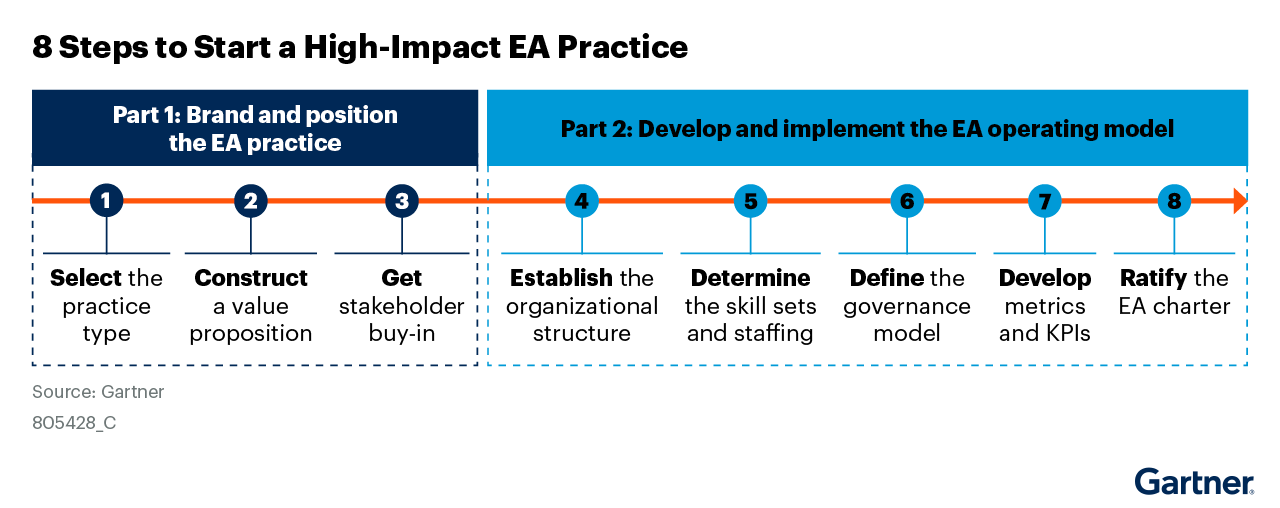
Starting an EA practice in an organized and timely manner is critical to success. Heads of EA must time box Gartner’s eight steps to start a high-impact EA practice to make a powerful first impression and gain credibility with sponsors and stakeholders. In Start a High-Impact EA Practice in 100 Days, we break down the first 100 days into eight concurrent, overlapping steps with suggested durations that can be modified (i.e., to longer or shorter durations) depending on the head of EA’s experience, ability to execute multiple steps simultaneously, and organizational constraints. Each time-boxed step includes goals, challenges, key activities, and progress markers.
Note: All eight steps can occur either sequentially or concurrently. Concurrently, it will improve the time it takes for the EA practice to market. However, success depends on your ability to execute multiple steps simultaneously (see Note 1).
Actions and Cautions
Actions
EA heads must focus on a structured and stakeholder-centric approach to building a high-impact EA function with three distinct parts.
Part I: Strategically position and brand EA:
- Educate yourself on the three types of EA practices: Traditional EA, business-outcome-driven EA (BODEA), and EA as an internal management consultancy (IMC).
- Assess your organization’s current EA capability, maturity, and specific needs to select the most appropriate EA practice type. Gartner recommends starting with BODEA as the de facto standard or taking a quantum leap to IMC if innovation, optimization, and transformation are key priorities. Start with traditional EA if the organization faces urgent IT issues such as legacy system failures, security breaches, or critical infrastructure outages.
- Construct a clear and compelling value proposition for the chosen EA practice type. This involves identifying stakeholders’ needs, conducting initial “roadshows” to solicit input, and developing a value proposition canvas and document.
- Actively market and sell the EA practice by describing the future EA function in business language, showcasing the real-world business problems it will solve, and demonstrating the benefits to stakeholders through a targeted communications plan.
- Utilize value-based selling techniques from management consultancies to engage and pitch key EA stakeholders. Focus on empathy and tailoring EA offerings to meet their specific needs, using a second “roadshow” to secure their buy-in and mandate.
Part II: Build or modernize the EA operating model:
- Establish an adaptive organizational structure that supports new ways of working, such as fusion teams, distributed digital delivery, and product-oriented and agile delivery operating models. Engage your CIO to gain support for this design.
- Implement EA services with defined engagement plans, work products, key deliverables, and metrics to streamline the delivery of EA to internal customers.
- Develop a solid staffing, hiring, and talent plan aligned with the chosen EA practice type and organizational structure. Identify essential competencies, skill sets, job descriptions, and career paths for a diverse team of architects.
- Define an adaptive EA governance model that moves away from “command and control” and aligns with IT and corporate governance. Democratize the process by establishing communities of practice (CoPs) where EA co-creates and updates minimum viable architectures (MVAs) with fusion teams, giving them voting rights for decision making.
- Develop a blend of EA performance and business value metrics and KPIs. Define practice management and business value metrics for EA services, demonstrating the business value EA delivers to stakeholders. Connect these metrics to “value stories” relevant to stakeholders’ outcomes. Start with foundational performance metrics and then adopt more mature business value metrics, tailoring scorecards for different audiences.
- Formalize with a realistic EA charter. Defer the construction and ratification of the EA charter until after completing Steps 1 through 7. Leverage the work products and deliverables (e.g., selected practice type, value proposition, stakeholder buy-in, organizational structure, staffing plan, governance model, metrics) from the preceding steps as crucial inputs to construct a practical and realistic EA charter. Ensure the charter is ratified through the appropriate governing body, and commit to periodically reviewing and updating it to reflect changes in scope, organizational design, contribution, processes, and mandate.
Cautions
EA heads must be aware of several challenges, complications, and common pitfalls that can derail their efforts to establish a high-impact EA function. These include:
- Ignoring the “where to start” problem:
- The greatest challenge is often knowing where to begin and what actions to take. Failing to follow a structured approach risks the EA practice being demoted, disbanded, or restarted.
- Lack of strategic positioning and buy-in:
- It is impossible to start an EA function successfully without a clear, compelling value proposition and securing genuine stakeholder understanding and buy-in.
- Many heads of EA mistakenly believe that a definition of EA and an EA charter alone provide the necessary mandate, leading to failed practices because they lack stakeholder alignment from the outset.
- Not understanding the organization’s needs, current and future state IT operating model, current EA maturity, and required resources upfront can lead to selecting the wrong practice type and overpromising on capabilities.
- Outmoded operating models:
- Using centralized or decentralized EA organizational structures unsuited for distributed digital delivery will impede decision making and new ways of working for fusion teams, products, and agile teams, leading to failure.
- Failing to build a solid staffing plan with the right mix of roles, competencies, and skill sets means the EA practice will struggle to deliver business outcomes.
- Implementing traditional “command and control” EA governance alienates products and fusion teams and is perceived as a bureaucratic roadblock, hindering the speed and agility required for digital delivery.
- Ineffective measurement and value demonstration:
- A top challenge is failing to identify and use the right metrics and KPIs to run the EA practice efficiently and, critically, demonstrate its business value.
- Many EA leaders focus too much on productivity metrics (EA practice management), while business executives seek business value metrics to understand EA’s impact on business outcomes. This disconnect can lead to EA being viewed as a “discretionary” and non-value-added discipline.
- Premature charter ratification:
- Constructing and ratifying the EA charter too soon, without first going through the rigorous process of defining the value proposition and securing stakeholder buy-in, is detrimental to the practice’s success. This can “pigeonhole” the EA practice and impede its ability to adapt and deliver on its authorized purpose.
How to Execute
Part I: Brand and Position the EA Practice
Step 1 — Select the Practice Type
Types of questions you should ask and answer:
- What kind of EA practice should I start?
- What resources do I require to begin a high-value, high-impact EA practice?
- How will I upgrade the EA practice and advance its capabilities and maturity?
Most EA practices follow a linear path to maturity. They begin as traditional EA practices, upgrade to business-outcome-driven EA (BODEA) practices, and extend into EA as an internal management consultancy (IMC) practice.
Challenge:
It is impossible for an EA head to successfully start a new EA practice without first knowing what type of organization needs it, and what the organization’s EA capability, maturity level, and required resources, and investments are.
Explanation:
Starting a high-value EA practice is contingent on the head of EA selecting the correct type of EA practice to solve business and technical problems. Without an understanding of the issues, opportunities, threats, and risks surrounding the business and operating models, as well as the technology and data stakeholders need to drive business outcomes, heads of EA cannot determine the type and focus of the EA practice (see Table 1). Starting a high-impact EA practice requires due diligence, resources, investment, and a maturity assessment.
EA Practice Type and Focus
EA practice type | EA practice focus |
Traditional EA | The focus is technology-centric, specifically on solutions and technical architecture, with an emphasis on projects and command and control governance. |
Business-outcome-driven EA (BODEA) | The focus is business-outcome-driven, specifically bridging business and technology architecture. It starts with business architecture (BA) to align business and IT by putting the “why” and “what” of EA before solutions and technical architecture, the “how” of EA. |
EA as an internal management consultancy (IMC) | The focus is stakeholder-centric. Specifically, it extends BODEA by delivering EA services to meet stakeholders’ needs. It professionalizes the EA practice by offering advice and guidance, working in a responsive and agile manner, and using adaptive governance. |
Source: Gartner (September 2025)
Solution:
Be realistic and practical from the outset to avoid overpromising and underdelivering. Do the due diligence and acquire the necessary investment and resources to deliver EA successfully to avoid the pitfalls and perils of starting a new EA practice. Start your journey by understanding stakeholders’ and organizational needs and assessing EA capability and maturity. Armed with the findings from a capabilities and maturity assessment, you can select the type of EA practice that best meets organizational needs.
While you may have compelling reasons to start a traditional EA practice, Gartner recommends starting with a BODEA practice — the de facto standard for successfully delivering EA.
Consider taking a quantum leap, bypassing or leapfrogging traditional and BODEA practices, starting with an IMC practice when CIOs must simultaneously focus on innovation, optimization, transformation, customer experience, resilience, and agility.
Actions:
- Educate yourself about the three different types of EA practices.
- Determine your experience, competencies, and comfort with planning, implementing, and managing different types of EA practices.
- Determine what EA practice makes the most sense for your organization, given its current EA capability and maturity, and what it needs from EA.
- Continuously evolve the EA practice by ensuring it remains aligned to the changing needs of stakeholders.
- Ensure that the EA practice has the capacity and capability to deliver on the promise of EA continuously.
Recommended Reading:
Step 2 — Construct a Value Proposition
Types of questions you should ask and answer:
- What does the organization need from a new EA practice?
- What’s in it for business leaders and product teams to engage and transact with the EA practice?
- How do I construct an EA value proposition?
The EA value proposition clearly states the benefits and outcomes that stakeholders will realize by collaborating with the EA practice. “Value” is the benefit stakeholders derive from working with the EA practice. “Benefit” is grounded in the stakeholders’ needs and derived from the outcomes they achieve.
Challenge:
It is impossible for a head of EA to successfully start a new EA practice without constructing a clear and compelling value proposition for the type of EA practice selected and securing stakeholder understanding and buy-in for it.
Explanation:
Ask five people to define EA, and you’ll likely receive ten responses. In many organizations, there’s a lack of clarity about what EA does, how it works, how it adds business value, what it does not do, and how it is measured.
Many heads of EA fail to demonstrate the value propositions of their EA programs from the outset, resulting in a failed EA practice. These leaders often start by defining EA and constructing an EA charter that lacks a compelling, stakeholder-aligned value proposition. They falsely believe that the definition of EA and the EA charter provide the necessary buy-in and mandate for the organization’s EA practice to succeed.
Solution:
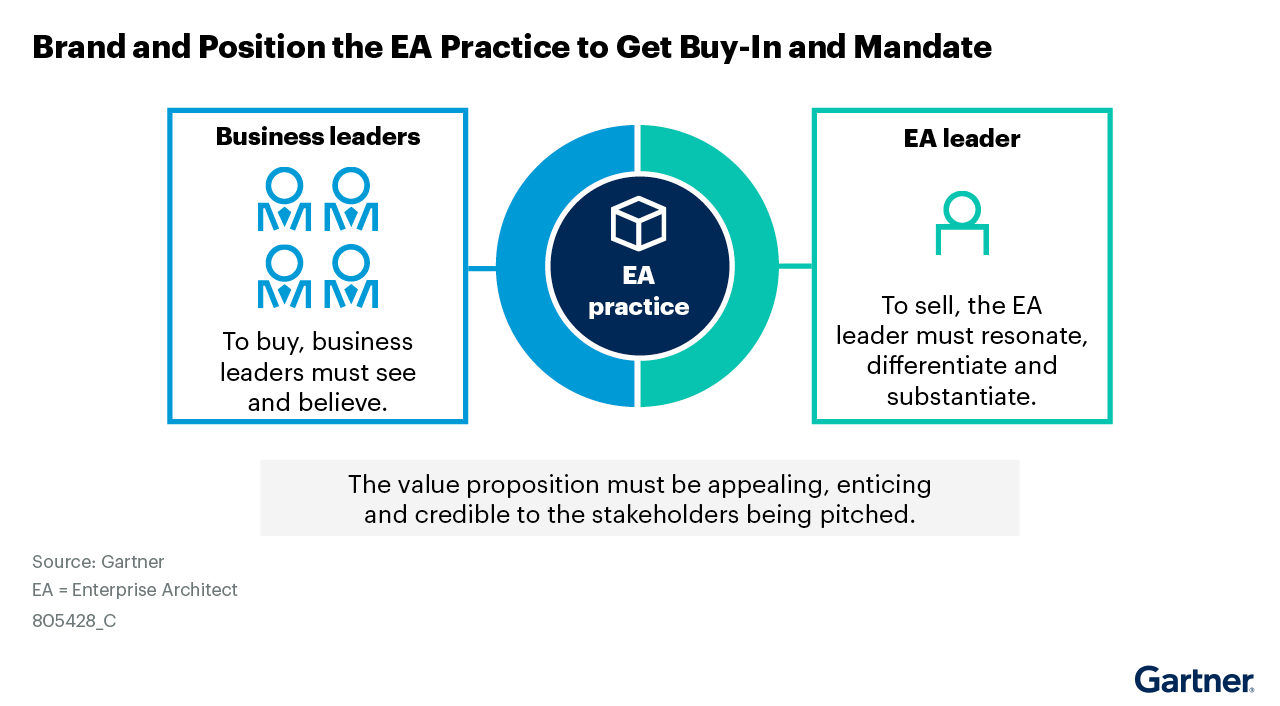
Recognize that branding and positioning the type of EA practice selected is a marketing and sales effort. The “powers” of an internal EA brand must be compelling, and the EA practice must be well-positioned so that key stakeholders will want to work with it. Identify exactly what business leaders and product teams need and value from EA. Ensure the EA value proposition is a key input to the EA charter.
Start by identifying stakeholders, going on an initial roadshow, asking and answering questions about what the organization needs from the EA practice, and constructing a value proposition canvas and value proposition document to get stakeholder buy-in and mandate. The EA practice value proposition must be appealing, enticing, and credible to the stakeholders being pitched (see Figure 2).
Actions:
- Market and sell the type of EA practice selected. Brand and position it as a function and discipline that the organization and stakeholders simply cannot do without.
- Showcase the business and technical problems that the chosen EA practice will solve. Include a business case and rationale as part of branding and positioning.
- Describe the EA practice in business language, and show how stakeholders will benefit from using it.
- Ensure the EA value proposition is a targeted campaign that reflects a single, all-encompassing understanding of the EA practice — what it does, how it works, and how it’s measured.
- Develop a tailored communications plan to influence and motivate stakeholders to engage and transact with the EA practice. Keep the EA value proposition message simple.
Recommended Reading:
Step 3 — Get Stakeholder Buy-In
Types of questions you should ask and answer:
- Do the EA stakeholders feel that I have taken the time to understand their needs?
- How do I solicit the EA practice’s stakeholders to start a new practice?
- What techniques can I use to pitch the EA practice’s stakeholders?
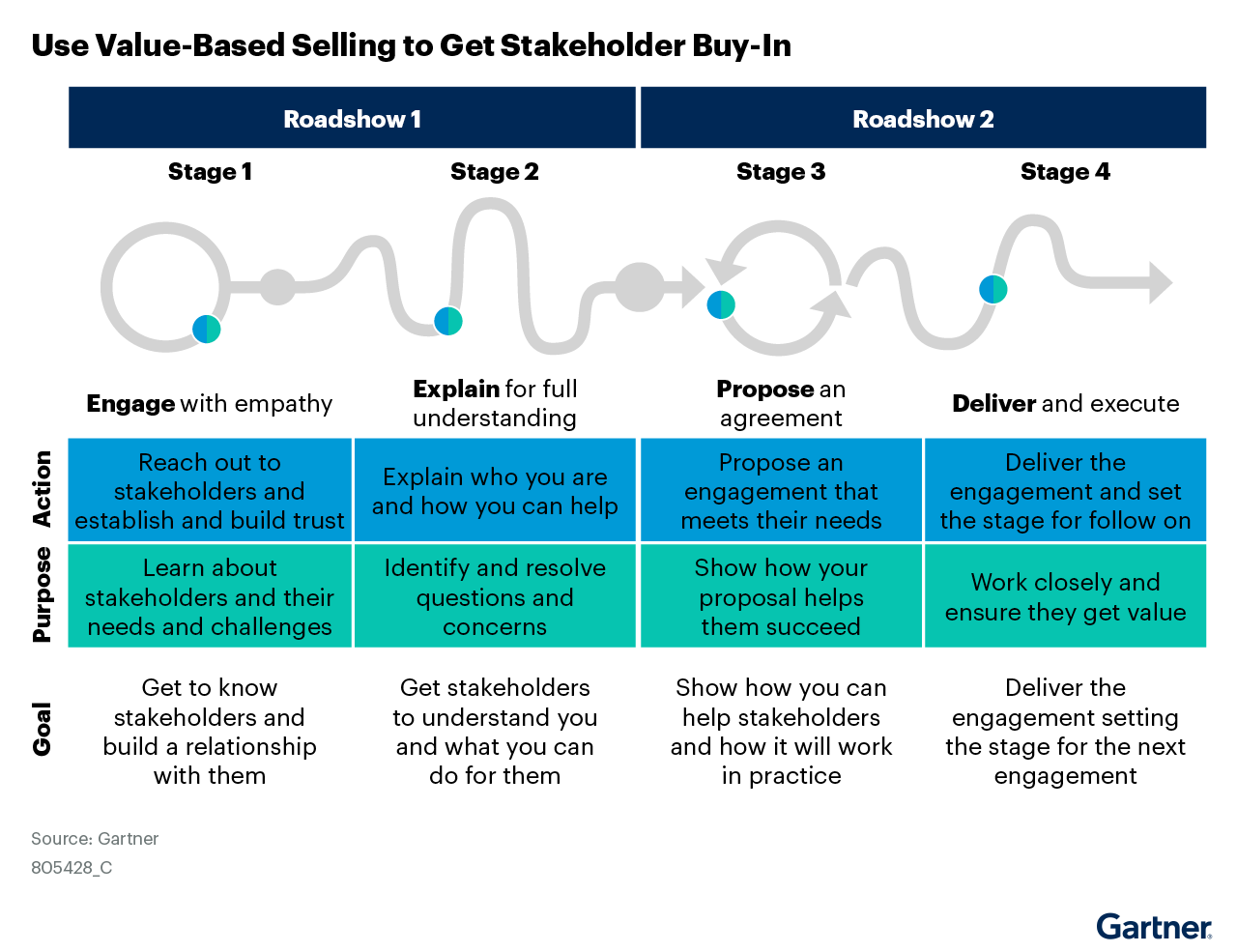
Value-based selling focuses on the value of solving stakeholders’ problems (needs). It is specific about the value being offered (how the need is met). It captures mutually meaningful value in every interaction (building the relationship). It clarifies, “What is in it for me?” — the consumer of EA.
Challenge:
It is impossible for a head of EA to successfully start a new EA practice without soliciting and pitching EA stakeholders to get their buy-in and mandate for the type of EA practice selected and how it will support their needs and priorities. Getting buy-in is also a prerequisite for stakeholder engagement. Simply put, if they don’t buy into the EA practice, its offerings, and how it will benefit them, they won’t engage with it either. Building an EA charter without getting stakeholder buy-in and mandate will result in a failed EA practice.
Explanation:
CIOs decree that the organization will do EA, and heads of EA walking into business leaders’ and product managers’ offices and presenting the definition of EA will not convince stakeholders to engage with the EA practice.
Solution:
Before starting or revamping an EA practice, learn and leverage the best practices of management consultancies by using value-based selling. Go on a roadshow to solicit and pitch EA stakeholders to get buy-in and mandate for the type of EA practice selected. Focus on empathy, soliciting a deep understanding of stakeholders’ needs, and shaping EA offerings that meet those needs. Use value-based selling to increase the likelihood of engaging and conducting transactions between the EA practice and EA stakeholders (see Figure 3).
Actions:
- Conduct a stakeholder analysis by identifying and segmenting key organizational stakeholders who will benefit from collaborating and working with the EA practice, and by identifying ways EA might support them.
- Go on an initial roadshow and use value-based selling to engage and solicit input from key EA stakeholders about what they need from the new EA practice.
- Construct a value proposition canvas, value proposition document, and value proposition statement.
- Go on a second roadshow, use the value proposition document to pitch the new EA practice to key EA stakeholders, and get stakeholder buy-in.
- Use the value proposition document as input for constructing the EA charter.
Recommended Reading:
Part II: Develop and Implement the EA Operating Model
Step 4 — Establish the Organizational Structure
Types of questions you should ask and answer:
- What EA organizational structure will meet the faster pace of business and operating model change, digitization, democratization, and distributed delivery?
- What EA organizational structure will support project- and product-oriented operating models that favor fusion teams and autonomy?
- What EA organizational structure will be adaptive and flexible while addressing the growing demand for EA?
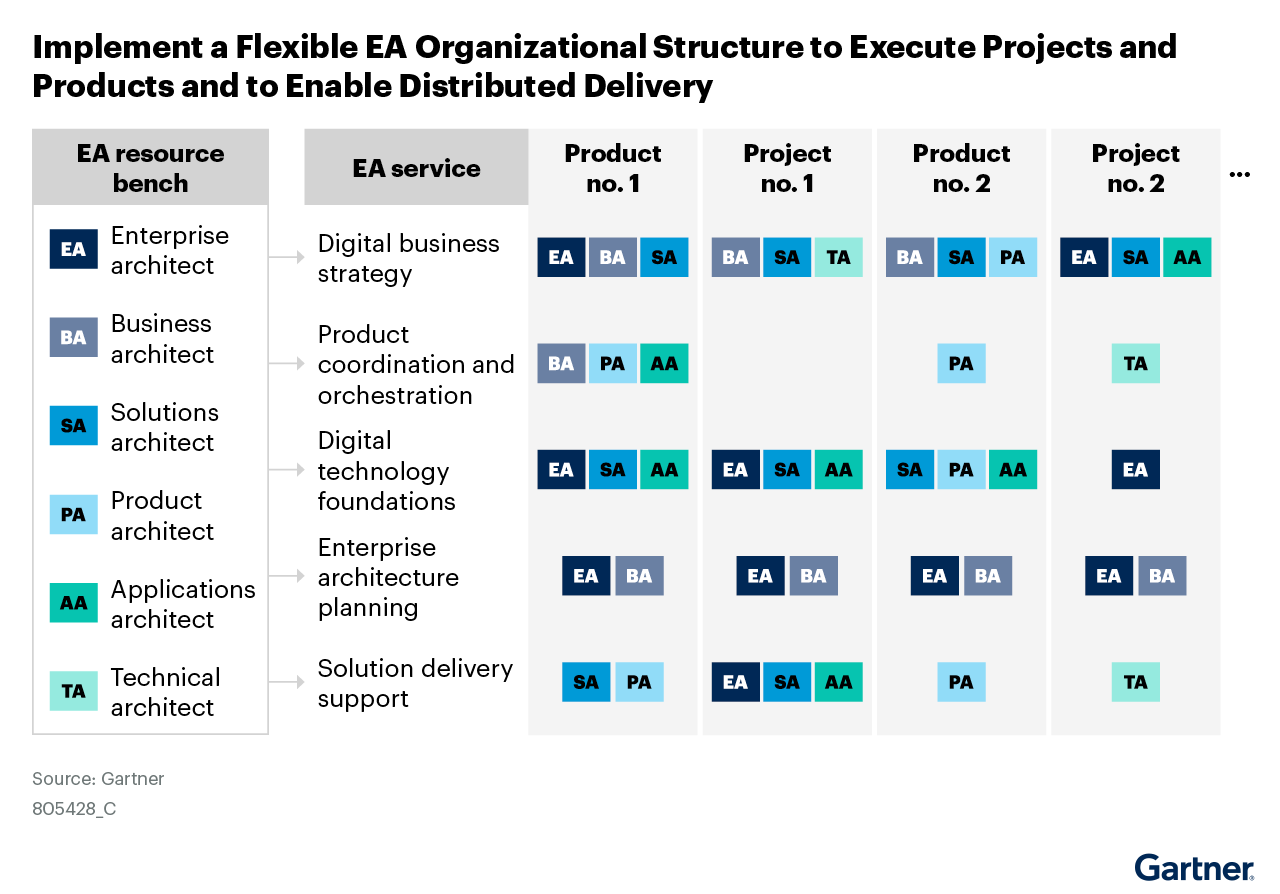
A flexible EA team structure helps EA practices adapt and respond quickly to a faster pace of change. It helps address the challenges of team function, coordination, and ultimately, performance with limited headcount. It integrates individual work by establishing roles, rules, and procedures for developing services, tasks, and resource capacity.
EA services provide a twofold, defined, and predictable way of working for the EA resource bench to deliver services to internal customers, and for the internal customers consuming EA services to drive their business outcomes. EA services include an engagement plan, work products, key deliverables, and metrics to measure the performance of EA services across projects and products.
Challenge:
Centralized and decentralized EA organizational structures are not well-suited to the new challenges of distributed digital delivery. They impede decision making and the new ways of working for fusion teams. The EA team structure needs to reflect the organization’s structure. For example, if you have a federated organizational model, a federated EA practice will be best suited. An outmoded EA organizational structure leads to a failed EA practice.
Explanation:
The reorganizing of IT and business resources into product lines and fusion teams has diffused decision-making power across the enterprise, product line, and delivery team levels. This transformation comes with high needs, volatility, and rapid, iterative change. Fusion teams need decision making to happen faster and closer to the point of value delivery. To succeed, fusion teams demand autonomy to create their own solutions and standards. They need greater freedom, responsibility, and agility. To be valuable to the enterprise, EA practices, specifically their organizational structures, must evolve to accommodate new ways of working.
Solution:
Assess where the organization is in its shift from project to product and distributed delivery. Identify new ways for the EA organizational structure to work so that it can guide and ensure architecturally sound decision making across the enterprise. Implement an EA organizational structure that can simultaneously execute projects and products. Implement EA services to enable the EA organizational structure (see Figure 4).
Actions:
- Understand how fusion teams work and rethink how EA enables them to co-create successfully.
- Reevaluate who the true decision makers are, as well as how and where EA must engage with them.
- Engage your CIO in a discussion to win support for designing and implementing an EA organizational structure that moves in lock step with the evolving IT operating model.
- Design the EA organizational structure to meet the needs of the enterprise today; plan on rethinking it as the organization and the EA practice’s maturity grow and evolve into IMC.
- Ensure the EA organizational structure can support fusion teams that must architect across three interconnected layers — community architecture, team architecture, and platform architecture.
Recommended Reading:
Step 5 — Determine the Skill Sets and Staffing
Types of questions you should ask and answer:
- What types of architects, competencies, and skill sets does the EA practice need to support traditional EA, BODEA, and IMC?
- What type of staffing and talent plan does the EA practice need to support projects, products, and distributed delivery?
- How many different types of architects does the EA practice need to meet the demand for EA?
EA is a high-performance team sport. Without a solid staffing plan and the right combination of roles, responsibilities, competencies, and skill sets, the EA practice will fail to help deliver business outcomes.
Challenge:
To deliver the digital ambitions of the organization, a high-impact EA practice needs a solid organizational structure and staffing plan. The staffing plan must support the type of EA practice selected (traditional EA, BODEA, or IMC). The staffing plan must identify the different kinds of architects required, their quantities, competencies, skill sets, and the services and tasks they will perform.
Explanation:
Projects and products, fusion teams, and distributed delivery are complex. Enabling the EA practice to deliver business value is contingent on human capital. Without solid practice management, a staffing plan, and the right people (roles, competencies, and skills), neither traditional EA, BODEA, and IMC practices, nor their respective operating models (organizational structure, services, and governance), will succeed.
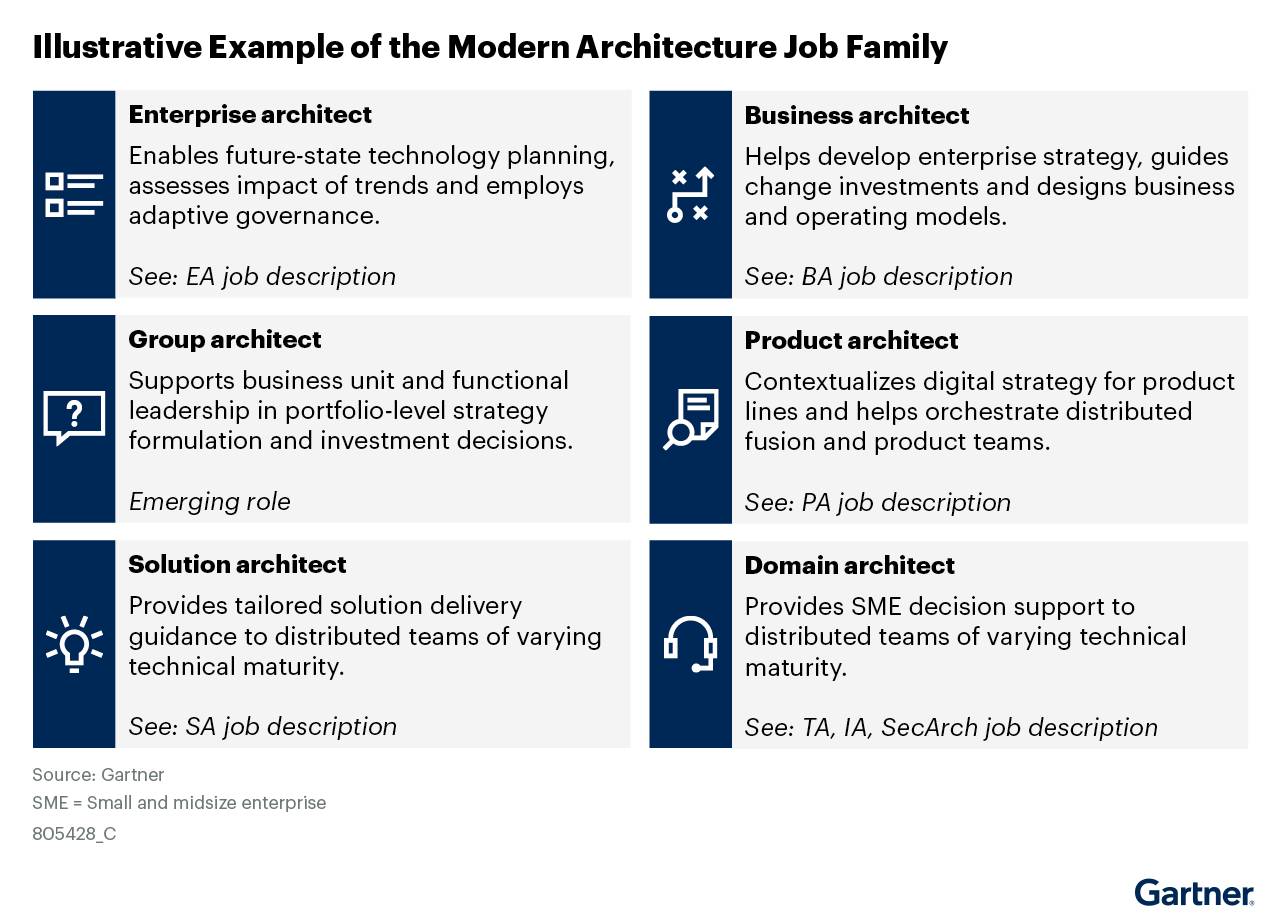
Hiring and developing the right type, mix, and quantity of EA roles — enterprise, business, information, solutions, products, technical, applications, infrastructure, and security architects — is essential to the value proposition and success of the EA practice.
Solution:
Avoid the pitfalls of starting a new EA practice by fully understanding the staffing and skill set requirements of traditional, BODEA, and IMC practice types. Develop, in tandem, the appropriate organizational structure and staffing plan required to deliver projects and products; in addition, enable distributed delivery. Professionalize the delivery of the EA practice by constructing a staffing plan that addresses tasks (jobs to be done), roles, responsibilities, competencies, skill sets, hiring, development, and demand management. Work with human resources (HR) to look internally and externally to find and hire the right competencies and skill sets to meet the needs of the type of EA practice selected (see Figure 5).
Actions:
- Construct a staffing, hiring, and talent plan — in conjunction with the organizational structure — to meet the value proposition and focus of the type of EA practice selected.
- Identify essential competencies and skill sets, as well as job descriptions and career paths for EA team members, and then identify training to help them develop and progress in their careers.
- Acquire resource bench forecasting competencies to manage demand for EA services.
- Construct a resource bench or talent pool with a demand management plan to deliver EA across projects and products.
- Manage the resource bench by proactively aligning the supply and demand of EA services.
Recommended Reading:
Step 6 — Define the Governance Model
Types of questions you should ask and answer:
- What type of governance should the EA practice implement to meet the faster pace of business and operating model change, the shift from project to product, democratization, fusion teams, and distributed delivery?
- What type of review boards should the EA practice implement to enable distributed delivery?
- What principles, reference models, standards, patterns, and decision frameworks should the EA practice implement?
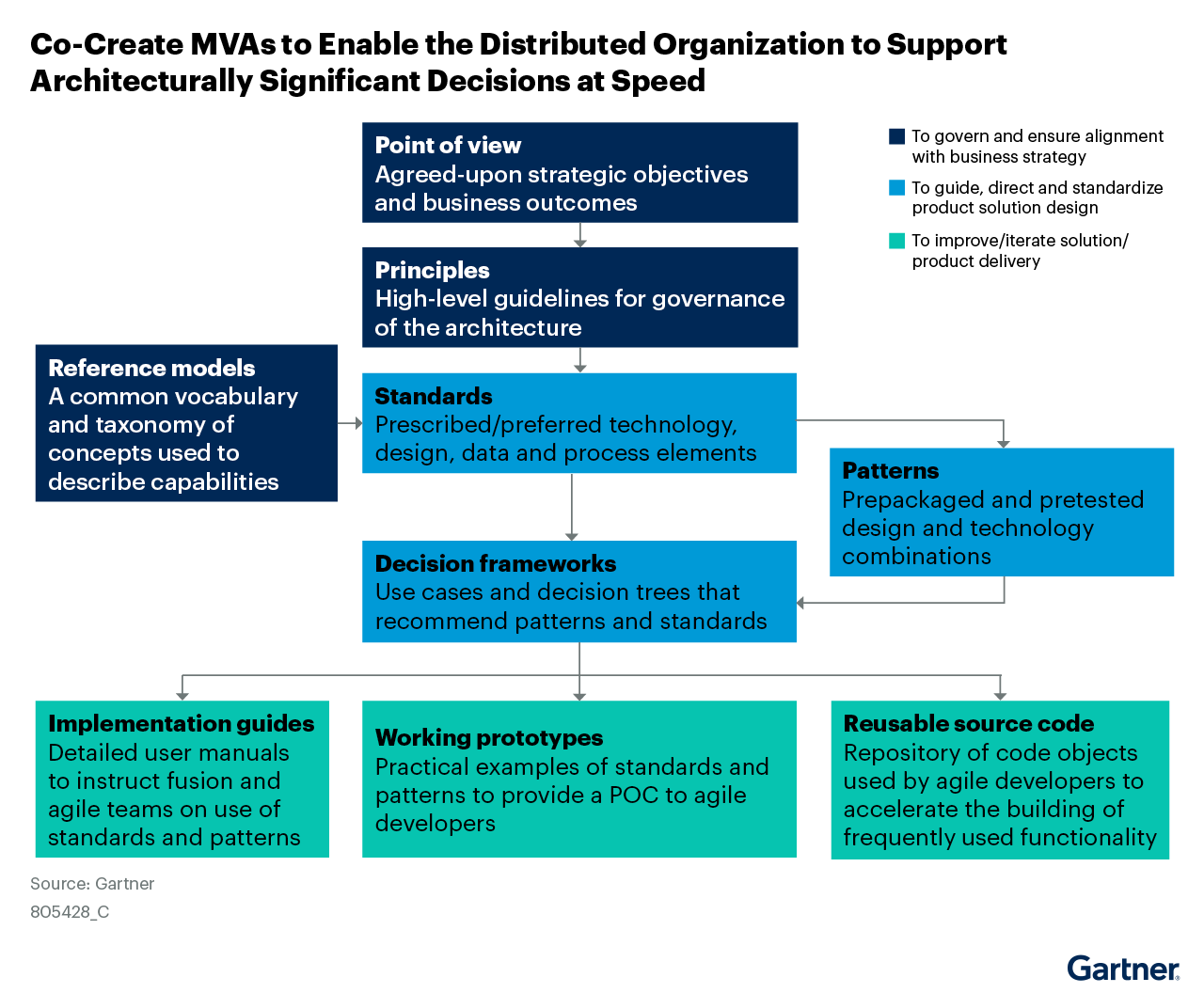
Minimum viable architecture (MVA) is a standardized framework used to ensure timely and compliant product development and iteration. It refers to the set of minimal architecture deliverables needed to support business outcomes that serve as a compliance baseline against which agile delivery teams develop products. It is not fixed and evolves with the changing needs of the stakeholders and what they learn via iterative product development.
Challenge:
EA governance has traditionally been about “command and control,” which is why it has a bad reputation with fusion teams who perceive it as an unnecessary bureaucratic roadblock. To support distributed and architecturally significant decisions at speed, the EA practice must focus on democratizing the EA governance process, which includes reforming and rethinking traditional architectural review boards.
Explanation:
Digital capabilities are increasingly being designed and delivered by fusion teams. Democratization is increasing with decision making distributed across fusion teams. A shared architecture that allows different parts of the enterprise to collaborate is required to avoid silos and impediments. Adaptive EA governance, which uses CoPs and MVAs, succeeds where traditional, heavy-handed EA review boards, processes, and guidance fail to support the swift decisions needed to deliver speed to value through agile and iterative methodologies (e.g., design thinking and agile).
Solution:
Align EA governance with IT and corporate governance and enterprise risk management so that EA governance shares the same common focus areas: strategy, investments, performance, resources, risk, and innovation. Support fusion teams by replacing one-size-fits-all governance with adaptive governance that contextualizes decision rights, while balancing product needs with enterprise goals, risk, and agility.
Repurpose traditional architectural review boards to provide guardrails — MVAs — for shared enterprise and product-level architecture decisions and shared enterprise services and digital technology foundations (see Figure 6).
Actions:
- Ensure EA governance helps the organization deliver business outcomes by focusing on orderly and coherent strategy execution vertically and horizontally.
- Ensure EA governance helps the organization find the right mix between enterprise risk and agility.
- Democratize the EA governance and architectural review board process by establishing CoPs consisting of fusion teams where the EA practice leads, co-creates, and updates MVAs.
- Update MVAs collaboratively by working with fusion teams through CoPs and giving representative members of fusion teams voting rights to facilitate democratic decision making.
- Ensure that the MVA eliminates technical debt, is scalable, conforms to enterprise standards, patterns, and designs, and is reusable.
Recommended Reading:
Step 7 — Develop Metrics and KPIs
Types of questions you should ask and answer:
- How will EA metrics and KPIs be used to measure the efficiency and effectiveness of the EA practice and its operating model?
- What metrics and KPIs do I need to measure the performance of the EA practice?
- What metrics and KPIs do I need to measure the business value of EA?
EA has a causal relationship and effect on enterprise operational excellence. It is a prerequisite to driving business outcomes and achieving financial performance. Good EA practice measurement proves that the cost and effort required to run the EA practice are adding value to the enterprise and stakeholders.
Challenge:
A top challenge for many EA heads is identifying and using the right metrics and KPIs to efficiently and effectively run the EA practice and demonstrate its business value. The problem is exacerbated because many EA heads fail to link EA metrics and KPIs to value stories and the services the EA practice offers. The metrics and KPI problem is why some business and IT leaders come to view EA as a “discretionary” and non-value-added discipline.
Explanation:
Many heads of EA focus on constructing EA practice management metrics, which focus on measuring the productivity of the EA practice. In contrast, business executives want business value metrics to measure EA’s impact on helping the organization achieve business outcomes. They want to know the impact and business value of EA services, tasks, and activities on making investment decisions that help run, grow, and transform the business.
Solution:
Identify EA performance management metrics that measure how the EA practice enables stakeholders’ top priorities. Design EA performance metrics to measure how EA services, tasks, and activities support stakeholders’ needs, their value stories, and business outcomes. Construct EA practice performance metrics and KPIs to measure the quality, quantity, efficiency, and productivity of the services the EA practice offers. Construct EA business value metrics and KPIs to measure how the EA practice contributes toward stakeholders achieving business outcomes. Track and periodically recalibrate EA practice efficiency and effectiveness metrics and KPIs, especially as EA services, tasks, and activities change to meet the needs of the evolving business and operating models. Start with foundational EA performance metrics and KPIs before adopting more mature EA business value metrics (see Table 2).
Use a Mix of EA Performance Metrics (Illustrative, Partial List)
Scorecard categories | Foundational metrics | Mature metrics |
Financial performance |
|
|
Project performance |
|
|
Operational performance |
|
|
Talent management |
|
|
User satisfaction |
|
|
Source: Gartner (September 2025)
Actions:
- Define EA services metrics and KPIs.
- Construct EA service metrics and KPIs to measure the efficiency and effectiveness of the EA practice, and business value metrics to measure the business value of EA to stakeholders.
- Construct value stories to connect EA metrics to narratives that are relevant to and consistent with outcomes the EA practice’s stakeholders are trying to achieve.
- Start with foundational EA practice performance management metrics and KPIs to track and refine EA practice measurement before adopting more mature EA business value metrics.
- Track EA practice progress against metrics and KPIs that reflect key stakeholders’ top priorities. Tailor metrics scorecards for different audiences.
- Aggregate EA activities into a small handful of EA services advertised via a service catalog. Use a combination of metrics and KPIs that are easily understood by stakeholders.
Recommended Reading:
Step 8 — Ratify the EA Charter
Types of questions you should ask and answer:
- Why do I need an EA charter?
- When should the EA charter be constructed and ratified?
- How often should the EA charter be updated?
Challenge:
The most important thing to do when starting a new EA practice is to formally document and execute the mandate. However, timing the construction and ratification of the EA charter is critical. Too soon, and without EA stakeholder buy-in, as reflected in the EA value proposition, will be detrimental.
Explanation:
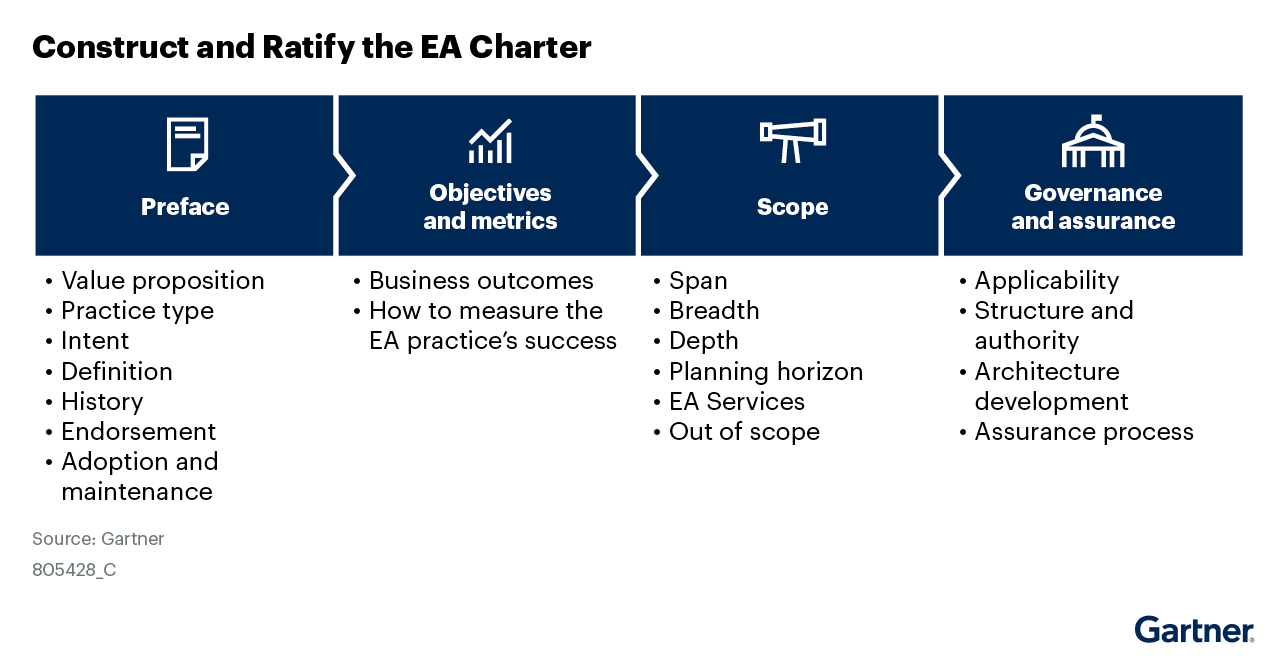
The EA charter establishes the basis for the EA practice’s existence and reflects its purpose (mission, goals, and objectives). It provides guidance for scope and execution. Starting a new EA practice without first going through the value proposition process and without customizing the charter to the organization’s uniqueness will pigeonhole and impede EA practice success. Heads of EA who do this run the risk of getting a mandate to execute an EA practice that will likely, and very soon after starting, deviate from what the actual practice was authorized and supposed to do after going live.
Solution:
Follow the prerequisite Steps 1 through 7 before constructing and ratifying the EA charter. Leverage the work products and deliverables from Steps 1 through 7 as valuable inputs to construct a practical and realistic EA charter that sets the EA practice up for success (see Figure 7).
Actions:
- Recognize that the EA charter is the most important document when starting a new EA practice.
- Defer the construction of the EA charter. Do the due diligence first and avoid running the risk of prematurely locking in, pigeonholing, and impeding the success of the new EA practice.
- Follow Steps 1 through 7 to gather the necessary information and inputs to construct a practical and realistic EA charter, setting the practice up for success.
- Ratify the EA charter through the appropriate governing body within the enterprise.
- Review and update the EA charter periodically. Refresh the document to reflect changes in the EA programs’ scope, trajectory, organizational design, contribution, processes, and mandate.
Recommended Reading:
Success Measures
A high-impact EA function’s success is measured by strong business alignment, high stakeholder engagement, broad adoption of EA deliverables, delivery of tangible value, effective governance, and ongoing maturity improvements. Tracking these metrics against benchmarks helps ensure your EA practice drives strategic business outcomes.
Success measures for enterprise architecture implementation
Business alignment
Measure: Percentage of EA initiatives directly linked to business strategy or objectives.
Benchmark: Leading organizations report >80% alignment (Gartner).
Stakeholder engagement
Measure: Stakeholder satisfaction scores from surveys or feedback sessions.
Benchmark: High-performing EA practices achieve >75% positive stakeholder ratings.
EA deliverable adoption
Measure: Rate of adoption of EA standards, roadmaps, and guidelines across projects.
Benchmark: A >70% adoption rate is common among mature EA functions.
Value delivered
Measure: Number and impact of quick wins (e.g., cost savings, risk reduction, improved agility) attributed to EA.
Benchmark: Organizations with effective EA report measurable improvements in project delivery time and cost-efficiency.
Governance effectiveness
Measure: Number of architecture reviews conducted, exceptions managed, and compliance rates with EA policies.
Benchmark: Mature EA practices maintain >90% compliance with established standards.
EA maturity assessment
Measure: Regular assessment using industry frameworks to track progress across capability domains (for example, see Gartner’s IT Score for Enterprise Architecture).
Benchmark: Aim for Level 3 or higher (defined, managed, and optimized EA processes).
Continuous improvement
Measure: Frequency and impact of EA process updates based on business and technology changes.
Benchmark: Leading organizations review and refine EA practices at least annually.
Acronym Key and Glossary Terms
Democratized architecture | The direct and indirect support provided to business-led digital investment and distributed delivery, whether done by those inside or outside the company. The support takes the form of guidance shaping the selection, creation, implementation, and management of digital investments made outside the IT department. |
Distributed enterprise | An enterprise that uses digital capabilities to both support hybrid and remote workers, and to deliver services to consumers or citizens remotely and in person. It uses an operating structure based on digital capabilities to deliver business and IT operations that are optimized for hybrid and remote working, and to provide services combining virtual and physical elements for both remote and in-person customers. Such capabilities must include configurable workflows, business processes, security approaches, risk management, and governance. |
EA services | The delivery of EA as a portfolio of services. An EA service includes a defined engagement model and plan, a package of work activities or work breakdown structure, deliverables, and metrics that EA teams provide to meet the digital needs of internal enterprise stakeholders or customers. |
EA talent pool | Group of exceptional candidates or employees, hired and trained to fill different domain architect positions on an EA resource bench, and to enable the delivery of defined EA services. Hiring externally for the talent pool includes high-caliber, qualified candidates. Hiring internally for the talent pool includes high-performing and high-potential employees ready to assume greater responsibility. |
Economic headwinds and economic tailwinds | Economic headwinds decrease enterprise growth or value. Economic tailwinds could help organizations drive value and growth (see IT Leaders Must Act Now to Navigate Economic Headwinds). |
Fusion team | A critical building block for a distributed digital delivery model that organizations need to accelerate their digital transformation. A multidisciplinary fusion team blends technology or analytics and business domain expertise and shares accountability for business and technology outcomes. Instead of organizing work by functions or technologies, fusion teams are typically organized by the cross-cutting business capabilities, business outcomes, or customer outcomes they support. Fusion teams are often designed to deliver products rather than projects. They are responsible for technology work and all other efforts required to create a complete product or service. Usually, they do not report to the IT department, but rather to a business unit. |
Operating model | The Blueprint for how value will be created and delivered to target customers. An operating model brings the business model to life and executes it. An information and technology (I&T) operating model represents how an organization orchestrates its I&T capabilities to achieve its strategic objectives. An enterprise operating model describes how the enterprise configures its capabilities to execute its actions to deliver business outcomes, as defined in the business model. |
Organizational structure | Creating structures that align roles, workflows, networks, and procedures with an organization’s goals. Organizational design often involves changes at the corporate level through business units and individual processes. |
Product management (digital business) | The process of conceiving, defining, delivering, monitoring, and refining products in, and withdrawing products from, a market to maximize business results. Product management tasks range from researching markets, customers, and competitors, to analyzing customers and products, to developing and maintaining a product vision and roadmap. They also include working with product delivery teams to test and prioritize the delivery of product capabilities to maximize customer value and business impact and derive growth from digital initiatives. These tasks are performed by people with a wide range of titles such as product manager, product owner, business analyst, product marketer, and service manager. Tasks are often distributed within a product management team according to the skills of its members, who may range from strategic visionaries to detail-oriented virtual members of a delivery team. Product management must accommodate the rapid delivery cadence of digital business by emphasizing speed and innovation, while managing a complex environment with many dependencies. Artifacts such as roadmaps have shorter “shelf lives” than those associated with physical consumer products, and therefore suit approaches that are lighter in weight, such as Lean Startup. |
Resource management | The comprehensive practice of planning, scheduling, allocating, and utilizing the workforce in the most effective and efficient manner to achieve the greatest organizational value. |
Note 1: Grouping of Research and Execution of Steps
Research grouping by steps is not intended to be rigid or a waterfall process. Instead, grouping gives readers an understanding of the types of steps/activities organizations take to start their EA practice. Also, some of the documents and Toolkits are archived, but they have all been reviewed to ensure they are aligned with Gartner’s current positions.
Clients should determine their traditional EA, BODEA, and IMC approaches based on their business needs and the scope, focus, and capabilities of their overall EA practice. Additionally, all eight steps featured in this research can occur either sequentially and/or concurrently. Concurrently, it will improve the EA program’s time to market. However, success will depend on the head of EA’s ability to execute multiple steps simultaneously.