Data Lineage Is Essential to Manage the Risks of Agentic AI
24 March 2026 - ID G00847339 - 5 min read
By Guido De Simoni
As agentic AI grows, data and analytics leaders must implement comprehensive and granular data lineage to manage the risks of agentic AI. This will ensure compliance, boost trust, and improve explainability.
Insights at a Glance
Agentic AI systems autonomously plan and execute workflows, making them integral to modern enterprise operations. However, their autonomy creates significant risks because of poor data quality and insufficient provenance analysis. Data lineage — the comprehensive, auditable tracking of data from source to consumption — is essential for establishing trust and explainability of agentic AI systems.
Data Lineage Supports:
- Trust and explainability: Detailed provenance records allow AI agents to validate decisions and provide explainable outputs. This traceability is critical for fault detection, troubleshooting, and resilience, and optimization of execution trajectories.
- Regulatory compliance: Lineage supports audit readiness for mandates like the EU AI Act, potentially reducing investigation times from weeks to hours by demonstrating that high-risk AI systems are trained on traceable datasets (see Modernize Data Governance for Agentic AI Adoption in Banking).
- Operational efficiency: Granular tracking enables real-time anomaly detection, where AI agents themselves can automate quality checks to prevent “garbage-in, garbage-out” scenarios (see AI Agents Augment the D&A Governance Team).
- Scalability: Active metadata and automated capture across diverse systems are required to maintain transparency in complex, multicloud environments, ensuring data remains governable as it moves through the ecosystem (see Reference Architecture Brief: Data Integration).
To succeed, D&A leaders must adopt a unified metadata strategy, implement granular tracking, and integrate lineage directly into agentic AI workflows (see AI and GenAI Demand a New Approach to Data Management). Failure to do so exposes organizations to regulatory penalties and operational failures.
Issue Context
The following factors set the stage for why data lineage is now a critical component for agentic AI:
- Autonomy and speed: Agentic AI systems are based on real-time data streams. Metadata “capture” and “use” must evolve to serve as an orchestration layer to support these autonomous operations (see AI Vendor Race: Emerging Tech: Metadata Becomes the Key to Survival for Data Management Vendors).
- Regulatory pressure: Mandates like the EU AI Act and BCBS 239 require high-risk AI systems to have traceable, high-quality trusted data to ensure accountability. Investing in agentic AI without AI-ready data endangers outcomes and compliance status (see Investing in AI Without AI-Ready Data Endangers Outcomes).
- Complexity of data ecosystems: Modern architectures span cloud, hybrid, and on-premises environments, making manual data tracking impossible to sustain. Leaders must balance new business requirements with legacy challenges by investing in robust data management platforms (see Top Trends in D&A for 2026: Converging Solutions With Data Management Platforms).
- Risk of error propagation: Lineage enables guardian agents or human experts to assure correct data is used in response to a user query, a decision-making process, or an automated action.
- The need for explainability: Organizations must be able to reconstruct the decision path of an AI agent to meet ethical standards and regulatory inquiries.
Impact Brief
The shift toward agentic AI presents a massive opportunity for efficiency but introduces significant operational and regulatory risk. D&A leaders that fail to implement robust data lineage face “garbage-in, garbage-out” scenarios, where not trusted data drives to hallucination everywhere which could lead to impact — such as false positives in fraud detection or dangerous misdiagnoses in healthcare.
Conversely, implementing AI-ready lineage offers substantial benefits:
- Cost savings: Robust governance can save millions in costs related to data breaches and compliance liabilities. Identifying and deprecating unused data assets through lineage can also significantly reduce storage costs (see Quick Answer: How Does Data Lineage Accelerate Data Management Capabilities?).
- Agility: Real-time traceability allows organizations to simulate the impact of data changes before deployment, enhancing resilience, tracing back and optimizing the end-to-end pipeline for the pinpointed issues.
- Trust: Transparent decision paths foster cross-functional collaboration and improve customer satisfaction (see Top Trends in D&A for 2026: Reducing GenAI Risk With Decision Governance).
The urgency is clear: As AI adoption accelerates, data lineage is a strategic necessity for maintaining corporate integrity and competitive advantage.
More Detail
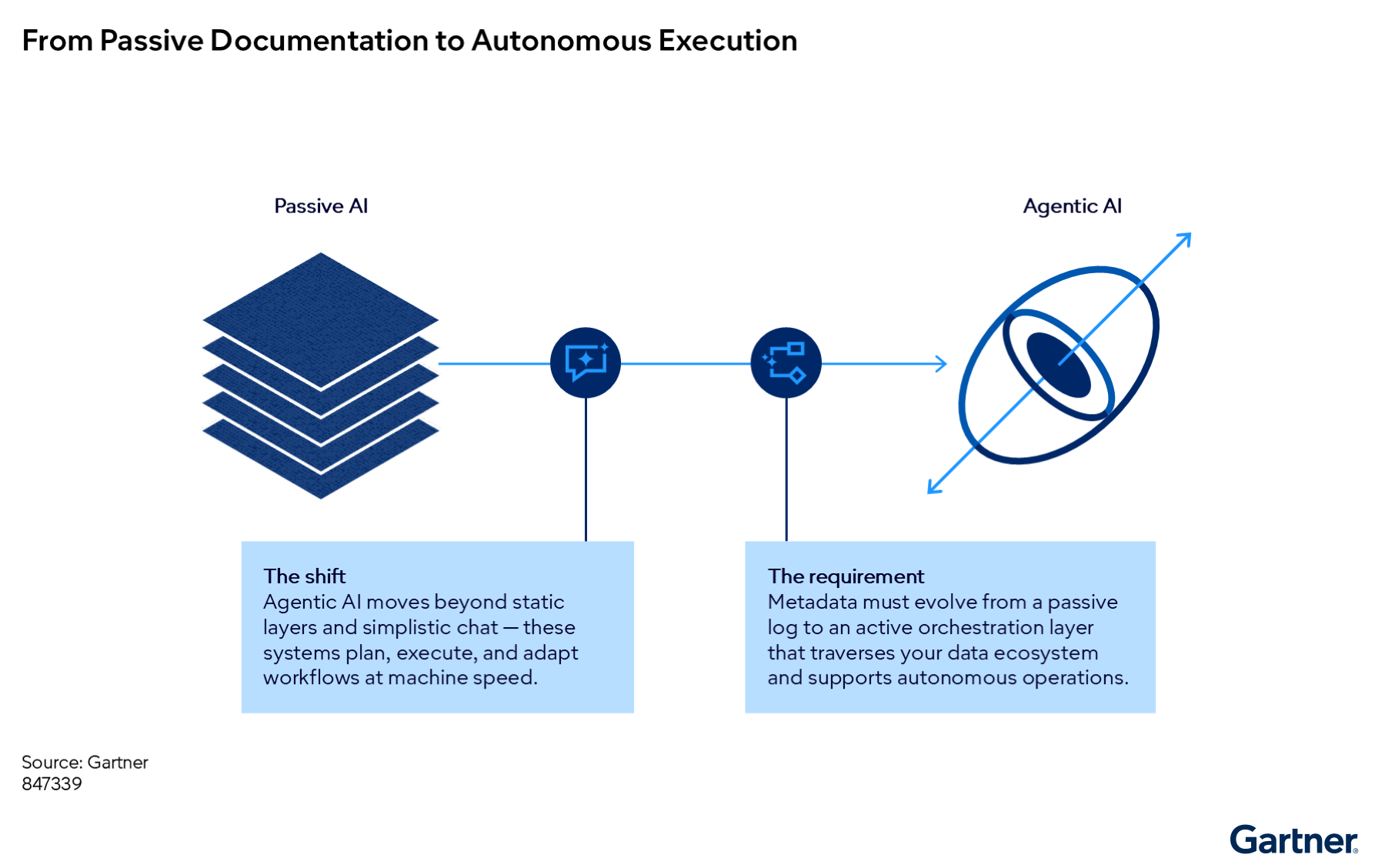
Mechanisms of AI-ready data lineage: Successful implementation depends on active metadata and granularity. Unlike static repositories, active metadata continuously captures changes as they occur, allowing AI agents to perform rapid root-cause analysis. Set up tracking to occur at the column or attribute level to pinpoint exactly which data modifications led to specific inaccuracies. Emerging technology requires context-aware data management where policies are embedded within the data flow (see Emerging Tech: AI Vendor Race: Agentic AI Needs Context-Aware Data Management). Implement bitemporal lineage, which allows organizations to reconstruct historical data states, which is a critical requirement for auditors who need proof of data states at the time a decision was made. We leverage two analogies: piles of documents as passive status quo, a gyroscope, centering on the concepts of autonomous stabilization, persistent orientation toward a goal, and dynamic adaptability (see Figure 1).
Overcoming implementation challenges: D&A leaders often struggle with siloed metadata and fragmented platforms. Overcoming this requires the adoption of common standards and a unified approach to metadata to enable cross-system orchestration. Furthermore, because AI agents are both creators and consumers of data, lineage systems must include safeguards like automated quality scoring and pre-committed validation layers to prevent the propagation of “hallucinations.”
Industry-specific applications
- Banking: Leading institutions use automated lineage to reduce data quality audit times from weeks to hours in credit decisioning and fraud detection and also be fast in meeting and assessing new regulatory requirements.
- Healthcare: Lineage ensures that automated diagnosis support and treatment plans are based on accurate, up-to-date patient records, ensuring patient safety.
- Manufacturing: AI agents use lineage to track sensor data, enabling predictive maintenance that prevents costly downtime and optimizes supply chain resilience.
Recommended actions
- Adopt a unified metadata strategy: Eliminate silos by integrating metadata across all sources using standardized protocols. A unified metadata strategy is fundamental to robust data pipelines and enables consistent governance.
- Deploy automated tools: Invest in solutions that automatically capture and update lineage in real time as data flows through the system. Data engineers can use agentic AI to automate the capture and enrichment of metadata, reducing manual intervention (see Critical Capabilities for Metadata Management Solutions).
- Integrate with governance: Tie lineage systems directly to role-based access controls, audit trails, and anomaly detection. AI agents can augment the governance team by enforcing policies and monitoring metadata continuously.
- Foster stewardship: Train technical and business functions on the importance of data lineage to drive a culture of accountability. Organizations should use criticality scoring tools to prioritize high-risk processes for guided attention (see Case Study: Effective IT Vendor Management With a Criticality Scoring System).