Magic Quadrant for Intranet Packaged Solutions
6 October 2025 - ID G00827475 - 63 min read
By Mike Gotta, Priyanka Singh, and 3 more
Intranets are one of the few technology investments that have widespread influence on employee experience, productivity and community building. Enterprise application leaders should use this analysis to navigate the IPS market, and determine suitable options that meet business needs.
Market Definition/Description
Gartner defines an intranet packaged solution (IPS) as a general-purpose, unified, multichannel software product available via public or private cloud deployment. It delivers a versatile range of business-to-employee digital experiences, including internal communications, community and social interaction, knowledge bases, self-service functions, and access to training and business applications. IPS products utilize web and mobile channels to support these experiences, while also offering native support for other channels such as email, AI assistants, digital signage, in-app plugins and messaging apps. The web channel may consist of a single site or a collection of IPS-created sites, encompassing various site types such as portals, “front doors” or hubs. An IPS is typically sponsored by HR and internal communication leaders as part of digital workplace initiatives.
An IPS aims to provide consistent digital experiences that help employees perform their best work, connect to the organization’s culture, align with the organization’s strategy, and advance their skills and expertise. It facilitates the creation, deployment, management and evolution of multichannel communications, serving as a common resource for information and knowledge sharing across the organization. Deploying an IPS enhances the effectiveness and efficiency of intranet projects.
IPS products are used for business-to-employee use cases, empowering stakeholders — such as communications, HR, CIOs and digital workplace leaders — to coordinate efforts that require both business and technical expertise. An IPS supports employees in a wide range of roles and contexts — including both office and frontline (or “deskless”) workers.
Key use cases addressed by IPS products include:
- Improving employee engagement and facilitating corporate communications
- Providing access to employee and workplace services
- Delivering a unified resource portal
- Enabling knowledge services for business areas
- Enabling better personal and team work management
- Promoting diverse intelligence assistance options
IPSs empower business technologists and citizen developers to extend the IPS.
A “packaged solution” signifies a holistic fit-for-purpose employee intranet approach. This excludes custom-built intranets, intranet products that require developers to build the solution, digital experience platforms used primarily for external needs, on-premises intranet solutions, or those solutions lacking core features in their offering. Products dependent on the purchase of other intranet products are not an IPS.
Mandatory Features
Mandatory IPS features include:
- Multichannel software product: Offered as a cloud-based (public or private), stand-alone, multichannel software product (that is, a single license or subscription) that includes web and mobile communication channels. It must have native support for other channels, such as email, digital signage, digital assistants (or similar AI experiences), in-app plug-ins and messaging. It must be a distinct stand-alone technology product and not augment, extend, advance or upgrade an existing intranet product that the customer must deploy. No additional application or platform technology must be purchased for it to function as an IPS.
- Editorial management: Management and delivery of information and communications experiences across multiple communications channels, devices and endpoints in multiple modalities. Editorial support includes communications and publishing governance activities such as planning, resourcing, templates, task coordination, content creation, campaign management, analytics and audience management.
- Content management: Management of sites, pages, content components, media (such as image and video), documents, metadata and templates. Includes content search, AI-based search and agent interaction as part of content activities (for example, AI-assisted content creation), as well as content analytics. Controls for information management policies are also included.
- Search, navigation and insight: IPS-wide search, enterprise search and federated search including traditional search techniques and emerging AI approaches. AI-based approaches can include search via AI assistants, AI agents and vector-based, large language model (LLM) searches. Query and retrieval approaches include AI-based prompts, synthesis and summation. Search analytics optimizes system tuning and insights on content, media and employee experience.
- Personalization: Leverages employee preferences, sentiment and behavior combined with analytics, graphs and other contextual data sources to create contextual and relevant digital experiences. This includes support for employee accessibility and multilingual needs.
- Peer engagement and work interaction: Supports collaboration, messaging, workflow, and the processes of capturing, refining and sharing knowledge, often through community and social experiences.
- Extensibility: Configurable prepackaged connectors and similar interoperability tooling to enhance IPS functionality and integration with other products, digital workplace applications, or business applications and back-end systems. Also includes IPS-provided APIs, composability support and orchestration mechanisms. Developer services include low-code and no-code functionality. Of note, “deep links” and iFrames and similar techniques do not qualify.
- Security, identity and access controls: Administration and management of access rights, role delegation, and support for security, compliance, and related policy controls and standards.
Common Features
Common IPS features include:
- Artificial intelligence back-end services: AI technologies that do not directly interact with employees but are used internally by the IPS. These include advanced analytics, machine learning, knowledge and work graphs, natural language processing (NLP), agents, LLMs, neural networks and other AI tooling that enhances IPS capabilities and supports adaptive experiences.
- Digital assistants and AI agents: Conversational interfaces where there is direct interaction (such as chatbots), or generative and agentic AI assistants. This includes the ability for employees to create and manage digital assistants and agents, and for the organization to govern their activities.
- Frontline support: Specialized capabilities, often accessed via mobile apps, to optimize support for “deskless” staff. These capabilities are sometimes referred to as frontline superapps, and include a library of minapps. Frontline support includes ad hoc and task- or service-specific workflow orchestration, with integration into relevant operational systems. It also supports shift management, training, certification, and safety needs specific to frontline scenarios. Additionally, it facilitates expertise location and discussion forums. Frontline messaging should go beyond basic individual and group chat to include non-PBX telephony, push-to-talk, location tracking, role switching, alerts and notifications, presence status, and broadcast and emergency interfaces. Other capabilities include “to do” lists, voice notes, voice messaging, and photo handling to associate pictures with task and service activity.
- Orchestration and automation: Support for programmatic mechanisms such as API integration, composability, task management and workflow to organize, coordinate and execute automation sequences within the IPS environment. This includes managing digital experiences within the IPS, as well as supporting dashboards, alerts, notifications, status and related actionable work management needs.
- Employee insights: Includes usage, activity, graph, history and trend analytics, as well as feedback via polls and surveys, sentiment analysis and other forms of people analytics. Employee insights also include how IPS acts as an extended employee directory through profiles and expertise. These profiles integrate with HR and directory systems and are used for extended employee insights, such as interests, expertise or subscriptions, and leveraged in conjunction with content management to implement personalization.
- Persona and journey mapping: Enables persona development, journey mapping, design testing and optimization.
- Platform architecture, deployment and assurance: Meets organizational requirements for migrating from legacy environments or coexisting with them. It effectively handles a complex collection of multisite presences, providing administrative, configuration and support services to handle deployment and ongoing management. It examines key standards related to accessibility, security, compliance, privacy and sovereignty completeness.
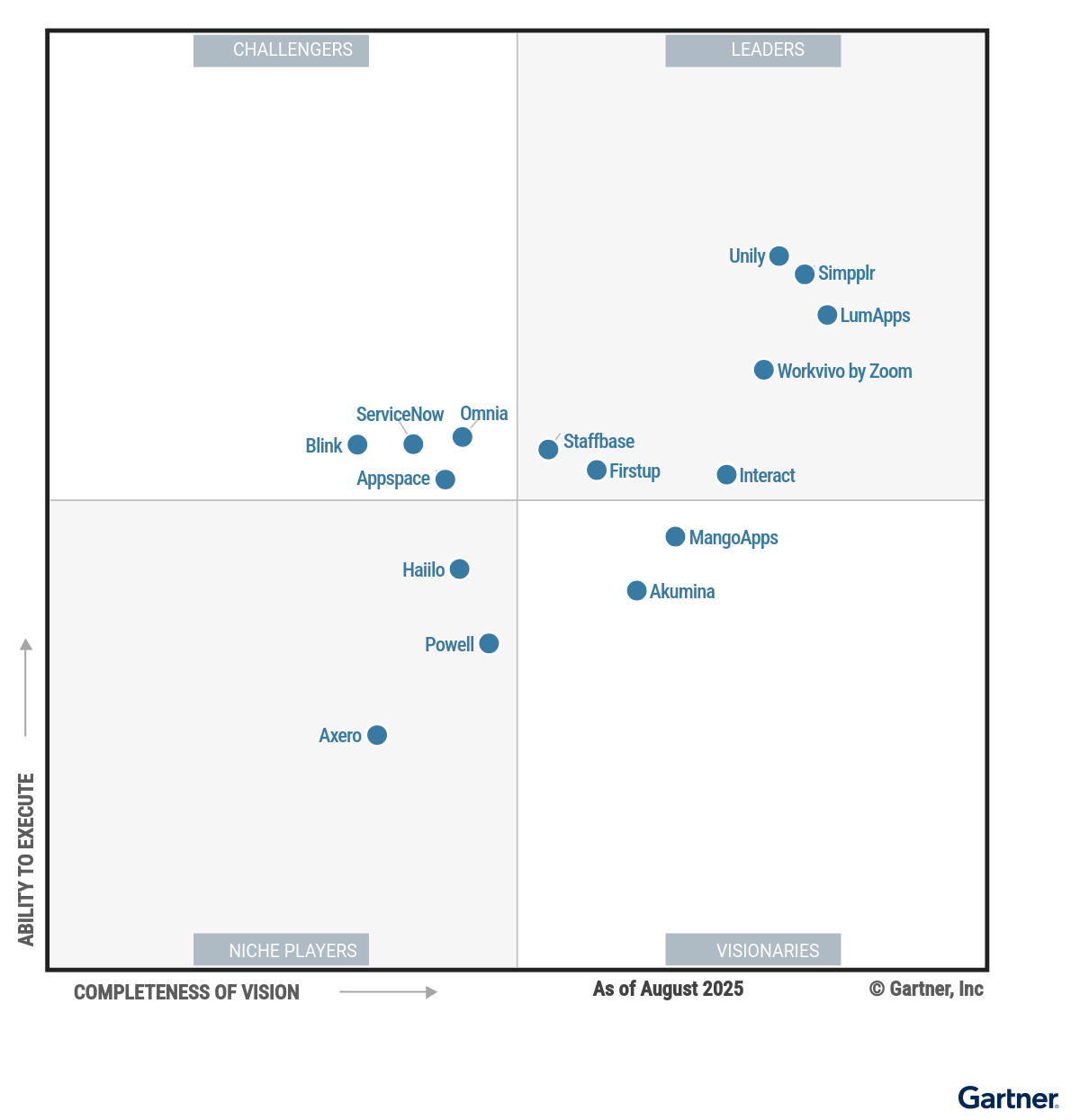
Magic Quadrant
Vendor Strengths and Cautions
Akumina
Akumina is a Visionary in this Magic Quadrant. Its Employee Experience Platform (EXP) IPS directly integrates with SharePoint in Microsoft 365. Akumina is headquartered in the U.S. and focuses primarily on customers in North America and Europe. The vendor does not target specific verticals and has customers across many industry segments. It focuses on employee engagement scenarios for employee experience and corporate communications teams. Key innovations include Akumina’s own content management system running in Microsoft Azure, which stores content in SharePoint and uses the Microsoft Semantic Kernel to manage its AI capabilities.
- Product strategy: Akumina introduced a new simplified product, “The Hive,” that targets the midsize enterprise market. “The Hive” focuses on helping employee engagement teams and communicators leverage the Microsoft stack while reducing IT burden.
- Market understanding: Hive’s emphasis on AI capabilities that directly address employee needs and expansion of the partner ecosystem demonstrate a strong market understanding based on customer insights.
- Marketing: Akumina’s reintegration of its marketing function tightens alignment between sales and customer success teams, leading to more coherent product messaging and improved customer experience.
- Personalization: Akumina provides a strong set of personalization capabilities, including a persona engine and extensive user-defined content preferences, enabling customers to deliver relevant and tailored employee experiences.
- Vertical/industry strategy: Organizations in specialized industries may find that Akumina’s broad platform approach requires greater internal customization, as the vendor does not offer pretailored, vertical-specific solutions.
- Geographic focus: Akumina remains heavily focused on North America and Europe, so for potential customers in other geographies it may be difficult to find expertise or an implementation partner.
- Customer experience: Clients may find limited opportunities for peer-to-peer learning and specialized support, as Akumina’s customer community programs lack the broader industry or geographic subcommunities of some of its competitors.
- Digital assistants and AI agents: Customers seeking advanced AI assistant features may find Akumina’s offerings less mature compared with competitors. For instance, while Akumina makes use of the Microsoft Semantic Kernel to provide a back-end agnostic model, its employee-facing AI assistants and agents did not score well compared to others with respect to the scope of use cases addressed, and ease of configuration.
Appspace
Appspace is a Challenger in this Magic Quadrant. Its IPS is aligned with Appspace’s efforts to connect digital and physical workplace experiences. Appspace is headquartered in the U.S. and operates globally, targeting multinational companies with complex needs. While not a vertical vendor, it can tailor its platform to support workflows, compliance and operational requirements to meet vertical needs. Key innovations include using AI to simplify information consumption, and multichannel communications, including hosting live meetings and aligning messages in physical workspaces and online.
- Connecting place and space for work: Appspace natively unifies its intranet with room and workspace management, potentially consolidating vendors. Organizations with remote, hybrid or onsite teams should assess their needs relative to Appspace’s IPS solution.
- Fine-tuned communications: Appspace leverages AI-driven features to deliver news and information consumption, ensuring employees remain up to date with relevant content, including digital signage and for facility-related meeting placements.
- Customer-centric approach: Appspace demonstrates a strong commitment to customer success. Based on client feedback, Appspace provides responsive support and a willingness to adapt offerings. Organizations with large-scale digital and physical workplace services needs would find Appspace’s unified approach attractive.
- Multichannel employee experience: Appspace’s multichannel communications approach, including hosting live meetings and aligning messages across digital and physical environments, helps organizations reach employees wherever they are.
- Limited breadth of IPS capabilities: Appspace’s overall IPS capabilities may not match the breadth offered by more established IPS vendors. Customers seeking comprehensive intranet features — such as advanced workflow automation, deep integrations or extensive content management — may find limitations.
- Workspace experience management focus: Appspace’s dual commitment to different markets (both workspace experience applications and IPS) may concern customers primarily about market priorities, long-term commitment and maturation of areas where Appspace has competitive weaknesses (such analytics, collaboration, orchestration and personalization).
- Architecting for complexity: As Appspace expands into the large enterprise market, some Gartner clients report challenges in scaling deployments across complex ecosystems with diverse IT integration and global needs. Organizations fitting that profile may be more adept at aligning Appspace to meet those scenarios.
- Limited collaboration and messaging features: Appspace’s feature set for real-time collaboration, social networking and integrated messaging is less mature compared with Leaders profiled in this Magic Quadrant. Organizations prioritizing these capabilities may need to supplement Appspace with additional solutions.
Axero
Axero is a Niche Player in this Magic Quadrant. The vendor positions its IPS as an intranet and workspace. Axero is headquartered in the U.S. with primary operations in North America and expansion into Europe. Axero’s customers value its system architecture and engineering approach. While not a vertically focused vendor, it has enjoyed recent success in financial services and banking, government, health care and real estate. Axero appeals to companies of all sizes. Axero’s innovation approach looks at intranet synergies with adjacent markets and strategies such as knowledge management and hybrid work.
- Knowing its desired customer profile: Axero distinguishes itself when IPS buyers also prioritize adjacent needs, such as a collaborative workspace with content and search services. Axero appeals to customers and prospects through its technical expertise and engineering mindset.
- Appealing to large and small clients: Axero has a strong presence in organizations under 2,500 employees, but has customers of all sizes, indicating versatility in handling different types of customer needs. Its ability to grow in both directions from a position of midmarket shows that it knows how to navigate the IPS market and a range of implementation needs.
- Pragmatic expansion: Axero’s steady improvements in sales, marketing and products help maintain its market presence and appeal to specific customers. Expansion efforts into regional markets incrementally provides it with a broader base from which to evolve its core market strategy.
- Executing at its own pace: Axero pursues a disciplined growth strategy, prioritizing stability. Organizations prioritizing vendor viability will find Axero’s approach a positive attribute. Leveraging its technical expertise and culture, Axero also appeals to buyers favoring technology capabilities over traditional vendor sales and marketing approaches.
- Engaging intranet sponsors at a business level: While Axero claims engagement and sponsorship from C-level executives (including HR and communications leaders), buyers can expect a stronger message on technology as its sales and go-to-market strategies lag competitors.
- Brand familiarity: Based on Gartner client discussions, Axero is less frequently included in their internal shortlists and has lower brand awareness among prospective clients.
- Competing at rising buyer expectations: Axero is adapting its IPS to better support everyday work routines. While Axero has baseline task and workflow features, complex or advanced work management scenarios are more reliant on professional developers (leveraging evolving webhooks and REST APIs). Buyers looking for more out-of-the-box and complete orchestration capabilities will find stronger alternatives.
- Evolving AI maturity: Axero’s AI capabilities focus on certain areas such as editorial, question answering and content summation. While it has baseline features that are shared by others in the market, buyers looking for more complete or aggressive efforts to extend AI across an IPS platform and employee experience will find stronger offerings in the market.
Blink
Blink is a Challenger and a new entrant to this Magic Quadrant, having expanded into the IPS market from a frontline employee communications application. It is U.S. headquartered and primarily serves customers in North America, Europe and Asia/Pacific, focusing on industries such as healthcare, transportation, retail and hospitality. As an IPS new entrant, Blink focuses on a “front door” employee experience, providing a minimal intranet that points to other resources. This enables Blink to build out deeper capabilities to support use cases expected by office workers. A key innovation is its AI capability, which includes Blink Assist for content creation, intelligent translation, sentiment analysis and predictive analytics.
- Sales experience: Blink demonstrates an understanding of buyer pain points and decision criteria throughout the sales experience with frontline-driven organizations. Blink also focuses on buyer goals as they relate to employee experience. Its sales enablement program and strategic alliances (with Workday, for example) further bolster its market position.
- Overall viability: Blink demonstrates strong overall viability, evidenced by robust financial performance, substantial investment in product development and an adaptable product strategy, indicating a stable and forward-thinking partner for clients.
- Building on frontline insights: Blink offers specialized onboarding teams that facilitate accelerated rollouts and provide continuous postdeployment guidance. Blink uses customer insights to directly inform product and service enhancement.
- From mobile to total experience: Blink’s mobile superapp empowers all employees with a microapp framework and social features to boost engagement and productivity through simple, personalized interactions and strong internal communications.
- Product strategy: Blink focuses on ad hoc work coordination for frontline employees rather than office work management. Customers needing advanced work management should consider other IPS options or carefully assess Blink’s maturity and capabilities.
- Vertical/industry strategy: Blink lacks broad vertical coverage, which is important for frontline use cases. While there is traction in healthcare, transportation, hospitality and retail, customers should evaluate Blink against their specific industry requirements.
- Innovation: Entry-level AI capabilities that buyers have come to expect — such as retrieval-augmented generation (RAG) for search and AI assistant functions — are not yet provided. Customers should confirm how Blink plans to integrate AI into its IPS offering and ensure that the vendor’s development timelines align with their requirements.
- Operations: Blink’s move into the IPS market from a focus on the frontline communications space can cause buyers to assess the maturity of Blink sales, support and operational activities. Buyers with a large number of office workers might prefer more established vendors.
Firstup
Firstup is a Leader in this Magic Quadrant. Its platform focuses on employee communications and leverages long-time expertise with internal communications scenarios. Firstup’s personalized, omnichannel messaging capability applies to all workforce segments. It focuses on enterprises with over 2,500 employees in the U.S. and Europe. Its expansion over the past three years into the IPS market strengthened its overall business model. Key innovations include AI-powered communications delivery, universal employee profiles, and single-point publishing across multiple channels, including digital signage and Microsoft Teams.
- Marketing strategy: Firstup’s go-to-market strategy emphasizes measurable business outcomes and targets new buyer personas by positioning its solution as a strategic workforce orchestration system. This approach can resonate with a broader range of enterprise stakeholders.
- Marketing execution: Firstup’s strength in bidirectional marketing execution helps it to build awareness of its business solution, educate customers and prospects, ensure that customer inquiries are handled properly for first contact, and guide customers through the onboarding process.
- Customer experience: Effective customer experience builds on marketing execution competencies to enable broader life cycle support for organizations leveraging Firstup’s IPS, as reflected by strong account management, leveraging customer feedback and promoting communities.
- Overall viability: Firstup’s score reflects its strong financial health, enterprise focus, large user base, commitment to R&D and strategic market positioning. This portfolio ensures long-term product viability and continuous innovation, benefiting large enterprises with extensive user bases.
- Expanding beyond communications: Buyers will find Firstup less complete as an IPS once their requirements expand beyond multichannel communications and frontline support (and into enterprise search, AI and content management capabilities, for example).
- Product or service: Firstup does not offer traditional work management capabilities — like task assignment, scheduling or workflow automation — which makes it a narrower offering compared to some competitors. Clients with traditional work management needs should evaluate other IPS vendors.
- Operational scalability concerns: Vendors moving into adjacent markets often face challenges in scaling operational processes and expanding sales, marketing and support capabilities. Buyers looking for a comprehensive intranet provider with broad technical depth may want to compare Firstup to a more-established IPS vendor, especially in areas of custom development and integration services.
- Vertical/industry strategy: Firstup does not offer vertical-specific solutions. Clients with such needs may need to evaluate other vendors that offer these tailored solutions.
Haiilo
Haiilo is a Niche Player in this Magic Quadrant. Recognized for its reputation as a multichannel IPS, Haiilo emphasizes a blend of communication, task management and work automation capabilities. Haiilo is headquartered in Germany. The company’s international footprint extends into Finland, France, the U.K. and the U.S. While originally designed as a multichannel platform, Haiilo has focused on supporting tasks, workflows and driving action across the organization. Its early delivery of an AI assistant is a key innovation that will mature over time. Haiilo primarily targets organizations with fewer than 25,000 employees, reflecting its commitment to serving a diverse, globally distributed clientele.
- Rapid capability development: Haiilo’s market and product strategy enables the integration of new features, such as AI assistants and agents, enhancing the platform’s adaptability for evolving client requirements.
- Modern IPS alignment: Haiilo’s origins as a multichannel communications and intranet vendor provide clients with an established solution that aligns with the current market definition for employee experience platforms.
- Responsive product development: Haiilo demonstrates strong market responsiveness through its early delivery of an AI assistant, offering new functionalities that address evolving customer requirements within the platform.
- Innovation pace: As an early adopter of AI assistants within its IPS solution, Haiilo provides capabilities that improve productivity and support new ways of working across industries.
- Fitting into intranet expectations: Haiilo’s broad positioning of its solution as an employee experience platform may not clearly communicate specific business value for organizations. Clients should inquire about Haiilo’s technology and ensure it provides their required IPS capabilities.
- Sales learning curve: As Haiilo establishes itself more firmly in the market, new buyers may find the vendor’s engagement, sales process and relationship management evolving to scale with new growth pressures.
- Limited regional presence: Haiilo primarily serves customers in North America and Europe, so clients in other regions will need to consider how adequately Haiilo can support them (directly or through partners) compared to other IPS vendors with a more global, regional and local presence.
- Sustaining AI efforts: Organizations may find Haiilo’s ability to sustain and expand its early innovations, such as its AI assistants and agents, challenging due to operational constraints, potentially limiting technical growth.
Interact
Interact is a Leader in this Magic Quadrant, headquartered in the U.S. with a strong presence in North America and Europe. The vendor also has customers in the Middle East and Asia/Pacific. Interact’s IPS prioritizes prepackaged capabilities, including multichannel communications, personalization, self-service and integration into back-end systems. Like other IPS vendors, Interact stresses employee experience benefits as it continues to add capabilities, such as AI assistants and agents. Interact focuses on large, enterprise-class customers in the financial services, healthcare and retail industries. The vendor’s key innovations include a focused investment in employee ideation and newsletter capabilities, both through acquisition.
- Market dexterity: Interact has above-average strength across three key marketing measures: strategy, responsiveness and execution. Interact understands that comprehensive messaging informs buyers on the key reasons they want an IPS.
- Customer-aligned offerings: Robust marketing skills enable greater customer insights and assist sales in contextualizing offers to meet different buyer needs, which can be influenced by size of company, industry and regions. Interact’s understanding of its core buying personas, including HR leaders, ensures its intranet offering and engagement processes align effectively with the strategic objectives of potential clients.
- Solid base to scale: Interact has significant market penetration in organizations with less than 25,000 employees. Its strength in platform architecture, deployment and extensibility positions it well to address the needs of larger organizations.
- Frontline strengths: Interact excels in frontline needs through broad integrations with work management and related systems, AI-powered FAQ and content summaries, and task management with photo and form support.
- Product gaps: Organizations seeking robust features for ideation, email newsletters or digital signage may find these newer capabilities less mature than Interact’s core intranet capabilities.
- Market segments: Prospective customers should evaluate whether Interact’s focus on specific business sizes (medium and large) and regions (North America and Europe) align with their own circumstances.
- Sales operations: Interact favors direct interaction with customers rather than building out a partner ecosystem. Limited partners and resources in Latin America, Japan and the wider Asia/Pacific region may impact customer experience, requiring buyers to validate partner expertise themselves.
- Limited AI capabilities: Interact offers a native AI back-end service and a “bring your own model” approach to AI. Customers must evaluate which solution meets their needs and ensure they have the required internal resources and expertise if they choose to switch from the default AI service.
LumApps
LumApps is a Leader in this Magic Quadrant. Its IPS provides broad functionality to connect employees, support their work and make it easy to get things done. LumApps is headquartered in France and targets both midmarket and large, complex enterprises that need a single intranet capable of supporting multiple types of users. LumApps supports global customers, with strong partnerships with both Google and Microsoft. Its key innovations include orchestration and automation capabilities to build miniapps and several AI use cases that support multiple types of users (including system admins, communications, content owners and consumers).
- Comprehensive and adaptable platform: LumApps’ robust intranet features and flexibility suit midmarket and large enterprises, allowing the platform to be tailored to a diverse range of use cases and contexts.
- Intranet for all workers: LumApps delivers a unified intranet experience that serves a broad range of users. Its focus on usability and task enablement helps organizations make it easier for employees to find information and get things done within the intranet. For instance, its implantation of Adaptive Cards can encapsulate task activities and chatbots.
- Platform extensibility: LumApps brings platform extensibility and a rich set of AI-powered features at a time when the market is actively seeking these capabilities. The ability to orchestrate and automate workflows, including building miniapps, positions LumApps as a forward-thinking leader in the IPS space.
- AI-driven employee enablement: The application of AI across the platform (serving system administrators, content owners and end users) enhances information discovery, personalization and productivity. LumApps’ focus on practical AI use cases helps organizations streamline communication and empower employees to accomplish tasks more efficiently.
- Configuration complexity: The extensive features and flexibility of the LumApps platform can add complexity to both setup and ongoing management. Organizations may require additional resources and support to fully leverage advanced configuration options, even with GenAI assistance for creating miniapps.
- Brand awareness and market presence: While LumApps is well-regarded in its core markets, its brand recognition and market story are still developing in some regions and segments. Organizations outside of LumApps’ established markets may be less familiar with the platform.
- Scaling to fit companies of all sizes: LumApps is at a transition point where its large customer base (of companies with over 10,000 employees) generates revenue growth, but its install base is mostly in organizations less than that size. IPS vendors struggled at times to balance their market success across small, medium and large enterprises. Buyers in organizations with under 10,000 employees should focus on how LumApps prioritizes feedback, support levels and escalations. Organizations with over 10,000 employees may want assurances that LumApps can address their unique needs.
- Content management depth: Buyers may find LumApps content services sufficient for intranet needs, but not as complete for broader use cases that involve more traditional document management. Organizations with broader sophisticated or specialized content management needs may find stronger options among competitors.
MangoApps
MangoApps is a Visionary in this Magic Quadrant. MangoApps’ IPS aims to be highly configurable, enabling broad task automation and application integration. It is headquartered in the U.S. and has offices in India and Germany. It has a presence in organizations of all sizes, but mostly in those with under 10,000 employees. To scale outside North America and Europe, MangoApps has a mix of dedicated staff and partners for sales and deployment support. The company has found success in retail, healthcare, manufacturing and banking. Its key innovations include templates to accelerate platform extensions and AI agents for administrative tasks, such as time off, onboarding and other HR or IT requests.
- Employee service focus: MangoApps excels at enabling employees to efficiently track time, manage HR and IT requests, and complete a wide range of service-related tasks. Its integration of AI agents further streamlines administrative processes.
- Highly configurable for diverse needs: The platform’s extensive configurability, supported by a library of templates, allows organizations to deploy intranet solutions tailored to different worker types and business requirements. This flexibility is particularly valuable for global organizations with varied use cases.
- Product-centric automation and extensibility: MangoApps adopts a product-centric approach that emphasizes automation and extensibility. By integrating with a wide array of business applications and orchestrating workflows, MangoApps brings all intranet components and services directly to users with the aim of simplifying how work gets done.
- Platform extensibility and orchestration: The platform’s robust extensibility and orchestration capabilities empower organizations to automate processes, answer questions and complete tasks efficiently.
- Complex configuration and maintenance: Despite the availability of templates, configuring, maintaining and updating the platform can be cumbersome. The complexity of MangoApps’ configuration tools may require significant time and expertise, potentially slowing deployment and increasing ongoing management overhead.
- Sales engagement constraints: Buyers may experience more technical depth than business acumen in sales engagements with MangoApps. Its technical expertise reflects a product-led, engineering organization. While a smaller sales team is not a severe limitation, it can affect how vendors respond to accounts. Prospective buyers may want to diversify their IPS shortlist if they feel less engaged with the vendor during the buying experience.
- Shifting messages: MangoApps did not perform comparatively for customer experience and operations, and Gartner client conversations have noted shifts in messaging based on “hot topics,” which can confuse buyers. Disparities in operational activities that interconnect sales, support and marketing may concern buyers favoring consistency as MangoApps scales its business.
- Lagging community and social experience: MangoApps’ core community and social functionality is less user-friendly than some competitors. Users may find the experience less engaging, particularly in organizations prioritizing vibrant community interaction and social collaboration.
Omnia
Omnia is a Challenger and a new entrant to this Magic Quadrant. Omnia’s IPS aims to provide an AI-driven, mobile-first and task-oriented digital workplace. It is headquartered in Sweden and has offices in Europe, the U.S., Canada, Australia and Vietnam. It targets small to midsize organizations across all industry segments that are located primarily in Europe and North America, and focuses on digital workplace teams that improve employee experience and engagement. The vendor’s key innovations include a superapp/miniapp model for frontline support that, despite being built on Microsoft Azure and deeply integrated into Microsoft 365, does not require Microsoft licenses and support for secure extranet use cases.
- Customer-centric performance: Omnia’s strong marketing and sales strategy translates into effective operational delivery and customer service, directly benefiting organizations seeking robust solutions for employee engagement, resource portals and knowledge services.
- Market focus: Omnia’s robust personalization, orchestration and integration make its IPS ideal for small to midsize organizations with both desk-based and frontline users.
- Practical AI benefits: Omnia prioritizes delivering tangible business value from its AI capabilities and offers organizations flexible deployment options and integrated AI solutions, including support for Microsoft Copilot.
- Sophisticated search: Omnia provides strong search capabilities based on Microsoft Search and the open-source Meilisearch search engine for hybrid full text and semantic search. The vendor also includes specific prebuilt AI prompts, with access to content in Omnia and in the Microsoft 365 tenant.
- Limited multilingual support: Outside of its core 13 languages, Omnia relies on AI-powered translation. Organizations will need to evaluate whether Omnia is capable of meeting their language requirements.
- Narrow innovation potential: Omnia’s innovation efforts are primarily focused on leveraging existing open-source technologies to provide practical enhancements to their product, which may not align with an organization’s strategy or policy on use of open source.
- Lack of industry specialization: Organizations in highly specialized industries may find Omnia’s broad product strategy approach requires greater internal customization, as the vendor does not offer pretailored, vertical-specific solutions.
- Developing AI capabilities: Organizations seeking advanced AI and digital assistant features may find Omnia’s current offerings less comprehensive compared to some competitors, as the vendor prioritizes deliberate, value-driven AI development.
Powell
Powell is a Niche Player in this Magic Quadrant. The Powell IPS provides an intranet built on top of Microsoft’s SharePoint and focuses on extending the Microsoft 365 platform. Powell is headquartered in France and has offices in Germany, the U.S. and Australia. The majority of Powell’s customers are located in Europe and North America. The vendor engages HR, IT and communications leaders when presenting its IPS solution and its engagement efforts are often effective in highly regulated industries. The vendor’s key innovations include development of the Powell Buddy AI assistant (an orchestration layer that is LLM-agnostic) and a studio environment that provides nontechnical users with a simplified way to build agents. Powell also provides token use management for AI cost control.
- Enhancing Microsoft 365: Organizations seeking to enhance Microsoft 365 appreciate Powell’s integration and unique features beyond standard SharePoint Online, including employee services and resource portals.
- Market understanding: Powell has a tight focus on regulated industry sectors, where an out-of-the-box SharePoint intranet might not meet requirements, but where customers are looking to gain further value from their Microsoft investment.
- Market responsiveness: Powell provides industry templates with specific connectors and use-case-based default compliance settings to meet industry-specific needs. This tailored approach helps address unique industry-related challenges.
- Digital assistance and AI agents: To help with information retrieval, content creation and knowledge base interaction, Powell Buddy was an early entrant into the market as an AI assistant and GenAI tool that now offers a collection of multirole agents. Powell’s AI efforts integrate with Microsoft Copilot, which is consistent with its overall alignment with Microsoft 365.
- Platform dependency: Organizations relying on tight integration with Microsoft 365 may find Powell’s own innovations a challenge to integrate. For example, it may be difficult to make a decision on whether to use Powell Buddy, Microsoft Copilot, or both.
- Product strategy: Powell’s focus on extending Microsoft 365’s native platform capabilities provides a sharp focus, but also places some limits on the direction for its product strategy. Like any Microsoft partner, Powell must to some extent be led by Microsoft’s development path and roadmap.
- Partner-dependent support: Organizations may find that Powell’s use of channel partners (where partners take on different roles) for marketing, sales and implementation means that the level of direct vendor interaction and support varies.
- Limited editorial work management: While Powell offers baseline editorial and campaign management, organizations with advanced or complex editorial work management needs may find its functionality less comprehensive compared to alternatives, causing them to use a mix of tools.
ServiceNow
ServiceNow is a Challenger in this Magic Quadrant. Its IPS offering, Employee Center Pro, is a stand-alone IPS product, but it is commonly licensed with ServiceNow’s HR solution. This bundling scenario is indicative of ServiceNow’s overall IPS approach, where the intranet reinforces the overall platform’s value to its customers. Employee Center Pro includes an app launcher, AI search, microsites and communications components. The company is headquartered in the U.S. and operates globally with offices in North America, Europe, Africa, the Middle East and Asia/Pacific. The vendor targets its IPS at organizations of all sizes, but follows ServiceNow’s overall sales efforts and priorities. ServiceNow’s IPS initiatives demonstrate the greatest autonomy in North America. Key innovations relate to AI capabilities and a “kiosk” IPS contextualization for frontline.
- Broader platform value: Organizations benefit from ServiceNow’s IPS when they are committed to the rest of the vendor’s platform, especially its HR Service Delivery component. Employee Center Pro acts as the digital employee experience across its ecosystem.
- Putting intranets to work: Clients benefit most from ServiceNow’s agentic AI efforts when they connect the IPS to related work management modules and uplift licensing to gain access to more AI tools. Integration with Microsoft Teams provides intranet and AI services.
- Listening to the market: Direct listening to prospects, customers and the market overall across many markets enables ServiceNow to synthesize and cross-reference requirements to construct sales, marketing, product and innovation efforts in a responsive manner.
- Platform savvy: ServiceNow is a platform vendor that happens to deliver an IPS in addition to its suite of business and IT applications. This provides deeper software engineering and technical architecture experience than other IPS vendors. Its non-IPS functionality enables it to shape agentic AI capabilities to handle scenarios outside core intranet demands. However, this strength is slightly offset if an organization is not using the rest of the portfolio.
- Intranet centricity: ServiceNow is a platform vendor, and its IPS is just one use case within its entire application portfolio. Organizations not fully committed to the ServiceNow platform — or those interested in a more platform-agnostic approach — should consider other IPS options.
- Licensing ambiguity: Employee Center Pro is a stand-alone offering, but is commonly bundled with HR Service Delivery. Additional functionality for its agentic AI features and integration into other ServiceNow applications can require unexpected licensing uplifts. Co-dependencies on other entitlements can be a concern for buyers that prefer a more independent solution.
- Multichannel reliance on Employee Center Pro: ServiceNow’s multichannel strategy rests heavily on employee use of Employee Center Pro, with Virtual Agent and Now Assist also playing multichannel roles. Organizations seeking a more independent endpoint experience with more flexible channel options may find that other IPS options align better with their digital employee experience efforts.
- Selling content management: While organizations expect intranets to manage web content for sites, they also expect file-based support for documents and other media types. Organizations with strong document-driven processes outside the ServiceNow platform can find more robust options in the market.
Simpplr
Simpplr is a Leader in this Magic Quadrant. Simpplr’s IPS supports employee engagement and productivity through multichannel communications with expanding integration, development and AI capabilities. It is headquartered in the U.S. and has offices in India, Canada and the U.K. Simpplr targets global customers with new business strength in North America and emerging business in EMEA. While not a vertical-driven company, it contextualizes its technical capabilities to appeal to different industries such as banking and healthcare. Key innovations include use of app tiles to create miniapps that encapsulate back-end integration, forms, data binding and third-party AI agents.
- Innovation at work: Buyers seeking an IPS with multiple ways to improve productivity as it relates to task handling and work management will find Simmplr’s innovation efforts related to AI, orchestration and its app tiles function valuable across multiple use cases.
- Governing AI diversity: Simpplr’s AI governance prioritizes transparency, safety and trust, using safeguards like NVIDIA’s NeMo Guardrails and Langfuse for consistent behavior and real-time monitoring. It manages multivendor LLMs with LiteLLM and MLflow for performance and flexibility.
- High bar for customer experience: Simpplr performed well across criteria involving customer touchpoints from marketing to sales, to pricing and partners involved in delivering client value.
- Integrated work and peer connection: For organizations, particularly those with frontline staff, Simpplr supports effective work management through integrated collaboration and messaging, while its employee insights and profiles are key for fostering stronger peer-to-peer connections.
- Keeping focus on multichannel fundamentals: Multichannel communications is an emerging baseline expectation for IPS buyers. Simpplr performs comparatively well, but alignment with its content, editorial management and multichannel communications features could be more cohesive.
- Geographic focus limitation: Simpplr is strongest in North America. Global organizations or those in regions with distinct requirements should evaluate whether Simpplr can support local needs directly or through its partner ecosystem compared to vendors with a more balanced geographic strategy.
- Product over sales and marketing: Simpplr primarily focuses on investing in product development, sometimes at the expense of sales and marketing. As a result, organizations should be aware of inconsistent experiences during the sales cycle and focus on deployment and onboarding efforts to ensure their own success.
- Keeping pace on content management: Buyers who need everyday intranet content services will find Simpplr’s capabilities more than adequate. However, content management features, functionality, and advanced analytics are not Simpplr’s core IPS strengths.
Staffbase
Staffbase is a Leader in this Magic Quadrant. Staffbase’s IPS provides a mobile-first, integrated platform for organizations with many frontline employees. The vendor typically targets enterprises with over 1,000 employees located in North America, Europe and Australia. It focuses on the manufacturing, healthcare, retail and logistics industries. Key innovations for the vendor include advanced AI services for content creation and governance, personalized content journeys, omnichannel publishing, deep integrations with Google Workspace and Microsoft 365, and robust analytics and extensibility.
- Market understanding: Staffbase’s experience in employee communications allows it to deliver intranet solutions that meet core multichannel and frontline needs. The vendor leverages client insight to focus on employee engagement and self-service, adapting its solution to its strengths.
- Navigating expectations: Staffbase appeals strongly to communication leaders while building intranet credibility in a market where use cases expand beyond engagement and self-service. With long-time integration with Microsoft, the IPS fits clients looking for a core intranet capability that spans both office and frontline workers.
- Sustainable growth: Staffbase’s strong financial performance, R&D investments and strategic growth ensure long-term product viability and continuous innovation, particularly in mobile-first and AI-powered solutions for frontline workers.
- Geographic strategy: Staffbase boasts strong global revenue distribution and a robust partner ecosystem that ensures successful implementation worldwide. The platform offers extensive multilanguage support, localized product versions and scalable deployments globally.
- Developing AI innovation: Organizations seeking more immediate and comprehensive AI-powered capabilities for employee services, work management and advanced data-driven optimization may find Staffbase’s current offerings a work in progress and immature overall.
- Keeping up with the market: While Staffbase presents a pragmatic product strategy with clear communications strengths, buyer expectations are expanding, exploring use cases that support task and work-related capabilities. Weaknesses in AI (beyond content), orchestration and extensibility (in the context of process-based applications and operational orchestration) may cause buyers looking for a more ambitious intranet deployment to consider other options.
- Use-case diversity: Organizations may encounter challenges with Staffbase’s dominant focus on the communications aspects of its platform, which doesn’t necessarily address the full suite of expected IPS use cases.
- Employee experience: Staffbase’s offering does not include native work management functionality. Organizations looking for a more unified native employee experience may find that switching to other applications introduces friction into the digital employee experience.
Unily
Unily is a Leader in this Magic Quadrant. Unily’s IPS offering emphasizes a mobile-first approach, and a comprehensive extensibility framework for integration with over 50 enterprise applications. The vendor is headquartered in the U.K. and has offices in North America and Australia. It typically targets large, complex organizations with over 5,000 employees with clients located in the U.S., Canada, U.K., Nordics, Middle East, Germany and Australia. Key decision makers on Unily include communications leaders and CIOs with less reliance on HR leaders. While not a vertically driven vendor, it has success in manufacturing, business services and legal. The vendor’s key innovations include early-stage delivery of AI-powered search, publishing, language translation and reporting.
- Marketing strategy: Unily favors larger-scale organizations with broader needs for a modern intranet, stressing its social, frontline, orchestration and analytics capabilities. Savvy marketing and onboarding support is part of the customer experience under the banner of “organizational velocity” to help clients achieve tangible success.
- Strong ecosystem and internal processes: Unily invests in building its partner network, integrations and initial operations to offer clients flexible options through its ability to build strategic relationships.
- Responsive development: Unily’s active customer feedback channels, including its portal and advisory board, ensure that its product enhancements and strategic direction align closely with evolving client needs and market trends.
- Contextualized for industry sectors: Unily offers tailored, vertical-specific solutions that can fit what buyers need for large organizations with dispersed workforces.
- Upper-market priority: Unily has a limited presence across smaller organizations. Based on Gartner client conversations, smaller companies sometimes feel like they are not a sales priority. Organizations over 10,000 employees are more aligned with Unily’s efforts.
- Early-stage AI efforts: There are several AI features that Unily currently does not provide relative to IPS market trends and market options, including search analytics, AI-powered audience response simulation and adaptive user interfaces. Clients should assess Unily’s early-stage AI capabilities to ensure they evolve at a pace that aligns with their needs.
- Complex pricing structure: Unily’s stepped pricing model and lack of public pricing transparency may create complexity and slow the sales and procurement process.
- Consistent customer support experiences: Conversations with Gartner clients often cite inconsistencies with customer support in terms of responsiveness and escalation timeliness that, in some cases, can cause organizations to conduct a market scan to find new options.
Workvivo by Zoom
Workvivo by Zoom is a Leader in this Magic Quadrant. As a Zoom company, Workvivo leverages Zoom’s real-time meeting, voice, messaging, live event and AI capabilities. Workvivo is headquartered in Ireland and primarily sells to customers in North America and Europe. It has grown its presence in Latin America, Asia/Pacific and Japan and typically focuses on customers with more than 1,000 employees. Half of its customer base is organizations with more than 25,000 employees. Workvivo concentrates on serving frontline workers in industries such as healthcare, manufacturing, retail and transportation. The vendor’s key innovations include automated migration from Workplace by Meta to Workvivo.
- Brand confidence: As a Zoom company, Workvivo leverages strong resources and market presence, ensuring stability, support and better integration for large enterprises.
- Customer centricity: Workvivo demonstrates a strong commitment to customer success by offering a range of executive partner programs, presale to postdeployment customer success initiatives, and boost programs to accelerate client time to competency. Clients receive proactive support, leading to enhanced customer experience and value realization.
- Execution agility: Workvivo uses marketing and customer insights to create effective programs and positioning, helping organizations shorten vendor selection cycles, though it may respond more slowly to market trends than some competitors.
- Community focus: Workvivo emphasizes peer-to-peer employee interaction and community building, positioning itself as one of the few vendors leading with strong social experiences since its inception. For customers prioritizing an internal community and social collaboration, it offers a robust platform for fostering engagement.
- Promising work futures: Organizations looking for an intranet to play a more active role in the everyday work routines of its employees will find stronger options in the market that better support work management, orchestration and platform extensibility.
- Expanding beyond social and community: Social and community experiences are a valuable part of an intranet experience. However, Workvivo is overly aggressive in focusing on that topic, according to Gartner client conversations. Some clients express frustration trying to focus on other use cases, causing them to consider vendors with a more balanced approach.
- Zoom shadows: Organizations strongly standardizing on Microsoft Teams may encounter internal concerns, as Workvivo is a Zoom company. While the front-end employee experience is a branded Workvivo interface, buyers will have to consider options to govern back-end platform services from Zoom.
- Lagging multichannel priorities: In its efforts to aggressively focus on intranet web site capabilities, Gartner clients sense that other multichannel capabilities are not on the forefront of the vendor’s solution, which can provide reasons to look for vendors with stronger editorial management and channel completeness.
Vendors Added and Dropped
We review and adjust our inclusion criteria for Magic Quadrants as markets change. As a result of these adjustments, the mix of vendors in any Magic Quadrant may change over time. A vendor's appearance in a Magic Quadrant one year and not the next does not necessarily indicate that we have changed our opinion of that vendor. It may be a reflection of a change in the market and, therefore, changed evaluation criteria, or of a change of focus by that vendor.
Added
- Blink
- Omnia
Dropped
Igloo Software was acquired by Appspace in September 2025. The company profile was dropped from the Magic Quadrant. Igloo Software’s IPS technology profile remains as part of the Critical Capabilities document. Post-M&A, Igloo Software may no longer be an active vendor in the market, which is why it is not reflected in this Magic Quadrant. However, the underlying technology continues to be relevant and is therefore covered in the Critical Capabilities document.
Inclusion and Exclusion Criteria
Product criteria:
- A vendor must demonstrate active participation in the IPS market as a provider of IPS software that meets the Gartner market definition and description including mandatory and common features to be considered an IPS.
- An IPS must be offered as a cloud-based (public or private) stand-alone, multichannel software product (single license or subscription) that includes web and mobile channels. It must have native support for other channels to be configured (such as e-mail, digital signage, digital assistants [or similar AI experiences], in-app plug-ins, and messaging). The IPS must have a cohesive software architecture (in terms of functional and structural completeness) that does more than add extensions and components that augment an existing intranet application. It must be a distinct stand-alone technology product and not augment, extend, advance, or upgrade an existing intranet product that the customer must purchase. It must not require purchase of additional technology for it to function as an IPS.
- The vendor’s IPS must actively be providing support for at least four of the following use cases (see Critical Capabilities for Intranet Packaged Solutions for complete definitions):
- Employee engagement
- Employee and workplace services
- Knowledge services
- Work management
- Intelligent assistance
- Resource portal
- The provider and its product must demonstrate stability and longevity in the IPS market, providing product general availability, marketing, sales, and support for at least two years (prior to 2025). IPS vendors must intend their submitted product to remain active in the market throughout 2026.
Business criteria:
- The vendor’s business focus and product must be used as the sole or primary intranet foundation for most of its customers. Products that are most frequently used for niche use cases or as supplements to other IPS offerings are excluded.
- A majority of vendor’s customer deployments must support business-to-employee (B2E), versus business-to-business (B2B) or business-to-customer (B2C) use cases.
- The vendor must have secured at least 100 new (not repeat business or renewals), active, paying (not free) customers (logos) in calendar year 2024 or the last 12 months. Alternatively, the provider must have at least 100 current, active (new and existing customers) with an annual contract value at or exceeding $100,000.
- Each vendor’s IPS offering must either:
- Have achieved at least $12 million of annual IPS subscription revenue in the vendor’s latest fiscal year, or
- Have achieved at least $8 million of annual IPS subscription revenue and have achieved at least 20% revenue growth derived from new IPS subscription sales in the vendor’s last fiscal year or the last 12 months.
- Each vendor must have a market presence in at least two of the following regions: North America; Latin America; Europe; Middle East and Africa; Asia/Pacific; Japan; and worldwide. Market presence is represented by having dedicated offices and employees in those regions.
- At least 10% of a vendor’s customers must be headquartered in at least two of the above regions.
- At least 20% of the revenue is associated with all regions outside the primary region in which the provider operates.
- In regions outside its primary operating domain, the vendor must have partners in each region where it has at least 10% of its customers or where it has 20% of its revenue associated with a region. These partners provide technology or business services such as system integration, enablement and adoption, or design services.
- At least 75% of the vendor’s IPS annual subscription revenue must be attributable to IPS product licenses and subscriptions, as opposed to nonsoftware services such as implementation, consulting, and training. If the vendor has multiple IPS products (for example, through acquisition or legacy reasons), excluding services, 80% of the vendor’s IPS annual subscription revenue must be associated with the IPS submitted to this Magic Quadrant.
- Adding technologies from acquired products, or third-party products, must be included and publicly available as part of the submitted IPS by the cutoff date published by Gartner for answering the RFI.
- The vendor must rank among the Top 25 for the Customer Interest Indicator (CII) as defined by Gartner. CII was calculated using a weighted mix of internal and external inputs that reflect Gartner client interest, vendor customer engagement, and vendor customer sentiment from 1 March 2024 through 28 February 2025.
Evaluation Criteria
Gartner analysts assess vendors based on the quality and efficiency of their processes, systems, methods or procedures that foster competitive, efficient and effective provider performance, ultimately contributing to revenue, retention and reputation. Vendors are evaluated on their success in achieving their vision.
Criteria for product or service, overall viability, market responsiveness/record, and customer experience were weighted as “high” as these typically drive vendor selection among potential buyers. Buyers express the most interest in product functionality, the vendor’s ability to deliver against objectives, its ability to innovate and adapt to changing market dynamics, and its reputation and overall satisfaction among existing customers.
Sales execution/pricing, marketing execution and operations were weighted as “medium.” While pricing is a factor in an IPS investment, it must be weighed against organizational and employee value as found in criteria weighted as “high.” Sales and marketing execution are still critical to vendor success, as the IPS market is evolving with new technologies and global uptake. Operations are also important as a signal of vendor commitment to delivery and global reach, as well as to management, logistical and overall efficiencies. These criteria also signal how well a vendor is framing its brand and market presence, and aligning with customer needs.
Ability to Execute
Ability to Execute Evaluation Criteria
| Evaluation Criteria | Weighting |
|---|---|
Product or Service | High |
Overall Viability | High |
Sales Execution/Pricing | Medium |
Market Responsiveness/Record | High |
Marketing Execution | Medium |
Customer Experience | High |
Operations | Medium |
Source: Gartner (October 2025)
Completeness of Vision
Gartner analysts assess vendors based on their capacity to effectively communicate their current and future market strategies, innovation, understanding of customer needs, and competitive positioning. Additionally, they evaluate how well these vendors align with customer requirements. Ultimately, the vendors are rated on their ability to leverage market dynamics to generate opportunities.
Marketing strategy, offering (product) strategy and innovation were weighted as “high.” In terms of vision, this is the most relevant in a buyer’s decision. Buyers are looking for vendors that understand the trends and changing dynamics in business-led work management, offer depth and breadth in their product capabilities, and have a strong product roadmap.
Market understanding, sales strategy and geographic strategy were weighted as “medium,” reflecting the ability of the vendor to remain relevant, competitive and able to take advantage of general technology opportunities such as the use of GenAI.
Business model was not rated, as it was addressed within other criteria.
Criteria for vertical/industry strategy is weighted as “low.” This is to ensure that vendors are assessed at some level for their ability to deliver very contextualized offerings that can meet the needs of some buyers and channel partners.
Completeness of Vision Evaluation Criteria
| Evaluation Criteria | Weighting |
|---|---|
Market Understanding | Medium |
Marketing Strategy | High |
Sales Strategy | Medium |
Offering (Product) Strategy | High |
Business Model | NotRated |
Vertical/Industry Strategy | Low |
Innovation | High |
Geographic Strategy | Medium |
Source: Gartner (October 2025)
Quadrant Descriptions
Leaders
Leaders have ample ability to support a variety of intranet use cases and consistently meet customer needs over substantial periods. Leaders have delivered significant product innovation in pursuit of IPS requirements and have been successful in selling to new customers across a wide range of industries.
Challengers
Challengers demonstrate significant Ability to Execute, with strong businesses and customer bases, as well as products that suit current demands. However, they lack the ability to see market patterns, buyer patterns, and market disruptions of Leaders and Visionaries, and may therefore struggle to fully satisfy future demands from a technology or business perspective.
Visionaries
Visionaries are forward-thinking vendors that demonstrate a firm grasp of emerging customer needs and the potential impact of new technologies. However, they may lack sufficient size and growth, service and support, market visibility, or capability in their offerings, service, and support to fully realize their vision.
Niche Players
Niche Players focus on limited intranet use cases or deployment scenarios, have limited geographic presence outside of their home market, and/or focus on a narrow set of industries. They may be newer entrants to the market, may not demonstrate the ability to consistently handle large deployments across multiple geographies or may lack strong sales. Niche Players’ offerings can be suitable for organizations that require local presence and support or seek a platform that addresses specific industry use cases and functional requirements.
Context
This Magic Quadrant evaluates vendors that meet Gartner’s inclusion criteria for the intranet packaged solutions market. It is intended to aid selection decisions about vendors and products. Application leaders who focus on intranets, internal multichannel communications, employee engagement and employee experience initiatives should:
- Understand the inclusion criteria and how those requirements may influence their own perspective on vendors in the market.
- Study the evaluation criteria by which we have determined each vendor’s Ability to Execute and Completeness of Vision.
- Evaluate the vendors’ strengths and cautions and consider its relevancy to internal assessments.
- Assess vendors in any of the four quadrants, with a focus on those that align with their multichannel communications and intranet requirements and strategic aspirations.
The associated Critical Capabilities for Intranet Packaged Solutions focuses on product capabilities and applicability against use cases. It should be used in conjunction with this Magic Quadrant to help organizations arrive at best-fit vendors for their intranet initiatives.
Market Overview
Intranets are one of the few technology investments organizations make that have widespread impact on employee experience, productivity, and community-building. IPSs are general-purpose technology and support a broad range of business and cultural activities. They are typically sponsored by HR, corporate communications and other central groups. IT organizations are a core partner, especially application leaders responsible for the digital workplace. While intranets have been around for decades, technology advancements, especially in areas related to GenAI and agentic AI, offer new ways for organizations to innovate. While there are perceptions that intranets will be replaced by AI-based alternatives, IPS vendors have been diligently investing in these technologies to offer new enterprise search experiences based on AI assistants and agents.
Intranets continue to garner interest by Gartner clients as part of modernization efforts and in some cases, to reduce complexity and shift IT support resources tied to internal development. Intranet modernization continues to be a primary driver for IPS interest. Indeed, IPSs are a key part of Gartner’s digital employee experience blueprint. Intranets are the core means of delivering employee engagement hubs, employee service hubs and technology services hubs, as well as other hubs (see Use a DEX Blueprint to Mature Your Digital Workplace Strategy).
Stakeholders believe IPS products offer consistency by providing out-of-the-box multichannel communications, editorial management, and content publishing capabilities. Such prebuilt functions enable organizations to delegate communication and content roles to line-of-business areas, and/or purpose-build connectors to back-end systems that reduce integration work. Additionally, IPS products offer personalization, search and extensibility capabilities that organizations can leverage within a single plaform.
IPS vendors are also delivering AI assistants and AI agents to improve how employees use the intranet for search, knowledge services and task automation. Advancements in IPS capabilities are reshaping the role of intranets within digital workplace initiatives. IPS frontline superapps are also maturing to provide unified access to information, applications and operational activities.
IPS providers are under continual pressure to both differentiate from and integrate with Microsoft tools and platforms. While it doesn’t have its own IPS, Microsoft is a ubiquitous competitor via an evolving portfolio of platforms and tools, including SharePoint Online, Teams, Viva Connections, Viva Engage and Viva Amplify. Other large incumbent providers are competitive threats to IPS vendors. ServiceNow and Zoom are examples of larger vendors moving into the IPS market more broadly.
Intranets Are Now Multichannel Software Platforms
Rising recognition of the value of internal employee communications has helped shape modern intranet software platforms. The need to engage with employees across the workforce has encouraged vendors to build out multichannel communications to support an expanded level of engagement with employees. Many vendors in the IPS market now support email communications (such as newsletters), digital signage, mobile apps, text messaging, and injecting internal communiques into popular applications such as Microsoft Teams or Salesforce Slack. The ability to channel communications via conversational AI assistants and AI agents is emerging.
To support a multichannel communications framework, market priorities are encouraging vendors to build our robust editorial management capabilities. Editorial management illustrates how innovation is still occurring in the market. It enables common work management practices (such as a shared calendar, delegation of roles, employee segmentation, personalization and campaign planning) and supports analytics. Multichannel communications is revitalizing mindsets regarding intranets as merely web site destinations.
Creating new use cases and ways to engage with decision makers, sponsors, and buyers or intranet solutions makes it more necessary for organizations to keep pace with how intranets can add value to employee experience needs.
Why is this important? Thirty-four percent of respondents to the 2024 Gartner Digital Worker Survey reported that they struggled to find the information or data needed to effectively perform their jobs at least sometimes. Similarly, 37% of respondents to the 2023 Gartner User Behavior and Influence Survey reported that they had failed to notice important information occasionally because of too many applications or the volume of information.
Agentic AI Takes Center Stage
A prominent trend across all markets and organizations has been the topic of AI and more recently, agentic AI and the use of AI assistants and agents. Organizations have devoted significant efforts to understanding and assimilating AI-related technology over the past year. Within digital workplace initiatives, Google and Microsoft have taken center stage, given their strategic role in many organizations for improving employee productivity. Gartner uses the term “everyday AI” to describe the broad general availability of AI technology to improve general productivity.
In the 2024 Gartner Digital Worker Survey, we found that 49% of workers report that “help finding information or data to do their work” is their top use for everyday AI applications and tools. Intranets also have the same potential to affect productivity.1 Indeed, IPS vendors have had the opportunity to watch and learn from 2024 trends and adoption experiences across different types of organizations, and in different markets, around the world. While some IPS vendors have proactively delivered early examples of agentic AI, those efforts will multiply and mature across the entire market.
The opportunities for agentic AI in the IPS market are far-reaching and will fundamentally transform not only the employee experience, but the breadth of use cases that intranets can support. While right now the efforts are early-stage and lack agency, vendors are advancing conversational AI assistants to help with finding information, automating simple tasks, real-time language translation, and handling alerts and notifications, as well as helping communications and publishers to better understand and leverage IPS analytics.
Broadening Support for Frontline Workers
Frontline, nonwired or “deskless” workers continue to become more central to go-to-market strategies of IPS vendors. Indeed, LumApp’s acquisition of Beekeeper exemplifies the importance of a dedicated focus on the unique need of frontline staff. Vendors increasingly deliver services through a mobile superapp and mobile browser access for workers who are reluctant to place an employer’s mobile app on their personal device. Kiosk options also remain necessary, as not all workplace environments support “on-the-job” use of mobile devices for various reasons, such as safety. Adding to the business case for one intranet for all employees are specific needs in some industry sectors, such as talent retention.
IPS vendors recognize the frontline market opportunity, but many are still learning about the distinct challenges of supporting frontline work. Rendering the same content and services targeted to office workers on mobile devices and kiosks is not enough. For example, frontline workers often need tools and insights that help them manage their work tasks and service priorities without having to search or launch separate applications. Digital signage can also play a role in certain scenarios. In addition, frontline work needs vary greatly, arguably more so than office work, across industries such as retail, manufacturing, hospitality and transportation. Specialized vendors focused heavily on frontline workers (such as WorkJam, YOOBIC, Zipline and Zebra Technologies) can be new competitors for some IPS vendors.
Shifting Priorities Among Use Cases
Of the use cases cited in this year’s Magic Quadrant and Critical Capabilities, we see the influence of agentic AI on the market. While all the use cases embrace AI capabilities, we call out a new use case, intelligent assistance, which acknowledges the more proactive role of conversational AI assistants and AI agents to help employees do deep research and proactive support on a continuous basis to achieve employee goals. While AI in this use case typically lacks much agency — that is, it is generally not autonomous and workers must still interact — the use case still represents a new reason to modernize intranets. In a similar fashion, long-standing use cases such as knowledge services are being augmented to involve greater reliance on AI-based search.
AI support for content analysis and content creation helps communicators and publishers deliver more engaging information to workers. Multichannel capabilities enable intranets to be more proactive in reaching out to employees with more contextual alerts, notifications, and just-in-time insights or information delivered over time via AI assistants or agents. That multichannel experience can extend across digital and physical workplaces, one reason why workplace experience application vendors such as Appspace and ServiceNow have extended into the IPS market.
Still, organizations struggle with intranet value. The “intranet” term itself is dated and the technology category dates back to the 1990s. They are often seen as passive vehicles to improve employee engagement and offer self-service capabilities. However, while employees derive value from intranets, they are a discretionary choice made by employees, as intranets typically do not play an everyday role in work routines. Because intranets have tremendous potential to reach the entire workforce, and modern intranets represent such a significant advance in technology capabilities, innovation in terms of use cases happens in the market on a continual basis.
The Influence of Microsoft Continues
Microsoft does not currently offer an IPS that meets the inclusion criteria for this Magic Quadrant. SharePoint Online is a tremendously popular platform for managing content and creating sites, but it requires capabilities from elsewhere to create the type of multichannel experiences that IPS vendors offer and to appeal to frontline workers. Organizations often leverage Viva Connections, Viva Engage, and Viva Amplify to support the use cases outlined in our Critical Capabilities report. For frontline, organizations need to embrace Microsoft Teams for Frontline and likely require Microsoft Intune to be downloaded on personal devices. Microsoft’s intranet capabilities often appeal to organizations that favor its development and customization interfaces, as well as recognize the potential impact of Copilot.
Still, Microsoft wields the most influence on the IPS market of any vendor, by far. First, all IPS vendors have to navigate their relationship with Microsoft, integrating and partnering on one level, while differentiating and partnering with Microsoft on the other. Organizations often already own the array of Microsoft products and platforms required to assemble and build an intranet. In order to thrive in the IPS market, all vendors must prove that they’re better than Microsoft alone, and that they will continue to be better for a considerable amount of time.
Further, IPS vendors must decide their relationship to Microsoft, both from a competitive standpoint and from an architecture, integration and development standpoint. Vendors can’t thrive without integrating with Microsoft, but the question is how tightly? The IPS market is split between vendors that run on top of the Microsoft 365 tenant (as do Akumina, Omnia and Powell) and those that run more independently, but typically use SharePoint Online to manage content. Even the vendors that run independently have various levels of integration with Microsoft, ranging from employing Entra ID to leveraging Microsoft Graph, Microsoft Copilot and Microsoft Teams.
Vertical Specialization Remains an Opportunity
Few of the vendors represented in this Magic Quadrant have solutions geared for specific industries, or even marketing or sales efforts geared for vertical industries, and several deny any significant difference. Gartner disagrees. Organizations in government, healthcare, retail, manufacturing, travel and hospitality have widely different goals, requirements, regulations and application ecosystems, which can require more vertical expertise and certifications. Moreover, Gartner customers often want the assurance that a vendor has experience working with customers in their industry.
Geographic Expansion Remains Incremental
Most of the vendors appearing in this Magic Quadrant have their operations and customer bases in North America and Western Europe, with some presence in English-speaking countries in the Asia/Pacific region. Geographic growth should not be considered inevitable. Organizations in regions that are not well-served by the IPS vendors evaluated in this research may find local alternatives that suffice. Vendors may encounter fluid societal situations or restrictions based on strict data sovereignty that local providers can address. Additionally, some regions that lack needed infrastructure and networking services might rethink intranet concepts in favor of more alternative approaches, such as superapps (see The Three Pillars of an Effective Workforce Superapp Strategy).
The evaluation of providers’ capabilities for this Magic Quadrant research and the related Critical Capabilities research came from both primary and secondary research carried out by Gartner.
The primary research used for this Magic Quadrant includes:
- A detailed provider survey conducted between April 2025 and June 2025
- Recorded demos and presentations by each provider showcasing specific aspects of their product, including support for different use-case scenarios
Secondary research used for this research includes the following, all taken from the last 12 months:
- Gartner’s Customer Interest Index, an internal study used to gauge market interest and awareness of vendors in a given market. Data inputs used to assess customer interest for this research include a mix of internal and external inputs that reflect customer awareness, interest and sentiment of IPS vendors.
- Client inquiries taken by Gartner on a provider’s IPS offering.
- Client satisfaction ratings and verbatim comments on the performance of individual providers taken from client reviews on Gartner Peer Insights.
- Insight from other Gartner analysts who have spoken with the providers, or have spoken to clients of the providers, about their offerings.
- Briefings delivered by providers to Gartner outside of the Magic Quadrant and Critical Capabilities processes on aspects of the providers’ capabilities.
- Press releases and publicly available information, including company websites and financial reports.
- Views and comments provided by other Gartner analysts as part of the Gartner internal review process.
2024 Gartner Digital Worker Survey. This survey sought to understand workers’ technological and workplace experience and sentiments. The research was conducted online from April through July 2024 among 5,141 respondents, who were from the U.S. (n = 1,121), Australia (n = 1,086), India (n = 996), the U.K. (n = 973) and China (n = 965). Participants were screened for full-time employment in organizations with 100 or more employees and were required to use digital technology for work purposes. Ages ranged from 18 through 74 years old, with quotas and weighting applied for age, gender, region and income, so that results were representative of countries’ working populations. We defined “digital technology” as including any combination of technological devices (such as laptops, smartphones and tablets), applications, and web services that people use for communication, information or productivity. Disclaimer: The results of this survey do not represent global findings or the market as a whole, but reflect the sentiments of the respondents and companies surveyed.
2023 Gartner User Behavior and Influence Survey. This survey sought to uncover the mechanisms behind the kinds of tech user behaviors that could affect adoption and, therefore, perceived solution value for buyers. It focused on the software applications used at work, whether provided by the company or acquired independently. The study was designed to also uncover trends relating to users who engage with vendors executing product-led growth strategies. The survey was conducted online from October through December 2023, among 4,082 respondents from organizations with at least 100 employees from the United States (38%), France (21%), Germany (21%) and Singapore (20%). Industries surveyed include education providers, energy, financial services, government, health payer, healthcare, insurance, manufacturing and natural resources, media, pharmaceuticals, biotechnology and life sciences, retail, services, technology, telecom, transportation, utilities, and wholesale. Qualified respondents were required to be full-time users or staff (including managers) who use technology products and services for their day-to-day work. They were also required to not be involved in vendor management or procurement. Disclaimer: Results of this study do not represent global findings or the market as a whole, but reflect the sentiments of the respondents and companies surveyed.
Ability to Execute
Product/Service: Core goods and services offered by the vendor for the defined market. This includes current product/service capabilities, quality, feature sets, skills and so on, whether offered natively or through OEM agreements/partnerships as defined in the market definition and detailed in the subcriteria.
Overall Viability: Viability includes an assessment of the overall organization's financial health, the financial and practical success of the business unit, and the likelihood that the individual business unit will continue investing in the product, will continue offering the product and will advance the state of the art within the organization's portfolio of products.
Sales Execution/Pricing: The vendor's capabilities in all presales activities and the structure that supports them. This includes deal management, pricing and negotiation, presales support, and the overall effectiveness of the sales channel.
Market Responsiveness/Record: Ability to respond, change direction, be flexible and achieve competitive success as opportunities develop, competitors act, customer needs evolve and market dynamics change. This criterion also considers the vendor's history of responsiveness.
Marketing Execution: The clarity, quality, creativity and efficacy of programs designed to deliver the organization's message to influence the market, promote the brand and business, increase awareness of the products, and establish a positive identification with the product/brand and organization in the minds of buyers. This "mind share" can be driven by a combination of publicity, promotional initiatives, thought leadership, word of mouth and sales activities.
Customer Experience: Relationships, products and services/programs that enable clients to be successful with the products evaluated. Specifically, this includes the ways customers receive technical support or account support. This can also include ancillary tools, customer support programs (and the quality thereof), availability of user groups, service-level agreements and so on.
Operations: The ability of the organization to meet its goals and commitments. Factors include the quality of the organizational structure, including skills, experiences, programs, systems and other vehicles that enable the organization to operate effectively and efficiently on an ongoing basis.
Completeness of Vision
Market Understanding: Ability of the vendor to understand buyers' wants and needs and to translate those into products and services. Vendors that show the highest degree of vision listen to and understand buyers' wants and needs, and can shape or enhance those with their added vision.
Marketing Strategy: A clear, differentiated set of messages consistently communicated throughout the organization and externalized through the website, advertising, customer programs and positioning statements.
Sales Strategy: The strategy for selling products that uses the appropriate network of direct and indirect sales, marketing, service, and communication affiliates that extend the scope and depth of market reach, skills, expertise, technologies, services and the customer base.
Offering (Product) Strategy: The vendor's approach to product development and delivery that emphasizes differentiation, functionality, methodology and feature sets as they map to current and future requirements.
Business Model: The soundness and logic of the vendor's underlying business proposition.
Vertical/Industry Strategy: The vendor's strategy to direct resources, skills and offerings to meet the specific needs of individual market segments, including vertical markets.
Innovation: Direct, related, complementary and synergistic layouts of resources, expertise or capital for investment, consolidation, defensive or pre-emptive purposes.
Geographic Strategy: The vendor's strategy to direct resources, skills and offerings to meet the specific needs of geographies outside the "home" or native geography, either directly or through partners, channels and subsidiaries as appropriate for that geography and market.