Market Guide for IT Financial Management Tools
28 April 2025 - ID G00806196 - 13 min read
By Robert Naegle
CIOs who aspire to advance their strategic IT leadership continue to look to ITFM tools for better spend transparency and cost controls, and more robust budgeting and forecasting capabilities. ITFM tools can significantly automate the analytics required to support ITFM practices and decision making.
Overview
Key Findings
- The market continues to consistently grow in the low double digits.
- Several new IT financial management (ITFM) vendors have emerged, expanding the list of potential vendors. Two vendors were removed from this ITFM market view.
- Growth in the cloud expense management tool market and the adoption of FinOps principles have sparked additional interest in broader IT expense management. This should add new energy to the ITFM market as CIOs look to manage the total costs of IT.
Recommendations
CIOs who desire to improve transparency into IT spend, improve IT finance analytics, and/or to simplify complex budgeting and forecasting requirements should:
- Look at ITFM tools as a way to automate their manual or spreadsheet-based ITFM practices.
- Leverage ITFM tools to reduce the complexity of cost modeling, allocation requirements and reporting frequency.
- Narrow the focus of ITFM tool implementations to addressing specific stakeholders’ needs, objectives, timing and alignment with the tool’s capabilities.
- Expand and enhance ITFM tool capabilities when appropriate to address additional stakeholders and financial tracking needs.
Market Definition
Gartner defines IT financial management (ITFM) as tools designed to help better manage IT spend. These tools will enable better spend transparency and cost controls, and more robust budgeting and forecasting capabilities. These tools can significantly automate the work required to support ITFM practices and decision making.
ITFM tools provide CIOs with the multiple views of IT spend and transparency required to answer the questions that technology stakeholders ask about the consumption and value delivered from IT resources.
Improved IT financial transparency can help CIOs and IT leaders:
- Communicate where the IT spend goes
- Answer the question, “Why does IT cost so much?”
- Optimize IT spend
- Justify investments for ongoing operations
- Support business value of IT narratives
- Tie costs to value
- Build cost-based business cases for new technology and business enablement
By demonstrating skills in finance, cost management, value creation and delivery against stakeholder needs, CIOs are better positioned to earn the strategic mandate over companywide information and digital spend.
Mandatory Features
- Data aggregation of all IT spend and consumption data —Generally from one or more general ledgers
- Cost model development — The data structure that defines the most important views of IT spend to the business and IT spend analysis
- The import and normalization of consumption data — The integration of consumption tracking and resource utilization data used to replace or augment allocation logic
- Standardization of allocation logic methods, calculations and consumptive data inputs — Used to allocate spend data against a cost model
- Reports and consolidating views of IT spend — Include, but not limited to, sourcing, platform, vendor, function, software, services and consumption
- Budgeting, forecasting and planning
Common Features
- Cloud expense management and cloud consumption data integration
- Some tools tout “near real-time” cloud expense management
Market Description
This document was revised on 5 May 2025. The document you are viewing is the corrected version. For more information, see the Corrections page on gartner.com.
IT financial management tools provide CIOs, IT leaders and business leaders with multiple ways to aggregate, analyze and present IT spend data. This helps answer stakeholder questions related to the costs and value for specific stakeholders, based on their interests.
A well-architected and properly implemented ITFM tool empowers CIOs to effectively address a broad spectrum of technology spending inquiries.
ITFM tools are different from corporate finance systems. They are designed to track and analyze IT spending, creating different views of IT spend and answering specific technology expenditure questions for different stakeholders. Most often, ITFM tools are owned and operated by IT.
While it is possible to do some of what ITFM tools do in an ERP system, spreadsheet and/or business intelligence tool, the degree of data manipulation required and the relatively small proportion of IT as a percentage of total spend commonly drive the need for a purpose-built ITFM solution.
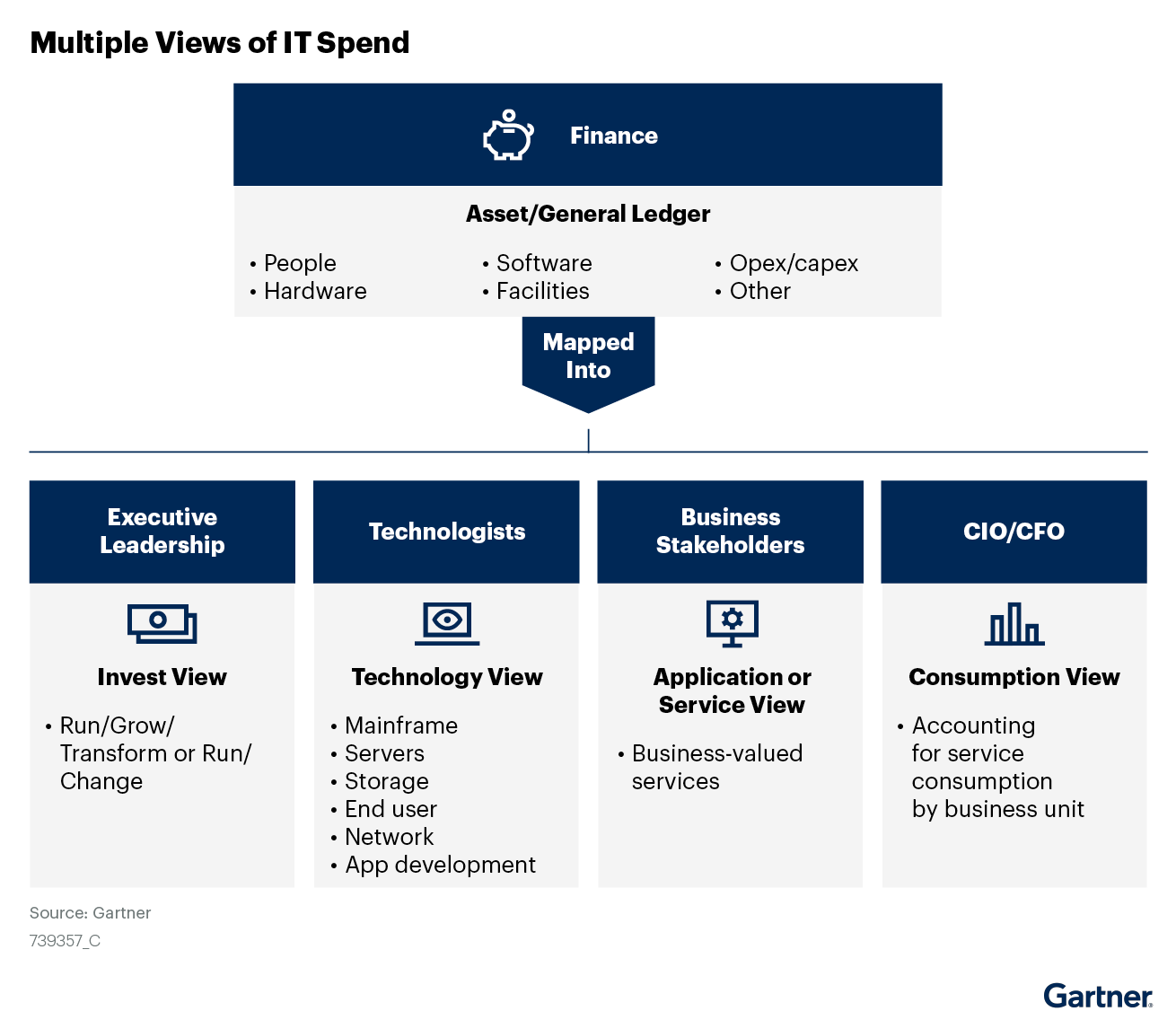
ITFM tools require a feed of spend data feed from the general ledger, as well as various systems of consumption measurement or tracking (such as labor tracking, contract management and configuration management database [CMDB]). Consumption data, along with assumptive allocation logic, is used to populate the ITFM/technology business management (TBM) cost model and create stakeholder-specific views of IT spend that facilitate better business decisions and financial goals (see Figure 1).
Spreadsheets remain the most common tool used to manage IT finances. However, as the demands for more detailed and frequent analysis increase, these highly customized, and often fragile, spreadsheets are replaced by ITFM tools. This occurs when a combination of the following tipping points is present (Table 1):
Tipping Points and Triggers for ITFM Tool Adoption — From a Spreadsheet to a Purpose-Built Tool
| Tipping points | Tool adoption triggers |
|---|---|
Reporting frequency | More than semiannually |
Number of data sources | More than three consumption data sources and/or increased cloud services spend (more than 15% of IT spend) |
Consumption data complexity and hygiene | Extract, transform and load (ETL) requirements are medium-to-high with a high volume of data |
Allocation complexity | Three or more complex allocation models and/or three to four allocation method changes per year |
Allocation flexibility | Inflexible model that requires special coding and more than three or four allocation logic changes per year |
Cost model changes | Major change to cost object types or classes (for example, from technology to application or business unit) |
Increased visibility into spend and consumption required | More granular depth of consumption data, requiring a more complex cost model and/or more accurate allocation logic/data |
Source: Gartner (April 2025)
Improved IT financial transparency helps the CIO and IT leaders optimize IT spending, justify investments in ongoing operations, and build business cases for new technology and business enablement. With detailed IT spending analysis, CIOs are in a better position to earn the strategic mandate over companywide information and digital spending if they demonstrate skills in finance, value drivers and stakeholder needs.
However, ITFM tools are not a panacea for all funding, charging, budgeting and transparency challenges. Successful financial management practices still require a clear vision, strong process discipline, key skills and business acumen.
Market Direction
The ITFM tool market continues to grow as CIOs are challenged to optimize spend, justify operating budgets, and secure new project funding. In the past 18-plus months, the primary demand driver for ITFM tools has been the requirement from business stakeholders and executive leadership for applications and service views of IT spend to help answer questions such as:
- Why does IT cost so much?
- What do we get for our IT investment?
- What is the business value of IT?
- What funding do we need to support operations, and why?
This trend is likely to continue due to ongoing financial pressures, economic uncertainty, and the need to secure and defend budgets.
Gartner IT Score maturity data confirms that ITFM tools remain limited in adoption. ITFM tool vendors are relatively mature, with an estimated 15% to 18% penetration rate, while users in the market are still maturing.1 The market grew by 16.7% in constant currency during 2023, as compared to 2022. Gartner data suggests that the market will grow at a compound annual growth rate of 11% in constant currency between 2023 and 2028. (see Forecast: IT Operations Management Software, Worldwide, 2022-2028, 2Q24 Update).
Analysis of Gartner client interactions indicates that most new ITFM tool buyers are looking for improved functionality over their spreadsheets (50% to 60%). As many as 30% to 35% of first-time ITFM tool buyers are purchasing a tool as one of the first steps in their ITFM journey.
Gartner believes multiple factors will contribute to the continued growth of the ITFM tool market:
- The growing expectations on CIOs to demonstrate the value of their spend.
- Tying IT spend to business outcomes and improving transparency for cost optimization.
- Accelerating adoption of cloud-based service delivery. As more IT moves to cloud-based delivery models, there will be an increased need for accountability and consumption management. Consumption-based billing practices will also increase.
- The growing interest in FinOps as a driver for cloud expense management. Gartner predicts that most FinOps adopters will need additional ITFM capabilities to manage the total cost of cloud and ultimately the total cost of IT solutions.
- Increasing AI and large language model spend that will need to be more carefully managed.
- Business-oriented CIOs’ and IT leaders’ interest in (and business demand for) better cost analysis and reporting to improve the financial management of IT.
- IBM validated the market through its purchase of Apptio and its prioritization of ITFM/TBM, as well as through its support and enhancement of the Apptio strategy.
- Significant investments in market education and demand creation. CIOs and IT leaders better understand how and why IT financial data and cost transparency can empower their decision making and strategic relevance.
- The entry of new software and service providers.
Factors impeding market growth include:
- Technology funds being increasingly allocated to business units, shifting ownership and responsibility away from the office of the CIO.
- IT and other senior executives not fully understanding or embracing the value of IT financial transparency.
- IT finance requirements being too infrequent to require a purpose-built tool.
- FinOps having the potential to distract CIOs from the total cost of IT conversation.
Market Analysis
The number of ITFM tool vendors has grown, with three new vendors added to our radar and two vendors removed from our market guide. IBM’s integration of, and ongoing investment in, Apptio’s ITFM offerings appears to be a stabilizing influence and an endorsement of the ITFM market.
Product offerings from the established software vendors are mature, with strong capabilities in the core ITFM requirements, which are:
- Data aggregation of all IT spend and consumption data
- Cost model development
- The allocation of spend data against a cost model
- Standardization of allocation methods and consumptive data inputs
- Reports and consolidated views of IT spend
- Budgeting, forecasting and planning
Several vendors in this guide report expanding their cloud expense management capabilities and adding generative AI technologies to assist in model design, data integration, and daily operations, analysis and reporting.
Representative Vendors
The vendors listed in this Market Guide do not imply an exhaustive list. This section is intended to provide more understanding of the market and its offerings.
Gartner primarily tracks ITFM tool vendors as listed on the top half of Figure 2. The vendors in the top half of the chart all offer a purpose-built ITFM tool. Vendors on the right offer potential ITFM tools that have not yet met Gartner’s requirements of demonstrated product features, reference clients or requests for vendor details from Gartner clients. The figure also includes a sample of consulting vendors, which can provide critical implementation services and custom-built ITFM functionality.
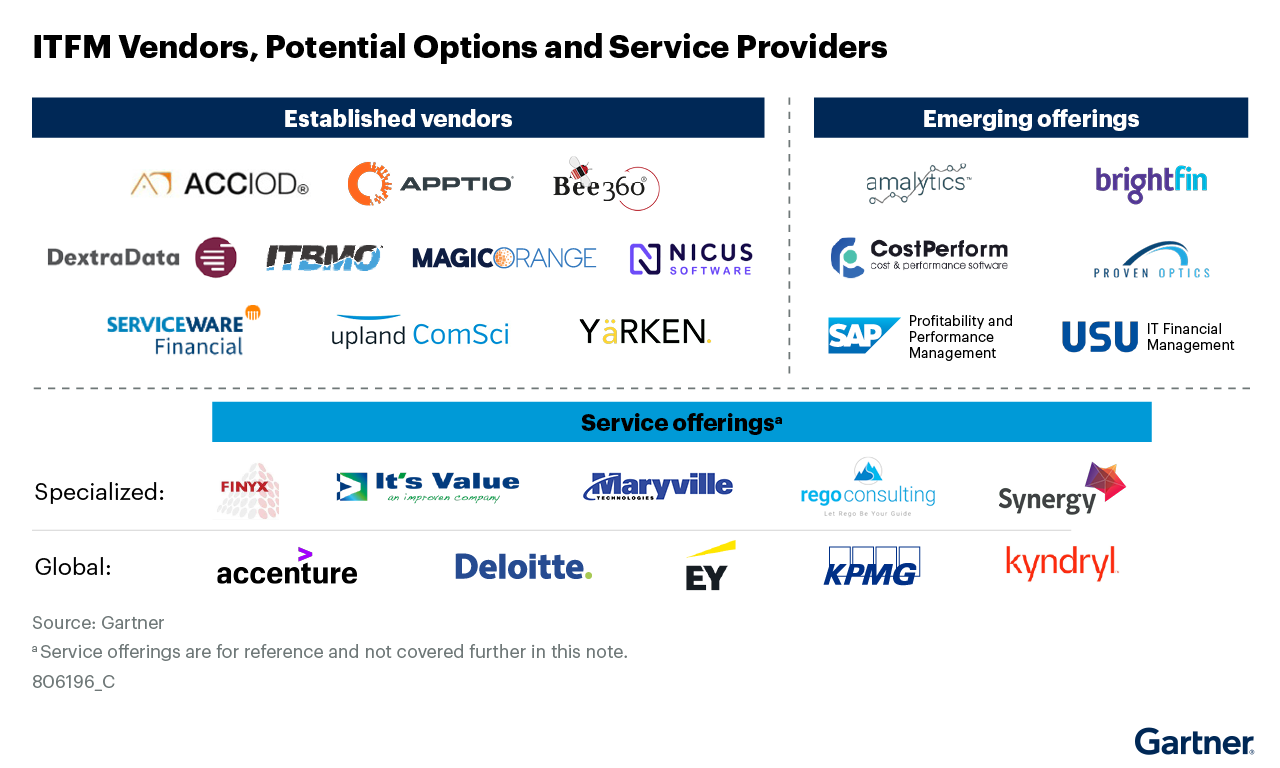
Changes in the ITFM vendor landscape from the top of Figure 2 include the following:
- Yärken is a promising ITFM vendor expanding this vendor landscape. It has demonstrated all of the core ITFM capabilities, and client questions and references validate its inclusion. Located in New Zealand, Yärken is extending its reach into North America and EMEA.
- CostPerform was also added to the emerging vendors list. It offers a broader cost-modeling, charging and recovery approach that, while different from traditional ITFM tools, can offer unique advantages. Located in the Netherlands, it has proven reach in EMEA and North America.
- ClearCost is an Australia-based company and longtime ITFM tool vendor. It was removed from this market analysis due to its lack of communication with Gartner, client reports of inactivity and a reported ownership change.
- BrightFin was also removed as an ITFM tool vendor. Per its website, the company is focused on cloud and telecom expense management (TEM).
- One IT service provider was added — Kyndryl — which comes to the ITFM services market as an extension of its focus on cloud spend management.
- Proven FM, an ITFM services firm, was purchased by Nicus.
For a more complete market perspective, Figure 2 also identifies service providers that have ITFM-specific practices (bottom of Figure 2, below the line).
Vendor Selection
The established ITFM tool offerings remain relatively consistent from last year’s report. Table 2 lists the 10 vendors Gartner tracks as validated ITFM software solutions (see Note 2 for how these vendors were selected).
Established Vendors in IT Financial Management Tools
| Established vendors | Primary ITFM products | Country of origin |
|---|---|---|
KP-One | France | |
Apptio (IBM) | IBM Apptio Essentials and IBM Apptio Standard | U.S. |
IT Financial Management | Germany | |
CIO Cockpit | Germany | |
EZTBM | U.S. | |
MagicOrange ITFM Edition | U.K. | |
IT Cost Transparency, ITFM Suite, IT Planning | U.S. | |
Serviceware Financial | Germany | |
Upland ComSci | U.S. | |
Yärken | New Zealand | |
Source: Gartner (April 2025)
Gartner monitors a second segment of tools from emerging vendors that offer technologies that meet many, but not all, of Gartner’s inclusion criteria (see Table 3). These requirements include demonstration of current capabilities in the previous 18 months, and client inquiry requests or vendor-provided current client references. In Figure 2, these vendors are in the section labeled “Potential Options.”
Emerging Vendors
Accenture | Tech Value Insights Engine (formally Advocate) | USA |
Amalytics | CostLens | England |
CostPerform | CostPerform | Netherlands |
Proven Optics | Proven Optics | USA |
SAP | Profitability and Performance Management | Germany |
USU | IT Financial Management | Germany |
Source: Gartner (April 2025)
Market Recommendations
CIOs looking to add purpose-built tools to support and enhance ITFM practices should start by:
- Validating their ITFM mandate, determining the primary audience and what questions are being answered.
- Securing executive and stakeholder buy-in. CIOs, along with the CFO and even key business leaders, should support, fund and take ownership of the ITFM tool initiative’s success.
- Rationalizing processes and skills before buying tools. CIOs should understand the true resource requirements to set up and maintain the tool. Tools will not eliminate the need for or offset the lack of good processes and skilled people. Well-implemented ITFM can help validate and improve processes and increase the ITFM talents’ capabilities and skills.
- Asking ITFM tool vendors to demonstrate specific use-case capabilities, rather than general functions. The tool vendors are experts at demonstrating functionality and capabilities. It is easy to be impressed by product demonstrations. However, for most, it is critical to understand how a product can address the organization’s specific IT finance needs and priorities.
- Defining the cost model, mapping, analytics and reporting needs before purchasing tools. These elements of an ITFM tool are too often misunderstood and poorly addressed prior to the tool’s purchase.
- Ensuring the availability of needed consumption measurement data to support the allocation process (such as a CMDB or an asset management repository).
- Improving their understanding of ITFM-related needs, priorities, reporting considerations and implementation challenges to more easily negotiate the right components, consulting and services (see Narrow Your Audience and Prioritize Objectives to Accelerate IT Financial Management Program Success).
- Defining implementation and tool adoption time frames to support the prioritized goals and objectives, rather than accept default tool implementation models.
1 Estimates of the ITFM tool market’s growth through 2027 are provided by Gartner analysts Colin Fletcher and Shailendra Upadhyayr. This is based on Forecast: IT Operations Management Software, Worldwide, 2022-2028, 2Q24 Update.
Note 1: Gartner’s Initial Market Coverage
This Market Guide provides Gartner’s initial coverage of the market and focuses on the market definition, rationale for the market and market dynamics.
Note 2: Representative Vendor Selection
Vendors represented in this Market Guide are vendors that Gartner has identified independently, via vendor briefings or client inquiries, and that meet Gartner’s requirements as ITFM vendors, as outlined in this Market Guide.