Market Guide for Digital Forensics and Incident Response Retainer Services
ARCHIVED
23 July 2025 - ID G00826755 - 21 min readBy Carlos De Sola Caraballo, Steve Santos, and 3 more
Digital forensics and incident response retainer services augment capacity and capability when responding to cybersecurity incidents. Security and risk management leaders should use this research to understand the DFIR market, evaluate trends, refine requirements and identify market players.
Overview
Key Findings
- Digital forensics and incident response (DFIR) retainer services have proven to be a key element of resilience and cyber readiness, especially given the rise in security incidents.
- DFIR and adjacent markets continue to grow. However, the wide variety of response options can lead to buyer confusion when selecting appropriate DFIR services.
- Cyber insurance policies, and some regulations like DORA, typically require organizations to have a DFIR retainer to ensure a minimum level of readiness, and to minimize potential loss. This trend is driving retainer adoption and guiding vendor selection.
- The integration of AI has significantly impacted DFIR. Services have reduced their time to engage and investigate, and have acquired improved incident context. This allows security organizations to pivot toward a more proactive approach to defense.
Recommendations
As a security and risk management leader responsible for security operations, you should:
- Coordinate with general counsel, public relations, investor relations and other relevant parties to identify the full range of incident response (IR) services needed. These may include DFIR, a breach coach (external counsel), public relations, expert witnesses and evidence retention.
- Prepare a list of recommended DFIR service providers to ensure coverage in the event of an incident. Consider different scopes, service-level agreements (SLAs) and delivery models, and involve all relevant and responsible stakeholders in the process.
- Evaluate existing or planned cyber insurance policies for DFIR retainer requirements or opportunities to lower premiums. Review your compliance roadmap to avoid potential penalties.
- Ensure that AI is applied wisely and that providers understand your specific context for an optimal output. Be vigilant about hidden costs associated with the technology you require.
Market Definition
This document was revised on 28 July 2025. The document you are viewing is the corrected version. For more information, see the Corrections page on Gartner.com.
Digital forensics and incident response (DFIR) retainer services help organizations assess and manage the impact of a security incident. Digital forensics (DF) services assist with forensic response, aid in forensic information gathering and advise on proactive best practices for avoiding a breach. Incident response (IR) services assist with breach investigation, triage and impact classification. These capabilities are delivered as professional services, supported by technology services from the same provider.
Providers of DFIR retainer services offer both reactive services to help organizations respond to breaches and proactive services to help organizations avoid and better prepare for breaches.
Typical reactive DFIR services consist of prepurchased retainers for forensic investigation, root cause analysis, recovery assistance and other procedure-related services, such as authority engagement, ransomware negotiation, litigation support, report creation and other communication services.
A range of proactive DFIR services, covering technology, procedure and people elements, are also available to support organizational readiness. Such services might assist with procedure development, tabletop exercises, architecture design and/or technology decisions. They might also provide reviews and assessments of security posture and incident response plans.
Mandatory Features
Mandatory features for this market include:
- Preincident design and assessment: Services assist with creation and/or review of IR policies and processes. Services offer assessments of incident response procedures, security posture (configuration and policies), and organizational readiness.
- Postincident response assistance: Services assist with forensic collection, examination and analysis of items for use in investigations to build a timeline of the incident, determine the scope of the compromise and perform root cause analysis.
- Prepaid retainers: DFIR services are available as an annual spend, giving access to incident response capabilities within an agreed SLA in the event of an incident. Response services might be bundled with regular exercises and/or assessments.
Common Features
Common features for this market include:
- Tabletop exercises and training
- Negotiation with threat actors (e.g., ransom) and notification of relevant authorities
- Reports of findings and lessons learned from the incident, including legal/court-focused reports
- Assistance with data recovery, including finding decryptors and providing a chain of custody
- Different delivery models
- Adversary simulation and penetration testing services
- Specialized use cases, such as operational technology (OT), Internet of Things (IoT) or mobile devices
- Expert witness testimony, representation and defense in court
- Additional remediation assistance
Market Description
Access to knowledgeable incident responders is critical to reducing the window, impact and severity of security incidents.
DFIR retainers are a set of capabilities procured through a services provider (and sometimes technology provider) that can help an organization to:
- Investigate malicious activity.
- Reverse-engineer malware.
- Obtain threat intelligence.
- Assist with incident recovery, from initial detection to incident postmortems that allow for better detection and response processes for future security events.
- Conduct tabletop exercises and training.
- Negotiate with threat actors (e.g., ransom) and notify relevant authorities.
- Report findings and lessons learned from the incident, including legal/court-focused reports.
- Assist with data recovery, including finding decryptors and providing a chain of custody.
- Give trial support service, including expert witness testimony, representation and defense in court.
- Provide specialized use cases, such as OT, IoT or mobile devices.
- Provide training and readiness services.
- Adjust the logging strategy to ensure there are no incident-relevant gaps.
- Speed up triage and scoping processes for a better escalation procedure.
- Confirm or discard the presence of certain indicators of compromise (IOCs) and/or threat actors boosting threat hunting capabilities.
DFIR services provide digital forensic examination and investigation capabilities to analyze digital channels, memory, social media, cloud services, endpoint systems, devices, applications and even OT or physical devices. The objective is to identify fraud, as well as malicious, unethical or illegal activities and threat actors — whether internal or external. For an investigation to take place, an organization must suspect or detect an activity with malicious intent (such as a breach). DFIR investigators must ensure that any evidence is collected following proper procedures, conduct a thorough examination, establish a chain of custody for evidence collection and prepare for potential court proceedings. An exception is when an organization suspects malicious presence without any alerts or proof of it. This scenario is typical of threat hunting, where forensic procedures and techniques are used to confirm or rule out the presence of IOCs based on your hypothesis.
Sometimes, legal requirements demand that providers strictly follow consistent processes and procedures during their analysis. It is essential that processes and artifacts are reflected in the documentation and reproducible, as the analysis should be as objective as possible. Any other analyst should be able to get the same results by following the same steps and using the same set of tools.
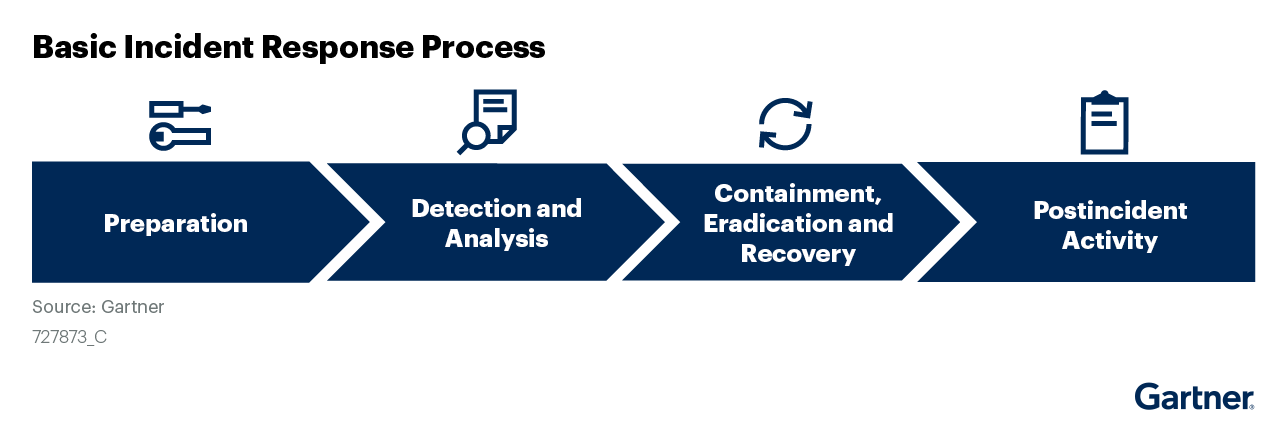
Most IR plans use some variation of the process described in NIST SP 800-61 Rev. 3.1 The basic IR process is outlined in Figure 1.
DFIR services are often retainer-based due to the nature of the work, supporting and augmenting an organization’s internal cybersecurity IR team. Retainer-based services encompass a wide variety of prenegotiated terms and conditions. Ideally, these terms are established well in advance of an incident, but in some cases, DFIR agreements are quickly established and negotiated after an incident occurs. This is known as an ad hoc provider or zero-hour retainer.
While DFIR retainers increasingly include both reactive and proactive services, the reactive portion is the core driver of retainer adoption. The reactive service focuses on the analysis part of the “detection and analysis” phase and on the “containment, eradication and recovery” phase, as shown in Figure 1.
In the event of an incident, the customer and DFIR firm will initiate a response that may require cross-organization incident coordination, including business lines, IT, general counsel (legal), HR and other corporate crisis management stakeholders.
DFIR retainers can be procured as a stand-alone service or bundled as part of a managed detection and response (MDR) contract (see Market Guide for Managed Detection and Response). In fact, as MDR offerings evolve and mature, many vendors offer both options.
An MDR provider typically offers ongoing monitoring and detection (security operations center services), along with incident response (DFIR). A basic MDR contract may include a basic level of response services for simple incidents requiring low effort. In essence, the response service is capped. For complex incidents, an MDR contract often requires an additional, bundled DFIR retainer component.
Bundling monitoring, detection and response into an MDR contract can be both cost-effective and convenient — though it does place all your trust in a single solution. No perfect approach exists here; some security and risk management leaders even opt for both a full MDR service and an additional DFIR retainer with another provider to keep their options open, especially if the additional retainer is a zero-dollar type.
Providers that rely heavily on specific technologies to deliver their DFIR services warrant special consideration. New approaches — often using different AI mechanisms — can reduce the time needed to “land on the incident,” setting the context and scope. These methods help ensure clients have the appropriate level of visibility and have established the right permissions through the tool, addressing the increasingly essential proactive angle that DFIR services provide. Unaddressed gaps in DFIR programs can severely delay incident recovery and reveal weaknesses in an organization’s threat detection and monitoring capabilities. Integrating AI into DFIR services accelerates incident contextualization and delivers comprehensive visibility, transforming reactive responses into more proactive defense strategies (see Key AI Automation Trends Shaping the Future of SecOps) .
Most DFIR retainer services have expanded their offerings to include preincident proactive services, such as “red teaming” and tabletop exercises to prepare for a security incident. Other proactive services offer targeted assistance, such as penetration testing and training workshops. These types of assistance have become popular because some providers allow their customers to consume unused hours on related services to increase the ROI of the contract and to incentivize renewal. Also, some regulations require organizations to test their capacity to react by doing this kind of exercise, showing transparency and trust.
DFIR retainer agreements are not all the same, and in many geographies, these services are increasingly delivered remotely. In fact, since the COVID-19 pandemic, many DFIR retainers are delivered remote-first, with on-premises services as an optional add-on. Note that travels and other derived costs can impact the costs of the engagements.
DFIR services can be accessed in three different ways:
- Ad hoc engagements — Most providers offering DFIR retainers provide ad hoc services. A small number focus solely on supporting customers that experience an incident (minor or major in scope or duration) and require assistance with very short-term reactive services. These engagements are usually reactive to remediate sudden needs related to cybersecurity incidents. The key aspects of these services are mitigation and recovery, often resulting in ad hoc engagements being more expensive than other service models.
- Prepaid retainers (most common) — This type of agreement requires annual spend with a provider that allocates funds to the DFIR services, typically used for reactive services. In some instances, the retainer is bundled with an assessment exercise where the provider ascertains the IR maturity of the customer’s organization and onboards the customer (for example, by collecting the information necessary to execute the retainer and deploy technical capabilities). These assessments usually lead to outputs that assist customers in focusing on deficiencies in their IR capabilities, such as the lack of a policy, logging capabilities, proper backup configuration or the existence of vaguely defined procedures.
- Zero-dollar/zero-hour retainers — This type of agreement has no prepaid funds. It settles and approves terms and conditions ahead of time in case the organization needs to engage the provider. The provider is likely to offer a “best effort” response time rather than a formal SLA, and hourly rates will be at the top end of the range. Note: This approach might be subject to availability, as the market is experiencing some oversubscription.
Common characteristics of DFIR agreements include:
- Preagreed hourly service rates, which depend on the provider, the agreement length (in years), the desired SLA/service tier and the geography of the customer (to comply with local and/or global requirements):
- Daily rates might also be quoted by the provider.
- Prepaid agreements have lower hourly rates than nonprepaid agreements and are priced according to the volume that has been prepaid (spending more results in a lower rate).
- An allocated number of prepaid hours assigned to DFIR services:
- This number can range from tens to hundreds of hours, depending on the buyer’s requirements, but is typically in the 80- to 160-hour range.
- It is common for some providers to require a minimum number of hours per use, even if the complete engagement doesn’t require that much time (e.g., engaging the retainer will consume 20 hours no matter what).
- An established response SLA once an incident is reported:
- Response SLAs vary; typically, prepaid agreements have better response times than nonprepaid (e.g., zero-cost or ad hoc) agreements.
- In some cases, a specific ransomware SLA is included to limit the scope of any encryption as soon as possible.
- Predefined or agreed costs for any required tools, as well as travel and expense rates and conditions if staff must be deployed to a customer’s premises.
- Determination of when and how support will be delivered, either remotely or on-premises:
- The on-premises option is the most expensive one and the one with longer SLAs.
Market Direction
Digital forensics (DF) and incident response (IR) services go hand in hand, but they were traditionally delivered by two separate types of consultants: forensic investigation consultants and IR consultants. Each activity has historically required different specialized skills. DF processes typically took more time to reveal the precise details of security breaches and were often driven by legal proceedings. IR was more cyberthreat-focused and included various security operations processes and technologies, such as containing malware and reconfiguring security detection, monitoring or protection controls.
Today, those lines of demarcation have blurred. The marketplace is crowded, with DFIR retainer-based services now offered by global advisory firms, security technology vendors, managed security service providers and specialized boutique security services firms. However, this is not a one-size-fits-all market. You will likely need to identify several suitable vendors based on your requirements, upfront and recurring costs, SLAs and provider expertise (for a comprehensive list of providers, see Tool: Vendor Identification for DFIR Retainer Services).
Gartner client inquiry has revealed several emerging trends with DFIR retainer-based services:
- DFIR retainer services are often mandated by cyber insurance carriers. As the number and impact of cybersecurity incidents increase, demand for DFIR retainers is likely to continue to grow.
- Some cyber insurance carriers have a preferred list of DFIR providers (panel vendors) with built-in service bundling (e.g., breach coach, specialized legal services), discounting and process integration with the cyber insurer. This trend ensures that organizations have a minimum amount of readiness, usually based on agents or configuration required from the providers for a proper response, and limited financial exposure.
- A new approach to these services uses automation for memory acquisition and investigation (see Cloud Security Requires Refined Incident Response Strategies). This reduces the number of people with expertise needed, and also the time required for the engagements. This approach is only applicable to specific environments due to the visibility and configuration settings that it requires.
AI progress continues to impact the DFIR market by reducing average investigation times, improving contextualization and proactively contributing to cyber strategy.
Market Analysis
Many managed security services providers (MSSPs) and MDR service providers also offer DFIR retainer-based services. For more information, refer to:
DFIR retainer services are not a substitute for proper security procedures. You should view your IR retainer provider as a partner that will work alongside you during a crisis.
Organizations that currently use an MDR provider or an MSSP may attach DFIR services to new or existing services from the provider.
DFIR providers fall into three categories:
- Providers that do not deploy any agent on the client’s endpoints.
- Providers that need to deploy their own agent on the client’s endpoints.
- Providers that require a commercial off-the-shelf EDR capability to be in place.
Buyers should consider the specific threats their organization faces to determine which type of provider best meets their requirements. For instance, if threats are ransomware-related, ensure the right level of artifacts (registry entries, memory dumps, etc.) can be obtained by the provider during the attack.
Clients in some countries may require additional procedures for sensitive data affected during an incident. These procedures should be addressed in preincident services and may involve the legal team. Clients may also have privacy concerns about data collection by providers that use their own agents on endpoints.
Pay close attention to log retention configurations and any additional capabilities needed for forensics purposes. In cases of memory corruption or log deletion, the steps taken by the attacker might be lost unless the organization introduces alternative logging solutions.
Buyers should also be aware that zero-hour retainers may result in missing prework, such as deploying an agent to all endpoints, conducting an initial risk assessment, or checking the right level of access and visibility. This can lead to an insufficient amount of artifacts and reduced response efficacy. Once an endpoint has been encrypted, it may be impossible to collect the required artifacts.
Finally, pay special attention to AI approaches. Even if AI drastically reduces investigation and reporting times, it is not going to completely remove your need for expertise and knowledge. Think about it like a very fast car — it still needs a good driver to avoid crashing.
Many factors can influence the selection of a DFIR services provider. However, the following two primary factors will help security and risk management leaders narrow down their list of potential providers.
Providers That Offer Proactive Services
Clients are increasingly asking which DFIR service providers offer an emergency service. This helps them “secure” a spot in a service provider’s queue should a breach happen. However, the response time (remote and on-site) and the SLA to a response time are the most important criteria to note before signing a retainer.
We’ve heard of clients that have been breached and placed in a response queue. But securing a spot in the queue is not enough; you need to be placed at the top of the queue. For more details about related services, ransomware or breach coverage and relevant certificates, see Tool: Vendor Identification for DFIR Retainer Services.
Specialized Tools, Solutions and Frameworks
Organizations increasingly depend on DFIR providers to dig deeper into incidents and deliver advanced analytics and detailed forensics reporting. Meeting these demands requires DFIR providers to use a highly specialized combination of products and processes to help lower the mean time to contain and respond to active incidents.
Specialized software, such as IR platforms, focus on the communication, collaboration and procedural part of incident response. Cloud-based investigations and responses require organizations to adapt their procedures and tools for effective engagement. For more information, see Cloud Security Requires Refined Incident Response Strategies.
Operational technology (OT) — a key category within cyber-physical systems (CPS) — represents environments where digital systems directly interact with physical processes. A strong example of this distinction is the need for providers that can operate effectively in OT settings. These environments often require entirely different procedures, tools, technologies and approaches from traditional IT or non-OT domains. As a result, it’s common for organizations to separate contracts between OT and non-OT scopes to ensure specialized expertise and compliance with unique operational requirements.
When selecting a digital risk incident response (DRIR) provider, organizations must thoroughly assess the vendor’s ability to effectively manage cybersecurity incidents within CPS environments (see Magic Quadrant for CPS Protection Platforms for more information). Evaluating the vendor’s expertise in these areas ensures a more resilient and tailored response to threats that could impact both digital infrastructure and physical operations.
Representative Vendors
The vendors listed in this Market Guide do not imply an exhaustive list. This section is intended to provide more understanding of the market and its offerings.
Vendor Selection
The 40 vendors named in this Market Guide represent providers of DFIR services. They include MSSPs and MDR companies, as well as technology and consulting vendors. We list the vendors about which Gartner has received the most client interest (determined by searches on Gartner.com and client inquiries).
Representative Vendors in Digital Forensics and Incident Response Retainer Services
| Vendor name | Product, service or solution name |
|---|---|
AKATI Sekurity | Digital Forensics and Incident Response Retainer Services |
Ankura | Forensics & Investigations |
Arctic Wolf | Incident Response |
Atos | Threat Detection, Investigation and Response |
Binalyze | Automated Investigation and Response Platform |
BlueVoyant | Digital Forensics and Incident Response Retainer |
Booz Allen Hamilton | Digital Forensic Investigations and Incident Response |
Check Point Software Technologies | Incident Response Services |
Cisco | Cisco Talos |
Coveware | Retained Ransomware and Cyber Extortion Incident Response |
CrowdStrike | CrowdStrike Incident Response Services |
CyberCX | Digital Forensics and Incident Response |
Cybereason | Cybereason Incident Response |
Darktrace (Cado Security) | Investigation and Response Automation |
Dell Technologies | Incident Response and Recovery Services |
Deloitte | Cyber Incident Response Services |
eSentire | Digital Forensics and Incident Response |
EY | Crisis Management and Incident Response Services |
Google Cloud (Mandiant) | Mandiant Incident Response Services |
Group-IB | Incident Response Retainer Services |
GuidePoint Security | Incident Response Retainer Service |
IBM | IBM Security X-Force Incident Response Services |
Integrity360 | Incident Response Retainer |
Kroll | Incident Response and Litigation Support |
Kudelski Security | Incident Response Services |
LGMS | Cyber Security Incident Response |
Mitiga | Emergency Cloud Incident Response |
mnemonic | Incident Response |
NCC Group | Incident Response |
Optiv | Cybersecurity Incident Response Services |
Orange Cyberdefense | Cyber Security Incident Response |
Palo Alto Unit 42 | Threat Informed Incident Response |
Pondurance | Digital Forensics and Incident Response Retainer Services |
PwC | Cyber Incident Response and Recovery |
Quorum Cyber | Incident Response Retainer Services |
Rapid7 | Incident Response Services |
Sophos (Secureworks) | Incident Response Services Retainer |
Sygnia | Digital Forensics, Incident Response Services, Incident Response Retainer |
Trustwave | Digital Forensics and Incident Response |
Verizon | Rapid Response Retainer |
Source: Gartner (July 2025)
Market Recommendations
No one-size-fits-all approach to DFIR services exists. These service providers and their capabilities can vary greatly, depending on multiple factors. With so many providers in the industry, buyers of DFIR retainer-based services must dig deep into their varying capabilities, strengths and experience.
Here are some areas to consider:
- Realize that security incidents are “when it occurs” situations, rather than “if it occurs” propositions. Therefore, you should have an IR program and institute the correct processes for it, ensuring your organization understands, reviews and regularly tests those processes, applying findings when necessary.
- Consider selecting a third party to help you review your plan, create a plan for IR and, if necessary, set up an appropriate retainer-based service with a DFIR services provider. Recognize that your organization faces a high possibility of a breach.
- If you are already using a provider for either MDR or managed security services, ask whether it offers a DFIR retainer-based service offering. This could provide faster response times and streamlined communications during an active incident. This option is ideal if you prefer speed over deep specialization, and it also helps ensure alignment with the scope of your current services.
- Obtain evidence from your (potential) DFIR services provider that its consultants and analysts adhere to proper and strict processes when handling evidence. These experts must provide clear analysis and reports that depict which data and systems are involved, how and why they are involved and, if possible, what the incident’s specific cause is. They should be able to advise on what must be done to contain and eradicate the problem, and provide steps for finding future-related vulnerabilities, such as creating threat-hunting use cases.
- Align your procedures, reports and analysis with your compliance; what’s important for a client might not be a high priority for you, and vice versa.
- DFIR retainer contracts are often for three years. Thoroughly review the retainer contract and ensure you have prenegotiated hourly rates and the flexibility to move upfront spend from reactive to proactive services to avoid a “use it or lose it” scenario. Be careful not to buy too many preallocated hours per year, unless these can be carried over to the next year or converted to proactive services.
- If you have a cyber insurance policy, consult your carrier and seek its guidance before signing a DFIR retainer with a vendor; otherwise, you might miss out on discounts or other advantages.
- AI can be your ally, but don’t just blindly rely on it. You still need the expertise and judgment to coordinate and direct its efforts for a successful engagement.
Discounts on DFIR retainers have been noted by clients that use the same provider for multiple security services offerings and by clients that use a recommended vendor from their cyber insurance carrier.
1 NIST SP 800-61 Rev. 3, National Institute of Standards and Technology.