Market Guide for Digital Adoption Platforms
ARCHIVED
3 September 2025 - ID G00827465 - 37 min readBy Melissa Hilbert, Maria Marino, and 2 more
Market divergence and deep AI development and integration demand a strategic review for your DAP investments. Application leaders should use this research to critically evaluate solutions and prioritize cross-application orchestration to improve efficiency, adoption and business transformation.
Overview
Key Findings
- AI, from generative to assistants and agents, is transforming how people work.
- DAPs need to provide analytics that tie to business outcomes and support business transformation.
- The divergence of application offerings focused on customer experience (CX) versus employee experience (EX) is deepening.
- The DAP market continues to grow, especially for midsize to large enterprise organizations.
Recommendations
- Evaluate vendors by examining their organizationwide capabilities and specific application and feature capabilities to support digital and business transformation and employee digital dexterity.
- Improve employee experience by integrating with third-party AI assistants or using DAP-vendor-supplied assistants that also integrate with third-party assistants to augment employee workflows.
- Investigate a DAP’s ability to tie to business outcomes by reviewing DAP-supplied analytics.
- Investigate specific capabilities included in the product offerings and any additional pricing mapped to your use cases and expected outcomes to create a business case for AI.
Strategic Planning Assumption(s)
By 2028, 40% of organizations will use GenAI, supplied in their DAPs, to automatically surface new workflows to employees.
By 2027, 30% of organizations will use AI assistants supplied by their DAP to integrate with other assistants delivering actionable business process augmentation and automation.
Market Definition
Gartner defines a digital adoption platform (DAP) as software that overlays employee- and customer-facing applications with in-application guidance to drive adoption, proficiency and engagement. It supports digital transformation by streamlining and accelerating how employees or customers learn and engage with technologies. It provides consistent experiences that help users complete work efficiently across multiple applications. In addition, DAP analytics provide actionable insights to improve experience, optimize work and adoption/utilization, boosting the ROI of applications.
Digital adoption platforms are used to help organizations decrease digital friction for employees and increase technology adoption, engagement and proficiency. They are also used externally to help customers adopt and engage with their software or portal. Example use cases for providing contextualized help include:
- Onboarding
- Organizational change management including business process, application UI and new application features
- Complicated tasks
- Infrequent tasks
- New feature adoption
- Knowledge management information and links that provide additional information to aid in completing a step in a process
Mandatory Features
The mandatory featuresfor this market include:
- In-application contextual guidance — This is step-by-step guidance to complete a task.
- Analytics — This is the analysis of overall guidance usage as well as step-by-step analysis within a workflow.
- Anonymized and aggregated user-data collection — This is completed before analysis to track usage and is reported by role.
- Content creation and management — This enables the creation and maintenance of guidance.
- Tours, announcements and bulletins — These provide an overview of an application or features within an application. They support new-user onboarding as well as changes or new features available to existing users. The bulletins feature also provides a mechanism to announce new application features.
- Cross-application contextual guidance — Step-by-step guidance crosses multiple applications and is provided in context of what the user is doing and where the user is at that moment. This includes hover help or tool tips that provide additional information on a guidance step.
- Surveys/feedback — These employee or customer feedback surveys take both short and long forms.
- If/then branched guidance — This type of guidance can take multiple paths based on information filled in at a particular step.
Optional Features
The optional features for this market include:
- Multilanguage content and application — The translation of content and application into multiple languages.
- Tracking and notification of workflow/guidance — This reveals issues or breakage associated with guidance.
- Simulations — This simulates applications not yet in production.
- Light automation of task entry — This involves some data entry automation that is programmatically based on information filled in at a step to then fill in additional fields (not the same as robotic process automation).
- AI — This includes Gen AI and is to be used by end users and administrators to search for information and guidance, and provide summarized responses.
Market Description
This document was revised on 8 September 2025. The document you are viewing is the corrected version. For more information, see the Corrections page on gartner.com.
DAPs accelerate digital transformation and drive business outcomes by helping employees and customers adopt and efficiently use applications. They accomplish this by offering guided application tours, step-by-step guidance, field validations, focus areas, personalized recommendations and, in some cases, AI-powered task completion.
Application vendors believe their UIs are straightforward — clear and easy to use — but users regularly struggle with them. Couple this with increasingly complex business processes that keep changing, as well as employees uncomfortable with or overwhelmed by new technology, and technology adoption is doomed. Employee productivity among workers experiencing digital friction is declining (see Figure 1). A DAP reduces the complexity of, and frequent updates to, application UIs and the complicated and ever-changing tasks employees must perform.
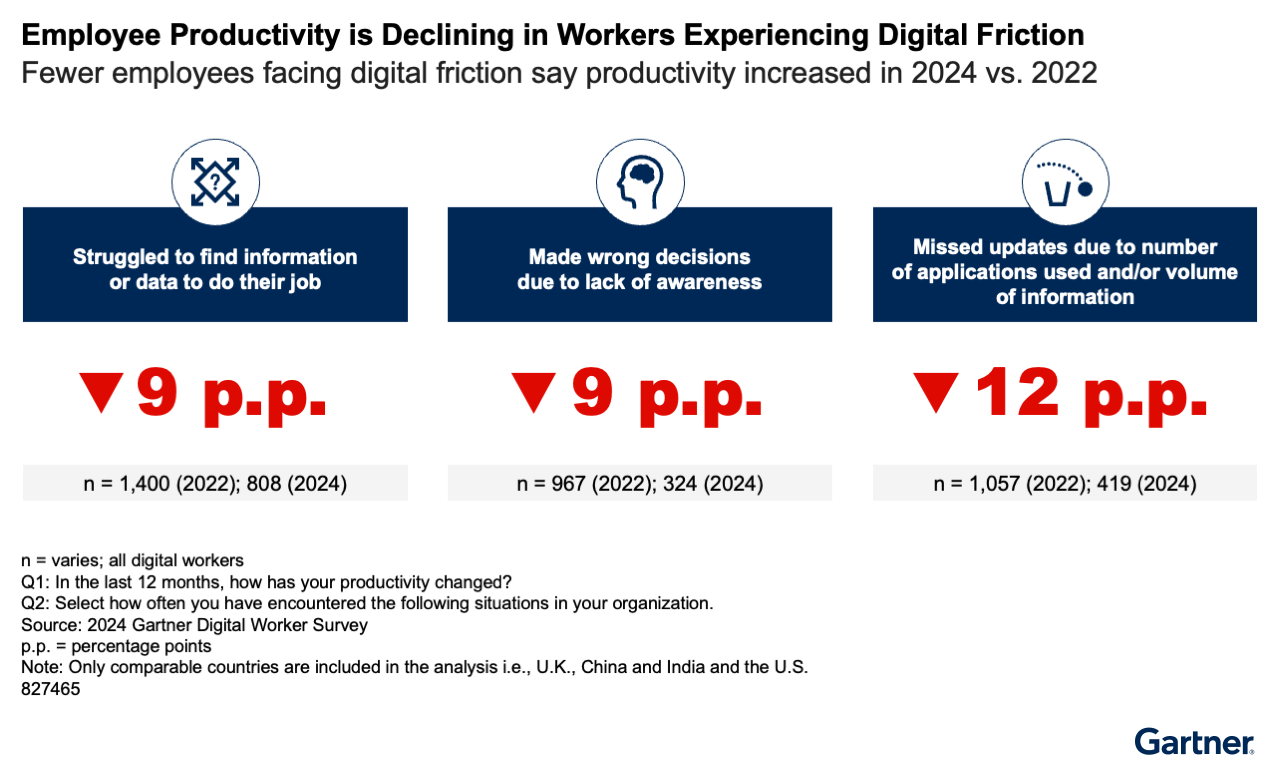
Gartner’s 2024 Digital Worker Survey found that productivity fell between 9-12 percentage points in the last two years.
- In 2024, only 24% of digital workers who struggle to find information (at least 70% of the time) said their productivity increased in the past year, down nine percentage points from 2022’s 33%.
- In 2024, only 28% of digital workers who made wrong decisions due to a lack of awareness (at least 70% of the time) said their productivity increased, down nine percentage points from 37% in 2022.
- In 2024, only 25% of digital workers who missed updates due to the number of applications used and/or volume of information produced (at least 70% of the time) said their productivity increased, down 12 percentage points from 37% in 2022.
These are significant drops. It’s important to note that falling productivity makes it harder for employees to gain digital skills and affects performance.
AI advances within DAPs are transforming how employees work. Providing in-application guidance has become a basic requirement as employees navigate across many applications to complete their work. Cross-application guidance is now required to complete many business processes. Many DAPs take that a step further to include workflow automation and GenAI to provide information and guidance on content to fill out a form more accurately.
Common employee-focused (internal) use cases for DAPs encompass onboarding/offboarding, completing complex or infrequent tasks, improving business process compliance, and supporting change management for applications. For customer-focused (external) use cases, onboarding and adoption play a significant role in the customer experience, while cross-application guidance plays only a small, if any, role.
DAPs:
- Provide real-time, in-app user assistance, reducing the learning curve and boosting productivity. Some vendors offer a more conversational assistance approach.
- Integrate with existing software systems and applications, allowing the DAP to track user actions and behaviors to identify pain points and offer targeted support.
- Help users complete daily or infrequent tasks — like annual performance reviews — in one or more applications quickly, efficiently and accurately.
Digital friction and frustration are often caused by business processes, not a specific application. DAPs provide in-application and cross-application guidance to help employees execute complex business processes that traverse multiple applications. They also offer analytics across the complete business process. Using analytics and data insights, business processes can be optimized by identifying areas for improvement and measuring digital transformation success. Business KPIs can be tied to improvements made by deploying a DAP.
A well-implemented and well-utilized DAP empowers organizations to confidently embrace digital transformation and innovation, increasing efficiency, user satisfaction and proficiency, and cost savings.
Technology providers can also embed a DAP into their software so customers can quickly onboard, execute workflows, expand feature usage and complete more advanced workflows over time. Adoption is a critical leading indicator of whether the customer is achieving value. Organizations can integrate product usage analytics with their CRM platforms to augment contact and account data and inform customer success programs. In addition, DAPs provide critical user feedback to product teams to inform and validate product roadmaps. DAPs can often be fully branded to create a unified experience for external customers.
DAPs augment SaaS applications but can also be deployed to on-premises or private cloud-hosted applications, as well as those installed on computers and mobile devices. A few vendors also support virtual application delivery. For more information, see Table 7: Deployment Modalities Supported.
Market Direction
The DAP market is on the cusp of significant transformation, moving beyond traditional “show-me” guidance to “do-it-for/with-me” automation. The rise of AI agents and assistants primarily drives this transformation. Guidance is the top reason organizations begin to evaluate DAPs, even though vendors are moving the market forward. Guidance remains foundational to DAPs. The shift toward sophisticated AI will redefine how organizations think about productivity, governance and risk in their application ecosystem.
The expected DAP market evolution in the next year includes:
- Advanced AI agent orchestration: DAPs will increasingly function as orchestrators within an application ecosystem by coordinating multiple first- and third-party AI agents and AI assistants across applications. This orchestration fundamentally changes how work is performed and enables users to focus on more valuable tasks, with AI assuming the mundane work. DAPs will provide real-time user context, trigger multiapplication actions and offer feedback loops to prove value, preventing guidance from being absorbed by other AI solutions. Some DAP vendors are actively developing or integrating with autonomous AI agents and conversational assistants designed to manage and execute multistep workflows automatically. AI assistants should be available on multiple endpoint devices, not just within an application; should orchestrate and coordinate with other AI assistants or agents; and should work across various applications and business processes.
- Outcome-driven guidance, nudging and analytics: The focus will shift from simply guiding to proactively nudging users toward specific business outcomes, like onboarding success or new feature adoption. This will require deep integration of behavioral analytics and AI and ML to identify adoption gaps, suggest content and measure the impact of interventions in real time. DAPs will self-tune to continuously optimize interventions based on effectiveness.
- Deepened cross-application journeys: DAPs will further expand guidance through complex processes and across multiple applications and platforms, coordinating actions and insights across various AI-aided tools. Enhanced integrations with CRM, ERP and HCM systems and connected applications will help users perform work more efficiently.
- Learning integration: While some DAPs have integrated learning, including courses, into their capabilities, other vendors are embracing an emerging trend: embedding digital learning directly into workflows to onboard, train and upskill employees in the flow of work. This embedding blurs the lines between traditional DAPs and learning management systems.
- Enhanced governance and personalization: As AI-powered guidance becomes more sophisticated, there will be increased emphasis on enterprise-grade governance features to ensure security, compliance and controlled access to content and data. Personalization will become hypertargeted, adapting guidance and learning based on user context, properties and past behaviors, moving beyond static rules defined by administrators.
- AI-powered customer experience: As AI agents gain more capabilities, they will threaten the customer experience use case. While guidance remains important, application software vendors may build their own assistants and agents to help end-users through standard tasks and common workflows.
Gartner expects expanded adoption of existing DAP investments and increased application adoption by enterprise organizations.
Market Analysis
Key Benefits of Implementing a DAP
Key benefits customers report from implementing DAPs include:
- Cost savings from:
- Reduction of “how-to” IT service desk requests
- Net reduction of training resources for new technology deployments
- Reduction in training for change management of existing technology implementations
- Increased end user:
- Proficiency and productivity with technology
- Ability to self-assist in learning new technology through tours, knowledge management and learning links
- Digital dexterity using company-supplied technology
- Engagement and satisfaction using technology
- Understanding and streamlining of business processes
- Reduced digital friction and improved DEX
Continued Market Bifurcation
The DAP market is characterized by a notable divergence in focus between customer- and employee-facing use cases, though some vendors are active in both. Companies like Amplitude, Appcues and Pendo have historically catered to customer experience (CX) teams, emphasizing behavioral analytics and voice of customer feedback to drive adoption and retention, A/B testing for campaigns and multichannel orchestration with email. In contrast, vendors such as WalkMe, Whatfix, Nexthink, Oracle, myMeta Software, and tts primarily focus on employee experience (internal) needs and enterprisewide adoption, productivity and change management.
AI Advancements
AI is driving significant advancements, including:
- Content generation and localization: AI creates guidance: titles, descriptions and content, and automated content translation.
- Element detection and workflow stability: Advanced AI-powered algorithms automatically adapt to UI changes, maintaining content accuracy and preventing workflow breakage — a key differentiator for stability and reduced maintenance of existing workflows or guides. Proactive monitoring and notification of broken guides are also standard.
- Analytics and insights: AI summarizes survey responses, provides conversational analytics, and improves identification or actionable insights.
- Targeting and personalization: Some platforms offer AI-driven smart triggers based on user behavior. Some platforms have gone beyond “rage clicks” to capture user confusion and target and determine opportune moments for guidance. This is evidenced primarily by vendors focused on the customer experience (external) use case, such as Amplitude, Appcues or Pendo.
- AI assistants: Vendors either deliver their own AI assistants and/or integrate with third-party AI assistants. These can be used within workflows to find information such as corporate policies, complete forms, and manage knowledge and learning for end users. Some AI assistants are contextualized to roles.
Market Growth
The DAP market contains vendors ranging from small startups with less than $2 million in revenue to publicly traded multinationals. Gartner estimates the 2024 market revenue was approximately $1.042 billion, which grew 27.7% from 2023. Despite economic uncertainty, Gartner expects 15% to 20% revenue growth for 2025. This market exists to support employees’ digital dexterity, helping them work proficiently and effectively. When employees adopt technology, it supports CIO digital transformation goals. This market also supports customer adoption of software, helping SaaS providers deliver a low-friction user experience.
Getting Started
Organizations seeking to purchase their first DAP will often buy it for up to five applications planned for deployment in the first year. The organization should include no more than two initial application deployments if planning to deploy for complex applications, such as ERP and CRM. This measured approach allows organizations to determine if the DAP is the right product fit and a suitable vendor and partner for them, while mitigating the risk of reconfiguring all workflows created if they must select a different vendor.
Representative Vendors
The vendors listed in this Market Guide do not imply an exhaustive list. This section is intended to provide more understanding of the market and its offerings.
Vendor Selection
Use Table 1 as a quick reference guide to the names of representative vendors and their digital adoption platforms (see Note 1). These solutions have been built to support cloud- or web-based applications by default. Use tables 2-7 in the appendix to review the features of vendors.
Representative Vendors in Digital Adoption Platforms
| Vendor | Product Name |
|---|---|
Amplitude | Amplitude Guides and Surveys |
Appcues | Appcues |
Cornerstone | Cornerstone Guide |
Knowmore |
|
myMeta Software | myMeta Digital Adoption Platform |
Nexthink | Adopt |
Oracle | Oracle Guided Learning |
Pendo | Pendo |
tts | tts performance suite |
Userlane | Userlane |
WalkMe, a SAP company | WalkMe Digital Adoption Platform |
Whatfix | Whatfix Digital Adoption Platform |
Source: Gartner (August 2025)
Vendor Profiles
Amplitude
Amplitude’s Guides and Surveys was introduced in February 2025 and supports cloud, web and mobile applications for external customers and their end users. It offers easy guide setup and guardrails to prevent pop-up fatigue. Features include targeting for delivery to specific end users, based on criteria like account health or new users, and triggers to launch guidance based on user behaviors like rage clicks. It offers end-user surveys and can generate AI summaries of survey responses. Analytics covers guides and surveys in a single view. It serves customers in communications, media, high tech, financial, business and professional services, and retail. Customers include McClatchy, Homebase, Intuitive, WHOOP and Redis.
Amplitude’s recent improvements include mobile guides and surveys, as well as an “experimentation” feature to test different guide or survey versions. Recent AI innovations include AI translations for guide/survey content and AI agents that receive goals from the user to generate guides and surveys.
Amplitude’s roadmap includes AI agents for guides and surveys to perform tasks such as detecting and fixing broken guides/surveys, “auto-pilot” targeting to surface a guide or survey at the best time, and deploying an in-app natural language AI assistant. Its 2025 acquisition of Kraftful will expand its voice of the customer (VOC) capabilities in its DAP.
In addition to in-house training services, Amplitude’s implementation projects are delivered through “Solution Partners” certified to deliver Amplitude onboarding, analytics setup and ongoing managed services. Most customers have over 5,000 users. Its pricing model is based on product tiers, with basic Starter and Plus packages and Growth Plans and Enterprise Plans for larger businesses.
Appcues
The Appcues platform targets the customer use case. It offers multiple channels for customers to reach end users through in-app experiences and via email and mobile push notifications. Guides can be built using a Google Chrome browser extension or the web-based “mobile builder.” It supports “experiments” to test new experiences versus control groups. It offers the “events explorer” feature for analytics and standard NPS or custom surveys. It serves customers in education, financial services, insurance and transportation. Customers include Fullstory, Bynder, Kaplan, Paylocity (Airbase) and Wayfair.
Appcues’s recent improvements include multistep, branching workflows and localization through AI translations. It also introduced “folders” to help platform users group content like workflows and checklists into folders. AI enhancements include localization of experiences, individualized recommendations, surfaced key metrics, summarized survey results and the ability to generate new mobile experiences for a natural language prompt.
Appcues’s roadmap includes plans to add in-app experiences to the campaign design workflow, which supports email and mobile push for improved channel orchestration and multi-variate branching. It focuses on making experience creation automatic through AI, surfacing deeper insights.
Appcues offers a 90-day onboarding program that includes multiple product training sessions and on-demand educational content. Most customers have fewer than 5,000 users. Its pricing model is based on Start, Grow, and Enterprise product tiers, based on monthly active users (MAU). Email and mobile push messaging channels can be added to any plan tier for a fee.
Cornerstone
Cornerstone Guide focuses on employee use cases. It is provided as part of the Learn subsuite of its Galaxy Platform enterprise talent management suite. It is primarily web-based for the delivery, creation and administration of guides. Its customers are in energy, utilities, financial services, healthcare payers, insurance, and life sciences. Customers include McKesson, Moss Adams, AbbVie, Westpac and Charter Communications.
Recent enhancements include Guide Assist, which uses GenAI to facilitate step content creation, custom styling for the player and tooltips, automated testing of embedded URLs, a simple How-To video capture tool for desktop applications, and scheduling for guide availability while publishing.
Future Cornerstone Guide improvements are in the broader roadmap for the Galaxy platform, which is restricted to Cornerstone customers via its customer portal. Cornerstone Guide’s cycle of three releases per year has been harmonized with Galaxy. Future improvements include deeper integration with the broader Galaxy AI, adaptive guidance based upon user behavior insights and a headless API framework for deeper integration into customer solutions.
Cornerstone Guide is provided in all Cornerstone products (Cornerstone Learn, Saba, Cornerstone LMS, and Cornerstone Learning Experience) as in-line customer help. It uses a subscription pricing model as part of the Galaxy Platform, with volume buckets depending on the number of supported applications and customer segment. Cornerstone Guide can also be purchased as a stand-alone product and used on customer’s web applications for guidance.
Knowmore
Knowmore’s K-NOW, offered in the Knowmore Suite, includes K-STUDIO for experiential business application training and K-VALUE for real-time digital adoption analytics, which supports employee use cases. It specializes in digital adoption for product life cycle management solutions, supporting specific platforms such as Dassault Systèmes (3DX), PTC (Windchill), Siemens Digital Industries (Teamcenter), Aras and Centric Software. It also delivers guidance tailored to individual user profiles. Its customers are in manufacturing and natural resources, financial services, professional and business services, high tech and software, and transportation and logistics sectors. Customers include Allianz, Michelin and Orange.
K-NOW’s recent enhancements include enriching content and improving user engagement in the platform. New functionalities include integrating external content such as documents and videos, “call-to-action” buttons, and AI-powered feedback analysis. These updates target a more comprehensive, interactive and insightful digital adoption experience, including new possibilities for checklists and better follow-up on end-user interactions.
Knowmore’s implementation network includes Accenture, Capgemini, DNASTREAM, APPLY Synergies, FERN, Entelgy, and Synpulse. Most customers have more than 10,000 users. The service is priced using a subscription model, with the price determined per application and user, decreasing as the number of applications and users increases. The subscription includes an unlimited number of administrators or authors.
Knowmore declined to participate in this research and did not respond to requests to fact check its profile. Gartner used publicly available resources to provide this profile.
myMeta
myMeta Software’s DAP integrates user guidance that emphasizes and supports scalability and aligns with business goals. It supports employee-facing use cases, including onboarding, compliance training and expense management, and includes configurable components for user guidance, feedback collection, analytics and workflow automation. Primarily used with SAP, Oracle and Workday, it also integrates with Microsoft and other platforms. Its tools collect user feedback through surveys, visualizes data via dashboards and builds step-by-step guides and contextual help using a low-code interface. The Maestro Module connects system configurations to project requirements for traceability and impact analysis. myMeta serves financial services, manufacturing and professional services. Customers include Barilla, CNH Industrial, Ferrero Group, EssilorLuxottica and Unilever.
Recent enhancements include Maestro for enterprise audit and quality control, integration of GenAI to automate guidance creation with myMeta’s AI assistant (beta mode) and an improved low-code framework for better responsiveness. myMeta also released AI-driven guidance localization and a contextual real-time survey feedback module.
Its roadmap includes open APIs, the myMeta Orchestra visual workflow tool and a low-code workflow editor. It plans an AI agent that connects to data sources, applies machine learning for ticket clustering and enables automated, scalable insight generation and solution management. Other plans focus on simplifying integrations, allowing more advanced back-end customization, expanding automation capabilities and redesigning the Draw module interface to support more complex logic and broader use cases.
myMeta’s implementation network includes external partners. Most customers have more than 10,000 users. The pricing model is annual per business application/module.
Nexthink
Nexthink’s Adopt DAP is available within its Nexthink Infinity DEX tool or as a stand-alone. Its strategy focuses on expanding Adopt within the Infinity platform. Employee-focused features include desktop pop-ups and Microsoft Teams messages for real-time guidance, reminders and feedback collection, even when applications aren’t open. When used with Infinity, it combines app usage analytics and performance monitoring. It serves financial services, life sciences, healthcare, manufacturing and high-tech. Customers include Interfor, PA, RS, Calvary and Driven Brands.
Recent enhancements include Nexthink Assist, an AI assistant that uses natural language to extract and analyze application usage data, perform contextual searches across documentation and create employee-facing campaigns. Its Writing AI assistant offers contextual feedback and suggestions to refine entries, complete structured writing tasks and maintain compliance with organizational standards. Admins can customize assistant behavior using templates for each use case, business process or field entry. GenAI translations localize guide content based on employees’ browser settings. Anonymized benchmarks, cross-customer data and a guide library were added. Action buttons launch automations from guides to solve IT issues.
Nexthink’s roadmap includes guide generation without configuration using business and user context, AI foundational knowledge and training on the application. It also plans experience mining to identify and provide guidance and automation, and an in-app chatbot to answer user questions contextually, which can trigger workflows or interact with other AI agents.
Nexthink’s implementation network includes more than a dozen partners; most customers range from 1,000 to 10,000 or more users. Its SaaS-based licensing model is per application/user/year.
Oracle
Oracle Guided Learning (OGL) serves customer and employee use cases, hosted, secured and governed on Oracle Cloud Infrastructure. It can function with any cloud application. Its strategy focuses on Oracle applications and customers. OGL offers a library of more than 2,000 prebuilt content items on Oracle applications and built-in integration with Oracle Fusion Cloud Applications. OGL includes AI for administrators to translate content suggestions (OCI AI Language) while building and maintaining guides (Intelligent Recommendations) and developing message guides (AI Assist). It serves communication, education, financial services, healthcare and professional and business services.
Oracle’s recent enhancements include Simulations, enabling administrators to share guides with users without access to an application; embedded connections with Oracle Cloud EPM and Oracle Analytics Cloud; validation with workflow conditions; and screenshot blurring to protect private information in a screenshot.
Future AI investments include RAGAI, allowing customers to use retrieval-augmented generation (RAG) to source critical knowledge bases for faster answers (form fill, search, etc.). Oracle also plans improvements to AI Assist to enable customers to create guides, conditions and summaries of analytics reports, as well as AI agents for DAP components for agentic workflows.
Oracle partners with major global system integrators and a network of training and delivery partners. Customers range in users from less than 50 to over 10,000 users. Its pricing model is a yearly subscription per application per user model.
Pendo
Pendo’s DAP features product modules including guides, analytics, NPS surveys, AI-generated analysis of customer feedback (Pendo Listen), session replay and email campaigns (Pendo Orchestrate). Most customers use it for the external customer use case. Pendo also supports employee applications, including cross-application guidance. Its AI builds guides based on user prompts for language translation and surfaces insights such as usage that drives retention. Pendo’s Feedback Agent allows users to ask questions about qualitative and quantitative user data. It serves customers in high tech, financial services, healthcare, manufacturing and services. Customers include United Airlines, PwC, Cox Automotive, Red Hat and JLL.
Pendo acquired Forwrd in July 2025 to include in the launch of Pendo Predict, which gathers usage and business data for predictive models. This helps customers identify churn risk and growth opportunities. It added an AI assistant for platform users. Pendo Orchestrate allows campaign integration between in-app and email, and guides are embedded natively within the application’s UI or via a classic “overlay.”
Pendo’s roadmap includes an agent to query analytics data and agent analytics to help customers understand agent usage, such as the number of prompts created. It plans an AI conversational version of the resource center using retrieval-augmented search of the customer’s Pendo Guides library, knowledge base connectors and analytics insights.
Pendo provides implementation, professional and premium customer success services for an additional fee. It also leverages partners for implementation, advisory and managed services across many geographies and industries. Its pricing model is based on MAU and product modules (e.g., Pendo Analytics, Session Replay, Pendo Guides).
tts
tts’s performance suite supports employee use cases. Instead of using overlay guidance, it uses a unique sidebar to deliver in-application guidance in the form of relevant instructions, content and links to related content. This approach reduces the complexity and effort required to build and maintain guidance. No integrations, browser extensions or scripted connections to applications are required, just installation on endpoint devices. The sidebar can be invoked manually from the system tray, or automatically in response to applications and their state. Learning is included in its product. Its customers are in multiple markets but it has many in automotive, financial services, healthcare providers, manufacturing and natural resources, and retail. Customers include BMW, Bosch, Boeing, FedEx and IKEA.
tts’s performance suite’s recent enhancements include expanding its business process guidance capabilities, a template for quickly creating learning content, simplified sharing options, various UI improvements, and further optimized context recognition.
tts performance suite’s roadmap includes enhancing AI capabilities in search results, cognitive content curation, natural language reporting for analytics, and integration with AI assistants like Microsoft 365 Copilot. It also plans to expand business process guidance functions, enhance user experience for creating and curating content, broaden its API for accessing content outside its performance suite, and provide improved analytics.
Most performance suite customers have up to 5,000 users, but span 100 to 100,000 users. It uses a subscription pricing model with a single end user license that authorizes any system role (author/admin/SME/viewer) and unlimited applications. This encourages broad enterprise usage, as the technology can support various web browsers and all Microsoft Windows endpoints within an organization.
Userlane
Userlane provides actionable insights into how employees work and more efficient, scalable actions to assist enterprises by integrating AI and human workflows. Its App Discovery helps customers discover and understand SaaS application usage and improves compliance by identifying noncompliant apps. Its HEART analytics provide detailed application usage data. It serves customers in financial services, life sciences, manufacturing, and professional and business services. Customers include Allianz, Audi Group, Mercedes-Benz Group, Munich Re Group and PwC.
Recent improvements include its strategic decision dashboard for a high-level portfolio overview to help make informed decisions by combining cost, risk and value metrics across applications. It highlights underutilized apps, potential savings, compliance risks and value optimization opportunities, helping leaders focus on impactful actions. Its expanded AI services include integrating with Microsoft 365 Copilot in Teams, enabling users to access Userlane content and guides from Microsoft. Userlane’s Agentic Assistance supports end users and administrators. Out-of-the-box AI agents include automating content creation/maintenance for task identification, measurement and auditor segmentation automation.
Userlane’s roadmap includes AI on-the-fly guide generation, predictive license rationalization, and AI agent telemetry back-propagation so HEART can measure the effectiveness of third-party agents. It also plans real-time HEART data feeds to Snowflake, ServiceNow and BI tools, as well as deep integration with Microsoft 365 Copilot.
Userlane’s network includes more than 20 implementation and consulting partners, and most of its customers have more than 5,000 users. Its pricing model offers app-based, usage-based and enterprise licensing agreements/flat fees.
WalkMe
WalkMe’s DAP targets the employee use case and can support the customer use case. It embeds AI and ML across its platform and includes automation and analytics. Workflows provide contextual assistance and proactive task automation. WalkMe offers automatic content translation, contextualization and AI-powered search with ActionBot. UI Intelligence, in its analytics portfolio, analyzes form interactions, identifies errors and offers recommendations. Discovery captures usage data from web and desktop applications to assess license optimization and cost savings without requiring WalkMe deployment. It serves the government and public sector, consumer product goods, financial services, high tech and software, and business and professional services. Customers include Fujitsu, Salt River Project, CHRISTUS Health, Accenture and KeyBank.
Recent enhancements include AI-powered surveys that trigger dynamic next best actions based on a user’s role and task. AI SmartTips validate and suggest entries in open text fields. AI Chat offers conversational UI in workflows, offering relevant content, automations and the ability to ask follow-up questions. It maintains session continuity across applications, even if WalkMe is not installed.
Its roadmap includes the always-on Joule action bar, a proactive AI assistant that anticipates end-user needs and offers real-time insight and support. Memory stores information shared during interactions to deliver more relevant suggestions. WalkMe plans an AI-powered digital learning solution that embeds training into tools and workflows to replace SAP Enable Now for new customers.
WalkMe’s network of 185 partners includes KPMG, Deloitte and Accenture. Most customers have more than 5,000 users. Pricing is based on the number of users (tiered), systems, contract length and add-ons.
Whatfix
Whatfix’s DAP supports employee and customer use cases and diverse environments, including OS-level applications and Citrix VDI. Technological capabilities include ScreenSense, Smart Context and Smart Detect to anticipate user intent and provide real-time, contextual assistance, and features to simplify content creation and adapt to UI changes for maintained relevance. Complementary products include Whatfix Mirror for application simulation and Whatfix Product Analytics. Its customers are in consumer goods, financial services, healthcare providers, high tech and software, manufacturing and natural resources. Customers include AkzoNobel, Experian, Ferring, Schneider Electric and Shell.
Recent enhancements include granular content targeting and real-time debugging tools for authors. Whatfix also includes guided workflows in environments where traditional element detection is challenging and natural language querying for analytics. The platform leverages AI to automate content creation and styling, bolstering element detection accuracy and facilitating insights from analytics and user feedback through natural language processing.
Whatfix’s roadmap plans automated content creation through AI-powered authoring journeys and proactive surfacing of insights and dashboards for user behavior and new AI products. Others include enhancements across adoption, analytics, Mirror and core platform functionalities to improve self-service, content management and user insights.
Most customers have more than 10,000 users. Its subscription pricing model combines a flat fee with a license fee per application, per user for employee-facing applications and per monthly active user (MAU) for customer-facing applications. Other options include enterprise licensing agreements. On-premises deployment, white-labeling, 24/7 support, Product Analytics, Mirror, and AI agents are all additional and priced separately.
Market Recommendations
Strategically align DAP with organizational AI maturity and use cases:
- Do not select a DAP based on its AI capabilities. Instead, first identify applications where adoption is low as well as specific friction points and struggling user segments within your applications.
- Choose a DAP whose AI maturity — encompassing content generation and localization, advanced element detection, analytics, targeting, and AI assistants and agents — aligns with your organization’s AI roadmap.
- Prioritize solutions that balance AI-powered assistance for platform administrators and end-users, ensuring the technology directly addresses defined business challenges and supports digital dexterity.
Prioritize cross-application orchestration and integration capabilities:
- Select a DAP that can function as a unified control center to orchestrate the use of AI assistants when guiding users to perform their tasks. This capability is very important as digital workplaces become increasingly complex with fragmented systems and the emerging use of third-party AI Assistants (e.g., Microsoft 365 Copilot, Google Gemini, SAP [Joule])
- Identify platforms with robust, open APIs and native integrations that enable contextual information exchange with external AI agents and other enterprise applications, facilitating seamless, end-to-end user journeys and automated workflows that transcend single-application boundaries.
Evaluate for proactive problem detection and long-term maintainability:
- Assess a DAP’s ability to automatically adapt to changes without requiring constant manual content adjustments. Given the dynamic nature of application user interfaces (UIs) and continuous business process changes, creating an antifragile environment ensures a lighter workload for content builders.
- Prioritize solutions that employ advanced, AI-powered element detection algorithms and offer proactive monitoring and alerting mechanisms to notify administrators of broken guidance or performance issues before they impact end users. This focus will significantly reduce the total cost of ownership by reducing change management efforts and ensuring the sustained effectiveness of your digital adoption initiatives.
Focus on outcome-driven value and actionable analytics:
- Shift from merely guiding to proactively nudging users toward specific business outcomes, such as onboarding success or feature adoption.
- Leverage the DAP’s analytics capabilities, including AI-powered insights, favoring visualization and dashboarding, to identify adoption gaps, measure the impact of interventions, and continuously optimize digital experiences for demonstrable return on investment. This outcome-centric mindset transforms DAPs from workflow guidance to delivering higher value by changing how people work.
Appendix
Vendor Capabilities, Part 1
| Vendor | Open API | Integration with Mixpanel | OOB integration with Tableau or Power BI | Machine learning for end user guidance | Machine learning for admin (content creator) guidance |
|---|---|---|---|---|---|
Amplitude | Y | Y | N | Y | N |
Appcues | Y | Y | N | N | N |
Cornerstone | Y | N | Y | N | N |
Knowmore* | Y | N | N | N | N |
myMeta | N | N | N | N | Y |
Nexthink | Y | Y | N | N | N |
Oracle | N | N | N | N | Y |
Pendo | Y | N | N | Y | N |
tts | Y | N | Y | N | N |
Userlane | Y | Y | Y | Y | Y |
WalkMe | Y | Y | Y | Y | Y |
Whatfix | Y | Y | Y | Y | Y |
Footnote: *Knowmore did not respond to the 2025 RFI. Data is from 2024. | |||||
Source: Gartner (August 2025)
Vendor Capabilities, Part 2
| Vendor | Starter kits by vertical provided by your organization | Starter kits by application provided by your organization | Starter kits available via a marketplace | Starter kits provided by a third party(s) | Anonymized and aggregated data collection |
|---|---|---|---|---|---|
Amplitude | Y | Y | N | N | Y |
Appcues | N | N | N | N | N |
Cornerstone | Y | Y | Y | N | Y |
Knowmore* | N | N | N | N | Y |
myMeta | Y | Y | Y | Y | Y |
Nexthink | N | Y | N | N | Y |
Oracle | Y | Y | N | N | Y |
Pendo | Y | Y | Y | N | Y |
tts | N | Y | N | N | Y |
Userlane | Y | Y | Y | Y | Y |
WalkMe | Y | Y | Y | Y | Y |
Whatfix | Y | Y | Y | Y | Y |
Footnote: *Knowmore did not respond to the 2025 RFI. Data is from 2024. | |||||
Source: Gartner (August 2025)
Vendor Capabilities, Part 3
| Vendor | Business process mining | Task mining | Uses mobile-first responsive design | Works on any end-user application run via a virtual machine | Works with any end user desktop application | Works with any end user on-premises application |
|---|---|---|---|---|---|---|
Amplitude | N | N | Y | N | Y | N |
Appcues | N | N | Y | Y | N | N |
Cornerstone | Y | Y | Y | Y | Y | Y |
Knowmore* | Y | Y | Y | Y | N | Y |
myMeta | N | N | Y | Y | N | Y |
Nexthink | N | Y | N | Y | N | Y |
Oracle | N | N | N | N | N | N |
Pendo | N | N | Y | N | N | N |
tts | N | N | Y | Y | Y | Y |
Userlane | Y | Y | Y | Y | Y, but via a partner | Y |
WalkMe | Y | Y | Y | Y | Y | Y |
Whatfix | N | Y | Y | Y | Y | Y |
Footnote: *Knowmore did not respond to the 2025 RFI. Data is from 2024. | ||||||
Source: Gartner (August 2025)
Vendor Capabilities, Part 4
| Vendor | Works with any end-user legacy (homegrown) systems | Works with any end-user native mobile app | AI-generated workflows | GenAI search | RAG-GenAI |
|---|---|---|---|---|---|
Amplitude | Y | Y | N | N | N |
Appcues | N | Y | Y | Y | Y |
Cornerstone | Y | Y | N | N | N |
Knowmore* | Y | N | * | Y | Y |
myMeta | Y | N | N | N | N |
Nexthink | Y | N | N | N | N |
Oracle | N | N | N | N | Y |
Pendo | N | Y | Y | Y | Y |
tts | Y | N | N | N | N |
Userlane | Y | N | N | Y | Y |
WalkMe | Y | Y | Y | Y | Y |
Whatfix | Y | Y | Y | Y | Y |
Footnote: *Knowmore did not respond to the 2025 RFI. Data is from 2024. | |||||
Source: Gartner (August 2025)
Vendor Capabilities, Part 5
| Vendor | AI Assistant | Integration with external AI agents | Integration with external AI assistants | GenAI recommendations (eg, creation of new guides based on user behaviors) | AI agents |
|---|---|---|---|---|---|
Amplitude | N | N | N | N | N |
Appcues | Y | N | N, but MCP architecture built | Y | Y |
Cornerstone | N | N | N | N | N |
Knowmore* | * | * | * | * | * |
myMeta | Y | Y | Y | N | Y |
Nexthink | Y | Y | N | Y | Y |
Oracle | Y | N | N | Y | N |
Pendo | Y | Y | N | Y | Y |
tts | N | Y | N | N | N |
Userlane | Y | Y | Y | N | Y |
WalkMe | Y | Y | Y | Y | Y |
Whatfix | Y | Y | Y | Y | Y |
Footnote: *Knowmore did not respond to the 2025 RFI. Data is from 2024. | |||||
Source: Gartner (August 2025)
Deployment Modalities Supported
| Vendor | Cloud/web products (SaaS) | On-premiseshosted | Desktop | Native mobile | Hybrid |
|---|---|---|---|---|---|
Amplitude | Y | Y | Y | ||
Appcues | Y | Y | Y | Y | |
Cornerstone | Y | Y | Y | Y | |
Knowmore* | Y | Y | Progressive mobile apps only, a K-NOW tag must be set in the apps. | ||
myMeta | Y | Y | |||
Nexthink | Y | Y | |||
Oracle | Y | Y | |||
Pendo | Y | Y, but requires internet access | Y, but requires internet access | Y | |
tts | Y | Y | Y | N, Supports mobile usage of content and web apps run from a mobile device, but not mobile guidance on native mobile apps. | Y |
Userlane | Y | Y | Y, but via partner | Y | Y, but via partner |
WalkMe, an SAP company | Y | Y | Y | Y | Y |
Whatfix | Y | Y | Y, and offline guidance is supported | Y | Y |
Footnote: *Knowmore did not respond to the 2025 RFI. Data is from 2024. | |||||
Source: Gartner (August 2025)
2024 Gartner Digital Worker Survey. This survey sought to understand workers’ technological and workplace experience and sentiments. The research was conducted online from April through July 2024 among 5,141 respondents, who were from the U.S. (n = 1,121), Australia (n = 1,086), India (n = 996), the U.K. (n = 973) and China (n = 965). Participants were screened for full-time employment in organizations with 100 or more employees and were required to use digital technology for work purposes. Ages ranged from 18 through 74 years old, with quotas and weighting applied for age, gender, region and income, so that results were representative of countries’ working populations. We defined “digital technology” as including any combination of technological devices (such as laptops, smartphones and tablets), applications, and web services that people use for communication, information or productivity. Disclaimer: The results of this survey do not represent global findings or the market as a whole, but reflect the sentiments of the respondents and companies surveyed.Year-on-year comparison is conducted for the set of countries that remain consistent across the years being analyzed. The United States, United Kingdom, China, and India are the countries included in this comparison
2022 Gartner Digital Worker Survey: This survey sought to understand workers’ technological and workplace experience and sentiments. The research was conducted online from September through November 2022 among 4,861 respondents from the U.S. (n = 1,564), China (n = 1,167), the U.K. (n = 1,072) and India (n = 1,058).
Participants were screened for full-time employment in organizations with 100 or more employees and were required to use digital technology for work purposes. Ages ranged from 18 through 74 years old, with quotas and weighting applied for age, gender, region and income, so that results are representative of working country populations. We defined “digital technology” as including any combination of technological devices (such as laptops, smartphones and tablets), applications and web services that people use for communication, information or productivity.
Disclaimer: The results of this survey do not represent global findings or the market as a whole, but reflect the sentiments of the respondents and companies surveyed.
Note 1: Representative Vendor Selection
For the 11 vendors listed here, Gartner was able to verify through public sources and vendor briefings that they provide at least three of the following capabilities: in-application guidance, usage analytics, anonymized data collection, and aggregation and contextual guidance.