Magic Quadrant for AI-Augmented Software Testing Tools
6 October 2025 - ID G00828088 - 51 min read
By Joachim Herschmann, Sushant Singhal, and 2 more
AI-augmented software testing tools are context-aware, data-driven and increasingly autonomous tools that enable software engineering leaders to deliver higher-quality products faster. Use our evaluation of AI-augmented software testing vendors to select the best fit for your organization.
Strategic Planning Assumption
By 2028, 70% of enterprises will have integrated AI-augmented software testing (AAST) tools into their software engineering toolchain, which is a significant increase from approximately 20% in early 2025.
Market Definition/Description
Gartner defines AI-augmented software testing tools as tools that provide fully integrated and orchestrated capabilities to enable continuous, self-optimizing and highly autonomous testing in the software development life cycle (SDLC) through the use of AI. Capabilities include the generation and maintenance of test scenarios, test cases, test automation, test suite optimization, test prioritization, test analysis, and test value scoring. As part of the larger toolset for AI-augmented development that aids software engineers in designing, coding and testing applications, AI-augmented software testing tools integrate with AI code assistants, chat interfaces, DevOps platforms, planning and deployment tools. They are delivered primarily as cloud-hosted services with some options for on-premises deployment.
AI-augmented software testing tools are designed to simplify and accelerate the creation, maintenance and management of test artifacts throughout the SDLC. They help software engineering teams to increase the efficiency, effectiveness and fidelity of tests by reducing human intervention. Teams can build confidence in the quality of their release candidates and support software engineering leaders in making informed decisions regarding product releases.
Organizations use AI-augmented software testing tools to reduce the dependency on manual testing or hard-to-maintain test automation, minimize manual handoffs, and provide consistent visibility throughout the software testing life cycle. By simplifying the testing process and abstracting the complexities associated with interacting with the system under test, AI-augmented software testing tools enable product teams to deliver customer value faster.
The market for AI-augmented software testing tools reflects the rapid evolution of technologies for efficient generation, maintenance, tracking, versioning, selection and prioritization of test artifacts; running tests at scale in the cloud; and optimizing the overall test process. These tools are intended to be more than just a tool for authoring and running tests; they are essential for businesses aiming to achieve excellence in software quality, productivity and market responsiveness.
Mandatory Features
Mandatory features for this market include:
- Conversational user interfaces: Support for natural language and prompt-based interactions for the purpose of fulfilling a request, such as asking questions, creating test artifacts or completing a task.
- GenAI for test development: Support for generative AI (GenAI) and large language models (LLMs) that can automatically generate a set of test artifacts, including test plans, test cases and test automation scripts. Data sources for training these models typically include large repositories of original source content such as technical documentation, requirements documents, code repositories, test descriptions or log files of real user interactions. Additional capabilities include providing suggestions for improving existing artifacts.
- Native automated UI, API and visual testing capabilities: Support for automated testing of web and native mobile applications through the UI, the API and services interfaces via integrated, native capabilities. These capabilities also support visual testing capabilities that highlight crucial changes to an application’s layout and/or content that breaks the user experience.
- Self-healing for test scripts: Automatic root cause analysis for failed test cases and recommendation of a fix (minimum capability) or automatic refactoring of the test case to fix the issue.
- Integrations: Support for integrations with DevOps platforms, planning tools, version control systems, data and infrastructure platforms, reporting tools and container tools for efficient regression testing and testing across environments.
- Team collaboration: Support for the visualization of testing workflows, a built-in knowledge base supporting the sharing of information and best practices and real-time communication through integrated chat or messaging interfaces. These capabilities can be either built into the tool or offered via seamless integrations with the customer’s existing platform.
- Enterprise administration: Support for single sign-on (SSO), role-based access control (RBAC), multifactor authentication (MFA), centralized user management, and the ability to support a large number of users and transactions as the organization grows.
Common Features
Common features for this market include:
- Model management: Support for different AI models for optimized software testing, including out-of-the-box (vendor-provided) models, models provided by third-party vendors, open-source models and a bring-your-own-model (BYOM) option.
- Agentic AI: Support for goal-driven software entities that have been granted rights by the user to act on the user’s behalf to autonomously make decisions and take action. These agents use AI techniques — combined with components such as memory, planning, sensing, tooling and guardrails — to complete tasks and achieve objectives.
- Manual to automated test conversion: Generation of automated tests for a range of different automation tools and frameworks by analyzing manual test case descriptions already captured in office documents, test management tools or other means of documentation, or by observing real user interactions. Users get access to the generated code as well to allow for customizations and migrations if needed.
- GenAI application testing: Support for testing of GenAI-powered applications exhibiting probabilistic behavior such as chatbots, LLM-powered conversational experiences and autonomous agents — testing both latency and quality of output.
- Test framework support: Support for the import, export and generation of test automation code for multiple testing frameworks (such as Selenium, Appium and Cucumber) in addition to the proprietary vendor ecosystem.
- Performance testing: Support for front-end page load (waterfall chart) measurement and full-scale back-end load testing.
- Test orchestration and prioritization: Support for prioritizing, optimizing and parallelizing test execution based on criteria such as reliability (flakiness) of tests, code changes or updates in test environments (change impact analysis).
- Defect prediction: Identification of gaps in quality and defect targets, minimization of redundancy, and improvement of the effectiveness and efficiency of testing processes by detecting patterns in historical quality assurance (QA) data.
- Service virtualization/API testing: Support for shift-left testing through the ability to test APIs and create virtual orchestrated services (not just simple mocking) instead of production services.
- Test data generation: Generation of synthetic test data that retain the structure and statistical properties (like correlations) of production data without a one-on-one relationship to the original data.
- Dashboard: An extensible and configurable (through templates or a conversational user interface) web dashboard that provides teams visibility into the overall test process. This includes views for the quality of software components, interdependencies between services, connected environments and drill-down options to view individual test results. The dashboard is customizable, enabling information curation by individuals and teams, and is extensible via plug-ins, webhooks and custom apps.
- Marketplace: Facilitation of the exchange of skills and knowledge, enabling the discovery of shared test repositories, and providing a curated collection of approved tools and libraries.
- Accessibility: Automated scanning of UI against recognized international standards (e.g., Web Content Accessibility Guidelines [WCAG] from W3C).
- Migration capabilities: User migration onto and away from the product in case the user wants to change vendors without losing their data and wasting effort rebuilding what they created using existing tools to avoid potential lock-in.
Magic Quadrant
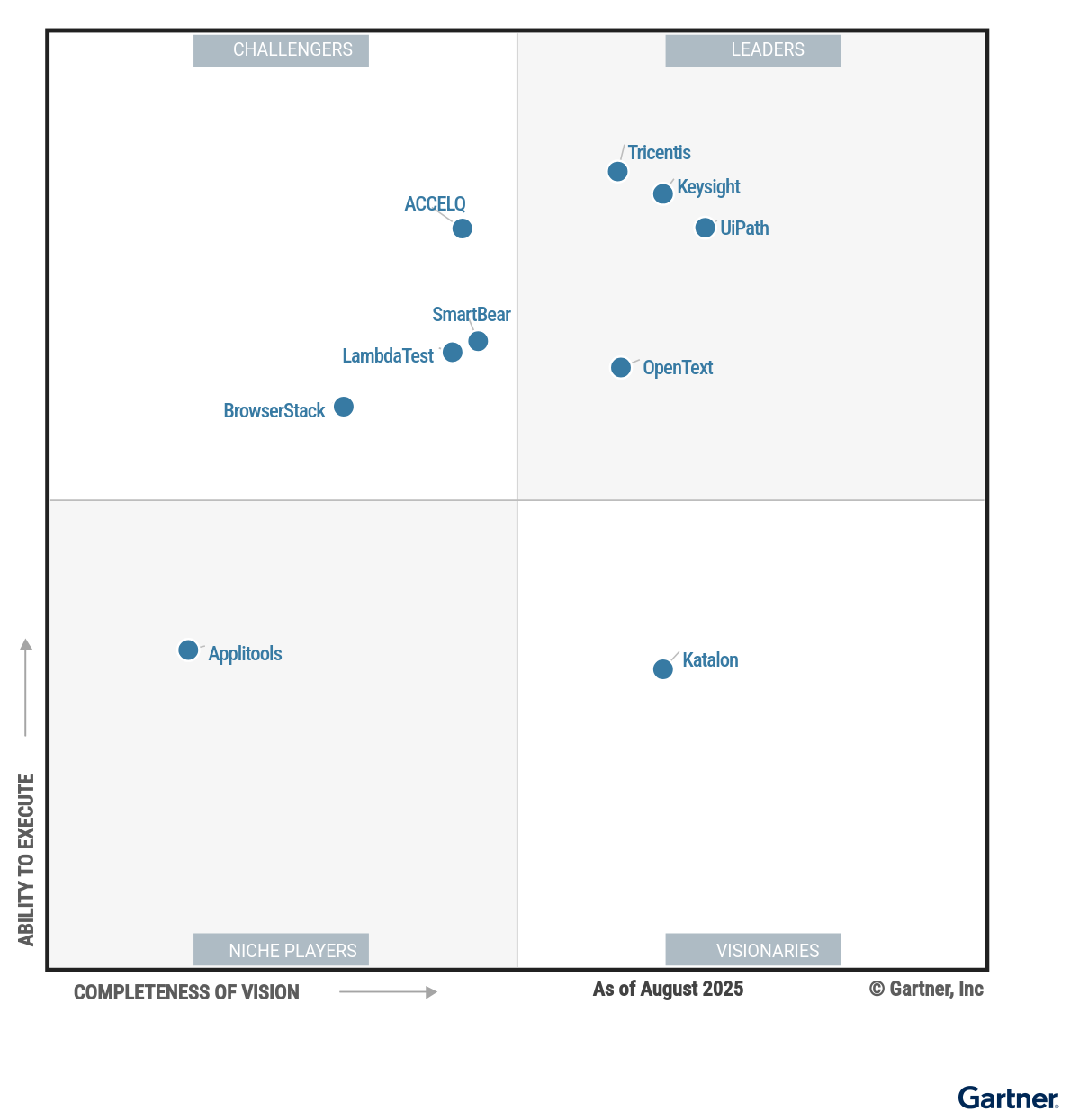
Vendor Strengths and Cautions
ACCELQ
ACCELQ is a Challenger in this Magic Quadrant. It offers the ACCELQ codeless test automation platform, which includes the ACCELQ Autopilot, a generative AI engine; ACCELQ Application Universe for visual modeling; ACCELQ Unified, which provides web, API, mobile and desktop test automation; and intelligent object identification. The platform supports cloud, on-premises and hybrid deployments.
ACCELQ’s operations are mainly in North America and Europe, with a growing footprint in APAC. Its clients are mostly midsize to large enterprises in technology, financial services and healthcare. Since 2024, ACCELQ has increased R&D investment, prioritizing AI life cycle augmentation and planning expanded performance testing.
- Product or service: ACCELQ Application Universe provides customers with a visual, no-code canvas for mapping business processes, which makes it easier to design scenarios and maintain processes. The platform enables visual data-driven testing and features intelligent object identification.
- Offering (product) strategy: ACCELQ provides a single, integrated platform with comprehensive automation for web, API, mobile and desktop testing. Its unified design differentiates it from competitors and offers a more cohesive user experience.
- Sales execution/pricing: ACCELQ has high customer retention and satisfaction. It compensates account managers based on customer experience scores for their accounts, which incentivizes them to remain attentive to customer needs.
- Innovation: ACCELQ has a consistent yet lower release cadence and does not offer a public-facing roadmap. This makes it more challenging for prospects to create a future-proof strategy for AI-augmented testing based on ACCELQ’s products.
- Marketing execution: Although ACCELQ maintains a consistent multimedia marketing program, prospective customers may struggle to locate and engage with these resources easily.
- Market understanding: ACCELQ’s marketing compares its platform to open-source tools, legacy platforms and newer entrants, with little focus on how it stacks up against innovations in customization and scalability offered by competitors. This undermines its credibility as a competitor to top-tier market participants.
Applitools
Applitools is a Niche Player in this Magic Quadrant. It offers the Applitools Intelligent Testing Platform, which includes Autonomous for AI-augmented testing; Eyes for visual regression and accessibility testing; infrastructure add-ons, including Ultrafast Grid for parallel cross-browser testing; and Execution Cloud. The platform is delivered as a SaaS solution that supports testing in cloud, on-premises and hybrid environments.
Applitools’ operations are mainly in North America and Europe, serving clients in the finance, retail and e-commerce, media and news, and technology industries. Since 2024, Applitools has launched Autonomous 2 for interactive AI-augmented test authoring and nonvisual assertions, and has updated Eyes for enhanced source code management and UI/UX integrations.
- Overall viability: Applitools’ consistent funding and R&D investment demonstrate financial stability and commitment to innovation. Customers can confidently plan multiyear testing strategies knowing that the vendor is unlikely to face resource constraints or abruptly discontinue its products.
- Business model: Applitools’ subscription-based SaaS model offers customers platform updates, unlimited test executions and flexible scaling without infrastructure management. The tiered approach provides accessible entry points for teams of various sizes and budgets, supporting growth and cost-effective expansion of testing capabilities.
- Product or service: Applitool’s deep expertise in AI-driven visual testing provides precise, reliable detection of UI regressions that traditional tools miss. Customers can integrate these capabilities into their CI/CD pipelines to catch visual defects early in their release cycles.
- Market understanding: Due to Applitools’ intense focus on visual AI, it provides a narrower range of testing landscape than most of its competitors. Customers should plan to supplement Applitools with other tools to achieve full testing coverage.
- Innovation: Applitools has limited agentic AI capabilities on its product roadmap, indicating a lack of vision for the direction of this market. Based on this roadmap, Applitools customers will likely encounter limitations in next-generation AI features in the long term.
- Sales execution/pricing: Applitools is lacking the robust sales machinery and brand recognition that many competitors participating in this research have. This limits Applitools’ ability to generate sales opportunities that win larger deals and grow market share.
BrowserStack
BrowserStack is a Challenger in this Magic Quadrant. It offers BrowserStack, which includes Automate, Low-Code Automation, Test Management, and Percy for visual testing and accessibility testing. Key features include AI-powered self-healing locators that dynamically fix broken tests, AI-enhanced visual testing, and UI anomaly detection. BrowserStack is delivered as a cloud-only SaaS platform.
BrowserStack’s operations are mainly in North America, Europe, and the Indian subcontinent, with most clients in small to midsize organizations in information technology, services, and manufacturing. Since 2024, BrowserStack has released 15 product updates and continues to invest in developing its AI tool capabilities.
- Market responsiveness/record: BrowserStack releases new features at a faster rate than most competitors and has recently secured patents for its remote infrastructure, machine learning, and test selection capabilities. Customers should feel confident about the company’s ability to quickly deliver capabilities that meet their current needs for test automation.
- Product or service: BrowserStack differentiates itself with strong capabilities for detecting accessibility issues through its Spectra Rule Engine. BrowserStack’s device cloud offers coverage across all device models, OS versions, and form factors, which reduces fragmentation challenges in cross-platform testing.
- Overall viability: BrowserStack possesses an extensive customer base within the market and demonstrates consistent new customer growth. Its market penetration and high customer acquisition highlight the company’s strong position within the overall market.
- Market understanding: BrowserStack is still working on a clear AI vision that supports its journey from a testing infrastructure provider to an integrated AI-powered testing platform.
- Innovation: Repeated acquisitions have created a somewhat inconsistent user experience across the various products, which may create challenges for adoption and cast doubt on the vendor’s ability to organically develop innovative solutions, set trends, and predict the market.
- Customer experience: In reference customer surveys, some BrowserStack customers reported issues with unreliable performance, including test sessions that lag, hang or time out unpredictably. Customers also mentioned that its test sessions are resource-intensive.
Katalon
Katalon is a Visionary in this Magic Quadrant. It offers the Katalon Platform, which includes generating test cases from user journeys, StudioAssist for natural language test generation, autonomous UI exploration, and test management. The platform supports cloud, on-premises or hybrid deployment.
Katalon’s operations are geographically diversified, with clients in small, medium, midmarket and enterprise organizations in IT and financial services. Since 2024, it has provided updates to TrueTest for AI-native autonomous test generation and to TestOps for test management and orchestration, providing traceability to business requirements.
- Innovation: Katalon TrueTest captures user interactions in production and preproduction, and uses them to autonomously generate and maintain automated tests that reflect customer behavior.
- Business model: Katalon offers a flexible subscription model and maintains a freemium‑to‑enterprise product strategy. Clients can begin with a focused use case, then scale through governed expansion.
- Market understanding: Katalon has demonstrated a strong understanding of the requirements for different testing use cases and the impact of AI on software testing. Katalon recognizes that many customers will take an incremental and pragmatic approach to adopting agentic AI in testing. This makes it attractive to customers and prospects seeking a general testing tool that will evolve with their needs.
- Product or service: Katalon’s platform lacks some features that most enterprises are seeking. Specifically, its LLM-powered software evaluation features are still under development, and it does not yet offer API traffic capture functionality.
- Market responsiveness/record: Katalon trails leaders in breadth and maturity of fully autonomous agentic testing and general‑purpose large action models. Customers should evaluate whether Katalon’s semiautonomous capabilities meet their needs.
- Overall viability: Katalon is relatively small compared to the Leaders in this market. While Katalon is a stable and growing software testing tool vendor and is clearly viable, it could be an acquisition target in this volatile market.
Keysight
Keysight is a Leader in this Magic Quadrant. It offers Eggplant Test, which includes Keysight Generator (secure on-premises GenAI for test design), Intelligent Computer Vision for AI visual testing, and Universal Fusion Engine for model-based testing. The platform supports cloud, on-premises and air-gapped deployments.
Keysight’s operations are mainly in North America and Europe, and its clients are mainly large organizations in the public sector and regulated sectors, including healthcare and industrial automation. Since 2024, it achieved Iron Bank Department of Defense certification and launched Universal Language Test Translator, which empowers engineers to write comprehensive and reusable test specifications that can be readily translated and executed on various platforms.
- Market understanding: Keysight specializes in supporting data sovereignty and protecting IP, which is well-suited to the needs of government agencies and organizations in highly regulated industries.
- Product or service: Keysight Eggplant Test offers the most comprehensive platform coverage for AI-augmented testing, including specialized platforms such as point-of-sale terminals, ATMs, kiosks, payment devices, IoT, set-top boxes, automotive in-vehicle infotainment, medical equipment, command and control systems (C4ISR), and extended reality (XR/VR).
- Overall viability: Keysight’s broad product portfolio, recurring revenue base, and sustained investment in AI and specialized platform support ensure strong product durability. Its cohesive ecosystem enables customers to adopt AI, automation and analytics without third-party dependencies.
- Innovation: Keysight has a low release cadence and lacks a cohesive and forward-looking public roadmap. This makes it more challenging for clients to create a future-proof strategy for AI-augmented testing.
- Marketing execution: Software application testing has a limited visibility within the Keysight product portfolio. Prospective customers will find it challenging to find information about Keysight’s Eggplant software testing offering and miss out on evaluating its innovative features.
- Offering (product) strategy: While Eggplant has API testing capabilities, its product strategy and market perception are still heavily skewed toward its UI-level testing. This leaves it vulnerable to competitors that offer a more balanced and integrated approach to layered testing.
LambdaTest
LambdaTest is a Challenger in this Magic Quadrant. It offers the LambdaTest Platform, which includes KaneAI for AI-powered test authoring, HyperExecute for test orchestration and execution, and Unified Test Manager, an AI-powered test management solution. The platform can be deployed across cloud, on-premises, or within hybrid environments.
LambdaTest’s operations are mainly in North America and Europe, with a growing presence in Asia/Pacific. Its clients are mostly small businesses within the technology, services and banking sectors. Since 2024, LambdaTest has enhanced its platform with features like the upgraded SmartUI Visual AI Engine and an AI-native Unified Test Manager with advanced management and debugging capabilities.
- Sales execution/pricing: LambdaTest uses a freemium-to-enterprise pricing model, which customers have indicated is cost-effective and provides good performance for the price. This accessible pricing strategy has helped to generate strong new customer growth and revenue, which LambdaTest is investing into increased product development.
- Market responsiveness/record: LambdaTest leverages data-driven usage analytics and observability and maintains a highly engaged and active customer advisory board, which enables it to sense customer demand better than most vendors. Its release cadence during the past year was faster than average, so customers quickly get the new features and enhancements they need.
- Customer experience: In customer reference surveys and Gartner Peer Insights, LambdaTest customers rated its service and support highly, especially compared to its competitors, with standout aspects being LambdaTest’s knowledgeable support, collaboration, and efficient delivery of services.
- Marketing strategy: LambdaTest lacks a clear, differentiated vision for how AI will fundamentally transform the testing experience. Recent announcements of KaneAI and an Agent-to-Agent Testing solution show ambition in marketing an AI-powered platform, but lack clear differentiation to what competitors are also promising.
- Offering (product) strategy: LambdaTest’s API testing remains shallow, highlighting a key gap in the platform’s portfolio. LambdaTest’s rapid pursuit of feature parity and market presence has resulted in a product set that, while broad, lacks depth, stability, and strategic coherence. The core offerings of real and virtual device clouds for browser and mobile testing are now considered baseline expectations in the market, underscoring the need for greater investment in differentiated and mature capabilities.
- Overall viability: LambdaTest’s lean operational size, smaller average deal size, and high percentage of short-term contracts could limit its long-term growth potential compared to its larger competitors. Customers should monitor LambdaTest’s ongoing ability to provide and invest in the provision of highly customized and specialized enterprise-grade capabilities.
OpenText
OpenText is a Leader in this Magic Quadrant. It offers the OpenText Core Software Delivery Platform, which includes extensive support for testing with traceability of artifacts and real-time insights of test progress. The platform can be deployed in cloud, on-premises or hybrid models.
OpenText’s operations are geographically diversified, and its clients tend to be large enterprises in finance, healthcare, insurance and the public sector. Since 2024, OpenText has delivered Titanium X, which includes an AI-powered assistant, DevOps Aviator, to its DevOps Cloud. DevOps Aviator creates test cases, conducts risk and root cause analysis, and maps policies for end-to-end compliance.
- Product or service: OpenText has the strongest collaboration capabilities of any vendor in this research, with strong integration features for Microsoft Teams, shared workspaces, and real-time notifications and alerts. Its platform enables teams to work together on testing activities and ensures that all stakeholders are notified and engaged when necessary.
- Market understanding: OpenText offers extensive features to help organizations comply with regulatory requirements, including built-in compliance validation tools and full test traceability for audits. These capabilities make it a strong choice for government agencies and enterprises in highly regulated industries.
- Overall viability: OpenText’s broad product portfolio, large customer base, recurring revenue base and sustained investment in AI ensure strong product durability. Its cohesive ecosystem enables customers to adopt AI, automation and analytics without third-party dependencies.
- Market responsiveness/record: OpenText’s slower release cadence makes it more challenging for clients to create a future-proof strategy for AI-augmented testing. They need to improve the turnaround time for implementing their valuable customer feedback.
- Offering (product) strategy: OpenText’s platform offers a variety of components, but differences in its interfaces can impact overall user experience consistency. Customers reported that the lack of a unified user experience across the platform made it more cumbersome to navigate and use.
- Sales execution/pricing: Reference customers rated OpenText poorly in terms of affordability. This perception about its cost, coupled with the company’s minimal digital marketing presence, restricts its ability to reach new customers, especially small and midsize organizations.
SmartBear
SmartBear is a Challenger in this Magic Quadrant. It offers a suite of testing solutions, which includes Reflect for cloud automation, TestComplete for desktop/enterprise, QMetry for independent test management, Zephyr for Jira-native test management, and ReadyAPI for API testing. The platform can be deployed as SaaS, on-premises or hybrid.
SmartBear’s operations are geographically diversified. It has clients of all sizes and across most industries, with a concentration in financial services and IT. Since 2024, it launched HaloAI, GenAI-powered mobile testing, and agentic workflows. It also acquired QMetry in December 2024, which improves its ability to meet compliance requirements for regulated industries.
- Sales execution/pricing: SmartBear offers flexible subscriptions for cloud and on-premises deployments of its platform, and it is transparent about its pricing. SmartBear has one of the highest customer acquisition rates compared to its competitors, as its pricing model attracts new customers of all sizes and across industries.
- Marketing execution: SmartBear invests significantly in marketing across the entire testing portfolio, with a notable portion of the budget being directed toward AI-driven innovations and campaigns, reflecting the increasing importance of AI in its product strategy and customer engagement efforts.
- Overall viability: Smartbear’s broad product portfolio, large customer base, recurring revenue base and sustained investment in AI ensure strong product durability. A strong network of regional and vertical channel partners extends the company’s reach without ballooning the sales force.
- Offering (product) strategy: SmartBear’s product offering consists of multiple partially overlapping products for test automation and test management with distinct user interfaces. The current lack of a cohesive user experience across the various products creates coordination challenges and barriers to adoption.
- Market responsiveness/record: SmartBear’s autonomous features and end-to-end AI integration still lag competitors offering more-advanced agentic workflows, indicating SmartBear remains slow to fully meet market demands for AI-driven testing automation. However, AI capabilities are evolving with Reflect, an AI-powered no-code platform that goes beyond basic pattern recognition and adaptive testing.
- Market understanding: SmartBear lacks clear vertical differentiation, despite having a sizable number of customers in banking and government. Its limited industry-specific features weaken its position versus competitors that specialize in supporting customers in those industries.
Tricentis
Tricentis is a Leader in this Magic Quadrant. It offers a set of testing tools, which includes qTest for unified test management, Tosca for no-code model-based automation, Testim for AI-powered low-code test creation, Test Management for Jira for native test process management in Jira, and NeoLoad for performance testing. The platform supports cloud, on-premises and hybrid deployments.
Tricentis’ operations are geographically diversified. Its clients are mostly large enterprises across a wide range of industries. Since 2024, Tricentis has expanded Copilot AI assistant functionality across its products, including qTest, Tosca, and Testim, and acquired SeaLights for test coverage and impact analytics.
- Business model: Tricentis’ business model leverages partnerships with global and regional system integrators, strategic consultancies, and value-added resellers. Clients leverage these resources to accelerate time to value, improve automation maturity, and scale efficiently.
- Marketing execution: Tricentis maintains a sizable marketing organization and budget to support a comprehensive content strategy, including white papers, webinars and customer case studies. These coordinated efforts ensure Tricentis’ value proposition resonates clearly with key decision makers.
- Overall viability: Tricentis’ consistent funding and R&D investment demonstrate financial stability and commitment to innovation. Customers can confidently plan multiyear testing strategies knowing that the vendor is unlikely to face resource constraints or abruptly discontinue its products.
- Offering (product) strategy: Tricentis has acquired numerous products over time, resulting in fragmented capabilities across distinct tools that require separate licenses. Customers have expressed confusion when selecting the appropriate tool for specific needs, and they face integration challenges when trying to unify workflows.
- Customer experience: Referenced customers and client conversations indicated below-average satisfaction with Tricentis’ products, however, on Gartner Peer Insights, customers provide above-average scores. The mixed customer feedback suggests Tricentis’ clients may encounter misalignment with evolving business requirements.
- Innovation: Tricentis’s flagship product, Tosca, provides a comprehensive set of capabilities, but its complexity and cost can slow adoption and raise total ownership burden in a market that increasingly values speed, simplicity, and accessibility. Several strategic acquisitions have not yet been fully integrated into a seamless experience and fail to fully compensate for missing organically developed innovation.
UiPath
UiPath is a Leader in this Magic Quadrant. It offers UiPath Test Cloud, which includes UiPath Studio, an IDE for creating tests; UiPath Orchestrator for executing tests; UiPath Test Manager for designing, scheduling and analyzing tests; and UiPath Autopilot for AI-powered solutions. The platform supports SaaS, on-premises and hybrid deployments.
UiPath’s operations are geographically diversified, and its customers are mostly large enterprises in financial services and healthcare. Since 2024, UiPath has advanced its AI-driven capabilities, introducing features like AI-powered search functionality, Autopilot for Testers, and its Agent Builder.
- Innovation: UiPath’s Autopilot for Testers and Agent Builder enable customers to create, customize, and deploy AI agents using natural language prompts and integrated toolsets, a capability not offered by other vendors reviewed. An agent creation capability allows teams to automate and tailor complex workflows to their specific testing needs.
- Customer experience: Reference customers reported high satisfaction with UiPath and confidence in the product. Customers praise UiPath’s out-of-the-box integration services alongside its positioning as an integrated partner rather than a third-party tool. UiPath’s high retention rate also indicates a positive customer experience.
- Market understanding: UiPath’s roadmap includes autonomous test agents, computer use for test execution from plain text, and agentic chat interfaces. This vision aligns with customer demands for AI-powered, cloud-native testing.
- Product or service: UiPath’s accessibility testing capabilities lag competitors, as it requires customers to manually input rules from external documents to define the compliance standards for each test run. In contrast, most of its competitors offer more integrated and automated accessibility testing solutions.
- Business model: UiPath has only allocated a small percentage of its total FTEs to AAST product development, with additional FTEs assigned to shared platform services development. This may limit its capacity to rapidly capture emerging market opportunities outside of its core robotic process automation (RPA) base.
- Marketing execution: Reference customers indicated that they perceived UiPath as primarily an RPA vendor. UiPath has yet to expand awareness of its AI-augmented testing offering outside of its existing RPA customer base. Its current brand positioning and messaging vision for AAST has not yet effectively established a strong, independent presence, thereby limiting its reach and appeal in the broader, highly competitive AAST market.
Inclusion and Exclusion Criteria
To qualify for inclusion, providers needed to meet the following criteria as of 30 April 2025:
Market Participation Inclusion Criteria
- Provide a dedicated, generally available (GA) AI-augmented software testing tool. GA means the product or service is available on a public-facing price sheet/card for purchase directly by clients. The vendor must be able to furnish the link to a pricing page for its AI-augmented software testing tool.
- Sell the solution directly to paying customers without requiring them to engage in professional services. The vendor must provide at least first-line support for these capabilities, including the use of bundled open-source software. This includes, but is not limited to, comprehensive product documentation, installation guidance and reference examples.
- Demonstrate an active product roadmap, go-to-market and selling strategy for the solution.
- Have phone, email and web customer support. The vendor must offer a contract, console/portal, technical documentation and customer support in English (either as the product’s default language or as an optional localization).
- Have at least 10% of its paying customers in each of three of the four following geographic regions:
- U.S. and Canada
- Central/South America
- Europe (including U.K.)
- Asia/Pacific
- Have sales or partner network presences that span at least three of the following regions:
- U.S. and Canada
- Central/South America
- Europe (including U.K.)
- Asia/Pacific
Technical Capabilities Inclusion Criteria
The AI-augmented software testing tool must offer native support for the following mandatory capabilities as described in the market definition:
- Conversational user interfaces: Support for natural language and prompt-based interactions for the purpose of fulfilling a request, such as asking questions, creating test artifacts or completing a task.
- GenAI for test development: Support for generative AI and large language models (LLMs) that can automatically generate a set of test artifacts, including test plans, test cases and test automation scripts. Additional capabilities include providing suggestions for improving existing artifacts.
- Native automated UI, API and visual testing capabilities: Support for automated testing of web and native mobile applications through the UI, the API, services interfaces and visual testing features via integrated, native capabilities.
- Self-healing for test scripts: Automatic root cause analysis for failed test cases and recommendation of a fix (minimum capability) or automatic refactoring of the test case to fix the issue.
- Integrations: Support for integrations with DevOps platforms, planning tools, version control systems, data and infrastructure platforms, reporting tools, and container tools for efficient regression testing and testing across environments.
- Team collaboration: Support for the visualization of testing workflows, a built-in knowledge base supporting the sharing of information and best practices and real-time communication through integrated chat or messaging interfaces. These capabilities can be either built into the tool or offered via seamless integrations with the customer’s existing platform.
- Enterprise administration: Support for single sign-on (SSO), role-based access control (RBAC), multifactor authentication (MFA), centralized user management, and the ability to support a large number of users and transactions as the organization grows.
Performance Inclusion Criteria
The vendor is required to meet the following financial performance criteria (reported in U.S. dollars). The default accounting standard is generally accepted accounting principles (GAAP):
- The AI-augmented software testing tool offering must have generated at least $30 million in annual GAAP revenue in calendar year 2024. The vendor must have at least 200 paying enterprise customers (excluding sales to managed service providers) with the AI-augmented software testing tool in production (excluding private beta or limited availability usage), with at least 30 seats per customer on average, utilizing the must-have functionalities (native automated UI, API and visual testing capabilities).
or
- The AI-augmented software testing tool must have generated a minimum of $25 million in annual GAAP revenue in calendar year 2024 and either shown a 40% revenue growth YoY or added 50 net-new enterprise logos in the calendar year 2024 when compared with the calendar year 2023 that are utilizing the must-have functionality (native automated UI, API and visual testing capabilities) in production (excluding private beta or limited availability usage).
In addition, the vendor must have a score of at least 44 in the Customer Interest Indicator (CII) defined by Gartner for this Magic Quadrant. The CII for this Magic Quadrant was calculated using a balanced set of measures, including:
- Gartner customer search, inquiry volume or pricing requests.
- Frequency of mentions as a competitor to other vendors in the Magic Quadrant for AI-Augmented Software Testing Tools in reviews for similar use cases on Gartner’s Peer Insights forum, as of 1 April 2025.
- Scores and frequency of mentions, as measured on Gartner Peer Insights.
- Significant innovations in the market, as noted by major publications, product enhancements or introductions, or industry awards.
- Other significant developments in corporate posture (e.g., mergers and acquisitions [M&A] activity).
We excluded vendors from the analysis if:
- The primary use case for the AI-augmented software testing tool is the testing of low-code applications, packaged business applications or SaaS-based applications (i.e., testing extensions, configurations or customizations of applications such as Salesforce, Microsoft Dynamics 365, Oracle, SAP or ServiceNow). The market needs and expected platform capabilities for these use cases differ from the market definition of this Magic Quadrant.
- The target is only a single system platform, such as only web, only mobile or only desktop.
- The platform is only sold as part of custom software development or professional services engagements (e.g., professional services providers using a custom solution for their clients).
Honorable Mentions
Functionize: Functionize is an AI‑powered test automation platform that leverages agent‑based digital workers to autonomously create, execute and maintain QA workflows. Its self‑healing capabilities and deep-learning engine adapt to UI and functional changes, reducing test maintenance and improving reliability. Functionize supports end‑to‑end, API, visual and cross‑browser testing via a cloud‑based platform. Functionize did not meet the inclusion criteria for revenue.
mabl: mabl is an AI‑native, unified, cloud‑based test automation platform that supports low‑code testing across web, mobile, APIs, accessibility, and performance domains. It enables teams to build tests with minimal scripting, run them with unlimited concurrency and offers strong autohealing capabilities to minimize test maintenance. The platform also generates tests from intent, stories, or manual tests, and provides automated test failure summaries and test coverage insights. mabl did not meet the inclusion criteria for revenue.
Parasoft: Parasoft is a veteran provider of automated software testing with a continuous quality testing platform that spans static analysis, unit testing, API and web UI testing, service virtualization, and runtime error detection. Its platform integrates AI‑enhanced tools across the software development life cycle, enabling teams to detect, prevent, fix and monitor defects. Parasoft delivers testing solutions across multiple industries worldwide. Parasoft did not meet the inclusion criteria for technical capabilities, as it does not provide native automated mobile and visual testing capabilities.
Evaluation Criteria
Ability to Execute
Product/Service: We specifically looked for breadth and depth of products and features across the SDLC, including:
- Test design and development
- Test case maintenance and reuse
- Test and test data generation and management, automated testing and integration, especially support for AI-augmented testing.
Overall Viability: We specifically looked for comprehensive information about the vendor’s financial status, including venture capital funding, profitability, strategies for economic downturn, investment plans for the next 12 months, annual revenue for fiscal year 2024, and projected revenue for FY25 and FY26.
Additionally, this criterion evaluated customer and market engagement, focusing on customer retention rates for calendar year 2024 and the first two quarters of 2025, the largest installation by number of concurrent users, and any relevant business acquisitions in the last 12 months.
Lastly, this criterion examined the organizational structure and workforce, including the number of full-time employees dedicated to the product, and any changes in senior management over the past year.
Sales Execution/Pricing: We specifically looked for detailed insights into the customer base, such as the top three decision makers in large enterprises who use the product, the current number of customers, segmentation across different sectors and the longevity of relationships with large-enterprise customers.
Additionally, this criterion evaluated the pricing models, including variations for different pricing models like pay-as-you-go, long-term commitment and fixed pricing. This criterion examined any free or trial offerings associated with the product, providing an understanding of the customer acquisition strategy and how potential customers can evaluate the product before making a purchase decision.
This criterion also assessed the effectiveness of sales such as short sales cycles, and the effectiveness and simplicity of pricing models (including typical one-time and recurring fees, on-premises and in the cloud). Lastly, this considered how the organization segments the AI-augmented software testing market and what are the primary methods of lead generation for those.
Market Responsiveness and Track Record: We specifically looked for detailed information about the company’s active engagement in open-source communities, the percentage of customers and partners contributing to the solution marketplace, and the year-over-year growth of the partner marketplace.
Additionally, this criterion evaluated the mechanisms used to listen and respond to customer needs, providing specific examples of their effective employment. Lastly, this criterion examined the extent of product customization for different markets and the company’s ability to innovate by being early to market with platform capabilities that competitors are only now catching up to.
Marketing Execution: We specifically looked for a clear description of how the product was positioned to development teams, the top reasons for developers to use the product, and the key differentiators that set it apart in the market.
Additionally, this criterion evaluated the estimated marketing budget for 2025, major marketing initiatives undertaken in the past year, strategies for visibility on search engines and engagement with followers/subscribers on various online and social media channels.
Lastly, this criterion examined the physical, virtual/hybrid conferences sponsored or presented at in 2024 and first two quarters of 2025, identifies top competitors, and highlights the unique differentiators that set the organization apart from its competitors.
Customer Experience: We specifically looked for details on training programs for developers, onboarding timelines, success measurement, implementation resources and user training needs.
Additionally, this criterion evaluated the customer support structure, dedicated full-time equivalents (FTEs), support availability, SLAs, response times and partner involvement, including the options available for enterprises to receive service and support in the event of a system failure. This criterion also examined the organization’s customer success program, retention strategies, user community support, ROI measurement, and the metrics and benchmarks used to gauge the effectiveness of the customer success program.
Lastly, this criterion assessed the vendor’s reputation in the market, based on customers’ feedback regarding their experiences working with the vendor. This includes the various ways in which the vendor can be engaged, including social media, message boards and other support avenues.
Operations: We specifically looked for detailed information about SLAs, including system uptime, upgrade policies, release timing and the growth rate of FTEs devoted to R&D and enterprise technical support, as well as subscriber options for update timing.
Additionally, this criterion evaluated staff training, partner employee training, operation and support centers worldwide, onboarding speed, and formal communication processes with customers. Lastly, this criterion examined the stability in leadership vision and employee retention.
Ability to Execute Evaluation Criteria
| Evaluation Criteria | Weighting |
|---|---|
Product or Service | High |
Overall Viability | High |
Sales Execution/Pricing | Medium |
Market Responsiveness/Record | Medium |
Marketing Execution | Medium |
Customer Experience | High |
Operations | Low |
Gartner (October 2025)
Completeness of Vision
Market Understanding: We specifically looked for innovation within the realm of software engineering. It focused on product development, identification of key offerings and adaptation to evolving client requirements for enhanced product viability.
Additionally, this criterion evaluates the proficiency of vendors in monitoring market trends, navigating challenges in the AI-augmented software testing market and anticipating technological disruptions to formulate a forward-thinking strategic vision. Lastly, it considers how well the vendor understands their user’s top priorities, use cases and challenges in software testing.
Marketing Strategy: We specifically looked for how well the organization defined its product/service messaging, positioning and go-to-market strategy, and how skillfully it planned its top marketing initiatives for industry understanding and adoption. This criterion also measured how well the organization has identified its target market verticals and client sizes.
Additionally, this criterion evaluated the organization’s targeting of specific roles for product marketing, outreach to CTOs, CIOs and software engineering leaders, and differentiation of the product value proposition by persona/buyer. It considered the identification and targeting of new partners for 2025. Lastly, this assessed the vendor’s capability to deliver a clear and differentiated message that maps to future market demands.
Sales Strategy: We specifically looked for the organization’s understanding of its sales growth strategies for 2025 and 2026, as well as factors shaping the sales pipeline, projected growth of the sales team, planned initiatives for product adoption and the impact of market changes on sales strategy.
Additionally, this criterion evaluated potential market expansion in the next 12 months, identifying target countries/regions and industries, and the contribution of indirect sales channel partners to revenue. Lastly, this criterion considered detailed information on pricing strategy, including licensing models, discount offerings and the organization’s approach to consumption-based charging.
Offering (Product) Strategy: We specifically looked for the specifics of the AI-augmented software testing tool offering, including its technical abilities, and trained consulting and system integrator partners.
Additionally, this criterion evaluated the user base, detailing the number of users using free and paid versions, the vendor’s strategy for supporting and contributing to open-source software usage and development. This criterion also considered the vendor’s strategic approach to product development and market positioning, including investment areas, success metrics, methods to avoid commoditization, methods to avoid lock-in, product enhancement strategies, and processes for integrating customer feedback into the product roadmap.
Lastly, this criterion assessed what makes the solution particularly cost-effective, competitive and easy-to-use relative to competitors.
Business Model: We specifically looked for the vendor’s business model changes concerning the AI-augmented software testing offering, the model’s planned evolution over the next 12 months and the offering’s contribution to overall company revenue.
Additionally, this criterion evaluated the vendor’s partnership strategy, focusing on the percentage of new customers obtained via partners or partner references in the last 12 months. Lastly, this criterion assessed how the vendor manages appropriate funding and alignment of staffing resources to succeed in this market, currently and in the future.
Vertical/Industry Strategy: We specifically looked for a comprehensive understanding of industry-specific go-to-market or technology partnerships, providing insight into strategic alliances and potential synergistic benefits.
Additionally, this criterion required a detailed overview of customer distribution across various verticals, including key customer names and top industry verticals. This criterion evaluated major initiatives planned to increase market share in vertical industry segments over the next 12 months, assessing forward-thinking strategies, growth potential and commitment to innovation.
Lastly, this criterion assessed differentiating capabilities for supporting the testing of custom built software for specific industries as opposed to testing of packaged solutions from vendors (COTS), which is not the focus of this research.
Innovation: We specifically looked for comprehensive insights into the vendor’s product leadership and innovation strategy, including processes and methodologies, future innovation plans, top differentiating innovations, the proportion of revenue invested in R&D, and strategic partnerships for innovation.
Additionally, this criterion required detailed information on how the vendor differentiates itself in the market with innovative product features and strategic partnerships, providing a clear picture of its competitive edge. This criterion also evaluated the vendor’s commitment to the broader technology community through contributions to open source or open standards related to its product.
Last, this criterion considered the key sources of input for product requirements and innovation and how these requirements are prioritized and assigned to R&D.
Geographic Strategy: We specifically looked for a comprehensive overview of the vendor’s differentiated delivery, sales and marketing strategies for various geographies, as well as its top three initiatives aimed at expanding market share beyond its core region.
Additionally, this criterion evaluated how the vendor ensures compliance with data sovereignty requirements, the internationalization/localization capabilities of its offering, and the number of natural languages supported. Lastly, this criterion considered the vendor’s current and prospective geographic markets, detailing its physical presence, staff count, customers, channel partners and the number of new customers acquired in each region over the past year.
Completeness of Vision Evaluation Criteria
| Evaluation Criteria | Weighting |
|---|---|
Market Understanding | High |
Marketing Strategy | Medium |
Sales Strategy | Medium |
Offering (Product) Strategy | Medium |
Business Model | Medium |
Vertical/Industry Strategy | Low |
Innovation | High |
Geographic Strategy | Medium |
Gartner (October 2025)
Quadrant Descriptions
Leaders
Leaders are vendors that execute strongly and can influence the market’s direction with their thought leadership and resources. They demonstrate a deep understanding of market needs and continuously innovate by integrating advanced AI technologies and expanding their feature sets to stay ahead of industry trends. These vendors also excel in building robust ecosystems through seamless integration with third-party tools, and maintaining strong security and compliance measures to protect against vulnerabilities and intellectual property risks.
Leaders also have a clear vision and well-defined product roadmap. They continuously expand their capabilities to deliver functionally rich software testing tools with robust capabilities supporting many stages of the SDLC. These vendors stand out in a highly competitive, global market, and serve a wide range of organizations and use cases.
Vendors can become Leaders in this market by acquiring another well-positioned vendor, integrating its technology into a wider application infrastructure offering and keeping up with the pace of software testing innovation. Additionally, they should address the testing challenges of digital transformations, regulatory demands and modernization initiatives head-on, with thought leadership and product functionality.
Leaders understand the market trends that will benefit them and their clients’ business strategies by enabling them to support their global business operations with widely deployable, well-supported AI-augmented software testing solutions for different industries and geographies. Leaders see the business potential of software testing initiatives, communicate this potential to business units and help their clients realize that potential.
Challengers
Challengers generally perform well at executing the types of work for which they offer functionality, but have a lagging or incomplete view of the market’s direction. Sometimes this is due to a lack of innovation in product, marketing and/or sales strategies, or a narrow focus on a single application domain. They often have a narrower focus of who the buyers are, what the use cases are or how users’ expectations will evolve.
They may have a background in traditional on-premises software testing or are a component in a large vendor ecosystem, and may currently lack visibility or credibility outside of their existing customer base or domain. As a result, their offerings have a more limited appeal than those of Leaders.
Challengers may lack a coordinated strategy for the various products in their platform portfolio, or their platform roadmap may be less complete than that of Leaders. Alternatively, they may lag behind Leaders in terms of marketing, sales channels, geographic presence, industry-specific content and innovation. To become Leaders, Challengers must improve in their specific areas of caution and match Leaders’ platform capabilities and roadmaps.
The future of these providers depends on how aggressive and proactive they are in addressing their current shortcomings. If they innovate to fulfill the pressing requirements of today’s software testing initiatives and market their offerings effectively, they will likely become Leaders. Otherwise, they may become Niche Players or Visionaries, or they may drop out of the Magic Quadrant. They may also remain Challengers, but this market’s strong dynamics and fast evolution over the past 18 months indicate that even maintaining their current position will require them to evolve.
Visionaries
Visionaries focus on innovating their product technologies and go-to-market strategies based on emerging technology and business trends. They offer a clear product roadmap that demonstrates a strong understanding of market demands.
Despite having a clear vision, Visionaries may lack visibility or credibility outside of their existing customer base or domain. Further, they may lack the resources or expertise to build awareness of their offerings beyond their respective focus area.
They are typically smaller in terms of revenue and market share compared to Leaders and Challengers, and they may offer an incomplete set of functionalities. However, they have the power and mind share to grow their capabilities, often in a different way from established Leaders.
To become Leaders, Visionaries must build stronger recognition of their platforms in new market segments and improve their sales and marketing execution. Visionaries generally make good acquisition targets for established, larger players that want to buy their way into the Leaders quadrant. Acquisitions are likely and will continue to play a vital role in the market dynamics in the coming years.
Niche Players
Niche Players focus on a segment of the market. That segment is typically defined by a specific use case, application type, or by another characteristic, such as industry, client size and spending power, or geographic area. Niche Players’ Ability to Execute is limited to their focus areas and is assessed accordingly. Their ability to innovate and survive in this market is limited by their narrow focus, but they often tend to move much faster than vendors in other quadrants.
Niche Players may be startups or small companies just starting to succeed, vendors focused on a specific subset of use cases, or vendors that provide a wide range of capabilities, but lack market understanding or focus for their products.
Niche Players’ offerings can be suitable for organizations that require local presence and support, want a close relationship with a provider, or seek a solution that addresses specific industry use cases and functional requirements. Niche Players that can fulfill these specific requirements may offset the viability risks associated with smaller vendors.
Niche Players are often popular targets for acquisition because they offer specialized AI-augmented software testing solutions that focus on a relatively narrow function or market segment. Their products often complement the broader testing support strategies and platforms of larger vendors. They can progress to other quadrants by improving their marketing strategy and fostering innovation.
Context
To address software testing needs across the organization, software engineering leaders and their teams have traditionally used a combination of test automation tools, specialized tools for testing mobile apps, or custom-built solutions, testing frameworks, and test management tools. Some teams have also used office tools like Microsoft Excel or have developed their own tools to address unique testing challenges.
AI-augmented software testing tools provide an alternative to this fragmented approach. They provide automation, integration and orchestration capabilities in an AI-powered, low-code/no-code environment, along with a range of prebuilt integrations to other tools in the software development ecosystem. AI-augmented software testing tools use AI to simplify the testing process and are increasingly addressing the challenge of testing generative AI applications and agents (see How to Test AI-Based Applications).
All AI-augmented software testing tools support a set of common use cases, but they differ in terms of the personas, deployment options and interaction styles they support, especially their support for AI-specific requirements.
Before software engineering leaders use this Magic Quadrant to select vendors, we recommend that they develop a thorough understanding of their software testing requirements. Here are the top 10 requirements to assess:
- The platform’s intended goal (short-term tactical use versus long-term strategic use)
- The type and number of applications to test: SaaS, packaged applications, internally developed applications, mobile apps, social media, file systems, IoT, data sources, data warehouses
- The provider’s track record and familiarity with its industry
- The testing skills of all user personas and how they align with the solution
- The vendor’s SLAs and quality-of-service requirements
- The organization’s security and regulatory compliance needs
- The geographic location of the vendor’s data centers and support centers
- The ability to deploy the testing tool in a hybrid mode, including multicloud options and public clouds, and within the customer’s data centers
- The availability and cost of tool skills from the provider and external service providers
- The long-term cost expectations and available budget
Software engineering leaders must also be aware of the limitations of AI-augmented software testing tools. Human expertise is critical to balance their risks (see Overcome 8 Limitations of Generative-AI-Powered Test Generation).
Lastly, software engineering leaders can benefit from using multiple software testing tools to address different use cases, instead of trying to standardize on a single tool. And keep in mind that specialized or custom-built software testing tools may continue to be more suitable for teams working on projects involving nonstandard technologies or for meeting specific requirements.
Market Overview
This document was republished on 6 October 2025. The version you are viewing is the corrected version. For more information, see Gartner’s Corrections page.
The days of manual software testing and brute-force automated testing are gone. AI is now integral to software testing. This is reflected in findings from the Gartner Software Engineering Survey for 2025; generating test cases is the software development stage where most leaders and teams experience maximum time savings from using AI, with requirements gathering also identified as a growing use case, especially with extensive AI usage. Software engineering leaders must equip their teams with AI-augmented software testing tools that are context-aware, data-driven and autonomous.
The first generation of AI-augmented software testing tools was defined by GenAI assistants. These GenAI assistants made software testing tools easier to interact with and helped to streamline testing processes, but human testers still had to intervene at each step of the process.
In 2025, advances in agentic AI capabilities are transforming the market. Testing processes are becoming increasingly autonomous. Vendors are rushing to create their own agentic AI ecosystems and to expose product capabilities via Model Context Protocol so they can enable communication between AI applications, AI agents and data sources (see Innovation Insight: Model Context Protocol).
Vendors are pursuing a vision where numerous AI agents collaborate to perform tasks across the design, coding, testing deployment and monitoring stages — all without human intervention. Instead, the human tester will provide initial guidance for the agents, orchestrate the process, review generated outputs and provide feedback to improve the process. With AI agents, software testers will be able to deliver higher-quality software products faster.
As AI-augmented software testing tools become increasingly agentic, demand for testing technologies continues to soar. Gartner forecasts that, in 2025, spending on testing tools will reach $2.8 billion. By 2028, the market is expected to reach $3.3 billion, growing at a compound annual growth rate of 5.3% between 2022 and 2028 (see Forecast: Application Development Software, Worldwide, 2022-2028, 2Q24 Update).
The continued growth and transformation of the AI-augmented software testing market has also driven numerous acquisitions since 2024. For instance:
- BrowserStack acquiring Requestly, a HTTP interception and mocking tool
- SmartBear acquiring Reflect, an AI-based testing tool
- SmartBear acquiring QMetry, a GenAI-enabled testing platform
- Tricentis acquiring SeaLights, a SaaS-based software quality intelligence platform
With these changes, customers can expect more powerful and viable solutions in the near future as vendors solidify their AI-based business models and testing strategies.
Now is the time for software engineering leaders to revamp testing processes with AI. Use our evaluation to understand the performance and vision of AI-augmented software testing tool vendors and to identify vendors that align with your organization’s short-term needs and longer-term strategy.
Then, use the companion Critical Capabilities for AI-Augmented Software Testing Tools to determine which tools offer the specific capabilities that your organization needs.
To provide clients with a more thorough evaluation of AI-augmented software testing vendors, we have replaced our Market Guide for AI-Augmented Software Testing Tools with this new Magic Quadrant.
Gartner Software Engineering Survey for 2025. The survey was conducted to provide a comprehensive understanding of the current landscape in software engineering. It aims to identify the demand for various roles, essential skills and upskilling strategies within the software engineering organization. It explores the integration of AI in software engineering workflows, their leadership experiences and prior roles of the current leaders. It also assesses their budget expectations, team structures, organizational outcomes and priorities. The survey was conducted online from October through December 2024 among 400 respondents from the U.S. (n = 320) and U.K. (n = 80). Qualified organizations operated in multiple industries (excluding the IT software industry involved in the development of commercial software and the education sector) and reported enterprisewide revenue for fiscal year 2023 of at least $250 million or equivalent. Qualified participants were highly involved in managing software engineering/application development teams and the activities they perform. Disclaimer: The results of this study do not represent global findings or the market as a whole, but reflect the sentiments of the respondents and companies surveyed.
Ability to Execute
Product/Service: Core goods and services offered by the vendor for the defined market. This includes current product/service capabilities, quality, feature sets, skills and so on, whether offered natively or through OEM agreements/partnerships as defined in the market definition and detailed in the subcriteria.
Overall Viability: Viability includes an assessment of the overall organization's financial health, the financial and practical success of the business unit, and the likelihood that the individual business unit will continue investing in the product, will continue offering the product and will advance the state of the art within the organization's portfolio of products.
Sales Execution/Pricing: The vendor's capabilities in all presales activities and the structure that supports them. This includes deal management, pricing and negotiation, presales support, and the overall effectiveness of the sales channel.
Market Responsiveness/Record: Ability to respond, change direction, be flexible and achieve competitive success as opportunities develop, competitors act, customer needs evolve and market dynamics change. This criterion also considers the vendor's history of responsiveness.
Marketing Execution: The clarity, quality, creativity and efficacy of programs designed to deliver the organization's message to influence the market, promote the brand and business, increase awareness of the products, and establish a positive identification with the product/brand and organization in the minds of buyers. This "mind share" can be driven by a combination of publicity, promotional initiatives, thought leadership, word of mouth and sales activities.
Customer Experience: Relationships, products and services/programs that enable clients to be successful with the products evaluated. Specifically, this includes the ways customers receive technical support or account support. This can also include ancillary tools, customer support programs (and the quality thereof), availability of user groups, service-level agreements and so on.
Operations: The ability of the organization to meet its goals and commitments. Factors include the quality of the organizational structure, including skills, experiences, programs, systems and other vehicles that enable the organization to operate effectively and efficiently on an ongoing basis.
Completeness of Vision
Market Understanding: Ability of the vendor to understand buyers' wants and needs and to translate those into products and services. Vendors that show the highest degree of vision listen to and understand buyers' wants and needs, and can shape or enhance those with their added vision.
Marketing Strategy: A clear, differentiated set of messages consistently communicated throughout the organization and externalized through the website, advertising, customer programs and positioning statements.
Sales Strategy: The strategy for selling products that uses the appropriate network of direct and indirect sales, marketing, service, and communication affiliates that extend the scope and depth of market reach, skills, expertise, technologies, services and the customer base.
Offering (Product) Strategy: The vendor's approach to product development and delivery that emphasizes differentiation, functionality, methodology and feature sets as they map to current and future requirements.
Business Model: The soundness and logic of the vendor's underlying business proposition.
Vertical/Industry Strategy: The vendor's strategy to direct resources, skills and offerings to meet the specific needs of individual market segments, including vertical markets.
Innovation: Direct, related, complementary and synergistic layouts of resources, expertise or capital for investment, consolidation, defensive or pre-emptive purposes.
Geographic Strategy: The vendor's strategy to direct resources, skills and offerings to meet the specific needs of geographies outside the "home" or native geography, either directly or through partners, channels and subsidiaries as appropriate for that geography and market.