Reduce Your IAM Attack Surface Using Visibility, Observability, and Remediation
8 October 2025 - ID G00783431 - 14 min read
By Rebecca Archambault
Visibility gaps created by disconnected tools and isolated silos expose organizations to an unmonitored IAM attack surface. IAM leaders can strengthen security across centralized and decentralized environments using visibility, observability, and remediation to reduce the identity attack surface, improving their overall security posture.
Overview
Key Findings
- The identity and access management (IAM) infrastructure is typically fragmented across multiple, disconnected tools and isolated silos, creating unmanaged visibility gaps and thereby exposing an unmonitored identity attack surface.
- Business units’ IAM decisions/configurations/implementations can lack IAM leader oversight and drive misconfigurations and security gaps, such as exposed machine credentials, disabled multifactor authentication (MFA), and orphaned accounts.
- Prospective buyers are overwhelmed by a crowded market of IAM posture, hygiene, identity threat detection and response (ITDR), and attack-surface management offerings. Each offering focuses on different feature sets, metrics, and integration models, making it difficult for buyers to discern which solution aligns with their specific requirements.
Recommendations
IAM leaders should:
- Start with a big-picture view of IAM by establishing unified visibility and observability across connected and disconnected systems to discover identities, consolidate access data, and enable advanced identity analytics.
- Enable distributed teams to make consensual, informed decisions, effectively reducing the identity attack surface, by visualizing accounts, entitlements, associated risk levels, and recommended actions, removing ambiguity across distributed IAM operations teams.
- Organizations can cut through the vendor noise, reduce decision fatigue, and select visibility vendors that best fit their unique environment and risk profile by employing a structured, requirements-driven approach and leveraging external expertise and peer validation.
Strategic Planning Assumption
By 2028, 70% of chief information security officers (CISOs) will utilize an identity visibility and intelligence platform (IVIP) to shrink their IAM attack surface, which reduces the risk of threats such as credential compromise, account takeovers (ATOs), session compromise, and unauthorized access.
Introduction
This document was revised on 2 January 2026. The document you are viewing is the corrected version. For more information, see the Corrections page on Gartner.com.
The growing complexity of IAM — driven by more internal and external humans and machines — has expanded a lightly monitored attack surface. At the same time, ineffective processes, fragmented teams, and unguided distributed IAM activities have hindered the organization’s decision-making around risk, requiring that IAM tools must be operated with a security mindset, as threat actors are targeting the identity infrastructure. Credential abuse is a top attack vector, according to the 2025 Data Breach Investigations Report by Verizon Business,1 calling attention to the importance of the identity attack surface.
What metrics, processes, and tools can organizations employ to proactively visualize their IAM attack surface and remediate hygiene issues to safeguard against identity threats? Emerging solutions provide real-time, visual dashboards of IAM hygiene gaps, enabling teams to rectify risky configurations and swiftly shrink the identity attack surface. Delivered continuously, these tools can automatically enforce governance policies and close hygiene gaps as they arise.
This insight focuses on protection by enhancing the visibility and observability of IAM data needed to achieve zero-trust, and it starts by understanding the “big picture of IAM.” Next, an understanding of the data and what makes up the IAM attack surface is discussed. Lastly, the IAM hygiene gaps are exposed using dashboards to visualize the data in an actionable format and prioritizing the highest-risk items for remediation. As hygiene gaps are closed, IAM leaders can quantitatively demonstrate a shrinking IAM attack surface over time.
This research is the fourth in a series that describes the importance of IAM hygiene. The other documents in this series are:
Analysis
Start With a Comprehensive View of IAM
A comprehensive big picture view of IAM prioritizes optimal IAM outcomes by managing access across various user constituencies, both human and machine, rather than focusing on specific tools or individual user groups.
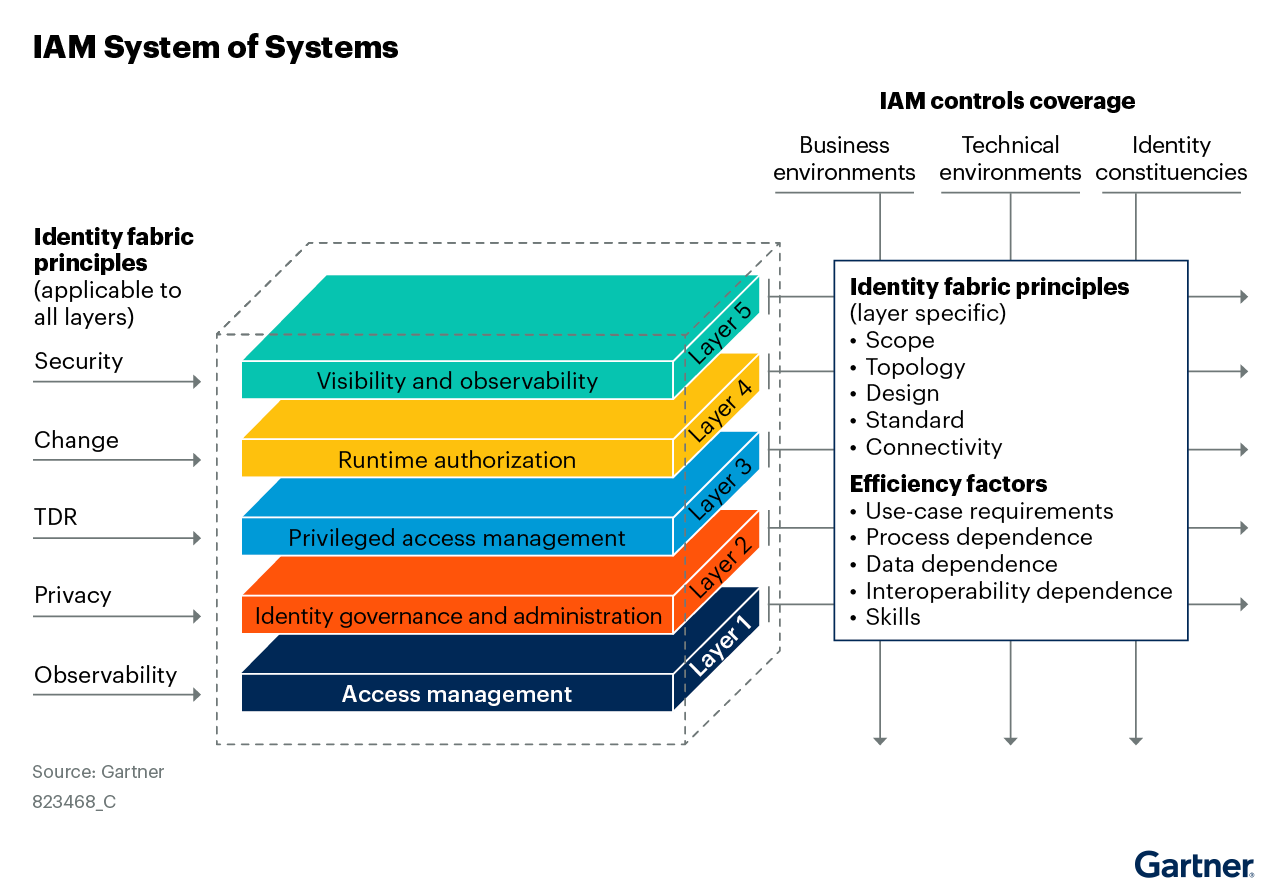
IAM is a complex system of systems, historically disconnected across IAM silos. The concept builds on Gartner’s idea of an identity fabric — as depicted in Figure 1, a system of systems arranged in distinct, independent layers. Each layer serves a specific function while maintaining technical, operational, and managerial independence. The long-term vision is to converge these layers into a unified identity platform that can seamlessly support large-scale and diverse business environments. The visibility and observability layer enables:
- The discovery of identities and their access configuration across all IAM systems.
- An identity and access data platform to establish and unify a common repository of data.
- Identity and access intelligence to enable identity analytics using machine learning (ML), as well as AI capabilities such as AI assistants and AI agents for intelligence automation.
Despite major IAM advances, residual blind spots persist; organizations can remediate hygiene flaws and shrink the identity attack surface only by gaining visibility across connected and disconnected ecosystems.
Remove Ambiguity Across Distributed IAM Operations Teams by Understanding IAM Data and Its Relation to the IAM Attack Surface
NIST defines an attack surface as “The set of points on the boundary of a system, a system element, or an environment where an attacker can try to enter, cause an effect on, or extract data from that system, system element, or environment.”
The IAM attack surface is composed of data. Organizations can demonstrably shrink their attack surface and reduce exposure by providing comprehensive data discovery and applying observability (prioritizing, validating, and remediating hygiene issues). This is distinct from a traditional user or metadirectory. It gathers, categorizes, and visualizes identity data across directories, tools, and multiple IAM domains. Ultimately, it enhances visibility and governance and improves IAM hygiene, enabling centralized control in a decentralized environment. Ownership and accountability are essential parts of any taxonomy, and key data elements are represented in Figure 2 below.
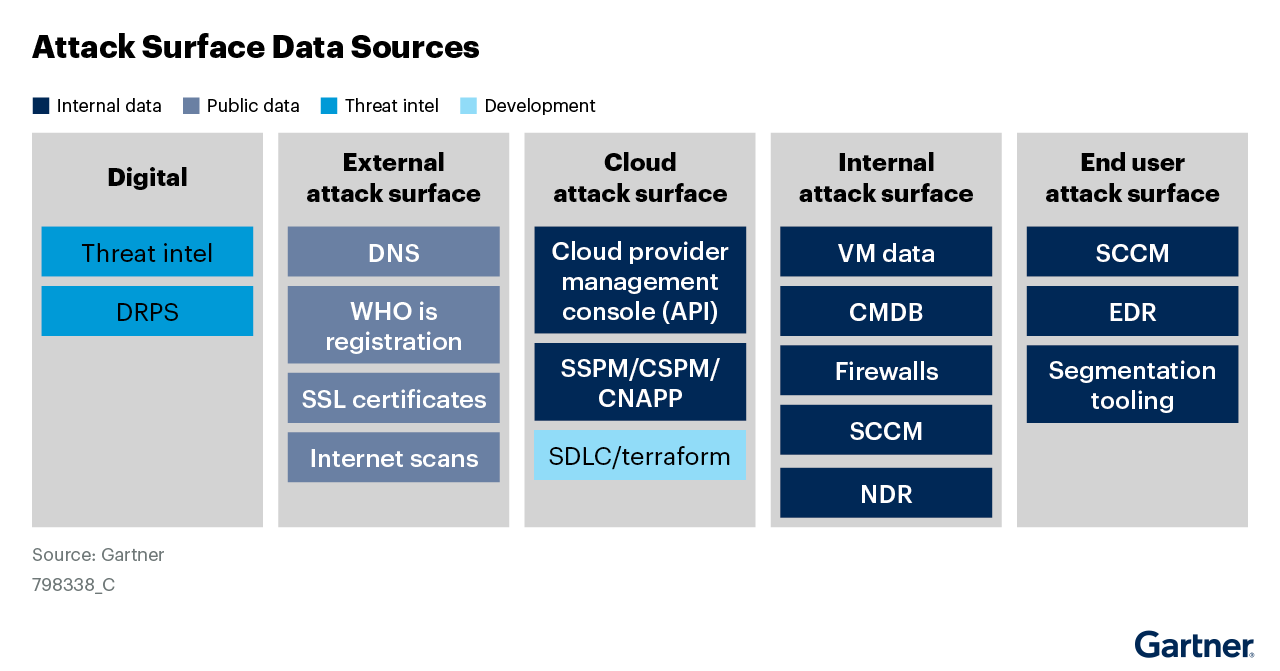
Collectively, this data defines what identities exist, how they authenticate, what they’re allowed to do, and how those activities are governed and monitored — forming the full scope of the IAM attack surface. See 4 Data Management Practices to Improve IAM Capabilities for insight on the important role identity plays. Entitlements can span across IAM capabilities and identities. For example:
- Core IAM capabilities focus on human and machine identities and account life cycles. A typical example is entitlements in IaaS. IaaS systems have hundreds of different services and thus have complex entitlement and policy structures. Outcomes of this analysis can lead to identifying unused entitlements (which means someone has too many access rights that they don’t use).
- A more in-depth analysis of these entitlements can also provide valuable information on potential attack paths that a malicious actor could use. These paths lead to administrator privilege elevation, which is an attacker’s ability to take over the particular system and beyond.
Expose Unmonitored IAM Data With a Unified Platform
As described in the Hype Cycle for Digital Identity, 2025, identity visibility and intelligence platforms (IVIP) provide rapid integration and visibility for IAM-relevant data, typically paired with (often AI-enabled) advanced analytics capabilities. This innovation provides a single view of IAM data, activity/events, relationships, configuration, and posture to enable rapid improvement of all other integrated IAM controls and capabilities, supporting both improved security and business enablement.
Identity visibility and intelligence platforms (IVIPs) rapidly ingest and unify IAM-relevant data — leveraging advanced (often AI-driven) analytics — to present a single window into identity and access events, user-resource relationships, and configuration and policy posture.
The objective of visibility and observability is to present a unified view of IAM data. Capabilities may include:
- Compliance management that goes beyond the foundational preventive mechanisms shown in Figure 2 above to proactively identify where controls may be lacking in advance of audits and regulatory reviews.
- The ability to take actions during runtime, such as:
- Sending a ticket or email informing that actions or decisions are needed based on AI recommendations
- Automated remediation of attack surface vulnerabilities, with human involvement
For example, using the Continuous Access Evaluation Profile (CAEP) of the Shared Signals Framework (SSF) defines mechanisms to communicate security events between trusted parties to enable continuous runtime access decisions, signaling that a session may need to terminate or quarantine, if suspect, until investigation can occur.
- Detection and response capabilities that can be integrated into security operations center (SOC) processes and tools. See the 2025 Planning Guide for Identity and Access Management.
- Resilience capabilities that provide proactive risk identification, enhanced operational continuity, reduction of downtime costs, real-time threat detection, and potentially a more automated incident response.
Identify and Address Hygiene Gaps by Using Dashboards to Visualize Data
In today’s rapidly evolving digital landscape, enhanced identity visibility is essential for distributed teams managing IAM, enabling informed decision-making. With visibility, distributed teams can understand which entitlements, resources, and policies are actively used versus idle, exposing hidden or indirect access paths (e.g., non-privileged users acquiring elevated rights). In addition, they can reveal identities and access grants created by business or technical teams, uncovering previously unnoticed gaps or unclear processes.
Effective dashboarding capabilities enable IAM teams to visualize data in multiple formats, making identifying and addressing hygiene gaps easier. Incorporating risk scores supports a risk-based approach to remediation. Persistent hygiene issues often signal underlying process weaknesses that need attention. Additionally, dashboards that illustrate reductions in the IAM attack surface over time provide CISOs with measurable evidence of improved security posture, which is valuable for accountability and incident response. See Prioritize IAM Hygiene for Robust Identity-First Security to learn why it is important to embed this into your IAM program.
Discovery tools that improve observability enable IAM operations team members to detect and quickly act upon anomalies. Visibility and observability depend on discovery comprehensiveness and are key to making informed IAM decisions.
Use ODMs to measure IAM attack surface progress.
Outcome-driven metrics (ODMs) focus on results rather than outputs. Instead of measuring the number of deployed controls (which may not indicate how well those controls reduce risk), ODMs evaluate the tangible results achieved through IAM investments. ODMs also support protection-level agreements (PLAs) establishing clear, negotiated target outcomes between business leadership and security teams. These agreements might, for example, state that access to critical resources must be revoked within a set number of days, thereby reducing the window of opportunity for attackers. Combining ODMs and PLAs transforms cybersecurity from a reactive function to a proactive, business-aligned discipline. See Use Outcome-Driven Metrics to Drive Value for Identity and Access Management for Gartner baseline measures. See the table in Note 2 for ways to measure your progress in shrinking the attack surface.
Prioritize Unified IAM Visibility
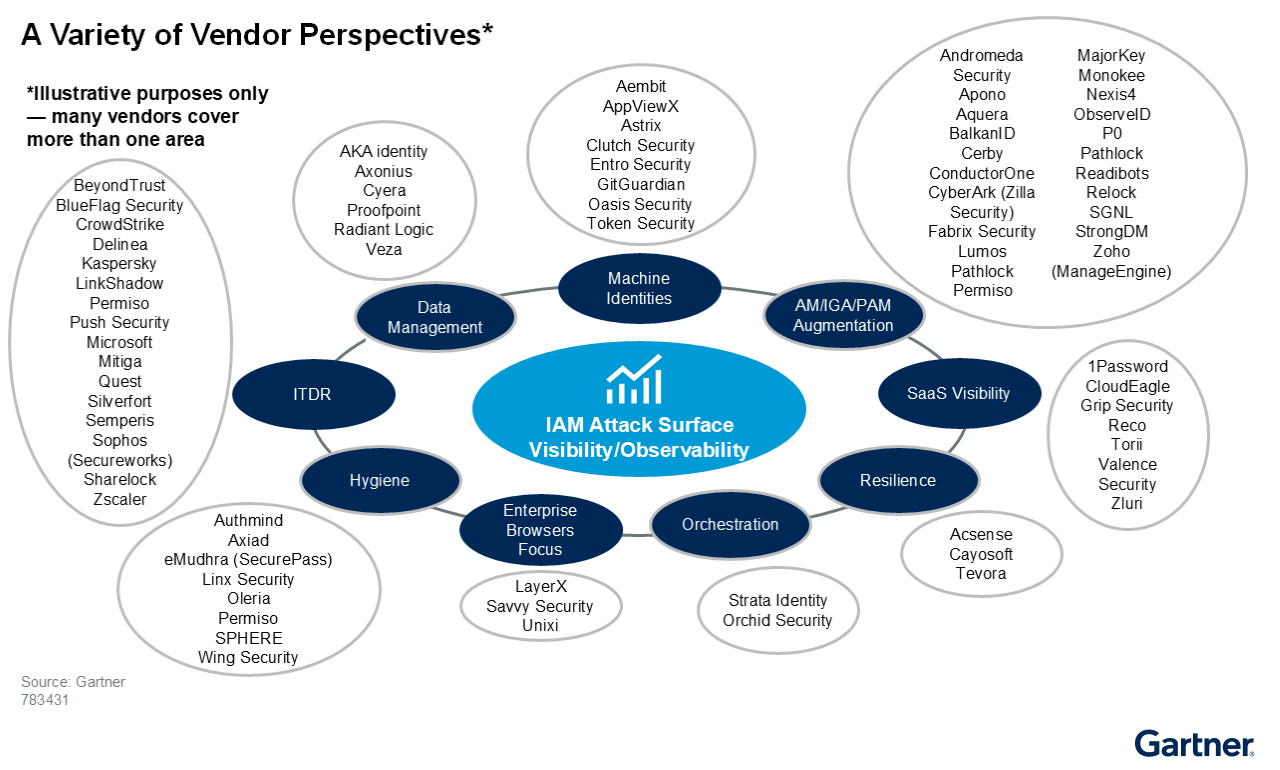
Visibility represents innovation, providing a single view of IAM data, activity/events, relationships, configuration, and posture to rapidly improve all other integrated IAM controls and capabilities supporting improved security and business enablement. As Figure 3 below details, there are many vendors with different perspectives in this space, meaning visibility can also be achieved in silos. The slide below is illustrative, as many different lenses offer some form of visibility. Vendors often provide more than one lens, so clarification of scope is important.
Evolving Space
The emergence of identity visibility and observability as a stand-alone market remains uncertain. This space is expected to see significant merger and acquisition (M&A) activity within the IAM and security sectors. Whether this pattern will persist as identity observability matures is yet to be determined. Gartner advises that the ideal approach is to view these capabilities as interdependent components of an integrated identity strategy rather than as stand-alone tools.
IAM leaders should:
- Form a cross-disciplinary task force that includes IT operations, application owners, and security governance teams.
- Conduct a comprehensive assessment of current identity infrastructures, including evaluating how legacy systems interoperate with modern cloud-based solutions.
- Perform a risk-quantified visibility gap analysis — beginning with machine identities — to identify gaps and blind spots and secure executive buy-in for targeted IVIP investments.
- Identify and remediate process failures (e.g., orphaned or dormant accounts) by collaborating with risk owners to implement playbooks and best practices, staying ahead of posture drift as the business evolves.
- Apply visibility, observability, and orchestration to continuously close hygiene gaps and demonstrably shrink the IAM attack surface over time, using the power of AI and ML intelligence with IVIPs.
- Extend these capabilities beyond technology silos to surface broader business-level risks — such as separation-of-duties violations — and drive comprehensive risk mitigation.
2023 Gartner IAM Modernization Preventing Identity-First Security Survey. This survey was conducted to determine how far the market is moving toward identity-first security. The survey was conducted online from 9 June to 24 July 2023 among 303 respondents from North America (n = 104 in the U.S. and Canada), Latin America (n = 41 in Brazil), Asia/Pacific (n = 59 in India, Australia, and Singapore), and EMEA (n = 99 in Germany, France and the U.K.). Respondents’ organizations had $100 million or more in 2022 enterprisewide annual revenue and 250 or more employees. Respondents were required to have some involvement in their organizations’ IAM. They were planning to have at least one workforce, consumer, or machine/nonhuman IAM initiative in their organization within the next two years. Disclaimer: The results of this survey do not represent global findings or the market as a whole, but reflect the sentiments of the respondents and companies surveyed.
1 2025 Data Breach Investigations Report, Verizon Business.
Note 1: Have visibility conversations with Existing Vendors
Machine IAM: Vendors that provide visibility into machine identities are referenced in the following Gartner research: Effectively Manage Your Organization’s Certificates, Innovation Insight: Secrets Management Tools, Leaders’ Guide to Modern Machine IAM.
See IAM — Taxonomy, Domains and Tooling for different types of tools offered for different types of identities. A summary list is provided here:
- Access management (AM) addresses authentication and single sign-on (SSO) capabilities that establish, manage, and enforce runtime access controls for modern standards-based and classic web applications and APIs. See Critical Capabilities for Access Management.
- Identity governance and administration (IGA) solutions manage the identity life cycle and govern access across on-premises and cloud environments. To accomplish this, IGA tools aggregate and correlate disparate identity and access rights data, and provide full capability controls over accounts and associated access. See Market Guide for Identity Governance and Administration and Innovation Insight: Light Identity Governance and Administration.
- Privileged access management (PAM) tools provide an elevated level of technical access through the management and protection of accounts, credentials, and commands, which are used to administer or configure systems and applications. See PAM: How to Address Discovery, Operating Model and Resilience Challenges, Critical Capabilities for Privileged Access Management for help with discovering privileged human and machine accounts.
- Cloud Security Posture Management (CSPM) vendors typically include the ability to identify misconfigurations, which are a primary reason for cloud-related data breaches described in Solution Criteria for Cloud Security Posture Management (CSPM).
- Cloud-Native Application Protection Platforms (CNAPP) are a set of security capabilities designed to protect the cloud infrastructure and applications. These technologies also play a critical role in the attack surface so visibility is key, especially at runtime. Visibility, configuration, and compliance monitoring are typically delivered as a set of capabilities under a single integrated platform. Vendors are represented in the Market Guide for Cloud-Native Application Protection Platforms.
- SaaS Security Posture Management (SSPM) vendors focus more on platform configuration and provide visibility into integrations and SaaS user insight. See How to Protect Your Clouds With CSPM, CWPP, CNAPP, and CASB for references to vendors. See Magic Quadrant for SaaS Management Platforms.
- Data Security Posture Management (DSPM) vendors — see Market Guide for Master Data Management Solutions.
Note 2: ODMs for Measuring IAM Attack Surface Progress

ODMs for Measuring IAM Attack Surface Progress
| Metric | Definition | Why it matters | Expected outcome |
|---|---|---|---|
Reduction in orphan/dormant accounts | Percentage reduction of accounts with no human ownership or that remain active post-offboarding | Eliminates legacy access that threat actors can exploit | Clear evidence of a disciplined IAM process; direct correlation to a reduced attack surface |
Compliance audit pass & access certification rates | Percentage rate of successful periodic reviews and certifications | Ensures continuous compliance and user access alignment with business needs | Higher adherence to IAM policies; tangible evidence of reduced unauthorized access opportunities |
Reduction in access-related support incidents | Percentage reduction in IT help desk requests tied to access issues | Indicates improved user experience and correct IAM function; indirectly reduces risk from manual overrides | Enhanced user autonomy; fewer inadvertent policy violations; streamlined IAM process |
Cost savings from IAM automation | Quantifiable cost reduction from implementing automation in provisioning/de-provisioning and other IAM processes | Demonstrates that investments in automation yield operational efficiencies that can be reinvested for further security enhancements | Less outages, lower operational costs, and a more controlled attack surface |
Source: Gartner (October 2025)