Magic Quadrant for Cloud ERP Finance
27 October 2025 - ID G00826840 - 42 min read
By Mike Helsel, Irmina Melarkode, and 2 more
Cloud ERP finance applications are rapidly evolving as automation, AI and composable architectures reshape the market amid rising regulatory and economic pressures. CFOs can use this research to identify vendors that deliver data-driven insights and future-ready finance solutions.
Strategic Planning Assumptions
By 2028, finance organizations using cloud ERP applications with embedded AI assistants will drive a 30% faster financial close.
By 2027, 80% of finance organizations will employ a hybrid build-and-buy approach to GenAI to maximize performance and differentiated value.
By 2027, 62% of cloud ERP spend will be on cloud ERP applications with GenAI capabilities, up from 14% in 2024.
Market Definition/Description
This document was revised on 27 October 2025. The document you are viewing is the corrected version. For more information, see the Corrections page on gartner.com.
Gartner defines ERP finance as a cloud-based application that enables organizations to manage a wide range of transactional financial processes including, but not limited to, general ledger, accounts payable and accounts receivable. The application serves as the system of record for finance that generates and stores accounting entries in accordance with accounting standards, facilitating the production of accurate financial statements and disclosures. It supplies finance with transactional and financial reports to support daily operations and provide insights into the financial health of the organization.
ERP finance supports the finance function by centralizing and streamlining transactional processes within a single application. It enables finance to access a standard enterprise data model that promotes visibility to key financial and transactional metrics, provides the data source for both external reporting and internal management reporting, and ultimately supports better decision making.
Common business problems addressed by ERP finance include:
- Reduce the risk and cost of noncompliance: Automating accounting entries and financial controls across transactional processes ensures accurate financial reporting and adherence to regulatory requirements, protecting the organization from potential legal and financial penalties.
- Mitigate business continuity risks: Operating on outdated or unsupported on-premises ERP poses risks such as revenue loss during downtime, data security breaches and noncompliance with industry regulations. These risks are critical to mitigate to ensure business continuity and operational resilience.
- Eliminate organizational inefficiencies: Providing a common platform that standardizes and automates routine finance processes addresses and streamlines operations, enabling the organization to scale and grow.
- Enhance financial visibility: Enabling a standard data model that connects operational data with financial data offers insights into financial metrics and supports data-driven decision making.
Mandatory Features
The mandatory features for this market include:
- Ability to generate and record accounting entries in compliance with accounting standards across assets, liabilities, equity, expenses and income when a transactional event with financial impact occurs.
- Ability to support core transactional finance processes, including general ledger, accounts payable, accounts receivable and fixed assets, with functionality such as user-role-based security profiles, standard forms, predefined rules and transaction processing capabilities.
- Ability to create transactional and financial reports in standardized and customized formats, providing insights into financial health of the organization for informed decision making.
Common Features
The common features for this market include:
- Ability to automate repetitive tasks and support collaboration across different teams within a process.
- Ability for finance to set up and manage system configuration within their teams, reducing the dependency on IT teams and third-party vendors.
- Ability to be delivered under a SaaS license model, where frequent updates, application support, infrastructure provisioning and management are the responsibility of the vendor.
Magic Quadrant
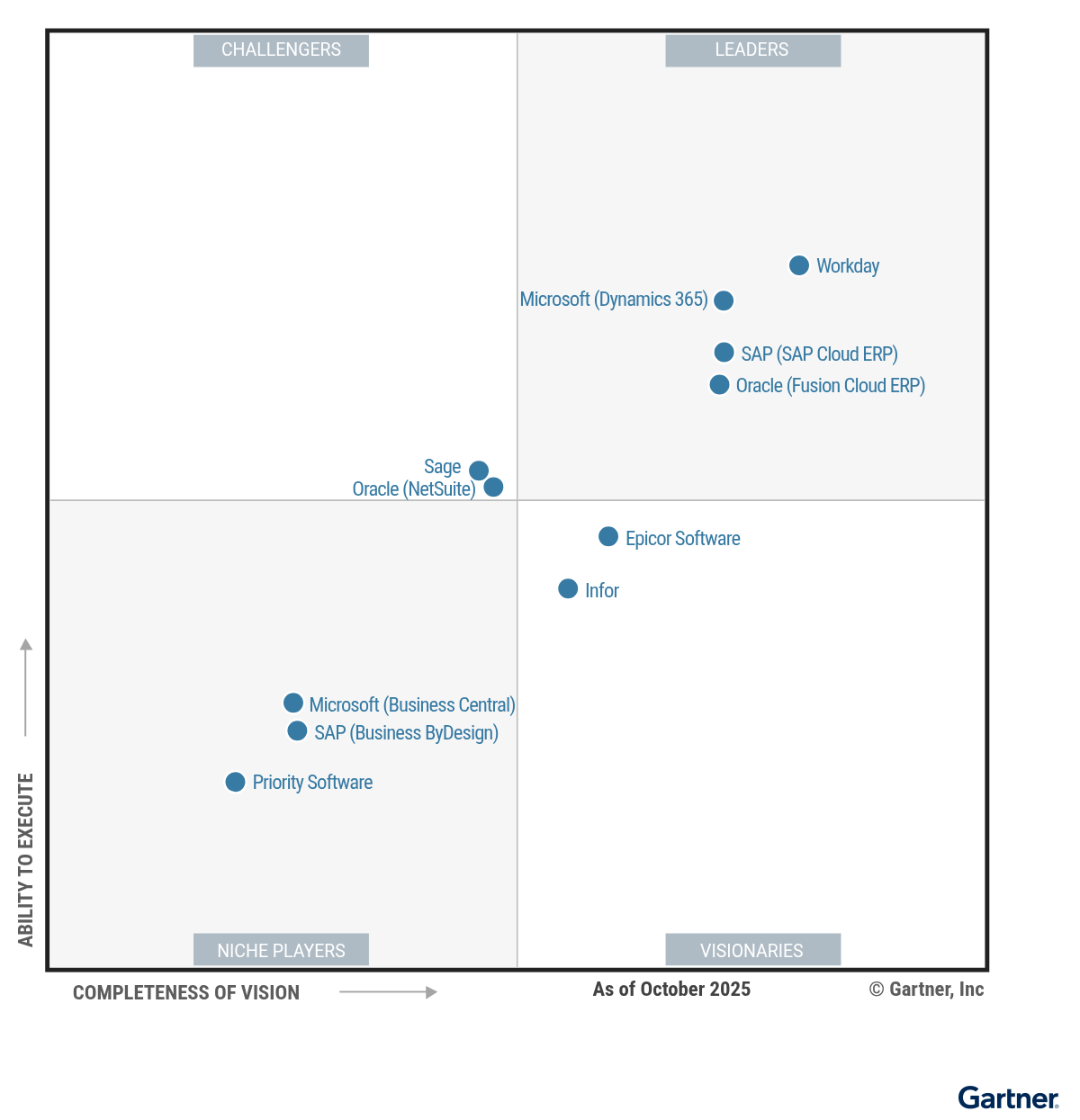
Vendor Strengths and Cautions
Epicor Software
Epicor is a Visionary in this Magic Quadrant, recognized for helping customers adapt to evolving business models and regulatory demands. Its product, Epicor Financials, uses a modular, API-driven architecture and no-code tools to streamline operations and configure the application without heavy IT involvement.
An innovative feature is Epicor Prism and Grow, an integrated AI assistant that enables customers to query financial data, run scenarios and predictive models in natural language. This enables CFOs to make faster, data-driven decisions and tailor workflows and configurations to their unique requirements. In 2026, Epicor plans to invest in flexible cross-border tariff and tax calculation tools to help customers meet global business requirements and control costs.
- Application strategy: Epicor’s vision is to deliver a well-orchestrated finance application that seamlessly integrates Epicor with partner solutions to support compliance and multientity operations. CFOs should monitor Epicor’s progress in executing this strategy, as it could help them reduce data silos and maintain consistent financial management as business structures and regulatory requirements change.
- Innovation roadmap: Epicor’s product roadmap includes plans to embed AI, predictive analytics and automation into core financial processes to help CFOs address higher workloads and the need for timely insights. CFOs should expect future updates to focus on practical tools that support efficiency and better decision making as business needs change.
- Extensibility: Epicor’s Application Studio has a no-code/low-code editor for user interface customization, enabling drag-and-drop personalization and new control additions. CFOs can use this to simplify complex configurations and improve team productivity while reducing reliance on specialized technical support.
- Integration: Epicor’s industry specialization can enable faster time to value for organizations within its target verticals, but connecting Epicor Financials to disparate platforms may require additional configuration and data mapping, particularly for organizations outside these core industries. CFOs should assess whether their IT resources and business model align with Epicor’s integration requirements and industry focus.
- Financial controls: Epicor relies on third-party partnerships for local accounting standards in several countries in EMEA. This requires organizations to assemble financial controls using multiple tools, rather than a unified native framework, increasing the risk of compliance issues. CFOs with international operations should anticipate higher resource needs and oversight to maintain compliance and effective controls across regions.
- Bank partners: Epicor’s integration with central banks for currency rate imports must be connected via Epicor Automation Studio. CFOs at multicurrency organizations should assess if that approach aligns with their operational needs, as it could lead to higher costs, increased manual effort, integration complexity and oversight.
Infor
Infor is a Visionary in this Magic Quadrant, recognized for delivering a unified, analytics-driven finance application focused on helping customers realize the intended value of ERP investments. Its product, Infor CloudSuite Financials & Supply Management, integrates process automation, real-time analytics and configurable workspaces, supported by robust integration using its Intelligent Open Network (ION) and low-code extensibility to streamline finance processes.
An innovative feature is Infor Process Intelligence, which uses process mining to deliver insights into financial workflows. This enables CFOs with complex operations to streamline processes, optimize resource allocation and reduce costs. In 2026, Infor will add an AI-driven billing chat for 24/7 self-service and automated error detection.
- Finance operations: Infor designs its role-based workspaces and dashboards to address finance teams’ daily workflow, reporting and analysis needs by consolidating relevant data and AI-driven insights from across the suite into a single location. CFOs should recognize that this approach demonstrates Infor’s awareness of evolving user expectations and the practical requirements of modern financial management.
- Customer-driven innovation: Infor’s product strategy incorporates direct feedback from finance leaders in healthcare, public sector and service industries to address compliance, funding and operational requirements. CFOs should note that this industry-specific focus and ongoing customer engagement help ensure future product updates remain aligned with evolving regulations.
- Innovation roadmap: Infor has increased its R&D investment from prior years to add new AI, automation and analytics features to its CloudSuite platform. CFOs can expect regular updates with tools like GenAI assistants and process mining to help improve efficiency and adapt to changing business needs.
- Accounting standards: Infor primarily supports U.S. Generally Accepted Accounting Principles (GAAP) and offers limited coverage for international accounting standards, requiring integration with Workiva for complex disclosures. CFOs with global operations should anticipate additional integration efforts and increased costs to meet statutory requirements outside North America.
- Process automation: Infor has key finance capabilities, such as subscription billing and treasury management, delivered via third-party partnerships rather than native modules. CFOs should assess the potential risk of process gaps and increased manual effort when consolidating these capabilities, as reliance on external partners may complicate workflow automation and reduce application efficiency.
- Pricing: Infor applies employee based pricing to all employees and contractors, which may increase costs for organizations with large or fluctuating workforces. CFOs should review workforce trends and forecast licensing requirements to avoid unexpected budget overruns and control cloud ERP expenses as staffing changes occur.
Microsoft (Business Central)
Microsoft Business Central is a Niche Player in this Magic Quadrant, recognized for supporting over 45,000 small and midsize businesses globally. Its product, Microsoft Dynamics 365 Business Central, uses dimensional accounting to tag transactions with attributes like department or project for flexible reporting without a complex chart of accounts.
An innovative feature is its integration with Microsoft Power Automate, which provides access to prebuilt automation templates and enables users to create custom workflows for tasks such as invoice reminders and report generation. This enables CFOs to improve efficiency and reduce manual workloads. In 2026, Microsoft plans to enhance financial reporting with new dashboard templates for faster analysis.
- Embedded automation: Microsoft Business Central streamlines routine back-office processes through built-in AI-driven automation features that reduce manual effort. CFOs can use these capabilities to increase efficiency and scalability without relying on additional third-party tools.
- Microsoft ecosystem: Microsoft Business Central natively integrates with Microsoft Copilot, Microsoft 365, Microsoft Teams and Microsoft Power BI, enabling seamless data flows and collaboration. CFOs can unify reporting and analysis across departments, which improves decision-making speed and ensures data consistency.
- Market insight: Microsoft Business Central demonstrates an understanding of the needs of small to midsize CFOs, such as cost management, the need for more agile decision making and increasing compliance complexity. CFOs using Microsoft Business Central can expect continued innovation in these areas.
- Workflow customization: While Microsoft Business Central offers workflows like purchase invoice approval, more advanced customization may require partner solutions or additional configuration. CFOs should evaluate the capabilities of internal technical resources and plan for extra time and costs when deploying complex or cross-functional workflows.
- Pricing: Microsoft Business Central is priced per user with additional fees for Copilot Studio and autonomous agents. CFOs should closely review automation requirements and forecast user growth to avoid unexpected expenses and control cloud ERP expenses.
- Life cycle management: Microsoft Business Central delivers major feature updates semiannually, allowing customers to schedule their own upgrade window within a 60-day period and also provides monthly regulatory updates. CFOs should recognize that while monthly regulatory updates support ongoing compliance, the less frequent cadence of major feature releases may limit the organization’s agility.
Microsoft (Dynamics 365)
Microsoft Dynamics 365 is a Leader in this Magic Quadrant, recognized for its customer-driven roadmap and ability to streamline global finance operations through AI-driven insights and real-time reporting. Its product, Microsoft Dynamics 365 Finance, offers unlimited financial dimensions, user-defined tags and a global chart of accounts for managing multientity environments in over 50 countries.
An innovative feature is its Copilot Studio, which allows users to build AI agents with natural language to automate finance tasks. This enables CFOs to improve cash flow through GenAI-driven collections that provide real-time customer reporting and tailor collection emails based on predicted payment behavior. In 2026, Microsoft will expand agentic AI for finance with new agents for exception management and predictive analytics.
- AI automation: Microsoft Dynamics 365 incorporates Copilot and embedded AI agents to deliver advanced AI automation and real-time insights within finance processes. These capabilities support predictive analytics and automated transaction processing so CFOs can, for example, improve forecasting accuracy and reduce time spent on manual reconciliations.
- Customer-driven innovation: Microsoft Dynamics 365 directly integrates customer feedback from surveys, advisory boards and innovation hubs into its product development process. This approach has yielded recent advancements, including low-code platform capabilities for building automated collections, enabling CFOs to proactively engage customers, streamline dispute resolution and optimize cash flow across the organization.
- Partner ecosystem: Microsoft Dynamics 365 has a broad global partner network that extends its reach and vertical expertise, offering specialized cloud migration and deployment support. CFOs can access tailored industry solutions to accelerate transformation and reduce the risk when moving from legacy systems.
- Pricing: Microsoft Dynamics 365’s tiered user licensing model and reliance on external partners can make it difficult to accurately predict the total cost of ownership. CFOs should evaluate all expenses, such as partner fees, integration, support and ongoing licensing.
- Customer support: Microsoft Dynamics 365 customers have reported inconsistent experiences with Microsoft’s internal customer support during and after deployment. CFOs should establish escalation protocols and consider supplemental partner support to maintain business continuity and prevent operational disruptions.
- Configuration: Configuring and managing multientity, multicurrency and intercompany processes in Microsoft Dynamics 365 can be complex, especially for organizations with diverse global operations. CFOs should ensure their teams have the necessary expertise or external support to establish and maintain these structures.
Oracle (Fusion Cloud ERP)
Oracle Fusion Cloud ERP is a Leader in this Magic Quadrant, recognized for its global scale, composable architecture and embedded low-code/no-code extensibility. Its product, Oracle Fusion Cloud ERP, enables organizations to manage complex, multientity structures; automate high-volume transactions; and access real-time data across geographies — supporting compliance, risk management and financial consolidation in dynamic environments.
An innovative feature is the use of agentic AI and GenAI, including its Ledger Agent and Document IO Agent, to automate invoice processing, reconciliation and reporting. This enables CFOs to improve efficiency in accounting operations. In 2026, Oracle plans to expand agentic AI for exception management, predictive analytics and data exploration.
Oracle Fusion Cloud ERP declined requests for supplemental information. Gartner’s analysis is therefore based on other credible sources.
- Product vision: Oracle Fusion Cloud ERP has a vision for automating finance tasks driven by AI-agent initiatives like Ledger and Account reconciliation agents, Payment Agent in AP and Billing and a cash application agent. These will enable CFOs to make better strategic decisions, improve accuracy and working capital, and drive efficiency.
- Proven scalability: Oracle Fusion Cloud ERP delivers scalable finance process automation that supports millions of transaction lines and complex account combinations. CFOs can ensure real-time data insights and compliance at scale, supporting business growth and competitive advantage while ensuring data compliance.
- Extensibility: Oracle Fusion Cloud ERP has a unified, modular architecture and embedded low-code/no-code platforms like Application Composer and APEX for workflow and analytics customization. CFOs can use these tools to adapt finance processes quickly since they are run in one application and address evolving business and regulatory requirements without extensive IT involvement.
- Optional solution evaluation: Oracle Fusion Cloud ERP includes embedded analytics and real-time reporting, with OTBI as a standard feature in the core finance suite and EPM complementing it with extended planning and modeling functionality. CFOs who do not require extended planning features should evaluate whether optional solutions such as EPM or FDIP are needed, as these may add cost and complexity for their analytics.
- Customer support: While Oracle reports measurable improvements in support response times and customer satisfaction, some organizations with complex or highly customized deployments still experience challenges in resolving critical issues. CFOs should review Oracle’s current support metrics, clarify escalation procedures and ensure internal resources are prepared to manage support interactions to minimize operational risk.
- Pricing: Oracle Fusion Cloud ERP pricing is determined by suite selection, user types, optional modules and negotiated terms, which requires forecasting to fully understand the pricing structure. CFOs should conduct scenario-based cost modeling, review contract terms for add-ons and assess the potential impact of business changes on future pricing to support effective budgeting.
Oracle (NetSuite)
Oracle NetSuite is a Challenger in this Magic Quadrant, recognized for its global reach, composable architecture and support for real-time data access and process automation. Its product, NetSuite, enables multinational organizations to orchestrate complex financial operations, improve agility and manage risk in dynamic business environments.
An innovative feature is its SuiteBilling integration with NetSuite CPQ, which helps manage consumption-based billing and subscription bundles as needs evolve. This enables CFOs with complex billing requirements to achieve flexible and scalable subscription management. In 2026, NetSuite plans to enhance Financial Exception Management, an AI-driven solution, to further automate error resolution and accelerate the financial close to improve efficiency.
Oracle NetSuite declined requests for supplemental information. Gartner’s analysis is therefore based on other credible sources.
- Application strategy: NetSuite’s infrastructure is designed to meet high application performance, security and scalability levels. CFOs can use this foundation to maintain business continuity, respond to changing operational needs and access new cloud and analytics capabilities, such as Autonomous Database and Analytics Cloud, without additional integration work.
- Process automation: NetSuite embeds AI-driven exception management and agentic workflows to automate end-to-end tasks such as invoice processing, payment application and project accounting. CFOs can use these capabilities to improve process efficiency, reduce manual errors and maintain consistent operations as transaction volumes increase.
- Financial controls: NetSuite applies AI and machine learning (ML) for risk, compliance and fraud monitoring, including anomaly detection and audit support. CFOs can set up automated alerts for suspicious transactions and streamline audit workflows, which improves internal governance and reduces the time and effort required for regulatory compliance.
- Life cycle management: NetSuite delivers semiannual automatic upgrades, giving customers immediate access to new features while keeping everyone on a single version. CFOs should recognize that although NetSuite provides a fixed upgrade schedule and sandbox testing, organizations cannot fully control upgrade timing, which may challenge those with complex requirements.
- Customer support: Some customers have reported mixed satisfaction with NetSuite’s customer support, with some citing long wait times and inconsistent resolution of complex issues. To help avoid delays in issue resolution, CFOs should consider supplemental support options or dedicated account management for highly configured environments.
- Pricing: NetSuite’s consulting fees and region-specific partner costs may increase total ownership expenses, particularly for smaller organizations. CFOs should proactively manage vendor relationships and monitor renewal processes to support cost transparency and accurate forecasting.
Priority Software
Priority Software is a Niche Player in this Magic Quadrant, recognized for sustained R&D investment and a structured, customer-driven roadmap. Its product, Priority, has an open, composable architecture and embedded no-code extensibility to help organizations scale financial operations across complex, multientity environments without specialized IT support.
An innovative feature is its advanced conversational analytics for reporting and dashboards, which use embedded AI and natural language processing to generate insights and custom visualizations from user queries. This enables CFOs to quickly access financial data, streamline reporting and make faster, more informed decisions without IT support. In 2026, Priority Software plans to deliver Priority Advisor, which uses agentic AI to automate anomaly detection.
Priority Software declined requests for supplemental information. Gartner’s analysis is therefore based on other credible sources.
- Vertical specialization: Priority has vertical-specific ERP capabilities, including revenue planning for various industries and specialized billing for software and technology sectors. CFOs should consider these industry-focused features to address unique operational and regulatory requirements more effectively.
- Integration: Priority offers prebuilt integrations and low-code/no-code tools for seamless connectivity with existing systems. CFOs can quickly connect finance workflows to other business applications, which accelerates adaptation to organizational changes and minimizes reliance on IT for routine updates.
- Pricing: Priority has a straightforward pricing model based on modules and named users, so organizations pay only for required features. CFOs can use this approach to maintain control and predictability over cloud ERP expenses.
- Data and analytics: Priority offers basic reporting and built-in AI features, including dashboards and self-service analytics, but lacks advanced analytics capabilities found in more robust solutions. CFOs should evaluate whether these native tools meet their organization’s analytical requirements, as dependence on third-party solutions may increase costs and introduce data integration and management complexity.
- Customer support: Priority has human and AI-driven customer support, but some customers report delays in issue resolution. CFOs should establish escalation procedures and regularly review support performance to ensure timely problem resolution and maintain operational continuity.
- AI investment: Priority’s AI roadmap is less advanced than other vendors in this research, and the availability of AI features for all modules is unclear. CFOs can use detailed AI feature lists and future development plans to confirm alignment with their organization’s AI objectives.
Sage
Sage is a Challenger in this Magic Quadrant, recognized for accounting-trained AI and a unified data architecture in its cloud ERP finance application. Its product, Sage Intacct, incorporates Sage Copilot and agentic AI features that automate core finance processes, such as AP automation, journal entry outlier detection and financial close orchestration.
An innovative feature is Sage Intacct AP Automation, which streamlines invoice ingestion, vendor matching and transaction coding using AI/ML to reduce manual effort and improve accuracy. This enables CFOs to accelerate AP processing and improve data quality. In 2026, Sage will launch agentic AI for autonomous cash flow forecasting and optimization.
- Financial controls: Sage Intacct has granular permissions, segregation of duties, configurable approvals and AI-driven outlier detection in its Intelligent General Ledger. CFOs can use these controls to strengthen audit readiness, find anomalous journal entries and proactively manage compliance risks.
- Vertical specialization: Sage Intacct offers microvertical applications with tailored features and integrations for sectors such as financial services, nonprofit, healthcare, SaaS and professional services, including industry-specific reporting templates and compliance workflows. CFOs in these sectors should consider these industry-specific features to streamline compliance and address unique operational requirements.
- Customer-driven innovation: Sage Intacct incorporates customer feedback, market research and industry best practices into its product roadmap to guide development. CFOs receive frequent updates with new analytics and modeling features, which support continuous improvement and keep finance operations aligned with changing business needs.
- User interface: Sage Intacct’s dashboard export and distribution capabilities may be restricted by user permissions and do not always preserve interactive elements such as drill-downs or embedded widgets. CFOs should validate whether the application’s export functionality meets their team’s advanced reporting requirements and assess if additional configuration or training is needed to avoid manual workarounds.
- Agentic AI: Sage Intacct’s AI agents are restricted to core finance processes such as AP and the financial close but lack support for advanced workflows, like accruals and predictive forecasting. CFOs seeking higher automation maturity should review whether these capabilities meet their operational objectives.
- Integration: Sage Intacct has bidirectional Salesforce and Hubspot connectors for contract data and revenue recognition, but it lacks AI-driven extraction from other sources. CFOs should anticipate manual processes, additional integration work or data silos if their organization manages contracts on multiple platforms.
SAP (Business ByDesign)
SAP Business ByDesign is a Niche Player in this Magic Quadrant, recognized for its integrated public cloud ERP suite for small and midsize enterprises needing real-time financial analytics, unified data and multi-GAAP compliance. Its product, SAP Business ByDesign, automates compliance and enforces budget controls through embedded analytics and workflow automation.
SAP Business ByDesign was designated feature-complete in 2023, with future development focused on legal, security and compliance, as well as small enhancements supporting 39 end-to-end business processes.
SAP will delist SAP Business ByDesign for new customers effective 20 April 2026. Existing customers can continue to use the software, buy additional licenses and receive quarterly updates and support, with no maintenance end date planned.
- Global compliance: SAP Business ByDesign offers dual control, granular access rights, multilevel approvals and regular compliance updates for 39 countries. CFOs can automate regulatory checks and maintain audit trails across jurisdictions, which supports consistent governance and reduces the risk of compliance failures.
- Analytics and reporting: SAP Business ByDesign has real-time analytics, over 150 prebuilt financial reports and multi-GAAP support for parallel financial statements. CFOs can analyze financial performance across multiple entities and standards without manual consolidation, which improves reporting speed and accuracy for global teams.
- Automation, AI and RPA: SAP Business ByDesign has prebuilt ML scenarios, such as payment delay prediction and supplier proposal recommendations, predictive analytics and more than 10 RPA bots for automating routine finance tasks. CFOs can use these to automate repetitive processes and proactively manage exceptions, which increases operational efficiency and frees up staff for higher-value analysis.
- Finance configuration: SAP Business ByDesign has 39 preconfigured, cross-functional, end-to-end business scenarios that integrate finance with other operational areas, but only five focus solely on finance. CFOs seeking stand-alone financials should weigh the suite’s integration benefits against its limited finance-only coverage.
- Data and analytics: SAP Business ByDesign offers standard reporting and predictive analytics, but advanced capabilities such as prescriptive insights, complex scenario modeling or custom dashboards typically require integration with SAP Analytics Cloud or external BI tools. CFOs should determine if the built-in analytics meet their needs or if additional analytics tools are required for more advanced data-driven decisions.
- Treasury and cash management: SAP Business ByDesign has basic treasury capabilities, including cash positioning, liquidity forecasting and bank reconciliation. CFOs with advanced treasury needs should review the platform’s functionality and plan for supplemental solutions if complex cash management is required.
SAP (SAP Cloud ERP)
SAP Cloud ERP is a Leader in this Magic Quadrant, recognized for its unified, dimension-driven architecture that enables real-time, agile planning and decision making across global entities. Its product, SAP Cloud ERP, provides localization for 60 countries, with analytics to enhance compliance and controls, and additional capabilities such as treasury, joint venture accounting and subscription billing.
An innovative feature is its integration with SAP’s Build Process Automation, enabling customers to automate tasks such as validating account balances, processing invoices and reconciling payments. This enables CFOs to use no-code tools and prebuilt bots to increase agility and accelerate the financial close. In 2026, SAP plans further investment in AI-driven financial analysis and automation.
- Extensibility: SAP Cloud ERP is natively integrated with SAP Business Technology Platform (BTP), which can rapidly extend, customize and connect finance processes with advanced analytics, automation and AI capabilities. CFOs can use this extensibility to quickly adapt to changing business requirements, unify data across disparate systems and drive continuous innovation without impacting core application stability.
- AI assistant: SAP Cloud ERP’s Joule AI assistant enables natural language interaction, automates routine tasks and delivers contextual financial insights. CFOs can reduce manual reporting effort and quickly access actionable analytics, which helps finance teams focus on strategic priorities and improve responsiveness.
- Risk management: SAP Cloud ERP automates credit management with real-time risk scoring, workflow processing and integration with over 15 global credit agencies. CFOs can accelerate receivables and reduce credit losses, strengthening portfolio management for international operations.
- Workflow configuration: SAP Cloud ERP’s customizable workflows for processes like invoice approval or automated journal entry require close collaboration with IT and advanced configuration expertise. CFOs should plan to engage highly technical resources to optimize advanced features and ensure successful adoption.
- AI model training: SAP Cloud ERP offers fewer options for finance customers to retrain AI models or provide granular feedback compared to other vendors in this research, who offer more extensive self-service AI and ML customization. CFOs should assess whether these constraints could hinder process optimization and consider evaluating supplemental AI solutions if advanced customization is a priority.
- Localized compliance: SAP Cloud ERP’s reliance on templates and localized content may not fully cover all multijurisdictional or industry-specific compliance requirements. CFOs should assess whether additional configuration or third-party partner applications are needed to meet their organization’s compliance needs.
Workday
Workday is a Leader in this Magic Quadrant, recognized for its differentiated architecture, featuring a unified data model and in-memory analytics that enable CFOs to analyze financial, operational and workforce data in real time. Its product, Workday Financial Management, automates high-volume transactions, facilitates granular analysis and helps organizations adapt quickly to regulatory and operational changes.
An innovative feature is its Accounting Center, which connects the general ledger with source systems for real-time, touchless accounting. This enables CFOs to reduce manual effort and accelerate the financial close. In 2026, Workday plans to expand AI agent-based automation and intelligent account reconciliations.
- AI agent: Workday uses its Document Intelligence to automate the ingestion and validation of business documents, such as contracts, statements of work and bank statements. CFOs can use this capability to reduce manual effort, strengthen financial controls and ensure accurate generation of accounting entries and billing schedules.
- Value management: Workday has ongoing cloud ERP value management through direct service, a global partner network and frequent product releases. CFOs can test new features in preview environments and adopt innovations quickly, which helps maintain system performance and minimizes disruption from updates.
- Regulatory agility: Workday’s financial management roadmap prioritizes continuous accounting and investment in anomaly detection to automate evidence collection and streamline audit preparation. CFOs should view Workday’s frequent innovation cycles and customer-driven product development as enablers for adapting finance operations to evolving regulatory requirements.
- AI model training: Workday does not fully disclose AI model data sources or offer granular user adjustments. CFOs should review transparency policies and monitor future updates to ensure alignment with governance and model refinement needs.
- Subscription management: Workday’s subscription management functionality for high-volume and complex usage-based billing is not yet available, with general release planned for 3Q25. CFOs should plan for interim manual processes and monitor feature releases to ensure future alignment with complex billing needs.
- Agent roadmap: Advanced AI agents for the financial close and cash applications are expected by 2026, although the recent acquisition of Flowise, a low-code AI agent builder, may accelerate deployment. CFOs should evaluate how this roadmap aligns with their AI adoption timelines and plan accordingly.
Inclusion and Exclusion Criteria
Product Capabilities
The vendor must deliver a cloud-based ERP finance product that includes the following product capabilities:
- Released for general availability before 05 May 2025.
- Support the mandatory ERP finance product features as defined in the Market Definition section.
- Actively market, sell and deploy the cloud ERP finance product on a stand-alone basis, devoid of any additional bundling with broader ERP suites or other applications.
Cloud Capabilities
The ERP suite must be deployed as a cloud service, meeting the attributes below. If a vendor offers both on-premises and cloud options, the capabilities of the on-premises offerings and any hosted on-premises options will not be considered in the evaluation process:
- Hosts within the vendor’s or a third-party public cloud environment (e.g., AWS, Google, Microsoft Azure).
- Implements upgrades directly as part of the cloud service, not through a third-party or managed service provider.
- Licenses the cloud service on a subscription or metered pay-for-use basis.
- Prohibits modification of its source code. However, configuration via citizen developer tools and extension via platform as a service (PaaS) — by partner, vendor or user — is allowed.
- Uses a single code line for all customers of the cloud service to enable rapid deployment of new functionality by the vendor.
- Offers self-service provisioning capabilities for the software (at least for development and test instances) without requiring involvement of the vendor.
Market Presence
The vendor must meet either of the following conditions:
- Have at least $50 million of booked subscription revenue for the stand-alone cloud ERP finance product for the year 1 April 2024 to 31 March 2025 — excluding revenue from on-premises, hosted, managed cloud service or other deployment models.
- Have revenue generated from the stand-alone cloud ERP finance product should meet a minimum compounded annual growth rate of 20% between 1 April 2024 to 31 March 2025.
The vendor must meet all the following conditions:
- The vendor must have at least 150 active customers using the cloud ERP finance product as of 31 March 2025.
- The vendor must actively sell, market and have live users of the cloud ERP finance product outside of its home region. “Live” is defined as the customers that are on the current SaaS version of the product as defined in the Market Definition and are in production.
- The vendor must rank in the top 25 vendors in Gartner’s Customer Interest Indicator (CII) compiled by Gartner Secondary Research Service for the market in April 2025. CII was calculated using a weighted mix of internal and external inputs that reflect Gartner client interest, vendor customer engagement and vendor customer sentiment in the year 01 March 2024 to 31 March 2025.
Evaluation Criteria
Ability to Execute
Gartner evaluates the cloud ERP finance market’s Ability to Execute by assessing each vendor’s product capabilities — such as core financial management, automation, extensibility and integration with other enterprise applications — as well as their sales execution and pricing, market responsiveness, customer experience, overall viability and operations. Analysts assess how these criteria help cloud ERP finance providers stay competitive, retain customers and adapt to evolving regulations, technology and user expectations.
In this Magic Quadrant, product or service quality and customer experience are key criteria. Organizations rely on cloud ERP finance vendors to deliver secure, scalable and innovative SaaS applications that streamline transactional finance processes and provide real-time financial insights, while ensuring a seamless and responsive customer experience from initial implementation to ongoing updates and support.
Effective sales execution and transparent, SaaS-based pricing models give customers confidence that they receive fair value and predictable costs for their investment. Strong market responsiveness and a proven track record of delivering timely product enhancements and regulatory updates demonstrate a vendor’s ability to adapt to evolving business and compliance needs. Overall viability, operational excellence and robust marketing execution collectively ensure long-term stability, reliable cloud-based delivery and comprehensive support for successful cloud ERP initiatives in a dynamic market landscape.
Ability to Execute Evaluation Criteria
| Evaluation Criteria | Weighting |
|---|---|
Product or Service | High |
Overall Viability | Medium |
Sales Execution/Pricing | Medium |
Market Responsiveness/Record | Medium |
Marketing Execution | Medium |
Customer Experience | High |
Operations | Medium |
Source: Gartner (October 2025)
Completeness of Vision
Gartner assesses the cloud ERP finance market’s Completeness of Vision by evaluating each vendor’s ability to articulate perspectives on the evolution of cloud-based financial management applications, anticipate the shifting needs of finance organizations and address emerging technology trends such as AI-driven automation, regulatory compliance and advanced analytics. Analysts also consider how well vendors understand and exploit market forces — such as transitioning from on-premises to SaaS models and increasing demand for real-time financial visibility — to create new opportunities for themselves and their customers.
In this Magic Quadrant, the criteria of innovation, market understanding and offering (product) strategy are considered the most critical. Excellence in these areas demonstrates a provider’s capacity to proactively identify and interpret CFOs’ evolving requirements, such as automation of transactional processes, extensibility and regulatory adherence, translate those insights into robust, cloud-native product strategies and deliver innovative solutions that differentiate them in a rapidly growing and competitive landscape.
The evaluation also focuses on vertical/industry strategy, assessing how well providers deliver applications for specific industries, regulatory environments and organization sizes. Geographic strategy considers the provider’s ability to expand and adapt offerings for global and local compliance, while sales strategy evaluates the effectiveness of go-to-market approaches and partner networks. Marketing strategy measures success in communicating the unique value of cloud ERP finance applications and generating demand among target enterprise finance organizations.
Completeness of Vision Evaluation Criteria
| Evaluation Criteria | Weighting |
|---|---|
Market Understanding | High |
Marketing Strategy | Medium |
Sales Strategy | Medium |
Offering (Product) Strategy | High |
Business Model | Low |
Vertical/Industry Strategy | Medium |
Innovation | High |
Geographic Strategy | Medium |
Source: Gartner (October 2025)
Quadrant Descriptions
Leaders
Leaders in the cloud ERP finance market empower CFOs to improve operational efficiency and manage risk through applications built for automation and real-time insights. These vendors shape the direction of the cloud ERP finance market by delivering scalable, modular and composable applications that address evolving finance requirements across industries and geographies.
Leaders distinguish themselves through a commitment to innovation, consistently delivering advanced AI-driven automation and analytics that simplify finance processes and support faster decision making. They exhibit a deep market understanding and a strong product strategy by evolving their product to meet CFO priorities and changing business needs, for example, by introducing AI-enabled capabilities (e.g., real-time anomaly detection and automated financial close), allowing CFOs to streamline workflows and proactively manage risk.
Leaders demonstrate proficiency in execution, supporting diverse industries and regions with flexible applications and robust partner networks. They provide configurable, sector-specific solutions and support partner collaboration through well-integrated applications. CFOs can rely on these vendors for consistent performance, rapid adoption of new features and proven support for complex finance environments.
Challengers
Challengers in the cloud ERP finance market demonstrate robust execution and deliver applications that address core requirements in process automation, financial controls and regulatory compliance. These vendors are recognized for technical stability and dependable support.
Challengers focus on effective configuration and adoption, providing structured support and clear service-level agreements that foster positive customer experiences. Their solutions are ideal for organizations seeking reliable deployments and proven finance capabilities, especially in regulated or midmarket environments.
While Challengers offer robust operational delivery and core functionality, their innovation strategies are more conservative, focusing on incremental improvements to foundational finance features such as transaction processing, workflows and master data management. Their pace of new releases and the depth of AI and analytics integration are typically slower and less advanced than those of Leaders, and their architectures are less flexible, which may limit agility for organizations with evolving requirements.
A Challenger can move to the Leader quadrant by showing a more forward-thinking perspective on market evolution and maintaining strong execution. Conversely, a Challenger may shift to Visionary or Niche Player status by prioritizing specialized innovation or segment-specific capabilities over broader expansion.
Visionaries
Visionaries in the cloud ERP finance market articulate a forward-looking product strategy, prioritizing innovation in AI agents, natural language analytics and adaptive automation. These vendors invest heavily in R&D to build advanced capabilities like GenAI, embedded analytics and low-code extensibility, while continuing to support core finance functions.
Visionaries distinguish themselves through an innovative roadmap, but they often face challenges in scaling execution and expanding market reach. Their ability to deliver on ambitious product strategies is still being validated, with adoption and operational maturity typically concentrated in select regions or industries.
Visionaries may experience shifts in market presence or strategic direction as they seek broader adoption and a more consistent track record. CFOs should carefully assess these vendors’ maturity and stability, evaluating their ability to scale, support complex compliance needs and maintain reliable customer support as growth accelerates.
A Visionary can move to the Leader quadrant by strengthening execution and demonstrating sustained growth through impactful innovation. Conversely, Visionaries may shift to Niche Player status if they narrow their focus to specialized markets or technologies.
Niche Players
Niche Players in the cloud ERP finance market specialize in delivering sector-specific applications designed to address unique compliance requirements and localized reporting standards. These applications are engineered to integrate with multiple ERP environments, enabling seamless connectivity of financial data and processes across diverse business functions and systems. These vendors focus on targeted capabilities for existing customers and core markets, which can limit the scope of AI-driven automation and analytics compared to broader market offerings.
Niche Players concentrate on finance process automation and compliance solutions within defined industries or regions, aligning their go-to-market strategies to the unique demands of their chosen segments. Their specialization enables them to address nuanced requirements, but it also restricts their overall customer base and market reach.
While Niche Players may lack the breadth of innovation seen in other segments, their focused approach can be a strong fit for organizations with specific finance transformation needs. CFOs should assess whether a Niche Player’s targeted capabilities and support model align with their business requirements, because these vendors may provide optimal value in scenarios demanding deep industry expertise, regulatory agility or integration with specialized applications.
Niche Players can move to the Visionary quadrant by developing a compelling innovation roadmap or into the Challenger quadrant by expanding execution and product capabilities. Their advancement in the market depends on their ability to broaden their vision by embracing trends such as pervasive AI agents and adaptive automation or scale operational excellence.
Context
This Magic Quadrant assesses vendors that meet Gartner’s criteria for cloud ERP finance, a market undergoing rapid transformation driven by the convergence of automation, AI and composable architectures. As organizations face mounting regulatory complexity, economic uncertainty and the need for operational agility, CFOs must make strategic decisions to future-proof their finance operations.
Cloud ERP finance applications serve as the central system of record for finance, consolidating transactional processes, enhancing data visibility and supporting compliance with global standards. The infusion of AI and advanced analytics enables CFOs to automate routine tasks, detect anomalies and generate predictive insights that inform business strategy and risk management.
To maximize value from cloud ERP finance investments, customers should focus on the following critical areas when evaluating vendors:
- Core functional and technical criteria: CFOs should assess how well each vendor supports their organization’s core transactional finance processes, such as GL, AP, AR and specialized functions like fixed assets or project accounting. Beyond meeting compliance needs (e.g., IFRS, GAAP), data integrity, auditability, security, role-based access and accurate disclosures, evaluate the extent of AI-driven automation and optimization. Seek applications with GenAI and agentic AI features that learn from operations and autonomously recommend or implement process improvements, reducing manual effort and driving efficiency. While these are baseline criteria for participating in this market, the depth and sophistication of AI-enabled features may vary significantly by vendor.
- AI pricing strategies: CFOs should evaluate AI pricing models as industry standards shift toward embedded AI as a baseline and premium pricing for advanced use cases. While most vendors now include core AI and GenAI features — such as predictive analytics and process automation — in standard ERP fees, advanced agentic AI and high-volume processing often require separate, consumption-based pricing. CFOs must assess the transparency of these models, including per-user, per-module or usage-based charges, and clarify which AI features are included versus those requiring additional investment. Prioritize solutions that link AI investment to measurable business outcomes and offer suitable billing. As agentic AI adoption increases, CFOs should clarify costs for partner-delivered AI, plan for dynamic budgeting and maintain a flexible pricing strategy by adopting adaptable financial arrangements such as scalable, usage-based or short-term contracts. These approaches support optimizing costs and service levels as business needs and technology evolve, maximizing ROI and ensuring that finance operations remain agile and future-proof.
- Reporting, visibility and data model: CFOs should review vendors for their ability to deliver standardized and customizable financial reporting built on a unified data model that integrates operational and financial data. They should also evaluate the use of AI and ML for automating analysis, generating predictive insights and supporting anomaly detection. CFOs should select the capabilities that align with their organization’s reporting and risk management needs.
- Automation, collaboration and self-service configuration: CFOs should select applications with embedded process automation and optimization technologies for repetitive finance tasks in AP, AR, reconciliations, financial close and reporting. Look for integrated preventative and detective controls, seamless cross-team collaboration and self-service configuration features. These allow CFOs to manage workflows and reporting structures independently, reduce reliance on IT and rapidly adapt to regulatory or business changes.
- Compliance, security and reporting requirements: CFOs should assess the application’s ability to address their organization’s regulatory and reporting complexities, including tax, e-invoicing, accounting standards and ESG disclosures. Prioritize vendors offering configurable controls and automated compliance reporting to ensure alignment with evolving requirements and to mitigate compliance risks. Consider whether the vendor supports sovereign cloud ERP options, environments designed for local data residency, privacy and jurisdictional compliance, which are important for organizations in highly regulated sectors.
- Vendor support and user experience: CFOs should focus on how vendors manage updates, provide ongoing support and deliver rapid innovation such as GenAI and automation, all while ensuring business continuity and reducing the total cost of ownership. Assess each vendor’s commitment to customer success by examining how they monitor and encourage the adoption of new features, including AI-driven capabilities, to help maximize cloud ERP value. Prioritize applications that deliver a personalized user experience, offer configurable dashboards and reports for various user groups and support stakeholder adoption.
Market Overview
The market for cloud ERP finance applications continues to experience growth and transformation, driven by CFOs’ need for greater agility, resilience and compliance in an increasingly complex business environment. In 2024, the worldwide ERP market software revenue reached $66 billion, reflecting an 11.3% increase over the previous year. Financial management system (FMS), which aligns with Gartner’s definition of cloud ERP finance to act as the system of record for financial transactions, accounted for 34.5% of this market and achieved a 9.8% annual growth rate (see Market Share: Enterprise Resource Planning, Worldwide, 2024).
CFOs expect cloud ERP finance platforms to deliver unified, real-time operations, improve compliance and support growth strategies. CFOs increasingly select cloud ERP finance applications that provide immediate data access, automate routine work and ensure compliance with global and local regulations. Vendors compete by integrating AI and advanced analytics to streamline financial processes, reduce risk and enable more informed decisions.
The following five market trends shape how organizations use cloud ERP finance to modernize finance operations, improve decision quality and address emerging compliance requirements.
Market Trends
AI-Driven Automation and Optimization
Vendors deploy AI and automation throughout core finance processes, such as financial close, cash flow forecasting, accruals and document-driven accounting. These technologies minimize manual tasks, speed up workflows and free CFOs and their teams to focus on strategic priorities. GenAI and agentic AI features allow applications to learn from ongoing operations and autonomously recommend process improvements, driving measurable efficiency gains.
Intelligent Analytics and Conversational Interfaces
CFOs and their teams use advanced analytics and natural language processing to access and interpret data quickly. Conversational interfaces let customers query financial information with simple text or voice commands, eliminating the need for technical expertise and broadening access to actionable insights across the organization. AI-driven reporting tools answer real-time questions about balance sheets, cash flow, accounts payable, cost and project management, supporting faster and more confident decision making.
Compliance and Risk Management
Cloud ERP finance applications have ML-based anomaly detection, real-time audit trails and automated controls. These features help organizations identify risks, maintain accurate financial reporting and keep pace with evolving regulatory standards. Applications can detect control-specific exceptions, such as duplicate postings or timing anomalies and send them for review and corrective action through integrated workflows. Automated audit processes reduce manual workload and strengthen internal controls.
Application Integration and Industry Adaptability
Cloud ERP vendors are advancing composable architectures and deep integration with partner applications to address industry-specific and regulatory needs, such as tax compliance and e-invoicing. To meet complex sector and regulatory demands, applications now offer automated industry reporting, regional tax support and compliance tools for mandates like ASC 606/IFRS 15 and local e-invoicing. These enhancements help organizations manage compliance, mitigate risk and adapt to changing regulations and market demands.
This is the first iteration of the Magic Quadrant for Cloud ERP Finance, replacing the previous 2021 Magic Quadrant for Cloud Core Financial Management Suites for Midsize, Large and Global Enterprises.
Acronym Key and Glossary Terms
| EDI | Electronic data interchange |
| ERP | Enterprise resource planning |
| ESG | Environmental, social and governance |
| AR | Accounts receivable |
| GAAP | Generally accepted accounting principles |
| IFRS | International Financial Reporting Standards |
| PaaS | Platform as a service |
| SaaS | Software as a service |
| GL | General ledger |
Ability to Execute
Product/Service: Core goods and services offered by the vendor for the defined market. This includes current product/service capabilities, quality, feature sets, skills and so on, whether offered natively or through OEM agreements/partnerships as defined in the market definition and detailed in the subcriteria.
Overall Viability: Viability includes an assessment of the overall organization's financial health, the financial and practical success of the business unit, and the likelihood that the individual business unit will continue investing in the product, will continue offering the product and will advance the state of the art within the organization's portfolio of products.
Sales Execution/Pricing: The vendor's capabilities in all presales activities and the structure that supports them. This includes deal management, pricing and negotiation, presales support, and the overall effectiveness of the sales channel.
Market Responsiveness/Record: Ability to respond, change direction, be flexible and achieve competitive success as opportunities develop, competitors act, customer needs evolve and market dynamics change. This criterion also considers the vendor's history of responsiveness.
Marketing Execution: The clarity, quality, creativity and efficacy of programs designed to deliver the organization's message to influence the market, promote the brand and business, increase awareness of the products, and establish a positive identification with the product/brand and organization in the minds of buyers. This "mind share" can be driven by a combination of publicity, promotional initiatives, thought leadership, word of mouth and sales activities.
Customer Experience: Relationships, products and services/programs that enable clients to be successful with the products evaluated. Specifically, this includes the ways customers receive technical support or account support. This can also include ancillary tools, customer support programs (and the quality thereof), availability of user groups, service-level agreements and so on.
Operations: The ability of the organization to meet its goals and commitments. Factors include the quality of the organizational structure, including skills, experiences, programs, systems and other vehicles that enable the organization to operate effectively and efficiently on an ongoing basis.
Completeness of Vision
Market Understanding: Ability of the vendor to understand buyers' wants and needs and to translate those into products and services. Vendors that show the highest degree of vision listen to and understand buyers' wants and needs, and can shape or enhance those with their added vision.
Marketing Strategy: A clear, differentiated set of messages consistently communicated throughout the organization and externalized through the website, advertising, customer programs and positioning statements.
Sales Strategy: The strategy for selling products that uses the appropriate network of direct and indirect sales, marketing, service, and communication affiliates that extend the scope and depth of market reach, skills, expertise, technologies, services and the customer base.
Offering (Product) Strategy: The vendor's approach to product development and delivery that emphasizes differentiation, functionality, methodology and feature sets as they map to current and future requirements.
Business Model: The soundness and logic of the vendor's underlying business proposition.
Vertical/Industry Strategy: The vendor's strategy to direct resources, skills and offerings to meet the specific needs of individual market segments, including vertical markets.
Innovation: Direct, related, complementary and synergistic layouts of resources, expertise or capital for investment, consolidation, defensive or pre-emptive purposes.
Geographic Strategy: The vendor's strategy to direct resources, skills and offerings to meet the specific needs of geographies outside the "home" or native geography, either directly or through partners, channels and subsidiaries as appropriate for that geography and market.