Magic Quadrant for Financial Planning Software
1 December 2025 - ID G00826041 - 48 min read
By Regina Crowder, Sid Sahoo, and 1 more
Financial planning software supports FP&A transformation through integrated, intelligent and continuous planning, leveraging AI, IBP and connected data. CFOs can use this research to identify vendors that best align with their process and planning requirements.
Market Definition/Description
This document was revised on 3 December 2025. The document you are viewing is the corrected version. For more information, see the Corrections page on gartner.com.
Gartner defines financial planning software (FPS) as the key tool that enables data-driven financial resource allocation, investment and spending decisions by supporting effective planning, budgeting and forecasting processes. FPS enables organizations to link their strategies to financial and operational plans through cloud-based software. It facilitates the creation and management of financial plans, budgets and forecasts by breaking down information silos and integrating operational KPIs. FPS analytics and reporting features offer a holistic performance view, connecting both operational (nonfinancial) and financial metrics, enabling stakeholders to make data-driven decisions.
The objective for CFOs and their teams is to provide a comprehensive and integrated approach to financial management by addressing the complexity of modern business environments, use of diverse data sources and need for real-time insights. FPS enables finance teams to manage and execute planning processes with a centralized application that supports data integration, data modeling, workflow and reporting capabilities. Finance teams typically leverage these solutions to address three key business challenges: Improving overall planning processes, supporting broader organizational decisions and enhancing overall effectiveness. They do so by integrating information from operation and financial sources. These solutions improve the planning process, optimize resource allocation and generate reliable financial statements by connecting operational and driver data to profit and loss, balance sheet and cash-flow statements, benefiting both internal management and external stakeholders.
Mandatory Features
- Delivered as a cloud-based application
- Ability to support financial planning, budgeting and forecasting processes through user-driven models
- Ability to administer the management of planning and forecasting cycles with user-role-based security profiles
- Ability for users to create reporting and analysis insights for informed decision making within the finance, planning and analysis function
Common Features
- Ability to integrate with ERP, CRM, human capital management (HCM) and other data sources to ensure accurate and unified enterprisewide planning
- Ability to track planning and system activities with built-in audit trails and versioning
- Ability to create and simulate financial and operational planning scenarios that help organizations analyze the impact of changes on financial performance
Magic Quadrant
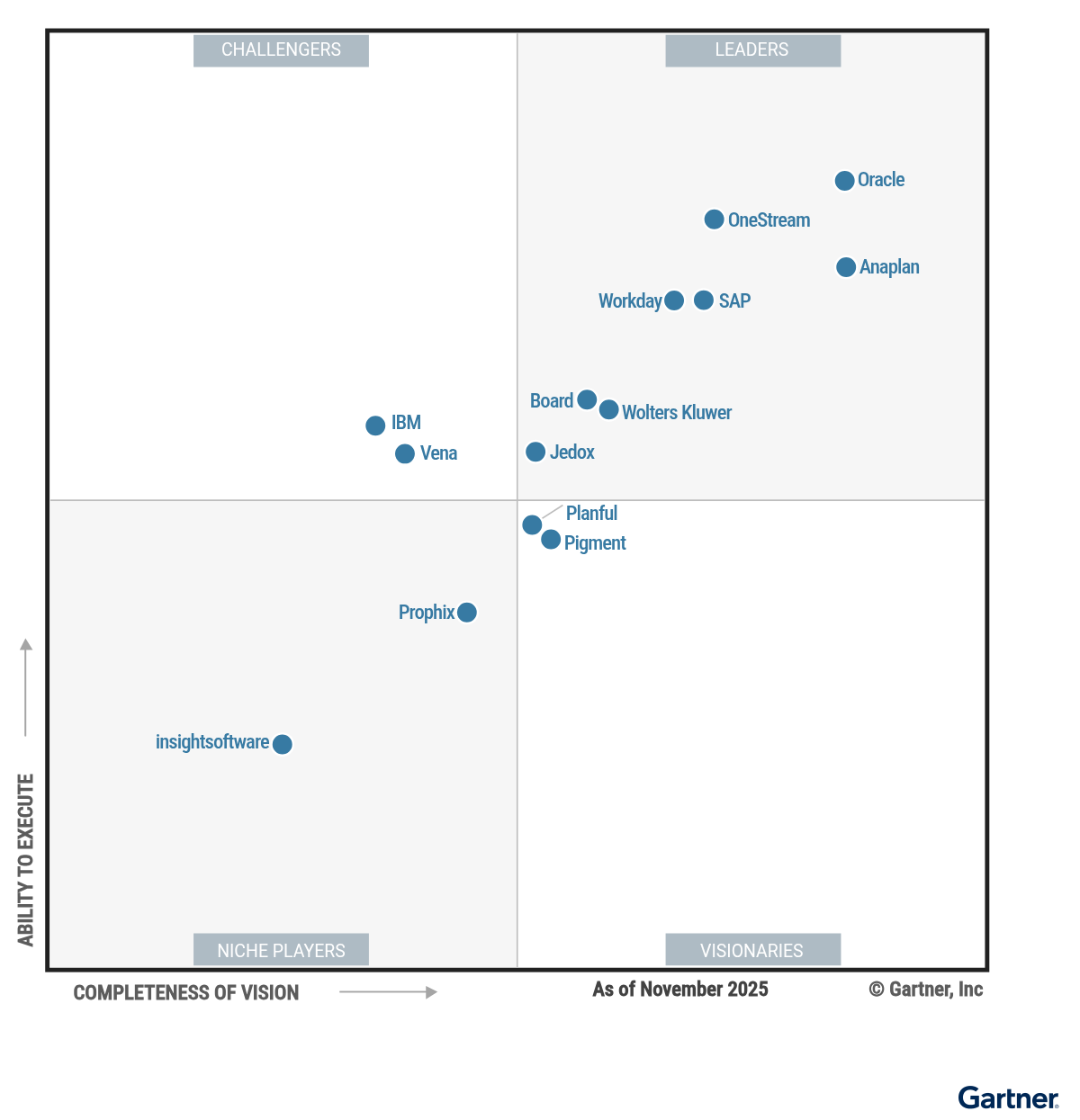
Vendor Strengths and Cautions
Anaplan
Anaplan is a Leader in this Magic Quadrant. Its product, the Anaplan platform, is known for delivering a cloud-native platform for integrated business planning (IBP), budgeting and forecasting as well as providing near-real-time connectivity in an integrated user experience. Anaplan’s ability to support a complex financial, strategic and operational supply chain as well as merchandise financial planning is evident in its strength in the retail sector.
A key feature is its proprietary Hyperblock calculation engine, for multidimensional modeling, efficient calculations and ad hoc scenario creation, important for scalable, enterprise data-driven decision making. In a future release, Anaplan also plans to accelerate partner developed applications through its new platform application framework starting with financial services and life sciences to deepen industry-vertical functionality and geographic coverage.
- Roadmap: Anaplan’s multiyear, $500 million innovation roadmap reflects a deliberate focus on accelerating product development over short-term financial returns. Its research and development is directed toward platform architecture, Anaplan Intelligence (AI) and enterprisewide planning applications across various domains such as go-to-market, supply chain and workforce highlighting vendor focus and IBP scope.
- IBP: Anaplan supports IBP use cases such as capital, Opex and revenue/margin planning, connecting strategic, financial, operational and external data across finance, supply chain, go-to-market and HR. It operates on a single platform, demonstrating an ability to support IBP maturity.
- Scenario planning: Anaplan automates and integrates real-time data feeds, including Bloomberg, OANDA and Nielsen, to enable cell-level event-driven recalculation, scenario refreshes and workflow alerts. High-volume support for versioning and scalability, flexible driver configuration and impact propagation across modules allow users to compare and update nonbase scenarios throughout the planning cycle.
- Add-on licensing: Anaplan’s prebuilt applications, such as Integrated Financial Planning and Operational Workforce Planning, are offered separately from the base subscription. These applications, which are regularly maintained and updated by Anaplan, require additional licensing, and organizations should factor these into cost considerations.
- GenAI releases: Two of Anaplan’s next-generation AI agents — CoModeler and Anomaly Detector Agent — are future roadmap releases. Its Anomaly Detector Agent trails vendors with released capabilities, limiting immediate CFO access to this capability.
- External drivers: Anaplan does not provide a prebuilt library of external economic indicators, which requires customers to source and integrate this data. This places additional responsibility on users to identify, acquire and manage relevant datasets, which impacts deployment and increases operational overhead.
Board
Board is a Leader in this Magic Quadrant. Its product, also called Board, integrates planning processes in a single platform, offering strategic, financial and operational planning with near-real-time analysis and data sharing. Board’s ability to support integrated planning is reflected in its IBP solution, developed with Oliver Wight, and this is evident in its strength in the manufacturing and retail sector.
A key feature is its Flex Grid interface, which provides self-service through an Excel-like experience, allowing users to enter, edit and analyze large volumes of data for detailed forecasting and scenario analysis. In a future release, Board plans to introduce a solution architect agent designed to auto-generate multidimensional calculation logic and dashboards via natural language.
- Economic indicators: Board Foresight analyzes over five million global datasets and correlates external indicators with internal time series data to surface metrics relevant to market shifts. This enables FP&A teams to incorporate relevant external intelligence, supporting continuous planning and risk assessment.
- Roadmap: Board’s 2026 roadmap introduces agents that combine reasoning and automation for cross-agent orchestration, enabling FP&A, economist, retail and supply chain agents to collaborate on a single semantic model. This approach drives critical continuous planning tasks with greater forecast accuracy across finance and operational teams.
- Risk detection: Board uses AI-/ML-driven balance sheet forecasting to identify working capital risks, such as analyze asset utilization and recommend Accounts Receivable (AR), Accounts Payable (AP) and debt actions. The Foresight Engine and Signals service enable real-time alerts, scenario testing and predictive modeling for FP&A risk planning.
- Geographic reach: Board’s customer base is concentrated in Europe, with a limited North American presence. The reliance on a partner-led delivery model in North America means execution depends on managing a partner’s capability and availability, requiring ongoing oversight to maintain consistent service and support.
- Support model: Board’s initial response times for critical issues range from one hour (Gold) to six hours (Standard). Customers are required to pay extra for the premium support tier, which offers faster issue resolution times.
- Data volume: Board reports lower actual data volumes in top customer deployments, despite an architecture designed for high capacity and concurrency. The platform’s scalability for high-throughput scenarios remains less demonstrated and requires further evaluation for peak data processing demands.
IBM
IBM is a Challenger in this Magic Quadrant. Its product, IBM Planning Analytics, is a configurable platform for financial and operational planning with an in-memory calculation engine for high-performance processing. IBM’s ability to efficiently handle extensive workloads helps to enable high performance and reliability for SKU planning, matrix reporting and product profitability and is evident in its significant retail client base.
A key feature is its integration of agentic AI within Planning Analytics, powered by watsonx GenAI. This coordinates enterprisewide data and processes, supporting process automation and AI-driven insights for planning and workflow integration. In a future release, IBM plans to integrate Planning Analytics with Microsoft Fabric to enable near-real-time data flows and reduce data replication.
- Scalability: IBM’s calculation engine uses a compressed data structure that stores only populated cells, improving memory efficiency. The platform supports multithreaded processing and auto-scales to meet workload demands, supporting consistent performance across large, complex FP&A models.
- Update process: IBM utilizes a containerized architecture, which allows software updates and security patching in a high availability environment that targets zero planned downtime, thus reducing the need for maintenance windows. This method supports the ongoing delivery of new features and security enhancements, reducing the operational impact for customers.
- AI explainability: IBM provides AI-driven explainability via its Planning Analytics Assistant using a GenAI feature called Explain cell. Users have the option to receive a natural-language contextual explanation that describes the logic and lineage of a model or calculation, enabling users to comprehend the logic behind a value.
- Data integration: IBM’s integration of its Planning Analytics platform with Microsoft Fabric is scheduled for 2026, meaning customers will not benefit from streamlined enterprise data flows until then. In the interim, near-real-time movement requires configuring Turbo Integrator and scheduling REST API endpoints, each relying on a separate ETL setup to coordinate data flows across hybrid environments.
- Pricing: IBM’s transparent tiered pricing model includes separate charges for additional users and advanced features such as the GenAI assistant. As organizations expand their use of AI, the per-user pricing structure often results in increased licensing costs, making it a critical consideration in AI scaling strategies.
- Data management: IBM Planning Analytics lacks native master data management (MDM) capabilities, requiring integration with external MDM solutions. This intentional design increases the integration effort and risk when aligning Planning Analytics with broader enterprise MDM systems, impacting data consistency across planning processes and total cost of ownership.
insightsoftware
insightsoftware is a Niche Player in this Magic Quadrant. Its product, JustPerform, offers web-based budgeting, planning and forecasting with an Excel-like interface and self-service reporting, dashboards and analytics. insightsoftware’s ability to support complex resource capacity, project margin forecasting and utilization-based revenue planning is evident in its significant professional services client base.
A key feature is its JustPerform sheets, a no-code multidimensional planning tool. This enables finance teams to build complex planning models using familiar Excel-like formulas, reducing IT dependency and accelerating model development. In a future release, insightsoftware plans to introduce a native Google Sheets add-in to support planning and collaboration for organizations using Google Workspace.
- AI governance: insightsoftware’s finance companion, Lineos, applies a human-centric AI approach, enabling finance teams to define rules, review AI recommendations and enforce granular data authorization. These AI governance controls support audit trails and enhance oversight of sensitive financial information.
- Model design: JustPerform’s proprietary engine enables FP&A teams to streamline financial planning by using drag-and-drop builders and a visual Data Flow Designer to manage planning models. This no-code functionality simplifies the setup of business rules, allowing finance teams to quickly adapt and update models as business requirements change.
- AI pricing: insightsoftware’s conversational AI, Lineos, comes at no additional subscription cost. This enables accessible natural language data analysis and automated insights, supporting finance organizations seeking practical, cost-efficient decision support.
- Scalability: Actual deployments of insightsoftware show relatively low concurrent user numbers, impacting organizations with large teams or complex planning needs. Misalignment between scalability requirements and the platform’s architectural capacity pose a risk of failing to meet performance expectations.
- Starter kits: Many of insightsoftware’s starter kits remain partner specific, resulting in increased configuration requirements and slower implementations. There is a risk of higher implementation and configuration costs for those relying on these kits.
- Scenario planning: insightsoftware supports independent scenario modeling only. Stacked or layered scenarios are not supported. Users cannot combine, overlay or manage dependencies across multiple scenarios, restricting advanced scenario planning, cumulative impact analysis and consolidated what-if workflows.
Jedox
Jedox is a Leader in this Magic Quadrant. Its product, Jedox EPM software, is a planning and performance management platform for budgeting, forecasting and reporting with AI, an in-memory database and customizable prebuilt models. Jedox’s ability to support complex sales and demand forecasting, product and store profitability analysis, and inventory management is evident in its significant retail client base.
A key feature is its JedoxAI, which combines GenAI and large language models (LLMs) with the in-memory planning engine. This delivers explainable, contextual financial insights, automates report narratives and supports historical and versioned data comparisons. In a future release, Jedox plans to introduce a modeling agent to support model builders by automating data integration, modeling and report creation.
- Predictive insights: Jedox maintains a strategic focus on research and development, with AI/ML funding tripling from 2023 to 2025. This investment supports automation through AIssisted Planning Wizards that help planners generate predictive forecasts, detect data outliers and automate repetitive tasks across planning workflows.
- AI data preparation: Jedox’s AIssited Data Preparation Wizard automates the process of detecting data outliers, suggesting replacements and preparing data for predictive modeling. Advanced data automation capabilities free up significant finance staff time for higher-value planning and analysis tasks.
- GenAI governance: Jedox applies a structured approach to GenAI governance that goes beyond standard compliance. Its architecture differentiates through instance-specific model fine-tuning and strict data isolation. Customers benefit by having separated GenAI environments, which prevent cross-client data exposure or use in external model training.
- Add-on licensing: Jedox requires additional fees or separate licenses for several core planning capabilities, including workforce, sales, and high-demand connectors, such as SAP, Salesforce, and Snowflake. The modular pricing structure, which varies based on customer requirements, introduces added complexity for organizations seeking comprehensive planning functionality.
- External drivers: Jedox does not offer a built-in library of external economic or market drivers. Relying on public or third-party sources introduces integration complexity, as administrators must configure extraction, transformation logic and scheduling to maintain consistency, control and alignment with planning processes.
- Data residency: Jedox relies on customer demand to establish dedicated cloud hosting in Canada and Latin America, currently provisioning Canadian and Latin American users in U.S.-based data centers. This approach introduces challenges related to data residency compliance and increased network latency for clients in regions outside of the United States, Europe, the Middle East, Asia and Australia.
OneStream
OneStream is a Leader in this Magic Quadrant. Its product, the OneStream platform, supports corporate planning processes, including data management, planning, forecasting, reporting and analytics. OneStream’s ability to support complex demand planning, product profitability and capital planning is evident in its significant manufacturing client base.
A key feature is its Extensible Dimensionality. This allows for both summarized and detailed planning and reporting within a single application, which is an asset for companies seeking integrated financial and operational reporting. In a future release, OneStream plans to introduce an operational analytics framework to support large-scale calculations on both internal and external data.
- Operational analytics: OneStream’s Dynamic Cube Services enable near-real-time synchronization of metadata and data from external sources without replication. This is ideal for rapidly changing external data sources, enabling more responsive planning and forecasting without reimporting data or modifying dimensions.
- Roadmap: OneStream continually reinvests in research, development and AI/ML to align with customer needs. Future focus includes real-time anomaly detection that triggers AI-generated commentary at specific data intersections, delivering contextual narratives and immediate insights to enable finance teams to accelerate decisions and midcycle planning corrections.
- AI integration: OneStream’s SensibleAI portfolio (Forecast, Studio and Agents) brings use cases enabled by AI right into the business workflows of the platform, supporting a centralized data model. This reduces complexity and improves end-user adoption, enabling finance teams to generate driver-based forecasts, align inputs across functions and reconcile plan data without manual intervention.
- AI pricing: SensibleAI Forecast and Studio require additional license fees within OneStream, which is an important consideration for organizations with constrained budgets. This pricing structure introduces additional cost considerations for clients with significant AI needs, impacting total cost of ownership and long-term budgeting.
- Starter kits: OneStream’s industry-specific starter kits are not included in the standard platform and are partner-developed solutions accessible via the company’s Solution Exchange. This approach requires additional effort and planning from clients, as access to these solutions depends on partner engagement rather than direct platform availability.
- Google integration: OneStream’s Google Workspace integration is limited to static documents and point-in-time data. Competing platforms offer real-time data sync, ad hoc analysis and collaborative planning directly in Google Workspace, leveraging native sharing and dynamic linking and giving finance teams more flexibility and seamless workflows.
Oracle
Oracle is a Leader in this Magic Quadrant. Its product, Oracle Fusion Cloud Enterprise Performance Management, offers platform capabilities and packaged solutions for financial and operational planning, as well as related analytics and reporting. Oracle’s ability to provide specialized solutions and initiatives tailored to the professional services industry, such as project and workforce planning, directly and through its partner network, is evident in its significant professional services client base.
A key feature is its integration of agentic AI within its financial planning solutions. This delivers automated insights, natural language interactions and predictive analytics to support decision-making and enterprisewide planning efficiency. In future updates, Oracle plans to continue to expand the use of transactional data in Fusion ERP to improve predictions, support root cause analysis and enhance AI within its planning platform.
- Roadmap: Oracle’s planned AI Agent Studio will enable users and partners to create and deploy custom AI agents across its application via a no-code platform. This will help users facilitate tailored automation for specific use cases, reducing dependence on vendor-provided agents and supporting unique workflow requirements.
- AI pricing: Oracle employs an all-inclusive named user pricing model. This structure streamlines contract negotiations and supports budget predictability, as it includes core AI agents built by Oracle in the base subscription at no extra charge, reducing operational risk and lowering barriers to AI adoption.
- Scenario planning: Oracle enhances scenario planning capabilities by leveraging Monte Carlo simulation, which quantifies risk through thousands of simulated outcomes based on input uncertainties. This capability enables organizations to assess the probability of achieving targets, supporting proactive adjustments and improved forecast confidence.
- External drivers: Oracle does not provide out-of-the-box libraries or proprietary data feeds for external performance drivers. Customers are required to integrate their own market data sources using the data integration engine and REST APIs.
- Data architecture: Oracle’s graph database functionality within Autonomous Database for FP&A requires API-based integration. This approach introduces additional configuration and implementation effort requiring specialized technical expertise to model data relationships.
- Language coverage: Oracle supports 20 languages, with an additional eight languages supported via the Smart View for Office add-in. This total is lower than other top vendors, which limits the user experience for multinational organizations that require broader language support for effective planning and collaboration.
Pigment
Pigment is a Visionary in this Magic Quadrant. Its product, Pigment, offers cloud-based financial performance management with purpose-built applications. Pigment’s ability to support annual recurring revenue modeling, SaaS metric tracking and scalability is evident in its significant technology client base.
A key feature is its Elastic Canvas, a distributed data architecture. This enables adaptable, integrated and scalable planning models, supporting concurrent users and AI agents and providing a centralized source of data for enterprisewide planning. In a future release, Pigment plans to expand its data and compute engine to further support performance and application of AI.
- Roadmap: Pigment’s 2026 roadmap innovation prioritizes its proprietary “vibe modeling” experience and a suite of AI Agents. Analyst, Planner and Modeler Agents will automate analysis, planning and modeling tasks, using advanced features for productivity and remaining competitive with AI agent capabilities offered by leading vendors.
- Data management: Pigment’s data hub consolidates master data from systems of record and shares it with planning models in real time, reducing manual reconciliation and duplication. This architecture enables shared, accurate data with near-real-time alignment across the platform, supporting connected planning and enhancing data integrity.
- Partner certification: Pigment is the only vendor with a project delivery requirement, mandating partners deliver at least three projects per year to maintain certification and demonstrate expertise through ongoing recertification. Quality is verified by partner and customer success managers, a plus for clients seeking high-quality implementations.
- Customer adoption: Pigment has limited customer adoption in critical operational planning areas, including marketing, IT and inventory planning, reflecting early-stage adoption. Despite its shared-data model supporting integrated business planning, low utilization outside workforce planning limits evidence of cross-functional planning maturity.
- Data residency: Pigment’s data residency options are limited to North America (USA) and the EU (Germany). Currently, customers cannot select other regions or countries for data hosting, which restricts flexibility for organizations with specific data localization or sovereignty requirements.
- Certification coverage: While Pigment conducts annual System and Organization Controls 1 (SOC 1) and System and Organization Controls 2 (SOC 2) Type II audits and maintains ISO 27001-aligned security policies, it does not currently hold formal certification for ISO 27001 (information security management), ISO 27017 (cloud-specific security controls) and ISO 27018 (protection of personal data in the cloud). This is a constraint for organizations with stringent regulatory or industry-specific compliance requirements.
Planful
Planful is a Visionary in this Magic Quadrant. Its product, the Planful platform, offers financial performance management, planning, budgeting, forecasting and modeling, reporting and process automation. Planful’s ability to deliver SKU-level planning, supply chain coordination and production costing is evident in its significant manufacturing client base.
A key feature is its SpotlightXL add-in for Excel and Google Sheets. This connects live to Planful data, allowing users to create and interact with reports in a familiar spreadsheet interface with centralized controls and security. In a future release, Planful intends to expand predictive capabilities through deeper integration of external data sources, including macroeconomic indicators further supporting decision making across planning cycles.
- Roadmap: Planful is developing five persona-based GenAI assistants (Workforce, Admin, Modeler, Controller and Planner) building on its AI Analyst Assistant. These assistants are designed to help finance users interpret financial results, reduce technical barriers and support broader strategic finance involvement.
- Scenario planning: Planful AI Analyst Assistant compares outcomes, identifies key impact variables and suggests scenarios for executive focus. Weighted scenario management via tagging, grouping and configurable probability assignment supports auditable, risk-adjusted planning.
- Workforce planning: Planful’s Workforce Pro module supports detailed workforce planning through a calculation engine for dynamic compensation modeling and employee-level actuals. Integrated data connections enable more precise headcount and cost forecasting, enhancing planning accuracy and alignment with HR strategies.
- Pricing: Planful’s advanced modules — such as Planful AI: Signals & Projections and Workforce Pro — and connectors to platforms like Snowflake and Power BI incur incremental subscription fees. This pricing model increases the total cost of ownership and limits some organizations’ ability to fully leverage advanced platform capabilities.
- Capacity: Planful’s reported data transfer volumes and concurrent user counts, as demonstrated by its top active customers, are lower than those of leading vendors. This indicates potential limitations for organizations with substantial data transfer needs or high user volumes.
- Language coverage: Planful supports 12 languages, which is competitive among midtier vendors but falls short of the broader coverage offered by market leaders. Specific localization and language needs remain a challenge for full enterprise adoption.
Prophix
Prophix is a Niche Player in this Magic Quadrant. Its product, Prophix One FP&A Plus offers automated and integrated planning, budgeting and forecasting on a single platform. Prophix’s ability to support complex SKU-level forecasting, bill of materials costing and capacity modeling is evident in its substantial manufacturing client base.
A key feature is its Prophix One Intelligence platform, featuring natural language Copilot and AI agents. This allows users to query data using natural language to generate charts, tables and narrative insights and to facilitate ad hoc analysis and decision making. In a future release, Prophix plans to introduce a modeling agent that automates model creation using existing data and outputs, accelerating discovery and reducing the time or technical skills required for model building.
- AI pricing: Prophix One Intelligence delivers integrated AI and predictive analytics directly within the core FP&A Plus platform, with no separate modules, additional fees or third-party tools. With this offering, Prophix provides a clear cost benefit by making advanced analytics accessible and streamlined for finance teams.
- Embedded BI: Prophix One FP&A Plus dashboards include embedded BI iFrames alongside native visualization options. Through near real-time integrations with major BI tools, licensed users can view consolidated, secure dashboards and access current data within a single platform, supporting streamlined decision making.
- Construction benchmarking: Prophix provides integrated access to construction sector financial benchmarking data, allowing customers to compare performance across key KPIs. This supports project-based organizations in identifying gaps, setting targets and leveraging external benchmarks for planning improvements.
- AI adoption: Prophix exhibits low active user adoption of AI/ML predictive features in core areas such as predictive cash flow forecasting and overall AI/ML utilization, despite these capabilities being embedded in standard offering pricing. This limited utilization reduces demonstrable value and reflects continued difficulty in translating AI capabilities into broad, active user engagement.
- Pricing: Prophix charges additional fees for development and test environments and for source system integrations beyond the first included connector. Organizations with multisystem landscapes or requirements for multiple environments incur a higher total cost of ownership, which reduces cost predictability and limits accessibility for scalable deployment.
- Project planning: Prophix does not offer project planning starter kits, which limits support for organizations seeking ready-to-use templates and accelerated deployment for project planning processes. The absence of these resources creates risk for longer implementation times and increased configuration effort to build project planning capabilities.
SAP
SAP is a Leader in this Magic Quadrant. Its product, SAP Analytics Cloud (SAC), combines BI, planning capabilities and predictive analytics in one cloud environment. SAP’s ability to help clients manage product costs, streamline planning with SAP Integrated Business Planning and monitor production efficiency is evident in its significant manufacturing client base.
A key feature is its planning integration approach with SAP Business Data Cloud. This provides centralized access to curated data, reduces data replication and supports AI-driven insights and integrated planning from a single data source. In a future release, SAP plans to introduce planning AI agents to review internal plan data and continuously monitor external data to identify risks and provide impact analysis for planners.
- Scenario planning: SAP Analytics Cloud compass integrates Monte Carlo simulation, allowing users to define drivers and value ranges to assess the impact of uncertainties in financial planning. Users are able to simulate thousands of scenarios, generating probability distributions for key performance indicators (KPIs) and revealing pessimistic, realistic and optimistic outcomes.
- Starter kits: SAP offers over 300 prebuilt planning and analytics content packages, including line-of-business and industry-specific options, at no additional cost for SAC for planning users. Packages are activated via the SAC Content Network and typically implemented in two to four weeks, providing CFOs and planning teams with standardized, vendor-supported models.
- Geographic reach: SAP’s global network includes an internal team and partner ecosystem across all regions and industries, supporting scalable planning for complex enterprises. Localized delivery is available through customer-selected data centers, with multilingual digital hubs and SAP Business Content Packages facilitating adoption and reducing configuration.
- Reporting access: SAP requires scheduled static export formats, including PDF, PowerPoint, Excel and comma-separated values (CSV), for report distribution to nonlicensed users. Nonlicensed users only access SAC widgets within MS Office interfaces that are set to offline or do not refresh automatically, limiting real-time interaction capabilities.
- AI pricing: Embedded AI features such as Smart Insights, Smart Discovery and Just Ask are free. Features such as AI-assisted advanced formula generation and commenting require CFOs to purchase AI units. This model results in consumption pricing sensitivity dependent on usage.
- Data reconciliation: SAC’s reconciliation process requires users to create reconciliation structures and utilize drill-through functionality for variance identification. Despite automation features like Data Change Insights, reliance on user-defined steps creates risk for reduced efficiency and increased reconciliation effort.
Vena
Vena is a Challenger in this Magic Quadrant. Its product, Vena Complete Planning, is a platform integrated with Microsoft 365 that offers AI, ML and BI capabilities with preconfigured solutions for various use cases. Vena’s ability to support cost modeling, inventory planning and capital expenditures (CapEx) forecasting is evident in its significant manufacturing client base.
A key feature is Vena Copilot, an AI agent that can automatically generate narrative explanations, highlighting key drivers behind variances and helping finance teams increase productivity, reduce manual effort and improve planning efficiency through automated analysis. In a future release, Vena plans to introduce new operational tables that support larger and more diverse data volumes integrated into Excel, enabling deeper planning across complex scenarios.
- Cloud security: Vena leverages Microsoft Azure and AWS for data storage, with options for flexibility, scalability and geographic coverage. The platform’s multicloud architecture, data residency options and encryption support are designed to address security and compliance requirements for global organizations.
- AI visualization: Vena’s AI-powered visualization analyzes data to identify and explain key drivers influencing metrics and KPIs. This capability enables business leaders to quickly understand segmented performance factors, supporting more informed decision making and targeted improvements.
- Microsoft integration: Vena natively integrates with Excel, PowerPoint and Teams, transforming spreadsheets into an FP&A platform. Vena Copilot in Microsoft Teams streamlines report generation and budget inputs. This experience drives user adoption for budgeting, forecasting, variance analysis and reporting, minimizing change management barriers.
- AI pricing: Vena restricts access to advanced AI/ML features based on package tier. Vena Insights is only included in the Complete package; Professional package customers must pay an additional fee for Insights and purchase extra Copilot user licenses beyond the single included license.
- Google integration: Vena does not support integration with Google Workspace applications such as Sheets, Docs, Slides or Gmail. This limitation affects organizations using Google tools by restricting collaboration, real-time data sharing and workflow efficiency, making report sharing in planning processes more difficult.
- Geographic reach: Vena’s financial planning software customer base is heavily concentrated in North America, with limited adoption in other regions. This concentration, along with Europe’s complex regulatory environment and multilingual needs, creates operational challenges for multinational organizations seeking broader support.
Wolters Kluwer
Wolters Kluwer is a Leader in this Magic Quadrant. Its product, CCH Tagetik, is an AI-based financial planning solution with near real-time analysis, modeling and reporting, as well as data-driven predictive forecasts. Wolters Kluwer’s ability to support enterprisewide planning, including sales and operations planning (S&OP), profitability analysis, production cost, supply chain, cash flow and ESG planning & analytics, is evident in its significant manufacturing client base.
A key feature is its Ask AI. This automates planning processes and workflows by suggesting, validating and executing steps, supporting time savings, anomaly detection and self-service analytics with both visual dashboards and familiar Excel 365. In a future release, Wolters Kluwer plans to evolve toward a data lakehouse architecture with data fabric connectors linking data and metadata to help finance structure flows, KPIs and dimensions across models.
- Data residency: Wolters Kluwer provides country-level data center selection across North America, Europe and APAC, ensuring in-country storage on AWS and Azure. This supports CFOs and organizations with complex international data requirements by enabling compliance and secure data storage, offering assurance of vendor capability for data residency.
- Sensitivity modeling: Wolters Kluwer’s no-code scenario management and modeling features include user-friendly probabilistic sensitivity modeling and distributions. This lays the groundwork to build a more comprehensive outlook of market conditions, a necessary process step to eventually automate scenario planning.
- Adoption platform: CCH Tagetik’s Digital Adoption Platform, integrated as an in-app overlay delivered through a learning academy, provides in-product training using a train-the-trainer model. This centralized approach supports global scale, helping users build proficiency and reduce time-to-value across teams and regions.
- Add-on licensing: Wolters Kluwer’s operational planning modules, including workforce planning, demand planning, supply planning and production cost planning & control, are priced as separate, per-user add-ons. Organizations that require multiple modules will incur additional investment for operational planning.
- Feature releases: Wolters Kluwer has experienced delays in delivering advanced collaboration features and master data management enhancements following a reprioritization of its product roadmap. These postponements affect customers seeking timely access to advanced collaboration and data governance capabilities, warranting roadmap evaluation.
- Data architecture: Wolters Kluwer is moving to a data lake house architecture with diversified data fabric and graph capabilities. Full enablement of agentic AI-driven continuous planning depends on the completion of these architectural enhancements.
Workday
Workday is a Leader in this Magic Quadrant. Its product, Workday Adaptive Planning, is an enterprise planning, reporting & analysis platform that applies AI to driver-based planning using algorithms to forecast outcomes and show how independent variables influence predictions. Workday’s ability to support complex project margin, utilization rate and billable hour planning is evident in its strong professional services client base.
A key feature is its personal & shareable what-if scenarios. This enables collaborative scenario creation and evaluation, helping organizations model changes, align teams and make data-driven decisions. In a future release, Workday plans to expand its role-based Planning Agent with new AI-powered skills for planners, including KPI monitoring, scenario generation, model architecture & design, formula engineering and continuous forecasting and integration of predictive forecasting into planning workflows.
- Dashboards: Workday offers unlimited view-only user licenses at no additional fee that allow users to view reports and dashboards online. It offers data security configurations to control what users see and provides a more secure and user-friendly approach to sharing information across the enterprise.
- Partner model: Workday enforces partner recertification with each twice-per-year release and requires accreditation plus joint deployments before partners lead projects. This structured oversight supports consistent implementation quality and contributes to strong customer retention, reinforcing business value for finance and planning leaders.
- Product development: Workday maintains a customer-first approach to product development, with over 65% of enhancements driven by user input. Strategic research and development investments are guided by direct engagement through advisory councils and design partner groups, helping prioritize planning capabilities.
- External drivers: Workday relies on its embedded integration framework and automated scheduled data loads to import external information into its Workday Adaptive Planning templates. The predictive forecast feature is limited to three data levers per run, which restricts the complexity and depth of multifactor analysis for organizations that rely heavily on external drivers and require more granular forecasting insights.
- ESG starter kit: Workday’s specialized industry starter kit for sustainability planning is delivered exclusively by external partners rather than directly by Workday. Implementation requires partner engagement, and oversight of the implementation depends on the selected partner’s capabilities and practices.
- Capital planning: Workday does not offer native, out-of-the-box functionality for key metrics like net present value (NPV) or internal rate of return (IRR) throughout the capital planning life cycle. Users have to rely on an additional configuration for comprehensive, standardized financial analysis throughout the capital planning life cycle.
Vendors Added and Dropped
We review and adjust our inclusion criteria for Magic Quadrants as markets change. As a result of these adjustments, the mix of vendors in any Magic Quadrant may change over time. A vendor's appearance in a Magic Quadrant one year and not the next does not necessarily indicate that we have changed our opinion of that vendor. It may be a reflection of a change in the market and, therefore, changed evaluation criteria, or of a change of focus by that vendor.
Added
No vendors were added to this Magic Quadrant.
Dropped
Kepion no longer appears in this Magic Quadrant report because it did not meet the inclusion criteria for the Customer Interest Indicator.
Strata no longer appears in this Magic Quadrant report because it did not meet the inclusion criteria for industry diversification.
Inclusion and Exclusion Criteria
To be considered for inclusion, a vendor must meet the specified market presence criteria, performance criteria and product capabilities. Furthermore, they must offer the solution on the cloud, adhering to the definition provided in the exclusion criteria.
To qualify for inclusion, providers need to meet the following criteria:
Product Capabilities
The vendor must deliver a cloud-based financial planning software product that includes the following product capabilities:
- Support the mandatory financial planning software features as defined in the Market Definition section.
- Deploy financial planning software as a cloud-based solution via software as a service (SaaS) on a provider-managed public or private cloud.
- Must have released its financial planning software for general availability before 31 December 2022 and be actively sold on a stand-alone basis, independent of other offerings or services.
Market Presence
The vendor must meet either of the following performance criteria:
- Have booked cloud subscription revenue of at least $35 million USD (or foreign currency equivalent) for the stand-alone cloud FPS for the year — 1 June 2024 to 31 May 2025 — excluding revenue from on-premises, hosted, managed cloud service or other deployment models.
- Revenue must come from stand-alone technology sales to financial planning software customers only and not from other products, other indirect sales channels like resellers, distributors or other applications who then sell the product to their own customers or embed the vendor’s product within their offering.
- Revenue from services, implementation fees or any adjacent modules beyond the Market Definition specified above should not be included.
OR
- Revenue generated from financial planning software should meet a minimum compounded annual growth rate of 20% between 1 June 2023 to 31 May 2025
The vendor must meet all of the following criteria for their financial planning software:
- Actively market and sell products to organizations with at least 50% of customers having annual revenues above $50 million over the last year. The definition of a customer is a single legal entity paying for stand-alone financial planning software.
- Have at least 300 customers “live” by 31 May 2025 and market to “live” customers in at least two regions across America, EMEA, Asia/Pacific or Latin America. (“Live” is defined as the customers that are on the current SaaS version of the product as defined in the Market Definition and are in production.)
- Must service financial planning software clients across at least five of the following major industries and must also have at least a 3% client portfolio representation in at least five of those industries, ensuring a diverse industry mix:
- Banking, finance and insurance
- Communications and telecom
- Education
- Energy and utilities
- Government
- Healthcare
- Life sciences
- Manufacturing
- Media and entertainment
- Professional services
- Retail
- Technology
- Transportation and logistics
- The vendor must rank among the top 16 for the Customer Interest Indicator (CII) as defined by Gartner for this Magic Quadrant. The CII was calculated using a weighted mix of internal and external inputs that reflect Gartner client interest, vendor customer engagement and vendor customer sentiment from 1 May 2024 to 31 May 2025.
Exclusion Criteria
This Magic Quadrant excludes vendor’s on-premises-only solutions and any cloud solutions that do not meet the following cloud service attributes:
- Hosts within the vendors or a third-party public cloud environment (e.g., AWS, Google, Microsoft Azure).
- Implements upgrades directly as part of the cloud service, not through a third party or managed service provider.
- Licenses the cloud service on a subscription or metered pay-for-use basis.
- Prohibits modification of its source code. Configuration via citizen developer tools and extension via platform as a service (PaaS) — by partner, vendor or user — is allowed.
- Uses a single code line for all customers of the cloud service to enable rapid deployment of new functionality by the vendor.
- Offers self-service provisioning capabilities for the software (at least for development and test instances) without requiring the involvement of the vendor.
Evaluation Criteria
Ability to Execute
Gartner evaluates vendors by assessing their product or service, customer experience, sales execution and pricing, market responsiveness, overall viability and operations. These criteria are used to determine how effectively vendors compete in the market, support customer success, create positive perceptions and respond to evolving market demands. It is important to note that, in this Magic Quadrant, marketing execution is not evaluated as part of the criteria.
In this Magic Quadrant, the product or service, customer experience, sales execution/pricing and market responsiveness criteria are particularly important:
- Product or service encompasses the vendors’ ability to deliver current capabilities, high quality, comprehensive feature sets and expertise, with a strong emphasis on functionality that enhances financial planning and decision-making processes for end users.
- Sales execution/pricing reflects the vendor’s ability to deliver clear and flexible pricing models, enabling financial planning customers to fully understand their purchases throughout the buying process.
- Market responsiveness ensures vendors can rapidly adjust their software to address the evolving needs of CFOs, enabling them to offer innovative solutions that enhance decision making, strategic planning, performance management and resource allocation.
- Customer experience evaluates the vendor’s capacity to deliver a journey that enables clients to succeed with the product or service.
Ability to Execute Evaluation Criteria
| Evaluation Criteria | Weighting |
|---|---|
Product or Service | High |
Overall Viability | Medium |
Sales Execution/Pricing | High |
Market Responsiveness/Record | High |
Marketing Execution | NotRated |
Customer Experience | High |
Operations | Medium |
Source: Gartner (December 2025)
Completeness of Vision
Gartner assesses vendors by evaluating their ability to articulate their perspectives on the market’s current and future direction to anticipate customers’ needs and technology trends and to address competitive forces. Analysts also evaluate Completeness of Vision by vendors’ understanding and articulation of how they exploit market forces to create new opportunities for themselves and their clients. It is important to note that, in this Magic Quadrant, a vendor’s marketing strategy and sales strategy is not evaluated as part of the criteria.
In this Magic Quadrant, market understanding, offering strategy and innovation are also particularly important:
- Market understanding focuses on the vendor’s ability to understand and anticipate future buyers’ requirements and needs.
- Offering strategy involves using the information gathered about future buyers’ requirements and needs to shape or enhance the products and services offered.
- Innovation enables vendors to develop cutting-edge solutions that not only meet current demands but also anticipate future trends, providing CFOs with tools that enhance efficiency, accuracy and strategic foresight.
Completeness of Vision Evaluation Criteria
| Evaluation Criteria | Weighting |
|---|---|
Market Understanding | High |
Marketing Strategy | NotRated |
Sales Strategy | NotRated |
Offering (Product) Strategy | High |
Business Model | Medium |
Vertical/Industry Strategy | Medium |
Innovation | High |
Geographic Strategy | Medium |
Source: Gartner (December 2025)
Quadrant Descriptions
Leaders
Leaders demonstrate a market-defining vision for how financial planning software empowers business leaders to achieve objectives in planning, budgeting and forecasting by leveraging integrated platforms with advanced analytics and AI. They are best positioned to shape market direction, offering mature, enterprise-scale solutions that consolidate financial and operational planning in a single, governed environment. In addition to a deep understanding of the market, Leaders have a proven track record and the ability to attract and retain customers with high retention rates.
Their platforms are architected for enterprisewide scale and high concurrency, supporting complex, large-scale modeling and integrated planning across functions. The technical foundation is ahead of most current deployments, with full-scale capabilities yet to be realized by most of their customers.
Leaders continuously expand platform functionality, adding data integration, transformation and management capabilities, while extending core offerings beyond traditional finance to include advanced modules like ESG planning and compliance support. Their integrated platforms enable integrated planning, budgeting and forecasting across functions, enhancing data governance and accuracy. Highly configurable designs allow complex modeling scenarios in detail, supporting unique industry needs.
Leaders are at the forefront of innovation, embedding AI and ML directly into planning workflows. Their use of agentic AI streamlines complex processes and executes multistep tasks, while advanced predictive tools — including stochastic simulations — help users analyze uncertain business events and model probable impacts. AI agents support end users with conversational data analysis, report generation and advanced calculation logic via natural language prompts. Automated insight summaries improve reporting efficiency, and full explainability features ensure transparency and trust in predictive forecasts and AI-driven recommendations.
Leaders consistently win new deals across geographies, industries and organization sizes. They deliver tailored solutions, including preconfigured industry starter kits and dedicated marketplaces for vertical-specific needs. Implementation strategies rely on proven methodologies structured around clear phases to ensure faster deployment. Partner ecosystems are rigorously managed through vetting, training and certification cycles, ensuring high-quality delivery and customer success. Through these efforts, leaders maintain their position at the forefront of the financial planning software market.
Challengers
Challengers deliver robust product capabilities that address clients’ diverse planning needs with customizable solutions, automating workflows and simplifying complex financial processes through preconfigured packages. Their platforms feature enterprise-grade modeling, leveraging Excel’s flexibility alongside multidimensional planning technologies for detailed model design and analysis. With a breadth of cloud infrastructure options, Challengers have established market credibility, a solid customer base, a proven ability to win deals and a strong position to succeed in the market.
Challengers work collaboratively with clients to co-create implementation strategies focused on customer success and accelerated time-to-value, often with preconfigured planning templates. Implementation processes align customers with certified experts or partners who oversee requirements gathering, provisioning, multidimensional data integration and model design. Quality assurance is supported by ongoing partner oversight and annual recertification. Vendor expert services and performance reviews ensure consistent customer experience and rapid issue resolution.
Though Challengers exhibit strong execution capabilities and product features to meet customer needs, their vision and pace of innovation remains behind the most transformative advancements introduced by Leaders and Visionaries. They primarily focus on enhancing established core areas such as planning, budgeting and forecasting, while simultaneously advancing leading capabilities such as agentic and GenAI integration, conversational interfaces and automated variance analysis. This strategic shift moves beyond basic functionality, positioning their products closer to industry innovation, though more limited compared with Leaders and Visionaries.
Challengers may be well suited for organizations that prioritize reliable execution and proven product and support practices over rapid product innovation. FP&A leaders should evaluate Challengers in light of their current strengths and limitations, carefully considering how any gaps in advanced or emerging capabilities could affect their ability to achieve near-term objectives and progress toward higher levels of future FP&A maturity.
A Challenger can move to the Leader quadrant by showing a more forward-thinking perspective on market evolution and maintaining strong execution. Conversely, a Challenger may shift to Visionary or Niche Player status by prioritizing specialized innovation or segment-specific capabilities over broader expansion.
Visionaries
Visionaries demonstrate a leading product vision and comprehensive roadmap by integrating strategic AI and ML capabilities, including automated intelligence features that improve forecast accuracy and accelerate decision making. They invest heavily in continuous innovation, often deploying enhancements multiple times per week using continuous integration and continuous delivery (CI/CD) methodologies, and collaborate with advisory boards and user interviews to refine their strategies.
Visionaries align their approaches with emerging trends shaping the financial planning software market, emphasizing predictive forecasting, conversational planning and workflow automation through specialized AI agents. Their roadmap includes advanced innovations such as large language models that enhance natural language processing for intuitive user interactions and real-time variance analysis.
Architectural enhancements, including horizontally distributed data engines, support large-scale datasets and enable IBP. Customized algorithms address complex scenarios, while integrated environments foster cross-functional planning across finance, HR, marketing and operations. This cohesive approach reflects commitment to modernization in the financial planning software market.
Though Visionaries exhibit a strong and differentiated vision, they may be limited in market presence and execution maturity. Customer bases are often regionally concentrated and may lack industry-specific starter kits for certain sectors.
Visionaries may be an appropriate choice for organizations seeking innovation from vendors with growing market momentum. This may offer a competitive advantage or an opportunity to influence the vendor’s product roadmap. However, given the comparatively limited market presence of Visionaries, organizations evaluating these providers should closely assess their ability to meet execution requirements for specific regions and industries.
A Visionary can move to the Leader quadrant by strengthening execution and demonstrating sustained growth through impactful innovation. Conversely, Visionaries may shift to Niche Player status if they narrow their focus to specialized markets or technologies.
Niche Players
Niche Players excel within specific segments of the financial planning market, offering tailored solutions that meet distinct buyer needs. While they may lack the broad vision and innovation breadth of more dominant vendors, they demonstrate strength through focused capabilities, such as vertical starter kits and accelerators for industries like construction, healthcare and professional services. Their platforms often feature high-performance calculation engines and integrated planning environments that reduce complexity and support granular planning models.
These vendors emphasize customer-driven strategies, including in-house implementations by domain experts and intuitive, finance-owned configurations using familiar tools like Excel. Their offerings support integrated planning and reporting, often replacing multitool complexity with a single, scalable system. Visual workflows and autonomous finance features — such as AI and natural language copilots — streamline processes and accelerate planning cycles, enhancing usability for finance teams.
Operations and go-to-market strategies remain concentrated in specific geographies or verticals, and while execution may be less proven across broader markets, their deployment models support timely implementations. Pricing remains competitive and transparent, and delivery models are designed to support consistent time-to-value for simple to moderately complex scenarios.
Though some organizations may lean toward vendors with broader market presence, Niche Players can be a strong fit for those seeking specialized capabilities aligned to their size, complexity or industry. FP&A leaders should assess these vendors’ geographic focus and solution depth to determine alignment with functional objectives and long-term planning needs.
Niche Players can move to the Visionary quadrant by developing a compelling innovation roadmap or into Challengers by expanding execution and product capabilities. Their advancement in the market depends on their ability to either broaden their vision by embracing trends such as pervasive AI agents and adaptive automation or to scale operational excellence.
Context
The evolution of cloud-based financial planning software and analytics has enabled organizations to leverage a broader array of data sources, including transactional, operational and external data. In some cases, these solutions offer access to near real-time information, further enhancing decision-making capabilities.
Access to a wider variety of data sources allows CFOs and their teams to address a broader range of financial and operational planning requirements. However, capitalizing on this opportunity often demands new technology and infrastructure investments tailored to both current and future organizational needs.
In addition to AI capabilities such as predictive analytics and insights and confidence metrics driven by natural language processing (NLP), the integration of agentic and GenAI is automating complex, multistep tasks. Advanced probabilistic tools like stochastic simulations further empower FP&A leaders to quantify risk and confidently analyze uncertain business events.
The following are key considerations and recommendations for assessing vendors that are best suited to meet buyers’ needs.
Assess implementation strategy and support:
- Assess the existing technology portfolio and how that technology stack would best integrate with the financial planning software.
- Investigate the rigor of vendor oversight, including mandatory partner recertification and consistent quality control mechanisms, to ensure long-term implementation success.
- Evaluate each vendor’s prebuilt connectors to ERPs, CRMs and accelerators/templates, including preconfigured tools to expedite implementation and integration, and vendors’ typical implementation time frames and costs.
- Determine the experience and support each solution provider has within the region and the specific technology ecosystems of the vertical.
Explore the differentiating features and vendor roadmaps:
- Understand that product development features and roadmaps differ between vendors.
- Confirm the vendor’s roadmap addresses emerging planning domains, reflecting shifts in market demand.
- Evaluate current and future advanced analytics capabilities, including the use of agentic AI for workflow automation, GenAI for insights and probabilistic tools like stochastic simulations for quantifying financial risk.
Examine the pricing models:
- Recognize that vendors in this market have pricing models mainly driven by user type, user volume or add-on support services. Features such as specialized AI capabilities, additional workspace beyond allocated limits and advanced ML functionalities might incur additional costs based on the vendors’ pricing models.
For further guidance, a more detailed analysis of the service providers’ capabilities, with scoring based on different use cases, is available in Critical Capabilities for Financial Planning Software.
Market Overview
The mandate for financial planning and analysis (FP&A) transformation continues, requiring the optimization of financial planning processes across complex operations and diverse, decentralized enterprise resource planning (ERP) and operational systems. Organizations are increasingly seeking agile, cloud-native platforms built for enterprisewide scale and high user concurrency, which can extract on-demand, value-added insights crucial for driving financial value across the enterprise.
To meet this demand, vendors now embed advanced features, including agentic artificial intelligence (AI) and stochastic simulations, such as Monte Carlo simulation, directly into planning workflows. These features automate tasks and precisely quantify strategic risk in near real time, typically delivered as software as a service (SaaS) cloud offerings.
Market Trends
The Expansion of AI in Financial Planning
Generative AI (GenAI) and agentic AI, alongside machine learning (ML), are redefining financial planning software by embedding intelligent automation into core workflows. Vendors are aligning roadmaps to meet demand for practical automation and operational clarity, offering natural language interfaces, predictive scenario engines and real-time anomaly detection. Forecasting capabilities now extend beyond time-series models to include regression, decision trees and neural networks, enabling multivariate analysis and deeper scenario planning.
These tools incorporate external drivers like inflation or GDP, improving forecast precision and enabling automated variance explanations and executive summaries. As AI adoption grows, trusted data foundations remain essential for delivering relevant, high-quality insights (see Innovation Insight: AI in Financial Planning Software).
Deep Data Integration and Connectivity
Modern planning solutions rely on deep data integration practices, with vendors enhancing connectivity through certified connectors and open application programming interfaces (APIs) for ERP, human capital management (HCM) and customer relationship management (CRM) systems. Integration with cloud data platforms like Snowflake, Microsoft Fabric and Databricks enables near-real-time data flows and minimizes replication.
Low-code and no-code tools empower finance teams to manage data mapping and transformation independently. AI-assisted integration features suggest mappings, detect anomalies and automate logic, ensuring data quality and consistency.
Interoperability with business intelligence (BI) tools, such as Power BI, Tableau and Qlik, ensures consistent reporting, while productivity suite integrations, such as Excel, PowerPoint and Teams, extend planning access and collaboration, reinforcing a single source of truth across the enterprise.
Collaboration and Connected Planning Across Functions
IBP continues to be a strategic priority for financial planning software providers, enabling organizations to align financial and operational plans across departments. Vendors are expanding platform capabilities to support cross-functional collaboration through specialized planning modules for workforce, supply chain, demand, capital, marketing and environmental, social and governance (ESG). These modules allow teams to model domain-specific assumptions while maintaining consistency with financial forecasts.
Near-real-time impact propagation ensures that changes made in one planning area — such as headcount or sales — area promptly update related financial statements, reducing manual reconciliation and improving planning agility. Scenario modeling tools further support collaboration by allowing users to simulate trade-offs across functions and evaluate the combined impact of layered assumptions.
Acronym Key and Glossary Terms
| AI | Artificial intelligence |
| API | Application programming interface |
| BI | Business intelligence |
| CPG | Consumer packaged goods |
| CRM | Customer relationship management |
| DAX | Data Analysis Expressions |
| EMEA | Europe, the Middle East and Africa |
| ERP | Enterprise resource planning |
| ESG | Environmental, social and governance |
| FP&A | Financial planning and analysis |
| GenAI | Generative artificial intelligence |
| IBP | Integrated business planning |
| JDBC | Java Database Connectivity |
| KPI | Key performance indicator |
| LLM | Large language model |
| M&A | Mergers and acquisitions |
| ML | Machine learning |
| MDM | Master data management |
| NLP | Natural language processing |
| OData | Open Data Protocol |
| ODBC | Open Database Connectivity |
| PA | Planning Analytics |
| REST APIs | Representational State Transfer Application Programming Interfaces |
| S&OP | Sales and operations planning |
| TM1 | Table Manager 1 |
| WCAG | Web Content Accessibility Guidelines |
Ability to Execute
Product/Service: Core goods and services offered by the vendor for the defined market. This includes current product/service capabilities, quality, feature sets, skills and so on, whether offered natively or through OEM agreements/partnerships as defined in the market definition and detailed in the subcriteria.
Overall Viability: Viability includes an assessment of the overall organization's financial health, the financial and practical success of the business unit, and the likelihood that the individual business unit will continue investing in the product, will continue offering the product and will advance the state of the art within the organization's portfolio of products.
Sales Execution/Pricing: The vendor's capabilities in all presales activities and the structure that supports them. This includes deal management, pricing and negotiation, presales support, and the overall effectiveness of the sales channel.
Market Responsiveness/Record: Ability to respond, change direction, be flexible and achieve competitive success as opportunities develop, competitors act, customer needs evolve and market dynamics change. This criterion also considers the vendor's history of responsiveness.
Marketing Execution: The clarity, quality, creativity and efficacy of programs designed to deliver the organization's message to influence the market, promote the brand and business, increase awareness of the products, and establish a positive identification with the product/brand and organization in the minds of buyers. This "mind share" can be driven by a combination of publicity, promotional initiatives, thought leadership, word of mouth and sales activities.
Customer Experience: Relationships, products and services/programs that enable clients to be successful with the products evaluated. Specifically, this includes the ways customers receive technical support or account support. This can also include ancillary tools, customer support programs (and the quality thereof), availability of user groups, service-level agreements and so on.
Operations: The ability of the organization to meet its goals and commitments. Factors include the quality of the organizational structure, including skills, experiences, programs, systems and other vehicles that enable the organization to operate effectively and efficiently on an ongoing basis.
Completeness of Vision
Market Understanding: Ability of the vendor to understand buyers' wants and needs and to translate those into products and services. Vendors that show the highest degree of vision listen to and understand buyers' wants and needs, and can shape or enhance those with their added vision.
Marketing Strategy: A clear, differentiated set of messages consistently communicated throughout the organization and externalized through the website, advertising, customer programs and positioning statements.
Sales Strategy: The strategy for selling products that uses the appropriate network of direct and indirect sales, marketing, service, and communication affiliates that extend the scope and depth of market reach, skills, expertise, technologies, services and the customer base.
Offering (Product) Strategy: The vendor's approach to product development and delivery that emphasizes differentiation, functionality, methodology and feature sets as they map to current and future requirements.
Business Model: The soundness and logic of the vendor's underlying business proposition.
Vertical/Industry Strategy: The vendor's strategy to direct resources, skills and offerings to meet the specific needs of individual market segments, including vertical markets.
Innovation: Direct, related, complementary and synergistic layouts of resources, expertise or capital for investment, consolidation, defensive or pre-emptive purposes.
Geographic Strategy: The vendor's strategy to direct resources, skills and offerings to meet the specific needs of geographies outside the "home" or native geography, either directly or through partners, channels and subsidiaries as appropriate for that geography and market.