Market Guide for Unified Commerce Platforms Anchored by AI-Enabled POS for Tier 2 Retailers
27 October 2025 - ID G00809866 - 41 min read
By Kelsie Marian, Max Panther Hammond
Vendors are increasing AI capabilities to improve unified commerce platforms and allow Tier 2 retailers to deliver more seamless customer experiences. Though POS applications still anchor such platforms, new architectures are emerging. Use this research and vendor identification tool to understand market dynamics.
Overview
Key Findings
- Technology providers are integrating AI into point of sale (POS) applications to enhance the associate experience, personalize customer interactions, and improve operational excellence, including predictive capabilities for loss prevention and order fulfillment.
- While POS continues to be the central integration point for unified commerce today, emerging platform architectures treat it as just one of many modular, extensible nodes within a broader commerce ecosystem.
- POS integration with smart check-out and Internet of Things (IoT) devices — particularly those with RFID — is becoming increasingly critical for Tier 2 retailers to streamline inventory management, reduce shrinkage, and accelerate check-out experiences.
- Cloud-native Tier 2 platforms are optimized for mobile devices to enable store associates to access POS functions and AI-driven features, such as personalized promotions and real-time inventory visibility, to improve customer experience and operational efficiency.
Recommendations
- Position POS upgrades as a strategic opportunity to modernize store infrastructure with embedded AI capabilities that enhance agility, intelligence, and associate enablement.
- Invest in unified commerce (UC) solutions to provide a central orchestration that provides seamless connectivity across essential UC capabilities. Partner with store ops and CX leaders to evaluate solutions for a proven track record of improving store fulfillment and delivering superior customer service.
- Assess the vendor’s disaster recovery features to establish its capability to deliver cloud-native POS solutions that guarantee adequate resilience, data security, and privacy.
- Meet with HR and learning and development (L&D) leaders to design role-specific training programs that build AI literacy and confidence, ensuring associates can effectively use AI applications to enhance customer service, inventory management, and operational efficiency.
Market Definition
Gartner defines unified commerce platforms anchored by point of sale (POS) for Tier 2 retailers as experience-driven hubs leveraging real-time data and MACH (microservices, API-first, cloud-native, headless) architecture to deliver scalable, mobile-first customer experiences across all retail channels. Designed mainly for nonfood and softline multichannel retailers with $500M to $2.99B in annual revenue, these platforms enable composability, extensibility, and resilience, supporting clienteling, loyalty, and RFID, and empowering associates for immersive customer engagement.
Unified commerce platforms anchored by POS applications enable Tier 2 retailers to navigate dynamic market shifts by improving operational efficiency and enhancing customer engagement. These solutions address the challenge of disparate systems by providing a centralized platform built on open architecture, which allows for real-time or near-real-time integration with various existing systems (like ERP, CRM, OMS) through bidirectional APIs and webhooks. This open and composable approach fosters a “best-of-breed” environment, granting retailers greater control over their rate of innovation by enabling customization of microservices and decoupling of front-end presentation layers.
The platforms facilitate seamless, personalized, and touchless shopping journeys, which are crucial for meeting evolving customer expectations and differentiating brands in competitive landscapes. They empower store associates with mobile-centric tools and consolidated user interfaces, sometimes referred to as “superapps,” that streamline tasks and provide a “single pane of glass” for real-time data and insights across channels, thereby enhancing productivity and the customer experience. Key outcomes include increased sales growth through unified data models, accelerated POS implementation, and improved data quality by maintaining a single source of truth for sales, product, and customer information. Additionally, these platforms offer monetization opportunities through integration with retail media networks, enabling personalized promotions and targeted marketing strategies at the point of sale.
Modern POS platforms increasingly support embedded AI capabilities that enable intelligent associate workflows, predictive inventory management, and real-time fraud detection. These capabilities require not only software modernization but also architectural readiness — such as cloud-native deployment, API-first integration, and mobile optimization — to ensure scalability and agility. CIOs must prioritize these upgrades as part of a broader strategy to operationalize AI across the store ecosystem.
Mandatory Features
- MACH principles: Adheres to MACH architecture for maximum flexibility, resiliency, scalability, and future readiness.
- Smart check-out/IoT integration: Includes self-check-out and RFID integration for efficiency and loss prevention.
- Clienteling and loyalty: Core functionalities for personalized customer interactions, capturing customer, loyalty and clienteling data across all touchpoints.
- Composable and headless architecture: Decoupled front-end from back-end logic, along with centralized services or microservices for integration with adjacent/third-party applications. Typically hardware-agnostic and supports separation from traditional hardware/software dependencies.
- Customer and associate mobility: Mobile POS and consolidated interfaces for associates to serve customers anywhere in the store.
- Order management: Integration with (if not built on top of) OMS, for flexible fulfillment options (BOPIS, Ship From Store, etc.), along with order management as a core capability.
- Data & analytics and real-time dashboard capabilities: Provides immediate, comprehensive visibility into inventory, product, and customer information across all channels, supported by real-time KPI dashboards and advanced analytics modules. This enables data-driven insights and informed decision making for optimized retail performance.
- Transactional services: Core POS transactional capabilities, including processing sales and returns.
Common Features
- Automated/manual discounting and promotions: Support for discounts, promotions, and automatic application of offers.
- Compliance, security, and localization: Support for global tax/regulatory compliance, security, and localization.
- Customizable UI and workflows: Allows retailers to tailor POS workflows and interfaces to their needs.
- Development toolkits and extensibility: Developer tools, low-code/no-code environments for customizations and microservice configuration.
- Embedded AI techniques: Use of such techniques as ML, NLP, GenAI, and LLM to improve customer and associate experiences.
- Flexible payment methods and secure processing: Multiple payment types, secure processing, and integrated payment solutions.
- Hardware-agnostic operation: Consistent operation across various hardware platforms.
- Influencer code tracking and campaign management: Support for bridging in-store and social media campaigns.
- Integration with enterprise systems: ERP, CRM, IMS, marketing automation, etc.
- Offline payment capabilities: Allow payments to be processed offline and synced when back online.
- Sales attribution to staff: Allows tracking of sales performance by staff member.
- Same source code across endpoints: Uniform codebase for all devices/endpoints.
- Service and repair order management: Management of orders for repairs and services.
- Stock and inventory management: In-store stock, inventory tracking, and stocktaking.
Market Description
This document was revised on 18 November 2025. The document you are viewing is the corrected version. For more information, see the Corrections page on Gartner.com.
The market encompasses unified commerce platforms (UCPs) anchored by POS applications for Tier 2 retailers, specifically defining those in non-food and softline retail segments with annual retail revenue between $500 million and $2.99 billion. These retailers typically operate across multiple channels, including a portfolio of physical stores. While existing segmentation between Tier 1 and Tier 2 UCP POS providers has shown some overlap in capabilities, this market guide focuses on solutions tailored to the operational and functional needs of Tier 2 retailers.
Over the past 12 to 24 months, the existing segmentation between UCP POS providers serving Tier 1 and Tier 2 retailers has become increasingly blurred. Vendors across both tiers of retail are expanding their capabilities, resulting in overlapping capabilities. Future iterations of this market guide may shift toward segmenting providers based on retail type—specifically, food versus non-food, allowing for a more nuanced evaluation of POS solutions that address the unique requirements of each category. The vendors profiled in this guide possess the capability to support Tier 1 retailers under specific conditions; however, their core market segment leans toward Tier 2 non-food retailers.
Vendors in this space increasingly offer platforms emphasizing mobility, composability, and cloud-native architectures. Tier 2 retailers are often able to implement modern, flexible technologies — such as architectures based on MACH (Microservices, API-first, Cloud-native, Headless) principles and edge computing — more quickly than Tier 1 retailers. This is primarily because they typically have less complex legacy infrastructure, which reduces barriers to technology adoption and enables faster digital transformation. Tier 2 platforms typically provide centralized services that integrate via APIs and may feature developer ecosystems that enable retailers to configure microservices independently.
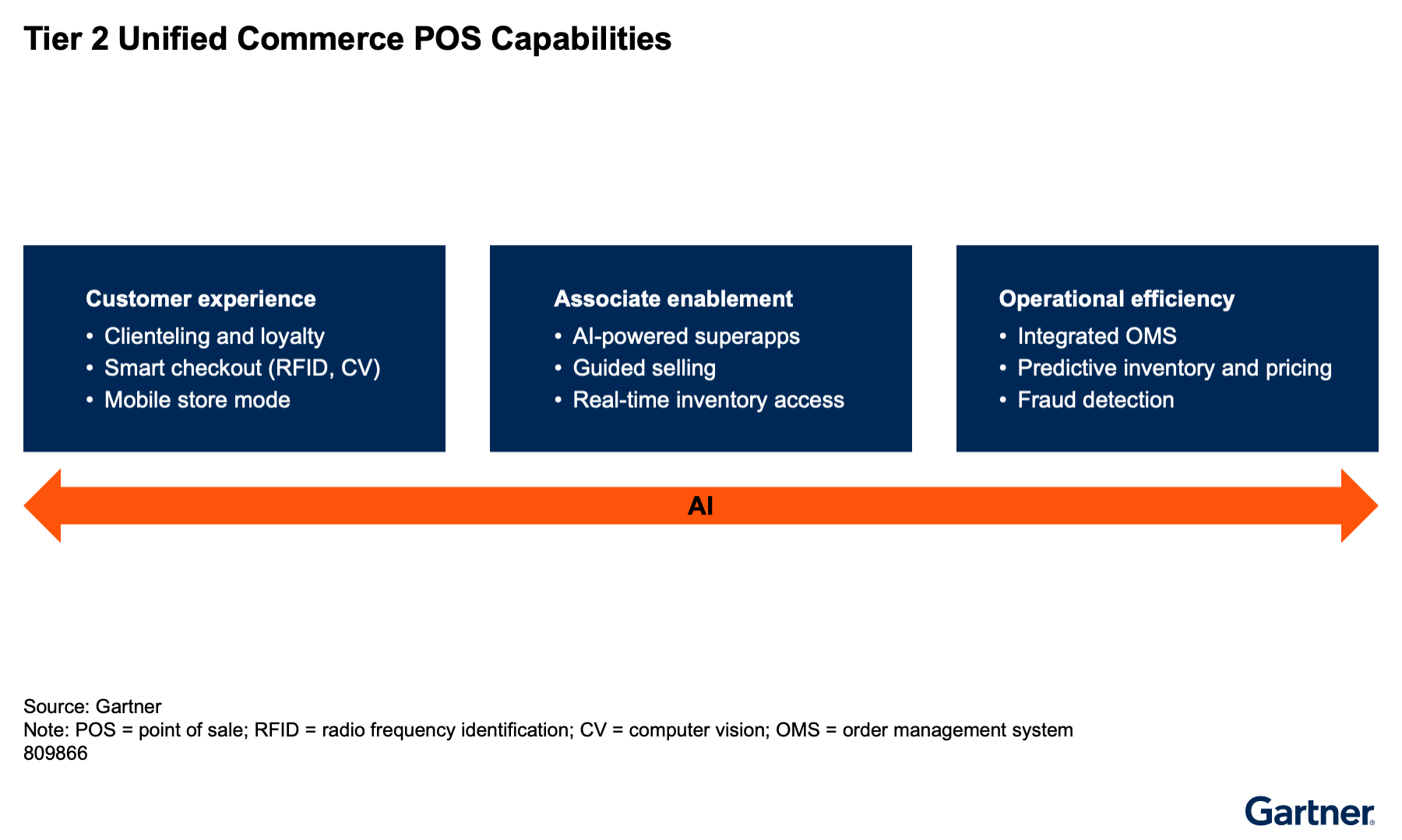
Additionally, AI capabilities within POS applications support associate enablement and personalized customer engagement, particularly when deployed within mobile solutions. Geographically, this market is characterized by solutions with fewer implementations in fewer countries or regions compared to offerings for Tier 1 retailers, often leading to a country-specific or regional presence among vendors, with solutions primarily implemented in non-food retailers (see Figure 1).
Market Direction
Gartner has observed increased interest in and adoption of UCPs anchored by POS across all retail segments over the past 12 to 18 months. Furthermore, AI has moved from peripheral experimentation to core functionality in Tier 2 UC offerings. Vendors are embedding AI into various POS applications to support real-time decision-making, predictive analytics, and intelligent customer engagement.
Reasons for initiating change include the high cost of current solutions, slow speed to market for innovation, and limitations in scale. More specifically, many factors are driving market growth, including:
- MACH architecture that can create a structure for an easy exchange of real-time data, enabled by centralized services called through APIs.
- The use of AI-enabled applications to upskill associates, personalize customer interactions, and gain prescriptive insight on loss prevention and order fulfillment.
- The rise in the adoption of agentic AI as an approach will further enhance the role of the physical store and POS systems by autonomously analyzing real-time data, optimizing pricing, and taking agency over parts of store manager and associate decision making.
- The requirement for cloud-native, web-scale, modular, and adaptive solutions that can be continuously and rapidly modified and refactored to support the dynamic and changing needs of Tier 2 retailers.
- The move to headless architecture can separate the front-end presentation layer from the back-end commerce solution for increased adaptability and engagement opportunities.
- The move to composable platforms that are modular and flexible — and most importantly, can deliver capabilities and frameworks that can be implemented within a flexible enterprise architecture that enables agility and resilience.
- The retailer’s business requirement to build interconnected systems, driven by the need to create a unified approach to the business architecture and touchpoints.
- Customer expectations for channelless engagement — in which they can seamlessly transition between online and offline touchpoints, and retailers can easily serve them whenever, wherever, and however they wish to compose their shopping pathways.
- The requirement to remain agile and resilient to persistent market disruption and gain more control over the speed of innovation.
- The ability to simplify data mobilization to ensure more accurate forecasting and key performance data are available to decision makers in real time.
- Increasing adoption by Tier 2 retailers of integrated payment solutions that unify payment processing with POS, inventory, CRM, and accounting systems. This consolidation streamlines operations, reduces manual reconciliation, and enables real-time visibility into transactions and inventory.
- The need to support store associates with enhanced mobility and enable immersive customer experiences for retailers to differentiate their brands in a competitive market.
- The need to build a store strategy around touchless, immersive, and digitally augmented experiences to support the next generation of store-based execution.
- New vendors entering the market and existing vendors’ expansion of their solution offerings.
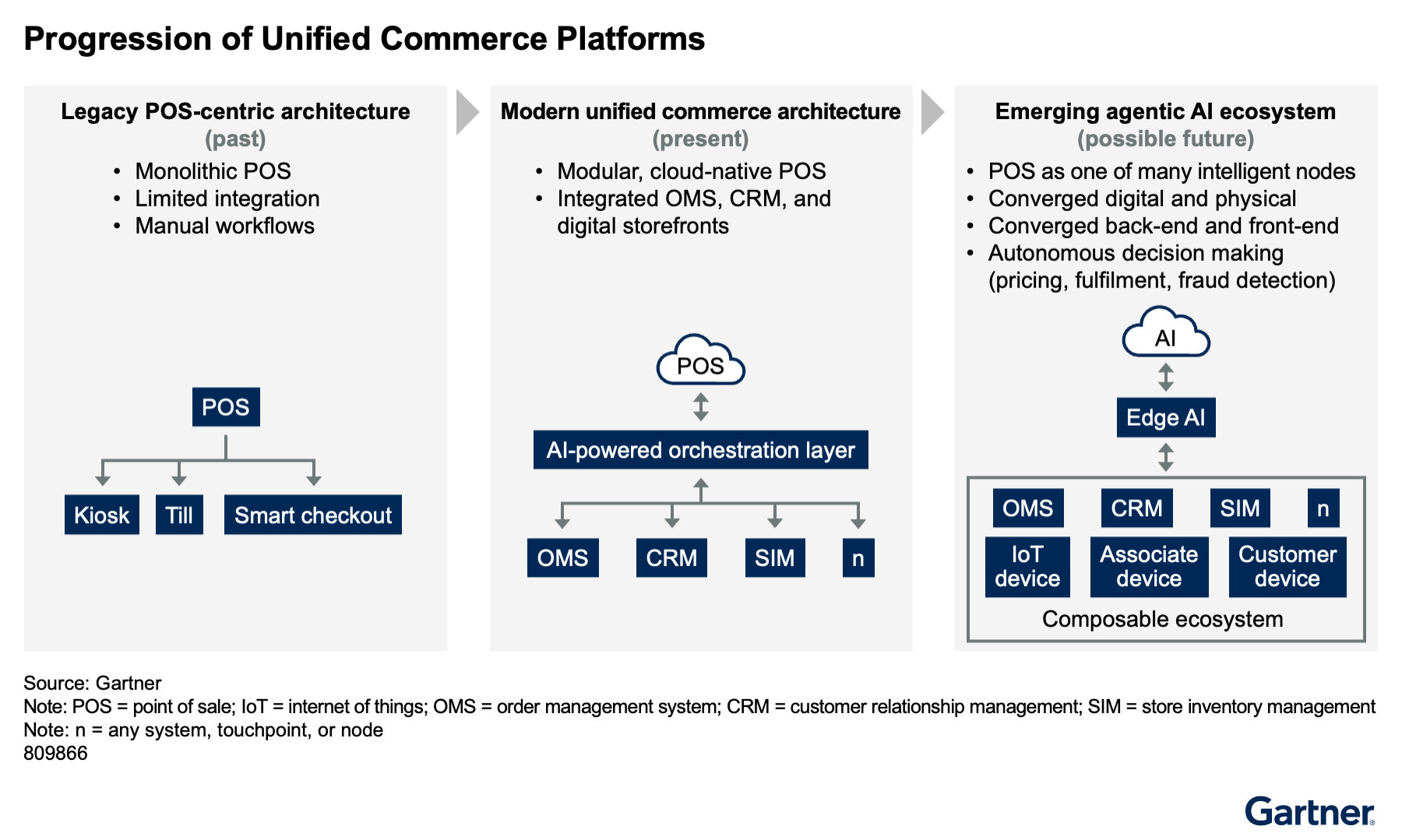
Gartner identifies an emergent, albeit nascent, transition in the function of POS as the foundational anchor of UC. Within the Tier 2 market segment, select vendors are repositioning POS as one of several modular and extensible touchpoints embedded within a broader, integrated ecosystem. Rather than positioning POS as the principal orchestrator, these platforms leverage advanced developer tooling, robust APIs, and UI extension frameworks to facilitate seamless interoperability with order management systems (OMSs), CRM solutions, and digital storefronts.
Concurrently, the advent of AI-driven architectures is catalyzing this evolution, introducing an agentic AI layer that orchestrates commerce, service, and marketing workflows. In this model, POS is redefined as a single intelligent endpoint within a holistic, AI-enabled ecosystem.
By decoupling POS from core commerce logic and embedding orchestration capabilities at the platform level, retailers realize enhanced agility, accelerated innovation cycles, and the capacity to deliver seamless, personalized customer experiences. For instance, store associates are empowered to access unified customer profiles, wishlists, and loyalty data via mobile devices, enabling high-touch clienteling without requiring every interaction to traverse a centralized POS. Simultaneously, native OMS solutions govern order routing, fulfillment, and returns, while administrative layers function as the operational system of record.
Gartner will maintain observation of this domain, tracking both retailer adoption patterns and vendor solution evolution for further indications of a broader industry shift toward platform-centric orchestration and AI-driven innovation (see Figure 2).
Market Analysis
The retail industry is contending with shifting consumer preferences and transformation requirements for in-store execution, necessitating rapid adaptation of operations, business models, and workforce strategies in response to macroeconomic and geopolitical dynamics. A critical initiative underway is the transformation of physical stores to meet evolving customer expectations for flexible, cost-effective, and expedited fulfillment. To drive this transformation, retailers must harness near- or real-time business intelligence within a comprehensive, AI-enabled strategy, particularly focused on operations and merchandising. Within the store environment, there is a growing emphasis on equipping frontline associates with AI-powered tools to enhance the in-store customer experience.
Fundamental customer expectations — such as convenience, continuity, and consistency — remain central to delivering superior retail outcomes. Modern consumers demand the ability to search for, purchase, receive, and utilize products and services seamlessly across a retailer’s entire ecosystem. In addition to flexible fulfillment, shifting customer preferences toward personalized, controllable, and meaningful interactions — alongside associates’ expectations to facilitate these experiences — are driving retailers to increase agility. Consequently, retailers are deploying modern POS technologies to enable seamless, integrated experiences for both customers and associates.
As online sales increasingly rely on or are influenced by physical stores, retailers require POS solutions that support seamless cross-channel operations. Modern POS systems bridge online and offline channels, supporting multiple customer touchpoints to deliver channelless engagement.
Retailers are also responding to new demands for value-driven consumption. Technology vendors have enhanced POS platforms with features that provide detailed product transparency, enabling consumers to access comprehensive product information on their own devices. Additionally, context-aware POS solutions optimized for the IoT are emerging, facilitating product transactions via RFID tag recognition.
For example, integrating POS with order management systems streamlines the click-and-collect process: when a sensor detects a customer’s arrival, an alert prompts an associate to prepare the order, and the transaction is completed upon customer acceptance, ensuring a frictionless experience.
Despite these advancements, retailers continue to face challenges related to fraud and shrinkage, including shoplifting and employee theft. Advanced self-check-out (SCO) systems are gaining traction, leveraging AI and computer vision (CV) to identify items without bar codes and detect fraudulent behaviors such as scan avoidance, label switching, “sweethearting,” and refund fraud. Open architectures now enable integration with third-party tools, such as fraud detection cameras, delivering specialized CV-based loss prevention capabilities.
Beyond CV other types of AI, such as generative AI (GenAI), are being leveraged within Tier 2 POS applications. The majority of vendors profiled in this Market Guide offer AI capabilities in their UC offerings, integrated directly into POS systems or accessed via APIs and third-party tools, enabling real-time intelligence and automation at the POS.
Expert virtual assistants support conversational interfaces and decision making through natural language queries, allowing associates to quickly access product information, generate personalized communications, and retrieve actionable insights without navigating complex dashboards. Natural language processing (NLP) further augments interactions by powering chatbots, voice assistants, and sentiment analysis, streamlining support and enabling intuitive engagement for both customers and associates.
Embedding multiple types of AI into retail applications — multimodal GenAI — can yield significant benefits: retailers can deliver more personalized and frictionless customer experiences, empower associates with intelligent tools that reduce training time and elevate service quality, and obtain predictive insights to enhance loss prevention, inventory management, and fulfillment operations.
The transfer of offline to online activities, or O2O, means that the components supporting that online interaction must be centrally available. These key components for UC include:
- Clienteling and loyalty: Most vendors in this segment incorporate these features directly into their solution stacks, enabling retailers to leverage comprehensive customer insights throughout the customer journey. AI further enhances loyalty by analyzing sales and engagement data to generate predictive insights and personalized offers, helping retailers increase the number of known in-store purchases and automatically activate rewards and discounts at check-out.
- Supplier information management (SIM): Integrating POS with inventory management systems enables precise SKU-level tracking, assuring customers that products are available for in-store pickup or try-on. UC POS platforms provide comprehensive, location-agnostic inventory access, streamlining management and availability. AI further enhances SIM by using real-time data to automate markdowns, optimize replenishment, and reduce waste through predictive monitoring of inventory signals.
- Order management: In UC platforms, order management (OM) is tightly integrated with POS. Within the Tier 2 market, several providers have architected POS atop OM to support flexible store-level order fulfillment. This capability is critical as retailers increasingly leverage store inventory across their ecosystems, with some handling over half of online orders via click and collect or store fulfillment. AI augments OM by enabling intelligent agents for real-time OM, returns, and inventory queries, driving faster, more accurate fulfillment and enhancing the customer experience.
- Pricing and promotions: Unified Price, Promotion, and Markdown Optimization (UPPMO) applications provide retailers with advanced tools to determine optimal pricing and promotional strategies, contributing critical data to POS UC platforms. It is important to note that while the POS system executes the pricing and promotional transactions, the actual calculations and optimization are performed by UPPMO solutions to enable the generation of personalized offers.
Lastly, retailers are rapidly adding customer touchpoints to meet customers almost anywhere and everywhere. New social channels and consumer adoption of IoT devices have enabled retailers to move beyond advertising in these mediums to actually transact. Additionally, Tier 2 POS vendors are leveraging AI to analyze customer feedback and engagement from social media and surveys to extract sentiment and behavioral insights. AI-powered conversational assistants integrated with loyalty apps provide real-time information and recommendations, enabling retailers to drive loyalty through hyper-personalized experiences — creating a more connected and responsive retail ecosystem beyond transactions.
Functional Capabilities
Customer and Associate Empowerment through Mobility and AI
Retailers are prioritizing mobility to enhance and give greater control over both customer and associate experiences. Delivering controllable experiences requires stores to become more immersive, offering in-store capabilities such as scan and go, endless aisle, and access to detailed product and stock information — all accessible via personal or provided mobile devices. Some vendor solutions, particularly for retailers in short life cycle segments like apparel, integrate POS components directly into consumers’ mobile applications. This empowers customers to manage their in-store shopping experience through features commonly referred to as “store mode,” which enables check-in upon arrival and provides enriched, store-focused functionality. Examples include connecting with store associates, booking or sending items to dressing rooms, and receiving notifications for click and collect, curbside pickup, or returns.
Currently, Tier 2 vendor solutions are heavily focused on associate mobility. As store roles diversify, associates must efficiently transition between customer service and operational tasks, such as store-based fulfillment. Mobility is a key differentiator in the Tier 2 POS market, with increasing emphasis on associate enablement through AI-powered tools and immersive experiences. Cloud-native platforms are optimized for mobile and AI use, allowing associates to access POS functions and intelligent features — including personalized promotions, real-time inventory visibility, and guided selling — directly from handheld devices anywhere in the store.
Recent innovations include the development of associate-facing UIs as superapps, utilizing Java-based widgets to aggregate and present data from integrated applications without requiring associates to switch systems or hardware. This streamlines task execution, reduces friction, and boosts productivity, enabling associates to shift from transactional roles to consultative, revenue-generating activities such as upselling and clienteling.
AI is further transforming the associate experience by automating repetitive tasks and providing intelligent assistance. Vendors are integrating GenAI and large language model (LLM)-powered assistants to help associates quickly retrieve product information, answer customer queries, and navigate store operations. Visual AI tools support item recognition and fraud detection, while predictive analytics enhance inventory management. These capabilities not only improve operational efficiency but also elevate associates as knowledgeable brand ambassadors. Looking ahead, agentic AI assistants are expected to significantly reshape associate and manager workflows, further evolving superapp and miniapp concepts.
However, the successful deployment of AI applications in stores requires a cultural shift. Frontline teams must be prepared to trust and collaborate with AI tools, which may be unfamiliar or perceived as disruptive. CIOs play a critical role in this transition by embedding AI literacy into change management frameworks and ensuring that training, mentorship, and peer support are in place. Clear talking points and cascaded communications are required to promote adoption, and store and regional managers should be equipped with hands-on experience using next-generation superapps. Unless they address the human dynamics of technology adoption, even the most advanced AI-enabled POS solutions risk underutilization or resistance, undermining their potential impact.
Headless Architecture for Seamless and Personalized Experiences
An extension of retailers’ demand for composability is the requirement for a headless approach to the platform architecture. This enables retailers to decouple the front-end presentation layer from the back-end commerce solutions, whether delivering internal or third-party application functionality. This is a key tenet of executing a unified commerce strategy successfully within Tier 2 retail. This type of architectural approach will allow easier delivery of more personalized, tailored, and seamless shopping experiences to consumers, regardless of touchpoint. Moreover, AI can enhance headless POS architecture by optimizing back-end services — like personalized offers, inventory forecasting, and fraud detection — that can be delivered to any front-end interface via APIs.
An independent front-end will ensure the consumer experience is not unjustifiably constrained by back-end systems. This is important to retailers as they strive to deliver functionality, such as providing increased mobile engagement in stores, tracking and engaging customers across social channels, and delivering more personalized experiences for their customers in new and innovative ways.
Development Toolkits for Agile Innovation and Competitive Resilience
In the face of persistent market disruption, which poses a constant threat to both revenue and profitability, retailers must become more agile to be resilient. Considering this, Tier 2 retailers are placing a significant amount of focus on developing a composable approach to both the business and the supporting architecture and technologies.
One immediate focus is to start with a composable approach to foundational applications and platforms, such as POS, as this solution is now central to delivering the UC strategy. Therefore, retailers are now looking to POS solutions that are modular, flexible and can deliver capabilities that can be implemented within a flexible enterprise architecture that enables agility for resilience.
Development toolkits are a key differentiator for Tier 2 retailers. These toolkits often include low-code/no-code environments, enabling retailers to rapidly build custom solutions and configure microservices and front-end experiences without relying on costly third-party providers. This agility allows Tier 2 retailers to quickly adapt to market disruptions and evolving customer expectations. By shifting control over innovation from the vendor to the retailer, this approach empowers retailers to create best-of-breed ecosystems for competitive advantage. Additionally, AI-powered POS software development kits leverage machine learning to analyze real-time data, allowing developers to seamlessly integrate advanced features such as demand forecasting.
Smart Check-out for Optimized Operations
Smart check-out and IoT integration are elevated as key capabilities for Tier 2 retailers. While fixed self-check-out remains common, new developments are increasingly driven by technologies such as RFID tagging, CV, and AI-assisted solutions. For soft lines, convenience and specialty retail, RFID often serves as a primary example for accelerating scanning and improving inventory accuracy. Retailers continue to invest in self-check-out technologies, with a focus on improving customer experience and combating shrinkage through enhanced monitoring and rule engines. Though some retailers are reconsidering their self-check-out approaches, the technology continues to evolve to address loss prevention challenges.
Nonfunctional Capabilities
Collaborative Considerations
Alongside the changes in technology and more modern approaches to POS application development, the relationship between a retailer and the vendor providing the POS solution has also evolved. Trust in the vendor extends beyond data security, solution support and professional services. Today, retailers need vendors that are collaborative and partner with them to successfully drive UC through POS. Therefore, retailers must also consider the following attributes to ensure successful implementation and an ongoing relationship with the selected partner.
Collaborative Ecosystem Partnerships
A retailer’s partnership with the vendor will be critical in underpinning a successful implementation. In addition to collaborating with the retailer to provide support and services, vendors must demonstrate their ability to collaborate with other vendors and solutions included within the retailer’s UC ecosystem. This means a shift in accountability from just the individual solution provided to a shared accountability for the retailer’s overall success. The relationship between the retailer and the vendor, based on trust, dependability, and collaboration, will be a determining factor in solution selection.
Retail Media Networks
For Tier 2 retailers, integrating POS systems with real media networks (RMNs) is essential for unlocking incremental revenue opportunities. POS platforms house rich first-party transaction data, which can be leveraged to deliver highly targeted advertising and facilitate closed-loop attribution, thereby providing brands with measurable proof of campaign performance. Seamless integration enables real-time alignment of promotional activities across both physical and digital touchpoints, ensuring a unified and consistent customer experience.
Security
Data breaches remain a top concern for all retailers and consumers, requiring proper data handling in the POS application, as well as in the larger UC platform in which POS resides. Solutions must comply with the Payment Application Data Security Standard (PA-DSS) industry security standards within the Payment Card Industry Data Security Standard (PCI-DSS) framework, and must adhere to any regional standards. It should also be noted that many of the solutions have been architected to not transmit or store any personal data, therefore insulating POS by moving all payment activity outside of the solution.
SoftPOS
By eliminating the need for expensive hardware and ongoing maintenance, SoftPOS is especially appealing to Tier 2 retailers. Implementation typically begins with targeted use cases — such as serving as a backup system if POS does not work or during seasonal sales peaks — before expanding more broadly. Integration with back-end systems is generally lightweight or phased in over time, supporting scenarios like pop-up shops, events and delivery payments for hybrid retail models. This incremental adoption allows Tier 2 retailers to enhance customer experience and streamline operations without significant infrastructure changes.
Support and Services
Because POS serves as the hub of a UC platform, critical factors in maintaining trust are high availability, resiliency, redundancy, and performance. Retailers must be confident in a vendor’s ability to be responsive and reliable in supporting the application wherever the retailer is conducting business globally. Furthermore, as retailers take advantage of the open architecture to implement new capabilities more frequently, vendors must be able to adequately partner with the retailer to suggest competitive changes and execute those changes quickly.
Representative Vendors
The vendors listed in this Market Guide do not imply an exhaustive list. This section is intended to provide more understanding of the market and its offerings.
Vendor Selection
As retailers consider alternative options to their current, dated and limited POS solutions, this research provides a list of representative Tier 2 vendors offering POS as part of larger UC platforms (see Table 1). Organizations should consider the variations in requirements that reflect their own specific needs based on the industry sector and geography in which they operate.
Representative Vendors in Traditional Tier 2 POS Unified Commerce Platforms
Vendor | POS solution | |
Cegid | Cegid Retail Y2 | Non-food |
comerzzia | comerzzia Unified Commerce Platform for Retail | Food and non-food |
Extenda Retail | Hii Checkout | Food |
LS Retail | LS Central | Food and non-food |
Manhattan Associates | Manhattan Active Point of Sale (POS) | Non-food |
NewStore | NewStore Associate App | Non-food |
Orisha Commerce | Openbravo POS | Non-food |
Salesforce | Retail Cloud POS | Non-food |
Sitoo | Sitoo Point of Service (POS) | Non-food |
Tata Consultancy Services | TCS OmniStore Unified Commerce Platform | Non-food |
Source: Gartner (October 2025)
Tool: Capability Identification for Tier 2 Unified Commerce Platforms Anchored by POS
Use this capability identification tool for Tier 2 to scan the Tier 2 UCP anchored by POS market to identify vendor solution capabilities and support locations.
This tool can be used by IT, sourcing, procurement and vendor management leaders to identify various solution capabilities from Tier 2 providers offering UCPs anchored by POS, including:
- AI capabilities: This section covers the AI techniques offered within POS products (LLMs, NLP, GenAI), AI strategy, and capabilities in both core and functional areas, such as IoT, mobile, and associate enablement.
- Customer cross-channel process support: Customers expect the ability to navigate between and across channels in a single transaction, which requires the POS solutions to recognize and receive payments, and handle merchandise returns, promotions, and loyalty benefits throughout the various channels. This section details various front-end customer processes orchestrated within the POS.
- Cross-channel capabilities of POS: The centralization of POS, as illustrated by the various scenarios, is critical to support a digital business model. This section provides a snapshot of implementations, including fixed POS, self-check-out, mobile, kiosks and other form factors.
- Development toolkit: This section provides an overview of each provider’s development toolkit offerings for building customer POS systems or integrating with existing systems.
- Converged capabilities: This section illustrates the must-have UCP capabilities anchored by POS requirements through the convergence of cloud, mobile, social, edge and IoT technologies.
- Implementation geographies: Tier 1 vendors support a wide spectrum of retail segments in multiple geographies. This section illustrates each vendor’s coverage by specific retail segment and geography where the retailers implement the vendor’s POS application.
- Vendor support: This section summarizes vendor coverage, provided by the vendor or approved partners, for support and services by geography.
Vendor Profiles
Cegid
Cegid deploys with fashion, specialty and luxury retailers to deliver a unified, frictionless shopping experience to its customers across all channels. Founded in 1983, Cegid is an international group with solutions for finance, tax management and human resources, as well as vertical business solutions such as retail, manufacturing and trade. Accounting and small companies are also served by this vendor. With more than 5,000 employees, the Cegid group operates in more than 20 countries globally.
POS application: Cegid Retail Y2
Version: Cegid Retail Y2 25.0.2
Synthesis between POS and order management: Cegid Retail has an internal order management system (OMS) that enables retailers to create, manage, fulfill and optimize omnichannel transactions. Midsize retailers would usually use this module as their only OMS. Larger Tier 1 retailers may connect Cegid Retail to their own/third-party OMS.
Implemented integrations include:
- Manhattan Associates
- Adobe
- Venistar
- OneStock
- Fluent Commerce
- IBM Sterling
- Salesforce
AI capabilities
- AI integration: AI is embedded in Cegid’s POS offering.
- Techniques used: The platform uses a variety of AI techniques, including NLP, LLMs, machine translation, rule-based systems, GenAI, and agentic AI.
- Strategy for AI: Cegid has a “Forward.ai” strategic plan and a dedicated AI center of excellence (COE) in Braga, Portugal. The company adopts a mixed approach to selecting AI use cases by gathering customer feedback and building prototypes. The focus is on providing AI features that suggest recommendations, with the user having full responsibility for validation.
Market & segment focus areas: Fashion/apparel, beauty, specialty and luxury retailers
comerzzia
Founded in 2009, comerzzia specializes in software solutions for food and specialty retail. The unified commerce solution offers modular, API-first architecture, enabling retailers to deliver seamless omnichannel experiences and adapt to evolving market demands. Key capabilities include advanced POS systems, mobile solutions with embedded AI, real-time inventory and order orchestration, robust loyalty management, and analytics-driven personalization. The platform is designed to enhance operational efficiency, support global expansion, and drive customer engagement across diverse retail environments. As of December 2024, comerzzia is part of the consolidated European group Alkemy-Retex.
POS application: comerzzia Unified Commerce Platform for Retail
Version: Suite 5.0 — POS 5.1 — API 3.0
Synthesis between POS and order management: comerzzia POS contains an internal OMS designed to cover current and future UC needs across any customer touchpoint. comerzzia’s API services allow for bidirectional integration with other OMS or e-commerce and m-commerce platforms.
Implemented integrations include:
- SAP Hybris
- Adobe
- PrestaShop
- Shopify
AI capabilities:
- AI integration: AI is embedded in comerzzia’s POS offering.
- Techniques used: The platform utilizes ML, NLP, CV, rule-based systems, virtual assistants (VAs), graph techniques and GenAI for various applications.
- Strategy for AI: comerzzia’s AI strategy focuses on creating practical use cases that deliver real value to retailers, such as fraud detection, product recognition, and personalized recommendations. Their human-in-the-loop systems use semi-automated decision workflows in critical scenarios. Their goal is to embed AI to improve staff productivity and business outcomes.
Market & segment focus areas: Food and specialty retailers
Extenda Retail
Extenda Retail is the result of the merger of two retail software companies in the Nordics, Extenda and Visma Retail. Extenda Retail is based in Stockholm, and the company has local offices in Norway, Sweden, the U.K., the Netherlands and India, with representation also in Germany, Romania, Moldova, Ukraine, India, Lithuania and Spain through strategic partners. Extenda Retail solutions are running in 38 countries, but the current focus is in the Nordic and European markets.
POS application: Hii Checkout
Version: V3.x.x
Synthesis between POS and order management: Hii Checkout seamlessly integrates with OMSs through standardized interfaces to facilitate three key business scenarios:
- Create an order: Customers can add items to a transaction that may be fulfilled from different locations. The integration helps customers to obtain delivery options and submit orders with chosen delivery methods and potential down payments.
- Update an order: Retailers can create pending orders, finalizing them upon receiving a down payment. The integration allows for getting order details with minimum down payment information and updating the order with payment data.
- Order pickup: Utilize the POS workstation to register in-store order pickups, making it convenient and efficient. The integration retrieves orders with potential down payments, handles payments (if necessary) and updates the order status to “delivered” in the OMS.
Implemented integrations include:
- M3
- SAP
- Oracle
- IFS
- Microsoft Dynamics
AI capabilities:
- AI integration: AI is embedded in Extenda Retail’s UCP POS offering.
- Techniques used: The platform utilizes ML, CV, and rule-based systems.
- Strategy for AI: Extenda Retail is actively developing AI capabilities, with a focus on prototypes for loss prevention and item recognition. GenAI chat-based interfaces and the use of ML for behavioral pattern recognition are also available within the platform.
Market & segment focus areas: Food retailers, fashion/apparel and general merchandise
LS Retail
LS Retail is a developer and provider of UC software for retail, hospitality and forecourt businesses. LS Retail solutions are located in more than 100,000 stores, retail chains, restaurants, hotels, pharmacies and fuel stations across 157 countries. Customers range from small to large retailers, and forecourt and hospitality companies. Acquired by Aptos in 2021, LS Retail will continue to run as a stand-alone business unit.
POS application: LS Central
Version: LS Central 27
Synthesis between POS and order management: LS Central is built upon Microsoft Dynamics 365 Business Central, an ERP system that offers order management functionality. The solution can also integrate with multiple third-party OMSs via extensions.
Implemented integrations include:
- Adobe
- Shopify
- Voyado
- Diller
- SAP
- Oracle
- F&O
AI capabilities: LS Central incorporates AI-driven capabilities directly into its platform with predictive analytics and forecasting where AI models help retailers anticipate demand, optimize replenishment, and evaluate promotions. AI agents and Copilot features streamline repetitive tasks and improve efficiency.
LS Central is built on Microsoft Dynamics Business Central which provides:
- Azure OpenAI Service which enables generative AI and Copilot experiences within Business Central and LS Central.
- Microsoft Fabric’s advanced data analysis and AI-driven reporting for retail operations
- Native Power Platform integration gives users AI-powered insights through Power BI dashboards and analytics.
Market & segment focus areas: Food retailers, fashion/apparel, specialty, consumer electronics, general merchandise retailers
Manhattan Associates
Manhattan Associates is headquartered in Atlanta, Georgia. Manhattan’s POS application is built on the Manhattan Active® Platform — a cloud-native, 100% all-microservice API platform. Manhattan Active POS is part of the Manhattan Active Omni suite, which also includes store inventory and fulfillment, order management, omnichannel promotions and customer engagement capabilities.
POS application: Manhattan Active POS
Version: Versionless/quarterly releases (last released October 2025)
Synthesis between POS and order management: The POS and order management applications are part of the Manhattan Active Omni suite, which is built as a set of shared microservices. As such, the POS natively utilizes multiple order management-related functions and interfaces to provide a unified experience to customers and associates in-store.
Implemented integrations: Manhattan Active POS has been fully integrated with non-Manhattan OMS, SIM, and other event processing platform (EPR), commerce and supply chain applications.
AI capability:
- AI integration: Manhattan has introduced a suite of AI-powered agents designed to enhance operational efficiency across store management, labor planning, inventory research, contextual data access, and configuration consulting.
- Techniques used: The deployment of digital agents facilitates natural language interaction with core supply chain and commerce applications. Additionally, the platform provides extensibility for retailers to develop and deploy custom agents, leveraging advanced AI capabilities within the Manhattan ecosystem.
- Strategy for AI: Manhattan’s approach to AI emphasizes customer and partner enablement, reducing dependency on vendor-led development cycles.
Market & segment focus areas: Department stores, mass merchants, specialty and fashion/apparel retailers
NewStore
NewStore provides UC for global retail brands to accelerate digital transformation. NewStore’s mobile-first, modular cloud platform includes POS, order management, clienteling, inventory, and native consumer apps. The NewStore REST API architecture is designed to integrate with existing business systems while supporting future innovation.
POS application: NewStore Associate App
Version: Versionless/NewStore is a SaaS solution in which all retailers run on a single, most up-to-date software version that is continuously enhanced.
Synthesis between POS and order management: NewStore Omnichannel POS is part of the same unified platform as NewStore Omnichannel OMS. Therefore, NewStore natively offers full omnichannel capabilities (e.g., real-time inventory across all channels; endless aisle; buy online, pickup in store [BOPIS]; buy anywhere return anywhere; omni order modification; omni customer profiles; ship from store) without requiring integration with a traditional OMS platform.
NewStore is able to run as a Tier 2 platform to any enterprise OMS. If an organization chooses to not use NewStore’s out-of-the-box OMS, it can integrate with another OMS using well-defined integration points. For example, NewStore’s Omnichannel POS can inject orders into an OMS or an OMS can send orders to NewStore that need store fulfillment.
Implemented integrations include:
- IBM Sterling
- Salesforce Order Management
AI capability: Not reported.
- AI integration: AI is embedded in the UCP POS offering. Not reported.
- Techniques used: Not reported.
- Strategy for AI: Not reported.
Market & segment focus areas: Fashion/apparel, mass merchant and specialty retailers
Orisha Commerce
Orisha Commerce helps brands and retailers of all sizes operate across different sectors and regions, providing a UC experience for customers across all sales channels. In 2024, Orisha Openbravo became Orisha Commerce. Orisha Commerce is the vendor of Openbravo Commerce Cloud, which includes Openbravo POS.
Orisha strives to simplify the introduction of new and frictionless shopping scenarios and innovations to help organizations gain greater agility for their UC operations. Orisha Commerce products, including Openbravo Commerce Cloud, are used by brands and retailers in more than 100 countries and in more than 60,000 retail touchpoints, including fixed tills, mobile devices and self-check-out terminals, managing more than 20 billion euros per year in sales transactions.
POS application: Openbravo POS
Version: 25Q2.1
Synthesis between POS and order management: Openbravo POS, a key component of the Openbravo Commerce Cloud, integrates with the rest of the Openbravo Commerce Cloud components of the suite to offer a comprehensive set of order management capabilities:
- Unified and real-time view of stock across physical stores and warehouses.
- The ability to import customer orders generated in external systems, such as the digital commerce platform, via a standard business-level real-time JSON:API that supports flexible shopping scenarios, such as reservations and full and partial payments.
- Use of fulfillment rules to select the best fulfillment locations. For example, when a new order is received from the e-commerce platform, the OMS engine generates a fulfillment proposal including the best locations based on available stock and applied rules. Locations can accept or reject the preparation, and so the engine is able to reevaluate the order to search for alternative fulfillment points if required. This service (selection of the best fulfillment locations) can be consumed via web services from any external system.
- Support for order preparation in the stores and warehouses, including scenarios such as click and collect, ship from store and in system-guided activities such as picking, packing and shipping, which can be also executed from mobile devices.
Implemented integrations include Manhattan Associates.
AI capabilities
- AI integration: AI is embedded in Openbravo’s UCP POS offering.
- Techniques used: The platform offers ML, NLP, GenAI and LLM.
- Strategy for AI: Openbravo’s AI strategy is to enable retailers to leverage AI-driven capabilities through an agile, modular architecture. The company is actively working to integrate with AI and analytics solutions to support rapid innovation. A key initiative is the upcoming integration with Tweakwise, an AI-powered product search and discovery suite, to provide intelligent product recommendations at the POS.
Market & segment focus areas: Fashion/apparel, home furnishings and home improvement, specialty, sporting goods retailers
Salesforce
Salesforce is a global cloud software company headquartered in San Francisco, California, known for its leadership in CRM and enterprise cloud platforms. Its Retail Cloud POS solution is designed for large and complex retail organizations seeking a UC experience across physical and digital channels.
Salesforce Retail Cloud POS merges transactional efficiency with the intelligence and connectivity of the broader Salesforce ecosystem through native integrations with Commerce Cloud, Service Cloud, Loyalty Management, and OMS. The solution is deployed across more than 1,500 store locations and over 9,000 registers. It supports a wide range of form factors, including fixed tills, mobile POS, and self-check-out, and is used by brands in luxury, specialty, and configurable goods retail.
POS application: Salesforce Retail Cloud POS
Version: V25
Synthesis between POS and order management: Retail Cloud POS is built on a microservices-based, API-first architecture that integrates with Salesforce OMS and third-party platforms. The system supports omnichannel scenarios including BOPIS; ship from store; reserve online, pick up in store (ROPIS); and buy online, return in store (BORIS). A universal shopping cart enables consistent experiences across channels, while real-time inventory visibility and fulfillment logic ensure accurate and efficient order processing. The platform supports guided workflows for picking, packing, and shipping, and is designed to scale across global operations with elastic cloud infrastructure.
Implemented integrations Include:
- Manhattan Associates
- Adyen
- NetSuite
- Verifone Flex
AI capabilities:
- AI integration: AI is embedded in Salesforce’s UCP POS offering.
- Techniques used: The platform offers GenAI, LLMs, deep learning, CV and NLP.
- Strategy for AI: Retail Cloud POS uses AI to suggest similar items if a customer wants an alternative, and the app can also display other items in a collection to maximize upselling potential. Retail Cloud POS offers a concierge-driven AI-based voice search experience for store associates with over 30 voice commands. Associates can access customer profiles, view available products, add notes to profiles, and check store analytics. For example, associates can say, “Show me all our yellow floral dresses,” and Retail Cloud POS will display items on the screen.
Market & segment focus areas: Apparel, footwear, health, beauty, home furnishings, wineries and luxury
Sitoo
Sitoo is a privately held tech company headquartered in Sweden. Sitoo started its UC and POS business in 2015.
Sitoo offers a cloud-native UCP anchored by a POS for global, fashion and lifestyle retailers. The platform is designed to integrate physical stores and online sales channels, enabling real-time visibility and management of inventory, transactions, and customer data across all locations. Store associates can access and process sales, returns, and fulfillments from any store or warehouse, supported by centralized data and inventory management tools. Sitoo’s architecture facilitates rapid deployment and requires minimal in-store hardware, with automated software updates. This approach allows retailers to standardize operations and support cross-channel sales and fulfillment, improving inventory accuracy and operational efficiency from the outset.
POS application: Sitoo POS
Version: 1.100 (iOS), 1.4.45 (Android)
Synthesis between POS and order management: Sitoo is order-management-agnostic. However, the platform has a growing number of order management capabilities that are rapidly becoming core features of the platform. Sitoo enables unified inventory with real-time visibility and accessibility across all stores and online sales channels, including multiple stock locations within a store as well as multiple price lists. Retailers can reserve or sell any available inventory from everywhere.
Functionality can include:
- Buy in store A, then collect in store B or ship from store B.
- Reserve in store A, then buy in store B.
- Buy in store, then ship from online or from a central warehouse
- Buy online, then pick up in store and fulfill with inventory available in store or with inventory shipped to store.
- Buy online, then ship from store and fulfill with inventory available in store.
- Buy from marketplace, then ship from store.
Implemented integrations include:
- Salesforce
- Manhattan Associates
- Oracle
- SAP
- OneStock
- Omnium
- RELEX Solutions
- Retailers’ homegrown internal OMS platform
AI capabilities:
- AI integration: AI is embedded in Sitoo’s UCP POS offering.
- Techniques used: The platform offers GenAI, a VA, LLMs, ML, and rule-based systems.
- Strategy for AI: Sitoo’s AI strategy continues to develop, with a focus on future enhancements to improve store performance and customer experience. Planned initiatives include using GenAI to boost store performance and enhance the customer experience (CX), as well as AI/ML capabilities for benchmarking, fraud prevention, and personalized recommendations.
Market & segment focus areas: Fashion/apparel, footwear, sporting, cosmetics, home decoration, furniture, specialty and department store retailers
Tata Consultancy Services
Tata Consultancy Services (TCS) is an IT services, consulting and business solutions organization. TCS offers a consulting-led, cognitive-powered, integrated portfolio of business, technology, and engineering services and solutions.
TCS is a part of the Tata group, India’s largest multinational business group. TCS has more than 600,000 consultants in more than 50 countries.
POS Application: TCS OmniStore Unified Commerce Platform
Version: 8.1.40
Synthesis between POS and order management: The TCS OmniStore Unified Commerce Platform provides order management capabilities through native connectors that are interoperable with any OMS. The order APIs from TCS’s UCP orchestrate with OMS services or have the ability to consume the order data to give a unified view of orders across channels.
Implemented integrations include:
- Oracle ATG Web Commerce
- IBM Sterling
- SAP
- Kibo
- Salesforce
- Microsoft Dynamics AX
- Flooid Commerce
AI capabilities:
- AI integration: AI is embedded in TCS OmniStore’s Unified Commerce Platform offering.
- Techniques used: The platform leverages ML, NLP, CV, deep learning, GenAI, LLMs, VAs, optimization techniques and agentic AI.
- Strategy for AI: TCS’s AI strategy is to build a modern, AI-native commerce fabric. The company is investing in agentic AI, which is designed to adapt to shopper intent and take autonomous actions. It leverages a vast pool of dedicated researchers and subject matter experts to gather insights and continuously innovate. The strategy also includes a strong emphasis on co-innovation with clients to ensure that AI capabilities are relevant and solve real-world problems.
Market & segment focus areas: Specialty, DIY and home improvement, fashion/apparel, luxury, pharmacy, electronic and department stores
Market Recommendations
Retail CIOs who are transforming from multichannel to UC and are implementing POS as part of a UCP must:
- Analyze your current POS functionality by comparing it with the need to deliver essential UC capabilities for click and collect, store fulfillment, clienteling and smart check-out.
- Identify POS solutions that are modular, flexible, AI-ready, and can deliver capabilities that can be implemented with agility for resilience in rapidly changing environments.
- Ensure that associates are able to access data, information and insights integrated from several applications, including from POS directly through an easily navigable front-end UI.
- Establish the vendor’s capability to deliver cloud-native POS solutions that guarantee adequate resilience, data security and privacy through a thorough assessment of their disaster recovery features.
Tool: The downloadable Tool lists those vendors that Gartner analysts have identified following market research and client interactions; it is not intended to provide a comprehensive list of all vendors in this market. Vendor information is current as of the time of publication and has not been verified by Gartner. The information this Tool presents should not be construed as investment-related guidance. Inclusion in the Tool does not indicate that Gartner recommends a given vendor or warrants its performance; and filter selections that direct the user to a single vendor do not indicate that Gartner recommends that vendor, merely that the vendor fits within those parameters.
Note 1: Gartner’s Initial Market Coverage
This Market Guide provides Gartner’s initial coverage of the market and focuses on the market definition, rationale for the market and market dynamics.
Notes 2: Retail Segments Covered in This Market Guide
The research looks at POS applications that have been commercially available since at least March 2023, and have implementations in the segments below:
- Apparel and footwear
- Discount
- Luxury
- Appliances
- Food and drug
- Music and video
- Books
- Furniture
- Office supply
- Consumer electronics
- General merchandise
- Specialty
- Convenience
- Grocery
- Sporting goods
- Department stores
- Home improvement
- Warehouse club