Emerging Tech: AI Vendor Race — Break Boundaries by Adapting DSMs to Emerging Use Cases
14 May 2026 - ID G00844505 - 8 min read
By Samantha Searle, Anushree Verma, and 3 more
Domain-specific model providers are exceeding model limitations by training them to handle quantitative data, as well as language. Product leaders must make DSMs able to handle time-series data and support scenario planning to prove their ability to adapt to more numeric, real-time use cases.
Overview
Key Findings
- High-tech C-level executives leading product or service portfolios must include the capability to handle quantitative data in their DSMs in the next 12 months, or risk losing market share to model providers who develop these capabilities for time-series analysis and scenario planning.
- Time-series analysis will accelerate DSM adoption only if it is used in combination with recurrent neural network models. This overcomes the issue that transformer-based models struggle to handle long-term time series.
- DSMs that can support scenario planning and modeling use cases in the next 12 months will deliver competitive differentiation by providing better insights over traditional statistical models. As DSMs are used as critical enablers to power agentic AI to adapt to new scenarios faster through agentic simulation, this will accelerate adoption further.
Recommendations
- Use DSMs as a powerful component of a composite AI solution for analyzing time-series data, in combination with other AI techniques (including recurrent neural networks, causal models, statistical models and reasoning capabilities) to optimize cost, value and accuracy.
- Adopt hybrid routing architectures equipped with smart routers to direct routine queries to cost-effective DSMs, while automatically routing complex scenario simulations to larger, frontier LLMs, which support more complex “what-if” scenarios.
Strategic Planning Assumptions
- By 2030, 70% of enterprise applications will be powered by DSMs and AI model networks, up from 20% in 2026.
- By 2030, all enterprises in the regulated industries will shift toward DSM, up from 5% in 2025.
Analysis
This document was revised on 19 May 2026. The document you are viewing is the corrected version. For more information, see the Corrections page on gartner.com.
Technology Description
Gartner sees the AI model market already moving beyond general-purpose LLMs to domain-specific models (DSMs) such as domain-specific language models (DSLMs), large domain models (or LxMs), and solutions that factor in a combination or network of models. Domain-specific models (DSMs) are AI models trained on specialized datasets to deliver targeted insight and automation for specific industries, functions or business processes. Unlike other general-purpose LLMs such as Claude Opus, GPT-5 or Gemini 3, DSMs embed deep domain knowledge into their parameters, resulting in higher accuracy and relevance for business-critical tasks. They are built from scratch or from customizing open-weight foundation models.
This research focuses on emerging technical and business use cases that DSMs can support: time-series analysis and scenario planning.
Sample vendors include Siemens, Articul8, Wipro, IBM, Mistral, Writer, Blend360, Navtech, Toloka and Sigmoid.
This is only a representative list of vendors. It is not exhaustive, nor does the inclusion or exclusion of any vendor in or from the list indicate any Gartner endorsement.
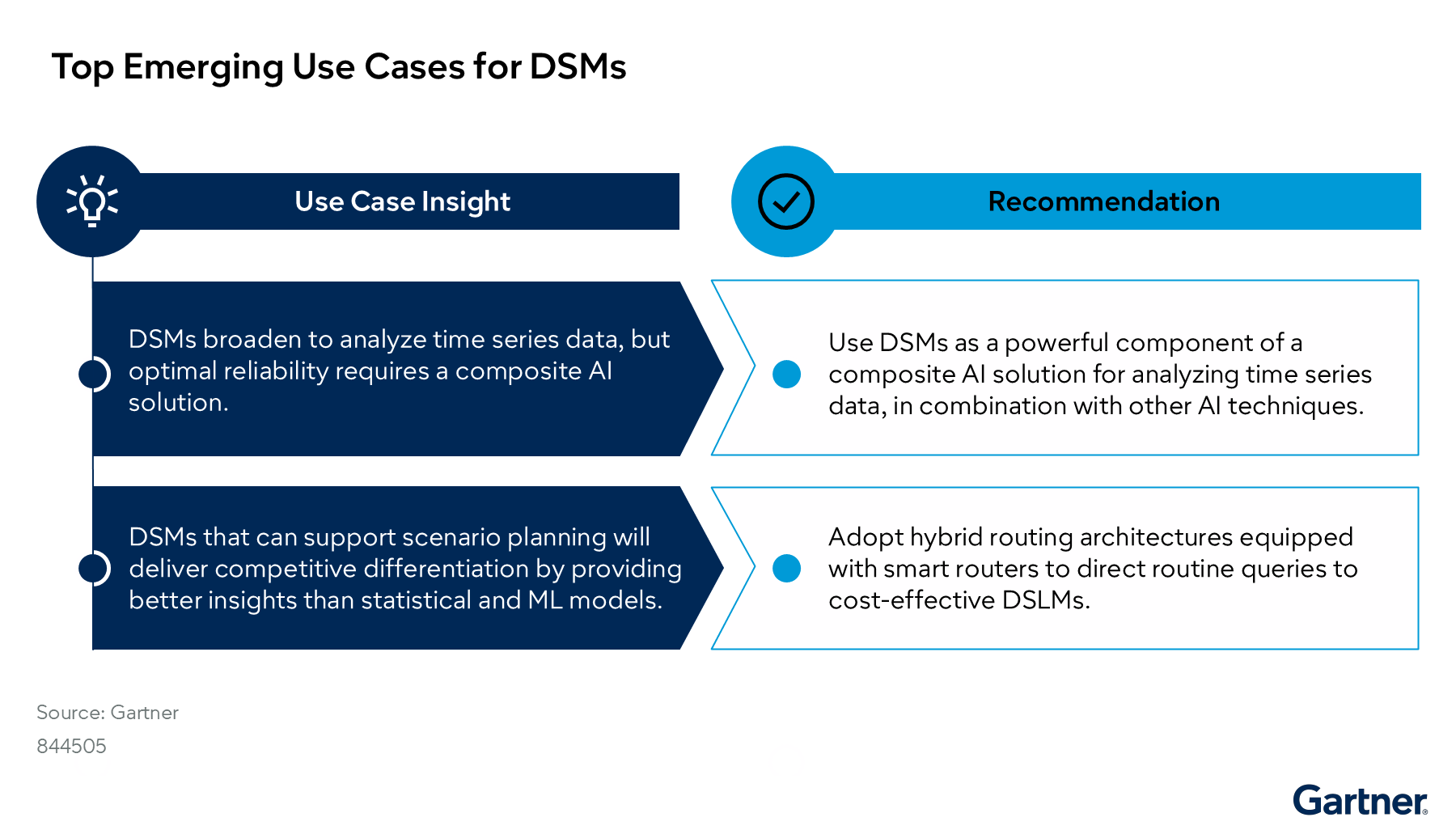
DSMs Broaden to Analyze Time-Series Data, But Optimal Reliability Requires a Composite AI Solution
Near-Term Implications for Product Leaders
The inability of DSMs to handle quantifiable data is a problem worth tackling. A successful time-series foundation (TSF) model must, for a specific use case, make trade-offs between cost, compute efficiency, model performance and accuracy, compared to a statistical or machine learning model.
Product leaders face three challenges:
- Data access, since most public datasets do not have enough industrial time-series data. Building a strong time-series model requires access to large, proprietary collections of sensor and operational data.
- How to handle counterfactual reasoning (how you interpret interventions to change a variable). Time-series data only indicates what has happened in the past. You need causal AI to explore what will happen if you change a variable.
- Transformer-based models struggle to handle long-term time-series forecasting. You need to combine DSMs with recurrent neural networks (RNNs) to overcome this limitation.
However, transformer-based models excel at parallelization, enabling transformers to model long-range dependencies more efficiently than sequential RNNs. Further advantages of using DSMs for time-series analysis are:
- They can excel at recognizing complex patterns in highly intermittent data, outperforming statistical methods, by treating forecasting as a “next-token generation” problem and using knowledge distillation.
- They eliminate the need to train narrow, specialized statistical models for every single piece of equipment or use case, allowing vendors to offer scalable solutions.
Recommended Actions for the Next Six to 18 Months
- Use DSMs as a powerful component of a composite AI solution for analyzing time-series data, in combination with other AI techniques (including recurrent neural networks, causal models, statistical models and reasoning capabilities) to optimize cost, value and accuracy.
- Determine your hybrid AI architectural strategy to enable DSM to handle long-term time-series data by combining DSMs with recurrent neural network architectures (see Emerging Tech: The Rise of Emerging AI Architectures That Outperform Transformers).
Analysis
LLMs — and, consequently, DSMs fine-tuned on them — are usually poor at prediction and forecasting. They are language-trained and handle numerical or structured data semantically rather than logically, which makes them unreliable as forecasting engines if used directly on structured numerical data. However, TSF models have emerged that use LLM concepts (like tokenization, large-scale pretraining, and transformers) but are trained directly on numeric sequences. They can match or outperform classical and deep learning baselines, especially in zero-shot or few-shot settings and where long-term probabilistic forecasts are required.
Despite these advances, TSF models cannot universally replace statistical or ML models, especially since the latter are more cost-effective. ML models are preferable for straightforward, quantitative time-series forecasting with limited data, offering greater robustness, interoperability, and efficiency.
Conversely, DSMs are better suited for time-series data when tasks require integration of domain-specific language, contextual understanding, or combining qualitative and quantitative information, though they need large specialized datasets.
Siemens has developed TSF Models, such as the generic time-series transformer (GTT), for zero-shot, multivariate forecasting. These TSF models are used in combination with traditional statistical methods and lightweight machine learning techniques. This hybrid AI architecture addresses the needs of multiple time series use cases like classification, forecasting, and anomaly detection in industrial sensor data.
Siemens’ predictive analytics platform supports a composite AI approach, with predictive AI, GTT integration and validation of the European Union regulation. It uses a transformer-based architecture to handle large amounts of data, statistical learning methods for anomaly detection and forecasting and domain-specific foundational models that are optimized for industrial applications.
Siemens is applying multivariate time-series models to numerous business use cases, including:
- Industrial manufacturing: Asset monitoring, fault detection, predelivery testing for engines and load and temperature forecasting
- Smart infrastructure: Prediction and energy load forecasting for power generation, energy utilization, chiller temperature as well as general-purpose forecasting and predicting electric transformer cooling degradation
GTTs demonstrate significant improvements in energy management and product quality prediction, replacing hard-to-monitor sensors and improving sensor data accuracy. Zero-shot validation of GTTs has shown high forecasting accuracy and contributed to reduced procurement and production costs.
Wipro’s TSF model, ForecastGPT, uses knowledge distillation and Mistral’s 8 billion parameter model. It runs a copy of an LLM that consumes time-series numerical data and generates numerical outputs, borrowing the semantic understanding and deep pattern recognition inherent to the original LLM. This technique makes their models capable of handling intermittent data. ForecastGPT has been applied to two use cases:
- Sales forecasting: ForecastGPT was applied to car audio component sales forecasting to optimize accuracy for downstream delivery. Wipro integrated macroeconomic indicators to capture future market sentiment in the forecast. This reduced the mean absolute percentage error in the forecast from 20% to 10%, resulting in better inventory turnover.
- Energy load forecasting: ForecastGPT predicted peak energy loads to ensure grid stability, accounting for dynamic factors like consumption behavior and weather. By optimizing supply and generation, the solution cut forecasting errors from 8% to 4%. This generated significant operational cost savings by preventing excess energy generation and emergency energy purchases.
DSMs for Scenario Planning Offer Critical Competitive Differentiation by Providing Adaptive Insights
Near-Term Implications for Product Leaders
Scenario planning use cases demand careful trade-offs between cost and performance. Continuous scenario modeling requires inputting and analyzing thousands of data sources daily. With commercial LLM APIs, this incurs massive token consumption costs, which can reach $250,000 to $400,000 per year. These costs can be reduced (over a three-year period) by creating an on-premises DSLM.
DSMs have insufficient reasoning capabilities to support complex “what-if” scenarios. The ultimate goal is to include causal AI to explain “cause and effect” relationships in the time-series data. Product leaders should integrate causal graphs where domain experts can map known dependencies, to guide DSM reasoning for causation.
The ultimate goal for applying DSMs to scenario planning is to combine them with causal AI to explain “cause and effect” relationships in the time-series data.
Recommended Actions for the Next Six to 18 Months
To successfully support scenario planning use cases, product leaders should:
- Optimize reliability and accuracy by building solutions capable of traversing disparate data sources, like internal ERP and inventory data and external geopolitical, financial and economic data. Since DSMs are only as good as the vendor database or knowledge graph they are based on, RAG needs to include numeric data in its knowledge sources.
- Adopt hybrid routing architectures equipped with smart routers to direct the vast majority of routine queries to cost-effective DSMs, while automatically routing complex scenario simulations to larger, frontier LLMs, which support more complex “what-if” scenarios.
- Examine how to incorporate reasoning capabilities into these models. Transparency and explainability are required to comply with relevant AI regulation and to gain user trust and confidence in using these models.
Analysis
The key requirement for scenario planning is to condition forecasts on changes in external drivers, such as pricing, promotions or supply shocks.These approaches scale classical driver-based forecasting into a foundation-model setting. Then, once a global model is trained, many scenarios can be simulated by swapping driver inputs. This functionality is critical for helping CIOs navigate volatile market conditions.
Scenario planning and modeling can be applied to several business use cases, including governance risk and compliance. Supply chain resilience is described below:
Supply chain resilience: Apexon developed an AI-driven risk resilience platform for logistics that actively utilizes what-if scenario planning and scenario simulation to ensure supply chain resilience. The system allows supply chain teams to evaluate the impact of specific events — such as factory closures, contract terminations, or sudden increases in crude oil prices — to clearly identify vulnerabilities and suggest alternate sourcing mitigations. Because complex “what-if” scenarios require significant reasoning power, Apexon uses a hybrid architecture that routes these specific scenario queries to larger models (like Claude) while relying on its core DSM for 90% of the standard risk identification.