Magic Quadrant for Public Cloud IT Transformation Services
4 August 2025 - ID G00823162 - 55 min read
By Tobi Bet, William Maurer, and 3 more
Cloud transformation is proven to drive measurable business outcomes and value when done well. This research highlights 2025 key trends such as business-outcome-driven engagements, AI/GenAI/agentic AI, and multicloud while helping you select the best-fit providers for your organization.
Market Definition/Description
Gartner defines public cloud IT transformation services (PCITS) as services designed to deliver transformational outcomes via the utilization of cloud-native professional and managed services. It includes migration, modernization, optimization and the building of new, transformational solutions on public hyperscale cloud infrastructure and platform services. Organizations seeking to use public clouds such as Amazon Web Services (AWS), Google Cloud Platform (GCP), Microsoft Azure, Oracle Cloud Infrastructure (OCI) and similar platforms engage with providers in this market to realize the greatest transformational benefits.
PCITS transforms client applications, workloads and data to the public cloud to achieve their clients’ business outcomes. It promotes use of cloud-native tools, AI/generative AI (GenAI)/data and analytics (D&A) and manages IT operations in the public cloud. It employs globally consistent cloud management, optimization and modernization to continuously manage reliability, scalability, interoperability and more.
Mandatory Features
- Comprehensive transformation approach: The service emphasizes digital transformation, from migration through optimization, encompassing rehost (lift and shift), revise (lift and optimize) and rebuild (lift and transform). It executes infrastructure-led activities like rehosting and portions of revision, but specializes in digital transformation services that demand substantial architecture and engineering expertise.
- Business outcome engagement: The engagement model prioritizes business outcomes. It initiates discussions by understanding clients’ business objectives and then translating them into future-proof application, data and platform requirements rather than diving into technical specifics.
- Cloud-native and application development expertise: The service offers a range of application development capabilities, while emphasizing cloud-native precepts when designing application architectures and operational models. By adhering to these principles, it maximizes the benefits of a client’s environment, future-proofing autoscalability, resilience, elasticity and efficient resource utilization for the client’s solutions.
- Multicloud expertise: The service includes a beneficial and innovative use of cloud services from multiple public cloud providers, based on the same general class of comparable IaaS and/or PaaS solutions or workloads.
- ESG: The service addresses environmental and social sustainability and associated governance. It also focuses on the ESG impacts of the service in a client’s environment.
Common Features
Tools:
- Discovery and migration
- Prebuilt development environments/industry models
- Portals and APIs
- Cloud operations
- Cloud financial management
Professional services:
- Cloud-native solution architecture design
- Holistic cloud application strategy focused on integration and optimisation, (e.g., commercial software, SaaS and underdeveloped applications)
- Cybersecurity strategic advisory
- Transformation incorporated across all phases of the cloud adoption life cycle.
- Agile approach to core client/vendor tool integration (e.g., IT service management (ITSM) integration for ticket management or DevSecOps tooling)
- Data and analytics/AI/GenAI capabilities
Managed services:
- Technical support (e.g., service desk and issue resolution, monitoring, configuration management)
- Cloud workload management, optimization and operational evolution
- Provisioning and deployment (managed continuous integration/continuous delivery [CI/CD])
- Maintain and strengthen security posture compliance and network services
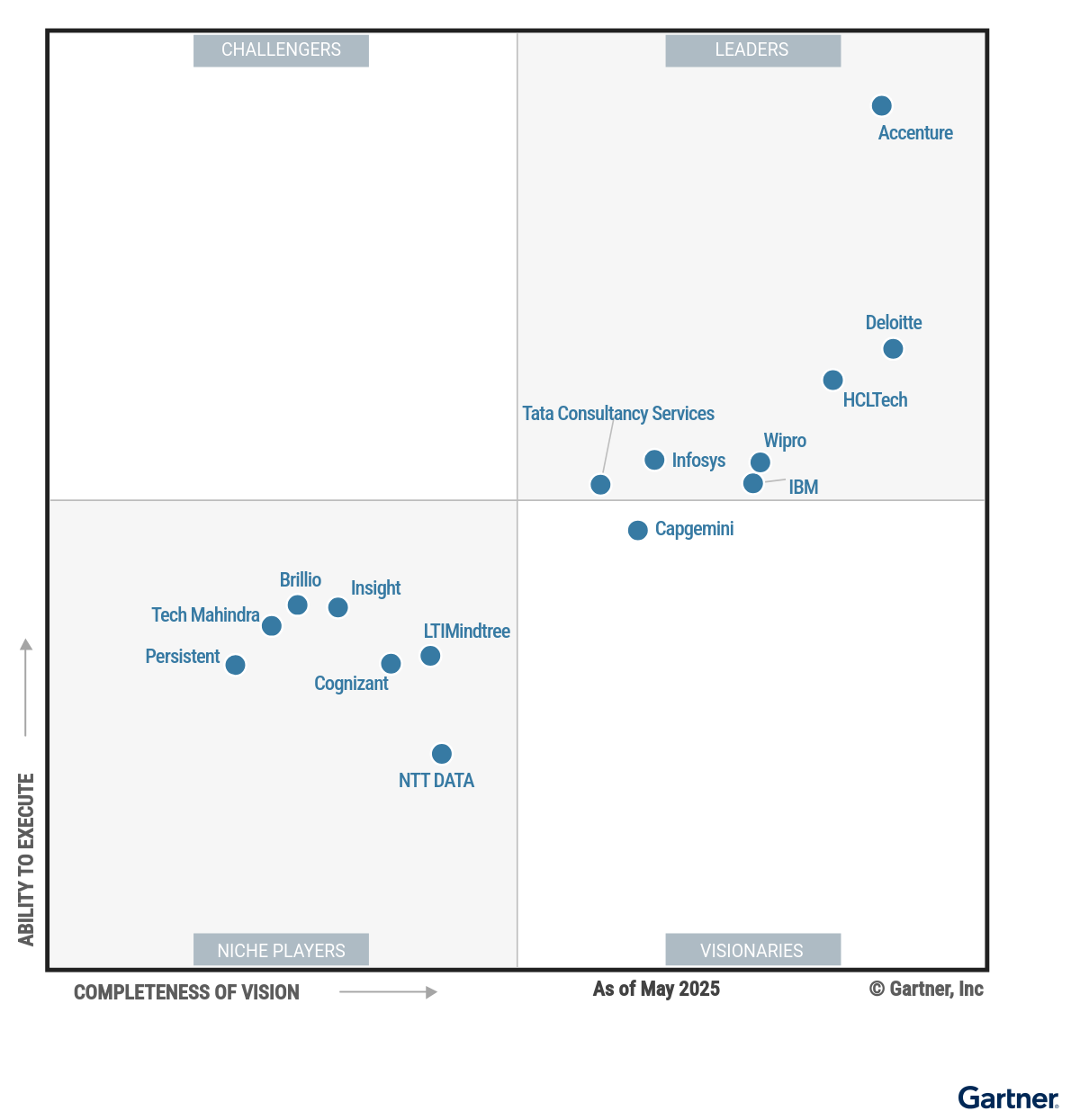
Magic Quadrant
Vendor Strengths and Cautions
Accenture
Accenture is a Leader in this Magic Quadrant. It is the largest IT services company in the world, with more than 781,000 employees operating in 120 countries. Its 2024 revenue was $64.9 billion, with PCITS revenue increasing year-over-year (YoY) to $24.5 billion. The majority of its PCITS customers use Microsoft Azure (49%), followed by AWS (33%), OCI (12%) and Google Cloud (12%). Its combined total of hyperscaler professional or expert cloud-certified individuals was 10,500, one of the highest among peers, completing over 4,500 PCITS migration projects. Forty-seven percent of its PCITS customers are based in North America, 32% in Europe and 17% in APAC, with the remaining 4% in Latin America and the Middle East and Africa. Accenture’s primary verticals are retail, financial services and insurance, and government, implementing focused industry services to over 2,000 clients.
- Transformation prescience: Accenture utilizes key concepts like an unbounded cloud-powered digital core and resilient innovation to reinvent its clients’ businesses, emphasizing its commitment to drive client transformation. From developing a universal wallet for a large wireless carrier to store and manage verified digital credentials for millions of people, to co-creating a digital ID website for the entire population of Japan, Accenture delivers best-in-class, long-term digital transformations.
- AI, GenAI, agentic AI advancement: Accenture is invested in an AI-first approach with large language model (LLM) monitoring, visibility into LLM development and transparency of AI life cycle or governance included in its base fee. Its customers reap practical benefits through these capabilities in cloud-enabled transformation, migrations and daily operations.
- Intelligent pricing: Accenture uses a multitude of SLAs and pricing models for its clients, mixing multiple price models for every agreement. This is most valuable in complex engagements where different stakeholders within the customer organization may have differing goals. For one client, it set a goal of 95% automation by 2025, which it achieved through co-solutioning, employing outcome-based pricing, and offsetting human resources with automation.
- Preference for strategic deals: Accenture has a low amount of rapid data center exit or lift-and-shift projects (12% of 4,500 clients), preferring deals where it can leverage its consulting strength and directly impact the client’s business. Therefore, it’s not a good fit for clients looking for quick modernization or simple platform lift-and-shift movements.
- Limited geographic strategy: Although Accenture is the largest IT services organization in the world, it has scant representation in Latin America, Africa and the Middle East. Global clients with locations in these areas must ensure that Accenture is able to deliver the necessary human and automated resources.
- Low PCITS revenue growth: Accenture ranks in the bottom quartile in this research in overall and PCITS revenue growth in 2024. While this aligns with its modest overall revenue growth and Accenture’s size, it merits mentioning. Clients are advised to ask for specific PCITS client successes in similar verticals to counter any concerns.
Brillio
Brillio is a Niche Player in this Magic Quadrant. It is an IT services company with 6,000 employees operating in six countries. Its 2024 PCITS revenue was $320 million, increasing YoY to $274 million. A majority of its PCITS customers use Microsoft Azure (49%), followed by AWS (26%), Google Cloud (15%) and OCI (4%). It has 5,100 dedicated PCITS employees for only 102 clients, migrating 17,500 workloads, which is minimal in comparison to its peers. Its total of hyperscaler professional or expert cloud-certified individuals was 82, the lowest among peers. Seventy-six percent of its PCITS customers are based in North America, 15% in Europe and 9% in APAC. Brillio’s primary verticals are financial services and insurance, retail, and healthcare, implementing focused industry services to the large majority of its clients (70%). Brillio ties business and IT outcomes to SLAs when negotiated.
- Employee satisfaction and growth: With 6,000 employees, Brillio managed a 35% employee increase and 8% attrition rate in 2024, lower than other vendors assessed in this research. Its train-the-trainer approach efficiently allocates resources, allowing it to adapt quickly. Its employees also have the largest percentage of multicloud certifications per resource in this research, which underpins its high client and employee satisfaction.
- Attractive pricing models: Brillio exhibits its client centricity by contracting pricing to business and IT outcomes, matching peers in other quadrants. With a simplified offering, 90% of its clients either pay by workloads in application groups based on group complexity or outcome-based or deliverables-based pricing.
- AI, GenAI and agentic AI: Brillio offers all standard AI capabilities, such as visibility into LLM development, monitoring of new LLM metrics, agentic AI, transparency of the AI life cycle for LLM, and governing third-party AI models in the base solution, for all clients. Brillio could be a good fit for clients looking for large dataset analysis and insights and agentic AI compliance assurance, when evaluated.
- Limited vision: Brillio’s inexperience with PCITS vision (30 clients) should prompt large global organizations to seek clarity on its framework for developing long-term strategies and goals to ensure alignment. To support global growth and maintain differentiation, investing in this area for Brillio and clients is crucial, and should include co-creation, long-term business objective goals and collaborative knowledge share.
- Small scale: Brillio had only 102 PCITS clients in 2024, lower than the average of 2,351 among vendors in this research, and it completed 55 PCITS migrations for a total of 17,500 workloads in 2024. Its acquisition of the U.K.-based CloudStratex advisory company in 2023 should help it grow in this area, but clients should understand how Brillio works, with its 15 delivery centers in only six countries, to assure adequate coverage.
- IT-outcome-focused: Brillio lags behind its peers in this area. Clients looking for agile prebuilt solutions may be disappointed. As Brillio grows and develops resources and scale, it may develop focused industry solution templates. Currently, it cites zero-trust business agility with microservices and observability-verticalized solutions, which are more hyperscaler templates than industry templates.
Capgemini
Capgemini is a Visionary in this Magic Quadrant. It is a global system integrator with 343,000 employees. It serves clients, in order of magnitude, on Microsoft Azure, AWS, OCI and Google Cloud. Its 160,000 PCITS resources have a combined total of 4,855 professional or expert individual certifications across the hyperscalers. Capgemini serves 5,040 clients and migrated 242,500 workloads in 2024, one of the smaller ratios for providers in this research. Its regional coverage comprises Europe (56%), North America (20%) and APAC (19%), followed by South and Central America (3%) and the Middle East and Africa (2%). Capgemini’s primary verticals are financial services (and insurance, retail and government [federal, state or local]).
- Strategic partnerships with hyperscalers: Capgemini is a pilot partner with Google Cloud and AWS for GenAI specialization, as well as an Azure Expert MSP and AWS Managed Service Provider partner. It is a launch partner for Microsoft Fabric and partners closely with Google on innovative projects, leveraging these alliances for transformational approaches.
- Extensive transformation and modernization capabilities: Capgemini builds transformational solutions across IaaS, PaaS and SaaS, supporting strategic cloud transformation by rebuilding/rearchitecting application portfolios for cloud-native DevOps. It drives digitalization for cloud-enabled digital business transformation outcomes. Offerings include AI-assisted mainframe modernization, IBM Z-as-a-Service and modernization of applications to microservices.
- Deep industry expertise: Capgemini develops industry-specific accelerators, particularly in insurance, covering embedded insurance, home telematics, touchless claims and data-powered underwriting. Capgemini focuses on outcome-based projects, aligning commercial pricing models like gain sharing and risk sharing with delivered value, aiming for business outcomes like cost takeout and revenue growth.
- Lacks tooling maturity: Capgemini’s tooling and automation model is less mature than other vendors assessed in this research. Its coverage is more focused on agile DevOps, rather than broader cloud optimization. Clients in need of cloud workload optimization and cloud-optimized toolchains can expect challenges in applying the “revise” pattern and the tools supporting this life cycle.
- More focused on cloud-native than multicloud solutions: Capgemini demonstrates strong multicloud capabilities across major platforms, but its emphasis remains on cloud-native development, rather than fully showcasing a comprehensive multicloud managed services expertise. Recent case studies highlight development efforts and ongoing multicloud management challenges, suggesting a need for clearer alignment with the evolving market demand for multicloud managed services over development-focused solutions.
- Revenue performance below peers: Capgemini saw a 1.9% overall revenue decline in 2024; it is only one of two reporting providers featured in this research to show negative growth. Its PCITS revenue was second-lowest at 9%, with average PCITS revenue growth for all reporting providers at 18%. Although this can be explained by macroeconomic and market challenges, it may also be due in part to Capgemini’s limited scale or ability to deliver in some areas, such as high-volume IaaS-focused solutions.
Cognizant
Cognizant is a Niche Player in this Magic Quadrant. It has 336,800 employees, operating in 35 countries. Its 2024 revenue was $19.7 million, with PCITS revenue increasing 7% to more than $7.7 billion. A large majority of its PCITS customers use Microsoft Azure (41%), followed by AWS (37%), Google Cloud (12%) and OCI (9%). Its combined total of hyperscaler professional and expert cloud certified individuals is approximately 4,260, completing over 135 PCITS migration projects. Fifty-seven percent of its PCITS customers are based in North America, 30% in Europe and 11% in APAC, with the remaining 2.5% in Latin America and the Middle East. Cognizant’s primary verticals are healthcare (250 clients), life sciences, biotech and pharmaceutical (250); and retail (120), implementing focused industry services to over 620 clients. It utilizes intelligent automation for its 35% of clients who have business outcome metrics.
- Domain expertise: Cognizant has deep vertical expertise, particularly in healthcare, with its TriZetto software platforms, supporting a large portion of the U.S. insured population and numerous payer organizations. It modernizes complex systems on public cloud infrastructure, addresses critical needs like regulatory compliance and enhancing core payer operations.
- Comprehensive managed service model: Cognizant offers fully managed PaaS solutions with complete operational accountability for the infrastructure and application layers. Clearly defined SLAs with financial commitments ensure high availability, consistent performance and enhanced security, minimizing disruptions.
- Platform modernization and technical debt reduction: Cognizant focuses on modernizing client platforms by reducing technical debt and custom code inventory. It replaces custom functions with core product features and aligns with regulatory updates to boost operational efficiencies and business agility on the new cloud platform.
- Cloud optimization tooling: Cognizant’s cloud-optimized tooling capabilities are less mature than its cloud-native offerings. Its cloud-optimized toolchains are relatively new, and more aligned with transformation patterns that require changing the code stack. This is a potential caution point for prospective clients whose primary focus involves optimizing existing, rather than rebuilding new cloud workloads.
- Resource increase: Despite reporting 7% growth in its PCITS revenue over the past year, Cognizant indicated a 0% net increase in dedicated public cloud service staff with 15.9% attrition, which is possibly the market demanding tighter delivery models. Clients can work with Cognizant to scale human and automation resources for significant future transformation engagements, particularly in a competitive talent market.
- Limited optimization capabilities: Cognizant scores below average with timely delivery of project outcomes and the ability to effectively apply optimization patterns to cloud workloads. Prospective clients with aggressive timelines or extensive needs for optimizing existing application footprints should conduct specific evaluations in these areas.
Deloitte
Deloitte is a Leader in this Magic Quadrant. It is a global service provider with 460,000 employees. Its 2024 fiscal total revenue was $64.9 billion. It serves a large number of clients in AWS and Microsoft Azure, followed by OCI and Google Cloud, highlighting its multiplatform experience. Gartner estimates that Deloitte has a total of 4,855 professional and expert-level, cloud-certified individuals across all major hyperscalers, an unexpectedly low number for the amount of projects it manages. However, Deloitte migrated the largest amount of significant workloads in this research in 2024. Deloitte’s clients are mainly in North America (43%), Europe (28%) and APAC (23%), followed by South and Central America (4%) and the Middle East and Africa (1%), with its strongest growth in NA. Its primary verticals include government (federal, state or local), financial services and insurance, and healthcare.
- Consistent execution: Deloitte has excellent repeatable methodologies for delivering most of the common digital business and technical outcomes sought by prospective PCITS customers. Clients should ascertain that its technical delivery capabilities are manifested in employee skills, processes and tools that are the right fit for their organization’s objectives.
- Effective exploitation of AI: Deloitte has invested deeply in critical areas such as data science, machine learning (ML) and GenAI. It has infused its processes and tools with GenAI capabilities, boosting employee productivity and improving delivery timelines.
- Long-term relationships: Deloitte pursues long-term evergreen engagements with its customers, focusing on cloud-native digital transformation. It maintains a steady revenue stream by delivering incremental value over time, and is therefore less focused on upfront payment for its services.
- Premium pricing: Previous Deloitte differentiators, such as true business-outcome-based pricing, expertise with agile delivery, and forward-thinking digital-native solutions, have commoditized as competitors have successfully accelerated innovation. Based on Gartner observation and client feedback, Deloitte’s premium pricing is often not warranted in the current competitive environment.
- Digital business emphasis: Deloitte’s proposals and preferred execution approaches emphasize its software engineering expertise, and it is unlikely to be an ideal choice for organizations whose application portfolios are primarily commercial off-the-shelf (COTS). Deloitte is likely to drive customers toward more modern approaches to enable business outcomes, even when the customer is reluctant to modernize.
- Limited infrastructure services: Deloitte lacks the breadth and depth of traditional infrastructure services that are commonly offered by other global system integrators (GSIs). Customers looking for add-on services, like remote infrastructure management and on-premises infrastructure deployment, should be aware that Deloitte relies on partners for these services.
HCLTech
HCLTech is a Leader in this Magic Quadrant. It has 220,000 employees, operating in 60 countries. Its 2024 fiscal revenue was $13.8 billion, with PCITS revenue substantially increasing 14% YoY to $7.82 billion. A large majority of its PCITS customers use AWS (21%), followed by Microsoft Azure (55)%, Google Cloud (16%) and OCI (6%). Its combined total of professional and expert cloud-certified individuals increased to 21,027, the highest among its peers in this research, completing 4,940 PCITS migration projects. Fifty-one percent of its PCITS customers are based in NA, 33% in EMEA and 14% in APAC, with the remaining 2% in South and Central America. HCLTech’s primary verticals are manufacturing; financial services and insurance; and life sciences, biotech and pharmaceutical, implementing templated industry services to over 1,386 clients. It states it co-creates with 72% of its PCITS clients prior to contract signing, yet 39% of its clients have business outcome metrics or SLAs.
- Methodical predictability: HCLTech delivers in a carefully planned fashion, accelerating time to value through patterns and industry cloud solutions with composable components. It is focused on delivering efficient and reliable solutions to its customers, driving successful technical outcomes such as greater automation and reduced engineering effort.
- Collaborative problem-solving: HCLTech is willing to collaborate not only with the customer’s teams, but also the customer’s other partners, enabled by its service integration and management (SIAM) experience. This sourcing model takes a systematic approach to problem solving so that it can lead the customer to their desired outcomes.
- Structured catalog: HCLTech offers a flexible catalog of offerings that enables a plug-and-play, pay-as-you-go operations model. It has been enabling its menu of services with GenAI capabilities, such as its BigFix AEX conversational AI platform, for knowledge search and zero-shot learning for articles that drive more efficient delivery.
- Azure concentration: Although HCLTech has competencies and customers across four major hyperscale providers, its customer base, revenue and significant deployments are concentrated in Azure. Only 20% of its customers across all hyperscalers are midsize enterprises (MSEs), an unusual circumstance for other Azure-concentrated providers; clients may need to better understand this particular dissimilarity.
- Innovation speed: While HCLTech’s processes and tools will appeal to customers who prefer a conservative, incremental approach to modernizing IT operations management, customers seeking greater velocity should encourage HCLTech to bring innovation — for example, through AI, unique sustainability SLAs and marketplace expertise.
- Peripheral and Integrated services: Storage and web hosting make up the lowest percentage of HCL’s business, compared to other vendors in this MQ. Clients looking for services such as load balancing, autoscaling, Kubernetes, data warehouse, security and networking outside of Azure should ask for a PoC and references.
IBM
IBM is a Leader in this Magic Quadrant. It is a large global IT services company with over 160,000 employees, operating in over 170 countries. IBM’s 2024 fiscal year revenue was $62.8 billion, with PCITS revenue undisclosed. A large majority of its PCITS customers use AWS (49%), followed by Microsoft Azure (43%), Google Cloud (5%) and OCI (2%). Its combined total of hyperscaler professional or expert-level certified individuals is 3,842, completing nearly 900 PCITS migration projects. Thirty-six percent of its PCITS customers are based in NA, 31% in APAC and 30% in Europe, with the remaining 3% in Latin America and Africa. IBM’s primary verticals are government, financial services and insurance and retail, implementing industry prebuilt templated services for over 680 clients. IBM co-creates with 95% of its PCITS clients prior to contract signing and utilizes intelligent automation for 90% of its deals. IBM states 65% of its clients have contracted business outcome metrics.
- Transformational outcome delivery: IBM adopts a strategic partnership approach characterized by a platform-centric and asset-driven methodology, powered by experienced teams, numerous tooling acquisitions, and integrated technology. This makes IBM particularly suited to customers seeking a partner to drive digital transformation built on cloud-native technologies and delivery models.
- Automation and AI realization: Through its IBM Consulting Advantage platform, IBM is moving beyond mere investment to actively realizing concrete benefits from embedding automation and AI directly into its methodologies, assets and platforms.
- Learning organization: IBM demonstrates clear reinvestment of lessons learned into its internal organization, capturing knowledge from engagements, structuring that knowledge into repeatable assets and improved methodologies, and disseminating it through platforms, training and collaborative forums. This helps ensure that both IBM and client organizations can benefit from the learning in the long term.
- Resource growth: IBM had just 3% PCITS employee growth in 2024, far below the average of 15% for all vendors in this MQ. From this, clients could infer that IBM is still on its reorganization journey, started in 2022 with its divestiture of Kyndryl. Even with the substantial experience IBM has in AI and automation, clients will need to ensure that IBM has the necessary resources and roadmap to meet their specific goals.
- Incumbent inertia: IBM can be reluctant to drive change into existing accounts. This reluctance can hinder a client’s ability to adapt to changing market environments if it impacts IBM’s existing commercial structures. Existing clients especially should require optimization and innovation meetings with IBM to make a noticeable change.
- Operational capabilities focus: IBM’s methodologies are focused on driving cloud transformation by embracing AI and machine learning, rather than providing marketplace or managed services. IBM is not a good fit for clients already with a strategy in hand from another provider.
Infosys
Infosys is a Leader in this Magic Quadrant. It is a global system integrator with 323,379 employees operating in 56 countries. Its 2024 fiscal revenue was $19.1 billion with PCITS revenue at $11.5 billion, 89% of which is considered transformational. Infosys serves many multicloud clients, covering Microsoft Azure (60%), AWS (58%), Google Cloud (11%), and OCI (2%). It has a combined total of 2,819 individual certifications across hyperscalers at the professional or expert level, below the average in this research. Although it served 1,575 PCITS clients in 2024, which is lower than the average of others in this research, it migrated over 515,100 workloads. Its PCITS customers are based in North America (751), Europe (505), APAC (268), the Middle East (40), South and Central America (8), and Africa (3). Infosys’s primary verticals are financial services and insurance (582 clients), manufacturing (977 clients) and retail (504 clients). Infosys co-creates with 82% of its PCITS clients prior to contract signing.
- Strategic partner: Infosys has a strategy focused on delivering services closer to the customer through innovation and technology hubs. It also increased its industry value creation; for example, co-creating and building multiple new revenue streams for a mining client.
- Advanced automation and tooling: Infosys leverages advanced automation and tooling, notably via its Infosys Cobalt platform and assets. A strong focus exists on zero-touch operations and automated healing, utilizing AIOps to minimize human intervention in cloud operations. Infosys tooling shows strong capabilities in automation and innovation.
- Commitment to talent and knowledge: Infosys places a strong emphasis on talent development, knowledge sharing, upskilling/reskilling client personnel and building local talent pools. It fosters a culture aimed at creating “full-stack” engineers with strong domain and technology skills, focused on automation. This includes a hub-and-spoke delivery model that incorporates local talent and allows for geographic flexibility based on client needs.
- Application reengineering focus: Infosys prioritizes application reengineering over a balanced strategy that equally prioritizes cloud-optimized and cloud-native strategies. This suggests potential variability in its operational cloud-native transformation capabilities.
- Sales and marketing execution: Infosys scores below average in pricing models, stating a very high percentage of business outcomes, but few contracted client examples. It is also one of the only providers to charge separately for all AI services, from LLM monitoring through GenAI, necessitating clients to negotiate additionally as needed.
- Automation applicability: The practical implementation and scope of Infosys’ high levels of automation, driven by its ambitious goals, may vary in maturity and degree of transformation delivered. It should be carefully validated, recognizing the complexities of enterprise environments. Clients should require verification of how and when automation is used, from assessment through managed services, to ensure expected delivery models and deliverables.
Insight
Insight is a Niche Player in this Magic Quadrant. It is an IT services company with 14,324 employees, 4,006 of them dedicated to PCITS resources. It operates in 25 countries. Its 2024 revenue was $8.7 billion, with PCITS revenue increasing YoY to $310 million. A majority of its PCITS customers use Microsoft Azure (58%), followed by Google Cloud (38%) and AWS (4%). It has a combined total of 588 hyperscaler professional and expert cloud-certified individuals for 20,000 clients, migrating 127,000 workloads, with 90% of its projects consisting of more than 100 workloads. Seventy-two percent of its PCITS customers are based in NA, 15% in Europe and 14% in APAC. Insight’s primary verticals are financial services and insurance (1,167 clients), government (889 clients) and healthcare (741 clients), implementing templated industry services. Insight co-creates with 60% of its PCITS clients prior to contract signing and offers gain share when combined with FinOps implementations.
- Strong growth without disruption: PCITS revenue growth was strong in 2024, capturing an average new client revenue growth of 23%. Equally important, merging Hanu, Amdaris and SADA — three distinctly different companies in the last three years — showcases Insight’s excellent internal communication and acquisition-blending skills.
- Distinguishing Google Cloud services: Insight supports 100% of Google Cloud with dedicated network and security services, strong experience on Kubernetes and serverless, and high D&A support at 69%. GC clients looking for these particular add-ons should include Insight in their evaluations.
- Reseller and MSE focus: Insight closed revenue in 2024 of $1.7 billion on midsize enterprise client wins, which was 55% of its overall PCITS business. In addition, Insight is the only provider in this research to provide reseller services to the vast majority of its clients (approximately 85%). Insight could be a good fit for clients looking to outsource multicloud services with licensing.
- Pricing innovation: Insight lacks innovative pricing. Its clients begin with standard SOWs that include business goals, scope, budget/resources, deliverables, T&Cs, and a timeline based on presales discovery work and delivery experience. Insight still issues change orders and its pricing models are almost exclusively tiers of services of increasing value, with higher tiers costing more.
- Limited focus on growth outcomes: Insight is focused on cost optimization and efficiency gains, as opposed to driving growth outcomes. While it is increasingly positioning more outcomes with customers based on tangible financial benefits or improved velocity and product development, it still represents less than 1% of its overall PCITS revenue.
- Automation/ML/AI straggler: Insight’s percentage of clients utilizing automation from assessment through operations is the lowest in this research. With just 145 machine learning clients (average in this research is 1,097), clients will need to inquire how Insight uses automation, machine learning and AI/GenAI to optimize and transform client environments to achieve better business vertical outcomes.
LTIMindtree
LTIMindtree is a Niche Player in this Magic Quadrant. It is a global IT services company with 82,000 employees operating in 38 countries. LTIMindtree’s 2024 revenue was $4.41 billion, with PCITS revenue increasing YoY to $1.70 billion. A large majority of its PCITS customers use Microsoft Azure (60%), followed by AWS (24%), Google Cloud (13%) and OCI (3%). Its combined total of AWS, Google Cloud and Microsoft Azure professional and expert cloud-certified individuals is 2,108, completing more than 500 PCITS migration projects. Seventy-one percent of its PCITS customers are based in NA, 19% in Europe and 8% in APAC, with the remaining 2% in the Middle East and Africa. LTIMindtree’s primary verticals are financial services and insurance (1,167 clients) and general manufacturing (741 clients), implementing focused industry services to over 360 clients. LTIMindtree co-creates with 20% of its PCITS clients prior to contract signing and utilizes intelligent automation for 95%, and 47% have contracted business outcome metrics.
- Commercial pragmatism: LTIMindtree offers flexible, outcome-based contracts, aligning its financial incentives with the client’s cost savings and business results. Its pricing strikes a good balance between consumption and tangible business outcomes. LTIMindtree is also willing to sacrifice revenue commitments to drive deal efficiencies for existing clients.
- Deep engineering expertise: LTIMindtree demonstrates deep engineering understanding through its advanced platforms, focus on accelerating and automating the engineering life cycle, strategic integration of GenAI into delivery, and its track record of delivering concrete operational and business outcomes.
- Cloud financial insight: LTIMindtree demonstrates a comprehensive understanding of cloud financial management (FinOps), starting with common cost takeouts related to infrastructure optimization, but extending into cost-aware architecture where more impactful, long-term savings are achieved. To LTIMindtree, FinOps is more than just a tooling capability, so it is an interesting fit for clients looking to include cloud financial management in their adoption plan.
- Technology-centric approach challenges: LTIMindtree’s tech-led capabilities can polarize its approach to focusing on business outcomes and benefits. With many cloud initiatives being business-led, clients may find LTIMindtree challenged in its ability to position the wider business benefits in articulating the case for particular solutions in some industry contexts.
- Conservative client approach limitations: LTIMindtree can be inclined to take a more conservative and less ambitious approach if it would involve challenging a client’s approach or understanding. This may limit the value and outcomes of its solutions, and clients should challenge LTIMindtree by asking for personalized recommendations.
- Low levels of co-creation: LTIMindtree reports significantly lower levels of co-creation when compared to others in this research, both pre- and postcontract. Therefore, it may rely on clients for a clear solution vision or face increased changes and costs during the transformation initiative.
NTT DATA
NTT DATA is a Niche Player in this Magic Quadrant. It is a global IT services company with nearly 200,000 employees, operating in over 50 countries. NTT DATA’s 2024 revenue was approximately $29 billion, with PCITS revenue at $4.82 billion. A large majority of its PCITS customers use AWS (42%), followed by Microsoft Azure (37%), Google Cloud (5%) and OCI (1%). Its combined total of hyperscale professional or expert cloud-certified individuals is 3,825, completing 600 PCITS projects. Fifty-six percent of its PCITS customers are based in APAC, 22% in North America and 18% in Europe, with the remaining 4% in Latin America and Africa. NTT DATA’s primary verticals are financial services/insurance (199 clients), general manufacturing (143 clients) and government (156 clients), implementing templated industry services to nearly 500 clients. NTT DATA co-creates with 42% of its PCITS clients prior to contract signing and utilizes intelligent automation for 90%, and 24% have contracted business outcome metrics.
- Managed operations focus: NTT DATA has a focus on predictive operations through its One NTT DATA platform with integrations to multiple systems, layered full stack observability and a strong emphasis on standardization, governance, automation and AI.
- Extensive platform capabilities: NTT DATA’s multicloud platform provides extensive capabilities built to deliver value across the entire (full) stack of cloud-based solutions. These capabilities include multicloud delivery, automation, service governance, observability, and integrated operations infused with AI and GenAI.
- Environmental and sustainability focus: NTT DATA seeks to partner for environmental and sustainability during modernization efforts. Through the integration of carbon emissions and live tracking of sustainability metrics into its FinOps Carbon tooling, NTT DATA provides a balanced view of cloud consumption.
- Limited cloud transformation support: NTT DATA is less adept at supporting clients that seek to fully leverage extended transformational and cloud-native opportunities, possibly in part due to its low percentage (15%) of strategic transformation clients. This makes NTT DATA more suited to clients with less ambitious cloud modernization plans.
- Lower cloud-native engineering capabilities: NTT DATA is more traditional in its approach to application development and application management, meaning it is less advanced in its adoption of cloud-native product-centric delivery models. This, combined with a more infrastructure centric approach, may make it less suited to clients with a product-centric focus.
- Inconsistent automation: NTT DATA’s automation and AI adoption is currently inconsistent, with an 85% operations efficient automation ability, yet only 60% usage by clients. With stronger focus in the discovery and operational phases, its automated remediation and recommendations for optimizing cloud-native deployments are among the lowest. Clients should inquire about specific use cases where they have successfully automated complex cloud-native optimization tasks.
Persistent
Persistent is a Niche Player in this Magic Quadrant. It has 23,941 employees operating in 21 countries, with 12% dedicated to PCITS. Its 2024 revenue was $1.9 billion, with PCITS revenue increasing YoY to $833 million. A large majority of its PCITS customers use AWS (45%), followed by Google Cloud (25%), Azure (23%) and OCI (2%). Its combined total of hyperscaler professional and expert cloud-certified individuals in 2024 was 821, completing 24,334 PCITS migration projects. Seventy-two percent of its PCITS customers are based in North America, 14% in APAC and 14% in Europe. Persistent’s primary verticals are financial services and insurance (204 clients) and healthcare (165 clients), implementing industry services to 468 clients. It co-creates with 45% of its PCITS clients prior to contract signing.
- Data competence: Persistent has focused on data-related expertise across its portfolio of solutions, and more than half of Persistent’s customers receive data-and-analytics-related services. This benefits organizations aiming to accelerate their data strategy for the GenAI era, beyond merely migrating to the cloud.
- Strong practitioner relationships: Persistent has an engineering heritage, and aims to achieve targeted technical outcomes on behalf of its customers. It keeps practitioners engaged with the customer’s technical team, fostering collaborative upskilling opportunities.
- MSE focus: Sixty-eight percent of Persistent’s customers are MSEs, and its typical project size and number of workloads migrated is relatively small, even for the MSE base. However, this allows Persistent to focus on the distinctive needs of this customer base, which many of the larger providers in this research overlook.
- Low transformational focus: Persistent’s ability to lead strategic transformation is at odds with its low number of clients taking advantage of these capabilities. Persistent is chosen mostly by clients seeking focused engineering efforts or ongoing cloud operations than it is for business-outcome-driven engagements.
- Innovation Investment: As a midsized PCITS vendor, Persistent allocates 50% of its R&D budget to GenAI, which is relatively modest on a per-dollar basis compared to others in this research. Clients are advised to explore Persistent’s focused accelerators and innovations to help drive meaningful solutions for their business.
- Geographic focus: Persistent is almost entirely focused on organizations and client delivery in North America. Prospects looking for services outside of North America should investigate whether Persistent’s delivery model, resources, average usage of delivery centers per client (four) and approach to cloud sovereignty are the right fit for their needs.
Tata Consultancy Services
Tata Consultancy Services (TCS) is a Leader in this Magic Quadrant. It is a global system integrator company with approximately 608,000 employees, operating in 55 countries. Its 2024 revenue was $30 billion, with PCITS revenue at $12,410 million, 80% of which is considered transformational. It serves clients in Microsoft Azure (35%), AWS (30%), Google Cloud (12%) and OCI (12%). It has a combined total of 13,015 individual certifications across hyperscalers at the professional or special levels, above average in this research. In 2024, TCS served 2,200 clients but migrated only 314,190 workloads, well below average. Its PCITS customers are based in North America (1,040), Europe (720), APAC (340), South and Central America (50), and Africa (50). TCS’s primary verticals are financial services and insurance (710 clients), retail (420 clients) and general manufacturing (365 clients), implementing industry services to 1,495 clients. TCS co-creates with 50% of its PCITS clients prior to contract signing.
- Strong performance in core cloud operations: TCS demonstrates strong capabilities in managing cloud-optimized and cloud-native environments, offering wide support for foundational cloud services. It provides client coverage for services like autoscaling and load balancing, and a wide range of managed services and cloud management platform capabilities for efficient operations.
- Advanced expertise in data and AI solutions: TCS has extensive expertise in data, analytics and ML, supporting clients with data warehousing and database modernization, and leveraging native hyperscaler capabilities. It has significant experience with data platforms and ML services, helping clients train models for specific use cases and exploring industry-specific and horizontal AI applications.
- Complex transformations capabilities: TCS supports complex enterprise applications across hyperscalers, addressing use cases like rapid data center exit, TCO reduction and cloud transformation. It employs proprietary frameworks, accelerators and migration factories, offering strategies for self-funded transformation through identified savings.
- Outdated tools, methodologies and pricing: TCS’ intellectual property, tools and accelerators are dated when compared to those of others in this research. TCS is one of the few providers in this research that charges for AI on a customized case-by-case basis, indicating a lack of integrated AI capability, which Gartner believes is more consistent with market trends and advantageous to customers.
- Migration and managed services challenges: Clients report experiencing difficulties in migrations, including compatibility issues with proprietary systems and performance bottlenecks. Obstacles in managed services include maintaining operational governance, nondisruptive patching/updates, and cost optimization through scaling strategies.
- Global coverage: Although TCS asserts global coverage, 95% of its PCITS services clients are currently contracted across just three regions — North America, Europe and APAC — highlighting a marked concentration. New clients with a large global presence extending beyond these areas will need to closely examine the adequacy of TCS’ capabilities in underrepresented locations.
Tech Mahindra
Tech Mahindra is a Niche Player in this Magic Quadrant. It is an IT services company with more than 154,000 employees, operating in 90 countries. Its 2024 revenue was $6.24 billion, with PCITS revenue comprising 29% of that at $1.8 billion. A majority of its PCITS customers use Microsoft Azure (28%), followed by AWS (18%), Azure, (14%) Google Cloud (5%) and OCI (1%). Its combined total of hyperscaler professional cloud-certified resources is 388 for 660 clients, migrating 169,300 workloads, minimal in comparison to its peers. Forty-nine percent of its PCITS customers are based in North America, 21% in Europe and 26% in APAC, with 1% to 2% coverage of the Middle East, Africa and Latin America. Tech Mahindra’s primary verticals are telco (40 clients), general manufacturing (22 clients), and financial services and insurance (18 clients); it uses industry-cloud-native templates for 150 clients. Tech Mahindra co-creates with 30% of its PCITS clients prior to contract signing.
- Significant sales: Tech Mahindra has a significant active pipeline of $4.2 billion across all sectors. This follows a very successful year in 2024, winning $565 million in new deals. Tech Mahindra is experiencing growth in its cloud services of over 33%, which is two times the market average, indicating a large number of clients receptive to its proposals.
- ERP expertise: Tech Mahindra has deep expertise in SAP, providing technical support (build, operate, manage) for RISE with SAP, particularly on the AWS and Microsoft Azure platforms. It also has a very large installed base and strong capabilities on the Oracle ERP side, particularly for legacy workloads like Oracle PeopleSoft and EBS. This makes OCI a default scenario for migration based on its ERP capabilities.
- ROI vertical expertise: Tech Mahindra manages services for a number of global telco and manufacturing organizations. It shares internally learned best practices, incorporating trust into its sales strategy, which is specifically appealing to those verticals. Its deep domain knowledge is leading to a recent proprietary solution for Optus, which is potentially replicable for other clients with similar needs.
- Lower-than-average automation: Tech Mahindra uses AI to automate tasks and generate recommendations, but its automation and agentic AI usage was below average when compared to others in this research. Clients seeking agility and increased automation resources should negotiate outcome-based automation optimization SLAs and pricing.
- Transformational change: Tech Mahindra does not incorporate culture and digital transformation as fluently as others in this research. Instead of aligning IT with long-term business goals, it is still learning the digital outcome model and how change and culture can accelerate it.
- Rigid pricing models: Tech Mahindra lags others in this research for linking deal values (total contract value), investments and outcomes to pricing. Clients can also use co-creation methods to upskill transformation.
Wipro
Wipro is a Leader in this Magic Quadrant. It has more than 233,000 employees, operating in 65 countries. Its 2024 revenue was $10.8 billion, with PCITS revenue approximately $4.75 billion. A large majority of its PCITS customers use Azure (45%), followed by AWS (36%), Google Cloud (17%) and OCI (2%). Its combined total of hyperscaler professional and expert cloud-certified individuals was 4,649, completing over 1,300 PCITS migration projects. 51% of its PCITS customers are based in North America, 31% in Europe and 15% in APAC, with the remaining 3% in other regions. Wipro’s primary verticals are financial services and insurance (321 clients), retail (178 clients), and healthcare (129 clients), implementing focused industry services to over 1,039 clients. It co-creates with approximately 45% of its PCITS clients prior to contract signing and utilizes intelligent automation for 158 clients that have business outcome metrics pricing.
- Transparent pricing models: Wipro has clear models, preferring tiered pricing as opposed to the more-outdated bundled or aggregate pricing. It is also one of the few that offers cloud reseller options. Ahead of its peers, Wipro’s managed services include the storing of artifacts in a client’s GitHub/GitLab to allow easier transition of data and assets back to the client for easier service(s) transition.
- Repeatable solutions: Wipro has built integrated platform services and other repeatable delivery components that express the experience and intellectual property that it has derived from engagements over the better part of the last decade. It has used its deep investment in GenAI, enabling autonomous intent-driven transformation, accelerating migrations with efficiencies for its clients.
- Innovation emphasis: The majority of Wipro engagements are consulting-led and include measurable business outcomes, predefined blueprints and agentic AI for dynamic task sequence. Wipro co-solutions and co-innovates with customers, ranging from those that are reluctant to pursue transformation to those with digital business ambitions.
- Divided business units: Wipro’s PCITS business is divided into business units (BUs) by cloud provider, each of which have their own personnel, IP and capabilities. While Wipro has made efforts to encourage BUs to coordinate to deliver multicloud solutions to customers, Gartner clients have reported that the experience is akin to working with separate companies.
- Preference for large deals: Wipro typically seeks large and complex deals (10% of its deals are MSE deals), taking a “land-and-expand” approach, in which Wipro commits to working with the customer over the long term, winning incremental work over time. Prospects whose appetite for PCITS capabilities are initially more limited may find it difficult to attract or hold Wipro’s interest.
- Dual hyperscaler focus: Although Wipro is growing its Google Cloud business, its OCI business is still in development. With multicloud increasing dramatically in 2024 with clients looking for more composable infrastructure solutioning, Wipro’s significant focus on its large AWS and Microsoft Azure customers could repel clients looking for objective business solutions, regardless of the hyperscaler.
Vendors Added and Dropped
We review and adjust our inclusion criteria for Magic Quadrants as markets change. As a result of these adjustments, the mix of vendors in any Magic Quadrant may change over time. A vendor's appearance in a Magic Quadrant one year and not the next does not necessarily indicate that we have changed our opinion of that vendor. It may be a reflection of a change in the market and, therefore, changed evaluation criteria, or of a change of focus by that vendor.
Added
- Insight
Dropped
The following vendors were dropped from this Magic Quadrant:
- Bespin Global: Did not meet the following requirements: 25% PCITS revenue, 10% or more PCITS clients or revenue in three regions.
- Cloud4C: Did not meet the specific AI/ML certifications on a primary or secondary hyperscaler.
- Eviden (Atos): Did not meet requirement to have 10% or more clients or revenue in three regions.
- Hitachi Digital Services: Did not meet the specific AI/ML certifications on a primary or secondary hyperscaler, nor the requirement for 10% or more clients or revenue in three regions.
- Rackspace Technology: Did not meet the requirement for 10% or more clients or revenue in three regions.
- SMX: Did not meet the specific AI/ML certifications on a primary or secondary hyperscaler.
- Virtusa: Did not meet the specific AI/ML certifications on a primary or secondary hyperscaler.
Inclusion and Exclusion Criteria
Required Inclusion Criteria
Must have all three validations per hyperscaler.
Amazon Web Services:
- Validated for the AWS Managed Service Provider partner program
- Validated for the DevOps Consulting Competency
- Validated for the Data & Analytics Consulting Competency
or
Google Cloud:
- Validated for the Managed Services Provider initiative
- Validated for the Application Development — Services specialization
- Validated for the Data Analytics — Services specialization
or
Microsoft Azure:
- Validated for the Azure Expert MSP certification
- Validated for the Azure: DevOps with GitHub on Microsoft Azure
- Validated for the Azure: Analytics on Microsoft Azure specialization
In addition:
Must have one of the following ML/AI certifications on a primary or secondary hyperscaler:
- Amazon Web Services: Validated for Machine Learning Consulting Competency
- Google Cloud: Validated for Machine Learning Services specialization
- Microsoft Azure: Validated for AI and Machine Learning specialization
Multicloud capability: Must have at least 20% PCITS client revenue on two or more of the following: AWS, Microsoft Azure, Google Cloud or OCI.
Must have 10% or more PCITS clients or PCITS clients revenue in at least three of the below regions:
- Asia/Pacific (including China/Japan/Australia/New Zealand)
- Europe
- Middle East and Africa
- North America
- Central and South America
Revenue must be above $300 million annually, with 25% or more PCITS revenue.
Magic Quadrant Exclusion Criteria
Participants included in a 2025 or 2026 PCITS MQ geographical contextualization note are excluded from this Magic Quadrant/Critical Capabilities research.
Honorable Mentions
While most IT managed services providers have adapted to provide public cloud IT transformation services, those not included in this Magic Quadrant have failed to meet at least one of Gartner’s inclusion criteria. However, many of these MSPs still have significant capabilities, if sometimes limited in focus. We have therefore also included a limited list of honorable mentions against the following broad classifications:
- Other large managed service providers
- Regionally focused service providers
- Boutique/emerging service providers
Other large managed service providers:
- Kyndryl is a global managed services provider that spun off of IBM. With 73,000 employees, Kyndryl operates on six continents and offers extensive services, including specialized legacy modernization and cloud transformational capabilities, with cloud providers such as AWS and Azure. Kyndryl did not meet the requirements for specific AI/ML certifications on a primary or secondary hyperscaler.
- PwC is a large (370,000 employees) global services network operating in 149 countries, offering cloud transformation through a business-first approach to leveraging cloud. PwC missed multiple inclusion criteria, including a number of certifications and geographic coverage requirements.
- UST, with 30,000 employees serving over 30 countries, provides digital transformation, leaning on cloud-native and application development capabilities. UST does not meet the requirement for having 10% or more PCITS clients or client revenue in at least three regions, as well as the requirement for AI/ML certifications.
Regionally focused service providers:
- CDW has over 15,000 employees; its clients are primarily in North America, and it offers cloud migration and modernization skills on Microsoft Azure, AWS and Google Cloud. CDW did not meet the requirement to have 10% or more PCITS clients or client revenue in at least three regions.
- Hexaware has more than 32,400 global employees and 58 delivery centers, offering automation and AI driven cloud services primarily in North America and Europe on AWS, Azure, Google Cloud and OCI. Hexaware did not meet multiple inclusion criteria, including the requirement to have 10% or more PCITS clients/client revenue in three regions, as well as the requirement for AI certifications.
- Reply, with 16,000 employees, is specialized in cloud consulting, system integration and digital services, operating primarily in Europe. Reply missed the 10% or more PCITS clients in three regions requirement.
Boutique/emerging service providers:
- Centroid, with 500 employees provides AI & ML driven cloud modernization services to North and South America with a strong focus on OCI and Oracle workloads across all of the major Hyperscalers.
- Effectual, with fewer than 500 employees, offers highly specialized AWS skills and capabilities (such as generative and agentic AI, as well as modernization), primarily in North America.
- Onix, with 2,000 employees, uses an IP-led services approach with a strong presence in North America and EMEA markets, specializing in Google Cloud modernization and digital transformation. Onix narrowly missed the AI/ML certification requirements and the requirement to have 20% PCITS client revenue in two or more clouds.
Evaluation Criteria
Ability to Execute
We evaluate vendors’ Ability to Execute in this market by using the following criteria:
Product or Service: Managed service providers are evaluated on their current service capabilities, including both human-powered and automated capabilities. These capabilities include:
- Proven deep and broad expertise as an MSP partner with the DevOps or App Dev competencies, and data and analytics capabilities.
- High-quality delivery of cloud-native solutions, emphasis on use of hyperscale provider tools, distributed cloud support, and professional and application services.
Overall Viability: MSPs are evaluated on the overall financial health of the company, their level of investment in this market and indicators of business success.
Sales Execution/Pricing: MSPs are evaluated on the quality of their sales team, proposal quality and value for money.
Market Responsiveness and Track Record: MSPs are evaluated on two aspects of their track record:
- Successful delivery in this market.
- Rapid delivery of support for new hyperscale provider capabilities.
Marketing Execution: MSPs are evaluated on the market’s awareness of their brand, prospective customers’ understanding of the MSP’s value proposition in this market, the quality of marketing campaigns, and other efforts such as social media participation.
Customer Experience: MSPs are evaluated on the quality of their contracts and associated delivery documentation, as well as the quality of the service experience for both traditional and cloud-native use cases.
Operations: MSPs are evaluated on their ability to consistently meet commitments and SLAs to their customers. MSPs were also evaluated on their ability to maintain adequate human and automation resources, and to offer flexibility without compromising reliability and delivery of services.
The relevant weights for each criterion are reported in the following table.
Ability to Execute Evaluation Criteria
| Evaluation Criteria | Weighting |
|---|---|
Product or Service | High |
Overall Viability | Low |
Sales Execution/Pricing | Medium |
Market Responsiveness/Record | Low |
Marketing Execution | Low |
Customer Experience | High |
Operations | High |
Source: Gartner (August 2025)
Completeness of Vision
We assess vendors’ Completeness of Vision in this market by using the following criteria:
Market Understanding: MSPs are assessed on their understanding of key aspects of the market and their ability to articulate how these aspects impact their strategy.
The aspects were:
- Transformation services in the context of cloud-native and digital business operations in hyperscale cloud providers.
- Transformation services in the context of organizations that are migrating existing workloads onto hyperscale providers.
- How DevOps tools, data and analytics, AI, and other automation are used in transforming clients.
Marketing Strategy: MSPs are assessed on their ability to articulate their position in the market and their competitive differentiation, and to communicate these messages clearly and consistently, both internally and externally, to a bimodal audience.
Sales Strategy: MSPs were assessed on their understanding of the buyer centers for the market and the way that these different buying centers want to engage with sales, as well as their partner and channel strategy.
Offering (Product) Strategy: MSPs were assessed on the breadth, depth, quality and differentiation of their service roadmaps in this market, including cloud-provider-specific capabilities, multicloud capabilities, hybrid IT capabilities and contracting.
Business Model: MSPs were assessed on their value proposition in three aspects:
- Organizations focused on “pure-play” public cloud transformation.
- Hybrid services that include cloud and noncloud infrastructure.
- Transformational services in conjunction with broader modernization solution capabilities, such as application management or managed services that go beyond lift and shift.
Vertical/Industry Strategy: MSPs were assessed on their ability to offer targeted services for focus areas. This includes regulated workloads and verticals such as healthcare, government and payment card industry (PCI)-compliant e-commerce; big data, analytics and IoT use cases; and digital business transformation.
Innovation: MSPs were assessed on the level of investment in the future of their business. This criterion includes aspects such as the deployment of engineering resources (especially for automation), investment in personnel training and certification, labs, innovation hubs, partnerships, and alliances.
Geographic Strategy: MSPs were assessed on their ability to expand their offerings beyond their home region, serving the needs of multinational businesses, as well as adapting their offerings to other geographies and meeting country-specific requirements.
The relevant weight of each criterion is reported in the following table.
Completeness of Vision Evaluation Criteria
| Evaluation Criteria | Weighting |
|---|---|
Market Understanding | High |
Marketing Strategy | Medium |
Sales Strategy | Medium |
Offering (Product) Strategy | High |
Business Model | Low |
Vertical/Industry Strategy | Medium |
Innovation | High |
Geographic Strategy | Medium |
Source: Gartner (August 2025)
Quadrant Descriptions
Leaders
Leaders have a consistent track record of delivering high-quality, cloud transformation, professional and managed services that thoughtfully exploit the capabilities of a multicloud environment. They are well-positioned to deliver leading-edge services into the future and to indicate the direction of the market.
Challengers
Challengers have a track record of successfully delivering cloud modernization and transformation services, but have a less-defined and still-maturing view of market direction. Challengers have a solid base of clients that are satisfied with the services provided. They have potential to become Leaders if they expand their vision.
Visionaries
Visionaries are well-positioned for the future, but could improve, increase or scale their delivery capabilities. Their track record of successful delivery and/or execution to their customers over a multiyear period needs to improve.
Niche Players
Niche Players have not yet achieved broad success in the market. Providers in this category can be a perfect fit for some organizations because of their focus on a specific area of the market. Some are limited in geography, or might not provide a full spectrum of transformational services, while others might be relatively new to the market.
Context
The public cloud IT transformation services (PCITS) market is relatively mature, but the expected vendor capabilities continue to evolve rapidly. Most vendors sell and deliver in disparate ways in different countries and verticals, due to significant local control. This leads to large deltas in the nature of the services, the quality of delivery and the customer outcomes.
Gartner believes that the quality of a customer’s migration partner — which ideally also delivers follow-on managed services — is likely to be the biggest influence on the customer’s one-year postmigration satisfaction with the cloud. As discussed in Beware of Public Cloud Migration Cost Traps, the shortcomings of the PCITS provider ecosystem are to blame for a great deal of cloud dissatisfaction. Customers need to carefully select their PCITS provider, ensure outcomes/deliverables are contracted, and hold the providers accountable.
While PCITS providers are increasingly developing AI-enabled capabilities and GenAI expertise, using GenAI to accelerate both migration and modernization, Gartner clients frequently emphasize that what they need is a “back to basics” approach. This is an approach that combines an efficient migration with an operations modernization, preparing them for a cloud-oriented future without radical disruption. They want a PCITS partner to deliver managed services enabled by automation, while driving the upskilling of internal personnel so that they can eventually insource cloud operations, if desired. This emphasis on delivering solid basics, differentiated by automation and depth of cloud expertise, is used throughout this year’s evaluation.
This Magic Quadrant still represents a broad range of participants, from those with easily recognizable names and billions of dollars of revenue to strong, smaller, born-in-the-cloud players. All of the vendors reviewed can deliver multicloud capabilities, cloud-native application development, and cloud professional and managed services in varied degrees, including geographic scale.
Gartner’s Magic Quadrant analysis offers must-have support for making informed decisions on selecting the right providers. This Magic Quadrant assesses the Ability to Execute and Completeness of Vision of 21 PCITS providers. The information and analysis can help organizations select a provider for application-led, cloud-native transformation projects and ongoing public cloud managed services that support critical functions and business objectives.
Market Overview
This document was republished on 5 August and 7 August 2025. The version you are viewing is the corrected version. For more information, see the Corrections page on gartner.com.
As organizations continue to embrace public and multicloud, digital transformation is at the top of everyone’s priority list. Last year, there was a definitive shift from a technology focus to business outcomes and value realization. Even with this year’s trend of “back to basics,” customers are still expecting to achieve their transformational aspirations, except now with less complexity and more automation. Gartner clients encounter significant complexity in their cloud migrations and managed services, creating the need for third-party cloud services, including assessment, development, management and many others.
The ability to provide transformation services, cloud-native application development, managed services, vertical industry insight and a customer experience approach are key factors of success for providers in this market. Additionally, clients seek automation, AI, GenAI, agentic AI, skills for containers, cloud native and multicloud capabilities.
The major trends that Gartner sees in analyzing this market include the following:
- AI/GenAI/agentic AI: According to Predicts 2025: AI and the Future of Work, “AI is set to profoundly reshape the future of work within enterprises by automating routine and repetitive tasks, enhancing decision-making processes, and fostering innovation across various sectors.” While most PCITS vendors are embracing all three, the level varies from simplistic productivity improvements to full delivery of end-to-end AI services, interweaving seamlessly to deliver agile, effective, cost-efficient services.
- Security/data privacy: There was a distinct increase this year in providers taking on security services or managing/monitoring security platform services like encryption. Sovereignty is playing a larger role in this time of volatility, uncertainty, complexity and ambiguity (VUCA). Providers are being asked to creatively solve how to protect their clients from not only breaches, but also from governments accessing their data in any region.
- Multicloud: Multicloud services bring aggregation, integration, customization and governance together. More than 80% of organizations now use multiple public cloud IaaS and PaaS providers (see Hype Cycle for Cloud Computing, 2025), with many customers preferring a single provider to manage multiple cloud and interoperating environments.
- Client experience: Client experience refers to the overall perception and impression that a customer has of a company or brand, based on their interactions throughout the entire customer journey. While many providers in this market claim to be client-success-focused, there is a sharp difference between them in approach, execution and reviews.
- Skills gap: This continues to be a major constraint for organizations in their digital transformation. Particularly, skills gaps in AI (including GenAI) and cybersecurity persist, which rank as the top three skills preventing organizations from achieving their objectives. (See CIOs Adopt Skills-Based Talent Strategies as IT Skills Gaps Linger.) Providers in this market have increased their investments by approximately 10% in reskilling and upskilling their workforces, as well as increasing knowledge share to uplift client skills.
Market Evolution
Every year, PCITS inclusion criteria are revised to reflect the distinct market changes that Gartner identifies. Since 2007, the market has adopted public cloud primarily with an infrastructure-led approach. Over time, that approach evolved to focus more on cloud-native capabilities, including additional services such as security services and application-led approaches. This year, Gartner saw the evolution continue with multicloud, business outcomes and client experience being of more importance than ever before. “Cloud-smart” has replaced “cloud-first” globally, with organizations choosing platforms that make the most sense both financially and technically for the business objective(s) they are trying to achieve.
While there are thousands of local and regional cloud IT service providers, all of the large global system integrators and many large consulting firms have entered the market in significant ways. Entry continues through acquisitions of smaller companies for a quick gain in expertise and to acquire talent, as well as for enabling geographic breadth. In the PCITS market, customers are primarily responsible for conveying business needs, objectives and requirements to the provider, more often in consultative precontract co-solutioning sessions. This usually results in clearly defined business-value expectations that manifest as application, data and performance requirements. Customers of this market are not driven to seek providers for marginal infrastructure efficiency improvements, and vendors that take this approach are considered to be modernizers rather than transformers. Client expectations favor providers that offer ingenuity, creativity and vertical experience in harnessing public cloud differentiation to achieve transformative multicloud deployment and business-driven outcomes.
The evaluation for this Magic Quadrant is informed by both Gartner primary and secondary research.
- Primary research includes:
- Briefings from participating service providers.
- Feedback from clients.
- CoE research information-gathering, including publicly available information.
- Secondary research includes:
- Client inquiries.
- Insight from other Gartner analysts who have spoken with the providers or clients of these providers about their cloud transformation products.
- Briefings delivered to Gartner outside of the Magic Quadrant process.
Ability to Execute
Product/Service: Core goods and services offered by the vendor for the defined market. This includes current product/service capabilities, quality, feature sets, skills and so on, whether offered natively or through OEM agreements/partnerships as defined in the market definition and detailed in the subcriteria.
Overall Viability: Viability includes an assessment of the overall organization's financial health, the financial and practical success of the business unit, and the likelihood that the individual business unit will continue investing in the product, will continue offering the product and will advance the state of the art within the organization's portfolio of products.
Sales Execution/Pricing: The vendor's capabilities in all presales activities and the structure that supports them. This includes deal management, pricing and negotiation, presales support, and the overall effectiveness of the sales channel.
Market Responsiveness/Record: Ability to respond, change direction, be flexible and achieve competitive success as opportunities develop, competitors act, customer needs evolve and market dynamics change. This criterion also considers the vendor's history of responsiveness.
Marketing Execution: The clarity, quality, creativity and efficacy of programs designed to deliver the organization's message to influence the market, promote the brand and business, increase awareness of the products, and establish a positive identification with the product/brand and organization in the minds of buyers. This "mind share" can be driven by a combination of publicity, promotional initiatives, thought leadership, word of mouth and sales activities.
Customer Experience: Relationships, products and services/programs that enable clients to be successful with the products evaluated. Specifically, this includes the ways customers receive technical support or account support. This can also include ancillary tools, customer support programs (and the quality thereof), availability of user groups, service-level agreements and so on.
Operations: The ability of the organization to meet its goals and commitments. Factors include the quality of the organizational structure, including skills, experiences, programs, systems and other vehicles that enable the organization to operate effectively and efficiently on an ongoing basis.
Completeness of Vision
Market Understanding: Ability of the vendor to understand buyers' wants and needs and to translate those into products and services. Vendors that show the highest degree of vision listen to and understand buyers' wants and needs, and can shape or enhance those with their added vision.
Marketing Strategy: A clear, differentiated set of messages consistently communicated throughout the organization and externalized through the website, advertising, customer programs and positioning statements.
Sales Strategy: The strategy for selling products that uses the appropriate network of direct and indirect sales, marketing, service, and communication affiliates that extend the scope and depth of market reach, skills, expertise, technologies, services and the customer base.
Offering (Product) Strategy: The vendor's approach to product development and delivery that emphasizes differentiation, functionality, methodology and feature sets as they map to current and future requirements.
Business Model: The soundness and logic of the vendor's underlying business proposition.
Vertical/Industry Strategy: The vendor's strategy to direct resources, skills and offerings to meet the specific needs of individual market segments, including vertical markets.
Innovation: Direct, related, complementary and synergistic layouts of resources, expertise or capital for investment, consolidation, defensive or pre-emptive purposes.
Geographic Strategy: The vendor's strategy to direct resources, skills and offerings to meet the specific needs of geographies outside the "home" or native geography, either directly or through partners, channels and subsidiaries as appropriate for that geography and market.