Critical Capabilities for Clinical Communication and Collaboration
13 January 2026 - ID G00826632 - 26 min read
By Gregg Pessin, Barry Runyon
Clinical communication and collaboration systems enhance the effectiveness of care teams, improve productivity among clinicians and staff members, and optimize nursing and allied health operations. Healthcare provider CIOs and clinical leaders should consider these critical capabilities when evaluating CC&C vendor solutions.
Overview
Key Findings
- CC&C platforms are increasingly situationally aware, with real-time, enterprise-level knowledge of essential clinical and patient event information derived from contemporary and historical data sources. Healthcare interoperability, Internet of Things (IoT), and AI advances have made it more practical to acquire, integrate, and activate patient-specific operational intelligence within healthcare provider workflows.
- CC&C platforms are increasingly collaborative. Collaboration is higher-order communication and requires the convergence of point-of-care solutions, interoperability middleware, IoT, analytics, and AI. It is not enough for care team members to merely communicate via mobile channels — they must share patient information and context with colleagues and adjacent IT systems in real time.
- CC&C platforms are becoming more automated, predictive, and smart as interoperability advances allow them to more effectively acquire and activate operational intelligence from surrounding clinical and operational systems. “Smart” refers to the practical use of operational intelligence continuously refreshed by learning and experience.
Recommendations
- Favor CC&C solutions that include patient engagement and care coordination capabilities, such as pre- and post-treatment follow-up, real-time family and caregiver communications, virtual bedside rounding, and EMS to ED communication and collaboration.
- Enhance care team collaboration by implementing CC&C solutions that integrate with nurse call, interactive patient care, resource scheduling systems, and alarm and notification systems via industry-standard protocols.
- Select CC&C product offerings that support CC&C’s essential use cases, including accessing critical patient results, collaborating and coordinating care, engaging patients and their caregivers, and ensuring patient safety.
What You Need to Know
This document was revised on 19 February 2026. The document you are viewing is the corrected version. For more information, see the Corrections page on gartner.com.
- CC&C systems are no longer limited to clinicians and care team members within acute care settings. The modern care team now includes the patients and their caregivers, family members, and support staff. CC&C will increasingly facilitate virtual care and remote consults and support outpatient, long-term care, and ED/EMS venues.
- CC&C systems leverage patient data within the patient throughput and capacity management application ecosystem, such as patient flow systems, bed management systems, transfer centers, and scheduling systems. CC&C platforms offer rounding, capture quality data and charges at the point of care, and participate in both the supply chain and the crisis and emergency management workflows.
- CC&C systems have become essential platforms for care team collaboration, characterized by their integration with point-of-care solutions, interoperability middleware, real-time location and IoT technologies, real-time analytics, and AI. AI enhancements include conversational AI, smart message routing and escalation, medical device integration, and AI agents for repetitive and burdensome tasks.
Analysis
Critical Capabilities Use-Case Graphics
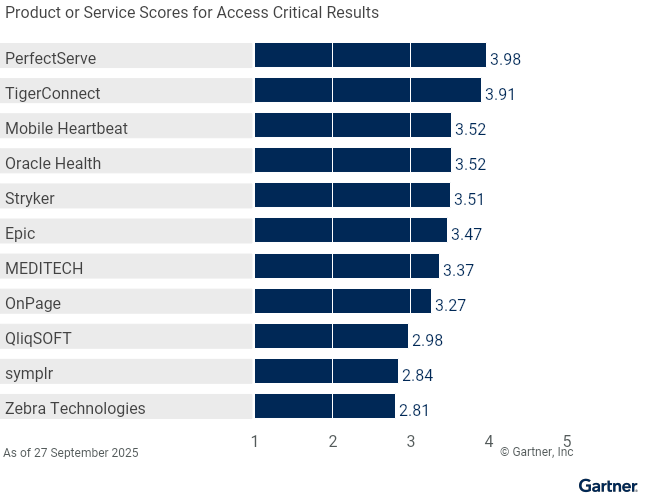
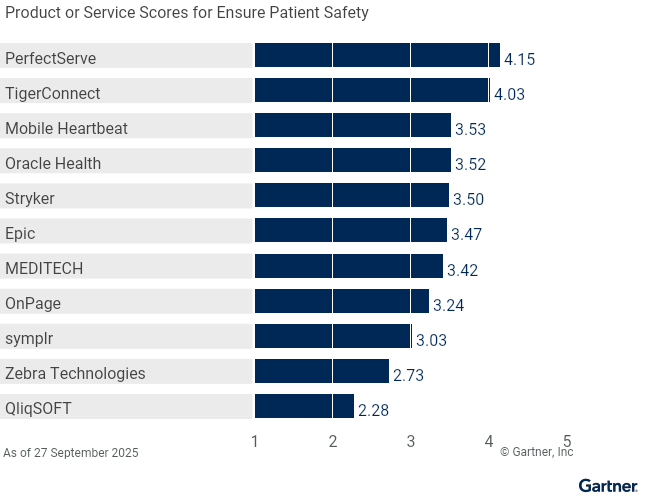
Vendors
Epic
Epic’s CC&C products include Epic Secure Chat, Epic Video Client, Hello World, and Epic Voice over IP (VoIP).
Epic does 100% of its business in the healthcare sector and deploys its CC&C products and services in acute care, ambulatory, long-term, skilled nursing, home, and virtual care settings. Epic is a privately held company with implementations in NA, EMEA, and APAC geographic regions.
Epic’s CC&C functionality natively integrates with its electronic health record (EHR) platform, ancillary offerings, and specialty modules. Epic leverages generative AI (GenAI) to respond to patient messages, summarize patient data, improve rounding and clinical notetaking, and optimize CC&C workflows.
Epic’s CC&C capabilities are available on desktops and iOS/Android mobile devices. Provider organizations that are live on Epic can also extend the platform to external non-Epic providers.
Epic scored well above the mean for all CC&C critical capabilities, with its strongest showing in critical results capability and the access critical results use case. These competencies facilitate timely and accurate care team access to patient information and are vital to the effectiveness of an EHR and the evolution of CC&C.
MEDITECH
MEDITECH is predominantly an EHR solution vendor with its cloud-based Expanse EHR platform. Expanse includes CC&C products and capabilities such as Expanse Now, Expanse Patient Connect, Expanse Point of Care, Expanse Care Compass, and Expanse Cam.
MEDITECH does 100% of its business in the healthcare sector, including inpatient, ambulatory, long-term care, home care, and virtual care venues. Its customers include practices, outpatient clinics, community hospitals, academic medical centers, and integrated delivery networks. MEDITECH is a privately held company that has implemented its services in the NA, EMEA, APAC, and LATAM geographic regions.
MEDITECH leverages GenAI to automate documentation during clinical encounters and at key transitions of care, and to provide intelligent search and summarization capabilities directly within the workflow. Its CC&C capabilities are available on desktops and iOS/Android smartphones.
MEDITECH’s scores are well above the mean for all CC&C critical capabilities, with its strongest showing in the critical results capability and the ensure patient safety use case. These competencies enable care teams to access patient information and are vital to the delivery of safe and effective care.
Mobile Heartbeat
Mobile Heartbeat has two platform-based solutions for the CC&C market, MH-CURE and Banyan. The on-premises MH-CURE platform is built on advanced directory capabilities that are sensitive to EHR and clinician bed assignments, creating a dynamic, comprehensive care team. The platform integrates with EHR patient data, laboratory results, nurse call, and real-time monitoring alerts. The platform supports mobile device management solutions and both iOS and Android personal and shared devices. Mobile Heartbeat is a wholly owned subsidiary of HCA Healthcare serving North America.
The Banyan platform is a cloud-native modular CC&C solution set that mirrors the features, functionality, and capabilities of MH-CURE. This modularity provides customizable CC&C capabilities to various-sized healthcare organizations, making implementation easier and more affordable for smaller organizations, ambulatory centers, and doctors’ offices. It offers an innovative handheld Bluetooth-connected badge that proxies some of its smartphone app functions.
Mobile Heartbeat’s scores are above the mean for all CC&C critical capabilities, with its strongest showing in the critical results capability and the collaborate on care use case. This competency facilitates care team communication, which improves the patient care journey through the efficient use of mobility, interoperability, IoT, operational intelligence, real-time analytics, AI, and decision-support technologies.
OnPage
OnPage, creator of one of the first HIPAA-compliant pager replacement systems, has extended its capabilities in the full CC&C market. When coupled together, its secure on-call alerting and messaging, live call routing, mass notification, on-call scheduling, and configurable escalation paths combine to form a viable, competitive CC&C platform. The company’s business is 100% focused on the healthcare sector in the EMEA, NA, and LATNAM geographic regions.
OnPage has developed extensive integrations with other platforms in the healthcare environment, including EHR, CRM, IT service management (ITSM), and collaboration suites such as Slack and Microsoft Teams to support platform functionality. The company supports API access for partners and customers to access and exchange data with its platform. OnPage provides an inclusive management console for efficient operation of its platform.
OnPage’s highest scores are in the critical results, secure messaging, and voice/telephony integration capabilities and the collaborate on care use case. Against its main competition, the non-EHR vendors, it has improved over the last year.
Oracle Health
Oracle Health’s CC&C product suite delivers voice, messaging, secondary alarm notifications, and clinical mobility via integration with its EHR. The product suite includes Oracle Health EHR Nursing Mobility, Oracle Health Messenger, Oracle Health Clinical AI Agent, Care Team Assignments, and Oracle Health Event Management.
Oracle Health does 100% of its business in the healthcare sector, including acute, ambulatory, and physician practice care venues. It is a publicly traded company, and its CC&C solution is installed in the NA, EMEA, APAC, and LATAM geographic regions.
Oracle Health leverages GenAI within CC&C its new AI-based EHR to automate documentation creation, surface clinical insights, streamline workflows, and reduce alarm fatigue. As Oracle Health begins to transition CC&C into its new AI-based EHR, GenAI capabilities will be available throughout CC&C workflows. Oracle Health’s CC&C capabilities are available on desktops and iOS/Android mobile devices.
Oracle Health’s scores are above the mean for all CC&C critical capabilities, with its strongest showing in the critical results capability and the access critical results and ensure patient safety use cases. These competencies facilitate the care team’s access to patient information and legitimate stakeholders outside of the inpatient setting and are vital to the effectiveness of an EHR and the evolution of CC&C.
PerfectServe
PerfectServe’s CC&C platform is hallmarked by its Dynamic Intelligent Routing (DIR) capability, which extends routing beyond typical role-based rule methods. This differentiator takes into account several variables, such as patient care team shift status, availability, and endpoint preferences, in real time to determine who the best message recipient should be. It enables more accurate message escalations if one team member does not respond to a request. DIR also includes features, such as message prioritization and deferment, that help health systems manage alert fatigue. Its AI capabilities collect notes from calls and messages, summarizing them for clinicians. Its conversational AI improves triage and call routing. It operates in the U.S. with a smaller presence in Canada and Ireland.
PerfectServe provides a suite of associated solutions, including provider and staff scheduling, a healthcare operator console, and a medical answering service. These integrate with its CC&C platform to provide healthcare providers with full capabilities. Its integrations extend beyond its offerings and include integrations with major EHR, nurse call, telemetry, scheduling, and directory products and services, as well as supporting traditional telephone and paging services. An important part of PerfectServe’s strategy is systems consolidation; a health system can replace multiple disparate scheduling, communications, and alerting platforms to achieve a near-term ROI.
PerfectServe scored high consistently across all five use cases, with its strongest showing in the collaborate on care and engage patient and caregiver use cases. Its critical capabilities ratings were well above the mean, with its highest scores in alarm management, care team collaboration, secure messaging, and voice/telephony.
QliqSOFT
QliqSOFT’s secure text message service, QliqCHAT, is complemented by its QliqCHAT with Qliq-Assisted Calling, QuincyChat, Quincy Chatbots, and Quincy Virtual Visits. QliqSOFT is a privately held company and does 100% of its business in the healthcare sector within inpatient, outpatient, and virtual care venues. It deploys its CC&C products in healthcare systems, hospitals, ambulatory clinics, and home health facilities in North America.
The QliqSOFT CC&C platform consolidates multiple point solutions for secure messaging, care-team information sharing, and custom form development for recipient-reported data. It leverages AI in its Quincy platform to create and deploy conversational AI chatbots for patient engagement, symptom checking, and medication management. QliqSOFT products are available on desktops and iOS and Android smartphones and ruggedized devices.
QliqSOFT’s scores were above the mean for most CC&C critical capabilities, except for alarm management and AI/analytics. It also had a strong showing in the reporting, critical results, interoperability, patient/family engagement, and secure messaging capabilities, as well as the engage patient and caregiver use case — competencies that complement its focus on outpatient care.
Stryker
Stryker entered the CC&C market in February 2022, acquiring the established CC&C vendor, Vocera Communications. Stryker’s CC&C portfolio includes its Vocera Clinical Communication and Workflow Platform, Vocera Edge smartphone app for clinical communication, Vocera Engage middleware for interoperability and alarm management, Vocera Ease patient and family communication products, and its Vocera Smartbadge and Minibadge and new Sync Badge hands-free wearable communications devices.
Stryker does 90% of its business in the healthcare sector, including acute, ambulatory, and long-term care venues. It is a publicly traded, global medical device and technology company with customers in the NA, EMEA, and APAC geographic regions.
Vocera Engage is an intelligent workflow engine that enables smart workflows including routing, prioritization, and escalation of alarms and notifications. Stryker CC&C products are available on desktops, iOS/Android mobile devices, and as hands-free devices.
Stryker scored well above the mean in all critical capabilities, with a strong showing in the critical results and interoperability capabilities and the collaborate on care and access critical results use cases.
Stryker declined requests for supplemental information. Gartner’s analysis is therefore based on other credible sources.
symplr
symplr’s CC&C product suite includes its Clinical Communications SaaS platform and EHR collaboration modules.
symplr is a privately held company and does 100% of its business in the healthcare sector within the acute, ambulatory, long-term, and virtual care venues, with customers for its CC&C platform in the U.S.
symplr’s CC&C offering is a component of its more extensive next-generation workforce management for healthcare platform. symplr leverages GenAI for analytics, reporting, and workflow optimization. CC&C products are available on desktops and iOS and Android mobile devices.
symplr scored above the mean for most CC&C critical capabilities, with a strong showing in the reporting, care team collaboration, critical results, secure messaging, and voice/telephony integration capabilities, and the collaborate on care use case. These CC&C competencies are key to care team effectiveness and facilitate symplr’s reinvention of the healthcare workforce management platform.
TigerConnect
TigerConnect is a fully featured CC&C platform that includes voice, video, and text communication organized through a customizable directory, on-call schedule, and role assignment functions. The platform is cloud-hosted and supports multiple mobile endpoint devices. Its CareConduit workflow orchestration platform routes events, alerts, and AI-driven insights across the care continuum to the appropriate person. It is 100% focused on the healthcare provider sector, serving U.S. and Canadian markets.
TigerConnect offers integrations with major EHR vendors, including an app-switching function between EHR user interfaces and its own. It also integrates with its own alarm management system and other nurse call solutions in the market, facilitating alert and alarm notifications and response through its platform.
TigerConnect’s scores are above the mean for all CC&C critical capabilities, with its strongest showing in the alarm management, care team collaboration, secure messaging, and voice/telephony capabilities, and the collaborate on care use case. It also scored highly in all of the other categories, making it a strong competitor in this market.
Zebra Technologies
Zebra Technologies has a long-established history of creating workplace communication devices for many industries, including retail, manufacturing, field operations, warehousing, and healthcare. Its healthcare-focused solutions enable the reliable delivery of CC&C secure messages, including voice, images, and text. Zebra couples its endpoint management with a real-time location system (RTLS) to enable accurate routing of messages to the nearest staff member. This capability also enhances staff safety by enabling the communication of emergent information to the appropriate staff member. It is available globally and serves many industries, including the healthcare provider sector.
Zebra’s Workcloud Sync product is based on a composable architecture that allows integration with EHRs, nurse call systems, alarm middleware, and telemetry. This flexibility allows customers to tailor workflows to their specific needs and optimize care delivery.
Zebra relies on its partner community for clinical application enablement for the CC&C market, which resulted in lower scores for the use-case analysis. Its highest score was for the collaborate on care use case, due to its integrated programmable duress button and voice and push-to-talk communication features. Its strongest capability is in voice/telephony integration.
Context
CC&C solutions have traditionally facilitated communication among physicians, nurses, and care team members. CC&C increasingly includes patients, caregivers, and family members in the care team, making CC&C a viable tool for patient/provider engagement and, in some cases, virtual care. CC&C can positively impact patient safety, care-team efficiency, nursing productivity, and morale. CC&C can also improve care coordination and address patient throughput challenges. CC&C systems represent the convergence of conventional inpatient communications, such as voice and paging, with modern channels such as secure messaging and video.
New care collaboration channels are vital at the point of care and during care transitions. They are essential to satisfy increased consumer and patient expectations and key care quality and performance indicators that affect provider reimbursement and revenue. Due to the persistent need of healthcare providers to improve operational efficiency, CC&C systems increasingly take advantage of operational intelligence housed in systems, such as patient flow, bed management, and resource scheduling systems. Focus your CC&C initiatives on reducing care team toil, including the tasks that erode nursing morale and well-being and contribute to burnout and retention issues.
Market Definition
Clinical communication and collaboration (CC&C) systems are mobile platforms that clinicians, care teams, patients and caregivers use to collaborate on treatment and care activities within ambulatory, acute, postacute and virtual care settings. CC&C systems improve situational awareness surrounding the patient and information sharing at the point of care and during care transitions. CC&C systems represent the convergence of conventional inpatient communications, such as telephony and paging, with modern channels enabled by mobility, interoperability and the Internet of Things (IoT).
CC&C solutions facilitate communication and collaboration among physicians, nurses, support staff and health system services. CC&C care teams increasingly include patients, caregivers and family members, making CC&C a viable tool for patient and family engagement and virtual care. CC&C can positively affect care outcomes, patient safety, care team efficiency, clinician productivity and morale, care coordination, and patient throughput and capacity management.
CC&C systems represent the convergence of conventional communication channels (such as telephony and paging) with modern devices and technologies (such as smartphones, secure chat, text messaging and video). Real-time and responsive care collaboration approaches are vital at the point of care and during care transitions. They are essential to satisfy increased consumer and patient expectations and key care quality measures that affect the organization’s reputation and revenue goals.
CC&C systems improve operational efficiency by incorporating patient data in systems, such as patient flow, bed management, location services and resource scheduling systems (such as on-call, physician or nursing). CC&C solutions are part of an emerging care team collaboration ecosystem, including interactive patient care, nurse call, resource scheduling systems, and alarms and notifications middleware.
Common CC&C use cases include:
- Accessing and viewing critical patient results
- Collaborating with care team members in real-time
- Engaging the patient and caregiver in care and treatment
- Enhancing the patient experience and reducing care team toil
- Improving patient safety and care quality measures
- Participating in virtual care encounters
- Managing medical device alarms and notifications
- Optimizing care handoffs and transitions
Mandatory Features
The mandatory features for this market include:
- Care team collaboration — The ability to communicate and collaborate with care team members over secure and compliant channels, such as secure messaging, chat, unified communications and workforce collaboration platforms.
- Critical results — The ability to securely access, view and integrate patient information housed in the electronic health record (EHR), ancillary and other essential clinical systems to support CC&C workflows.
- Secure messaging — The ability to facilitate secure messaging and chat sessions among patients, care team members, support staff, community physicians and other legitimate stakeholders.
- Task and workflow management — This feature enables the care team to assign and track tasks, set priorities and automate routine workflows, enhancing efficiency. It includes collaboration tools like shared task lists and document sharing, facilitating effective teamwork regardless of location.
- Analytics — The ability to apply advanced analysis, logic-based and AI techniques to interpret events, and support and automate decisions and actions.
Optional Features
The optional features for this market include:
- Alarm management — The ability to connect to alarms and notification middleware to acquire, filter, escalate and manage medical device codes and alarms.
- Interoperability — The ability to acquire, exchange and integrate patient information with point-of-care, operational, and patient and clinician context systems (such as nurse call, on-call, patient flow and bed management systems) using industry interoperability standards and protocols.
- Patient/family engagement — The ability to include the patient, family members and caregivers in the care team communications, collaborative sessions and workflows.
- Voice/telephony integration — The ability to initiate and receive voice calls and integrate with Session Initiation Protocol (SIP), PBX and voice over IP (VoIP) technologies.
- Reporting — The ability to capture, analyze, report on and optimize patient and care team activity.
Product/Service Trends
CC&C platforms are becoming more automated, predictive, and smart as interoperability advances allow them to more effectively acquire and activate operational intelligence from surrounding clinical and operational systems. CC&C platforms are continuing to evolve alongside advances in real-time healthcare system (RTHS) features and capabilities.
CC&C platforms will become increasingly situationally aware with real-time, enterprise-level knowledge of essential clinical and patient event information derived from current and historical data sources. They will use real-time operational intelligence to appropriately elevate and orchestrate essential clinical workflows and processes within the patient’s context.
CC&C platforms will become increasingly collaborative. Collaboration is higher-order communication and requires the convergence of point-of-care solutions, interoperability middleware, IoT, analytics, and AI. Therefore, it is not enough for care team members to merely communicate via mobile channels — they must share patient information and context with colleagues and adjacent IT systems in real time.
Staffing shortages and employee retention are significant concerns for healthcare providers, and team-based staffing is gaining popularity. In this context, CC&C has become a critical tool for leveraging team-based staffing models that rely on increasing care team efficiency and individual contributor productivity. More patient engagement and virtual care capabilities are available as CC&C solution vendors focus on empowering families and caregivers to become more engaged care-team members.
CC&C platforms have become more critical as risks for communication failures increase. CC&C platforms can effectively handle complex, role-based teams without creating more administrative burdens for staff. They can also effectively remediate inefficient clinical workflows, disjointed care-team handoffs, and care transitions that still characterize many care team interactions.
There is increasing support for postacute care, hospital-at-home, and home-care workflows, which will drive CC&C vendor planning roadmaps. CC&C platforms have begun to support EMS to ED collaboration and data sharing, and streamlining prehospital interactions and workflows.
Critical Capabilities Definition
Alarm Management
The ability to connect to alarms and notification middleware to acquire, filter, escalate, and manage medical device codes and alarms.
AI/Analytics
The ability to apply advanced analysis, logic-based, and AI techniques to interpret events and support and automate decisions and actions.
Reporting
The ability to capture, analyze, report on, and optimize patient and care team activity.
Care Team Collaboration
The ability to communicate and collaborate with care team members over secure and compliant channels, such as chat, unified communications, and workforce collaboration platforms. Collaboration also includes task management and orchestration.
Critical Results
The ability to securely access, view, and integrate patient information housed in the EHR, ancillary, and other essential clinical systems to support CC&C workflows.
Interoperability
The ability to acquire, exchange, and integrate patient information with point-of-care, operational, and patient and clinician context systems using industry interoperability standards and protocols. Example integrations include nurse call, on-call, patient flow, and bed management systems.
Patient/Family Engagement
The ability to include the patient, family members, and caregivers in the care team communications, collaborative sessions, and workflows.
Secure Messaging
The ability to facilitate secure messaging and chat sessions among patients, care team members, support staff, community physicians, and other legitimate stakeholders.
Voice/Telephony Integration
The ability to initiate and receive voice calls and integrate them with system-in-package (SIP), PBX, and VoIP technologies.
Use Cases
Collaborate on Care
This involves communicating with care team members within a clinical pathway, a treatment plan, or a patient encounter.
Coordinate Care
This involves securely routing calls and messages and sharing information and artifacts in near real time to expedite the patient journey.
Engage Patient and Caregiver
This involves engaging the patient, family members, and caregivers before, during, and after a patient encounter or hospital stay.
Access Critical Results
This involves compliantly and promptly accessing, updating, and viewing patient EHI on a mobile device.
This includes lab results, clinical documentation, medical images, medications, and problem lists.
Ensure Patient Safety
This involves CC&C platform capabilities to ensure patient safety during a hospital stay and responses to common patient safety risks.
This includes adverse drug events, hospital-acquired infections, patient falls, staffing shortages, and care coordination and transition challenges.
Vendors Added and Dropped
We review and adjust our inclusion criteria for Critical Capabilities as markets change. As a result of these adjustments, the mix of vendors in any Critical Capability may change over time. A vendor’s appearance in a Critical Capability one year and not the next does not necessarily indicate that we have changed our opinion of that vendor. It may be a reflection of a change in the market and, therefore, changed inclusion criteria, or of a change of focus by that vendor.
Added
No vendors have been added or dropped.
Dropped
No vendors have been added or dropped.
Inclusion and Exclusion Criteria
To qualify for inclusion, vendors must demonstrate:
1. They do most of their business in the healthcare provider space (ambulatory, inpatient, postacute care spaces).
2. Their platform includes competitive product offerings that align with the various CC&C critical capabilities, minimally those designated as must-have:
- Must-have:
- Analytics: The ability to apply advanced analysis, logic-based, and AI techniques to interpret events, and support and automate decisions and actions.
- Care team collaboration: The ability to communicate and collaborate with care team members over secure and compliant channels, such as chat, unified communications, and workforce collaboration platforms. Collaboration also includes the ability to assign and track tasks, set priorities, and automate routine workflows.
- Critical results: The ability to securely access, view, and integrate patient information housed in the EHR, ancillary, and other essential clinical systems to support CC&C workflows.
- Secure messaging: The ability to facilitate secure messaging and chat sessions among patients, care team members, support staff, community physicians, and other legitimate stakeholders.
- Standard:
- Alarm management: The ability to connect to alarms and notification middleware to acquire, filter, escalate, and manage medical device codes and alarms.
- Interoperability: The ability to acquire, exchange, and integrate patient information with point-of-care, operational, and patient and clinician context systems using industry interoperability standards and protocols.
- Voice/telephony integration: The ability to initiate and receive voice calls and integrate with system-in-package (SIP), PBX and VoIP technologies.
- Optional:
- Patient/family engagement: The ability to include the patient, family members, and caregivers in the care team communications, collaborative sessions, and workflows.
- Reporting: The ability to capture, analyze, and report on patient and care team activity.
3. Have ten or more healthcare provider customers in production deployments.
4. Support a combination of on-premises, hosted, hybrid, and cloud service delivery models.
5. Offer, directly or through partnerships, implementation, and support services for their platform.
Weighting for Critical Capabilities in Use Cases
| Critical Capabilities | Collaborate on Care | Coordinate Care | Engage Patient and Caregiver | Access Critical Results | Ensure Patient Safety |
|---|---|---|---|---|---|
Alarm Management | 5% | 0% | 0% | 0% | 25% |
AI/Analytics | 3% | 10% | 3% | 10% | 5% |
Reporting | 2% | 5% | 2% | 10% | 5% |
Care Team Collaboration | 25% | 15% | 20% | 10% | 10% |
Critical Results | 20% | 20% | 10% | 25% | 20% |
Interoperability | 10% | 10% | 10% | 20% | 10% |
Patient/Family Engagement | 5% | 10% | 25% | 5% | 5% |
Secure Messaging | 15% | 15% | 20% | 10% | 10% |
Voice/Telephony Integration | 15% | 15% | 10% | 10% | 10% |
As of 27 September 2025 | |||||
Source: Gartner (January 2026)
This methodology requires analysts to identify the critical capabilities for a class of products/services. Each capability is then weighted in terms of its relative importance for specific product/service use cases.
Critical Capabilities Rating
Each of the products/services that meet our inclusion criteria has been evaluated on a scale from 1.0 to 5.0 for critical capabilities.
Product/Service Rating on Critical Capabilities
| Critical Capabilities | Epic | MEDITECH | Mobile Heartbeat | OnPage | Oracle Health | PerfectServe | QliqSOFT | Stryker | symplr | TigerConnect | Zebra Technologies |
|---|---|---|---|---|---|---|---|---|---|---|---|
Alarm Management | 3.5 | 3.5 | 3.5 | 3.0 | 3.5 | 4.5 | 0.0 | 3.5 | 3.3 | 4.3 | 2.5 |
AI/Analytics | 3.0 | 3.0 | 3.0 | 2.8 | 3.0 | 4.0 | 0.0 | 2.8 | 0.0 | 4.0 | 2.5 |
Reporting | 3.5 | 3.5 | 3.5 | 3.3 | 3.5 | 3.5 | 3.5 | 3.3 | 3.5 | 3.5 | 3.3 |
Care Team Collaboration | 3.0 | 3.0 | 3.5 | 3.3 | 3.0 | 4.5 | 3.3 | 3.5 | 3.5 | 4.3 | 3.0 |
Critical Results | 4.0 | 4.0 | 3.8 | 3.5 | 4.0 | 3.5 | 3.5 | 4.0 | 3.5 | 3.5 | 3.3 |
Interoperability | 3.5 | 3.0 | 3.5 | 3.0 | 3.5 | 4.0 | 3.5 | 3.8 | 2.8 | 4.0 | 2.5 |
Patient/Family Engagement | 3.3 | 3.3 | 3.3 | 3.0 | 3.3 | 4.0 | 3.5 | 2.8 | 0.0 | 3.8 | 0.0 |
Secure Messaging | 3.5 | 3.5 | 3.5 | 3.5 | 3.5 | 4.5 | 3.5 | 3.0 | 3.5 | 4.3 | 2.5 |
Voice/Telephony Integration | 3.0 | 3.0 | 3.5 | 3.5 | 3.5 | 4.5 | 2.0 | 3.5 | 3.5 | 4.3 | 3.5 |
As of 27 September 2025 | |||||||||||
Source: Gartner (January 2026)
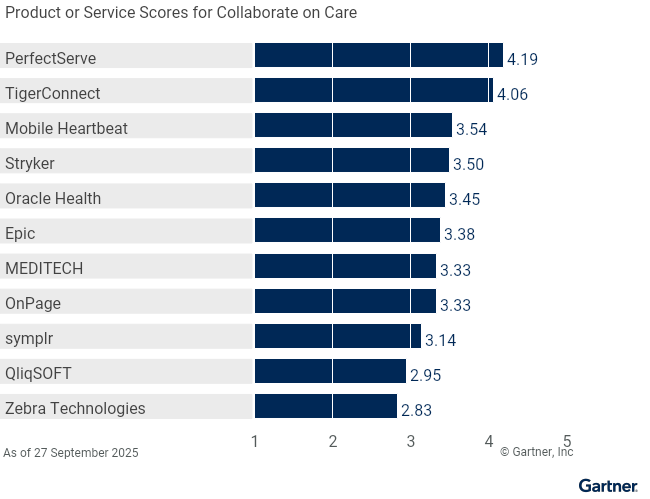
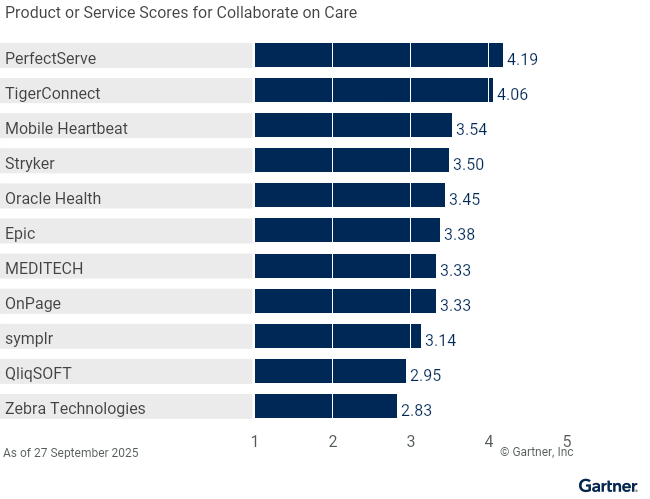
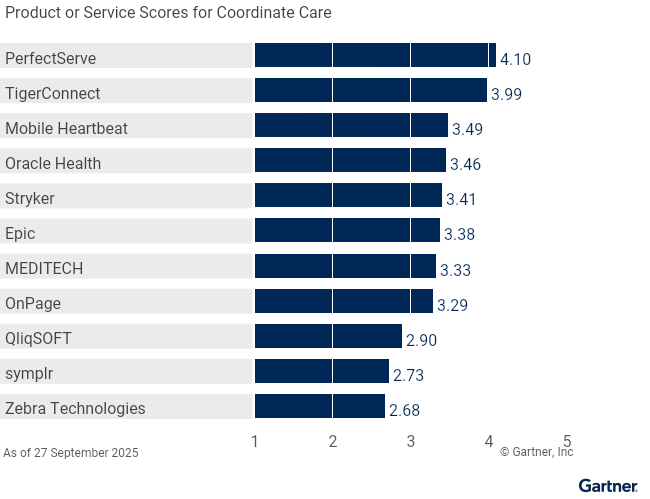
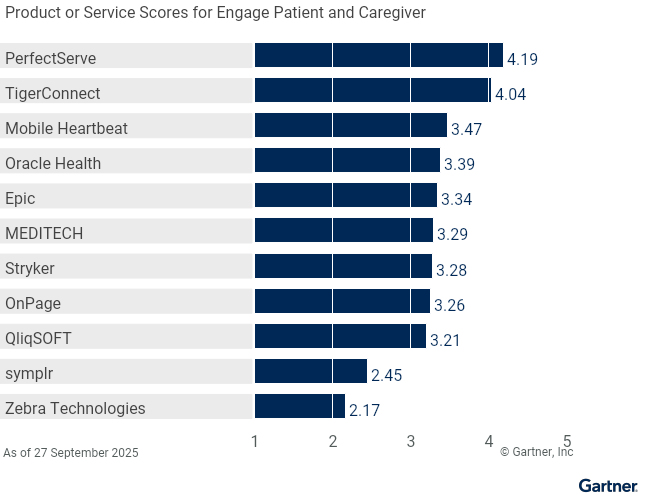
Table 3 shows the product/service scores for each use case. The scores, which are generated by multiplying the use-case weightings by the product/service ratings, summarize how well the critical capabilities are met for each use case.
Product Score in Use Cases
| Use Cases | Epic | MEDITECH | Mobile Heartbeat | OnPage | Oracle Health | PerfectServe | QliqSOFT | Stryker | symplr | TigerConnect | Zebra Technologies |
|---|---|---|---|---|---|---|---|---|---|---|---|
Collaborate on Care | 3.38 | 3.33 | 3.54 | 3.33 | 3.45 | 4.19 | 2.95 | 3.50 | 3.14 | 4.06 | 2.83 |
Coordinate Care | 3.38 | 3.33 | 3.49 | 3.29 | 3.46 | 4.10 | 2.90 | 3.41 | 2.73 | 3.99 | 2.68 |
Engage Patient and Caregiver | 3.34 | 3.29 | 3.47 | 3.26 | 3.39 | 4.19 | 3.21 | 3.28 | 2.45 | 4.04 | 2.17 |
Access Critical Results | 3.47 | 3.37 | 3.52 | 3.27 | 3.52 | 3.98 | 2.98 | 3.51 | 2.84 | 3.91 | 2.81 |
Ensure Patient Safety | 3.47 | 3.42 | 3.53 | 3.24 | 3.52 | 4.15 | 2.28 | 3.50 | 3.03 | 4.03 | 2.73 |
As of 27 September 2025 | |||||||||||
Source: Gartner (January 2026)
To determine an overall score for each product/service in the use cases, multiply the ratings in Table 2 by the weightings shown in Table 1.
Critical Capabilities Methodology
This methodology requires analysts to identify the critical capabilities for a class of products or services. Each capability is then weighted in terms of its relative importance for specific product or service use cases. Next, products/services are rated in terms of how well they achieve each of the critical capabilities. A score that summarizes how well they meet the critical capabilities for each use case is then calculated for each product/service.
"Critical capabilities" are attributes that differentiate products/services in a class in terms of their quality and performance. Gartner recommends that users consider the set of critical capabilities as some of the most important criteria for acquisition decisions.
In defining the product/service category for evaluation, the analyst first identifies the leading uses for the products/services in this market. What needs are end-users looking to fulfill, when considering products/services in this market? Use cases should match common client deployment scenarios. These distinct client scenarios define the Use Cases.
The analyst then identifies the critical capabilities. These capabilities are generalized groups of features commonly required by this class of products/services. Each capability is assigned a level of importance in fulfilling that particular need; some sets of features are more important than others, depending on the use case being evaluated.
Each vendor’s product or service is evaluated in terms of how well it delivers each capability, on a five-point scale. These ratings are displayed side-by-side for all vendors, allowing easy comparisons between the different sets of features.
Ratings and summary scores range from 1.0 to 5.0:
1 = Poor or Absent: most or all defined requirements for a capability are not achieved
2 = Fair: some requirements are not achieved
3 = Good: meets requirements
4 = Excellent: meets or exceeds some requirements
5 = Outstanding: significantly exceeds requirements
To determine an overall score for each product in the use cases, the product ratings are multiplied by the weightings to come up with the product score in use cases.
The critical capabilities Gartner has selected do not represent all capabilities for any product; therefore, may not represent those most important for a specific use situation or business objective. Clients should use a critical capabilities analysis as one of several sources of input about a product before making a product/service decision.