
Design Thinking Can Revolutionize Your Customer Experience Strategies
Design Thinking isn't new, but it is new to most IT organizations. IT leaders supporting business applications and applications infrastructure initiatives must understand the importance of Design Thinking for their own solutions delivery, especially as digital business opportunities arise.

Foundational Document
This research is reviewed periodically for accuracy. Last reviewed on 4 April 2017.
Impacts
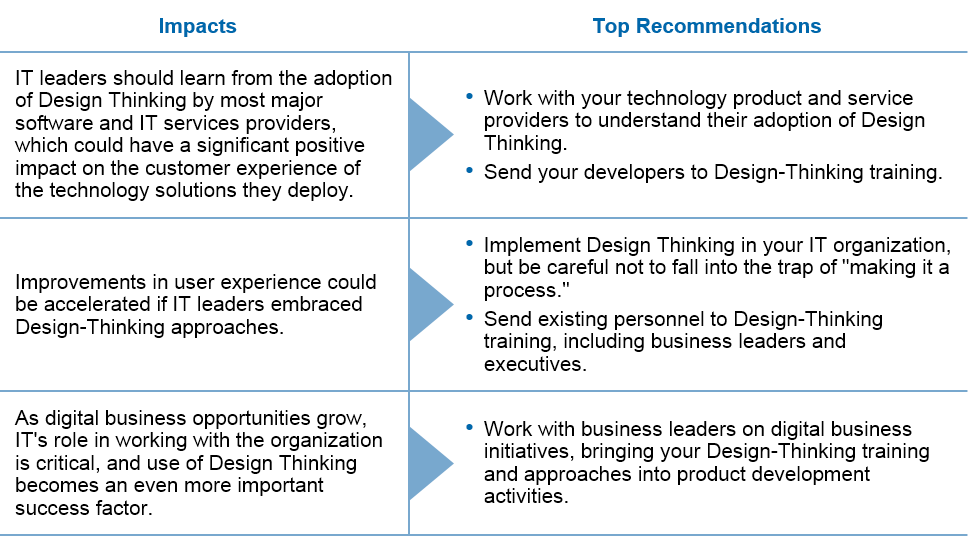
- IT leaders should look at and learn from the adoption of Design Thinking by almost all of the major software and IT services providers, which could have a significant positive impact on the customer experience of the technology solutions they deploy.
- While Design Thinking has been adopted widely in product design, it has seen only moderate adoption by enterprise IT, yet improvements in user experience could be accelerated if IT leaders embraced Design-Thinking approaches.
- As digital business opportunities grow, IT's role in working with the organization is critical, and use of Design Thinking becomes an even more important success factor.
Recommendations
For IT leaders supporting CRM, ERP and other business applications initiatives, or applications infrastructure initiatives:
- Understand what Design Thinking is, and is not.
- Implement Design Thinking in your IT organization, but be careful not to fall into the trap of "making it a process."
- Train existing personnel on Design Thinking, including business leaders and executives, and seed projects with new hires from design schools.
- Make sure that design is a first-level priority, starting at the beginning of the project and continuing throughout its life cycle.
- Work with business leaders on digital business initiatives, bringing your Design-Thinking training and approaches into product development activities.
Strategic Planning Assumptions
By 2017, more than 30% of enterprise IT organizations will have attempted to implement Design Thinking, up from less than 10% today.
By 2017, less than 50% of enterprise IT organizations attempting to implement Design Thinking will be successful.
Analysis
Design Thinking can have a significant impact on your customer experience strategies. Every IT organization wants to improve the user experience of the solutions it delivers, and enjoy the resulting improvement in customer experience, but very few use Design Thinking to improve user experience. This is an interesting disconnect, as many product and services teams have been using Design Thinking in their design processes for years. Yet Design Thinking has hardly ever made its way over to the IT department.
Through its use of empathy, brainstorming, iteration and collaboration, Design Thinking can improve the user experience, and therefore the customer experience, of IT-provisioned systems. IT should follow the example set by product teams in seeking to improve overall customer experience.
Design Thinking requires the designer to walk a mile in the user's shoes. User-centered design is an angle on this, but Design Thinking goes further, requiring true empathy with the user. This level of understanding can only be created by observation, and data-driven design is a core tenet of Design Thinking.
Design Thinking also requires a collaborative, open and iterative approach. Agile design methodologies employ such a model, but Design Thinking adds an unrestricted, "no harm, no foul" brainstorming activity, where many ideas are tossed around, no ideas are "bad ideas," and people are encouraged to think creatively with no penalty. Depending on the existing culture of the organization, this may not be easy to implement and may require a great deal of change management to accomplish.
The biggest divergence of Design Thinking from traditionally engineered IT solutions is the approach to the problem. IT solutions typically solve a problem. The problem is narrow in scope to ensure a solution. Design Thinking doesn't focus on solving a problem — it focuses on reaching a goal. This subtle shift opens up the opportunity space, and allows designers to derive more creative solutions than they otherwise would constrained by the bounds of traditional problem solving.
The result is a set of IT solutions that exceed customer needs, delivered in a way that delights the customer. The solutions delivered via Design Thinking will have a better fit with customer needs, but will also incorporate many unanticipated or future needs.
Figure 1. Impacts and Top Recommendations for IT leaders Supporting Business Applications and Applications Infrastructure Initiatives
Source: Gartner (November 2015)
Brief History
Design Thinking isn't new. Certain aspects can be traced back to the industrial revolution. The Bauhaus, a German art school that operated from 1919 to 1933, created the concept of the "craftsman-artist," a founding principle of modern design. However, the formalization of Design Thinking as a methodology came about in 1969 with Herbert S. Simon's "The Sciences of the Artificial."1 Business adoption of Design Thinking was enabled in 1991 by the works of David M. Kelly, who founded the Ideo company.
Design Thinking has been used in many product companies since the mid-1990s. Most notable is Apple, which revolutionized and disrupted many industries with the advent of the iPod, iPhone and iPad products. But Design Thinking wasn't applied broadly to IT until 2012, when software vendors started to adopt its concepts and methodologies, train their developers, and modify their software development processes to reflect a Design-Thinking approach.
Definition
Design Thinking has many definitions. In fact, there are so many definitions floating around that the concept has become muddied. No single definition fits all purposes. In this research note, we present several of the leading definitions of Design Thinking.
Tim Brown, CEO of Ideo, defines Design Thinking as an approach that uses the designer's sensibility and methods for problem solving to meet people's needs in a technologically feasible and commercially viable way. It is human-centered innovation.
Researchers and authors at Thisisdesignthinking.net define it as a "package of mindsets, principles, practices and techniques, which resemble the way certain designers work and approach problems that go beyond a product's look." They go on to relate that "people who perceive it a philosophy argue with pragmatics who use it as a toolbox." Hence, different definitions of Design Thinking from different perspectives.
Gartner analyst Ray Valdes simplifies it to: "Design Thinking is a structured approach to innovation."
Design Thinking brings creativity and informed intuition back into management practice. It is a creative process of building up ideas, where one starts with a goal rather than attempting to solve a specific problem. There are no judgments or fear of failure in Design Thinking. Intuition is applied to recognize patterns in the environment, and through iterative approaches alternate solutions are explored simultaneously.
Design Thinking is a method for driving strategic change by:
- Supporting the building of ideas and "outside-in" thinking
- Taking risks at early stages — failing fast
- Understanding customers and their goals, behaviors and values
- Testing and prototyping ideas early, and instilling an active feedback loop
- Challenging a product or service's usability, feasibility or perceived value
Design Thinking is ideal for coming up with new approaches; new ways of doing stuff. It's about making the right product that satisfies the user to the maximum extent.
Key to Design Thinking is to focus on a goal, not on solving a problem. One common exercise (the Vase Exercise) used at the start of Design-Thinking training is to ask students to design "the thing that holds flowers on a table." The results are a collection of traditional vases, with minor variations on the theme. Next, the students are asked to design a "better way to enjoy flowers." When presented with that goal the designs become very creative, often not resembling a traditional vase at all. Pursuit of a goal versus solving a problem is the key difference.
One of the best sources of thought leadership in Design Thinking is the Hasso Plattner Institute of Design at Stanford (the "d.school"), which subscribes to the following steps for Design Thinking:
- Understand: Research and become familiar with the subject matter. Subject-matter experts may be employed here, but real users are also used as sources of information. Persona and stories are good tools to use to further flesh out the area, as well as to continue to test future potential solution sets.
- Observe: Actively observe the environment, the subject and interactions. Record activities via a variety of mechanisms, including laboratory studies and field-based studies. Iterate back to the "Understand" phase until the subject space is thoroughly explored.
- Define point of view: Consider multiple points of view to flesh out the problem and to provide alternate paths to the goal. Here is where the problem is defined, key insights are identified, and design principles established. Iterate back to the "Observe" phase to validate the points of view with actual observation, and to the "Understand" phase to validate alignment with persona and stories.
- Ideate: Brainstorm, generating lots of ideas without criticism. Traditional brainstorming methods (for example, colored sticky notes) can be used here. Choose a solution set. Iterate back to the "Define Point of View" phase to validate alignment with points of view.
- Prototype: Rapidly develop prototypes. Initially, generate low-fidelity prototypes and evolve to high-fidelity prototypes. Iterate back to the "Ideate" phase to validate the prototypes' fit for purpose and back to the "Define Point of View" phase to assure alignment.
- Test: Test the proposed solution and validate its fit for purpose. Iterate back to the "Prototype" phase to modify and improve the prototype(s) based on results of the testing. Iterate back to the "Define Point of View" phase to assure alignment.
This d.school process has multiple iteration loops. Design Thinking itself is an iterative process. This process, with some variants, is common in Design-Thinking programs and in design courses of major universities. In fact, Design Thinking is taught in over 100 higher education institutions and also in some K-12 schools.
Design Thinking has its detractors, however. Bruce Nussbaum, historically a huge advocate of Design Thinking, calls it a "failed experiment." The biggest issue that Nussbaum identifies with Design Thinking is that companies have turned it "into a linear, gated, by-the-book methodology that delivered, at best, incremental change and innovation." This "processization" of Design Thinking, avoiding the messiness that is inherent in true Design Thinking, is something to be avoided. It is a process, but not a "cookie cutter" process, that adheres to the constraints of a well-defined, repeatable business process. It is creation, and true creation is messy.
Adoption of Design Thinking is not easy. It requires a change in design and development philosophy, perhaps even a change in culture. These changes can be quite difficult to accomplish, and because of this a large number of Design-Thinking efforts will fail, especially in the first iteration. This does not mean that enterprises should avoid the effort. With the right change management, and a lot of hard work, Design Thinking can take hold in an enterprise and deliver very positive results.
Design Thinking supports transformative, innovative and strategic change by:
- Driving shared commitment through collaboration
- Developing emotionally satisfying experiences through empathetic research
- Finding deeply felt insights through visualization
- Uncovering unexpected opportunities by asking new questions
- Building up powerful new ideas through the use of intuition and learning through prototyping
Design Thinking has proven to help organizations identify and create new opportunities for themselves, their stakeholders and their customers. However, change is achieved through an organization's willingness to adopt its culture to new ways of thinking, as well as its capacity to deliver results.
Newer design methodologies like Service Design and Lean Startup have been inspired and heavily influenced by Design Thinking. They are less academic and somewhat more practical, which may make enterprise IT adoption easier.
Impacts and Recommendations
IT leaders should look at and learn from the adoption of Design Thinking by almost all of the major software and IT services providers, which could have a significant positive impact on the customer experience of the technology solutions they deploy
Design Thinking has enjoyed significant adoption by software and services providers. It's hard to find a major technology company that does not have an investment in Design Thinking.
IBM launched the IBM Design Studio in Austin, Texas in 2013. This facility was purpose-built to foster the teamwork, open collaboration and ideation processes that exemplify Design Thinking. IBM runs regular Design-Thinking training (Designcamp) for developers, business leaders and executives in Austin, as well as 22 additional design studio sites around the world by YE15. IBM extends this training to partners and customers. To date, tens of thousands have taken Design-Thinking training. IBM also changed its software development methodologies to incorporate Design Thinking and has changed the ratio of designers to developers from 1:33 to 1:8. A new IBM Design Language was created to provide consistency across the product lines, but still allow creativity and freedom.
SAP has fully embraced Design Thinking. Hasso Plattner, one of the founders of SAP, created the Hasso Plattner Institute of Design at Stanford (the d.school), one of the leading sources of Design Thinking in the world. Sam Yen, Chief Design Officer of SAP, is a Stanford University graduate with extensive training from the d.school. SAP has facilities calls "AppHauses" around the world, of which the AppHaus Heidelberg is the most prominent, where Design Thinking is taught to SAP developers, partners and customers. SAP has embraced Design Thinking in its software development methodologies and, as a result, has created the Fiori product as its new user experience tool.2
Oracle's President of Product Development, Thomas Kurian, was the sponsor of Oracle's Design-Thinking efforts. All Oracle developers have been training on its new design approaches, and the company's large center of excellence supports the product teams.3 Oracle's new Alta language was created as a result of Kurian's efforts and is its new standard for user experience.
Other technology vendors like Microsoft, Intuit, Workday, Salesforce and Google employ Design Thinking. In addition, services providers like Accenture, Deloitte, MRM/McCann, LiquidHub, Razorfish, and Infosys utilize Design Thinking. In fact, Infosys recently completed the training of 56,000 employees on Design-Thinking techniques.
The section above is neither intended to be an exhaustive list of all technology companies employing Design Thinking, nor is it intended to exhaust all Design-Thinking capabilities of the companies listed. Rather, it serves to illustrate how technology companies have made a significant investment in Design Thinking, and how it permeates aspects of their product- and service-design processes.
Mass adoption of Design Thinking by technology providers has resulted in major improvements in their product development and user experience methodologies and processes. Design is now a first-level priority. The ratio of designers to developers has increased in many companies. Implementation of Design Thinking has started to yield results via new versions of applications software and infrastructure technologies with significantly improved user experiences.
But this can be a tedious and slow process. While some project teams in some technology providers embrace Design Thinking wholeheartedly, not everybody embraces it at the same pace. And many software vendors have a long way to go to improve their user experience. So don't expect miracles overnight!
One offshoot of the investment in design studios is the extension of Design-Thinking training to customers. If one or more of your providers offer Design-Thinking training, take advantage of it. You won't be able to send your entire developer corps to this training, but you can send multiple teams to get a taste, then bring back to your enterprise the concepts where you can implement your own training regimen, perhaps with the assistance of a services provider.
Design Thinking is applicable to any company, not just technology providers. The benefits enjoyed by product-centric companies for decades can be yours, too!
Recommendations:
- Work with your technology product and services providers to understand their adoption of Design Thinking, and leverage new releases that have improved user experience through adoption of Design Thinking in the product development process.
- Identify opportunities to learn Design Thinking from your technology providers. Send your developers to Design-Thinking training, and use their design studios for some of your projects. Incubate some pilots in these studios.
- Borrow liberally from your technology providers. Use their training, ideas, studios and methodologies in your own IT development projects. Leverage their Web resources and human resources to learn what Design Thinking is and how to make it work in your enterprise.
While Design Thinking has been adopted widely in product design, it has seen only moderate adoption by enterprise IT, yet improvements in user experience could be accelerated if IT leaders embraced Design-Thinking approaches
The user experience of most software developed by enterprise IT is frequently abysmal. Methodologies have been employed to help improve the user experience, and many methodologies such as user-centered design, persona, interaction patterns and journey maps have made a big difference in the usability of IT-provisioned technology solutions.
Design Thinking can accelerate this improvement in user experience in a big way. The application of good user-experience methodologies does not ensure that the end product will meet the needs of the user. The empathy that is part of Design Thinking helps chart the course toward the correct goal, one that satisfies the user.
Within the Gartner Pace Layer Model (see "Pace-Layered Toolkits and Best Practices"), Design Thinking is most applicable to Systems of Differentiation and Systems of Innovation. In practice, Design Thinking is most applied to customer-facing initiatives, but it is applicable to any audience and should be considered for digital workplace, supplier and public-sector initiatives. In fact, employees often suffer with the worst user interfaces imaginable and deserve the radical improvements possible via Design Thinking.
Practitioners must not wait for Design Thinking to trickle down into a specialized version of Design Thinking for IT. It doesn't work that way. CIOs, applications leaders, chief architects and other strategic IT leaders must seek out Design-Thinking initiatives that are already underway in their organizations or their industries, even if the IT aspect initially seems irrelevant. In fact, when IT leaders fully integrate their thinking with business thinking, the result truly transforms the relationship between business and IT.
Recommendations:
- Do not wait for "Design Thinking for IT." Seek out Design-Thinking initiatives that are already underway in your organization or your industry.
- Understand what Design Thinking is and is not.
- Start efforts in areas of the organization where transformative, innovative or strategic change is needed. Set expectations about Design Thinking clearly and upfront, and get the leadership team's support.
- Leverage skills from other business units using Design Thinking. If one of these business units also supports customer experience, even better. For example, if marketing uses Design Thinking, leverage those skills to work with IT on marketing technology initiatives.
- Practice Design Thinking early and often.
- Implement Design Thinking in your IT organization, but be careful not to fall into the trap of "making it a process." Make it a part of your software development and deployment methodologies.
- Supplement your efforts by getting expert outside assistance.
- Train existing personnel on Design Thinking, including executives. Seed projects with new hires from design schools.
- Make sure that design is a first-level priority, starting at the beginning of the project, and continuing throughout its life cycle.
As digital business opportunities grow, IT's role in working with the organization is critical, and use of Design Thinking becomes an even more important success factor
Digital business transformation requires innovative, out-of-the-box thinking. Design Thinking is a natural fit as many enterprises seek to transform and, in some cases, reinvent themselves as digital businesses.
IT leaders should step up and take a leadership role in digital business transformation. The IT organization sees every process of every business function, business unit or geographic unit, as well as the touchpoints that span the business. This perspective is unique; unfortunately, it is not leveraged effectively.
As digital business opportunities arise, IT should make this visibility count. Digital business, in its melding of people, process, business and "things," needs to embrace the inherent knowledge of technology that IT possesses.
If Design Thinking is not already employed in the product development process of the enterprise, IT should share its newfound knowledge of Design Thinking with the product teams. Together, IT and product teams can explore new digital business opportunities.
As enterprises seek to deliver new digital business solutions, a compelling customer experience will be a key differentiator. Prodigious use of Design Thinking can help to ensure that the experiences derived from use of the new product or service will lead to customer satisfaction, and therefore to success.
Recommendations:
- Stop being an IT order taker. Step up and be a leader across the enterprise. You may not be the leader of digital business transformation, but you should be a leader of business transformation.
- Work with business leaders on digital business initiatives, bringing your Design-Thinking training and approaches into product development activities.
Evidence
1 H.S. Simon, "The Sciences of the Artificial," MIT Press, 1969.
2 Let's Talk About Design and User Experience, SAP User Experience Community
