
2016 Strategic Roadmap for Digital Business Transformation
The transformation from analog business to full-scale digital business can happen quickly. The descriptions and tools in our five-stage development model will help CIOs deploy the right resources for every stage.
Key Findings
- Many enterprises use the term "digital business" to refer to any initiative that uses digital technology to conduct business. Executing transactions through new channels is more properly e-business; engaging customers through new online channels is really digital marketing.
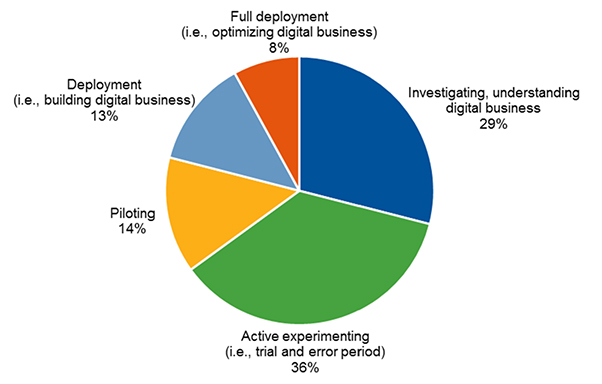
- About two-thirds of enterprises are investigating or experimenting with digital business, according to Gartner's 2015 CIO survey. Few enterprises have full-scale digital businesses.
- Enterprises must go through a series of five stages to a digitalized business. Gartner has developed a roadmap that will guide the enterprise through these transformations.
- Enterprises need to master six areas in order to move from e-business or digital marketing through the five stages to digital business at scale: business/technology vision, technology convergence, analytics and algorithms, bimodal operations, infrastructure, and organization and culture.
Recommendations
CIOs focused on strengthening business relationships:
- Determine the stage your digital business initiative is in – or perhaps the enterprise has several projects at various stages in different divisions or geographies.
- Review the skills, tools and other resources deployed on the project, and determine whether they suit the stage of digital business development. For example, the earlier stages will need more creative, agile talent than operationally oriented staff while the proportion will be reversed in later stages.
- Look at the next stage in the development process, and start to prepare the resources you will need for it. When you're ready to move from Stage 2 to Stage 3, for example, you'll need to involve people who can set a go-to-market strategy and a marketing plan.
Analysis
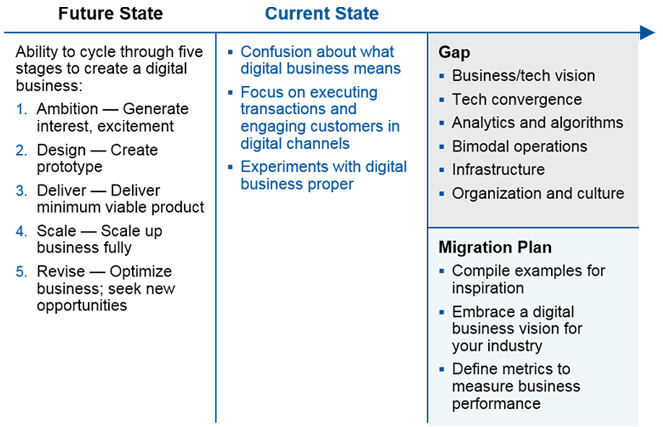
In most enterprises, digital business starts with a leader or small group of leaders who may have a narrow idea for a new product or service. Ultimately, it should end up as an enterprisewide commitment to digital business innovation at scale. Digital business is the business strategy. Enterprises must go through a series of transformations to move from the first to the final stage. The first enterprises to go through this sequence had to stumble on the answers themselves. Gartner has developed a roadmap that will guide the enterprise through these transformations (see Figure 1). CIOs can use this roadmap to plan projects to take the enterprise's digital business from stage to stage.
Figure 1. Strategic Roadmap for Digital Business
Source: Gartner (October 2016)
Future State
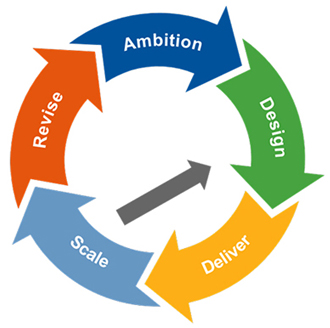
To succeed in digital business, enterprises must cycle through five stages (see Figure 2).
Figure 2. The Five Stages of Digital Business
Source: Gartner (October 2016)
The Gartner 2015 Digital Business Survey of 304 business and IT leaders involved with digital business revealed that most enterprises are still in the early stages (see Figure 3 and "Gartner Survey Shows Digital Business Leaders Breaking From the Pack").
Figure 3. Percentage of Enterprises at Various Stages in Digital Business
Source: Gartner (October 2016)
Stage 1: Ambition
A single leader or a small group of IT and business unit leaders educate, instigate and provoke peers to generate interest and excitement in digital business. Senior executives may appoint them, or they may launch the effort on their own initiative. They start to investigate the possibilities by envisioning a scenario of the future, such as a business moment.
A business moment is a moment in time, where people, business and internet-enabled things work together to solve a problem or create value.
The leaders realize they need an enterprise strategy to address how digital technologies will influence the business model and a roadmap to ensure the enterprise grows and stays relevant.
Example: Suppose a shipment of parts for a construction site is stopped at the U.S.-Mexico border. The shipping container detects the delay and communicates with the construction site project management system and the project manager, and makes recommendations on what needs to be done to keep the project on schedule.
Recommended Reading:
"Toolkit: Use Business Moments to Identify Hidden Value Opportunities for Your Enterprise"
"Industry Visions for Digital Business Set the Terms of Competition"
Stage 2: Design
The digital business leader or group propose something big enough to get attention, yet small enough to succeed. They create one or more prototypes of something that will have an impact on a product or channel by playing with technologies such as sensors, location awareness, advanced analytics and mobility. The prototype involves a product with a business model or industry vision supporting it. The enterprise creates a team that uses Mode 2 behavior to innovate rapidly around the new digital offering. The organization is building confidence in its ability to respond to technology disruptions.
Example: Goldcorp has outfitted its mine in Northern Quebec with Internet of Things (IoT) technologies that track people and assets, and monitor ventilation. Machines are monitored for optimal use and can self-call for maintenance. The ventilation self-adjusts based on the location of people and machines to provide optimal conditions and save the mine a potential $1.5 million to $2.5 million per year in energy costs (see "Fifty Examples of Digital Business: A CIO and CEO Resource").
Recommended Reading:
"Draw on Four Social Science Disciplines to Design Digital Business"
Stage 3: Deliver
The CEO orders the development of an enterprise strategy for digital business and places a seasoned leader in charge of it. The leader has rallied a team to deploy a minimum viable product that creates a competitive advantage or new capability. After testing parts of the solution in the real world, the team eventually feels confident enough to launch a pilot project to test the whole offering. The team and its bimodal behavior have expanded to include representatives from all the corporate functions necessary to support the product.
Example: Adherium offers an inhaler with sensors that tracks the dates and times it was used by the patient. A Bluetooth link transfers the data to an app on the patient's smartphone, which then uploads it to the cloud. Patients, physicians and caretakers can use the data to track whether the patient is keeping up with his medication. Adherence to medication by adult asthmatics increased by 59%, and severe attacks declined 60%.
Recommended Reading:
"Kick-Start Bimodal IT by Launching Mode 2"
Stage 4: Scale
An initiative supported by multiple business functions scales up the new digital business on an enterprise platform, including industrializing operations. Technologies such as smart machines, algorithms and embedded analytics replace human intervention. The enterprise must rapidly cycle through Stages 2 to 4 many times to find a winning, scalable product. When it does find one, the enterprise moves from partial deployment to full deployment across regions where it competes. A more methodical, detail-oriented culture starts to take over as the business scales and operations must be optimized.
Example: In recruiting, HR systems ingest the resumes of applicants. Predictive algorithms take account of many factors in calculating the likelihood that a candidate will be successful in a given role. Algorithms deliver much better results than searching resumes for key words related to the position (see "Algorithms Will Transform Talent Acquisition").
Recommended Reading:
"Building a Digital Business Technology Platform"
Stage 5. Revise
The digital transformation reaches a tipping point, and the enterprise becomes a digital business. New revenue and profit from digital initiatives outpace those from conventional business. Earnings per share go up. Brand equity is dramatically enhanced. The enterprise focuses on refining the digital offering and optimizing its technical and business performance. The enterprise also returns to Stage 1 to consider other possibilities for digital business to add to or replace the one it has just successfully deployed.
Example: One key performance indicator (KPI) (digitalizing sales) measures the percentage of revenue sold through digital channels such as the web and mobile apps. These KPIs can be adapted for each industry. A life insurance company may measure the percentage of its sales that are made through self-serve digital channels, while a property-and-casualty insurer may measure the percentage of claims submitted through digital channels.
Recommended Reading:
"Steps to Build a Value Model of Leading Indicators for the Digital Era"
Current State
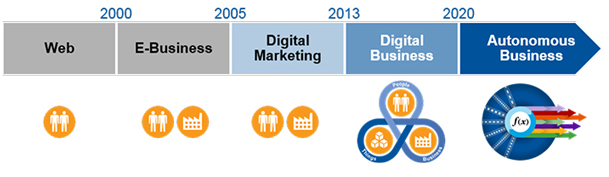
Many enterprises use the term "digital business" to refer to any initiative that uses digital technology to conduct business. In many cases, the initiative involves executing transactions through new channels, which is more properly e-business, or engaging customers through new online channels – digital marketing (see Figure 4). Digital business proper involves the blurring of the digital and physical worlds by linking people, businesses and things. We expect that around 2020, a combination of algorithms and smart machines will start to drive digital business. Mainstream enterprises have only just started to experiment with digital business. A few aggressive technology adopters have started to scale into digital businesses that will make a material difference to corporate earnings.
Figure 4. Digital Business Continues to Evolve
Source: Gartner (October 2016)
Gap Analysis and Interdependencies
Enterprises need to master six areas in order to move from e-business or digital marketing through the five stages to digital business at scale:
- Business/technology vision: Few leaders understand the business possibilities of technology in enterprises that have just started to tackle digital business. These few may be in business units or in the IT organization. Their vision needs to be propagated across the organization.
- Technology convergence: To bridge the digital and physical worlds, digital business must combine the IoT, such as sensors, wearables and smart machines, operational technology (OT) – systems that control physical plant – and IT. Most IT organizations do not understand how to manage IoT and OT, let alone how to combine them.
- Algorithms and analytics: Digital business will be differentiated based on the customer value it delivers. The enterprise will know more about customers, especially their context and intention at any moment, and will deliver unique solutions for what they most need. Enterprises must improve their capabilities in analytics and algorithms to operate at this pace and complexity.
- Bimodal operations: Digital business requires rapid design and prototyping in the early stages, and process discipline in the later stages to industrialize the offerings. The enterprise could be scaling up one digital product and prototyping another at the same time. Business units need to operate bimodally, not just the IT organization.
- Infrastructure: Conventional IT infrastructure will not support digital business. It must expand to incorporate the many new data types of IoT and OT. This data must be integrated with conventional data. The infrastructure must be robust enough to handle all this data – perhaps an order of magnitude greater than data from IT systems alone. It has to support real-time operations.
- Organization and culture: In the early stages, digital business must be fostered and protected from established units that may kill it out of neglect or malice. Later, managers attuned to digital business must be spread across the organization. Overall, management must foster a spirit of openness and collaboration so that people work across business and technology silos.
Migration Plan
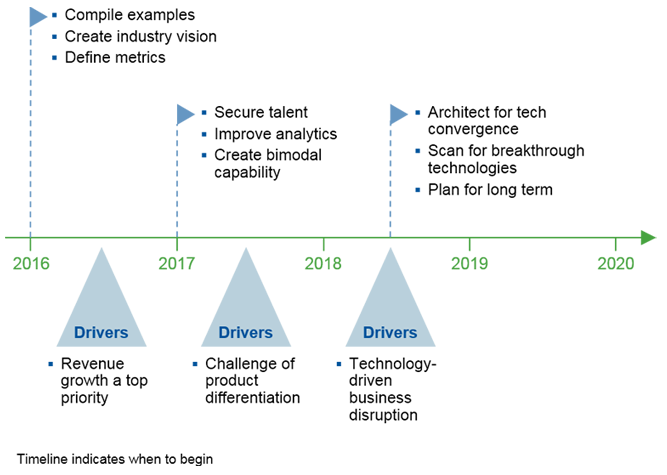
The most important digital business priority is simply to start (see Figure 5). Time may be the most important factor as Gartner's survey cited above found a widening gap between leaders and laggards. At some point, the gap will become insurmountable. Accordingly, we have given higher priority to projects that CIOs need to do first as well as to projects that lay the groundwork for later stages.
Figure 5. Strategic Roadmap for Digital Business Timeline
Source: Gartner (October 2016)
Higher Priority
Compile examples: Look for examples of digital business that can inspire or provide a model for your own efforts. Examples from other industries may enable you to be more innovative in your home market. Create an industry vision: An industry vision proposes nothing less than the complete redefinition of the enterprise, as well as the industry. It is one vision of many that could be possible for any given industry. The purpose of an industry vision is to stretch thinking about what is possible.
Define metrics: Digital business requires metrics that identify how business activities will affect financial performance. These performance metrics enhance IT-to-business communication by allowing greater precision in addressing the complex issues around value creation in digital business.
Medium Priority
Design a business moment: A "business moment" is a transient opportunity that is exploited dynamically. Moments are short (even seconds), depending on the nature of the opportunity. A business moment sets in motion a series of events and actions involving a network of people, businesses and things that spans or crosses multiple industries and multiple ecosystems.
Secure talent: Digital business requires people who combine business and technology expertise. They must be versatile, creative and collaborative, particularly in the early stages. The later stages need people who can build, integrate and scale digital business systems.
Improve analytics: Advanced analytics solves problems by diagnosing root causes and effects, and by anticipating and optimizing outcomes, behaviors, and processes. Digital business will require new analytic model and unique algorithms – and people who can build them.
Create bimodal capability: Those supporting digital business must prepare to incorporate digital innovations into the way they operate. Marrying a more predictable evolution of products and technologies (Mode 1) with the new and innovative (Mode 2) is the essence of a bimodal capability.
Lower Priority
Imagine new industries: Digital business will often eliminate the traditional boundaries between industries and bring markets together. The enterprise can gain new opportunities by using digital technology to create products for adjacent markets.
Architect for technology convergence: IoT and OT will generate unprecedented volume, velocity and variety of data. Enterprises must rearchitect their data management systems, adopt new data management services and platforms, and create new flow policies and practices. An IoT platform is the centerpiece. It controls the ingestion, storage and analysis of device data.
Scan for breakthrough technologies: New technologies will continue to emerge that create new opportunities for digital business. The enterprise needs a permanent function that evaluates new technologies for their business potential.
Plan for the long term: CIOs should think about the distant future as they build digital business capabilities. By 2020, algorithms will not only provide insight but will also become pivotal to competitive differentiation. By 2030, smart machines and algorithms will operate businesses with little or no human involvement. Algorithmic and autonomous business have implications for enterprise strategy, technology and organization.
Gartner Recommended Reading
Some documents may not be available as part of your current Gartner subscription.
"Toolkit: Taxonomy of Gartner Digital Business Research"
"Digital Business Transformation: Turning the Digital Dream Into Reality"
"Digital Business KPIs: Defining and Measuring Success"
"Digital Businesses Will Compete and Seek Opportunity in the Span of a Moment"
"Deliver on the Promise of Bimodal"
"Five Steps to Build Your Digital Business Dream Team"
Source: Gartner (January 2015)
Evidence
We based this document on practical frameworks we have developed in working directly with clients to develop roadmaps for digital business. The frameworks reflect Gartner's overall research into digital business.
