
Survey Analysis: Five Things You Can Learn From Your Peers About DCIM
IT leaders who are evaluating data center infrastructure management tools to improve operational efficiency and business agility can benefit from the lessons learned by early adopters. Use this research to better understand the risks, rewards and best practices of a successful DCIM deployment.
Key Findings
- Real benefits can be achieved with DCIM even if you don't deploy the full suite, and most organizations prefer to deploy DCIM on a module-by-module basis.
- The top-reported reasons for deploying DCIM are to improve capacity planning, IT/facilities integration and data center visualization.
- The most commonly reported inhibitors to adopting DCIM are cost/budget, staffing concerns and a lack of prioritization.
- DCIM purchases are primarily selected, funded and used by people in IT roles.
- The factors that are most commonly reported as most important in picking a vendor for a DCIM tool are ease of deployment, ease of use, price and software integration capabilities.
Recommendations
- Investigate DCIM tools as part of your effort to improve operational efficiency and facilitate business agility.
- Determine how much time IT staff is spending on day-to-day tasks that would be improved with DCIM, so you truly understand the value you would gain from deploying it.
- Begin campaigning now to have DCIM included as a line item in next year's IT budget, and if you're planning to build a new data center or undergo a major refurbishment of an existing one, insist on it.
Survey Objective
The 2015 Gartner Research Circle Survey for data center infrastructure management (DCIM) was designed to elicit user feedback on users' views of, and adoption plans for, DCIM tools. It explored the timing of DCIM investment plans, the problems users are trying to solve with DCIM, the drivers and inhibitors of adoption, and how DCIM purchase decisions are being made and funded.
Data Insights
Every organization looks for ways to gain a competitive edge, often by introducing product enhancements, improving service delivery or customer service, or keeping a careful eye on pricing. However as a CIO, CTO, head of IT infrastructure and operations, or data center manager, you can contribute to your company's efforts by increasing the operational efficiency of your data center. By improving data center resource utilization (both staffing and infrastructure), increasing system transparency (to facilitate better collaboration between teams), and focusing on cost savings/cost containment efforts, you can significantly contribute to creating a more agile business environment.
One tool that has emerged to help organizations achieve this goal is data center infrastructure management. In a recent primary research study of companies with ongoing data center modernization and consolidation initiatives, 58% of respondents said that they either have already begun investing in and deploying DCIM or are planning to.
This research highlights five key things you can learn from your peers in other organizations who have already made initial forays into DCIM:
- DCIM tools provide a wide range of capabilities. How are your peers in other enterprises buying and deploying them?
- Why are your peers investing in DCIM? What are the most common problems companies are trying to solve with DCIM?
- What are the biggest concerns your peers have about DCIM? What caused some of them to postpone their initial investment or is stopping them from investing all together?
- What factors are companies focusing on most when they choose a DCIM vendor?
- What roles are usually responsible for selecting a DCIM tool, and how are the purchases being funded?
Fact 1: Your Peers Understand They Can Reap Real Benefits From DCIM Even If They Don't Deploy the Full Suite and They Prefer to Buy Modularly
At a high level, DCIM solutions are intended to help enterprises look at their data center operations more holistically and not to just optimize their infrastructure utilization, but to do so proactively. This means that when new equipment needs to be deployed, data center managers don't simply look for the best place to install it out of the currently available space. They also consider whether there is an opportunity to move things around in the data center before installing the new hardware so that they make the most efficient use of all the space, power and cooling capacity. Gartner calls this process "incremental optimization." It represents the assumption that all data centers start off with a well-optimized design, but as new hardware is added and other devices are decommissioned, utilization and optimization gradually deteriorate, leaving fragmented power, cooling or rack unit space that depletes the data center's overall efficiency.
DCIM solutions provide numerous capabilities that combine to provide this more cohesive and actionable view. They include:
- Power monitoring
- Environmental monitoring
- Resource (asset) management
- Visualization of floor space and connectivity (2D or 3D)
- Reporting
- Predictive analysis
- Modeling/simulation
- Airflow and pressure monitoring
- Workflow management
- Other capabilities
To obtain the full benefits of DCIM, you would at least need to deploy the first six. However, smaller gains in data center efficiency can be achieved by implementing some of these capabilities individually. For example, an organization that uses a spreadsheet to keep track of where each IT asset is located and what it is connected to could see vast improvements in the accuracy of its data and improve staff efficiency by deploying the resource management part of DCIM. Similarly, an enterprise that has a mandate to lower energy costs (perhaps one located in a region where power is particularly expensive) could reap significant benefits by deploying just the power monitoring and management capabilities of a DCIM tool.
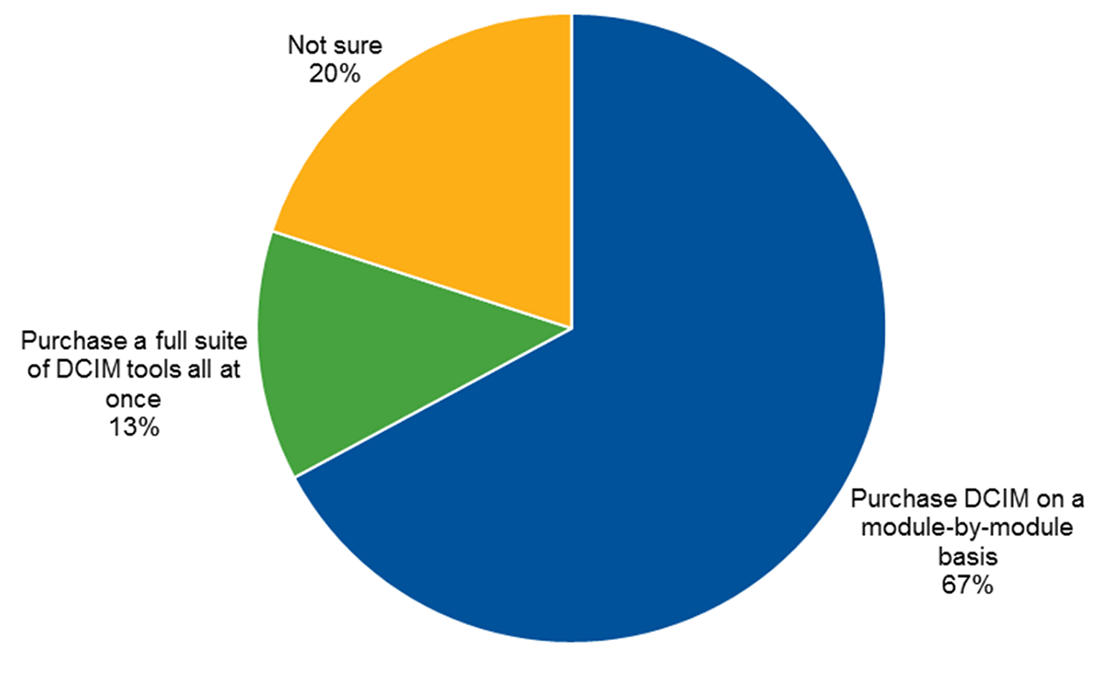
Our research shows that most enterprises prefer to buy their DCIM solutions module by module. Whether they are doing this because they need only a point solution for a particular problem as in the examples above, or because they plan to implement the full DCIM suite but just prefer to do it in stages, 67% of the enterprises in our survey reported that, when they invest, they will do so on a module-by-module basis (see Figure 1).
Figure 1. Which Option Best Describes How Your Organization Invested or Will Invest in DCIM?
Note:
Number of respondents = 70 (have invested in or plan to invest in DCIM).
Source: Gartner (December 2015)
Advice:
- Investigate what functionality you may need going forward, as well as what you need today, when exploring DCIM solutions. Make sure the vendors you evaluate are equipped to address your potential future needs, as well as your current ones.
- Ask detailed questions about prospective vendors' pricing models. Several DCIM vendors today sell their solution only as a full suite; while others sell their DCIM tools modularly, those modules are not always broken down as logically or as granularly as you'd expect. Make sure you understand exactly what modules must be purchased to achieve the functionality you require (in some cases, it may require more than one).
Fact 2: Your Peers Invest in DCIM to Improve Capacity Planning, IT/Facilities Integration and Data Center Visualization – But They Won't Tackle It All at Once
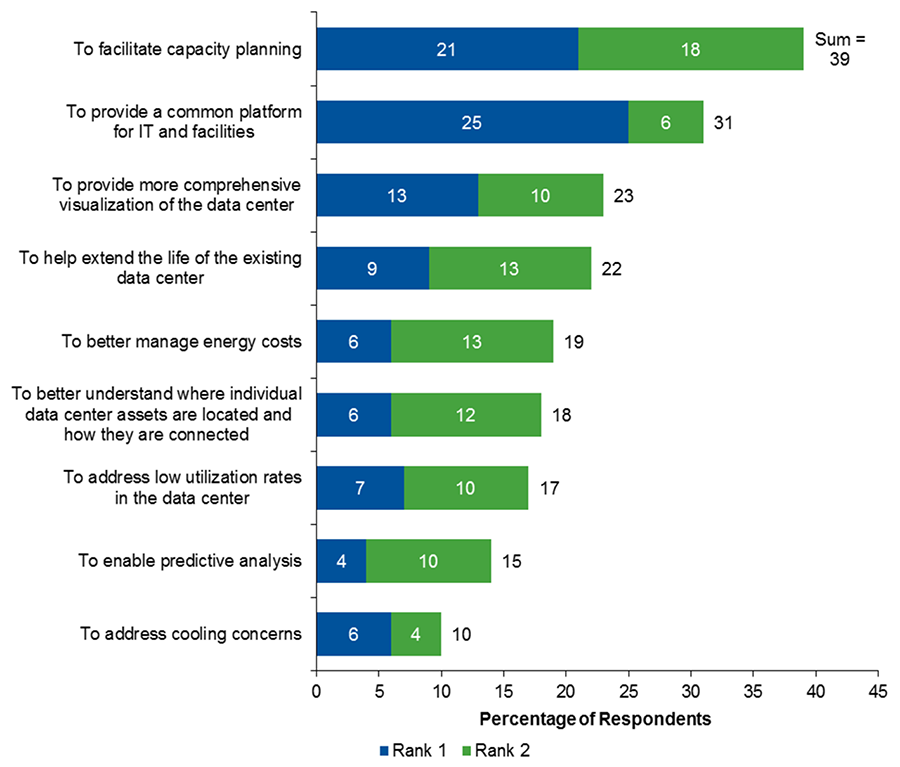
When we ask organizations that are investing in DCIM tools to tell us why they're doing so, they talk about things that tie into the larger promise of DCIM. While reducing energy costs remains a factor, the most commonly reported driver of DCIM investment plans is to facilitate capacity planning. (This echoes the findings from a study Gartner did in 2013. Even then, large enterprises reportedly were three times more likely to base their justification for a DCIM purchase on a capacity planning use case than on power and cooling management.) Beyond that, investment is frequently driven by a desire to provide a common platform for IT and facilities, to provide more comprehensive visualization of the data center, and to help extend the life of the existing data center (see Figure 2).
The most effective implementation of capacity planning would make use of most, if not all, of DCIM's many capabilities. For example, it would incorporate predictive analysis (including what-if scenarios) to help determine the downstream impacts of different proposed changes. However, we know that the vast majority of organizations are not going out and purchasing power monitoring, environmental monitoring, resource (asset) management, visualization, reporting, predictive analysis, modeling/simulation, airflow and pressure monitoring, and workflow management all at once. Rather, they're investing in DCIM on a module-by-module basis, and indeed, an organization can begin its capacity planning efforts using a subset of the capabilities.
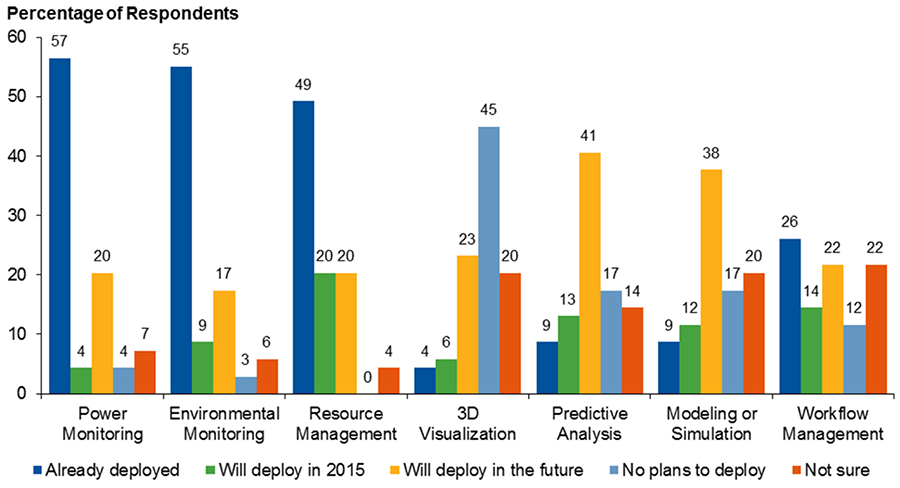
The fundamental components needed to begin capacity planning are power monitoring, environmental monitoring and resource management. In fact, these are the most common starting points for organizations beginning to implement DCIM (see Figure 3). The primary goal of any data center manager is to keep the infrastructure up and running so as to ensure uninterrupted access to all applications. Having near-real-time monitoring of power usage and environmental factors down to the rack level (at least) not only alerts data center managers when a potential problem is imminent, but also enables them to study the power and cooling trends in their data centers, facilitating pre-emptive actions. Having a solid understanding of what assets are deployed where in the data center, as well as what they are connected to, can help speed up problem solving and avoid unexpected downtime. While historical metrics for data center equipment were mean time between failures (MTBF) and mean time to recovery (MTTR), DCIM can help IT focus on mean time to service – or how fast a device can be found and replaced.
The next most popular module is workflow management, with just over a quarter of survey respondents reporting that they have already deployed it and an additional 36% planning to deploy it in the future (see Figure 3). Workflow management is a good tie in to change management and incident management systems and is therefore a logical and valuable extension of DCIM's resource management capabilities. When a new device is scheduled to be installed (or when something needs to be moved) in the data center, the workflow management module generates a work order that indicates the precise location within a rack where it is to be installed (sometimes with illustrations), and which power/circuit and network ports it is to be connected to, helping to ensure accurate deployment and eliminate costly configuration errors.
However, some key capabilities needed to achieve the full benefits of DCIM functionality, like predictive analysis and modeling/simulation, are still in the future for most organizations. Enterprises that can deploy these capabilities and begin to use them to incrementally optimize their data centers may find that they achieve capital expenditure (capex) and operating expenditure (opex) savings and gain data center utilization improvements that can help the overall business reach its agility goals.
Figure 2. Top Drivers of DCIM Investment
Notes:
Number of respondents = 67 (have invested in or plan to invest in DCIM).
Question we asked: What are or were the biggest drivers, in order of importance, of your organization's decision to invest in DCIM tools?
Source: Gartner (December 2015)
Figure 3. DCIM Module Deployment Timeline
Notes:
Number of respondents = 69 (have deployed or plan to deploy DCIM).
Question we asked: What is your organization's timeline for deploying each of these DCIM modules or capabilities?
The survey asked specifically about 3D visualization, not visualization in general. All DCIM solutions will have some sort of visualization capabilities, with some more rudimentary than others.
Additional percentage who have deployed or will deploy but don't know when: Power monitoring: 7%; environmental monitoring: 10%; resource management: 6%; 3D visualization: 1%; predictive analysis: 6%; modeling or simulation: 4%; workflow management: 4%.
Source: Gartner (December 2015)
Advice:
- Deploy power monitoring, environmental monitoring and resource management to create the foundation for doing capacity planning.
- Keep in mind that you may or may not need 3D or animated visualization. Ensure that the DCIM solutions you consider have strong-enough reporting and visualization capabilities to make capacity planning (and later, predictive analysis and what-if scenarios) easy.
Fact 3: When Your Peers Hesitate to Invest in DCIM, It's Mostly Because of Cost/Budget and Staffing Concerns or a Lack of Prioritization
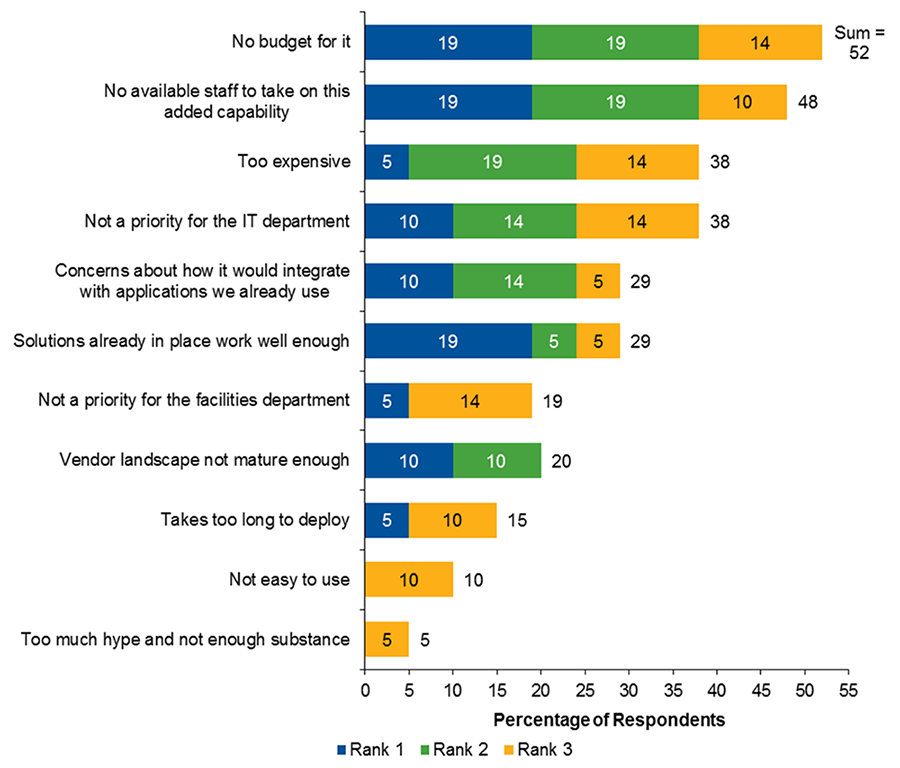
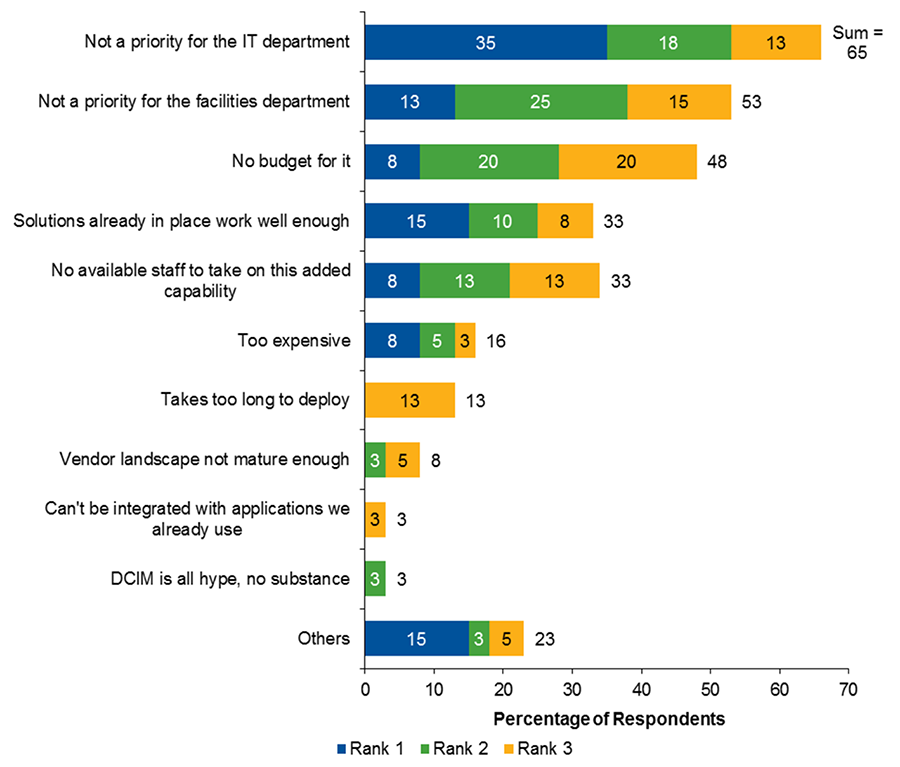
At this point, you may be wondering why everyone isn't deploying DCIM if it offers so many benefits. Respondents in our survey who are planning to invest but just haven't done it yet cited cost/budget, staffing and lack of prioritization as the main reasons for the delay (see Figure 4). Similarly, respondents who are not planning to invest in DCIM at all also reported budget concerns, but they were more likely to talk about DCIM not being a priority and already having solutions in place that work well enough as their primary reasons for not investing (see Figure 5).
Common factors behind these answers are concerns about cost and whether it's really worth putting the staffing resources toward a DCIM project. Both are valid concerns, but we recommend considering both sides of the issue before making a final decision.
While DCIM tools can be expensive, there are many different DCIM tools on the market available at a wide range of price points based on how basic or robust they are (see "Magic Quadrant for Data Center Infrastructure Management Tools"). Many can be purchased modularly, which mitigates the initial cost while allowing you to try them out in one area (such as power monitoring or resource management) and then expand over time as you see fit. Vendors also offer a variety of pricing models (including DCIM as a service) to suit customer needs. Most importantly, DCIM tools can provide opex savings (via lower energy costs and better staff utilization) and capex savings (when overall data center optimization enables you to postpone, or even avoid, costly data center expansion) that help offset the cost of purchase and should be considered as part of the ROI equation.
When trying to determine if the benefits of DCIM warrant putting staffing resource toward it, consider how streamlining operations and providing better overall visualization of the data center can help you operate with more agility. Maintaining your asset "database" manually on an Excel spreadsheet, as many of today's organizations do, is very resource-intensive and invites inaccuracy. While initially deploying DCIM can be cumbersome, having a more accurate accounting of where your assets are and what they're connected to will save time for your staff on day-to-day operations, such as identifying the best location to install new equipment or determining what the downstream implications would be of taking a piece of equipment down for maintenance. Additionally, integrating DCIM into your workflow creates a single source of truth for all asset moves, adds and deletes, which over time can have huge benefits in operational efficiency. That said, deployment can indeed be challenging if your starting point documentation is incomplete or inaccurate. However, some solutions are simpler than others, and most DCIM vendors offer training and professional services to assist with the process.
Figure 4. Reasons for Not Investing in DCIM Yet – Organizations With Future Plans to Invest
Notes:
Number of respondents = 21 (plan to invest in DCIM in 2015 or beyond).
Question we asked: You said your organization has not yet invested in DCIM for its data center. What are the most important reasons for this?
Source: Gartner (December 2015)
Figure 5. Reasons for Not Investing in DCIM – Organizations With No Plans to Invest
Notes:
Number of respondents = 40 (don't plan to invest in DCIM).
Question we asked: Why has your organization chosen not to invest in DCIM for its data centers?
Source: Gartner (December 2015)
Advice:
- Determine how much time IT staff is spending on day-to-day tasks that would be improved with DCIM, so you truly understand the value you would gain from deploying it.
- Make sure you consider DCIM's capex and opex savings potential when calculating the ROI for a DCIM purchase and when crafting your business case, keeping in mind that some tools are more robust (and costly) than others.
- Understand how your internal IT processes would need to change to support any DCIM tool functionality you might select. Like all software, if proper training is not implemented, there is a greater risk that purchased functionality will not be utilized properly, thus negating the value of the product.
Fact 4: Your Peers Choose DCIM Tools Based on Ease of Deployment/Use, Price and Software Integration Capabilities
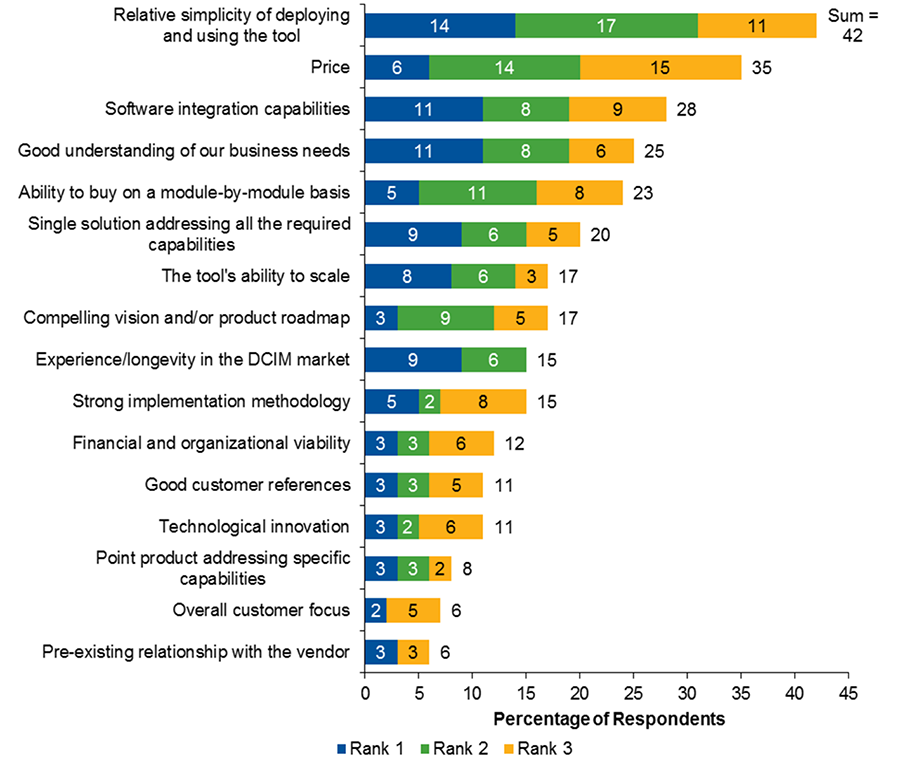
The three things that your peers say are the most important when picking a vendor for DCIM tools are ease of deployment and use, price, and software integration capabilities (see Figure 6). While price is almost always a factor, when justifying a purchase in a new product category, ease of use (including ease of integration) will dictate how much value you ultimately obtain from the solution and how quick the time to value is.
DCIM tools have a reputation for being time-consuming to deploy and difficult to use. Of course, this varies depending on the solution you choose; some offerings are more basic or more robust than others, and there are trade-offs between functionality and ease of use. However, there are some common challenges. For example, resource management is a common entry point for DCIM. Deploying the resource management function of DCIM requires that you have a complete and accurate database of all your assets – and that you know precisely where they are located in your data center (down to the rack position) and what they are connected to (power circuit, LAN and so forth). An organization that has this in a file that can be imported into the DCIM tool will find that the ramp up is less time-consuming than those that have to build the database from scratch. Still, most companies will experience some challenges because audits inevitably show that their records were not fully up to date.
While deployment can be cumbersome, this very challenge illuminates a key problem with today's data centers that DCIM tools help solve. You can't do effective capacity planning if you don't have a true understanding of what assets you have in your data center and how things are interconnected. Therefore, the time and effort required to come to a single, accurate database can provide big benefits in the long run, provided you continue to maintain it.
Your peers also highlighted integration as an important area to consider when evaluating DCIM solutions. Today's data centers have a heterogeneous mix of hardware and software that the DCIM tool has to work with. It is critically important to ensure that the DCIM tools you consider will properly function alongside any configuration management database (CMDB), building management system (BMS), IT asset management (ITAM), workflow management and IT service management tools you already have in place.
Figure 6. Most Important Factors in Selecting a Vendor for DCIM Tools
Notes:
Number of respondents = 65 (have invested in or plan to invest in DCIM and can articulate the timing).
Question we asked: What factors are most important to your organization when selecting a vendor for DCIM tools?
Source: Gartner (December 2015)
Advice:
- Ask vendors what they are doing to simplify deployment and improve overall ease of use. Make sure you validate their answers in your proof of concept (POC) and with customer references and by talking to industry analysts about the solutions you're considering.
- Inquire in detail about how the vendor supports initial deployment. For example, does the tool support autodiscovery, physical discovery (via sensors, RFID tags, intelligent power distribution units [PDUs], smart racks or smart power strips), protocol discovery, uploads from existing files (like spreadsheets, Visio or XML), integration with an existing CMDB system, and so forth? (See "DCIM Solutions: How Do They DO That?" for more details.)
- Determine if the DCIM tools you are evaluating can integrate with the software applications you are currently using in your data center. Make sure you ask how the integration is achieved (for example, is it preintegrated out of the box, is there an open API, is it done upon customer request and so forth), and whether the integrations are passive or active (push/pull). If a particular integration is critical, validate it as part of the demo or POC.
Fact 5: While There Is a Facilities Component, DCIM Purchases Are Generally Selected, Funded and Used by IT Roles
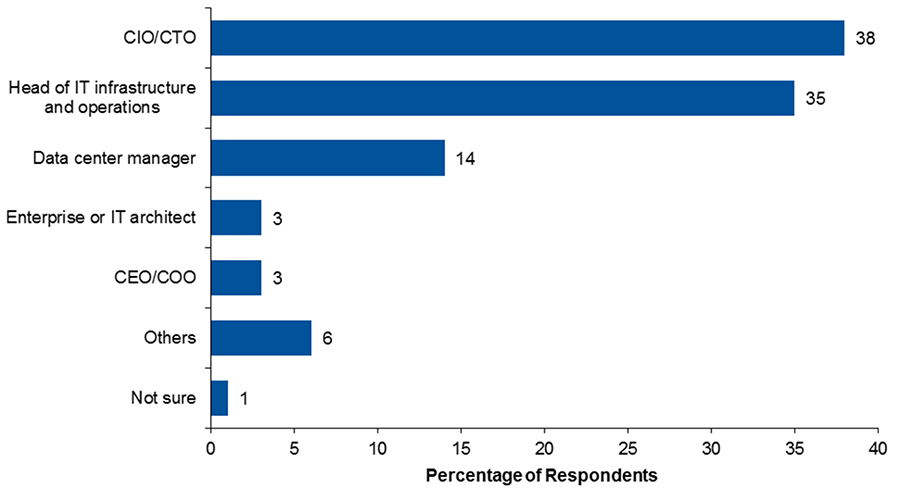
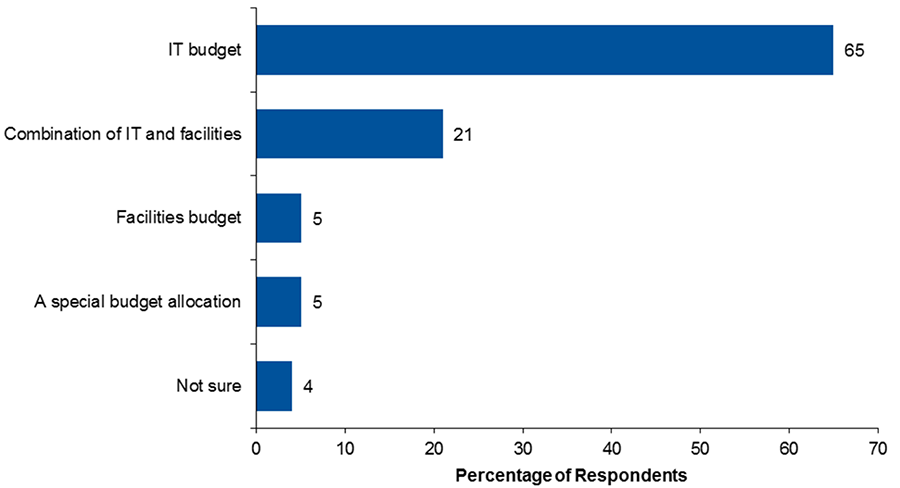
Although one of the top reasons given for investing in DCIM is to provide a common platform for IT and facilities, when it comes to purchasing a DCIM tool, selection and funding are predominantly handled by IT. The CIO/CTO role was the most commonly named primary decision maker for a DCIM purchase in our survey, followed closely by the head of IT infrastructure and operations (see Figure 7). Funding reportedly comes primarily from the IT budget, with "a combination of IT and facilities" budgets coming in a distant second (see Figure 8). This is a change from previous studies, where special budget allocations were often required to purchase a DCIM tool. Today, more organizations are planning ahead and budgeting for DCIM tools for their data centers.
Interestingly, while CIOs and CTOs are the most common purchase decision makers, they are not key users of DCIM tools. Rather, data center managers are the most common users, followed by the heads of IT infrastructure and operations and tech operators (see Figure 9). This demonstrates the dual nature of the benefits that DCIM can provide. Data center managers and heads of IT infrastructure and operations use DCIM tools to efficiently gather information that they can then use to guide strategy and provide day-to-day direction to team members. In contrast, tech operators experience more direct and immediate benefits when DCIM is deployed. The tools allow them to more efficiently monitor the health of the data center and to quickly assess what is going on and what actions they need to take if an event occurs, and to do it faster than if they were using more manual methods. This is clearly a benefit to the individual but ultimately helps the broader company as well, since operating more efficiently means more time is freed up for staff to work on other things.
Figure 7. Primary Decision Makers for DCIM Purchases
Notes:
Number of respondents = 78 (have deployed or plan to deploy DCIM).
Question we asked: Who is the primary decision maker for DCIM purchases?
Source: Gartner (December 2015)
Figure 8. Funding for DCIM Purchases
Notes:
Number of respondents = 78 (have invested in or plan to invest in DCIM).
Question we asked: Which best describes where budget was allocated from (or will be allocated from) in order to fund your organization's DCIM solution?
Source: Gartner (December 2015)
Figure 9. Primary, Secondary and Tertiary DCIM Tool Users
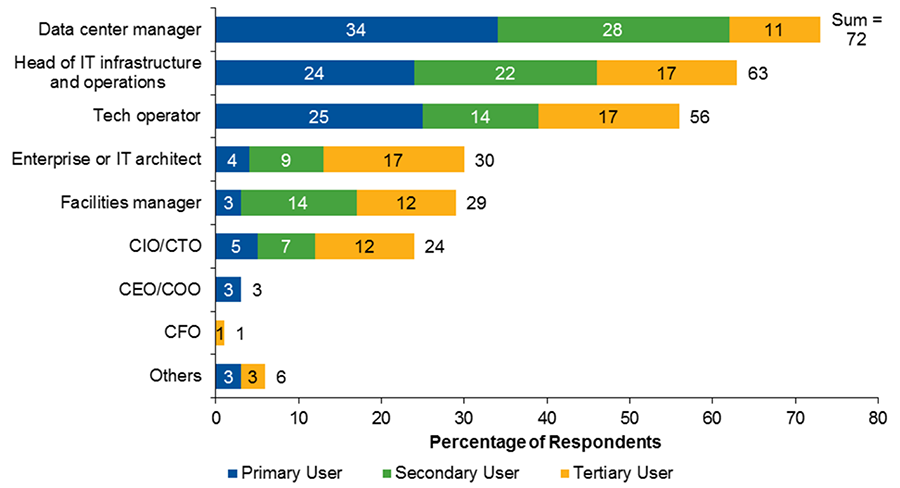
Notes:
Number of respondents = 76 (have deployed or plan to deploy DCIM).
Question we asked: Who are, or will be, the primary users of the DCIM tool? Choose up to three in order of importance.
Source: Gartner (December 2015)
Advice:
- Consider who the primary users will be at your organization, and validate that the solutions you are considering have role-based dashboards and report features aligned to your key users.
- Follow your peers' lead in planning ahead for DCIM purchases. Over the last few years, DCIM has shifted from being funded mostly by special budget allocation to being a planned budget line item.
- Begin campaigning now to have DCIM included as a line item in next year's IT budget, and if you're planning to build a new data center, insist on it.
Methodology
This research was conducted via an online survey from 2 through 11 March 2015. The 121 participants were members of the Gartner Research Circle – a Gartner-managed panel comprising IT and business leaders. Each respondent was involved in the data center modernization and consolidation initiative at either the management or contributor level, and each had a job role in one of the following categories: IT infrastructure and operations, CIO and IT leadership, or enterprise architecture. Geographic distribution of respondents was 36%, North America; 40%, EMEA; 12%, Latin America; and 12%, Asia/Pacific. Respondents were fairly evenly split between organizations with fewer than 1,000 employees, 1,000 to 9,999 employees, and more than 10,000 employees. They represented a wide range of revenue bands and included a normal distribution of industries.
The survey was developed collaboratively by a team of Gartner analysts covering DCIM, and it was reviewed, tested and administered by Gartner's Research Data and Analytics team.
Definitions
Data center infrastructure management tools monitor, measure, manage and/or control data center resources and energy consumption of both IT-related equipment (such as servers, storage and network switches) and facilities infrastructure components (such as PDUs and computer room air conditioners [CRACs]). DCIM tools are data-center-specific (they are designed for data center use), rather than general BMS tools, and are used to optimize data center power, cooling and physical space.
Solutions do not have to be sensor-based, but they do have to be designed to accommodate real-time power and temperature/environmental monitoring. They must also support resource management, which Gartner defines as going beyond typical ITAM to include the location and interrelationships between assets (such as what they are connected to, what resources they are using in the data center and what level of utilization they reach) for the purpose of facilitating better space and capacity planning. Additionally, DCIM tools must have the reporting and visualization capabilities necessary to analyze the data collected in ways that are meaningful to several constituencies, such as data center operators and managers, facility managers, and C-level executives. DCIM solutions may also include other functionality, such as predictive analysis, modeling/simulation, airflow and pressure monitoring, workflow management, IT physical asset monitoring and management, resource control, or other related capabilities.
Evidence
This research was conducted via an online survey from 2 through 11 March 2015. The 121 participants were members of the Gartner Research Circle – a Gartner-managed panel comprising IT and business leaders.
