
For Agentic SDLC, the AI Coding Harness Matters More Than the Coding Model
Software engineering leaders should prioritize engineering a harness layer before scaling agent adoption by selecting a harness product (such as Claude Code, OpenAI Codex or Kiro) and assigning platform engineering teams to own context management, real-time backpressure and verification gates.
Strategic Planning Assumption
By 2028, organizations with AI coding harness infrastructure will experience 60% fewer postdeployment defects than those without.
Issue
AI coding tools have achieved near-universal adoption across software engineering organizations,1 and teams increasingly apply AI beyond code generation to testing, documentation, deployment and other SDLC activities. 2
But increased development velocity has not translated into equivalent improvements in software quality. Only 53% of leaders rate their teams effective at meeting software quality standards, 1 and only 39% of engineering leaders and teams report reduction in technical debt of newly generated code as a result of using AI tools in SDLC. 2 More code is being produced and shipped faster, without the governance controls required to maintain quality at scale.
The AI coding harness addresses this gap. The harness operates at two levels.
- The harness product is an agentic coding platform (such as Claude Code, OpenAI Codex, OpenCode, Cursor, Google Antigravity or Kiro) that provides primitives for context delivery, enforcement, verification and model routing.
- The harness layer is the organizational configuration built on top of the product: rules files, coding standards, enforcement hooks, skills, verification gates and managed settings that a platform team engineers and maintains.
Every agentic coding platform provides baseline harness capabilities, but organizational configuration determines whether the harness enforces standards specific to a given codebase. Together, these components govern how AI agents generate and validate code before it reaches the codebase.
Software engineering leaders should implement harness infrastructure to ensure the productivity gains from AI coding tools do not translate into higher defect rates and technical debt.
Impact
Approximately 20% of software engineering leaders report that the inability to effectively govern the quality and security of AI capabilities in software is one of the top obstacles for their organizations to achieve its priorities. 1 The cost of ungoverned AI code generation compounds across three dimensions:
- Defect accumulation: AI-generated code carries higher defect rates than human-written code in ungoverned environments, and as code volume scales, defects accumulate faster than teams can remediate them.
- Verification bottleneck: Developers report spending more time verifying AI-generated code than writing it from scratch, creating a paradox where faster generation produces slower delivery because the review burden negates the velocity gains.
- Trust erosion: Developer trust in AI accuracy has declined year over year. Without infrastructure that proves output correctness, teams revert to manual review workflows that cannot keep pace with agent-generated volume.
Each dimension reinforces the others. Defects erode trust, eroded trust increases verification burden and verification bottlenecks slow delivery. Software engineering leaders must implement harness infrastructure that enforces standards and verifies output through automated checks (linting, type checking, test execution and security scanning) during generation to break this cycle before defects and review burden scale with AI-generated code volume.
More Detail
The AI coding harness changes how organizations govern agentic software development. Understanding what the harness does and how it enforces standards during generation explains why infrastructure, not model selection, determines output (e.g., code, documentation, tests) quality.
What the Harness Does
Bowling alleys install bumper rails for children and inexperienced bowlers. The bumpers do not improve the bowler’s technique. They constrain the ball’s trajectory so that even a poor throw reaches the pins, and the outcome becomes predictable regardless of skill level. In this regard, AI coding agents are like children bowlers; they need bumpers to avoid going in the gutter.
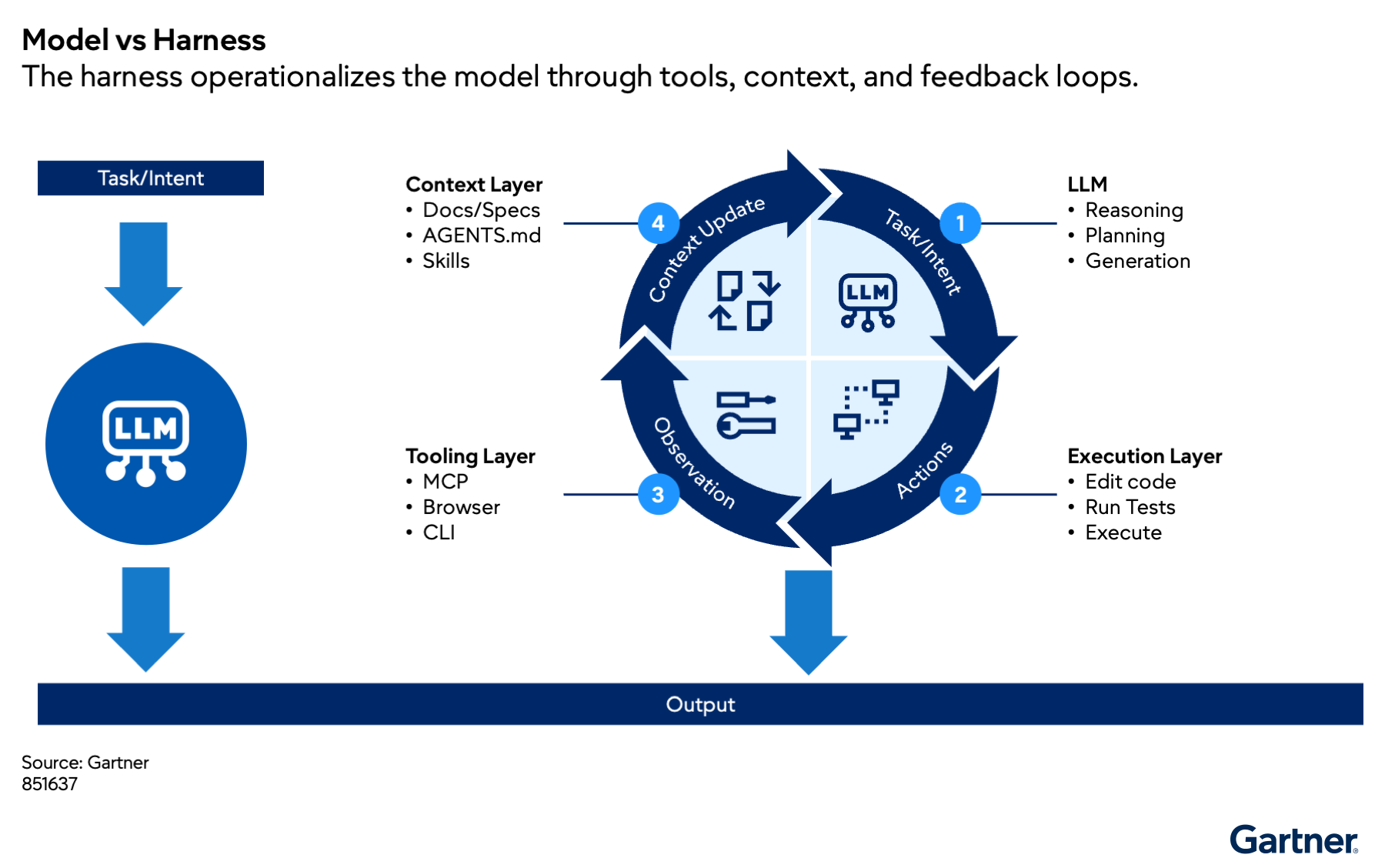
The AI coding harness works the same way as bowling alley bumpers. The harness product sits between an AI model and an organization’s codebase. The harness layer, the rules files, enforcement hooks and verification gates that a platform team builds on top of the product, governs how the model operates and ensures generated output meets organizational standards before it reaches production. Three capabilities define the harness layer.
- Context engineering provides the model with organizational knowledge before it generates a single line of code. Rules files, coding standards, architectural constraints, project structure and testing expectations load into the model’s context at session start. The model does not guess how the organization writes software. The harness tells it.
- Enforcement hooks block nonconforming output and force real-time self-correction. When a linter flags a style violation, a type checker catches a signature mismatch or a security scanner detects a dependency vulnerability, the hook returns a failure signal. The agent reads the error, corrects the code and retries within the same session.
- Verification gates require empirical proof that generated artifacts meet their requirements. A proof command, such as a passing test suite, successful build, log scan, browser check, or API invocation runs after generation. The agent cannot mark a task complete until verification passes. The harness trusts executable evidence, not the model’s assertion that the code works.
The three capabilities produce a closed-loop system where the model generates, the harness evaluates and the model corrects until the check passes. Each rule added to the context layer, each enforcement hook configured and each verification gate deployed improves every future agent session. The capabilities compound in a way that model upgrades cannot.
Software engineering leaders must invest in harness capabilities (context engineering, enforcement hooks and verification gates) to ensure AI-generated code meets organizational standards before it reaches production.
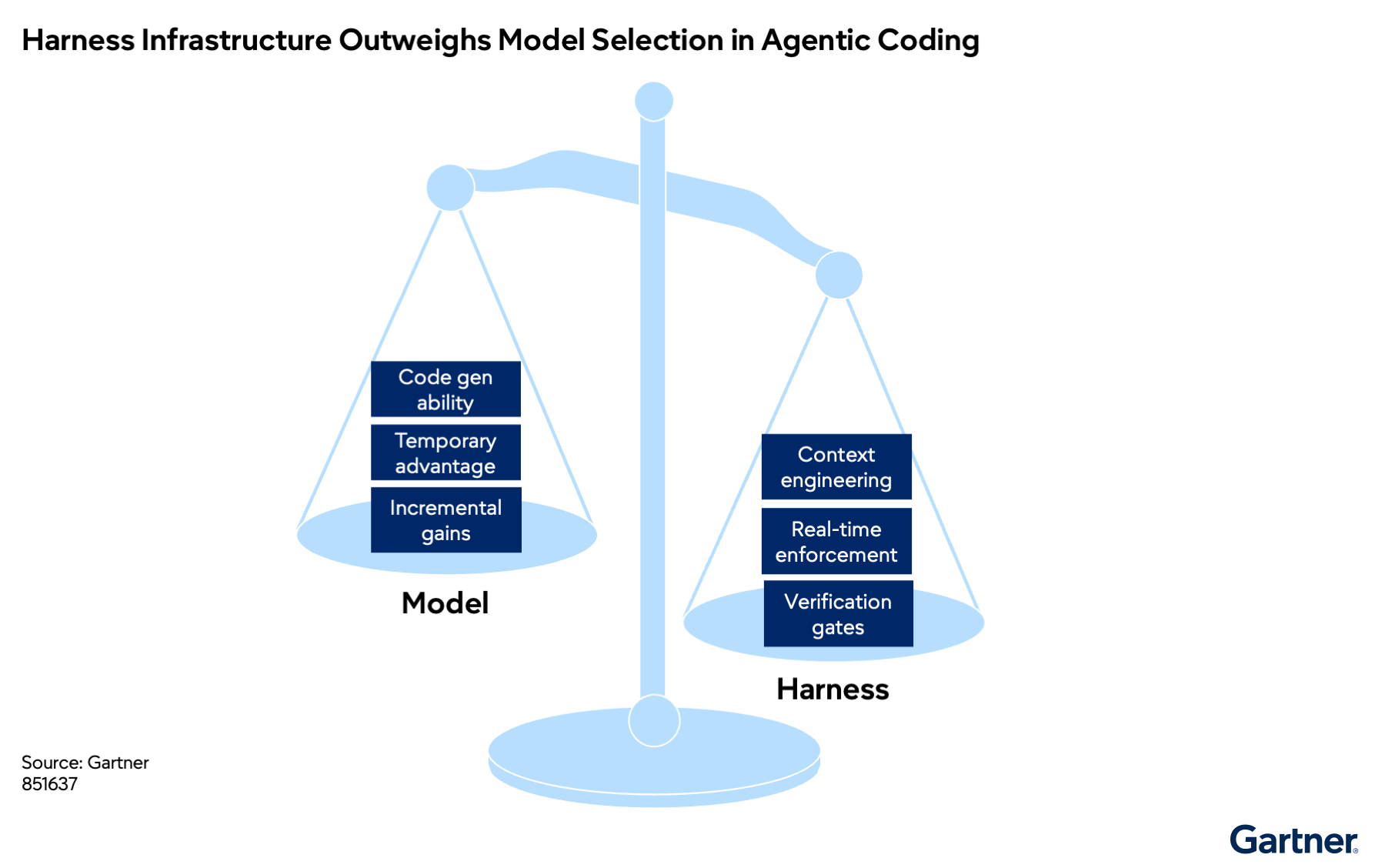
Figure 1: Harness Infrastructure Outweighs Model Selection in Agentic Coding
Why the Model Is the Wrong Investment
For teams using AI code assistants, which, by definition, lack a harness, model quality is the primary variable because the response flows from the model to the developer with no orchestration layer. The developer provides context, evaluates output and decides what to accept, functioning as the harness. For agents executing multistep autonomous workflows, the infrastructure surrounding the model becomes the dominant variable because no human is in the loop to catch compound errors, supply missing context or enforce standards at each step. The harness-over-model argument applies to agentic coding (see How to Choose Between AI Code Assistants and AI Coding Agents).
Software engineering leaders evaluating AI coding tools face quarterly model releases from a dozen providers, each claiming benchmark gains.
Top coding models cluster within a narrow performance band on industry benchmarks, with the gap compressing year over year. The last step-function improvement arrived in late 2024, and every release since has produced incremental gains. 3
The instinct is to chase the best model. That instinct misallocates resources.
But the same model can perform dramatically differently depending on the harness, with results ranging from about 23% to 45%, a 22-point swing driven entirely by tooling rather than model quality. By comparison, the performance gap between top models is minimal, typically only 1 to 3 points. 4
Models converge because vendors compete on the same training data, benchmarks and scaling curves. Harness capabilities compound because they encode institutional knowledge that persists across model changes. And when leading models perform within a few percentage points of each other, model selection has a negligible effect on production code quality.
Software engineering leaders should redirect investment from model benchmarking toward harness engineering by prioritizing context design, enforcement infrastructure and verification workflows that govern how AI coding agents operate.
Figure 2: Model vs. Harness
How Errors Compound Without Real-Time Enforcement
AI coding agents produce a chain of dependent decisions, each built on the outputs of prior steps. A wrong import in step two propagates through every subsequent step, and an incorrect type assumption in step five invalidates every function that references it. Each error compounds on the last.
With agentic coding, the cost of correcting an error during generation is a fraction of the cost of correcting it after the agent has built an entire feature on a flawed foundation.
Backpressure is real-time enforcement feedback that forces an agent to self-correct before its output reaches the codebase. It transforms code generation from a one-pass process into a loop. The agent generates, the enforcement hook evaluates, the agent reads the failure and the agent retries. The loop continues until the check passes.
The alternative is posthoc review, where a human examines the full output after the agent finishes. By that point, compound errors have cascaded across every file the agent touched, and remediation requires tracing back through the entire chain. The review burden scales with the complexity of the task, which is the complexity that makes agents valuable in the first place.
Adding self-correction loops to a fixed model lifted success rates from 53.8% to 81.8%. 5 The enforcement infrastructure changed while the model stayed the same. The cost per task increased, a trade-off that collapses as model inference costs decline and as organizations amortize harness investment across every agent session (see 4 Key Steps to Accelerate AI Adoption Across Engineering Teams).
Software engineering leaders must ensure their platform teams configure enforcement hooks that block violations and force agent self-correction during generation, shifting quality control from postgeneration review to real-time enforcement.
Who Builds the Harness
The harness’s two levels, product and layer, create a natural organizational division. A platform team selects the harness product and engineers the harness layer, and implementation teams use the configured harness to produce software through specification and verification.
The platform team owns two decisions: Which harness product to adopt and how to engineer the harness layer. Layer engineering includes context design (rules, standards and architectural constraints delivered to models), enforcement configuration (which hooks block at which checkpoints), verification standards (proof commands and success criteria) and continuous improvement (encoding lessons from across all teams into the layer). The platform team engineers infrastructure, not application code (see How to Adopt Claude Code at Enterprise Scale).
While platform teams should iteratively evolve the harness, each iteration should adhere to a definition of done (see Improve Software Quality by Using a Definition of Done).
Implementation teams (see Future of Software Engineering 2030: AI-Native Tiny Teams) are blended groups of software engineers, test engineers and product stakeholders who produce specifications, configure the harness for their project context and verify output against intent. The engineer’s role shifts from writing code to orchestrating agents, and product managers participate more directly because the specification becomes the primary input to the production process.
The harness is the AI-specific extension of the internal developer platform. Organizations with existing platform engineering teams extend the charter to include harness ownership. Organizations without a platform engineering function should assign harness ownership to a central team or community of practice that governs developer tooling, because the investment grows more urgent as AI-generated code becomes the majority of output.
The architecture’s defining property is its learning loop. When one implementation team discovers the harness misses a vulnerability category, the platform team adds a detection rule, and every team benefits immediately. When a team finds a specification pattern that produces higher-quality output, the platform team encodes it as a reusable template, and every team gains access. This is organizational learning encoded in infrastructure. One team’s discovery compounds across every team’s output.
Actions
- Select a harness product and engineer the harness layer before scaling agent adoption. Choose an agentic coding platform and deploy the harness for a single team’s agentic workflow. Begin with enforcement hooks that convert existing CI checks such as linting, type checking and security scanning into blocking gates that force agents to self-correct during generation. Expand the harness by adding context engineering and verification gates as the platform team codifies successful patterns and extends them across teams.
- Assign harness ownership to the platform engineering team. Extend the platform team’s charter to engineer and maintain the harness layer serving all implementation teams. Centralized ownership enables organizations to encode standards, enforcement rules and verification patterns into shared infrastructure, so improvements discovered by one team immediately benefit all teams. Organizations without a platform engineering function should establish one as AI-generated code becomes a larger share of output.
Cautions
Model quality reduces the floor by producing fewer errors. The harness raises the ceiling by enforcing organizational standards.
- A poorly designed harness degrades the performance it is supposed to improve. Overloaded context files, contradictory instructions and excessive rules reduce model adherence, because models struggle to follow more than a few dozen directives simultaneously. Begin by encoding the definition of done as enforcement hooks (linting, type checking, security scanning) and expand incrementally based on measured results. Effective harness engineering is targeted, not comprehensive.
- The harness has diminishing returns at the complexity frontier. The harness governs well-defined, verifiable tasks, and organizations that attempt to extend it beyond this boundary will find that the overhead exceeds the benefit.
- While service virtualization extends the harness’s verification capability beyond unit tests to integration and system-level validation, organizations should be aware that comprehensive testing earlier in the pipeline may introduce complexity and require careful management. Without proper oversight, there is a risk of over-reliance on virtualized services, which may not fully replicate real-world conditions, potentially leading to gaps in defect detection and increased remediation costs later in the life cycle (see Use AI-Assisted Service Virtualization to Test AI Applications).
Evidence
1 Gartner Software Engineering Survey for 2026. This survey was conducted to provide a comprehensive understanding of the current landscape in software engineering, as well as to determine the priorities and strategic challenges of software engineering leaders. It also aims to identify the demand for various roles and skills within software engineering organizations, and assess their budget expectations, team structures and organizational outcomes. Finally, it explores the integration of AI in software engineering workflows and its impact on engineering organizations. The survey was conducted online from August through November 2025 among 482 respondents from the U.S. (n = 360) and U.K. (n = 122). Qualifying organizations operated in multiple industries and reported enterprisewide revenue for fiscal year 2024 of at least $250 million or equivalent. Qualified participants were highly involved in managing software engineering/application development teams and the activities they perform. Disclaimer: The results of this survey do not represent global findings or the market as a whole, but reflect the sentiments of the respondents and companies surveyed.
2 2025 Gartner AI in Software Engineering Survey. This study was conducted to explore the adoption of AI within software engineering functions, focusing on two key areas: the use of AI tools (e.g., AI code assistants, AI code agents) throughout the software engineering life cycle (SDLC); and the development of AI-powered solutions (or AI engineering) within software engineering functions, along with their contribution to business outcomes. The research was conducted online from 29 April through 25 June 2025 among 299 respondents from North America (n = 150), EMEA (n = 104) and Asia/Pacific (n = 45). Quotas were established for company sizes and for industries to ensure a good representation across the sample. Organizations were required to be either piloting or using AI tools in SDLC for less than four years, and either piloting or having built AI solutions in their software engineering functions. Respondents included both leaders and individual contributors from software engineering functions, each with at least one year of tenure at their current organization. All respondents were involved in decision making or directly engaged in using AI tools or building AI solutions within their software engineering functions. Disclaimer: The results of this survey do not represent global findings or the market as a whole, but reflect the sentiments of the respondents and companies surveyed.
3 SWE Benchmark, swebench.com.
4 SWE-Bench Pro Leaderboard, Morph.
5 Self-Correcting Code Generation Using Multi-Step Agent, deepsense.ai.
