
Unleashing AI in the Cloud: A New I&O-CCOE Enablement Framework
Cloud-based AI platforms can enable rapid delivery of solutions with measurable business value. To maximize these benefits, heads of I&O, along with their cloud center of excellence leaders, should strategically define and prioritize actionable steps that facilitate seamless integration of essential cloud-based AI platform components.
Insights at a Glance
Disjointed cloud services often result in operational inefficiencies, increased costs, data fragmentation, and poor customer experiences due to siloed value delivery across organizations. If properly integrated cloud-based artificial intelligence (AI) platforms can unify these disparate services into a single, strategic value stream. Success depends on enabling three core components:
- Strong data governance and quality,
- Accessible cloud/AI tools and services, and
- Flexibility to adapt and scale.
The CCOE and infrastructure and operations (I&O) functions are best positioned to enable cloud-based AI platforms because they combine strategic cloud governance with operational expertise. Within an I&O-CCOE enablement framework:
- The CCOE serves as the governance arm (“strategic broker”), setting policies, standards, and best practices to ensure secure, compliant, and effective adoption.
- While I&O acts as the operational and execution arm (“strategic enabler”), translating the CCOE’s strategic direction into practical outcomes by implementing, managing, and optimizing the infrastructure required for cloud-based AI platforms.
Impact Brief
The rise of artificial intelligence (AI) has the potential to reshape IT and business processes, and its convergence with cloud computing can address many pressing business challenges (e.g., increased operating costs, changing business demands, growing compliance requirements and mounting technical complexity, etc.). Cloud-based AI platforms (e.g., Microsoft Azure AI, Google Cloud AI, IBM Watsonx, Salesforce Einstein Oracle Cloud AI, H2O.ai, etc.) are public cloud-based environments that provide the infrastructure, tools, and services needed to build, train, deploy, and manage AI and machine learning (ML) models. If deployed and managed correctly, these cloud-based AI platforms can break previous cloud silos and provide streamlined operations and security, improved end-to-end business collaboration and, ultimately, enhanced customer experiences.
CIOs Must Lead the Adoption of AI-Infused Industry Cloud Solutions, they can’t execute this alone, and they need the support of their cloud and IT operations departments. AI teams within I&O and the cloud center of excellence (CCOE) are best positioned to lead integration efforts, combining technical expertise, operational focus, and cloud governance. This enables cloud-based AI platforms to deliver targeted value to various users to advance their business priorities. By embedding their operational expertise into the larger business cloud strategy, heads of I&O can direct their AI teams within the function to work together with the CCOE leader and their teams to jointly develop a framework to ensure the proper core linkages and components are in place to enable cloud-based AI platforms — turning them into true business enablers. At the core of this strategic framework, designate the CCOE as the governance arm (“strategic broker”) and I&O as the operational and execution arm, sometimes referred to How to Achieve Cloud Platform Operations Success, (“strategic enabler”) of cloud-based AI platform integration.
*While not all businesses have a CCOE, for the purpose of this note, CCOE can also represent the function and/or individuals responsible for the business’s cloud strategy and governance.
Actions and Cautions
Actions
In order to develop a comprehensive I&O-CCOE enablement framework that seamlessly integrates and enables cloud-based AI platforms, heads of I&O, along with their CCOE partners, should:
- Center I&O-CCOE enablement framework on linking IaaS and PaaS, through cloud-based AI platforms, to unify the value cloud and AI services offer for the entire business.
- Focus on bolstering three core components necessary to enable cloud-based AI platforms: marketplaces, data fabric, and composability. These components provide a flexible, integrated, and efficient ecosystem for building and deploying AI cloud solutions.
How to Execute
Link PaaS-IaaS Through Cloud-Based AI Platforms to Shift From Siloed Cloud Value to Unified AI-Driven Business Value
While responsibility for SaaS is decentralized throughout an organization, heads of I&O and their AI teams within the function are best positioned to drive linkage of IaaS and PaaS offerings with the CCOE through AI cloud platforms. Linking IaaS and PaaS in this manner creates a unified, scalable, and automated platform that serves as the connective tissue for disparate cloud services, thus making it easier to build, run, and scale complex AI models and applications efficiently while also ensuring operational stability for the entire business.
Through a unified framework, the CCOE and the I&O function can enable and strengthen these linkages by establishing governance standards, optimizing platforms for sustainability and ensuring utilization through continuous improvement enhancements. For each of these tasks, there are clear responsibilities for the I&O team and the CCOE that, together, drive to the outcomes, as highlighted in the Tables 1-3 below. This collaboration makes sure that the foundational infrastructure (IaaS) is effectively optimized and governed, while the development platforms (PaaS) are standardized and readily available for the innovative potential of cloud-based AI platforms.
I&O software vendors will increasingly change their licensing models to make it harder for internal I&O organizations to recreate their software using vibe coding, while providing heavy license incentives to adopt AI agent platforms and services so that they are closely tied to the value and the implementation of AI agents.
Table 1: Governance and Standardization
| CCOE (standardizes PaaS governance) | Head of I&O and team (standardizes IaaS governance) | Business value outcomes (secure IaaS-PaaS governance framework) |
|---|---|---|
|
|
|
Source: Gartner (January 2026)
Table 2: Platform Optimization and Sustainability
| CCOE (standardizes PaaS platform selections) | Head of I&O and team (enables sustainable hybrid infrastructure environments) | Business value outcomes (optimized AI cloud platform environment) |
|---|---|---|
|
|
|
Source: Gartner (January 2026)
Table 3: Utilization and Continuous Improvement
| CCOE (drive business utilization) | Head of I&O and team (provide operational monitoring) | Business value outcomes (unified monitoring and performance management) |
|---|---|---|
|
|
|
Source: Gartner (January 2026)
Through this joint IaaS-PaaS framework, heads of I&O and their AI teams within the function, in partnership with the CCOE, can actively connect IaaS and PaaS, through the conduit that is cloud-based AI platforms, thereby naturally fostering a more collaborative environment with development teams, who in turn work closely with business units on applications and custom SaaS offerings.
Invest In and Build Up Foundational Cloud-Based AI Platform Components
For cloud-based AI platforms to function effectively in ensuring AI and cloud services work in unison to provide holistic business value, it is important to:
- Provide seamless access to cloud and AI tools/services for all relevant business users.
- Establish strong data governance and quality controls to ensure reliable and compliant data.
- Build flexible systems that can adapt and scale integration of cloud and AI technologies.
At the core of the I&O-CCOE enablement framework, the three key components that must be adopted are: data fabric, composable technology and AI cloud marketplace (see Figure 1).
Figure 1: Foundational AI Cloud Platform Capabilities
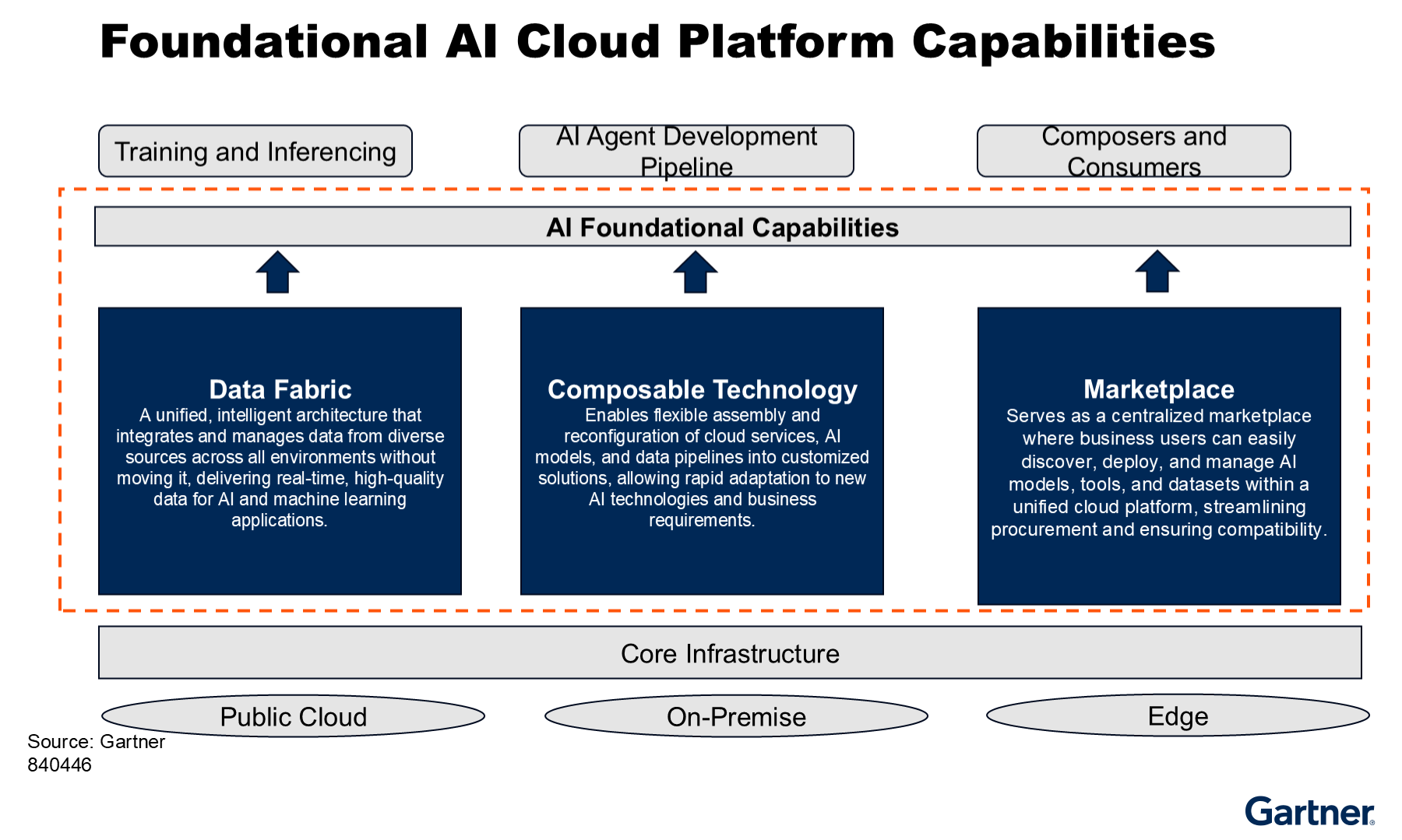
Together these three components enable cloud-based AI platforms by making it easier to discover, access, manage, and combine resources and capabilities for the business to utilize for their specific contexts. As a result, it is imperative that heads of I&O direct their AI teams to work with the CCOE to build up these components to ensure that cloud-based AI platforms deliver for the business. There are also specific responsibilities for the I&O team and for the CCOE to take on that, together, enable the desired outcomes, as listed in the tables below.
For the AI cloud marketplace it is important to have a strategic well-planned roll out of all cloud-based AI platforms solutions. A strategic rollout ensures the AI cloud marketplace is secure, scalable, and user-friendly, allowing for long-term growth that aligns with the specific needs of its users to advance business goals (see Table 4).
Table 4: AI Cloud Marketplace Enablement Framework
| CCOE (build the AI cloud marketplace) | Head of I&O and team (enable the AI cloud marketplace) | Business value outcomes (business-aligned AI cloud marketplace to drive innovation) |
|---|---|---|
|
|
|
Source: Gartner (January 2026)
As part of this process, heads of I&O and the CCOE have the collective responsibility to ensure that the data fabric, which connects disparate data sources across the enterprise without physically moving them, is not just a technical solution but a strategic asset that enables cloud-based AI platforms at scale (see Table 5).
Table 5: Data Fabric Enablement Framework
| CCOE (set data standards) | Head of I&O and team (architect data infrastructure) | Business value outcomes (unified data foundation) |
|---|---|---|
|
|
|
Source: Gartner (January 2026)
Finally, composable technology is key to enabling cloud-based AI platforms since it makes these advanced capabilities flexible, interoperable, and easily accessible across businesses. Heads of I&O and the CCOE need to work together to standardize these components and automate assembly (see Table 6).
Table 6: Composable Technology Enablement Framework
| CCOE (identify composable technology business needs) | Head of I&O (set up the core technical infrastructure for composability) | Business value outcomes (agile and adaptable customer-focused technology solutions) |
|---|---|---|
|
|
|
Source: Gartner (January 2026)
Success Measures
To determine if the I&O-CCOE framework is effectively enabling cloud-based AI platforms, track metrics related to:
- Governance and standardization (e.g., time to deploy new AI/ML tools or PaaS/IaaS resources etc.)
- Platform optimization and sustainability (e.g., % of AI workloads running on hybrid infrastructure etc.)
- Business utilization and continuous improvement (e.g., adoption rate of cloud-based AI platform features by business units etc.)
- AI cloud marketplace enablement (e.g., reduction in time-to-value for new AI initiatives via marketplace adoption etc.)
- Data fabric enablement (e.g., time required to provision and access new data sources etc.)
- Composable technology enablement (e.g., business unit satisfaction with speed and flexibility of new solution delivery etc.)
