
2018 CIO Agenda: Consumer Goods Industry Insights
Consumer goods CIOs are poised to enable and lead their organizations through digital business transformation. Striking the right balance between enablement, optimization and transformation will separate the winners from the mere survivors.
Key Findings
- Focus on growth and market share remains at the top of consumer goods (CG) organizations' strategic business priorities, highlighting the competitive nature of the industry and alignment with their CEOs' goals.
- Digital business transformation has increased in importance. CIOs see business intelligence and analytics, digitalization and digital marketing, and the Internet of Things as the driving technologies.
- Spending priorities by technology area and the digital business maturity curve indicate that CIOs are placing their confidence in the role that digital will play in the company's success.
Recommendations
CIOs driving growth with sales and marketing technologies in consumer goods:
- Architect a focused digital agenda that demonstrates a clear commitment to leading your department and your company through a transition driven by the digitalization of both processes and products.
- Establish your team as the digital navigators who have the knowledge and experience to take your company to the next level by experimenting and getting out in front of your competitors.
- Mitigate risk to your company's digital transformation by developing a phased implementation plan that highlights critical technology and functional team dependencies.
Survey Objective
The purpose of the 2018 Gartner CIO Agenda is to help CIOs and other IT leaders set and validate their management agendas for the coming year. To achieve this, the CIO Survey gathered data from 3,160 CIO respondents in 98 countries and across major industries, representing $13.0 trillion in revenue and public-sector budgets and $277 billion in IT spending. Respondents came from a range of industries, including manufacturing, government, professional services, banking, energy/utilities, education, insurance, retail, healthcare, transportation, communications and media.
This report focuses on the answers from 157 consumer goods CIO respondents and compares them with the total sample.
This report focuses on the following key questions:
- What is the top strategic business priority for the organization over the next two years?
- Which technology areas will help the business to differentiate from rivals and win?
- How is spending on technology changing? In particular:
- Which technology areas will receive the highest amount of new or additional funding in 2018?
- Which technology area will see the biggest reductions in funding in 2018 versus 2017?
- How will the organization achieve digital transformation? In particular:
- What is the stage of the organization's digital maturity?
- Where is the enterprise's digital spending focused?
- What are the barriers to digital success?
Together, the answers to these questions offer some revealing insights into how CG CIOs are planning to transform themselves, their businesses and the IT that supports their businesses. This data, together with Gartner's interaction with clients and coverage of the industries, is the basis for the analysis and recommendations within this document. This research is linked to the Key Initiative of how to execute a digital strategy in consumer goods.
The full survey, covering more than 50 questions, was designed to prove or disprove a series of hypotheses devised by a core team of Gartner research analysts and Executive Programs representatives. The key findings from the total dataset are published in their entirety as "The 2018 CIO Agenda: Mastering the New Job of the CIO."
Data Insights
Looking forward, the consumer goods industry is facing a relatively challenging environment. Growth in the historically most profitable geographic markets remains flat. Retail channels are evolving, and consumer expectations are becoming more demanding and harder to fulfill. It might be tempting to focus on cost reduction and optimization in the face of these challenges. However, most CG executives understand that the path to success is driven by creating new products and out-innovating the competition. Growth will come from different markets, better alignment to unique channel needs and a more customized approach to dealing with customers.
Gartner's most recent CIO Survey data indicates that, as a group, CIOs clearly recognize that, while driving growth is critical, digital transformation is an imperative. CIOs can, and should, play a significant role in enabling their companies to become digitally competitive.
Strategic Business Priorities
CIOs indicated that the top three priorities from their perspectives were: (1) growth and market share; (2) digital business and digital transformation; and (3) globalization and geographic expansion. Our analysis grouped the data into four distinct quadrants (see Figure 1 and Note 1 for a key to the boxes). The boxes align to specific initiatives and priorities:
- Blue boxes – Managing growth and enabling the future
- Green boxes – Managing growth and running the business
- Orange boxes – Managing cost and running the business
- Gray boxes – Managing cost and enabling the future
Given the nature of the consumer products industry, we found it surprising that there is not a greater strategic focus on both customers and innovation as fundamental to growth. Understanding the customer base and creating new products are fundamental to building a strong business.
Figure 1. Strategic Business Priorities
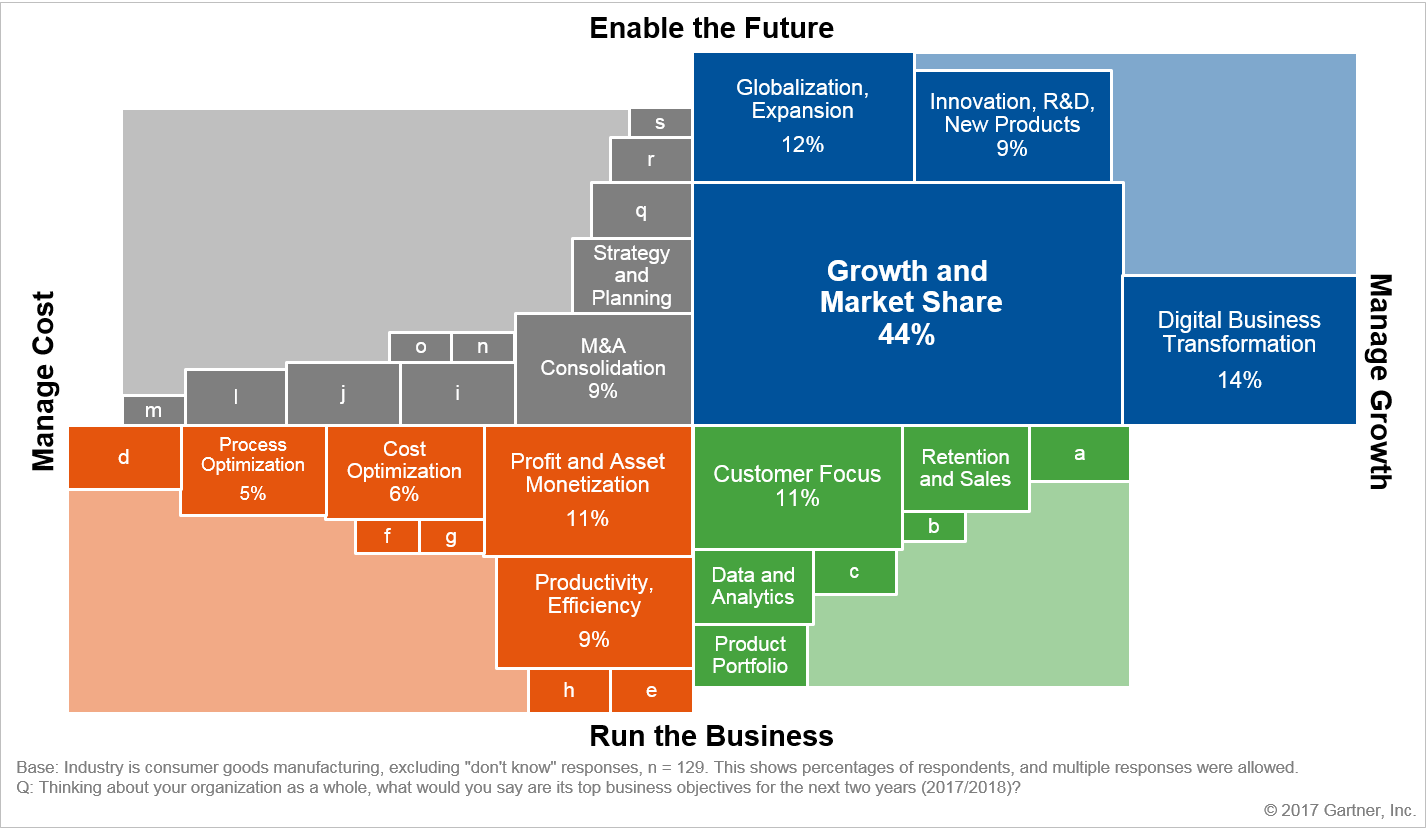
M&A = merger and acquisition
Source: Gartner (October 2017)
Recommendations
Catalog your organization's top strategic business priorities with your cross-functional peers. Then benchmark them against the priorities articulated by your CG peers as articulated in Figure 1. CG companies should have important initiatives in every quadrant, as growth initiatives will be fueled and funded by improvements in both processes and cost structure. Looking further into the future on initiatives allows a CG company to play offense and establish stronger competitive positions. It will be incumbent on CIOs to drive the digital transformation that will be behind many future product innovations.
Top Technology to Win
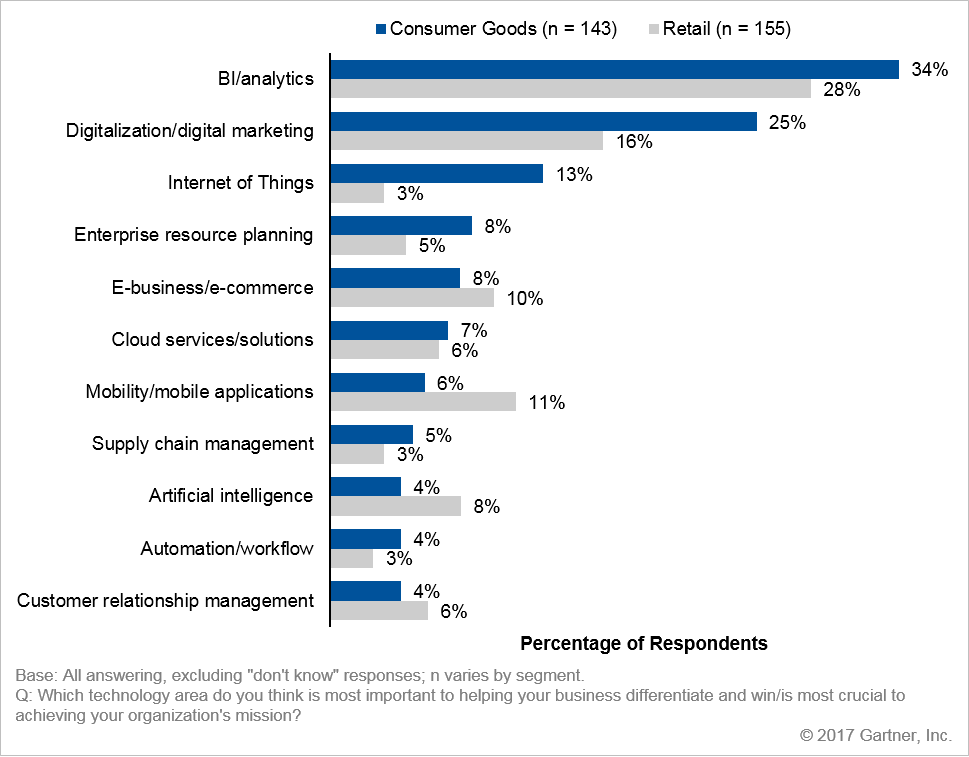
Business intelligence (BI) and analytics continue to top the lists of technologies that CG companies believe are critical to their success. Figure 2 not only illustrates the top strategic technologies for CG companies, but also highlights the top technologies to win for retailers. As most CG companies sell no product without the retail trade, an understanding of how retailers plan to win provides important insight. Like CG companies, retailers believe that BI and analytics and digitalization and digital marketing are the top two technologies, and are really focused on them. Retailers, versus their CG counterparts, are less focused on the Internet of Things and are more focused on e-commerce and mobility.
Figure 2. Top Technology to Win
Source: Gartner (October 2017)
In general, CG companies can expect a more analytically sophisticated trade and a more complicated channel network. CG companies can achieve value from the Internet of Things in their own supply chains and in product design. However, collaboration with retailers on the Internet of Things will likely be required to get the greatest level of value in the long term.
Recommendations
Enable your business to develop increasingly compelling value propositions by ensuring a focus on organizational tools that further the development of competitive and consumer insights. This would include an effort to integrate disparate types and sources of data, such as shipment data and spending and performance data on promotions, some of which may be digital images.
Additionally, focus on how that data is both analyzed and visualized. Aligning with business leaders on what they believe is the most critical information will ensure you collect the right data, instead of just collecting and storing huge volumes of data. Many CG business leaders are already inundated with too much data. Data and marketing have become tightly linked. Selecting the right channels and targeting the right consumers at the right time require even greater analytical sophistication. CIOs should develop and deploy tools that enhance the speed and quality of decision making for those leaders.
Top Technology Areas for New and Decreased Spending
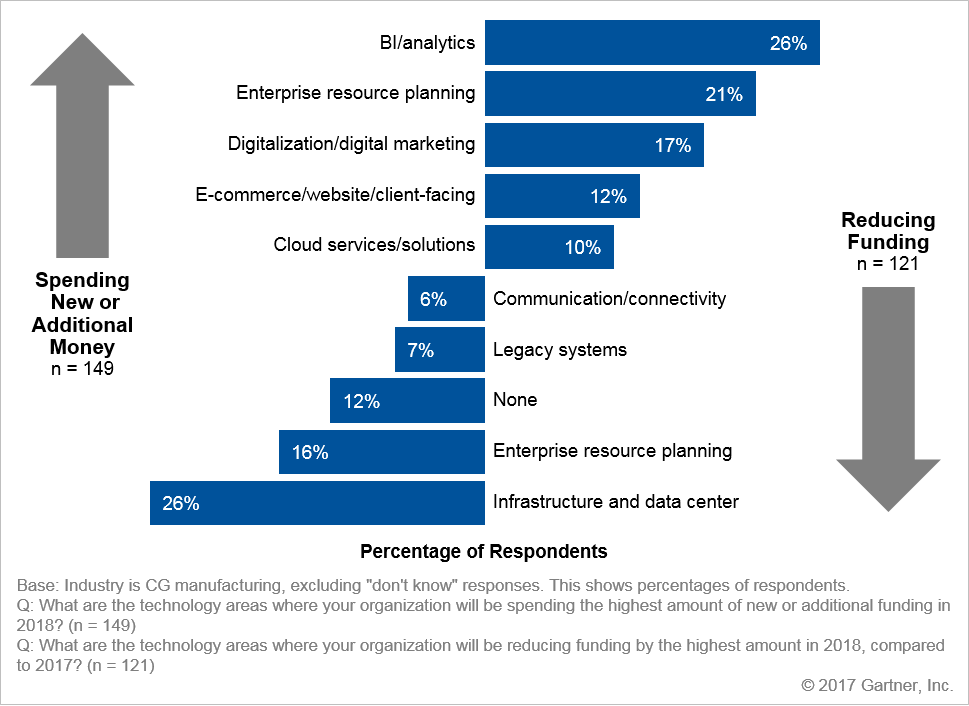
There is good alignment between what CG companies believe are the top technologies to win and where they are spending new funds (see Figure 3 for the top five technology areas for increases and decreases in spending). BI and analytics and digitalization and digital marketing are at the top of the list from the standpoints of impact and increase in spending. About 21% of CG companies are spending more on ERP, and 16% are spending less, indicating the different levels of maturity of the sample. This may also be driven by a likely shift in the way that IT delivers services to the organization. This will continue to evolve as more CG companies move to cloud data providers.
Interestingly, 12% of CG companies indicate that they will be spending more on e-commerce, website and customer-facing applications. In general, we should expect more CG companies to increase the level of their expenditures to sell directly to customers. About 12% of companies indicated that they would not be spending less on any particular technology area, year over year.
Figure 3. Top Technology Areas for New and Decreased Spending
Source: Gartner (October 2017)
Recommendations:
To support deployment of technologies that will have the largest strategic impact, ensure that you have the appropriate talent on your teams. Supporting the business over time will require a constantly shifting talent base. Periodically assessing your current capabilities against future priorities will clarify how your organization will need to shift. As the amount of data available to evaluate the business increases, and as the need for decision-making agility becomes critical, it will be necessary to evaluate different cloud-based models.
Achieving Digital Transformation
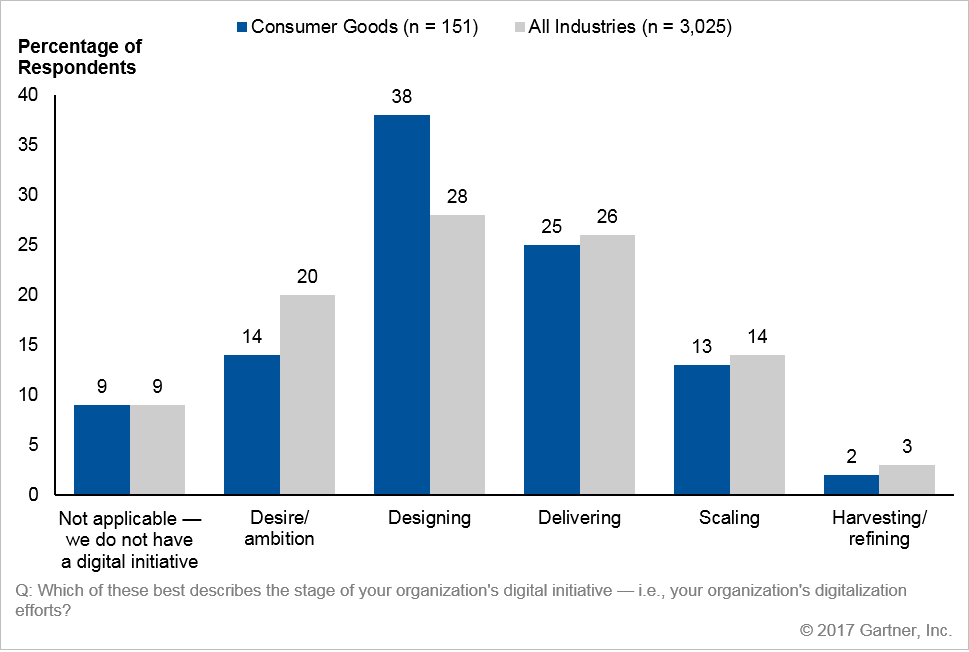
CG CIOs know how important it is to lead their organizations through the digital transformation journey. The digital maturity curve for CG companies is similar to the all-industry curve. However, fewer CG companies are in the desire and ambition stage, and more CG companies are in the designing phase (see Figure 4). A number of industries are much further ahead – most notably, communications service providers, K-12 education, retail and financial services. CG companies could be characterized as being slightly behind on the maturity curve. This is set to change over the next few years as those companies move from designing to delivering.
Figure 4. Stages of Digital Maturity
Source: Gartner (October 2017)
Spending patterns indicate how a company is thinking about digitalization. Enterprises can spend in three areas against their digital initiatives:
- Enablement – This investment creates a foundation for the digital business, including building a new digital business technology platform and/or converting previously manual or separate business processes into an integrated digital operating model.
- Optimization – This investment enhances the performance of the existing digital business by more closely integrating information flows from digital and physical assets, thus reducing the interaction cost of people, businesses and things that transact within the business ecosystem.
- Transformation – This investment enables radical change of the existing business model (the way the organization operates, its target market or citizenry, and how it succeeds), exploiting new and evolving digital capabilities to dramatically change the sources of revenue (private sector) or basis of service delivery (public sector).
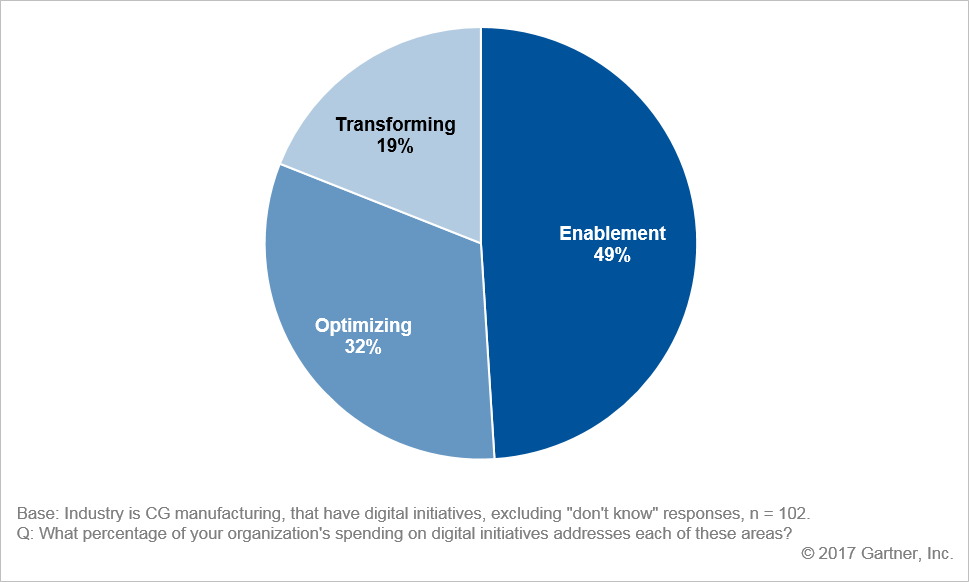
Figure 5 highlights, on average, how CG companies are spending against these three areas.
Figure 5. Spending on Digitalization
Source: Gartner (October 2017)
Other industries are spending about the same in enablement, optimizing and transforming. Communications service providers, financial services and healthcare providers are leading all of the industries when it comes to transformation. As CG companies further embrace digitalization and move from designing to delivering and scaling, we can expect for the percentage of spending to increase for both optimizing and transforming.
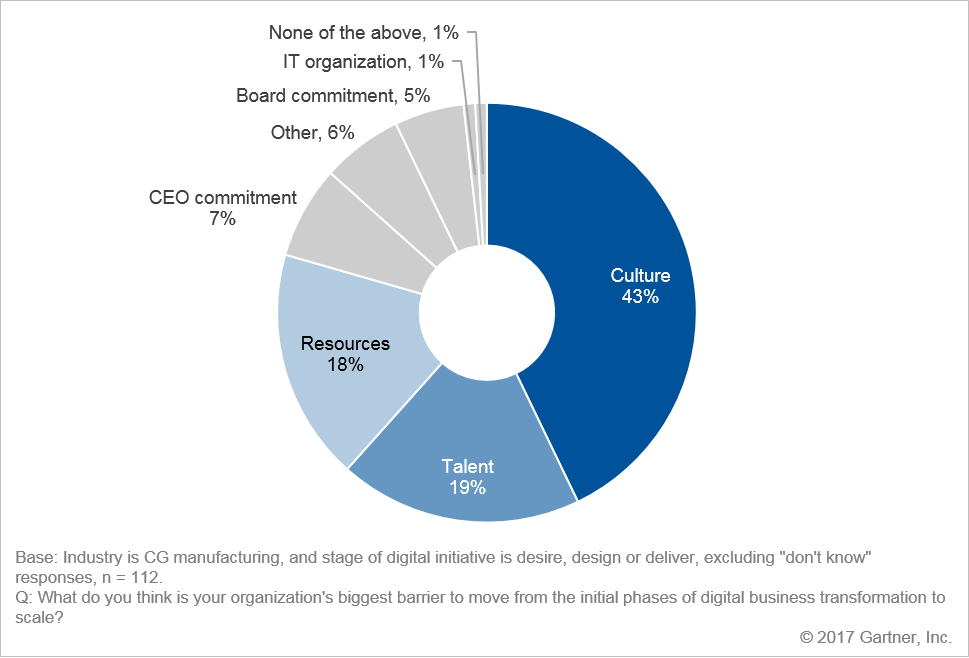
Digital transformation will not come easily to any company. A number of barriers will make scaling difficult. See Figure 6 for a view of the barriers for CG companies.
Figure 6. Barriers to Scaling Digital Business Transformation
Source: Gartner (October 2017)
As with many technology and change initiatives, culture, talent and resources top the list. About 43% of consumer goods CIOs indicated that culture was the largest barrier to scaling their digital initiative, followed by talent at 19% and resources at 18%. This would mean that a good deal of heavy lifting must be done outside of just identifying and deploying digital technologies.
Many CG companies are looking for a specific playbook as it relates to which technologies are the most important. Often, CIOs just want a shortlist of what to deploy. That, however, is not a realistic expectation, given the different starting places that all companies find themselves. It will take a recognition that getting the organization aligned and in a position to drive value from digital initiatives will require a large change effort.
Recommendation
CG CIOs need to lead the digital transformation of their teams and the rest of the organization. They will play a major role in helping their organizations think differently about what business process, new products, collaboration, sales and marketing will look like in a digital future. The CIO will be asked to lead in all three areas: enablement, optimization and transformation. All three will be important, but transformation will specifically require significant leadership from the CIO.
Methodology
The 2018 Gartner CIO Survey was conducted via an online survey from 20 April to 26 June 2017 among Gartner Executive Programs members and other CIOs. Qualified respondents were the most senior IT leader (CIO) for their overall organization or a part of their organization (e.g., a business unit or region). The total sample was 3,160, with representation from all geographies and industry sectors (public and private).
The survey was developed collaboratively by a team of Gartner analysts and was reviewed, tested and administered by Gartner's Research Data and Analytics team.
Evidence
This report is based on Gartner's annual survey of CIOs (see Survey Objective and Methodology sections for details), which was conducted between 20 April and 26 June 2017. A total of 3,160 respondents participated, including 157 consumer goods CIOs. The respondents were members of Gartner Executive Programs and other IT leaders.
Note 1
Key to Strategic Business Priority Boxes in Figure 1
Below are percentages for unlabeled boxes:
- a = Partner/channel relationship/expansion – 2.3%
- b = E-commerce – 0.8%
- c = Marketing/communications/brand – 1.6%
- d = Operations improvement/efficiency/excellence – 3.1%
- e = Quality/performance/market leader – 1.6%
- f = Financial health – 0.8%
- g = Governance, compliance, regulations – 0.8%
- h = Infrastructure development/transformation – 1.6%
- i = Technology initiatives/improvements – 3.1%
- j = Sustainability/social responsibility – 3.1%
- l = Supply chain improvement/optimization – 2.3%
- m = Diversification – 0.8%
- n = System integration – 0.8%
- o = Organizational culture – 0.8%
- q = Economic growth/development – 2.3%
- r = Employee training – 1.6%
- s = CIO's role/responsibilities/management – 0.8%
Below are percentages for labeled boxes listed without percentages:
- Strategy and planning – 3.9%
- Retention and sales (new customers/retention/sales) – 5%
- Data and analytics (analytics/data/information) – 3.9%
- Product portfolio (product/portfolio improvements) – 3.1%
