
Building a Successful Business Case for an Application Modernization Program
Applications and software engineering leaders often struggle to develop a successful application modernization business case. Those who succeed take a business-focused approach, splitting the work to target the most critical business capabilities, and delivering in multiple waves.
Overview
Key Findings
- Application and software engineering leaders often find it challenging to create a modernization business case that convinces management — especially business stakeholders — to invest, with case weakness often stemming from taking an IT-centric approach.
- With an increasing number of ever more interconnected platforms in use today, it is no longer effective to approach modernization by focusing on one platform or one application at a time. The focus should be on the set of applications that support a business capability.
- Organizations often try to modernize the entire portfolio in one program, but are unable to execute such large, high-risk programs due to their long duration and half-hearted support.
Recommendations
As an applications and software engineering leader building a business case for application modernization, you should:
- Align your application modernization business case to business objectives, priorities and appetite for change by using four critical business case sections: problem statement, technology migration, project description and cost-benefit analysis.
- Prioritize critical business capabilities and identify associated applications for modernization by executing a business-led analysis of IT assets.
- Reduce disruption, risk, uncertainty and time to value by dividing the application modernization program into multiple smaller waves of work. Use business capability value to identify, prioritize and bundle applications into these waves.
Introduction
The best approach to application modernization is to prevent deterioration and have product-centric delivery teams continuously modernize the application to keep its business, technical and cost fitness at a high level. However, many organizations are dealing with bloated application portfolios with high technical debt, risk and cost. In such a case, a modernization initiative with additional funding is required to “cure” the application portfolio from intolerable risks and obstacles.
Application and software engineering leaders struggle to create a business case for such application modernization initiatives that convinces all stakeholders and paves the way for successful execution.
As a result, necessary modernization initiatives are rejected or postponed; and even if they are selected and funded they have a high risk of failure.
The consequence is that business fitness and technical fitness of the application portfolio further deteriorates. Technical debt and cost accumulation imposes risk and burden on the organization. As time passes, application leaders require larger budgets, bigger initiatives with more risk and disruption, making selling and executing a modernization initiative even harder.
How do I create an application modernization business case that “sells” to business leadership and prepares for a successful execution?
A compelling and successful application modernization business case aligns to business objectives and priorities, focuses on business capabilities rather than applications, and proposes an incremental approach to lower risk, disruption and time to value.
Analysis
Align Your Application Modernization Business Case to Business Objectives, Priorities and Appetite for Change
Writing a compelling business case is always challenging. Gartner has a broad set of research to help in creating a business case, including suggestions for a business case outline (see Note 1). The application modernization business case is like most other business cases — except there are four areas that need extra or more-refined information (see Figure 1):
- Problem statement
- Technology migration
- Project description
- Cost-benefit analysis
Figure 1: Areas Needing Specific Attention in a Modernization Business Case
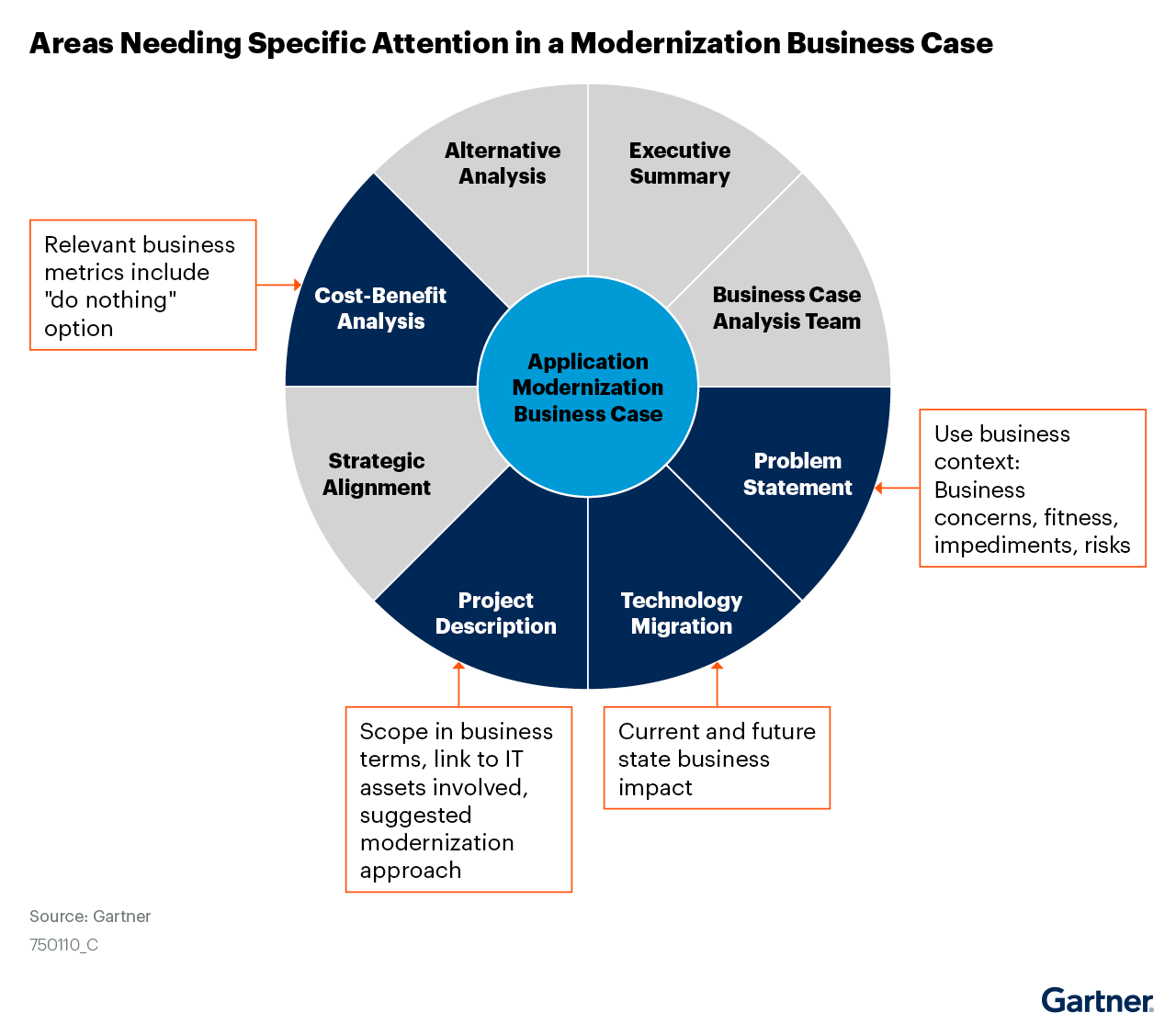
The content of these four sections should define the details of the modernization program. It should do this in a way that highlights the value proposition of the modernization effort to the organization and provides confidence that execution leads to success. It should provide the reader the ability to see how each step in the program provides benefits to the organization. Failure to provide sufficient detail will result in the reader not understanding how the complexity of the organization is understood, and how this understanding will ensure successful modernization with minimal risk to success.
We now explore these four sections in depth.
1. Problem Statement
The problem statement of a modernization business case is much more complex than it is in other types of business case presentations. The background of 30-plus years of technical debt accumulation must be described in a few paragraphs. Traditionally, boards are not overly technical. Therefore, you as application or software engineering leader must ensure the message is succinct and describes how technical debt is impacting the business.
The business case needs a clear definition — in business terms — of the problem you are trying to solve: What are the issues, concerns or impediments? Gartner has identified six common drivers of application modernization that can be used to state the objective of the modernization initiative:
- To increase business fit, business value and agility
- To reduce complexity, risk and cost
Creating a business case for just one of the six drivers, such as cost, would be challenging. In most cases, a combination of drivers creates a critical point to take action, especially if there is a joint business and IT benefit of the proposed modernization (see Choose the Right Approach to Modernize Your Legacy Systems).
2. Technology Migration
Describing the “from” and “to” states of the migration of the technology ecosystem is equally difficult. The likelihood of business case success will be dramatically lower unless this section clearly draws a direct correlation between the transition from “current state” to “end state” and the benefits to the organization. The business case is asking for money to take working applications and change either the application or the platform the application is running on, to achieve specific goals.
Example
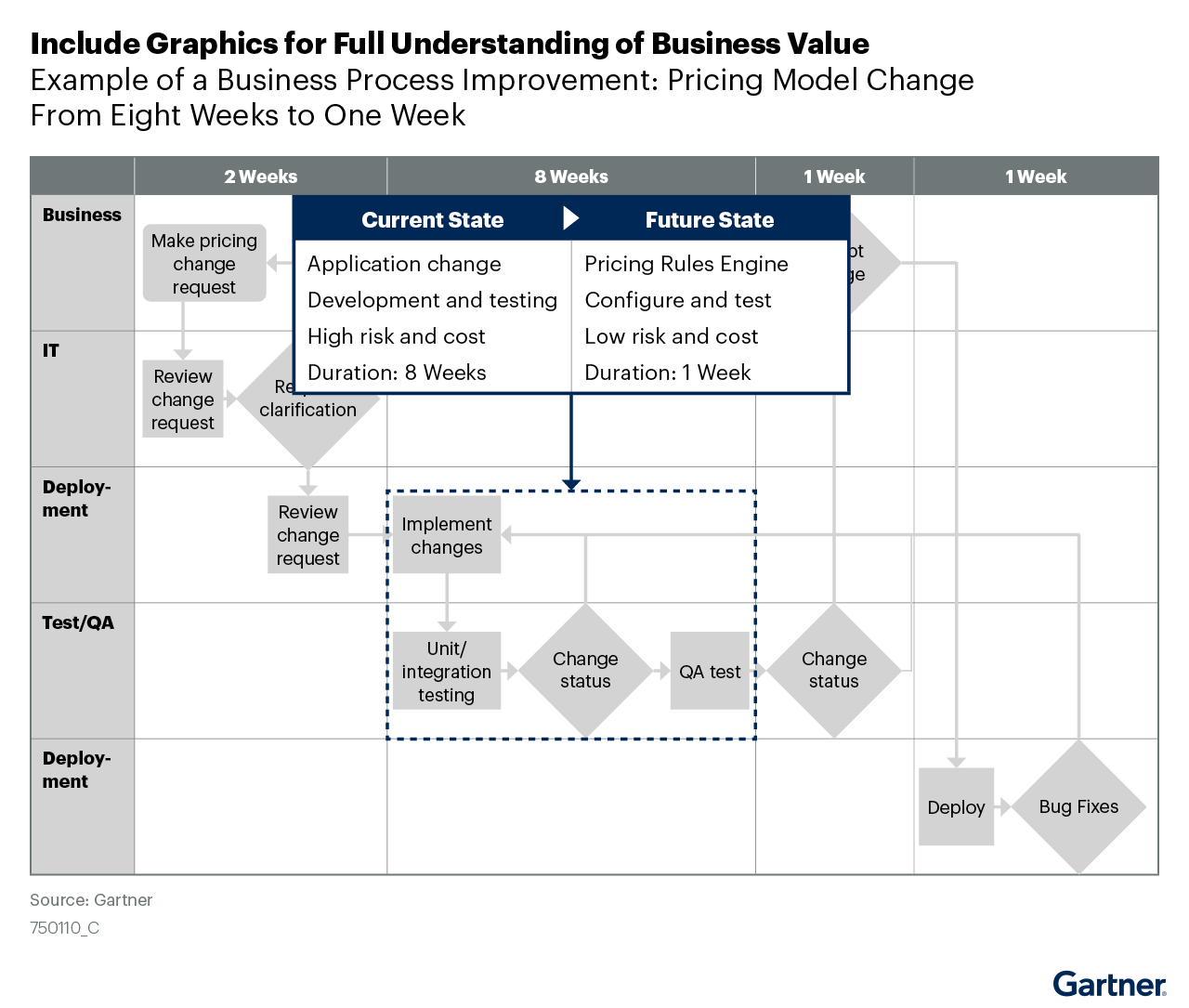
An organization wants to become more competitive in pricing by implementing flexible pricing mechanisms allowing different pricing schemes, customer centric pricing, flexible discount schemes, etc. The current application portfolio does not support this as it supports and assumes a fixed set of pricing schemes. Implementing a new pricing scheme in the current state requires software changes and testing, takes too long and comes with high cost and risk. A rearchitecture modernization activity could pull current pricing rules into a rule engine. Coupling this rule engine with the existing applications would provide greater business value, while reducing the time to market for changes.
The business case should take the reader on a journey from the current application state to how the new application state will enhance the capabilities of the business, while reducing the time to value, cost, risk and disruption. For the above example, the business case must explain:
- The importance of the pricing business capability
- How the business capability is affected by technical debt
- How technology has improved over the years and provides better support
- How the modernization will make pricing changes easier, quicker and less risky without significant development cycles
This comes down to a saving in time, which equates to a saving in cost in all areas of the business.
As it’s rare for a single application to run the end-to-end business process, many business processes are supported by multiple applications. The complexity of this discussion can quickly make the reader lose focus. Without focus and clarity the business case will be discarded. By including pictorial representations of the current and future state from a business perspective, the reader will quickly understand the required technology transformation and the business value to the organization (see Figure 2).
Figure 2: Include Graphics for Full Understanding of Business Value
3. Project Description
Without a clear project description, the approval board will deny the program. A common issue with IT modernization business cases is the complexity. Depending on the scope, a modernizing program might include 10’s or 100’s of applications. The approval board needs a clear and concise project description but also needs to understand the scope and complexity of the program and how this complexity will be managed in the execution. Provide just enough information so the reader understands the scope, complexity and approach of the modernization program.
The project description must include:
- Scope — Describe the scope of the program in business terms. What business domains, functions and capabilities are in scope.
- Complexity — This is a challenge, you want to be clear and concise, but also make sure that stakeholders understand the complexity and dependencies. The difference between traditional and modernization business cases is the level of detail needed to provide the reader with enough information to approve the program, without providing so much information that it paralyzes the reader in complexity. This section must make clear which applications, databases, application stacks and platforms are targeted by this program and how these IT assets relate to the business capabilities mentioned earlier. Breaking down the complexity and illustrating it graphically is the best method to engage the reader in understanding the problem/solution space. This will allow the reader to understand how each application supports the business. Enterprise complexity analysis tools can help to create that information and is recommended for any medium or large modernization program (see next section).
- Approach — The scope and complexity of modernization programs brings increased cost, risk and disruption. This might go above the level that an organization is willing and able to tolerate. As a result, stakeholders can be reluctant to approve such a program. At a minimum they want to understand how the risk, cost and disruption can be reduced. The answer is to break up the effort into an incremental program. Offering the board a prioritized and staged multistep, multiplatform program design will increase the probability of business case acceptance and program success. This approach will be discussed in the next sections.
The project description allows the reader to quickly understand a highly complex modernization program with a direct correlation to business value, without requiring expertise in business processes, applications and infrastructure.
4. Cost-Benefit Analysis
Ironically, one of the main reasons application modernization business cases fail is their focus on the modernization aspect. A clear opportunity description along with cost-benefit analysis rooted in the business value domain is critical. A business case should clearly define the impact on the business, and use relevant business metrics to monitor and report the effect during execution.
You can use the Gartner Business Value Model to define relevant business metrics for a given business capability (see Use Gartner’s Business Value Model To Make Better Investment Decisions). This provides the common language needed by application leaders to bridge the gap between the proposed modernization effort and its impact on the different business aspects — and ultimately on financial performance. This model and approach can support both the justification and the internal prioritization of modernization efforts.
One option that should be discussed is “do nothing” (see Use the Application Prospectus Process to Revitalize IT Investment Management). The business case must show the correlation between doing nothing, and the impediments and technical debt that is crushing the organization.
Prioritize Critical Business Capabilities and Identify Associated Applications for Modernization
Failure to obtain and provide illustration of all the linkages between the business process and IT will leave the reader unable to determine the validity of the business case. A modernization effort started without this knowledge would incur high risk.
To create a compelling business case you, as application or software engineering leader, must ensure two steps are followed:
- Scope internal business capabilities — Work with business leaders to identify and prioritize the relevant business capabilities that are in scope for the modernization effort.
- Perform Enterprise Complexity Analysis — Engage a tool vendor or service provider that offers the capability to analyze a multiplatform application landscape using tools. Enterprise Complexity Analysis tools will reduce time, increase completeness and create critical insight into the application portfolio via graphs, tables and charts.
Scope Internal Business Capabilities
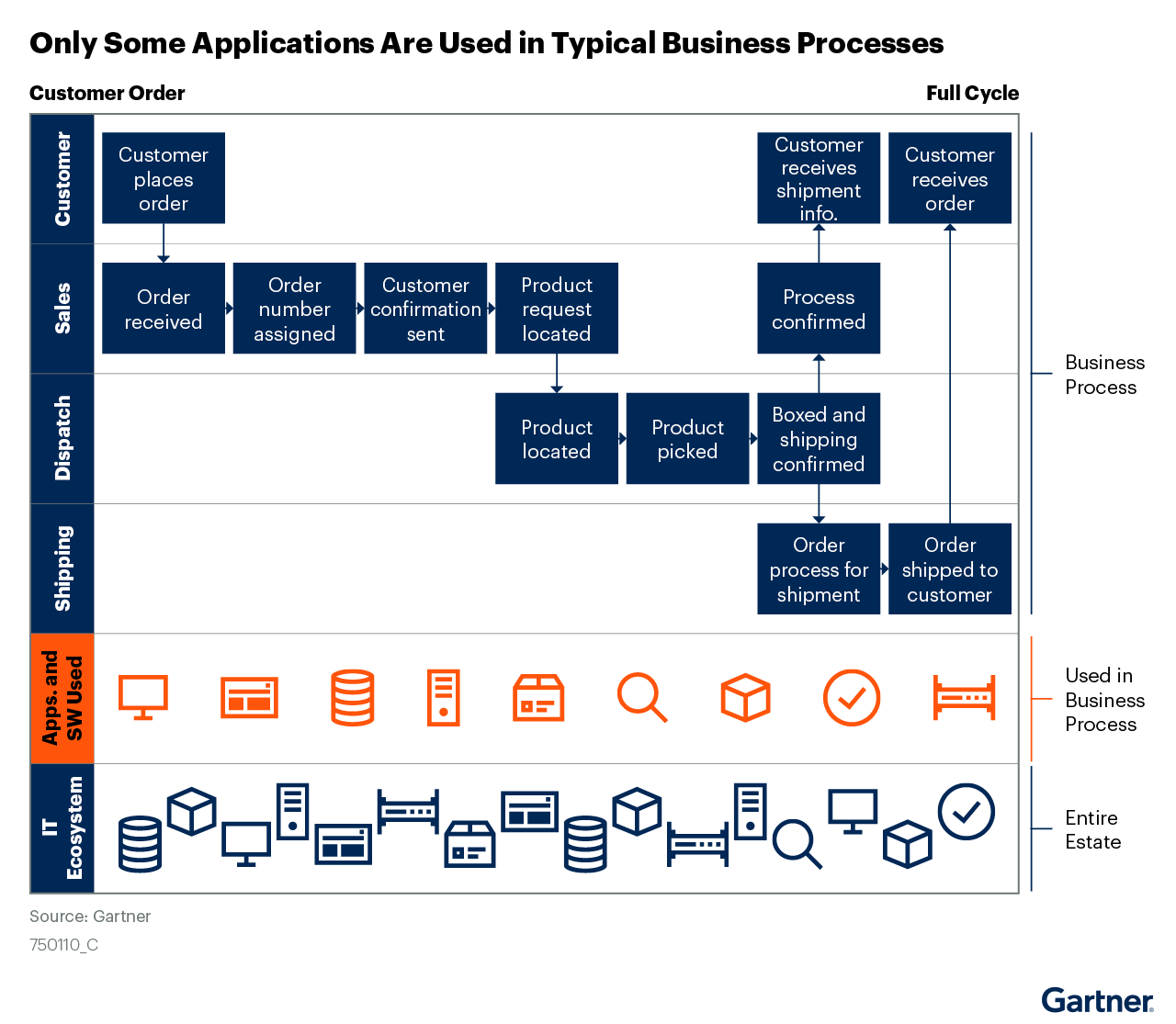
Using a business-focused analysis of the application estate defines a smaller set of applications and systems that need to be included in the business case. Figure 3 shows a typical customer order business process. When customers order something, only some of the applications and systems are used to fulfill the order business process. Selecting only applications (or application components) currently used by the business reduces the number of applications to be modernized. Organizing delivery around business processes, and focusing on the applications/databases used, allows modernization waves to be smaller.
Figure 3: Only Some Applications Are Used in Typical Business Processes
An application fitness assessment and a tolerate, invest, migrate, eliminate (TIME) analysis will add more insight as to where the business capability suffers from business fitness and technical fitness issues, and what applications should be targeted for modernization (see Use TIME to Engage the Business for Application and Product Portfolio Triage).
Providing this level of detail in the business case will provide management the assurance that your team has developed a complete understanding of the business and of its interaction with IT. With a business-centric modernization business case, the reader immediately knows:
- Which business capabilities will benefit from the modernization initiative
- Which applications and systems are in scope and affected
- That not every asset in the business is affected
- The priority and sequence of application and system modernization tasks
Perform Enterprise Complexity Analysis
To obtain the benefits of a business-led analysis for modernization, you must obtain a complete understanding of the interconnections. This level of application interaction cannot be performed by hand — you must use a purpose-built tool from a third party (see example from CAST Imaging in Figure 4).
Figure 4: Third-Party Tools Provide an Application Interconnections Overview
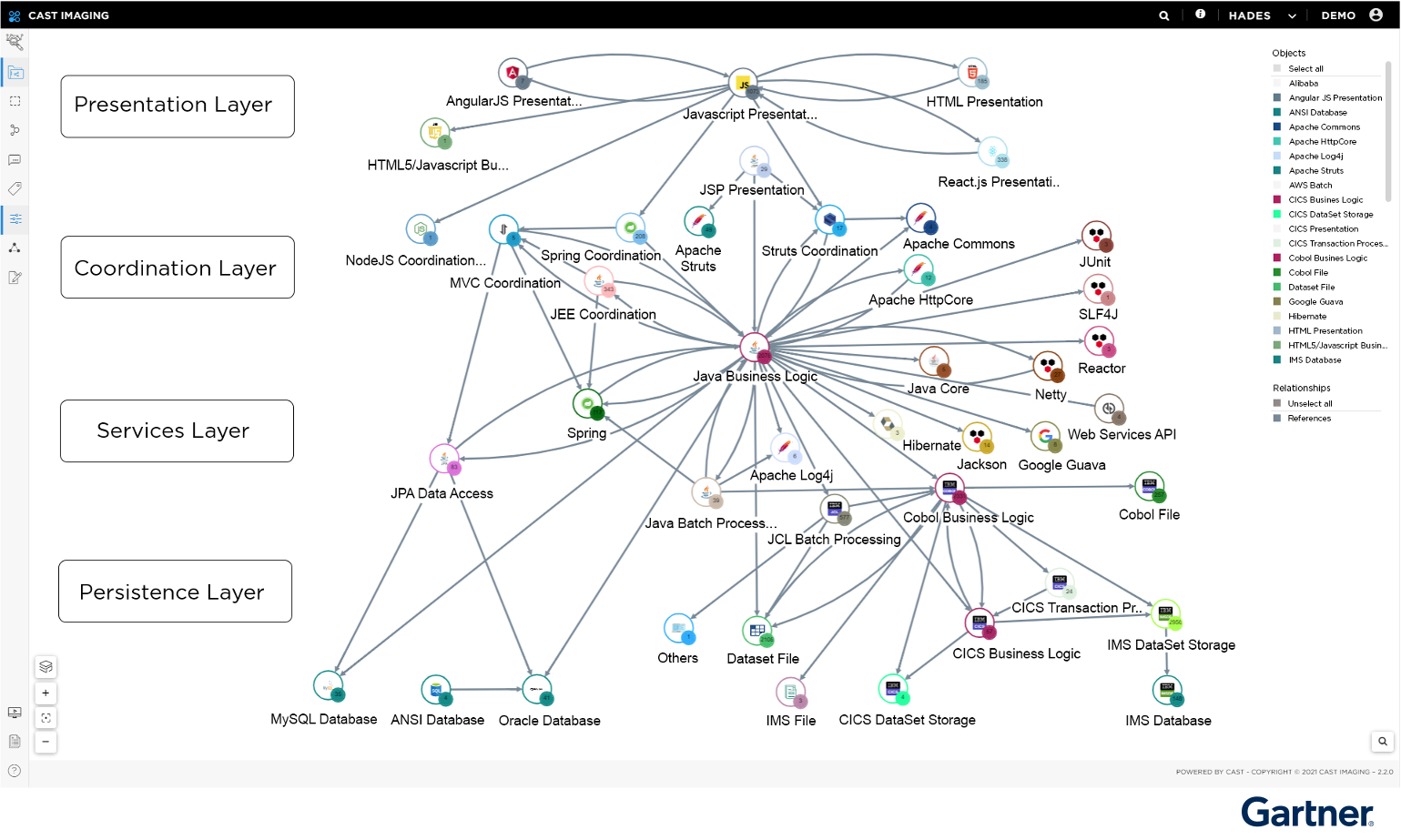
Source: Screenshot from CAST (castsoftware.com).
These tools utilize static code flow analysis to understand how all the systems used in a business process interact with every other system in the application estate. In doing so, these tools outline the business process execution tree:
- Does an application create/read/update/delete data from databases?
- Does it start other applications?
- Does it communicate over the network to some unseen product or API?
- What other dependencies exist?
Most organizations do not know these answers. And every organization must understand the flow of information before starting a modernizing initiative (see also Complexity Analysis Tools Are Worth Their Price for Application Modernization and Business Alignment).
Application complexity must be understood to ensure successful modernization. Failure to understand the connection points, the database interactions and network connectivity will consume money and time. This in turn will increase the cost, complexity and risk for the modernization effort. Gartner receives inquiries around this issue continually. Some clients expend millions of dollars assuming this expenditure will complete a modernization effort. After the funds are exhausted, many find they have made only a single-digit-percentage impact to their entire estate.
Divide the Program Into Multiple Smaller Waves of Application Modernization
Performing enterprise complexity analysis ensures only applications that are actually being used within a business capability are modernized. In addition, this approach also promotes the ability to lay out wave-based modernization. By performing modernization on smaller, more manageable pieces of the landscape, you will decrease risk, disruption and time-to-value. In addition, the funding of the program can be aligned to each wave (see Use Continuous Modernization to Build Digital Platforms From Legacy Applications).
By placing representative views of the waves and the basic concept of wave-based modernization into the business case, you will ensure the review board understands that the effort is not a “boil the ocean” plan. The plan is crisp, based on business needs, prioritized around business capability impediments and makes the best use of development resources.
The initial view must be at a program level, comprising the business capabilities being addressed. Follow these steps:
- Lay out the business capabilities in a priority order
- Look for business capabilities representing the highest rates of return to the organization, and place them at the beginning of the program
- Distribute the business capabilities across the entire program, attempting to keep an even workload from beginning to end
The complexity of the program is not apparent until business processes are broken down into the individual application components that support their function. The difficulty of the business process is not apparent until all the components are discovered, and the interdependence of each of these components is uncovered. This determines the complexity and order of the processes.
The breakup of business capabilities (and by definition, the applications and platforms) into waves is a delicate balance of velocity versus time. Each wave consists of just enough applications to modernize a business capability. Depending on the size of the business capability and the number of supporting applications, waves can consist of a single capability or multiple capabilities. It is best to keep the maximum duration of a wave within six to 12 months. Both business and management will see little value beyond 12 months, and you risk loss of support for the initiative. In this manner, you can derive the length of the overall modernization program. By keeping the waves balanced, the funding required each year is predictable and should be within a 20% differential year over year.
Presenting the program in these terms allows the reader of the business case to ensure the proper level of funding is made available for each year in the program. Typical enterprise modernization programs have a three- to 10-year life span for the modernization effort itself.
Evidence
In 2020, Gartner received 158 inquiries on the topic of Application Modernization business cases.
Note 1: Business Case Outline
See Business Case Template, Guidance Framework for Creating a Defensible Business Case and Toolkit: Get Funding for IT Initiatives by Using Effective Business Case Executive Summaries
Business case proposals generally contain the following areas:
- Executive Summary
- Issue
- Anticipated Outcomes
- Recommendation
- Justification
- Business Case Analysis Team
- Problem Definition
- Problem Statement
- Organizational Impact
- Technology Migration
- Project Overview
- Project Description
- Goals and Objectives
- Project Performance
- Project Assumptions
- Project Constraints
- Major Project Milestones
- Strategic Alignment
- Cost-Benefit Analysis
- Alternative Analysis
- Approvals
