A playbook for the Chief Data Officer: Implementing Your Data Strategy Across the "Last Mile"
Research from Gartner
How to Create Data and Analytics Everywhere for Everyone: Top Insights for Digital Business
Data and analytics leaders cannot master the opportunities and challenges of digital business transformation unless they devise a new model that both empowers analytics leaders in their local domains and leverages the shared best practices of the central organization.
Analysis
To succeed in digital business, data and analytics must be at the pulse of the organization — incorporated into all key decisions across finance, sales, marketing, supply chain and all other core business functions.
Data and analytics leaders often struggle to both bridge and coordinate an array of isolated, decentralized analytic solutions — in effect, analytic silos. Yet many vital business processes span multiple parts of the business — requiring a new business model. Domain analytics is an emerging approach intended to overcome these limitations by harmonizing the isolated analytic solutions into a leveraged, strategic discipline, as required.
Domain analytics refers to the collective set or portfolio of data and analytics applied across specific industry verticals and business processes to drive improved decision making. Domain analytics recognizes that critical expertise is in a particular business domain. It empowers business people in that domain to perform analytics on their own, while also aligning this domain with centralized data and analytics capabilities for maximum business impact.
Data and analytics leaders mastering the transformation required for digital business should answer the following strategic questions:
- How do I develop a domain analytics strategy?
- What is the business value of domain analytics, and how can this be measured?
- How can I leverage the best practices of a hybrid and distributed organizational model?
- What is the right approach to packaging domain analytics, to make it more contextualized, and how and where can I find support for my domain analytics initiative?
- What best practices should I adopt to govern and enable domain-specific data and processes?
Strategic Planning Assumptions
By 2019, 50% of centrally organized analytics programs will be replaced by a hybrid organizational model that shares power with local domain analytics leaders.
By 2019, citizen data scientists will surpass data scientists in the amount of advanced analysis produced.
Research Highlights
Several key issues are associated with the emergence of domain analytics:
- Analytic adoption across the organization has become increasingly domain-specific and fragmented, losing the leverage of core teams and established best practices.
- There is a wide set analytics research within industry, domain and technology teams. However, different domains have differing priorities for an organization as well as differing levels of maturity.
- Centralized business intelligence (BI) teams risk becoming a bottleneck, because their roles and skills are necessary, but no longer sufficient to meet the needs and scale of digital business transformation.
- A one-size-fits-all analytics strategy no longer fits the needs of digital business.
- Without a strategic discipline across all local domains and centralized BI, there is risk of duplicate or redundant analytics — resulting in higher costs, inconsistent analysis of data driving a lack of trust in the results, and a lack of those economies of scale that leverage best practices for speed and scale.
How Do I Develop a Domain Analytics Strategy?
A comprehensive data and analytics strategy sets the pace, direction and cadence of the organization's approach and enables the successful communication of scope and business impact between leaders responsible for driving data and analytics programs and business leaders responsible for achieving the business goals. Data and analytics leaders need to align their strategies using the axes of Gartner's data and analytics compass strategy. The north-to-south axis in this strategy (from "Business Value" to "Governance") is focused on the business perspective; the west-to-east axis (from "Organization" to "Technology") addresses specific operations and aspects of technology.
Most IT-led data and analytics program initiatives are, by definition, technology-centric and often lack alignment with business strategy and business impact. Business domains increasingly take over control, ownership and responsibility on data and analytics applications and use cases, but often underestimate the associated complexity and risks.
Data and analytics leaders must optimize their domain-specific analytics competencies for success in the digital business and to sufficiently support multiple use cases across business processes, industry verticals, analytic methods and data. The Gartner domain analytics framework maps business domain analytics across their relevant industry verticals (see Figure 1). It can also be used to provoke thinking about nontraditional data sources and analytical methods.
Figure 1. The Domain Analytics Framework
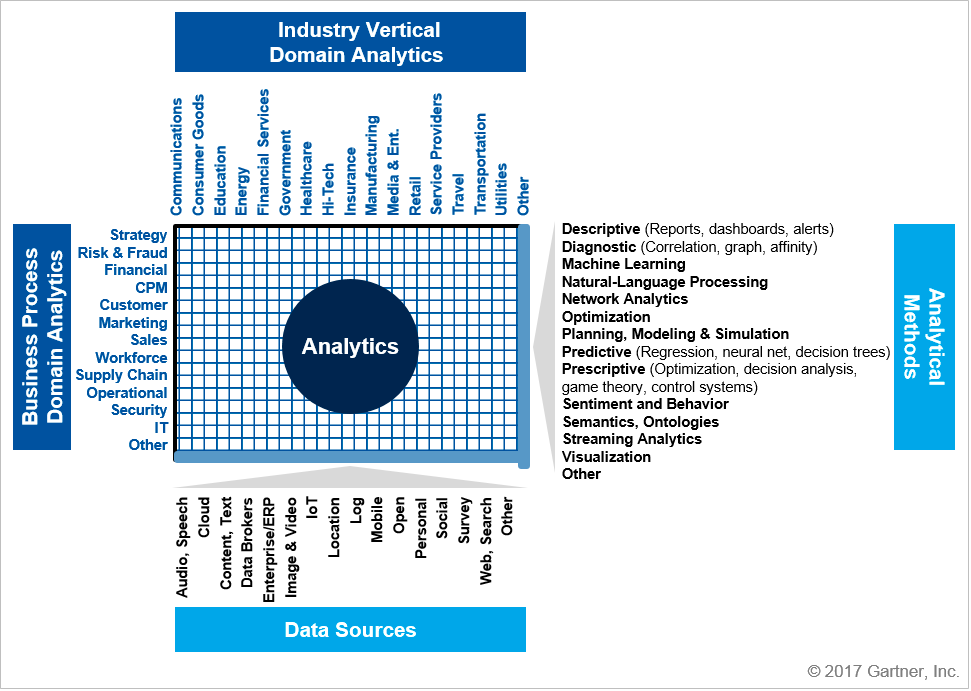
Ent. = entertainment; IoT = Internet of Things
Source: Gartner (November 2017)
The strategy must address all dimensions of data and analytics and be inclusive of data management strategies.
As data and analytics has become pervasive in all aspects of businesses, communities and even in our personal lives, the ability to communicate in this language — that is, being data-literate — is the new organizational readiness factor.
Create your data and analytics strategy by following the principles of the data and analytics compass strategy, which outlines business value, organization, technology and governance by answering the four questions below.
What Is the Business Value of Domain Analytics, and How Can This Be Measured?
Data and analytics leaders must not overlook the importance of aligning the data and analytics strategy with the business perspective. You should treat investments in data and analytics the same way you would invest in a new market, new products or new services. To get started, adopt a common framework for improving results through performance measurement that can be applied and contextualized for all domains.
One of the best ways of finding business value is learning from others who do this well. Many great examples are documented in the 2017 Analytics Excellence awards.
How Do I Manage a Hybrid and Distributed Organizational Model?
With analytics pervasive across the organization, the centralized business intelligence competency center (BICC) model is no longer sufficient. The advance and availability of self-service data preparation and data visualization tools have empowered a generation of new citizen data scientists — usually people with deep domain expertise who are on the front line to spot new business opportunities. We recommend you create an organizational model that empowers domain analytics leaders within their sphere of influence, but that also fosters collaboration and consistency with other domains — including that of the central IT department.
The growing importance and strategic significance of data and analytics is creating new challenges for organizations and for data and analytics leaders. While some traditional IT roles are being disrupted by "citizen" roles performed by line-function business users, new hybrid roles are emerging that span functions and departments and blend IT and business roles to become almost the norm. The analytics center of excellence (ACE; sometimes also called the "analytics community of excellence") has evolved from more technically oriented BICCs into ACEs with a broader set of capabilities and domain knowledge.
By deploying the ACE effectively, the organization will benefit through:
- Economies of scale — by leveraging best practices and frameworks that can be contextualized and scaled across the entire organization.
- Consistency across the organization — by speaking a "common language" and introducing governance frameworks and best practices.
- Speed and agility — filling in the "white space" to increase analytics maturity in domains, and encouraging innovation.
- Alignment across the enterprise between central IT and business domains — for the organizational model and governance model, including data quality, security and privacy, and business value.
What Is the Right Approach to Packaging Domain Analytics, and How and Where Can I Find Support for My Initiative?
A common challenge faced by domain analytics leaders is when to choose a broader BI platform instead of a domain-specific application. Rather than adopting a "one size fits all" mentality and using a general-purpose BI platform to meet all their analytics needs, analytics leaders need to broaden their thinking and look at analytics as a portfolio of different techniques and packaging — in order to address different build/buy/outsource requirements. This applies from embedded analytics within enterprise applications to stand-alone packaged analytics, to custom analytics built using BI and data science platforms from both software vendors and service providers. The more the analytics are embedded or packaged as an application, the more contextualized the experience for the specific role and domain. Realizing the long-term or ongoing plan for a domain analytics vision, your organization may also require or benefit from external service providers to help structure your strategy.
For domain-specific applications across business processes, Gartner's Hype Cycles provide a graphic representation of the maturity and adoption of technologies and applications, and how they are relevant to solving real business problems and exploiting new opportunities. Two Hype Cycles provide insight into analytical applications supporting business processes such as back-office finance, HR, procurement, IT supply chain and customer experience. Additional Hype Cycles also support a wide range of industry verticals.
Which Best Practices Should I Embrace to Govern and Enable Domain-Specific Data and Processes?
The widespread and decentralized use of data and analytics capabilities across organizations requires a new approach in order to ensure consistency and transparency for the decision-making models applied. Think of governance as an enabler, not a restrictor. This is the fundamental difference between compliance and governance. Analytics governance is a positive force that defines the rules of the game for the business. Setting the ground rules for analytics governance keeps everyone in the organization playing the same game.
Organizations can no longer assume they own all of the data they govern. If data and analytics leaders are to deliver real business value, they must adopt a trust-based approach to information governance. A new approach is emerging that focuses less on the active conformance of data and more on the demonstrated trust users and peers have in that data. This is changing the way information governance and data quality are being implemented, and also impacting tools and technology as a result.
While working with external service providers, enterprises should shift to a co-managed governance model that leverages both control and trust factors. Governance models can be contextualized and leveraged to address domain-specific requirements.
Source: Gartner Research Note G00325238, Melissa Davis, Jim Hare, Jorgen Heizenberg, Gareth Herschel, Valerie A Logan, Kurt Schlegel, Thomas Oestreich, 29 November 2017
Acronym Key and Glossary Terms
ACE - analytics center of excellence
BI - business intelligence
BICC - business intelligence competency center
Evidence
This research is based on hundreds of client inquiries and interactions with many analysts across all aspects of data and analytics — across both industries and business domains.