
Let Generative AI Flourish Through Bottom-Up Innovation
Executive leaders of digital business should be thinking not just how they’ll use GenAI, but how they can lead in — and with — the technology. They must ensure the right balance is struck between the broadest efforts possible to innovate with the need to manage the most pressing risks.
Overview
Key Findings
- Despite impressive advances, Generative AI (GenAI) should be seen by executive leaders of digital business as a maturing technology that creates an enormous opportunity for any aspiring digital business to create and dominate new GenAI market categories.
- Too many organizations are engaged in establishing GenAI policies or GenAI steering committees that are too focused on managing risks at the cost of innovating in a dynamic market.
Recommendations
In order to realize the full potential of GenAI, executive leaders of digital business should:
- Capture opportunities to become GenAI market leaders by fostering speedy, bottom-up innovation as experimentation with leveraging GenAI technology increases.
- Avoiding stifling creative bottom-up innovation across the organization by actively limiting efforts to create overly strict AI policies and AI steering committees that seek to centralize control over GenAI innovation initiatives.
Strategic Planning Assumption
Through 2024, a majority of GenAI deployments will have been developed in-house, rather than having been acquired by a technology provider.
Introduction
Since ChatGPT exploded on the scene in late 2022, organizations have been scrambling to make sense of the technology. As a result, executive leaders of digital business have found themselves being hit from all sides to “do something.” We are seeing executive leaders trying to figure out where their organizations can realize value through GenAI, as they assess what is still an unclear risk profile — including the emerging regulatory landscape — all while trying to learn the basics of the underlying technology itself.
However, in the face of growing demand for executive-level attention, something important needs to be kept in mind. Despite the impressive advances in GenAI, it is, as a whole, a maturing technology. Consider the following characteristics of the GenAI market:
- Significant improvements are being realized with every major revision of the top large language models (LLMs).
- The competitive landscape for GenAI is highly dynamic (see Note 1).
- The mechanisms for commercializing GenAI are a work-in-progress, as is the potential impact of open-source offerings on the viability of commercial GenAI.
- The partner ecosystem around the major LLM providers is still forming.
- Government regulations are still emerging, with significant differences in approach emerging from different government jurisdictions.1
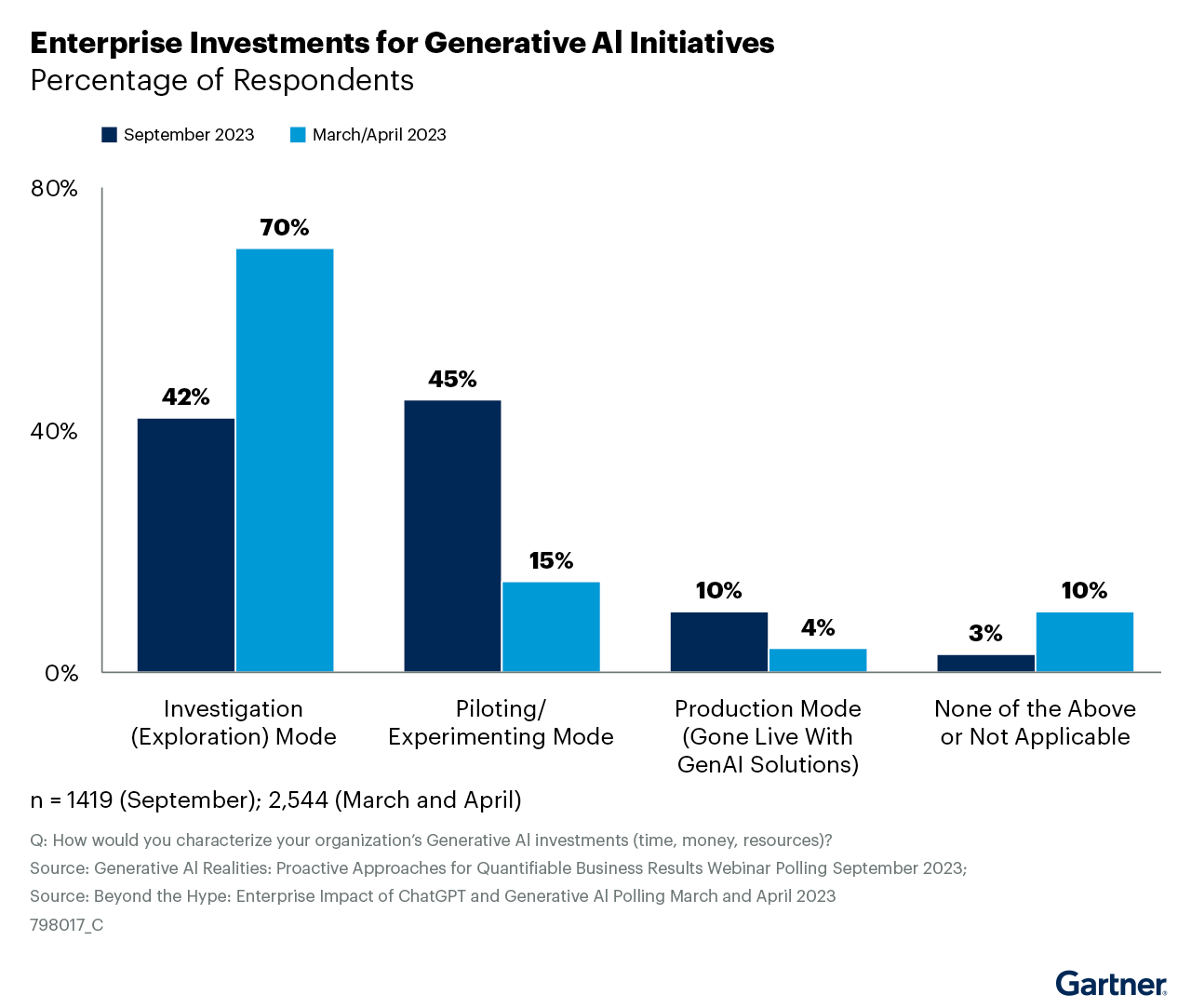
The immature nature of the GenAI market is reflected in the fact that a large majority of organizations are still investigating what is possible with the technology (see Figure 1).
Figure 1: Current Phase of Generative AI
Executive leaders should be thinking about the contribution they will be making to the effective use of GenAI. At the same time, they will need to avoid the temptation of seeing themselves as simply technology consumers while focusing only on the risks associated with vendor-supplied GenAI solutions. Doing so gives their organization the possibility of maximizing the value of GenAI through their own innovations.
Analysis
Emphasize Speedy GenAI Innovation
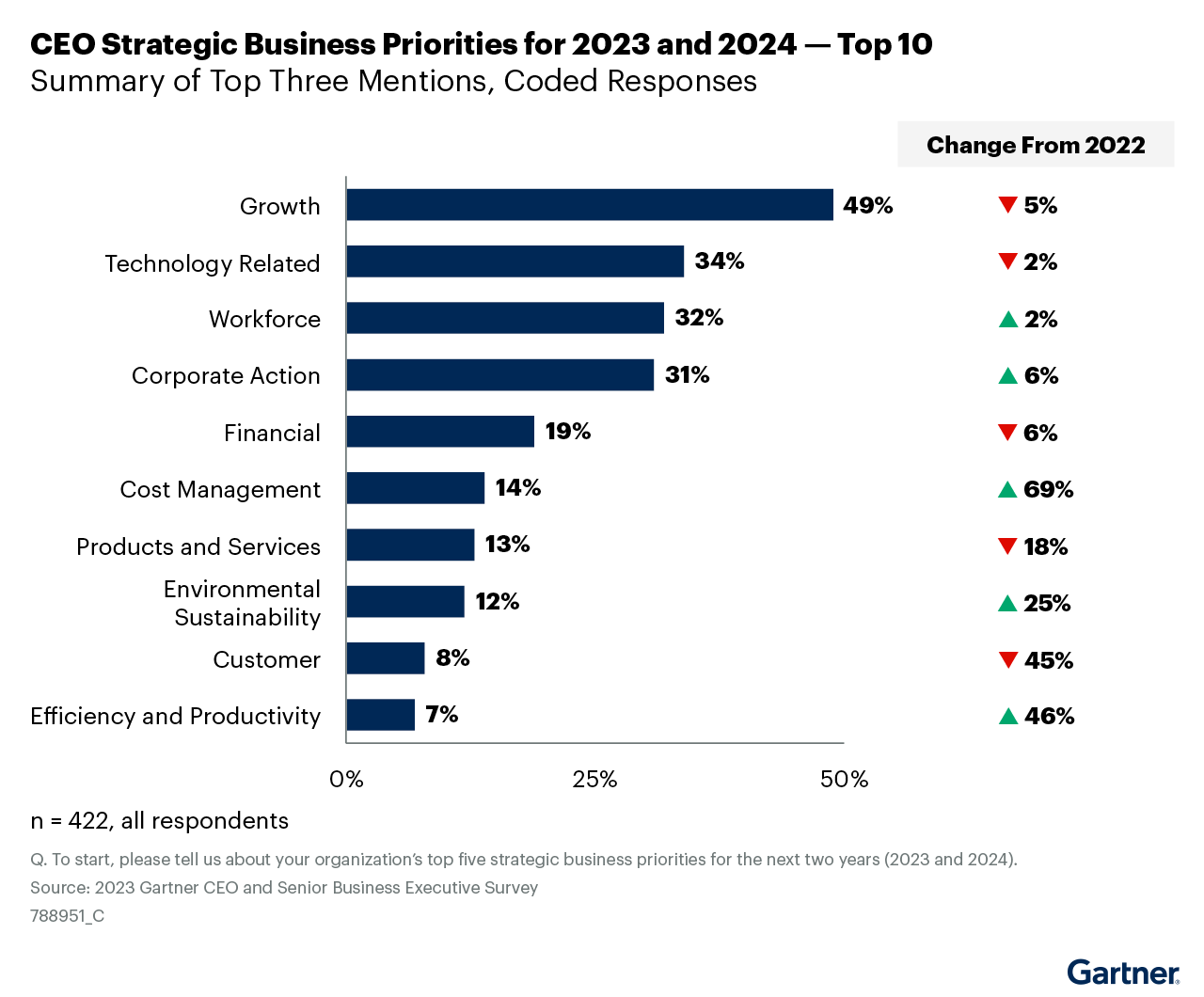
CEOs and other senior business executives have indicated to Gartner that their top strategic business priority for 2023 and 2024 is growth (see Figure 2).
Figure 2: CEO Strategic Business Priorities for 2023 and 2024 — Top 10
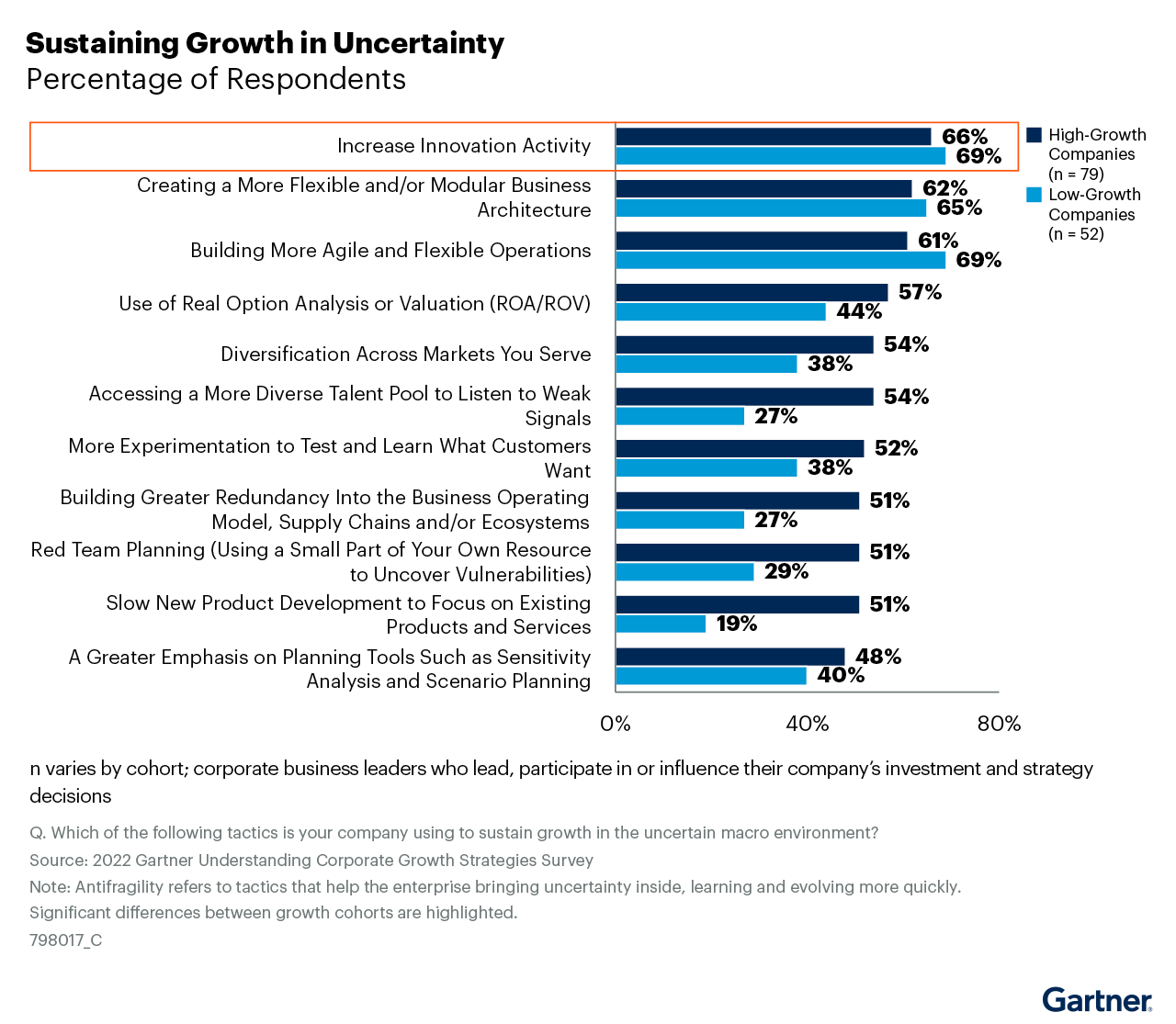
In an uncertain market landscape, increasing innovation is the most important tactic that innovation leaders are using to sustain growth (see Figure 3).
Figure 3: Sustaining Growth in Uncertainty
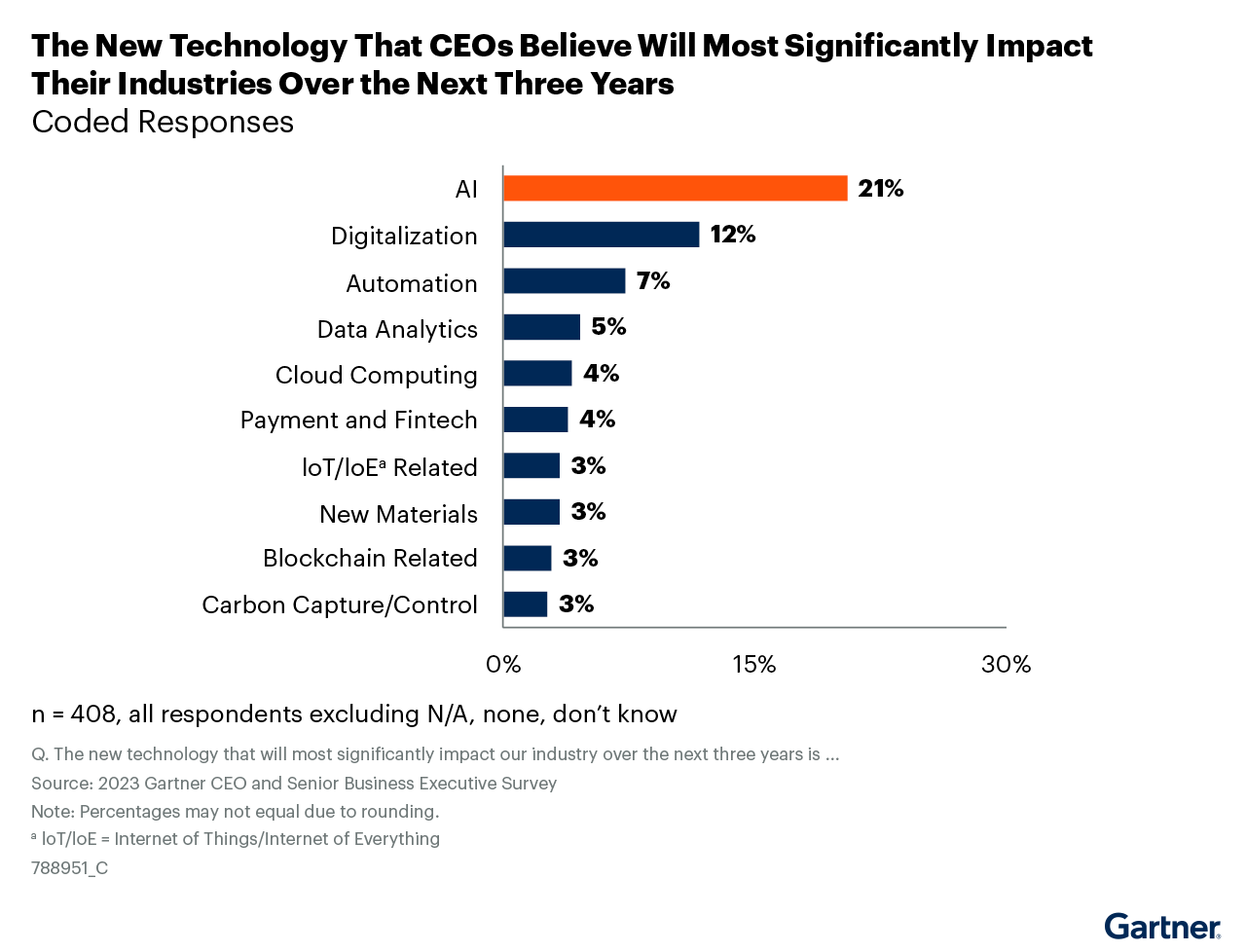
As AI is the technology that CIO’s believe will have the most significant impact on their industry over the next three years, it’s to be expected that, given its high profile, efforts to drive growth through innovation will focus on ways to use GenAI (see Figure 4).
Of course, an important aspect of immature technology is managing emerging, ambiguous risk. And in response to the growing innovation-directed experimentation of GenAI, organizations are rushing to implement GenAI use policies. Yet, across the many AI policies we have examined, one risk is consistently neglected. Almost none have considered the risk to their organizations of not being an AI market leader.
This point belies a limited perspective about the potential of GenAI by those drafting AI policies. Historically, businesses would consider new technology as a means to improve operational efficiency. Modern businesses, as we can see below, are just as inclined to look for ways to improve customer experience and drive revenue (see Figure 4).
Figure 4: The New Technology That CEO’s Believe Will Most Significantly Impact Their Industries Over the Next Three Years
The potential mistake executive leaders can make is to allow their business to pursue these results solely through the use of technology vendors’ solutions. But, there is no longer a hard line that delineates a technology provider from a technology-consuming enterprise. The modern enterprise seeks to become a digital business. Its leaders recognize their ability to create and commercialize digital assets, not simply manage the supply and utilization of providers’ digital assets. Executive leaders of digital business must direct their organizations to strive toward GenAI leadership. Without a risk-benefit analysis that accurately assesses the potential benefits of GenAI, the entire analysis is a wasted effort.
Executive leaders of digital business must realize that GenAI market leadership is a real possibility. GenAI leadership requires enterprise to manage technical complexity and incur costs, although those will vary depending on deployment approach. GenAI leadership doesn’t require an enterprise to incur the cost and complexity of building its own LLM from scratch, although this is a real option given the right circumstances. Enterprises can apply their data assets to what are referred to as fine-tuning techniques to create new solutions, either for internal use or as market-facing digital products (see Note 2). Prompt design skills, directed and quarantined, can be the source of competitive differentiation.
Many categories of GenAI will emerge, and there is nothing stopping a modern enterprise from becoming a category creator. And leading organizations such as JPMorgan Chase,2 Bloomberg,3 and Thomson Reuters4 see their existing business as a way to become GenAI providers, rather than only seeing their business as being served by GenAI providers. As more businesses come to this understanding, the nature of what defines the GenAI market will be reshaped.
Speed of innovation, therefore, is of the essence. And to achieve that, GenAI requires bottom-up innovation. This is the ability of any team, in any department, in any business unit, in any subsidiary to experiment with GenAI, within reasonable risk guardrails.
Recommendations
- Update innovation goals, where necessary, so that they expressly seek to create a culture of innovation and vest innovation teams with the responsibility to enable an innovation mindset that supports the experimentation with GenAI.
- Do not micromanage this outcome. Rather, with higher-level business goals established, have dedicated innovation teams use Gartner’s Customizable Innovation Framework, contextualize those goals to organizational realities, and then select and deploy the activities best suited to drive GenAI innovation.
Don’t Stifle Bottom-Up Innovation
This is not to say there aren’t risks associated with GenAI. Some GenAI risks are legitimate and must be dealt with now (e.g., using secure corporate information in publicly available chatbots, using GenAI outputs without proper checks). Executive leaders should also recognize that an element of fear mongering in the public sphere is amplifying concerns about the risks of GenAI that, in some cases, are hyperbolic (e.g., mass unemployment, the end of humanity) and are generating widespread calls for regulation. We are hard pressed to recall any previous advance in digital technology that has followed this path so early in its development.
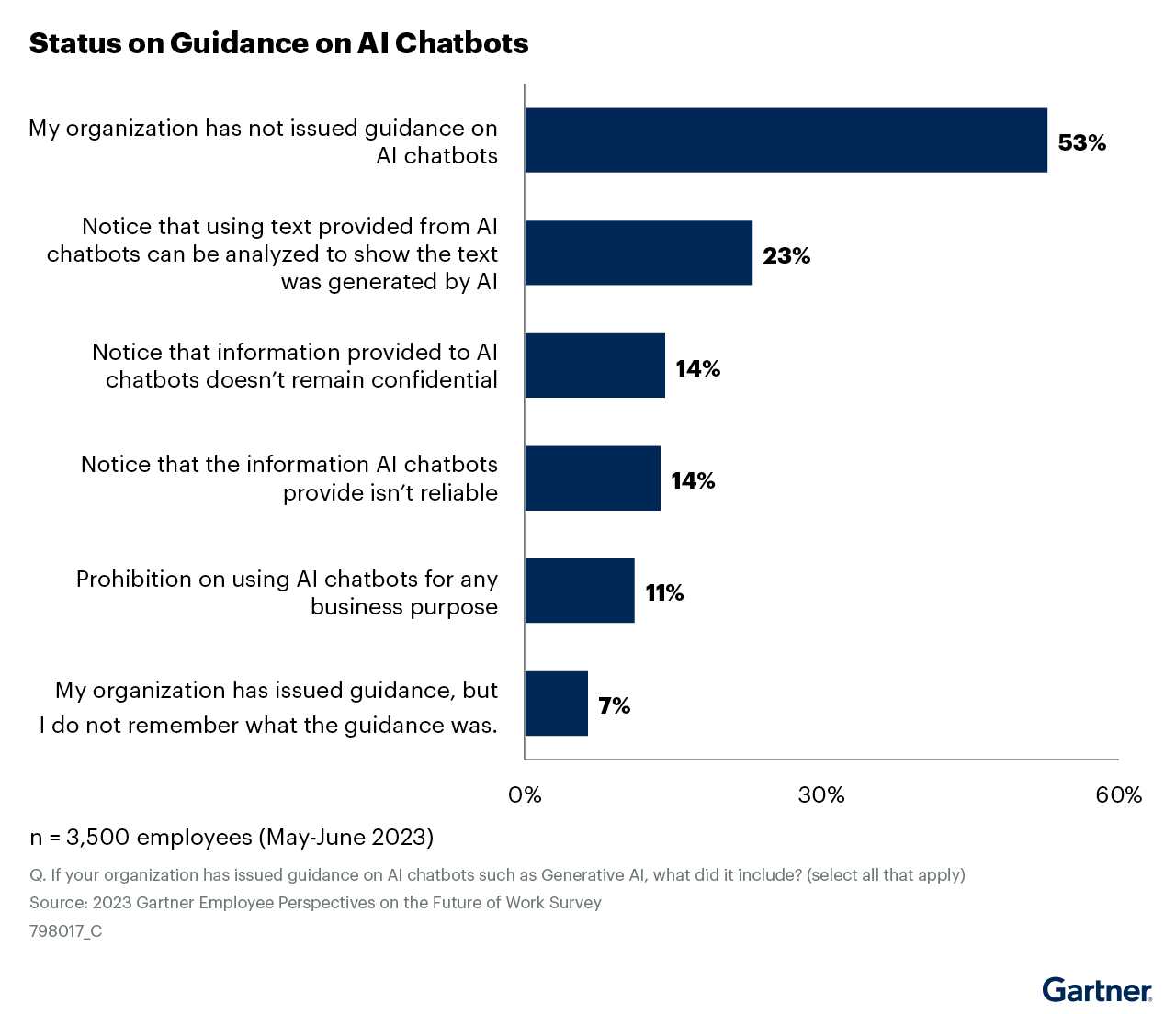
More than half of the respondents to the 2023 Gartner Employee Perspective on the Future of Work Survey,5 state that their organizations have not issued any guidance on AI chatbots (see Figure 5). So, it’s not surprising that we’re hearing from many Gartner clients a desire to set up some type of centralized AI steering committee (sometimes referred to as a GenAI tiger team) to guide the organization to mitigate both the real and perceived risks of GenAI.
Figure 5: Status On Guidance on AI Chatbots
Nearly all proposed AI policies and AI steering committee charters we see share two common traits:
- They seek to manage risk through a centralization authority, generally a specific team that owns an AI policy and that may also be a permission-granting body.
- They are based on highly proscriptive, acceptable AI use conditions.
If the underlying theme of GenAI value realization is speedy, bottom-up innovation, executive leaders must avoid the temptation to mitigate risk by creating AI policies and committees that effectively centralize the approval over GenAI initiatives. As we’ve highlighted, GenAI technology is maturing and the market is too dynamic. The creators of centralized AI policies and steering committees clearly want to cover their organization for anything that can go wrong. While that’s laudable at one level, it’s unrealistic on another. As experimentation continues, the nature of GenAI risk will be moving from broad brush into nuanced categories. There is no reason to believe that an AI policy can reasonably cover all the possibilities, or that an AI steering committee can stay abreast of them all. Increased effort to do so will come at the cost of the autonomy and flexibility needed to support bottom-up GenAI innovation to thoroughly evaluate use cases against cost, value and technical feasibility.
The scope of potential GenAI solutions spans every single facet of an enterprise. For bottom-up innovation to gain traction across such a broad range of business operations, experimentation should be allowed to flourish with the widest possible risk management guardrails. Don’t create new AI policies where existing data privacy or information security policies can be updated for GenAI. Don’t impose strict risk management conditions on GenAI experiments, but instead let GenAI experiments be conducted with the requirement to identify, manage and inform of any GenAI risk identified. And position AI steering committees as centers of GenAI collaboration, rather than centers of GenAI control.
Recommendations
- Charter the chief risk officer with establishing baseline risk management policies under the guiding principle of minimum viable policy (MVP). CROs must focus on policies that are obviously necessary and avoid those that are “nice to have, just in case.”
- Where AI steering committees need to be established, design them to an attitude of advice giving based on domain expertise rather than management based on organizational silo.
- Amend or revise existing information security and privacy policies so they include the use of GenAI as opposed to crafting distinct AI-specific policies.
Evidence
1 The EU and U.S. Diverge on AI Regulation: A Transatlantic Comparison and Steps to Alignment, TechStream, Brookings Institute.
2 GPT: The Next Frontier in Fintech, Led by JP Morgan Chase, Fintech Finance News.
3 Introducing BloombergGPT, Bloomberg’s 50-Billion Parameter Large Language Model, Purpose-Built From Scratch for Finance, Bloomberg.
4 Thomson Reuters Brings Forward Vision to Redefine the Future Of Professionals With Content-Driven AI Technology, Thomson Reuters.
5 2023 Gartner Voice of the Client Content Survey (Generative AI). This survey was conducted online with 820 engaged Gartner clients in IT and business leader roles from 9 May through 31 May 2023. The objective of the survey was to better understand client needs and to gauge the use and expectations of generative AI in their organizations. Participants represented a wide range of industries and came from across the world: 56% from North America, 27% from EMEA, 13% from APAC and 4% from Latin America. All participants had recently engaged with Gartner’s content on gartner.com (within the last 90 days).
Note 1: GenAI Competitive Landscape
Not only is there fierce competition among providers already in the market (e.g., OpenAI, Alphabet), there is interest in providers that have emerging GenAI product strategies (e.g., Apple, Tesla, Amazon), along with open source LLMs (e.g., Falcon LLM, OpenLLaMA)
- On Apple’s AI intentions: “Its conference unveiling the updates included zero mentions of AI, now a buzzword for tech companies of all stripes. Instead, Apple used more technical language such as machine learning or transformer language model. Apple has been quiet about the technology — so quiet that it has been accused of falling behind.” See Apple Is An AI Company Now.
- On Tesla’s AI Intentions: “Tesla’s established fleet is an underrated aspect of its AI program. Tesla has more vehicles on the road than any other EV brand by a country mile, and it collects data on every vehicle daily. It feeds this data into its neural network, using the input to build models and train its algorithms over time.” See Is Tesla’s AI Tech its Biggest Competitive Advantage?
- On Amazon’s AI Intentions: “Instead of having a single application or small set of applications based on large language models that individuals can use, Amazon has launched an AWS service called Bedrock that’s designed to let companies build applications using one of several different AI-powered foundation models.” Amazon’s Generative AI Strategy Focuses On Choice
Note 2: Fine-Tuning
Fine-tuning takes a large foundation model (LLM) and further feeds it labeled data examples for a specific use case and creates new model weights and updates to the model parameters.
