Magic Quadrant for Managed Hybrid Cloud Hosting, Asia/Pacific
Analyst(s):
To Chee Eng, Kenshi Tazaki, Arup RoySummary
Managed cloud providers in Asia/Pacific are beginning to introduce early hybrid cloud capabilities. This Magic Quadrant helps infrastructure and operations leaders choose providers that can support their use cases and geographic requirements.
Market Definition/Description
Gartner defines managed hybrid cloud hosting (MHCH) as a standardized, productized offering that combines a cloud-enabled system infrastructure platform — consisting of a pool of compute, network and storage hardware — with cloud infrastructure framework software to facilitate self-service and rapid provisioning.
In addition to offering this service from cloud infrastructure located in its own data center, the provider must offer a choice of using a hyperscale public infrastructure as a service (IaaS) provider or an Asian country-specific, large-scale IaaS provider. For more information on IaaS providers, see "Magic Quadrant for Cloud Infrastructure as a Service, Worldwide."
The infrastructure platform should be located both in a service provider's data center for the cloud-enabled system infrastructure (CESI) platform and in an Asia country for the public IaaS platform. It also requires the use of a standardized deployment across all service provider customers and leverages a single codebase.
At the minimum, a service provider must supply server OS management services, including guest OS instances if virtualization is used. The provider must also supply other managed and professional services relating to the deployment and operation of the infrastructure, such as:
-
Management of infrastructure software at the middleware layer, such as web server software, application servers and database servers
-
Management of storage, including backup and recovery
-
Management of security
-
Management of network devices
-
Professional services associated with MHCH, such as design and architecture, capacity planning, migration, performance testing, and security auditing
All services should be available to customers in the Asia region as of 1 June 2017, with the option to take some or all services. For a more detailed overview of MHCH, see "Technology Overview for Cloud-Enabled Managed Hosting" and "Magic Quadrant for Managed Hybrid Cloud Hosting, Europe."
Use Cases Covered by This Magic Quadrant
This Magic Quadrant focuses on the following common use cases, independent of the type or types of infrastructure used for the associated workloads:
-
E-business hosting for digital marketing sites, e-commerce websites, SaaS, social websites, and similar modern online properties and applications. These workloads are often complex and are associated with a high rate of change in systems and application infrastructure.
-
Web-based business application hosting for corporate intranets and web-based applications delivered to users primarily within enterprises. The applications may be commercial software or developed in-house; workloads are often relatively static, and they do not have a high rate of change.
-
Enterprise application hosting for the infrastructure supporting large commercial software applications, such as those of Oracle and SAP. These workloads are often complex and require specialized knowledge to operate optimally, but they do not have a high rate of change.
All three use cases are typically tactical sourcing decisions that center on one application or a single group of closely related applications (such as everything associated with an enterprise's video portal). They are typically best-served by a best-of-breed provider that has strong operational expertise with similar solutions. However, many customers expand their use of hosting over time, and the choice of provider may become a strategic decision for a customer.
In the MHCH, it is difficult to find a provider that excels in all the areas mentioned above, as well as in many countries within Asia. Providers may be leaders in some delivery areas, but they may lag behind in other areas. Additionally, smaller providers may do one thing extraordinarily well, but they may not have a comprehensive set of services or the geographic reach that enables them to address a broad array of use cases. As a result, it is important to match your use case with a vendor that excels in meeting your particular functional and geographic needs.
It is also crucial to note that this Magic Quadrant shows the overall position of a vendor in the MHCH market only. It does not consider a provider's strength in other adjacent delivery areas in IT services (although this may be referenced in the Vendor Strengths and Cautions section). Therefore, it is crucial to look beyond just the placement of the vendors in this Magic Quadrant during your evaluation and selection. Your individual needs may be best-served by vendors in the Leaders quadrant, as well as by the Niche Players, especially if you have an unusual need.
Note: The Asia cloud data center presence field lists only those data centers that provide MHCH services within the Asian region. Some vendors have other data centers set aside for data center outsourcing, network services and colocation, as well as MHCH data centers outside the region, which are not included.
Types of Business Covered by This Magic Quadrant
This Magic Quadrant focuses on MHCH services for the following types of business:
-
Asia's businesses, including government and midmarket companies: Their operations are typically domestic in nature. They require their IT infrastructure to be located within their markets for a variety of reasons, of which data security, data sovereignty and proximity hosting for application performance are the most important.
-
Western multinational companies (MNCs) operating in Asia: These businesses typically host their IT infrastructure in one or two regional locations (hubs), typically Singapore and Hong Kong and — to a lesser extent — in Japan and Australia because fewer MNCs have regional headquarters there. In some instances, they may require local hosting in India for back-end IT operations, and in China to support their large businesses there. Providers that address this segment must have presence in both Singapore and Hong Kong and, to a lesser extent, in the other markets.
Magic Quadrant
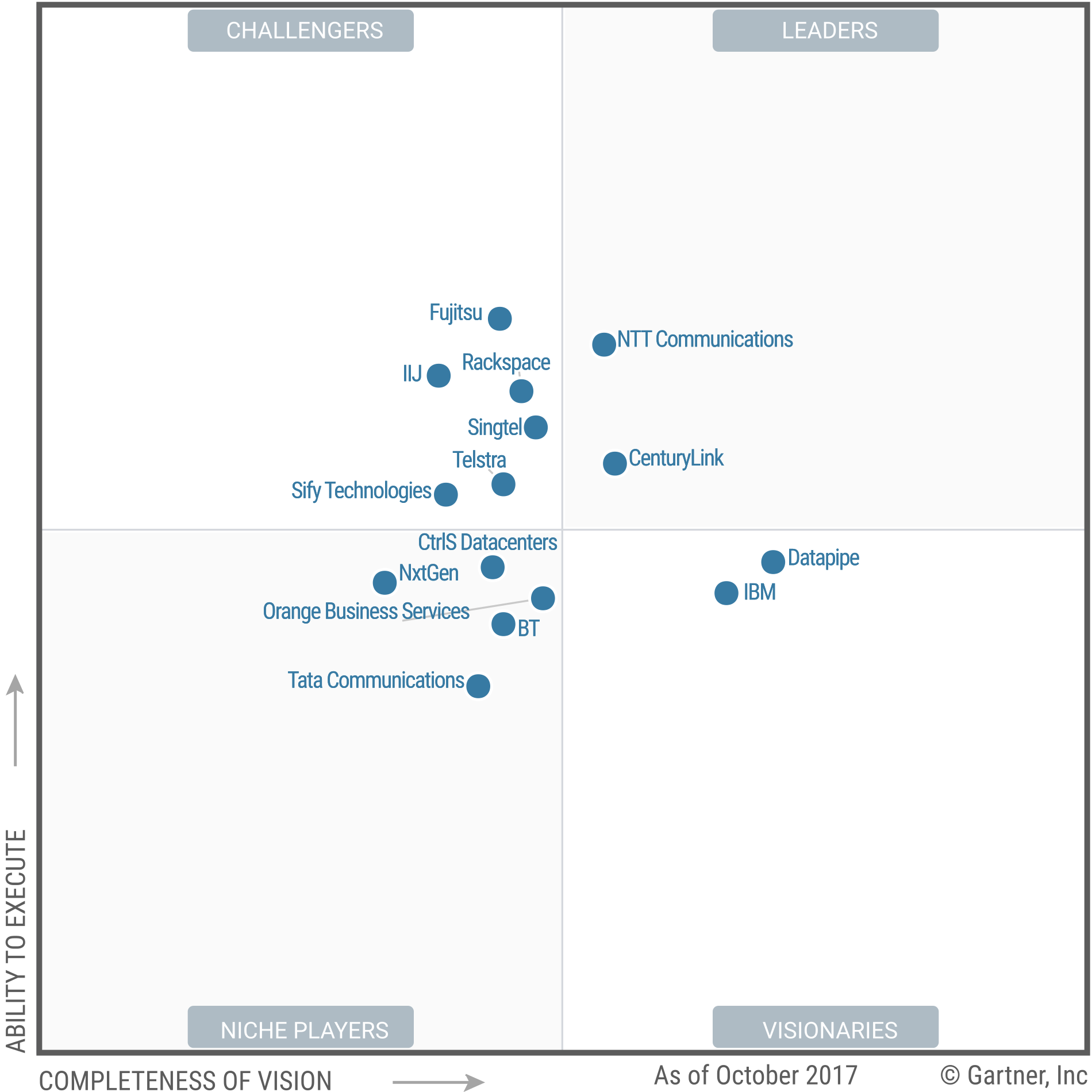
Source: Gartner (October 2017)
Vendor Strengths and Cautions
BT
BT is a global communications service provider (CSP), with a track record for managed hosting and cloud services in the U.K. and Europe. Its target customers are MNCs. It offers multitenant and single-tenant services.
Data center presence in Asia: Tokyo, Singapore, Hong Kong, Shanghai, and Bangalore
Public cloud IaaS providers supported: Microsoft Azure
Strengths
-
BT has strong regional presence in Asia through its network service business, with substantial sales, professional services and managed service capabilities, which it is leveraging to jump-start its managed cloud services in the region. It is reporting good revenue growth, albeit from a low base, with an ability to win business in multiple markets.
-
It operates a proven multitenant cloud platform, with a bare-metal option. It offers a choice of private cloud services. It has a good portfolio of managed services, including support for security, operating systems, databases and disaster recovery, as well as Microsoft Exchange and SharePoint. This service is supported by professional services.
-
It supports hybrid cloud. BT has introduced a cloud management platform that provides a single portal for ordering and provisioning, orchestration, and management of multiple clouds, including third-party services. It supports Microsoft Azure, and it is in the process of supporting other major cloud providers.
Cautions
-
BT is a late entrant in the managed cloud service market in Asia, compared with established providers in the region. Consequently, its managed and professional services capabilities are relatively small, and it will take time for BT to build up scale and experience.
-
Its hybrid cloud management platform is new, and it's too early to assess its capabilities. It has limited experience supporting third-party cloud services in the region. It has yet to support Amazon Web Services (AWS), a key provider for agile IT, although plans are in progress.
-
It's focused on delivering managed services that can address major needs of a typical enterprise, compared with players with strong IT background that offer a broader suite of managed services to address all requirements, large and small, for an enterprise.
CenturyLink
CenturyLink is a global CSP, with a track record in managed hosting in the U.S. and Europe. It targets enterprises, including MNCs. It offers multitenant and single-tenant services.
Data center presence in Asia: Australia, Singapore, Hong Kong, Japan, India and China
Public cloud IaaS providers supported: AWS, Microsoft Azure and Google Cloud Platform
Strengths
-
CenturyLink is now focused on hybrid clouds, offering support for all major third-party clouds. It has introduced a hybrid cloud management platform (Cloud Application Manager), with the aim of providing ordering, provisioning and management of multiple clouds via a single pane of glass. A key component is a multicloud application management service, which enables customers to orchestrate the deployment of applications to more than 12 cloud providers and create a self-service catalog of applications and infrastructure via a single pane of glass.
-
It has a competitive cloud platform, with cloud-native capabilities, an easy-to-use portal, and good governance and management features. It also offers a choice of private cloud options. It has a broad range of managed services, with support for databases, storage and disaster recovery, and security. It offers a high level of automation for provisioning and management of managed services.
-
It has extended its managed services to applications, supporting both SAP Hana and SAP Hana Enterprise Cloud (HEC). It has introduced a relational database as a service for MySQL and MS SQL. It is also building up its professional services capabilities, focusing on security, hybrid cloud, SAP and analytics.
Cautions
-
CenturyLink's hybrid cloud management platform is new, and it lacks the full functionalities that the company envisioned. For example, while the ordering and provisioning of third-party clouds is available, a consolidated view of the billing and invoicing on AWS and Microsoft Azure is in the process of being rolled out in Asia.
-
Its managed services for third-party clouds is new, having been released only in the second quarter of 2017. Consequently, it has little experience offering the service in the region. Managed services are currently limited to AWS and Microsoft Azure, and they are not yet available on Google.
-
Its strategy to evolve beyond infrastructure services into a more broad-based IT services provider will require a new level of investment in IT skills. CenturyLink is in the early stages of implementing the strategy, with support for a limited range of applications.
CtrlS Datacenters
CtrlS Datacenters is a major data center and managed hosting provider in India. It targets enterprises. It offers multitenant and single-tenant services.
Data center presence in Asia: India (Hyderabad, Mumbai and Delhi), with cloud nodes in Sri Lanka, Singapore, Malaysia, Thailand, the Philippines, Indonesia, Australia, and Vietnam
Public cloud IaaS providers supported: AWS, Microsoft Azure and Google Cloud Platform
Strengths
-
CtrlS provides a wide range of managed services, including security, middleware and databases. It supports a wide range of databases, including Oracle, MySQL, MS SQL Server, MongoDB and NoSQL. It has enhanced its security capabilities significantly, offering complete life cycle management of security of data and a single SLA from detection to remediation.
-
It has extended its strategy to include support for hybrid clouds, including third-party cloud services. It has enhanced its cloud management platform to support hybrid cloud environments, with the ability to define security and governance policy across different platforms. It is currently skilling up its staff to support AWS and Microsoft Azure services, in anticipation of hybrid cloud requirements.
-
It offers high-availability services through its high-grade data centers, multiavailability zones and four-way disaster recovery architecture, with a zero data loss guarantee backed by SLAs. Due to this implementation, it is particularly strong in the banking and finance sector. It also operates a private community cloud for payment banks in India. The banking cloud is highly secure and meets the security requirements of the Reserve Bank of India, the state financial regulator.
Cautions
-
CtrlS has limited experience supporting third-party services, including AWS and Microsoft Azure, which are becoming increasingly important for customers. While it has enhanced its cloud management platform to provide hybrid cloud capabilities, the platform is in the early stage of development.
-
It is expanding its presence outside India to tap new growth opportunities, typically by setting up cloud nodes to support in-country requirements, supported by a small solution team and remote support from India. However, its presence in each market is small at this stage. It is still largely an India-only player.
-
It needs to invest significantly in sales and marketing, professional services, and support capabilities in the new markets to compete with the large international providers.
Datapipe
Datapipe is a U.S.-based managed cloud service provider. Its target market is MNCs. It offers multitenant and single-tenant services.
Data center presence in Asia: Hong Kong, China (Shanghai), and Singapore
Public cloud IaaS providers supported: AWS, Azure, and Alibaba Cloud
Note: Datapipe signed an agreement on 11 September 2017 to be acquired by Rackspace, a managed cloud provider also assessed in this Magic Quadrant. There is potential synergy between the two companies, but this is not assessed in this Magic Quadrant because the acquisition was expected to be completed in the fourth quarter of 2017, after the release of this report.
Strengths
-
Datapipe has a significant lead in hybrid cloud services. It is among the first to support AWS, Microsoft Azure and Alibaba Cloud (the leading cloud provider in China), with experience offering infrastructure and managed services on all three cloud platforms. It provides a broad range of hybrid cloud management capabilities, with an ability to order and orchestrate AWS, Microsoft Azure, and its own cloud services on demand through a single pane of glass.
-
It is an AWS Premier Consulting Partner, with strong managed AWS capabilities. It has been certified by AWS as a Migration Competency Partner, with expertise and experience handling large migration projects. It is building up its managed Microsoft capabilities. It has been certified as a managed service partner for Microsoft's Cloud Solution Provider program, Office 365 services and Microsoft Azure.
-
It provides a broad range of managed services, including security, database and governance services. This is supported by high-touch customer service and support, resulting in high customer satisfaction. It also provides automation services to speed up the deployment of cloud resources. It offers a simple pricing scheme, which includes infrastructure and managed services in one price.
Cautions
-
Datapipe has a relatively small presence in Asia. Consequently, its customer base is small, although many customers are significant in terms of size and complexity.
-
It lacks the financial resources to expand quickly to tap business opportunities in the region. Its operations are concentrated in Hong Kong, with a small support presence in China and Singapore.
-
Compared with its AWS expertise, it has less experience supporting Microsoft Azure and Office 365. It also extended its support to Alibaba Cloud only in October 2016.
Fujitsu
Fujitsu is a global IT services provider, with a track record for outsourcing and managed services. Its target market is enterprises. It offers multitenant and single-tenant services.
Data center presence in Asia: Japan, Australia, Singapore, China, Thailand, the Philippines, Malaysia and Vietnam
Public cloud IaaS providers supported: Fujitsu Cloud IaaS Trusted Public S5 and Microsoft Azure
Strengths
-
Fujitsu offers a good data center footprint, with a good range of managed services, including support for security, middleware, databases and select applications. It is also SAP-certified for cloud and SAP Hana. It has a track record in managing large-scale IT infrastructure in its primary markets, including Japan, Australia and Singapore, with good quality service, and responsive service and support. This is backed by experienced professional services.
-
It offers UForge AppCenter, an application automation platform, which can automate the migration of existing systems, including operating systems, middleware and applications, to cloud platforms. It models the full software stack, including configuration logic, as metadata and automatically builds a machine image for the targeted cloud. This application-as-code templating techniques can also be used to deploy new applications.
-
It offers an integration platform as a service (PaaS), RunMyProcess, which can integrate the operation of multiple cloud platforms, including third-party services such as AWS and Microsoft Azure, using a business system-led, workflow-based approach. It provides design and development tools to enable customers to model and create end-to-end workflows, supported by a large library of connectors, to speed up deployment over hybrid clouds.
Cautions
-
Fujitsu introduced a new OpenStack-based platform, Fujitsu Cloud Service K5, which will be its main cloud platform in the future. However, the platform is new, with limited differentiation, and it is available only in Japan, Europe and the U.S. Fujitsu plans to deploy the platform in Australia and Singapore, but the timeline is not firm.
-
It continues to put emphasis on its VMware-based cloud platform, which comes with the full range of managed services and is available in all locations. In contrast, its open-source Xen-based platform, Fujitsu Cloud IaaS Trusted Public S5, has limited managed services, and it is available only in Japan, Australia and Singapore.
-
Its hybrid cloud capabilities are new. For third-party clouds, it currently supports only Microsoft Azure, and it has yet to extend its support to AWS. It also has limited experience supporting third-party clouds. Its UForge AppCenter and RunMyProcess platforms are available as discrete services, and not as part of an integrated hybrid cloud management suite.
IBM
IBM is a global IT services provider with strong presence in Asia. Its target markets are enterprises and government. It offers multitenant and single-tenant services.
Data center presence in Asia: Hong Kong, Singapore, Japan (Tokyo), Australia (Sydney and Melbourne), and India (Chennai)
Public cloud IaaS providers supported: IBM Bluemix, AWS, Microsoft Azure and Google Cloud Platform
Strengths
-
IBM has strong consulting capabilities, experience in enterprise applications, and a track record for managing large-scale IT infrastructure and operations, putting it in a favorable position to support large enterprises with complex cloud requirements. While it tends to lead with transformational projects, it is willing to take on stand-alone cloud projects. Combined with its commercial flexibility, it's beginning to win more customers and in more markets in Asia.
-
IBM has integrated its SoftLayer platform into its Bluemix offering to provide a unified IaaS/PaaS experience for both developers and nondevelopers. It is increasingly focused on hybrid clouds, with support for third-party cloud services. It offers a comprehensive hybrid cloud solution, featuring cloud brokerage, automation and orchestration, unified service management, and analytics for optimization.
-
It provides a broad range of managed services, including support for database, middleware, security and disaster recovery. It also provides a full range of managed services for Oracle and SAP applications, including application management and life cycle management services. It is also building up its professional and managed services expertise to support hybrid cloud deployments.
Cautions
-
IBM continues to operate two IaaS platforms in Asia — Cloud Managed Services (CMS) and Bluemix (SoftLayer). They have different capabilities and are managed separately. IBM will be making investments to unify their capabilities by mid-2018.
-
Its data center coverage is currently less extensive than it appears on the surface. CMS is available only in Singapore, Hong Kong and India, while Bluemix is available in all locations. IBM plans to offer CMS in more locations in 2018, including Australia and Japan.
-
IBM currently has limited experience supporting AWS and Microsoft Azure in the region. It will continue to push its Bluemix IaaS/PaaS platform, which is gaining momentum in Asia, as part of its hybrid cloud offerings.
IIJ
IIJ is a major hosting and managed service provider in Japan. Its target markets are enterprises and midmarket companies. It offers multitenant and single-tenant services.
Data center presence in Asia: Japan, China, Singapore, Indonesia, Thailand and Vietnam
Public cloud IaaS providers supported: AWS and Microsoft Azure
Strengths
-
IIJ's cloud platform, IIJ GIO Infrastructure P2, gives enterprises the flexibility to select the optimal combination of resources for their infrastructure. The platform integrates IIJ's open-source-based public cloud and VMware-based platform under a single management system and portal, sharing a common Network File System (NFS) and Common Internet File System (CIFS) storage for data storage.
-
It offers a broad range of managed services, including security management, database management and disaster recovery, including on public cloud. It is SAP-certified for cloud services and SAP Hana, and it has gained significant experience during the last few years implementing SAP on its platform.
-
It has introduced an in-house-developed cloud management platform, which provides unified operations management of multiple cloud services, including third-party clouds. The platform is available as a software as a service (SaaS). Functions include monitoring, alerts, ticket management and management reporting.
Cautions
-
IIJ is in the early stages of developing its cloud management platform, currently limited to support functions. It plans to enhance its functionalities with predictive fault detection, automated support functions and unified cloud management. Based on the roadmap, its cloud management platform will lag behind others in terms of richness of features for hybrid cloud management.
-
It has good international coverage, with presence in five Asian markets outside Japan. However, it has not rolled out its broad portfolio of products to all the markets due to limited market maturity in some of these markets. Its presence in these markets is also small.
-
IIJ has significant experience supporting enterprise application requirements. However, it has yet to capitalize on its capability to offer transformation services with managed cloud services, which is a differentiator for large IT services providers.
NxtGen
NxtGen is a managed hosting and cloud service provider in India. The company, based in Bangalore, targets enterprises and midmarket companies. It offers multitenant and single-tenant services.
Data center presence in Asia: Bangalore, Mumbai, Delhi and Ahmedabad, with a cloud node in Singapore
Public cloud IaaS providers supported: Microsoft Azure
Strengths
-
NxtGen is a fast-rising managed cloud provider in India. It operates high-grade data centers, with good geographic coverage. It has dual data centers in three locations for redundancy purposes. It has acquired a sizable base of customers, many of them large enterprises, including MNCs with operations in India.
-
It has a good cloud platform, designed originally as a public cloud for online gaming, using flash-based solid-state drive (SSD) storage for high input/output (I/O) performance, with a bare-metal option. It has introduced a cloud management platform to extend its support to third-party cloud services. It currently supports Microsoft Azure, with plans to extend to Azure Stack.
-
It provides a good range of managed services, including database, middleware, security and disaster recovery, including putting disaster recovery on public cloud. It is SAP-certified for infrastructure operations services and has gained significant experience hosting SAP apps. It has introduced data protection as a service for the banking and government sectors.
Cautions
-
NxtGen is in the early stages of supporting third-party cloud services, which will become increasingly important as customers look to the strong public cloud capabilities for Mode 2 IT.
-
It does not support AWS at this stage. While it has strong skills for managing its own platform and VMware, NxtGen is just beginning to build up AWS and Microsoft Azure management skills.
-
It is still largely an India-only provider, even though it has opened a data center in Singapore. It's not known outside its home market, and its international presence is small.
NTT Communications
NTT Communications is a global CSP, wholly owned by the NTT Group in Japan. Its target markets are enterprises, including MNCs. It offers multitenant and single-tenant services.
Data center presence in Asia: Japan, Singapore, Hong Kong, Australia (Sydney), Malaysia (Kuala Lumpur), Thailand (Bangkok) and India (Mumbai)
Public cloud IaaS providers supported: AWS and Microsoft Azure
Strengths
-
NTT Communications has expanded its broad portfolio of services to include hybrid clouds, with many private cloud options. Its cloud management platform can integrate its cloud platforms with third-party services, offering multicloud provisioning, orchestration and management under a single cloud portal. It is building its skill sets quickly in Asia to support the hyperscale providers, with 70 AWS-certified engineers and 70 Microsoft-certified engineers so far.
-
It provides a comprehensive range of managed services, with support for security, databases, middleware, and select applications from SAP, Oracle and Microsoft. It's also a certified infrastructure provider for SAP Hana. It offers a full range of professional services, ranging from cloud consulting to migration to life cycle management. It has extended its managed and professional services to third-party clouds.
-
It has good geographic coverage, with presence in all regional hubs and several major developing markets. It has a strong foothold in India through its subsidiary, Netmagic, a major managed hosting and cloud provider in India, which has been integrated into NTT Communications' operations. It has large managed cloud hosting revenue in Asia, with half coming from markets outside Japan. It is also getting better at winning more complex projects, due to its improving managed and professional services capabilities.
Cautions
-
NTT Communications has introduced a new OpenStack-based platform that will support both Mode 1 IT operations and Mode 2 agile application development. However, this platform is in the early stage of development and has limited differentiation. The platform is available in only four markets — Japan, Singapore, Australia and Hong Kong. In other markets, customers need to use its existing cloud platforms.
-
It is in the early stages of developing its hybrid cloud capabilities, with limited experience supporting AWS and Microsoft Azure.
-
It is gaining experience supporting some mission-critical applications or use cases. However, it has limited experience in supporting a broad range of enterprise applications, which puts it at a disadvantage when competing against the large IT services providers.
Orange Business Services
Orange Business Services is a global CSP. Its target customers are MNCs and enterprises in Asia. It offers multitenant and single-tenant services.
Data center presence in Asia: Australia, Singapore, Hong Kong and China (Shanghai)
Public cloud IaaS providers supported: AWS and Microsoft Azure
Strengths
-
Orange has a well-thought-out hybrid cloud service. It supports the leading public cloud providers, with a wide choice of private cloud options. It provides a hybrid cloud management solution, which provides single sign-on access, service catalog, provisioning and management of multicloud environments via a cloud portal.
-
It has expanded its consulting capabilities, supporting customers with a full range of professional services, including audit and advisory, architecture and design, security, migration and implementation, and life cycle management. Its professional services team has experience in data center consolidation and managed cloud services in Asia.
-
It has a good catalog of infrastructure and managed services, which gives it the flexibility to customize individual solutions for customers. It provides end-to-end service management, with SLAs for network, IaaS and OS, and applications. It has strong presence in Asia, and it has experience supporting MNCs.
Cautions
-
Orange has limited experience supporting complex enterprise applications. To augment its capabilities, it relies on partnerships with strong IT services providers to deliver a complete solution.
-
Its customer base is relatively small, and it is mostly focused on MNCs with infrastructure requirements in Asia. It has made little progress supporting domestic enterprises, although it has some successes.
-
For hybrid clouds, the contract management is done directly between the customer and the third-party cloud provider, although it will consider taking over the contract if the volume is large enough.
Rackspace
Rackspace is a U.S.-based hosting provider with a strong track record in managed hosting in the U.S. and the U.K. It targets enterprises, including MNCs. Rackspace offers multitenant and single-tenant services.
Data center presence in Asia: Hong Kong and Australia (Sydney)
Public cloud IaaS providers supported: AWS, Microsoft Azure and Google Cloud Platform
Note: Rackspace signed an agreement on 11 September 2017 to acquire Datapipe, a managed cloud provider also assessed in this Magic Quadrant. There is potential synergy between the two companies, but this is not assessed in this Magic Quadrant because the acquisition was expected to be completed in the fourth quarter of 2017, after the release of this report.
Strengths
-
Rackspace is making good progress transforming into a multicloud provider. It supports all the major third-party clouds, leveraging its historic strength in managed services. It is gaining momentum winning managed AWS projects, with reports of successful implementation by early customers.
-
It is strong in managed services, with good processes, support tools and automation capabilities, enabling it to deliver a consistent service quality over a broad customer base. This is backed by a very strong service and support culture. The result is high customer satisfaction and excellent retention.
-
It has a broad range of managed services, including support for databases, security and governance, SAP and Oracle applications, popular e-commerce and web content management applications, and customized applications on Java or Microsoft .NET. It is building up its professional services capabilities to provide end-to-end support for cloud migration.
Cautions
-
Rackspace's support for third-party cloud services is relatively new, and it needs time to build up experience supporting AWS and Microsoft Azure. It lacks a single pane of glass for hybrid cloud management or orchestration. Instead, it uses the management consoles and native toolsets of partner providers to provide managed services.
-
It is building a professional services team, but the team is relatively small. In addition, it will focus on building capabilities for supporting AWS and Microsoft Azure. This will limit its ability to support large or complex requirements for Mode 1 IT and traditional workloads.
-
Its presence in Asia is concentrated in Hong Kong and Australia. To expand its reach, it opened an office in Singapore in the third quarter of 2017 to support its hyperscale partners, AWS and Microsoft Azure, both with presence in the market. The office will have sales, professional services and support capabilities.
Sify Technologies
Sify Technologies is a major information and communication technology (ICT) solution and service provider in India, with a track record in managed hosting and network services. It targets enterprises and midmarket companies. It offers multitenant and single-tenant hosting services.
Data center presence in Asia: Mumbai, Delhi, Chennai and Bangalore
Public cloud IaaS providers supported: AWS and Microsoft Azure
Strengths
-
Sify offers a wide range of managed services, including managed security, database management and middleware management. Sify has built up its skill set supporting the Microsoft environment, in addition to its experience in VMware. It is also SAP-certified for hosting, cloud, Hana and application services, with experience supporting SAP migration.
-
It is now offering managed services on top of third-party cloud providers, including both AWS and Microsoft Azure, as part of its new focus on hybrid clouds. It has early experience implementing projects on the hyperscale providers in India. It will also support AWS and Microsoft Azure regions outside of India.
-
It operates high-grade data centers in four major cities, with a disaster recovery service. Its cloud platform can support bare-metal services. It is getting more successful handling large or complex projects, including building community clouds for state governments. Sify is also commercially agile, and it has completed private cloud projects with usage- or transaction-based pricing.
Cautions
-
Sify's support for third-party cloud services is new, with limited experience supporting AWS and Microsoft Azure. Its cloud portal currently lacks multicloud management capabilities.
-
It plans to offer managed services on third-party cloud services outside India for international expansion. Until it has developed this business, it is still largely an India-only player.
-
Sify is more focused on traditional workloads for Mode 1 IT, with limited experience supporting applications with Mode 2 cloud-native requirements, which will become increasingly important.
Singtel
Singtel is the leading CSP and IT services provider in Singapore. It also has strong presence in Australia through its subsidiary Optus. Its target customers are enterprises, including MNCs. It offers multitenant and single-tenant services.
Data center presence in Asia: Singapore and Australia
Public cloud IaaS providers supported: AWS, Microsoft Azure and Alibaba Cloud
Strengths
-
Singtel has a well-thought-out hybrid cloud strategy, with the aim of supporting all the major public cloud providers, including rising cloud providers such as Alibaba Cloud. It is in the process of extending its support to Google Cloud Platform. It has a hybrid cloud management platform (Liquid Sky) for the ordering, orchestration and management of hybrid cloud environments.
-
It has a well-developed framework for migrating customers to cloud, supported by professional and managed services, with full cloud life cycle management. To support the use of public clouds, it has an internally developed cloud spend management tool that can provide detailed analysis for cost controls. It has early experience implementing hybrid clouds, including third-party services, for customers.
-
It has a broad portfolio of managed services, including management of databases, middleware, web servers and application servers. It has a large IT services arm, which enables Singtel to handle large and complex environments. It operates G-Cloud, a private community cloud, for Singapore's government. It has strong security capabilities, enhanced by Trustwave, its U.S.-based managed security provider.
Cautions
-
Singtel's hybrid cloud service is relatively new, and it needs time to gain experience supporting third-party cloud services or hybrid cloud environments.
-
It has strong experience in the government sector but has less experience in enterprise applications or vertical industries, which puts it at a slight disadvantage when competing with established IT services providers for large or complex migrations involving traditional workloads.
-
Singtel is historically a strong regional player. But its cloud capabilities are concentrated in Singapore and, to a lesser extent, Australia, where it is a relatively weak provider. It has yet to expand its services into other markets.
Tata Communications
Tata Communications is a global CSP, as well as a major CSP in India. It was an early provider of public cloud services, but it shifted its focus to managed cloud services two years ago. It targets enterprises, including MNCs. It offers multitenant and single-tenant services.
Data center presence in Asia: India, Singapore, Hong Kong and Malaysia
Public cloud IaaS providers supported: Microsoft Azure
Strengths
-
Tata Communications has a track record in managed hosting in India, and it is leveraging its resources and experience to extend into the managed cloud service market. It launched an OpenStack-based platform two years ago, targeted at Mode 1 IT operations. It has strong presence in India, with cloud data centers in Delhi, Mumbai, Hyderabad, Bangalore and Chennai. It has expanded its service internationally, targeting MNCs.
-
It has a wide portfolio of managed services, including cloud storage, disaster recovery and security. It provides support for operating systems, infrastructure middleware and databases. It is a certified provider for SAP and SAP Hana, and it has introduced container as a service based on Docker and Kubernetes. It has acquired the Multi-Tier Cloud Security (MTCS) Level 3 certification, Singapore's highest security management certification for cloud operations. It offers professional services for cloud migration and implementation.
-
It has a strong focus on hybrid cloud, with support for Microsoft Azure, and it is in the process of extending to AWS. Tata Communications has launched a hybrid cloud management platform, with single pane of glass for access, orchestration and management of multiple cloud services. The platform enables customers to keep a tab on resource utilization by each business unit, supported by showback and chargeback features.
Cautions
-
Tata Communications is a late entrant in the managed cloud service market, having launched the service only in October 2015. Its customer base is still small, with most of its customers located in India. It is less price-competitive than other cloud providers in India, but it has started revising its pricing to be more in line with the market.
-
Its hybrid cloud services are new, and it has limited experience supporting third-party cloud services. Its hybrid cloud management portal is newly developed and thus does not have a field track record yet.
-
It has strong brand recognition in the enterprise networking market. However, its cloud infrastructure services capabilities are not well-understood by enterprises, which can delay their adoption significantly.
Telstra
Telstra is the leading CSP in Australia. Its target customers are enterprises, including MNCs. It offers multitenant and single-tenant services.
Data center presence in Asia: Australia (Sydney, Melbourne and Perth), Singapore, and Hong Kong
Public cloud IaaS providers supported: AWS, Microsoft Azure and IBM Bluemix
Strengths
-
Telstra is putting a strong focus on hybrid cloud. Its cloud management platform provides a single pane of glass for ordering, provisioning and service management across a hybrid cloud environment. It provides managed services on top of these platforms, with single bill and first point of contact for support.
-
It has enhanced its suite of cloud professional services beyond cloud strategy and planning consulting to include cloud implementation and integration services, migration, and cost optimization services. Its acquisitions of Australian cloud consulting companies — Kloud and Readify — have augmented its capabilities. It is also skilling up to support third-party services, and it has been certified as an AWS Managed Services provider.
-
It has a strong presence in Australia, and it can also support MNCs with regional requirements. It provides end-to-end service management, with SLAs for cloud platform, network infrastructure and applications. It puts significant effort into providing a great customer experience, with a high-touch service, a user-friendly cloud portal and a globally consistent product.
Cautions
-
Telstra's hybrid cloud services are new, with limited experience supporting third-party cloud services. It is building up its professional services to support hybrid clouds, but it will take time to build up this capability.
-
Its portfolio of managed services is relatively small, covering key services such as security, backup and disaster recovery, and OS management. It has improved its support for web servers, but for databases, its options are limited.
-
It has limited professional services and expertise in enterprise applications, which limit its ability to compete for large or complex migrations involving traditional workloads — an important segment of the market.
Vendors Added and Dropped
We review and adjust our inclusion criteria for Magic Quadrants as markets change. As a result of these adjustments, the mix of vendors in any Magic Quadrant may change over time. A vendor's appearance in a Magic Quadrant one year and not the next does not necessarily indicate that we have changed our opinion of that vendor. It may be a reflection of a change in the market and, therefore, changed evaluation criteria, or of a change of focus by that vendor.
Added
-
BT
-
Tata Communications
Dropped
-
Dimension Data: It has de-emphasized the operation of cloud infrastructure services to focus on cloud solutions and integration for large enterprises.
-
Hewlett Packard Enterprise (HPE): The business has been merged with CSC to form DXC Technology. The new company has not provided to Gartner a strategy and integration update for the new entity, without which we are unable to assess its continued engagement in the market.
-
Verizon: Its cloud service has been sold to IBM. IBM is evaluated in the Magic Quadrant.
Inclusion and Exclusion Criteria
To be included in this Magic Quadrant, the following criteria had to be met:
-
The provider must sell cloud-enabled managed hosting as a stand-alone service, with no requirements to bundle it with application development, application maintenance or other IT outsourcing and/or data center outsourcing.
-
In addition to offering this service from cloud infrastructure located in its own data center, the provider must offer a choice of using a hyperscale public IaaS provider or Asia country-specific, large-scale IaaS provider. For more information, see " Magic Quadrant for Cloud Infrastructure as a Service, Worldwide."
-
The provider's qualifying offering(s) must allow customers direct or mediated self-service for OS instance provisioning on a CESI platform, with usage-based billing and resource-metering increments as options, and OS management services that are coterminous with the underlying compute resources.
-
The service(s) evaluated must be enterprise-class, offering 24/7 customer support (including phone support), and must all have infrastructure availability SLAs.
-
The provider must operate the cloud infrastructure platform in one or several major markets in Asia, with associated technical support, managed and professional services, and sales capabilities within the region.
-
The provider must be among the larger providers in the MHCH market in Asia, either in the region or in a large market such as Australia, Japan, Singapore, Hong Kong, India and China. The service must be commercially available for at least two years.
-
The top 15 providers, as measured by a combination of market share (revenue, virtual machines and customers) and presence (staffing, countries and data centers), which also met the above criteria, will be selected for inclusion in the Magic Quadrant.
-
For the purpose of this report, Asia is defined as: Australia, China, Hong Kong, India, Indonesia, Japan, South Korea, Malaysia, New Zealand, the Philippines, Singapore, Thailand, Taiwan and Vietnam.
Products and Services Excluded From This Evaluation
This Magic Quadrant is for MHCH only. That means the following adjacent services are explicitly excluded from evaluation:
Colocation: Although many MHCH providers also offer colocation, the quality of colocation offerings is not evaluated in this Magic Quadrant. This Magic Quadrant should not be used to select colocation vendors.
-
Self-managed cloud IaaS: Many businesses want a self-provisioned, self-managed dynamically provisioned infrastructure; they want to take advantage of the cost-efficiencies of a provider's scale and automation tools, but they do not want to relinquish control. If your interest is primarily in self-managed cloud infrastructure, see "Magic Quadrant for Cloud Infrastructure as a Service, Worldwide."
-
Data center outsourcing (DCO) and remote infrastructure management (RIM): Many DCO providers may manage the infrastructure for web applications as part of a DCO contract. However, this Magic Quadrant evaluates only managed hosting that is sold as a stand-alone service within provider-owned data center facilities and through an IaaS provider data center. It explicitly excludes hosting that may be part of a more general DCO or RIM contract. DCO providers are covered by "Magic Quadrant for Data Center Outsourcing and Infrastructure Utility Services, North America," "Magic Quadrant for Data Center Outsourcing and Infrastructure Utility Services, Europe" and "Magic Quadrant for Data Center Outsourcing and Infrastructure Utility Services, Asia/Pacific."
-
Application management services: While some managed hosting providers may have some expertise in understanding how best to run the infrastructure underlying specific applications, we consider managed hosting services to stop below the application layer. Application layer services are part of the application management market.
-
Cloud management platforms: Cloud-building hardware and software — software such as BMC's Cloud Lifecycle Management (CLM), and Citrix's CloudPlatform and OpenStack, and integrated solutions, such as HPE's CloudSystem Matrix — are not evaluated in this Magic Quadrant, which is restricted to services. Instead, see "Market Guide for Cloud Management Platforms."
Evaluation Criteria
Ability to Execute
This Magic Quadrant is aimed at businesses operating in Asia, including MNCs with regional hosting requirements and Asia businesses with domestic hosting requirements. Asia is a large region with 13 major markets. Providers that aim for market leadership need to demonstrate that they can address multiple markets within the region with the support of a competitive cloud platform, as well as associated managed and professional capabilities.
We gave high weightings to two criteria:
-
Market Responsiveness/Record, which includes a provider's history and ability to respond to market needs and opportunities in the region
-
Product or Service, which includes a provider's cloud platform, range of services, managed and professional services, and service availability in all key markets
Source: Gartner (October 2017)
Completeness of Vision
This Magic Quadrant is aimed at businesses operating in Asia, including MNCs with regional hosting requirements and Asia businesses with domestic hosting requirements. Due to the region's large size and fragmented geography, providers need a strong Market Understanding of their target segments, as this will determine their Geographic Strategy, supported by a competitive Offering (Product) Strategy. We gave high weightings to these three criteria.
Ideally, a leading provider should provide services in all major markets within Asia. However, we recognized that this is not yet feasible due to the tremendous amount of resources required to address all these markets at a local level. As a result, we looked for providers that can support multiple markets today and that have the potential to become fuller regional providers in the future.
Source: Gartner (October 2017)
Quadrant Descriptions
Leaders
Providers require a strong strategy to become a Leader in Asia. They need to invest in their products, geographic coverage and delivery capabilities to the extent that they can become strong regional players. To build their market positions, they must have the ability and willingness to invest for the future.
Challengers
Challengers typically have a strong Ability to Execute, but they trail the market in terms of geographic coverage or product evolution. They have experience in managed hosting services, but they have not exploited technology and market demand to build highly competitive MHCH services. They could become Leaders if they extend their vision and strategy, but they could also fall quickly behind in this fast-moving market if they focus only on the short term.
Visionaries
Visionaries are typically early movers with an innovative or disruptive approach to the market; however, they have limited geographic coverage or services that are new and unproven. They may become Challengers or Leaders if they can execute strongly on their vision and the market accepts their services.
Niche Players
Niche Players typically perform well in a particular segment of the market, but they have limited ability to outperform other providers in the region as a whole. Their focus on a particular segment or geography limits their ability to address the broader market. They tend to be relatively unknown outside their target market.
Context
This Magic Quadrant focuses on managed hybrid hosting services for businesses in Asia, with support for hyperscale cloud providers. These are standardized products that combine a CESI with managed services. This Magic Quadrant focuses on services for Asian enterprises and Western MNCs operating in Asia.
The aim of this Magic Quadrant is to help enterprises sourcing for MHCH services by establishing which providers are best-placed to serve the needs of Asia's broad market. Ideally, a provider should offer services in most major markets, but this is not yet feasible due to the tremendous amount of resources required to address all these markets at a local level.
We evaluated a select number of providers that focus on the region's developed markets, particularly the key regional hubs such as Singapore, Hong Kong, Australia and Japan.
We also included providers from India, as this country serves as the IT back end for many MNCs. We also looked at providers in China, as there is a growing need for MNCs to host in this country as business expands there. However, China's service provider market lacks mature managed cloud services. As a result, we did not include any provider from China in this Magic Quadrant.
We give higher weightings to providers that:
-
Offer an MHCH that is competitive in terms of range of services, cloud platform, service features, managed and professional services, and local service and support
-
Experience and track record supporting enterprises in Asia, with ability to win MNCs with regional requirements and Asian enterprises with domestic hosting needs only
-
Serve multiple country markets in Asia, including regional hubs such as Singapore, Hong Kong, Australia and Japan, to meet the requirements of MNCs
Market Overview
Cloud adoption is growing strongly in Asia, albeit from a low base. Enterprises are adopting both cloud-enabled managed hosting and public cloud services, such as AWS and Microsoft Azure, typically for different use cases. It's getting increasingly common for enterprises to have multiple cloud environments, often operated and supported separately.
MHCH providers, which traditionally focused on operating their own platform with related managed and professional services, are beginning to transform themselves to offer hybrid or multicloud services, focusing on hyperscale providers. The objectives are to enlarge their revenue opportunity and "to own" a customer account for competitive reasons.
The typical approach includes:
-
Offer managed services on third-party cloud providers, which can extend management up to the application layer
-
Offer a hybrid cloud management platform that includes support for third-party cloud providers, with a centralized portal for ordering, orchestration and management
-
Offer professional services related to hybrid cloud design and architecture, migration and integration, ongoing optimization, and life cycle management
These capabilities are new, and capabilities can differ significantly. These services have been introduced in the past year, and very few providers have implementation experience. Customer demand is still in the nascent stage, with most enterprises still getting an understanding of the service concept and value, with few deployments.
But the MHCH fulfills a real need and will become increasingly important as more enterprises migrate to cloud.
There are a wide range of players, including cloud and managed hosting providers (mostly from the U.S.), large IT services providers, and global and regional CSPs. Their backgrounds differ significantly:
-
Cloud and managed hosting providers have better automation and managed service capabilities, but they lack strong regional presence.
-
IT services providers have more managed hosting experience, typically as part of larger IT services or data center outsourcing deals, and deep presence in some country markets.
-
CSPs lead in network and hosting services, typically offering end-to-end service management, including network, cloud infrastructure and application performance.
The providers are highly focused on supporting traditional enterprise applications for Mode 1 IT requirements, which place priority on availability, security and assurance. Most have gained some level of maturity in terms of cloud platform development, managed service capabilities and experience supporting enterprises with traditional workloads.
Nevertheless, most continue to invest in the service and are making good progress, albeit at different speeds. In the past year, they have been:
-
Building up cloud advisory services, especially for cloud migration and transformation
-
Developing expertise in key enterprise applications (in particular SAP, Oracle and Microsoft)
-
Introducing software as a service, including disaster recovery, database and, in some instances, Office 365.
An increasing number of providers are now focused on hybrid clouds as their new strategy. We believe the market will continue to evolve greatly during the next few years. Enterprises should select the provider that matches their needs in the near term and keep to shorter contracts. This will give enterprises the opportunity to select another provider as the market matures.
Evaluation Criteria Definitions
Ability to Execute
Product/Service: Core goods and services offered by the vendor for the defined market. This includes current product/service capabilities, quality, feature sets, skills and so on, whether offered natively or through OEM agreements/partnerships as defined in the market definition and detailed in the subcriteria.
Overall Viability: Viability includes an assessment of the overall organization's financial health, the financial and practical success of the business unit, and the likelihood that the individual business unit will continue investing in the product, will continue offering the product and will advance the state of the art within the organization's portfolio of products.
Sales Execution/Pricing: The vendor's capabilities in all presales activities and the structure that supports them. This includes deal management, pricing and negotiation, presales support, and the overall effectiveness of the sales channel.
Market Responsiveness/Record: Ability to respond, change direction, be flexible and achieve competitive success as opportunities develop, competitors act, customer needs evolve and market dynamics change. This criterion also considers the vendor's history of responsiveness.
Marketing Execution: The clarity, quality, creativity and efficacy of programs designed to deliver the organization's message to influence the market, promote the brand and business, increase awareness of the products, and establish a positive identification with the product/brand and organization in the minds of buyers. This "mind share" can be driven by a combination of publicity, promotional initiatives, thought leadership, word of mouth and sales activities.
Customer Experience: Relationships, products and services/programs that enable clients to be successful with the products evaluated. Specifically, this includes the ways customers receive technical support or account support. This can also include ancillary tools, customer support programs (and the quality thereof), availability of user groups, service-level agreements and so on.
Operations: The ability of the organization to meet its goals and commitments. Factors include the quality of the organizational structure, including skills, experiences, programs, systems and other vehicles that enable the organization to operate effectively and efficiently on an ongoing basis.
Completeness of Vision
Market Understanding: Ability of the vendor to understand buyers' wants and needs and to translate those into products and services. Vendors that show the highest degree of vision listen to and understand buyers' wants and needs, and can shape or enhance those with their added vision.
Marketing Strategy: A clear, differentiated set of messages consistently communicated throughout the organization and externalized through the website, advertising, customer programs and positioning statements.
Sales Strategy: The strategy for selling products that uses the appropriate network of direct and indirect sales, marketing, service, and communication affiliates that extend the scope and depth of market reach, skills, expertise, technologies, services and the customer base.
Offering (Product) Strategy: The vendor's approach to product development and delivery that emphasizes differentiation, functionality, methodology and feature sets as they map to current and future requirements.
Business Model: The soundness and logic of the vendor's underlying business proposition.
Vertical/Industry Strategy: The vendor's strategy to direct resources, skills and offerings to meet the specific needs of individual market segments, including vertical markets.
Innovation: Direct, related, complementary and synergistic layouts of resources, expertise or capital for investment, consolidation, defensive or pre-emptive purposes.
Geographic Strategy: The vendor's strategy to direct resources, skills and offerings to meet the specific needs of geographies outside the "home" or native geography, either directly or through partners, channels and subsidiaries as appropriate for that geography and market.
