Market Guide for Manufacturing Execution System (MES) Software
Research from Gartner
Market Guide for Manufacturing Execution System Software
Manufacturing executives are looking to MES software as an enterprise solution that aligns manufacturing and supply chain technologies. This Market Guide will assess the state of the MES market and provide advice for choosing and implementing MES solutions.
Key Findings
- Companies successfully implementing MES view MES as an enterprise solution, not just something for individual plant performance improvement.
- The market is changing as larger ERP, product life cycle management (PLM) and operational technology (OT) vendors continue to acquire established pure-play MES vendors and new vendors enter the space.
- Advanced technologies (e.g., cloud, Internet of Things [IoT] and mobile) will pressure MES users and practitioners to ensure that MES applications keep pace with the features that users have come to expect from their consumer device experience.
- Multitenant SaaS MES offerings are appearing in the market, predominantly in the discrete manufacturing midmarket.
Recommendations
- Prioritize domain expertise when evaluating MES partners. Be sure to partner with providers that know and understand your business and have a track record to prove it.
- Choose a vendor based on long-term business need. In meeting those needs, the solution you choose may not be a traditional MES system.
- Make sure the vendor you choose has the vision to support analytic tools to make sense of the onslaught of data that the IoT will bring, as well as a technology roadmap for alternative deployment implementations.
Strategic Planning Assumption
By 2020, 50% of current independent MES vendors will no longer exist.
Market Definition
This document was revised on 16 September 2016. The document you are viewing is the corrected version. For more information, see the Corrections page on gartner.com.
The manufacturing execution system (MES) market has almost as many definitions as there are vendors. This has been further obfuscated by the creation of terms like manufacturing operations management (MOM).
Gartner defines MES as "a specialist class of production-oriented software that manages, monitors and synchronizes the execution of real-time, physical processes involved in transforming raw materials into intermediate and/or finished goods. These systems coordinate this execution of work orders with production scheduling and enterprise-level systems like ERP and product life cycle management (PLM). MES applications also provide feedback on process performance, and support component and material-level traceability, genealogy, and integration with process history, where required."
These capabilities extend from product design release (PLM) and work order release (ERP) through completion of the manufacturing process. MES in Gartner's definition does not include the automation layer, such as supervisory control and data acquisition (SCADA), human-machine interface (HMI), or programmable logic controllers (PLCs).
Market Direction
The MES market grew 16% in 2015 to an estimated $3 billion. A closer look at this growth rate, however, shows that the growth has been predominantly in existing clients (see Table 1), and in implementation and consulting revenue, not in software/maintenance (see Table 2). While software vendors claim to be reducing their implementation cost to be equal to their software investment, the achievement of this goal still appears to be elusive.1
Table 1. Net New MES Client Decrease Since 2014
Percent MES Revenue by Customer Category |
2014 |
2015 |
Net New Customers |
39% |
34% |
Existing Customers |
61% |
66% |
Source: Gartner (June 2016)
Table 2. Largest Revenue Share From Implementation and Consulting
Percent of MES Revenue by Category |
2014 |
2015 |
Software License |
35% |
28% |
Software Maintenance |
31% |
24% |
Implementation and Consulting |
28% |
36% |
Development Services |
3% |
3% |
Hosting/On-Demand Services (e.g., Subscription/Transaction) |
2% |
6% |
Hardware and Equipment (e.g., Servers, Sensors, Scanners) |
1% |
2% |
Source: Gartner (June 2016)
There has also not been an appreciable shift in the regional focus of MES, with only slight growth in Latin American and Asian deployments (see Table 3).
Table 3. MES Implementations Predominantly in North America and Europe
Percent of MES Deployments (Sites) by Geography |
2014 |
2015 |
North America |
43% |
41% |
Europe |
30% |
30% |
Latin America |
5% |
7% |
Asia |
17% |
19% |
Rest of World (ROW) |
5% |
2% |
Source: Gartner (June 2016)
In a market defined by predominantly on-premises implementations of configurable software, there are several market factors that are shaking the foundation of the MES industry.
Consolidation/Acquisition of MES Pure-Play Vendors
As MES vendors reach the $30 million to $50 million revenue glass ceiling, they are being acquired. These acquisitions take one of three forms:
- Industrial companies acquiring MES software assets as service offerings to their core business
- MES and automation vendors looking to expand by acquiring competitors
- Enterprise software vendors moving into the MES space
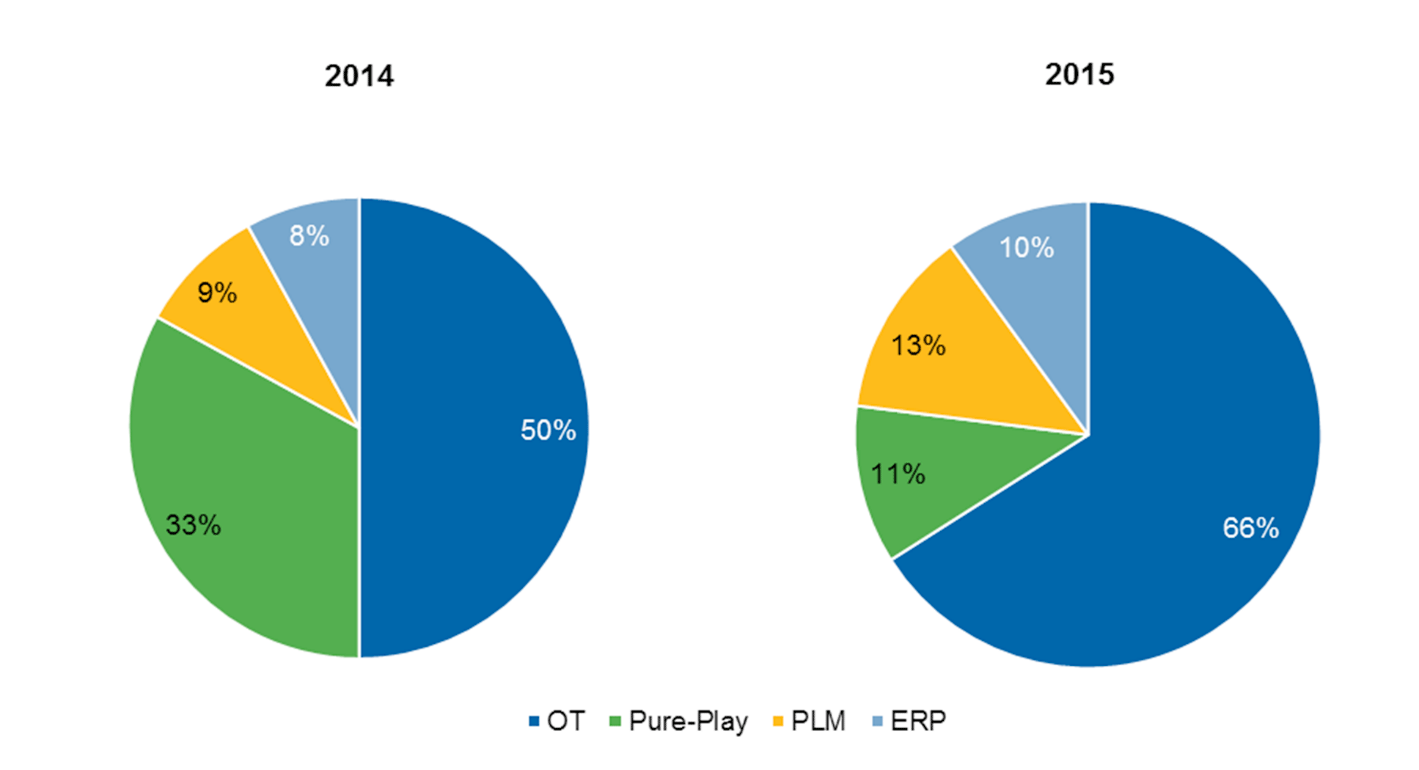
Recent acquisitions have continued this trend, with PSI Metals acquiring a competitor, Broner Metals Solutions, in late 2014 and Dürr Group, a mechanical plant and engineering firm, acquiring iTAC Software in 2015. Based on our 2016 individual vendor surveys for the MES Market Guide,1 we predict that, by 2020, 50% of current pure-play MES vendors will no longer exist (see Figure 1).
Figure 1. Based on Revenue Share, OT, PLM and ERP Vendors Are Taking Over the MES Landscape
Source: Gartner (June 2016)
The revenue distribution for OT, pure-play, PLM and ERP vendors shows that pure-play vendors are losing ground due to acquisitions. The result is that these pressures are falling squarely on MES vendors, who are faced with several choices. In addition to enhancing and improving their core technology to cover a broader scope of manufacturing functionality, vendors should:
- Invest in mobility and user experience (UX) improvements to bring tried-and-true systems in line with expectations brought on by consumer electronics technology.
- Invest in embedded analytics and data science in preparation for the predicted onslaught of data inside and outside of the factory, via such things as intelligent sensors and smart machines that IoT will bring.
- Invest in infrastructure changes that will make the MES environment deployable in the cloud (see Note 1), including multisite operation with per-site data segregation and a hybrid system architecture for 24/7 assured production uptime.
- Improve the configurability of their solutions to reduce deployment time/cost.
The trend of reduction in revenue share for independent pure-play MES vendors will continue as automation (OT) vendors continue to acquire MES assets, and ERP/PLM vendors add more sophisticated manufacturing process management (MPM) and model-based manufacturing (MbM) capabilities.
Deployment Still Predominantly Single Site On-Premises, but Changing
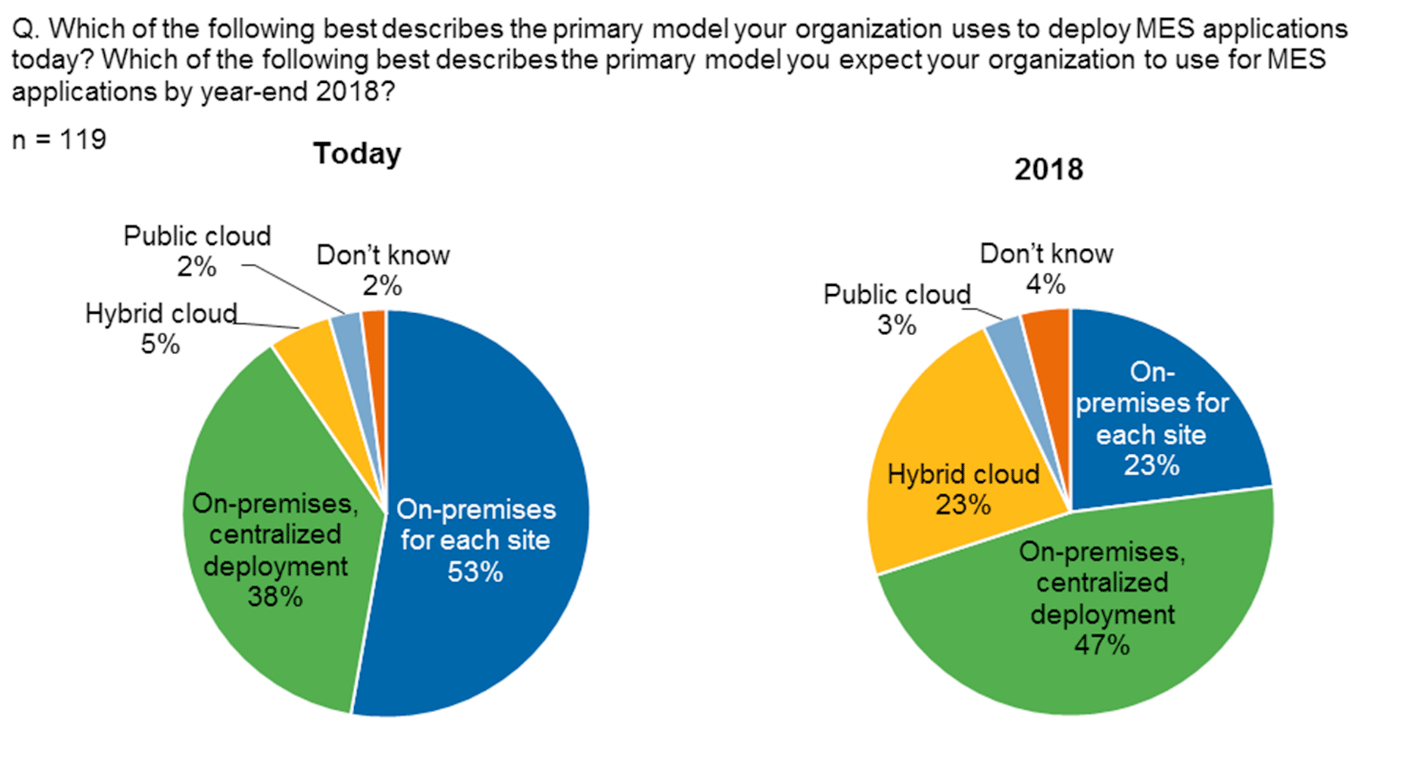
According to a 2015 study on the business value of MES, the MES deployment method is predominantly single site on-premises (53%).2 The combination of new and different economic models that come with cloud deployment, including SaaS contracts and technology infrastructure changes, made many MES vendors wary of cloud-based solutions, even in the face of market push (see Figure 2). This is expected to change rapidly over the next three years as off-premises methods (data center and cloud) will dominate.
Figure 2. Data Center and Cloud-Based Implementations Are Expected to Be the Dominant Deployment Models by 2018
Source: Gartner (June 2016)
The vendor landscape is also changing, as Plex Systems' manufacturing cloud ERP/MES offering has been joined by the first pure-play, 100% multitenant cloud-based MES from 42Q. Established MES players are also embracing cloud deployment.1 In our conversations with end users, fears related to system availability and transaction speed are lessening. Push-back more often comes from security concerns.3
Internet of Things
In one sense, MES vendors, especially vendors from the automation side, have been dealing with a flavor of the IoT for years, with automated data collection from machines, process equipment and PLCs. To these vendors, IoT is not new at all. However, this new class of devices that are internet-connected has the capability of causing real disruption in the MES market. It's still unclear if current IoT-focused providers will take MES seriously. The SCM market had its chance for well over a decade and very few capitalized. Those that did had varied success.
MES practitioners will need to be able to operate outside of their current silos to take advantage of the power of IoT – before someone else does.
Big Data
Gartner clients report that, on average, 70% of factory data goes unused,4 Add to this the onslaught of intelligent sensors and devices expected to be added via IoT technologies, and it can clearly be seen that the MES challenge has moved from how to collect data to how to determine what data is meaningful and should be leveraged. There will increasingly be more pressure on the MES vendor community to provide tools for analyzing massive amounts of data as well as predictive technologies for helping manufacturers make better decisions based on the data they are capturing.
The crux of the issue is that MES vendors traditionally treat data analysis as a closed system, focused solely on data that has been collected within their own domain. In fact, many MES vendors have abdicated the analysis to third-party report writers and analysis tools. This has led to the rise of operational intelligence (OI) systems specifically designed to analyze data collected across multiple systems (silos). Vendors that supply both MES and OI capabilities will be better-suited for handling whatever IoT and big data challenges are out there. If your vendor repackages third-party business intelligence (BI) tools, investigate whether or not you will be required to sign two license agreements.
Market Analysis
Vendor Segmentation
On the surface, MES vendors will appear to have similar functionality; however, learning their core competencies can lead to a better fit for your most important requirements.
Gartner clients report considerable confusion about exactly what MES is and how to select the correct vendor. Much of this is because the vendor community is defined by three different attributes: Class of vendor, vertical industry orientation and horizontal functionality orientation.
Class of Vendor
Gartner has identified four different classes of vendors that sell MES software (see Table 4).
Table 4. MES Vendor Class Definitions
Vendor Classes |
|
Pure-Play |
These vendors derive 100% of their revenue from sales of MES software and the services to support those sales. They typically focus on a few vertical industries and design their products to provide rich feature sets that would not be available from enterprise software vendors. |
OT |
These vendors offer automation/operational technology (OT [see Note 2]) and sell MES software in addition to HMI/SCADA/distributed control systems (DCS) applications. Some also offer historians. In many cases, the MES solutions are intellectual property (IP) from prior acquisitions of pure-play vendors. |
ERP |
These vendors sell stand-alone MES modules that are designed with specific integration points into their broader ERP suites. ERP vendors offering native MES typically migrate from routing/work order management to electronic display/data collection on the production floor as their entry into MES. Some ERP vendors are also adding MPM capability to beef up their integration to the MES environment. |
PLM |
These vendors provide stand-alone MES applications that are preintegrated (or are in the process of being integrated) into their product data management (PDM) and computer-aided design (CAD)/computer-aided engineering (CAE) systems. As with ERP vendors, many PLM vendors have also added MES capability via acquisition. PLM vendors offering native MES are moving toward MPM and MbM capabilities. |
Source: Gartner (June 2016)
Vertical Industry Orientation
Vertical segmentation has been a key element of the MES vendor landscape. It is difficult for a vendor that has specialized in a specific vertical to jump to another unrelated vertical seamlessly and quickly. It can involve almost as much effort to move to a new vertical as it took to become established in the primary vertical.
One method that has been successful in moving cross-industry is by leveraging industry expertise from an implementation partner. This has been successful in developing both industry-specific templates as well as custom application software to meet industry-specific needs.
We believe this specialization trend will be the eventual destination for pure-play and automation vendors, as ERP and PLM vendors will tend to migrate toward general discrete manufacturing and assembly MES systems that will support the widest range of customers. By understanding the vertical, the class of vendor and their genealogy, you can help determine the best fit for your MES.
Representative Vendors
The vendors listed in this Market Guide do not imply an exhaustive list. This section is intended to provide more understanding of the market and its offerings.
The representative vendors in this section cover a wide cross section of vertical industries. To simplify comparison across industry verticals, two charts are used to show vendor industry concentration. The details were obtained from Gartner's 2016 individual vendor surveys for the MES Market Guide.1 Figure 3 (Discrete Manufacturing) and Figure 4 (Process Manufacturing) show vendors in this list defined by the most common industry verticals they serve, defined by percent of vendor revenue. These charts also reflect the current vendor landscape, which has changed via new entrants, as well as mergers/acquisitions of some players by larger vendors. There are certainly examples of these vendors outside of the stated industry verticals. This can be a very dynamic area, as vendors continually evaluate other verticals in their growth strategies.
Figure 3. MES Vendor Coverage – Discrete Manufacturing
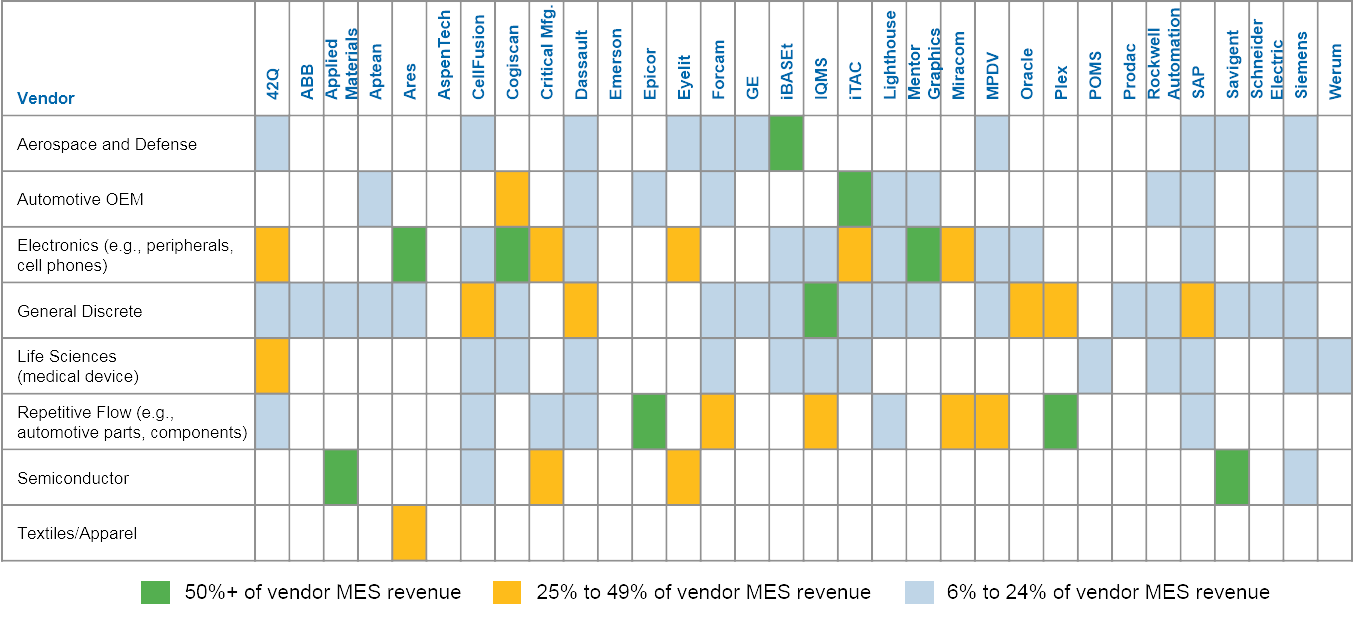
Note: The chart is not intended to indicate completeness of vendor offering for any specific vertical industry. Many vendors successfully support industries not listed as a concentration area for that vendor. The chart is intended only to indicate industries that provide more than 5% of a vendor's revenue. Cell color does not indicate or reflect completeness of offering or market share. Vendors with no colored cells have discrete manufacturing MES offerings, but with 5% or less MES revenue contribution in any vertical market.
Source: Gartner (June 2016)
Figure 4. MES Vendor Coverage – Process Manufacturing
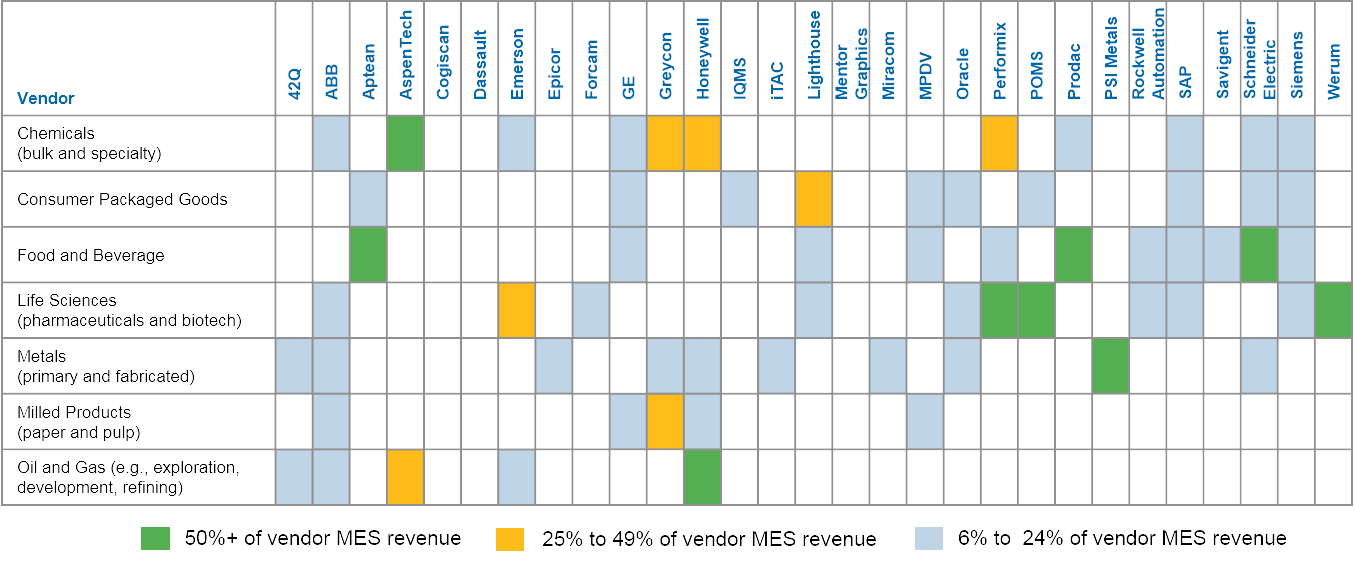
Note: The chart is not intended to indicate completeness of vendor offering for any specific vertical industry. Many vendors successfully support industries not listed as a concentration area for that vendor. The chart is intended only to indicate industries that provide more than 5% of a vendor's revenue. Cell color does not indicate or reflect completeness of offering or market share. Vendors with no colored cells have process manufacturing MES offerings, but with 5% or less MES revenue contribution in any vertical market.
Source: Gartner (June 2016)
42Q
Vendor Class: Pure-Play
Vendor Specialty Areas: Electronics, Medical Device
42Q is offered as multitenant SaaS cloud solution. It officially launched as a company on 3 May 2016 during the creation of the Market Guide "42Q, a Pure-Play Cloud Provider, Could Be an MES Market Disrupter." We will be watching the progress of 42Q as it enters the mainstream MES marketplace as one of only a few cloud-based offerings.
42Q MES was created as an internal system for contract manufacturer Sanmina. It has been implemented in discrete manufacturing environments (including highly regulated, high-transaction, low-latency factories) that are build-to-order, configure-to-order and build-to-stock at Sanmina for the past four or five years. 42Q has been deployed in some external customers for three years.
ABB
Vendor Class: OT
Vendor Specialty Areas: Process Manufacturing (Chemicals, Pharma, Metals, Milled Products, Oil and Gas)
ABB's core MES modules, cpmPlus, are distributed under the general heading of Collaborative Production Management. They focus on production order management and work instruction delivery, maintenance management, quality, materials traceability, warehouse management, performance management, and enterprise manufacturing intelligence (EMI). They also provide production planning and scheduling functionality, including integration to SAP PP/PP-PI and MII. In addition to offering its own solutions for EMI and reporting, ABB provides integration to third-party historians and reporting tools.
ABB performs roughly 90% of its own implementations, with services ranging from simple installation/training for small shrink-wrapped products to complete design, configuration, FAT pilot, site installation, SAT, training, startup support, poststartup support and poststartup system monitoring. ABB has developed implementation templates for cement, mining, pulp and paper, oil and gas, pharma, food and beverage, and repetitive/discrete industries.
Applied Materials
Vendor Class: OT
Vendor Specialty Area: Semiconductor
Applied Materials offers MES and factory productivity applications as part of its Global Services business, supplying manufacturing solutions in semiconductor (wafer and packaging), flat panel display (FPD), solar and medical device. The Applied SmartFactory portfolio of solutions addresses the following manufacturing disciplines: product quality, factory productivity, equipment productivity and supply chain execution. These include out-of-the-box MES solutions for semiconductor and discrete manufacturing, FACTORYworks to build custom solutions with factory-specific working templates for semiconductor, FPD, packaging and medical device manufacturing. Applied Materials' provides capabilities in the areas of dispatching, scheduling, planning, material handling, fault detection, statistical process control (SPC), advanced process control, maintenance management, policy automation and factory simulation.
Aptean
Vendor Class: ERP
Vendor Specialty Areas: Food and Beverage, CPG
Aptean was formed by the merger of CDC Software and Consona in August 2012. Aptean provides a process solution platform, combining Ross ERP, Factory MES (formerly CDC Factory), Pivotal CRM and analytics modules powered by QlikView. Aptean's MES product, Factory MES, is for CP; food and beverage; and discrete, repetitive flow manufacturers where data capture, production performance and quality reporting are required. The system contains an alerting and escalation engine, a packaged operational review framework, and plant and enterprise analytics. Aptean also has packaged integrations to SAP.
Aptean performs all implementations using its implementation team in North America and Europe, and leverages a partner network in LATAM and APAC, focusing heavily on a change management methodology alongside software implementation.
Current release (8.1) includes features such as a mobile-enabled (browser-independent), configurable cell page, more powerful analytics/BI capability, and material lot/batch weight usage tracking. Quality data can be recorded in areas outside of production, providing a full end-to-end quality workflow.
Ares International
Vendor Class: Pure-Play
Vendor Specialty Areas: Electronics, Textile/Apparel
Ares' MES product, ciMes, is predominantly used in specialized electronic environments such as LED/LCD production and semiconductor. Ares provides both software and consulting services. The SQL-Server-based offering is browser-independent with mobile support. The product includes quality, performance management, analytics and packaged integrations to SAP and Ross ERP systems.
Currently, ciMes is at version 5.1, which added a component tracking system specifically for LED production.
AspenTech
Vendor Class: Pure-Play
Vendor Specialty Areas: Specialty Chemicals, Oil and Gas, Pharmaceuticals, Food and Beverage
AspenTech is a provider of software for engineering, manufacturing and supply chain exclusively for the process industries, with global operations and customer deployments. It has a range of optimization from process design systems, control systems and MES, to planning and scheduling. Half of its MES business is in chemicals. AspenTech also provides its own historian (Aspen InfoPlus.21) as part of the aspenONE MES platform.
Ten percent of AspenTech implementations are supported by system integrators, notably Orbis Software, CGI (Logica), ISG IT & Automation, Industrial Technology Services (ITS), and Process Automation Solutions.
Release v8.8 of aspenONE includes improvements to search and trend, new analysis charts, event (production segment) analysis, cross-enterprise content aggregation, and aspenONEProcess Explorer integrated with manufacturing master data management (mMDM) and Aspen Production Record Manager (batch records) data.
CellFusion
Vendor Class: Pure-Play
Vendor Specialty Area: General Discrete
CellFusion's Lean Enterprise Innovation solutions blur the lines between value stream mapping, production planning and manufacturing execution. As engineering or order prioritization changes occur, the system debottlenecks production flow, with operators continuing to lean out their work processes while still being guided by the relevant visual work instructions and interactively enforcing data consolidation in paperless operations. The product also provides traceability down to the operator in the event of a customer-driven issue or failed process.
The solutions include lean engineering, material flow and supply, flexible workforce management, balanced operations planning, visual manufacturing operations, zero-defect and zero-tolerance strategies, and total quality management (TQM) and total productive maintenance (TPM), as well as value stream information portals.
CellFusion provides prebuilt templates for all discrete manufacturing, from complex manufacturing to high-volume manufacturing. Implementations are processed by CellFusion and by lean manufacturing partners and experts.
CellFusion's most recent release added value stream and supply chain integration, multitier traceability throughout the supply chain, in-sync satellite technology, and visualization with smart eye glass integration.
Cogiscan
Vendor Class: Pure-Play
Vendor Specialty Areas: Electronics, Automotive
Cogiscan provides both application software and data collection hardware focused on track, trace and control (TTC). Primarily for Tier 1 and Tier 2 original equipment and design manufacturers (OEM and ODM) and electronic manufacturing services (EMS), it offers specialized application modules for material control, analytics and traceability.
Cogiscan also partners with leading equipment and MES vendors in the electronics industry to provide a robust and neutral connectivity solution to enable Industry 4.0 and IoT. Cogiscan's OEM reselling partners include Juki Automation Systems (Americas, Europe and Asia), Speedline Technologies, ASM Assembly Systems, Fuji Machine and iTAC Software.
Cogiscan's latest release (v.15.3) added enhancements to facilitate support of larger installations, improvements to existing application modules and several new machine interfaces. Other notable changes include a new integration with Panasonic PanaCIM MES software and an enhanced integration with iTAC MES.
Critical Manufacturing
Vendor Class: Pure-Play
Vendor Specialty Areas: Electronics, Semiconductors, Repetitive Flow
Critical Manufacturing is an offshoot organization of Portugal's larger Critical Software, a software development and design firm. Critical Manufacturing's MES application, cmNavigo MES, is built completely on the Microsoft stack, including a web-based, rich internet application (RIA) GUI, based on Silverlight and HTML5. It is available in specific configurations for semiconductor, solar, electronics and medical device production. Critical Manufacturing's cmNavigo has capabilities for work in progress (WIP) visibility and traceability, equipment integration and management, maintenance management, quality management, scheduling optimization, and enterprise system integration. It also has integrated OI capabilities delivered through end-user-specific dashboard construction and configuration capabilities.
The cmNavigo productivity suite is at version 5.0. It promotes mobile MES and has been built out to include features such as maintenance management mobile, alarm management, labor management, warehouse management, dashboard designer, OLAP browser widget and SPC widget.
Dassault Systèmes
Vendor Class: PLM
Vendor Specialty Areas: General Discrete (Aerospace and Defense, Automotive, Industrial Equipment, Electronics), Life Sciences (Medical Device), CPG
Dassault Systèmes' DELMIA Apriso has become the featured MES platform for Dassault Systèmes. Its customer base is global, and DELMIA Apriso is a good fit across multiple verticals. These include industrial equipment, automotive and electronics, as well as consumer and batch product production, where material traceability, quality and serialization from secondary processes through the finished goods warehouse are needed.
DELMIA Apriso is built on a business process management (BPM) platform, with applications for production, warehousing, quality, maintenance and time/labor collection, as well as genealogy/traceability, process management and manufacturing intelligence. Dassault Systèmes is converging Manufacturing Operations Management products and supply chain offerings from recent acquisitions (Quintiq and, most recently, Ortems) into one single operations management solution for all verticals.
DELMIA Apriso 2016 is the current release, including, among other features, support for the OPC UA standard and providing more efficient management of machine connectivity configuration. It also has a new module, Issue Management, for capturing, investigating, analyzing and resolving various forms of shop floor issues.
Emerson Process Management
Vendor Class: OT
Vendor Specialty Areas: Pharma, Chemicals, Oil and Gas
Emerson's MES offering is the Syncade Smart Operations Management suite. Syncade products are configurable and compliant with all relevant OSHA, FDA and cGXP regulations, including 21CFR Part 11. Syncade enables plantwide integration from the plant floor to the enterprise. Asynchronous communication to third-party host computers, including standard interface setups for connectivity to SAP and OSI PI, provides easy access to production and planning information.
The Syncade suite saw a number of upgrades since 2014, including additional dispensing methods, extended equipment state methods, enhanced electronic workflow functionality, expanded support for mobile devices and an updated technology platform.
Epicor
Vendor Class: ERP
Vendor Specialty Areas: Repetitive Flow, Automotive
The majority of Epicor Mattec MES customers are strongly rooted in plastic (such as molding and extrusion) and metal (stamping and die casting, for example) production, and have less than $1 billion in annual revenue.
Epicor Mattec MES supports production scheduling, SPC charting and trending, machine and asset monitoring, statistical quality control (SQC), OEE, plant and enterprise analytics, downtime tracking, machine maintenance management, and alerts and notifications. The machine connections are established through an Epicor proprietary connector called a machine interface unit (MIU) or via OLE for process control (OPC). Additionally, operator touchscreen interfaces for data entry supplement the automated data capture.
The current version of Mattec MES (8.2) includes a new browser-based shop floor HMI built on HTML5. New hardware (MIU) is scheduled to become generally available at the end of May 2015 and is much like an IoT-enabling appliance for the plant floor.
Eyelit
Vendor Class: Pure-Play
Vendor Specialty Areas: Electronics, Semiconductors
Eyelit provides a Java-based manufacturing solution (which also supports open-source environments) for semiconductor, solar, microelectronics and general electronics production. Its core platform provides an event-based enterprise and factory system integration, production optimization and transactional workflow management. The platform is supported by a series of composite applications for quality, genealogy, OI and multisite coordination. Although the majority of Eyelit's customers are based in North America, it has global deployments.
The Eyelit manufacturing product suite includes MES, Asset Management, Costing, FactoryConnect, Recipe Management System (RMS) and Special Processing/SWR. The current release, 5.22, features R2R/APC integration capabilities, special work requests to adjust recipes in the RMS module and configurable rule factors in the Advanced Dispatching module. Features in the Eyelit Asset Management module support additional automation scenarios involving in-line tools and concurrent processing of material contained in a lot and multiple tools, without the need to split the lot in the MES module.
Eyelit provides prebuilt template examples for semiconductor, solar (internal and third-party partner), micro-electromechanical systems (MEMS) and life sciences (medical device).
Forcam
Vendor Class: Pure-Play
Vendor Specialty Areas: General Discrete (Automotive, Aerospace and Defense), Life Sciences
Forcam provides predefined implementation templates for automotive suppliers, aerospace and the machine tool industry. Forcam's product suite, Forcam Force, provides schedule and dispatch, performance analysis, energy control, track and trace, and document control with DNC. It includes machine integration with MTConnect, connectors for ERP and supply chain, PLM and IT, including cloud services for platform as a service (PaaS).
Forcam Force introduced in-memory data processing and real-time capabilities, with the complex-event processing (CEP) rule engine, as well as mobile support to enable cloud-based functionalities.
Current release of Forcam Force (v.5) features an in-memory MES application with single-instance (multitenant) architecture, CEP. BPM modeling and plug-ins/drivers to CNC/PLC controls, ERP/PLM/test data management (TDM)/computer-aided quality (CAQ)/computerized maintenance management system (CMMS) systems.
GE Digital
Vendor Class: OT
Vendor Specialty Areas: General Discrete, Aerospace and Defense, Chemicals, CPG, Food and Beverage, Milled Products
GE Digital is a division of GE that provides cloud services, software, control systems, and implementation and consulting services across multiple manufacturing verticals. Its manufacturing applications are offered as part of GE's larger Brilliant Manufacturing suite. Its products are designed to orchestrate and optimize multiple aspects of production operations. Recent enhancements include a web user interface using HTML5 technology, a microservices-based cloud architecture, and production displays for operators, supervisors and managers in the plant and enterprise.
GE is investing heavily in IoT technologies and data science under the heading of "The Industrial Internet." These offerings include not only traditional MES, but also EMI and predictive analytics. Seventeen percent of GE implementations are cloud-based.
Greycon
Vendor Class: Pure-Play
Vendor Specialty Areas: Mill Products
Greycon focuses on mill product industries (reels and sheets) and has an international presence. Based on Microsoft .NET, its MES product, GreyconMill, was added to the portfolio in 2008 through the acquisition of Swedish MES provider Effsys Effektiva. It has been developed continuously since then. GreyconMill provides functionality for production and converting operations tracking, labeling, quality control, genealogy and performance reporting, and support for warehouse management and dispatching functions. Although it can run stand-alone, it functions best as an integrated component of the Greycon suite of advanced planning and scheduling products, opt-Studio and X-Trim. These applications carry the bulk of customer investment and deployment.
Greycon's X-Trim and opt-Studio solutions are being adopted by the metal rolling mill/service center market, but the majority of the company's business is based in the paper/film industry. Greycon's differentiator is specific domain expertise in scheduling and trimming for the paper, plastic film, metals and converting industries with over 450 customer sites worldwide.
GreyconMill is at release GM3.063.06, which includes translatable properties, configurable editors and performance improvements.
Honeywell Process Solutions
Vendor Class: OT
Vendor Specialty Areas: Oil and Gas, Chemicals, Mill Products
Honeywell Process Solutions provides a portfolio of products to serve key MES needs in different industries. The portfolio is an integrated suite operating on a unified technology platform and leveraging OPC- and OPC UA-secure plant connectivity. The MES suite enables operational and predictive analytics through secure connectivity, cloud and mobility to create smart operating plants for improved reliability, efficiency and safety. Its specific features include production accounting, process safety, asset performance monitoring and management, mass balance and data reconciliation, yield accounting, planning and scheduling, operations monitoring, visualization, inventory optimization, energy monitoring and management, enterprise collaboration, remote operations, tracking, port and warehouse management, shipping and logistics, key performance indicators, recipe and batch, genealogy, operations logbook, decision support, and advanced analytics.
Honeywell also provides prebuilt industry vertical solutions for upstream oil and gas, pulp and paper (and adjacent markets such as plastic films), mining, and refining and petrochemical. Honeywell has transitioned its solutions to offer both cloud-based (including SaaS) and hosted solutions. Honeywell has added new offerings and capabilities to support emerging technologies such as Industrial Internet of Things (IIOT) connectivity, cloud, mobility, analytics to drive business transformation and digitization initiatives.
iBASEt
Vendor Class: Pure-Play
Vendor Specialty Areas: Aerospace and Defense, Medical Device, Electronics, General Discrete
iBASEt's Solumina MES product has a heritage in aerospace and defense (A&D) manufacturing, and maintenance repair and overhaul (MRO). iBASEt's solution enables product life cycle execution, starting with supply chain quality management, and then MES and MRO. Using paperless work instructions and process planning, Solumina includes job dispatch, process control, resource management and detailed genealogy tracking. Solumina's as-built and as-maintained data goes beyond bills of materials (BOMs) and validation of as-designed; it includes detailed unique serial identification (Unique Device Identifier [UDI] or Unique Identification [UID], if applicable) or lot number, and complete history of engineering changes and approved deviations. Solumina includes a complete enterprise quality management system (EQMS) that embeds quality management into production execution controls. Source inspection orders, nonconformance management reports (NCMRs), supplier corrective actions (SCARs), root cause corrective actions (RCCA) and audits can be automatically exposed to suppliers via the supplier web portal. The Solumina product has predefined implementation templates for aerospace and defense, as well as medical device.
The latest release (G8 R1) includes enhanced out-of-the-box integration packages for SAP, Deltek Costpoint, PTC Windchill, Kronos and Siemens Teamcenter; closed-loop change management processes with PLM, WIP and supply chain; and enhancements to continuous improvement processes (manufacturing intelligence, and corrective and preventive action [CAPA]).
IQMS
Vendor Class: ERP
Vendor Specialty Areas: Automotive, Medical Device, Electronics, General Discrete, CPG
IQMS offers MES as part of its manufacturing ERP offering and on a stand-alone basis. It offers modules and implementation templates that are tailored for specific industry verticals – aerospace and defense, assembly, automotive, medical device, packaging, plastics/rubber, process, and stamping.
As a manufacturing ERP provider, IQMS's breadth of functionality exceeds what is found in most MES suites. The company's customer base is predominantly in the midmarket manufacturing arena, with most of its installations in North America.
In addition to on-premises deployments, IQMS supports hosted cloud and SaaS cloud deployments, which represents 13% of its client base.
iTAC Software
Vendor Class: Pure-Play
Vendor Specialty Areas: Automotive, Electronics
In 2015, iTAC was acquired by automotive manufacturing systems provider, Dürr Group. iTAC Software's Java-based iTAC.MES.Suite is built for high-speed, high-transaction (that is, high-volume and high-variant) production environments. It's deployed in repetitive-flow environments; injection molding; and electronics, mechatronics and mechanical manufacturing. A significant share of the customer base is Europe-centric, with many customers having executed global rollouts of the application. The iTAC.MES.Suite's open architecture allows for multiple device and equipment integration scenarios that help process interlocking or error-proofing functionality for discovering and resolving quality issues during production. This is foundational to iTAC's core value proposition of detailed part and process traceability. The vendor also provides specific integration adapters for SAP among numerous other ERP solutions. iTAC has predefined implementation templates for automotive, electronics, telecom, metal fabrication, energy/utilities and medical devices.
The most current release, 8.50.01, includes personalized factory data collection (pFDC) for capturing time consumption on work orders/works steps and employee basis, iTAC.smart.FactoryAppStudio (graphical workflow toolset), multiple work orders and phantom product support, support of commissioning/preparation, and integration of SAP JCo 3.0.
Lighthouse Systems
Vendor Class: Pure-Play
Vendor Specialty Areas: CPG, Automotive, Electronics, Life Sciences, Food and Beverage
Lighthouse Systems' Shopfloor-Online MES product is applicable across a range of manufacturing industries. The majority of its customers are in CPG and repetitive-flow manufacturing, such as discrete part suppliers. The vendor also has a presence in discrete assembly markets. Shopfloor-Online offers modules, from label printing and production scheduling to downtime reporting, maintenance management and job tracking, all of which sit atop the core database.
Recent releases (6.2) have included a rapid deployment tool, source control of all software assets, a staffing module, warehouse management, energy management, workflow and electronic batch record (EBR)/device history record (DHR).
Through a joint venture with Zenith Technologies and LZ Lifescience, Lighthouse is now seeing more business from life sciences manufacturers.
Mentor Graphics
Vendor Class: PLM
Vendor Specialty Areas: Electronics
Mentor Graphics' MES offering, Valor MSS, is designed for printed circuit board (PCB) manufacturing. Valor MSS provides a platform for transforming engineering BOMs into process plans, production process monitoring, equipment commissioning, scheduling and flow optimization, and materials traceability from fabrication through test and assembly. Version 12.05, released in October 2014, has supply chain enhancements, new surface mount technology (SMT) machine interfaces and a new set of enterprise APIs. There are no prebuilt implementation templates for Valor MSS, as customer workflows tend to be unique.
Miracom
Vendor Class: Pure-Play
Vendor Specialty Areas: Electronics, Repetitive Flow, Metals
Miracom has been in business since 1998, serving discrete segments within high-tech and general manufacturing markets. The majority of its customer base is in Asia, and it relies on global partnerships with resellers and system integrators to access the European and U.S. markets. Its product set includes an enterprise-level MES application under the MESplus brand. The offering is part of a broader manufacturing software application portfolio that includes applications for quality and yield management (DAcrux), advanced planning and scheduling (APSplus), factory automation (FAmate), flexible monitoring system (FMBplus) and manufacturing intelligence (EMIplus). Miracom also offers its own enterprise application integration layer, Highway 101, for message brokering and interfacing among MES and various external enterprise systems, such as ERP, SCM and CRM. The recently added new product called MobilePlant is a manufacturing mobility software solution enabling the management and execution of various manufacturing operations using mobile devices.
MPDV
Vendor Class: Pure-Play
Vendor Specialty Areas: Repetitive Flow, General Discrete, CPG, Food and Beverage, Milled Products
MPDV provides an MES solution, Hydra, and associated data collection hardware, with a number of MES modules for shop floor and machine data management, scheduling/sequencing, tracking and tracing, tool/resource management, gage management, in-process inspection, and time and attendance/personnel time management and personnel scheduling.
MPDV introduced new BI features in the 2014 release of MES Cockpit 3.1 for the display of real-time data and KPIs from production.
MPDV has an office in Chicago, Illinois, to serve its North American customer base. Hydra is available in more than 40 languages.
Oracle
Vendor Class: ERP
Vendor Specialty Areas: General Discrete, Electronics, CPG, Pharma, Metals
Oracle offers two dedicated MES solutions: Oracle Manufacturing Execution System for Discrete Manufacturing and Oracle Manufacturing Execution System for Process Manufacturing. Both are modules of Oracle E-Business Suite Release 12, extending the Oracle Process Manufacturing (OPM) and Oracle Discrete Manufacturing product families. Oracle's MES solutions come with a supervisor's workbench (for plant management) and MES workstations (for operators), as well as support work order assignment, standard operating procedure (SOP) delivery, integrated quality management (with E-Business Suite quality solution) and resource consumption (backflushed into ERP inventory modules).
Reporting is native to Oracle's MES offerings. However, there is also an integration capability with Oracle's dedicated EMI offering, Oracle Manufacturing Operations Center (MOC), which is marketed and sold separately.
Oracle MES 12.2.5 usability improved to touchscreens, mobile devices, serialization support, e-kanban, and added key Endeca extensions:
Oracle Discrete Manufacturing Extensions for Endeca and Oracle Process Manufacturing Extensions for Endeca.
Performix
Vendor Class: Pure-Play
Vendor Specialty Areas: Pharma, Chemicals, Food and Beverage
Performix xMES targets the SAP pharmaceutical and chemical customer base, and it's starting to expand into food and beverage. The vendor leverages SAP MII to integrate its xMES application with the SAP ERP suite. This offers a path to basic process automation, while shielding users from the dual data-entry burden of interacting with multiple SAP components. This is done by extending SAP ERP, SAP product life cycle management (PLM), SAP Quality Management (QM), and SAP PP-PI functionality and master data for recipe modification (xRecipe), recipe execution (xMES), and the capture and analysis of electronic batch records (xBatch). Production data is captured as batch event history in xBatch and, for continuous data, connectors to data historians are offered. The vendor has enhanced functionality for weigh and dispense, mobile device support and compliance audits.
Performix xMES 10.5 includes connectivity with Process PLM and NeoPLM, support for Linux enhanced review by exceptions, analytics leveraging SAP Hana and Dispatching.
All the production data is captured as batch event history in Performix xBatch. For continuous data, Performix xMES integrates with OSIsoft PI System, GE iFIX, Automsoft Rapid and other historians.
Plex Systems
Vendor Class: ERP
Vendor Specialty Areas: Repetitive Flow, General Discrete
Plex Systems provides a cloud-based, multitenant ERP application, Plex Manufacturing Cloud. Its MES is an integrated component of this offering, designed for discrete and process manufacturers in automotive, aerospace and defense, electronics, industrial, precision metal-forming, and food and beverage. The MES offers work instruction display, pick-to-light systems, tooling management, and part and process traceability. It offers bidirectional communication with plant-floor controller systems, and onboard displays and other equipment through Plex web services XML/Soap-based integration technology.
Plex Systems also has integrated engineering modules that support process planning/routing development, as well as QMS functionality for quality planning, SPC, corrective action and supplier quality management.
As the Plex Manufacturing Cloud is a multitenant application, there are no releases, per se. Application functionality is added continuously, with end-user clients able to choose which new functionality they wish to enable. Recent enhancements include enterprise financials, master scheduling, sales and operations planning, distribution planning, advanced analytics, and dashboards, as well as lot management.
POMS
Vendor Class: Pure-Play
Vendor Specialty Areas: Pharma, CPG
POMS has been offering POMSnet MES for life sciences with industry-specific functionality since 1988. POMSnet is found almost exclusively in the life sciences (medical device, pharmaceutical/biotech) and CPG verticals, also predominantly in North America and Europe. POMSnet is web-based and built on a Microsoft .NET stack. The company also offers its own data historian/data warehouse supporting an enterprise manufacturing intelligence application.
In 2014, POMS announced MES in the Cloud. Releases 340 and 400 had new features including an embedded middleware adapter, the ability to add complex ingredient potency calculations, optimized material dispensing, dynamic addition and sizing of sublots based on equipment capacity, line clearance templates, dynamic runtime text/images on operator pages, support for equipment-status-based processes independent from batches, and support for using standard processes that are managed outside of the recipe structure.
POMS also added support for dynamic recipe creation from PLM/ERP using standard templates. Bills (e.g., materials, equipment, parameters) can be downloaded along with master data into POMSnet and then assembled into a recipe with routing information through a standard web service.
POMSnet also supports R&D and clinical manufacturing. It updated its material and equipment phases to allow the researcher to record what resources are used as they execute the recipe or to create a BOM for each run without having to update the recipe.
Prodac
Vendor Class: Pure-Play
Vendor Specialty Areas: Food & Beverage, Chemical, General Discrete
With roots in a joint venture between The Coca-Cola Company and an industrial engineering service provider 25 years ago, Prodac Systems serves packaging and bottling/filling operations in food and beverage. The Prodac Microsoft .NET-based MES is deployed at the country-level subsidiaries of many global beverage producers and consumer products companies. It has also fulfilled multisite deployments for global organizations. Prodac incorporates functionality for EMI that customers leverage not only to track production (production inventory management, quality control and job scheduling, for instance), but from which to launch and manage continuous improvement programs.
The current release is Prodac 2016, including full BI, mobile support, advanced analysis, a silo module and seamless integration to SAP. It opened an office in Canada, and will open an office in Germany in 2017.
PSI Metals
Vendor Class: Pure-Play
Vendor Specialty Areas: Metals
PSI exclusively serves the metals (aluminum, steel and copper) industry, where maximizing asset utilization and shortening lead and delivery times – paired with higher product complexity – are ongoing needs. It offers its production management system solutions based on its product suite, PSImetals, that includes functionality for supply chain planning and scheduling, order dressing, production and quality execution, as well as inbound and outbound logistics. The product approach allows fully integrated solutions and specialized stand-alone services. PSImetals has a standard interface to the SAP ERP system. PSImetals EAI framework PSIintegration provides communication adaptors to all major ERP and automation providers.
Current PSImetals release is version 5.12 featuring a business flow configurator, PSI Click Design configurable GUI, KPI-driven planning and scheduling, alternative routes within order dressing, open demand determination and prestaging within logistics.
Rockwell Automation
Vendor Class: OT
Vendor Specialty Areas: Automotive, Pharma, Medical Device, CPG, Food and Beverage, General Discrete, Electronics, Metals
Rockwell Automation's MES customers include automotive OEMs and tier suppliers, pharmaceutical and biologic producers, and food and beverage, and CP companies. The FactoryTalk ProductionCentre MES integrates production processes such as order or quality management with business analytics for a connected and paperless shop floor. This improves efficiencies, supports improvement initiatives, and ensures regulatory compliance and quality. The solution enables quality improvement, global operational efficiencies, regulatory compliance, accelerated time to market and real-time quality data sharing.
Rockwell Automation's MES assets are further refined into industry-specific suites (AutoSuite, CPGSuite, PharmaSuite) and modular fit-for-purpose applications (production management, performance management and quality management to date). These assets are built on the common platform of FactoryTalk ProductionCentre MES, providing for automated data collection, quality, genealogy and traceability, analytics, and asset management to integrate with Rockwell Automation and other provider's process controls, batch execution and SCADA systems. The most recent release of FactoryTalk ProductionCentre (10.22) included cloud support, thin-client HTML5, mobility, and an update to Java 8 and notification service.
SAP
Vendor Class: ERP
Vendor Specialty Areas: Aerospace and Defense, Automotive, Repetitive Flow, General Discrete, Electronics, Medical Device
SAP provides multiple MES solutions – SAP Manufacturing Execution (ME) and SAP Complex Assembly Manufacturing Solution (CAMS). SAP MES systems are well-suited for discrete manufacturing. They are used by companies operating high-speed electronics production or manufacturing capital equipment with complex fabrication and assembly requirements, such as helicopters. Its strengths are in serialized data capture, integrated quality management, inventory management and the enforcement of production steps. SAP supports process industry through base functionality in the SAP ERP Central Component (ECC) suite, augmented with SAP's Manufacturing Integration and Intelligence (MII) offering. As SAP continues to grow the Hana platform, SAP ME and CAMS will also be able to leverage the capabilities of Hana.
The current release, SAP ME 15.11, includes MII-based integration and KPIs, production control, unit-level track and trace/genealogy, nonconformance management, mass deployment with enhanced change and transport system (CTS+), process interlocking, role-specific access, personalized dashboards for operators, flexible production process modeling, multibrowser support, and Hana Support.
Savigent Software
Vendor Class: Pure-Play
Vendor Specialty Areas: Semiconductor, Food and Beverage
Savigent Software is a provider of event-driven manufacturing operations management software. The company provides workflow automation, manufacturing intelligence and system integration solutions. Savigent Software's product suite meshes service-oriented architecture (SOA) and Web 2.0 constructs to help manufacturing organizations drive processes across siloed applications. This new paradigm offers the flexibility to adapt existing systems and build new processes to match unique business/industry requirements versus a traditional MES deployment. At the core of the software is a workflow engine that can be configured to take input from a wide variety of devices and applications to make decisions on what events/alarms should take place based on these conditions.
As a workflow platform, Savigent provides a large number of packaged integrations, including with Applied Materials, IBM, Impresa, Infor, Lawson M3 ERP, Microsoft, Oracle, PTC, Sage, SAP, SAS. Siemens, Synchrono, TIBCO Software and plant floor equipment.
Savigent's latest release, v6.0, includes: Artifact Server, a workflow app store, where workflow apps can be pulled down by individual plants and deployed; enhanced data access for reporting; IMSQL – query language exposed to web services; and historian (including enterprise and integrated options)/information model explorer to access both Savigent historical data and data from other systems.
While Savigent got its start supporting the semiconductor industry, the company is seeing continued growth in CPG, food and beverage, and other industries. Current release (6.1) has added streamlining of fault/anomaly detection and a web workflow portal.
Schneider Electric
Vendor Class: OT
Vendor Specialty Areas: Food and Beverage, General Discrete, CPG, Chemicals, Metals, Mining, Oil and Gas
Schneider Electric offers companies in the food and beverage, consumer products, chemicals, metals and mining, automotive, and industrial product industries a highly packaged MES application. It leverages a significant portion of the native services in the core Wonderware System Platform, as well as Ampla, which serves the mining industry.
The current release, Wonderware MES 2014 R2, includes the following new features:
- MES/Performance OEE module; new client front end (web-based); new line management capabilities (utilization, production counters); new KPIs for utilization, bottlenecks and line rollover; line OEE calculation and monitoring that now can be based on automatic or manual line bottleneck determination
- MES/Quality with enhanced sample frequencies; SPC chart enhancements; archive and store; and SPC rule evaluations
- Multisite MES standardization, model-driven platform using a combination of Wonderware Skelta BPM and MES
Siemens
Vendor Class: PLM/MOM
Vendor Specialty Areas: Aerospace and Defense, Automotive, General Discrete, Electronics/Semiconductor, Life Sciences/Medical Device/Pharmaceuticals, Food and Beverage, CPG, Chemicals
The Siemens Manufacturing Operations Management (MOM) portfolio works together with the Siemens PLM portfolio to help manufacturers optimize their digital enterprise and realize innovation. The portfolio includes solutions for manufacturing execution (Simatic IT and Camstar Enterprise Platform), quality management (IBS QMS), advanced planning and scheduling (Simatic IT Preactor), and HMI/SCADA (Simatic WinCC and WinCC Open Architecture).
Siemens recently launched the next generation of Simatic IT solutions (v.7) built on the Simatic IT unified architecture foundation. The Simatic IT foundation exposes a common set of manufacturing services that can be browsed and consumed within manufacturing solutions that seamlessly support user-oriented workflows, rather than requiring the user to access multiple applications to complete a single task, including industry-specific MES components such as Simatic IT UniCam (for electronics assembly) or Simatic IT eBR (for pharmaceutical manufacturing).
The Camstar Enterprise Platform is focused on addressing the needs of semiconductor and medical device industries. The newest version (v.6 software update 10) introduces manufacturing process change management (Camstar Change); weighing and dispensing/batch processing derived from Simatic IT eBR (Camstar Batch), process time enforcement, and acceptable quality level (AQL) sampling.
Werum IT Solutions
Vendor Class: Pure-Play
Vendor Specialty Areas: Life Sciences (Pharma, Medical Device, Biotech)
Werum IT Solutions is a supplier of manufacturing execution systems and manufacturing IT solutions for the pharmaceutical and biopharmaceutical industries. Many of its customers have standardized on Werum's Pas-X MES atop existing DCS and batch execution systems to generate electronic batch records and handle weigh and dispense, bulk production, formulation, quality management, equipment integration, and materials tracking. In addition to this core functionality, Werum provides application-specific process templates for certain pharmaceutical and biotech business processes, including API manufacturing, fill and finish, and packaging. Werum's manufacturing IT solutions help pharma manufacturers increase efficiency, improve productivity and meet regulatory requirements. The range of projects includes global MES programs with multisite rollouts all over the world as well as single-site solutions in individual countries. Werum has added product feature packages as solutions for process performance management by visualization of manufacturing KPIs, track and trace/serialization, and process development for supporting the electronic development of recipes.
Current release, Pas-X v3.1.8, includes a dedicated dialogue for material reconciliation and the Pas-X Evaluations Package used to make production assessments and develop strategies for process optimization.
Market Recommendations
- When choosing a vendor/implementation partner, look for functional fit as well as understanding of your industry; talk with proven production customers in your industry.
- Evaluate the caliber of the vendor leadership team and the level of R&D investment. Understand your vendors' visions (and completeness of vision), and carefully assess their ability to execute on their visions.
- When evaluating MES systems, look at configurability, flexibility and ease of integration (and not just ERP integration). The level of system customization required is inversely proportional to implementation success rate.
- MES systems will need to support increasing amounts of data and sophisticated data analysis. Ensure that your provider has a plan for support of IoT devices and advanced analytics (not just report writing).
- Evaluate your vendor's global deployment, and maintenance and support capabilities.
- Ensure your vendor can support multisite centrally hosted deployments.
- Be sure to include bidirectional communication/collaboration capabilities on your desired features list. As MES becomes a more visible part of the larger supply chain ecosystem, these capabilities will grow in importance.
Source: Gartner Research Note G00278227, Rick Franzosa, 21 June 2016
Evidence
1 Individual vendor surveys for the 2016 MES Market Guide: Thirty-six vendors from North America, Europe and Asia were surveyed via an emailed survey form.
2 2015 Gartner/MESA Business Value of MES survey: Gartner's survey of 119 MES practitioners was conducted online from 9 September through 5 October 2015. Typically, respondents represented large global manufacturing companies of 10,000 employees or more. There was approximately a 50/50 split of respondents between discrete manufacturing and process manufacturing industries. Forty-five percent of respondents identified themselves as IT, 23% as line of business and 27% in a hybrid business-IT role.
3 Vendor reference calls in support of 2016 MES Market Guide: Data was collected from 72 client references spanning late 2014 through 2015.
4 Inquiry calls with 25 to 50 Gartner clients in 2015.
Note 1. Cloud Computing
Gartner defines cloud computing as a style of computing where scalable and elastic IT-related capabilities are provided "as a service" to customers using internet technologies.
Note 2. Operational Technology (OT) Vendors
Vendors defined in this Market Guide as OT vendors are companies that are in the plant automation business, providing operational technologies for the automation of plant and equipment in conjunction with their MES software business.