In Manufacturing, Action Today Shapes Tomorrow
Agentic AI transforms ERP – early adopters gain speed, insights and edge
Research from Gartner
Innovation Insight: AI Is on the Cusp of Reshaping ERP
The rapid pace of AI innovation is now on the verge of altering both the nature and the capabilities of ERP applications. This research is designed to help ERP leaders assess the state of AI in the ERP market and to set realistic expectations regarding enterprise goals and objectives.
Overview
Key Findings
- Since the mid-2010s, ERP vendors have incorporated a variety of artificial intelligence (AI) techniques in their solutions. However, the vendor hype surrounding generative AI (GenAI) and agentic AI is making it increasingly difficult for enterprises to put a realistic value on these new sources of innovation and differentiation.
- ERP vendors have not retrofitted AI capabilities for legacy, on-premises solutions. Although cloud ERP adoption rates continue to grow, customer adoption of available ERP AI use cases is lagging.
- GenAI and agentic AI are expected to have a major impact on the ERP market. Gartner forecasts that 62% of 2027 spending will be on ERP applications with these AI capabilities, which is a major increase from 14% in 2024. This may alter the vendor landscape, because the investment required is substantial, and vendors that rely heavily on third parties could be at a disadvantage.
- As vendors determine optimal ways to monetize their AI investments, customers may face licensing challenges.
Recommendations
- Increase the likelihood of meeting enterprise objectives by defining specific AI use cases required by your organization, then developing a clear understanding of the current state of AI in the ERP market that can address them. AI is not a goal in itself. The aim should be to deliver business outcomes that meet organization enterprise objectives.
- Manage the exaggerated hype around AI by focusing efforts on the organization’s AI aspirations, then assess the available vendor capabilities that have proven use cases. This includes AI use cases that provide sufficient value and feasibility, both technically and organizationally, which should be prioritized.
- Balance the value of the expected innovation and its cost by monitoring current ERP contracts and expected future ERP contractual scenarios. Vendors are likely to migrate to usage-based costing, which will require substantially more insight into use cases and how they are monetized by vendors.
Strategic Planning Assumptions
By 2028, more than 50% of on-premises ERP customers will prioritize adopting a cloud application platform approach to enable AI-based functional features.
By 2028, enterprises will enhance productivity by replacing 60% of SaaS workplace applications that lack GenAI-driven capabilities with those that do.
Introduction
ERP vendors have offered a variety of AI capabilities; however, the recent emergence of GenAI and agentic AI has demonstrated the potential to transform ERP in ways that have not been seen since the advent of cloud computing. In addition, future technological improvements in decision intelligence, cross-process orchestration and automation could provide an advanced level of innovation and adaptive user experiences. Figure 1 provides an overview of the AI techniques and examples in each.
Figure 1: AI Techniques in ERP
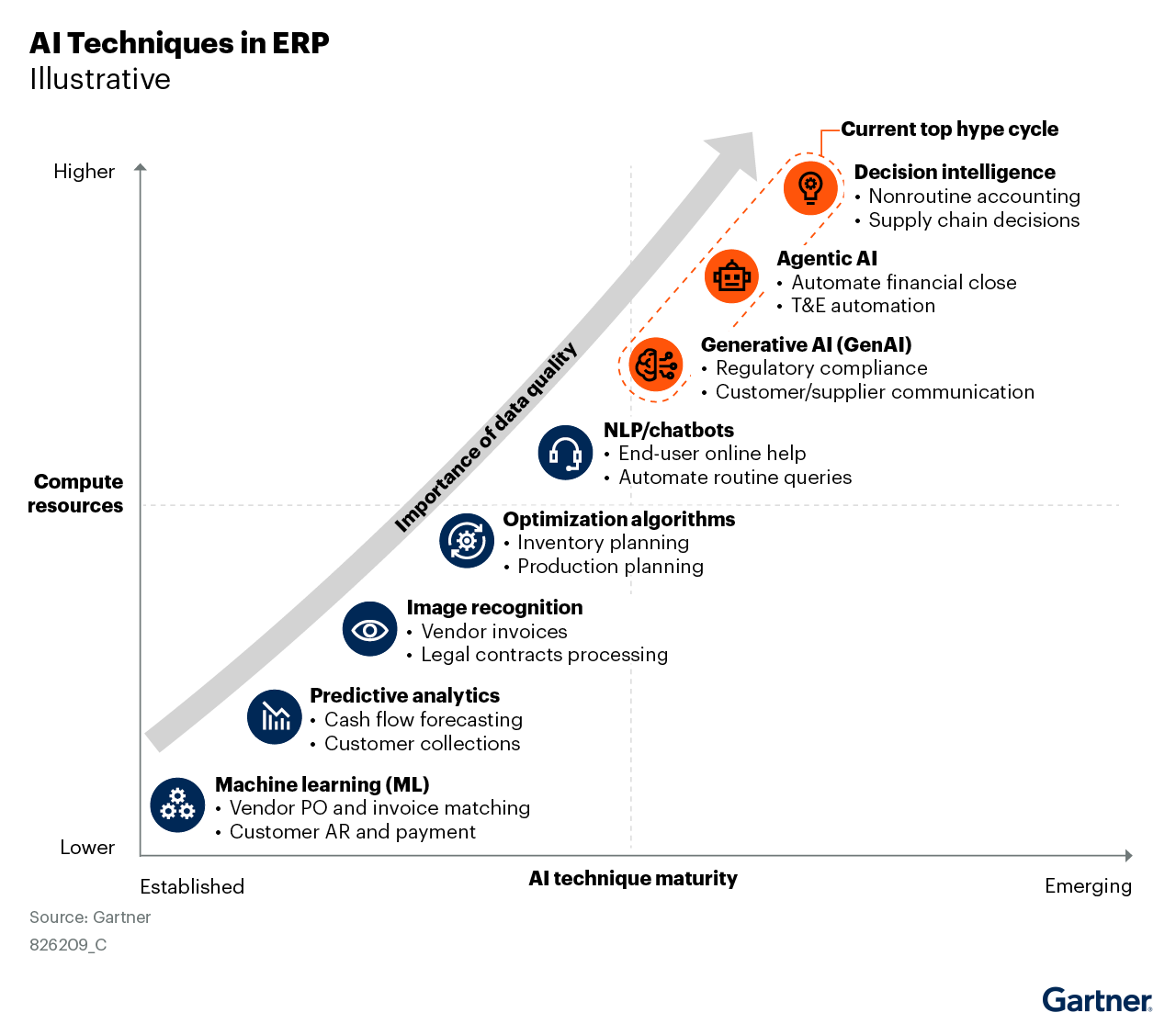
The emerging AI technologies require substantially greater computing resources, as well as a high level of data quality to ensure they work as designed. Finally, these AI capabilities are only available in the latest modern cloud ERP versions. Customers that continue to operate on-premises legacy solutions will need to rely on third-party AI solutions.
Description
In late 2023, GenAI emerged as one of the fastest-growing technologies ever witnessed. GenAI technologies can generate new derived versions of content, strategies, designs and methods generated by models trained on large repositories of original source content. GenAI has profound business impacts on content discovery, creation, authenticity and regulations; automation of human work; and customer and employee experiences.
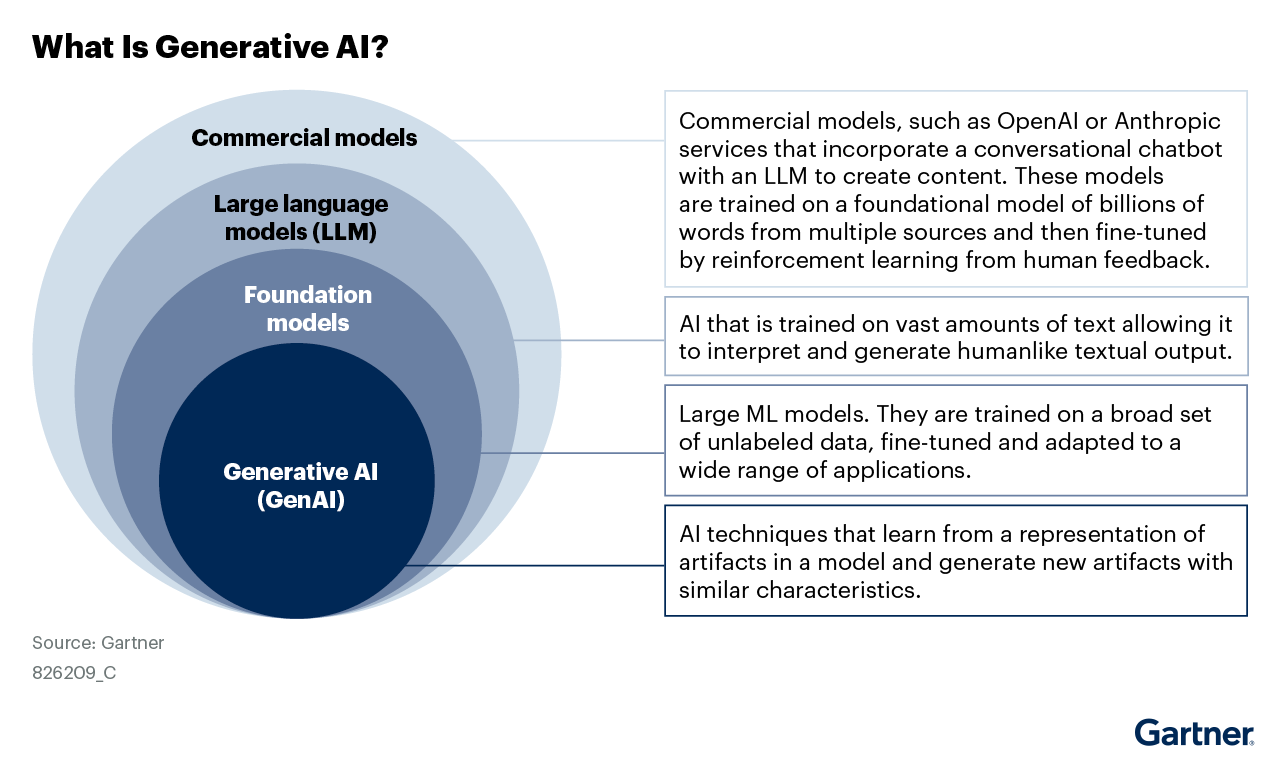
Commercial models involve a conversational chatbot and an LLM to create content. They use a foundational model involving multiple sources fine-tuned by learning from human feedback. LLMs are trained on broad sets of data, adapted to a wide range of applications. (Figure 2 provides an overview of GenAI and its relationship to commercial models, LLMs and foundation models.)
Figure 2: What Is Generative AI?
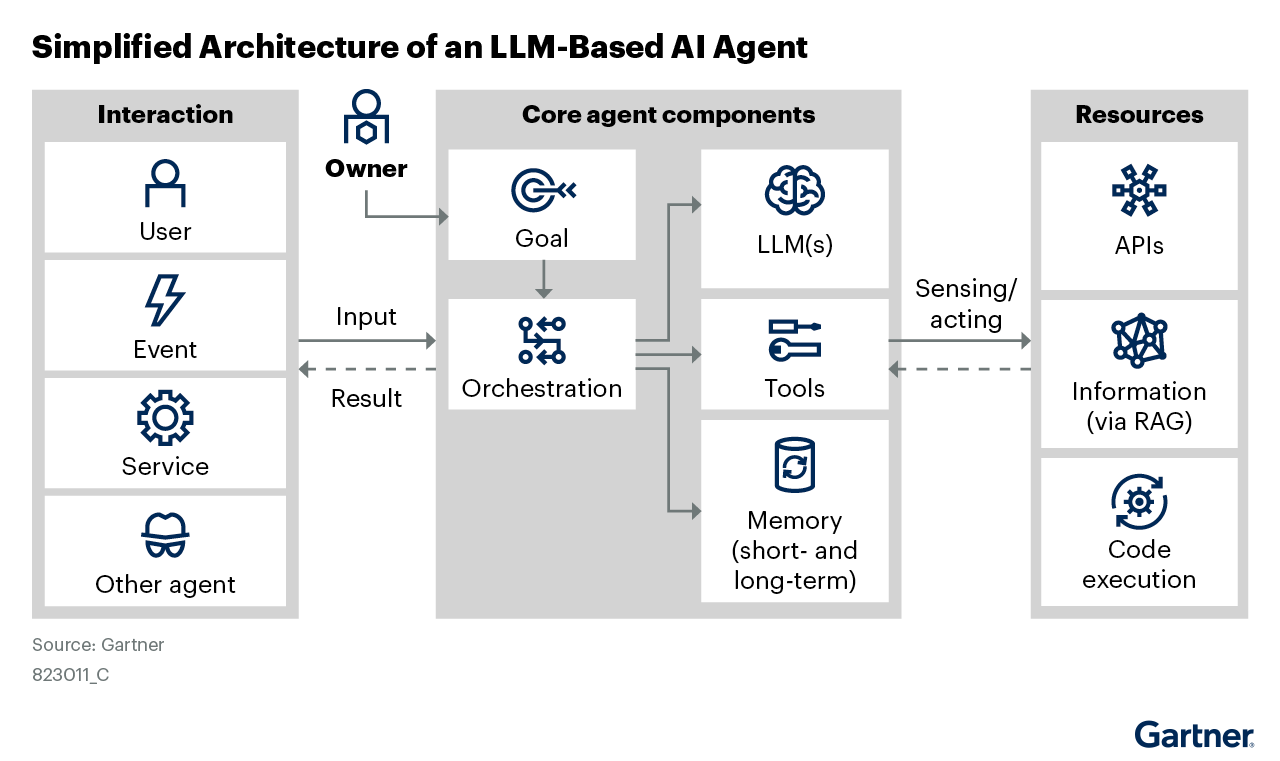
Agentic AI has now emerged as the latest must-have capability in the market for vendors looking to support or enable AI-based business solutions and attempting to differentiate themselves in a noisy and competitive market. AI agents are autonomous or semiautonomous software entities that use AI techniques to perceive, have the “agency” (i.e., the delegated right) to make decisions, take actions, and achieve goals in their digital or physical environments. (Figure 3 provides a simplified overview of how AI agents work.)
Figure 3: Simplified LLM-Based AI Agent Architecture
Agentic AI offers the promise of a virtual workforce of agents that can assist, offload or augment human tasks and traditional applications. The goal-driven planning capabilities of agentic AI also promises to deliver more adaptable software systems, capable of completing a wide variety of “undefined” tasks in a domain, rather than only those designed into the software.
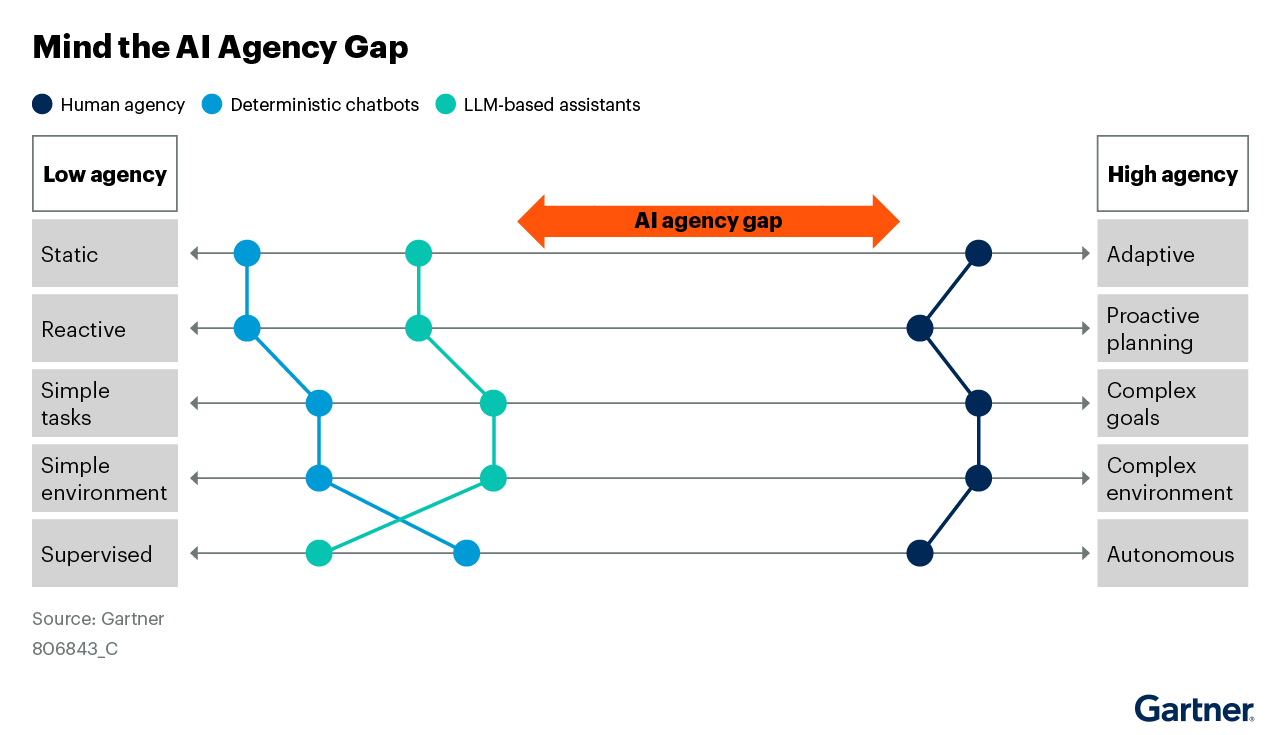
AI agency is a spectrum. It runs from traditional systems with limited agency that perform specific tasks under narrowly defined conditions to future agentic AI systems with full agency that learn from their environment, plan approaches, make decisions and perform tasks independently. Figure 4 shows on the left side the current state of agentic AI capabilities, compared with the vision on the right, along with the gap that will need to be filled to move in this future direction.
Figure 4: Mind the AI Agency Gap
AI agents are autonomous or semiautonomous software entities that use AI techniques to perceive, make decisions, take actions and achieve goals in their digital or physical environments.— Source: Innovation Insights: AI Agents
Decision intelligence (DI) is a practical discipline that advances decision making by explicitly understanding and engineering how decisions are made, and how outcomes are evaluated, managed and improved via feedback. This capability is still several years away and is not the current focus of this research.
Benefits and Uses
The current use cases for GenAI and agentic AI primarily involve process automation and end-user productivity. With GenAI in ERP, Gartner mainly sees benefits around text, voice and image use cases. Available examples include:
- Communications with business partners, such as employees, suppliers, customers and related stakeholders. For example, automatically creating job posting requirements from a human capital management (HCM) skills application, creating emails to suppliers for purchase order changes or summarizing the content of a customer receivables collection call on customer promises to pay.
- Natural language interfaces that can answer a variety of questions on information contained in an ERP landscape directly in the ERP or via other productivity tools.
- Use of natural language to seamlessly build low-code application extensions on vendor platforms and integrations back into configure-only ERP processes.
- The creation of images that will reduce the effort to create professional-level product photos that industries such as retail and manufacturing can use in their product portfolios.
Gartner also predicts that GenAI will be a valuable future use case for automating the configuration and implementation of cloud ERP, as well as automating the integration of third-party applications in a highly composable application landscape.
Agentic AI use cases are limited, with only a handful that are generally available to customers and are still much closer to advanced robotic process automation (RPA) cases than autonomous agents. Near-term use cases are expected to automate a variety of routine processes in ERP. A sample of vendor roadmap use cases include:
- Financial statement account reconciliation and close-the-books activities.
- Automating the posting of time and expense and approval workflows.
- Communication agents to autonomously manage the collaboration with suppliers of the detection of unusual or anomalous transactions where an AI agent can analyze account balances and provide supporting documentation.
- Talent recruiting to automate a variety of tasks, such as job postings, sourcing passive candidates and communication.
- Production planning activities, including planning optimization and consequence analysis.
Conceivably, any business process enabled by an ERP solution could contain an agent or a series of agents for automation.
DI viability is still a number of years away; however, use cases could focus on activities that require analysis, where the system can make decisions that are reviewed by a human in the loop. An example could be making recommendations for a bad debt reserve for financial statement balance sheet amounts or making raw materials sourcing decisions based on a variety of factors.
Risks
- There will be a high level of uncertainty concerning how vendors monetize this innovation. Large ERP vendors will be able to provide most, but not all of the computing resources needed (infrastructure, large language models [LLMs], etc.). Many of the smaller ERP vendors will rely almost wholly on third parties. Given the enormous computing resources needed and variety of cost-charging patterns with those third parties, ERP vendors are still figuring out whether and how to charge customers. Customers can expect a variety of consumption-oriented pricing models, which will make it difficult to forecast costs.
- Beware of “agent-washing.” Many technology vendors have begun using the term “AI agents” to describe a broad spectrum of capabilities, including renamed AI assistants and chatbots. This dilution of the term is primarily driven by marketing, and is motivated to capture the imagination and attention of users, technical professionals and leaders. The level will vary as vendors add new agentic features, and the hype around agents ebbs and flows.
- Not every business problem or process will be solved by an agent. Ensure that the implementation of an ERP agent will lead to positive business outcomes and impact the “right work” — that is, productivity improvements that affect desired business outcomes.
- Data will come to the forefront as the ability of GenAI and agentic AI to deliver reliable and accurate results will depend on the quality of data. Customers without strong data governance structures in place may find a supercharged garbage-in, garbage-out (GIGO) scenario.
- Governance and security are key to minimize “AI sprawl.” ERP vendors have promised to not use customer data to train models, and all will rely on their proprietary tools, as well as third-party products that themselves use nontransparent approaches. Security and governance will require a great deal to oversee.
- Will agents be cordoned off inside an ERP vendors’ “walled garden” or will there be cross-application agents — for example, between a CRM solution and ERP? This will add additional layers of governance and security.
- ROI is difficult to calculate. It remains to be seen whether GenAI and agentic AI will improve productivity, meet expected business outcomes and provide a realistic ROI. Until vendors have enough use cases in which substantive case studies can be proven, this question may remain unanswered for the immediate future.
Recommendations
- Enhance the likelihood of meeting enterprise objectives by developing a clear understanding of the current state of AI in the ERP market. Incorporate current and future roadmap vendor offerings into the ERP strategy. As with any new technology, the focus should be on the enterprise goals and objectives and how the ERP solution enables those processes and analytics to meet those objectives.
- Manage the hype around AI by focusing efforts on available vendor capabilities with proven use cases. AI use cases that provide a likelihood of value and feasibility, technically and organizationally, should be prioritized. Gartner provides a variety of AI use comparison reports by functional domain and industry. These are a good source to understand which use cases have the highest likelihood of success.
- Strive for a balance between the value of the expected innovation and cost by monitoring current ERP contracts and expected future ERP contractual scenarios. Vendors are likely to migrate to usage-based costing, which will require substantially more insight into use cases and how they are monetized by vendors.
Representative Providers
Nearly all of the vendors in Gartner Magic Quadrants for Cloud ERP (both service- and product-centric) have announced agentic AI initiatives. These include Oracle, Epicor, Infor, SAP, Microsoft, Workday, IFS, Priority Software and Sage.
Source: Gartner Research Note G00826209, Greg Leiter, Denis Torii, 19 February 2025
Evidence
Some of the data has been sourced from Forecast Analysis: GenAI in ERP Software, Worldwide.
Vendor briefings were provided by ERP software vendors.
Gartner internal and published research on GenAI and agentic AI includes Gartner Hype Cycle research.