
Market Guide for Digital Health Platform for Healthcare Providers
To keep pace with changing business, clinical and consumer expectations, healthcare provider CIOs are shifting from monolithic IT to a digital health platform (DHP) architecture. CIOs can use this research to identify the capabilities and vendors best-suited to their digital transformation journey.
Overview
Key Findings
- Healthcare providers are shifting from their current monolithic, EHR-centric IT application suite to successfully navigate changing business, clinical and consumer requirements.
- The digital health platform (DHP) is an architectural approach that delivers unique contextualized digital experiences to a range of users and an application portfolio that is more modular and adaptable to business change.
- The digital giants and healthcare specialized vendors have launched a range of cloud-first platforms that can liberate and connect siloed application data, provide prebuilt digital business capabilities and include tools to compose new digital experiences for end users.
Recommendations
Healthcare provider CIOs advancing healthcare and life science digital transformation and innovation should:
- Promote the DHP approach by explaining why your organization and partners need to think and act differently when developing new digital capabilities to meet the needs of your business.
- Increase value from your IT investments and control the costs of existing monolithic applications by adopting a roadmap toward a composable business and technical architecture.
- Evaluate strategic partners and solution offerings against your organization’s short- and medium-term goals for clinical transformation and business agility.
Strategic Planning Assumption
By 2024, healthcare providers that have adopted a DHP approach will outpace competition and partners by 80% in the speed of digital transformation and new feature implementation.
Market Definition
This document was revised on 11 October 2021. The document you are viewing is the corrected version. For more information, see the Corrections page on gartner.com.
Digital health platform (DHP) technologies enable a new architectural approach to rapidly deploying digital capabilities using modern cloud services. DHP-enabling technologies and services combine three key elements:
- A healthcare data fabric that provides data connectors and clinically relevant data models that help liberate siloed application data from operational systems
- A library of prebuilt software components, application modules or packaged business capabilities (PBCs) that providers can leverage to create new digital experiences and composed applications
- Composition tools that enable providers to build tailored digital experiences across a broad range of stakeholders
The DHP approach enables a CIO to adjust the application portfolio at the pace of business change. It puts the organization on a path to faster value realization when responding to strategic imperatives and external uncertainties.
Market Description
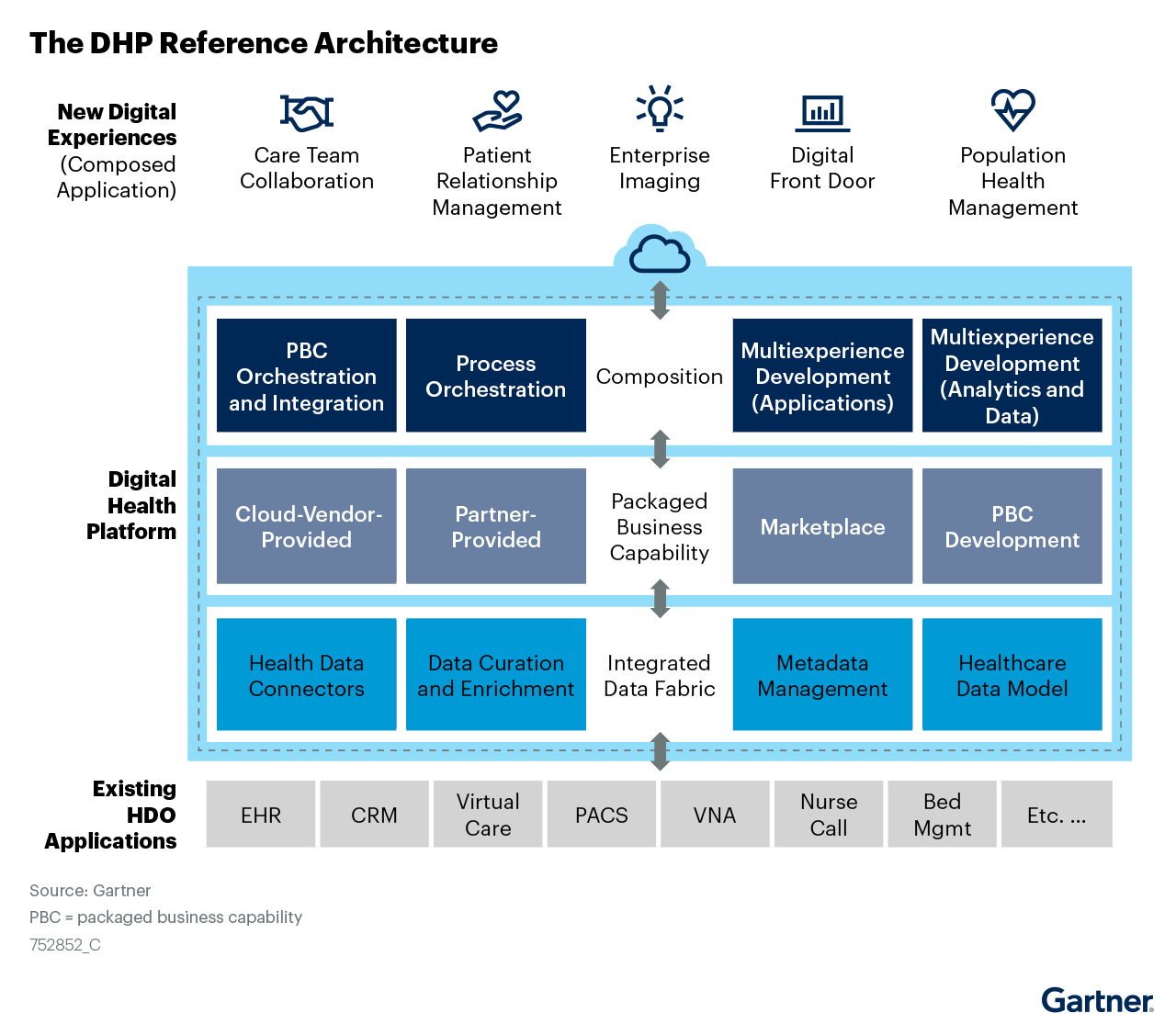
DHP technologies and services, when properly deployed, enable healthcare organizations to be more proactive and agile in how they source and implement new business capabilities in support of digital transformation and optimization. The DHP architectural approach represents a major shift in how provider organizations will build and buy applications and digital services. The vendors in the market offer elements enabling the DHP across three layers (see Figure 1).
These DHP-enabling elements include:
- An integrated data fabric layer that providers use to connect and interface with existing healthcare applications to deliver data and metadata management for the other layers.
- A packaged business capability layer where applications and data are repurposed using published APIs and/or standards-based interfaces. These PBCs become a library of business functions providers can draw from to orchestrate or compose into new applications. PBCs are provided directly by vendors or through application marketplaces, and can also be obtained from partners or custom developed by providers in-house using tools delivered within the composition layer.
- A composition layer where providers connect and orchestrate PBCs and data into new digital experiences that have much-improved user interfaces (UIs)/user experiences (UX). Providers create these end-to-end experiences to meet clinical or operational workflow needs and reduce screen time wherever possible. The composition layer includes tools that support low-code development and rapid deployment of new applications.
Figure 1: Digital Health Platform Reference Architecture
For provider CIOs, building such a platform architecture involves a variety of technologies and services. The companies featured in this research offer healthcare-industry-specific platforms that bring together required technologies into a bundle of products and services that can support this new architectural paradigm.
Today, not all products are comprehensive across all tiers. Product roadmaps for the vendors supporting the DHP approach often indicate plans where gaps in capability exist (e.g., many vendors in this Market Guide do not have low-code, no-code development for provider clinical informatics teams within the composition tier).
Market Direction
The market for DHP-enabling technologies and services has evolved rapidly during 2020 and 2021, accelerated in part by providers’ demand for new capabilities during the pandemic and their need to support a more integrated operating model for clinical service delivery. The DHP shift will emerge as the most cost-effective and technically efficient way to scale new digital capabilities within and across health ecosystems and will over time replace the monolithic era of the megasuite electronic health record (EHR).
Therefore, we expect that new investment by healthcare providers will shift from ongoing support and upgrades of core monolithic applications, such as the enterprise EHR, toward a more modular, interoperable cloud environment they can use to compose and deploy new application experiences. The challenge of managing EHR total cost of ownership will persist until healthcare providers address commercial and behavioral barriers that limit innovation or seek to monetize when and how information is shared outside the EHR.
Providers’ composition of new digital experiences for both patients and practitioners will be focused on use cases including advanced analytics (e.g., command centers), the use of ML/AI for clinical triage, and diagnostics and planning treatment. Other use cases will include clinical collaboration and administrative automation, virtual care including remote patient monitoring, patient engagement, and hybrid ways of working for healthcare staff.
Gartner believes this shift is underway as evidenced by these facts and our ongoing conversations with provider CIOs and other executives:
- Insights from Gartner’s healthcare provider CIO webinar in July 2021 indicated that 56% of attendees plan to leverage healthcare cloud to scale new capabilities or build new capabilities outside the EHR. In addition, 44% of respondents said they will continue to rely on their EHR vendors to provide new capabilities in the future. 1
- Gartner’s 2020 Building Digital Business Platforms survey found that the DHP technologies and services will become a predominant approach among provider CIOs to accelerate digital transformation and harness the value of existing investments.2 These include the following healthcare provider approaches:
- Increasing adoption of cloud-native application architecture, using API mediation to build their digital business platforms. 2
- Increasing development and use of data lakes and enabling predictive and prescriptive analytics.
- Deploying IoT platforms for connected medical devices.
- Providing new applications delivered over a range of channels and devices using multiexperience development platforms (MXDPs) and low-code application (LCAP) technologies.
Cloud Service Providers and EHR Vendors Are Starting to Become More Open
We are seeing healthcare providers increasingly making a shift to cloud. We have seen cloud service providers (CSPs) – such as Amazon Web Services (AWS), Google and Microsoft – position healthcare-provider-specific cloud software in response to provider’s needs. These healthcare-specific technologies and services include capabilities that increase data liquidity across operational systems and aim to solve one of the industry- defining problems – the limited interoperability and poor usability of core clinical systems of record.
A number of companies featured in this Market Guide have been leaders across other industries outside of healthcare or have delivered clinically focused digital healthcare products and services for some time. These organizations also help providers to navigate regulatory requirements across many global regions (e.g., GE Healthcare, Philips). These established healthcare IT vendors build from a large footprint through products spanning medical devices, imaging solutions, patient monitoring and, more recently, healthcare command centers.
Additionally, we have noted a refreshing change from the tightly controlled and highly monetized integration challenges we have seen with EHR megasuite vendors in the last decade. The strategic partnerships forming between the CSPs and health systems, such as Kaiser Permanente moving IT services to Microsoft Azure, indicate a willingness to be "all in" on public cloud and API-centric.
EHR Megasuite Vendor Aspirations Are Adjusting
EHR megasuite vendors are also starting to use public cloud to deploy new capabilities, although vendor opinions appear to vary on how the digital giants will influence healthcare (see quotes below). One example is Cerner’s shift to embracing cloud and its partnerships with Xealth to develop digital health solutions for clinicians. Also, Allscripts extended its partnership with Microsoft to enable cloud-based health IT solutions. In the next three years, we foresee more increased focus on capabilities outside the core EHR from the EHR vendors as they build on their core competencies of health record capture and data processing.
Market Analysis
DHP Architectural Approach Delivers Enterprise Outcomes
Healthcare provider CIOs, CTOs, CMIOs, CNIOs, enterprise architects, and data and analytics leaders will face a number of decisions when adopting a DHP approach and evaluating vendors. They will need to consider which solution type and, ultimately, which vendors are best suited to their clinical and business transformation and modernization needs. And they will need to be confident that the vendors they buy from share a common vision of a more open and integrated healthcare experience for patients and providers alike as the path to better health outcomes.
The CIO should work with the business and IT leaders to create a clear vision of what business goals and capabilities are needed over the course of a detailed five-year or more roadmap when adopting the DHP approach.
Typical goals will include:
- Increasing the resilience, adaptability and flexibility of the organization.
- Getting a higher return on investment in current applications, infrastructure and managed services.
- Delivering better digital experiences for stakeholders, particularly clinicians and patients.
- Levelling the playing field so that all vendors are required to provide comprehensive open APIs as a core competency.
- Using global and regional data terminologies and standards such as HL7, FHIR (R4), X12, LOINC and DICOM.
- Implementing a consistent approach to extracting data fluid and making it accessible.
- Complying with privacy, cyber regulation when making use of cloud services in combination with existing on-premises applications.
Once healthcare providers have prioritized their desired outcomes, they can evaluate vendors to determine which ones are in tune with their strategic objectives. Here we set out the essential capabilities provider CIOs should apply when evaluating vendors across each tier of the DHP architecture.
Integrated Data Fabric Layer – Key Criteria
The data fabric of the DHP provides a scalable data and integration capability for providers to improve care delivery workflow and decision making. The integrated data fabric layer enables the exchange and governance of data from disparate core applications and makes them ready for business use. It is not meant to replace a fully featured data fabric as defined in other Gartner research. This is, instead, a set of features required to accelerate healthcare use cases.
Key features of the DHP integrated data fabric layer are:
- Health data connectors using industry standards such as HL7 and FHIR. In addition, support for some proprietary or more basic forms of integration to extract and exchange data (such as supporting batch transfer or EHR overnight data extracts used to update proprietary EHR BI tools)
- Data curation and enrichment services that standardize and normalize incoming data, including patient de-identification and other data transformation tools
- Metadata management services that manage the flow of data and metadata in preparing data for reuse
- A healthcare-specific common data model for standard and custom objects that facilitate interoperability (for example, EHR clinical data)
- The ability to retain consent and privacy flags that patients have provided, which exist in operational systems that must be honored if PHI legislative compliance is required (such as HIPAA and GDPR)
CIOs should review their existing data fabric capabilities and determine the level and type of integration support that current line-of-business systems possess (such as EHR, PACS/RIS or VNA, RCM, patient CRM). Capture the costs of current integration as this will prove useful in justifying future investment with a view to simplifying and reducing current integration complexity and costs.
Expect your existing vendors to reduce integration complexity and costs, and leverage new purchase cycles to evaluate potential vendors on how they charge for or facilitate EHR integration also with a focus on cost and complexity reduction.
Packaged Business Capabilities and Application Modules – Key Criteria
Many vendors, including Microsoft, Philips and IBM, supply prebuilt healthcare-specific applications and present them as software as a service (SaaS) tools, often through their application marketplace. Some of those applications encapsulate a specific business functionality, a process or an analytical algorithm. These current capabilities from some vendors align to Gartner’s definition of a PBC. At the current evolving stage of market development, it is clear that DHP-oriented vendors are for the most part looking to provide modular, autonomous and discoverable building blocks that are specific to healthcare (e.g., a clinical diagnostic algorithm or virtual health assistant). These building blocks are also designed to be assembled by provider organizations into a new application experience, or integrated into an existing one, through APIs and event interfaces.
For example:
- AWS offers Amazon Comprehend Medical that uses machine learning (ML) to extract knowledge from clinical notes and free text. Vancouver General Hospital (VGH) and University of British Columbia (UBC) have been using the service to create their own machine learning models that can triage x-rays to provide a better healthcare experience.
- Microsoft Cloud for Healthcare offers the AI-powered Azure Health Bot as a conversational interface for patients. The CDC in the U.S. used the Azure chatbot to create a COVID-19 symptom checker.
- Salesforce Health Cloud offers Patient 360 for displaying longitudinal patient information, which was adopted by the State of California for COVID-19 vaccination.
- Philips HealthSuite Digital Platform offers Oncology Informatics, which provides an end-to-end oncology care pathway that Dana-Farber Cancer Institute has deployed.
- IBM offers Watson Change detection, which is an ML system for identifying cost drivers in relation to healthcare data.
- GE offers a breast cancer negative scoring algorithm that can be embedded within a clinical diagnostic workflow through APIs.
Today, vendor offerings are at various stages of development across all three tiers of Gartner’s DHP reference architecture. Typical gaps today include nascent composition tooling for creating better user experiences or limitations in the ways technical capabilities have been packaged, or are capable of being used, as building blocks for composed application experiences. For example, some capabilities are only being offered as a SaaS product with little ability for reuse or are lacking in modularity and open APIs.
CIOs should give preference to those technologies and services that feature business- centric software modularity and autonomy in their design, and expect developing vendor platforms to provide open APIs that give access to their application functionality and data fabric.
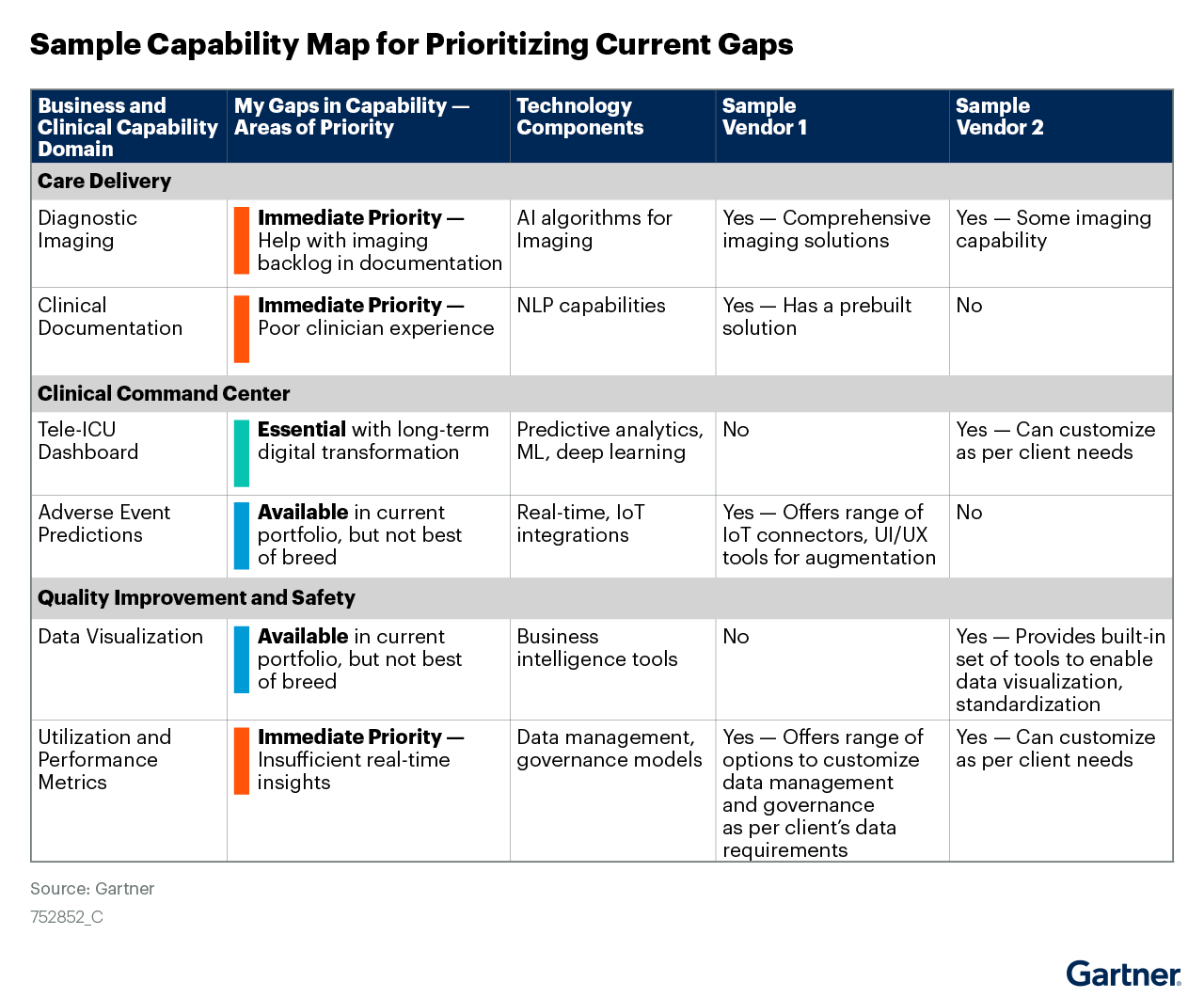
It is also important that CIOs have a good understanding of the capabilities needed to enable both short- and medium-term digital transformation goals for their organization (see Figure 2). Use Gartner’s capability mapping approach to identify current gaps and assess which vendor products and product roadmaps are most likely to meet your organization’s priorities.
Figure 2: Sample Capability Map for Prioritizing Current Gaps
Composition Tools – Key Criteria
The composition layer supports provider organizations’ shift toward the use of fusion teams to design, build and operate better patient and clinician experiences tailored for specific groups of users. The discipline and skills of composition focus on delivering satisfying and intuitive application experiences that meet end-user preferences across delivery channels and devices.
Multiexperience development platforms for both applications and analytics reside in this composition layer. Vendors typically supply composition layer tools as part of the DHP technology and services bundle.
The vendors evaluated in this Market Guide have composition tools and services that span:
- API orchestration for designing and building, or connecting SMART on FHIR apps.
- User interface design (for example, embedding workflow with a collaboration tool such as Microsoft Teams or creating new patient forms)
- LCAP for facilitating not only technical roles, but also business and clinical IT roles
- Event-driven APIs to facilitate event management
Today, these tools are typically used by technical IT professionals and not their business peers. But Gartner believes the market will evolve such that vendors make composition tools more usable by broader roles within healthcare provider organizations (e.g., clinical informaticians). Composability, thus, will become more readily available to and achievable by a range of stakeholders.
CIOs should evaluate vendors based on how often and how many of their customers extensively rely on their composition capabilities. When evaluating vendors, factor in whether your in-house application development team has access to the tools and the skill set needed to work with business units to create new digital experiences on demand. Assess if the presence of composition tools such as LCAP and MXDP make it easier for your organization to deliver customized digital experiences.
Representative Vendors
The vendors listed in this Market Guide do not imply an exhaustive list. This section is intended to provide more understanding of the market and its offerings.
Market Introduction
In this research, we provide detailed profiles of vendors enabling the digital health platform that participated in Gartner’s 2021 Market Guide for Digital Health Platform Survey conducted in June 2021 (see Note 1). For additional details on vendor capabilities, see the Appendix section.
Table 1: Representative Vendors in Digital Health Platform for Healthcare Providers
| Vendor Name | Product/Service/Solution Name | Solution Availability Across Regions | |||||
|---|---|---|---|---|---|---|---|
| North America | Latin America | Western Europe | Eastern Europe | APAC | EMEA | ||
| Amazon Web Services (AWS) | AWS for Health | ✔ | ✔ | ✔ | ✔ | ✔ | ✔ |
| GE Healthcare | Edison Health Services | ✔ | — | ✔ | ✔ | ✔ | — |
| Google Cloud | Google Cloud Platform – For Healthcare and Life Sciences | ✔ | ✔ | ✔ | ✔ | ✔ | ✔ |
| IBM | IBM Health Data Connect | ✔ | ✔ | ✔ | ✔ | ✔ | ✔ |
| InterSystems | InterSystems Data Platform | ✔ | ✔ | ✔ | ✔ | ✔ | ✔ |
| Microsoft | Microsoft Cloud for Healthcare | ✔ | ✔ | ✔ | ✔ | ✔ | ✔ |
| NTT DATA | Nucleus for Healthcare | ✔ | — | — | — | — | — |
| Philips | Philips HealthSuite | ✔ | ✔ | ✔ | ✔ | ✔ | ✔ |
| Salesforce | Salesforce Health Cloud | ✔ | ✔ | ✔ | ✔ | ✔ | ✔ |
| SAS | SAS Health on SAS Viya | ✔ | ✔ | ✔ | ✔ | ✔ | ✔ |
| ServiceNow | Healthcare and Life Sciences Service Management, EMR Help | ✔ | ✔ | ✔ | ✔ | ✔ | ✔ |
Vendor Profiles
Amazon Web Services
Headquarters: Seattle, Washington, U.S.
Ownership: Public
Licensing Model: Pay per use, consumption-based billing
Summary: Amazon Web Services (AWS) has an extensive and broad set of on-demand technologies and capabilities that make up its AWS for Health Platform, including Amazon HealthLake (i.e., Data Lake and Analytics). HealthLake APIs enable the user to aggregate patient reports and notes into the HealthLake. The data will need to be converted to the FHIR R4 format prior to ingesting into HealthLake, and AWS points to its partners to help achieve that conversion. HealthLake uses machine learning to extract meaningful medical information from the aggregated data, such as medications, procedures and diagnoses. The more data added to HealthLake the better the longitudinal view becomes for each patient. As with all AWS products, HealthLake follows a standard metered pay-as-you-go model, so there are no upfront costs, and although there is no long- term financial commitment, as with any move from one provider to another, there could be significant costs.
Data Fabric: The AWS HealthLake provides a comprehensive set of data fabric capabilities. The data model is FHIR R4-compliant, and incoming data will need to be at this level before using an API to load. If data is not at FHIR R4, then it will need to be converted using one of AWS’s partners. AWS does not provide DICOM connectors but instead says it would work with third parties to ensure that AWS APIs integrate with their existing tools.
HealthLake provides the organizing, indexing and structuring healthcare information and the service provides appropriate extensibility with its APIs. HealthLake currently has 71 FHIR resource types for its data stores and makes them available for analysis to support population health management, improve quality of care and improve DHO efficiency.
Supporting a rich set of metadata management capabilities, AWS Glue provides and supports both visual and code-based interfaces. AWS has a multifaceted approach to AI/ML services, allowing customers to work with the building blocks, such as TensorFlow, PyTorch and MXNet. They can work up to full-stack development of models using Amazon SageMaker and extending to stateless API-accessed managed services such as Amazon Comprehend Medical.
Packaged Business Capabilities and Application Modules Include: HealthLake makes good use of the rich AWS ecosystem to provide packaged business capabilities covering data and analytics functions, the clinical care process and telehealth. However, these are tools to build packaged business capabilities. AWS provides PBCs such as:
- Amazon Transcribe Medical
- Amazon Comprehend Medical
- Amazon Textract
- Amazon Lex
- Amazon Polly for text to speech
- Amazon Chime SDK for building additional telehealth, virtual care or remote capabilities
Composition Tools: Amazon builds on its wider technology capabilities to provide multiexperience development tools and no-code/low-code tools – as a part of Amazon QuickSight service. AWS services such as AWS Amplify and Amazon Honeycode provide low-code/no-code capabilities and Buildbot web and mobile applications. Again, this needs cloud development capability in order to make use of and build usable products. Amazon has a large and wide partner network and a healthy growth partnership pipeline.
GE Healthcare
Headquarters: Boston, Massachusetts, U.S.
Ownership: Public
Licensing Model: Subscription
Summary: GE Healthcare’s mission is to help create a healthier world with more precise and efficient care through its products and services. To that end, the Edison Intelligence Platform (EIP) is a comprehensive realization of a DHP architecture. It has strong representation across all three tiers. Established services span connected devices, D&A, AI/ML tools and a range of PBCs. GE has a particular focus on clinical specialties and disease modalities.
GE Healthcare sells direct to healthcare providers, and there is an application marketplace. Strategic partnerships with cloud providers currently include AWS, with the ability to support other cloud platforms and multicloud environments on the roadmap. In addition, the platform is available on-premises to support virtualized and distributed healthcare delivery models that fit the customer’s preference.
Data Fabric: The data fabric supports bidirectional exchange using industry standards and open APIs. Custom APIs are possible where unique formats or mapping are required. Data management tools can be used to create data pipelines to support automated data transformation. The platform supports common data models such as OMOP and i2B2. Data can be persisted using FHIR, HL7, IHE, XDS and modality-specific models. Customers can extend these capabilities to support their own models through additional GE services. The GE tools are a combination of GE tools and third-party software. Edison works with existing leading metadata tools (such as Collibra, Informatica) as it does not contain a native capability. The future roadmap is expected to support digital pathology, consumer healthcare wearables and behavioral data.
Packaged Business Capabilities and Application Modules Include:
- Breast cancer negative scoring API
- ICU dashboards and data management
- A longitudinal clinical record viewer
- Advanced imaging visualization (imaging fabric)
- NLP for clinical context
- Prebuilt capabilities for oncology, cardiology, MSK and neurology, or for modality (such as CT, MR, SR)
Virtual care is facilitated by Mural, an Edison Platform-hosted offering for virtual care application, which enables inpatient virtual care. The device-agnostic platform integrates data from multiple systems and devices to provide real-time insights. The solution can support virtual care across a single care area (e.g., eICU) or multiple care areas, and across an entire hospital or health system as well.
Composition Tools: Edison provides a set of healthcare-specific building blocks (represented as microservices) and the tools to orchestrate those building blocks into clinical workflows. Composition tools support clinical workflow prioritization and scheduling (such as image prioritization). The design platform currently supports plugging in SMART on FHIR apps. No-code and low-code tools are planned on the future roadmap, and GE is actively containerizing its many software components to support an API-driven, composable DHP architecture.
Google Cloud
Headquarters: Mountain View, California, U.S.
Ownership: Public
Licensing Model: Subscription, pay per use, consumption-based billing, per user/per month, perpetual license
Summary: Google Cloud’s solutions for healthcare and life sciences enable organizations to evolve the care paradigm, advance research at scale, optimize operations and manufacturing, and empower everyone in the organization to innovate and transform.
Google healthcare-specific cloud offerings include the recently launched Healthcare Data Engine (available in private preview as of now). This offering aims to harmonize data from multiple sources – including medical records, claims, clinical trials and research data – allowing operational leaders, doctors, researchers and clinicians to gain real-time holistic views of records at a glance. Healthcare Data Engine builds and extends on the existing Google Cloud Healthcare API. It makes healthcare data more useful by enabling an interoperable, longitudinal record of patient data, and by providing clinical insights in FHIR format. It also includes BigQuery, a planetary-scale database with full support for HL7 v2 and FHIR v4 data standards, as well as HIPAA compliance. Google Cloud’s data, analytics and AI offerings offer custom technologies for clinical and operational settings, and built-in partnership with Google Cloud’s Office of the CTO and Google Cloud Professional Services. The private preview of Healthcare Data Engine is available through private partners such as Deloitte, Maven Wave and Quantiph.
Data Fabric: Healthcare Data Engine supports a wide range of data connectors, such as FHIR through Cloud Data Fusion, and DICOM connectors via the open-source DICOM web. It leverages BigQuery analytics and artificial intelligence to process large datasets. The Cloud Healthcare API’s de-identification search capability detects sensitive data in DICOM instances and FHIR resources, such as protected health information (PHI), and then uses a de-identification transformation to mask, delete or otherwise obscure the data. Data harmonization and reconciliation run on the Google Kubernetes Engine. NLP and ML capability enable data curation and enrichment. Google’s cloud SQL relational database offers data catalogs. Data discovery is offered under Healthcare Natural Language API and Google’s AutoML. Business intelligence and visualization are enabled by the Looker BI platform.
Packaged Business Capabilities and Application Modules Include:
- Contact Center AI
- Rapid Response Virtual Agent
- Population Health
- Visualization of healthcare services (powered by Google Maps)
- Resource Alignment
- Patient 360 View and Patient Flow
Virtual care capabilities are enabled through its partnership with Amwell.
Composition Tools: Google Cloud composition capabilities are focused on application developers and cloud architects, as well as healthcare business IT teams. Low-code/no- code capability is offered under the Appsheet development platform. Apigee API Management provides data and event orchestration capability.
IBM
Headquarters: New York, New York, U.S.
Ownership: Public
Licensing Model: Subscription, pay per use, consumption-based billing, per user/per month, perpetual license
Summary: IBM Watson Health focuses on accelerating digital transformation for healthcare enterprises with the power of hybrid cloud, AI and client-value-oriented services. Watson Health offers a range of tools and capabilities to unlock value from healthcare data, reinvent processes and accelerate predictive business.
Watson Health leverages a mix of native and open-source resources to enable healthcare providers to become composable. In order to operate in evolving healthcare ecosystems, Watson Health aims to leverage partners. It offers integrations with all leading EHR vendors, along with focus on PACS and reporting information systems vendors as well. Most of its recent partnerships are focused on areas such as medical imaging (IBM AI Imaging Marketplace), patient engagement communication (IBM Phytel and Genesys) and population health management.
Data Fabric: With its Health Data Connect capabilities, Watson Health supports HL7 and FHIR standards, and facilitates custom integrations via both EHRs and IoT connectors. DICOM connectors are a part of the upcoming product roadmap. Watson Health leverages a mix of native and open-source projects to facilitate data curation. Projects include LinuxForHealth, Project Alvearie for AI and analytics, and the IBM FHIR Server. For metadata management, IBM Watson Health offers a Watson Knowledge Catalog that enables an enterprise metadata repository, which enables users to access, curate, categorize and share data, knowledge assets and their relationships, and support virtual care. IBM Watson Annotator for Clinical Data enables enrichment of unstructured healthcare data. Watson Health brings in a strong suite of NLP, AI, data and analytics, and BI capabilities built in-house. It offers an FHIR v4-based Common Data Model (CDM) under its Project Alvearie.
Packaged Business Capabilities and Application Modules Include:
- IBM Watson Annotator for Clinical Data
- Watson Change Detection
- Computer vision analytics for imaging workflow
- Health Insights and Healthcare Data Analytics as a service
- Price transparency tools
- Chatbots for understanding health plan benefits
Virtual care is supported via IBM’s LinuxForHealth, which is an open-source distributed processing network system. It enables third-party applications, such as video meetings and remote patient monitoring, by utilizing components within Health Data Connect, to facilitate seamless integration across deployments on any platform (mainframes, embedded devices, multicloud and LinuxONE).
Composition Tools: Watson Health’s composition tools are focused on data scientists, data engineers and data analysts. Most of the composition tools are for use by IBM internal staff and consultants currently. It offers Analytics Workbench, a healthcare- infused data science environment, which enables users to access, curate and share data along with data orchestration and data science tools enabling internal collaboration. For scenarios like rapid application development, a developer use-case-specific health pattern library, along with a GitHub library, is available within the open-source Project Alvearie. External users can leverage some of these capabilities through the IBM Cloud Paks for Data.
InterSystems
Headquarters: Cambridge, Massachusetts, U.S.
Ownership: Private
Licensing Model: Subscription, pay per use, consumption-based billing, per user/per month, perpetual license
Summary: InterSystems IRIS for Health and HealthShare combine to address the DHP architectural approach in an offering built for health organizations to harness the power of the data within operational clinical and business systems. The vast majority of capabilities are native within the product, although InterSystems does partner with other solution providers to augment its in-house built solution where appropriate. InterSystems main channels are direct to healthcare providers, through cloud partnerships (such as with AWS, Azure and GCP), and through partners such as Epic and 3M that utilize the InterSystems platform to enable their own products.
Another noteworthy partnership is with MediWay Technology to underpin the iMedical healthcare cloud solution in the Chinese HIT market. Recent partnerships have been formed with Apple (including Apple Health certification) and with AWS (in support of the AWS HealthLake product and services).
Data Fabric: The data fabric includes a broad set of bidirectional data connectors that span healthcare and generic protocols, formats and standards for structured and unstructured data. A unique feature is the native canonical healthcare-specific data model – Summary Document Architecture (SDA). This helps an organization or wider ecosystem achieve semantic interoperability across operational systems. The SDA is also available via a transformation-as-a-service model. The SDA is extensible, allowing users to add archetypes should they find that the core SDA does not meet a requirement. The IRIS solution supports industry-specific open data models such as OMOP and i2B2.
The product will work with external metadata management tools, as the native metadata capability is focused only on patient data. Other capabilities include NLP, BI and reporting tools, predictive modelling, AutoML, Spark connectivity, and an ML toolkit. InterSystems also provides tools for de-identification, data scientist services and data virtualization through partners.
Packaged Business Capabilities and Application Modules Include:
- Extended Master Patient Index and Provider Directory (EMPI)
- Dynamic clinical cohorts to visualize patient cohorts
- Advanced clinical notifications
- A longitudinal clinical record viewer
- Patient engagement, care planning and coordination
- API management
Customers have used the API features to integrate clinical data, analytics and other capabilities into the Microsoft Teams environment.
Composition Tools: The products support composition through API development tools, event stream handling (such as for IoT medical-grade/consumer-grade devices), and message routing (such as for clinical notification).
Microsoft
Headquarters: Redmond, Washington, U.S.
Ownership: Public
Licensing Model: Monthly fee per user plus cloud consumption
Summary: Microsoft Cloud for Healthcare provides capabilities to manage health data at scale and make it easier for healthcare organizations to improve the patient experience, coordinate care and drive operational efficiency while helping support security, compliance and interoperability of health data.
Microsoft has taken its strong lineup of existing platform offerings, such as Azure, Microsoft 365, Dynamics 365 and Power Platform, and enabled them to serve the healthcare market through enhanced data services. Microsoft thoroughly embraces FHIR in the entire Cloud for Healthcare stack as both a data model and an API, which is a bet on the continued importance of that standard in the future of healthcare interoperability. The Azure API stack fully supports the ingestion of all healthcare data types including IoT devices. Once in Azure, users have access to a powerful lineup of data and metadata management tools including graph databases. Healthcare-specific PBCs include Microsoft’s popular Azure Health Bot, which is in use by more than 6,000 customers and care management dashboards and analytics. Microsoft seems far ahead of competitors on low-code/no-code composition by leveraging its Power Platform and Azure Logic Apps. This could be its secret weapon for winning the provider market, where software development skills are not commonly found.Data Fabric: Microsoft Cloud for Healthcare is anchored by Azure at its base, and hence the many data management tools available are here for healthcare. Microsoft Cloud for Healthcare includes the healthcare data model for Dynamics 365 and Microsoft Dataverse, which is based on the FHIR standards framework. In addition, the Azure API for FHIRingests multiple data types (native FHIR, HL7, CCDA, DICOM, IOT devices) and places them in a unified FHIR-based data store. As in other market offerings, FHIR is the standard for the Cloud for Healthcare data model. The Azure API for FHIR is persistent throughout the stack to allow sharing of data bidirectionally. Other notable Azure tools include Purview for data governance and metadata management, Synapse for analytics, Azure ML and Azure AI, and even a NoSQL graph database with Cosmos DB. Synapse supports an ecosystem of machine learning and advanced analytics tools such as support for Dataiku, MathWorks (MATLAB) and Qubole.
Packaged Business Capabilities and Application Modules Include:
- Azure Health Bot
- Care Management
- Patient Access, Outreach and Service Center
- PowerBI and the PowerBI Marketplace (for analytics and business intelligence)
- Microsoft 365 (includes Microsoft Teams)
- Operational and clinical analytics
Composition Tools: Microsoft Cloud for Healthcare demonstrates a broad set of composition tools, with deep coverage for data and analytics. Significant capabilities for business intelligence are naturally found inside PowerBI. Moreover, advanced analytics for big data query and modeling are supplied by Azure SQL, Azure Synapse and Azure Data Explorer. Application composition is enabled through Visual Studio, Power Platform and Azure Logic Apps. Azure Logic Apps automates and schedules workflows to integrate apps, data, services and systems using little to no code. Overall, the width and depth of tools for composing both analytics and applications give Microsoft a leading position. Composition tools could be its best differentiation for winning the provider market, where software development skills are not commonly found.
NTT DATA
Headquarters: Tokyo, Japan
Ownership: Public
Licensing Model: Subscription
Summary: NTT DATA Nucleus for Healthcare is a framework developed through an alliance of healthcare partners including Teladoc Health, R1 RCM, Enli and VisitPay to create a digital framework that allows for interchangeable technologies as clinical and business needs change. Nucleus is a cloud-based platform providing data integration, automation and AI capabilities. Although Nucleus leverages native Azure, some customers have deployed some components on AWS and Google Cloud.
Licensing of the Nucleus platform is based on three tiers. The core tier is subscription- based and prices depend on the size of the organization. The application tier provides access to the application market and is priced based on the number of third-party applications required by the customer. The top tier provides capabilities facilitating digital front door, clinical engagement and provider analytics, and is priced based on which modules are selected. All tiers have an implementation cost and a monthly subscription or maintenance fee.
Nucleus for Healthcare does have identity and consent management capabilities. However, for most functionalities, Nucleus for Healthcare leverages the identity and consent from the EMR, if those functionalities are core to the EMR.
Data Fabric: Nucleus provides a wide range of data fabric capabilities directly or through a third party. The data model is fully FHIR-compliant and supported by ingestion accelerators for HL7, DICOM, SDOH and IoT. Data exchange for inbound (data from EMRs) and outbound messages (data from the digital front door such as scheduling or telehealth systems) is provided through FHIR-compliant APIs.
The core platform provides the key technologies for data curation tools including standardization, normalization and encryption. De-identification tools are provided by integrating third-party vendors. The platform metadata management tools such as the data catalog are built out of Microsoft Azure.
The AI/ML services, which are also provided through Azure, provide a collection of tools including risk stratification and predictive clinical management tools for conditions such as sepsis management.
Packaged Business Capabilities and Application Modules Include: The Nucleus platform has a strong set of packaged business capabilities that provide general data analytics functions and clinical care process tools. Specifically, these PBCs include:
- Population health management
- Clinical engagement
- Financial and operational metrics
- Data integration and visualization
- Psychographic segmentation
- Next best action using AI models
Composition Tools: The architecture of the solution supports composability and can leverage multiexperience tools for data analytics and development tools for applications, However, the platform does not provide user-facing low-code/no-code capabilities. The Nucleus integration layer consisting of data services and app integration including APIs can be redeployed using various enterprise service bus (ESB) technologies.
Philips
Headquarters: Amsterdam, Netherlands
Ownership: Public
Licensing Model: Consumption-based billing
Summary: The Philips HealthSuite platform aims to liberate, store, integrate and enable actionable insights on data from disparate functions, and accelerate development of digital propositions across the care continuum with common and domain-specific platform capabilities.
The HealthSuite platform is built on AWS, with cloud application support from Cloud Foundry and other third-party tools. Most of the clinical capabilities are native to Philips, and a few general-purpose AI capabilities come from AWS SageMaker. Philips has a large footprint inside the walls of the hospital across the globe, so apart from cloud services, HealthSuite also includes its edge offering to provide secure connectivity from the hospital premises directly to the cloud. HealthSuite’s recent partnerships focus on medical device integrations (patient monitoring, imaging, home healthcare) with a vision of extending the breadth and depth of clinical and device data and capabilities for providing actionable clinical insights on those data.
Data Fabric: HealthSuite offers a wide range of healthcare connectors for different data types: ioBridge, DICOM, Connect IoT and Data Ingestion capabilities. It offers a range of data curation tools such as HealthSuite Data Processing Framework, Clinical Data Repository and the unique HealthSuite Information Language System (ILS). In addition, Philips’ clinical data lake facilitates metadata management. HealthSuite offers a range of capabilities to facilitate AI and analytics life cycles such as Data Preparation for Analytics and the Algorithm Development and Training Environments. Advanced AI and analytics suites include capabilities like annotation, auto-labeling, federated learning and de- identification capabilities. HealthSuite supports a range of open common data model standards and also offers its own clinical indication-specific data models (such as for oncology, cardiology).
Packaged Business Capabilities and Application Modules Include: Philips HealthSuite has a wide range of PBCs within the engagement layer, including:
- Oncology Informatics
- eCareCoordinator
- VitalHealth Insights
- Image quality scores in diagnostic x-rays
- IntelliView Alarm Advisor
- Performance Optimization and Utilization Scores
Virtual care, such as video consultations and remote patient monitoring, is a widely supported wide range of COTS offerings, along with proprietary integrations, device management, IoT capabilities, edge/gateway devices, and API management.
Composition Tools: Composition capabilities target application developers and cloud architects primarily. HealthSuite’s API management offers capabilities for third-party apps to communicate and exchange information with Philips and other third-party apps. Apart from cloud services, HealthSuite also includes its edge offering to provide secure connectivity from the hospital premises directly to the cloud. No-code/low-code capabilities are available for customers for specific use cases only (such as care pathway configurations).
Salesforce
Headquarters: San Francisco, California, U.S.
Ownership: Public
Licensing Model: Monthly fee per user
Summary: Salesforce Health Cloud connects people, data and processes for better healthcare outcomes. The solution aims to deliver personalized digital-first experiences at scale with a 360-degree patient view that can be expanded and customized by business users using a low-code/no-code approach.
Salesforce differentiates in the digital health platform space with an emphasis on the data fabric layer, with notable capabilities to connect across many data sources, both healthcare-specific and general business. Notable capabilities are the well-known and broadly implemented Tableau tools for data visualization and Patient360, its tool for viewing longitudinal patient information. The Health Cloud benefits greatly from the low- code and multiexperience tools available to general users of Salesforce’s CRM solution, which significantly lowers the bar for nonprofessional developers to become proficient solution builders.
Data Fabric: Health Cloud users will find an abundance of tools and APIs that range from those targeted at developers to others that are low-code. Between MuleSoft Composer and Salesforce Data Pipelines, users have access to out-of-the-box connectors for data integration, augmentation and enrichment across healthcare standards (HL7 v2, FHIR, X12). They also have access to other sources like Slack, NetSuite, Workday, Heroku Postgres, AWS, Azure and Snowflake. Capabilities include a click-based ETL tool for manipulating records across data stores, then writing the results back to Salesforce, ensuring that incoming external data is transformed to fit existing schema. Custom integrations can be built and exposed with low-code tools such as Salesforce Flows, External Service and Lightning App Builder. Users have access to the proprietary Apex object-oriented programming language for executing and controlling data flow in and out of the platform. While the Health Cloud’s data model is FHIR R4, it does not support FHIR APIs for data retrieval (unless the MuleSoft API is configured to do so).
Packaged Business Capabilities and Application Modules Include: Salesforce Health Cloud has a number of capabilities for both data visualization and analytics and for applications that enable communications. Its PBCs and application capabilities include:
- Einstein Discovery for analytics
- Tableau CRM for Healthcare, which includes over 20 dashboards
- Patient 360
- Prediction Builder
- Einstein chatbots, chatter messaging
- Remote patient monitoring framework (support for IoT devices including Apple Watch and Fitbit)
Composition Tools: The solution supports composition through a mix of low-code and developer-targeted tools. The Salesforce Platform uses low-code and no-code tools to create, customize and ship apps and digital experiences. MuleSoft Composer and API management capabilities are low-code integration tools that link the Salesforce Platform with MuleSoft. Salesforce Flow encompasses building, managing and running flows and processes. Support for event-driven APIs is powered through Platform Events, Change Data Capture, the Streaming API, Apache Kafka, RabbitMQ, Storm, MapR, Kinesis and others.
SAS
Headquarters: Cary, North Carolina, U.S.
Ownership: Private
Licensing Model(s): Subscription, pay per use, perpetual license
Summary: SAS provides a healthcare-specific cloud-ready environment to help organizations harness the power of data through advanced analytical capabilities that drive better patient outcomes and experiences. The platform combines a comprehensive data fabric layer offering both generic and health-specific connectors and data management tools alongside a range of prebuilt models for epidemiology, public health and clinical risk analysis, predictive analytics, and healthcare performance.
SAS’s main channels are direct to healthcare payers, providers and governments through regional partners that act as managed analytics service providers (MASPs) adding their own IP to the SAS for healthcare platform. SAS is able to ingest and augment data from the major EHR providers and has built those integrations in conjunction with end-user clients. SAS has a global partnership with Microsoft to utilize Azure and integrate with Power Platform and Dynamics 365. Other partnerships exist with a range of global system integrators (GSIs), and technology partners such as NVIDIA, Intel and AWS.
Data Fabric: The data fabric and derived models are perhaps SAS’s most powerful nonhuman asset. It contains over 40 connectors into more than 80 data sources, and the Microsoft partnership adds more healthcare-specific capabilities via the Azure healthcare APIs. SAS supports data quality audit and improvement, de-identification, standardization, normalization, parsing, and matching. ML and AI tools are used to help prepare data. The SAS data fabric does not have a proprietary or open clinical data model but can be used to prepare data for downstream exchange ingestion or analysis. The product supports metadata management and can deliver metadata bridges to import third-party metadata.
Packaged Business Capabilities and Application Modules Include:
- Clinical risk adjustment models
- Insights into avoidable complications, avoidable readmissions, length-of-stay optimization
- Cost of care and utilization of care
- Epidemiological views of prevalence and incidence of disease and determinants
Domain models will be able to make use of a range of AI/ML-native capabilities such as NLP, computer vision and deep learning to augment human clinical and business decision making.
Composition Tools: Composition is achieved via SAS tools and SAS consulting services. Tools are focused on the production of insights and reports by data scientists and analysts (such as clinical dashboards, EHR workflow integration of risk and predictive models). Models can be composed for infection prevention, antibiotic stewardship, epidemiology and help with care pathway optimization. SAS supports what-if analysis to understand the impact of policy and clinical care interventions at the population health level. Composition tools support models trained in open-source frameworks, a developer community and the ability to integrate with EMRs and billing systems. The platform supports both SOAP and RESTful web service access either directly from other systems or via an enterprise service bus (ESB).
ServiceNow
Headquarters: Santa Clara, California, U.S.
Ownership: Public
Licensing Model: Monthly fee per user plus cloud consumption
Summary: ServiceNow wants to make healthcare more human by connecting teams, streamlining processes and securely integrating systems so providers can change lives for the better. ServiceNow is best known for its service management technologies, which are commonly used by healthcare providers as such. Its Now Platform is included in this Market Guide because it occupies a unique space in creating a composable enterprise.
ServiceNow differentiates by focusing on workflows – the orchestration of people, data and applications needed to execute a particular task. The Now Platform is not built on a foundation of data management like others in the market. Its data fabric capabilities are limited, with data connectors only for essential elements for its FHIR-based data model. Users will not find any tools for data curation or metadata management, but they do have access to the core relational database where they can use third-party tools to manipulate data elements directly.
PBCs are few, but include a "Patient 360" function that gathers and routes data to and from disparate applications, plus essential data and analytic PBCs for creating dashboards and basic visualizations. This is coupled with ServiceNow’s composition tool (App Engine Studio), which is a low-code approach to building workflows. In this sense, the Now Platform is not an API orchestrator, but a people workflow orchestrator that routes tasks and data to various software systems to execute a specific task. Its low-code tool is a practical tool for creating new workflows and custom-built data forms.
Data Fabric: The Now Platform does not purport to be or support a healthcare data lake, thus capabilities are limited to those from its partner Redox to support HL7 FHIR. The platform supports an HL7 FHIR data model as an extension of ServiceNow’s existing customer service model. There are no data management services, although ServiceNow exposes the configuration management database (CMDB) at the core of the platform for custom development and integration.
Packaged Business Capabilities and Application Modules Include:
- Patient 360
- Dashboards and data visualization tools
- Vaccine administration management
- Previsit management
- Patient support services
- Virtual agent chatbot
Composition Tools: The product supports composition through the App Engine Studio. This is a no-code authoring tool for editing data models, building forms from templates or building them from scratch. The composed workflows can incorporate and blend mobile and desktop experiences and thus eliminate paper-based processes.
Market Recommendations
- During vendor selection, prioritize the functional capabilities in the area most aligned to your specific use case. Some vendors offer strong prebuilt out-of-the-box capabilities. Others excel in facilitating collaboration between organizations, or offer better integration and reuse of your existing legacy IT systems. Some vendors may be offering capabilities via their partners, whereas for others many of the capabilities may be native to their platform.
- Evaluate vendors on their ability to provide platform configuration and integration with existing applications and data stores, and their ability to meet local regulatory requirements.
- Seek transparency on commercial terms for data reuse, product metering and pricing, and which services they provide directly, or via third-party partners.
- Understand the dynamics between pay-as-you go and enterprise license pricing and how that will drive TCO as you scale.
Acronym Key and Glossary Terms
Composable enterprise |
A composable enterprise is an organization that delivers business outcomes and adapts to the pace of business change. It does this through the assembly and combination of packaged business capabilities (PBCs). PBCs are application building blocks that have been purchased or developed. |
Multiexperience development platform (MXDP) |
A multiexperience development platform (MXDP) offers development teams an opinionated and integrated set of front- end development tools and “backends for frontends’ capabilities. It enables distributed and scalable development (both in teams and architecture) of fit-for-purpose apps across digital touchpoints and interaction modalities. |
Packaged business capabilities (PBCs) |
Packaged business capabilities (PBCs) are software components that represent a well-defined business capability, functionally recognizable as such by a business user. |
Low-code application platform (LCAP) |
A low-code application platform (LCAP) is an application platform that supports rapid application development, deployment, execution and management using declarative, high-level programming abstractions such as model-driven and metadata-based programming languages, and one-step deployments. LCAPs provide and support user interfaces (UIs), business processes and data services. |
Appendix: Additional Details on Vendor Capabilities
Table 2 outlines vendor capabilities across the data fabric layer of the digital health platform. It captures the presences of health data connectors, data curation and enrichment services, metadata management services, and healthcare common data models.
Table 2: Vendor Capabilities Across the Data Fabric Layer
| Vendor Name | Healthcare Data Connectors | Data Curation and Enrichment Services | Metadata Management Tools | Supports/Offers Healthcare Common Data Models | ||||||||
|---|---|---|---|---|---|---|---|---|---|---|---|---|
| FHIR | DICOM | IoT | Data De-Identification | Data Standardization | Data Normalization | Data Catalogs | Graph Technology | AI/ML for Active Meta-Analysis | Internal Data Model | Medical Specific* | Support for Open Standards** | |
| Amazon Web Services (AWS) | ✔ | — | ✔ | ✔ | ✔ | ✔ | ✔ | ✔ | ✔ | ✔ | — | ✔ |
| GE Healthcare | ✔ | ✔ | ✔ | ✔ | ✔ | ✔ | ✔ | — | ✔ | ✔ | ✔ | ✔ |
| Google Cloud | ✔ | ✔ | — | ✔ | ✔ | ✔ | ✔ | ✔ | ✔ | — | — | ✔ |
| IBM | ✔ | — | ✔ | ✔ | ✔ | ✔ | ✔ | ✔ | ✔ | ✔ | ✔ | ✔ |
| InterSystems | ✔ | ✔ | ✔ | ✔ | ✔ | ✔ | ✔ | — | — | ✔ | — | ✔ |
| Microsoft | ✔ | ✔ | ✔ | ✔ | ✔ | ✔ | ✔ | ✔ | ✔ | ✔ | — | ✔ |
| NTT DATA | ✔ | ✔ | ✔ | ✔ | ✔ | ✔ | ✔ | ✔ | ✔ | ✔ | — | ✔ |
| Philips | ✔ | ✔ | ✔ | ✔ | ✔ | ✔ | ✔ | ✔ | ✔ | — | ✔ | ✔ |
| Salesforce | ✔ | — | ✔ | ✔ | ✔ | ✔ | ✔ | — | ✔ | ✔ | — | ✔ |
| SAS | — | — | ✔ | ✔ | ✔ | ✔ | ✔ | ✔ | ✔ | — | — | ✔ |
| ServiceNow | ✔ | — | — | — | — | — | — | — | — | ✔ | — | ✔ |
| *Medical-speciality-specific common data includes oncology common data models, cardiology common data models **Supports any one or more than one of these open standards such as FHIR, OMOP, OpenEHR, IHE, STDM | ||||||||||||
Source: Gartner (October 2021)
Table 3 outlines vendor offerings across the packaged business capabilities layer. It includes insights on whether the vendor supports various healthcare/general prebuilt capabilities, along with capabilities supporting virtual care and patient-facing tools. The table also includes examples of popular PBCs offered by vendors.
Table 3: Examples of Vendors’ Capabilities to Offer Different Types of PBCs
| Vendor Name | Healthcare- Specific PBCs (1) | General-Purpose Data & Analytics Functions PBCs (2) | Clinical Care Process/Care Delivery PBCs (3) | PBCs to Be Directly Used by Patients/Consumers (4) | PBCs to Support Virtual Care (5) |
|---|---|---|---|---|---|
| Amazon Web Services (AWS) |
|
|
|
|
|
| GE Healthcare |
|
|
|
|
|
| Google Cloud |
|
|
|
|
|
| IBM |
|
|
|
|
|
| InterSystems |
|
|
|
|
|
| Microsoft |
|
|
|
|
|
| NTT DATA |
|
|
|
|
|
| Philips |
|
|
|
|
|
| Salesforce |
|
|
|
|
|
| SAS |
|
|
— | — | — |
| ServiceNow |
|
|
|
|
— |
| (1) Healthcare-specific prebuilt data and analytics function PBCs, such as population risk stratification, radiographic images coring, evaluation and management dashboards (2) General-purpose data and analytics function PBCs, such as data preparation (drag and drop, user-defined combination of data, building models from user-defined measures, sets and groups of hierarchies), data catalogs (ability to find and consume analytic content), management (track and govern usage), augmented insights (ML to automatically identify important attributes) (3) Prebuilt functions specific to clinical care process/care delivery PBCs, such as prebuilt tools/software/functions that support the clinical care process or any kind of patient care delivery process, chatbot service to support digital front door strategy, secure messaging for collaboration (4) PBCs to be directly used by patients/consumers, such as patient portal, mobile app, costing tools (5) PBCs to assist in virtual care, such as video meeting app, connectivity to medical devices to support remote monitoring | |||||
Source: Gartner (October 2021)
Table 4 outlines vendors’ capabilities to enable composition of new digital experiences. This refers to their ability to orchestrate, offering LCAP, MXDP capabilities, to allow business and end users to create much better software experiences by combining data from across various sources and PBCs together.
Table 4: Vendor Capabilities to Enable Composition of Digital Experiences
| Vendor Name | MXDP Tools for Data and Analytics* | MXDP Tools for Applications | No-Code/Low-Code Development Tools | Data Orchestration – API, Event Management |
|---|---|---|---|---|
| Amazon Web Services (AWS) | ✔ | ✔ | ✔ | ✔ |
| GE Healthcare | — | — | — | ✔ |
| Google Cloud | — | — | ✔ | ✔ |
| IBM | — | — | ✔ | ✔ |
| InterSystems | ✔ | ✔ | ✔ | ✔ |
| Microsoft | ✔ | ✔ | ✔ | ✔ |
| NTT DATA | ✔ | ✔ | — | ✔ |
| Philips | — | — | ✔ | ✔ |
| Salesforce | ✔ | ✔ | ✔ | ✔ |
| SAS | ✔ | ✔ | ✔ | — |
| ServiceNow | — | ✔ | ✔ | — |
| *MXDP = multiexperience development platform. Not all vendors fully support this capability across the entire spectrum. For more details on multiexperience development platforms, see Magic Quadrant for Multiexperience Development Platforms for a list of the most advanced vendors in this space. | ||||
Source: Gartner (October 2021)
Table 5 outlines the status of vendor compliance standards for healthcare-specific offerings. It also includes insights on the vendor’s ability to offer identity and consent management.
Table 5: Vendors’ Current Compliance Standards, Along With Ability to Facilitate Identity and Consent Management for Their Healthcare Cloud Offerings
| Vendor Name | Identity Management | Consent Management | HITRUST CSF | PCI DSS | ISO 27001 | EU GDPR | MARS-E | HIPAA | HITECH | NIST | SOC2 |
|---|---|---|---|---|---|---|---|---|---|---|---|
| Amazon Web Services (AWS) | — | — | ✔ | ✔ | ✔ | ✔ | — | ✔ | ✔ | ✔ | ✔ |
| GE Healthcare | ✔ | ✔ | — | — | — | ✔ | — | ✔ | — | ✔ | — |
| Google Cloud | ✔ | ✔ | ✔ | ✔ | ✔ | ✔ | — | ✔ | ✔ | ✔ | ✔ |
| IBM | ✔ | ✔ | ✔ | — | ✔ | ✔ | — | ✔ | ✔ | ✔ | ✔ |
| InterSystems | ✔ | ✔ | ✔ | ✔ | ✔ | ✔ | — | ✔ | ✔ | ✔ | ✔ |
| Microsoft | ✔ | ✔ | ✔ | ✔ | ✔ | ✔ | ✔ | ✔ | ✔ | ✔ | ✔ |
| NTT DATA | ✔ | ✔ | ✔ | — | — | — | — | ✔ | ✔ | ✔ | ✔ |
| Philips | ✔ | ✔ | ✔ | — | ✔ | ✔ | — | ✔ | — | ✔ | ✔ |
| Salesforce | — | — | ✔ | — | ✔ | ✔ | — | ✔ | — | — | ✔ |
| SAS | ✔ | — | — | — | ✔ | ✔ | — | ✔ | ✔ | ✔ | ✔ |
| ServiceNow | ✔ | ✔ | ✔ | — | — | — | — | ✔ | ✔ | ✔ | ✔ |
Source: Gartner (October 2021)
Evidence
Gartner’s 2020 Market Guide for Digital Health Platform Survey. In June 2021, Gartner conducted a survey of representative DHP technology and service vendors in the market. Unless otherwise stated, the charts and tables in this report are based on the self-reported survey data provided by these vendors in this market. As required by Gartner’s research methodology, vendors received a copy of the information for factual review prior to publication.
1 ESS Healthcare: The Digital Health Platform – How to Harness the Healthcare Cloud. In July 2021, Gartner conducted this Executive Programs webinar with approximately 60 healthcare provider CIOs across the U.S. During the webinar, Gartner conducted a poll question "Where do healthcare providers expect the majority of their future digital capabilities to come from?"
2 Gartner’s 2020 Building Digital Business Platforms Survey (Insights on Adoption Rate Section): This survey was conducted online from May through June 2020 among 206 respondents. Respondents worked for organizations in North America and Western Europe with at least $1 billion in annual revenue. Organizations were from the manufacturing and natural resources, communications, media, services, retail, banking and financial services, insurance, healthcare providers (n = 35), transportation, and utilities industries.
Organizations also had to be working on digital business efforts or have plans to do so, defined as involving IoT, delivery of public APIs and private/B2B APIs, or a combination thereof. Quotas were set to ensure a majority of organizations have a fully implemented digital business initiative. Respondents were required to have a job title of director or more senior, and to be involved in either digital business, data analytics, IoT or API-based platforms for partners. With respect to digital business initiatives, they were also required to have a role in either defining technology requirements, investigating or evaluating service providers, or making final decisions. The results of this study do not represent global findings or the market as a whole, but reflect the sentiment of the respondents and companies surveyed.
3 One Year Later: AWS Collaboration Driving Cerner’s Shift to a Digital Platform Company, Cerner.
4 How Cloud-Based Solutions Can Drive Innovation and Support Community Hospitals, Becker’s Hospital Review.
5 The Billionaire Who Controls Your Medical Records, Forbes.
Note 1
Representative Vendor Selection
The vendors listed in this section do not imply an exhaustive list. This section is intended to provide an understanding of the market and its offerings. There may be additional vendors that are relevant and suitable for you that have not been listed in this research. It is not, nor is it intended to be, a competitive analysis of the vendors discussed.
We included these vendors based on two key requirements:
- Offer healthcare-provider-specific healthcare cloud offerings
- Offer most of the capabilities across all three layers of the digital health platform reference architecture. The maturity of the capabilities may vary.
