A Practical Guide to Building Sovereign AI Cloud Platforms
Want to build compliant AI infrastructure, retaining full control of your data and tech stack?
Research from Gartner
Business Drivers for GenAI Infrastructure Placement: On-Premises or Cloud?
As generative AI adoption accelerates, heads of I&O face a pivotal question: Should we build our AI infrastructure on-premises or consume cloud services? This note explains the business drivers that guide this decision, aligning it with business strategy, operational agility, control, and long-term value creation.
Overview
Key Findings
- Sixty-three percent of application leaders’ organizations in a recent Gartner survey are using or plan to use a SaaS or cloud-based deployment for GenAI solutions, while 35% are exploring hybrid models, and only 1% remain committed to purely on-premises deployments.
- Regulatory and data sovereignty pressures are driving on-premises GenAI infrastructure, while demand uncertainty and workload volatility hinder large capital investments on-premises, often leading to underutilized infrastructure or missed scaling opportunities.
- Data gravity remains a key factor for choosing where to deploy the AI infrastructure, as moving large datasets across environments is costly and risky because it’s not just about migrating historical datasets; it also involves rearchitecting systems to continuously move and process current data streams.
Recommendations
- Prioritize consuming managed services in the cloud for nondifferentiating use cases, and reserve build efforts for strategic workloads such as proprietary AI use cases (e.g., drug discovery). This accelerates time to value while focusing scarce resources on areas that deliver competitive advantage.
- Use public cloud for rapid prototyping, iterative trial and error, and testing of AI pipelines between cloud platforms to validate performance and demand requirements whenever possible, even when final deployment is required on-premises. This approach accelerates development cycles and ensures validated performance, while minimizing capital investment risk for on-premises infrastructure.
- Minimize latency, reduce egress costs, and ensure residency compliance by co-locating compute with data.
Strategic Planning Assumptions
By 2028, strict data sovereignty and privacy regulations will compel over 25% of enterprises in regulated industries to repatriate their primary GenAI workloads on-premises.
Through 2029, dependency on proprietary foundation models will result in over 50% of GenAI adopters being locked into a single public cloud provider’s ecosystem.
Introduction
Generative AI represents a transformative capability such as reshaping customer engagement, operational productivity, and innovation velocity. Yet, the delivery model for the underlying AI infrastructure is a pivotal decision point. Heads of I&O must weigh building on-premises infrastructure (private cloud, on-premises GPU clusters, custom orchestration) versus consuming hyperscaler platforms (managed AI services, foundation model APIs, elastic GPU instances).
This decision is no longer about technology alone; it is driven by business priorities such as data sovereignty, data gravity, model availability, talent readiness, and infrastructure constraints. While cloud platforms offer rapid scalability and managed services for faster experimentation, on-premises deployments provide greater control over data, security, and performance — often essential for regulated industries or proprietary workloads.
Key Insight
The true value for heads of I&O lies not in building infrastructure, but in how effectively it is leveraged to deliver business outcomes. Therefore, the on-premises vs. cloud decision should be anchored in each use case’s potential to create differentiated value such as compliance, IP protection, or performance. If an on-premises infrastructure stack does not significantly improve the business-critical aspects of the project, organizations should focus on using cloud services to achieve faster results.
This note explains the business drivers that guide the selection of on-premises or cloud infrastructure for generative AI initiatives, helping heads of I&O make context-specific choices that balance speed, control, and differentiated value creation.
Analysis
As generative AI moves from experimentation to enterprise deployment, infrastructure decisions are increasingly shaped by distinct strategic archetypes, not a single dominant model. We outline three core archetypes observed across leading enterprises, each shaped by distinct priorities, risk profiles, and operational contexts.
Archetypes of Decision Outcomes
Figure 1: Spectrum of AI Infrastructure Deployment Options for Generative AI
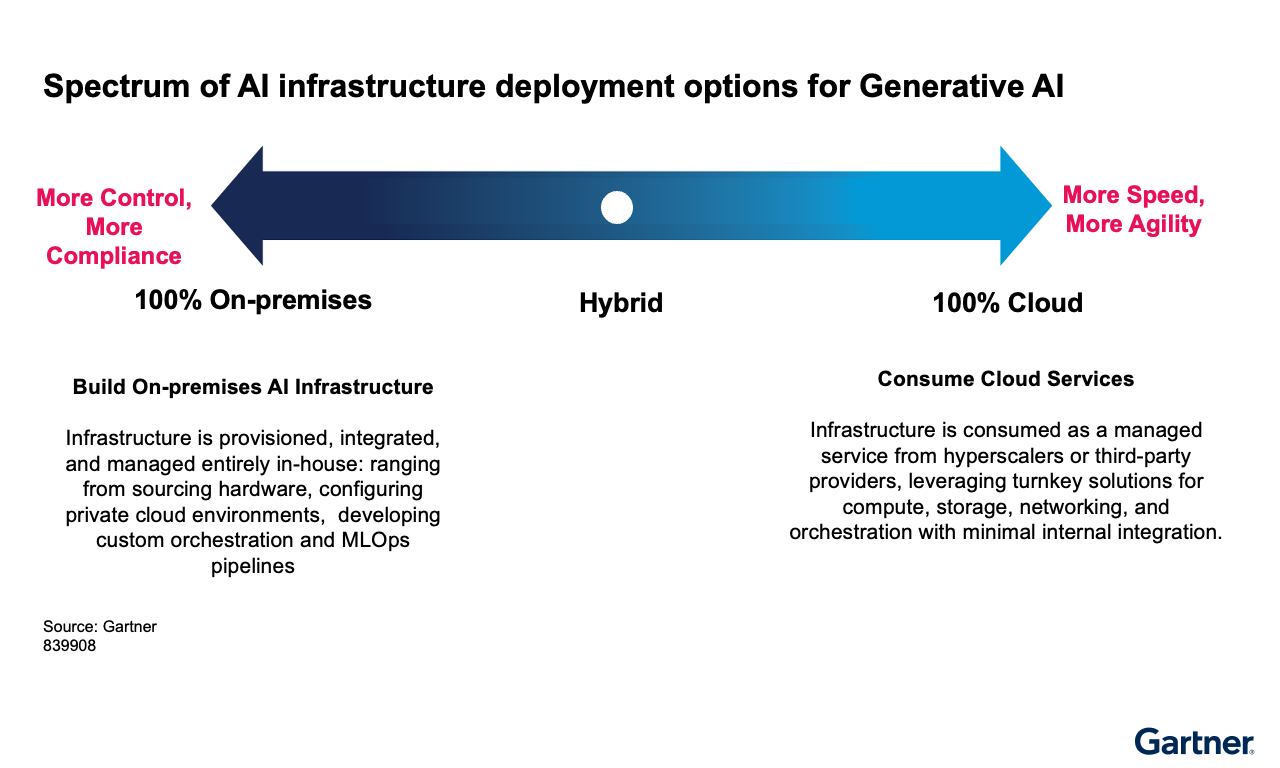
Cloud-focused: A “cloud” strategy leverages hyperscaler platforms (such as Amazon Web Services, Microsoft Azure, or Google Cloud) to rapidly access managed GenAI services. This includes access to foundation model APIs, turnkey XOps (DataOps, ModelOps, LLMOps, and AgentOps) environments, elastic GPU/TPU/ASIC instances, and end-to-end orchestration.
Cloud accelerates deployment, reduces operational overhead, and enables rapid scaling. The trade-off is limited customization, potential vendor lock-in, and reliance on external compliance regimes. This is optimal for organizations prioritizing speed, scalability, and lower upfront investment.
On-premises-focused: An “on-premises” strategy involves designing and deploying the complete GenAI infrastructure stack on-premises. This approach involves procuring and integrating hardware (e.g., on-premises GPU/ASIC clusters), deploying private cloud environments, configuring storage and networking, and deploying orchestration and MLOps pipelines.
Organizations retain complete control over data residency, model life cycle, security, and compliance. This control is critical for regulated industries or proprietary use cases. However, this demands significant upfront capital investment, specialized talent, and longer time to value due to the complexity of integration and ongoing maintenance.
Hybrid: A “hybrid” strategy combines elements of on-premises and cloud, selectively leveraging on-premises clusters for strategic workloads (such as proprietary models) and consuming cloud services for other use cases. For example, a pharmaceutical company uses on-premises infrastructure to run high-security, proprietary drug discovery simulations, while leveraging cloud-based AI chatbots to handle customer inquiries.
Hybrid offers flexibility to optimize cost, control, and innovation, but introduces complexity in integration, governance, and interoperability. Success requires robust architecture, clear data boundaries, and mature operational processes.
It’s important to note that the decision of where to host GenAI workloads (on-premises or in the cloud) is absolute at the workload level but flexible at the portfolio level.
- Individual GenAI workloads are rarely split across on-premises and cloud because latency, orchestration, and governance constraints make hybrid deployment impractical for a single workload.
- Most enterprises adopt a hybrid strategy across their portfolio, placing some AI computational workloads on-premises (for compliance or data gravity) while others run in the cloud (for agility and scale).
The AI infrastructure delivery decision is a high-stakes trade-off; there is no “one size fits all.” Heads of I&O must rigorously evaluate both business and technical parameters, as these factors will ultimately define the optimal GenAI infrastructure strategy and determine the speed and scale of value realization.
Business Drivers for GenAI Infrastructure Decisions
For each GenAI application, the inference workload is deployed in a single, definitive location — either on-premises or in the cloud (and occasionally at the edge). While organizations may adopt a hybrid infrastructure strategy across their portfolio, individual GenAI workloads are rarely hybrid in deployment due to latency, orchestration, and governance constraints.
The decision framework for workload placement is absolute, governed by core business factors such as proprietary AI use cases (e.g., drug discovery), regulatory compliance requirements, and the availability of internal expertise (as shown in Figure 2). Each parameter is a hard gate: Either your requirements align with hyperscaler capabilities, or you must take full control and build an on-premises AI infrastructure in your data center.
Figure 2: Business Drivers for GenAI Infrastructure Placement: On-Premises or Cloud
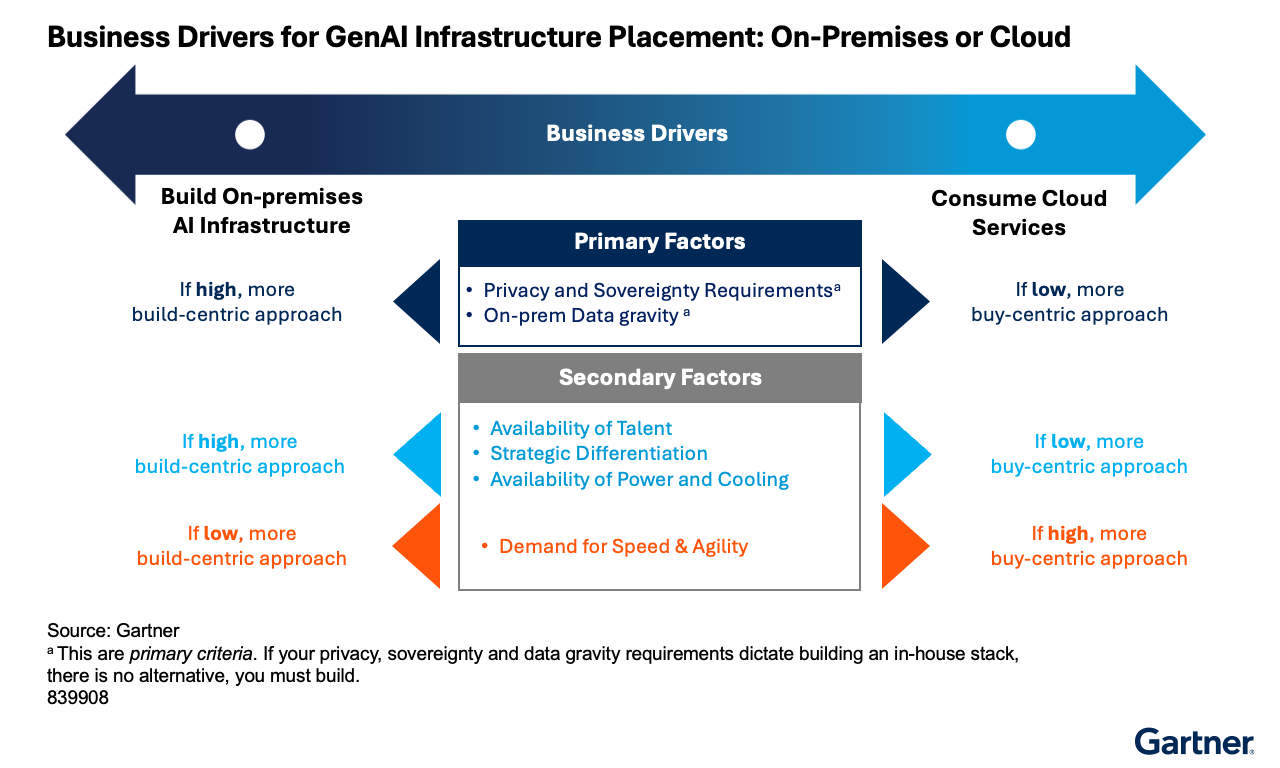
Privacy and sovereignty requirements: The degree to which enterprise data must be protected, governed, and retained within specific jurisdictions is a critical determinant. Incorporate robust AI governance, including bias monitoring, explainability, and auditability, at the outset, regardless of the model.
This is a primary criterion. If your privacy and sovereignty requirements dictate building an in-house stack, there is no alternative; you must build (unless a cloud or specialized cloud services provider is able to deliver a sovereign cloud zone). Regulatory mandates such as GDPR, HIPAA, and sector-specific laws (e.g., EU financial data localization) often require data to remain within controlled environments, making external cloud solutions legally or operationally unfeasible. Beyond regulatory mandates, geopolitical considerations may also influence the strategic imperative to retain full control over the infrastructure stack within national borders.
- Cloud: If hyperscaler compliance certifications (e.g., ISO, SOC, GDPR) fully satisfy your regulatory and data residency needs.
- On-premises: If you face stringent sovereignty mandates or sector-specific regulations (e.g., financial services, government) requiring uncompromised control over data and infrastructure.
- Observed best practice: Highly regulated industries — such as financial services, healthcare, and government — default to sovereign infrastructure (within geographic territories) or on-premises builds due to strict data localization laws and audit requirements.
Data gravity: The physical and logical location of your data is a constraint, as data movement is expensive, slow, and fraught with risk. GenAI workloads are data-hungry; proximity to data is paramount for performance and cost-efficiency.
This is a primary criterion. If your data gravity constraints prevent cloud migration, you must build infrastructure where the data resides; there is no workaround. Attempting to shuttle large datasets across environments introduces prohibitive latency, spiraling costs, and compliance exposure.
- Cloud: If your data already resides in the cloud, or you have the operational and regulatory clearance to migrate on-premises datasets to hyperscaler platforms.
- On-premises: If data cannot be moved off-premises due to privacy, compliance, or prohibitive egress costs. Architect for ultra-low latency, high-throughput ingestion, and sustain large-scale ETL operations directly at the source.
- Observed best practice: When data cannot move, infrastructure must move — organizations frequently deploy GenAI capabilities where their data resides to avoid performance bottlenecks and regulatory risk.
GenAI model availability: Access to state-of-the-art foundation models is a hard gating factor; if the models you need are only available through hyperscaler APIs, devising a cloud-first or hybrid strategy is your only option. According to the latest 2025 Gartner GenAI Impact on Tech Providers Survey, commercial models dominate today, 36% of enterprises primarily use them, but hybrid strategies (22%) and open-source adoption (19%) are also significant, signaling a clear shift toward flexibility and cost optimization.
- Cloud: If your use cases depend on proprietary or cutting-edge foundation models (such as GPT-5) that are exclusively available through hyperscaler platforms.
- On-premises: If your required models can be self-hosted (such as Google Gemini over Google Distributed Cloud) or open source and internally developed.
- Observed best practice: To access proprietary models (available only in the cloud) for on-premises clusters, organizations adopt a hybrid strategy, running sensitive workloads on-premises while integrating API gateways for cloud-hosted models.
Availability of talent: The ability to architect, deploy, and manage GenAI infrastructure hinges on the depth and breadth of internal expertise. According to the 2024 Gartner AI Mandates for the Enterprise Survey, only 17% of respondents say their organizations have enough talent to support AI adoption.
Successful implementation requires specialized skills across AI operations, MLOps, and platform engineering. Organizations must realistically assess their talent pool and readiness to support the complexity and scale of GenAI workloads.
- Cloud: If your organization lacks knowledge of managing large-scale AI infrastructure clusters, platform engineering, and AI engineering (such as AI Ops, ModelOps) talent. However, you need to have the required cloud engineering skills.
- On-premises: If you have or are willing to invest in specialized teams to manage complex GenAI stacks.
- Observed best practice: Most organizations opt for cloud platforms to bypass steep talent barriers, as they can repurpose existing cloud engineering capabilities without needing specialized expertise in GPU cluster management, low-level optimization (e.g., CUDA, NCCL, Triton), or custom orchestration pipelines required for in-house GenAI infrastructure.
Speed and agility: Rapid time to market and the ability to iterate rapidly are often decisive in GenAI adoption.
- Cloud: If immediate access to high-performance infrastructure is required and long-term usage is predictable, then a negotiated approach to cloud might deliver the best economies of scale.
- On-premises: If you require ultra-low latency, continuous model refinement, or deep domain customization beyond what hyperscalers offer. However, supply chain constraints (such as limited availability of AI accelerators, scale-up network, and cooling systems) can delay on-premises builds, making cloud a necessary interim strategy.
- Observed best practice: Even when long-term workload requirements (such as data sovereignty and data gravity) suggest an eventual shift to on-premises infrastructure, organizations often leverage cloud platforms to serve as the launchpad for GenAI experimentation. However, for use cases mandating on-premises infrastructure, as use cases move to production and demand stabilizes, they shift workloads on-premises to optimize for strategic alignment.
Strategic differentiation: The extent to which GenAI is a source of competitive advantage versus operational efficiency. Reserve scarce build resources for true differentiators; aggressively buy for utility use cases.
- Cloud: If GenAI is primarily enabling internal efficiencies or noncore applications (e.g., chatbots, productivity tools).
- On-premises: If GenAI is central to your value proposition or IP (e.g., proprietary research, product innovation).
- Observed best practice: Most organizations prioritize buying managed services for nondifferentiating GenAI use cases, reserving scarce build efforts for strategic workloads that drive competitive advantage. This approach accelerates time to value while focusing internal resources where they matter most.
Availability of power and cooling: GenAI workloads demand HPC-class power density and advanced cooling systems. Without these, even the most advanced GPUs will underperform — or remain idle — creating stranded capital. Cooling systems alone account for 30% to 40% of total data center energy consumption, making them a major operational constraint for GenAI workloads.
- Cloud: If your current facilities cannot support high-density power and thermal loads, or if rapid scaling is required.
- On-premises: If you can provision and operate data centers with the required power density and thermal management systems. This often involves significant capital outlay for liquid cooling, redundant power feeds, etc.
- Observed best practice: Most organizations start in the cloud to bypass physical constraints and later invest in on-premises capacity only when demand stabilizes and ROI justifies the capital expenditure.
Conclusion
Where to deploy GenAI infrastructure is not a one-time decision; it is an evolving portfolio management exercise that must be grounded in business value, operational discipline, and forward-looking capacity planning. The mandate for heads of I&O is clear: avoid fragmented, custom-made configurations for individual use cases.
Instead, design a platform strategy that categorizes GenAI workloads into logical buckets based on compliance needs, performance requirements, and strategic priorities (see Top 3 Practices for Scaling GenAI Infrastructure). This approach streamlines governance, accelerates deployment, and contains operational complexity.
Most organizations begin with small-scale pilots, leveraging either cloud or on-premises environments to validate GenAI use cases. As demand stabilizes and business value becomes clear, infrastructure strategies must evolve — scaling selectively based on technical feasibility and strategic importance.
Three dominant archetypes have emerged across industries, each reflecting distinct priorities (such as control, speed, and operational complexity) and trade-offs:
- Cloud-focused: Prioritizes rapid deployment and scalability by leveraging hyperscaler-managed services (see Quick Answer: How Should I Provide Cloud Governance for AI Projects?).
Representative example: Pfizer accelerated drug development and reduced infrastructure costs by outsourcing GenAI workloads to Amazon Web Services (AWS).1 - On-premises-focused: Invests in comprehensive in-house infrastructure for maximum control, performance, and IP retention.
Representative example: BMW Group built a dedicated NVIDIA DGX supercomputer for industrial AI, enabling autonomous model development, implementation, and maintenance of AI applications.2 - Hybrid: Integrates both on-premises and cloud approaches, balancing agility, cost, and compliance through selective use of cloud and internal data centers.
Representative example: JP Morgan Chase uses public cloud for rapid prototyping and “no-regrets” trial and error, shuttling models between cloud platforms to validate performance and compliance. Once GenAI applications mature, they are migrated to internal data centers.3
The most resilient infrastructure strategies are not rigid; they evolve with the portfolio, balancing control, agility, and value creation.
Evidence
1 Driving Patient-Centric Innovation in Life Sciences Using Generative AI With Pfizer, Amazon Web Services (AWS).
2 Driving Innovation: NVIDIA Supports BMW Group’s Leap in Production Efficiency With Generative AI, NVIDIA.
3 How JPMorgan Chase’s Infrastructure Chief Keeps the AI Engine Humming, CIO Dive.
2025 Gartner Impact of GenAI on Tech Providers Survey. The survey was designed to understand the impact of generative AI (GenAI) on revenue, profitability and sustained enterprise performance among technology and service providers. It also examined how GenAI is being integrated into products and services. The survey was conducted online in April and May 2025. It includes responses from 498 technology and service provider executives based in North America (n = 198), Western Europe (n = 161) and Asia/Pacific (n = 139). Respondents were required to be actively engaged in artificial intelligence as an emerging technology, with direct involvement in GenAI initiatives. Participants held roles across the C-suite, marketing and product marketing, product development and engineering, demand generation, industry or regional leadership, service delivery, line of business, and innovation functions. Quotas were applied across regions, company revenue, job functions and product offerings (software or SaaS and IT services) to ensure balanced representation. Of the respondents, 124 were from companies with annual revenue of between $5 million and $250 million, and 374 from companies with revenue above $250 million. Disclaimer: The results of this survey do not represent global findings or the market as a whole, but reflect the sentiments of the respondents and companies surveyed.
2024 Gartner AI Mandates for the Enterprise Survey. This study was conducted to understand how AI and generative AI (GenAI) are being adopted by enterprises, focusing on areas such as AI strategy, data, governance, literacy, engineering, organization, portfolio and value, to assist clients in keeping pace with AI’s rapid evolution. The research was conducted online from October through December 2024 among 432 respondents from the U.S. (n = 181), the U.K. (n = 70), France (n = 50), Germany (n = 50), India (n = 51) and Japan (n = 30). Quotas were established for company sizes and for industries to ensure a good representation across the sample. Organizations were required to have deployed at least one AI use case in production. Respondents were screened for C-level executives (e.g., chief AI officer, chief data officer, chief data scientist, chief digital officer, chief information officer, chief operating officer, chief technology officer or equivalent) or roles above vice presidents. All respondents were required to have high involvement in at least one AI initiative. Disclaimer: The results of this survey do not represent global findings or the market as a whole, but reflect the sentiments of the respondents and companies surveyed.
2024 Gartner Enterprise Application Leaders Signature Survey. This study was conducted to understand how enterprise application leaders are pursuing and implementing innovative technologies. The research was conducted online from January through March 2024 among 272 respondents from organizations across all industries in North America (n = 143), Europe (n = 70) and Asia/Pacific (n = 50) with annual revenue of $500 million or more. Soft quotas were established for company size, type of industry, applications portfolio (CRM, digital workplace and ERP), and respondent’s function type and job level to ensure a good representation across the sample. Organizations were required to have deployed or plan to deploy within two years at least one of the following technologies: generative AI, augmented analytics, digital experience monitoring, hyperautomation or intelligent applications. Respondents were midlevel managers or above, directly involved in the applications portfolio and were required to have certain responsibilities when related to its innovative technologies. In addition, respondents were required to have knowledge of technology innovation funding, technology innovation deployment models and technology innovation priorities. Disclaimer: The results of this survey do not represent global findings or the market as a whole, but reflect the sentiments of the respondents and companies surveyed.
Source: Gartner Research G00839908, Sushovan Mukhopadhyay, Chirag Dekate, 30 September 2025