A Practical Guide to Building Sovereign AI Cloud Platforms
Want to build compliant AI infrastructure, retaining full control of your data and tech stack?
Preface
Export controls and other geopolitical measures can now directly restrict multinational enterprises' access to advanced AI models. AI sovereignty has therefore become a business continuity issue, requiring the attention of CIOs and technology decision-makers.
In a changing geopolitical environment, digital sovereignty is expanding from a concern about data to a business continuity requirement spanning data, operations, and technology. Enterprises should also regard sovereignty as a strategic opportunity to strengthen technological resilience and business outcomes, rather than solely as a compliance burden.
Highly regulated industries need to use generative AI while retaining control over data, operations, and technology and reducing dependence on a single external provider. A sovereign AI cloud addresses these requirements. It extends sovereignty across models, compute, and inference, on a cloud foundation that provides the three pillars of sovereignty: data, operational, and technological sovereignty. This approach has entered national digital strategies and industry practice in recent years.
Chapter 1: The Sovereign AI Imperative in Highly Regulated Industries
1.1 Regulatory Constraints: Data Must Remain in Controlled Environments
In highly regulated industries, including utilities, financial services, energy, healthcare, and telecommunications, strict data localization laws and audit requirements govern data storage, processing, and access. For these industries, privacy and sovereignty requirements are among the first criteria weighed in AI infrastructure placement. These mandates often require data to remain within controlled environments, “making external cloud solutions legally or operationally unfeasible.”1
The physical characteristics of data reinforce this constraint. Data gravity binds AI workloads to data that is often too sensitive or too legally constrained to move. “When data cannot move, infrastructure must move — organizations frequently deploy GenAI capabilities where their data resides to avoid performance bottlenecks and regulatory risk.”¹ For highly regulated industries whose data must legally remain within a controlled boundary, regulation and data gravity lead to the same conclusion: AI compute and platforms must operate in the controlled environment where the data resides, under enterprise control. Gartner outlines this trend: “By 2028, strict data sovereignty and privacy regulations will compel over 25% of enterprises in regulated industries to repatriate their primary GenAI workloads on-premises.”1
1.2 Autonomy and Control: Who Holds the Keys
Data localization determines where data is stored. Highly regulated industries must also establish who controls the infrastructure and critical capabilities. Even when data and systems are deployed locally, an enterprise may still depend on an external provider for operations, version updates, or core components. Supply chain disruptions or policy changes can then interrupt services or limit the enterprise’s ability to act independently.
These dependencies are often distributed across the technology stack and are not immediately visible. Cloud platforms, operating systems, databases, middleware, chips, firmware, and hardware can each contain components exposed to external influence. Gartner recommends: “Conduct an immediate dependency audit. Identify exposure to foreign influence by mapping vertical layers (infrastructure, platforms, applications) and horizontal areas (AI, digital workplace, information systems). Prioritize components based on risk exposure and strategic value.”2
1.3 The AI Era: Sovereignty Extends from Data Storage to Model Training and Inference
Gartner predicts that “by 2027, 35% of countries will be locked into region-specific AI platforms using proprietary contextual data.”3 Highly regulated industries must therefore consider where models are trained and inference is performed, as well as whether the supply of those capabilities remains reliable and controllable.
External dependencies in AI create more immediate risks than in traditional IT — “as recent U.S. export controls demonstrate, failing to diversify AI dependencies and relying on a single global provider creates acute vulnerabilities. Critical operations can be brought to a sudden halt, leaving enterprises without access to necessary intelligence and exposing them to severe business continuity risks.”3
Long-term ecosystem lock-in compounds the risk of sudden interruption. Gartner predicts that “through 2029, dependency on proprietary foundation models will result in over 50% of GenAI adopters being locked into a single public cloud provider’s ecosystem.”1 This dependence raises switching costs across models, compute, and supporting services.
AI training and inference extend compliance obligations across the model lifecycle, from data and models to compute and inference processes. External control over any part of that chain can affect the continued availability of AI capabilities. Localization and autonomy must therefore extend beyond data storage to the full AI lifecycle. “Agentic AI is disintermediating traditional SaaS interfaces by migrating business logic into AI orchestration platforms. This forces D&A teams to transition to AI-first data architectures where they can exercise appropriate sovereign control based on the workload’s risk profile.”3
Summary: From Mandated Autonomy to the Sovereign AI Cloud
Compliance requirements, the need for autonomy, and the additional demands of AI converge on the sovereign AI cloud. The cloud foundation provides data, operational, and technological sovereignty, while models, compute, and platform services run entirely within that foundation. AI capabilities remain under enterprise control alongside data, operations, and technology.
Two implementation paths are generally available: a complete enterprise-built environment or delivery by a provider with the required capabilities. Where sovereignty requirements mandate that data and infrastructure remain in a controlled environment, “there is no alternative; you must build (unless a cloud or specialized cloud services provider is able to deliver a sovereign cloud zone).”1
A complete self-build is impractical for most enterprises. It requires substantial upfront investment and lengthy implementation, followed by continuous version development and security maintenance for both the cloud and AI platforms. Completing the initial build does not ensure long-term availability. Scarce AI expertise adds to this burden. “According to the 2024 Gartner AI Mandates for the Enterprise Survey, only 17% of respondents say their organizations have enough talent to support AI adoption.”1 For most highly regulated industries, a provider-delivered sovereign AI cloud offers a more practical way to combine autonomy with feasible implementation.
Chapter 2: What Makes a Cloud Sovereign
2.1 Sovereignty Is a Matter of Degree
A sovereign AI cloud qualifies through the degree to which it meets sovereignty requirements, rather than through its label. There is no one-size-fits-all strategy. Sovereignty “is a spectrum that typically involves trade-offs in cost, scalability, data survivability and functional depth.”2 Enterprises must determine the level of sovereignty each workload requires.
These trade-offs have operational consequences. “Globally centralized architectures are incompatible with sovereign mandates, leading to unavoidable environment duplication and 15% to 20% price premiums for sovereign infrastructure.”3 Sovereign cloud offerings also ship with narrower service catalogs and delayed features, which complicates delivery. A qualified sovereign AI cloud must meet the most stringent sovereignty requirements while also giving enterprises flexibility to choose among different levels.
2.2 The Three Pillars of Sovereignty: Data, Operations, and Technology
A sovereign AI cloud rests on three pillars: data sovereignty, operational sovereignty, and technological sovereignty.
① Data sovereignty: “control over data access and location.”2 This covers data location and accessibility throughout its lifecycle. For AI, the scope extends to data generated across the entire AI lifecycle: training and fine-tuning data, retrieval-augmented generation (RAG) corpora and vector stores, and inference prompts and invocation logs. Prompts and logs often contain sensitive business information and require controls as strict as those applied to business data.
② Operational sovereignty: “visibility into and control over provider actions.”2 This includes where workloads are processed, who operates them, and which laws apply. Keeping data local does not ensure local operations. Operational and legal independence are also required to prevent data access under extraterritorial legal demands. For AI, operational sovereignty extends to model operations and governance: who scales models, resolves incidents, and tunes performance; who decides on upgrades, retirement, and behavioral changes; and whether the local operator or an external provider holds visibility and audit rights over inference logs and usage data.
③ Technological sovereignty: “autonomy and continuity without reliance on the provider.”2 This includes the countries or regions from which the technology stack originates. For AI, the stack extends upward to AI frameworks and model weights and downward to AI chips and compute supply. If model weights require external authorization or chips depend on a single source, cloud platform autonomy alone does not establish technological sovereignty for AI.
“While achieving data sovereignty is relatively straightforward, attaining true operational sovereignty, and especially technological sovereignty, can be challenging.”2 AI extends those requirements further into model and compute supply.
2.3 From Loose to Tight: Sovereignty as a Deployment Spectrum
The three pillars provide the assessment framework. “Digital sovereignty is a spectrum, and there are multiple provider solutions from global hyperscalers as well as local providers depending on what is considered compliant in the jurisdiction.”2 In deployment, that spectrum runs from looser to tighter, with the degree of isolation increasing at each step. Enterprises can place workloads along that spectrum according to their sensitivity. Gartner describes a set of provider models positioned along it.2 The four models below follow that set; the descriptions and the workload fit are Tencent Cloud’s own analysis.
Public cloud data boundary: A data boundary established within the public cloud through software-defined controls such as external key management provides a relatively low level of sovereignty, suitable for commercial and lightly regulated workloads.
Locally operated isolated cloud: An isolated cloud deployed in a specified region and operated exclusively by local residents adds operational sovereignty to data sovereignty. It suits regulated workloads that require greater autonomy.
Physically isolated cloud / air-gapped environment: Physical separation from global infrastructure allows fully disconnected, independent operation, with the customer owning the hardware and the software update cycle. This offers the highest level of sovereignty for the most sensitive mission-critical workloads.
Partner-operated exclusive local cloud: A dedicated local cloud operated by a local partner company that preferably uses only a local technology stack primarily serves cost-sensitive local workloads. It offers an alternative approach to local operations.
Provider models and the four levels in the figure below are adapted from Gartner, Digital Sovereignty Is Needed for Future Technological Resilience and Business Outcome, G00838383, 2 February 2026.2
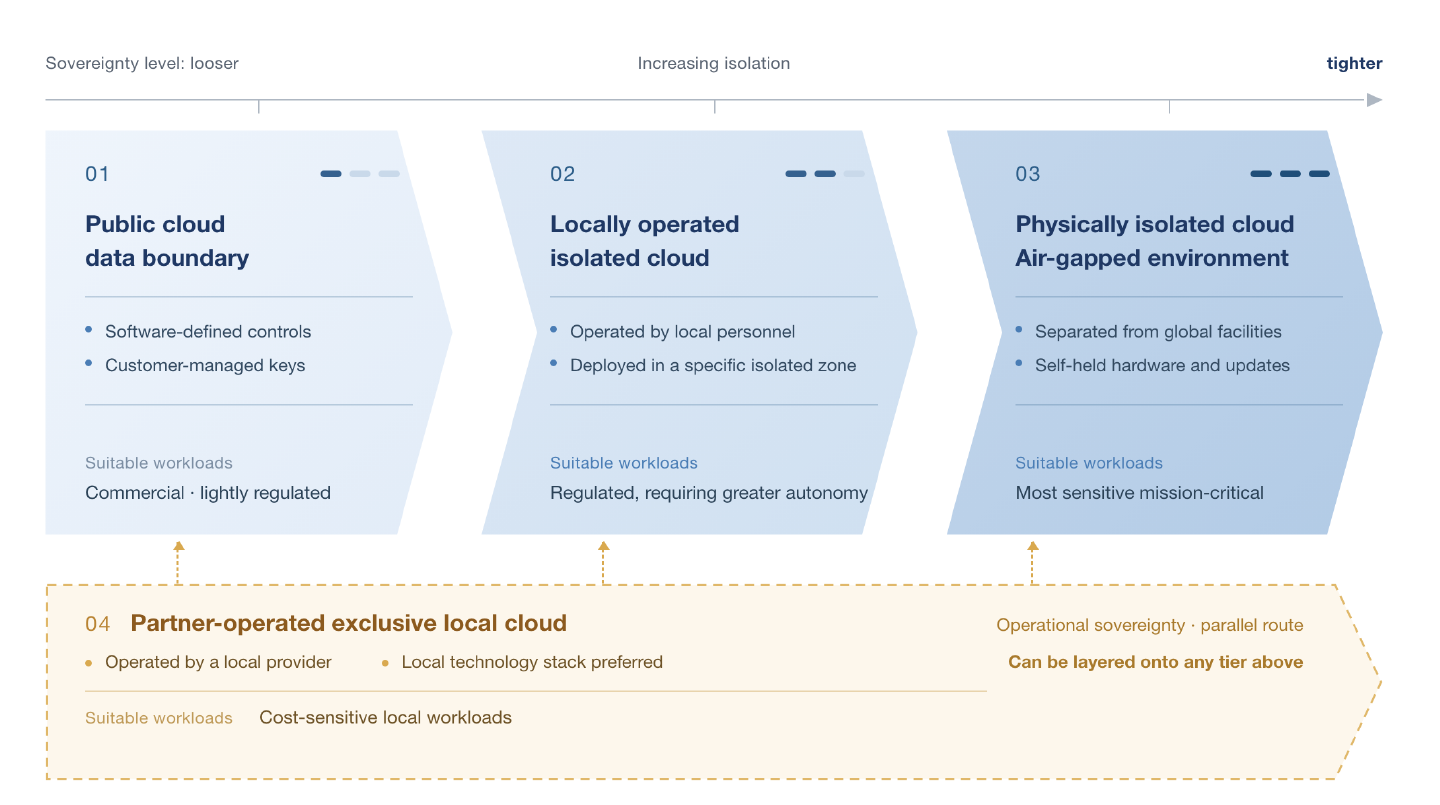
The first three options form the main axis of increasing sovereignty. The fourth is an alternative route to operational sovereignty, rather than a higher level, and can be combined with the others.
AI workloads have distinct placement requirements along this spectrum. Training and fine-tuning depend heavily on consolidated data and exhibit the strongest data gravity. They generally require a high-sovereignty environment close to the data source. The placement of inference workloads can vary with business sensitivity: highly sensitive inference stays in controlled environments, while less sensitive inference can use more elastic deployment models.
A qualified sovereign AI cloud should meet at least three conditions. First, it must provide capabilities for all three pillars across the AI lifecycle: control over training and inference data, enterprise authority over model operations, and achievable technological sovereignty over models and compute. Second, it must support multiple levels on the deployment spectrum and allow the placement of training and inference workloads to be determined separately. Third, it must allow sovereignty levels to change within a single technology architecture, so changes in workload or model sensitivity do not require a different platform, migration, or rebuilding.
Chapter 3: Tencent Cloud Enterprise — The Complete Capability Stack of a Sovereign AI Cloud
3.1 What Is Tencent Cloud Enterprise
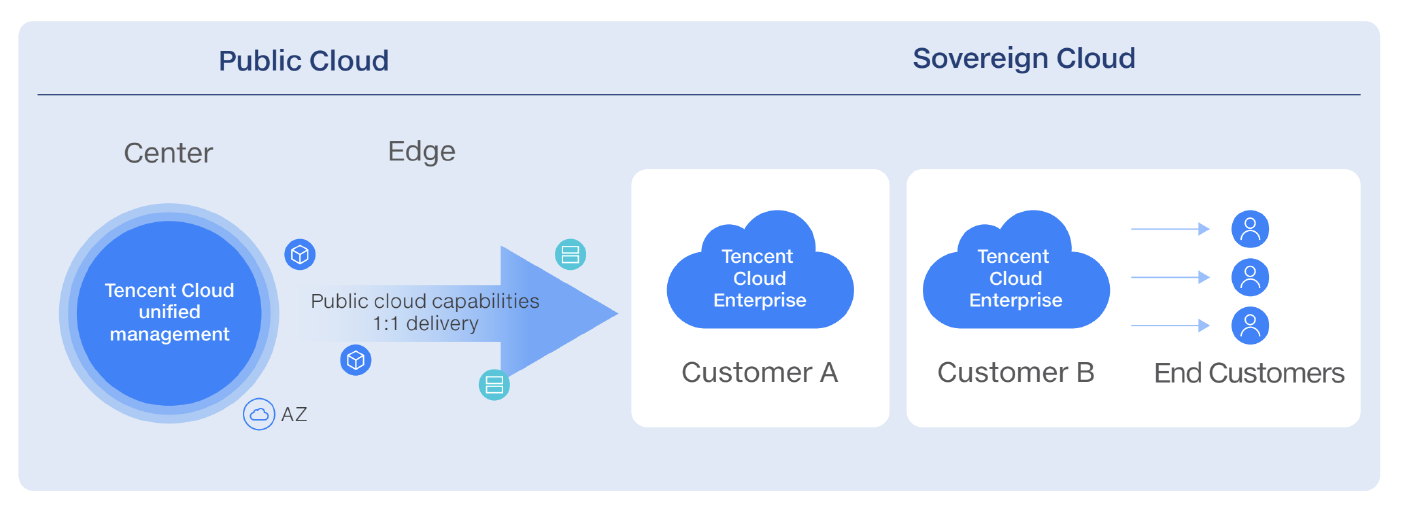
Tencent Cloud Enterprise is a full-stack private cloud built on the same technology as Tencent’s public cloud. It brings capabilities validated at public cloud scale into environments under customer control.
For highly regulated industries, Tencent Cloud Enterprise can deliver a sovereign cloud zone, providing a feasible implementation path that preserves autonomy alongside the option of a complete self-build.
3.2 Deployment Models for a Sovereign AI Cloud
Enterprises can choose their level of sovereignty. A common public and private cloud architecture enables Tencent Cloud Enterprise to cover the entire deployment spectrum, from a public cloud data boundary to an air-gapped environment. Every level uses the same technology architecture.
The most sensitive mission-critical workloads can run independently in an air-gapped environment, with no control plane connection back to the public cloud. Compared with solutions whose control planes must call back to the public cloud and cannot operate independently when disconnected, this capability reduces dependence on a single external provider.
Tencent Cloud Enterprise can also underpin multi-tenant platforms operated by local providers for specific industries. This corresponds to the partner-operated exclusive local cloud option on the deployment spectrum.
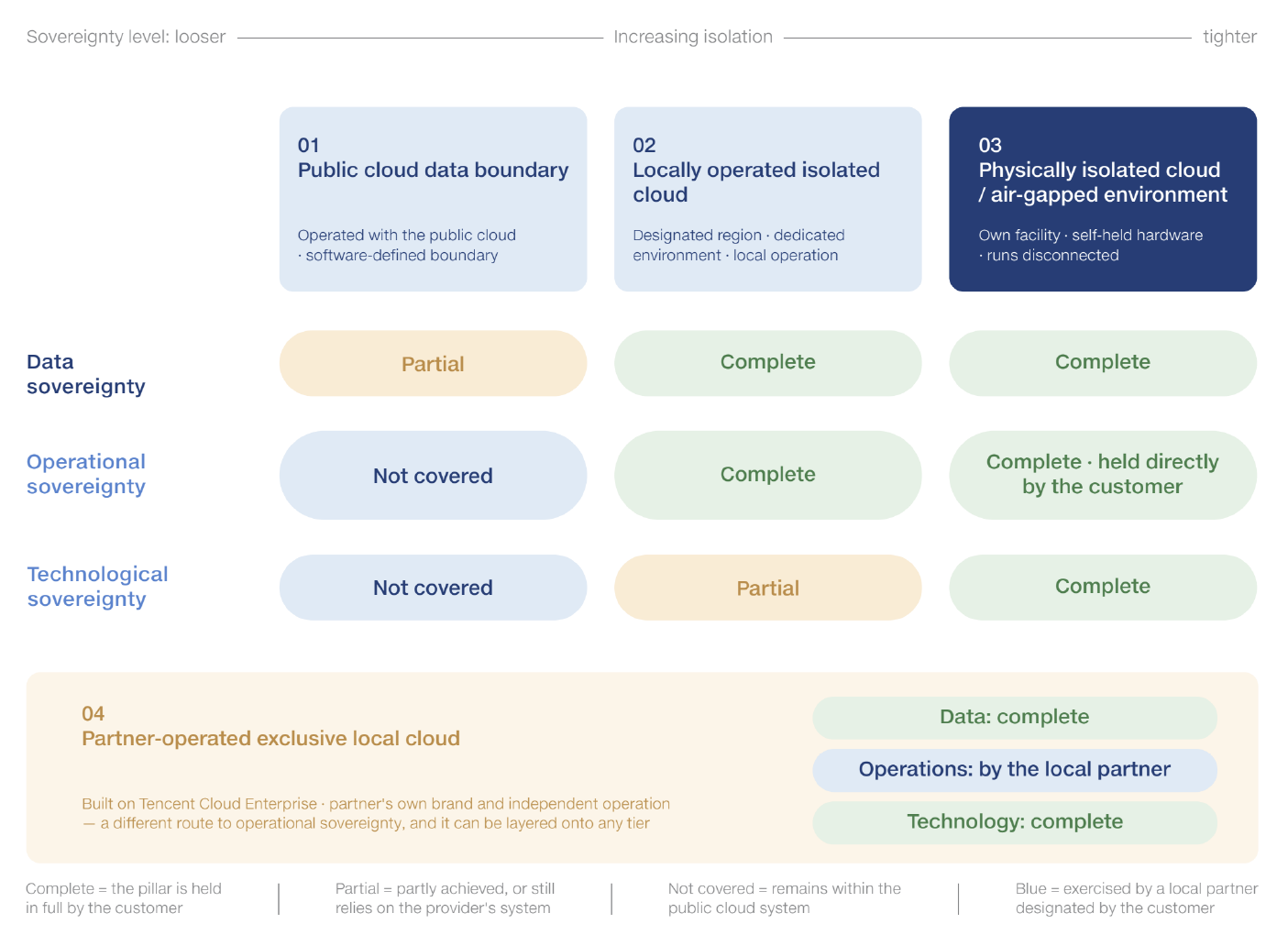
The shared public and private cloud architecture allows AI and business workloads to be distributed and moved along the spectrum. When their sensitivity changes, enterprises can adjust deployment locations without adopting a different technology architecture.
3.3 Core Advantages in Building a Sovereign AI Cloud
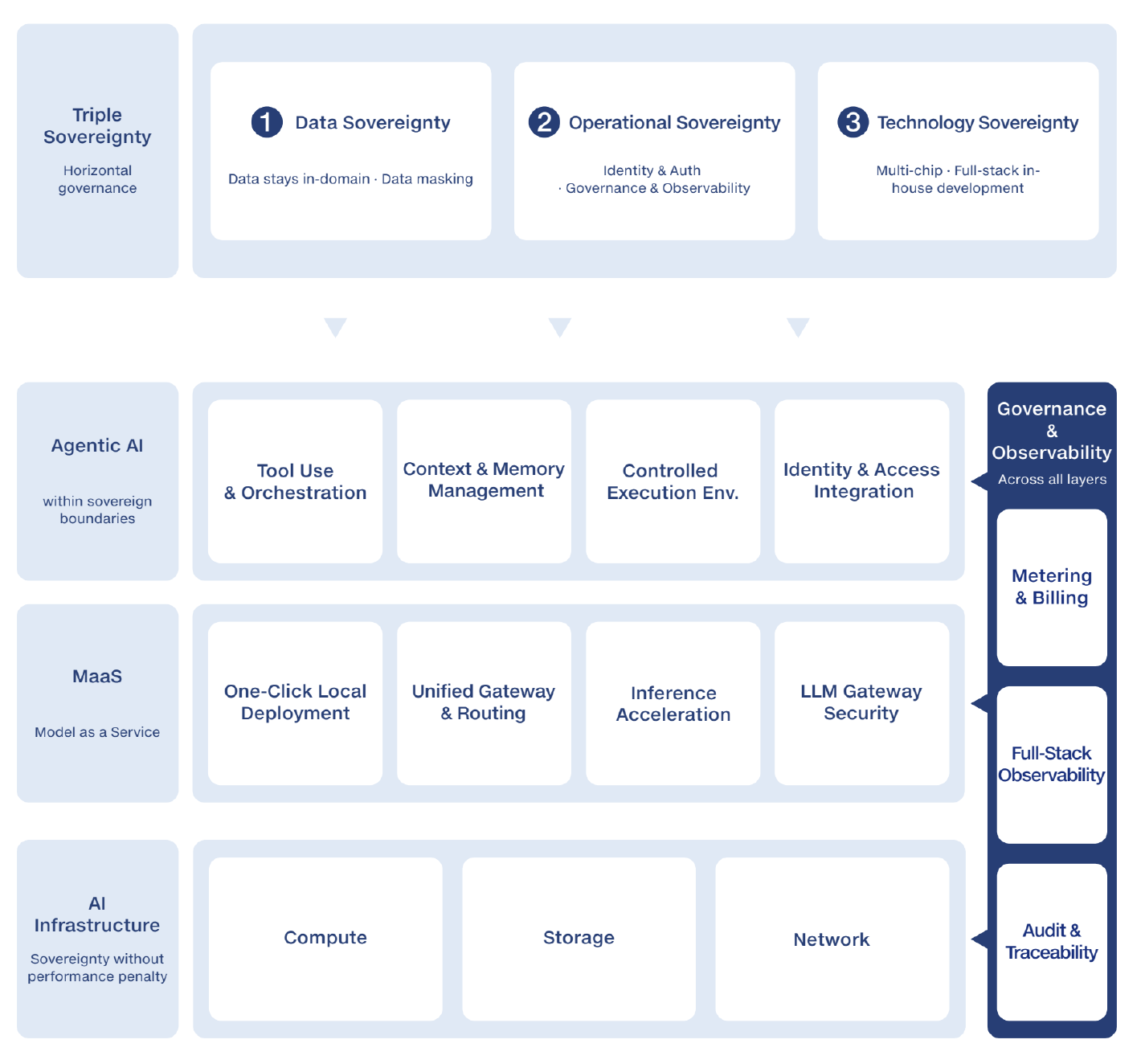
Tencent Cloud Enterprise delivers a governed intelligence control plane as well as compute and models within the customer environment. As the model layer becomes commoditized, “the value layer shifts back to software. Orchestration, identity, policy, evaluations, logs, governance, memory controls and workflow integration.”4 Control over this layer determines ownership of the enterprise’s intelligence assets and business logic. The cloud foundation provides capabilities for all three pillars of sovereignty across the AI lifecycle, from training and fine-tuning data and model operating rights to model weights and compute supply. Above it sit complete AI compute infrastructure, a model service layer deployed in the customer environment, and support for running agents within the sovereign boundary. Together, these layers provide complete, efficient AI capabilities with governance throughout.
3.3.1 The Three Pillars and Their AI Extensions
Tencent Cloud Enterprise provides capabilities for data, operational, and technological sovereignty and extends each into the AI lifecycle. The final test of the three pillars is survivability. An internally developed full stack, together with control over models and compute, enables deployed workloads and model services to continue running even when external dependencies are severed.
① Data Sovereignty
Data residency and location choice: Data stays on-premises within the enterprise’s internal network. Deployments can use enterprise-owned data centers or dedicated environments in specified regions. The AI data plane includes inference prompts and invocation logs, training and fine-tuning data, RAG corpora and vector stores, knowledge bases, and skill assets. All receive the same level of control as business data. Model training and fine-tuning are completed entirely within the internal network.
Data protection and tiered governance: Capabilities include encryption, independent key management, fine-grained access control, personally identifiable information (PII) masking, and data classification.
Unified governance and compliance auditing: Common standards and interfaces provide consistent governance from public cloud deployments to air-gapped environments. The platform holds multiple data protection certifications and supports third-party audits.
② Operational Sovereignty
Complete customer deployment of the control plane: Identity and access management, key management, resource scheduling, operations interfaces, and version upgrades form the platform’s management core: the control plane. It is deployed entirely in the customer environment and operated by the customer or a local provider without external intervention. It does not call back to the public cloud and can run independently in an isolated environment. Where data resides, control resides.
Governance and observability: Full-stack observability makes platform status visible, while end-to-end records of invocations and operations support auditing and traceability. In multi-tenant environments, resources and data are isolated between tenants, each with its own governance. Tenant-level metering and billing give operators visibility into platform usage and activity and the ability to verify and control them.
Independent model operations and auditing: The customer decides when to make models available, retire them, or change versions, without updates being pushed by an external provider. The local operator holds visibility and audit rights over inference logs and usage data, down to token-level details. Prompt and response logging can be enabled according to privacy classifications. Governance of AI capabilities therefore remains with the customer.
③ Technological Sovereignty
A single cloud spanning multiple chip architectures: Compute supply is independent of a single supply chain. One cloud platform manages CPUs, GPUs, and DPUs, supports multiple mainstream chip architectures and server vendors, and combines heterogeneous compute into a single schedulable resource pool. If one supply channel becomes restricted, workloads can continue on alternatives. An interruption in one channel does not halt AI capabilities.
An internally developed full stack: Infrastructure and the AI engineering lifecycle are developed in-house, providing capabilities from chips to agents. The architecture and technology are shared with Tencent’s public cloud, bringing capabilities validated at scale into private environments on a 1:1 basis. The sovereign environment shares the development path of the main architecture, rather than operating as a separate version with delayed functionality.
Openness and source code escrow: Open software APIs support third-party integration. Tiered source code access is available, and regulated customers can obtain complete source code escrow.
Control over models and weights: Both open-source and Tencent-developed models can be deployed locally without depending on external model APIs. Customers can obtain open-source model weights independently, while key technology assets for Tencent-developed models are delivered through escrow arrangements. Model supply is independent of a single provider.
3.3.2 AI Compute Infrastructure: Sovereignty Without Compromising Performance
Complete infrastructure is a prerequisite. Tencent Cloud Enterprise covers four components of AI compute infrastructure within the sovereign environment. For compute, GPU virtual machines and bare metal are managed alongside general-purpose compute, with partitioning, sharing, and scheduling of colocated training and inference workloads. Storage supports the highly concurrent data access required for training. Networking uses an open, compatible high-speed lossless network fabric without dependence on a particular switch vendor. Acceleration increases output per unit of compute without changes to higher-level frameworks or model code.
AI within a sovereign environment can keep data on-premises while maintaining performance. The differences are apparent in training, inference, result consistency, and multi-turn interaction.
Faster training: Dataset loading throughput matches the rate at which compute consumes data. Storage handles highly concurrent reads and writes involving both large and small files. Fast checkpoint writes and recovery prevent GPUs from sitting idle while waiting for data, shortening training cycles and reducing compute costs.
Lower inference latency: Local access to RAG corpora and vector stores keeps retrieval from becoming a bottleneck for time to first token. Combined with a low-latency inference path, this allows responses to begin immediately after a request.
Deterministic, consistent results: The high-speed lossless network fabric supports collective communication without packet loss, retransmission, or throughput reduction, producing deterministic, consistent results in large-scale parallel computation. Every transfer between storage and compute is verified to ensure reliable, complete reads and writes. Performance gains do not compromise accuracy.
No degradation across turns: Multi-turn conversations move historical context between CPU memory and GPU memory. Inefficient handling repeats transfers and computation on every turn, slowing responses as sessions grow. This explains why some local deployments lose performance with extended use. Tencent Cloud Enterprise combines efficient CPU-to-GPU data paths with context caching and scheduling, keeping context resident wherever possible and swapping it in or out as needed. Responses remain stable during long conversations, follow-up questions, and long-document analysis, with no interference between users under high concurrency.
Deployment scale is also flexible. A sovereign environment can start with a dozen or so servers and expand to more than ten thousand. Networking designs for small deployments further reduce the cost of smaller sovereign cloud zones. High sovereignty does not necessarily require high implementation costs.
3.3.3 The Model Service Layer (MaaS): Complete AI Services Within the Sovereign Environment
Above the sovereign foundation and AI compute infrastructure, Tencent Cloud Enterprise provides an enterprise model service layer, Model-as-a-Service (MaaS). Gartner predicts that “by 2027, advanced enterprise AI buyers will require governed multi-model routing for production GenAI workloads, with policy controls based on data sensitivity, output authority, and cost per accepted action.”⁴ Deployed in the customer’s own environment, the model service platform integrates with compute scheduling and partitioning below and provides model supply, development tools, and service operations above.
Local model services: Multiple models are available for local deployment, with one-click deployment and services ready to run. APIs compatible with commonly used model interfaces provide access to these services. Domain models can be fine-tuned and deployed locally, while quantization, caching, and other inference optimizations increase output per unit of compute.
End-to-end LLM tools: Local capabilities cover data annotation, large language model fine-tuning, AI agent training, and model selection and evaluation. The full lifecycle runs from data through fine-tuning or training and evaluation to one-click deployment.
Unified AI gateway and model orchestration: A single entry point selects among built-in and external models according to the task, data sensitivity, and cost through intelligent routing and fallback. It switches automatically during failures or degradation and provides authentication, rate limiting, and auditing for invocations. External models can be brought under common policies through the gateway’s proxy. Models remain replaceable, and supply is independent of a single provider. Model choice resides at this layer.
LLM service operations: Service operations support high-concurrency agent workloads, a unified entry point for multiple models, and frequent service changes and releases.
LLM gateway security: End-to-end protection covers authentication and authorization, content safety, privacy masking, and attack defense.
3.3.4 Running Agents Within the Sovereign Boundary
AI workloads are moving from single-turn question answering toward agentic AI. Agents plan tasks independently, invoke tools and systems, and accumulate context and memory across multiple interactions. Sovereignty requirements expand accordingly. Agents hold credentials and access business data and systems under enterprise identities. The sovereignty of their runtime environment directly determines the exposure of enterprise data and operations.
Tencent Cloud Enterprise provides complete support for running AI agents within the sovereign environment. Tool invocation and orchestration allow agents to complete tasks across enterprise systems and tools. Context and memory management maintain session state and accumulated knowledge during long-running tasks. A controlled execution environment sets boundaries for autonomous actions. Integration with enterprise identity and access management ensures that agents access data and systems through controlled identities, with least-privilege access and auditable operations throughout.
Autonomous agents therefore remain within the sovereign boundary. They organize business processes into multi-step task chains, including data retrieval, system invocation, generation, and review, with each step executed in the orchestration layer. Ownership of business logic follows the location and governance of these task chains. The sovereign environment keeps this layer under enterprise control. The AI compute layer supports the same objective: long agent sessions and repeated tool calls are central workloads for context caching and scheduling and low-latency inference.
3.4 The Local Partner Ecosystem: Enabling Operational Sovereignty
The three pillars depend on both platform capabilities and who delivers and operates them locally. Operational sovereignty requires local operators for critical workloads with minimal external intervention. For most enterprises, building an operations team covering both cloud platforms and model engineering is impractical. A more common approach uses local providers familiar with local regulations, languages, and markets that can “act as data trustees or independent operators to shield data from foreign government overreach”2 in sovereign cloud delivery and operations.
Tencent Cloud Enterprise acts as an enabler. The customer chooses the operator, whether its own team or a designated sovereign partner. Local partners receive the foundation and operating methodology to build, onboard, sell, and operate the cloud. They retain their own brands, set prices independently, and control end-customer relationships and data. Tencent Cloud Enterprise supports partners without taking over their role. Support includes operations tools, knowledge transfer, staff training and certification, and joint operations during the initial stage, enabling partners to assume independent responsibility for daily operations and continued platform development.
Local partnerships cover major Asia-Pacific markets and are expanding into the Middle East.
Chapter 4: Industry Adoption Paths for the Sovereign AI Cloud
Sovereignty has concrete implications in each industry. In financial services, the three pillars translate into records and audits for regulatory inquiries. In healthcare, they apply to a growing body of data retained for ten years or more. In government, they must satisfy both public spending reviews and public safety requirements. In telecommunications, they underpin the trust and responsibilities of critical infrastructure providers. Different constraints and starting points require different adoption paths.
4.1 Highly Regulated Industries: Financial Services and Healthcare
Financial services and healthcare are major adopters of sovereign AI infrastructure localization policies, driven by strict national data localization laws. Hospitals process patient data locally on sovereign AI infrastructure and use AI to support diagnosis within compliance requirements. Countries are building sovereign AI platforms to develop drugs and treatments suited to their populations using local population data, treating healthcare data as a protected national asset. Financial institutions are adopting local models that run on sovereign AI infrastructure to reduce geopolitical risk and dependence on foreign technology. Banks have begun using locally deployed models for core workloads such as fraud detection and credit scoring.
In both industries, compliance requirements and business continuity make localization a necessary direction.
Financial Services: Classify First, Then Build the Cloud
The principal risk for financial institutions is a uniform deployment approach. Placing every workload in the highest-sovereignty environment imposes the highest costs and the slowest access to new functionality. Data and workload classification must come first.
Classification exposes the actual constraints. Data governance lags application development: corpora are distributed across core banking, lending, and channel systems, with longstanding gaps in classification and masking. Compute shortages coexist with idle capacity: GPUs are expensive, yet existing compute lacks unified scheduling and partitioning, keeping utilization low. Responsibility for model operations is unclear: model availability and retirement depend on external provider updates, while inference logs and usage data cannot be inspected or audited by regulators. Sovereign infrastructure premiums further complicate the investment case. Projects alternate between attempts to implement everything at once and uncertainty about where to begin. Limited talent also makes complete self-builds impractical for most institutions.
The path has four steps that are difficult to bypass. First, assess and classify: establish which data must stay in the institution’s controlled environment and which workloads can use elastic deployment models. Second, build the foundation: start with small-scale inference on a dozen or so servers in an institution-owned data center, then expand after validating the use cases.
Third, complete the use case lifecycle: select two or three high-value, low-risk use cases, such as intelligent customer service, knowledge-base question answering, and code assistants. Establish the full path from data consolidation, fine-tuning, and evaluation to auditing and metering. Fourth, scale operations: improve utilization through unified training and inference scheduling and compute partitioning, and establish tenant-level metering and billing and model operations. Once capabilities mature, large institutions can offer the platform to peers as an industry cloud. The cloud platform then becomes a vehicle for delivering capabilities as well as a cost center.
For financial institutions, Tencent Cloud Enterprise typically takes the form of a private cloud in institution-owned data centers, with metro active-active and multi-site disaster recovery. The most sensitive workloads run in physically isolated environments capable of independent operation when disconnected. Training and fine-tuning remain entirely within the institution. Inference placement follows sensitivity: risk management, fraud detection, and credit scoring stay in the sovereign environment, while general workloads such as office assistants and knowledge question answering use elastic deployment models through unified AI gateway routing. The institution gains independently operated model services, auditable token-level usage records, and the option to provide capabilities to peers.
Healthcare: Infrastructure Is the Constraint
Healthcare adds a physical constraint to those in financial services. A single CT examination produces several hundred MB to 1 GB of raw images; whole-genome sequencing produces approximately 100 GB. Most jurisdictions require images and medical records to be retained for more than ten years. This creates a continually growing body of data that cannot be deleted. Moving it between environments is neither economical nor compatible with compliance requirements. Infrastructure must reside where the data resides.
Two further constraints apply. Sensitivity is permanent: a compromised payment account can be replaced, but exposure of a genome or medical history can affect a patient for life and extend to blood relatives. Healthcare also has distinct regulatory thresholds. AI used for diagnostic support is classified as a medical device in most jurisdictions, with additional transparency and human oversight obligations for high-risk applications. The regulatory path determines which use cases can proceed first; acceptable performance alone does not authorize deployment.
The main bottleneck is the absence of infrastructure and governance. Building AI before resolving data silos leaves field semantics and master patient indexes inconsistent across campuses. Buying compute before identifying use cases creates isolated compute pools with limited utilization. AI applications that require additional logins or interface switching quickly lose clinical adoption. Success depends on actual uptake within existing clinical workflows. Untraceable outputs also prevent reconstruction of the original circumstances during quality reviews and assessments of responsibility.
The cost structure determines the implementation sequence. A unified foundation and data consolidation come first. Consolidation and standardization already deliver returns through higher utilization from resource pooling, common operations across campuses, and faster access to centrally stored images. These benefits do not depend on AI. Use case selection follows regulatory classification. Applications outside clinical decision-making, including document generation and quality control, report structuring, and research retrieval, proceed first. Clinical support applications require assessment of their regulatory status. A practical approach is to work with licensed organizations and host their algorithms and data on the sovereign foundation.
After pilots, consolidate distributed models, compute, and knowledge bases on a common platform. Clinical departments develop applications, while the platform team manages admission and auditing. Multi-center research presents a separate challenge: agreements alone cannot reconcile cross-institution cohorts with requirements that data stays on-premises. Models and computation must move to the data.
Healthcare workloads occupy the high-sovereignty end of the deployment spectrum. Tencent Cloud Enterprise runs in hospital or regional controlled data centers, without control plane connections back to the public cloud and with independent operation when disconnected. The same foundation supports existing clinical systems, including HIS, LIS, and PACS, alongside AI workloads. A single cloud spanning multiple chip architectures supports heterogeneous hardware and software choices. Domain fine-tuning uses local clinical corpora entirely within the hospital. Inference is classified by sensitivity and latency: clinical and documentation workloads stay on-premises, latency-sensitive use cases run close to their point of use, and operational analytics containing no patient information can use elastic deployment models.
4.2 The Public Sector: Activate Existing Capacity Before Building New
Government has the strongest requirement for sovereign AI. Governments are localizing models on sovereign AI infrastructure to automate activities from tax filing to urban planning without sending data to remote clouds. A sovereign technology stack prevents foreign entities from using a country’s public data to anticipate economic vulnerabilities or sources of social pressure, tactics already common in modern cyberwarfare. Locally deployed models reflect local cultures and linguistic nuances that general global models may lack. Sovereign AI is a prerequisite for fulfilling public responsibilities.
The implementation priority is shifting from government cloud to government AI infrastructure. The previous phase focused on moving systems to the cloud and consolidating data. The current phase adds AI compute infrastructure and model services to the same foundation.
Four constraints shape implementation. Data remains fragmented across departments that have built systems independently for years, making consolidation expensive and slow. Compute is fragmented and often assigned permanently according to model specifications during deployment. As workloads grow, it cannot be reallocated: workloads queue during the day while capacity sits idle at night. Total capacity may appear sufficient, yet usable capacity is inadequate. Public funding imposes hard limits: large upfront investments are difficult to approve, and idle capacity created by building first and finding use cases later can trigger accountability reviews. Independent operations capabilities are also limited. When operations depend on on-site vendor staff, operational control does not reside with government. Public sector workloads additionally have very low tolerance for error. Outputs presented to the public or used in administrative processes must be traceable and reviewable. Registration and security assessments of generative AI services are already prerequisites for deployment.
Implementation has five steps, each with deliverables that can be assessed at acceptance. First make it visible: inventory compute across departments, bring it under unified management, and create an asset register so existing capacity becomes schedulable. This requires the least investment and produces the fastest results. Then make it usable: introduce departmental applications and approvals, quotas, and metering and billing. Token-based metering and time-of-use pricing encourage off-peak usage through economic incentives.
Next, enable models to run: deploy local model services while consolidating government corpora and implementing classification and masking. Data governance must precede model engineering. Then demonstrate results: establish complete implementation and operations for two or three high-value, low-risk use cases, with source citations, traceability, and a human in the loop. Finally, establish lasting operations: a common foundation supports multiple departments, with departmental tenants and usage-based settlement. AI becomes a public service that can be requested, measured, and assessed.
For government, Tencent Cloud Enterprise typically forms a dedicated AI compute zone in government data centers. The most sensitive workloads can be physically isolated or air-gapped. Unified management of heterogeneous chips addresses environments containing multiple brands and generations of compute. Source code escrow preserves the ability to take over operations if a provider cannot fulfill its obligations. Training and fine-tuning remain entirely within the government network. All public-facing services are managed through a unified gateway for content safety, traceable activity records, and rate limiting.
4.3 Telecommunications: From Connectivity to Sovereign AI Services
Telecommunications operators are well placed to turn sovereign AI into a service offering as well as use it internally. They have both the capabilities and demand to build sovereign AI infrastructure, established experience in compliance, privacy, and security, and a trusted role as national critical infrastructure providers. Operators are upgrading existing data centers' space, power, and connectivity, expanding internal AI capabilities, and introducing AI services for enterprise customers through networks that already reach government, business, and individual users. They can scale infrastructure nationally and build AI compute networks, with centralized or regional data centers for training and distributed facilities, such as base station sites, for inference.
Growth pressure provides the context. Traditional telecommunications growth is slowing, while capital expenditure and operating costs remain under pressure. GSMA Intelligence’s tracking of approximately 250 operators worldwide indicates that approximately 75%–80% of AI projects still primarily target cost reduction and efficiency, with customer service the most mature application area. The direction is clear, however: GPU-as-a-Service, Model-as-a-Service, and enterprise agents are turning AI into a revenue source as well as an internal tool.
The main challenge is safe, economical production deployment. Most proofs of concept are complete. Production is constrained by fragmented data, low GPU utilization, tightly coupled applications and models, and unclear security responsibilities. Projects that build only GPU clusters without data governance, model management, inference services, and metered operations create expensive, isolated compute pools.
The sequence begins internally before extending to external customers. Sovereign governance and the cloud foundation come first: classify workloads and data, establish identity and access management, key management, log auditing, and model admission, and initially support IT workloads such as office functions, development, customer service, and analytics. Core network transformation is not the starting point. Validate value in low-risk, frequent, measurable use cases, including enterprise knowledge assistants, development assistants, and customer service agent assistants. RAG can demonstrate knowledge retrieval hit rates, handling times, and other metrics within a short period.
Next, consolidate distributed projects into a unified AI factory, with common data access, model repositories, evaluation, inference services, and security guardrails. Business teams develop applications quickly, while the platform team manages admission, scheduling, and cost accounting. Existing IT production systems move to the cloud according to four categories: retain, migrate, rearchitect, retire. This avoids rebuilding everything at once.
Commercialization follows stable internal operations. Operators can package sovereign cloud zones, compute services, model services, and enterprise agents for government and enterprise customers. The resulting offering combines infrastructure, model services, and local operations in an integrated digital capability, extending beyond data center space and dedicated connections.
Tencent Cloud Enterprise provides the sovereign digital foundation for IT, data, and AI workloads, integrating with the existing network equipment ecosystem through standard interfaces. Training and large-scale fine-tuning are concentrated in central AI compute clusters. Latency-sensitive use cases in service outlets and campuses use central management with edge inference. Multitenancy, metering and billing, and white-label capabilities let operators offer AI services under their own brands. Sovereignty requirements become a trusted basis for entering government and enterprise AI markets.
Chapter 5: Tencent Cloud Enterprise in Practice — Sovereign AI Cloud Deployments
Sovereignty requirements must ultimately be tested in industry deployments. A major securities firm illustrates infrastructure rebuilding in financial services. A multi-campus hospital follows the healthcare sequence of infrastructure and data first, AI second. A central urban district implements the public sector’s first two steps: first make it visible, then make it usable. A mobile operator has reached the transition from internal operations to external services. Starting points and scale differ, but the objective is consistent: place the workloads with the highest sovereignty requirements in cloud environments under the organization’s control.
Case Study 1: A Major Securities Firm — Rebuilding AI Compute for Agent Workloads
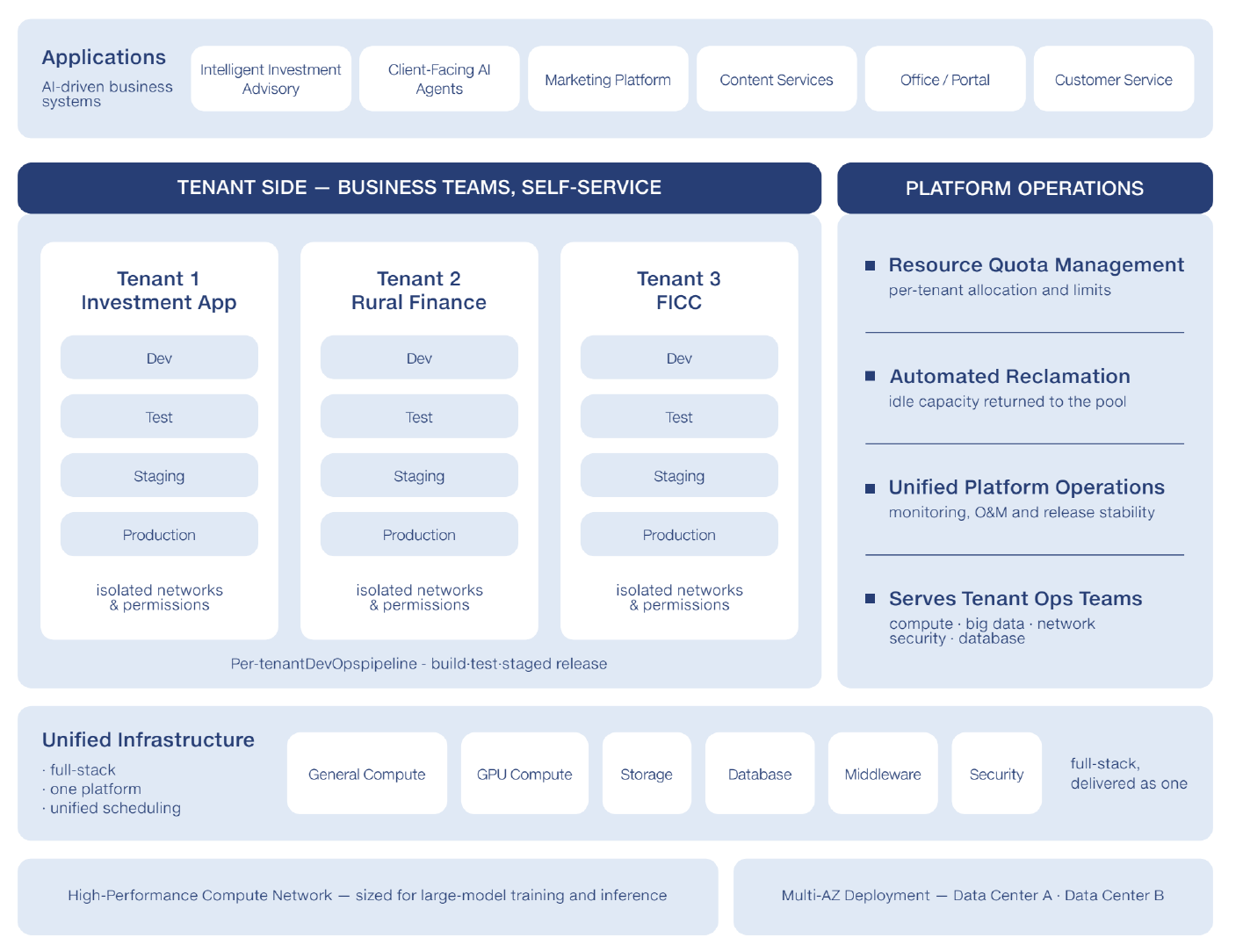
This comprehensive securities firm, known for its internet-driven business, has made intelligent investment advisory services and client-facing AI applications the focus of its next phase of business development. Organizations whose businesses center on AI applications share a common constraint: agents and the data they generate must remain in controlled environments. Existing virtualization and hyperconverged architectures struggle to support the dynamic scheduling and elastic scaling these workloads require.
The firm rebuilt its infrastructure with Tencent Cloud Enterprise, deploying compute, storage, databases, middleware, and security as an integrated full stack. General-purpose compute and GPU-based AI compute share a common architecture and scheduling system, while high-performance AI networking supports large language model training and inference. Clear operating boundaries between tenants and the platform allow business teams to obtain compute and services as needed. Both training and inference take place under the firm’s control. Agents, together with the data and capabilities they generate, remain within that controlled environment.
Case Study 2: A Multi-Campus Hospital — Consolidated Data and On-Premises AI
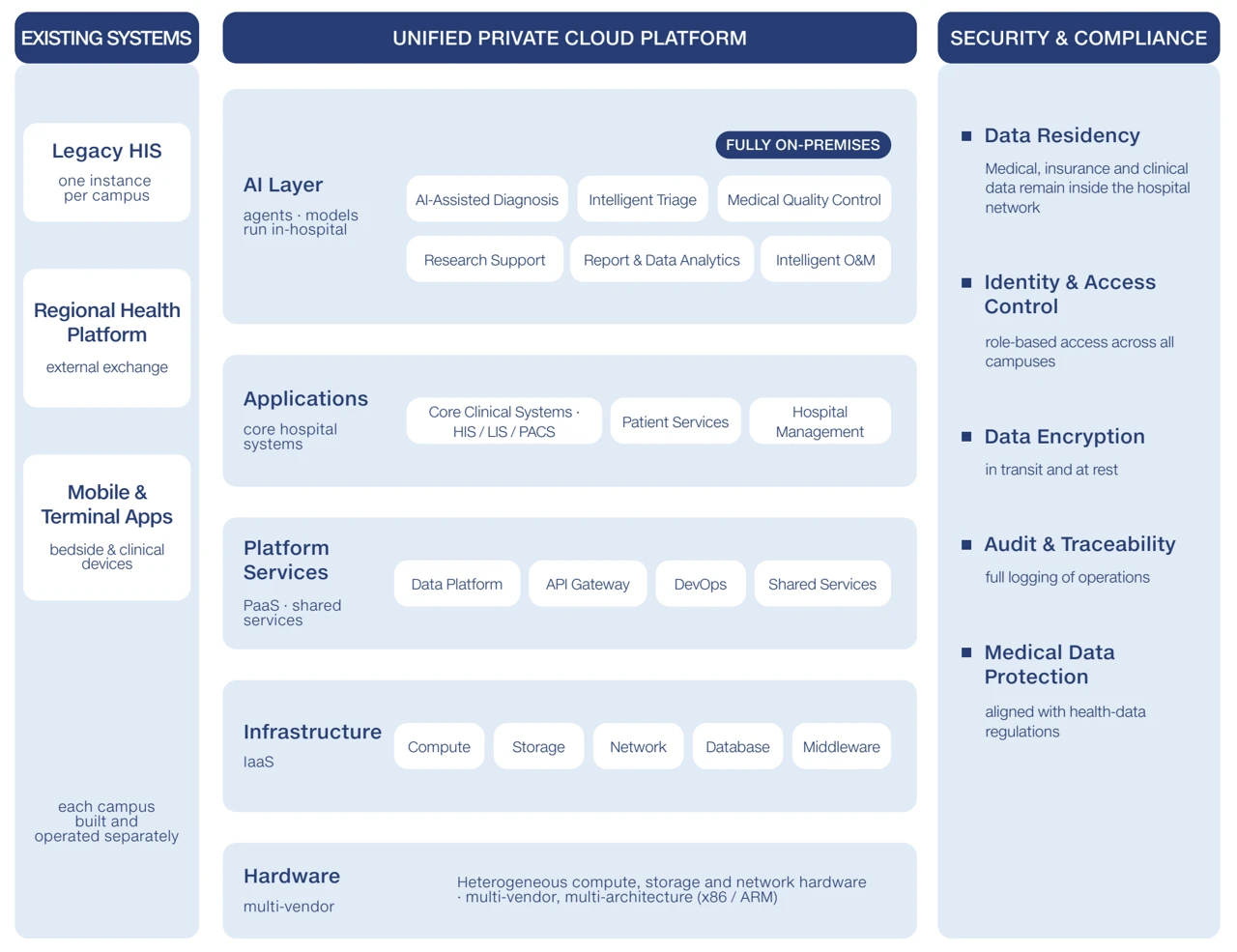
This general hospital operates as a group across multiple campuses. Years of independent development have created substantial data silos and operating costs. Medical records, insurance information, and clinical data must legally remain within the hospital, one of healthcare’s strictest constraints.
The hospital established a common foundation across its campuses with Tencent Cloud Enterprise. An integrated IaaS and PaaS full stack supports core systems, including HIS, LIS, and PACS. A single cloud spanning multiple chip architectures accommodates heterogeneous hardware and software choices. An AI agent platform runs above it, keeping office administration, research assistance, report analysis, and intelligent operations within the hospital. Infrastructure and data consolidation preceded AI applications.
After hospital-wide data consolidation, resource utilization improved by more than 50%, and capacity could scale elastically within minutes during peak patient demand. Healthcare workloads with the strongest data gravity and AI applications now share the same controlled, on-premises environment.
Case Study 3: A Central Urban District — Unified Scheduling of Existing Compute
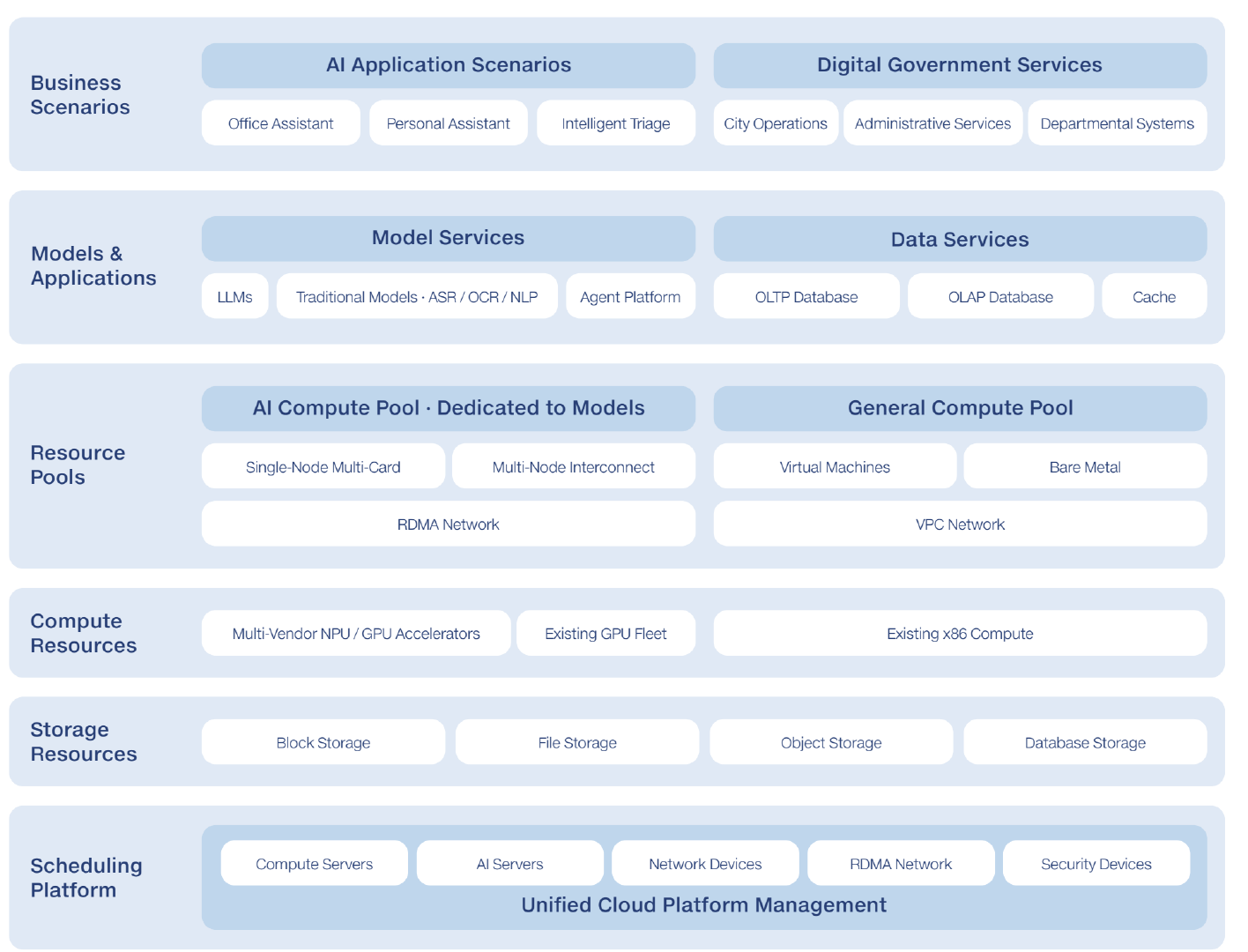
The district had already established an AI compute resource pool with over a hundred multi-vendor GPU cards, supporting dozens of routinely operated systems for public security, urban management, hotlines, and other departments. Allocation was the problem. Compute had been assigned permanently to model specifications during deployment. Capacity approached saturation during working hours and workloads queued, while much of it remained idle at night and on weekends. Further expansion would be uneconomical and difficult to justify in public spending reviews.
The district built an intelligent compute scheduling platform on Tencent Cloud Enterprise without adding any equipment. It classified business systems by importance, guaranteeing baseline throughput for critical services at all times and scheduling batch and offline jobs automatically at night and on weekends. A unified gateway routes requests intelligently according to model workloads. Compute allocations change with invocation volumes, while departmental quotas and time-of-use pricing encourage off-peak demand. Based on current invocation data, full deployment of scheduling is expected to release capacity equivalent to more than ten GPU cards without adding equipment. Continuous measurements from a unified observability dashboard will verify this result and form part of the acceptance criteria.
Case Study 4: A Mobile Operator — Local Data Residency and Local Operations
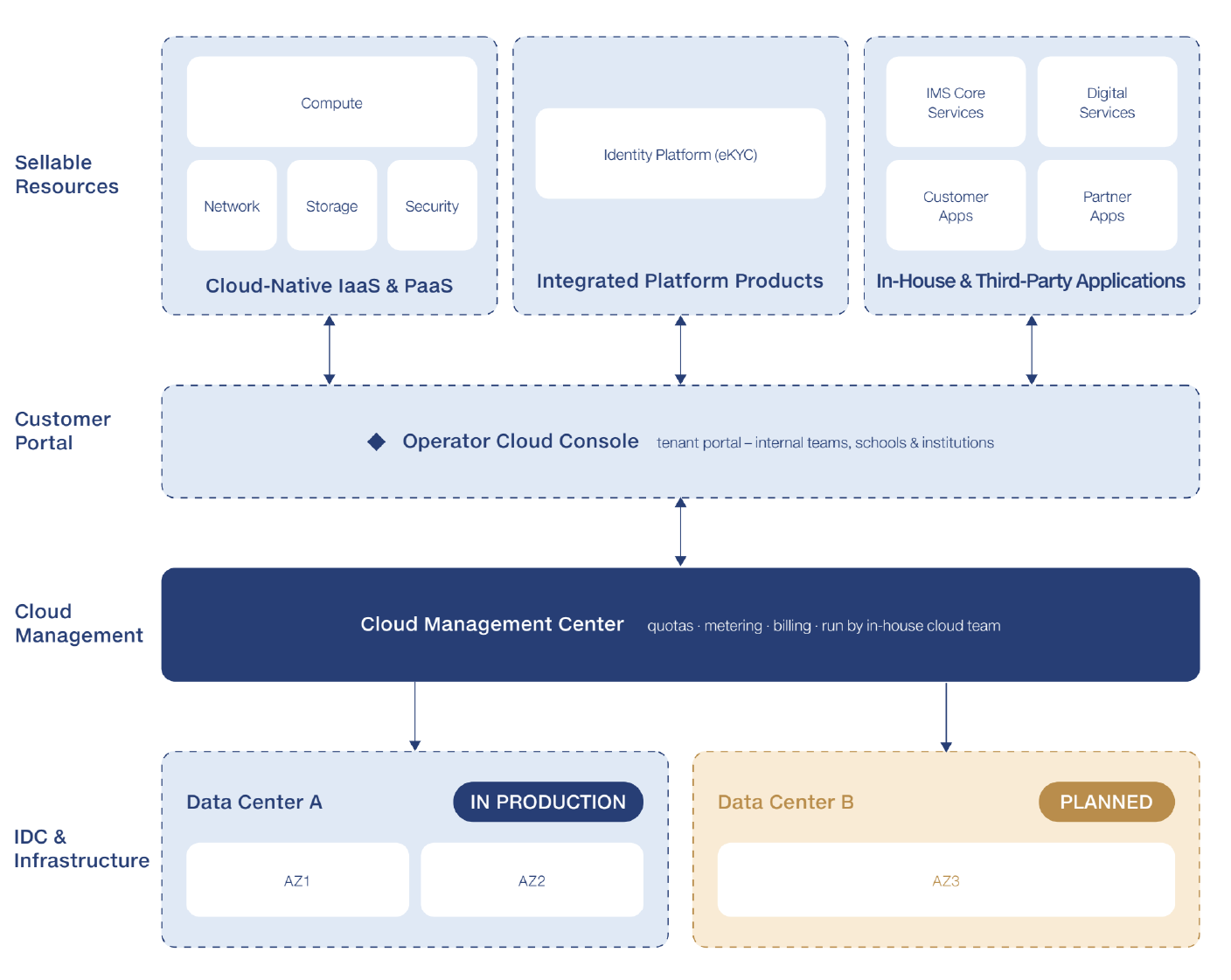
The operator serves more than 100 million users. Two drivers are clear: rising subscription costs for its existing virtualization platform and a legal requirement to store data such as biometric information locally. Platform replacement is therefore both a cost decision and a data sovereignty requirement.
The operator replaced its legacy commercial virtualization platform with Tencent Cloud Enterprise, establishing a private cloud and unified cloud management portal covering cloud servers, storage, private networks, and cloud security. Data remains local throughout. Replacement involved an architectural audit of existing business systems to determine individually whether to retain, rearchitect, or rebuild them before migration. The platform’s multitenancy and metering and billing support both internal workloads and cloud services for local schools and educational institutions. The operator also established its own cloud technology team, which is progressively taking responsibility for daily platform operations.
Conclusion
Evolving export controls and data sovereignty regulations have made access to critical AI capabilities a variable in business continuity. Highly regulated industries must determine the level and form of sovereignty they require: where workloads belong on the deployment spectrum and who controls models and compute.
A sovereign AI cloud allows enterprises to use AI capabilities while retaining independent control. Data, operational, and technological sovereignty are established at the cloud foundation and extend through model services and AI compute infrastructure across the full AI lifecycle. Deployment options allow flexibility in balancing capability depth and implementation cost. Provider-delivered sovereign cloud zones make this approach feasible alongside complete self-builds.
Sovereignty also creates long-term business value. Data accumulates in controlled environments, model development serves enterprise objectives, compute efficiency improves the enterprise’s cost structure, and business logic orchestration and governance remain under its control. Enterprises that hold these capabilities can develop AI into a lasting business asset. For organizations planning this transition, Tencent Cloud Enterprise provides a sovereign AI cloud foundation built on the same technology as the public cloud, able to develop with business needs, together with local implementation support across target markets. Sovereignty is a starting point for securing long-term AI returns through independent control.
References
1Business Drivers for GenAI Infrastructure Placement: On-Premises or Cloud?, Gartner, ID G00839908, Sushovan Mukhopadhyay & Chirag Dekate, 30 September 2025.
2Digital Sovereignty Is Needed for Future Technological Resilience and Business Outcome, Gartner, ID G00838383, Tsuneo Fujiwara et al., 2 February 2026.
3 Sovereign AI Is Breaking Your Operating Model. Here’s What to Do, Gartner, ID G00843821, Deepak Seth et al., 29 June 2026.
4 China Won’t Replace Western AI. It Will Reprice Enterprise Software., Gartner, ID G00830818, Alastair Woolcock, Evan Zeng & Arun Chandrasekaran, 21 August 2026.
About Tencent Cloud
Tencent Cloud, one of the world’s leading cloud companies, is committed to creating innovative solutions to resolve real-world issues and enabling digital transformation for smart industries. Through our extensive global infrastructure, Tencent Cloud provides businesses across the globe with stable and secure industry-leading cloud products and services, leveraging technological advancements such as cloud computing, Big Data analytics, AI, communication and network security. It is our constant mission to meet the needs of industries across the board, including the fields of gaming, media and entertainment, finance, healthcare, property, retail, tourism, and automotive.
Tencent Cloud’s infrastructure spans 24 regions, operates in 69 zones, and covers over 1 million global servers and 3200+ global acceleration nodes, aside from 400T global bandwidth reserve and 400+ authoritative certifications. Tencent Cloud develops comprehensive industry-specific solutions, fosters an open and collaborative cloud ecosystem, and empowers diverse sectors in their digital transformation journeys.
Copyright Statement
All the contents of this white paper are protected by copyright or other forms of proprietary rights. All rights, title and interest in the contents of this white paper are owned by or controlled by Tencent Cloud, unless otherwise expressly stated. If you reproduce, excerpt, or use any text or viewpoints of this white paper, you should indicate “source: Tencent Cloud ‘Building Sovereign AI Cloud Platforms: A Practical Guide’”. Except as permitted under this copyright statement, none of the contents of this white paper may be distributed, reproduced, republished or transmitted in any form or by any means without the written approval from Tencent Cloud. Those who violate the above statement will be held legally responsible.
Legal Disclaimer
This white paper is prepared by Tencent Cloud. The opinions expressed in this white paper are those of the authors. This white paper may not cover all grounds and is subject to change. While the authors endeavor to keep the information up to date and correct, the information is provided "AS IS", without warranty of any kind, express or implied, about the completeness, accuracy, reliability, suitability, or availability with respect to the information, products, services, or related graphics contained in the white paper for any purpose. This white paper has not been reviewed, approved or disapproved by regulatory authorities of any jurisdiction. Any reliance you place on such information in this white paper is therefore strictly at your own risk. YOU SHOULD CONSULT YOUR OWN TECHNICAL, LEGAL, FINANCIAL, TAX OR OTHER PROFESSIONAL ADVISOR(S) BEFORE ENGAGING IN ANY ACTIVITY IN CONNECTION WITH THE INFORMATION PROVIDED IN THE WHITE PAPER.
Source: Tencent