
The Road to a Net Zero Data Center
Climate change and sustainability are driving boardroom and shareholder conversations about corporate social responsibility. To contribute to their organizations’ environmental stewardship goals, I&O leaders must understand their role to play in reducing carbon emissions and water consumption.
Overview
Key Findings
- Sustainability-related materiality issues for data centers are energy consumption, greenhouse gas (GHG) emissions (Scopes 2 and 3), e-waste and water consumption.
- Use of a renewable energy supply is critical to a net zero data center, but it is not enough on its own. Achieving net zero will require addressing Scopes 1, 2 and 3 GHG emissions.
- Net zero cloud services are very attractive to many I&O leaders facing major investment in on-premises services. Be mindful not to conflate 100% renewable energy with being net zero.
- Data centers running on carbon-intensive electricity grids, with little provision for renewable energy, could become a stranded asset or will carry a financial liability if they are subject to carbon taxes or pricing.
Recommendations
To maintain and optimize existing data center infrastructure, I&O leaders must:
- Implement an emissions reduction and sustainability program across all three scopes within data centers by following the 7-point plan outlined in this research.
- Improve the I&O sustainability posture by moving more workloads to proven net zero public cloud services, where possible, or to service providers with a clear path to net zero targets.
- Reduce carbon emissions and water consumption with a net zero data center.
- Actively implement a radical energy efficiency and emissions reduction plan that falls in line with the enterprise net zero target or similar science-based targets.
Introduction
The focus on reducing greenhouse gas emissions and implementing resource sustainability has been accelerated following the global pandemic as governmental recovery plans are tying funding to sustainability goals. For I&O leaders, this means introducing a strategy to reduce their organization’s carbon footprint (greenhouse gas emissions), water consumption, resource utilization and e-waste management in data centers.
This mandate exists alongside pressure to cut costs and improve operational agility. The alternatives are either elderly, less efficient data centers or ones that cannot consume any form of renewable energy, thus becoming a liability for business should emission taxations be introduced. I&O leaders must continue to improve performance while also reducing carbon and water consumption. This research introduces the concept of the net zero data center and the proactive measures required from I&O leaders to achieve this goal.
Before I&O leaders can begin to invest efforts into a sustainability program, they need to understand the organization’s wider sustainability goals and initiatives. Often, investments into data center infrastructure to achieve a net zero target — which requires making step-change improvements in energy efficiency such as use of free air cooling or investing in on-site cleaner energy generation — will be unjustifiable. Building new or outsourcing to cloud or third parties may be a more attractive option, as long as the providers also have a defined net zero strategy with their delivery.
Emissions are broken down into three distinct scopes, the definitions of which can be found in Figure 1.
Figure 1: GHG Emissions Scopes
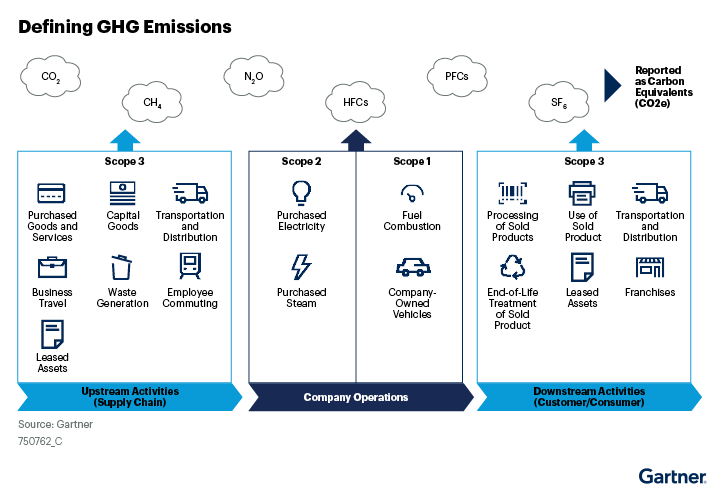
Scope 1 is typically less than 10% of total emissions for a data center. Scopes 2 and 3 are the most material issues for data centers. They will vary between data centers based on many factors; but, generally, as a rule-of-thumb will be roughly equivalent.
Data center operations that claim to be carbon neutral (or similar) are usually referring only to Scopes 1 and 2. To be net zero, according to the Science Based Targets initiative (SBTi), will require neutrality across all three scopes.
Net zero requires implementing good circular economy practices and use of neutralizing carbon offsets. Table 1 contextualizes the emission scopes for typical data center emission sources.
Table 1: The Emission Scopes for Typical Data Center Emission Sources
| Scope | Description |
|---|---|
1 |
Direct emissions from diesel generators or similar on-site generation capacity.
Some refrigerants. |
2 |
Emissions from grid electricity generation used for data center operation, including air conditioning and power distribution. |
3 |
Manufacturing and supply chain emissions associated with data center equipment and services (including cloud and colocation maintenance), as well as end-of-life disposal.
Packaging. |
Source: Gartner (June 2021)
Analysis
Implement a GHG Emissions Reduction and Sustainability Program for Data Centers by Following the 7-Point Plan
To build and operate a net zero data center operation requires combining multiple complementary practices. They will have a cumulatively balanced cost of operations and the GHG emissions reductions across all three categorized scopes of emissions. While all will be required, the mix will vary depending on location.
The 7-point plan:
- There are many factors involved in choosing a location for a data center, of which data residency is not the least. For net zero, it is imperative to locate data centers in areas with environmental conditions that aid carbon emission reduction by requiring less energy for cooling, allowing free cooling. Another option is to locate data centers where there is an abundant supply of economically priced low-carbon (such as nuclear) or renewable electricity.
- Not all renewable energy strategies are equivalent. They vary in their credibility. Develop a renewable energy strategy that aligns to the enterprise’s values and ambitions. That might include investing in net new capacity, power purchase agreements, procuring Renewable Energy Certificates, or making use of on-site generation technologies like CHP and fuel cells.
- Without impacting operational performance requirements, ensure high levels of utilization are a key performance goal.
- Use higher-efficiency cooling techniques such as hot aisle/cold aisle configuration, filtered free air cooling, Computational Fluid Dynamics analysis of airflow, high-density racks, liquid cooling technologies, and increased environmental temperature or groundwater/seawater heat exchanges. These techniques increase operational efficiency and reduce the data center’s carbon footprint and operating costs.
- While not central to a net zero goal, water consumption can be a material issue for a data center, particularly in areas of existing or growing water stress. Move water consumption for cooling systems from potable mains fed to grey water sources such as seawater, recycled water or rainwater collection systems.
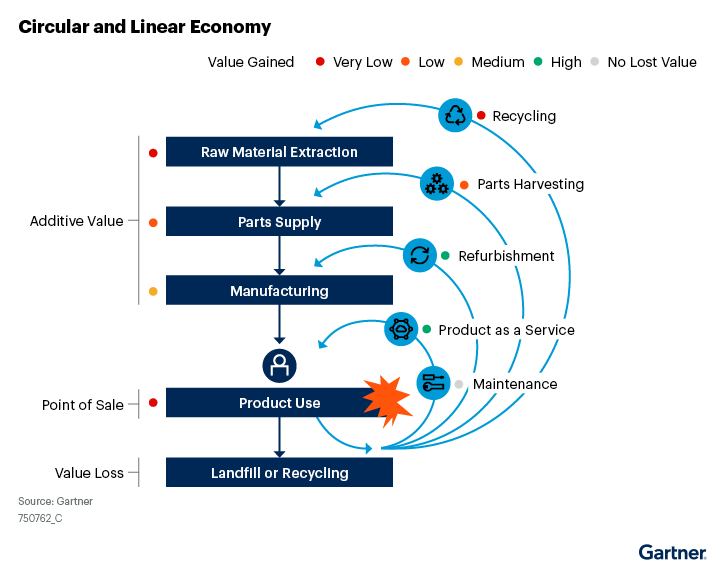
- To address Scope 3 emissions, implement a circular economy strategy and program (see Figure 2), ensuring materials recycling looks to extend the life assets, and includes parts harvesting, refurbishment, and recovery of valuable and environmentally sensitive materials.
- Invest in suitable GHG emissions offsetting programs. While this will initially involve both neutralizing and compensating offsets, it is likely a net zero data center will need to rely on neutralizing offsets.
Figure 2: Defining the Circular Economy
The Benefits of Moving Workloads to Greener Public Cloud Services
According to Gartner inquiries, public cloud providers can offer higher efficiencies in economies of scale and server virtualization against on-premises infrastructure. Cloud providers have a very strong financial incentive to develop energy efficient data centers — many run data centers with a world-class power usage effectiveness well below Scopes 1 and 2. Some are going further and addressing their Scopes 1 and 2 GHG emissions and looking at making operations carbon neutral.
Cloud services provide an opportunity for I&O leaders to consider migrating workloads to platforms that will provide ready-made sustainability advantages. Some cloud providers are including specific information on their sustainability initiatives and GHG emissions footprint. The Microsoft Azure Sustainability Calculator provides information on the carbon footprint, and the Google regional carbon emissions report and AWS’s environmental initiative portal give I&O leaders an understanding of how these hyperscalers are approaching their sustainability efforts.
Cloud migration should not be considered as a stand-alone method of addressing GHG emissions, but, rather, as part of a wider cloud strategy. Cloud providers should also be assessed for their net zero data center initiatives to the same 7-point plan.
Actively Implement a Radical Energy Efficiency and Emissions Reduction Plan Now
I&O leaders must consider their net zero data center project now, as data center migrations can take at least six to nine months, and cloud migrations can take significantly longer. Recent announcements from the U.S. administration, plus the ongoing initiatives from the EU, point to ambitious plans to address sustainability in their territories. These initiatives will potentially be adopted around the globe. The IMF has recently highlighted Canada’s Federal Carbon Pricing Law as being a model for other countries to follow. All these announcements point to further impetus to address sustainability at the C-suite level.
I&O managers in enterprises with a net zero target, or giving serious consideration to similar science-based targets, should actively implement a radical energy efficiency and emissions reduction plan.
In conclusion, I&O leaders should work with the organization’s overall sustainability goals to reduce GHG emissions and prepare for continued government-driven initiatives to enforce these changes.
Evidence
Definitions of Scopes 1, 2 and 3 emissions are available from the U.S. EPA.
Sustainability statements are available from each major infrastructure hyperscale provider as listed above.
Acronym Key and Glossary Terms
| Scopes 1, 2 and 3 emissions | Scope 1 emissions are those directly controlled by an organization during their processes, such as the generation of greenhouse gasses during the operation of a furnace or when generating electricity.Scope 2 emissions are GHGs that are generated indirectly by an organization during their processes such as energy consumption of IT equipment during the conduct of normal business activity.Scope 3 emissions are those GHG emissions that are not owned by the organization but are indirectly generated in the supply or value chain of the organization. |
