
Reducing Water Consumption
According to Gartner1, “water consumption can be a material issue for a data center, particularly in areas of existing or growing water stress.”
The use of water in data center cooling has been driven by the desire to increase thermal management energy efficiency by effectively expanding the number of hours the cooling system can operate in free-cooling mode. This approach sacrifices water consumption for energy efficiency and could prove unsustainable in water-scarce areas. The challenge, then, for thermal management design in those areas becomes not simply to maximize energy efficiency but optimizing both energy efficiency and water usage.
Chilled water free-cooling systems achieve a balance between water utilization and energy efficiency. Energy efficiency can be optimization through strategies such as increasing air and water temperatures, system-level control, and the addition of adiabatic technologies. A chilled water system also simplifies the implementation of energy-efficient liquid cooling to support high-density racks and can enable heat recovery to enhance building efficiency. These systems can use onboard controllers to enable the use of water strictly when needed based on redundancy, efficiency, or cooling demand, enabling water-efficient operation.
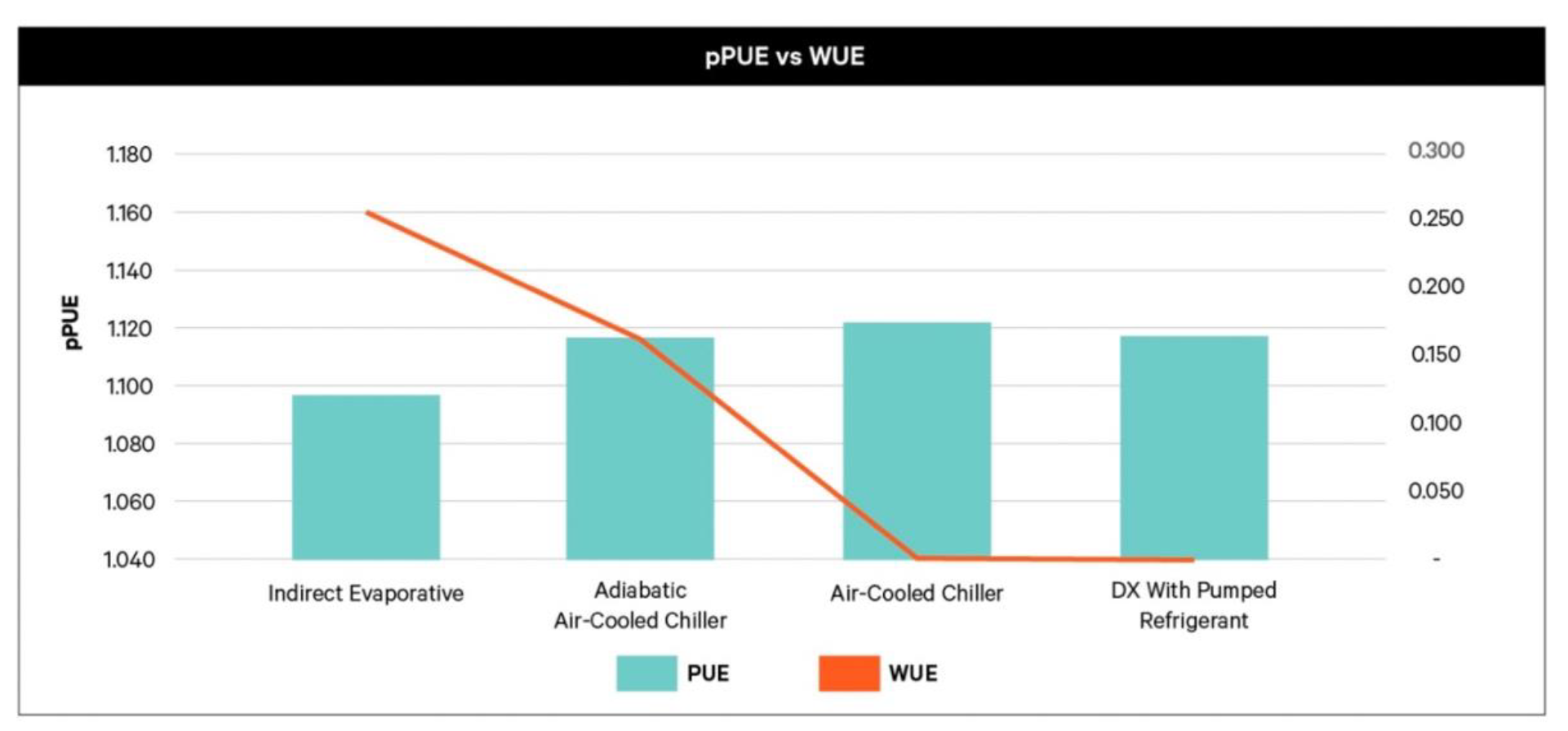
For areas where water is availability is limited, water-free direct expansion (DX) systems, such as the Vertiv™ Liebert® DSE free-cooling economization system, can be employed. DX systems come close to delivering the energy efficiency of indirect evaporative water systems while conserving the water used by those systems. In a direct comparison of the two systems, the DX system with pumped refrigerant delivered a partial power usage effectiveness (pPUE) of about .01 higher than the indirect evaporative system while reducing water usage effectiveness (WUE) from .25 for the indirect evaporative system to zero for the DX system with pumped refrigerant.
**Note: This is from a statistical comparison of data center cooling systems using a standardized data center model conducted by Vertiv.
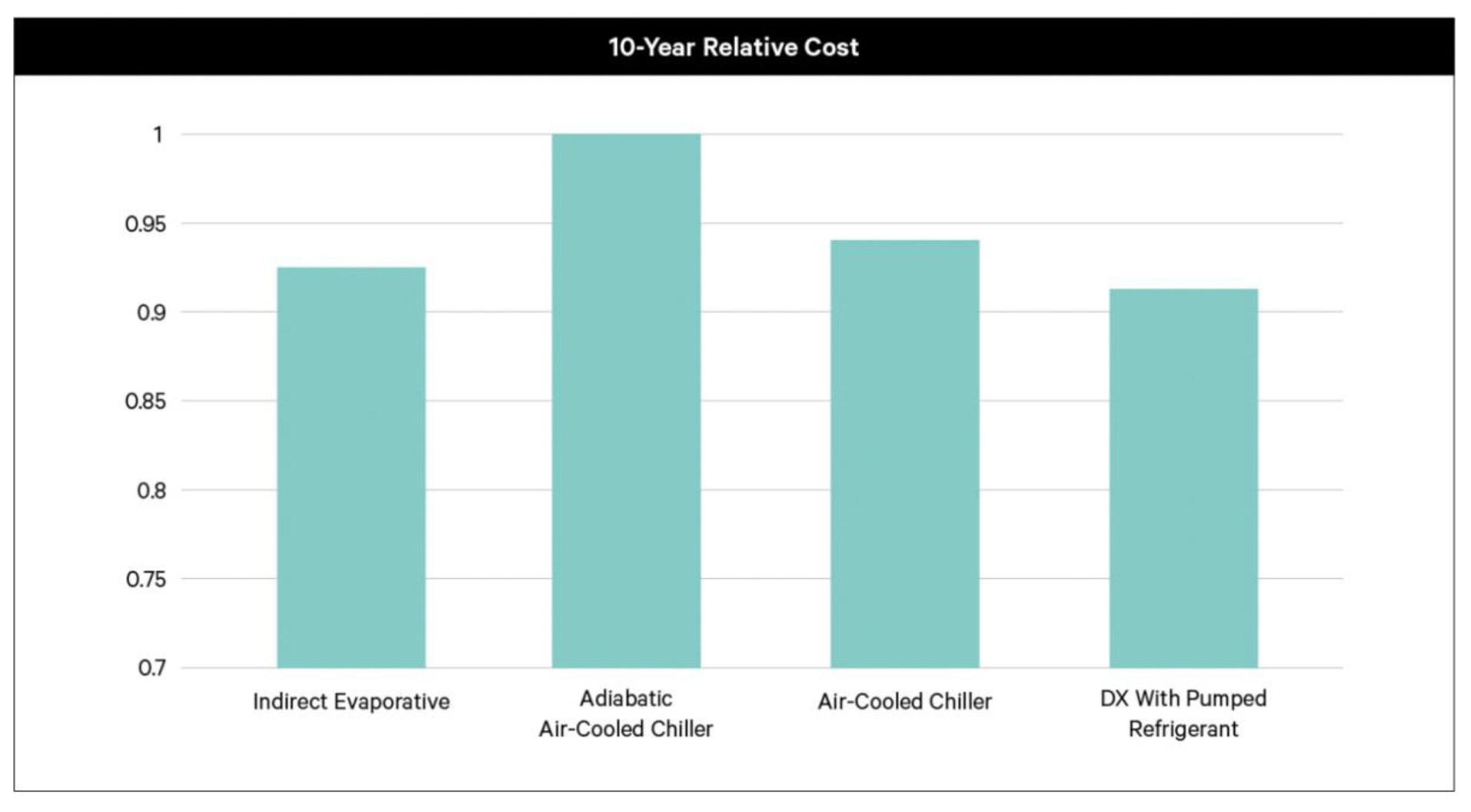
Solutions are available today from manufacturers, such as Vertiv, to help operators transition to water-efficient and water-free thermal technologies to enable energy efficient operation in areas where water availability is limited.
1 Gartner, The Road to a Net Zero Data Center, Tiny Haynes, Philip Dawson, Simon Mingay, 10 June 2021
Real-World Solution 1: Managing Higher Densities
Background:
Silicon Valley-based Colovore delivers a colocation data center environment designed to support next-generation high performance computing (HPC) for applications that include artificial intelligence, virtual reality, and big data. Colovore’s high-density solutions are ideal for these applications because they allow customers to deploy servers in a highly compact footprint that requires much less space and far fewer cabinets than traditional colocation facilities.
Critical Need:
The increase in power usage from HPC coupled with the high operating temperatures of high-density environments required Colovore to implement a robust thermal management solution that would enable compact server footprints that maximize power, cooling, and operating efficiency.
Solution:
Colovore chose the Vertiv™ Liebert® DCD rear-door heat exchangers to deliver efficient and effective high-density cooling. The Liebert DCD liquid cooling modules manage efficient heat removal of up to 35 kW per rack across the entire data center floor. This solution enabled fully packed, top-to-bottom rack deployments with no wasted or unusable rack unit slots and increased operating and capital efficiency due to significant reductions in required cabinets, data center floor space, and energy consumption. The high-density facility also relies on Vertiv UPS systems, power distribution units, and supplemental air- cooling systems.
Real-World Solution 2: Increasing Power System Efficiency
Background:
The University of Southampton, UK, enables its exceptional research and development capabilities and entrepreneurial culture with a forward- thinking IT team and a proactive approach to data center infrastructure. With computing demands continuing to increase, the university identified the need for a new data center that could achieve the dual goals of enabling HPC while ensuring environmental accountability.
Critical Need:
The challenge the university faced during the data center design process was enabling HPC alongside more repetitive processing tasks while optimizing efficiency across the various load profiles.
Solution:
The university chose the modular Vertiv™ Liebert® Trinergy Cube UPS system to meet its current needs for a high-efficiency power system while maintaining the flexibility to adapt to future requirements. The Liebert Trinergy Cube is the first high-power UPS with an adaptive algorithm that continually monitors the power supply and load and automatically selects the most efficient operating mode. With the new facility, the university reduced its data center energy requirements by 300 megawatt-hours per year and annual CO2 production by 160 tons compared to the previous, less efficient facility.
Contact Us:
Corporate Headquarters
1050 Dearborn Dr., Columbus, OH 43085, United States
Phone: +1 (614) 888-0246
Fax: +1 (614) 841-6882
Email: contact@VertivCo.com
