How to be a Great Marketer with AI
Leveraging AI in the Management of Digital Experiences
Research from Gartner
Applying AI to WCM and DXP – Key Use Cases
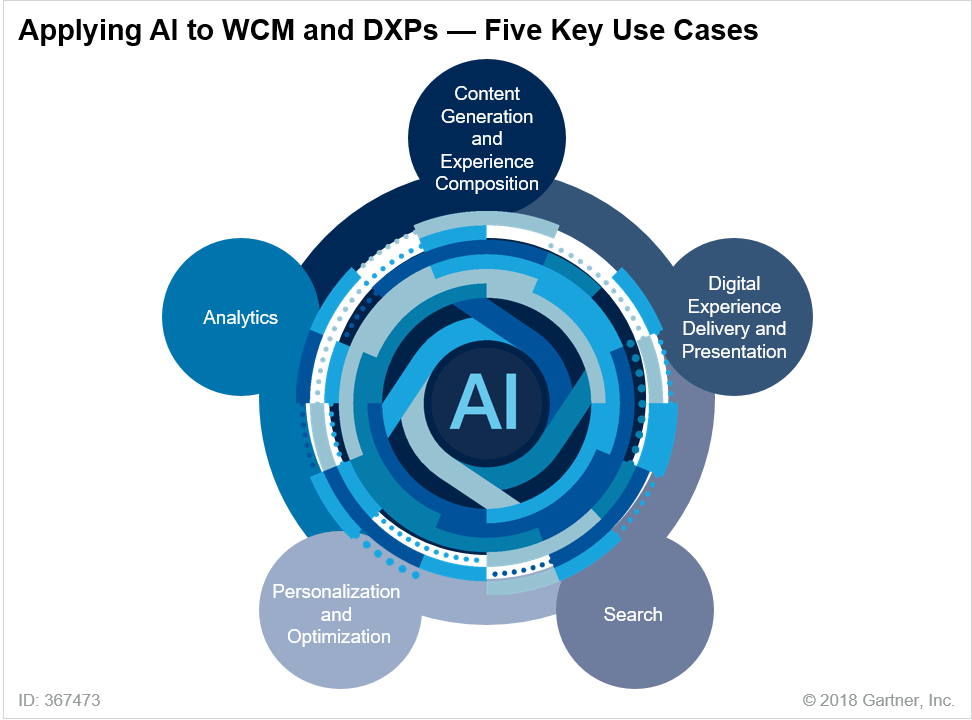
Application leaders in charge of web content management and digital experience platform programs often struggle with applying artificial intelligence for maximum benefit and best next digital experiences. The five key use cases below can provide practical business value.
Key Findings
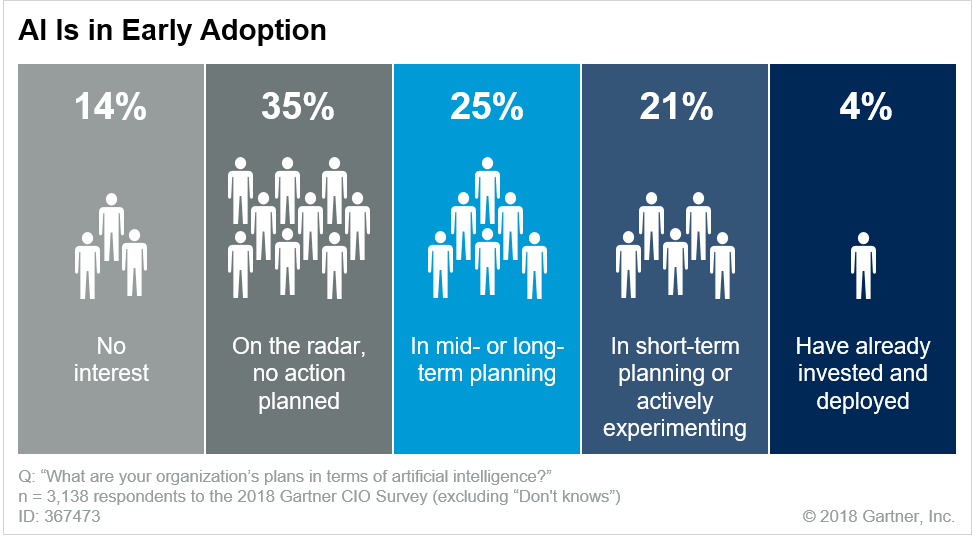
- While the majority of global organizations indicate high interest in using artificial intelligence (AI), only a very small fraction – approximately 4% – have deployed AI-driven projects.
- AI has the potential to revolutionize a wide variety of content-centric use cases, including those served by web content management (WCM) and digital experience platforms (DXPs).
- Applying AI effectively remains a challenge, whether using integrations with AI technologies/frameworks or through the capabilities built in as part of the platform.
Recommendations
Application leaders responsible for customer experience applications within WCM and DXP programs:
- Study the five use cases below and select those that are most likely to bring the highest benefits, shortest time to value and lowest barriers to adoption for your organization.
- Ensure AI-driven capabilities are small, focused and targeted, which will help you realize practical value from them.
- Focus new AI development on content-centric use cases with existing large amounts of data that cannot be easily analyzed by humans.
- Prioritize specific use cases based on differentiated customer experiences.
- Staff your AI-based initiatives appropriately with people with the required skill sets, including data engineers, linguists, data scientists and ergonomists.
Strategic Planning Assumptions
By 2020, more than 50% of CIOs will have artificial intelligence as one of their top five investment priorities.
By 2022, 50% of new digital business revenue streams will be discovered using machine-generated dynamic metadata.
Analysis
Artificial intelligence (AI) has a specific and powerful relevance to areas of digital experiences and customer experiences, particularly when coupled with web content management (WCM) software and digital experience platforms (DXPs). AI techniques can solve a wide array of business problems and generate significant returns on investment (ranging from about 20% to over 800%).1
However, applying AI effectively to WCM and DXP programs remains a challenge – whether integrating third-party AI technologies or using the increasing AI capabilities built into WCM and DXP technologies. Application leaders must differentiate between the subsets of AI technologies and apply AI to enhance programs aimed at driving better digital experiences.
Based on the data from Gartner client inquiries on the topics of WCM/DXP and AI in the last two years, less than 2% of clients have applied AI satisfactorily. Those that have are still in the very early stages.
At the same time, Gartner survey results highlight that AI is a top priority for CEOs, who are increasing investment in projects that improve the experience of customers interacting with their organization (see Figure 1 below and “Survey Analysis: Customer Experience Innovation 2017 – AI Now on the CX Map”).
In addition, Gartner’s 2018 CIO survey shows that, although 81% of respondents indicate that they either have AI on their radar or have initiated projects, only 4% have projects currently deployed.
Figure 1. Artificial Intelligence Is in Early Adoption
Source: Gartner (September 2018)
As both content and intelligence are primary components of customer experience, the impact of AI on WCM and DXP is substantial. AI is becoming widely used to enhance the customer experience and it is poised to bring such benefits as:
However, as we'll discuss, a DXP is not necessarily – and, in some use cases, is not likely to be – a single offering from a single vendor. Many customers are better served by assembling their own DXP based on best-of-breed components.
- Productivity gains due to automated processes
- Efficiency gains due to better decision making
- The ability to analyze large sets of data
- More effective and engaging customer experiences based on better insights and data
- New revenue
- Innovation and differentiation
- Cost reduction
In this research, we highlight five most common use cases for applying AI to content operations in the realm of WCM and DXPs.
Figure 2. The Five Key Use Cases for AI as Applied to WCM and DXPs
AI = artificial intelligence; DXP = digital experience platform; WCM = web content management
Source: Gartner (September 2018)
1. Content Generation and Experience Composition
Content creation and experience composition remains one of the most time-consuming tasks in typical WCM and DXP day-to-day operations. Augmented with AI capabilities – especially those of machine learning (ML), natural language processing (NLP) and natural language generation (NLG) – this process can be carried out much faster to then yield content and experiences that are more efficient, relevant and engaging.
Most organizations have large amounts of content and data, often scattered across multiple content management systems and repositories. A lot of that content is hard to find, and thus present to the customer, due to poor mechanisms for stitching the content together across disparate systems.
The API-first approach can be helpful for integrating multiple content technologies in order to source and manage content in a centralized manner, minimizing the number of silos. Most importantly, AI can play a crucial role in identifying and automatically sourcing the right content from the right source. Furthermore, automated content creation can be guided by AI, too, where suggestions for relevant content can be gained through discovery and analysis across multiple systems.
As modern digital experiences require multiple types of content and greater content velocity, AI’s role in the automation of content processing is becoming most widely applicable and driving tangible business results, such as speed to market. Moreover, digital experiences are shifting away from text-led to voice, video and immersive augmented-, virtual- and mixed-reality experiences.
Content automation and content creation services driven by AI can make for highly effective solutions that span multiple areas. These include:
- Content autoclassification and metadata management/content tagging
- Content protection and compliance
- Video and audio transcription
- Content translation
- Content sourcing and discovery across multiple repositories
- NLG of new content based on data
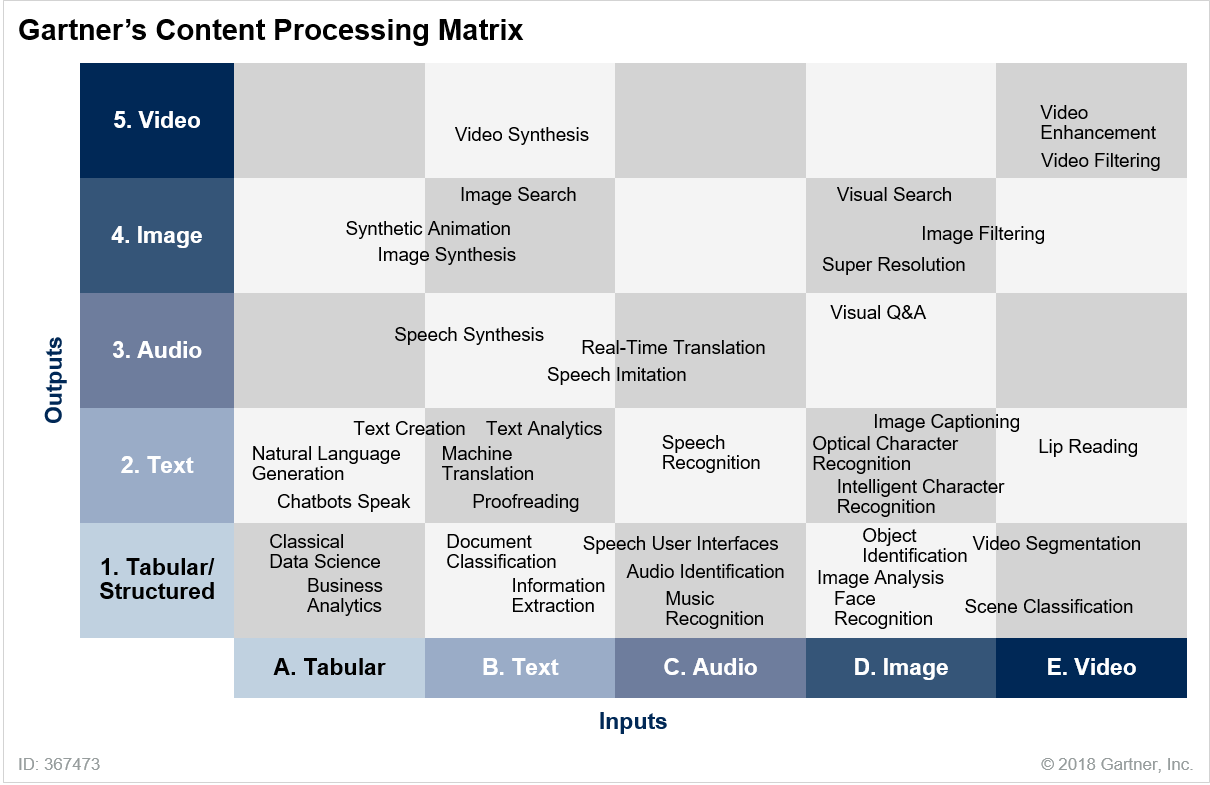
But this landscape can expand very quickly depending on your requirements and the types of content you use in digital experiences. In Figure 3, we present a content processing matrix, where the horizontal and vertical axes describe the most prominent input and output types, respectively.
Figure 3. Gartner’s Content Processing Matrix
Source: Gartner (September 2018)
Effective content generation and experience composition relies heavily on the underlying metadata of the various types of content in the above matrix. Taxonomy and metadata management is a task that is typically expensive, error prone and time consuming. AI’s capabilities, however, can drastically reduce human involvement and cost, as well as improve accuracy of tagging and metadata. Advanced text analytics and NLP tools can do this job at a low-enough cost and with enough accuracy to make using them a wise move.
Gartner sees approximately 60% to 80% accuracy in “out of the box” use of autoclassification technologies for automatic creation of taxonomies. But this number should improve with minimal human intervention and continuous feeding and training of AI technologies.
2. Digital Experience Delivery and Presentation
Emerging digital experience channels such as augmented reality/virtual reality (AR/VR), mixed reality, immersive experiences, IoT devices and conversational interfaces require content presentation in a format specific to them (see “Is Conversational AI the Only UX You Will Ever Need?”). Further, the content must be presented specific to the person interacting with it. This demand goes beyond what traditional website- and mobile-driven templates can accomplish.
Experience design and presentation also draw on the atomic content, the granularity of which allows for the extraction of a piece of content and the dynamic creation of a presentation appropriate for a specific channel. And this is where traditional templating and rule-based presentation is being overtaken by machine-learning-based presentation.
Presentation of content and experiences can be optimized according to a number of variables, such as:
- Profile identifiers
- Usage patterns
- Psychographics
- Sentiment
- Geolocation and proximity
Design and presentation based on new and improved data coming from machine learning is another way to optimize your experience delivery. AI’s underlying benefit is that the machine models continue to iterate, learn and improve with more data and feedback over time, thus making better recommendations of what type of dynamic templating or presentation vehicle will yield the most user satisfaction and business value.
AI can also help in the granularity and atomization of content – which, in essence, is the next evolution of content reuse – to make it more granular and consumable across various channels. The result can be an automated delivery of one content variant (short-form text only) versus the other (long-form with video), based on various factors that include delivery channel, customer segment, and time of day.
As organizations face an increasing demand for providing content and experiences that are non-text, AI’s ability to transform textual content into other formats of presentation and delivery such as voice narration and speech (especially in conversational interfaces), video and animations (and vice versa) becomes important. One of the greatest benefits is automation of the process here, where human narrators and recording studios with their respective costs are no longer necessary.
3. Search
Whether for internal or external use cases, search is a fundamental capability of a content-centric technology. Search capability can come either organically or through an integration in the context of DXPs.
Search engines index content so that it can be queried to deliver information. The use of AI has changed the way content is indexed (extracted and represented), queried (capturing customers’ intent and matching it to data in the index) and displayed (presented as information through various touchpoints).
Search and insight engines apply AI – specifically NLP/NLG, graph technology and machine learning – in the following ways:
- Indexing:
- Extracting content from rich media (e.g., speech to text, sentiment, image recognition) using machine learning
- Classifying and labeling content using machine learning
- Representing and interrelating content and its labels in a “normalized” form using graph-based indexes
- Query:
- Parsing natural language using NLP
- Capturing multiple implicit parameters from users and profiling them using machine learning
- Mapping user nomenclature to the nomenclature within content using NLP and machine learning
- Tuning relevance using the application of machine learning to usage and other analytical data
- Indirectly relating queries to content in the index using associations
- Display:
- Returning information in the form of natural language using NLG
- Selecting and adapting content to fit the touchpoint using machine learning
- Converting text into speech using machine learning
- Presenting search recommendations
- Allowing for predictive and/or visual search
- Allowing for personalized search
4. Personalization and Optimization
Personalization is primed for rebirth in the era of AI. Your typical rule-based personalization can be significantly enhanced by machine learning techniques. Such techniques provide deeper, more individualized levels of understanding of your customers and their needs.
Much of the AI devoted to personalization is, for now, still reliant on humans developing specific targeting rules for specific segments; but full automation is not far away. Much of the current basic personalization is geared toward providing suggestions and recommendations. To do that, algorithms are applied to sets of data that contain information about similar entities.
But AI can bring much more to the table. AI has a role in each stage of a personalization process. To fulfill the definition of AI, in the sense that it learns and continually improves, personalization must cover the entire life cycle of digital experiences across all channels. Continual learning and improvement are needed in many areas, including:
- Customer behavior
- In-context intent
- Location and proximity via use of sensors and beacons
- Experience targeting
- Customer segmentation
- Testing and optimization
- Microtargeting
Examples of how AI is already available to deliver personalized digital experiences today include:
- Using A/B and multivariate testing with segment detection to suggest personalization rules and predict the potential impact of content and design changes
- Analysis and optimization of user journeys and the information architecture that supports them
- Using machine learning to improve relevance and autotargeting based on automated insights
- Automated customer profiles that draw from data across multiple systems to get to the 360-degree view profile
- Optimal marketing touch sequence based on data mining, modeling and probabilistic visitor behavior
- Automated creation of content variants for testing and targeting to specific segments based on NLP
5. Analytics
Analytics is at the core of more relevant digital experiences through data, insight and understanding.
Traditionally, in the contexts of WCM and DXP, organizations have long been reliant on descriptive and diagnostic analytics. Later on, predictive analytics emerged as the next wave of improving the application of data analysis to content operations and digital experiences. With AI, predictive analytics, as well as prescriptive analytics, can be vastly improved to address more complex use cases.
AI-driven analytics is necessary for any type of organization that deals with large, diverse and complex content repositories that can contain both structured and unstructured content. AI can aid in mining unstructured content for customer insight, competitive intelligence and sentiment or opinion, thus driving business value. Applying AI to the increasing amount of data available from all the channels and touchpoints of customer interactions is crucial for improvement of digital experiences.
With prescriptive analytics, organizations can get AI to prescribe a preferred course of action to meet a predefined objective. For example, through a combination of predictive analytics and rules, you could set up a certain response when a specific point in the customer journey will be reached. The prescribed course of action here could be to serve up a specific type of content to turn a person in the browsing mode into a buyer. Prescriptive analytics differs from descriptive, diagnostic and predictive analytics in that the output is a recommended (and sometimes automated) action.
Augmented analytics is a next-generation data and analytics paradigm that uses machine learning to automate data preparation, insight discovery and insight sharing (see “Augmented Analytics Is the Future of Data and Analytics”). Augmented analytics uses machine learning automation to augment human intelligence and contextual awareness across the entire data and analytics workflow – from data to insight, to action, to impact the entire data management, analytics and BI, and data science and machine learning analytics workflow. Augmented analytics will be crucial for delivering unbiased decisions and impartial contextual awareness. It will transform how users interact with data, and how they consume and act on insights.
Augmented analytics accelerates the time it takes to get accurate insights and augments human analysis by using machine learning algorithms to automate data preparation, insight discovery and insight sharing for a broad range of use cases in content management and digital experiences. Organizations should explore and apply augmented analytics, whether that be via a content author trying to compose an experience, or a data scientist focusing on a specialized targeting model.
Organizations should also not stop at the analytics use cases they can imagine, but rather recognize the importance of advanced analytics for uncovering new patterns and business opportunities.
Recommendations
As applicable to all the use cases above, application leaders should consider the following recommendations before diving into implementation:
- Ensure that initial applications of AI products are small, focused and targeted.
- Focus new AI development on content-centric automations that shorten time to value.
- Prioritize based on differentiated customer experiences.
- Target use cases with existing large amounts of data that cannot be easily analyzed by humans.
- Staff your AI-based initiatives appropriately with the required skill sets, such as offered by data engineers, linguists, data scientists and ergonomists.
Source: Gartner Research Note G00367473, Irina Guseva, Mick MacComascaigh, 10 September 2018
Evidence
1 According to the 2017 Gartner Annual Enterprise Survey – Artificial Intelligence, 36% of AI projects are IT-led (the most common response). This points to the fact that AI techniques are still considered more from a technology perspective than for their potential business value. The survey research was conducted online from November 2017 through December 2017 among 1,990 respondents in organizations with more than 20 employees located in the United States, the U.K., France, Brazil, China and India. Of those, 890 respondents qualified to answer questions in the AI section. To qualify, respondents were required to be from an organization that was investing in AI (with no description/limitations on investment), at least in the planning stage, or personally involved in decisions involving implementation, planning/budgeting, evaluating vendors, or setting strategy. The results of this study are representative of the respondent base and not necessarily the market as a whole. The survey was developed collaboratively by a team of Gartner analysts and was reviewed, tested and administered by Gartner's Research Data and Analytics team.
2 The Gartner 2018 CIO Survey was conducted online from 20 April through 26 June 2017 among Gartner Executive Program members and other CIOs. Qualified respondents were the most senior IT leaders (CIOs) for their overall organization or a part of their organization (a business unit or region, for example). The total sample was 3,160, with representation from all geographies and industry sectors (public and private). The survey was developed collaboratively by a team of Gartner analysts and was reviewed, tested and administered by Gartner’s Research Data and Analytics team. Although 86% of respondents (n = 3,138) indicated that they either have AI on their radar or have initiated projects, only 4% had projects currently deployed. Moreover, when asked how confident they were in terms of their understanding of AI, only 11% rated themselves as competent or very competent (n = 2,798).
Additional research came from Gartner inquiry.